



Abstract
Given the historical nature of the Obama presidency, this paper qualitatively examines whether black men and women believe the Obamas can change low marriage rates among blacks in America. By using a marital–political–cultural change framework as our foundation, this exploratory study examined the written responses of 17 blacks between the ages of 23 and 61 years to two questions. (1) “Do you believe that President Barack Obama and Michelle Obama have the ability to change low marriage rates among blacks in the United States?” (2) “In what ways can President Barack Obama and Michelle Obama change low marriage rates among blacks in the United States?” Qualitative analyses of the data resulted in four delineated themes: (1) the inability of the Obamas to change the importance of marriage; (2) the inability of the Obamas to change marital motivations and stability; (3) the ability of the Obamas to change low marriage rates among blacks through positive interactions; and (4) the ability of the Obamas to change low marriage rates among blacks as a positive model for marriage. Supporting qualitative data are presented in connection with each theme. Policy implications for black marriage are also discussed.
Keywords
Since the day Barack Hussein Obama was elected the 44th president of the United States, the world has been well aware of the historical importance of this event. According to Adam Nagourney (2008), of the New York Times, “The election of Mr Obama amounted to a national catharsis—a repudiation of a historically unpopular Republican president and his economic and foreign policies, and an embrace of Mr Obama’s call for a change in the direction and the tone of the country.” In addition to his new role as President of the United States, that night, the eyes of the world were also on Michelle Obama, their new First Lady. As the couple walked hand in hand, waving enthusiastically to the cheering crowd before them, one wondered if the nation’s first black president and first lady had the power to positively change low rates of marriage among blacks in America. This article explores the possible impact that the Obamas may have on the institution of African American marriage on a small pilot sample. As “race remains a principal determinant of social organization” (Wilkinson, 1995: 168) and was “a major undercurrent of the campaign” of President Obama (King, 2011: 67), in this study race is based on the shared history, ways of speaking, and psychological identity related to “Blackness” (Tatterstall, 2004). By introducing the marital–political–cultural change framework, as a model for the impact of an African American marital–political figure on perceptions, changes in attitudes and behaviors, media coverage, and historical context, the figure has some capability of influencing people about marriage possibilities. Thus, our framework extends theoretical approaches that examine inequality in the number of marriages of black women to black men (gender imbalance theory) (Taylor et al., 1997) or the inability of black males to adequately support a family (economic constraints theory) (Hill, 2005) by specifically exploring how blacks perceive the marriage of Mr. and Mrs. Obama, as well as how these perceptions influence their marital choices. Modeling is an important tool in the development of self-understanding, sensibilities, family and overall life organization. As social scientists have pinpointed the vitality of models and mentors in developmental theory (Indurkhya, 2006; Pahl and Way, 2006), the assertion is made that the role of marriage in the personal and professional life of the Obamas may warrant more attention. Furthermore, this article examines data collected from research participants that answered qualitatively to items relevant to President and First Lady Obama’s marriage and their own personal ideas and choices about marriage. “Media coverage of Barack and Michelle’s relationship is important to study because of its potential effects on perceptions of Black love in America” (Chikowore, 2009: 6).
In addition to churches and faith-based organizations (Wilcox, 2007), the media may also be informative about positive and progressive models of successful and devoted African American marriages. The African American Healthy Marriage Initiative (AAHMI), a component of the Administration for Children and Families’ (ACF [http://www.acf.hhs.gov/initiatives-priorities]) National Healthy Marriage Initiative (NHMI), “specifically promotes a culturally competent strategy for fostering healthy marriage and responsible fatherhood, improving child well-being and strengthening families within the African American Community” (http://www.aahmi.net), yet very little is known about the likelihood that this couple will change declining marriage rates among blacks in America. By using a marital–political–cultural change framework to examine perceptions regarding the ability of the Obamas to cause an increase in the number and stability of black marriages and stronger communities, the authors attempt to discover whether there is a tangible correlation between this high-profile marriage and the marital choices that African Americans may make. The authors developed this framework as a model that seeks to explain how political and social change in the USA may also influence ideas and attitudes about marriage that exemplifies strength, fortitude, partnership and empowerment among African Americans. The framework posits that three variables, marriage, politics, and culture, create a synergy that impacts on how marriage is interpreted, and that making marriage a life priority is equal to educational and career choices. This theory explains a phenomenon where media models positively impact the number of marriages.
Marital–political–cultural change framework
Given this study’s focus on whether the marital model provided by President Obama and First Lady Michelle Obama may inform black attitudes regarding marriage, this study will be situated within a marital–political–cultural change framework. Unlike other black celebrity power couples in 20th-century America, such as Bill and Camille Cosby, political couples have unique influences in international African communities, such as President Nelson Mandela and his second and third wives Winnie and Graca Michel, and Dr. Martin Luther King and his wife Mrs. Coretta Scott King. The meaning and pressure of political involvement by these couples, which result in transformative societal change while prioritizing marriage as foundational of family and community life, is important in African and African American culture. Based on the fields of anthropology and cultural ecology, this framework acknowledges the politicized status of marriage and that cultural change is consciously and unconsciously informed by the marital and political climate in which individuals reside. The former field explains the development of cultural change while the latter explores “the ways in which culture change is induced by adaptation to environment” (Steward, 1955: 5). At the core of this framework is the recognition that marriage simultaneously influences individual, dyadic, political, and social frames of reference regarding self and others. Although this paper does not examine the meaning that lesbian, gay, bisexual, and transgender individuals assign to same-sex marital unions (Lannutti, 2005), this ongoing debate aptly illustrates that marriage is a political event that is directly linked to the political and social climate that facilitates greater acceptance toward homosexuality (Lottes and Kuriloff, 1994), and ultimately social change. Essentially, President and First Lady Obama’s presence in the media necessitates that men and women, both individually and collectively, form an opinion about this couple’s politics and their marriage, which may in turn influence what they think about this couple and the ways in which they pattern their romantic lives after this highly visible and recognizable model. In other words, the Obamas have the capacity to actively influence how black men and women perceive them, as well as the extent to which marriage fits into their psychological and behavioral paradigms.
In addition, as models of a healthy black marriage, the Obamas may further goals of United States federal initiatives, most notably the AAHMI (http://www.acf.hhs.gov/healthymarriage/aa_hmi/AAHMI.html), which specifically encourages the stabilization of healthy black romantic partnerships, for the betterment of the couple, their children, and their communities. The AAHMI is encouraged to continue its observation and intervention of television images, which show entertainment, athletic, and political figures that depict reality and stereotypes. It has been documented that television is maintained as the medium which would reverse the misinformation surrounding blacks (Cummings, 1988). In the section that follows, we highlight scholarship related to societal changes in the structure of families in the United States and abroad, black marriage patterns, the influence of the media on marital relationships, and then present the marital–political–cultural change framework on which this study is based.
Review of literature
Societal changes among marriages
In the United States and abroad, marriage and the structure of family have seen dramatic changes over the past five decades. In contrast to previous decades, when marriage was the primary site for childrearing, recent statistics reveal that one in four children (25.8%) in the United States is being reared in a single-parent home compared with an average of 14.9% in other countries such as the UK, New Zealand, Greece, Spain, Italy, and Luxembourg (Daily Mail Reporter, 2011). Although several factors have been posited, scholars have given special attention to the cultural acceptance of single-parent childrearing and the rejection of marriage as a prerequisite to parenthood (Chaney and Marsh, 2009; Chaney and Monroe, 2011; Hill, 2005; Taylor et al., 1997). Although society has generally seen an increase in the number of children from all races being reared in single-parent families, this trend is more pronounced among blacks. When compared with whites (62%) and Hispanics (60%), blacks are less likely to marry (41%) (U.S. Census Bureau, 2010) and more likely to divorce or end their relationship upon initial cohabitation to become a single-parent (AAHMI, 2011; Chaney, 2012; Dixon, 2009; Hill, 2005; Taylor et al., 1997; Tucker and Mitchell-Kernan, 1995; Tucker and Taylor, 1989). Given the increased policy attention that has been given to decreasing single-parenthood and increasing marriage among blacks in the United States (AAHMI, 2011), it is important to examine the possible influence the public marriage of President Barack Obama and his wife Michelle is having on the marital attitudes of blacks in the United States.
Black marriage patterns
Marriage is one of the core values of society. Almost 20 years ago, the well-renowned black scholar and psychologist Dr. Na’im Akbar (1991) penned the following: “marriage is such an important lesson in manhood (womanhood) development. It is no wonder that every society requires some form of it” (p. 13). Given the societal significance of marriage, the last several decades have seen a general decline in marriage, and this trend is particularly prominent among blacks and whites. In her study of the dynamics of single-parent, poor black women, Jarrett (1994) discovered that, for the majority of these women, marriage is an unattainable goal—essentially a “white girl’s dream”. In addition, when compared with men of other racial and ethnic groups, black men are less likely to marry a woman with whom they are cohabiting (Oppenheimer, 2003; Smock and Manning, 2004). Although low incomes and economic marginality do not prevent the formation and establishment of black families, they do, however, decrease the likelihood that these couples will enter into marriage (Chaney and Marsh, 2009). Interestingly, when there is economic prosperity among blacks (for example, a high availability of jobs), black men are more likely to marry and start a family, and the chances of their marriage lasting increase dramatically (Billingsley, 1968; Demo et al., 2000; Fossett and Kiecolt, 1993; Mason, 1996; McAdoo, 1997). Interestingly, certain factors increase the likelihood that a black couple will have a strong marriage.
The marital–political–cultural change framework emanates from observations of how the media covers the American president. Media coverage of President and First Lady Barack and Michelle Obama has historical implications with regards to portrayals of African Americans, not only as influencing politics but influencing negative and stereotypical images of African American couples (Chikowore, 2009). While there is an enormous amount of literature regarding racial stereotypes in the media (Baker, 1996; Margolis, 1999; Pickering, 2008; Ramasubramanian, 2011; Ward, 2004), this article’s literature review purposefully sought out studies that revealed marital models that emphasized political and cultural change in the media. Our emphasis on political and cultural marital models is a far cry from the Amos and Andy Show, which aired between 1951 and 1953 and highlighted the marriage of the strong yet stereotypical working-class couple, Amos and Sapphire. Although Amos was a solid family man and independent businessman in the radio show of the 1940s, the television series zeroed in on the shiftless and irresponsible Kingfish (Lipsitz, 1986: 372). The NAACP (National Association for the Advancement of Colored People) understood the power of media images and fought against such images on this show. Although Clair and Cliff Huxtable’s marriage on The Cosby Show, a sitcom that aired in the 1980s, did not have overt political overtones, it definitely demonstrated that progressive, culturally affirming families exist when educated parents head and rear them. “The show also managed to appeal to couples by portraying Cliff and Claire Cosby’s romantic relationship as the centerpiece of the show” (Chikowore, 2009: 7).
The European-centered context has produced stereotypical fragile male/female relationships, and does not include critical values of relationships such as sacrifice, inspiration, vision, and victory (Kambon, 1998), by which the marital–political–cultural change framework provides an alternative lens for observing marital phenomena. History shows us that the quest for marriage and family by Africans who were enslaved was not quelled by oppressive social policy, and that one of the first political and liberating acts of freedom after 1863 was to get married (Dixon, 2007). Therefore, this framework adds a lens to how politics and culture undermines and/or influences African American marriages.
In an earlier examination of the marital happiness of black husbands and wives, Ball (1990) found the presence of minor children at home was significantly related to parents’ marital happiness, with husbands happiest in their marriages when they were rearing preschool or teenage children, and wives happiest with few children, no minor children, or preschool children. Years earlier, Billingsley (1992) identified seven traditional black family values. According to this renowned black scholar, love of learning, a strong work orientation, politics, service to others, cooperation (e.g., working with others toward economic, political, and social goals), racial pride, and economic independence were key ingredients in strong black families. In the most recent study on the characteristics of strong black marriages, Hopkins-Williams (2007) found faith in God, spousal commitment, and communication to be the cornerstones of strong black marriages. Clearly, as Billingsley (1992) points out, politics can increase the likelihood of strong black families, and marriages. This study looked at how political and cultural images are depicted in the media, and how these depictions influence the perceptions of a small group of black men and women.
The media and marital relationships
The media influence different aspects of family life, and over the past several decades key volumes have explored their impact on families (Douglas, 2003; Fiske, 1987; Cashmore, 1994; Gurevitch et al., 1982; MacBeth, 1996; Perse, 2001; Robinson, 1982; Yadav, 2004). In particular, scholars have explored the relationship between the effects of media on social change (Meyrowitz, 1985), political success (Squires, 1994), and public opinion and voting patterns (Perse, 2001). In subsequent paragraphs, we highlight the work of previous scholars that have identified unique nuances between television and various aspects of family life.
In the book Media Events: The Live Broadcasting of History, Daniel Dayan and Elizu Katz (1992) advance from the onset that “history is process, not events” (p. vii) and the pivotal role of live broadcasters is shaping the “event” into one that is related to either “ceremonial politics” or “parliamentary politics.” Their assessment of the interdependence between television, the viewer, the commentator, and the event was expressed in these words: Television not only confers roles upon principals and viewers, but serves as simultaneous commentator and subtitler of the event. The more remote the viewer from the event—physically and psychologically—the more the broadcasters help to “bring home” its meaning and enliven that meaning with interest and relevance (p. 38).
The assessment provided by Dayan and Katz (1992) reminds us of three realities. For one, the “principal” and “viewer” share a dynamic relationship by which the actions and behaviors of both influence and are influenced by the other. Simply, the principal is aware of how the viewer perceives him while the viewer forms an opinion and/or opinions regarding the object of media attention and interest. Also, the media allows viewers to remain connected to the principal and the event by constant commentary and detailed description of processes as they occur. Through this organic process, heightened interest in the subject, his life, perspectives, and capacity for modeling, are heightened. Finally, broadcasters are skilled at bridging the physical and psychological gap between the principal, the event, and the viewers by animatedly presenting the information and reinforcing its cultural, social, and historical relevance. Therefore, regardless of whether they are aware of it, the media constantly reminded the viewer of the contemporary and historical significance of Obama’s presidency, as well as the new marital–political model that stood before them as potential conduits for cultural change as the President and First Lady Obama took their distinguished place in history.
Other scholars have explored whether individuals’ personal views of marriage would influence their evaluations of televised couples’ marital satisfaction. By relying on social–cognitive theory and interpersonal frameworks, Perse et al. (1994) proposed that the marital views of 358 college students would influence their perceptions of television couples’ marital satisfaction. The results of their study revealed that college students with traditional views of marriage tended to perceive the marriages of televised married couples as more satisfying than did students with less traditional views. Essentially, this study suggests that the marital schema provided to individuals has a direct effect on how they perceive the marital models seen on television.
Several years later, Berry (1999) examined the possible effects of televised representations of black family life upon young viewers. Essentially, his thesis rested on three premises: (1) that televised images of black families are complex and multifaceted, which make it difficult to determine the effects of these images on viewers; (2) that the heterogeneous nature of black families (e.g., social, psychological, and physical attributes) is formed by their unique experiences and realities; and (3) that television can be a beneficial and productive medium for viewers. In support of this, other scholars have found a negative relationship between minority media images and self-perception (Fujioka, 2005). Although contradictory, the findings of Berry (1999) and Fujioka (2005) reveal that the unique heterogeneous experiences of the viewer influence his or her perceptions of the object as well the extent to which he or she will model his or her behavior after the example provided by the object.
Given the increased divorce rate in the United States over the past several decades (Wolfers, 2006), other scholars have examined the effects of televised images of married couples on marital expectations. To determine whether a relationship existed between these real and fictional realities, Segrin and Nabi (2002) conducted a study in which 285 never-married university students completed a survey that examined the relationships between television viewing, holding idealistic expectations about marriage, and intentions to marry. Although overall television viewing had a negative association upon idealistic marriage expectations, interestingly viewing of romantic genre programming (e.g., romantic comedies, soap operas) was positively associated with idealistic expectations about marriage. Furthermore, the findings of this study also revealed a strong and positive association between these expectations and marital intentions among this subset of Americans, as these authors concluded that the media play a role in developing and reinforcing beliefs about marriage (Segrin and Nabi, 2002). Interestingly, Brown and Pardun (2004) found little cultural variability in the television shows frequently viewed by blacks and whites, and that exposure to positive images on television can positively alter perceptions (Ortiz and Harwood, 2007).
This body of scholarship reveals four important areas that are relevant to our current discussion. For one, the media were instrumental in presenting the marital–political model that was heralded to the world during the historically significant inauguration of President Obama and First Lady Obama (Dayan and Katz, 1992). Also, personal views regarding marriage directly influence how individuals perceive the marital satisfaction of televised couples (Perse et al., 1994). In addition, as the experiences of African Americans are not static, it is possible for members of this group to have different perspectives regarding the same media images (Berry, 1999; Fujuika, 2005; Segrin and Nabi, 2002). Furthermore, as positive images on television can positively alter perceptions (Ortiz and Harwood, 2007), it is possible for perceptions to gradually alter marital expectations and views regarding black love and marital commitment. Ultimately, the aforementioned studies provide compelling evidence that the media supports individual, dyadic, and cultural shifts regarding attitudes and behaviors associated with several aspects of family life.
Marital–political–cultural change framework
At this point, we would like to discuss the framework on which this study is based. The marital–political–cultural change framework is rooted in the fields of history, politics, psychology, sociology, African American studies, and media communication. The outer assumption of this framework recognizes that the historical climate in which individuals reside spurs political change. In the wake of what many considered to be a disastrous two-term Bush Administration, many Americans expressed the need for change (Harlow, 2009). Although Shirley Chisholm and the Reverend Jesse Jackson ran for President of the United States decades before Obama (Finkenbine, 2009), the U.S. zeitgeist was clearly not in their favor. Simply put, during the time that Chisholm and Jackson ran for the presidency (Finkenbine, 2009), the USA was not psychologically ready for a black president. Interestingly, by questioning many of the choices made by the previous administration, Barack Obama became the personification of the change that many Americans were seeking. Although he may not have been aware of it during the early stages of his presidential campaign, the change that Obama promised signified that the USA was finally ready to elect a black president.
The second assumption of this framework is the married political figure that holds a distinct place in history. Although high-profile political couples have existed (e.g., the late John Fitzgerald and Jacqueline Kennedy, Bill and Hillary Clinton, George and Barbara Bush), the aforementioned past presidents and their wives are white, and have been historically more represented in the political arena. Clearly, Barack and Michelle Obama are different. Upon his election, the Obamas became a team that the world would watch because the decisions of President Obama would have direct implications for the lives of them and their families. Furthermore, in contrast to successful black married couples whose exposure is limited to public entertainment venues (e.g., concerts, music videos, interviews), the Obamas would enjoy a significantly higher level of exposure because their perspectives incite supportive and contradictory political ideology. The third assumption of this framework assumes that media coverage of a highly visible black political couple has the power to motivate changes in attitudes and behaviors toward marriage. Although the printed page has some effect on the political process, it has been found that visual imagery is a key component in the political debate process (Jaeho, 2009). Additionally, by allowing the masses to see them within various contexts, the media allows viewers to better understand the daily complexities in the lives of the marital–political figure, and, by default, humanizes them. As a result, this increases the likelihood that viewers can more closely identify with this couple, and be encouraged to model their behavior on that of the marital-political figure. The fourth assumption of this framework recognizes that individuals influence and are influenced by the environment in which they live. Given the retreat from marriage among a significant number of African Americans (Edin and Reed, 2005), organizations such as the African American Healthy Marriage Initiative (AAHMI) (http://www.acf.hhs.gov/healthymarriage/aa_hmi/AAHMI.html) were established to reverse this sociological trend and stabilize black families.
Last, and most important, is the power of the media to directly shape how we perceive the marital–political figure. Clearly, media coverage occurs during political events in which the president and his wife are both photographed (Thompson, 2009), as well as during public interview forums in which they discuss their love, commitment, and support for one another and their family. A case in point is that CBS received 25.1 million viewers when presidential candidate Barack Obama and his wife Michelle were featured on 60 Minutes. Interestingly, this was the station’s largest number of viewers since January 1999 (Gary, n.d.). Essentially, the marital–political–cultural change framework is a worldview that allows individuals to understand how previous conditions (history) shape current (political) ideology, the ways that individuals are encouraged to model their behavior after the marital–political figure (psychology), the entities that influence and are influenced by marital efforts (African American culture studies, sociology), and the power of the media to shape contemporary attitudes regarding the marital–political figure (the Obamas), as well as marriage for themselves, more broadly (a graphic representation of this framework can be found in Figure 1). Of note is that other scholars have documented in the media that editorials and opinion pieces suggest that many Americans favor a shift in perceptions of First Lady Michelle Obama (Porter and Parks, 2011: 121).
The marital-political-cultural change framework.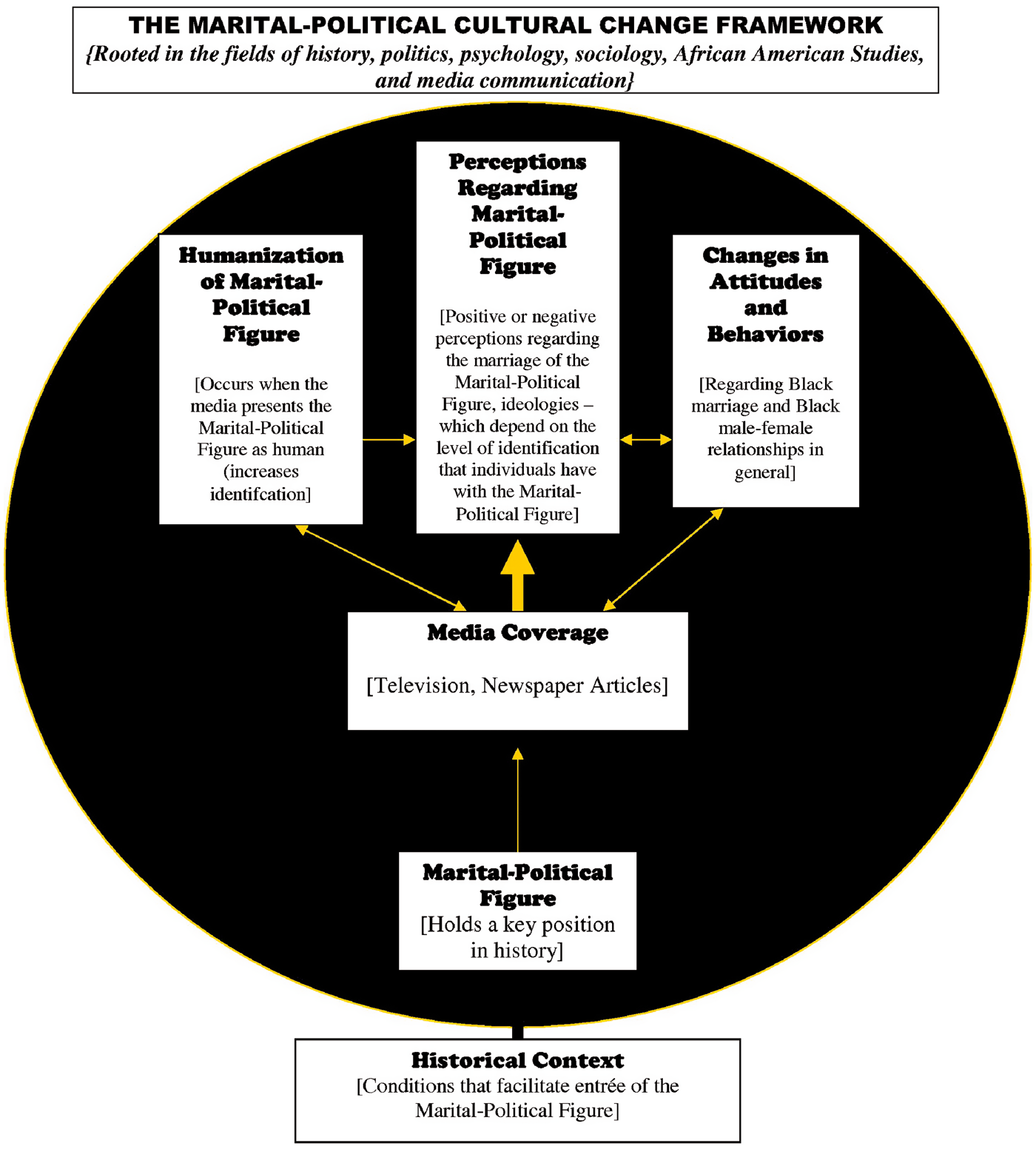
Significance of the current study
The marital–political–cultural change framework that we propose is particularly relevant to the goals of this study, and, at this point, we would like to discuss the significance of this framework to President and First Lady Obama. First and foremost, this framework is based on African Americans’ desire to marry. Although members of this group are less likely to marry than whites and Hispanics (Taylor et al., 1997; U.S. Census Bureau, 2010), the highly visible relationship of President and First Lady Obama is proof that a black couple can successfully make and create history, and create a lasting, mutually supportive, and happy marriage. In other words, the highly visible marriage of the Obamas can give African Americans a template by which to pattern their own marital and professional success. Second, as marriage is a social and political event, entered into as a result of individual (micro-) and societal (macro-)level forces, President and First Lady Obama’s presence in the media provides a highly visible model of black love and motivates individuals to form an opinion regarding this couple’s politics and their marriage, which may in turn influence their thoughts and actions in respect to their own lives. Third, the marital model provided by President and First Lady Obama is unique because it beautifully represents the cultural ethos of “moving on up” as opposed to the stories of high-profile couples who are wealthy, because they were “discovered” in the music, professional sports, fashion, or acting field. Although one might assert that Barack and Michelle’s Harvard Law School graduate status signaled that they were “up” and had already made it in the world, we believe Barack and Michelle’s ascendance as President and First Lady of the United States signaled a new rise in political power and status, one never before experienced by an African American man or woman in America. Fourth, the “cultural change” perspective that we advance recognizes that attitudinal and/or behavioral change in individuals, groups, and societies is a gradual, conscious, and unconscious process. For us, “cultural change” in African Americans’ attitudes regarding the Obamas and their marriage is more likely to occur when this couple is seen together, with their family, or when they share the specific ways that they have supported or continue to support one another. Clearly, President and First Lady Obama are highly successful and accomplished individuals; however, as a team they are a political powerhouse of intelligence, articulation, focus, love, support, respect, admiration, and marital stability that may increase the number and stability of African American marriages over time.
Design
This small, pilot qualitative study seeks to examine whether blacks believe the Obamas can change the declining rates of marriage among blacks in America. Given the historical nature of the current administration, no studies to date have connected the marriage of a particular political figure, in this case President Obama, with the likelihood of increased marital entry and stability among blacks. This study extends Chikowore’s (2009) study in that it elicits the perspectives of African American men and women in an age group that generally has the most interest in romantic involvement and the financial resources to marry (Taylor et al., 1997). Past research has revealed black politics to be separated by identity, class, and gender lines (Dawson, 1994), yet given the current administration, and its goal to strengthen marriage and families, it is critical to introduce marriage into the political discussion through understanding the effects of a strong political marriage on the rates of black marriage in America. As an extension of Dawson’s (1994) earlier work, and Chikowore’s (2009) more recent work, this study will determine how black men and women from different age groups feel about the possible effects of the Obama marriage on the rates of black marriage in America.
This study is based on two questions. (1) Do blacks believe that President Barack Obama and Michelle Obama have the ability to change the declining rates of black marriage in the United States? (2) In what ways can President Barack Obama and Michelle Obama change the rates of black marriage in the United States? There are two major limitations with the aforementioned research. For one, given the current administration and goals of this study, no studies to date have bridged the marriage and political literature in a qualitative way. The aforementioned studies have generally relied on demographic and quantitative data (Bobo and Gilliam, 1990; Edlund and Pende, 2002; Ifill, 2009; Profiles of Black Mayors in America, 1977; Jones, 1978; McAdams, 1989; McAdoo, 1997; Street, 2009; Taylor et al., 1997; Tucker and Mitchell-Kernan, 1995; Tucker and Taylor, 1989), which does not fully extrapolate the hows and whys of human attitudes, which are essential to this particular method of discovery. Second, with few exceptions (Ball, 1990; Chikowore, 2009; Jarrett, 1994; Hopkins-Williams, 2007), much of the scholarship on black marriages has been done not from a strengths perspective (focusing on marital and family resilience), but rather a deficit perspective (focusing on marital and family pathology), and no studies to date have systematically examined how a particular political figure can influence marriage. This study will fill this gap in the research by qualitatively analyzing black men and women’s written narratives regarding the ability of the Obamas to change the rates of black marriage in America.
Our proposed marital–political–cultural change framework informed this inquiry in two ways. First, although the majority of African Americans hoped to one day marry (Tucker & Mitchell-Kernan, 1995; U.S. Census Bureau, 2010), we did not assume that the respondents in this study would provide the same or similar responses regarding the effects of the Obama marriage on their current marital situation, or that of African Americans, more broadly. Given the unique experiences of African Americans (Berry, 1999; Fujuika, 2005; Segrin and Nabi, 2002), we were particularly sensitive to this reality and solicited the views of a diverse subset of African American men and women from various ages, socioeconomic statuses, and geographical locations. Second, when analyzing the data, we were aware of the effects of the Obama interactions with one another on perceptions of black love, and black pride. Although some studies have highlighted the factors that underlie black men’s decision to date and marry non-black women (Craig-Henderson, 2006), this framework allowed us to determine whether the Obama marriage was bigger than the Obamas. Simply, this framework allowed us to examine the various ways in which African Americans and others are motivated by the highly visible, marital and political model provided by President and First Lady Obama.
Methodology
Sample
This exploratory study comprised 17 black male and female participants. Because we were interested in obtaining diverse perspectives, an opportunistic sample was implemented. In particular, individuals from different age groups, levels of education, relationship and parental statuses, and religious affiliations were selected. The participants were recruited through a mass electronic announcement, and were advised that we were interested in whether they believed President Obama and his wife Michelle could change the rates of black marriage. The first author sent a mass electronic announcement regarding the goals of the study to a diverse group of African American women and men. Only African American women and men received an invitation to participate in the study. While 20 individuals were invited to participate in the study, 17 individuals actually responded to the invitation and participated in the study. Although the total number of participants is small, an 85% acceptance rate is rather high, and thus allowed us to answer the questions that guided the study. In addition, the participants had the option of sending their responses to the first author by email or regular mail. After completing the necessary consent and demographic forms, participants were asked to read the Washington Times article “The Good Obama Can Do” by the nationally syndicated columnist Mona Charen (2008) (http://washingtontimes.com/news/2008/dec/18/the-good-obama-can-do/), share their level of agreement or disagreement with the article, and provide a written rationale for their response on an open-ended survey. Participants responded to the following: The author is optimistic that Barack and Michelle Obama can positively influence the rates of marriage in the African American community. (a) Do you agree or disagree with the author’s view? Please provide a rationale for your response. (b) If so, exactly how can Barack and Michelle Obama accomplish this? Please provide a rationale for your response.
This piece was selected because the authors were interested in the level of agreement that African American men and women have with the view expounded in the Washington Times (which has a conservative, right-wing political orientation) and Mona Charen (2008), a nationally known, conservative journalist, author, and columnist. The identity of all participants is protected through pseudonyms. No monetary compensation was provided to the participants. This methodology was chosen because it was a time-efficient way for the first author to solicit the perspectives of several black men and women, and allowed anyone who chose to participate to privately pen their opinions, values, and experiences regarding the questions of interest.
Demographic characteristics of participants (N = 17).
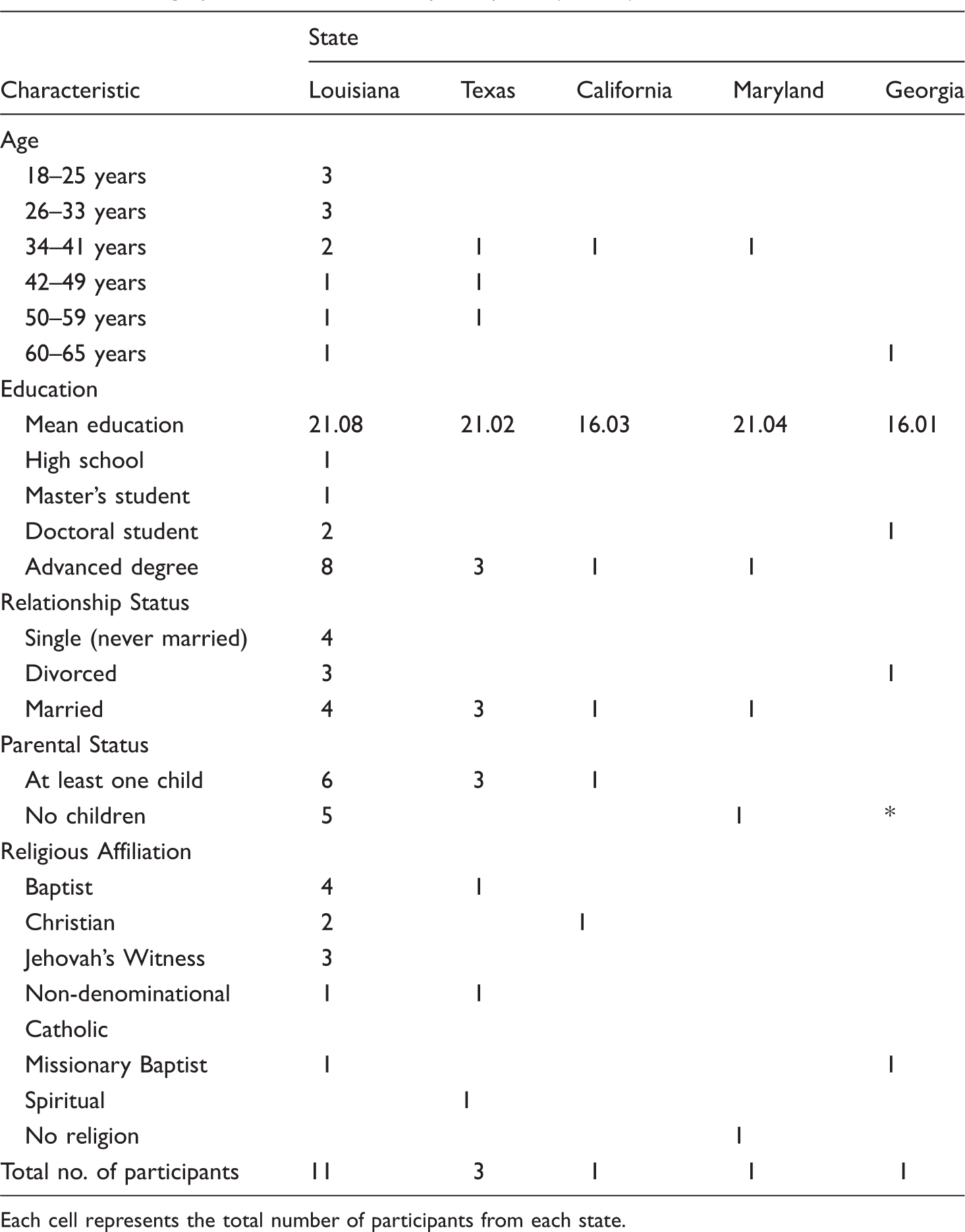
Each cell represents the total number of participants from each state.
Annual Income as Reported by Participants (N = 17).

Each cell represents the total number of participants from each state.
Research design
To identify the themes that emerged from the written interviews, all narrative responses were content-analyzed using grounded theory and an open-coding process (Holsti, 1969; Strauss and Corbin, 1990; Taylor and Bogdan, 1998), and themes were identified from the narratives. In order to clearly abstract themes from the written responses, words and phrases were the units of analysis. Specifically, coding involved examining all responses, keeping track of emerging themes, assigning words and symbols to each coding category, and examining how the themes presented are specifically related to the ability or inability of the Obamas to change black marriage. To control for the “length and stylistic complexity” of written and verbal responses, raters only coded for the “presence or absence of endorsement” of particular categories (Mattis, 2000).
To assess the reliability of the coding system, a list of all codes and their definitions along with the written responses was given to two outsiders, who then coded the transcripts based on this predetermined list of codes. The outside coder was selected on account of having extensive experience with coding and analyzing narrative data. This strategy allowed for a qualitative version of inter-rater reliability in that only core themes/concepts that (a) were identified by both coders, (b) occurred in the majority of the participants’ interviews, and (c) were salient are included in this paper. After a 96% coding reliability rate was established between the researcher and the outside coder, it was determined that a working coding system had been established. In order to sufficiently control for reliability, a second outside coder was selected to code and analyze the narrative data after the initial coding reliability had been established.
Results
Although three participants (18%) did not support, or had reservations about, the author’s optimism, 14 (82%) participants believed the Obamas can positively change the declining marriages rates among blacks. The four primary themes that emerged from the written narratives were related to (1) the inability of the Obamas to change the importance of marriage; (2) the inability of the Obamas to change marital motivations and stability; (3) the ability of the Obamas to change black marriage rates through positive interactions; and (4) the ability of the Obamas to change black marriage rates as a positive model for marriage. The subsequent paragraphs will highlight narratives that supported these four primary themes.
Lack of support for Chikowore’s findings
In contrast to Chikowore’s (2009) study, not all of the participants in this study were optimistic about the ability of the Obamas to effect marital change. Some of the men and women in the aforementioned study believed that individuals must always be aware that the Obama marriage is not perfect and that this couple may sometimes experience conflict in their marriage behind closed doors. Three participants in our study did not believe that the Obamas could change the rates of black marriage. One participant wondered whether the importance of marriage could be changed by the high visibility of the Obamas. Interestingly, the perspectives of these individuals were related to the lack of positive marital models, the desire for individuals to make a living, to have happier marriages, or to be single again. Thomas, a 38-year-old professor who has been married for two years, and is the father of two children (ages 14 years and 17 months), described his feelings in this way: “I disagree. I do not believe that something as significant as marriage can be influenced by simply seeing one couple.”
Other participants wondered if concerns about the economy would minimize the importance of marriage, for some. Nancy, a 61-year-old divorced, retired postal worker, and mother of three children (ages 42, 40 and 38 years), reiterated this view when she penned the following: “With some, but only a few. People are too concerned about making ends meet.”
The inability of the Obamas to change marital motivations and stability
In support of Thomas and Nancy’s views, another participant was skeptical regarding the ability of this couple to change the rates of black marriage. For Roberto, a 41-year-old single graduate student with no children, a couple’s initial motivation for marrying is more important than seeing the Obamas as a conduit for positive black marriage, per se. When describing his perspective, he shared the following: I don’t agree with the author. I don’t think Barack and Michelle Obama can positively influence the culture of marriage in the African American community. One reason is that some married black couples wish they were single and admit that they married the wrong person for the wrong reason and for some strange reason remain in unhappy relationships. Even though the Obamas’ marriage is highly admired it can’t make a married couple happy if on the inside they are miserable.
As evidenced by the aforementioned, not all blacks believe that the Obamas can positively change the rates of black marriage. Based on these comments, some doubt the ability of one couple to motivate other blacks to marry, economic stressors being more important than marriage per se, or the inability to replace feelings of marital discontent with a positive regard for marriage. Conversely, Charen’s (2008) optimism regarding the ability of the Obamas to positively influence the rates of black marriage resonated with the majority of the men and women who participated in this study. Specifically, these themes were related to the positive interactions of the Obamas and the Obamas as strong and positive models for black marriage.
Support for Chikowore’s Findings
The ability of the Obamas to change the rates of marriage through positive interactions
In support of Chikowore’s (2009) findings, the overwhelming majority of men and women in this study were confident that positive interactions between the Obamas can change the rates of black marriage. In particular, most of the participants were inspired by this couple’s genuine love and public displays of affection, and believed the couple to be a positive marriage and marital model for individuals who lack them in their lives. For Carol, a 40-year-old journalist and mother of three children (ages six, four and two years), who has been married for eight years, the presence and public displays of affection of this couple were so powerful that they motivated her to spend quality time with her husband during the weekend of the Presidential Inauguration. She penned the following: Yes. They are accomplished people who have so far displayed some of the traditional family values and morals that the public is itching to see again. The media can’t stop covering some of the small things they do. The dance and the kiss at the Inauguration Ball reminded us that YES! a black married man and woman can still be in love and kiss and dance together. Those images reminded us that black love and marriage are sooo important and sooo beautiful. I know it inspired me to want to go out with my husband that weekend.
Another participant compared positive interactions between the Obamas with the obvious level of satisfaction in her marriage. When responding to whether she agreed or disagreed with the author’s view, Deidre, a 27-year-old, divorced registered nurse, who has no children, wrote the following: I agree. Their body language and positive demeanor says that they are content with their marriage. The contentment is clearly seen in public, therefore influencing it.
In sharing how she thought the Obamas could specifically influence the rates of black marriage, Deidre continued: They both have established careers that they obtained BEFORE marriage, giving them strength to financially, socially, and emotionally support one another when challenged (Michelle was Barack’s boss).
The aforementioned comments were further supported by Barry, a 38-year-old, married, professional Californian actor, and father of a 13-year-old son, who has been married for one and a half years. For Barry, the Obamas can provide a positive and strong image that runs counter to the negative ones that are prevalent in the media. He expressed this when he penned the following: I agree with the author’s point of view. Having the person who is considered the most powerful man in the world supporting, initiating the reinforcing the ideals of family and time at dinner with out with the intrusive and distracting “idiot box” blaring all of the negative things inherent in the world is a very positive thing. At this point it is even revolutionary, that we, as a society, rely on the TV to tell us what our own family and neighbors are thinking instead of having the dialogue.
The positive interaction theme provided by Carol, Deidre, and Barry was further articulated by Faye, a 59-year-old analyst, Dallas (Texas) resident, and mother of two children (aged 27 and 24 years) and a wife for 27 years. However, in an extension of the aforementioned views, Faye believed the positive interactions between the Obamas could have widespread effects on a wide array of Americans. She shared the following: The Obamas have the bully pit and they are watched by the world—their dress, their gentle touches, looks of affection, interaction with their girls, extended family, friends, etc. They are watched by all races, ages, religions, etc. With such wide audience, they can use it to reach all socioeconomic statuses regarding including the low income which is often difficult to effect attitude and behavior changes. They can accomplish this by staying true to who they are and continuing to allow the public to share in their life styles and thoughts. I too believe that they should share more family-oriented and child rearing experiences that can be emulated by the masses.
Clearly, black men and women have noticed the way that this couple interacts with one another. In particular, Carol was reminded of the importance and beauty of “black love and marriage,” Deidre was stuck by the “contentment” or degree of marital satisfaction demonstrated by this couple, Barry by this couple’s ability to provide a positive counter-example to the negative images of black love and family that permeate society. In support of the positive example that this couple provides, the views of other participants focused on the visibility of this couple as a model for strong black marriage in America.
The ability of the Obamas to change the rates of black marriage as a positive model for marriage
In addition to individuals noticing the positive ways in which they interact with one another, several participants believed the example provided by the Obamas can positively affect marital change. Victor, a single, 24-year-old educational administrator, with no children, wrote: “I agree. [They can do this] by providing a model they are conveying a positive message.”
In a slight departure from Christopher’s view, the ability of the Obamas to positively change the rates of black marriage would greatly depend on the person who is observing. This opinion was expressed by Amelia, a 31-year-old, single doctoral student, with no children. When discussing the importance of positive examples of marriage, she shared: “I agree to some extent. I believe that examples teach just as well as experience for some, i.e., the mere example of strong black marriage will have some effect.”
In addition to being strong marital models, for other participants this couple can provide solid answers related to marriage and family that are of interest to the world. This view was provided by Mona, a 51-year-old, divorced computer manager, and mother of two children (a 31-year-old daughter and a 26-year-old son), when she shared: “Many nationalities are looking to this first family for positive answers in marriage, education, and positive role models.”
Another participant spoke of the ability of the Obamas to provide a strong model of marriage, with the caveat that blacks must make a conscious decision to imitate this marital model in their daily lives. This view was confirmed by Ezra, a 25-year-old community affairs liaison, who has been married for two years. This father of two (two years and five months) provided the following comments: I agree that their imagery is powerful and will have positive effects, if only indirectly. However, black culture must replicate this model thousands of time over to maximize its influence on a day to day basis. By simply being who they already are. They are polished professionals, affectionate, intelligent, and engaging.
Another participant envisions the Obamas as spokespersons for strong marriage and family values, particularly among the young. This view was introduced by Stella, a 59-year-old professor, who has been married for 38 years and has two children (ages 36 and 32 years). She penned the following: I agree. Having a model of the ideal that is presented in the media on a regular basis will likely influence the attitudes of young people. They can continue to show love and respect for each other in public, talk about the joys of their marriage, model appropriate behaviors with their children. Additionally, they can appear in public forums that promote marriage and the family.
The Obamas as role models was a response that was mirrored by other participants in the study. Harriett, a 56-year-old, divorced administrative assistant from Georgia, and mother of twins (son and daughter, 37 years of age), provided the following testimony: “Agree. People tend to look for role models. Given this situation and with the status of the Obamas, people will emulate them. By continuing to set the example they do. Open affection, profession of feelings ….”
Patricia, a 24-year-old, single university extension associate, with no children believed the Obamas have the power to provide a positive example for many black communities that lack strong marriage models. She expressed herself in this way: Yes. I agree. The Obamas have a high regard in many communities that lack stable marriages. I believe they are viewed as an esteemed couple who can influence others to do as they are doing in raising their children together.
When discussing the importance of role models and the myriads of role models that are present in the black community, Patricia continued: Role models mean a lot in low-income communities. There is always someone to look up to from the local gang-banger or most athletic basketball player in the NBA. By having a president and first lady who resembles the reflection of the African American community, younger couples may be more likely to follow in the path of a well-known role model.
Interestingly, for some participants, the Obamas are the authentic version of a well-known, and beloved, televised fictional family. Michael, a 32-year-old doctoral student, who has been married for 2 years, believed that the Obamas have created a real-life version of this televised family. This father of a two-month old son wrote: I agree. Influences are all over, and anything not negative concerning the culture of marriage is a positive. The Obamas are far from negative. I agree with the notion that the Obamas picked up where the Huxtables left off, except this is no act. They can accomplish this by being true to who they are. Most people lead best by example, which is what they have been doing. Therefore, if the Obamas are going to have a profound effect, the media will have to shed more light on the Obamas as a family unit.
In a slight departure from the previous comments, another participant believed President Obama’s family background can motivate black men to create a stable marriage and family life. Yvonne, a 38-year-old Texan professor who has been married for three years, and is mother to a five-month-old son, provided the following commentary: I agree. Their presence in the White House validates loving black families. The fact that Obama comes from a broken home, yet has worked to keep his own home intact speaks volumes. I hope he will be an example to other men.
Interestingly, another participant recognized that although President Obama may not end up being the nation’s most effective president, the positive example set by him and his wife will transcend any political accomplishments that he attains during his term. When responding to how the Obamas can positively change the current rate of black marriage in America, Barry wrote the following: I believe they can do this by continuing to do what they are doing … lead by example. He may turn out not to be our greatest commander-in-chief, but his example of what a man with integrity can and should be is transcendent. His wife is supportive, yet strong and opinionated. She stands on her own two feet and is a force to be reckoned with next to her husband or not, but the impact of them together is what will alter the fabric.
For another participant, the Obamas have the power to influence black love, black beauty, and better health practices, particularly among black women. This view was shared by Belinda, a 48-year-old Texan professor, and mother of two children (20-year-old daughter and 16-year-old son), who has been married for 18 years. When sharing her perspectives regarding the aforementioned, Belinda provided this extended narrative: Yes, absolutely. People are watching them like crazy. Some people will learn from and try to model this. If they make a purposeful attempt to be models, I think more people will learn from and grow from it (e.g., be positively influenced). If not, just their existence will help. As I complete this survey, I just saw on TV a cover of Barack and Michelle, hugging and smiling. The headline was “Michelle: Why Barack Loves Her” (it is a US magazine). This is fantastic.
And, oh, by the way, she’s a Black, Black woman … not the closest thing to almost not Black that so many Black celebrities, politicians, and elites seem to marry. This says that Black women are beautiful, smart, desirable, and good enough for the rest of Black men in the country. She has Black features, good!, and brown skin, Black women’s hair, and a Black woman’s beautiful body (strong, not skinny, but also not fat, as so many of us are). This marriage can also speak to the beauty of Black women who look Black, too. Michelle can model good health for Black women who don’t have it and don’t take care of themselves for what ever reason. She works out daily. We can model and learn from this!
As evidenced by these comments, the Obamas can set a positive example that can be emulated by blacks and ethnic groups in the USA. For Mona, “many nationalities” are looking to this First Couple for answers related to marriage and parenting, Ezra’s view is that “Black culture must replicate this model,” and Stella’s view is that they “appear in public forums” that promote strong marital and family values. Still for other men and women, this couple is a strong role model for the black community. Harriett was confident that “people will emulate them,” Patricia was excited about the likelihood that “younger couples may be more likely to follow in the path of a well-known role model,” and Michael believed the Obamas “picked up where the Huxtables left off.” In addition, Yvonne was impressed with Obamas’ ability to create a family that was distinct from his own family of origin, Barry recognized the ability of the Obama marriage to have a greater impact than his political policies, and Belinda was optimistic that this couple can alter black love, perceptions of black beauty, and beneficial health practices among black women.
Discussion
This article examined black men and women’s opinions regarding the ability of the Obamas to change the current rate of black marriage in America. From the outset, the authors introduced the marital–political–cultural change framework which acknowledges the ability of the Obamas to cause an increase in the number and stability of black marriages and stronger communities. The overwhelming majority of men and women in this study believed President and First Lady Obama have this power. Results in the current study have made a substantial contribution to the current scholarship by bridging the marriage, marital stability, and political literature with the effects of a key black political figure on members of the black community. More directly, this study accomplished this by identifying the attitudes of a diverse group of black men and women.
However, before the findings are discussed, the limitations of this study should be noted. For one, the small sample size makes it difficult to determine whether a larger number of black men and women share the same views regarding the potential impact of the current administration on the declining rate of black marriage in America. Furthermore, as the majority of the participants were college-educated and had a median income of $37,500, the current sample lacked socioeconomic diversity. An additional limitation of this study is that the authors did not inquire about the respondents’ general exposure to media coverage of the Obamas, the sources of this exposure, or whether they saw specific images of this family. In spite of these limitations, however, this study is the first to initiate scholarly dialogue regarding how the marriage of the nation’s first black president and first lady can change the declining rate of black marriage in the USA. The findings do not create generalizability with regards to how all African Americans may view the Obamas as a template for marriage. The study’s findings suggest that there may be acknowledgment that the presence of a unique political African American couple highlighted in the daily media may influence ideas of marriage among African Americans. Thus, for many black men and women, the ability of the Obamas to positively influence the declining rate of black marriage may be linked to their degree of romantic quality and/or political involvement.
This view supports the second assumption of our marital–political–cultural change framework, for it recognizes the Obamas’ unique place in history as the first (self-identified) married black president and first lady. Interestingly, although the majority of the narratives specifically focused on positive outcomes for black families, for several participants the Obama marriage can have more far-reaching effects. Specifically, as this couple is “watched by all races, ages, religions,” they can provide solid answers to “many nationalities” that seek answers to marriage and family difficulties, and will motivate people, in general (and not just blacks), to “emulate them”. These comments directly support the third assumption of our marital–political–cultural change framework, the mass appeal of the Obamas, as well as their ability to transcend race, ethnicity, and color to address world concerns.
In spite of the many negative and conflict-ridden black male–female relationships that permeate the media (Hill, 2005), such as the televised Amos and Andy Show of the 1950s, the Obamas are the strongest and most visible example of black love and happy marriage in the USA. Of particular note was the comparison between the Obamas and the Huxtables, who are one of the most beloved black television families to date. This suggests that, although many blacks were interested in the marital quality and parenting styles demonstrated by this television patriarch and matriarch, they were always aware that this family was a fictional one. Further, this suggests that the optimism of many blacks may be consciously (or unconsciously) associated with their perception of the Obamas as an actualized version of this beloved, fictional family.
Although many were optimistic that the Obamas could promote more positive marital attitudes among members of the general population, others were hopeful that the Obama marriage could have positive effects among the young. This view supports the fourth assumption of the marital–political–cultural change framework that we proposed earlier. Since young voters (18–29 years of age) were the driving force behind the election of President Obama (Kinney, 2009), the Obama marriage may motivate the young, many of whom have started, or are on the brink of starting, families, to adopt many of the traditional values that are foundational in black families. In particular, the Obamas may encourage the young (and those who are older) to develop a passion for learning, develop a strong work ethic, become more involved in politics, make a commitment to serving others, cooperate with community members (e.g., working toward economic, political, and social goals), and exhibit racial pride and economic independence (Billingsley, 1992). In addition, even though they may not see many strong models of marriage in their families or communities, black youth (as well as those who are older) may work to deepen their faith in God, spousal commitment, and communication, in order to have a strong black marriage that mirrors that of the Obamas.
Directions for future research
There are five ways that future studies can expound upon the findings that have been presented here. First, future research should seek the perspectives of a more diverse group of black men and women. Through exploring the views of blacks who represent different ages, marital and parental statuses, geographic regions, educations, religions, socioeconomic levels, and degrees of political activism, future research may reveal more varied themes than the ones presented in this study. Second, future research should examine whether the high visibility of the Obama marriage will result in more positive images of black love and marriage in television and film. Given media interest in the intelligence, shared commitment, mutual support, and physical beauty of this couple, future work in this area may find that this couple have established a standard for presidential marriage that has been unprecedented to this day. Thus, such work in this area would distinguish how African Americans’ perceptions of this couple compares with those of other prominent black married couples such as Colin and Alma Powell, Will and Jada Smith, Martin Luther and Coretta Scott King, Bill and Camille Cosby, Denzel and Pauletta Washington, Ossie and Ruby Dee Davis, Nick Ashford and Valerie Simpson, and Marilyn McCoo and Billy Davis. Third, future studies should examine whether the positive and powerful images associated with the Obama marriage have motivated other married black couples to strengthen their marriages. In addition, increased community involvement may result in greater support for single parents, more mentoring programs for children in single-parent homes, and heightened activism, particularly in disadvantaged communities. Fourth, future studies should explore the specific ways that black men from single-parent homes keep their homes intact. Of particular interest is the increased likelihood of black men to experience unemployment or seasonal employment (Tucker & Mitchell-Kernan, 1995), yet still keep their families strong. Last, given the AAHMI’s emphasis on promoting strong marriage and greater father involvement, future studies must examine whether the Obamas’ example will urge a larger number of black men and women to marry or become more involved parents.
Conclusion
Clearly, the eyes of the world are on Barack and Michelle Obama. And given the level of national and international interest that they have generated since November 4, 2008, one should expect that every look, gesture, and comment that this couple makes to and about one another will be highly scrutinized and at the center of political fodder. The inauguration of President Obama demonstrates that the USA was ready for Barack Obama and his life partner, Michelle. Owing to their historical place in society as well as the political foundation on which their marriage is built, this couple presents a new marital–political–cultural change framework that is built on mutual love, commitment, intelligence, admiration, and support. It will be interesting to watch the love story the media tells regarding how this high-powered, political, married couple maintains a strong marriage as well as how they can effect small, yet substantial, marital change within the black culture. We are hopeful that media portrayal of this historical model of marital and political solidarity will encourage other black men and women to desire the same in their marital relationships. Although one cannot conclusively determine that the Obama marriage will solely be responsible for an increase and a stability in black marriages and communities, the findings of this study are important because they demonstrate that the overwhelming majority of black men and women are optimistic that this couple can change the declining rate of black marriage and community in the USA. In spite of the abundance of negative media images that assault black families, the findings presented in this study are important because they acknowledge that President Barack Obama and First Lady Michelle Obama have the ability to effect positive marital change in the USA and abroad.
Footnotes
Funding
This research received no specific grant from any funding agency in the public, commercial or not-for-profit sectors.