



Abstract
This article examines the formation of European identity among children in two very different countries: the traditionally Eurosceptic United Kingdom and the enthusiastic EU newcomer, Bulgaria. The paper revisits existing debates about the relationships between European identity, knowledge and the political and historical context, paying particular attention to the meanings attached to Europe. It demonstrates that children who identify as European are more likely to see Europe in geographic terms, which facilitates the perception of the European identity as ‘default’. In contrast, children who refuse to describe themselves as European see Europe as an exclusive political entity, associated with high standards and distant elites. These perceptions are significantly more common among Bulgarian children, who often depict Europe as a dream, and perceive the European identity as an ideal they aspire to reach. The article also shows how ethnicity and the images of Europe influence the relationship between national and European identities.
Introduction
The European Union (EU) has expanded at an unprecedented pace from 12 Member States in 1994 to 27 in 2007. One of the main challenges enlargement has posed is the ever-increasing gap between the elites and the citizens, or the so-called democratic or legitimacy deficit (Grundmann, 1999; Lord, 1998: 165). Recent events such as the painful negotiations over the latest EU treaty and the failed referenda in France and the Netherlands in 2005 suggest that, without a proper level of support from the people, the future of the European project becomes uncertain. It is therefore hardly a surprise that the past decades have seen a surge in empirical studies on popular support for EU integration, which examined the impact of factors ranging from values and national attachments to the perceived economic benefits of European integration (e.g. Deflem and Pampel, 1996; Gabel, 1998; Hewstone, 1986; Inglehart, 1977; Janssen, 1991). As the EU expanded to include the former communist countries of Central and Eastern Europe, attention shifted to the new Member States. These provided an ideal laboratory for existing explanatory models, and for their elaboration (Christin, 2005; Cichowski, 2000; Tanasoiu and Colonescu, 2008).
While this body of research approaches European integration primarily as an economic and political process, literature published since the mid-1990s increasingly focuses on the social and cultural dimensions of Europeanization, including the formation of European identity (e.g. Breakwell and Lyons, 1996; Bruter, 2005; Cinnirella, 1996; Díez Medrano and Gutiérrez, 2001; Duchesne and Frognier, 1995; 2008). Several scholars (Bache and George, 2006; Beus, 2001; Decker, 2002) have also suggested that support for European integration, and hence the democratic legitimacy of the EU, is dependent on the development of a stronger collective attachment to Europe. Our article contributes to this body of work by examining the formation of European identity among children in Bulgaria and England. More specifically, our aim is twofold. First, we seek to clarify the relationships between European identification, knowledge (cognitive mobilization) and the political and historical context, paying particular attention to the meanings children attach to Europe. We argue that greater levels of cognitive mobilization or knowledge about Europe do not automatically imply stronger attachments to Europe. Rather, levels of identification with Europe depend on the meanings attached to Europe. These meanings, in turn, are shaped in part by the historical and political context. Second, we also investigate the relationship between European and national identity, focusing on the role of representations of Europe vis-à-vis the nation, as well as on links with ethnicity.
To achieve these aims, we draw on 174 semi-structured interviews with children aged 9–10, conducted in two different Member States: Bulgaria and the UK (more precisely one of its four nations: England). Given Bulgaria’s enthusiastic embrace of European membership and England’s notorious Euroscepticism, one would expect to find higher levels of identification with Europe among Bulgarian children. Yet, as our results demonstrate, this expectation is misleading; European identifications are actually considerably more common among English than Bulgarian children, despite the fact that Bulgarian children tend to be more knowledgeable about Europe and, in particular, the EU. These results lead us to revisit existing explanatory models of European identification along the lines outlined above.
The decision to conduct our study among children may seem unusual. Existing research on European identity focuses largely on adults (notable exceptions are Barrett, 2007 and Philippou, 2005), and one may also wonder whether children as young as 9 or 10 years old can really form a meaningful attachment to an abstract entity such as Europe. Yet existing studies by Barrett and his associates (for a summary see Barrett, 2007) have clearly demonstrated that by the age of 9 or 10 (and quite often much earlier) children already possess a national identity and many – 70% of the 10-year-olds in Barrett’s (1996: 357–358) English sample – say they feel European as well. Barrett (1996: 363) also found ‘a fundamental shift in children’s awareness of the supranational group to which they belonged between six and ten years of age’ since only 3% of the six-year-olds in his sample defined themselves as European. Our study thus provides an insight into a decisive stage of European identity formation. This is not to say that the forms of European identification detected among children, and the factors determining them, will be immediately applicable to adults. European and national identities, along with such similarly abstract forms of identification as ethnicity and kinship, tend to be more flexible and open to negotiation than, for instance, gender identities (cf. Jenkins, 2004: 62–65), and are thus more likely to change as children grow up. Nonetheless, it is feasible to assume that these early forms of European identification, established during childhood, will be less flexible than those acquired later in life, and will thus exert a lasting impact. If we are to fully understand the key determinants that shape the formation of European identity on a mass level, research on children is therefore clearly indispensable.
Explaining European identity
Paradoxically, even though many studies of European identity are similar both theoretically – a majority draw on Tajfel’s (1981) social identity and Turner et al.’s (1987) self-categorization theories (among others, Barrett, 1996; Breakwell and Lyons, 1996; Castano, 2004; Cinnirella, 1996) – and empirically – they tend to analyse the same Eurobarometer surveys – the conclusions they reach regarding the existence of European identity are often contradictory. Thus, some (Beetham and Lord, 1998: 29) argue that ‘most commentators are agreed that a sense of European identity and loyalty is embryonic at best among the European electorate’, while others (Bruter, 2005: 131) firmly believe that ‘there is such thing as a European identity, which is certainly developed by a significant part of the European polity’. These disagreements stem not only from the different time periods in which research was conducted but also in part from the lack of agreement over the definition and measurement of European identity, in particular from the tendency to think of identity as a stable psychological entity or state, which, once developed, simply continues to exist. Yet, as sociological and anthropological theories of identity emphasize, identity is not a fixed ‘thing’ that individuals or groups possess, but a discursively and socially constituted process or position (e.g. Jenkins, 2004; Lawler, 2008). In line with this, European identity should be conceptualized not as a finished object or state, but as a fluctuating process dependent on diverse contextual factors (for a similar approach see Duchesne and Frognier, 2008). Identity is best operationalized, therefore, as a ‘series of identifications’ (Woodward, 2002: 5).
Empirical studies have examined a number of contextual factors that affect the process of European identification on a mass level. Inglehart’s early research (1970; 1977) emphasized the importance of ‘cognitive mobilization’ and value orientations. Drawing on theories of modernization developed during the 1950s and the 1960s (e.g. Deutsch, 1961), Inglehart suggested that identification with Europe, as well as support for European integration, is likely to be higher among those individuals who are more ‘cognitively mobilized’ – that is, who are able to relate to remote roles and situations, including a remote political community – and among individuals sharing ‘postmaterialist’ values, such as orientation to individual self-actualization, independence and intellectual fulfilment. Subsequent studies confirmed that the link between cognitive mobilization and European identification appears relatively robust, while the link with postmaterialist values does not (Díez Medrano and Gutiérrez, 2001; Duchesne and Frognier, 1995; Janssen, 1991).
Arguably, the operational definition of cognitive mobilization proposed by Inglehart and used in subsequent research is too narrowly focused on formal and political dimensions, and hence not entirely adequate if we want to capture the social and cultural aspects of European identity formation. When devising his analytical framework, Inglehart (1970: 47) limited the original concept of social mobilization (Deutsch, 1961) to ‘the individual’s capacity to receive and interpret messages relating to a remote political community’ and measured it using indicators such as exposure to the news media, level of education, and frequency of political discussions with friends. While not irrelevant, such indicators tell us little about the individual’s ability to understand issues related to Europe, and restrict cognitive mobilization to the political domain – neither of which is particularly conducive to an inquiry into the social and cultural aspects of European identification. To make the argument about cognitive mobilization more directly relevant to the study of European identity, it is therefore advisable to devise a measurement more open to the diverse dimensions of individual knowledge about and understanding of Europe, which does not limit cognitive mobilization solely to political communication skills. This is what our study seeks to achieve.
It is tempting to assume that a high level of knowledge about Europe – or, more broadly, a high level of cognitive mobilization – will go hand in hand with a strong attachment to Europe. Yet, as Eder (2009: 432–434) points out, the assumption that knowledge about Europe and familiarity with European symbols such as the flag or the anthem automatically imply the existence of European identification is misleading because it overlooks the impact of shared narratives and meanings. Whether or not higher levels of knowledge will give rise to European identifications depends on the ‘content’ of this knowledge – or, more specifically, on the nature of meanings attached to Europe.
Eder is not alone in emphasizing the importance of meanings in shaping identifications. Drawing on Turner’s (1975) and Tajfel’s (1981) social identity theory, Díez Medrano and Gutierrez (2001) argue that individuals who perceive Europe in positive rather than negative terms will be more likely to identify as European. However, it is questionable whether positive images of Europe automatically lead to European identification. While social identity theory indeed maintains that individuals strive to attain a positive social identity, this does not necessarily mean they will immediately identify with the group they perceive in positive terms, or attempt to emulate its behaviour (‘social mobility’). In endeavouring to attain a positive identity, they could also choose to enter into a competitive relationship with the higher-status group (‘social competition’), or seek to improve their own group status and image by changing the criteria for comparison with the higher-status group (‘social creativity’). Furthermore, even when an individual chooses the route of social mobility, it is possible to envisage a situation in which the positive identity is constructed as an ideal one should strive to attain, but has not yet achieved – which could potentially discourage the immediate adoption of the higher-status identity.
These diverse strategies of identity management suggest that the relationship between European identification and meanings cannot be understood fully if we restrict our analysis to the simple opposition between negative and positive meanings. One solution might lie in adopting a more encompassing typology of meanings of Europe, and distinguishing between ‘civic’ and ‘cultural’ components of European identity (Bruter, 2005). Although widely used in studies of national identity, such typologies are often criticized for being too crude to capture the variety of actual forms of collective identification and exclusion (Janmaat, 2006; Pehrson et al., 2009). In particular, when dealing with sample sizes that are amenable to qualitative analysis – which is the case in our study – it is better to avoid starting with a rigidly defined typology of meanings, and instead devise a more nuanced one based on bottom-up analysis of materials.
Meanings, knowledge and identities are of course not formed in a vacuum, but are shaped by the particularities of the political, social and historical context. As Díez Medrano and Gutiérrez (2001) show in their examination of European identity formation in Spain, the historical trajectory and political developments after the death of Franco gave rise to a positive portrayal of Europe, which became associated with various economic and political gains, as well as with strength, modernization, democratization and peace. These positive meanings, argue the authors, are among the factors that can explain the relatively high levels of European identification among Spanish citizens. Moreover, as Faas (2010: 12) points out, ‘the experience of people in different countries demonstrates that there can be no single definition of Europe.’ It is feasible to expect that the historical and political trajectories of Bulgaria and England will also have an impact on the meanings of Europe invoked by children, and thereby also on their identifications.
Even if, in many aspects, England is a fairly typical representative of Western Europe, this is hardly the case in terms of its positioning vis-à-vis Europe. Situated geographically off the mainland of Europe, the UK is often perceived as detached from Europe; at the level of everyday discourse, the inhabitants of the British Isles frequently draw contrasts between the British ‘us’ and ‘them’ in continental Europe, and even associate travelling to other European countries as ‘going to Europe’. Historically, the UK was a far less enthusiastic supporter of European integration than, for instance, France and Germany, and its political elites were often openly hostile or at best sceptical toward EU policies. The Eurobarometer surveys indicate that such attitudes are shared by a considerable proportion of the population; UK citizens are typically among the least enthusiastic supporters of the EU, and also exhibit the lowest levels of attachment to Europe (Cinnirella and Hamilton, 2007). Furthermore, of all four nations in the UK, the English are often given as an example of being the least ‘supportive of the EU’ (Carey, 2002). It is therefore not a surprise that the UK is often labelled as the ‘awkward partner’ (Blair et al., 2001) in a ‘troubled relationship’ with Europe (Minford et al., 2005: 20). Some authors even suggest that the UK is a ‘stranger in Europe’ (Wall, 2008: 204–221) and Europe is, at best, its friendly ‘other’ (Risse, 2004: 266).
At first sight, England’s political and historical trajectory may lead us to expect that English children will perceive Europe as a distant entity, and refuse to identify with it, or at least that levels of European identification among them will be lower than among Bulgarian children. However, a closer look at the historical and political context of European identity formation in Bulgaria indicates that this may not be the case. One of the main differences between Eastern and Western European conceptions is in the definition of what the ‘ideal’ Europe is and who (which countries) represents it (Kuus, 2007; Mihelj, 2005; Ranova, 2010). Kuus (2007: 22) claims that, when the concept ‘Eastern Europe’ was coined, it was defined ‘as being a part of Europe by geography but still in process of becoming fully European in the political and cultural sense’ and ‘the region’s difference from Western Europe became conceptualized as distance from an idealized Europe’. Originally formed during the Enlightenment period (Wolff, 1994), these perceptions, along with the associated feelings of inferiority vis-à-vis the West, were revived after the fall of the communist regimes. In this context, Central and Eastern Europeans often view EU membership as a ‘return to Europe’ (Katsikas and Siani-Daview, 2010: 15; Kuus, 2007: 27).
In the Bulgarian case, Ranova (2010: 155–172) says, this return is linked with an ideological battle between the ‘cultural establishment’ and the ‘elite-in-the-making’. For the former, Bulgaria’s national identity should be enhanced rather than demarcated by Europeanization, whereas the latter ‘creates its recognizable identity by enunciating a direct critique of nationalism’ (Ranova, 2010: 156). Both groups have one thing in common: ‘an inferiority complex’ towards Europe. They feel they are lagging behind the Europe they are aiming towards. It will be interesting to see whether this inferiority complex is shared by Bulgarian children. If this is the case, then it may well be that the difference between the level of European identifications among Bulgarian and English children will not be particularly striking. After all, regardless of its troubled relationship with Europe and in particular the EU, the UK is a long-standing member. It is quite possible that, at least for the youngest generations of Britons, European identity – much like British, English or Scottish identity – is increasingly becoming something they take for granted. If it is the case that in established Western nation-states, national identity tends to become ‘banal’ and self-evident (cf. Billig, 1995), then it is reasonable to expect that, in old EU Member States, European identity will also, gradually, become ‘banal’ (cf. Cram, 2009). Existing comparative data on European identity in old Member States yield some support to this argument. Citizens of the founding states are more likely to identify as European than those of the UK and Scandinavian states (Citrin and Sides, 2004: 167). Also, longitudinal comparisons reveal that the proportion of citizens expressing equal attachment to both their own nation and Europe is growing across all old Member States, including the UK (Citrin and Sides, 2004: 170). These results lead us to tread carefully when hypothesizing about the relationship between European identifications in England and Bulgaria. If our reasoning is correct, the level of European identifications in Bulgaria should be similar to that in England, or perhaps even slightly lower.
Another issue to consider when developing an explanatory model for European identity is the relationship between European and national identifications. Some commentators suggest that European and national identities are ‘mutually incompatible’ (Cinnirella, 1996: 258), and that the ‘unfinished’ formation of the European identity might represent a potential threat to current identities (Breakwell, 2004: 34–35). Comparative studies involving several Member States, however, typically demonstrate that the nature of the relationship varies from country to country (e.g. Citrin and Sides, 2004; Duchesne and Frognier, 1995) and also with time (Duchesne and Frognier, 2008). Often, people who identify strongly with nation(-state)s also identify strongly with Europe and, hence, the two identities are complementary – or, as Díez Medrano and Gutiérrez (2001) and Risse (2004) suggest, ‘nested’. This nestedness resembles the ‘Russian Matruska doll’ as ‘national identities form the core and European identity the outer boundary of the Russian doll’ (Risse, 2004: 250). Finally, studies imply that, in some cases, national and European identities are not related at all (e.g. Mihić, 2009).
Given the variability of the relationship between national and European identities across time and space, it makes sense to ask what factors might help explain this variation. According to Díez Medrano and Gutiérrez (2001), a key factor is the framing of Europe and its relationship to national identity. If Europe is seen as a threat to national identity, then strong national attachments are likely to go hand in hand with low levels of European identification. If, in contrast, Europe is seen as potentially advantageous for the nation, then the relationship is likely to be positive. Díez Medrano and Gutiérrez also argue that these different meanings are shaped by the disparate political contexts and historical trajectories of individual countries, which helps explain why the nature of the relationship between national and European identities varies from country to country. Another decisive factor, which accounts for the variation of the relationship across time, is the existence of political contestation; if the benefits of European integration are disputed, anti-European arguments are likely to prompt an increase in the proportion of citizens who perceive Europe as a threat to national identity, which in turn leads to a negative relationship between national and European identifications (cf. Duchesne and Frognier, 2008). Finally, Cinnirella and Hamilton’s (2007) study among British Asians suggests that the relationship between national and European identities may also depend on ethnicity. In examining our materials we should seek to establish whether and to what extent these arguments apply also to Bulgarian and English children’s identifications.
Methodology and sampling
Unlike the majority of existing research on European identity, the study relies on in-depth, semi-structured interviews rather than existing large-scale surveys. Each child was interviewed individually for a period of between 40 and 90 minutes. The interviews combined closed- and open-ended questions as well as psychological strategies, mostly the use of cards and photographs. To assess children’s cognitive mobilization vis-à-vis Europe and the EU – that is, their knowledge of Europe/the EU – children were asked to explain what Europe and the EU are, to name the Member States, and to identify a range of key EU symbols such as the flag and the euro, as well as important personalities in the history and present affairs of the Union. Initially, we used more than 30 photographs when asking children to identify national, local and European symbols and personalities. Then, we read out the names of all European and national public figures, previously used in the photographs' identification questions, and asked children whether they recognized the names and if yes, who these people were and how they first heard about them. This range of questions allowed us to assess cognitive mobilization in a more direct and encompassing way than past studies of European identity did. Responses to open-ended questions were coded thematically using the constant comparison method (Dye et al., 2000; Glaser, 1965), based on relevant differences and similarities in the available material. Children’s identifications, on the other hand, were researched by using a number of questions, mainly adapted from Barrett’s (2007) studies. First, they were shown cards with identity labels (girl, boy, child, pupil, European, British, etc.) and were asked to choose and then rank the ones that describe them. Then, they were directly asked ‘Are you European/Bulgarian/English/British?’ and were subsequently prompted to explain how important these identities were for them and what they meant, namely what it means to be European/Bulgarian/English/British. Finally, the pupils had to choose among different cards that offered different variations of the relationship between their national and European identifications. Since the larger study was concerned not only with children’s knowledge and identifications but also with a myriad of other factors, the questionnaire used included quite a few other questions, on demographics, media use, etc. These do not have a direct bearing on the aims of this paper and will be discussed elsewhere. (The full questionnaire is available upon request.)
The sample included 174 children between the ages of 9 and 10, of whom 67 were from England and 107 from Bulgaria. All interviews were conducted between February 2009 and February 2010. Pupils were recruited through schools, and recruitment was guided by a combination of theoretical sampling and disproportionate stratified sampling. The chosen methods of data collection and analysis precluded the adoption of fully random and proportionate sampling. Instead, drawing on the principles of theoretical sampling (cf. Deacon et al., 2007: 54), we sought to recruit children who were more likely to help elaborate emerging hypotheses. For instance, given that one of the explanatory factors considered in the study was ethnicity, the sample was ethnically boosted to ensure an adequate number of ethnic minority children (32.7% in Bulgaria and 35.8% in the UK). The focus was on the Roma minority in Bulgaria and on Asian children with family origins from India in England. These are two of the biggest minority groups in the respective countries. Given the overall qualitative nature of the sample, it was not possible to include more minority groups because that would have prevented meaningful comparisons. Obviously, the label ‘ethnic minority’ is hardly telling, given that the two ethnic minorities groups are quite different from each other, historically and culturally but also in relation to Europe and potentially to the EU. These differences undoubtedly have repercussions on the level of European and even national identities. The simplification of variables for clarity of presentation purposes, namely labelling both groups as ethnic minorities, is by no means an attempt to blur or ignore the differences between them and the importance of these differences for the processes studied. That is why, when relevant, the repercussions of these differences will be further addressed in the paper. It is interesting to note, however, that, in spite of the immense differences between the two ethnic minority groups, quite a few similarities were found among them in relation to European identities.
Furthermore, when the sample was constructed, every effort was made to achieve a degree of randomness in drawing the sub-populations. In other words, the theoretical saturation aim was achieved with the help of the principles guiding disproportionate stratified sampling – a form of probability sampling in which ‘the researcher draws a random sample from each subpopulation’ he or she is interested in (Neuman, 2007: 152). The procedure was as follows. First, the head teachers of schools whose catchment areas cover different socio-economic characteristics (as determined by their Ofsted (Office for Standards in Education, Children's Services and Skills) reports in England) were approached in both countries in order to make sure that there is a fair representation of socio-economic groups. Further recruitment was based on the same principle: inclusion of as many diverse backgrounds as possible. Once a head teacher gave permission, all children in the respective age group were asked to participate. The final sample includes participants from a wide range of socio-economic backgrounds, and, indeed, children’s status appears to impact substantially on their European identities – a topic explored in further work on the subject.
Given the size of the sample, we of course cannot claim that our results provide a representative portrayal of European identification in England and Bulgaria. The value of this study therefore does not lie in estimating average effects of particular causal factors (such as cognitive mobilization, meanings or the historical and political context) on European identifications in populations at large. Instead, the contribution lies in accounting for why European identifications among selected groups of children are as they are, by means of providing a meaningful explanation of relationships between causal factors. We would hope that this explanation of causality will provide a useful reference point for large-scale, quantitative studies.
Results and discussion
The European identity is not particularly salient among either Bulgarian or English children we interviewed. Fewer than half of all children – 43% – said yes when asked ‘Are you European?’ In line with our argument – but perhaps in contrast to commonsense expectations – the expressions of European belonging were far more common in the traditionally Eurosceptic country than in the newcomer that, by all accounts, has embraced its membership wholeheartedly. While only 20.6% of Bulgarian children chose the word ‘European’ to describe themselves, the proportion of English children was 28.4%, χ2(1, N = 174) = 6.25, p = 0.001. Similarly, while only 37.4% of Bulgarian children replied yes when asked ‘Are you European?’, the proportion among English children was 52.2%, χ2(1, N =174) = 3.71, p = 0.05.
At first sight, it is tempting to suggest that this result is an outcome of Bulgaria’s recent membership and the fact that the knowledge about Europe and the EU has not yet trickled down to all of its youngest members, and they are therefore not as ‘cognitively mobilized’ as their English peers. However, other data imply this is not the case. In both countries, the proportion of children who were knowledgeable about Europe and the EU was significantly higher than the proportion of those who identified with Europe. Although only a third of Bulgarians and half of English children defined themselves as European, many more actually knew what Europe is: 62% in Bulgaria and 91% in England, χ2(1, N = 174) = 18.02, p < 0.001. Other questions suggest that, in many aspects, and especially with regard to the EU, Bulgarian children are more knowledgeable than English ones. The EU flag was clearly recognized by considerably more children in Bulgaria than in England: 84.1% vs 49.3%, χ2(1, N = 174) = 24.16, p < 0.001. Bulgarians were also more familiar with their national representatives at European level. In England, only three children recognized the name of their Commissioner, Catherine Ashton, while, in Bulgaria, 43.9% said they had heard about Meglena Kuneva, who was a European Commissioner at the time of interviewing, χ2(1, N = 174) = 30.85, p < 0.001. Furthermore, more Bulgarian than English children tended to recognize their MEPs (Members of the European Parliament), and only 13% of English children as opposed to 33% of Bulgarian ones correctly described the euro as Europe’s currency, χ2(1, N = 174) = 6.82, p = 0.009. Finally, although English children were able to list a greater number of European states, only one among the sample (1.5%) as opposed to 10.3% of the Bulgarians, knew the exact number of Member States, χ2(1, N = 174) = 4.96, p = 0.026.
Most common patterns of relationship between knowledge and identification.

Notes: Pattern 1, a child knows about Europe and/or the EU and feels European; pattern 2, only knowledge without European identity; pattern 3, neither knowledge nor identity; pattern 4, identity without knowledge. Cross-national differences are statistically significant as χ2(1, N = 174) = 17.82, p < 0.001.
To explain this difference, we need to take into account the role of meanings. The thematic analysis of the open-ended questions shows that English and Bulgarian children hold rather different perceptions of Europe. English children provided a relatively unified description of Europe as a continent – a word used by 48%. A further 27% depicted it as a few countries and for 15% it was a country. Thus, a boy said, Europe is ‘lots of countries in an area of the world’, while another one quite simply defined it as ‘one of the seven continents’.
Bulgarian accounts are qualitatively different. The word ‘continent’ was used by only a fifth of children and another fifth specifically talked about Europe being equal to the EU. The biggest thematic group involves those pupils who volunteered the word ‘state’. It is unclear whether by state they actually meant a nation-state or a super/supra-state organization such as the EU. Furthermore, even some who used the word ‘continent’ include vocabulary more typical for the EU and especially for its pre-accession process. For example, a girl said Europe is ‘a continent, in Europe they accepted Italy, Bulgaria, Austria’. A boy said Europe is a ‘created’ continent. ‘Accepted’ and ‘created’ clearly clash with the geographical meaning of the word ‘continent’, implying there is more to Europe than geography (the EU?). Ultimately, a boy who tried to explain how exactly Europe and the EU are linked ended up equating them: ‘I know that Bulgaria is part of Europe. Europe is countries that have become one; they have joined the European Union.’
These results enable us to make sense of the different patterns of identification and knowledge. For children who define Europe as a continent, it is most likely easier to identify with it, because they accept that simply by virtue of living on that continent they qualify as European. By contrast, for pupils who associate Europe with a political entity, identification is not so straightforward, since it probably implies complying with certain rules and regulations or living up to certain standards, or suggests a personal connection with a rather abstract and distant political entity. Given that English children are more inclined to see Europe as a continent than Bulgarians, it is feasible to argue that these different meanings shape their sense of European-ness, making English children on average more willing to self-identify as European, even if they do not know much about the EU. Arguably, the geographic perception of Europe is also more amenable to a ‘banal’ European identity – taken for granted and perceived as a part of the natural order of things.
The analysis of the additional question of ‘What does it mean to be European’ largely confirms these trends. All in all, the cross-national accounts are quite similar. For the majority, it is equivalent to living in Europe although not all realize they actually do. However, for a significant proportion of Bulgarian children – unlike English ones – the European identity appears as a high-status, dream-like identity, one they aspire towards but have not yet attained. For such children, identifying with Europe is not (yet) an option.
The analysis of the patterns of relationship between knowledge, identification and meanings reveals that differences in meanings allow us to explain not only the differences between the two countries, but also national variations among individual children. The majority of English children who identified as European not only knew more about both Europe and the EU but also tended to define Europe as a continent (71.4%) and the EU as an organization of European states (57%) which have gathered together to help each other and work as a parliament or a government. In contrast, English ‘non-Europeans’ rarely (15.2%) defined Europe as a continent, and half did not know what the EU is – some even thought it was the London Olympics, a capital city or another name for Europe. Among Bulgarian ‘Europeans’, the focus on Europe as a geographical rather than a political entity was not as strong (34.2%), though it was still considerably stronger than among the ‘non-Europeans’. The ‘non-Europeans’ hardly ever said that Europe is a continent (7%), and instead tended to describe Europe as a state (33.8%) or hold misconceptions (e.g. a city or a school). When asked about the EU, more than half did not know what to say, and, among those who did provide a description, many excluded themselves from it, because they thought the EU is for rich people and politicians.
To sum up, meanings clearly intervene in the relationship between knowledge and identification at both individual and national levels. In England and Bulgaria alike, children who identify as European are more likely to see Europe as a geographical entity – a meaning that is more conducive to banal Europeanism – and the proportion of children who see Europe in geographic terms is higher in England. In contrast, children who do not identify as European either do not know what Europe and/or the EU are, or (in the Bulgarian case) associate Europe with an exclusive political entity or a distant dream. It is because of this that, in the Bulgarian case, the discrepancy between levels of cognitive mobilization and European identification is even higher than in England. These results are consistent with our expectations: the meanings children attach to Europe (which are of key importance for their European identifications) are closely linked with the national political and historical context, including the potential for growth of (banal) European identity.
The final issue to consider is the relationship between the national and the European identities. In this respect, it is important to distinguish between the presence of identity, as such, and its relative salience. The figures on children’s national identities show that national identifications – both British and English – are somewhat more common among English children. When asked if they were Bulgarian/English/British, 77.6% defined themselves as Bulgarian, 85.1% as English and 80.6% as British. At the same time, however, national identity appears to be significantly more salient for Bulgarian than English children. When given a selection of name cards with labels indicating different types of identities (‘girl’, ‘boy’, ‘pupil’, ‘European’, ‘Bulgarian’, ‘English’, etc.) and then asked to rank their chosen identities, 70.6% ranked being Bulgarian among their top three identities as opposed to only 40.9% and 16.7% of English children on British-ness and English-ness, respectively (χ2(1, N = 174) = 16.02, p < 0.01 for difference between ranking of Bulgarian and English identity and χ2(1, N = 174) = 38.84, p < 0.001 for difference between ranking of Bulgarian and British identity). Data on European identity reveal a remarkably similar pattern. As already mentioned, the European identity was somewhat more common among English than Bulgarian children (52.2% as opposed to 37.4%). Yet, at the same time, as many as 40.9% of Bulgarian children who identified as European by selecting the European card considered it a top three identity, as opposed to only 15.8% of English children. The difference is not statistically significant, however, perhaps because a very small number of children in relative terms actually selected the European card (22 in Bulgaria and 19 in England).
These results suggest that by and large, in both countries, national and European identities are compatible, if not mutually reinforcing. This is confirmed by the high proportion of children who choose to identify both with the nation and with Europe. Children were presented with a set of questions offering them to select the option of identifying themselves as only European, only national, or both national and European. In the UK case children first got to select from ‘British’, ‘both British and European’ and ‘European’ and then from ‘English’, ‘both English and European’ and ‘European’. As many as 52.3% of Bulgarian children chose the ‘Bulgarian and European’ option, while, among English children, 56.7% chose the ‘English and European’ option and 62.7% the ‘British and European’ option. Quite interestingly, as many as 91% of those who chose the ‘English and European’ option also chose the ‘British and European option’ and, similarly, as many as 98.3% of those who selected the ‘British and European’ option also selected the ‘English and European’ one. Thus, even some of the children who initially did not define themselves as European chose a combination of national and European identities to describe who they are.
On the whole, given the relatively similar figures in both countries, it is difficult to derive any firm conclusions about the impact of systemic factors: either the political and historical context or the particular meanings shaped by them. If anything, we can speculate that the disparate political and historical contexts, as well as meanings of Europe, are both conducive to a predominantly compatible relationship between national and European identities.
Patterns of relationship between national and European identities.
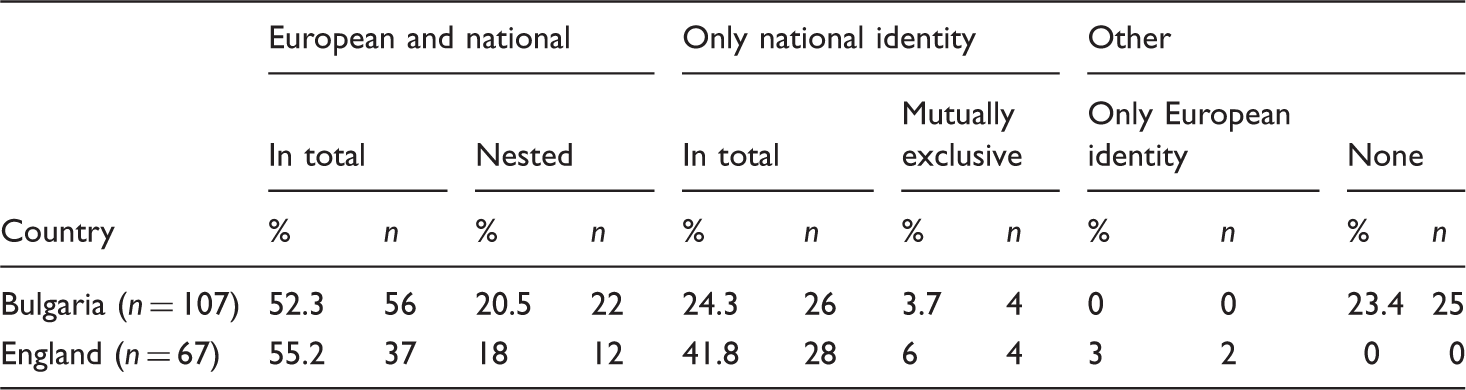
The first major category includes children who chose a combination of national and European identities. For instance, one girl said she was happy to be European because ‘it is my home and it’s also the place where I like to go on holiday.’ Among children in this group, a significant proportion (18% in England and 20.5% in Bulgaria) described their identities in a way consistent with the notion of nested identities. These children explicitly explained they defined themselves as European exactly because their country is part of Europe and/or the EU, as the two girls in the quotations below did:
–Why did you say you are European? –Because I was from Britain. –Who do you think is European? –I am from Bulgaria and Bulgaria is in Europe.
The second category includes those children who declared they possessed only a national identity. For the majority of them, the lack of European identification is not a result of any explicit antagonism between the national and the European identities. In fact, for only four children in Bulgaria and four in England were the European and the national identities mutually exclusive, because they clearly stated they were not European as they could not be both English/British and European, or both Bulgarian and European. Thus, when asked ‘Why did you say you are not European?’ a boy in Bulgaria replied ‘Because I am Bulgarian, actually Gypsy’, while a girl in England explained: ‘I don’t know. I asked my Mum “Am I European?” No, I am not European. I am either British or English or Hindu. That’s what my Mum says. I say what she says.’
As the quotations demonstrate, these children perceived the European and national identities as mutually incompatible, which supports the argument about the influence of meanings and images of Europe. At the same time, these examples also provide support for the impact of ethnicity; many of the children who failed to define themselves as European were actually members of the ethnic minorities: mainly Indians in England and Roma in Bulgaria. Some of them endorsed a national identity, but failed to embrace the European one, perhaps because they did not consider it as inclusive. Our quantitative data also support this conclusion. Thus, only two Roma defined themselves as European in contrast to more than a half of ethnic Bulgarians, χ2(2, N = 107) = 27.86, p < 0.001. In England, 66.7% of the ethnic English defined themselves as European in contrast to 28% of the minority, χ2(2, N = 67) = 14.39, p < 0.001. These results, however, are very different from the ones reached by Cinnirella and Hamilton (2007) who concluded that the relationship between ethnic minority status and European identity among British Asians is positive. Given that our interviewees were children, whereas their study was based on a survey among adults, our results might suggest that the youngest generation of British Asians share a different, more exclusive perception of Europe, but a more inclusive perception of their national (British and/or English) identity. Evidently, the relationship between ethnic minority status and European identity as well as the overall impact of social structures deserves a closer, more detailed consideration. We intend to address this in future work.
Finally, the last category is the so-called ‘other’, namely all who do not fit into any of the previous three. They either said they had no national and European identities (23.4% in Bulgaria and 0% in England) or declared they felt only European (0% in Bulgaria and 3% in England). For these children, it is not relevant to research the relationship between the European and the national identity, because there is no such relationship; they defined themselves as only British/English/Bulgarian or European or none for reasons other than interplay between the national and the European dimensions.
Conclusion
To sum up, the results presented in this article help clarify the relationship between European identity and the various factors that, according to existing research, influence its formation: cognitive mobilization (specifically, knowledge about Europe/the EU), meanings of Europe, and the political and historical context. Our analysis demonstrates the key role played by divergent meanings of Europe, which helps explain the divergent patterns of knowledge and identification at both systemic and individual levels. Children who identify as European not only know more about Europe and/or the EU, but are more likely to see Europe in geographic terms, and this image facilitates the perception of the European identity as a taken-for-granted, default or even potentially banal identity, one acquired simply by virtue of living in Europe. In contrast, children who refuse to describe themselves as European either know little about Europe and/or the EU, or perceive it primarily as an exclusive political entity, which is associated with high standards, distant political elites, or rich people – and therefore not an entity children can identify with.
The latter group of meanings is significantly more common among Bulgarian children we interviewed, who also tended to see Europe as a distant ideal or a dream, and hence perceived the European identity as an ideal they aspired to but did not yet possess. Such idealized images were absent among English children. As a result, Bulgarian children were less likely to identify as European than English ones, although they tended to be more knowledgeable about Europe and in particular the EU. As we have argued, the systemic differences in meanings can be linked to the disparate political and historical trajectories of the two countries: on the one hand, the history of an idealized perception of (Western) Europe in Bulgaria, reactivated after the fall of communism; on the other hand, the gradual proliferation of a default form of Europeanism in the UK. Still, the last point should not be overstated; although the percentage of English children who defined themselves as European was higher than that of Bulgarian children, the difference is not very significant. Moreover, it is difficult to predict how this identification will develop with age, and especially with greater exposure to the notoriously Eurosceptic news coverage of European events in English media. The role of other socialization agents such as school and parents is also worth researching – a topic of analysis for subsequent papers.
In terms of the relationship between national and European identities, there was no significant difference between European and Bulgarian children in our sample – for slightly more than half in each group, the identities appeared complementary – and it was therefore impossible to draw any conclusions about the impact of systemic factors. In contrast, comparisons between individual children confirmed the influence of images of Europe. Those children who felt their national belonging was an obstacle to European identity tended to perceive Europe either as a threat or simply as incompatible with nationhood. The results also suggest that the relationship between European and national identity is affected by ethnicity, though not in the same way as suggested in existing research. In both countries, ethnic minority children were less likely to embrace a European identity, and their answers imply that European identity might have a racial boundary. These results call for a closer examination of the relationship between European identity and ethnicity – an issue that we could not tackle fully here, and which has to be addressed in conjunction with other social structures: age, gender and, above all, class.