



Abstract
The last 20 years have seen a flood of studies of resistance, ranging from collective to individual acts of resistance, from the study of material aspects to its more ideational ones. Yet students of resistance have neglected the psychological dimension of everyday individual acts of resistance to power. This article is a first step to remedy that oversight. Inspired by Butler’s reading of Foucault’s notion of power at work in subjection and resistance, the article uses Goffman to substantiate such an account. Based on a 20-month ethnographic study of a traditional immigrant suburb north of Stockholm, Sweden, which is being redeveloped into a high-tech region, it offers empirical insight into the psychic life of resistance. Further, a particular resistance strategy is identified: symbolic dislocations through adherence to a boundary other than the one subjecting the self in the first place.
The last 20 years have seen a burgeoning literature on acts of resistance. Studies of resistance have focused on everything from organized large-scale public confrontation (McAdam et al., 2001; McCarthy and Wolfson, 1996; McCarthy and Zald, 1977) to everyday forms of individual resistance (Prasad and Prasad, 1998; Scott, 1985), from the study of material or physical modes of resistance (Haveman et al., 2007; McAdam et al., 2001) to resistance at the symbolic level (Hughes et al., 1995; Pickering, 2000). We have studied hairstyles (Weitz, 2001) and secretarial ‘bitching’ (Sotirin and Gottfried, 1999); we have examined the refusal to vote at home (Pile, 1997) and long-term opposition to colonialism and slavery abroad (Guha, 1997). In short, a wide variety of phenomena – both individual and collective, material and symbolic – have been conceived as resistance (for comprehensive reviews see Hollander and Einwohner, 2004; Raby, 2005).
Although resistance has become so ubiquitous that, some have warned, the concept may be growing meaningless (Brown, 1996), these studies all recognize oppositional behaviour as political (Hollander and Einwohner, 2004). A second point in common is the acknowledgement of the relevance of identity in both collective and individual acts of resistance. Manuel Castells, for example, has called attention to the significance of the collective identities fostered by resistance movements in contemporary society, which themselves constitute an element of social change (Castells, 1997). Further, studies stress the relevance of shared experiences of oppression in the assertion of a collective and oppositional identity (Hall, 2000;Taylor et al., 2009), which are at the heart of the resistance strategies of social movements (Woodward, 1997). Similarly, identity has shown to be central to understanding individual strategies among the unemployed to resist being labelled as ‘scroungers’ or ‘cheats’ (Howe, 1998) or employees’ resistance to organizational control (Covaleski et al., 1998).
Wide-ranging as the literature on resistance may be, little empirical work has been done on what, inspired by Judith Butler, we might call ‘the psychic life of resistance’. Acknowledging the symbolic boundary defining a group’s identity and encouraging collective acts of resistance, as these studies do, prompts the question of such a connection in regard to individual acts of resistance. Many have despaired over the tendency of members of oppressed groups to comply with the very power relations from which they suffer (Fletcher, 2001). There is today a missing link between an identity of subordination and individual rejections of such subordination. We have a lot to learn about the psychology of resistance and attention has been called to the lack of person-centred ethnographic studies that would bring the psychological aspects of resistance into focus (Seymour, 2006). The possibility of resistance that Butler reads out of the work of Michel Foucault, however, suggests that individual acts of resistance are possible in the gap between interpellation and conduct, and this allows, I would argue, for a much needed intellectual move from subordination to everyday individual acts of resistance. Indeed, the study of the symbolic dislocations performed through everyday individual acts of resistance may help us to understand the efforts of subordinated persons to cast off the symbolic claims that are made to their identities.
In this article, I address the opportunities for the individual to resist the symbolic boundary (ethnicity) that subjects her/him and forms her/his identity. That is, in the article, ethnicity is conceived as a symbolic boundary that shapes individual identities. Accordingly, resistance will refer to individuals’ efforts to recast the symbolic claims made on their identities, efforts that, I argue, take the form of symbolic dislocations on the categories subjecting the ethnic other. I begin with a discussion of subjection and resistance as two simultaneous dimensions of power. The following empirical sections are based on a case study of a traditional immigrant suburb north of Stockholm, Sweden, that is being redeveloped into a high-tech region of international standards, thus introducing technology as a symbolic boundary to redefine a suburb whose socioeconomic organization follows ethnic lines. The two subsequent analytical sections illustrate, first, the limits of subjection and the space opened to individual resistance and, second, specific acts of resistance that indicate a particular resistance strategy. Everyday individual acts of resistance, I want to argue, is practised through symbolic dislocations performed by adherence to a symbolic boundary other than the one constituting the subject and initiating her/his agency.
Identity of subordination: Possibility for individual resistance?
Erving Goffman taught us that stigma is not so much about individuals as about social roles. ‘The normal and the stigmatized are not persons but rather perspectives’ (Goffman, 1963: 163–164) upon recognizable social norms. Mixed contacts, those occurring between a normal and a stigmatized, become sites where unrealized norms are evidenced. When studying such situations, Goffman looked at the attempts of both performers (the stigmatized and the normal) to sustain an appearance of normality, thus enacting conventional social norms, and reproducing what is socially acceptable.
Goffman, that is, argued that the stigmatized plays as important a role in maintaining social norms as the normal does. It is not simply by studying the problem of unsustained norms that one is able to observe what the taken-for-granted norms are. Social norms are sustained as much by those favoured as by those disfavoured by them. Norms, that is, are produced and sustained far beyond the circle of those who realize it. It is in this sense that Goffman has been pivotal in advancing our understanding of an identity of subordination.
Goffman’s argument is parallel to Foucault’s conception of the subject as an effect of diffuse, all-encompassing relations of power. For Foucault, the individual is the product of modern power relations; that is, power relations are inscribed in our very bodies. Thus, our daily gestures, behaviours, impulses, thoughts and normative values are also an expression of those power relations.
At this point, the possibility of resistance to power relations that form the self and shape her/his identity has occasioned intense theoretical debates, particularly in reference to Foucault’s notion of power. On the one hand, some argue that Foucault’s power is so totalizing (it ‘reaches into the very grain of individuals, touches their bodies and inserts itself into their actions and attitudes, their discourses, learning processes and everyday lives’ – Foucault, 1980: 39) that it ultimately paralyses any form of resistance (Fraser, 1981; Habermas, 1987), an observation that is valid even in a Goffmanian world permeated by processes of social regulation.
On the other hand, many researchers find Foucault’s notion of power liberating in that all-encompassing power relations are said to beget increased opportunities for acts of resistance. Forms of resistance no longer maintain the traditional legitimacy of class politics and conflicting interests (Fleming and Sewell, 2002). Rather, a power that forms the subject locates the possibility of resistance at the individual level of micro practices. Accordingly, resistance may take the form of daily ‘ethico-political’ choices (Foucault, 1984: 343), and in this sense, resistance is connected to an ideal of self-creation (Foucault, 1983). Collective resistance becomes possible, not in the name of an ideology or grand theory but, rather, as a reaction to intolerable shared experiences of bodily subjugation (Pickett, 1996).
However, the connection between an identity of subordination and an individual act of resistance is still unclear. Neither Goffman nor Foucault is able to account for the step that transforms ordinary individual acts into individual acts of resistance. Judith Butler’s reading of Foucault, I suggest, may help us here.
Butler understands the subject as the site of both subjection and agency, subjection being the process by which the boundaries that structure extant power relations form the subject and initiate her/his agency. Elaborating on Foucault’s ideas, Judith Butler considers the problem of subjection as ‘[a] power exerted on a subject, subjection is nevertheless a power assumed by the subject, an assumption that constitutes the instrument of that subject’s becoming’ (Butler, 1997: 11, italics in original). Power is thus not merely something external that we stand in opposition to, but something ‘we depend on for our own existence and what we harbor and preserve in the beings that we are’ (Butler, 1997: 2). That is, power relations form the subject – we know ourselves through discourses and reflexive definition – and shape the subject’s sense of agency.
If, Butler argues, the subject is both the product of relations of domination and the site of agency, then ‘any effort to oppose subordination will necessarily presuppose and reinvoke it’ (Butler, 1997: 12). Yet, she continues, the act of presupposing subordination is not the same as the act of re-invoking it. ‘Power considered as a condition of the subject is necessarily not the same as power considered as what the subject is said to wield. The power that initiates the subject fails to remain continuous with the power that is the subject’s agency’ (Butler, 1997: 12; italics added). In other words, the formation of the subject is never complete. Power, that is, is discontinuous and needs constant renewal through the subject’s reiteration of the conditions of domination. It is precisely in these acts of continuous reiteration, I argue, that the subject finds the possibility of resistance.
In other words, Goffman’s organization of social intimacy and Foucault’s structuring of the socioeconomic order are both produced by actual individuals and groups of individuals that orient themselves towards discourse in talk, writing and action. On each of these ‘occasions’ (cf. Goffman, 1967), the subject can choose to conform or to resist the established order by reiterating or dislocating the boundary subjecting her/him. Individual acts of resistance, the article shows, take the form of everyday, at times inadvertent, symbolic dislocations on the boundaries that constitute her/his subjectivity.
Goffman’s focus on the micro-interactions of everyday life is often seen as the opposite to Foucault’s focus on entire systems of thought. Yet one of Foucault’s greatest accomplishments was to vividly illustrate the subtlety and pervasiveness of power, a power that structures our discourses, organizes our communities, shapes our identities, limits our field of action and forms the subject. As Ian Hacking argues, Goffman complements Foucault by developing an understanding of ‘how the forms of discourse become part of the lives of ordinary people, or even how they become institutionalized and made part of the structure of institutions at work’ (Hacking, 2004: 278). Similarly, I argue, Goffman complements Butler by developing an understanding of how the incompleteness of the subject opens a space for everyday individual acts of resistance to the identity claims made on her/him; or even how through various individual identity strategies, the subject refuses to fully reinvoke the power subjecting her/him. That is, a Goffmanian analysis substantiates Butler’s insight that Foucault’s totalizing power fails to suffocate the subject, pinpointing individual strategies for the managing of identity and subversion of power.
In sum, three points in Butler’s reading of Foucault’s notion of power are especially relevant to understanding the psychic aspect of individual acts of resistance. First, subjection to relations of power constitutes the subject and initiates her/his agency. Second, given the continuous need for power to reiterate itself, subjection is never complete and, third, this opens the possibility for resistance to extant relations of power. I use Goffman to substantiate this account of the psychic life of subjection by looking closely at the ethnic boundary that forms the immigrant subject. Although my research subject took ethnicity as a given, the ethnic other oscillated in her/his relationship to it, at times assuming her/his identity as an ethnic other and at other times seeing her-/himself as the exception to the rule. Such oscillations of identity, my findings suggest, make space for individual resistance. As we will see, exploiting this space requires the presence of another symbolic boundary; in the particular case presented here, the symbolic boundary drawn by technology.
Setting: The Kista Borough
Kista is an administrative borough of the City of Stockholm, Sweden. Built in the mid-1970s following the ABC-city concept – A for ‘arbete’, work; B for ‘bostäder’, housing; and C for ‘centrum’, a city centre – the idea was to create a suburb that was independent of the City of Stockholm. In practice, the idea was implemented by locating work places, a small shopping centre and residences in close proximity to each other (Brattberg, 1977). As a consequence, Kista is architecturally divided, most noticeably, by the underground line, which in its passage through Kista emerges from the ground separating residential from working areas. A big shopping centre is located under the underground railway, thus bridging both areas.
Social welfare assistance.
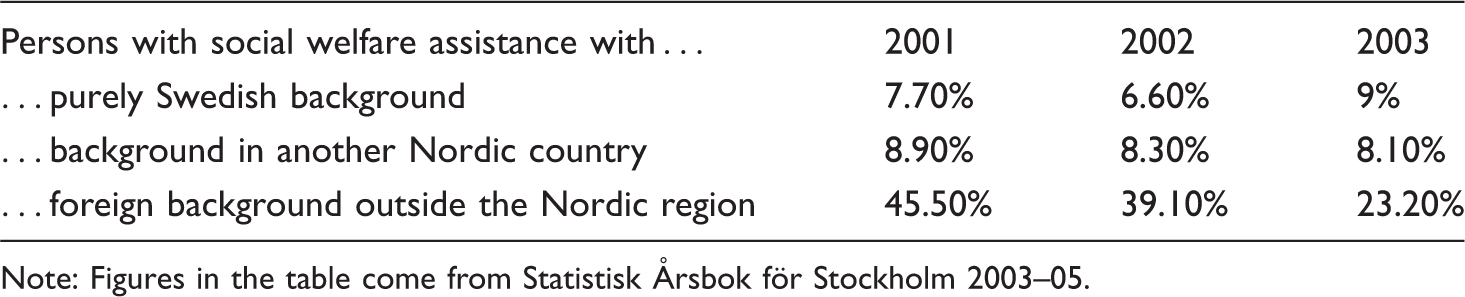
Note: Figures in the table come from Statistisk Årsbok för Stockholm 2003–05.
Kista Borough.
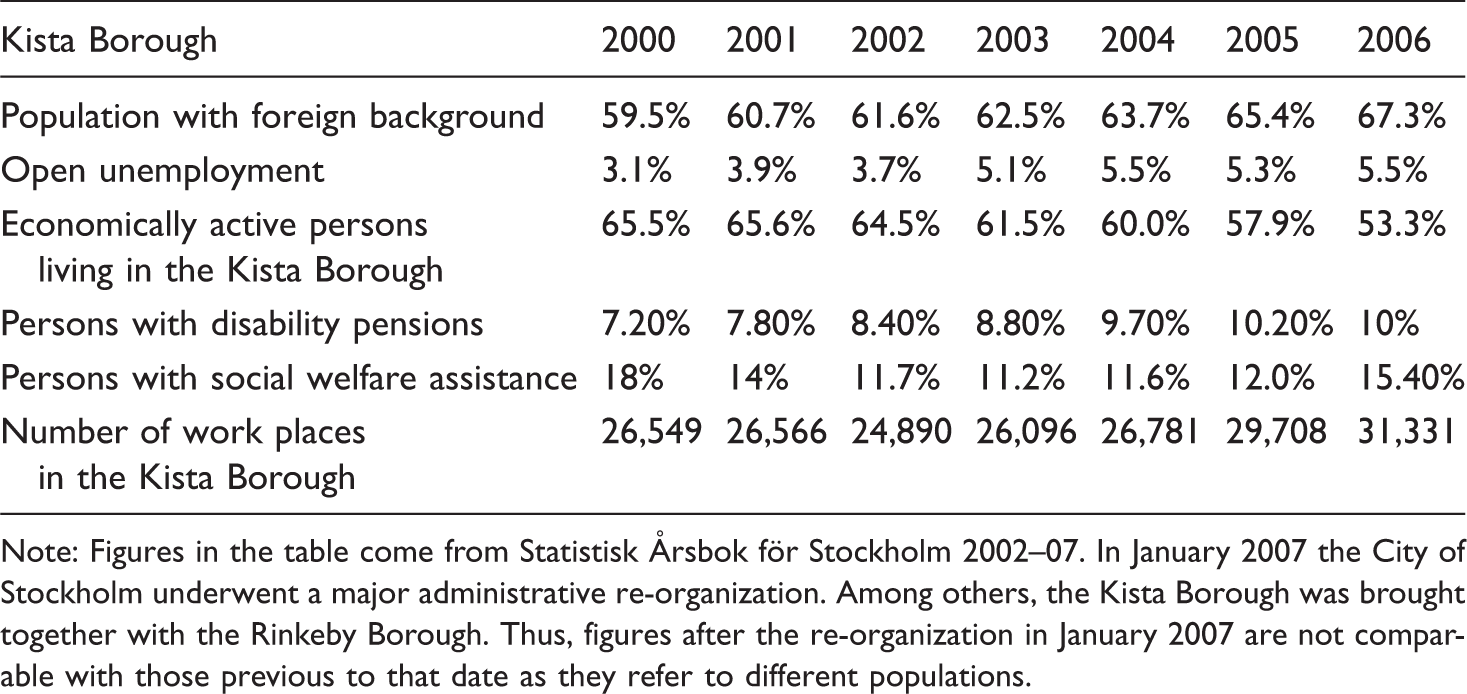
Note: Figures in the table come from Statistisk Årsbok för Stockholm 2002–07. In January 2007 the City of Stockholm underwent a major administrative re-organization. Among others, the Kista Borough was brought together with the Rinkeby Borough. Thus, figures after the re-organization in January 2007 are not comparable with those previous to that date as they refer to different populations.
The Kista Borough is simultaneously an increasingly important node in the global economic network of high-tech regions and an oft-derided suburban area characterized by ethnic segregation (for a different depiction of another derided Swedish suburb see Sernhede, 2002). Architecture and the underground line can be seen as the physical counterparts of deeper social, economic and ethnic divisions. These divisions have marked, and still mark, regional development efforts in Kista such as Kista Science City.
In September 2000, the Executive Office of the City of Stockholm presented the long-term plans for the region in a document bearing the title ‘Kista Science City – From vision to reality’, a regional development project framed within the tradition of science- and technology-based regional development projects, more often called science parks. Such regional development projects put science and technology at the centre of regional economic policies (O’Mara, 2005). Scientific knowledge, as the assumptions in such policies go, leads to technological innovation that in turn fosters economic growth and results in social change (for further elaboration, see Castells and Hall, 1994).
In the year 2000, several delegates from the City of Stockholm travelled to Silicon Valley. Inspired by it (and other science parks) they set out to redefine what had traditionally been an immigrant suburb into a high-tech region of international standards. These efforts were structured along a discourse on science and technology, a particular regional development rationality that is based in a belief in science and technology. When such science- and technology-centred policies are implemented in a region divided along ethnic lines, as we will see, the technology boundary that structures the discourse may be invoked by the ethnic subject to resist subordination.
Method
Taking place over one-and-a-half years, the study used various fieldwork techniques to gain an understanding of the power dynamics at work in a traditional immigrant suburb that was being redefined as a high-tech region. First, over 60 in-depth unstructured interviews (Spradley, 1979), ranging from 40 minutes to two-and-a-half hours, with people working, living or representing the borough’s administration were carried out. The interviews typically began with contextual information about the subject’s relation to Kista and how they arrived in the region. From that initial phase where contact was established and an interaction pattern built, everything was discussed, from their daily routines and movement in the borough to their personal interests and concerns. Invariably, I would end the conversation by asking them for someone they thought it might be interesting for me to interview.
Further, participant observations were conducted on the industrial and the residential sides of both formal and informal events. Formal events ranged from conferences on the future of Kista and lunches associated with meetings about how to attract venture capital to presentations on the renovation of the Kista Square and employment days at the local community centre. To access the less public sphere of residents’ lives, I volunteered in the local public library helping school children with their homework once a week, and joined a women’s organization in the borough. At all of these occasions I took field notes that were developed immediately after into fuller descriptions.
To analyse what amounted to hundreds of written pages, I took an inductive approach to the field, in line with the grounded theory approach of the study (Glaser and Strauss, 1967). To manage the sheer quantity of material I proceeded in three steps. First, I meticulously read and scrutinized interview transcripts, written material and field notes in order to generate categories and code the text accordingly. For each category, I opened a file with all the quotes, anecdotes and descriptions coded under that category. These files were re-read several times in an attempt to confirm, reject, or modify coded categories. Many of the categories referred to differences, documenting allusions to ‘us’ and ‘them’. Categories included constructions of several sources of differences, such as gender, ethnicity and class (mainly through the marker of education). However, references to ethnicity were undoubtedly the richest and most prevalent, at times combining in complex ways with references to technology expertise/knowledge. For this article, I decided to focus on this particular intersection. The second step for the analysis of empirical material implied generating a frame of interpretation. The relevant files were then read again in search of underlying themes. The dynamics of power relations slowly emerged as a central theme in which topics such as subjection and resistance were particularly relevant. In the third and final step, I re-read still once more the categorized material looking for examples and exceptions that could help me modify, refute or nuance the frames of interpretation.
Findings
Analysis of the empirical material showed a specific aspect of power relations: the need to continuously reiterate power in the subject’s acting, and the possibility of resisting power that opened in the act of reiteration. In what follows, the article will focus on the possibility of individual resistance to power relations by describing two interdependent processes. First, the opening of a space for resistance to existing relations of power: the process by which the subject other hesitates in re-invoking the symbolic boundary that constitutes her/his identity and shapes her/his agency. Second, resisting subjection to a boundary that initiates the subject’s agency: the process by which the ethnic subject actively resists ethnicity as the only appropriate boundary defining her/him.
More particularly for the Kista case, the ethnic boundary articulated extant power relations. The limits of subjection and the possibility of individual acts of resistance were formulated in terms of ethnicity. While resistance was enabled by subjection to the ethnic boundary, however, individual acts of resistance proceeded through symbolic dislocations performed by adhering to an alternative boundary, namely, the technology boundary that so often organizes socioeconomic relations in high-tech regions such as Kista Science City.
Opening up space for resistance
Although ethnicity articulated the identity of the person of immigrant background living in Kista, subjection to the ethnic boundary, as we will see, was not complete. Without ever questioning the objectivity of the ethnic boundary to mark the essence of her/his fellow stigmatized she/he oscillated between seeing her-/himself as belonging to the group of outsiders or as an exception to the ethnic rule. This manifested in ambivalence towards her/his ethnic identity. The following excerpt is an example: Cajsa. I grew up in Bredäng, an immigrant area, you know. Much more so now than when we lived there. It’s called ‘the Orient Express’ – [the underground’s red line to the south because] there are so many immigrants there. I went to school and hanged out with both Swedes and immigrants. They were as I was. Maybe someone had one parent coming from Sweden and the other parent from another country. I always felt Swedish. I was a Swede! If someone asked me, I always presented myself as a Swede. Grew up here, speak Swedish and have always lived here. I thought Sweden was that way. Until I started to study at KTH [the engineering university]. My first week there was a shock. There were only Swedes, whole Swedes. They saw something in me, it must have been my behaviour or my appearance, I don’t know. But they asked, ‘where do you come from, actually?’ Since then, I don’t see myself as a Swede. I thought, ‘I don’t think like them, I don’t have the same life as them.’ eb. What do you mean? Cajsa. They had a family and celebrated Mid-Summer with their family. I’ve never celebrated Mid-Summer, I’ve never needed to. My friends came from other countries as well and didn’t celebrate Mid-Summer either. It was that way with many things, it’s many small things … You get used after a while. And now, whenever I go to the suburbs, it’s just the opposite – ‘wow! How many immigrants!’
Cajsa and her mother came to Sweden from Poland some 20 years ago. I met her while she was writing her master’s thesis at the engineering university in Kista. The Sweden she grew up with was one where, at least as she perceived it, the ethnic boundary was irrelevant. Swedish identity did not go through one’s or one’s parents’ place of birth. Despite her Polish descent, she never had to question her Swedishness (Lödén, 2008). It was only when she entered into her engineering studies that she started to reformulate her identity. It was then that she started learning about the normative ideals she failed to meet. Both the reactions of the ‘normals’ towards her – asking what her origin ‘actually’ was – and her realization of not sharing customs nor family standards led her to establish a distance from her previous definitions of self: ‘Since then, I don’t see myself as a Swede.’
At the same time, she does not identify completely with what is open to her. Her perception has changed to the point that now, whenever she returns to the area where she grew up, she does not see Sweden as she saw it when she was a child. She is watching, with disbelief, the Sweden of her childhood turn into an immigrant enclave, into ‘the Orient’, into a region inhabited by non-Swedes. Her definition of Sweden has changed from one where ethnicity was not a relevant category to one where it is its main defining criteria. She orients herself towards the boundary; independently of her liking or dislike for it, she is subjected to the ethnic boundary, forcing her to take a position regarding the values and ideals implied in it. According to that framework Cajsa is not a fully fledged Swede.
Observe, however, the use of irony to allude to the stigmatized and deal with the problem of unmet social norms (Goffman, 1963). Cajsa used the term ‘Orient Express’ to describe the immigrant area of her early years. The use of irony reflects the relation of the individual to the ethnic boundary while refusing to validate the truth of the established ethnic hierarchy. Irony, it seems, becomes a strategy to contest the strength of dominant cultural forces in the current situation. It shows the individual engaged in a critical attitude: while she speaks from within the ethnic order, she questions its truth. The stigmatized subject oscillates between a refusal to be personally marked by unmet social norms and, yet, a certain degree of identification with the outsider as defined by those very norms. Cajsa’s self-identity swings back and forth between the normal ‘Swede’ and the stigmatized ‘immigrant’. Subjection, that is, is not complete, ambivalence marking the limits of subjection that Butler pointed out to us.
Embarrassment over those who comply with the dominant image of the ‘immigrant’ category is found as well at the limits of subjection. Consider the following quote: Setareh. You don’t want to give a bad image of immigrants, but one must say that, since [the shopping centre] was renovated, many youngsters hang around in the mall. They do nothing, just hang around and do nothing. They dirty the place, are noisy and messy. eb. Do they come from the area? Setareh. Mostly from here, maybe some from Rinkeby or Tensta. In [an internet and video-game cafe], they come from Rinkeby to go there. That’s really negative. It irritates me that they have to have extra personnel and extra guards.
‘You don’t want to give a bad image of immigrants,’ partly because, having Iranian parents, Setareh is herself categorized as an ‘immigrant’. Hence, the irritation towards those who make it more difficult for her to rub off stigma and resist ethnic subjection. Her own standing, she feels, is directly affected by the youngsters’ behaviour.
As Goffman observes, ‘the very notion of shameful differences assumes a similarity in regard to crucial beliefs, those regarding identity’ (Goffman, 1963: 156). Non-Swedishness seems to be accepted as a deviation – a shameful deviation for that matter – from the normative ideal even by those who deviate. The power of the ethnic boundary is maintained in part through the formation of the subject, and that formation is made patent in the assimilation of the social norms inherent to the boundary.
The limits of subjection are also seen when the ethnic subject presents herself as an exception to the rule. In the following example, the stigmatized opts to highlight that she worked, duly paid taxes, and had never depended on social welfare. Even more: she emphasized that every member of her family did likewise: Alicja. I work, I do not work illegally, I pay my taxes, I do not go to the social welfare. As long as I’m able to work I won’t go to the social welfare, I’m not going to ask for money because we have honour, we do not go to the social welfare. I will never go to the social welfare and ask for money, as long as I can work. Maybe it comes the day I cannot work and cannot pay my accounts, but I have children who can help me. Everything I do is ok, yet we are always ‘svartskalle’ [slang for immigrant]. I feel like a ‘svartskalle’.
This middle-aged Polish woman gives detailed explanations of how she conforms to legality, of how she is not like the dominant image attached to the people of immigrant background, of how good a citizen she is – she works, pays her taxes and does not rely on social welfare. The speediness and voluntaryness of her explanations show that she knows of the stigma falling upon the ethnic subject, feels embarrassed by it (an embarrassment that tells of her sharing the norms of the established), and quickly wants to prove that she does not comply with it. She does not question the boundary that so defines her. Instead, her strategy is to show that she is rather an exception to the rule. A rule that, no matter her efforts on the contrary, keeps defining her as an ‘outsider’, an ‘immigrant’, forever the ‘other’.
She continues: Alicja. I am ashamed because I know I don’t speak good Swedish. They must get stressed: ‘what are you saying? what are you saying?’ All the time ‘what are you saying?’ That wouldn’t be good for them or for me. I can’t say that I isolate myself. I buy the newspapers – Aftonblandet is my favorite – I listen to the news, I am interested in the country where I live, I want to know everything that happens here. But I feel … I can’t say that I feel less worthy, sometimes, yes, I don’t feel that well. And I think there are many that feel that way. Ok, we live here, they are nice, they laugh, they ask ‘how do you do?’, they hug, but they close their doors. eb. In what sense do you feel less worthy? Is it something that happens, or …? Alicja. No, it is not something that happens. […] I do nothing wrong here in Sweden. I work, pay my taxes, I don’t work illegally and still, I feel like … I don’t know if I am welcome in this country or not. Maybe, we migrants have physical or psychological problems. Not that we are psychologically ill but we maybe have something in our brains.
This quote painfully summarizes the impossible situation in which subjection places the ethnic subject – a situation forcing her to accept and reproduce the ethnic categorical boundary that splits people and organizes socioeconomic relations into ‘we’ (immigrants), and ‘they’ (Swedes). This Polish woman is left to choose between identifying with the general image of ‘the immigrant’, thus having to bear the shame of stigma (an embarrassment that reveals how much she shares in the norms of the establishment – Goffman, 1963) and putting distance between her and those who are seen to comply with that image, thus defining herself as what we could call a deficient normal: ‘I can’t say that I isolate myself’ – Alicja feels she owes explanations to show conformity with the customs of ‘the normals’ – ‘I buy the newspapers, I listen to the news, I am interested in the country where I live, I want to know everything that happens here.’ But opting for the identity of ‘the normal’ forces her to see herself as deficient or, in her own words, ‘less worthy’.
The insight of a lesser human worth brings her back to define herself fully as another ‘immigrant’ with the sorrows proper to the immigrant badge: ‘there are many that feel that way’. And, returning once more to the question of being ‘normal’, she says ‘I do nothing wrong here in Sweden. I work, pay my taxes, I don’t work illegally’. But if she is normal she is still deviant: ‘and still, I feel like … ’ Her oscillations back and forth between a stigmatized identity and a deficient identity take her so far as to admit a collective psychological defect – ‘maybe, we migrants […] have something in our brains’.
Although Cajsa and Alicja occupy different class positions – the former grew up in Sweden and speaks the language without an accent, whereas the latter has a noticeable accent; the former has been educated in the engineering university, the latter has no formal education – both these women share the experience of ethnic subordination. While the form of their experiences differs, as does the account each gives of it, both women resent the hegemonic ethnic boundary that constitutes their subjectivities and limits their space for action. It is this shared resentment and this shared experience of limited action that is at the root of an inclusive solidarity across national and racial backgrounds among those classified as ‘immigrant’ (Ålund and Grandqvist, 1995).
In sum, oscillations of identity between that of a stigmatized ‘immigrant’ and that of a deficient ‘normal’ were particularly visible among those living in Kista’s residential area. These manifested in various forms: distancing oneself from one’s fellow-stigmatized, an ironic relationship towards the ethnic boundary that marks one’s identity, and emphasis in presenting oneself as an exception to the rule. These oscillations are a symptom of the subjection of the ethnic other to wider social norms (Goffman, 1963), despite the fact that accepting them implies regarding oneself as deviant, deficient, disgraced. It implies, that is, admitting a lesser human worth and reproducing the criteria that makes it so. It shows the extent to which extant ethnic power relations constitute subjectivity (Foucault, 1980). However, it is in the ethnic subject’s ambivalence to her ethnic identity that we can appreciate the limits of subjection. To those who questioned the limits of subjection and thus the possibility of individual resistance in a Foucauldian world of discursive dominance, oscillations of identity show that subjection is not complete, opening up space for individual acts of resistance.
Resistance
If subjection is a form of power, and the subject an effect of subjection, how can the subject take an oppositional relation to the power that is forming her/him? The case studied shows one particular strategy by which the agent resists extant power relations while, nevertheless, reproducing them: adherence to a symbolic boundary other than the one forming the subject. Let me offer a few examples.
Blanca is a Chilean woman in her mid-50s who flew to Sweden shortly after Pinochet’s coup. She collaborates with a women’s organization in the Kista Borough. The following excerpt comes from a conversation we had while we sat in the underground train on our way back to downtown Stockholm after one of the organization’s grill-parties: The intellectual elite works in Kista, and KTH [the engineering university] is its most important centre in Sweden. That’s why I’m impressed that you are there. But, of course, you didn’t arrive as an immigrant. It is different to come as a student. I’m a refugee, not an immigrant, but Swedes make no distinctions. It’s all the same. You must have contacts back in Spain, something that interests them, maybe the university. Otherwise, there are so many well-educated people and nothing, there’s no work. Congratulations!
Blanca starts by acknowledging the relevance of higher education and technical expertise for being admitted in Kista’s industrial park. ‘The intellectual elite works in Kista’ – her words echo the norms of a high-tech professional class (O’Mara, 2005), norms that place technology and education as the main borders demarcating the ‘appropriate’ from the ‘inappropriate’ participant of a high-tech region (Barinaga, 2010).
She then continues by making reference to my immigrant background. ‘I’m surprised that you are there,’ she says. Blanca is surprised to know that, given my immigrant background, I nevertheless do work at the engineering university located in Kista’s industrial side. ‘But, of course,’ she admits, ‘you didn’t arrive as an immigrant.’ Her line of reasoning gives away the extent to which the ethnic boundary and the technology boundary defining the high-tech professional class are tightly connected in the mind of the ethnic subject resident in a high-tech region. Both boundaries are connected in a relation of opposites, by which the categories distinguished by the symbolic boundaries are associated, and meaning infused to each other. As a result, the category of the ‘ethnic other’ becomes incompatible with that of a ‘high-tech professional class’ (an intersectional analysis is appropriate here, but for lack of space, I refer to Barinaga, 2008).
Further, she hints at a strategy to resist the subjection that she experiences. ‘It is different to come here as a student’, she says, indicating that one way to reverse the existing balance of power is through pursuing higher education. Still, she seems to contend, you are an ‘immigrant’ so there must be something else ‘they’ want from you: contacts back home. Education, she implies, is not enough. She hears with disbelief a person of immigrant background showing her that it is possible to have an immigrant background and still work within ‘the intellectual elite’. Her final ‘congratulations!’ is a tribute to those who resist the ethnic boundary and succeed in transgressing the social hierarchy.
To elaborate on the view that pursuing advanced studies is a strategy to resist ethnic subordination, the value placed on knowledge and higher education is itself an integral tenet of the rationality governing high-tech regions (O’Mara, 2005). Technical education regulates normative ideals about the ‘appropriate’ dweller and the ‘competent’ employee in high-tech regions. That is, the technology boundary (with the embedded value of higher education) formulates the socioeconomic order in high-tech regions, opening up the possibility of resisting power relations structured along other boundaries – in the Kista case, the ethnic one.
Consider another example. Suhail is an Iraqi man in his mid-20s who I met when he worked at the engineering university in Kista. Although he had lived longer in Sweden than in Iraq, he introduced himself as an ‘Iraqi Arab’. When asked for the reason, he answered: I know I make it more difficult for me when I introduce myself as an ‘Iraqi Arab’ but I want to show them. One needs to be twice as good.
Notice, above all, how in his resistance to be considered the ‘typical immigrant’ Suhail reasserts ethnicity as a valid boundary forming the subject. He introduces himself as an ‘Iraqi Arab’ subjecting himself to the ethnic boundary that he, then, aims to reverse. He derives his agency from existing power relations – a strength born from his immigrant identity, from his very subjection to the ethnic boundary.
Still, he is aware of how this strategy may misfire. He is aware that he is reproducing the boundary that subordinates him to an ethnic Swede. At this point in our conversation he gives me a personal example of when such has been the case. Suhail tells me about a job he had at a high-tech production line before beginning his engineering education and how he was dismissed inappropriately, suggesting that it was because of ethnic bias. Yet, he is glad about what happened: for if it was not for that I might have not gone on to study at KTH. But as it is now, they can’t just dismiss me. If you have knowledge, they need you. I remember I thought ‘next time, it is me who is having the power’.
Suhail embraces the technology boundary that prescribes pursuing higher engineering education as a strategy to resist the ethnic boundary that subordinates him. He resists ethnicity from within (remember that he defined himself as an ‘Iraqi Arab’), while subscribing to the norms of the professional class embedded in the technology boundary in order to oppose the subordinating force of ethnicity. Adhering to the technology boundary enables him to perform symbolic dislocations that open up the possibility for him to reverse his subordination and destabilize extant power relations.
Another example comes from Kazim, a man in his early 30s born in Sweden of a Swedish mother and an Algerian father. Kazim got his degree from Uppsala and holds a PhD in Economics from the Stockholm School of Economics. Together with two friends of Iranian background he is starting a high-tech company in Kista. When asked for the reason, he answered: This is where you come if you’re a ‘svartskalle’. We don’t get into the established organizations, such as Ericsson. It’s no coincidence that Aziz, Sahib or I are here. As an immigrant you have to create your own structures [immigrant-led enterprises]. When I was studying in Uppsala I thought ‘it’s no good idea to send your CV. It says Kazim, or Aziz.’ You know that as soon as they see the name they throw the CV away. Then you only have two alternatives. The first is to feel as a victim. The second is to accept your cultural distinction, take advantage of being different and create your own structures.
Kazim does not agree that education alone is a sufficient strategy to oppose subordination and facilitate social mobility in Swedish society. As a university student in Uppsala he was disheartened about his future prospects for entering the labour market. He argued that education was only accounted for if accompanied by the ‘appropriate’ ethnicity. In the space opened by the need of power to reiterate itself (Butler, 1997), Kazim chooses to actively resist ethnic subordination, a resistance that grows from reasserting his ‘cultural distinction’ and starting an immigrant-led high-tech enterprise together with two highly educated friends of Iranian background. Kazim resists the dominant juxtaposition of ‘immigrant’ subject and low (uneducated) class by attaching ethnicity to the higher education that is the marker of the professional class. That is, Kazim dislocates the dominant intersection of class and ethnicity to his advantage, reversing the categories that are often juxtaposed.
Summing up
The subject’s identity is shaped by subjection to the ethnic boundary. Further, subjection to the ethnic boundary initiates the agency of the subject, even for acts of resistance to the very boundary that forms her/him. Subjection, that is, implies subjectivication of the subject, yet not total submission. In other words, space for resistance lies within subjection. Whereas movements based on a politics of identity, such as the Black Power movement or certain feminist strands, shape resistance along the same boundaries subjecting them – race and gender respectively – a different strategy was identified in the case at hand. Individual acts of resistance grew out of subjection to ethnicity yet were carried out through alignment to the technology boundary, a boundary that structures the socioeconomic order of the region where resistance was played out. Adherence to the technology boundary as a way to resist ethnic subjection took the form of symbolic dislocations that juxtaposed the derided category of the ‘immigrant’ to the praised categories of ‘technology expert’ and ‘high-tech entrepreneur’.
Discussion: The psychic life of resistance
The challenge posed by the debate on the possibility of resistance to power is that of ‘account[ing] for the possibility of resistance to political and psychic subjugation without resorting to the master-narratives of the Enlightenment or to romanticized notions of a pre-discursive self untouched by power’ (Keye, 2005: 92). My answer to this challenge is to show that, although subjected by power relations, resistance is possible by subscribing to discourses other than the one that subordinates and forms the subject’s agency. Accordingly, the subject reproduces the social category that subordinates her/his identity while embracing new categories that dislocate and potentially subvert the one that subjects her/him in the first place.
The study was inspired in Goffman’s approach to the management of identity, which highlights the effort of the stigmatized individual to comply with the boundary subjecting her. Yet, according to Butler’s reading of Foucault, subjection is never complete. This article empirically develops this insight showing, first, that oscillations in identity by the individual of foreign background are a manifestation of the limits of subjection, thus opening a space for individual acts of resistance to the boundary that so defines her/him. Second, the article offered empirical evidence of one particular resistance strategy: the performance of symbolic dislocations through adherence to a symbolic boundary different from the one subjecting her/him.
First, the empirical material showed the limits of subjection to the ethnic boundary and the space opened up to resist subordination. Such is the case in the other’s manifested ambivalence towards her/his own identity. Oscillations of identity showed the extent to which extant power relations subject the ethnic other. The normative values inherent to the ethnic boundary colonized the soul of the other to such a degree that the other readily accepted the mark of stigma or the ballast of deficiency without even questioning the boundary that framed those values. The oscillations evidenced a silent agreement about how one should be, behave and live. The ethnic subject finds space to negotiate her subject position in the social fabric; however, it is not a passive acceptance of the boundary since she/he can choose to position her-/himself either as a stigmatized ‘immigrant’ or as a deficient ‘normal’. Yet that negotiation is framed within the norms and constraints set by a boundary she/he never chose. That is, the ethnic subject resists ethnicity from within.
As a consequence, at the very moment she/he defines her identity as a stigmatized immigrant or as a deficient normal, she/he is also reproducing the ethnic boundary that forms those subject positions, thus replicating the conditions of her/his own subordination. Yet, it is in the very possibility of choice between subject positions (Barinaga, 2007), in the efforts of the ethnic subject to define her-/himself as an exception to the rule, that we can appreciate the limits of subjection, and thus the space that is opened up to individual acts of resistance.
This appears to be the paradox of the power–subject relation: the subject is dependent on power relations for its own existence, yet derives its agency from power. It is here that Butler asks, ‘[i]f subordination is the condition of possibility for agency, how might agency be thought in opposition to the forces of subordination?’ (Butler, 1997: 10; italics added). Her answer is that consciousness turns against itself, threatening the subject with its own dissolution. The answer given in this article, and the second claim made through empirical evidence, is that the subject can resist the power that forms her/him and conditions her agency by subscribing to a boundary different from the one that defines extant power relations. She/he brandishes an alternative boundary in the struggle against the boundary that forms her/him. In this case, with help of the technology boundary that regulates the normative ideals in high-tech regions, the ethnic subject hopes to thwart the symbolic value of ethnicity. Through, at times, inadvertent symbolic dislocations that intersect the technology and ethnic boundaries in new ways, the ethnic subject aims to re-signify the boundary subjecting her/him (Butler, 1995), and thus de-stabilize extant relations of power. In other words, the ethnic subject reconfigures her/his ethnic condition through repetitive dislocations of the dominant intersection between the ethnic and technology symbolic boundaries.
Note, however, that symbolic dislocations are not necessarily oppositional to the forces of subordination. As Butler argues, it is in the need for subjection to be continuously reproduced that the subject draws her/his agency and finds space for subversive resistance (Butler, 1995). In other words, everyday individual acts of resistance were enabled by existing power relations. Since action – even if an action of resistance – occurs within the limits set by power relations, that action questions power relations while it at the same time perpetuates them. That is why Foucault, in his later work, alludes to modes of resistance that are not necessarily in a relation of opposition to power relations. Since power relations structure the field of possible actions by means of action, there is always an opportunity for the subject to cross the field in new ways (Foucault, 1982). Thus, resistance is not merely oppositional or antagonistic; it may consist, as in the case at hand, of the subject creatively acting upon her-/himself and her/his field of actions through symbolic dislocations so that the subject becomes autonomous within a structured set of practices and institutions.
Such a strategy does not target the very boundary that organizes power relations. Ethnicity remains unquestioned as a category defining identity. It remains an unavoidable boundary defining a sizable group of people. Not only does it remain unquestioned, it is further reproduced, for it forms the very subjects that actively resist its subordinating effects. The ethnic boundary remains a premise for the possibility of resistance. In this sense, resistance may undermine the effects of power relations though it is unable to rearticulate the terms of subjection. Yet, in this case, the introduction of a new symbolic boundary (technology) to redefine oneself and dislocate the old defining boundary (ethnicity) opened up the possibility for the stigmatized resident to relate to her-/himself in new forms. In other words, although ethnicity remained unquestioned as a legitimate boundary defining and subjecting the region’s residents, the technology boundary gave them a touchstone for new identities, to re-interpret themselves and thus to act in new ways.