




Abstract
Ethnic disparities in educational aspirations and choices are important to comprehend ethnic education inequality. Based on a mixed-method approach (3121 questionnaires and 40 interviews of pupils), this article investigates ethnic differences among nine ethnic minority groups of pupils in Brussels with regard to their educational aspirations. The multivariate analysis of the questionnaires shows that pupils from only four out of the nine ethnic minorities hold significantly higher aspirations than the majority group. In addition, our mixed-method results did not support the hypothesis on perceived ethnic discrimination in the labour market in explaining the higher educational aspirations of ethnic minority youth. Nevertheless, personal experience of discrimination at school is significantly associated with higher educational aspirations. We conclude by highlighting the relevance of the parental transmission of the intergenerational mobility project in explaining ethnic differences in youth’s educational aspirations.
Introduction
Ethnic inequality within the education system is considered by social scientists and policy makers as a major issue to be addressed for the structural integration of ethnic minorities. Ethnic educational inequality is not only composed of ethnic disadvantage in academic performance (the so-called primary effects), but also of ethnic disadvantage that results from variations in educational choices conditional upon learning abilities and academic performance (the so-called secondary effects) (Van De Werfhorst and Van Tubergen, 2007). While the current debate focuses mainly on explaining ethnic differences in school test scores, much less has been done in investigating ethnic differences in educational aspirations. However, this issue is essential to understand the process of ethnic educational inequality in its entirety.
Based on a unique survey of highly diverse youth attending the last year of compulsory education in Brussels, this article seeks to explore further the mechanisms behind youth’s educational aspirations by analysing ethnic differences in the level of tertiary education pupils want to achieve. We use the generic term of ‘ethnic minority youth’ to describe youth born abroad (the first-generation immigrants) or youth born in the receiving society whose parents immigrate in the receiving society (the second-generation immigrants). We demonstrate that, contrary to many previous studies (e.g. Brinbaum and Cebolla-Boado, 2007; Van De Werfhorst and Van Tubergen, 2007), ethnic minorities and the majority group do not systematically differ in terms of educational aspirations. With our very detailed sample that differentiates 10 ethnic origins, we show that only some specific minorities have higher aspirations than pupils in the majority group. Moreover, through a mixed-method approach, we bring into question the idea that this positive association between ethnic origin and higher educational aspirations is due to a defensive strategy against possible discrimination later in the labour market.
Explaining ethnic differences in educational aspirations
The nascent European literature points to significant ethnic differences in education aspirations: ethnic minority youth seems to have higher educational aspirations (i.e. the level of education pupils want to achieve) as well as tertiary education attendance rates than their majority peers, by controlling (among other factors) for previous school achievements and socioeconomic background (Brinbaum and Cebolla-Boado, 2007; Brinbaum and Kieffer, 2005; Jonsson and Rudolphi, 2010; Kristen et al., 2008; Leslie and Drinkwater, 1999; Modood, 2004; Van De Werfhorst and Van Tubergen, 2007). Strikingly, this positive association between ethnic origin and educational aspirations sharply contrasts with the negative association between ethnic origin and educational achievements in test scores, all things being equal (Bohon et al., 2006; Cooper, 2009). The mechanisms leading to ethnic disadvantage in school performances have then to differ largely from those leading to ethnic differences in educational choices (Heath and Brinbaum, 2007).
Several determinants leading to ethnic disparities in school performances have already been highlighted in the literature, such as a difference in socioeconomic status (Jacobs et al., 2009) but also a lack of the requisite cultural capital (Heath and Brinbaum, 2007), or social and ethnic segregation within schools (Agirdag et al., 2012; Jacobs et al., 2009). On the other hand, empirical explanations for the positive association between ethnic origin and educational aspirations have received far less attention. The idea of a transmission of parental aspirations to their children has been outlined by empirical research. Accordingly, high education aspirations of ethnic minority youth would be due to their parents’ high aspirations. Brinbaum and Cebolla-Boado (2007) showed that educational aspirations of immigrant parents (i.e. the level of education parents want their children to achieve) were higher than those of non-immigrant parents from similar socioeconomic backgrounds. Two distinct factors seem to explain this. First, first-generation immigrants are self-selected and share high expectations of intergenerational upward mobility (Kao and Tienda, 1995). Many (economic) immigrants seem indeed to consider migration as part of a social mobility project for their family (Heath et al., 2008): they are willing to better themselves and especially the prospects of their children (Modood, 2004) and to emphasize particularly the importance of success at school and at work to their children (Glick and White, 2004). A qualitative study by Zeroulou (1988) among Muslim ethnic minority youth in France showed that the parental intergenerational social mobility project played an important role in their high educational aspirations. Educational achievements of Muslim ethnic minority youth who succeed at university are linked to some organized systems of representations about emigration. Such representational systems are materialized by the existence of migratory projects in which school plays a dominant role (Zeroulou, 1988: 467). High educational aspirations for their children form, then, an important component of immigrants’ upward social mobility project.
The second factor accounting for high parental aspirations refers to the schooling experience of immigrant parents (Phalet et al., 2004: 65). Accordingly, the lack of schooling of immigrant parents is mainly due to the deficient school system of the country of origin. Most immigrant parents who are low educated do not have any experience of school failure in the receiving society. Immigrant parents will be more likely than parents from the majority with similar educational backgrounds to positively value school achievement (Phalet et al., 2004: 65). In addition, immigrant parents are likely to lack information about the education system of the receiving society and to draw unrealistically high expectations and aspirations for their offspring.
There is also some evidence that immigrant parents can successfully transmit their aspirations and collectivistic values to their children, even if this result could not be replicated to all groups under study (see Phalet and Schönpflug, 2001 for Turkish parents in Germany). Ethnic minority youth, in turn, have been shown to be characterized by group-oriented motivation for achievement combining family loyalty and high educational aspirations (see Phalet and Claeys, 1993 for Turkish youth). The successful transmission of parental aspiration to their children seems, then, to account for the higher aspiration of ethnic minority youth.
However, the transmission of parents’ aspirations to children might not be the only mechanism that explains the high aspirations of immigrant youth. A second factor has been put forward in the literature but – to our best knowledge – not been empirically assessed yet, contrary to the idea of parental transmission. It refers to the perception of ethnic discrimination in the labour market (Brinbaum and Cebolla-Boado, 2007; Heath et al., 2008; Leslie and Drinkwater, 1999). According to this hypothesis, ethnic minority youth have higher educational aspirations because they expect to suffer from ethnic discrimination in the labour market. Awareness of ethnic discrimination in the labour market would imply that the ‘opportunity cost’ of continuing into tertiary education is lower for ethnic minority than for the majority youth (Heath et al., 2008; Leslie and Drinkwater, 1999). Furthermore, the pursuit of tertiary education might be considered by ethnic minority youth as a defensive strategy against difficulties expected in the labour market, such as ethnic discrimination and the resulting high unemployment rates experienced by ethnic minorities (Brinbaum and Cebolla-Boado, 2007). Personal experience of discrimination at school might also lead to higher educational aspirations. Indeed, one of the possible reactions to experienced personal discrimination is to undertake individual actions in order to improve upward mobility within the system (Lalonde and Cameron, 1994). St-Hilaire (2002) showed that Mexican-origin pupils in the USA who reported some experience of personal discrimination at school had significantly higher aspirations. Next to perceived labour market discrimination, experience of discrimination at school might thus also mediate the association of ethnic origin with educational aspirations.
In this contribution, we propose to assess the empirical validity of the second mechanism (perceived discrimination in the labour market and experienced discrimination at school) by comparing aspirations of pupils of various ethnic origins. This is important because the results of almost all previous studies (with the exception of Jonsson and Rudolphi, 2010) are based on a comparison of the educational aspirations of the majority group with those of a few different ethnic minority groups: Maghrebian and Portuguese youth in France (Brinbaum and Kieffer, 2005); Turkish, Surinamese and Antillean youth in the Netherlands (Van De Werfhorst and Van Tubergen, 2007); and Turkish, ex-Yugoslav, Italian and South European youth in Germany (Kristen and Dollmann, 2009). This leads to a problematic generalization of the findings to the overall immigrant population; yet, as we will show, educational aspirations cannot be reduced to a duality between the majority and ethnic minority groups. Indeed, educational aspirations among ethnic minorities are a much more complex phenomenon. Our representative sample, reflecting the remarkable heterogeneous composition of the Brussels population, will enable us to compare the educational aspirations of the majority group with those of nine different ethnic minority groups and, in turn, to test the generalizability of previous findings concerning significant ethnic differences in aspirations to other ethnic minority groups.
In the first part of this contribution, the Brussels context, regarding its main ethnic minorities, its labour market and its education system, will be briefly sketched. Then, the methods used for both the quantitative and qualitative analyses will be described. Third, we will assess statistically the power of perceived ethnic discrimination in the labour market and of experienced discrimination at school in explaining the higher educational aspirations of ethnic minorities. Lastly, the association between perception of ethnic discrimination in the labour market and educational aspirations will be studied more in-depth with qualitative methods. We will present the results of face-to-face interviews in which ethnic minority youth justify their educational aspirations with regard to their perception of ethnic discrimination in the labour market. This, of course, will enhance the debate that has until now only suggested but –to our best knowledge – not tested the perceived ethnic discrimination hypothesis as a possible explanation for the higher aspirations of ethnic minority youth.
The Brussels context
One of the striking characteristics of Brussels is its wide cultural diversity, composed of both first- (people born abroad) and second- (people born in Belgium, whose parents were born abroad) generation immigrants. The three most represented countries of origin among the Brussels population of non-EU origin are Morocco, Turkey and the Democratic Republic of Congo (DRC, Belgium’s largest former colony) (Willaert and Deboosere, 2005). Besides these immigration waves, Brussels – as EU and NATO headquarters – also comprises a highly qualified elite of non-Belgian EU citizens. This elite is best suited for the Brussels labour market, which is mainly composed of highly qualified jobs in the tertiary sector. As a consequence, low-skilled inhabitants suffer from high unemployment risks: the unemployment rate of under-qualified residents (i.e. residents with, at most, inferior secondary education) is in Brussels five times higher than the unemployment rate of residents with a tertiary education degree (Thys, 2000). Therefore, tertiary education is crucial to minimize unemployment risks on the Brussels labour market. Moreover, the non-EU population suffers from higher unemployment risks: among the Brussels population, non-EU citizens are almost three times more likely to be unemployed than Belgians or EU citizens (Thys, 2000). This probability gives a rough approximation of discrimination faced by the population of non-EU origin on the Brussels labour market.
The last point in this section concerns the Belgian educational system. Education in Belgium has been regulated and financed since 1989 by three communities (the French-speaking, Dutch-speaking and German-speaking communities). Although the education systems of the three communities are autonomous, their structures remain similar (Jacobs et al., 2009). As an official bilingual region, Brussels is composed of schools belonging to both the French-speaking and Dutch-speaking communities. One of the characteristics of the education landscape in both the French-speaking and Dutch-speaking communities here is its high social and ethnic segregation (Jacobs et al., 2009). This social and ethnic segregation has been shown to affect both educational achievement (Agirdag et al., 2012; Jacobs et al., 2009) and educational aspiration of pupils in Belgium (Van Houtte and Stevens, 2012). The school segregation is mostly due to the Belgian quasi-market education system (Dumay and Dupriez, 2007). This quasi-market is characterized by freedom for parents to choose a school for their children as well as pedagogic freedom for schools. This situation leads to high competition between schools to attract pupils and thus to high social and ethnic school segregation. The Belgian secondary education system is composed of three educational tracks: general, technical and vocational. These tracks theoretically lead to the same diploma (the higher secondary educational certificate, with an additional schooling year in the vocational track), but practically, they do not give the same chance to succeed in tertiary education, the general track being more favourable than the others. Pupils in Belgium are oriented to one of the three tracks early in their school trajectory (at the latest once they complete the first grade of the secondary education). The Belgian educational system is thus characterized by scholars as a `separation model’ (Dupriez et al., 2008).
Methods
The data gathering took place in two phases: the first quantitative and the second qualitative. The design of our study is sequential (in two successive steps) and non-equivalent: the first quantitative step has more weight than the second one (see Leech and Onwuegbuzie, 2007). This mixed-method approach allows us both to verify and to generate theory, which is one of the main advantages of mixed-methods over other methodological perspectives (Tashakkori and Teddlie, 2002). The quantitative part of our study enables us to statistically assess our hypothesis on the relationship between perceived and experienced discrimination and educational aspirations, while the qualitative part will help us to understand further the link between these, if there is any. In other words, face-to-face interviews will serve to validate the hypothesis tested in the quantitative part.
Quantitative sample
Seven out of the 19 municipalities in the Brussels Region were selected due to their representativeness of the geographic and demographic diversity of Brussels. All secondary schools of the seven municipalities were included in the sample. Seventy of the selected schools (17 Dutch-speaking and 53 French-speaking schools) took part in the survey (response rate, 88%). The distribution of the participating schools across the 19 municipalities is presented in the Appendix. Pupils attending the last year of secondary education in the selected schools were asked to participate in the survey. In total, 3121 pupils responded in 2007 (a response rate of about 70% within the participating schools). The pupils who took part in our survey compose almost one-third of the total school population of Brussels in the last grade of secondary education. Respondents were, on average, 18 years old. 1
Qualitative sample
The qualitative sample was chosen in order to discuss further the results from the quantitative part. As we wanted to better grasp the mechanisms underlying educational aspirations, we decided to focus on people who were following the general track. These young people were in a position to go to university and get a good degree. They also arguably were in the best position to have high aspirations compared to those following one of the other tracks, because educational secondary tracks attended by Belgian youth are strong predictors of youth’s educational aspirations (Delvaux et al., 2007). They could possibly become upwardly mobile and realize their parents’ mobility project. If successful, they were also likely to face discrimination in the labour market to a larger extent than youth without such high aspirations. Indeed, while non-EU citizens with a secondary education degree are 2.5 times more likely than Belgians to be unemployed in Brussels, non-EU residents in Brussels with a tertiary degree are five times more likely to be unemployed than Belgians (Thys, 2000). As a consequence, they were also the most susceptible to suffer in the near future from a discrepancy between their aspirations and their job opportunities in the labour market. Moreover, ethnic minorities with high educational levels in Brussels are significantly more likely to perceive ethnic discrimination in the labour market than ethnic minorities with a lower educational degree (Vandezande et al., 2011). Thus, the perception of ethnic discrimination in the labour market is likely to be the most salient in the discourse of ethnic minority youth with a successful school trajectory and with potential high educational aspirations. Thus, this qualitative focus on ethnic minority youth with a successful school trajectory and with potential high educational aspirations allows us to investigate whether the hypothesis on perceived ethnic discrimination in the labour market has any relevance at all for the educational aspiration of ethnic minority youth.
A rational sampling method was used to select schools. We made use of the average socio-demographic characteristics of the 70 schools of the quantitative sample to select four schools that showed similar average socioeconomic and educational characteristics. Schools with a similar low average socioeconomic status were selected. Moreover, since social school segregation in Brussels is coupled with ethnic school segregation, the four selected schools were likely to be attended by a large proportion of pupils from ethnic minorities. Thus, pupils composing the qualitative sample are, on average, from a low socioeconomic background and have similar previous school achievements with regard to their educational track.
Pupils were contacted during the 2009–10 school year. Forty of the 149 registered pupils in the selected schools participated in the qualitative study. This non-response rate is acceptable because the effective population of pupils who regularly attend school is smaller than the one that is officially registered. All of the 40 interviewees want to fulfil a tertiary education degree. Out of the 40 interviewees, 35 were from an ethnic minority group. The more frequent origins in this sample are: Morocco (17); Eastern Europe (5); Turkey (4); and the Democratic Republic of Congo (4). Half of these pupils belong to the second generation (i.e. pupils born in Belgium with immigrant parents) and the other half to the first generation of immigrants. Moreover, we also selected five interviewees with Belgian backgrounds in the qualitative analysis in order to have a control group and to differentiate answers between pupils with immigrant backgrounds from the ones with a Belgian background. The entire qualitative sample is composed of 40 percent of boys, and about 50 percent of the interviewees have a mother with, at most, a secondary education qualification.
A single researcher conducted semi-structured interviews with all the 40 interviewees. The guideline for the interviews included the following components: pupils were asked to describe their educational career, their ethnic origin, their daily life (inside and outside school) and their professional future. Concerning their aspirations, pupils were asked to explain the reasons why they wanted to pursue a tertiary degree. A thematic analysis was undertaken by the researcher who conducted the interviews. The interviews were fully transcribed and coded with NVivo software. The coding was based on the vocabulary used by the interviewees in order to grasp the way they themselves categorize and justify their aspirations. The types of justifications spontaneously given by the interviewers are presented and discussed in the qualitative part of this article.
Quantitative analysis
Statistical technique
A multilevel linear analysis was performed in order to assess the impact of individual characteristics on pupils’ aspirations by controlling for a possible school influence. Multilevel analysis makes it possible to take into account the hierarchical structure of the sample in order to have non-biased individual estimates (Raudenbush and Bryk, 2002). For the sake of simplicity, the results presented in this contribution are based on a model in which the outcome (i.e. the aspired educational degree) is treated as an interval variable. Nevertheless, multilevel ordered multinomial logistic models were also run and showed similar results to the multilevel linear models presented in the results section.
Data
Outcome variable
Mean (SD) of the outcomes, the perception of discrimination in the labour market and experienced discrimination at school across categories of ethnic origin.
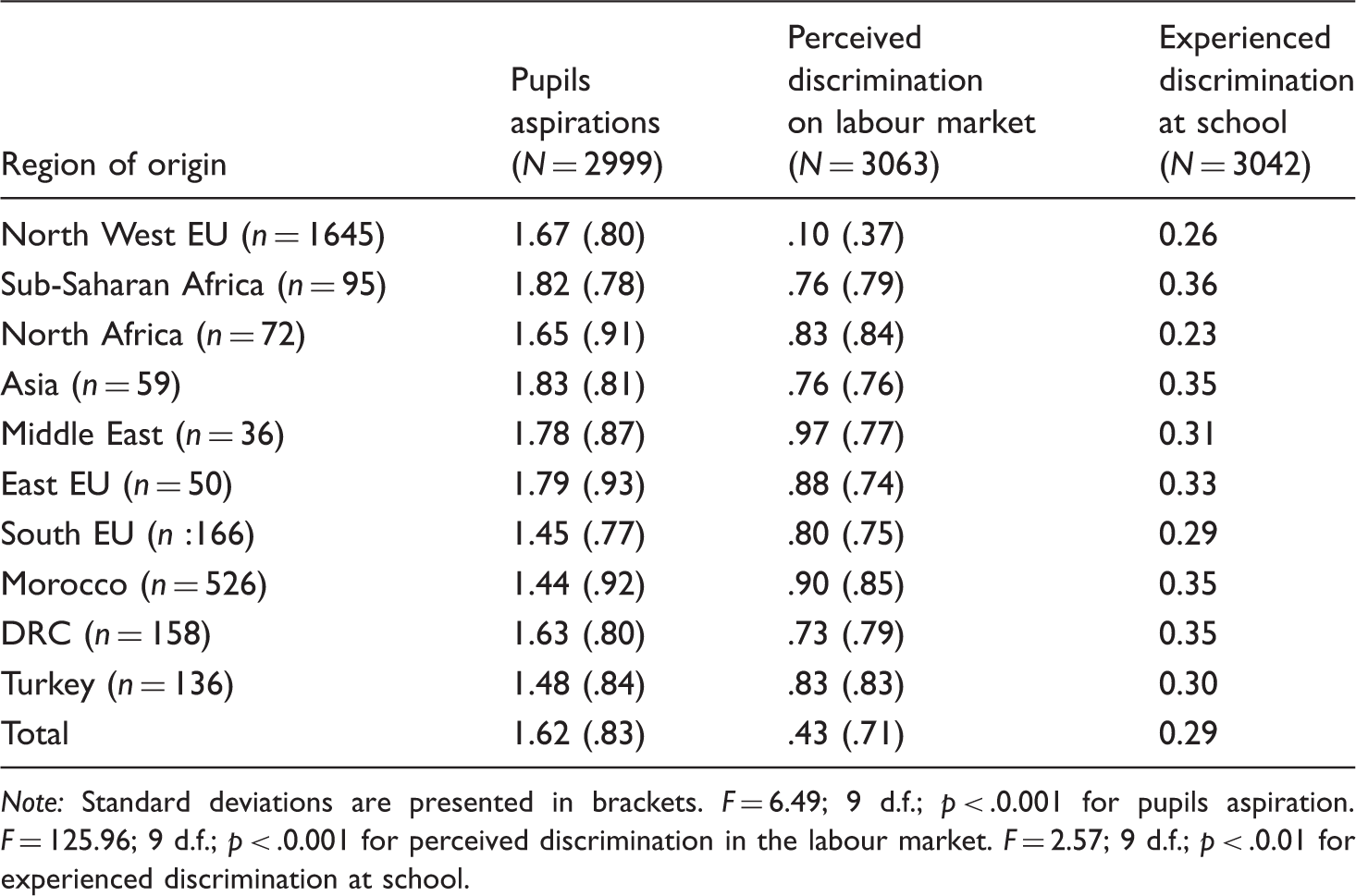
Note: Standard deviations are presented in brackets. F = 6.49; 9 d.f.; p < .0.001 for pupils aspiration. F = 125.96; 9 d.f.; p < .0.001 for perceived discrimination in the labour market. F = 2.57; 9 d.f.; p < .0.01 for experienced discrimination at school.
Explanatory variables
Ethnic origin of pupils is measured with the mother’s country of birth. The main immigrant groups in Belgium (Congolese, Turks, Moroccans) are well represented in the data and can be treated as separate ethnic categories. However, the 92 other-origin countries need to be regrouped into larger categories with a sufficient size for the statistical analysis. We use the United Nations Statistics Division classification to regroup the 92 other countries of origin by regions. In total, we can differentiate between 10 categories of origin: Sub-Saharan Africa (except DRC) (3.1%); North Africa (except Morocco) (2.4%); Asia (except Turkey) (2.0%); Middle East (1.2%); East Europe (1.8%); South Europe (5.5%); Morocco (17.7%); DRC (5.3%); Turkey (4.6%); and North West EU (reference category; 53.7%). 2 Moreover, ethnic minority youth born in Belgium will be differentiated from those born abroad: among pupils whose mother was born in a non-North West EU country, 29.4 percent were not born in Belgium.
The item measuring the perception of ethnic discrimination in the labour market is: ‘If a company has to choose between a job applicant of foreign origin and a Belgian one (i.e. someone whose parents and grandparents were born in Belgium), which of these two applicants – who have exactly the same characteristics – will the company select?’ The item was administered with a five-point Likert scale: ‘Surely the applicant of foreign origin’; ‘Probably the applicant of foreign origin’; ‘There won’t be any difference’; ‘Probably the Belgian applicant’; ‘Surely the Belgian applicant’. The item was crossed with a dummy on the country of birth of the mother (either North West Europe or another country). This crossing was useful to construct a variable measuring the perception of discrimination in the labour market against the own group (either the immigrant population or the majority group). The construction of this variable was done as follows: pupils who answered that ‘surely their own group will be discriminated against’ received a value of 2. Those who responded ‘probably their own group’ received a value of 1 and those who answered that their own group will not be discriminated against received a value of 0. The variable ‘perception of discrimination in the labour market’ was introduced with dummies in the statistical analysis.
Next to the perception of discrimination in the labour market, we will also test whether personal experience of discrimination at school affects their aspirations (measured with a dummy: ‘During the previous year, have you ever been treated unequally or discriminated at school?’). 3 As can be seen in Table 1, perceived discrimination in the labour market has a significantly higher mean among ethnic minority youth than among North West EU pupils, while almost a third of the pupils from both the majority and ethnic minorities experienced discrimination at school at least once last year.
Ethnic differences on educational aspirations and the explanatory power of the perceived discrimination in the labour market and experienced discrimination at school will be assessed while controlling the effect of socio-demographic variables that arguably influence aspirations, including gender (Brinbaum and Kieffer, 2005), educational achievements (Cooper, 2009; Mello, 2009) and socioeconomic status (Bohon et al., 2006; Van De Werfhorst and Van Tubergen, 2007).
Female (56.7%) is the reference category for gender. Pupils’ educational achievements are measured by their education tracks (general, reference category: 55.9%; technical: 31.4%; vocational: 12.8%) as well as by a dummy referring to whether or not they repeated a grade (49.9% did not repeat a grade; reference category). The socioeconomic background (and capital) is approximated by the mother’s education degree (low-education degree, reference category: 16.5%; middle education degree: 35.0%; high education degree: 41.1%), whether the father is working (81.3%; reference category) and whether parents are involved in pupils’ education (‘parental control’). The latter is measured with the following item: ‘does at least one of your parents know your school notes?’ with a five-point Likert scale ranging from always (0) to never (4) (M: 0.95; SD: 1.12).
Results
Regression results on pupils’ aspirations (controlling for school variation).
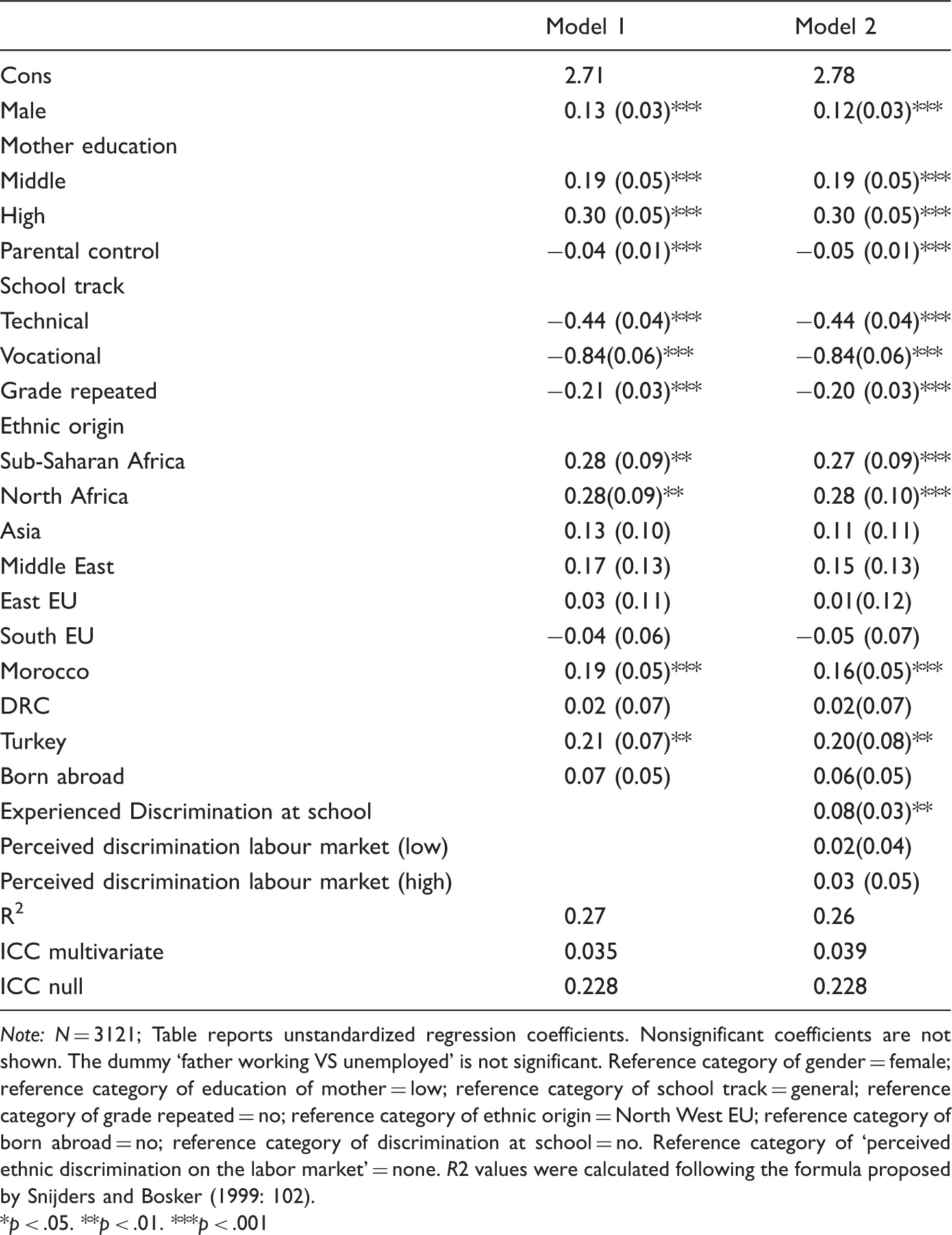
Note: N = 3121; Table reports unstandardized regression coefficients. Nonsignificant coefficients are not shown. The dummy ‘father working VS unemployed’ is not significant. Reference category of gender = female; reference category of education of mother = low; reference category of school track = general; reference category of grade repeated = no; reference category of ethnic origin = North West EU; reference category of born abroad = no; reference category of discrimination at school = no. Reference category of ‘perceived ethnic discrimination on the labor market’ = none. R2 values were calculated following the formula proposed by Snijders and Bosker (1999: 102).
p < .05. **p < .01. ***p < .001
Pupils from only four out of the nine ethnic minority groups have higher educational aspirations than the majority group. Pupils whose mother was born in Sub-Saharan and North Africa, in Morocco or in Turkey show higher aspirations than their peers from North West EU, all other things being equal. Thus, ethnic differences on pupils’ aspirations cannot be generalized to all ethnic minority groups of our sample, contrary to the results of Jonsson and Rudolphi (2010). Pupils from Asia, the Middle East, East EU, South EU and the DRC have similar aspirations and expectations to the majority group. Pupils’ country of birth (either Belgium or abroad) does not affect their aspirations. This first model explains 27 percent of the variance of pupils’ aspirations.
After having assessed ethnic differences on aspirations, let us now have a look at the power of perceived ethnic discrimination in the labour market and personally experienced discrimination at school in explaining ethnic differences in educational aspirations. These two variables have been added in a second step to the model and the results are presented in Model 2 of Table 2. First of all, and contrary to the hypothesis on perceived ethnic discrimination in the labour market, the perception that the own group is unequally treated in the labour market is not significantly associated with educational aspirations. In addition, perceived ethnic discrimination in the labour market cannot account for ethnic differences in aspirations: the ethnic origin coefficients do not decrease in Model 2. Moreover, interaction terms between perceived discrimination in the labour market and ethnic origin are non-significant (not shown). Our quantitative results suggest that, even if most of ethnic minority pupils perceive ethnic discrimination in the labour market (see Table 1), they do not associate it with their own educational aspirations. The relationship between the perception of ethnic discrimination in the labour market and educational aspirations among ethnic minority youth will be further explored in the qualitative section.
Lastly, the personal experience of discrimination at school during the previous year has a significant impact on pupils’ aspirations: pupils who personally experienced discrimination at school at least once during the previous year have significantly higher aspirations than their peers without any experience of discrimination at school. This corroborates the findings of St-Hilaire (2002). This being said, this variable explains neither ethnic differences in educational aspirations nor any additional amount of the total variance of pupils’ aspirations.
Focus on the relationship of perceived ethnic discrimination with educational aspirations: A qualitative analysis
The previous results do not provide much support for the hypothesis of perceived discrimination in the labour market. Let us then have a look at the accounts of pupils on their educational aspirations to further investigate the complex relationship between their perception of ethnic discrimination in the labour market and their own educational aspirations. Recall that our qualitative sample is not randomly selected, but is composed of young people in their last school year coming on average from a low socioeconomic background and having followed the general track. This section is structured in three parts: the first one focuses on ethnic minority youth’s perception of ethnic discrimination, while the second highlights the arguments they used to justify their educational aspirations; the third part focusses on our control group of pupils from the majority and their arguments justifying educational aspirations
Perception of ethnic discrimination
As already mentioned, even if ethnic minority youth perceives ethnic discrimination in the labour market, this cannot statistically explain why youngsters from some ethnic minorities have significantly higher education aspirations than the majority. A more in-depth analysis of the perceptions of different kinds of discrimination among ethnic minority youth sheds light on the non-significant association between perceived ethnic discrimination in the labour market and educational aspirations.
During the interviews, when discussing discrimination, ethnic minority youth did not spontaneously mention discrimination in the labour market but talked to a large extent about general stereotypes and discrimination by the police against their own group. Perception of discrimination in the labour market did not constitute an important aspect of ethnic minority youth’s representations on ethnic discrimination. Actually, the entire labour world did not play an important role in their accounts. It appeared to be too far away from their immediate lives, which revolved mainly around school, friends and families. It is therefore unlikely that the perception of ethnic discrimination in the labour market affects ethnic minority youth’s actions for or representations of their professional future. Moreover, even when the interviewees perceived ethnic discrimination in the labour market, they did not relate it to their own aspirations and educational projects. As an illustration, the following quote is from one of the few interviewees (N) who spontaneously mentioned ethnic discrimination in the labour market: N : Yes, it’s true when we’re strangers or when we’re Belgian. For example, I don’t know, if I’ve the same diploma as you for example and if I apply somewhere, well…. I don’t know…. You’ll maybe be taken for the job because you’ve a Belgian name and that my name’s Ali or so…. Well anyway…. Interviewer: But it does not make you lose your motivation to study or to find a job? N: No. Well I’ll do my best to have a degree and then if I don’t find a job it’s something else. It’s another story.
Perception of ethnic discrimination appears more in Muslims’ accounts among both girls and boys than in those of non-Muslim ethnic minority youth. 4 This is in line with the findings of Jacobs and Rea (2008) based on a sample of Brussels youth: they showed that the ethnic minority groups who suffered the most from mistrust from the majority were the populations of Moroccan and Turkish origin. Members of these groups are not only stigmatized because of their foreign origin, but also because of their attributed religious belonging. In the interviews, the type of stereotypes mostly mentioned by the youth of Muslim origin relates to the fact that Muslims are too often equated with offenders or criminals. According to interviewed young Muslims, this kind of prejudice against their religious community is widespread among the general population. Moreover, most of them reported personal experiences of that kind of prejudice and related discrimination, such as abusive arrests or identity control undertaken by policemen.
Nevertheless, interviewed Muslims agreed to some extent with this type of prejudice against their own religious community. In their opinion, a part of the Muslim youth was fostering the stigmatization of the whole Muslim community. They characterized these young Muslims as youngsters who ‘hold the walls’ (i.e. inactive youngsters who spend their time on the street). Interviewed young Muslims differentiated themselves from these peers considered as responsible for the spread of some negative characteristics against the Muslim community. This quote from an interviewee illustrates this orientation: Yes it’s said in the Religion, God likes workers, educated people who know science, who know this knowledge and where it comes from. But them [ndl: other young Muslims] they’re there all day long; they hold the walls with their cigarettes. They do nothing. […] they haven’t looked at what is the religion spirituality. […] I’d say I understand better the sense of the religion than them. I better understand the meaning of Islam than those guys.
This differentiation process can shed light on the non-significant association between perceived ethnic discrimination and educational aspirations. The interviewed young Muslims – who had a successful school trajectory and high education aspirations – recognized that ethnic discrimination did exist in Belgian society and that they had even personally suffered or might suffer from prejudice against Muslims. However, they did not think this could prevent them from realizing their aspirations. On the contrary, they shared the meritocratic opinion that if one really wanted to succeed in something, one would succeed in it. In expressing this meritocratic viewpoint the interviewees explained that their school career had been until now successful because they were working hard and did their schoolwork and homework conscientiously. By doing so they distinguished themselves from youth attending the technical and vocational tracks, who were considered by the interviewees as lazy. In the construction of their own aspirations, societal factors such as generalized discrimination or prejudice against their group did not play an important role given this meritocratic conception of success. By contrast, personal experience of discrimination in the educational system seemed associated with higher aspirations, as our quantitative findings had already shown. Thus, the distinction between the awareness of generalized societal discrimination against the own group and the effective experience of personal unequal treatment within an institution that is highly relevant for their educational aspirations is important to understand educational aspirations among ethnic minority youth.
Justifications of educational aspirations among ethnic minority youth
We showed that the perception of societal ethnic discrimination (in the labour market or more broadly within the society) did not seem to be decisive for interviewed ethnic minority youth in their decision process about their educational future because of their meritocratic conception of success. It is now necessary to outline the arguments put forward by ethnic minority youth to justify their educational choices and especially to explain why they wanted to get a tertiary education degree.
Some of these justifications are similar to those identified by Zeroulou (1988) among Muslim ethnic minority youth in France: educational success or choices among ethnic minority youth have to be understood to some extent through the perception of their family’s migration projects. Two types of justification are put forward by ethnic minority youth with regard to their educational aspirations. Based on these two types of justification, interviewees can be regrouped into two distinct clusters. These clusters are not mutually exclusive: they are based on the main argument given by interviewees to explain their aspirations. In other words, in some accounts youngsters used both types of arguments to justify their aspirations.
Youngsters belonging to the first cluster wanted to attend a tertiary education curriculum in order to please their parents and to ‘return them all the sacrifices they have done for their children’. They wanted to pursue tertiary education study in order to prevent their parents from being disappointed, as their parents had left their country of origin to ‘give family members more chance’ and to provide educational opportunities to their children. The following quotes illustrate this analysis: I want to go to university also because, I have, well, I’d say not a weight on my shoulders, but my father has given everything so that his children could study. He sacrificed himself and he started to work at the age of 12 […] He said: ‘I don’t want my children go through this step; so I want my children go to university.’ School is really a serious thing for my mum. She says, she says: ‘If it wasn’t for that I wouldn’t have left Congo to come here with you. I came here in order for you to have a good life and to study because there I don’t know which life you would have had, but I came here only for school.’
In this first cluster, the interviewees’ high aspirations were part of a long-term family project. This project consisted in not having to work too young and to receive a good education in order to have a ‘good job’.
In contrast, ethnic minority youth belonging to the second cluster did not spontaneously refer to their family’s migration to justify their educational aspirations. The justification here was entirely individual. In this cluster, the interviewees explained their future educational choices by putting forward their own personal interests for specific topics. For example, one youngster explained that he wanted to study economics because he likes attending economics classes in his secondary education. Another boy explained that he wanted to pursue a degree in communication for the following reason: since I was eleven or twelve years old I have liked to write so I write just like that, I read also. […] I know I want to do that because I do not see myself elsewhere.
In this second cluster, educational aspirations were not seen in terms of intergenerational social mobility but rather in terms of a personal project of self-expression and realization. Attending tertiary education study was a straightforward decision among ethnic minority youth of the second cluster because they did not conceive of any other alternatives in their life trajectory. Tertiary education was then considered as the most logical step in their educational career. The following quote illustrates this point: I want to say I haven’t done six years of general track for in the end stopping studies, going to work and getting a 1200 euros salary.
Interviewees of the second cluster concentrated their attention on the content of the tertiary study they wanted to attend. It had to reflect who they were. This being said, they did not seem to have a clear idea on their professional future: they still did not know what kind of job they wanted to do. On this point both clusters were similar: the professional future remained unclear whatever the justifications of the educational aspirations were.
These qualitative findings are consistent with literature detailing high educational aspirations of ethnic minority youth. According to Louie (2001) concerning Chinese immigrant families in the USA, or according to Shah et al. (2010) on British Pakistani families, analysing aspirations implies taking into account not only socioeconomic factors but also ethnicity, gender, religion and parent–child relations. These authors show that immigrant families all share high educational aspirations that are components of their upward social mobility project. These perceptions do not vary across social classes, even if middle-class immigrant families possess more resources and develop more strategies to transform their aspirations into actions (Louie, 2001). In line with these authors, our findings suggest that minority youth aspiration is a multidimensional phenomenon – it cannot be explained by a single factor.
Justifications of educational aspirations among Belgian youth
Justifications of educational aspirations of the five pupils without an immigrant background of our sample are similar to the second cluster of ethnic minority youth’s discourses: aspirations appeared to be linked to personal interest in specific topics. Indeed, pupils from the majority in our sample thought it was necessary to choose studies linked to their passions and hobbies. In this sense they insisted on the content of courses they wished to pursue and on the future job their degree would lead to. Here the discourses clearly mentioned concrete professional perspectives in contrast to the two clusters of minority youth who were quite uncertain in this respect. In other words, Belgian pupils in our sample had aspirations about a specific kind of job they wanted get in the future. This job had to be linked to their ‘passion’. The type of degree they were about to choose was supposed to lead them to their dream job: I would like to perform theatre because I really like it. Next year I will attend a private school that prepares for the conservatoire. It is a well-known school with good reputation. It provides a specific approach on the subject and that really interests me. I have always loved people looking at me when I am on stage and this is the reason why I really want to do artistic studies with a good level.
Therefore, among youth from the majority, we found similar types of justification to those in the second cluster of ethnic minority youth. That is, the majority youth explained their future educational choices by putting forward their own personal interests for specific topics. By contrast, none of the five interviewees from the majority mentioned aspirations their parents had for them or any intergenerational upward mobility project within their family. Within the limitations because of the small number of interviewees from the majority, it seems that the justifications related to the intergenerational social mobility project (cluster 1) are expressed only by ethnic minority youth.
Discussion
In order to better understand the process underlying ethnic education inequality, research should not only focus on the analysis of ethnic disparities in primary effects, but also in secondary effects. Indeed, possible ethnic disparities in educational aspirations and choices, as well as in the process leading to these educational choices, might be important components in comprehending ethnic education inequality. This contribution has hopefully contributed to a more encompassing understanding of these components.
First of all, the statistical results of our contribution showed that only pupils from four out of the nine ethnic minority categories in our sample (Turkey, Morocco, Sub-Saharan Africa and North Africa) held significantly higher aspirations than pupils from the majority group by controlling for gender, socioeconomic status (SES) and school achievement. The discrepancy between ethnic minorities and the majority in their educational aspirations often reported in the European empirical literature should be definitely put into perspective: not all ethnic minority groups do significantly differ from the majority in their educational aspirations. Future empirical research on ethnic disparities in secondary effects should therefore pay more attention to the diversity of ethnic minorities comprising the school population of the receiving society and to possible contrasted results with regard to the origin of ethnic minorities.
Our mixed-method approach shed light on the positive association between ethnic origin and educational aspirations and the possible role of perceived discrimination in it by controlling for the usual socio-demographic characteristics. Contrary to what could be expected from the theoretical literature, the power of perceived ethnic discrimination in the labour market in explaining ethnic differences in aspirations was not confirmed. Our quantitative results showed that, even if ethnic minority youth did perceive significant ethnic discrimination in the labour market, they did not relate this perception to their own educational aspirations. The association between educational aspirations and perception of ethnic discrimination in the labour market was not significant. In addition, qualitative interviews of ethnic minority youth in the general track with high aspirations showed that they did not spontaneously mention ethnic discrimination in the labour market when justifying their educational aspirations and representations of their professional future. Rather, their representation of professional and educational success could be defined as meritocratic. They did not consider that ethnic discrimination could restrain them from achieving their own aspirations.
While our results do not support the perceived ethnic discrimination hypothesis in explaining ethnic differences in aspirations, the quantitative part of this contribution indicated another determinant of youth educational aspirations. Personal experienced discrimination at school did indeed significantly affect pupils’ aspirations, even if it could not explain why some ethnic minority youth have higher aspirations than their peers. It seems, thus, that discrimination can be significantly associated with educational aspirations. Nevertheless, the discrimination variable that significantly affected pupils’ aspirations in our results is a measure of personal experienced discrimination and not of perceived group-level discrimination. Social psychology studies can provide insights on the differentiated impact of our two discrimination measures on pupils’ aspirations. For instance, Stroebe et al. (2009) showed that group disadvantage was seen as an indicator of unjust treatment only by group members who themselves had been personally affected by negative treatment. This would mean that ethnic minority youth who have experienced only success in their educational trajectories would unlikely relate their perception of ethnic discrimination at the group level (i.e. their ethnic group) to their own personal outcomes and projects. By contrast, youth who personally suffered from unequal treatment in their education trajectories would be more likely to take into account this kind of unequal treatment in the construction of their own aspirations. The fact that Turkish, Moroccan or North African minority youth hold higher aspirations than the majority might be linked to the large stigmatization of Muslim ethnic minority groups within the majority population. The qualitative analysis showed that Muslim interviewees were mainly the ones who spontaneously mentioned the stigmatization of their religious community by the broader society. Thus, even if perceived discrimination in the labour market was not salient for their own aspirations, the more general and abstract feeling of stigmatization might well play a role.
This means that the process leading to youth’s educational choices cannot be translated into simple mechanisms from cause to effect: ethnic discrimination might indeed play a role in ethnic minority youth’s aspirations, but this role cannot be reduced to the causality effect stated in the perceived ethnic discrimination hypothesis. In order to better grasp the impact of ethnic discrimination on educational aspirations, future research should strive to encompass the complexity of perceived and experienced personal and group-level ethnic discrimination as well as its differentiated possible consequences highlighted in the social psychology literature. Such an interdisciplinary approach would without doubt broaden our current understanding of ethnic differences in secondary educational effects.
If ethnic differences in aspirations cannot be satisfactorily explained by the hypothesis of perceived ethnic discrimination, what else could help explain them? Ethnic differences in aspirations may be further interpreted in the light of the parental transmission of the intergenerational upward mobility project to their children discussed in the introduction. Although we were not able to statistically assess this hypothesis, our qualitative findings do support it to some extent: the high educational aspirations of at least some ethnic minority youth following the general track are closely linked to the intergenerational social mobility project of their parents. When justifying their personal aspirations, some interviewees did indeed refer to the sacrifice their parents had made through their migration project in order to provide them with better social mobility opportunities. Among ethnic minority youth with high aspirations, the awareness of the intergenerational social mobility project of their parents and the willingness to pursue it play, without doubt, a role in the construction of their aspirations and career choices. As a consequence, the parental transmission of the intergenerational mobility project turns out to be a promising explanation for ethnic differences in educational aspirations, which seems to be more powerful than the hypothesis of perceived discrimination in the labour market tested in this article. Our article clearly shows that the process of educational aspirations was quite complex and that a single methodological perspective was not sufficient to unravel it. Many of the hypotheses put forward by researchers need further investigation to be confirmed and appropriate methodology is needed to disentangle the different factors at stake in the formation of educational aspirations. Our mixed-method analysis appeared to be a particularly relevant approach for the interpretation of complex processes as well as for the launch of a new research agenda.
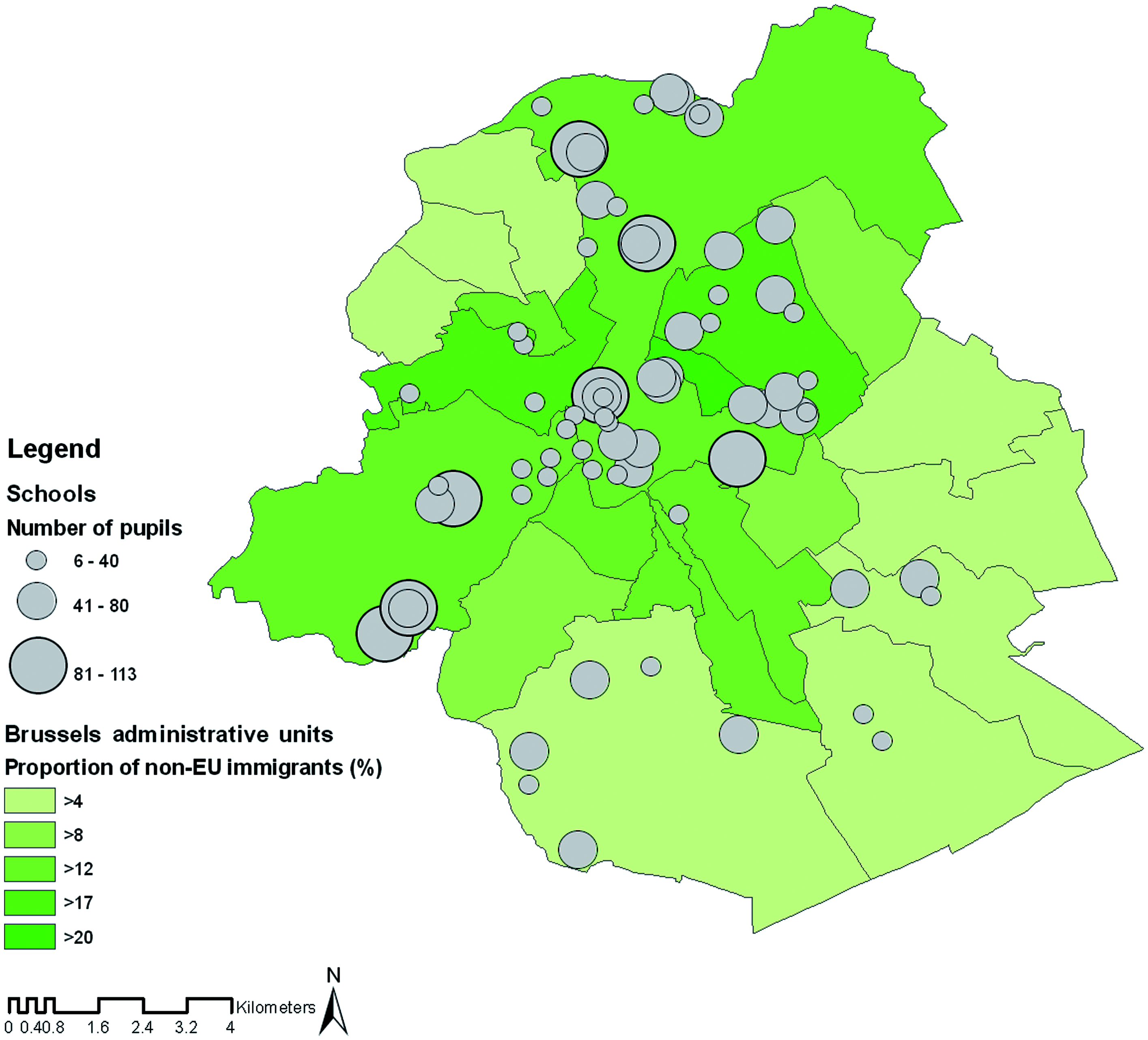
Location of participating schools for the quantitative sample in relation to the proportion of non-EU immigrants in Brussels municipalities in 2006.
Footnotes
Acknowledgements
The data analysed in this article are part of a survey funded by Prospective Research in Brussels, the FRS-FNRS and the Université libre de Bruxelles.