



Abstract
Studies of secularization suggest it is a complex and multidimensional process and that secularization unfolds in different sets of identities, practices and values. But, in spite of its non-linear and non-coherent character, secularization it is not necessarily arbitrary and individualistic. Rather, as this work demonstrates, ethnic groups may be influenced by similar secularizing forces, but the impact of these forces will be different and different paths of secularization will take place. In this work, based on a survey conducted in March 2009 of a representative sample of the adult Jewish population in Israel, we study three major ethnic groups in Israel to demonstrate how ethnicity influences the process of secularization measured in beliefs, practices and attitudes. Our findings demonstrate that ethnicity creates distinct paths of secularization with different changes of practices, beliefs and values. While for some ethnic groups secularization happens alongside a significant change in beliefs, practices and behaviors, for others religion remains significant and secularization is more partial, especially when measured in liberal values.
Recent studies of secularization suggest it is a complex and multidimensional process rather than a linear progression in which religion disappears (Chaves, 1994; Dobbleare, 1981; Lechner, 1991; Norris and Inglehart, 2004). While some scholars provided evidence that secularization is not occurring and religious belief remains strong (Stark and Finke, 2000), others argued that secularization is about declining religious authority, not belief (Chaves, 1994) and that secularization unfolds unevenly through different changes of belief, practices and participation (Dobbelaere, 1981). However, if secularization is a process, underscored by changes in society, in spite of its non-linear and non-coherent character, it is not necessarily arbitrary and individualistic. Rather, as we argue in this paper, ethnic identities can create different paths of secularization. Religious and ethnic identities were found to interact either when ethnic identities form around religion or when religious identities are essentially ethnic and have little religious content (Gans, 1994; Mitchell, 2006; see also: Greeley, 1976; Hammond, 1988; Sandberg, 1974). In many contexts, there is a two-way relationship between religion and ethnicity (Mitchell, 2006). Consequently, secularization may unfold in distinct patterns contextualized by ethnicity so that ethnic groups secularize in different forms of belief, practice and changes of attitudes.
In this work, based on a survey conducted in March 2009 of a representative sample of the adult Jewish population in Israel, we examine how ethnicity influences the process of secularization measured in identities, practices and attitudes. In Israel, unlike many democracies, there is no separation of church and state. Israel has been described as a ‘non-liberal democracy’ because of the monopoly of Orthodoxy over Jewish religious life, entrenched anti-liberal and ethnocentric attitudes in society, and various discriminatory practices towards minorities (Ben-Dor et al., 2003; Sagiv-Shifter and Shamir, 2002). But, in the last two decades, religion seems to have lost some of its hold over public life and secularization of the public sphere can be observed in the proliferation of non-kosher restaurants and food shops, an annual, crowd-drawing gay parade and the rapidly growing commercial activity on the Sabbath (Saturday in Israel). This secularization, however, is matched by remaining strongholds of the Orthodox monopoly, resurgence of religion in different forms, and limited commitment to the liberal values of tolerance and equality (Ben-Porat and Feniger, 2009).
Israeli society, like many other societies, displays mixed signals of religiosity and secularity that defy attempts to place individuals, groups and society at large on a continuum from ‘religious’ and ‘secular’ and to delineate a linear course of ‘secularization.’ Surveys and studies of Jewish religiosity in Israel depict a complex picture of beliefs, practices and values. While religious Orthodox Jews and committed secularists demonstrate a more or less coherent pattern, the majority of Israelis show different levels of belief and attitudes and a selective choice of practices and rituals (Levy et al., 2002). Beliefs, practices and values, however, are not entirely arbitrary but rather, as we demonstrate below, unfold in patterns molded by ethnicity. In this study, we examine different aspect of secularization in three major Jewish ethnic groups – Ashkenazim (of European descent), Mizrachim (of Middle East or North African descent) and immigrants from the Former Soviet Union (FSU) – in order to understand how secularization unfolds in each one of them. By a comparative study of these three major ethnic divisions of Israeli Jewish society, we can discern different paths of secularization, measured in secular identities, practices, beliefs and liberal values.
Secularization – Theoretical overview
Secularization is a complex process influenced by ideological perceptions, political struggles, demographic changes and the evolution of a market economy. Taken together, these factors create new opportunities, incentives and constraints for individuals and, consequently, different paths of secularization. Not all of these paths are evident in explicit individual commitments, planned political action or formal societal changes. Religious ideas and practices may be present even when they are neither theologically pure nor socially insulated (Ammerman, 2007: 6). Similarly, even those who may be considered secular often maintain have at least some religious beliefs and engage in some religious practices. Thus, secularization must be refined and studied according to its different analytical distinctions and the context where the process unfolds.
Both the concept and the implications of secularization have been extensively debated in recent decades. Secularization refers to a process in which religion loses significance in the operation of the social system and its overarching claims of truth and authority are challenged. In this process a general disengagement from churches and a subordination of religious values to secular agendas is expected as society adopts a rational and utilitarian basis for its decisions (Wallis and Bruce, 1989; see also Shiner, 1967). In the political sphere, secularization entails the separation of church and state and the retreat of religion to a private world where it has authority only over its followers (Bell, 1980; Dobbeleare, 1981). The ‘secularization theory’ that developed in the middle of the twentieth century argued that secularization is linked to the wider social process of modernization, industrialization, urbanization and rationalization, a process that inevitably diminishes religion's role in both the private and public spheres (McClay, 2001; Norris and Inglehart, 2004). Scholars also argued that the separation of church and state was the foundation of a democratic society based on liberal values that include a commitment to individual rights and tolerance (Bruce, 2002; Keane, 2000; Sartori, 1995; Waltzer, 1984).
Contrary to the expectations of the secularization theory, religion remained a significant factor in politics and society (Casanova, 1994; Hadden, 1987; Stark and Finke, 2000). Critics of the secularization theory blamed it for imposing the secular worldview of scientists and ignoring data refuting the claims that religion was declining (Stark and Finke, 2000: 62). Thus, even if in its initial phases modernization was linked with the decline of church authority, in the longer run religious beliefs and institutions proved resilient and religion re-emerged as a vital force in the new world political order (Hadden, 1987; Inglehart and Baker, 2000). Secularization, however, cannot be entirely dismissed, as some evidence does point to the erosion of religion. Churches in Europe and America are facing a downward trend, and a significant growth in the number of Americans who describe themselves as non-religious was recorded in the past two decades (Kosmin and Keysar, 2009; Voas and Crockett, 2005; for a defense of secularization theory see: Bruce, 2011). These changes can be attributed, among other things, to an expanding consumer culture indifferent to, or intolerant to, religious restrictions (Barber, 1992) and a secularization that may occur ‘involuntarily as an autonomous and largely endogenous process and as an unintended and perhaps unanticipated consequence of that more fundamental process of change’ (Wilson, 2001: 39).
Attempts to measure secularization have sought to disaggregate the process and examine the authority of religious institutions, their changing nature and the decline of religious beliefs separately (Chaves, 1994; Dobbelaere; 1999; Norris and Inglehart, 2004). What underscores these measurements is the understanding that secularization is not a uniform process and that its pace, form, motivating forces and outcomes depend also on specific, local conditions (Lechner, 1991). Measurements of secularization in many cases reveal not a linear and universal process but a bricolage (Dobbelaere, 1999) or a hybrid form of beliefs, practices and values. These forms, however, are not necessarily arbitrary or individual and can be embedded in local structures and mediated through other identities. Several studies established the relation between religion and ethnicity. Scholars have argued that many religious identities are actually ethnic in nature and have little actual religious content (Gans, 1994; Mitchell, 2006; see also: Greeley, 1976; Hammond, 1988; Sandberg, 1974).
Based on a common heritage (real or assumed), ethnicity involves some combination of language, shared territory, elements of a common culture, physical appearance and religion. Religion, religious identity and religious behavior, accordingly, relate not only to the supernatural, traditional orthodoxy or regular religious practice (Mitchell, 2006) but can also be part of an ethnic identity. As part of an ethnic identity, religion provides a sense of ‘primordial continuity’ (Demerath, 2000) often loosely connected to ‘formal’ religious content. However, as Mitchell (2006) notes, religion is not merely an ethnic marker: ‘It is not simply a one-way relationship where people use religion to legitimize boundaries that are already there; religious beliefs themselves may partially constitute the boundaries’ (2006: 1144). Religion provides ideological concepts that blend with cultural and historical contexts and is adopted even by members of the ethnic group who are not religiously devout or even partially secularized and, consequently, its decline, even in secularized societies may be limited or partial (Sharot et al., 1986).
Ethnic assimilation, for example, often parallels religious secularization (Hammond and Warner, 1993) but religion may remain significant in different ways and re-surface. Thus, when religion is embedded in ethnic identities, secularization will unfold not only through individual choices and personal biographies but also through collective identities influencing changes of beliefs, rituals and values. Based on the above, we argue, first, that secularization is an uneven process that unfolds in hybrid forms of beliefs, practices and values. Yet, second, ethnicity provides a framework within which secularization occurs and influences the formation of hybrid, but not arbitrary, paths of secularization. And, consequently, third, while ethnic groups may be affected by similar secularizing forces those forces have different impacts and translate to different paths of secularization.
Israel: Religion, secularization and democracy
Tacit agreements between the religious and secular communities in Israel, known as the ‘status quo,’ have faced considerable challenges in recent years in light of demographic and economic changes in the country. The status quo arrangements were designed to ensure the cooperation of the religious community in the pre-state and early statehood period and included measures that had an increasingly significant effect on the everyday life of all Jewish citizens, religious and secular. The status quo had a direct effect on the lives of secular Jews, especially in light of the changes Israel has gone through since the 1990s. The designation of Saturday, the Sabbath, as the day of rest, with the mandatory closing of stores and public services, the required observance of Jewish dietary rules (kashrut) in public institutions and the Orthodox monopoly over burial, marriage and divorce have all became points of contention between religious and secular Israeli Jews.
Three developments were central to the challenges to the status quo and underscored the secularization of Israel. The first was the growth of ideological secularism and non-Orthodox Judaism that aimed to weaken the Orthodox hold over public life. This secularism associated itself with liberal and humanistic values and wanted to end the status quo. It promulgated a world view that included civil rights, equality, freedom and a desire to integrate Israel into the liberal Western world (Kimmerling, 2004; Malkin, 2000: 12). Politically, it expressed itself in demands to end the Orthodox monopoly over marriage and burial. The second development was Israel’s transformation into a Western-style affluent society, open to foreign cultural influences and deeply engaged in consumption. Thus, Israelis became more hedonistic and less willing to accept religious and other restrictions on everyday life. Therefore, consuming non-kosher food or shopping on the Sabbath became an option more and more Israelis took advantage of. The third development was a demographic change due to the migration in the 1990s of one million secular, or many cases, non-Jewish (according to Orthodox Jewish law) immigrants from the FSU to Israel. The demand of veteran Israelis for civil marriage was strengthened by the large number of non-Jewish immigrants who could not be married by the Orthodox rabbinate. In a similar vein, the demand of secular Israelis for non-Orthodox burial ceremonies was strengthened by the needs of non-Jewish immigrants. Secularization, however, like elsewhere, is matched by opposite tendencies of religious revival or return to religion. In addition, the high birth-rate among the ultra-Orthodox ensures their continued significance in Israeli society and politics.
The categories of ‘secular’ and ‘religious’ capture only part of the complexity of religious–secular life when measured in beliefs, practices and values. Seventeen per cent of Israelis define themselves as ‘religious’ and ‘ultraorthodox’, 35% and 43%, respectively, define themselves as ‘traditional’ and ‘non-religious’ and 5% as ‘anti-religious’ (Levy et al., 2002). The category of traditional (or, in some surveys ‘non-religious’) refers to a flexible position with regard to beliefs and practices. Those who see themselves as belonging in this category have a positive view of religion but do not follow many of its commandments (Liebman and Yadgar, 2009). Significant rituals are observed by the majority of Israelis, including those in the ‘non-religious’ category, more demanding and restricting observance is limited to those who define themselves as religious (Levi et al., 2002). Finally, practices that defy religious authority, especially those related to the economic changes described above, are not necessarily related to a liberal worldview and to tolerance (Ben-Porat and Feniger, 2009).
Secular and religious Jews have major differences of opinion about the role of religion in private and public life that translate to political tensions and struggles (Etzioni-Halevy, 2000; Katz, 2008; Kimmerling, 1999; Shelef, 2010). Secular principled struggles, however, capture only part of the impact of secularization. A ‘secularization of everyday life,’ drawing on the economic and demographic changes described above, has a no less significant influence, even if not registered in formal political changes, on individual choices and identities, consequently, on the public sphere (Ben-Porat and Feniger, 2009). This secularization is fractional, especially when measured in liberal worldviews and tolerance, not necessarily following the changes in everyday life (Ben-Porat and Feniger, 2009).
The disconnect between secularity, measured in practices of everyday life, and liberalism, measured in commitment to equality and tolerance, is significant for understanding secularization in Israel. Israel has been described by several scholars as an ‘illiberal democracy’ (Ben-Dor et al., 2003; Sagiv-Shifter and Shamir, 2002) with significant consequences for the status of women, homosexuals and especially Arab citizens of the state. This last group has been identified as the least popular group in Israel, so the treatment of Israeli Arabs is an important test case for liberalism and tolerance (Sagiv-Shifter and Shamir, 2002). The preference for Jews over non-Jews in Israel is anchored in laws that deal with immigration, the use of state land and semi-governmental institutions as well as in Israel’s basic laws that underscore the Jewish character of the state (Smooha, 1992; Rouhana, 1998). In terms of public perceptions, the vast majority of Jewish citizens refuse to compromise on the status of Israel as a Jewish state and many perceive Arabs as potential or actual enemies and as part of the larger Israeli–Arab and Israeli–Palestinian conflict.
Secularization in Israel in the last two decades is influenced by three developments – principled struggles, economic growth and demographic changes – and unfolds in three measureable changes. First, changes in belief systems, away from religion towards a more secular approach. Second, changes in religious practices, that are either the result of the result alternative ways of life and choices that defy religious authority or of choices related to the development of a consumer society that contradict religious restrictions. Finally, secularization involves the adoption of liberal principles over the role of religion in public life and, possibly, to a lesser extent, wider liberal commitment for minority rights. These changes are, to a large extent, independent as the hybrid forms of secularization demonstrate. Yet, they are not entirely arbitrary and individual but rather molded by ethnicities and the distinct relations between ethnicity and religion.
Secularism, religiosity and ethnicity in Israel
Religion continues to play a role in the lives of many Jewish Israelis, religious and non-religious. This role can range from belief systems to religious practices (most important for evaluating Jewish religiosity) or the preference for religious values over liberal values. The changes described above provide Jewish Israelis with new dilemmas, choices and opportunities regarding religious identities and practices. Like elsewhere, these choices often translate into what seems like individual and arbitrary hybrid forms or a bricolage of behaviors and attitudes. But, what exactly is secularized depends, among other things, on what religion constitutes. Given that religion can mean different things and play a different role for different ethnic groups, their secularization may also be different.
In this work we focus on the three major ethnic groups among Jewish Israelis: Ashkenazim; Mizrachim (or Sepharadim); and Russian immigrants. While this division overlooks internal differences in each group, the cultural resemblances, historical experience and identities justify the categorization. While in all groups, as demonstrated below, secularization has occurred, it has manifested itself in different ways and patterns. Ethnicity, therefore, plays a significant role not only in constituting religion but also in influencing and shaping distinct patterns of secularization.
Ashkenazim, the dominant group, are Jews whose origins are in Europe (and later the US). The movement of Jews from ghettoized communities to urban centers and to the modern sectors of education, commerce and industry was followed by a considerable decline in Jewish religious practices, but this did not amount to the abandonment of Judaism (Sharot et al., 1986). Those immigrating to Palestine since the early 1900s often adopted a secular world view in contrast to their religious communities in Eastern Europe and as part of Zionist–socialist ideology. Part of the process of nation and state-building involved the modus vivendi arrived at between the secular Ashkenazim (whose relation to religion remained ambivalent) and the moderate Orthodox Zionists, resulting in the status quo arrangements (Sharot, 1990). Since the mid-1980s, however, secular Ashkenazim have become more and more attuned to Western life-styles and liberal politics, a process that has accelerated with the rapid globalization of Israel in the 1990s. Ashkenazim tend to be more secular than Mizrachim, are proportionally over-represented in the middle- and upper-classes and among the supporters of the left-wing political parties.
Mizrachim (also referred to as Sepharadim) are Jews whose origins are in the countries of the Middle East and North Africa. The vast majority of Mizrachim immigrated to Israel after the country’s independence in 1948. The state’s secular elite attempted to secularize these immigrants as part of a modernization process that showed little regard for the immigrants’ traditions. However, the Mizrachim resisted secularization and developed a strategy of cultural accommodation, steering a religious path midway between Ashkenazi Orthodoxy and Ashkenazi secularism that they describe as ‘traditional’ or masorti (Shokeid, 1984). This model is based on a tradition that is open to variations in beliefs and practices and an oral tradition (different from Ashkenazi formality and its written tradition). This pattern, however, may be not an adaptation or a weak form of religiosity but rather an ‘imported’ pattern and an independent model that developed among Jews in Muslim countries. Like the Muslim majority in their countries of origin, the Mizrachim continued to perceive religion and religious authorities as significant even as they have gone through a modernizing process. This pattern is sustained in the second and third generations of Mizrachim in Israel as well. While flexible in some of its practices, the group maintains a conservative position regarding the role of religion in their community and is strict in its observance of rituals (Leon, 2009). The ‘ethnic gap’ formed between Ashkenazim and Mizrachim in the educational and occupational spheres in early statehood (Shafir and Peled, 2002: 79) still exists, measured in educational attainment, income distribution and status. Mizrachim tend to vote for right-wing political parties. The preference of Mizrachim for the right wing and their hostility towards Arabs can be explained by competition in the labor market (Peled, 1990) or by the semi-peripheral position of Mizrachim and their demand for the primacy of ethno-national Jewish identity to rectify their status. These attitudes were strengthened even more in reaction to globalization when the ethno-national discourse of citizenship, infused with religious content, was used as a platform for demanding protection and the extension of social citizenship rights (Shafir and Peled, 2002; see also: Shalev and Levy, 2003).
Russian immigrants arrived en masse in Israel after the collapse of the Soviet Union. The one million immigrants who arrived between 1989 and 2000 constitute the largest single country-of-origin group among the Jewish population of Israel (Al-Haj, 2002).While this large group is not homogeneous, its members do share some general characteristics. Jews in the Soviet Union were secularized under the communist regime, leaving them with only vague notions about Judaism (Ben-Rafael, 2007; Leshem, 2001). In Russia it was not uncommon for Jews to attend Orthodox Christian services and halachic (Jewish religious law) regulations concerning ‘who is a Jew’ were often completely disregarded. As a result, due to intermarriage, about one-fourth of the immigrants do not meet the religious criteria of Jewishness (Ben-Rafael, 2007). Questions of church and state are very important for the secular immigrants and demands for civil marriage and burial or for the right to sell pork are often raised by immigrant political parties. The political orientation of the immigrants has been described as ‘pragmatic-secular-rightist and ethnic’ (Al Haj, 2002). This right-wing secularism, different from the political stance of most secular Ashkenazim, can be explained by the Soviet experience, and the particular Jewish experience in the Soviet Union. First, Russian Jews bring with them orientalist and Islamophobic attitudes rooted in Russian-Soviet perceptions of ‘Russia’s Orient’ (the Caucasus and East Asia) through which they view the reality of their new country (Shumsky, 2004). Second, ‘ethnic engineering’ in the Soviet Union marginalized the Jewish people as a national minority bereft of territory. In Israel, Russian Jews revolted against this characterization by emphasizing an attachment to the land and support for the ethnocentric framework. Therefore, Russian immigrants adhere to the basic consensus among the Jewish majority in Israel regarding the Jewish ethnocentric political culture of the state (Shumsky, 2001). FSU immigrants’ support for the secularization of Israel is not based on an all-encompassing civil perception, but is restricted mainly to the internal Jewish–Jewish discourse.
Secularization – Ethnic paths in Israel
Religion can help define the boundaries of the ethnic group, provide it with a sense of continuity or be embedded in its rituals so it is part of ethnic culture and identity. Consequently, while different ethnic groups may be influenced by similar secularizing forces, the impact of these forces will be different and different paths of secularization will take place. Israel, and the three ethnic groups described above, allows us to demonstrate the way ethnicity shapes distinct paths of secularization. Historically, these ethnic groups went through different phases of secularization. For FSU immigrants and for some Ashkenazim this occurred before immigration, for Mizrachim, after immigration, and the secularization of Ashkenazim and Mizrachim has accelerated in the past two decades. But what does this secularization mean? What kind of paths, measured in identities, practices and attitudes, can be identified in each group? After providing some general data on secularization and ethnicity, we will demonstrate the following:
The secularization of non-Orthodox Mizrachim tends to be more restricted than that of Ashkenazim and FSU immigrants. Religion plays a more significant role in their everyday lives. While they have been influenced by changes in recent years that undermine some of their religious commitment, they have not adopted liberal attitudes. The secularization of non-Orthodox Ashkenazim is manifested in practices and attitudes that challenge religious institutions and a relatively strong commitment to liberal attitudes, especially on issues that concern individual freedoms. The secularism of FSU immigrants occurred before immigration to Israel and is manifested in strong secular beliefs and minimal religious practices. While FSU immigrants display liberal attitudes towards individual freedoms, this liberalism remains within the boundaries of ethno-nationalism.
Data and method
Data for this study was collected by a telephone survey conducted in March 2009 by the BI and Lucille Cohen Institute for Public Opinion Research at Tel Aviv University. Respondents constituted a representative sample of the adult (18+) Jewish population in Israel. The sampling was a probability sampling of statistical areas within layers defined according to socio-demographic characteristics. This sampling ensures the representation of different groups in the population within the sample, especially that of groups that are relatively smaller in size. The final response rate was 58% and the final number of interviewees was 605 (for more information on the sampling procedure, see Appendix 1).
In this research we focus on the non-religious (or non-Orthodox) Jewish population in Israel, so all of the respondents who defined themselves as ‘religious’ or ‘very religious’ were excluded from most of the analysis. The main research population (i.e. non-Orthodox Jews) consisted of 495 subjects, 82% of the sample, matching the findings of other research conducted in Israel in recent years (see, for example, Central Bureau of Statistics, 2009). Our analysis is divided into three main parts. In the first part we compare the socio-demographic characteristics of the three ethnic groups described above: Ashkenazim, Mizrachim and FSU immigrants. This comparison includes: level of education, self-reported socio-economic status and self-description of one’s religiosity/secularity as ‘secular’ or ‘traditional.’ In addition, by asking respondents about their parents’ religiosity when they were children, we establish a measurement of an intergenerational secularization process. In the second part we examine practices related to Jewish religion: attending synagogue, observing the dietary rules of kashrut and observance of the Sabbath. In this analysis we use models of logistic regression in which the dependent variable is the observance or non-observance of the practices mentioned above. The independent variables in this analysis are ethnicity, education and socio-economic status. In the third part we analyze the attitudes of non-Orthodox Jews in Israel using models of linear regression in which the dependent variables are scales built from items of the survey. Three dimensions of attitudes are analyzed: belief in God; support for liberal changes that would limit the power of the religious establishment in favor of personal liberties (abortion, marriage and burial); and attitudes towards the Arab minority as a measurement of political liberalism.
Variables
Social and demographic variables
Ethnicity: As in many surveys conducted in Israel, respondents were asked about their country of birth (if not Israel, also the year of immigration) and their fathers’ country of birth. According to their answers they were divided into four categories: Ashkenazim (descendents of those from countries in Europe or North America), Mizrachim (descendants of those from countries in the Middle East or North Africa, FSU immigrants (those who arrived after 1989) and second-generation Israeli natives (whose fathers were also born in Israel). For every category a dummy variable was created and used in the multivariate analyses. In the analysis we focused on the difference between Mizrachim, Ashkenazim and FSU immigrants. In fact, the category of second-generation natives includes Ashkenazim, Mizrachim and people of mixed origin and is used for statistical control in the multivariate analyses. Education: Respondents were asked about the highest level of education they reached. A dummy variable was created in which academic education (BA and above) received the value of 1 and the rest the value of 0. Socio-economic status: Respondents were asked to rank the level of their household on a scale of 1 (low) to 5 (high). Self-definition of religiosity: Respondents were asked to describe themselves as secular, traditional, religious or very religious. Those who defined themselves as religious or very religious were omitted from most of the analyses. We referred to the group of secular and traditional Jews as non-Orthodox, but this term can include people who observe religious practices, believe in God or belong to non-Orthodox congregations. Gender: Male were coded as 0 and females as 1. Age: Respondents’ age in years.
Variables of religious practices
Attending synagogue: Respondents were asked whether they attend synagogue for prayer and how often. We used a dummy variable that distinguished between those who attend synagogue, regardless of frequency (assigned the value of 1), and those who do not attend at all (assigned the value of 0). Observance of kashrut: Respondents were asked whether they observe the kashrut rules strictly, partially or not at all. We used a dummy variable that distinguished between those who observe kahsrut, strictly or partially (assigned the value of 1), and those who do not observe kashrut at all (assigned the value of 0). Shopping on the Sabbath: The Jewish religion forbids commercial activity on the day of rest, but in recent years many shops have begun operating on the Sabbath. Respondents were asked whether they shop on the Sabbath and how often. Here again we used a dummy variable that distinguished between those who shop on the Sabbath, regardless of frequency (assigned the value of 1), and those who do not (assigned the value of 0).
Attitude variables
Belief in God: This scale was created by a principle component analysis based on agreement or disagreement with three statements: 1) ‘The Jewish people are the chosen people,’; 2) ‘God gave Moses the Torah (the first five books of the Old Testament) on Mount Sinai’; and 3) ‘There is a divine presence that directs the world.’ Respondents ranked their agreement with these statements from 1 (‘strongly disagree’) to 5 (‘strongly agree’). The Cronbach’s alpha value of the three items was 0.73. Individual freedoms vs. religious authority: This scale was created by a principle component analysis based on three items concerning liberal freedoms. The first item deals with abortion. Respondents were asked on a scale of 1 (‘strongly disagree’) to 5 (‘strongly agree’) whether they agree or disagree that ‘every woman who chooses should be allowed to have an abortion.’ The second item deals with civil marriage in Israel. On a scale of 1 to 5 respondents were asked whether they support or object to legalizing civil marriage in Israel. Cemeteries in Israel are also under the jurisdiction of religious Orthodoxy and civil services are limited. On the same scale of 1 to 5 respondents were asked to state whether they support or object to the provision of civil burial in Israel. The Cronbach’s alpha value of the three items was 0.71. Attitudes on equality for Arab citizens: This scale examines commitment to liberal values of equality for, and fair treatment of, minorities in order to determine whether secularism is related to liberal attitudes among different ethnic groups. A scale was created by a principle component analysis based on three items in which respondents were asked if they agree with the following statements: (1) ‘The state of Israel has to invest resources in Arab schools in order to reduce existing inequalities between Jews and Arabs’; (2) ‘Jews should receive priority in government jobs’ (the answer’s score was reversed); and (3) ‘Arabs should be allowed to rent or purchase apartments in Jewish neighborhoods.’ While legally Arabs are permitted to reside in Jewish neighborhoods, their attempts to do so often raise Jewish objections. In practice, there is a strong degree of spatial segregation between Jews and Arabs in Israel. Here again, the answers were scored on a scale from 1 (‘strongly disagree’) to 5 (‘strongly agree’). The Cronbach’s alpha value of the three items was 0.67.
Results
Self-definition of religiosity by parents’ religiosity.
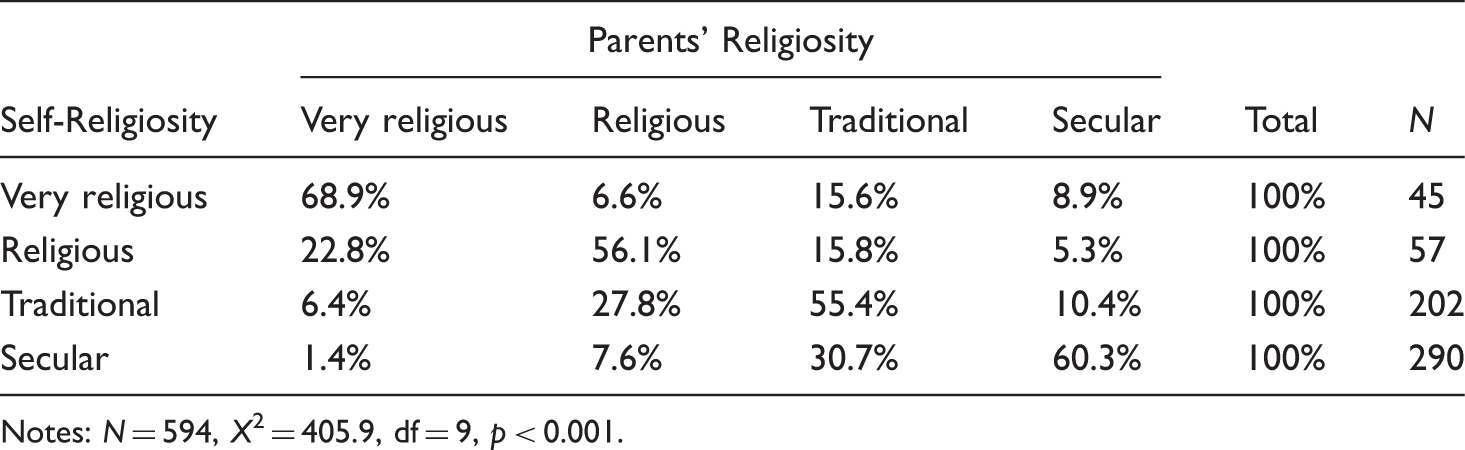
Notes: N = 594, X2 = 405.9, df = 9, p < 0.001.
Parents’ religiosity by self-definition of religiosity.
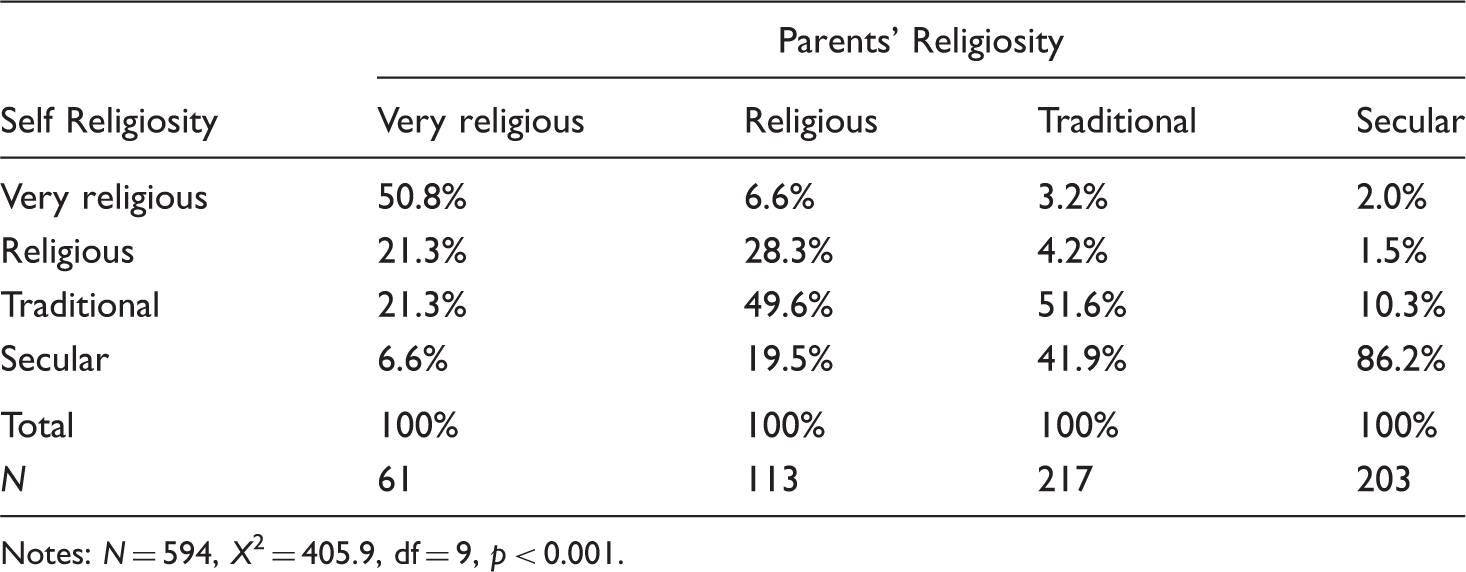
Notes: N = 594, X2 = 405.9, df = 9, p < 0.001.
Per cent of each ethnic group in the study’s population, per cent of respondents with an academic degree, mean self-reported socio-economic status and the per cent of respondents who define themselves as ‘secular,’ by ethnicity.
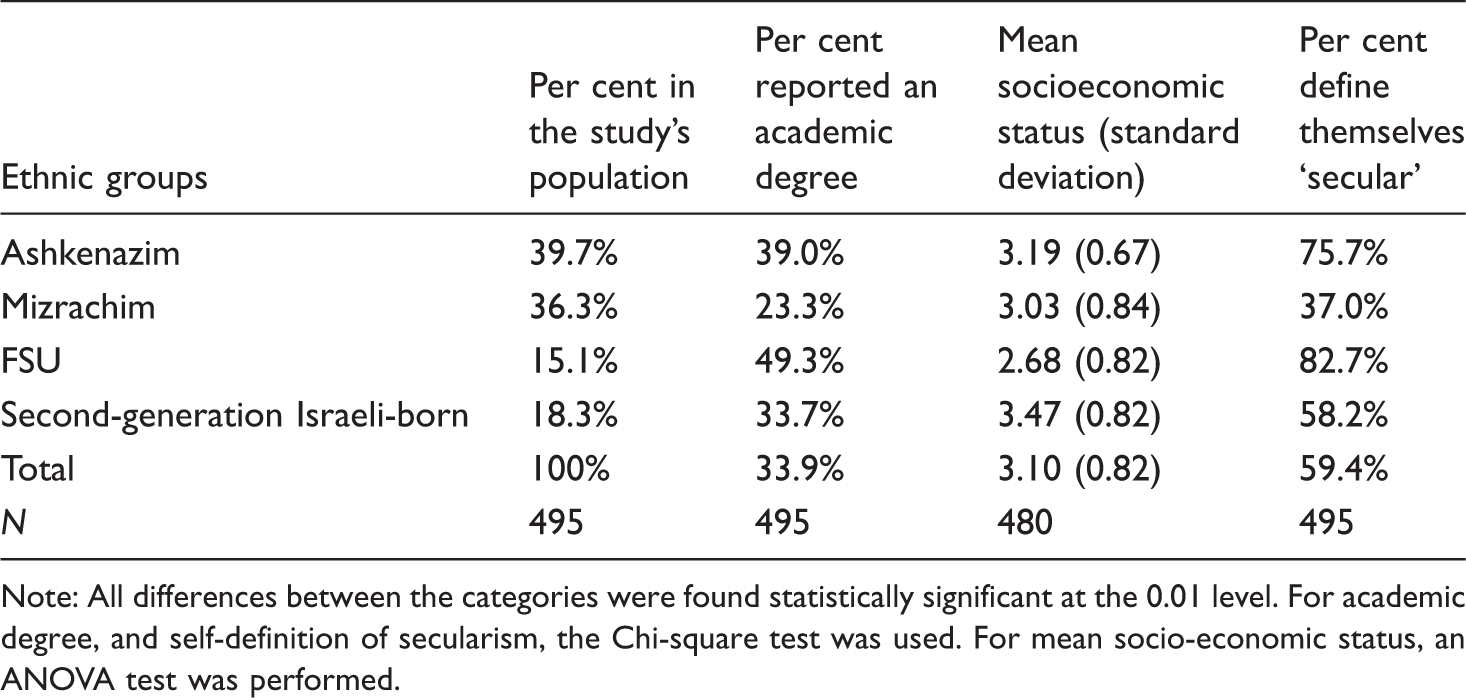
Note: All differences between the categories were found statistically significant at the 0.01 level. For academic degree, and self-definition of secularism, the Chi-square test was used. For mean socio-economic status, an ANOVA test was performed.
Religious practices among non-Orthodox Jews
Exponential coefficients from logistic regression analyses of the probability of attending synagogue, eating kosher food and shopping on the Sabbath.
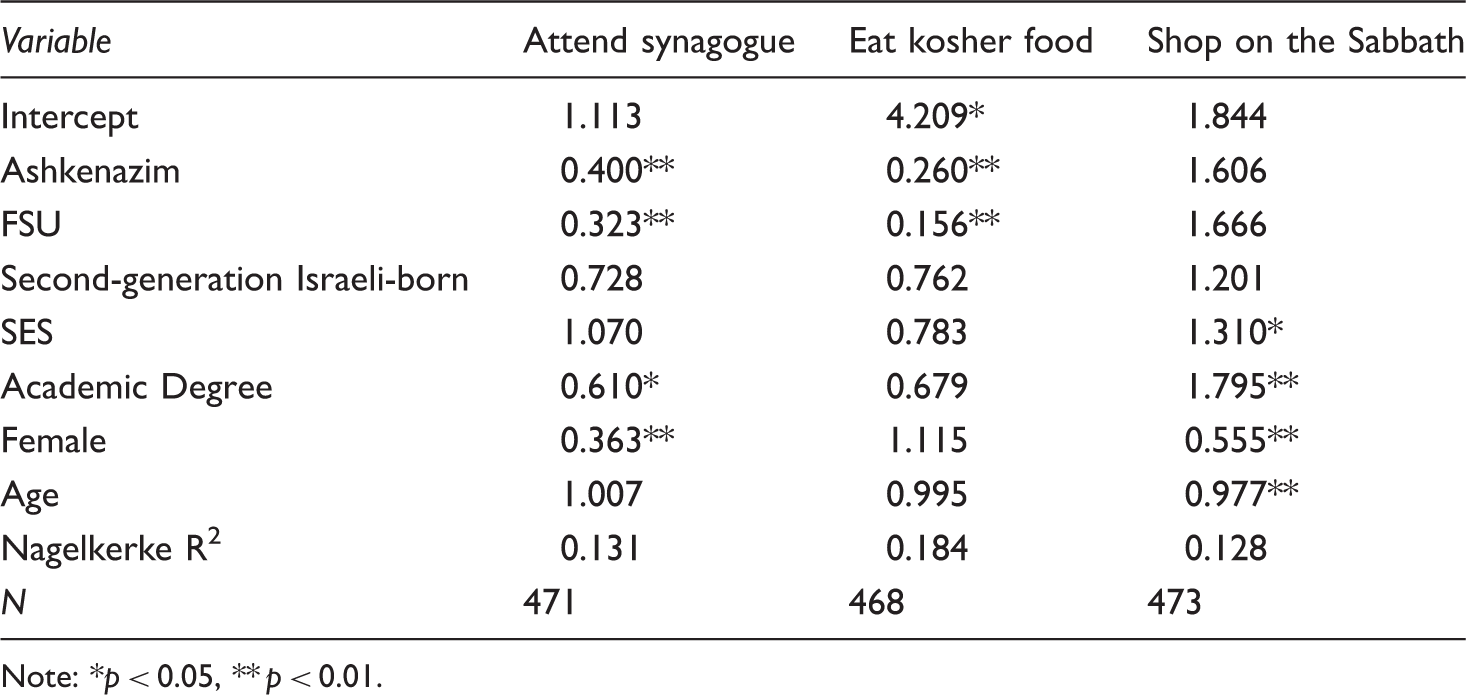
Note: *p < 0.05, ** p < 0.01.
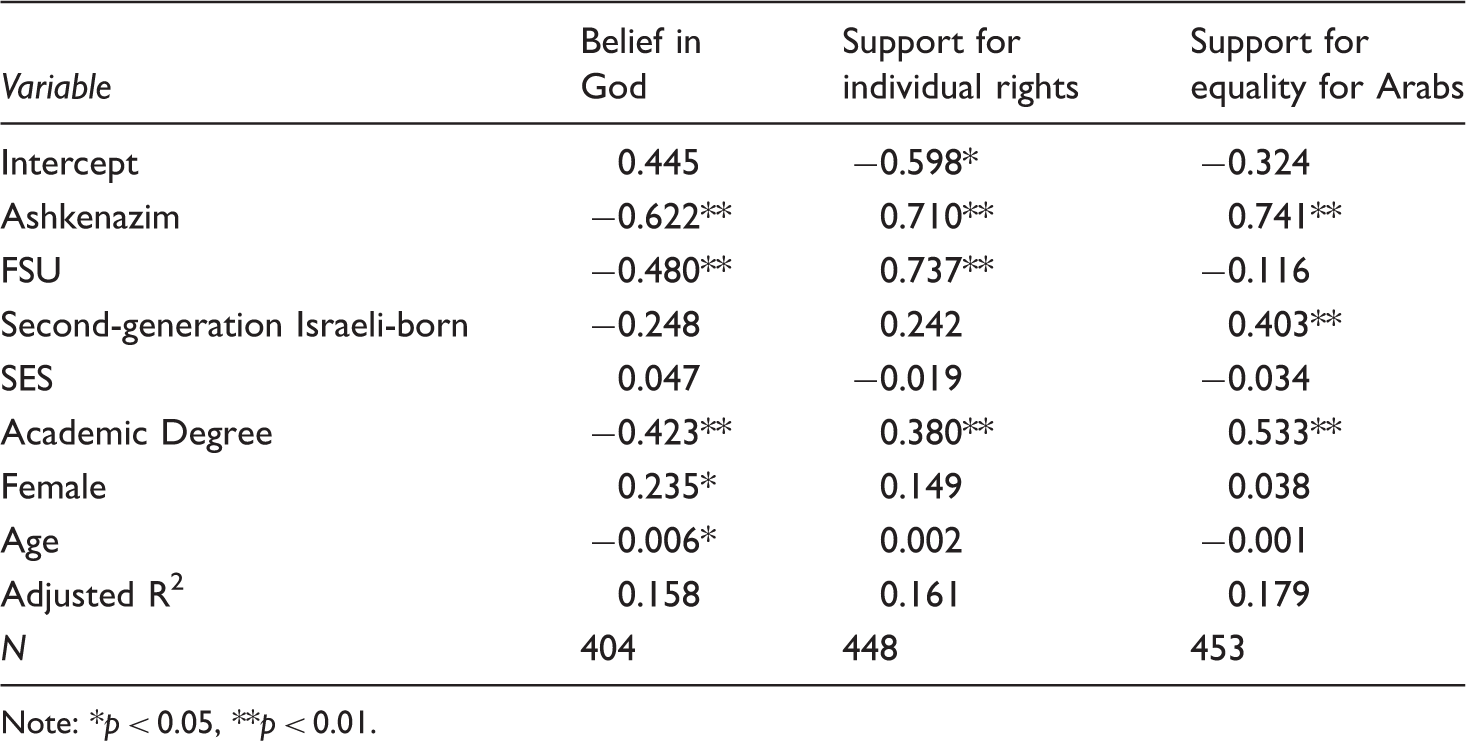
Coefficients from linear regression analyses of belief in God, support for individual rights and support for equality for Arabs.
Note: *p < 0.05, **p < 0.01.
Non-Orthodox Mizrachim are also stricter in their observance of kashrut, followed by Ashkenazim and FSU immigrants. In a separate analysis (not shown here) the difference between Ashkenazim and FSU immigrants was statistically significant at the 0.01 level. Socio-economic status, higher level of education, gender and age did not have a statistically significant effect on the probability of keeping kosher.
The findings with regard to shopping on the Sabbath, however, present a different picture than the other two practices. After controlling for socio-economic status and education, we found no statistically significant differences among the three groups with regard to their likelihood of shopping on the Sabbath. Higher socio-economic status and education were positively correlated with shopping on the Sabbath and age was inversely correlated with shopping on the Sabbath. Interestingly, women were less prone than men to shop on the Sabbath, possibly because of the longer working hours of men during the week that make shopping on the Sabbath more attractive.
The self-definition of Mizrachim as traditional and the self-definition of Ashkenazim as secular are also related to religious practices. Non-Orthodox Mizrachim are much more likely to maintain some religious practices such as attending synagogue or observing kashrut. Shopping on the Sabbath, however, is common to all non-Orthodox Jews, including Mizrachim. We will explain the difference between the practices in the discussion.
Values and attitudes
We also compared the three ethnic groups with regard to three different aspects of religious, secular and liberal attitudes: belief in God, support for individual liberal freedom (versus religious authority) and support for equality for the Arab minority. The three scales are standardized with an average of 0 and a standard deviation of 1. We conducted the analysis using models of linear regression (OLS) that included the ethnic groups (Mizrachim as the reference category) and controlled for socio-economic status, education, gender and age (Table 4).
With regard to belief in God, there was a significant difference between Mizrachim, on the one hand, and Ashkenazim and FSU immigrants, on the other. The belief level of Ashkenazim and FSU immigrants was much lower than that of Mizrachim. Only a small and statistically insignificant difference was found between Ashkenazim and FSU immigrants (not shown here). Socio-economic status had no independent effect on belief and academic education had a negative effect on the level of belief. Women reported higher levels of belief than men. Regarding age, we found a negative effect (i.e. younger people had stronger beliefs than older people) but this effect was weak and on the margins of the 0.05 level of statistical significance (p = 0.047).
Support for individual freedoms, including support for abortion, civil marriage and civil burial, represents opposition to the status quo in Israel. Here, again, Ashkenazim and FSU immigrants were found to be similar. The support of Ashkenazim and FSU immigrants for liberal reforms was much higher than that of Mizrachim and the difference between Ashkenazim and FSU immigrants was statistically insignificant (not shown here). Socio-economic status, gender and age had no statistically significant independent effect on support for individual freedoms. As expected, academic education was positively correlated with support for liberal reforms.
In the final analysis we used support for the equality of Arab citizens as a measure of political liberalism. The findings from this analysis differ from the other two. While Ashkenazim expressed greater support for Arab equality, Mizrachim and FSU immigrants were far less supportive. The difference between Mizrachim and FSU immigrants was small and statistically insignificant (not shown here). Socio-economic status, gender and age had no statistically significant independent effects on support for the equality for Arab citizens. Academic education was positively correlated with support for such equality.
Discussion
Secularism in Israel is limited in scope in a country where the concept of a Jewish state overrides many other commitments, including those of secular Jews. However, in recent decades signs of secularization in the public sphere have been hard to ignore. These include shopping malls that operate on the Sabbath, non-kosher restaurants selling pork and a growing number of Jewish Israelis who refuse to be married (or buried) by the Orthodox establishment. The meaning of those individual choices, the context in which they are made and the influence of ethnicity on these choices are at the core of this study. Like elsewhere, secularization in Israel is a non-linear, non-coherent, bricolage or hybrid form of beliefs, practices and attitudes that individuals adopt, and is influenced by recent changes and new opportunities that became available. The categories of religious and secular fail to capture the reality, in which many Israelis, believers and non-believers, continue to perform religious rituals, prefer religious services provided by the Orthodox establishment and find liberal values alien (Ben-Porat and Feniger, 2009; Levy et al., 2002). For example, 30% of those who describe themselves as ‘secular’ also reported that they ‘somewhat observe Jewish religious tradition (Levy et al., 2002). Israelis, therefore, create an identity for themselves through their choice of practices, beliefs and values that pertain to everyday life. As this study demonstrates, these choices are often mediated by ethnic identities.
Non-Orthodox Ashkenazim and FSU immigrants are more likely to identify themselves as ‘secular’ than Mizrachim who prefer to describe themselves as ‘traditional.’ This preference can be explained by the familial and communal religiosity of Middle Eastern Jews that allows flexibility and accommodation and rejects the dichotomy of religious/secular categories more common to Ashkenazim (Leon, 2009; Shokeid, 1984). The differences stretch beyond self-identity and also apply to practices. The traditional character of non-Orthodox Mizrachim is also expressed in their greater likelihood to attend synagogue and to observe the rules of kashrut. Communal religiosity and the fact that Mizrachi synagogues are also open to those who do not strictly observe (Leon, 2009) may explain why more non-Orthodox Mizrachim are more likely to attend synagogue. The observance of kashrut, mainly not eating pork and mixing milk with meat, indicates that the secularization of FSU immigrants and Ashkenazim is more rapid than that of non-Orthodox Mizrachim, who still view kashrut as significant. Shopping on the Sabbath, conversely, is one area where the secularization of Mizrachim is similar to other groups. This new trend, of the past two decades, is a result of a growing consumer culture that influences all groups and co-exists with traditional identities (Ben-Porat and Feniger, 2009).
The question of belief in God again distinguishes Mizrachim, on the one hand, from Ashkenzaim and FSU immigrants on the other. Consistent with the finding above, Mizrachim tend to follow more religious practices and also report higher levels of belief in God. This level of religious belief also extends to greater support for the status quo of non-Orthodox Mizrachim and less support for liberal reforms. Thus, Ashkenazim and FSU immigrants are more likely than Mizrachim to support a pro-choice abortion policy and the replacement of the Orthodox monopoly with civil marriage and burial. The strong support of FSU immigrants for civil marriage and burial can be explained, not only by their strong secularism, but also by the fact that the Orthodox monopoly presents very real problems for many of the immigrants who are not recognized as Jewish. On several occasions, public cemeteries, controlled by the Orthodox, have refused to bury immigrants suspected of being non-Jews. Similarly, because of the Orthodox monopoly, immigrants not recognized as Jewish cannot marry in Israel.
Extending secularism to political liberalism clearly demonstrates the boundaries of Israeli secularization. While among Ashkenazim the support for equality for Arabs is higher than among the other two groups, it remains limited. For Mizrachim, the more conservative nature of their secularization, their loyalty to right-wing parties, their socio-economic position, which puts them in direct competition with Arabs for jobs, and their desire to be part of mainstream Israeli society may also explain their reluctance to support liberal political measures of equality for Arabs. FSU immigrants are supportive of liberal reforms that pertain to Jewish (or non-Arab) citizens but strongly reject measures of equality for Arab citizens. As noted earlier, this attitude may be explained by the immigrants’ suspicions of Arabs rooted in a ‘Russian Orientalism’ and a territorial ethno-nationalism that gives priority to one ethnic group over others. In addition, like Mizrachim, Russian immigrants are engaged in an identity struggle for legitimacy in Israeli society and may seek the power of ethno-national boundaries to shore up their position in the country.
Conclusions
The unpacking of secularization reveals individual choices of belief, practices and values that aggregate to social norms, political preferences and public policies. Consequently, secular practices can be separated from beliefs and both can be separated from liberal values, often associated with secularism. Viewing the process through the lens of ethnicity helps identify patterns or path dependencies in which ethnic identity structures the choices made by individuals. This theoretical framework can be applied in different cases where historical and contemporary conditions structure different secularization paths.
The Israeli case study demonstrates three general, ideal types, of secularization related, though not exclusive, to the three main Jewish ethnic groups in Israel. Ashkenazim, whose secularization began in nineteenth-century Europe and later in the adoption of secular Zionism, display a more coherent ‘liberal secularization.’ This secularization is manifested in self-identification, secular practices, and support for liberal reforms that would allow individual freedoms and, relative to other groups, greater support for equality for Arab citizens. Mizrachim, whose secularization process happened in later periods and without the abandonment of religion, demonstrate what can be described as ‘everyday life secularization.’ This secularization includes further relaxation of some religious commandments, like shopping on the Sabbath, but maintains other practices, a respect for religious authority (against liberal reforms) and rejection of political liberalism. Finally, the secularization of FSU immigrants can be described as ‘ethnic-liberal’. This secularization includes a strong secular identity, distance from religious practices and support for liberal reforms against the Orthodox monopoly. This liberalism, however, does not stretch beyond ethnic boundaries, as the rejection of equality measures for Arab citizen demonstrates.
The debate over secularization theory has led to new attempts to conceptualize secularization as a non-linear and non-coherent process with differential paths and consequences. Not only in Israel, the focus of this study, can the complex relation between religion, ethnicity and nationalism be observed. Religious identities and practices are not only underscored by belief but also by social and political goals and commitments. Consequently, secularization may affect some religions more than others, erode some practices within religion more than others and advance separately from the adoption of liberal values and commitments. Ethnicity can explain some of the differences and the paths of secularization as well as the continued importance of religion when it performs various roles significant to the group’s cohesion. While for some ethnic groups secularization happens alongside a significant change in beliefs, practices and behaviors, for others religion remains significant and secularization is more partial. This process is especially significant for ethnic groups who are insecure, economically or socially, and/or for groups for which religion remains an important identity marker. In such cases, secularization does not extend beyond ethno-national boundaries.