



Abstract
This article focuses on both the narratives of Project Champion, a surveillance scheme in Birmingham in the UK that saw the installation of 216 closed circuit television and Automated Number Plate Recognition cameras in two areas which contained the greatest concentration of Muslims in the city. Considering the period of time throughout which Project Champion was conceived in 2008, instigated and eventually dismantled by July 2011, this article provides an unprecedented insight into the damaging impact that can occur if local agencies and institutions fail in their attempts to put central government policies into practice at the local and community levels. Whilst Project Champion is an extraordinarily intense and somewhat extreme instance of government counter-terrorism policy, this article allows for a range of issues that have previously been explored in a broader and largely national context to be considered in some depth at the highly localised level.
Introduction
Whether we like it or not we are the 7/7 bombers. We are the ones who bought down the twin towers. We are Al Qaeda and Osama Bin Laden. That’s how people see us. We’re the new Jews and we’re the new blacks. (Young Muslim female interviewed in the aftermath of Project Champion)
Whilst both the present Coalition and previous New Labour Governments have repeatedly stressed that the legislation and policies were not about Islam, governmental narratives have identified some ‘perverted’ or ‘radical’ forms of Islam leading to terrorist activity (Brown, 2010). In spite of this, the notion of ‘winning of hearts and minds’ – founded upon the principle that ‘communities defeat terrorism’ (Briggs et al. 2006) – has resulted in an increased focus on maintaining harmonious relationships between Muslim ‘communities’ and the government’s security services (Spalek, 2010; Spalek and Lambert, 2008). Correspondingly, the implementation of Prevent strategies in particular has been disproportionately targeted towards those same Muslim communities. Local police officers have routinely worked with and alongside Muslim communities at the same time as being the leads in implementing multi-layered, multi-agency approaches to preventing violent extremism. At times this has resulted in the blurring of the lines between the role of the police and the security services (Khan, 2009; Kundnani, 2007; Spalek and Lambert, 2008). Brown (2010) and Cesari (2010) go further and suggest that the very framing of Muslim issues through the lens of security has securitised Muslims and their communities.
Approach and method
Whilst many of these issues have been considered in the broader and largely national context, this article seeks to focus on a very particular case-study which explores some of the dynamics between counter-terrorism policy and Muslim communities at a local level. To do so, this article focuses on Project Champion, a scheme through which 216 closed circuit television (CCTV) and Automated Number Plate Recognition (ANPR) cameras were installed – some overtly, some covertly – in two areas of the city of Birmingham, both of which were home to some of the most concentrated Muslim populations in the city. Drawing on the emergent narratives from a range of different institutional, individual and communal perspectives, this article seeks to tell the ‘story’ of Project Champion. This story and the narratives that inform it are important. As Dauite and Lightfoot (2004) put it, dominant narratives tend to present a coherent story line. However, as they go on, these dominant stories tend to be implicitly organised and mediated by dominant forces which look to characterise the values, practices and controls inherent within less dominant and powerful groups. In doing so, such narratives inform and determine the status quo and norm: identifying the social and political ‘heroes’ and ‘villains’ as regards what life should be like, what should be heralded or what hidden (Dauite and Lightfoot, 2004). Accordingly, narratives have the potential to valorise particular understandings or meanings, whether social, political, cultural or other. Consequently, this article provides a timely opportunity to reflect on the function and impact of narratives associated with counter-terrorism strategies at a time when existing strategies and approaches remain under continued scrutiny.
This article draws upon research undertaken over the period of time through which Project Champion was conceived, instigated and eventually dismantled. In doing so, a range of different research methods were used to capture the views of those involved in the protest and resistance to the scheme, as well as those who were integral to its development and implementation. Before the facts around Project Champion’s existence came to light, both researchers were embedded in networks wherein policy-makers were working alongside Muslim representative organisations to implement counter-terror strategy in Birmingham. This research project was also investigating the identities of young Muslim men in the city. Somewhat by chance, as Project Champion became public knowledge, as researchers we found ourselves ideally placed to observe how the scheme’s unveiling was to impact upon residents of affected neighbourhoods, the networks of relationships between Muslim organisations and governmental institutions, and on Muslim identity in the city more broadly. The original ethnographic and participant observation methods aimed at investigating Muslim identity were broadened and one researcher became embedded within the protest movement against Project Champion to observe attitudes to the scheme and the institutional response. Four public meetings were attended by the researchers, during which authorities aimed to justify the scheme to almost unanimously sceptical residents. Additionally, formal interviews were conducted with institutional figures and campaigners and documentary analyses of institutional resources served to give insight into the technicalities of the Project Champion’s construction and deployment. Narratives in the context of this article, therefore, can be seen to be material, in the sense of being spoken, written or heard, and conceptual via cultural tools that generate explanatory coherence in real-world activities (Solis, 2004).
Such mixed methods and participation from a range of actors provided at times, dilemmas of positionality. Most significantly, the embedding of one researcher with a Muslim background within the protest movement blurred the boundary between insider and outsider status. Whilst the involvement with the protest movement fell short of the activist research of researchers employed by Huisman (2008) in her work with Muslim refugees, this embedded approach allowed the researcher to capture the politics of protest and provided access to spaces such as protest stalls within streets in the affected neighbourhoods, where discussions and debates around Project Champion’s contested legitimacy frequently took place. An oft-cited criticism of such ethnographic embedding, or even the very presence of an observer is that it jeopardises objectivity (Spano, 2005, 2006). On the contrary we would reject the very notion that objectivity is achievable preferring instead the view that researchers inherit embodied knowledge (Heidegger, 1962; Sherif, 2001: 436). Consequently we would argue that attempting to ‘decontaminate’ data is incoherent (Monahan and Fisher, 2010). Instead, this embedding allowed for both master and counter-narratives to be captured and considered.
Drawing upon the work of Solis (2004), the capturing and comparison of both master and counter-narratives is important. For her, master narratives are those which are typically produced and disseminated by social and political institutions and their representatives that convey messages with implicit moral tones formed by the guiding political and social ideologies underpinning those same institutions and their representatives. On the contrary, counter-narratives are those which are neither produced nor disseminated by the institutions, instead emanating from a wide range of different voices and contexts typically as a means of countering, challenging, confronting or opposing the master narratives. Counter-narratives also, given the context and setting of this article, provide space with which to actively challenge such well-worn and oft-repeated clichés that are prone to paint Muslims as ‘others’, always in inevitable conflict with Western liberal cultural norms (Morey and Yaqin, 2010). This article therefore necessarily uses narratives from actors across a range of spheres – protestors, residents, institutional representatives and the textual discourses produced by government departments – to describe and explain how Project Champion was experienced by the different key actors. Thus what follows is a narrative of Project Champion – its ‘story’ – co-constructed from both master and counter-narratives which include the nuanced – and at times unheard – narratives of protestors, residents and others as a means of affording equal credence with those produced by the social and political institutions and their representatives.
Project Champion in context
Birmingham is the second-largest conurbation in the UK after London. According to the 2001 Census, the Muslim population across England was approximately 3%. In Birmingham however, Muslims accounted for just under 15% (140,033) of the city’s total population meaning it was the local authority with the largest Muslim population in the UK (Birmingham City Council, 2003). Whilst Abbas (2006) suggests that trends from the past 30 years are likely to show that the Muslim population has increased in the intervening decade, others estimated Birmingham’s Muslim population to now exceed 200,000 (Waterhouse Consulting, 2008). The vast majority of Birmingham’s Muslim population (71.7%) are concentrated in seven wards: Sparkbrook (19,372); Bordesley Green (18,629); Washwood Heath (16,847); Springfield (13,461); Lozells and East Handsworth (10,853); and Nechells (8822) (Birmingham City Council, 2003). Many have complex, multi-faceted identities influenced by their heritage and experience as first, second or third-generation migrants, as Britons, as young people living in deprived inner-city neighbourhoods, and as Muslims.
On first view, it seems unlikely that the complexity of identities of the city’s Muslim population and the potential for a surveillance scheme to stigmatise an area and therefore its inhabitants was given much – indeed any – consideration. Project Champion was however, such a surveillance scheme. It involved the installation of 216 cameras over two areas which primarily spanned four of the wards identified previously (Sparkbrook, Bordesley Green, Washwood Heath and Springfield) home to almost half (48.8%) of the city’s total Muslim population. Figure 1 demonstrates how the surveillance infrastructure was concentrated in the heavily Muslim-populated neighbourhoods in the city, with the camera locations outside those neighbourhoods being located on arterial routes into those areas. Across the two locations, 144 of the cameras were overt and visible, 106 having ANPR functionality. ANPR cameras are designed to track cars moving in particular directions through junctions by reading and logging vehicle registration plates. In addition, 72 covert cameras were also installed, the precise locations of which remain unknown but which were also confined to the same areas. The total cost of the scheme was £3.5million with an additional £375,000 a year being set aside for maintenance and running costs (ACPO TAM, 2007: 7).
The (overt) Project Champion cameras overlaid on a map of population density of Muslim residents.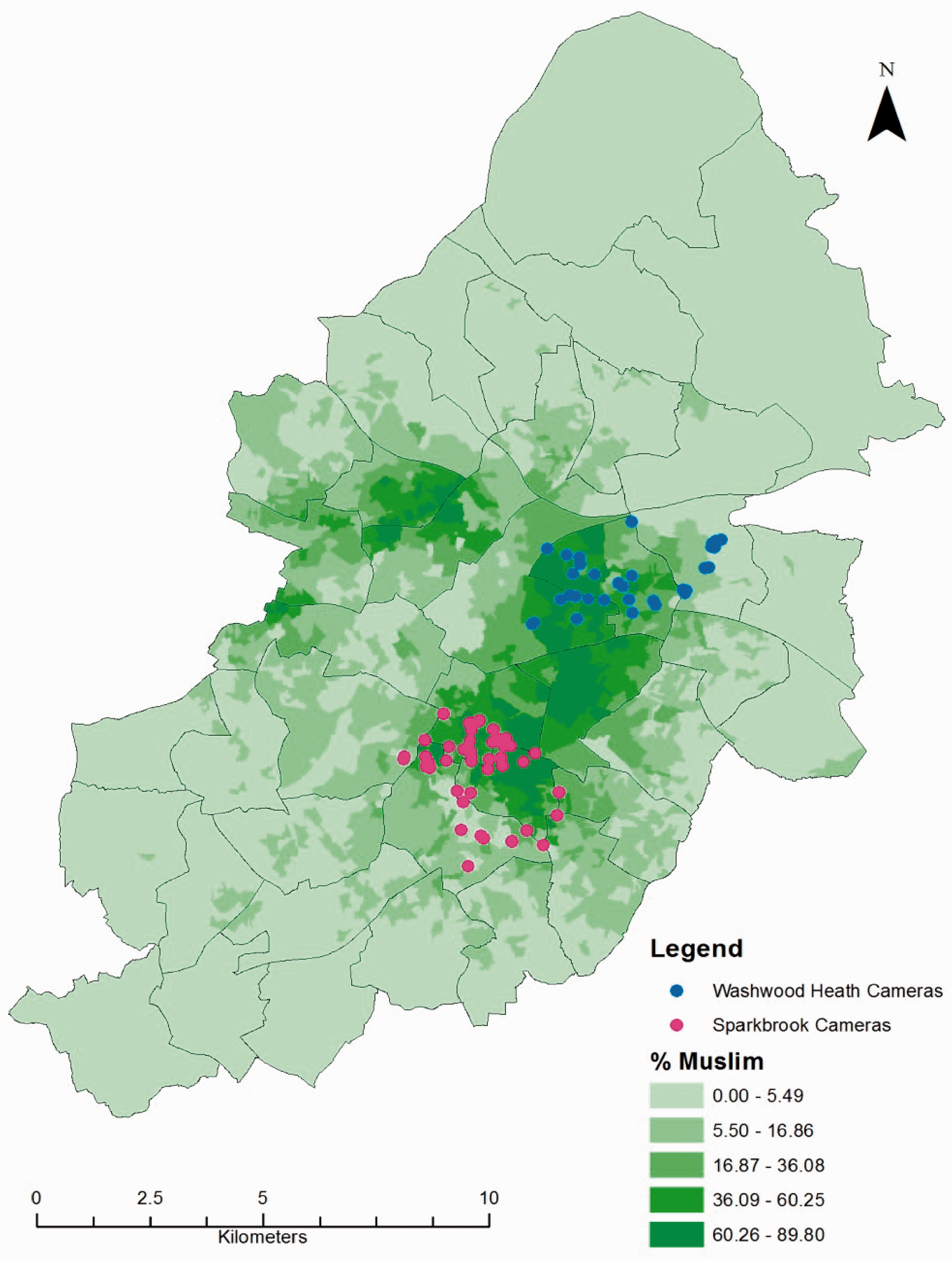
Whilst Project Champion was not part of the previously referenced Prevent programme which was running nationally, it is important to consider Project Champion as part of a broader counter-terrorism agenda. The Prevent strand of government policy was both unprecedented and significant: it aimed to ‘reach’ Muslims at risk of extremism before any crime had been committed (CLG, 2007). Key to its success was, as before, working with Muslim groups and social and community workers on a local level. In early 2007, Birmingham was identified as one of a handful of priority areas and was duly allocated £525,000 as part of the Prevent Pathfinder (Waterhouse Consulting, 2008). Shortly afterwards, Prevent funding was increased to £2.4 million over three years (Waterhouse Consulting, 2008). Through a variety of different projects, Birmingham City Council and West Midlands Police began to engage with Muslim groups across the city to implement the Prevent agenda. Trust was built slowly between West Midlands Police and a variety of Muslim ‘leaders’, both in terms of representatives and organisations. In doing so, the Police and the authorities gained some capacity to deliver Prevent projects at the same time that Muslim groups were able to benefit from funding for projects which it would largely have autonomous control over.
As Briggs (2010) and Spalek and McDonald (2011) note, community-centred approaches to counter-radicalisation efforts have become somewhat of a policy mantra. The Prevent programme explicitly had a community focus (CLG, 2007: 7) and the construction of relationships between Muslim groups and government departments were thus crucial to the successful operation of Prevent. Interviews with representatives of both Police and Muslim groups as part of this research gave the strong impression that, prior to Project Champion, security services and Muslim community representatives had been engaging constructively and successfully to achieve counter-terrorism goals. But as Project Champion was instigated and eventually discovered by local residents, this trust was undermined. As the following narratives of Project Champion demonstrate, there was a divergence between the institutions and those opposing the scheme. It is this aspect of Project Champion therefore, rather than its positioning within the Prevent agenda, that this article seeks to explore.
The case for Project Champion: An institutional narrative
On the 14th of February 2008 – nine months before the independent evaluation of Birmingham’s Pathfinder programme was published – Project Champion appeared as an agenda item during a meeting of the West Midlands Police Authority. It was at this time that a decision was made to apply for funding for the scheme from the Association of Chief Police Officers’ Terrorism and Allied Matters (ACCO TAM). It was also at this meeting that Birmingham City Council agreed to invest £500,000 and to share the running costs with West Midlands Police. The strategic Business Case for the project (ACCO TAM, 2007) – available in redacted form following a Freedom of Information request by anti-CCTV campaigners in 2010 – gives an insight into the rationale of Project Champion. The document states its aims were to capture large amounts of data, particularly about vehicle movements, as part of a ‘net’ of surveillance technology (ACPO TAM, 2007 1). The document continues by suggesting the capturing data would be on an ‘as and when’ basis (ACPO TAM, 2007). Whilst the surveillance net would help track ‘subjects’, data would also be gathered on all vehicle movements in the designated areas. Thus the aims were about the building of surveillance capacity as part of a counter-terror infrastructure in preparation for any future requirement to monitor movements of anyone identified as a ‘subject’.
To provide advocacy for the scheme, the Business Case cites the ‘severe’ nature of the security threat from al Qaeda-inspired terrorism and points to the events of 7/7 as evidence of the need to operate ‘across organisational and geographic boundaries’ to address that threat (ACPO TAM, 2007: 1). It is interesting to note how the Project Champion Review (Thornton, 2010: 7) would later state that the terrorist attacks on Glasgow Airport and the ‘Tiger Tiger’ nightclub in London were further evidence of the need to track vehicle movements across geographic boundaries. The report also cited another incident in which West Midlands Police thwarted a plot to kidnap and execute a Muslim soldier. Referencing news coverage in the Times newspaper, it suggested that the Police operation focussed on British-born Pakistani men living in Birmingham, concentrating on the Alum Rock and Sparkhill areas. However, a subsequent look at the report in the Times highlights how the only reference to Sparkhill was a non-evidenced quip about its residents becoming used to terror raids (Jenkins and McGroy, 2007). Nonetheless, the Business Case asserted the West Midlands was particularly vulnerable.
Intended benefits of the scheme included the increased quality and quantity of intelligence as well as evidence-capture from ‘hits’ of subjects on ANPR cameras. One of the listed benefits was predicted to be the potential for ‘evidential product’ for investigations which were not related to counter-terrorism but which would help prevent incidents of ‘serious harm’ to communities. This however, included the caveat that such a use would depend upon specific protocol arrangements, supposedly between counter-terrorism police and investigators of non-counter-terrorism incidents. It would also not be used in any way in which the location of covert surveillance equipment might be disclosed (ACPO TAM, 2007). This was one of only four risks identified in the Business Case. The others were: insufficient funding; planning consent and co-operation of suppliers. No note whatsoever was made of opposition by residents or the raising of objections by elected officials representing those affected by the scheme. By January 2010, the installation of cameras had begun and, in order to cordon the Sparkhill and Alum Rock areas with cameras, wards around those areas also had to host cameras. In total, nine wards had cameras installed within them (Thornton, 2010: 25).
Consultation with cloak and daggers
After developing Project Champion in relative secrecy, the challenge for officials was to secure consent from elected officials overseeing the work of the Safer Birmingham Partnership (SBP). The preferred method to achieve this seemed to misrepresent the nature of the scheme to councillors. The Thames Valley Police (Thornton, 2010) review of Project Champion contains details on how senior police officers did this. In January 2009, Assistant Chief Constable (ACC) Patani and ACC Hyde were part of a meeting with ‘senior officers’ in which ACC Patani and Chief Inspector (CI) Marriot (who currently heads Birmingham’s Preventing Extremism programme) agreed to construct ‘a narrative’ to support Project Champion which would involve details about ‘high-crime areas’ (Thornton, 2010: 16). This narrative was reiterated in a number of public meetings once Project Champion had become public by, among others, Jackie Russell of the SBP. While the Business Case made it plain that the principal steer of the scheme was the threat of terrorism, this constructed narrative stressed how the scheme would be used to reduce local crime and anti-social behaviour. It would also include the allegation that the areas covered by Project Champion were where crime was highest in the city. This was also communicated to elected officials on the 28th of April 2009 at a meeting chaired by ACC Stuart Hyde between BSP, Birmingham City Council and local councillors in the affected wards. As with the Business Case, the minutes of this meeting were restricted and only released in June 2010 (West Midlands Police, 2009). Taking place under the pretext of consultation, despite the scheme having already been agreed and submitted for funding approval, ACC Hyde communicated the scheme as a general crime-reduction project. As ACC Hyde explained, ‘[the funding] had been made available to Safer Birmingham Partnerships … for CCTV and ANPR (to) bring a greater sense of safety for local residents and (to) increase revenue into the area by promoting small business in the locality.’ (West Midlands Police, 2009: 1)
At the meeting, Councillor (Cllr) Salma Yaqoob – representing one of the affected wards – asked why her constituency had been identified. The response from Chief Superintendant Turner was that the new scheme represented ‘an opportunity to localise these facilities and tailor make them to work for local issues such as anti-social behaviour and criminal damage’ (West Midlands Police, 2009: 2). Furthermore, Cllr Yaqoob enquired as to how the scheme was being funded. According to the minutes, ACC Hyde answered that the money came ‘solely from the Home Office and it would not be used to provide additional Officers but would be used to Police in a new smarter way using up-to-date technology’ (West Midlands Police, 2009: 2). No mention was made of TAM funding. Cllr Yaqoob also asked whether this might be linked in some ways to the government’s Prevent programme. If it did, she added, it ‘would breach the very little trust that has taken so long to build in the community and that it will be viewed as targeting the Muslim community’ (West Midlands Police, 2009: 3). As the official documentation states: ACC Hyde responded that if he said that additional CCTV and ANPR facilities would not have any benefit around counter-terrorism then he would be lying, and that is why the element was in the briefing note … (West Midlands Police, 2009: 3)
A view from the ground: The counter-narrative
I’m just an ordinary bloke in Moseley really and I accidentally got involved in this stuff. I had just been to visit friends in Leeds and walking back from the bus stop to my flat on Coppice route – every time, the same route, and I got half way and I saw this new lamppost thing which didn’t look like any other lamppost and I thought that has got to be for a camera. And I thought why is that there – what’s it doing there – what’s it for. Cameras, here? (Steve Jolly, Interview) They explained that they (the cameras) aren’t there for local crime in Moseley but for roads that lead into Sparkbrook … They actually told us that! They sent a printed letter – in a press statement that they are there to cover rat runs into Sparkbrook … they just happened to be out in a different [electoral] ward but the purpose was to monitor people leaving and coming to Sparkbrook. They were told the choice of positions was ‘intelligence led’. Knowing that they are here to put this ring around Muslim areas and they are not about local crime. (Steve Jolly, Interview) The big thing was The Guardian. I realised I wasn’t really getting anywhere with councillors and MPs. I realised it was too political for them – they valued their careers above the issues at stake and they didn’t want the cameras, the publicity which was obviously going to erupt. So I knew we had to get the media onboard and it became a media campaign really. So I spoke to Liberty and The Guardian, and Paul Lewis from The Guardian came up here to see me and he came to see a lot of evidence. (Steve Jolly, Interview) It was shock really – a proper punch in the face like woah…these attacks on Muslims and this is the last hit I felt. I don’t live in the area and someone said that to me but that’s an attack on Muslims I said. Anyhow, I felt it was attack on me as a person. (Merfat, Interview)
Three constituency meetings followed shortly after The Guardian article was published; in Hall Green, Moseley and Sparkhill, the first reportedly attracting 100 residents with 60 at the following two. At the Sparkhill meeting, local councillors were in attendance including Salma Yaqoob who gave a speech criticising the conduct of the Police in implementing the scheme. Some experienced campaigners from Stop the War Coalition, the Muslim Public Affairs Committee, and Socialist Workers Party were also in attendance but the audience was mostly residents with no affiliation to organised groups and who did not hold positions at any relevant institutional level. What resulted was a raucous, passionate, public meeting at which pointed criticism was levelled at Jackie Russell, chair of SBP and CI Moore, who was representing West Midlands Police. Some of the criticism sought to directly challenge the as-yet–to-be-identified constructed narrative of the police. Questions included whether or not local police would have access to data from the cameras (a question which was addressed to, but not answered by, CI Moore). Cllr Yaqoob and another audience member upon hearing the narrative that Project Champion would help reduce local crime asked if this was a key objective. CI Moore responded: I’ve been involved in some of this agenda and there are all sorts of funding schemes and this funding stream appeared to be a good one … it had to have broader utility (beyond CT) to have any chance of getting funding. (CI Moore, Sparkhill Community meeting 22/07/10) I’m reading this document and it says trust and confidence. I have to say, after this I don’t trust you [Applause]. Sparkbrook now – national media. Police are saying 11 arrests in this area due to terrorism – 0.001% of the population – so you’ve imposed these cameras and gone and spent 3 million quid on it. We don’t normally take part in these sorts of things, but when the powers that be accuse us as being terrorists and terrorist sympathisers, that’s when we have to speak up.(Resident, Sparkhill community meeting, 22 July 10) Hidden cameras are for spying on people – why are you spending money – we don’t trust police for a second – all you do is lie. One day you say one thing, another day you say something else…You put everyone off applying [to join the police]. (Resident, Sparkhill community meeting 22 July 10) You said you put cameras here to stop crime – you don’t need cameras, you need officers. How can we trust you guys? (Resident, Sparkhill community meeting 22 July 10)
The Spycam summit: Narratives collide
Soon after, a dedicated website was set up to oppose Project Champion and regular updates were communicated via Facebook. Jolly was also increasingly appearing on local and national media to speak about the scheme. Publically, SBP and West Midlands Police came under increasing pressure. A further defining moment occurred on 4 July 2010 when an event dubbed the ‘Spycam Summit’ was held in Balsall Heath and attracted such high-profile individuals as Lord Nazir, Shami Chakrabati Director of civil-liberties group Liberty, and Cllr Yaqoob. Chakarabati’s inclusion was more than mere good publicity as two days before, Liberty had written to the Chief Constable of West Midlands Police, Chris Simms, notifying him that the group’s lawyers had proposed a claim for a judicial review of Project Champion. The 16-page letter went on to make a case against the cameras picking out some of the apparent contradictions from the Business Case, the meeting with elected representatives, and the scheme as it had been presented to residents. Liberty referred to 2001 Census data showing Sparkhill and Washwood Heath as being the wards with the greatest percentage of Muslims thereby suggesting the targeting of these areas would legally require an Equality Impact Assessment to have been undertaken, something which SBP failed to undertake thus contravening Section 71 of the Race Relations Act. Liberty also challenged the Police and SBP on failure to consult. Liberty also went on to suggest that Project Champion breached Article 8 of the European Convention of Human Rights (ECHR) which allows for CCTV in public spaces only for ‘normal use’ but which also seeks to protect citizens from covert surveillance and invasions of privacy. It also claimed a breach of Article 14 of the ECHR which protects against discrimination on grounds of race and religion. Liberty’s lawyers duly requested the removal of all cameras and the recognition of their unlawfulness, threatening that non-compliance would result in an application for judicial review and a request for disclosure of all relevant documents relating to planning and implementation.
Initially, ACC Suzette Davenport of West Midlands Police refused an invitation to appear at the Spycam Summit citing medical reasons. Despite having no prior involvement, Davenport’s soon-to-be replacement ACC Sharon Rowe was asked to attend instead. By this time the Police were increasingly alert to the loss of trust among Muslim community representatives in their attitudes towards policing. As Spalek (2010) has discussed in particular reference to policing in the context of the contemporary terrorist threat, trust is essential not only in allowing ‘community’ intelligence to be communicated to security services, but also to ensure to counteract the problematisation of Muslim communities as a result of community-focussed approaches to counter-radicalisation.
It is perhaps within this context that we can understand the subsequent reversal of the institutional attitude towards both the cameras and the protestors, as ACC Sharon Rowe apologised for the method of implementation of Project Champion and promised that ‘the community would be part of the monitoring and scrutiny … [having] a totally open and transparent access to the cameras’ (fieldnotes). Whilst street protests continued for protestors, a meeting for organisers of the protests were held a fortnight after the Summit to evaluate how the situation was developing. It was agreed that protests should continue and that ACC Rowe’s comments were vague enough to imagine an active police strategy of keeping the cameras in place for non-counter-terror purposes. Despite the conciliatory tone of Rowe’s words, the announcement that a review of Project Champion would be carried out by Sarah Thornton of Thames Valley Police caused more unease and suspicion not least because Thornton was Chair of ACPO TAM, the group which had funded the scheme. Despite this, the Summit was a catalyst for a more diplomatic relationship between the Police and the protestors.
The climbdown
On 10 August, West Midlands Police Authority held a meeting to discuss issues of trust and confidence. The Authority is one of 43 such bodies which guide regional police forces’ aims and priorities as well as providing a civilian scrutiny. While members of the Authority had been in Project Champion meetings since February 2008 (Birmingham City Council, 2010: 27), the chair stressed that responsibility for the cameras did not rest with it. Jolly and Cllr Yaqoob responded with speeches that claimed avoidance of responsibility. National and local media were present and footage of an angry resident equating Project Champion with the actions of communist and imperialist regimes was shown on national BBC news broadcasts. This again returned the issue to prominence in the media and added further public pressure. It was also the first time that both citizens and politicians outside of Birmingham would see the Authority being attacked and criticised by residents and councillors alike for its apparent failings.
An advisory group – which at the time was referred to as a ‘Reference Group’ – had been established to advise the Police and the Authority regarding the future of Project Champion. The Reference Group would have oversight responsibilities for the Project Board which would take the scheme forward. However, it was difficult to ascertain precisely how the creation of the Reference Group had taken place and more importantly, how its members had been chosen. Some from the group had been known to the Police for work they had done regarding the Prevent agenda and this included the Chair of the Reference Group who had an active role in the counter-radicalisation programme. The willingness to allow critics of Project Champion to become involved was striking. From interviews, one Reference Group member noted: It’s interesting that 90% of the reference group are openly against the cameras. The police knew that and they still got behind the rest of the project board to actually allow that to happen. We got Steve Jolly in our reference group…To have him and others around the table is brilliant. They said that they want a critical oversight as opposed to an independent representation. They would rather have someone rather critical for it can’t be seen that they’re just bringing out yes-men. (Reference Group member, interview)
It was two other events that eventually resulted in the dismantling of Project Champion. The first was the Thames Valley Police report, released on 30 September 2010 (Thornton, 2010). The report was highly critical of the project’s management, concluding that the separation of the ‘political’ aspect of the project with the ‘actual’ delivery resulted in the scheme being communicated in a wholly misleading way. The acknowledgement of the gap between how the scheme was sold to residents and how it had been planned satisfied some of the protestors though the diplomatic language used to catalogue the failure was frustrating to others. Conclusions on compliance of the scheme with various ethical and police procedural laws were also damning: ‘there was nothing … that demonstrated that the authorisation process for use of the cameras had been considered, and there was no policy, plan or procedures in place for their management in compliance with RIPA or applicable legislation, codes or guidance’ (Thornton, 2010: 7). The Police Authority also came in for criticism, especially when the scheme was noted as becoming a critical incident. As the report concluded, everything was ‘too little too late, and the lack of transparency about the purpose of the project has resulted in a loss of trust’ (Thornton, 2010: 24). The report cited and approved the comment by an unnamed community leader that Project Champion had ‘set back community relations by a decade’.
The second event was the open Police Authority meeting on 25 October 2010 where the general public were permitted to observe but not participate. Here, Birmingham City Council presented its own report from the Local Services and Community Safety Overview and Scrutiny Committee (Birmingham City Council, 2010). Criticism was harsher than in the Thames Valley Police report, especially regarding consultation failures and accountability. On the very aims of Project Champion, the report stated that SBP categorically misrepresented the case for the project and went as far as misusing statistics ‘to divert public attention from the real intent of the project’ (Birmingham City Council, 2010: 47). The report also claimed that the Police Authority were not fully enough informed of the project in February 2008 when funding was provisionally agreed. It also added that the City Council was never formally asked to appropriate funds (Birmingham City Council, 2010: 48–49). Consultation by the Police and SPB was described as, ‘limited and inaccurate’ (Birmingham City Council, 2010: 49) and as being ‘based on incorrect and at best incomplete information’ (Birmingham City Council, 2010: 51). The consultation shortcomings were described as ‘unacceptable’ and the report outright accused those at SPB of providing ‘false information’ (Birmingham City Council, 2010: 52). It was scathing of Russell in particular for continuing to assert that Project Champion was about all forms of crime rather than being explicitly about terrorism. At best it can be said that there was a catastrophic lack of inquisitiveness about this Project by the two organisations that should have been scrutinising the project on the Public’s behalf: The Police Authority and the Safer Birmingham Partnership. Basic questions were not asked: what were the specifications for the Project, how was the data to be used, what would be the impact on community relations, how effective would the Project be, and more seriously, they failed to recognise the significance of the Project and its impact upon local communities. (Birmingham City Council, 2010: 60–61)
Reflecting on the narratives
The content and story told by the narratives – both master and counter – of Project Champion are as equally important as they are problematic: both have the potential to shape and influence social understanding and meaning. There is evidence to support an argument to support the view that the social and political institutions detrimentally framed and conceptualised the minority group for whom the scheme was most impacting, namely Muslims. In particular, this was framed and conceptualised in terms of a threat, one that emanated not just from the locations targeted, but also the people who lived there. To reiterate on Dauite and Lightfoot (2004), the master narratives afforded some valorisation to existing and pre-existent social and political understandings and meanings about Muslims. This fits with Fekete’s (2009) acknowledgement that many of the recent post-securitisation narratives to have emerged from institutional sources have disproportionately focussed on the issue of threat. Most worrying is the way in which many of these have been extremely subtle and nuanced, where even the merest notion of belonging to a ‘Muslim community’ is perceived problematically albeit deeply embedded and covert. The result being, as Fekete (2009) adds, that the institutions and those with the necessary power to control them then only have to take a relatively ‘short step’ with which to be able to justify, legitimise and implement various coercive and punitive measures in order to counter that threat. In terms of Project Champion, a master narrative which was able to justify, legitimate and subsequently implement was clearly necessary and indeed evident. Whether the threat was real or not, Project Champion was underpinned by the sheer desperation of government and its institutions to find elusive evidence for terrorism, focussing on and scrutinising any space within which the process of ‘radicalisation’ might be taking place.
But the counter-narrative and the eventual outcome demonstrate that the protestors, residents and ‘communities’ were certainly not without agency to construct and perceive their own story of Project Champion. As Spalek and Lambert (2008: 257) have noted, ‘active citizenship’ as a concept has infiltrated many arenas of social policy, including that of counter-terrorism. The involvement of community actors does not necessary equate clearly to either co-option by the state or an idealised co-operation, but instead a complex set of relationships and interplays which, in this instance, led to the removal of a surveillance scheme which was deemed to have transgressed codes of transparency, democracy and the rights of communities to avoid securitisation by geography or religion. Project Champion provides a timely reminder of how easy it is for open and more covert types of policy approaches to conflict with each other, especially given that communities have become seen as necessary partners in preventing terrorism. As one individual engaged in the Prevent agenda angrily put it during an interview for this project, instead of gaining the support of communities and individuals as the Prevent agenda in Birmingham had in recent years, Project Champion was the sort of thing that could prompt someone to put ‘bombs on buses’. Likewise Thornton (2010: 74) noted how this one project had the potential to damage much of the good work which had preceded it, setting back the social and political engagement of Muslims by a decade. Far from embodying the notion of ‘winning of hearts and minds’ as a means of co-opting communities in order to defeat terrorism (Briggs et al., 2006), for some Muslims interviewed for this project, Project Champion was instead a part of a singular political and military project that was targeting and oppressing Muslims as much in Birmingham as indeed in Afghanistan and Iraq.
Briggs et al. (2006: 59) in their advocacy of community-based approaches of counter-terrorism listed three principles upon which such approaches must be based. They were first, a recognition of the differences and heterogeneity of the Muslim community; second, a transparent and accountable governance process and third, a response to the grievances of Muslim communities. In the case of Project Champion, a scheme which sweepingly monitored two swathes of largely Muslim communities without any transparent or democratic process, the first two of Briggs’ principles were transgressed. In responding to the grievances of Muslim communities, one can perhaps suggest that the resolution to the project with community involvement at best represents a rather belated attempt on the part of government institutions to correct the mistakes that they themselves had made.
In conclusion, the full legacy of Project Champion will become increasingly apparent as time goes on. If pressed to speculate, it might be reasonable to suggest that this legacy is unlikely to be entirely positive. Critical to this is likely to be the point reiterated from Dauite and Lightfoot (2004) previously, about the way in which master narratives valorise existing and pre-existent social and political understandings and meanings. For many individuals and communities living in Birmingham, many of whom are unlikely to be Muslims, it is possible that the master narratives of Project Champion have reinforced many of the tensions and fears that currently exist in society about the ‘threat’ – perceived or otherwise – posed by Muslims. Project Champion was an extraordinary and extreme manifestation of the government’s policy approach to preventing violent extremism. In this way, it cannot be seen to be indicative of the government’s wider policy implementation programme, either of New Labour or the Coalition Government of whom both have sought to strategise and implement a wide range of different security and counter-terror policies and approaches. Nonetheless, Project Champion – and more so the master narratives that emanate from social and political institutions and their representatives – highlights the very real dangers of governmental strategies and policies where rationale and reality appear to be rejected in favour of irrationality and hyper-reality and the sheer desperation to find and destroy what can become – at times – the elusive and mythical process of ‘radicalisation’: ‘Whether we like it or not … That’s how people see us’. The damage caused by Project Champion may be irreconcilable.