



Abstract
This essay analyses skin bleaching among middle-class Tanzanian women as performative practice. It draws on empirical material from interviews with middle-class Tanzanian women as well as from advertisements in Dar es Salaam. Skin bleaching is situated at a ‘site of ambivalence’ (Butler), revolving around ‘light beauty’ as postcolonial regulatory ideal. Thus on the one hand, skin bleaching is analyzed as a practice of ‘passing for light(-skinned), embodying urban ‘modern’ forms of subjectivation. On the other hand, the decolonizing potential of skin bleaching becomes apparent as the interviewed women’s forms of embodiment renegotiate postcolonial Blackness putting forward notions of ‘browning’ (Tate). However, ‘light beauty’ then also appears as norm, according to which forms of embodiment can only ‘fail’. In this regard, skin bleaching challenges essentialized notions of Blackness, embodied in the color of one’s skin, while it also illustrates the performativity of racialized embodiment and its intersections with other structural categories.
Keywords
Introduction
Skin bleaching is a worldwide cosmetic practice, conducted by actors of different genders and classes (Mire, 2001). However, as Amina Mire (2001) emphasizes, it is especially Black women’s skin bleaching on the African continent as well as within ‘African diasporas’ that has evoked discussions in academia, medicine, and politics. Referred to as ‘ethnic cosmetic surgery’ within medical and cosmetic discourses (Davis, 1995: 74), skin bleaching among Black women has been problematized as racialized practice, whereas other women’s bleaching practices, especially those of white women, have remained ‘invisible’, that is to say, non-ethnicized and non-racialized (Mire, 2001). What becomes apparent is a discursive gendered racialization of this bodily practice, reproducing racist perspectives on Black bodies. Black women’s skin bleaching then either becomes pathologized as ‘inferiority complex’, as in psychological studies (Kpanake et al., 2009; Lewis et al., 2011) or framed as the ‘desire’ to change racialized bodily parts, as put forward by cosmetic and medical discourses (Davis, 1995: 74). Considering Black women’s skin bleaching as ‘ethnic cosmetic surgery’, thus reproduces (post)colonial racist perspectives on Black bodies, reifying skin as crucial signifier of ‘race’ (Bhabha, 1994: 78). As a result, the complexity of power relations that shape this bodily practice disappears from view. Furthermore, the aforementioned discourses deprive skin bleaching of its performativity with respect to constructions of intersectional power relations and constructions of Blackness and beauty.
Within the fields of feminist, queer, and postcolonial theory, discussions on skin bleaching shift the analytical focus towards performative embodiment in the face of existing power relations (Castro Varela and Dhawan, 2005; Davis, 2003; Tate, 2009, 2010). While the emancipatory potential of ‘only’ normalizing bodily practices in the face of cosmetic or esthetic surgery among white women has been broadly acknowledged, esthetic surgery among non-white 1 women has led to ambivalent positions on such practices (Bordo, 1999; Davis, 1995, 2003). Perspectives that emphasize a ‘non-white desire’ to ‘be white’ prevail (Castro Varela and Dhawan, 2005; Hunter, 2011; Mire, 2001; Pierre, 2008). In contrast, Shirley Anne Tate (2010: 195) argues for a de-centering of whiteness and a re-centering of multiple Blackness in this regard. Tate (2010: 204–207) pleads for a ‘decolonization of beauty studies’ emphasizing the performative character of esthetic surgery practices like skin bleaching with respect to existing constructions of ‘race’ and ‘beauty’, and reclaiming its place within renegotiations of (racializing) practices of beauty and style, and hence also within Blackness. With Foucault (2005: 261f) we might say that it is the relation between normalization and resistance that is at stake here, normalization and resistance always being intertwined and thus constituting each other.
It is this very tension between normalization and resistance in the face of postcolonial constructions of whiteness and Blackness that constitutes the focus of this essay, drawing on my research on skin bleaching among middle-class Tanzanian women (done in Dar es Salaam in August and September 2010). 2 Following notions of the gendered, racialized and classed body as performative (Butler, 1993; Tate, 2009), I will analyze skin bleaching as performative practice in the face of postcolonial power relations. In this regard, the bodily practice is located at a ‘site of ambivalence’ (Butler, 1993: 84), oscillating between practices of ‘passing for light(-skinned)’ 3 and decolonizing forms of Black embodiment (Tate, 2010). At the center of this ‘site of ambivalence’ is the ideal of ‘light beauty’, which will be situated within postcolonial racialized, gendered and classed relations in the urban context of Dar es Salaam. I will be arguing that it is this very ‘light beauty’ that is reproduced as well as contested by the differing forms of embodiment among middle-class Tanzanian women. Hence, the performative character of (gendered and classed) racialization in the context of skin bleaching shall be stressed in the following analysis.
Firstly, I will give a short overview of the theoretical framework I am drawing on in order to conceptualize skin bleaching as performative practice in the face of postcolonial power relations. Secondly, skin bleaching will be located within a genealogy of ‘commodity racism’, while analyzing postcolonial shifts with respect to advertisements. Thirdly, various forms of embodied realities of the interviewed women will be analyzed, oscillating between notions of ‘passing for light(-skinned)’ and decolonizing forms of Black embodiment.
Decolonizing the performativity of skin bleaching
As a consequence of being in the mode of becoming, and in always living with the constitutive possibility of becoming otherwise, the body is that which can occupy the norm in myriad ways, exceed the norm, rework the norm, and expose realities to which we thought we were confined as open to transformation. (Butler, 2004: 217)
Hence there is a non-coincidence between ‘regulatory ideals’, performative practices and bodily materializations. Thus, Butler (1993: xvii) argues that subjectivation processes always result in a ‘surplus’, in forms of embodiment or bodily materializations perceived as unintelligible in the face of governing norms. Forms of subjectivation and embodiment are then ever ‘damned to fail’ (Alkemeyer and Villa, 2010: 326). Hence, embodiment always needs to be understood as ‘precarious’, as apparent ‘normal’ forms of embodiment always depend on the abject ‘a-normal Other’, resulting in a constant destabilization of the former by the latter (Butler, 1993: 84).
While Butler’s (1993) work focuses on the performativity of gendered and sexed bodies with respect to norms of governing, skin bleaching shifts the focus towards the performativity of ‘race’ (Tate, 2005, 2009) and its intersections with other forms of oppression, especially with class and gender. In this regard, Homi K Bhabha’s (1994) notion of mimicry and hybridity, presented in his well-known book, Location of Culture (1994), provides important insights for the analysis of (post)colonial forms of subjectivation and embodiment. According to Bhabha (1994: 86), one of colonial discourses’ powerful effects comprises the colonized subject’s attempts of mimicking and embodying the colonizers’ norms. In Foucauldian (1988) terms, we may say that colonial power (re)produces specific forms of subjectivation, which need to be performed by (post)colonizing as well as (post)colonized subjects in form of technologies of the self. Bhabha’s (1994) work then reveals a constant need to re-affirm and re-naturalize the apparent difference between (post)colonizer and (post)colonized, in the sense of naming the ‘Other’ as ‘always the same but not white’ (89). Thus skin bleaching among Black women seems to be trapped within a postcolonial unequal Black/white logic, framed merely as a ‘desire’ to ‘pass 4 for white’ (Tate, 2010: 201f).
However, Bhabha (1994: 88) also states an ambivalence with respect to mimicry as it also always produces something different, ‘hybrid’ in relation to (post)colonial discourse: ‘[T]he discourse of mimicry is constructed around an ambivalence; in order to be effective, mimicry must continually produce its slippage, its excess, its difference’ (86). According to Tate (2010: 205), it is such a link of mimicry and hybridity that destabilizes a mere reproduction of unequal self/Other-binaries through mimicry. As a result, Tate (2010) pleads for a decolonization of beauty studies in the face of ‘race-ing stylization technologies’ (197), of which skin bleaching is part. Criticizing the marking of only ‘non-white esthetics’ as racialized, she re-claims a place for stylization practices like skin bleaching within discussions around the performativity of ‘beauty’ and ‘race’ in general. Accordingly, all forms of stylization and beauty practices would need to be considered as ‘“race-ing” work’ (Tate, 2010: 199) re-negotiating racialized embodiment. Perceiving ‘race’ as performative and skin bleaching as performative practice then opens possibilities for hybridity within Blackness in the face of different structural categories such as gender, class, dis-/ability, sexuality, ethnicity, and/or nationality (Tate, 2010: 207).
Such a perspective on Black embodiment does not contradict the importance of the embodied category ‘Black’ for politics and practices of strategic essentialism going along with it (Spivak, 1988; Tate, 2010: 206). Rather, skin bleaching is understood as provoking a rethinking of notions of anti-racist Blackness in the face of intersectional power relations. ‘Hybridity’ then does not imply a departure from racializing embodiment; rather, the latter presents ‘a location from which hybridity can emerge’ (Tate, 2005: 85). Stylization practices like skin bleaching can thus engender decolonizing forms of Black embodiment, as a fixation on ‘authentic’ Black skin as well as an identification with whiteness as normative position is resisted (Tate, 2005: 120, 2010: 207). Tate (2005) describes these moments of resistance as ‘hybridity of the everyday’ (120). In this regard, she emphasizes the notion of ‘browning’ (Tate 2010: 204), engendered through ‘race-ing stylization practices’ such as skin bleaching: ‘[S]kin bleaching is not about imitating a white ideal but about presenting the original “browning” as a construction in a way which is meaningful to the bleacher and which in turn makes his Blackness clear’ (Tate, 2010: 204). Thus whiteness becomes de-centered as ‘desired norm’, while multiple forms of Blackness are re-centered.
In line with Tate’s notion of ‘browning’, in this essay ‘light beauty’ is conceptualized as a postcolonial regulatory ideal, though depending on the Black/white binary in relation to which the practitioners re-position themselves through the bodily practice of skin bleaching. Butler’s ‘sites of ambivalence’ can then be re-conceptualized as embodying a tension between processes of ‘passing for light(-skinned)’—reproducing existing forms of postcolonial oppression at the intersection of class, ‘race’ and gender in postcolonial Dar es Salaam—and moments of decolonization challenging the boundaries of Blackness. Acknowledging the performative character of racialized, gendered and classed embodiment, while critiquing existing structures of postcolonial oppression is thus crucial with respect to an analysis of skin bleaching. The following analysis of skin bleaching among middle-class Tanzanian women in Dar es Salaam thus concerns the specific power relations at work, while it also takes into account subversive, decolonizing forms of Black embodiment. So let me now turn to my empirical material, starting by situating skin bleaching within a genealogy of commodifying ‘race’.
From whiteness to lightness—packing ‘race’, class and gender into commodities
In her article, Skin-bleaching: Poison, beauty, power, and the politics of the colour line, Amina Mire (2001) situates the growing global skin bleaching industry within a genealogy of what has been described as ‘commodity racism’ by Anne McClintock (1995). Accordingly, Mire (2001) shows how the interplay of historically generated hegemonic whiteness and racialized medicine have resulted in a racist connotation of skin bleaching as a predominantly ‘Black problem’. Yet the history of skin bleaching started as a ‘white one’. As long ago as the time of the ancient Greeks, people used white lead to bleach their skin (Pierre, 2008: 18). With the establishment of the cosmetic industry in the nineteenth century skin bleaching underwent a boom. While the first target group was women of ‘the European diaspora’ living in the United States and in imperial outposts, by the turn of the century, Black women, mainly in the United States and in South Africa, had become the ‘new target groups’ for skin-bleaching products (Thomas, 2009: 189ff). By the 1950s, the market for skin-bleaching products had gone beyond the borders of South Africa and had, according to the South African magazine Drum, extended to 13 African countries or colonies (Thomas, 2009: 200).
In her essay, Black No More: Skin Bleaching and the Emergence of New Negro Womanhood Beauty Culture, Treva B Lindsey (2011) situates the popularity of skin-bleaching products among African American women in the twentieth century within the ‘New Negro Movement’ and a ‘politics of appearance that intersected with ideas about African American possibility and the fashioning of a New Negro identity’ (102). Thus, despite placing white cultural hegemony within an emerging new Black identity, skin bleaching also constituted a technology of the self for many African-American women linked to self-determination and autonomy (Lindsey, 2011: 98). With respect to South Africa, Lynn M Thomas (2009) shows how Black women’s skin-bleaching practice in the first half of twentieth century South Africa was shaped by such US American discourses and subjectivities. Accordingly, the author situates the bodily practice at the ‘intersection of racial hierarchies, capitalist commerce, and individual desire for betterment’ (Thomas, 2009: 189).
In the face of a politicization of the category Black through anticolonial and black consciousness movements, the re-appropriation and re-valorization of the ‘Black body’ became crucial. Stylizing the ‘essential Black body’ as the one and only starting point of antiracist politics resulted in a targeting of practices such as skin bleaching as apparent denial of Black identity (Tate, 2010: 148). Further, the various health damages predominantly linked to the two main bleaching ingredients—mercury and hydroquinone 5 —came to be increasingly debated within medical and political fields. Hence, by the end of the 1960s within a number of newly independent Eastern African countries, government actions against skin-bleaching products were taken. This was also the case in Tanzania in 1968, when the first president Julius Kambarage Nyerere banned skin bleaching alongside wigs, short shorts, miniskirts and tight trousers, under the auspices of ‘African socialism’, also known as Ujamaa in Swahili terminology (Thomas, 2009: 200–208). The ban was embedded within one of Ujamaa’s central policies, the promotion of Tanzania’s ‘indigenous cultures and traditions’ in the face of their longstanding devaluation and oppression under colonial rule (Nchimbi, 2005: 2).
Yet the state’s attempts to restrict western commodities and lifestyles did not result in their complete eradication, as the products continued to be available in the realm of informal market activities (Yoder, 2006: 15). In the course of the restructuring of Tanzania’s political economy due to the debt crisis in the 1980s and the neocolonial imposition of Structural Adjustment Programs (SAPs) by the International Monetary Fund and the World Bank (Shivji, 2006: 61, 65), a renewed increase of skin-bleaching products occurred. Hence, the Ministry of Health tried again to ban certain soaps and cosmetics containing mercury in the mid-1990s (Nchimbi, 2005: 2). The Tanzania Food and Drugs Authority (TFDA) began to regulate cosmetics under the Tanzania Food, Drugs and Cosmetics Act of 2003. Since then, 222 products containing hydroquinone, mercury, steroids or other harmful ingredients have been banned, as the author was told in an interview with a Medical Devices Assessment and Enforcement Officer at TFDA. However, the huge range of skin-bleaching products available at the biggest market in Dar es Salaam, Kariakoo, reflects the ongoing popularity and lucrativeness of this business despite the government’s efforts to restrict it, or as a salesman of cosmetic products states: ‘All the rich people are in the cosmetic business. There is no other business like the one of cosmetics which brings as much money as this one’.
Currently, the formal and informalized markets offer a broad range of skin-bleaching products. While they vary according to price, they all circle around the ideal of ‘light beauty’, which needs to be situated within the intersectional power relations of the urban setting of Dar es Salaam. Hence, it is no longer the ‘white mask’, as Frantz Fanon (1967) analyzed it with respect to colonial times, but the ‘light face’ smiling at you from billboards at any corner of the city. In an interview, two self-employed cloth traders in their 30s mentioned how different racialized bodies are used in advertisements, depending on the subject at stake. As such, ‘there are many [Black people] in advertisements for agriculture, persons from the countryside. You see village people, village people are Black people. They don’t take white people from the city, they take Black people from the village’.
In contrast, people with lighter skin are rather associated with business and cosmetic advertisements (Fritsch, 2011: 108f). Figure 1 illustrates the specific role of a lighter skin tone in constructing the image of middle-class women in an urban setting. Taken from an article about female entrepreneurs in the women’s section of the Tanzanian daily newspaper The Citizen (14 August 2010), it shows three light-skinned Tanzanian businesswomen, relating the middle and upper classes to a lighter skin tone. Furthermore, the three women are wearing clothes representing city life, linking lighter skin to specific urban lifestyles and appearance, illustrating the performativity of ‘lightness’ as brought forward by intersectional power relations. According to my research, the role of racialized appearance and lifestyle—and hence of practices of consumption—is central to the functioning of class in Tanzania, which will be outlined further in the text (Fritsch, 2011: 19).
Ad for female entrepreneurs. Source: The Citizen, Women’s Section, 14 August 2010, 5.
While the two women in the quote above use the term ‘white’ in order to describe urban forms of subjectivation, at another moment of the interview they clarify their notion of ‘whiteness’. They explain: ‘They don’t put Black people, they put people whose skin is a bit lighter, not very dark and not very white. Let’s say we call them “maji ya kunde”’—this is the corresponding term to describe Tate’s ‘browning’. In contrast to ‘mweupe’, ‘white’, and ‘mweusi’, Black‘, ‘maji ya kunde’ means ‘light-skinned’, literally translated it describes the color of water when boiling black-eyed peas. It is this lighter skin tone that is also emphasized by a 30-year-old self-employed seller of phone credit when talking about cosmetic advertisements: For example, with cosmetics. How I see it, many who promote cosmetics prefer to show Black people. A person who is naturally Black. If a person wants to promote her_his product, s_he looks for a girl who is Black … She is not really Black. Her skin must be soft and light. Ad for skin lightening product So White! of the brand Fair&White. Source: Personal photography from the shop window of a cosmetic supermarket in the center of Dar es Salaam, 10 August 2010.
However, responding to the question whether products like Fair&White in fact bleach, a doctor working at the above mentioned cosmetic supermarket points to the apparent difference between bleaching and lightening as commonly referred to by women using skin-bleaching products as well as by sellers. This distinction is reflected in two different Swahili terms, the doctor explains to me, both commonly referred to in day-to-day language: ‘Kujichubua’ literally meaning to ‘scrub oneself’, refers to ‘bleaching’, while ‘kung‘arisha’ describes the practice of ‘lightening’ as well as ‘softening’. According to the director of the Gesellschaft Österreichischer Chemiker Wien (Society of Austrian Chemists), no difference between lightening and bleaching exists from a chemical perspective, in terms of their composition or effects. However, the differentiation put forward by the research participants evokes longstanding genealogies of a racialization of class (McClintock, 1995: 214–23). In the respective context, class relations become racialized as classed positions are linked to perceptions of their bodies and their bodily practices as (‘naturally’) different from other classes. According to the doctor working in the cosmetic supermarket mentioned above, the lower class bleaches, and in the long run, destroys their skin using cheap, harmful creams, composed of different products mixed together and sold on the street, called ‘mkorogo’ in Swahili. In contrast, the upper and middle class use lightening products that are more expensive and of a higher quality, such as the ones he sells, which make the skin more beautiful, ‘healthier’ and softer. The doctor compares lightening with ‘taking a shower’, articulating colonial discourses of ‘washing’ ‘dark skin’ ‘away’ by using soap: ‘It’s not to bleach. ... As I have told you, if you take a shower, you tend to do what, not to clean the body? So among the ingredients which are put inside they help to clean’. Lightening would thus imply a ‘normal’ practice that reinstalls the ‘natural’ state of one’s skin as it was before any environmental influences: Lightening is not bleaching … You know a person‘s skin when s_he is born … the skin is like here [he is pointing to the inner side of my forearm], all right? Something which lightens you up, will be like here [the inner side of the forearm], it can’t exceed that. Ad for natural cosmetics. Source: Shear Hair&Beauty, August/September 2010(6): 63.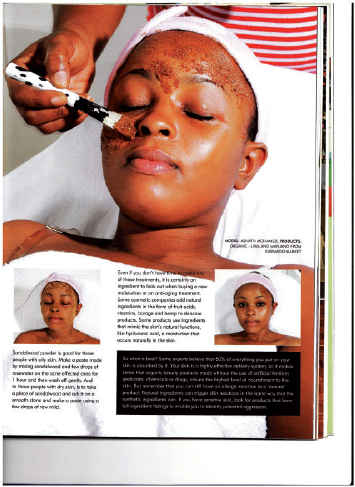
While ‘natural cosmetics’ target a very narrow segment of Dar es Salaam’s population, the research has shown that ‘unnatural’ bleaching products have been broadly ‘mainstreamed’ (Fritsch, 2011: 100–108). However, following Nchimbi (2005), middle-class women appear as ‘key agents for the contemporary beauty industry’ in Tanzania (14). The ideal of ‘light beauty’ can then be understood as embodying a postcolonial interplay of class, ‘race’, and gender. It is in the face of such commodified and discursive promotion of ‘light beauty’ that the practice of skin bleaching among the interviewed middle-class women needs to be analyzed. As will be shown in the following, skin bleaching constitutes a practice that enables middle-class women in Dar es Salaam to ‘pass for light(-skinned)’ and thus to embody urban ‘modern’ forms of subjectivation. In doing so, skin bleaching performatively unmasks various forms of interplay of class, racialization, gender, and beauty.
Passing for ‘light(-skinned)’
You know, the way we see people in Tanzania, for example a person who works, she has her income, she has her possibilities … but you will see that she does not like to bleach. But a great percentage of people of the lower class they like to use these creams. But a person who has possibilities doesn’t like it, she likes her skin to be soft and light. You don’t find it [skin bleaching] among lawyers or politicians. We here like it, we like to be white.
6
The women’s perspective stands in contrast to that of a well-known TV presenter and seller of skin-bleaching products, who explains: ‘A lot of the people who like to be white come from the middle and the upper classes’. Once more, there is reference to ‘whiteness’ or the ‘white’: once again, I want to stress that a reading of such notions of whiteness needs to depart from lightness even if it is addressed as ‘white’ in some of the quotes. This is important in order to shift the focus onto contextualizations of whiteness in Tanzania. As a Tanzanian independent researcher, newspaper columnist and policy analyst puts it: ‘I want to hypothesize that the construction of whiteness, the way it has developed, it has been Africanized’. Another one of my interviewees, a 28-year-old self-employed trader in clothes, also reflected on which kind of whiteness is aspired to in skin bleaching by pointing to an ‘Africanization’ of whiteness. She explains: ‘Wazungu 7 are very white. Arabs and Indians 8 have this kind of whiteness, yellowish. This one is more beautiful. People bleach in order to become like them’.
Western white privileges, encapsulated in the notion of the ‘Wazungu’, are an ongoing neocolonial reality in Tanzania. Yet, the interviewed women’s perception of Tanzanians of the ‘Arab’ and ‘Indian diaspora’ as ‘white’ reflects an important contextualization of whiteness in postcolonial Tanzania. In this regard the interplay of ‘race’ and class is of crucial importance, as has already been analyzed with respect to the skin-bleaching market. Accordingly, racialized relations, especially in the coastal region and on the Zanzibar archipelago, have been shaped by the dominance of traders from North Africa since the seventh/eight century as well as from India since the twelfth century (Nchimbi, 2005: 14). Besides trade relations, the Ottoman Empire also institutionalized its rule in the coastal region and the Zanzibar archipelago, which led to the shift of the sultan’s court to Zanzibar in 1841. The Ottoman Empire was tightly enmeshed with capital accumulated by members of the ‘Indian diaspora’, who ‘acted not only as merchants but also as moneylenders and customs collectors along the coast’ (Burton, 2013: 7), and became what has been termed a ‘middleman minority’ (2). Strongly engaged in the East African slave trade and holding close ties with the colonial powers, respectively, Germany and then Great Britain, members of the ‘Arab’ and ‘Indian diasporas’ became part of the ruling class (Schicho, 2004: 311–17).
In this sense, alongside postcolonial western whiteness, the longstanding political and economic hegemony of ‘Arab’ and ‘Indian diasporas’ in Tanzania de-centers western whiteness with respect to constructions of whiteness in this context. As a result, the focus needs to be shifted to non-European forms of racialized domination. Further, the perception of Tanzanians of Arab or Indian diasporas as ‘white’ and the fact that these population groups have become part of the Tanzanian society has contributed to non-western forms of whiteness, inscribed within Tanzanian class relations. Accordingly, with respect to my question about who would be perceived as ‘white’ in Tanzania, many of the interviewees referred to Tanzanians of the Arab and Indian diasporas (Fritsch, 2011: 119). Besides, some interviewed women also described other ethnic groups as ‘white’, respectively, the Warangi, Wachagga, Wasambaa or the Wapare (Fritsch, 2011: 114). Such further constructions of whiteness in Tanzania put forward the different contextual discursive and material (re)productions of whiteness, showing the contingent independence of constructions of whiteness from ‘skin color’. This becomes especially manifest in the face of the violent stigmatization of people with albinism (Dave-Odigie, 2010). Important to the following analysis is hence the longstanding genealogy of interplay of class and racialization in the Tanzanian context. The higher a person’s socio-economic position, the more light(-skinned) the (perception of the) body. Within such a system of racialized class relations, the interviewed women performatively position themselves as ‘light(-skinned) middle-class’ through skin bleaching.
Returning to the quote at the beginning of this section, the upper class is thus perceived as already ‘light(-skinned)’, while the middle and lower classes are required to bleach in order to embody lightness. Accordingly, the two cloth traders, bleaching practice distinguishes them from other classes since they follow specific racialized perceptions of their bodies. The intersection of ‘race’ and class becomes apparent and is performatively reconstructed through skin bleaching. On the one hand, skin bleaching reaffirms their distinction from an upper class that neither likes to, nor needs to, bleach. On the other hand, referring to the price of their bleaching products at another point in the interview, at a cost of around US$15, the two traders distance themselves from lower-class people buying mkorogo on the street (at around US$4). Thus, when I asked them about their bleaching practice, they immediately referred to it as kung’arisha, lightening, in contrast to the lower class’s bleaching, respectively, kujichubua. In perceiving their bleaching practice as ‘lightening’, they seem to affiliate themselves more with the upper class, illustrating the passing character of skin bleaching.
A ‘passing as light(-skinned)’ becomes further apparent as one of the two cloth traders explains that she would be referred to as ‘Arab’ in her home village. Given her ‘originally’ racialized position as ‘Bantu’, the perception of her light(-skinned) body as ‘Arab’ reproduces racialized notions of class. Further, two other interviewees emphasize ‘Tanzanian women’ of the ‘Arab diaspora’ as the most beautiful among Tanzanian women (Fritsch, 2011: 116). Yet, at that point it seems crucial to reconsider the socio-economic position of the two clothes traders as middle-classed, and hence to emphasize once more again the interplay of class and ‘race’. Their ability to perform an apparent proximity to the upper class, racialized as ‘light(-skinned) and in their case linked to a specific racialized position as ‘Arab’, strongly depends on their higher socio-economic position. This positionality stands in contrast to lower-class women, for example, for whom such a performatively embodied proximity to the upper class would seem much more unrealistic.
Racialized notions of class differences also appear with respect to urban–rural relations. Accordingly, the two cloth traders referred to above explain that a woman bleaching her skin would be showing that ‘she has made it’. Associations of lighter skin with ‘modernity’ and city life versus darker skin with ‘backwardness’, already mentioned with respect to advertising, illustrate the potential of skin bleaching in presenting oneself as ‘light, modern, civilized and from the city’. As a 28-year-old freelancer involved in the clothes trade explains: ‘These days if you are Black, ... you seem like a lout’. The respective term for ‘lout’ in Swahili is ‘mshamba’, which has two meanings: it refers to people living in rural areas but it also means ‘lout’ or ‘uncouth person’, illustrating the intersection of ‘race’ and class in one term. Consequently, the ability to buy skin-bleaching creams reflects one’s ability to consume at all, thus performatively representing one’s apparently better socio-economic position. Skin bleaching thus appears as a self-domesticating practice, especially for middle-class Tanzanian women, as their ‘enlightened’ bodies appear to represent the respective income of the household 9 (Fritsch, 2011: 92–5). Accordingly, a 35-year-old bartender expresses fear in the face of attempting to stop bleaching after more than 10 years: in her view, people will make fun of her for not having enough money.
Performing one’s middle-class status through lighter skin can thus have concrete material and social impacts, as two other cloth traders explain: ‘If you are beautiful, if you ask for a job at the reception, you get it. But if you are not beautiful, you don’t get a job’. ‘Being beautiful’, implies ‘being light(-skinned)’, according to the two interviewees. A lighter skin tone can also function as a ‘bonus’ in attracting a potential partner, as one of the cloth traders elaborates on with respect to her own experience: ‘I was Black and I had a boyfriend who did not like it that I was Black, thus he left me. Afterwards I started to bleach and I got a boyfriend who likes white women’. Such a preference of Tanzanian men for lighter Tanzanian women has been mentioned in many interviews. The reinstallation of gendered and racialized notions of beauty by skin bleaching can be well illustrated with respect to weddings. According to many interviewees, it has become usual that women of all classes start bleaching in advance in order to be ‘prettier’. However, some interviewees also contrast this perspective emphasizing their partners’ or parents’ criticism towards their bleaching practice. Accordingly, their parents would rather speak out against skin bleaching, denouncing it as a denial of their ‘Black, African identity’. While such arguments seem to draw on pan-Africanist ideas by which the parent’s generation is much more shaped, some husbands or partners are said to refer more to medical discourses putting forward the health problems often related to skin bleaching (Fritsch, 2011: 92–95, 123).
The need for embodied representations of class through a light skin tone, especially for women, is clearly represented on TV. With regards to the appearance criteria required for the TV business, a TV presenter of a show dealing with fashion, beauty and art, on East African TV (EATV), comments: They [the managers] would say beautiful or pretty. But for me, one thing is light skin. Light skin, because that presents Beyoncé and all that ideal kind of thing. And it’s really sad because most people here are not so very light skinned, so if you look at TV, not only TV but all the leaders of the country, their wives, you know they are either Arabs or Indians or mixed or somehow light-skinned. You know not a proper dark Bantu kind of woman. And another thing, hair-do, I have my afro, the more you look like Beyoncé, it’s weaves, straight hair, you know, Black gone European kind of, take a Black woman, make her light. When I say make her look white, you know, straight hair, here it’s not so important to be very skinny, that’s because I refer to Beyoncé all the time. But that’s the look. Yeah, light skin, straight hair or you put fake hair or somehow long hair.
In this sense, female TV presenters are required to match the hegemonic form of Black subjectivation of ‘light beauty’, as exemplified by the appearance of another TV presenter at the Tanzanian Independent Television (ITV). As opposed to other interviewees I spoke to, she denies that she is bleaching and emphasizes that she uses a lot of make-up at work. Furthermore, she refers to various types of lighting technology making people’s skin tone appear more ‘light’ on TV. Representing ‘the girl who made it’—in the sense of embodying an ‘upper class’ lifestyle and appearance despite her middle class background—she has become an important ‘role model’ for many young Tanzanian women (Fritsch, 2011: 114, 126). In contrast, the EATV presenter’s perception of her own bodily representation on TV reflects how one’s class can compensate one’s racialized position. Born in Tanzania, she grew up in Sweden, and had been living in Dar es Salaam for one year by the time of the research. In her show, she attempts to reinstate ‘Africanness’ and Blackness as central identifications for young people and especially for women. This is reflected in her own embodiment, which she describes in the following way: ‘I look like typical Bantu women. I love wearing African stuff’. Yet, in the next sentence she refers to her ‘proper English’ and her ‘foreignness’: ‘I have elements where people think she must be a foreigner, you understand? Just my way of being, if people don’t know me properly, that’s what they will know from me’. The differing forms of Black embodiment of the two TV moderators thus present the various interplays of class, racialization, and beauty ideals in the face of postcolonial power relations. The possibility of the presenter at EATV to affirm her ‘Africanness’, for example in the sense of showing her afro on TV, needs to be linked to her privileged position of coming from Europe, and thus also of embodying ‘Europeanness’. In contrast, the TV presenter at ITV, ‘originally’ from Tanzania and exhibiting a lower socio-economic background, needs to appear ‘lighter’ on TV in order to ‘pass for light(-skinned)’.
Hence, the analysis presented thus far has shown how skin bleaching among middle-class Tanzanian women in the context of Dar es Salaam can be understood as a performative practice, enabling the interviewed women to participate in the world of urban ‘modernity’ and ‘consumerist city life’. In this regard, ‘light beauty’ has emerged as a regulatory ideal, restructuring postcolonial power relations in the urban context of Dar es Salaam. While ‘light beauty’ thus embodies classed, racialized, and gendered notions of beauty, it also troubles the hegemonic Black/white binary. So let me now turn to the decolonizing moments regarding Blackness at the site of ambivalence where I am situating skin bleaching.
Decolonizing Blackness
Whiteness and Blackness as regulatory ideals position subjects in an either/or logic. In the face of such a racialized dichotomic order, to many interviewed women it seems unclear whether the light skin color aspired to should be perceived as a form of whiteness or Blackness, with the result that some perceive their lightness as a form of Blackness, while others describe it as a form of whiteness (Fritsch, 2011: 122–127). Central to this uncertainty is the question of racialized ‘origin’, which seems to be challenged by skin bleaching. Hence, the already introduced seller of phone credit explains that skin bleaching would force her to move away from her ‘origin a bit’, which she describes as ‘Black’: ‘It makes you white. You lose your own skin color, it changes you. You start being white’. In line with the analysis so far, the quote needs to be understood as referring to the analyzed ‘passing for light(-skinned)’.
However, although bleaching ‘makes you white’ in the sense of ‘light(-skinned)’, apparent ‘limits’ are often referred to in the interviews I did, reflecting how the postcolonial context in Dar es Salaam reinforces naturalized conceptions of lightness, in Bhabha’s (1994) sense of ‘almost the same but not quite’ (89). Hence, ‘European whiteness’ as well as the ‘whiteness’ or rather ‘lightness’ of Tanzanians of the Arab or Indian diasporas is naturalized as ‘real whites’ by a 28-year-old self-employed clothes trader. She explains: ‘Like a Mzungu, Arab or Indian, their skin, their whiteness is known. … But a Black person who bleaches her_himself, there are limits’. With respect to such ‘limits’, many interviewed women refer to the apparent ‘resistance’ of some body parts, such as the cartilage of one’s fingers or toes to bleaching, resulting in such parts remaining dark. Furthermore, many interviewees emphasize the health risks related to bleaching, such as a reddening of the skin due to increased sensitivity to the sun or stretch marks (Fritsch, 2011: 121).
As such, while skin bleaching is meant to produce the ideal racialized body, strong bleaching results in the opposite, as stated by one of the above-mentioned domestic workers: ‘If they bleach themselves until they become red, they are not beautiful any more’. In other words, as long as bleachers appear ‘natural’, their apparent ‘artificial lightness’ is not ‘seen’. In line with this, some of the interviewed women explain that people would make fun of them if their bleaching practice shows side effects. A Political Science student at the University of Dar es Salaam at the time of the research and one of the research participants not bleaching, describes women showing side-effects of bleaching as ‘weird looking’ (Fritsch, 2011: 121). Accordingly, as soon as bleaching leads to obvious ‘incompatibilities’ with existing notions of racialized beauty, it becomes a negative and, as the description of ‘weird looking’ implies, an irritating practice. Women showing skin irregularities because of skin bleaching are hence considered as ‘out of order’, ‘deviant’, and ‘irritating’. In the face of Blackness and whiteness as regulatory ideals, ‘bleached bodies’ are hence no longer considered as ‘Black’, while their position as ‘white’ is also rendered impossible due to postcolonial power relations. The interviewees’ embodied realities thus seem to ‘fail’ in the face of binary constructions of a regulatory Black/white divide.
However, it is exactly this apparent failing which is contested by some interviewed women, as they refer to a third term, namely maji ya kunde, in order to describe the actual or desired skin tone (Fritsch, 2011: 111). In following the terms of my analysis here, we may say that the respective interviewees thus literally translate hegemonic global notions of ‘browning’ (Tate, 2009: 99), embodied by artists like Beyoncé, into their embodied realities. In doing so, the hegemonic Black/white binary is disrupted through the introduction of a third term, through which notions of hybridity are brought forward (Tate, 2005: 79). Such a disruption can be observed as the two clothes traders in their 30s, introduced in the preceding section, describe this form of embodiment as ‘a bit white’, but different from the whiteness of Tanzanians of the Indian or Arab diaspora as well as from the whiteness of Wazungus. With Tate (2010) one might say that the two interviewees re-negotiate their place within the realm of Black esthetics as “‘the other’ is also appropriated and inscribed onto the surface of the body” (206). In this context, the “other” consists in “a bit of whiteness”, while the desired skin tone is clearly situated within notions of Blackness.
Such a re-centering of the ‘light beauty’ within the realm of Blackness becomes apparent as the two interviewed domestic workers distance themselves from notions of whiteness when they elaborate on racialized positions produced by skin bleaching: ‘Let’s say there is no whiteness, there is lightness and Blackness, these two’. In other words, while the hegemonic Black/white order reinforces a reading of skin bleaching as ‘passing for white’, the quote de-centers whiteness with respect to forms of embodiment in the context of skin bleaching. Instead, the interviewed women stress their wish to become ‘light’. At the same time, many interviewees emphasize their position as ‘Africans’, which they link to ‘being Black’ (Fritsch, 2011: 131). The respective interviewees hence refer to other postcolonial narratives of ‘origin’, namely ‘being African’, in order to re-position themselves within notions of Blackness as ‘light(-skinned)’. Consequently, they situate themselves within racialized power relations, according to which their bodies are excluded from whiteness, while they re-claim their place within forms of Blackness. Drawing on Tate (2005) once more, the interviewees “do not deny the binary oppositions of Black and white but challenge them and expand the category Black by including themselves as ‘light skinned’ women within it” (121).
However, and coming back to the moments of ‘failing’ mentioned at the beginning of this section, it is not only in the face of a Black/white divide that the women’s bodies appear as ‘failing’. Rather, it is also due to the ‘light beauty’ as third regulatory ideal that the interviewed women’s bodies are subjugated under the power of naturalization. Consequently, each of the interviewed women has developed her own way of handling her beauty practice. Many emphasize a ‘moderate’ form of bleaching in the sense of the previously mentioned kung’arisha, lightening, in order to prevent harmful side effects. Furthermore, the 28-year-old clothes trader already referred to with respect to the racialization of Tanzanians of the ‘Indian’ and ‘Arab diasporas’ as ‘light(-skinned)’, explains that she tries to hide her bleaching practice, so that her social environment would perceive her as ‘naturally light’. A 24-year-old hairdresser and law student states that, after suffering from skin problems, she has decided to use bleaching creams only every third day, which she, again reproducing the distinction between lightening and bleaching, perceives as ‘lightening’ in contrast to her previous ‘bleaching’ (Fritsch, 2011: 124, 126). In this sense, the ideal of ‘light beauty’ has led to a specific way of practicing skin bleaching among most of the interviewees: apparent ‘natural lightness’ is performatively (re-)produced through moderate skin bleaching.
The two cloth traders in their 30s even challenge the need to ‘appear naturally light’. Underlining their preference for skin bleaching, which makes them ‘beautiful’, they explain that they talk openly about their practice. While this pride reproduces the previously analyzed function of skin bleaching as part of the performativity of middle-class lifestyle, their decision to not hide their bleaching practice challenges notions of ‘natural lightness’ (Fritsch, 2011: 117, 124–126). Furthermore, one of them needed to reduce her bleaching habit due to skin problems. As a result, her skin has become darker and she has been addressed as being ‘Black again’ by her social surrounding. While still using ‘lightening’ creams, she emphasizes feeling well ‘in her skin’ and to be considered ‘Black’ and not ‘light’ anymore. Hence, it is due to governing norms that her body has been considered ‘Black again’ and ‘failing’ in the face of the ‘light beauty’.
However, what becomes apparent is that none of the interviewed women has ever ‘left Blackness’. Through their practice of skin bleaching, the interviewed women engender different forms of a ‘hybridity of the everyday’, we might say with Tate’s (2005: 120) terminology. By introducing the third term, maji ya kunde, some of the women resist the Black/white binary logic inscribed within the notion of lightness, according to which they are seen to either ‘pass for white’, ‘fail to pass’, or to ‘deny’ their position as Black women. In doing so, essentialized ‘origins’ of Blackness are re-negotiated, namely the color of one’s skin. Rather, by producing ‘natural lightness’ through ‘artificial skin bleaching’, skin bleaching in the sense of mimicry undermines essentialized racialized positions, as it creams ‘white looks’ onto Black bodies (Tate, 2010: 206) while resisting the Black/white binary at the same time. A decolonization of Blackness is advocated, as the interviewed women re-claim and perform their positioning as ‘light’ within Blackness.
Conclusion: Trans-skin and the decolonizing potential of skin bleaching
This text has emphasized the performativity of skin bleaching among middle-class Tanzanian women in Dar es Salaam with respect to postcolonial intersectional power relations. Accordingly, this bodily practice has been situated at a ‘site of ambivalence’, circulating around ‘light beauty’ as a postcolonial regulatory ideal. Skin bleaching among middle-class women has thus appeared as a stylization practice, which reproduces a classed, gendered and racialized middle-class lifestyle, while it also renegotiates forms of postcolonial Blackness.
On one hand, it has hence been argued that skin bleaching among middle-class Tanzanian women unmasks the various interplays of class, racialization, gender, and beauty within a postcolonial context. In the face of a perception of the Tanzanian upper- and middle-class as ‘light(-skinned)’, skin bleaching enables middle-class women to ‘pass for light(-skinned)’ and hence to participate in the consumerist world of urban Tanzania. In this regard, it has been shown how the interviewed women perform their middle-class position along specific racialized perceptions of their bodies. In doing so, skin bleaching reproduces classed, racialized and gendered notions of beauty.
However, and on the other hand, it is in the face of ‘light beauty’ that the decolonizing potential of skin bleaching has become apparent. As has been shown, some interviewed women have introduced a third term, namely maji ya kunde, in order to describe their desired or actual skin tone. In doing so, the governing Black/white divide has been challenged, as ‘lightness’ has been re-claimed as a form of Black embodiment. Nevertheless, ‘light beauty’ has also been unmasked as a regulatory ideal, according to which embodied realities can only ‘fail’. It becomes obvious that ‘light beauty’ is always more than ‘light skin’, as it is embedded within other power relations. Middle-class women’s bleaching practice then works ‘trans-skin’: it challenges essentialized notions of postcolonial Blackness, while it also shows the performativity of racialized embodiment and its intersectionalities with other structural categories.
Footnotes
Acknowledgements
I want to thank all the people who have made this research possible: To all research participants: Asanteni sana! Thanks to Jacqueline Mgumia for accompanying me during the research and to Birgit Sauer for supervising the diploma thesis. Thanks to Trystan Cotten and the three anonymous reviewers for the helpful comments on an earlier draft of this article. Thanks for proofreading to Ruth Simpson and Manuela Zechner.
Declaration of conflicting interests
The author(s) declared no potential conflicts of interest with respect to the research, authorship, and/or publication of this article.
Funding
The author(s) disclosed receipt of the following financial support for the research, authorship, and/or publication of this article: This research has been funded by a short-term grant abroad provided by the University of Vienna, ID No. 000212.