




Abstract
Discrimination is a problem for both minority groups and the societies in which they live. Perceived group discrimination reflects the direct experiences of immigrants but is also an indicator of reception context and social cohesion in the host country. This paper examines perceptions of group discrimination among recently migrated Polish immigrants to four Western European countries, and specifically focuses on changes over time in these individual perceptions, using a new longitudinal survey of immigrants. Are there cross-national differences in (changes in) perceived group discrimination, and how is discrimination related to exposure to and experiences in the host country? By employing a panel design we find that perceived discrimination is higher among Polish migrants in the Netherlands in Wave 1 than in the other three countries; perceptions of discrimination also increase more there between waves of the survey, as well as in the UK. Perceptions of group discrimination are related to some aspects of exposure to the host country, but most strongly associated with negative experiences in the host country. Differences in country contexts – attitudinal climate and national discourses – seem to play a role in understanding perceived group discrimination among new Polish immigrants in Western Europe.
Keywords
Introduction
Discrimination is a problem for both minority groups and the societies they live in, and can be a key obstacle to the integration of migrants. Perceived group discrimination reflects both direct experiences but is also an indicator of receiving country context and social cohesion. Perceptions of discrimination among migrants can influence sense of belonging and well-being (Safi, 2010). A growing body of research examines the role of discrimination in affecting how individuals identify with the host country versus identifying with their own group (Diehl et al, 2016, this volume; Jasinskaja-Lahti et al., 2009; Nandi and Platt, 2013). Discrimination can also play a role in acculturation, with those perceiving group discrimination being less likely to adapt to the host country in terms of attitudes (Roeder and Lubbers, 2016, this volume). To the extent that immigrants lack a sense of belonging, feel unfairly treated and retreat into separate identities, this can put a strain on social cohesion (De Vroome et al., 2014). Measuring immigrants' perceptions of discrimination against their group allows us to investigate receiving contexts for immigrant groups.
Much of the literature on discrimination has been about racial/ethnic or other non-Western minorities in Western societies (Pager and Shephard, 2008). This paper is novel in its focus on East Europeans moving to Western Europe and their experiences in the country they migrate to. Free movement of labour is central to the ‘European project’, one of the most important rights the European Commission grants to its citizens (European Commission, 2010). EU migration, and indeed EU integration policy, is solely concerned with ‘Third Country Nationals’, migrants from outside the EU, and not with other European nationals, who are essentially free to move to whatever other European country they want (e.g. Common Basic Principles of Integration). This has resulted in very different patterns of migration in Europe, more flexible and complex than before (Favell, 2008). Polish migration, coined by some as the ‘great East West migration in the past decade’ (Black et al, 2010), offers a great opportunity to test how ‘freely’ Europeans can move from one country to another.
Comparative analysis of discrimination is much less common than that focusing on individual countries. Large-scale comparative surveys such as the European Social Survey and the Eurobarometer allow baseline comparisons of perceptions of discrimination among the general population, but one key problem with country comparisons is that not only do the country contexts differ but also the characteristics of the migrants to each country differ in terms of race, origin country and migration history. Analysing the same migrant group in four different receiving contexts – Ireland, the UK, the Netherlands and Germany – allows us to focus on the receiving country context. Polish migration was substantial to all countries in the years following Poland's accession to the EU, but the countries differ in their social, cultural and economic contexts. While all except Ireland have long histories of inward migration and experience of significant ethnic/racial minorities throughout the 20th-century, large-scale Polish migration is new to all of them except Germany.
Perceived group discrimination is essentially an attitude. It is linked to personal experience of discrimination, to the extent that that is perceived as being group-related, but it will also reflect the ‘threat in the air’ that comes from awareness of others’ experience, and of popular discourses. Such perceptions of discrimination are, therefore, likely to vary not only with personal characteristics and degree of exposure but also critically with the differences in context. Uniquely, this study investigates such contextual differences: it is able to do so because it treats a single origin group in four different contexts arriving at the same time. In addition, this paper enhances our understanding of the impact and correlates of discrimination among new migrants and among white minority groups, who have largely been absent from the discrimination literature, which has been framed as largely concerning visible minorities.
A strength of the comparison of receiving country contexts is the focus on perceptions of discrimination among recently arrived immigrants. By investigating new immigrants in four different receiving contexts, we measure perceptions of discrimination among those who have accumulated very little experience of their destination country. Another strength of the comparison is that we were able to follow individuals over time drawing on data from a unique dataset produced in the international survey project on Socio-cultural Integration Processes among New Immigrants in Europe (SCIP) that was funded by the NORFACE Research Programme on Migration (Diehl et al., 2015). The SCIP project is a two-wave-panel study of selected migrant groups in which about 7000 recent migrants aged between 18 and 60 were surveyed in four European destination countries – Germany, Netherlands, United Kingdom and Ireland. Migrants were interviewed soon after their arrival and as many as possible were re-interviewed 1.5 years later. We examine whether and how perceptions change among the same group as they stay in the host country. How is this change related to exposure to the host country and personal experiences there?
The paper seeks to address the following key questions: are there differences in perceived group discrimination among new Polish immigrants across countries? Do these perceptions change over time? How is perceived discrimination related to exposure, experience and difference in country contexts? The paper first presents a brief overview of Polish migration to the four countries and the attitudinal context in each country. The next section discusses theoretical perspectives on perceived group discrimination, developing hypotheses about exposure to both the host country and the origin country, and experiences in the host country and how these might affect perceived discrimination. The section also discusses how these mechanisms might differ across countries, given differences in the attitudinal climate. The paper proceeds by discussing the evidence used to test these hypotheses, describing the unique cross-national panel survey of new immigrants (SCIP), the measures used and the analytic strategy. Then, the findings are presented on perceived discrimination among Poles in the four countries, and how these perceptions change over time, as well as the results of models of perceived group discrimination at Wave 1, and models of change over time. The discussion section concludes, highlighting key results, implications for future research and the paper's contribution.
Polish Migrants in Ireland, the UK, Germany and the Netherlands
Following the accession of Poland to the EU in 2004, there was substantial migration of Poles to all four West European countries in this study. The increase in Polish migration was perhaps most dramatic in the UK and Ireland, which were two of only three European countries to fully open their labour markets to East Europeans on accession in 2004. Based on Census data for England and Wales, the number of Polish-born migrants increased from 19,000 in 2001 to 466,000 in 2011, so that by 2011, 1% of the population of England and Wales was born in Poland. In Ireland, the number of Polish nationals living in Ireland rose from 2000 in 2002 to 120,000 in 2011. By 2011, Polish nationals made up 2.7% of the Irish population, the largest national minority.
Polish migration to Germany and the Netherlands also increased, although not as rapidly. Notably the Netherlands restricted labour migration until 2007, Germany until May 2011. In 2010, the number of Polish born registered in the Netherlands was 160,000, although Van der Heijden et al. (2013) estimate the total number Polish born was 182,000, given that not all Polish migrants register there. In Germany by 2009, around 1 million people were from a Polish background, of whom 400,000 remained Polish nationals as others became German citizens (Luthra et al., 2014).
In the early years after Accession, many Poles were drawn to the booming labour markets in Western Europe in the face of high unemployment rates in Poland, which was 18.8% in 2004. Yet by 2010–2011, when the first wave of the survey was conducted, the situation was rather different. In Ireland, which entered a deep recession in 2008, the unemployment rate was just under 15% by 2011, compared with 8% in the UK, 6% in Germany and 4.5% in the Netherland. 1 This labour market variation between destination countries is also evident if we consider unemployment rates of new immigrants to these countries. In Wave 1 of the SCIP sample (see Evidence and analytic strategy section for a description of the survey), the unemployment rate was around 34% for new Polish immigrants in Ireland and the UK, compared with just under 12% in Germany and 9% in the Netherlands. 2
New East-West migration in Europe has offered a challenge to existing conceptions of migration in Europe, in particular the permanence of the migration decision (Favell, 2008). Migration patterns have become more complex, with more temporary and circular migration (Engbersen et al., 2013; Favell, 2008). In many ways, Polish migrants are not the typical ‘immigrant’, particularly in West European countries with a tradition of immigration. They are White Europeans, not racially distinct from the host populations: cultural distance is also less than for many non-EU migrants. Work on Polish migrants has also highlighted the diversity of migration motives, attachment and intentions to stay among this group (Duvell and Vogel, 2006; Krings et al., 2013). Polish migrants in Western Europe are less encumbered by border restrictions and work regulations than ‘traditional’, non-EU migrants; communication is easier due to cell phones, skype and cheap flights (Luthra et al. 2014). Yet the fact that migration is low cost and relatively easy and the physical and cultural and distance is low does not necessarily mean that migrants will quickly integrate into the host country.
For example, the attitudinal or receiving context for Polish migrants in the countries differs. While attitudes to immigrants in Ireland became more negative during the recession (see McGinnity et al., 2013), this is perhaps less true of attitudes to Polish migrants. Haynes et al. (2009) note the lack of debate on immigration in the Irish media, though generally positive portrayal of Poles, in contrast to other groups. Kingston et al. (2015) find the experience of discrimination much higher among Black Africans than white EU migrants, of which Poles are the majority. In the Netherlands by contrast, there is now a negative social climate towards new EU immigrants, especially Poles, Bulgarians and Romanians, fomented by the radical right wing party of Geert Wilders. A recurrent theme in the Dutch media has been welfare fraud by immigrants, in particular Bulgarians. During the period of the fieldwork for this survey, the Freedom Party opened up a highly publicised ‘blacklist’ on a website on which people were asked to report Polish misbehaviour (the so-called Polenmeldpunt). Results from a recent survey of the Dutch general population show negative attitudes towards new EU immigrants from Eastern Europe. This is particularly true of economic consequences (‘they take our jobs’) and crime (‘crime is increasing because of these groups’) (Dagevos and Gijsberts, 2013). While anti-immigrant discourse in the Netherlands has increasingly focused on Eastern Europeans, anti-Muslim discourse is also still prominent in public debate.
In the UK too, in spite of a long tradition of immigration and ethnic diversity, immigration has been a contentious and highly salient issue for the past 15 years. Intense policy and enforcement activity has reduced non-EU immigration, but immigration from within the EU, which the government has little power to restrict, has risen rapidly (Ford and Heath, 2014). Public concern about increasing immigration has found expression in growing support for the anti-immigration party, UKIP. In 2013, the British Social Attitudes survey found 77% of UK nationals wanted immigration reduced a little or a lot: over half (53%) of UK nationals believed that the costs of labour migration from within the EU were greater than the benefits, though a significant segment of the population remained positive about immigration (Ford and Heath, 2014). There are particular anxieties in the British public about the limited policy leverage the British government has to reduce EU immigration, or restrict welfare benefit receipt among EU migrants to Germany, with its proximity and historical links, is less of a ‘new’ destination for Polish migrants. There are also some negative attitudes towards immigrants in Germany, but more towards Muslim migrants than East Europeans, most cogently expressed perhaps by the politician Sarrazin's hugely popular anti-Muslim book, which links Muslim migrants to welfare tourism and crime (Sarrazin, 2010). A recent study comparing attitudes in Germany and the UK finds attitudes to immigration becoming more positive in Germany, and more negative in Britain in the past 10 years: the authors conclude the two countries are ‘on very different paths’ (Duffy et al., 2014). It is also relevant that a significant proportion of Polish migrants to Germany, particularly in the immediate post-Wende years, were ethnic Germans, contributing to a relatively positive image of Polish migrants there.
In terms of perceptions of discrimination among minority groups, comparative surveys such as the European Social Survey give an overview of perceptions of discrimination in Western Europe, but sample sizes do not permit detailed comparisons of immigrants' in different countries (OECD, 2013). The same is true of the Eurobarometer surveys (European Commission, 2008). The EU-Midis survey was a more in-depth cross-national survey of perceived discrimination; however, there were considerable variations between the surveys in the different countries with respect to sample selection procedures, coverage and choice of ethnic minority group to be sampled and so it is not possible to compare between countries (OECD, 2013). By contrast, the SCIP sample used in this paper permits a comparison of the perceptions of discrimination among migrants from the same country of origin in four different countries, and also collects data on change over time in perceptions.
Theory and expectations about perceived group discrimination
Why would we expect migrants to perceive discrimination against their group? According to social identity theory, individuals strive to achieve and preserve a positive social identity. They do so by comparing their in-group with out-groups, and selectively perceiving (mainly) positively valued characteristics to be typical of the in-group and (mainly) negatively valued characteristics to be typical of out-groups (Hewstone et al., 2002). Closely linked to theories of intergroup relations, stereotypes are usually defined as beliefs about a group that are used to ‘proxy’ missing information, for example that members of the group are typically intelligent, hardworking, criminal or lazy. In general stereotypes produce a readiness to perceive behaviours or characteristics that ‘fit the stereotype’: other characteristics are ignored. Some authors have argued that context plays a significant role in whether or not stereotypes are invoked: stereotypes are more likely to be invoked in situations of group threat, and in competition for resources (Dovidio and Gaertner, 2010). Others argue that the concern is not so much about the consequences of an individual interaction but as about what Steele (1997) called the ‘threat in the air’, that is the unfavourable stereotypes that are widely available in society about one or another group that will have an impact on performance or well-being of members of that group. It is precisely this ‘threat’, reflecting the stereotypes about a group in a receiving country, that the measure of perceptions against the group used in this paper is designed to capture.
Yet how do stereotypes develop: how is an ‘in-group’ and an ‘out-group’ defined? Recent studies have highlighted the importance of symbolic boundaries to distinguish ‘us’ and ‘them’. How these boundaries are constructed varies considerably across countries and across time (Wimmer, 2008). Wimmer argues that boundary making is processual and not static, a result of struggles between actors, and influenced by the institutional order, the distribution of power and political networks (Wimmer, 2008). Bail (2008) proposes the idea that in the older immigration countries of the European core, of which the Netherlands, Germany and the UK are all cited as examples, immigration has a history, and discourse about immigration has evolved over decades. Racial distinctions have become less tenable, but as immigration now seems more permanent, the host population becomes more concerned about their linguistic and/or cultural identity. Linguistic and/or cultural identity becomes the prime mechanism of intergroup exclusion. This allows salient boundaries to develop between White European immigrants and European host populations, not just racial distinctions between Black or Asian immigrants from non-Western countries.
An extension of social identity theory, ethnic conflict or competition theory offers further insights into how group relations and conflict might change over time or vary across countries by highlighting the role of context. Ethnic competition theory is the idea that ethnic groups compete for scarce resources such as jobs, housing, power or cultural values (Quillian, 1995). Individuals may perceive more socio-economic threat and competition from minority groups under negative economic conditions (high unemployment rates), or following rapid immigration (Scheepers et al., 2002). There was a rapid increase in immigration following Accession in 2004 in all four countries (see section Polish migrants in Ireland, the UK, Germany and the Netherlands), although Poles were ‘new immigrants’ to a lesser extent in Germany (section Polish migrants in Ireland, the UK, Germany and the Netherlands). As discussed in section Polish migrants in Ireland, the UK, Germany and the Netherlands, the extent of recession also varied considerably in these countries, with Ireland hardest hit.
The extent and nature of the discourse and stereotypes about migrants in a country is influenced by a range of factors. For individuals who are concerned about the threat to culture and national unity, as well as declining national authority in the face of EU membership, anti-immigrant elites play an important role in persuading the public that restrictive immigration is the answer (Ivarsflaten, 2005). Anti-immigrant elites can also set the agenda for which groups should be excluded. Arguably the success of radical right wing anti-immigration parties in the Netherlands and the UK has influenced the attitudinal climate regarding East Europeans.
Exposure to the host country
However, the relationship between the attitudes of the host population and perceptions of minority groups of discrimination is not straightforward. An important element of this relationship is the extent to which immigrants are exposed to the dominant culture: there may be a negative discourse around immigrants or certain minority groups but they are simply not aware of this. Our first general expectation is that greater exposure to the majority beliefs and public discourse will lead to higher perceived discrimination among immigrants.
We measure exposure in a number of ways. First, and most clearly, the length of time living in the country. This is a survey of new immigrants, so in the first months they may be unaware of the discourse, but as they become exposed to the society they may perceive more discrimination. Consistent with this hypothesis, we would also expect a rise in perceived discrimination between the two waves of the survey. We have to acknowledge that all measures we use for exposure are indirect measures. The fact that an immigrant resides longer in a country of destination does not per definition imply that this leads to a higher exposure, since it depends on his or her actual behaviour. However, the probability of exposure is higher with longer length of residence. We also supplement duration with a number of more specific measures of exposure – engagement with the media, host country politics, language ability and social contact.
The media – television, Internet and print media, particularly tabloid newspapers in the case of immigration, play an important role in communicating the dominant ideas to the population, both majority and minority groups. Both the beliefs and interactions of the majority group will be affected by media messages, but also the perceptions of the minority groups of discrimination and prejudice in the society (Sizemore and Milner, 2004). Given the role of the media in transmitting stereotypes, Gerbner's cultivation hypothesis argues that reality is affected by content and consumption of media messages (Gerbner, 1969). Cultural consumption of host country media then is another indicator of exposure, and respondents who watch more TV are likely to perceive higher levels of and increases in perceptions of discrimination. Similarly, given the political nature of anti-immigrant discourse, an interest and knowledge of host country politics is another important indicator of exposure to host country debates.
Language ability is an important indicator of integration, and migrants' ability to engage with the host culture and attitudes, but it is also important in cultural consumption. Thus host country language proficiency is another indicator of exposure, as individuals are more aware of media messages and discourse in their host country (Tolsma et al., 2012).
Allport (1954) argues that social contact can reduce prejudice and overturn or modify stereotypes. However, the extent of this can depend on the nature of the contact (MacLaren, 2003). Positive social contact may reduce prejudice, but negative social contact may also serve to make migrants more aware of the attitudes and stereotypes in the host country. Often measures of social contact measure frequency of contact, as in this survey, not the nature or intensity of the contact. It is possible then that social contacts with host country nationals will be an indicator of exposure and associated with higher perceptions of and increases in perceived discrimination against the group. All these different measures of exposure are seen as explanatory factors to explain differences in and changes in perceptions of discrimination.
Taken together, we expect exposure, measured as duration, host country media consumption, political interest, language ability and social contact to be positively associated with perceptions of group discrimination and with increases in perceptions of group discrimination over time (Hypothesis 1).
Origin country exposure
Of course for migrants, particularly new migrants, contact with and exposure to others from their country of origin may be extremely important. Ethnic networks have shown to be important for finding employment, navigating host country institutions and for social support more generally, particularly in the early stages of migration (Esser, 2008). However, exposure to co-ethnics might also make new immigrants more aware of discrimination against their group than they would otherwise be. Similarly, an orientation to and exposure to the country of origin, for example through media channels, may also be associated with higher perceived discrimination against the group.
Hypothesis 2 is that more exposure to the country of origin and the co-ethnic community (other Poles in the host country), and an increase in origin country exposure will be associated with higher perceived discrimination.
Experiences in the host country
Of course, migrants may not just form opinions on their group's relative position from the media and discourse in the host country: their perceptions of discrimination may also be shaped by their personal experiences in the country they migrate to. Labour market or economic integration may be associated with perceptions of discrimination among minorities. Research in Ireland on the whole population has found that those who are unemployed are more likely to report having experienced discrimination, especially in recruitment but also in other domains (McGinnity et al., 2012). Not all migrants may attribute this to discrimination against their group but it does seem likely that unemployed migrants will have higher perceptions of group discrimination than employed migrants. Moreover, migrants who experience negative changes in their employment position over time (e.g. lose their job) may also be expected to experience a greater increase in perceived discrimination.
Not only objective conditions (or changes in these conditions) like employment situation but also people's perception is important here. Migrants who feel badly treated in the host country, or report increases in these negative experiences, can be expected to feel higher group discrimination. Experiences of harassment, problems in access to housing, being treated negatively by official institutions and reporting having been turned down for a job while in the host country may all contribute to a perception among immigrants that the group is being discriminated against. Our third main hypothesis then is that new immigrants who have negative experiences in the host country will be more likely to perceive (increases in) discrimination against their group (Hypothesis 3).
Cross-national variation
A strength of this paper is that we consider the same immigrant group in four different countries: much research on discrimination is hampered by the fact that immigrant groups are very different across countries. Do we expect the effect of exposure and experience on the perceived group discrimination to be universal processes with a similar effect across countries, or to vary according to the country context? A key factor here is the nature of the discourse that immigrants are being exposed to. As discussed above, both the high-level national (political and media) discourse and the attitudes of individuals towards East European migrants seem to be more negative in the UK and particularly the Netherlands than in Germany or Ireland. For this reason, we expect that exposure will be more salient for (increases in) perceptions of group discrimination in the UK and the Netherlands (Hypothesis 4a).
Similarly in countries with a more negative attitudinal climate with anti-immigration discourse in the public domain, we might expect that there will be a stronger link between personal negative experiences and perceptions of group discrimination. It follows then that the impact of negative experiences in the host country will be more salient in understanding perceptions of discrimination in the UK and the Netherlands and also increases in negative experiences to explain the higher increase of discrimination in these countries. Hypothesis 4b is that negative experiences will play a greater role in (increases in) perceptions of discrimination in the UK and the Netherlands than in Ireland and Germany.
Of course, there may be other factors underlying country differences in perceptions of group discrimination. This paper considers Poles in all four countries, but these migrants may differ in other relevant characteristics. Previous research has found, for example, that younger migrants perceive more discrimination and unfair treatment than older migrants (Sigelman and Welch, 1991), although this may depend on the minority group. While one might expect migrants with secure jobs and high incomes to be less likely to perceive discrimination, there is also some evidence for an ‘integration paradox’ in the Netherlands, at least for the longstanding immigrant groups like the Turkish and Moroccan Dutch, whereby those who are highly educated perceive more discrimination (Tolsma et al., 2012). To the extent that Polish migrants to these countries differ in their age, gender and migration motives, and these are associated with perceptions of discrimination, this might reduce cross-national differences in perceptions of discrimination and how this changes over time. Similarly, to the extent that Polish migrants differ in their exposure to the host country, in terms of duration, cultural consumption, political interest, language ability and social contact with natives, as well as experiences in the host country in a range of life domains, this may also reduce cross-national differences in perceptions of group discrimination.
Evidence and analytic strategy
Data
We draw on data from the international survey project on Socio-cultural Integration Processes among New Immigrants in Europe (SCIP) that was funded by the NORFACE Research Programme on Migration (Diehl et al., 2015). The SCIP project is a two-wave-panel study of selected migrant groups in which about 7000 recent migrants aged between 18 and 60 were surveyed in four European destination countries – Germany, Netherlands, United Kingdom and Ireland. Migrants were interviewed soon after their arrival and as many as possible were re-interviewed 1.5 years later (full questionnaire available at: www.scip-info.org, accessed 2 November 2015). To analyse group differences, Poles as a rather recent immigrant group to these destinations, and Turks/Pakistanis/Moroccans as groups representing the classical labour/colonial migration to Western Europe, were included in the SCIP survey. These groups contribute greatly to the share of migrant population in the four countries (for a detailed description of the methodology and sampling see Gresser and Schacht, 2015).
In this paper, we use data from Polish migrants in the four countries, who had spent a maximum of 2 years in the country at the time of the first survey. These data collection resulted in 1056 valid wave 1 responses in Ireland; 776 in the UK; 874 in the Netherlands and 1484 in Germany. In the second wave, 405 valid responses remain in Ireland, 242 in the UK, 680 in Germany and 376 in the Netherlands. For further details on non-response rates in this survey and interwave attrition, see Gresser and Schacht (2015).
Measures
In the SCIP survey, perceived group discrimination is measured consistently across countries, as ‘Some say that people from [CO] are being discriminated against in [RC]. How often do you think [co] people are discriminated against in [RC]? Very often/Often/ Sometimes/almost never/Never’. 3 The responses are coded on a scale from 1 to 5 where 5 is ‘very often’. The question wording is identical in Wave 1 and Wave 2. To analyse the change over time in perceived discrimination we construct a difference score between the perceptions of wave 1 and wave 2, where a positive score indicates an increase in perceived discrimination. Note the measure is of people's perceptions of discrimination: there may be discrimination of which the respondent is not aware; these perceptions may or may not be related to their own personal experience.
Both the different sampling strategies in the four countries and the different migration histories of Poles to the four countries may lead to compositional differences between the samples. One pronounced difference is that the Poles in Ireland are better educated than in the other three countries. Also, in Ireland and the UK, the Poles are younger, on an average, than in Germany and the Netherlands (see Gresser and Schacht, 2015). The length of stay is longer in the Netherlands, while Ireland in particular has a lot of very recently migrated Poles. Therefore, we control for age and education in our analyses, as well as gender and migration motive. Education is measured as four categories, from none or primary through to third level (degree) qualifications. As most of the Poles in the sample were economic migrants, we simply distinguish those who were economic migrants from those who were not.
Regarding our hypotheses on exposure, we distinguish several variables. First, of all we include duration in the host country (measured in months). Language skills of the host country are self-assessed, a combined index of listening, speaking, reading and writing (Cronbach's alpha=.94). The scale ranges from 1 (not well at all) through to 4 (very well). Interest in host country politics is measured on a scale from 1 (not interested) to 4 (very interested). Host country TV use is measured from 1 (never) to 5 (every day). Social contacts measure frequency of contact with the host country population (from 1 (never) through 6 (daily)). In addition to these measures, we measure changes in exposure between wave 1 and wave 2 by including the difference score of media exposure between wave 1 and wave 2 and the difference score of host country social contacts. Our measures of origin country exposure are constructed in a similar way. We include origin country TV use and social contacts with co-ethnics; as well as the change in origin country social contacts between wave 1 and wave 2.
Our final set of variables concerns the influence of experiences in the host country. We include principal economic status, measured as employed, unemployed or other (education, home duties or other). In addition to these, we measure changes between Wave 1 and Wave 2 in employment position. We identify those who changed labour market status, either moved from employment to unemployment, or unemployment to employment. Finally, we include a measure of (negative) experience in the host society. Respondents were asked whether they had negative experiences in four life domains: since you moved to [RC] have you been turned down for a job or a job interview?; Since you moved to [RC] have you been refused on a rental or housing application, or denied in a hostel or shared accommodation?; Have you ever experienced bad treatment at official institutions in [RC], such as rudeness or having to wait longer than the usual time for assistance or documents?; Since you moved to [RC] have you ever been yelled at, spat on, or experiences physical violence in a public place from a stranger? People could answer yes or no. We constructed a combined index from these four items. In Wave 2, the questions were the same, except that respondents were asked to record their experience since the last interview. We included a measure of changes in these negative experiences between Wave 1 and Wave 2 (as the difference score).
Methods
To test our hypotheses, we first estimated a linear regression (OLS) for perceptions of discrimination at wave 1. Then, we estimated linear regressions of the change in perceived group discrimination. These are known as ‘change score models’ (Allison, 1990; Johnson, 2005). We included the level of perceived discrimination at wave 1 as a control variable (to control for ceiling effects).
For analyses at Wave 1, all migrants are included. To study changes between the waves only the migrants that have responded to both waves are included (the so-called balanced panel). We present both pooled models and country specific models. For the pooled models, we estimated nested models to see whether the remaining variance between countries could be explained by the sets of variables introduced.
Given that in all four countries less than half the Wave 1 respondents responded and were in the host country at Wave 2, we also analyse whether non-response is associated with perceptions of group discrimination, which might bias the analysis of change over time.
Perceptions of discrimination among Poles in four Western European countries
Figure 1 shows that in Ireland, Germany and the UK at Wave 1, a similar, modest proportion of Polish migrants say that they feel Poles are discriminated against often or very often (around 15%). This is in sharp contrast to the Netherlands where 40% of Poles say they feel Poles are discriminated against often or very often. In all four countries, a large proportion of respondents feel that Polish people are discriminated against sometimes. The Wave 1 responses suggest that specific discourses and attitudinal climate may play a role, at least in the Netherlands.
‘How often do you think Polish people are discriminated against in (receiving country)’ (Wave 1).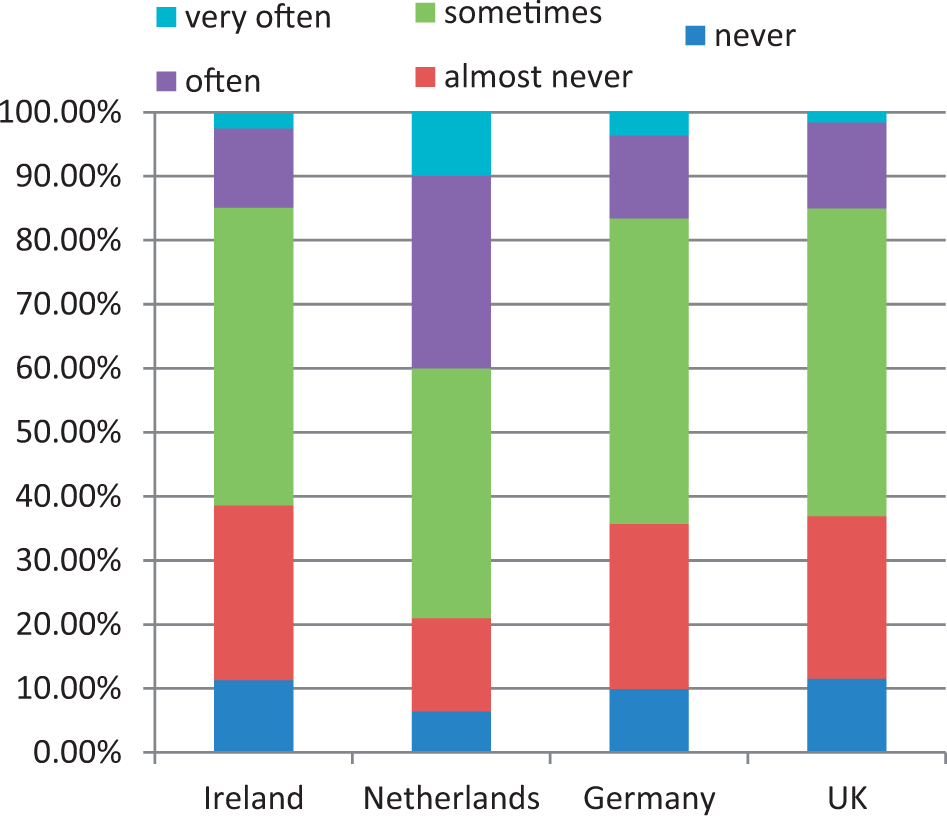
Figure 2 compares perceptions of discrimination in each country among those responding at both Wave 1 and Wave 2. Here we see perceptions of discrimination are actually somewhat lower in Ireland in Wave 2, with just over 10% of Polish migrants reporting that Poles are discriminated against often or very often. A similar pattern is found in Germany. In the Netherlands, the opposite is true: the proportion of migrants who feel discriminated against rises between waves, from 40% reporting that Poles are discriminated against often or very often in Wave 1 to almost 50% in Wave 2. In the UK, this proportion also rises, although from a much lower base (just under 20% in Wave 1 to just under 30% in Wave 2). Once again, these descriptive findings tend to support the idea that attitudinal climate will affect perceptions of discrimination among migrants, with a greater rise in the Netherlands and the UK. Given it is the same immigrant group – Poles in all four countries – the difference in perceptions of discrimination and change in perceptions is remarkable.
‘How often do you think Polish people are discriminated against in (receiving country)’ (Waves 1 and 2). Note: Only respondents present at both waves.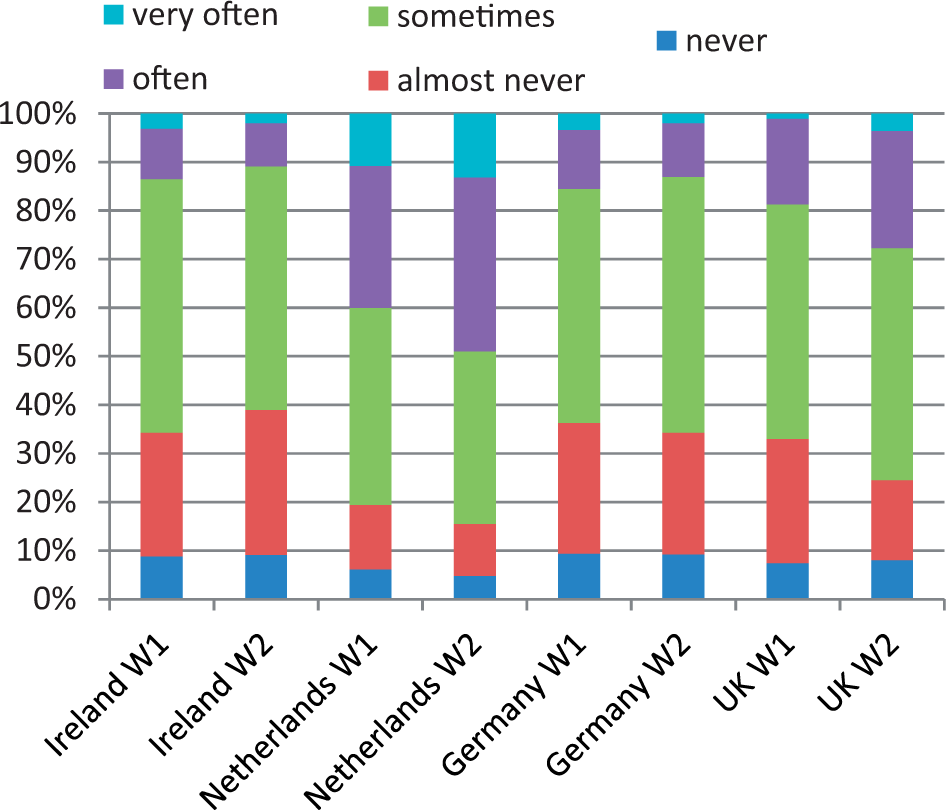
We addressed the question of whether there was any selectivity among those who were reinterviewed at Wave 2. That is, we explored whether those who perceived frequent discrimination not respond at the second wave. The results are provided in Table A1 in the Appendices, which compares mean scores on perceptions of discrimination of all those who responded to this questions at Wave 1; Wave 1 responses for those also present at Wave 2, and Wave 2 responses.
Table A1 shows that actually for Ireland and the UK the opposite is true: those who responded at Wave 2 were slightly more likely to perceive discrimination in Wave 1. In the Netherlands and Germany, there is no difference in perceptions of discrimination between all those present at Wave 1 and those present at Wave 2. So it is not, as we might expect that those who perceived discrimination were more likely to have either left the receiving countries or be lost to follow up.
Modelling perceived group discrimination
Perceived group discrimination among Polish migrants, Wave 1 and OLS.
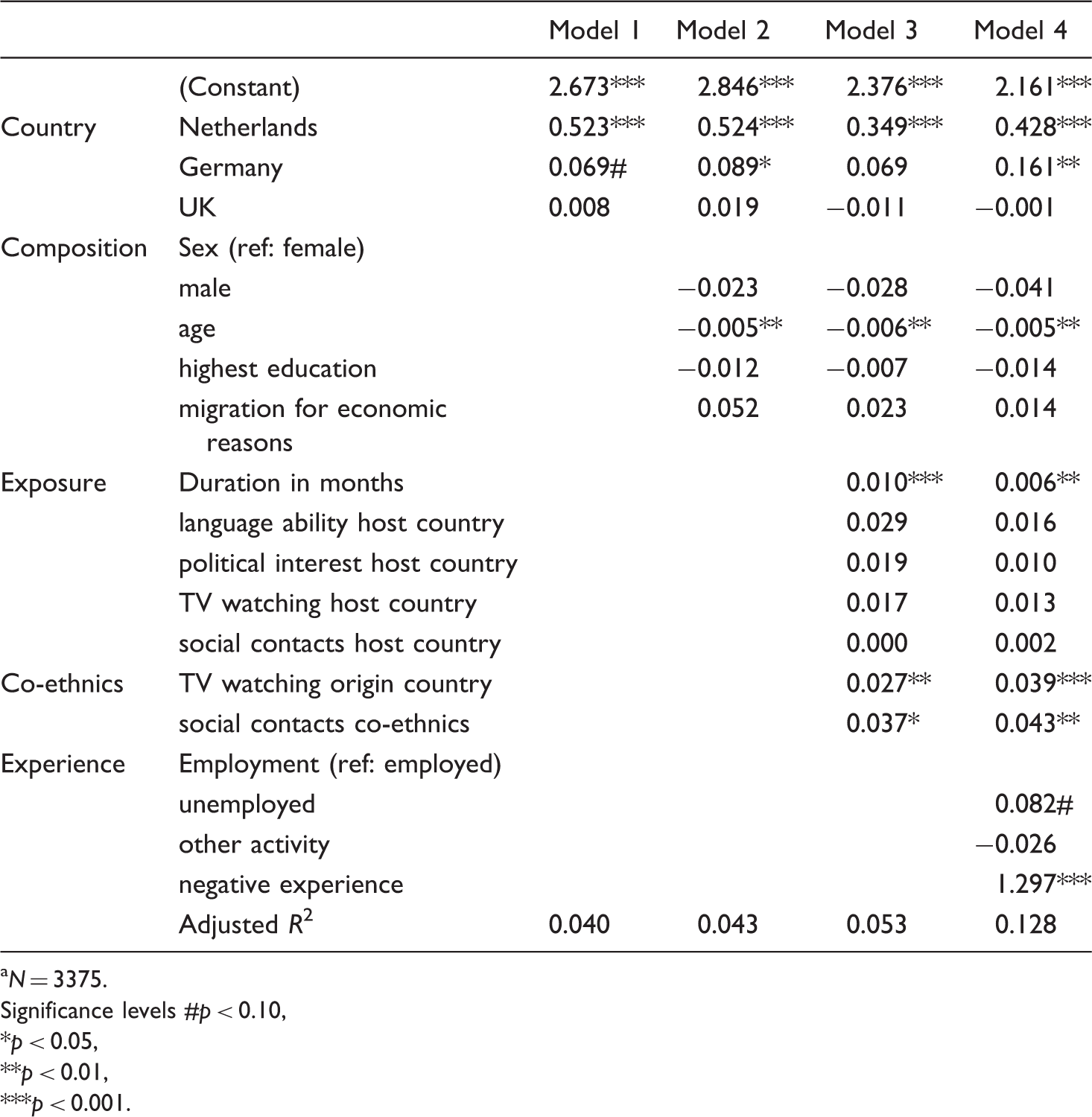
aN = 3375.
Significance levels #p < 0.10,
p < 0.05,
p < 0.01,
p < 0.001.
Change in perceived group discrimination among Polish migrants from Wave 1 to Wave 2, OLS regression a .

N = 1376.
Significance levels #p<0.10,
p < 0.05,
p < 0.01,
p < 0.001.
Model 1 in Table 1, a pooled model of country differences with Ireland as the reference category, shows clearly, as in Figure 1, that perceived discrimination is higher among Poles in the Netherlands. It is slightly higher among Poles in Germany, and the difference is marginally significant (10% significance level). There are no significant differences between perceptions of discrimination among Poles in Ireland and in the UK at Wave 1. The difference between countries is not explained by compositional differences between the countries in age, gender, education or migration motives (model 2). Only the effect of age is significant in the pooled model: the older Poles perceive less discrimination (especially in Ireland, see Table A2).
What happens when we add variables measuring exposure to the host country (model 3)? Duration in months is positively associated with perceived discrimination. Polish migrants who have been living in the host country longer perceive higher levels of discrimination than those who have arrived more recently. This is consistent with hypothesis 1. Other measures of exposure, such as language ability, political interest and host country media consumption show very small positive associations with perceived discrimination but are not statistically significant. There is also no effect of social contacts with host country nationals in this model.
Social contact with co-ethnics is associated with higher perceived discrimination, consistent with hypothesis 2. Polish migrants who spend more time with other Poles are more likely to perceive discrimination against their group soon after arrival in Wave 1. We also find a positive effect of watching origin country TV, which is also in line with hypothesis 2. More exposure to the origin country group is associated with a higher perceived discrimination against their own group.
What about the effects of experience in the host country? Model 4 adds whether migrants are unemployed or inactive (compared with being unemployed), and also the index measuring negative experiences in the host country (see Evidence and analytic strategy section for how this is measured). Model 4 shows that unemployed migrants perceive higher levels of discrimination than employed migrants, as expected. In addition, negative experiences in the host country are very strongly associated with perceived discrimination. Migrants who report negative experiences, such as negative experiences with official institutions or harassment, have higher scores on perceived discrimination. This supports Hypothesis 3.
Do these effects vary across countries? Table A2 presents models of perceived discrimination among new immigrants at Wave 1 for each country separately. Here it is clear that exposure, measured as duration, is more strongly associated with perceived discrimination in Ireland than in the other countries (Table A2). This is not consistent with Hypothesis 4a, that exposure would be more salient in the Netherlands and the UK. This finding is more likely to be linked to the fact that Poles in Ireland are the ‘newest immigrants’ with the shortest durations, and that duration is likely to play a key role in the initial months following migration. Further investigation would be required to pursue this idea. Other measures of exposure show very modest associations with perceived discrimination and in general no differences in countries are observed. The one exception is that social contacts with host country nationals are associated with higher perceived discrimination in the UK, consistent with Hypothesis 4a. The opposite of this is true in Germany, where social contacts with host country nationals are associated with lower perceived discrimination, more resonant with Allport's (1954) social contact hypothesis. Of course Polish migrants’ contact with Germans in Germany may be more positive than Polish contacts with UK nationals in the UK.
Hypothesis 4b was that experiences in the host country would be more strongly associated with perceived discrimination in the Netherlands and the UK. Do we find evidence of this? The effect of negative experiences in the host country is strongly associated with perceived discrimination in all four countries: no strong country variation is found (Table A3). Compared to the Netherlands or Germany, being unemployed is associated with higher discrimination in the UK, but this is also true in Ireland. This stronger association may be related to the higher proportion of migrants who are unemployed at Wave 1 in Ireland and the UK. Thus we find no support for the idea that experience is more salient in countries with a negative discourse, at least at Wave 1.
In terms of cross-national differences in overall perceptions of discrimination, it is interesting to note that once we control for exposure to the host country and contact with co-ethnics, the difference between Poles in the Netherlands (and Germany) and Poles in Ireland is reduced (Model 3). It seems that part of the higher levels of perceived discrimination among Poles in the Netherlands as compared with the other countries are caused by differences in exposure to the host country. However, once we control for unemployment and negative experiences, cross-national differences in perceptions are slightly larger (Model 4). This is partly because given the deep labour market recession in Ireland at the time of survey, unemployment and being turned down for a job was much for likely for Polish migrants in Ireland than in either the Netherlands or Germany (see Polish migrants in Ireland, the UK, Germany and the Netherlands section).
What happens to perceptions of discrimination as new migrants stay longer in the host countries? Table 2 shows the results of an OLS regression of change in perceived group discrimination among Polish migrants between Wave 1 and Wave 2, for those who responded to the survey at Wave 2.
From Model 1 in Table 2, we see that not only are perceptions of discrimination higher among Poles in the Netherlands at Wave 1, but the increase is also greater than among Poles in Ireland. Interestingly, the increase in perceptions of discrimination is also greater among Poles in the UK, though at Wave 1 Poles in Ireland and the UK did not differ in this regard. The change in perceptions of discrimination among Poles in Germany and Ireland does not differ between waves (as was also shown in Figure 2). Again, we see that the older Polish migrants change less in the negative direction as compared with their younger co-ethnics and, again, we see that differences between countries in the change in perceptions are not caused by compositional differences in age, gender, education or migration motives.
Is this change over time in perceptions of discrimination associated with differential exposure between the waves (Hypothesis 1)? Indicators of exposure in the model – duration at Wave 1, host country media consumption, political interest and social contacts with host country nationals or changes therein show modest and insignificant associations with changes in perceived discrimination. For the most part, exposure to the origin country and changes in exposure (Hypothesis 2) are not significantly related to increases in perceptions of group discrimination. The exception is TV watching origin country, which has a small effect on increases in perceived discrimination (significant at the 10% level).
The story is rather different for negative experiences, which are strongly associated with change in perceived group discrimination. Model 4 in Table 2 shows that migrants who recorded more negative experiences at Wave 1 and migrants who recorded a greater increase in negative experiences perceived a greater increase in group discrimination between waves. This supports our third hypothesis.
Do the effects of exposure and experience vary across countries as we hypothesised? Table A3 presents models of change in perceived group discrimination estimated separately for each country. These models do not show clear support for the notion that exposure, measured as cultural consumption and political interest are more salient in the Netherlands and the UK. However, social contact with host country nationals is associated with higher increases in perceived discrimination in the Netherlands, but not in the UK. However, overall the support for hypothesis 4a that changes in perceived discrimination are more strongly related to exposure in the Netherlands and the UK is limited, at least using these measures of exposure.
Table A3 also shows cross-national differences in the role of experience. In all four countries, recording negative experiences at Wave 1 is associated with a greater rise in perceived discrimination against Poles as a group. However, recording an increase in negative experiences has a much stronger effect in the Netherlands and the UK, consistent with hypothesis 4b. Model 5 in Table 2 models this explicitly: here we see a significantly greater effect of increases in negative experiences on the increase in perceptions of group discrimination in the Netherlands (see interaction terms). The effect for the UK is, however, not statically significant in Model 5 (note that the number of cases in the UK is smallest of all groups).
Discussion
This paper examines perceptions of discrimination among Polish migrants to four Western European countries shortly after migration and then tracks change in perceptions between individuals eighteen months later. Much work on discrimination is based on non-Western minorities: this paper is different in that it looks at perceived discrimination among White Europeans. As noted earlier in the paper, the new East-West migration in Europe is rather different from other migrations. The paper makes a contribution to the literature by comparing perceptions of discrimination among migrants from the same country of origin (Poland) in four different West European countries. As discussed in the introduction, the focus on new immigrants allows us to compare receiving country context for immigrants who have recently arrived: the panel survey allows us to measure change in the groups' perceptions as they stay longer in their destination country.
Drawing on previous literature on discrimination and the role of anti-immigrant elites in influencing attitudes, we develop expectations about how (changes in) perceived group discrimination might be related to exposure to both the host country, contact with the origin country and experiences in the host country and how these processes might differ by country context.
At Wave 1, shortly after arrival, the paper finds considerably higher levels of perceived discrimination among Polish migrants in the Netherlands – and to a lesser extent in Germany – than in Ireland. Duration in the host country is related to perceived discrimination at Wave 1, as are negative experiences in the host country: Polish migrants who have lived in the host country longer, and those who have had negative experiences in the host country are more likely to perceive discrimination against their group than others. But the cross national differences at Wave 1 are still found after controlling for composition, exposure and experiences measures.
Investigating change in perceptions of discrimination, we find a greater increase in perceived discrimination in the Netherlands and the UK between Wave 1 and Wave 2, 18 months later. And, for the Netherlands we find a significantly larger effect of increases in negative experiences on increases in perceptions of discrimination. So Poles in the Netherlands who report more negative encounters (like harassment or being treated badly by Dutch institutions) are more likely to increase their perception of group discrimination towards their own ethnic group.
While the detailed measures of exposure do not play a strong role, and we cannot rule out other unmeasured causes, the findings on change between waves suggest that at a broad level, 18 months' exposure to the host country is more strongly (negatively) associated with perceived discrimination in the two countries with a negative attitudinal climate towards immigrants at the time of the surveys. No such increase in perceived discrimination among the same group of migrants was found in the same timeframe in Ireland and Germany. This does give a first indication that perceptions of group discrimination are influenced by the general attitudinal climate in the two countries, which is most negative towards the new immigrant groups from Eastern Europe, and which is fuelled by the radical right wing parties in both countries.
One question emerging from this paper is to which extent the receiving context differs for different groups of immigrants. As discussed above, perceived threat may be linked to overall attitudes to immigration but also group-specific stereotypes articulated in public debates. Would we expect to see the same pattern of results for non-Western migrants in these four countries? Another interesting avenue for further research would be to investigate the wider implications of discrimination and well-being that is the link between perceptions of group discrimination and well-being, sense of belonging and whether migrants stay in the host country.
To the extent that perceptions of discrimination are linked to identity and to social cohesion, these findings on discrimination suggest that ‘free movement within Europe’, in this case East–West migration, may present somewhat more of a challenge to social cohesion than the European Commission – or indeed many Europeans – would like to believe. Clearly, however, the challenge presented to social cohesion varies according to the country to which East European migrants migrate. Political and national discourses around immigration and specifically Eastern European immigrants differ considerably in these four West European countries and the ‘threat in the air’ experienced by new Polish immigrants is rather different depending on the countries to which they migrate.
Footnotes
Acknowledgements
The authors would like to acknowledge the generous assistance of Antje Roeder in compiling the data files. The authors would also like to acknowledge the comments of other contributors to this special issue at a workshop in Goettingen in November 2014. The authors are particularly grateful to Lucinda Platt for her detailed and insightful comments on the manuscript.
Declaration of conflicting interests
The author(s) declared no potential conflicts of interest with respect to the research, authorship, and/or publication of this article.
Funding
The author(s) disclosed receipt of the following financial support for the research, authorship, and/or publication of this article: This paper draws on data from the international survey project on Socio-cultural Integration Processes among New Immigrants in Europe (SCIP) that was funded by the NORFACE Research Programme on Migration.