



Abstract
The positive relationship between education and exogamy has been well established in the literature; however, we know less regarding the mechanisms behind this relationship as well as the heterogeneity of this relationship across groups and household types.1 Thus, this paper analyzes different forms of household types for descendants focusing on the relationship between education and exogamy.1 Focusing on the role of education both at the individual and at the group level contributes to our understanding of current and future trends regarding social and family structures in destination countries. High quality data at the individual level, from Statistics Sweden, for the whole population of interest are utilized. The overall results confirm the positive relationship between education and exogamy. However, not only education at the individual level but also at the group level is important. Furthermore, this relationship varies across the educational distribution, gender, as well as household type.
Keywords
Introduction
How individuals sort into household units has long attracted the attention of social scientists. It is a common finding that partnership formation is more likely to take place among individuals with similar characteristics such as education, income, socioeconomic background, ethnicity, religion, religiosity, etc. commonly referred to as positive assortative matching (PAM) (Epstein and Guttman, 1984; McPherson et al., 2001; Mare, 1991; Pencavel, 1998). Consistent with this literature, the tendency of immigrants to marry within their ethnic group is a common finding (Kalmijn, 1998; Trejo and Duncan, 2011b). Explanations regarding why individuals marry within their group vary across disciplines. Some of such explanations focus on the efficiency gains arguing that similarity in partner characteristics simplifies, for example, joint decision making and rearing of children (Becker, 1974). Within this line of argument it is postulated that there are numerous benefits to forming a partnership within one’s group, derived from a common ethnic background and shared experiences. Some of such benefits are due to shared customs, religion, language, etc. which, in turn, makes joint decision making regarding the distribution of time and money, rearing children, the observance of rituals, and many other aspects of life easier and more efficient (Chiswick and Houseworth, 2011). On a critical perspective, clearly, there are several traits and characteristics that couples may value and share, which are mainly unobservable in data sets (such as tastes, views on life, ethics, etc. which may or may not be related to one’s origins). Furthermore, these decisions are also constrained by ethnic segregation at the level of residence, school, and work place, as well as social norms regarding union formation behavior and discrimination in the marriage market (Çelikaksoy, 2014b).
On the other hand, several studies have drawn attention to the positive relationship between integration/social cohesion and out-group/intermarriage/exogamy. In his commonly cited work, Gordon (1964) has argued that intermarriage is an important measure of assimilation, where social cohesion between ethnic majority and minority groups is achieved at the most intimate level. Regarding the relationship between intermarriage and integration, one could distinguish between economic and social integration. Within the migration and integration literature, explanations behind the relationship between intermarriage and economic integration are mainly at the individual level and mainly focus on individuals with a relatively recent migrant background 2 where, for whom marrying a person from the majority group leads to a better language proficiency, entrance into native networks, etc. These consequences of intermarriage, in turn, lead to better employment and earnings opportunities. Although this relationship at the micro level is relatively easier to examine, it also has its complications mainly due to the issue of selection and causality. It is quite difficult to conclude whether intermarriage causes better economic outcomes or certain type of individuals are selected into intermarriage. There is evidence for both explanations in the literature (Furtado and Trejo, 2013). Several studies have argued that intermarriage leads to economic integration showing that intermarried immigrants in Australia, France, Denmark, and Sweden earn significantly higher incomes than their endogamously married counterparts (Çelikaksoy, 2007; Dribe and Lundh, 2008; Meng and Gregory, 2005; Meng and Meurs, 2006). There is also evidence, however, that the positive relationship between intermarriage and economic integration is not a causal one and that the observed relationship is due to selection (Irastorza and Bevelander, 2014; Kantarevic, 2004; Nekby, 2010).
On the other hand, explanations behind the relationship between intermarriage and social cohesion exist mainly at the macro level. It is argued that a higher rate of intermarriage is an indicator of the dissolution of social and cultural barriers across groups and therefore of social and cultural integration. This lessening of social distance across groups is the main element in the “melting pot” theory. These macro-level explanations are relatively more difficult to examine since who marries whom and why becomes more complicated when all groups are taken into account and integration is a reciprocal phenomenon rather than a one-way assimilation concept. The difficulty of analyzing these macro-level trends arises due to several reasons. One is due to the various possible definitions of intermarriage. The other reason is due to the difficulty of identifying the reasons behind the changing patterns of intermarriage, where some of the explanations are related to overall social change regarding various factors and are not necessarily related to immigrant integration. Thus, this assumed link between intermarriage and integration has also been criticized and it is argued that the assumed relationship between intermarriage and integration is more complex than many social scientists have posited and that higher rates of intermarriage for some groups can entail a complex comingling of economic and social integration and marginalization. Thus, simple, straightforward generalizations must be tempered since the experience of intermarriage will vary across social class, gender, region, etc. (Song, 2009).
The majority of European studies regarding intermarriage and economic integration focus on the first generation. Studies on native-born individuals with foreign-born parents (usually called “descendants” or “second generation” in the literature) are relatively fewer and mainly rely on survey data and on selected groups and origins. Furthermore, excluding native-born individuals with foreign backgrounds, where one of the parents is a native born could bias the results. Thus, small-scale survey analyses focusing on specific types of descendants are not ideal for identifying the heterogeneities across groups and union types. The relative scarcity of large-scale studies for the native born in the European context is due mainly to data limitations. This type of analysis requires information on the country of origin of the individuals and spouses but also of the parents as well as parents-in-law, and nationwide data sets usually do not provide this type of information. Several international studies, such as those using German and US data relied on information on citizenship or self-reported ethnic background. Although there are some advantages of using self-reported ethnic background, the well-known challenge to utilizing this type of data is related to “ethnic attrition.” For example, selected groups of native-born individuals may not self-identify as being from a certain background despite having foreign-born parents and, as a result, they would disappear from the sample of descendants (Trejo and Duncan, 2011a, 2011b).
Clearly, the union formation behavior of native-born individuals with a foreign background is relevant not only in relation to integration and social cohesion but also from a point of view of change in union formation behavior over generations for all groups as well as intergenerational transmissions of union formation behavior. Consistent with the theoretical explanations of the benefits of endogamous marriages, it is argued that endogamously married parents are more efficient in transmitting their own culture, rituals, religion, etc. to their children than exogamously married parents. Thus, endogamy is discussed within the framework of maintaining group-related ethnic, religious, or cultural traits over generations (Bisin and Verdier, 2000, 2001). Furthermore, Çelikaksoy (2012) shows that union formation behavior is of an intergenerational nature as well, where union formation patterns are partly transmitted from parents to their offspring.
Given the postulated relationship between out-group marriage and social cohesion for current as well as next generations, the determinants of out-group union formation behavior have been the focus of a large number of analyses in the literature. Several studies agree that education is one of the main determinants of out-group union formation behavior and that there is a positive relationship between education and exogamy. There are, however, studies showing that, for some ethnic groups there is no difference in certain types of intermarriage rates by education and they draw attention to the heterogeneity of this relationship (Berthoud, 2005; Muttarak, 2007). The positive relationship between education and exogamy has been documented also for Sweden (Behtoui, 2010; Çelikaksoy, 2012; Çelikaksoy et al., 2010; Dribe and Lundh, 2008; Irastorza and Bevelander, 2014). However, we know less about the mechanisms behind this relationship as well as the heterogeneity of this relationship across gender as well as union types.
Exogamy or intermarriage can be defined in various ways depending on data availability but also depending on the specific questions of the analyses. In this paper, if there is a common foreign ethnic background between the two native-born spouses then this is defined as “endogamy.” Thus, having no common foreign ethnic background between the spouses is defined as “exogamy” or intermarriage within the context of this paper, which will be discussed more in detail in the “Data and analytic strategy” section.
Immigration to Sweden
Approximately 30% of Sweden’s population has a foreign background when we look at only two generations. Within the population of those with a foreign background the proportion of foreign born is 57% and 17% are born in Sweden to two foreign-born parents, whereas 25% are born in Sweden to one foreign born and one native-born parent (SCB, 2015). There have been three main sources of immigration to Sweden. The first concerns migration from the Nordic countries during and after the Second World War period. With the agreement signed in 1954, the already existing common Nordic labor market was formalized (Wadensjö, 2012). The main purpose of the agreement was maintenance of full employment and to achieve balanced regional development. From this period forward labor migration, primarily from Finland, continued. The second concerns labor migrants from Southern and Eastern European countries in the 1950s and 1960s recruited to work in the (at the time) booming manufacturing sector. The third concerns refugee migration. After the early 1970s, labor migration became more restrictive and refugee migration as well as family (re)unification became the largest sources of migration to Sweden. Refugee migration to Sweden stemmed from Estonia in 1944; Hungary in the late 1950s; Czechoslovakia and Poland in the late 1960s; Latin America, the Middle East, and Africa in the 1970s; Iran in the 1980s; Yugoslavia (mainly Bosnia and Herzegovina) in the 1990s; and Iraq in the early 2000s. In 2005, the five largest immigrant groups in Sweden originated from Finland, Iraq, Yugoslavia, Iran, and Bosnia and Herzegovina. Sweden did not apply any transitional rules for migrants coming from the 10 new member states with the EU enlargement in 2004. The migration from these countries also increased, especially from Poland and Baltic states. In 2014, the five largest groups are as follows: Finland, Iraq, Poland, Iran, and Yugoslavia (SCB, 2015). However, in the 2015 statistics, Syria will be in the five largest immigrant groups due to the current Syrian refugee crisis. Gender, age, and civil status compositions vary across type of migration and country of origin. Sweden has also been receiving the largest number of asylum applications by unaccompanied minors 3 when compared to all EU countries (Çelikaksoy and Wadensjö, 2015a, 2015b). Thus, family formation patterns of the current generation migrants as well as their offspring are yet to be seen.
Education in Sweden
Schools are publicly funded in Sweden. Compulsory education in Sweden consists of nine years. Compulsory education is followed by three years of high school, where students can choose between vocational study lines preparing for different occupations or academic-only lines preparing for higher education. High school can be followed by either tertiary education or postsecondary studies consisting of advanced vocational training which is intended to meet the labor market’s needs for the skills required for the modern production of goods and services. In principle, one has the possibility of continuing to higher education from all lines of high school education, where in the case of vocational lines by taking extra courses. Tertiary education at universities or university colleges takes between two to three years, where a bachelor’s degree can be followed by a master’s degree. Tertiary education is also free of charge. In addition, student aid is available for a maximum period of six academic years, which is partly a grant and partly a loan. The student aid is income tested.
Education and intermarriage
Some of the potential mechanisms behind the positive relationship between education and exogamy can be summarized within three main categories. Education may alter an individual’s skills and preferences affecting their ability and willingness to adapt to a different culture and form a union with someone outside their own ethnicity (Chiswick and Houseworth, 2011; Furtado, 2010; Heaton and Jacobsen, 2000). Cohen (1977) postulates the importance of secular education in decreasing aversion to members of other groups, while Kalmijn (1998) draws attention to the modernizing effects of education and its role in intermarriage behavior. However, no support for this mechanism is found empirically after controlling for other avenues through which education may affect the probability of out-group unions (Furtado, 2010).
Another way in which education may increase the likelihood of out-group union is through facilitating opportunity and hindering residential segregation. It is argued that individuals from immigrant groups tend to leave their ethnic environment to obtain higher education (Furtado, 2010; Kalmijn, 1998). Furthermore, they tend to stay away from their ethnic environments after their education due to increased employment opportunities across a wider geographic scope. In addition, educational environments and institutions are argued to create opportunity structures to meet potential spouses from diverse backgrounds (Mare, 1991). Finally, PAM on education (as discussed theoretically and shown empirically in several studies) works as a mechanism through which education influences out-group marriage. A preference for PAM on education may lead to out-group unions since the distributions of education vary by ethnicity and immigrants may have to trade similarities in ethnicity for similarities in education. This argument is also consistent with the general trend of a shift in the dimensions of matching from ascribed characteristics toward attained characteristics (Kalmijn, 1998).
However, not only the educational attainment of the individual but also the overall education level of the individual’s group is of importance for union formation behavior. Group characteristics or ethnic capital constructs the socioeconomic environment of one’s group (Borjas, 1995). Thus, for example, the overall education level of the group can be expected to influence intermarriage preferences as well as opportunities of the group as a whole and have externalities on the individuals who belong to this group. Following the above-explained arguments we might expect highly educated ethnic groups to be relatively more able and willing to adapt to a different culture than their own, 4 and thus to be more open to and have more opportunities to form unions with members outside their own group. Thus, it is important to look at the overall education level of the ethnic group as well as at the education of the individual in addition to the relationship between the two in influencing the likelihood of out-group union formation behavior.
Theoretical background
The literature on partnership formation, within the scope of this paper, largely focuses on three broad factors thought to influence the decision-making process concerning spouse choice: preferences, opportunity for contact, and ethnic capital. It is generally assumed that people have a preference for spouses who are similar to themselves in terms of socioeconomic and cultural resources. One reason for this is that the benefits from marriage are thought to be most efficiently utilized when individuals of similar traits match in the marriage market, as discussed in the “Introduction” section (Becker, 1974; Chiswick and Houseworth, 2011 Kalmijn, 1998; Kalmijn and Van Tubergen, 2006). 5 Becker’s theory of marriage therefore predicts positive assortative mating by both socioeconomic and cultural resources such as those attributed to ethnic backgrounds.
Preferences for a partner with the same ethnic background or similar experiences of being a descendant from a certain foreign origin may, however, vary across a number of individual characteristics such as education, birthplace, duration of residence in the destination country, and in country of origin. Education is emphasized as one of the most important indicators of family formation patterns and has been found to be negatively correlated with ethnic endogamy and positively correlated with exogamy (Chiswick and Houseworth, 2011; Davis, 1982; Kalmijn, 1991, 1993, 1998; Kohn, 1977; Lievens, 1998; Mare, 1991; Qian, 1999). Kalmijn (1991, 1998) argues that the rate of assortative mating by ascribed characteristics, such as religion and ethnicity, is declining over time while assortative mating on the grounds of attained characteristics is becoming more important both in the US and European contexts.
Thus, it is expected that education will have a negative association with the likelihood of ethnically endogamous marriages and a positive association with the likelihood of ethnically exogamous marriages.
Furthermore, parental education can also play a similar role in the same direction regarding parents’ preferences for potential spouses for their children. Thus, parental education is also expected to have a negative relationship with ethnic endogamy and a positive relationship with ethnic exogamy. Other predictions include that having a native-born parent and being from relatively more recent cohorts are negatively associated with the likelihood of endogamy. Having a native parent can influence spouse choice decisions of their children through several factors concerning both preferences and opportunity of contact. Cohort effects are related to an overall shift, where more recent groups can be expected to be more likely to marry exogamously. However, this effect can vary across union types as well as gender. Marital status is expected to have a relationship with union formation behavior. Several studies have found that marriage is positively associated with endogamous unions. However, this relationship can vary across union types. Exogamous unions that involve a foreign-born spouse are expected to be positively associated with marriage since the spouse needs a visa in these union types.
Over and beyond preferences, the opportunity to meet potential mates is an important factor in partner choice. England and Farkas (1986) and Oppenheimer (1988) use search theory (originally developed for the labor market) to relate the efforts a person exerts to find suitable partners to the restrictions that characterize the marriage market. Two perspectives commonly link marriage market characteristics to marriage formation (Lewis and Oppenheimer, 2000). The first emphasizes sex ratios (Akers, 1967; Bisin and Verdier, 2000; Muhsam, 1974; Schoen, 1983). Some immigrant groups may experience unbalanced sex ratios in the host country within their ethnic group inducing a higher degree of intermarriage or a search for spouses in home countries. 6 A second perspective known as the “structuralist” approach focuses on the concentration of ethnic groups rather than sex ratios (Bisin and Verdier, 2000; Blau, 1977; Blau et al., 1982; Blau and Schwartz, 1984). The structuralist approach is concerned with social heterogeneity and group cohesion especially among groups small in size relative to the total population. Limited marriage markets via unbalanced sex ratios within immigrant groups in the host country and small group sizes may therefore induce those with immigrant backgrounds to seek mates outside the relevant local marriage market in the form of interethnic spouses or transnational spouses from origin countries (Angrist, 2002; Becker, 1974, 1991; Çelikaksoy, 2006; Çelikaksoy et al., 2006; Gilbertson et al., 1996; Grossbard-Schechtman, 1993). I therefore expect sex ratio and relative group size to be positively associated with the likelihood of endogamous marriages, since these variables indicate the availability of potential spouses from the same ethnic origin within Sweden.
Finally, spousal choice is likely to be influenced by “ethnic capital,” measured by the average skill level in an ethnic group (Borjas, 1992). Ethnic capital can influence the likelihood of intermarriage through various channels. First of all, highly skilled ethnic groups might be discriminated against to a lesser degree than their counterparts in the marriage market by out-group members. Second, highly skilled ethnic groups might be relatively more integrated into the society regarding various measures, such as high levels of participation in social leisure activities, low levels of workplace segregation, residential segregation, etc. increasing the overall opportunities as well as the preferences of the group for intermarriages. These group-level consequences regarding intermarriages in turn affect the individuals who belong to these groups through role models, norms, and so on.
Furthermore, the preferences of parents with regard to in-group marriages of their children may be influenced by their own level of education. Relatively higher educated parents may be relatively more open toward exogamy parallel to the literature discussed earlier. Household formation behavior has long been controlled by states, cultures, and religions. Furthermore, there are differences in gender roles in general across cultures but also in relation to responsibilities after marriage toward parents and parents-in-law. Thus, marriage norms and third-party involvement in children’s marriage patterns vary by gender since there is large variation in the role marriage plays in different cultures and religions with regard to gender (Çelikaksoy, 2012, 2014b). Thus, it is predicted that the education of parents will be negatively associated with their children’s probability of ethnic endogamy, where these correlations are expected to vary by gender.
Data and analytic strategy
Data
The data used in the analyses stem from register information at Statistics Sweden (SCB) on the entire working age population (16–65) residing in Sweden in 2005. Included in the data is detailed individual information on personal, demographic, and labor market characteristics. In addition, information is available on country of birth and education of the mother. 7 Due to partner identification numbers it is possible to link all individuals with their partners. Partnership is defined as marriage or cohabitation. Information on cohabitation is available only for those with joint children.
The native-born sample is restricted to individuals with nonmissing information on country of birth of parents, partners, and parents-in-law. The original sample of native-born individuals with at least one foreign-born parent is restricted to individuals aged 30–45 years of age and who are in a partnership, which gives us a sample of around 119,000. Since the focus of the paper is union formation decisions of native-born individuals with a foreign background, native-born individuals with two native-born parents are excluded from the main sample. However, they are not excluded from the spouses’ sample. Due to the restriction of nonmissing information on the birthplace of family members, around 2% of the sample is dropped. The final sample comprises 116,052 individuals.
Analytic strategy
Within-group union for a native-born person with a foreign background is defined by foreign ethnic background 8 as well as by generation. Thus, a native-born individual with a foreign ethnic background forming a union with a native-born spouse who has the same foreign background as the individual him/herself is defined as a “within-group union.” 9 Thus, a union consisting of spouses with the same foreign ethnic background as well as having the shared experience of having been born and raised in Sweden 10 is defined as a within-group union. 11 The probability of being in a partnership characterized by within-group union formation behavior is estimated by linear probability models controlling for varying sets of individual, marriage market, as well as parental characteristics described in greater detail below. All estimations are run separately by gender.
Within-group union is defined as an indicator variable equal to one if the main individual is in a union with a partner from his/her group and as zero otherwise. Thus, this variable takes the value one if there is a joint foreign background between the spouses and zero otherwise. To begin with, a number of marriage market characteristics are controlled for in estimation to account for differences in availability across ethnic groups measuring the availability of potential spouses from one’s own group by two variables, namely sex ratios and relative group size. Sex ratio is defined as the proportion of female to male within each country of origin in the estimations on men, and vice versa, the proportion male to female within each country of origin, in estimations on women. Relative group size is defined as the proportion of females (males) from a given country of origin relative to the population of females (males) in Sweden. Since all main individuals in our analysis are born in Sweden, country of origin is determined by the birthplace of the foreign-born parent. The higher the availability of potential spouses from one’s ethnic group, the less likely the individual is to form a union with a partner outside this group. Thus, these variables are expected to be positively associated with the likelihood of within-group unions. Civil status, having a native-born parent, maternal education, region of origin, municipality lived in as well as cohorts are also controlled for, as discussed in the “Theoretical background” section.
The key variables of interest are the education variables. They are indicator variables taking the value of one if the condition is satisfied and zero otherwise. The first variable shows whether the individual has an education higher than the median of his/her ethnic group. The second variable shows whether the individual’s ethnic group has a higher education level than that of Sweden. According to the theoretical discussions above, both of these variables are expected to be negatively associated with the likelihood of within-group union.
Results
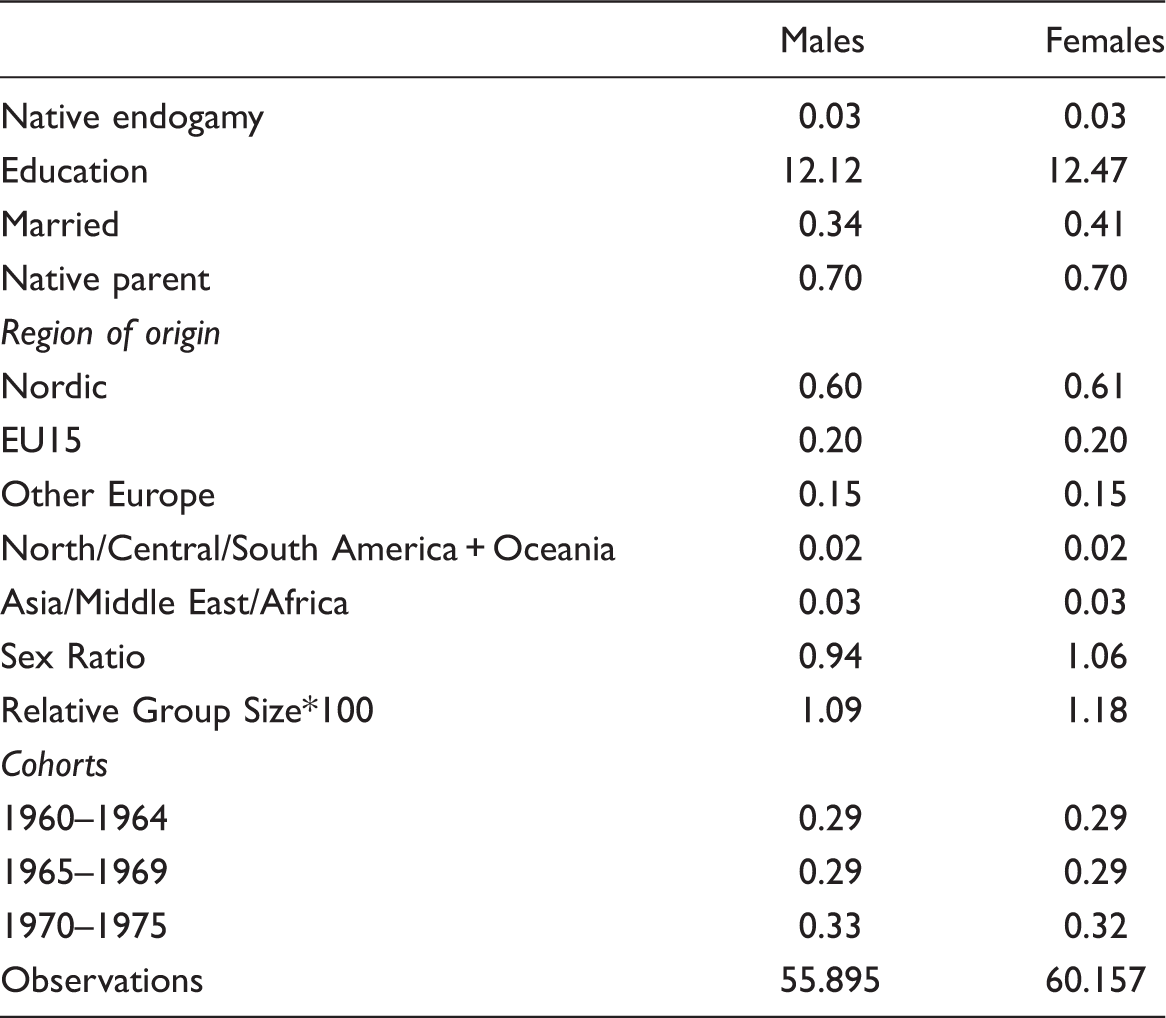
Descriptive statistics.
Linear probability model for within-group union.

Robust standard errors in parentheses, clustered on country of origin.
p < 0.10, **p < 0.05, ***p < 0.01.
Parental background is controlled for by the education of the mother as well as an indicator variable that takes the value one if the individual has one native-born parent. Previous studies have shown that, not only the native-born status of the individual but also having a native-born parent has a very important role in the union formation behavior of individuals, where those with a native-born parent are less likely to marry someone from their foreign ethnic background (Çelikaksoy, 2012; Çelikaksoy et al., 2010). The results presented in Table 2 also support these findings: having a native-born parent decreases the probability of within-group union by 4 percentage points for males, and by 2.7 percentage points for females. Being married versus cohabiting does not seem to play an important role especially in the case of females, perhaps partly due to the fact that only cohabiting couples with children, i.e. those whose commitment is expected to be as strong as it may be for married couples, are included in the data set. In the case of marriage market characteristics, we can see that group size is positively associated with the likelihood of forming a within-group union as expected. This shows that the larger the size of native-born individuals with a certain foreign background, the higher the likelihood that they marry within this group. It can be seen that younger cohorts are less likely to form such a union when compared to older cohorts, which might indicate a change in individuals’ out-group versus in-group spousal preferences over time even though the range of the cohorts is quite narrow. However, this finding might also be related to the change in the number of potential spouses within this category.
We can see that higher levels of mother’s education are negatively associated with the likelihood of forming a within-group union (as expected and discussed in the “Theoretical background” section). The reference category here is compulsory school which is less than nine years. After controlling for all the variables, there are not any large differences across regions of origin except in the case of America, Oceania, and Other Europe. The reference category here is the Nordic countries. The same analysis is also done by excluding those with a native parent. The results are the same for columns 1, 3, and 4. We find the same results for the second column as well with the exception of the coefficient on group level education, which is again negative but not significant. Thus, for males, whose parents are both born abroad, belonging to a group with an average education level above the median does not seem to influence their union formation behavior. This could be related to gender differences in discrimination in the marriage market or the importance of group level attitudes toward intermarriage.
I conduct further analyses to take a closer look at the role of education on union formation behavior. A native-born individual who does not form a union within his/her own group (defined both by generation as well as foreign background) has several other options. These four options are also defined by the birthplace of the spouse as well as that of the spouse’s parents. I use a multinomial logit model for estimating the separate types of out-group union forms, where the reference category is within-group union as defined earlier in the paper. There are four different types of out-group union: an individual can form a union with: (1) a native-born spouse who has no foreign background for two generations, own and parental; (2) a native-born spouse who has a foreign background that is different from his/her own background; (3) a foreign-born spouse with the same foreign background; or (4) a foreign-born spouse with a different background than his/her own.
We can see that having higher education than one’s own group as well as belonging to an ethnic group with high education is positively associated with the probability of forming an out-group union with native-born spouses who has a native background for both males and females. However, the interaction term is not significant for males, while it is negative and significant for females. In other words, females who are from highly educated groups and who have higher education than that of their group are less likely to form out-group unions with native-born spouses who have a native background; instead, they tend to marry endogamously within their ethnic native group. This is consistent with the findings presented in Table 2, which show a preference of highly educated people who belong to highly educated groups for ethnic endogamy as well as for shared experiences. Thus, PAM is probably utilized both at the ethnic as well as educational level, since they come from an ethnic group with a higher education level than that of those with a native background. Most importantly, this finding challenges the idea of a linear, simple relationship between education, integration, and intermarriage and draws attention to the heterogeneity across educational distributions, gender, as well as union types.
Spouse type (ref. within-group union).

p < 0.10, **p < 0.05, ***p < 0.01.
We also control for several marriage market, parental, and individual characteristics. We can see that having a native-born parent is positively associated with the likelihood of having a native-born spouse with a native background as expected. However, this variable is also positively associated with the likelihood of forming a union with individuals from a different background than that of their own in the case of both native- as well as foreign-born spouses. This might be related to the intergenerational transmission of interethnic union formation behavior (Çelikaksoy, 2012). Being married versus in cohabitation is negatively associated with the likelihood of forming native unions, whereas it is positively associated with the likelihood of forming transnational unions. As discussed earlier this might be related to visa requirements and processes. Relative group size is negatively associated with all out-group union forms showing the importance of the availability of potential spouses from one’s own group. Overall mother’s education is positively associated with all out-group union forms except for “foreign-born same-background” spouses. As also discussed earlier, part of this form of union can be defined as marriage migration and it is a common finding that both own and parental education is negatively associated with the likelihood of forming such a union. 12
Discussion
This paper focuses on the role of education at the individual as well as at the group level to examine the relationship between education and all different forms of household types for descendants of immigrants. Sharing the same experience of being a descendent as well as sharing a common foreign ethnic background is defined as “within-group union.” Furthermore, out-group unions are differentiated into four categories. Household types are defined based on own, parental and spousal origins, as well as the origin of parents-in-law. The main question addressed in the paper deals with the role of education in within versus out-group union formation behavior for the descendants of immigrants in Sweden. In addition, the heterogeneity of this relationship is analyzed across gender and household types.
The article challenges the indicated positive, straightforward relationship between education and marriage to the majority group postulated by the cultural adoption and residential segregation arguments. Furthermore, it draws attention to preferences of ethnic endogamy and shared experiences for those who are at the top of the educational distribution in line with the PAM argument. Thus, these results indicate that the observed shift from ascribed characteristics towards attained characteristics is mainly due to structural constraints rather than a shift in preferences of union formation with individuals from the majority group due to cultrual assimilation. When individuals do not have to trade similarities in these two areas they tend to prefer PAM in both areas. In addition, the results are analyzed and discussed with a focus on gender and several different types of households.
Focusing on the next generation is important given the ongoing changes regarding the size and characteristics of the ethnic groups as well as changes in educational attainment both within and across ethnic groups (Çelikaksoy, 2014). Thus, gender gaps in educational attainment will lead to an increase in intermarriages for some groups, while it will lead to hypogamy for females in others, depending on the group characteristics.
Thus, by focusing on the household formation behavior of native-born individuals, the article pays attention to group level, individual, parental, as well as structural marriage market characteristics.
Overall, the findings regarding marriage market, parental background, and individual characteristics are consistent with the reported results of previous studies. Opportunity measured by relative group size is found to be positively correlated to within-group union. Parental background measured by parental nativity and maternal education is negatively correlated with within-group union formation probabilities. The coefficient for marital status comparing married versus cohabiting couples is not significantly different from zero for females and significant only at the 10% level for males. After controlling for all the above-mentioned variables, variation in within-group union formation probabilities across regions of origin is observed only for males.
The main findings regarding education are also consistent with the literature. The results confirm the positive relationship between education and out-group union (exogamy) reported in previous studies. Having an education above the median of one’s own group is negatively associated with the probability of within-group union. However, not only education at the individual level, but also education at the group level, is important for the union formation behavior of descendants. In addition, the interaction of education at these two different levels is important for union formation behavior, with highly educated people who belong to highly educated groups being more likely to marry within their own group. I argue that this finding challenges the idea of a linear, simple relationship between education, integration, and intermarriage. Furthermore, the results show that the role of education varies across gender as well as union type.
Females from highly educated ethnic groups who have a higher education than that of their group are less likely to form out-group unions after controlling for a wide range of marriage market, parental, and individual characteristics. These out-group unions include spouses from the majority group as well as foreign- and native-born spouses from a different ethnic origin than the individual herself. Instead, these females are more likely to form unions with other native-born spouses who share the same foreign ethnic origin as them. These results draw attention to the PAM preferences of individuals at the higher end of the educational distribution on grounds of both generation and foreign ethnic background, especially in the case of females. Deconstructing out-group unions into separate categories shows that this preference is unique to within-group unions as defined in this paper and cannot be generalized to all ethnically endogamous unions. We can see that, in the case of a union with a foreign-born spouse who shares the same foreign ethnic background as the individual the results are quite different. Thus, not only sharing the same foreign ethnic background but also sharing the experience of having been born in Sweden is important. We can also see that marital status mainly varies across the nativity status of the spouse while parental background mainly varies across the status of sharing a common foreign ethnic background given they are out-group unions.
Overall these results point out the importance of distinguishing different types of unions by both generation and shared foreign ethnic background. Furthermore, the findings point out the heterogeneity of the results across the educational distribution, gender, as well as union types. There is a need for further research on mating patterns across various lines over time to better understand the mechanisms, such as constraints as well as preferences behind the changes in mating patterns over time.
Footnotes
Declaration of conflicting interests
The author(s) declared no potential conflicts of interest with respect to the research, authorship, and/or publication of this article.
Funding
The author(s) received no financial support for the research, authorship, and/or publication of this article.