



Abstract
This paper analyses the marital dissolution of binational couples (i.e. couples comprised of immigrants and natives) in countries with traditionally distinct integration models: Canada, the United States and France. Previous studies appeal to cultural differences to explain the higher divorce rates of binational couples but they omit the potential effect of migration or that of environmental factors such as immigration policies and attitudes towards migration and intermarriage. In order to test a model that includes all these factors, an identical online survey was conducted in the cited countries. The concepts ‘binational couples’ and ‘culture’ were disentangled into specific types of couples and variables. While being involved in a binational marriage was not found to be a significant predictor of divorce, being involved in one where both partners are foreign born decreases the risk of divorce. Religion, family values and families’ perception of a relationship are also significantly related to marital stability.
Introduction
Immigrants' integration into host societies is a priority issue in the agendas of policy makers and scholars of immigrant receiving countries. As a subtopic of this extensive research field, intermarriage has been posited as a factor that, by crossing physical and social borders, contributes to the integration between the foreign-born and the native populations, and between people from different ethnicities (e.g. Alba, 1995; Alba and Golden, 1986; Alba and Nee, 1997; Bossard, 1939; Giorgas and Jones, 2002; Kennedy, 1943; Price, 1982). 1
However, these ideas are not always supported by empirical studies. In fact, whereas intermarriage patterns between immigrants and natives, or between natives of different races and ethnicities have been largely explored, few researchers have looked at the marital stability of couples comprised of immigrants and natives (i.e. binational couples). The scarce literature on this topic (e.g. Cao et al., 2008; Kalmijn et al., 2005; Van Huis and Steenhof, 2003) concludes that, due to cultural differences, binational couples are more likely to divorce than couples formed by partners coming from the same country of origin (i.e. conational couples). 2 However, they do not specify what aspects of partners’ cultural references are challenging their relationships. 3 This essentialist and static notion of partners’ distinctive ‘cultures’ may be problematic as, by ignoring couples’ cultural exchange and growth (i.e. ‘cultural hybridization’ in García-Canclini's (2002) words), it perpetuates their cultural differences. In this paper, the concept of culture is disentangled into measurable variables such as religion, language, parental origin and Hofstede's individualism and masculinity indexes.
The cited studies were conducted in single countries and they do not consider the potential effect of the opportunity cost of migration (e.g. a potential temporary loss of human and social capital, employment and social status, etc.) or that of environmental factors (such as immigration policies and history, integration models, racial prejudice and attitudes towards migration and intermarriage) on the marital stability of binational couples.
Finally, the higher divorce rates of binational versus conational couples reported in these studies raise the question of whether such integration between immigrants and natives is successfully happening and to what extent (Osanami et al., 2016). In the introductory chapter of this special issue, it has been stated that intermarriage may not only promote integration – which has been defined as a two-way process of mutual understanding and accommodation between the newcomers and the long-term residents of a geographical area – but also be a product of it. Mixed marriages have been portrayed as microcosms of increasingly diverse societies. If the positive correlation between intermarriage among binational couples and divorce reported by Cao et al. (2008), Kalmijn et al. (2005) and Van Huis and Steenhof (2003) is confirmed in future studies, the following conclusions could be made from this important finding: while the occurrence of intermarriage may indicate the lessening of the social distance between ethnic minorities and the majority (Gordon, 1964) and the softening of negative attitudes against the out-group in future generations (Kalmijn, 1998), a ‘failure’ in the cohabitance of binational couples may also be a signal of a failure in the structural integration among newcomers and the long-term residents of a geographical area.
I claim that the marital stability of binational couples can be affected not only by cultural factors but also by the cited migration and environmental factors. In order to fill these gaps in the literature, I conduct a comparative study that tests the combined effect of migration, cultural and environmental factors on the divorce patterns of binational and conational couples in one European and two North American countries: Canada, the United States (US) and France. These countries were selected because of the different political and immigration history of the old versus the new world, and their traditionally distinct integration models, namely, multiculturalism in Canada, assimilation in France and the so-called melting pot in the US. 4 Such differences are expected to have an impact on each country's current immigration policies and people's attitudes towards immigrants and mixed couples.
The main research questions addressed in this paper are as follows: (1) Are binational couples living in these countries more prone to separate than conational ones? (2) Binational couples can be comprised of two foreign-born partners from different countries or of one native and one foreign-born partner. Are there differences in the marital stability between these two types of binational couples? (3) According to previous studies, ethno-cultural factors explain differences in marital stability among people; however, they do not disentangle this concept. This paper aims to do so by asking what aspects of partners' culture are in play in binational and conational couples' marital experiences. (4) What are the effects of migration-related factors on binational and foreign-born conational couples' divorce patterns? (5) And finally, does binational and conational couples' marital stability differ among countries of residence with different immigration and integration policies, and different attitudes towards migration and intermarriage?
Marriages comprised of immigrants and natives have been conceptualized as intermarriages, mixed marriages, interethnic or interracial marriages (where partners belong to different ethnic groups or races), nationality intermarriages, binational marriages and cross-cultural marriages. The term ‘cross-cultural marriages’ was coined by Falicov (1995) to refer to unions where spouses come from different ethnic, racial, religious, social or nationality groups, whereas ‘nationality intermarriages’ narrow the concept to unions between partners of different national origins (Kalmijn et al., 2005). In Koelet and De Valk (2014), nationality marriages are termed ‘binational marriages’. More specifically, these authors define ‘European binational marriages’ as marriages between partners with a different European nationality at the time of marriage. Finally, marriage migrants have been described as those who enter a country with the purpose of marrying a resident of that country (Timmerman, 2006). Marriage migrants can constitute partners from the same country or from two different ones and could have the same ethnic background or not.
In keeping with Kalmijn et al. (2005) and Koelet and De Valk (2014), this paper focuses on the marital stability of couples in which partners were born in different countries, which I will call ‘binational couples’, as I believe that these terms describe this type of union more accurately. Furthermore, binational and conational couples can be comprised of different combinations of foreign-born and locally born individuals that may have different characteristics and marital behaviour. They can be formed by two foreign-born partners from the same country (foreign conational couples) or from different countries (foreign binational couples), by one foreign-born and one locally born partner, or by two natives (native conational couples). 5 Variables describing these stylized cases of unions will be included in the analyses in order to compare potential differences in their likelihood of divorce. While the general concepts of ‘couple’ and ‘union’ will be used in the empirical study to describe two people who live together as common-law partners – regardless of whether they are officially married or not – in the literature section I will cite the terms used by the studies of reference, including ‘marriage’ and ‘spouse’.
The next section of the paper reviews the literature on binational couples and divorce. The research design and methodology are explained in ‘Research design’ section. This is followed by a presentation and discussion of the main findings. The last section describes the implications of the study and concludes the paper.
Intermarriage and divorce
Studies on the divorce hazard of binational couples focus on cultural factors to explain the causes of marital disruption (e.g. Cao et al., 2008; Kalmijn et al., 2005; Van Huis and Steenhof, 2003) while they ignore individual factors such as the opportunity cost of migration and other additional challenges which limit the ability of migrants to participate in the socioeconomic, cultural and political spheres of their new environment. 6 Furthermore, since all of these studies were conducted in single countries (the Netherlands, Belgium or Switzerland) over single time periods, the potential influence of country-level environmental factors such as immigration histories, policies and societal attitudes towards migrants and intermarriage is missing in the analysis. I argue that both migration and migration-related environmental factors in the host society can also affect the stability of binational couples; and that the influence of these forces could be explored by conducting comparative international empirical studies or by replicating the same study in a single country at different periods of time with differential immigration policies.
Built on a theoretical model developed by Irastorza and DeVoretz (2015), in which individual, cultural and environmental factors interact to predict binational couples' divorce hazard, an identical empirical study was conducted in three countries. Given the limited literature on binational couples' marital disruption, the theoretical model comprises psychological, sociological and anthropological insights gleaned from empirical studies on mainstream and interethnic marriages, immigrants' integration and cultural studies. The next three subsections summarize the main findings of these fields. 7
Individual factors
Some of the individual factors addressed in the mainstream literature to explain marital disruption include human capital endowments, premarital history and other socio-demographic characteristics such as age, gender, previous marital history, the presence of children and household income.
A low educational level, marrying at an early age or the existence of previous marriages and premarital births were found to increase the risk of marital disruption in the United States (Heaton, 2002; Phillips and Sweeney, 2005; Raley and Bumpass, 2003). Kierna and Cherlin (1999) report that the offspring of divorced parents in the United Kingdom were more likely to have dissolved their first partnerships by the age of 33. Waite and Lillard (1991) found that couples with children aged five or younger face significantly lower risks of disruption than other couples. Similar results on the positive effect of preschool children on their parents’ marital stability were reported by Becker et al. (1977) and Cherlin (1977). However, these three authors also found that the presence of children aged 13 or older increases their parents’ likelihood of divorce. They explain these findings by arguing that having children may signal at least a short-run commitment to the continuation of the relationship. Couples who have children would make a greater effort to overcome marital difficulties than those who do not, thus lowering the risk of a divorce. The literature shows that the correlation between income and divorce is gender sensitive. While some scholars (e.g. Waite and Lillard, 1991) found that a husband's low income increases the risk of marital disruption, others (e.g. Liu and Vikat, 2004) found that the relationship between the share of a wife's income and the divorce risk is positive. This finding supports the ‘independence effect’, i.e. women gain less, from an economic viewpoint, from marriage when they earn more than their husbands. They also found that the higher the total income of the couple, the lower their divorce risk. On the contrary, Rogers and DeBoer (2001) report opposite results: they concluded that increases in married women's income significantly increase their marital happiness and well-being and thus, lower the risk of divorce.
The above-cited factors apply to the divorce risk of both binational couples and mainstream couples. Nevertheless, previous studies suggest that binational couples face additional difficulties arising from cultural differences, reasons for marrying or their migration experience. Kalmijn et al. (2005) rigorously analysed the effect of nationality and religion heterogamy, i.e. differences in countries of origin and religious affiliation, on the risk of divorce in the Netherlands and report a strong correlation between nationality heterogamy and divorce but a modest correlation between religious heterogamy and divorce. Van Huis and Steenhof (2003) obtained similar results but they specify that the risk of divorce in the Netherlands is higher for binational couples of western and non-western origin than for Dutch couples. Cao et al. (2008) also report similar findings in Switzerland. These authors explore the effect of heterogeneity in some variables, such as citizenship and the origin of the partners, on marital instability and find a negative correlation between nationality heterogamy (Swiss married to non-western) and divorce. They rationalize this finding by appealing to cultural differences and migration-related challenges but they do not elaborate on these hypotheses.
Alternatively, studies on marriage migration suggest that the motivation to marry (i.e. love versus instrumental migration) is a significant explanatory factor for binational marriage disruption. In her empirical study conducted in Belgium, Timmerman (2006) found that a high proportion of Turkish migration marriages with Belgian natives fail. Corijn (2009) reports similar findings, i.e. an increased divorce hazard in the early years of the marriages among the Turks and Moroccans both in Flanders and the Netherlands, where after three years of marriage the foreign partner obtains a permanent residence permit. In this case, convenience or the opportunity to migrate for various reasons is considered to be the motivation to marry for the foreign-born partner, whereas multiple motivations such as the possibility of marrying an ‘authentic’ co-ethnic from the country of origin of the parents or grandparents would apply for the partner born in Western Europe (Timmerman, 2006). Timmerman adds that the culture or tradition of migration and the importance of the family institution, which is usually involved in the decision to marry, play significant roles in choosing a foreign co-ethnic partner.
I cited the opportunity cost of migration as a potential explanatory factor of divorce for binational couples. Hovey (2001) identifies five categories of stress factors related to migration: stressors of the migration process and trajectory; language and communication problems; environmental stressors related to socio-cultural changes; economic, unemployment and marginality problems; and the loss of family and social support. I argue that these factors may explain individual cases of marital (in)stability in binational couples. For example, the migration strategy of the foreign-born partner (e.g. the reasons and purpose of migration, the expected duration of stay in the host country, the prospect of family reunification, citizenship acquisition and potential outmigration plans) may affect the marital stability of binational couples as follows: one could expect that migrants who want to return to their country of origin after spending a given number of years in the host country are more likely to divorce, depending on their partner's willingness to move with them. In contrast, those partners who plan to bring family members to the host country or apply for citizenship have long-term plans and thus, would be more prone to remain married. Likewise, whereas some immigrants have relatives, friends, acquaintances or other support networks from their ethnic community or local institutions to host and help them when they move into a new country, others do not. It is expected that those who have a wider social network will be more likely to feel more satisfied with their experience in the new country as well as in their relationship and thus, less likely to leave the country and the marriage.
Cultural factors
Cultural factors, as conceptualized by country of origin (often referred to as ‘ethnicity’) and religion, have been cited in the literature as explanatory factors of divorce between intermarried people (Cao et al., 2008; Kalmijn et al., 2005; Van Huis and Steenhof, 2003). However, the concept of cultural differences, beyond differences in birth countries and religious affiliations, and the ways to make this concept measurable to study binational couples’ divorce patterns need to be unravelled. I aim to contribute to the literature by appealing to cross-cultural studies in psychology. The individualism–collectivism and masculinity–femininity dimensions have been commonly used by cross-cultural psychologists to explain cultural differences, including differences in marital and gender roles (e.g. Arends-Toth and Van de Vijver, 2009a, 2009b; Hofstede, 1980; Lester, 1995; Triandis, 1995; Triandis and Gelfand, 2012).
Hofstede (1980) defines culture as ‘the collective mental programming of the people in an environment […] that is different from that of other groups, tribes, regions, minorities or majorities, or nations’ (1980: 43). According to him, the distance from power, uncertainty avoidance, individualism–collectivism and masculinity–femininity dimensions shape the cultural mental programming at the national level. Several empirical studies (e.g. Arends-Toth and Van de Vijver, 2009a, 2009b; Lester, 1995) have been conducted based on the last two dimensions to analyse differences in family values. As opposed to individualism, the construct of collectivism refers to tight social networks built on an individuals’ high sense of loyalty towards the group and their inclination to provide for other group members, mainly for family members.
Arends-Toth and Van de Vijver (2009a, 2009b) used Hofstede's model to analyse cultural differences in family, marital and gender role values among immigrants and majority members in the Netherlands. They conclude that immigrants come from more collectivistic countries and have stronger family-oriented and marital values than the Dutch. However, no significant differences were found in gender-role values between the two groups. On the contrary, socio-demographic variables, especially education, were found to be influential factors of cultural differences.
Lester (1995) reports similar results. Based on Hofstede's scores of 26 countries, he associated high individualism scores with high national divorce rates but he found no statistically significant correlations between divorce rates and masculinity scores.
Finally, Van Huis and Steenhof (2003) analyse the divorce risk for foreigners in the Netherlands by looking at their country of origin and gender to show that couples comprised of Dutch women and non-western men have the highest risk of divorce, whereas Dutch marriages are the most stable. They suggest that cultural differences and the interest of foreigners to obtain a resident permit could partially explain these results. Despite the fact that they do not further explore these ideas, their findings insinuate that differences in gender roles between both partners' birth countries may be relevant to predict binational couples' marital stability.
Religion has also been identified as a significant factor in marital instability (Booth et al., 1995; Lehrer and Chiswick, 1993). Kalmijn et al. (2005) compared couples with different combinations of unaffiliated, Catholic, Reformed, Orthodox, other protestant groups and Jewish partners living in the Netherlands, and found a modest correlation between religious heterogamy and divorce. Interestingly, marriages in which members were non-believers were most likely to divorce, owing to the ‘main-effects’ hypothesis: the more traditional the value orientation of religious or national groups, the less likely their members are to divorce.
Language and communication problems constitute another group of migration stressors cited by Hovey (2001) that may also affect the survival of binational couples. The underlying reasoning behind this assertion is twofold: first, good communication is a key factor in the success of any kind of relationship; this can be more challenging for binational couples who are not fluent enough in each other's first language or a third common language. Second, as pointed by the European Commission (2004), migrants’ poor language skills constitute a key challenge for the integration between them and the host society. The knowledge of the host country's language facilitates the labour and social participation of the foreign born in the host socioeconomic system, which, in turn, may have a positive effect on the marital relationship. However, the opposite hypotheses could also be posed, i.e. having more education and better language skills would facilitate the integration of the foreign-born partner into the new society which, in turn, could increase the probability of marital disruption because this increases the ‘outside option’, i.e. the pool of alternative candidates. Partners’ commitment to the relationship may increase or decrease the probability of each of these scenarios.
In sum, couples who come from countries with similar value orientation have a good knowledge of a common language and have the same religion or more traditional religious affiliation are prone to have fewer internal challenges and thus less likely to divorce than their counterparts.
Environmental factors
Environmental factors have not been addressed in the literature on mixed marriages as predictors of marriage survival. Yet, I believe that different immigration policies, attitudes towards migration and intermarriage, and the presence of ethnic enclaves and other support groups for immigrants may facilitate or hinder the participation of foreign-born partners of binational couples in the economic, social, cultural and even the political spheres across countries. I argue that unfavourable environmental conditions, which prevent the integration or inclusion of the foreign-born partner in the cited domains, may increase the risk of divorce for binational couples.
There is a debate about the differential role national integration models (often classified as multiculturalism, assimilationism, exclusionism and, more recently, the integrationist model) play in the integration between immigrants and host societies. Whereas some scholars such as Carrera (2006) and Joppke (2007) claim that integration policies are converging towards assimilation and thus it no longer makes sense to think in terms of national models for immigrants' integration in Western Europe, others as Jocobs and Rea (2007) state the opposite. There is a third group of scholars (e.g. Heckman and Schnapper, 2003; Peres, 2010) who, based on comparative analyses of national developments of integration policies across Europe, provide a more conciliatory hypothesis. These authors acknowledge the existence of a converging tendency in European integration models but still argue that relevant national differences derived from country-level immigration histories and policies remain. These differential policies may facilitate or hinder the incorporation of immigrants into the economic, social, cultural and political spheres, which, in turn, may affect the marital stability of binational couples.
It has also been claimed that the public sector cannot be the only institution facilitating integration processes but that the private and non-governmental sectors, which can provide immigrants with crucial social resources, also need to be involved (Papademetrtriou, 2003). Employer and worker groups, church groups, civic, ethnic and immigrant organization and other community-based, non-profit entities are some examples of support groups for newcomers in the private sector. More informal networks such as ethnic enclaves have also been identified as facilitators of the settlement and initial labour integration of newly arrived immigrants in the United States and Canada (Portes and Manning, 2005; Qadeer et al., 2010). Based on these studies, I postulate that the divorce risk of binational coupes is also place dependent, this risk being lower for binational couples who live in places where a network of the private and governmental sectors provide them with additional resources that facilitate their integration than the divorce risk of those who live in areas where these services are not provided.
Promoting participation in the political decision-making process and fighting discrimination and racism in politics and media are other important avenues to take in order to boost the integration between immigrants and host countries in the European Union. Extreme negativity towards immigrants may lead to certain situations (such as a non-shared desire to leave the country) in which marital stability could be threatened. Likewise, hostile attitudes towards intermarriage from family members, friends or the wider society may have the same effect. Based on a survey and follow-up interviews on attitudes towards interracial marriage conducted in Sweden, Osanami Törngren (2011) reports that the majority of respondents could imagine getting involved in an interracial relationship and would not react negatively if a family member did the same. However, the respondents also indicated that such relationships are not well accepted in Sweden. These negative societal attitudes towards intermarriage are expected to add additional challenges to the marital stability of binational couples.
In sum, I pose that the likelihood of divorce of binational couples may be affected by individual, cultural and environmental factors, and that the effects of these sets of factors cannot be analysed separately. For instance, the socio-economic integration of immigrants with identical human and financial capital endowments will vary from one host country to another depending on cultural and linguistic differences between the country of origin (e.g. the Canada) and two possible destinations (e.g. the United States and Japan). In turn, this may affect their stress levels and desire to stay in the host country and therefore, their marital stability. Likewise, the cultural distance between partners born in different countries will also vary depending on the individual characteristics of each partner such as human capital and socio-demographic factors, and their previous exposure to, and familiarity with, each other's culture. Thus, as suggested by Irastorza and DeVoretz (2015), I include these three interacting sets of factors in my theoretical model to analyse the marital stability of binational couples.
Research design
In order to test the conceptual model presented in the previous section, an identical survey was designed and conducted in Canada, the US and France. The respondents were locally born and foreign-born people who were, or had been, married or in a common-law relationship when the survey was conducted.
Sample selection and survey procedure
Partners or former partners of binational couples constitute the target population of this study while those of conational unions are included in the sample as a control group. Due to the high cost of gathering a random sample of binational couples large enough to conduct statistical analysis on, I decided to use panel data to conduct the empirical study. The Canadian, US and French samples were selected from representative web panels. The research and marketing company Leger distributed the online survey among their panelists in Canada and the US whereas their partner company Survey Sampling International (SSI) did it in France. The three surveys were completed between March 2013 and February 2014. Leger and SSI recruit their panelists online and over the phone by offering them incentives such as cash, prizes and the opportunity to make donations. Their panels are representative of the Canadian, US and French populations in terms of age and gender. As for demographics such as education and income, it is assumed that they are also going to be representative when age and gender are representative. For this study, they also monitored for the panelists' birth countries in order to ensure the representativeness of the foreign-born population.
A total of 1255 people were interviewed: 405 in Canada, 450 in the US and 400 in France. Almost 60% of them were, or had been, involved in binational cohabiting relationships, half of which were comprised of a foreign-born and a native person and the other half were formed by two foreign-born people from different countries. This group is over-represented on purpose because it constitutes the target population of the study. The over-representation of individuals involved in binational unions also allowed me to run regressions on this subsample, which would otherwise not be large enough for that purpose. The remaining 40.5% is comprised of conational couples in which both partners were locally born (17.8%) or they were born in the same foreign country (22.7%), and it is included as a control group. 8
The different compositions of couples were designed to test the effect of immigration as well as the so-called cultural factors. Respondents were asked to answer the same questions about themselves and their (ex-)partners. When referring to their partners, they had the option of answering ‘I don't know’. This, as well as the lack of data on Hofstede's individualism and masculinity scores for certain countries, created missing values, which were left as such and explains the lower number of individuals included in some regressions.
Characteristics of the sample
Separation rates of individuals involved in binational versus conational relationships by country.
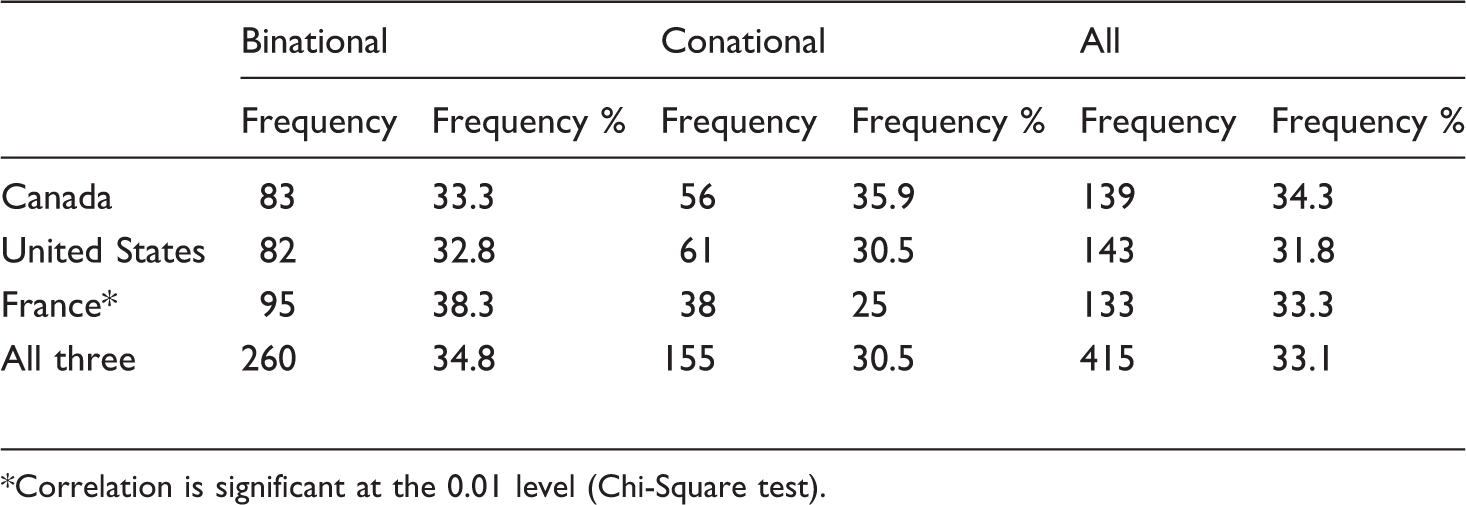
Correlation is significant at the 0.01 level (Chi-Square test).
Descriptive statistics.

The most salient differences between the two groups were found in the variables classified as cultural factors. As expected, the proportion of couples who share an identical parental origin (i.e. those in which the parents of one partner were born in the same country or countries as the parents of the other partner) is significantly higher among conational couples than it is among binational ones. And the opposite is true for the variable DifferentParentalOrigin, which describes couples in which none of the parents of one partner was born in the same country as the parents of the other partner.
The number of respondents who grow up speaking the same language or languages and the number of people who have the same religious affiliation is also higher among conational couples. On the contrary, differences in gender roles, as measured by Hofstede's masculinity index, are higher among binational couples.
The low number of respondents who mentioned their relationships as the number one reason to migrate (about 10% in both sub-samples) and the even lower number of those who migrated under a spousal reunion program (under 3% in both cases) suggest that there are not many marriage migrants in the sample.
Environmental variables show a larger percentage of individuals involved in binational versus conational relationships who had relatives in the destination country when they migrated. Finally, attitudinal and perceptual variables are slightly more positive for conational partners than for binational ones.
Description of variables
An identical questionnaire was asked in Canada, the US and France. The questionnaire, comprised of 100 questions, was designed in order to capture the key variables identified in previous studies and discussed in the literature section. The main themes of the questionnaire can be listed as follows:
Migration history of the foreign-born (ex-)partners; Origin, linguistic and religious background of both (ex-)partners and their parents; Settlement of the foreign-born (ex-)partner(s): use of settlement services and networks, and people's attitudes upon arrival in the new country; Marital history of both (ex-)partners; Background socio-demographics of both (ex-)partners.
The dependent variable of the study, Separated, is a binary variable created to explain whether each respondent has ever been separated or whether he or she is still married. Those respondents who fulfilled both conditions were asked to answer the questions thinking of their former relationship and thus, were included in the group of separated people.
The independent variables included in the analysis explain the conceptual framework described in the previous section and are defined in Appendix 1. The main independent variable, BinationalCouples, is also a binary variable describing if the respondent is, or has ever been, involved in a binational cohabiting relationship. In an attempt to disentangle this variable into more specific types of couples, four new variables describing the exact composition of couples were created and included in the analyses. These new variables are as follows: ForeignBinational (which includes couples comprised of foreign-born partners from different countries), ForeignConational (where both foreign-born partners come from the same country), Native&Foreignborn and BothNatives. 9
The variables describing the country of origin of the respondents and their partners, as well as the individualism and masculinity indexes, were included to measure the influence of the country-level context of acculturation, whereas those indicating the country of origin of their parents are expected to capture the parental ‘cultural’ effect or what in other studies has been conceptualized as the ‘ethnicity’ effect. Note that these variables are not intended to capture phonotypical differences between partners and the society's reaction to them but were included to measure differences in marital and family values, as I believe that individuals’ birth and socialization countries, and those of their parents, will shape their understanding of gender roles and their overall behaviour in a relationship. Furthermore, attitudinal variables were included in the analyses to measure families’, friends’ and the rest of the society's influence on intermarriage.
The more subjective attitudinal and perceptual variables that refer to the respondents, their partners, their children, relatives and friends were answered from the respondent's perspective. Variables describing the socio-demographic background and marital history of each partner are mentioned in the mainstream divorce literature and were included as control variables. Finally, some variables describing certain characteristics of each partner (e.g. SignificantofReligion and SignificantofReligion_Partner) were combined and converted into a new variable in order to reduce the number of variables in the analysis.
Two of these variables need further explanation. Whereas the variable Individualism_Couple was created as the sum of the Hofstede's individualism indexes of both partners' birth countries, as suggested in Irastorza and DeVoretz (2015), Masculinity_Couple describes the difference in the masculinity index between the partners' birth countries. The reason for computing these two variables in a different way is as follows: people coming from more collectivistic countries are supposed to have stronger family-oriented and marital values and the potentially lower individualism score of the country of birth of one partner is expected to compensate for the higher score of the other partner. However, in the case of the second variable, included as a proxy for gender roles, a significant difference in the country-level scores between the partners is more likely to be a source of conflict – especially when a male partner comes from a masculine-oriented society with distinct gender roles and a female partner comes from a more feminine-oriented one – than it is to balance the relationship.
Statistical method
A set of binomial logistic regressions was run on survey data to answer the research questions of the study. This method explains the probability of membership in one of the two categories of a dependent variable or the likelihood of an event happening versus not happening. In this case, it predicts the probability of binational and conational partners to separate versus to stay together.
Although survey respondents answered questions about themselves and their (ex-)partners, individuals, rather than couples, constitute the unit of analysis in this study. The multiple models respond to an attempt to isolate the effect of different groups of factors, namely migration-related, cultural and environmental factors. As migration and integration variables only apply to foreign-born respondents and certain variables such as the ones describing Hofstede's individualism and masculinity scores have missing values, the number of individuals included in each model differs.
Logistic regression predicting the effect of independent variable BinationalCouple on dependent Separated.

Reference categories are EmployedatMarriage_None, DifferentParentalOrigin and US.
Logistic regression predicting the effect of disentangled independent variable BinationalCouple on dependent.

Reference categories in models 5 and 6 are Native&Native, EmployedatMarriage_None, DifferentParentalOrigin and US; and in models 7 and 8 they are NativeAndForeignborn, EmployedatMarriage_None, DifferentParentalOrigin and US.
Logistic regression predicting the effect of couple composition on dependent Separated by country of residence.
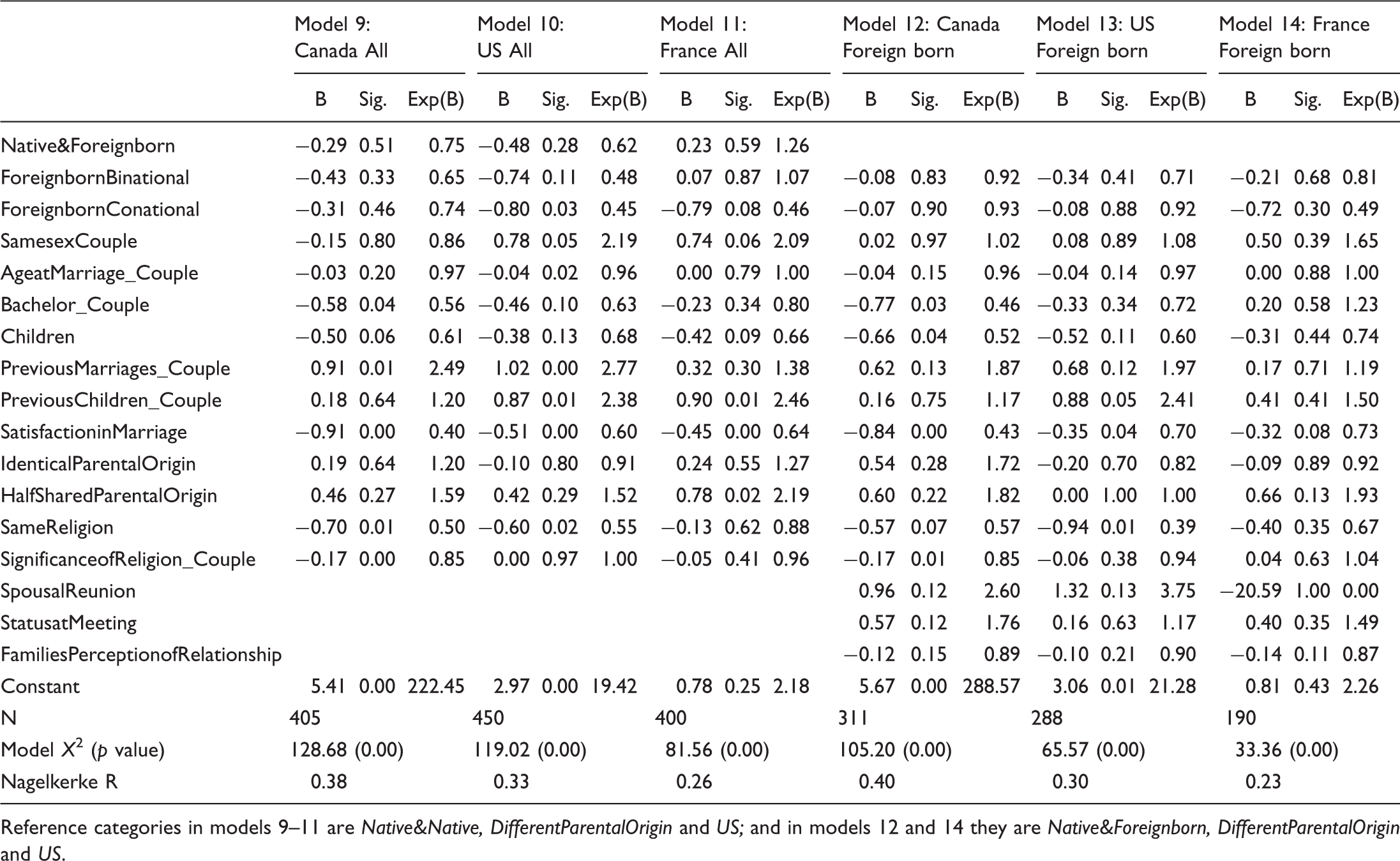
Reference categories in models 9–11 are Native&Native, DifferentParentalOrigin and US; and in models 12 and 14 they are Native&Foreignborn, DifferentParentalOrigin and US.
Results
The results of a series of regressions predicting binational couples' probability to separate are presented in Tables 3 to 5. The key explanatory variable, BinationalCouple, is included in Table 3. This variable was disentangled in four different variables and the results are shown in Table 4. Finally, Table 5 shows the findings of the variables that were found to be statistically significant in the regressions presented in Tables 3 and 4 for the sub-samples Canada, US and France.
All the models included in each table contain one or various variables describing the origin-based composition of the couple and background variables. Cultural, immigration and environmental factors were gradually introduced in three different models to check for changes in (i) their power of explanation as measured by Nagelkerke's coefficient of determination and (ii) the significance of the variables included in one group when another block of variables was included. Half of the regressions reported in each table were run on sub-samples where the respondents (but not necessarily their partners) were foreign born. This allowed for the inclusion of migration and settlement variables. The last models of each table include the three groups of factors plus the control variables and are expected to capture the combined effect of individual, cultural and environmental variables on individuals' likelihood to separate. The p values of the models' chi squares show that all the models are statistically significant.
According to the results of the regressions presented in the four models of Table 3, being part of a binational relationship is not a significant predictor of marital stability. This is a key finding that contradicts previous studies (e.g. Cao et al., 2008; Kalmijn et al., 2005; Van Huis and Steenhof, 2003). The rest of the variables included in model 1 that describe the respondents' age at marriage, their gender, educational level, having children, previous relationships, premarital children and marital satisfaction are background variables and had the expected effect on the respondents' likelihood of divorce. However, most of these variables become statistically non-significant in models 2–4, when migration, cultural and environmental variables are added to the base model. Having children, previous marriages and marital satisfaction constitute an exception as they remain significant in models 1–8. The three variables explaining the age difference between partners, whether their parents were married when they were growing up and their employment status when they met their partners are not statistically significant in any of the models tested.
Factors describing aspects of the culture of origin of the respondents, namely parental origin or ethnicity, languages spoken when growing up, religion, the degree of individualism/collectivism and the degree of masculinity/femininity of their birth countries were added in model 2. Having an identical, similar or completely different parental origin does not seem to affect the divorce hazard of individuals in this sample. This result is consistent in models 1–4 but not with mainstream studies on interethnic couples and divorce. As expected, partners who have the same religious affiliation are less likely to separate than their counterparts. Likewise, the more religious a couple is the higher their probabilities of staying together are. These two results are consistent in the four models presented in Table 3 and with the studies presented in the literature section. Finally, whereas the sum of the individualism scores of the partners' birth countries are positively correlated with their likelihood of separating in all models analysed, differences in the masculinity index among them are not statistically significant in any of them.
Models 3 and 4 include migration and integration variables and were run on a sub-sample of foreign-born respondents. Two out of the five migration-related variables included in model 3 are statistically significant predictors of divorce for foreign-born individuals: their migration path – spousal reunion versus others – and their residence status when they met their partners. According to these findings, foreign-born respondents who were citizens or permanent residents of France, Canada or the US when they met their partners are less likely to remain married than their counterparts. Interestingly, migrating into the new country under a spousal reunification program also increases foreign-born partners' chances of separating.
The same results were obtained in model 4, after integration variables were added, with one exception. While being a citizen or a permanent resident of the new country was found to increase foreign-born partners' chances of separating in model 3, the effect of this variable is not significant in model 4. Only one out of the six integration variables included in model 4 is significant: FamiliesPerceptionofRelationship. This scale variable combines the answers given by the respondent about the perception that both partners' families have on their relationship. The expected result, i.e. the more positive this perception is the lower their likelihood of divorce, is repeated in model 8 of Table 4. On the contrary, having relatives in the new country, local people's attitude towards the respondent after migrating, friends' and the rest of the society's perception of the relationship, and living in Canada or France compared to living in the US are not significant predictors of divorce for individuals included in this sample.
Table 4 presents the results of almost identical models as the ones exposed in Table 3, with the only differences being that the variable BinationalCouple was replaced by the following types of couples: Native&Foreignborn, Foreignborn_DifferentCountries and Foreignborn_SameCountry (Native&Native is the reference category), and that the variable Foreignborn was omitted due to high colinearity with the above-mentioned variables. As shown in model 5, foreign conational couples and foreign binational couples are less likely to separate than native conational couples. In other words, unions comprised of two foreign-born partners are more stable than native couples. However, after controlling for cultural factors such as religion and family values in model 6, these variables become statistically non-significant. A possible explanation for these results could be that immigrants to western countries often come from more traditional societies with lower divorce rates. Finally, being in a union where one partner is foreign born and the other one native does not alter the chances of separating. The rest of the results of the regressions reported in models 5–8 are consistent with those shown in the previous models.
Table 5 shows the effect of those variables that were statistically significant in the previous models on the dependent Separated for different sub-samples divided by country of residence and the country of origin of the couples. The reason for only selecting variables that had a significant effect in previous models is the low number of individuals in these sub-samples, especially in the ones where the respondents were foreign born. Due to the same reason, and despite being significant in the previous models, the variable describing the level of individualism of the partners' birth countries was also omitted from these models.
The predicted effect of most explanatory variables included in the models 9–14, where the experiences of couples living in Canada, the US and France are compared, is the same as in the previous models. The observed differences are related to the significance of some variables, which may be a result of a decrease in the number of individuals and/or in the number of variables included in models 5–8, and not to the sign of them.
The main differences by country of residence can be summarized as follows: the origin of couples is only significant for the sub-samples of the US and France (models 10 and 11), comprised of locally born and foreign-born respondents. While foreign conational couples are less likely to separate than conational couples born in the US and France, this factor does not seem to affect couples living in Canada. This variable is not significant in models 12–14, comprised only of foreign-born respondents.
Parental origin only matters in France, where couples formed by partners who have one parent born in the same country as one parent of their partner are less likely to stay together than those who have a completely different parental origin. This is an interesting result as it contradicts previous studies that correlate cultural or ethnic heterogeneity with divorce.
The variables describing the religious affiliation and the importance of religion are statistically significant and have the same effect as in previous models for the Canadian sub-sample; having the same religion has a positive effect on marital stability in the US but the degree of significance of religion in both partners' lives does not matter; none of these variables are significant in the French sample.
As for the differences in socio-demographic variables is concerned, same-sex couples living in the US and France are more likely to separate than their counterparts, whereas this variable is not significant in the Canadian sample. Age at marriage is also significant and negatively correlated to divorce in the US, but it is not significant in Canada and France. The educational level is not a predictor of marital survival in the US and France but it is in Canada, where it decreases individuals' probability of separating. Having children does not increase the odds of marital stability in the US as it does in Canada and France. Whereas having previous cohabiting relationships increases the chances of divorce for couples living in Canada and US, it does not affect couples living in France. This result is not significant in models 12–14, where the respondents are foreign born. Having premarital children has the expected negative effect among couples in the US and France but it does not have a significant influence in couples living in Canada.
To sum up, according to the results of the regressions presented in this section, being in a binational relationship does not alter individuals' chances of staying together or separating. However, when this variable was disentangled in stylized cases of couples, I found that being part of a foreign binational or a foreign conational couples, as compared to being in a native conational union, decreases the likelihood of divorce. In other words, being foreign born versus locally born matters more than being in a binational or conational relationship for marital stability, with those comprised of foreign-born people being more stable than native couples. I argued that the fact that immigrants to Europe and North America often come from more traditional societies may explain this finding, as these variables become non-significant when cultural variables are added to the model.
In fact, cultural factors and, more specifically, religion and marital and family values, were found to be the most significant and robust predictors of marital stability. Couples who are affiliated with the same religion and those for whom religion is more important are more likely to remain together than their counterparts. These findings confirm Kalmijn et al.'s (2005) main effects hypothesis, i.e. having a more traditional value orientation decreases the risk of divorce; but they provide partial evidence to support the heterogamy hypothesis, according to which when the religions or national origins of the two partners are dissimilar, the risk of divorce is higher. Likewise, as found in previous studies (e.g. Lester, 1995), being born in more collectivistic countries increases couples' chances of staying together. Having a half-shared parental origin (i.e. where one parent of one partner and one parent of the other partner were born in the same country) is also significant and increases individuals' likelihood of divorce for couples living in France.
As for migration factors, being a permanent resident or a citizen of the new country when they met their future partners increase foreign-born partners' probability of separating. In other words, foreigners who had a consolidated status as new residents before marrying are more likely to separate than those who did not. However, this variable becomes non-significant when environmental variables are added.
The only variable that turned out to be a significant predictor of divorce out of the six environmental variables included in our models is the perception that both partners' families have about their relationship. As expected, the more positive this perception is, the higher couples' chances of remaining married are.
Overall, the group of background control variables included in these analyses was found to be a better predictor of divorce hazard than the combination of migration, cultural and environmental factors. Moreover, the explanatory power of these three groups of factors is very small. 11
The models tested on the country level worked better for the Canadian sub-sample, which has the highest coefficients of determination, and worse for the French sub-sample, with the lowest coefficients of determination, than for the US one. While foreign-born conational couples are less likely to separate than locally born conational couples in the US and France, this variable is not significant in Canada. Finally, religion is not significantly related to divorce in France; and while having the same religion is important in the US, couple's cumulative significance of religion is not relevant. These two variables are statistically significant and decrease the risk of divorce in Canada. These country-level differences in the effect of religion on divorce may be related to differences in their political history, immigration and integration and state models. Canada, the US and France are secular states where freedom of religion is a constitutional right and the main religious affiliation of the majority of the population in the three countries is Christian. However, whereas (Christian) religion has traditionally been present in US and Canadian politics (e.g. God is mentioned in the national anthems of both countries, as it has been – and, in some cases, it still is – in sworn testimonies in the US), France is well known for its republicanism and laic tradition. Furthermore, unlike in Canada, where the government is officially committed to cultural and religious pluralism, immigrants to France are expected to assimilate into its republican model. These assimilation-prone policies may result in a more homogeneous and less religious mainstream society.
Conclusions
This paper compares binational couples’ divorce hazard to that of conational couples. The main contributions of the paper are as follows: (i) it is based on a conceptual model that includes not only cultural variables but also migration and country-level environmental variables that are often omitted in the intermarriage literature; (ii) identical survey data were used to test this model in two North American and one European country with distinct immigration histories, policies and integration models; (iii) the constructs ‘binational couples’ and ‘culture’ were disentangled into specific stylized cases of unions and aspects of culture that resulted in more precise findings.
According to the main findings of this paper, whereas being part of a binational relationship does not alter individuals' likelihood of separating, being part of a union where both partners are foreign born decreases it. However, the coefficients of these variables become statistically non-significant when cultural factors are added to the model. The fact that immigrants to western countries often come from more traditional societies with lower divorce rates may explain these findings and the change in the level of significance of the variables describing couples' origin. This hypothesis was confirmed by the expected effect of religion on divorce and the positive correlation between divorce and the Hofstede's individualism index, included in the model as a proxy for marital and family values in the respondents' birth countries. Differences in the parental cultural influence were found to be significantly correlated to marital stability only for couples living in France. Environmental variables included in the analysis to measure the effect of the context of reception are not significant. Finally, families' perception about the relationship, as well as background variables has the expected effect on the risk of divorce. These findings are partially consistent with previous studies on intermarriage. Perhaps the most relevant country-level difference in divorce patterns among couples living in Canada, the US and France is the effect of religion on their marital stability. Whereas religious factors were found to be negatively correlated to divorce in the US and Canada, they were not significant in France. I argued that differences in the integration model of these countries (i.e. multiculturalism versus assimilation), along with their distinct political and immigration history might explain this finding.
The empirical study was built on a conceptual model proposed by Irastorza and DeVoretz (2015) who claim that migration, cultural and environmental factors influence each other and, therefore, should be analysed together. In order to test this conceptual model, different groups of factors were added in different models, with the last one containing the three groups of factors. While the level of significance of some of the independent variables – such as that of the stylized cases of couples – changed when a new group of factors was added, the significance of others – e.g. those describing marital satisfaction, religion and country-level individualism – remained the same. The coefficients of determination of each model did not increase much when each block of factors was added and this increase may also have been caused by the simple fact of adding more variables. Still, the models in which all sets of variables were included show the highest power of explanation. Thus, this study provides partial results confirming the appropriateness of the conceptual model suggested by Irastorza and DeVoretz (2015) to analyse binational couples' marital stability. Further research is needed to advance towards building a robust comprehensive conceptual model on intermarriage and divorce.
The findings of this paper should be interpreted with caution. First, the empirical analysis was conducted on survey data collected among private, country-level panellists. Thus, not only is the number of individuals in some sub-samples (in particular, those in models 12–14) low, but also the samples were not randomly selected. Second, despite the fact that variables describing respondents’ and their parents’ birth countries were included in the analyses, this study does not address ethnic and racial differences, which constitute another potential source of social pressure and conflict among couples, per se in binational couples. However, the fact that the survey was designed to conduct this particular study, the number and suitability of the variables included in the analysis, the representativeness of the panels as well as the comparative nature of the study make it unique and the findings robust enough to contribute to the existing literature on migration, intermarriage and divorce. For example, some attitudinal variables measuring the effect of families’, friends’ and societal attitudes towards interethnic or interracial unions were included in the models to compensate for the ‘colour blindness’ of the study.
Moreover, the operationalization of the concepts ‘binational couples’ and ‘culture’ into specific types of unions and measurable aspects of culture contributes to the often-vague and stereotypical discussions on intermarriage, ethnicity, culture and divorce. While most governments tend to avoid the discussions on race and ethnicity (assimilation-prone countries such as France constitute a clear example of governmental approaches aimed to promote social cohesion by ignoring racial or ethnic differences), I believe that these concepts are sometimes overused or employed without enough rigor by scholars. Perhaps due to a lack of more detailed and qualitative data, some researchers tend to explain various social phenomena by appealing to ‘cultural disparities’ between the majority and minority groups, and discrimination. The latter are, most of the time, treated as a disadvantaged and homogeneous single group. For example, it is common in intermarriage studies that include immigrants and natives to classify individuals as western versus non-western, Europeans or North Americans versus others, or as whites versus visible minorities. When such distinctions are made, the westerners are implied to be the most advanced, democratic and egalitarian while the non-western would be the less progressive. Yet, these ex ante assumptions are rarely scrutinized or empirically tested.
Unlike in most of these studies, foreign-born binational and conational entities were also included in this paper. Rather than using preconceived ideas of cultural differences among western and non-western countries, different types of unions were built based on the following two characteristics of the partners: whether they were foreign born or not, and whether they were born in the same country or not. While the first factor was used to test the effect on immigration and its consequences on marital instability, the second one is expected to capture differences in the contexts of acculturation between partners, i.e. what in previous studies has been identified as ‘culture’.
The concept of culture was also unravelled and operationalized by including variables describing differences in religion, languages spoken, parental origin, family values and gender roles. Half of these variables (namely, religious affiliations, the significance of religion and country-level individualism scores) were found to be robust explanatory variables of marital instability. These results suggest that simplistic notions of cultural differences between binational couples are not sufficient in explaining a complex array of variables influencing the sustainability of such relationships.
One of the main discussions of this special issue is the relationship between intermarriage and integration. This article has questioned and empirically tested the widely accepted idea of intermarriage as an indicator of integration. According to previous studies on the divorce hazard of binational couples, these are more likely to separate than conational couples. While I have suggested that the higher divorce rates of binational couples reported in the literature may be a signal of a failure in the structural integration among newcomers and the long-term residents of a geographical area, the results reported in this article contradict previous studies. In other words, being involved in a binational versus conational union does not have an effect on the divorce hazard of couples living in France, Canada or the US. Therefore, while this study does not provide empirical evidence against the idea of a positive correlation between intermarriage and integration, its results do not allow confirming this hypothesis either. More empirical research is needed to address this question.
Footnotes
Acknowledgements
An earlier version of this article was presented at the Norface Migration Conference 2013. The author would like to thank the participants of that conference, the coeditors of this special issue, Miri Song and Sayaka Osanami, and two anonymous reviewers for their valuable comments on the paper.
Declaration of conflicting interests
The author(s) declared no potential conflicts of interest with respect to the research, authorship, and/or publication of this article.
Funding
The author(s) disclosed receipt of the following financial support for the research, authorship, and/or publication of this article: This research was supported by a Marie Curie International Outgoing Fellowship within the 7th European Community Framework Programme.