




Abstract
When does a disadvantaged group’s representation turn from descriptive to substantive? A disadvantaged group is systematically unlucky in the resources it receives from society. If that group uses its social power in a politically effective manner, consequently turning representation from descriptive to substantive, it can change public policies and the group’s luck. I verify this claim using an original dataset examining Arab Israelis in seven mixed Israeli cities between 1995 and 2013, containing more than 6000 observations of their statistical areas differentiated by their socio-economic cluster rank. I show that, in some policy areas, Arab representation and cooperation improve Arab Israelis’ well-being. This improvement increases in cities that receive substantial government support. Thus, the use of power by systematically unlucky groups helps them move into a position from which they can effectively change public policies.
Keywords
Introduction
When does representation turn from a mere presence in government to having a real effect on public policy outputs? The qualities of democratic representation intertwine between being descriptive, symbolic or substantive. While the first two qualities of representation do not compel any clear public policy outputs, substantive representation reveals itself in representatives acting for the interests of others (Pitkin, 1967). Descriptive representation associates population proportions with representatives’ proportions in ruling institutions (Mansbridge, 1999). For disadvantaged minorities, representation per se also has a potential symbolic value which decreases dominated social groups’ alienation from society (Pantoja and Segura, 2003). It does so by affecting the views of both minorities and non-minorities who start relating to minorities as a legitimate part of society (Theobald and Haider-Markel, 2008).
Representation has qualities which relate to the actual functioning of representatives in power, namely minority representatives’ responsiveness and accountability to disadvantaged minority groups (Trounstine, 2010). From these aspects of representation, research shows that minority group representatives tend to comply with their groups’ policy demands in a more credible manner than politicians who do not belong to such groups (Griffin and Newman, 2008). Hence, the way in which representatives share their voters' characteristics reflects descriptive representation. Representatives who promote their voters' interests while in power engage in substantive representation (Marschall and Shah, 2007). A disadvantaged group which has descriptive and symbolic representation would not necessarily see congruence between its policy preferences and policy outputs. However, substantive representation means the attainment of that particular congruence: a disadvantaged group which sees its policy preferences included in designed and implemented public policies (Griffin and Newman, 2008). Focusing on institutional–political factors affecting the descriptive–substantive representation turn (Childs and Krook, 2008), the question I explore here is: under which conditions does disadvantaged groups’ representation turn from descriptive to substantive?
I borrow the concepts I use to examine this issue from the discussion regarding political power and social equality in analytical philosophy and political sociology stemming from rational-choice theory (Dowding, 2004). I follow Dowding, who emphasizes the importance of organized collective action as a necessary condition to becoming socially powerful. Only once a group has achieved this degree of social power can it get its policy preferences included in government policies (Dowding, 2003). I assume that substantive representation reflects a political tipping point where luck becomes power: collective action designed to use the group’s potential power in elections to compel the privileged group to cooperate with the disadvantaged group and increase the resources the latter receives from the government. Thus, power is an outcome of changing a group’s social position due to collective action efforts serving the group's interests.
I examine this theory using the case of Arab Israelis residing in mixed Israeli cities. Research consistently shows that there is inequality between Arabs and Jews in Israel in the provision of public goods (Rekhess and Rudnizki, 2009). Mixed Israeli cities usually have a significant portion of Arab Israelis. Consequently, Jewish mayors in such cities might be interested in including Arab representatives in the policy-making process. Also, these cities reflect Israel's inter-group cultural and social tensions. Hence, in mixed cities, the allocation of resources by the Jewish majority to the Arab minority is not a self-evident linear process. Instead, it follows the extent of political cooperation in the city. I use an original dataset that includes mixed Israeli cities between 1995 and 2013. The data analysis shows that, when there are Arab representatives on the city council, city councils allocate more resources to the Arab sector for education and new infrastructure. The effects of representatives on educational policy are stronger in cities that receive government support and belong to average socio-economic clusters. These results reflect the importance of a strategic collective action process and the need for an institutional framework pre-set in a manner that allows the minority to act strategically to attain its goals.
Disadvantaged minorities, representation, and redistribution: Luck, resources and power (and resources again)
Political representation has three main facets: descriptive, symbolic and substantive (Pitkin, 1967). Descriptive representation refers to representatives who share specific characteristics with their constituency (Mansbridge, 1999). At the very least, descriptive representation reflects a given social group’s proportion in elected institutions (Powell, 2004). The symbolic facet of representation comes into being when minorities and non-minorities alike perceive minorities' inclusion in government as a model for minorities’ inclusion in other walks of life (Theobald and Haider-Markel, 2008). However, the expectation in democratic theory is that, as disadvantaged minority groups become more involved in politics through descriptive and potentially symbolic representation, the policy process will reflect their views and preferences (Dovi, 2002; Pitkin, 1967). The outcome of this process should echo disadvantaged minorities’ inclusion with their public policy preferences reflected in public policy outputs (Griffin and Newman, 2008: chap. 2), thereby turning disadvantaged groups’ representation to substantive (Powell, 2004).
Scholars point at a series of phases in representation turning from descriptive to substantive, beginning with a group developing a ‘critical mass’ of representatives in elected institutions. Supposedly, such a critical mass of minority representatives offers a linear pathway for a change in the representation’s quality: more representatives would mean more influence and therefore more public policy outputs coinciding with the minority’s interests (Dahlerup and Freidenvall, 2005). However, disadvantaged minorities’ representatives might become ‘tokens’ for representation without having a real effect on public policy (Marschall et al., 2010). Hence, merely increasing the number of representatives does not suffice for making the qualitative transfer from descriptive representation to substantive representation. This transfer usually follows other normative, institutional and political factors that go beyond mere descriptive representation even with a critical mass of group representatives (Childs and Krook, 2008). What are these political factors that facilitate the actual mechanism leading to disadvantaged minorities’ political effect? A useful setting to examine this question with regard to minority–majority relations is that of local governments in urban environments. This setting is useful due to the immediacy and clarity of the effect of inter-group relations on local policy decision-making (Marschall and Ruhil, 2007).
Empirical research focusing on local politics shows that the mere presence of politicians from a particular social group in political institutions, along with actions they take in order to benefit their social group, can cause other players in these institutions to change their perceptions about this social group and provide it with more resources (Barrett, 1995, 1997; Haider-Markel and Meier, 2003). Moreover, council members who engage with mayors from racial or ethnic groups different from their own can turn a municipality’s policy in favor of their social group (Sass and Mehay, 2003). This is a symbolic value for descriptive representation that, at the very least, could alternate minorities’ views on political realities increasing their involvement within politics thereby decreasing alienation and opening the door for improved representation (Marschall and Ruhil, 2007). Therefore, descriptive representation can potentially lead to substantive representation, where politicians are present in policy-making arenas or take an active part in policy initiatives (Haider-Markel, 2007). It should be noted that institutional incentives that compel leaders to overcome ethnic and racial differences and cooperate for political gain could result in inter-group cooperation (Trounstine, 2008). Furthermore, when mayoral monopolies become weaker and political competition increases, either for the mayor’s position or over seats in the council, disadvantaged groups might be included in public policy making (Trounstine, 2008). Consequently, the coalition that designs public policy could allocate public resources to these disadvantaged groups to gain their support (Marschall and Ruhil, 2007).
The main concepts this paper uses to conceptualize and analyze the eventuality of these outcomes are luck, power, resources and collective action (Dowding, 2004). Luck refers to a group’s inadvertent success in having their preferences coincide with public policy outputs without any effort. Power is the ability to exert pressure on policymakers to alter their policies in favor of the groups exerting pressure. Resources are the outcomes that reflect the successful use of social power in political institutions (Dowding, 2008). Several possibilities emerge from these connections between luck, power, pressure and resources. Those who are systematically lucky have resources without exerting any power. In such cases, the government promotes policies that benefit those with luck and provides resources to them due to their shared preferences without the lucky groups needing to apply any pressure to attain these resources (Dowding, 2003). In contrast, those who are systematically unlucky face public policies that do not reflect their preferences (Lukes and Haglund, 2005). In democracies, the missing link between these two categories of social luck is social power. Power might be in the hands of political elites who use it to support the systematically lucky because their interests coincide (Bachrach and Baratz, 1970). Systematic misfortune could stem from a lack of awareness and blind acceptance of an unjust social setting (Lukes and Haglund, 2005). However, a lack of resources could also be an outcome of a political failure to effectively use pressure on policy makers. Consequently, having power in politics is potentially a function of strategic use of collective action in the service of interests (Dowding, 2003).
How can we define strategic political pressure? Groups can mobilize and turn out to vote in particular geographical areas for particular candidates using social pressure to reward and sanction group members for voting behaviour (Stokes, 2005). In order for such a maneuver to facilitate strategic political pressure, group members need to locate the political institution in which their representatives could have a position that would enhance their ability to gain resources for the group they represent. Once they locate such an institution, they turn out to vote for candidates or parties competing in it (Rosenthal et al., 2018). Political parties tend to focus their attention and political efforts in places where they locate such group support (Nachmias et al., 2016). This shift in parties’ political efforts could result in parties and representatives also shifting resources to these areas seeking to facilitate group support (Stokes, 2005; Trounstine, 2008).
When strategic mobilization yields resources for those who began the interaction as unlucky, we can see political power in action. However, systematically unlucky groups might have the power to push their group members to vote, but still have no resources even after putting in such an effort. How could that happen? One answer would be a lack of awareness on all sides of the actual interests of the dominated group (Lukes and Haglund, 2005). Consequently, group members’ behaviors would be unstrategic as they would push for non-beneficial policies. For example, Black and Latino minorities in US local politics refrained from joint action either in elections or when in power despite sharing similar interests (Kaufmann, 2003). In such a case the group’s efforts could get its members into power. However, once in power, they would promote other groups' interests (Roemer, 2001).
Exerting effort and achieving little, if any, improvement in public policy outputs is descriptive representation in its most futile form. In such cases, members of disadvantaged groups do not act effectively to achieve the goals of the dominated group. Such ineffective behavior would be the case of ‘token’ representatives or even a potentially effective critical mass in government that still has no clear effect on government responsiveness to groups’ interests (Marschall et al., 2010). Key to representatives being responsive and accountable to attain public policy outputs should be voters’ pressure with voters having such goals in mind (Trounstine, 2010). For that to happen, voters need to be aware of the possibility of having an effective influence on government, and their representatives being willing to work strategically by forming coalitions to attain these goals (Marschall et al., 2010).
However, even with collective action and group awareness, the ruling coalitions might push back against the dominated group’s interests. This is the point of acquiring a critical mass of representation yet enjoying little access to power when the majority has no need and interest in cooperating with the minority groups (Anwar, 2001). Hence, without an institutional incentive for cooperation between the dominant and dominated groups, we have no reason to expect that such cooperation will happen. In that scenario, in order to gain resources for the dominated group, the disadvantaged group’s representatives would need to maneuver vis-a-vis the ruling coalition to include the dominated group’s preferences in public policies. This maneuvering could happen if the institutional rules and the other parties’ preferences coerce the ruling coalition into cooperation with the dominated groups’ representatives. Strategically, there is no other reason for such cooperation. Thus, the road from descriptive (potentially symbolic) representation to substantive representation stems from a combination of the dominated group’s awareness of its situation, organized collective action by the group to promote their representatives, and the dominating groups’ representatives having a political need to comply with the dominated group’s representatives’ demands. I can now offer my main hypothesis:
Hypothesis 1: Representation turns from descriptive to substantive when:
1a: The disadvantaged group organizes its efforts collectively in order to attain its interests.
1b: It is in the interests of the ruling elite to include the disadvantaged group in power.
From descriptive to substantive representation: Arab Israelis in mixed cities
The Arab Israeli minority in Israel proper 1 is disadvantaged and systematically unlucky in all aspects of the Israeli socio-economic stratification system (Adler et al., 2005). Arab Israelis usually reside in communities often separated from the Jewish majority (Rekhess, 2014). They also live in mixed cities where they constitute a minority, often coexisting with the dominant majority Jewish population (Leibovitz, 2007). Arab Israelis vary in their religious allegiances as Muslims, Christians, and Druze. Muslims and Druze tend to live in local towns and villages in which they constitute a majority (Nachmias et al., 2012). Christian Arabs reside in larger towns and enjoy more socio-economic upward mobility than Muslims and Druze (Khattab, 2002).
The Arab minority in Israel belongs both to the Arab nation and the Palestinian people who battle with the state of Israel (Ghanem and Mustafa, 2011; Kook, 2017; Yiftachel and Yacobi, 2003). However, Arab Israelis are also Israeli citizens who, at least indirectly, accept Israel as a Zionist Jewish state (Rekhess, 2007). Beyond Israeli politics’ intra-Jewish complexity (Hirsch-Hoefler et al., 2010), to a large extent, Jewish voters are hostile towards the Arab Israeli minority due to its Arab-Palestinian national identity (Canetti-Nisim and Pedahzur, 2003; Pedahzur and Yishai, 1999). Policy areas in which inequality exists include education, where the public sector allocates significantly fewer resources to the Arabs than those provided to the Jewish population (Golan-Agnon, 2006). Also, the degree of the Arab public’s inclusion in the Israeli labor force is small, as is their ability to achieve senior positions within it (Hareven and Ghanem, 1996). Concerning infrastructure, the government constructs very few new or improved roads in places where Arabs are the majority, leaving them more exposed to accidents and damage to people and property (Okun and Friedlander, 2005). Finally, the construction of new houses and housing solutions for Arab communities are limited and pose an economic burden and social obstacle for Arabs in Israel (Jamal, 2006).
These and other issues raise both internal and external criticisms regarding Israel’s behavior towards the Arab minority (Habib et al., 2010; Yiftachel, 2006). The primary contention in these criticisms maintains that the Jewish state constructs its public policy apparatus in a manner that allocates resources differently to Arabs and Jews (Habib et al., 2010; Yiftachel, 2006). Thus, the basic definition of Israel as a Jewish state embeds within it Arab–Jewish inequality. Consequently, in Israel, representation for non-Jews is only a façade of democracy (Yiftachel, 2006), which at the very least reflects the Bachrach-Baratz scenario: even if Arabs use their electoral potential, the ruling coalitions block and deflect any use of power by the systematically unlucky. This approach to Arab–Jewish inequality in Israel proper yields the following hypothesis:
Hypothesis 2: Arab Israelis’ representation will be descriptive rather than substantive.
Mainstream parties in Israel have channeled resources to Arab Israelis (Miles, 2018; Rekhess and Rudnizki, 2009: 266–267), particularly in the period before intraparty election primaries, when party leaders seek their support. However, Arab voters usually vote for Arab national parties in national elections (Bligh, 2013). Consequently, party leaders at best explicitly rewarded local party bosses rather than the Arab sector as a whole. Hence, obtaining rewards through intraparty primaries is quite limited and promotes patronage politics rather than being a source of significant social change (Sha’alan, 2012; Stern, 2012). Since the 1990s and more so since the 2001 prime minister’s election, the Arab public in Israel has not fully utilized its electoral strength in national elections by turning out and voting (Bligh, 2013). Moreover, Arab Israelis who do vote tend to vote for Arab parties (Jamal, 2008). Therefore, national Jewish parties have little if any electoral incentives to divert resources to the Arab public (Nachmias et al., 2016). Hence, Arab representation is descriptive on the national level in Israel. Regarding our theoretical concepts, on the national level, Arab Israelis are systematically unlucky, powerless and have few, if any, resources.
As I noted earlier, in Arab-dominated localities, public goods are handled by Arab politicians. To see how this happens, let us examine Israel’s local authorities’ political–institutional rules. Local elections in Israel are held using a double ballot: one ballot for the mayor’s position and the other for parties competing for a place on the city council. The elected mayor is the candidate who wins the majority of the votes of the local authority’s registered voters. Seats on the city council are allocated using proportional representation, which potentially gives the mayor a great deal of agenda power vis-a-vis the council. However, an opposition-led council can block the mayor’s policy initiatives. Hence, the mayor has to continually seek coalition partners within the council to pass the legislation he or she seeks (Nachmias, 2004). Thus, despite the strong agenda powers Israeli mayors have, they still need and seek city council cooperation to run the city (Nachmias, 2004) effectively. In Arabic majority municipalities, Arab politicians represent their constituents in a manner that brings short-term benefits for one of the local Arab clans (Hamula). Whenever a clan takes over a local authority through local elections, it usually allocates resources to benefit members of its own clan. In doing so, the ruling clan rewards its members using public budgets while depriving others (Ben-Bassat and Dahan, 2012). In such cases, Arab Israelis are systematically lucky, powerful and have resources. Thus, theoretically, this setting is unhelpful for testing our hypothesis.
However, mixed Israeli cities provide a better site for testing our theory. In such settings, Arabs can turn descriptive representation into substantive representation (Leibovitz, 2007). In mixed cities, most of the population is Jewish, but there is a large proportion of Arab residents (Rekhess and Rudnizki, 2009: 7). Formally, such cities include Jerusalem, 2 Haifa, Tel Aviv-Jaffa, Lod, Ramle, Acre, Nazareth Illit, and Maalot-Tarshiha. According to the Israeli Central Bureau of Statistics (ICBS), approximately 100,000 Israeli Arabs live in mixed cities. They do so for various reasons (Leibovitz, 2007). In some mixed cities, the Arab population was there since before the establishment of the state of Israel. In most of these cities, the Arab residents were the majority until the 1948 War, during which many of them fled or were expelled and thus the remaining Arabs became the minority in some of these cities (Leibovitz, 2007).
Israeli authorities established two mixed cities after the formation of the state: Nazareth Ilit and Maalot-Tarshiha. Over the years, Nazareth Ilit began to absorb Arab residents from surrounding Arab towns, especially those wishing to improve their living conditions and who had the means to live in the city (Jeffay, 2013). During the 1960s, the Israeli Ministry of the Interior consolidated Maalot-Tarshiha, unifying a Jewish locality and an Arab village. In several cases in which cities underwent a demographic change, the Arab residents sold their homes and moved to other places, including other mixed cities with cheaper housing (Avidan and Mathew, 2009). While this process has been quite radical in Jaffa (Rosen and Razin, 2009), it has happened throughout a variety of mixed Israeli cities (Goldblatt and Omer, 2014). For the most part, in mixed cities, Arab Israelis who sit on the local city council are a minority within the council and potentially can be a part of the Jewish mayor’s coalition (Leibovitz, 2007). Conceptually then, Arab Israelis in mixed cities are systematically unlucky but have potential power whose use depends on cooperation with the ruling elites. Moreover, in this setting, I can establish a correlation between the increase in Arab Israelis’ resources and the effective use of their political power. Thus, our final hypothesis states that:
Hypothesis 3: In a mixed city politically dominated by Jews, if a part of the city’s leadership needs to cooperate with Arab politicians and can do so politically, Arab Israelis’ representation will turn from descriptive to substantive.
Research design strategy: Mixed Israeli cities as a quasi-experimental design
This paper uses a quasi-experimental research design consisting of an informed selection of case studies aimed at assessing the impact of factors that might affect the dependent variables (Dunning, 2009). The variance in the processes that allocate Arab residents to one mixed city and not another allows us to assume that there is no unique reason for their distribution. Such a unique reason could prevent the use of a quasi-experimental design (Dunning, 2009). As the causality behind the inclusion of certain cases in the sample is not entirely random, it must be examined to avoid omitted-variables bias (Blackwell, 2013).
Thus, using mixed cities allows us to control the factors that affect the design and implementation of public policies concerning Israel’s Arab sector and examine alternative hypotheses to Hypotheses 2 and 3. The important factor relevant to Hypothesis 2 is Arab–Jewish tensions. Unlike in the national arena, the animosity Jews may have towards Arabs does not block the latter’s ability to maneuver effectively in the local authority’s political arena (Leibovitz, 2007). Thus, as Arab-Jewish animosity exists in mixed cities, according to Hypothesis 2, we should see persistent inequality between Arabs and Jews in mixed cities. If as Arabs’ political representation in mixed cities varies, so does the allocation of resources to the Arab sector, then the mixed cities’ environment would allow us to observe that effect.
An additional factor we must consider is the effect of Arab clan politics and its consequent patronage politics, which exists in Arab dominated localities (Halabi, 2014). These localities’ poor functioning stems from the lack of modern management practices which characterizes the Arab local public sector and limits its ability to improve the Arab local authorities’ productivity (Ghanem and Mustafa, 2009). Poor management coincides with the clan structure that exists in this sector, creating a local political economy of corruption and misuse of public resources (Ben-Bassat and Dahan, 2012). Correcting these faults should result in a significant improvement in the Arab sector’s practices in allocating public goods (Ghanem and Mustafa, 2009). Majority (Jewish)-minority (Arab) relations in mixed cities dilute this effect because Arab clans cannot take over the council, and the public goods they receive are an outcome of policies made by the Jewish-dominated council.
Thus, using mixed cities as laboratories in the field reduces the influence of a variable that might override the effect of specific policies on specific ethnicities (clan-based corruption) and retains the variable (animosity) that should affect the connections between ethnicity, representation, and policy. Consequently, the treatment variable is the level of the Arab sector’s representation in local political institutions, measured as the ratio of Arab members on the city council.
Method
Data and measurement
The dataset includes the following seven mixed cities: Tel-Aviv Jaffa, Haifa, Ramle, Lod, Akko, Nazareth Ilit, and Maalot-Tarshiha. The central unit of analysis for this dataset is Israel's Central Bureau of Statistics’ (ICBS) statistical areas. What are these areas? The ICBS irregularly (depending on government decisions and available budgets) collects vast amounts of data through a census (Kamen, 2005) that studies people in their geographic locations. Hence, the census offers a clear picture of the socio-demographic character of geographic locations. These data allow the ICBS to estimate the traits of the population in various places and identify areas that have distinct socio-economic characteristics. The ICBS then ranks them into socio-economic clusters ranging from 1 (the poorest) to 22 (the richest) (Kamen, 2005). During the time span of this research, ICBS conducted two large-scale censuses: in 1995 and 2008. Each such measurement divided the cities into categories based on their ethnic composition and socio-economic class (Kamen, 2005).
For each area, these data include observations of the proportions of Jews and Arabs in the area and housing development data. This information is not readily available, and ICBS researchers compiled it for this research using a research grant I received for this purpose. ICBS also collected statistics about annual eligibility for a high school degree and data about new infrastructure. They collected this information using a locality rather than an area. 3 As for election information, I used data from the Ministry of Justice's website and undigitized hardcopy data, 4 as well as data from the Ministry of the Interior’s website 5 and hardcopy data. Information about the cities’ finances and budgets came from the ICBS’ localities’ profiles website 6 and the Ministry of the Interior’s website. 7 The data collection process took about six months and was carried out by two research assistants and the much-appreciated assistance of ICBS researchers. Thus, for each statistical area from the seven mixed cities, I had measurements taken at various points in time and broken down on an annual basis that captured annual socio-demographic changes in the statistical area and the locality. The data structure yielded panel data of about 6290 repeated observations of statistical areas profiled demographically, nested in both the area and the city’s demographic and socio-economic characteristics as well as the city’s political and administrative structures. 8
Dependent variables
I followed Brender’s (2003) approach for measuring the effectiveness of resource allocations and focused on the main policy areas that Arab citizens in Israel define as essential to their well-being, and whose supply in the Arab sector is significantly lacking. These include:
1.1
1.2
1.3
Independent variables
2.2.
2.2.1 Turnout for municipal elections on a city level. Research regarding local turnout in Israel shows how important this variable is for understanding municipalities’ ethnic politics, management, leadership and political handling (Ben-Bassat and Dahan, 2009; Nachmias et al., 2012). Thus, I controlled for this variable, assuming that turnout levels could potentially affect the cities’ political environment and the resulting public policies.
2.2.2 Political competition for the mayor’s position. Given that mayors face less opposition during election time and while in power, they have more autonomy over decisions. Therefore, they would be less likely to need to rely on allies for making policies and vice versa (Gissendanner, 2004; Preuhs, 2006). To estimate that effect, I measured both the gap in votes between the mayoral elections' winner and runner-up as well as the difference between the party with the largest number of seats on the council and the next largest party. Both of these variables could affect the city council's power structures, coalitions, and policy-making capacities.
2.2.3 Number of parties on the city council. I used this indicator as a measure of council fragmentation assuming that the potential complexity of bargaining over local public policy, would be more complicated as the number of parties on the city council increases.
2.3.
2.3.1 Ethnic composition of the city and statistical area. I calculated the ratio of Arabs in the city and the statistical area, to examine the effect of ethnicity on the relationship between representation and the allocation of resources. The proportion of Arabs in the city and statistical area might affect decisions regarding allocations at the city level that benefit the Arab population on either level or both.
2.3.2 City’s fiscal strength. An alternative reason driving budgetary allocations might be the socio-economic characteristics of the city and the statistical area rather than the direct effect of ethnoreligious divides in Israeli society (Bardhan and Mookherjee, 2000). I measured this variable using the city’s primary income source as measured by the ratio between the city's income and the government’s budgetary transfers to the city. Increases in this number mean that the city has a more substantial internal income than the budget it receives from the state. This particular measure implies that a city needs less government support and can stand economically on its own feet. Consequently, such a city is more independent in public policy making and less affected by central government directives (Reingewertz, 2015).
2.3.3 Statistical area’s socio-economic cluster rank. This variable is very indicative of the city’s socio-economic structures. In a study combining politics and society such as this one, this variable could potentially contextualize political behavior and public policy in the city, thereby supplying important contextualization for the urban micro-dynamics that affect electoral politics and public policy (Nachmias et al., 2016; Rosenthal et al., 2018). Thus, in the mixed-effects regression model, I used this factor as the random effect that nests and controls the model.
Hence, this paper offers a mixed-effects regression model in which the fixed effects are:
The ratio of Arab representatives on the city council. The characteristics of the city and statistical area (the proportion of Arabs in the city, the proportion of Arabs in the statistical areas, the city’s self-funding). The electoral competition patterns of the city (electoral turnout, mayor’s electoral dominance, competition on the council, number of parties on the council).
The regression analyses used this model to estimate the three dependent variables identified above: new houses in the statistical areas, new infrastructure in the city, and the Bagrut eligibility of the city’s Arab population.
Findings
Table 1 provides the data about new housing in the statistical areas. The mixed-effects models concerning new housing rates show that having more Arab representatives does increase housing rates, but the standard deviation is too high for this estimate to be significant. A decreasing rate in new house construction means that, in these areas, the Arabs’ ratio is higher than in other areas. The stronger coefficients appear in the political model where housing increases with voter turnout, a more competitive city council and a mayor with a clear lead over his/her challengers. Thus, the model with the best fit is the ethnicity and economics model, followed by the representation model, and finally the political model.
New housing in statistical areas.

*significant at 0.05 level; **significant at 0.01 level; ***significant at 0.00 level.
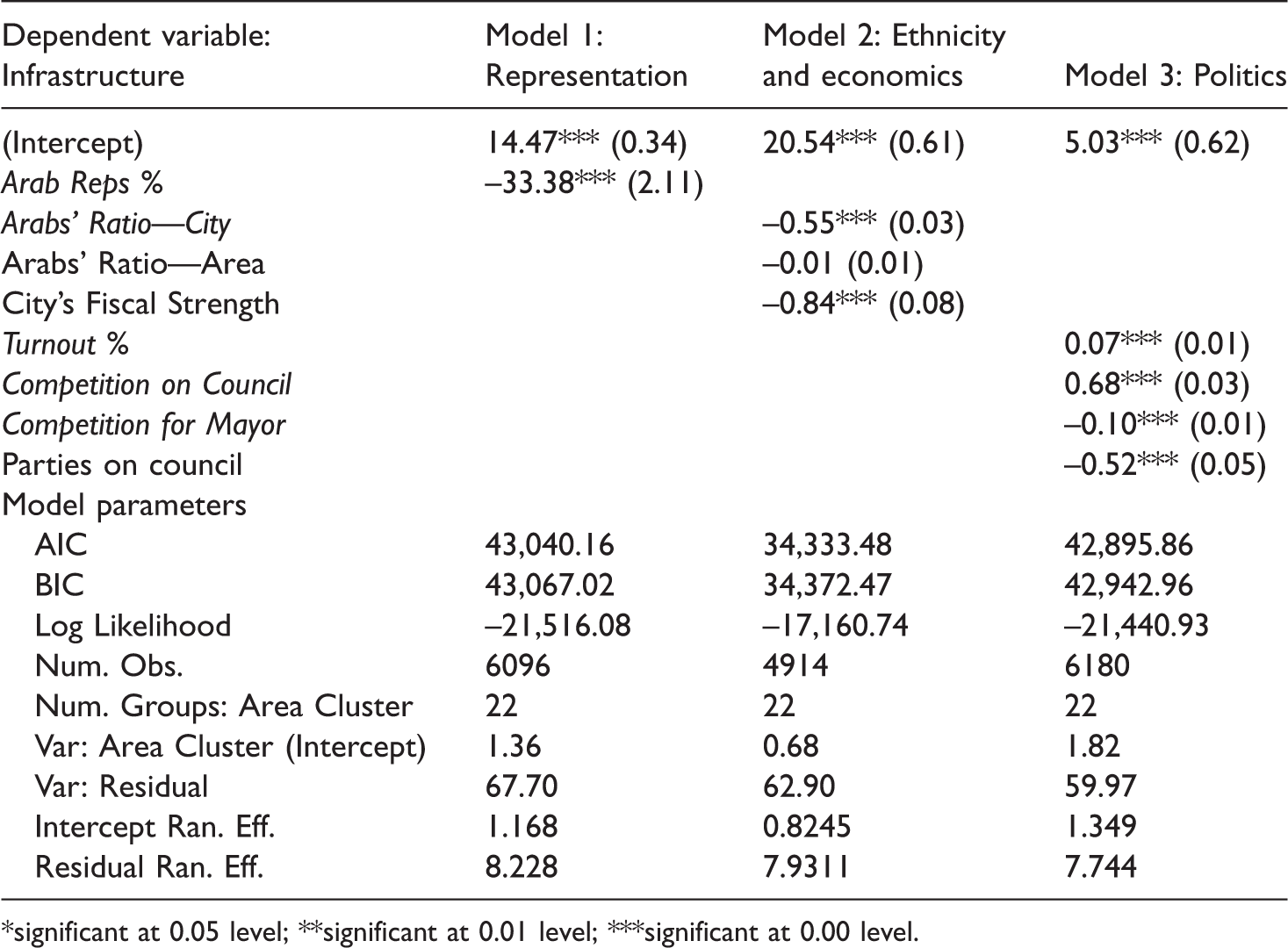
Table 2 lists the new infrastructure at the city level. Here the ratio of Arab representatives on the city council means a decrease in the construction of new infrastructure. The ethnicity and economics model reveals a reduction in infrastructure due to the increase in the Arab ratio in the city and an increase in government funding for the city. The political model shows a combination of higher voter turnout, increased gap between the two leading parties on the council and having fewer parties on the council increases the construction of new infrastructure. Here the ethnicity and economics model is the best fit, followed by the representation model and finally the political model. This effect varies between statistical areas. The influence of random effects is the strongest in the political model and the weakest in the ethnicity and economics model.
New infrastructures—City level.
*significant at 0.05 level; **significant at 0.01 level; ***significant at 0.00 level.
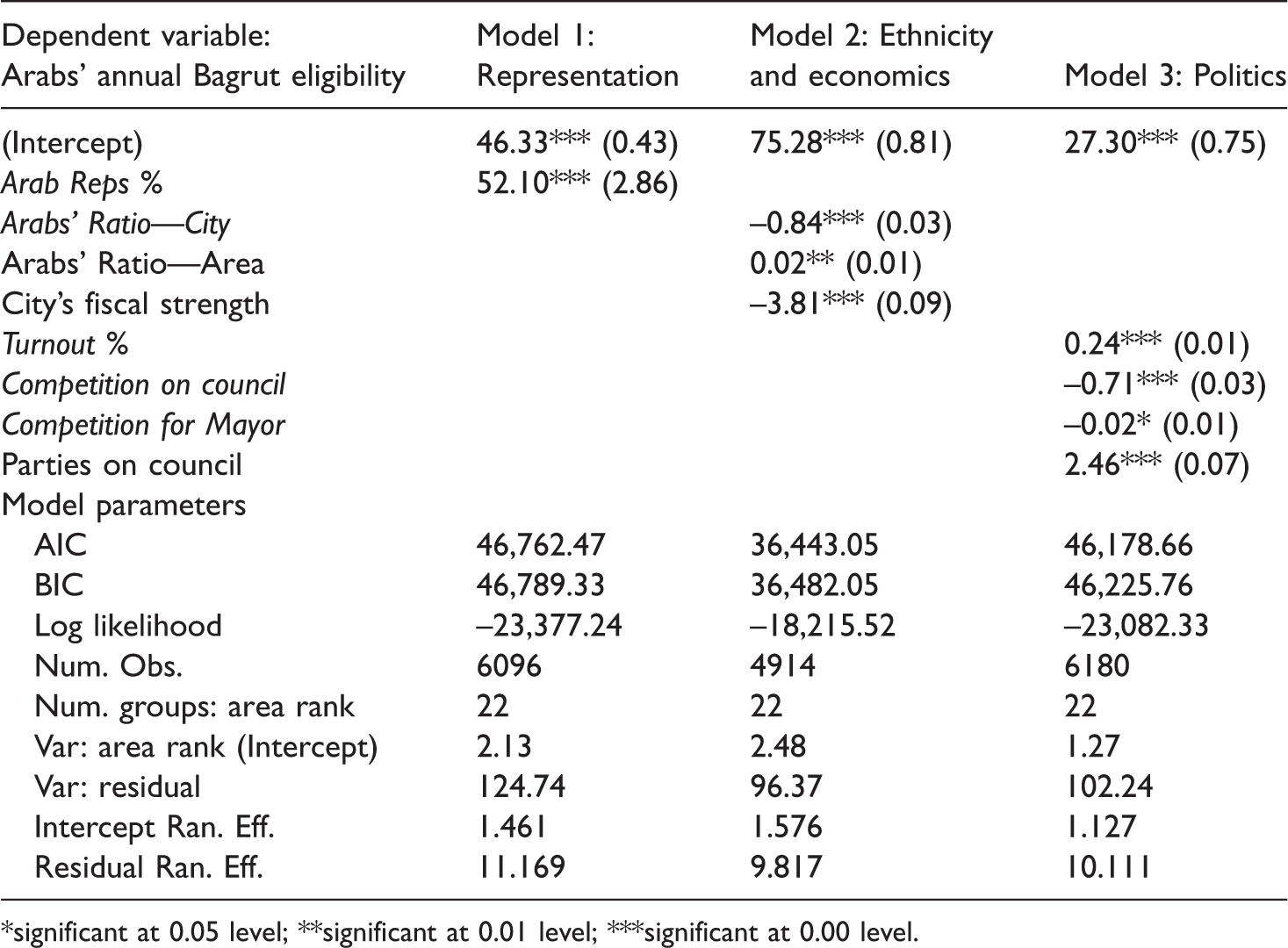
Table 3 presents the data about Bagrut eligibility for Arabs at the city level. The models show a robust and positive effect on Bagrut eligibility for the ratio of Arab representatives, a negative coefficient for the proportion of Arabs in the city, along with a negative effect of city self-funding on eligibility. Politically, there is a strong and positive effect for more parties on the council alongside higher voter turnout. As before, the ethnicity and economics model has the best fit, with a very similar level of fit for the other models. The statistical areas create variance between the models’ effects on eligibility. The smallest difference between areas appears in the ethnicity and economics model, followed by the political model, and the strongest influence for the random effect appears in the representation model. Thus, it seems that the key to understanding public policies as a whole, and educational policy outputs in particular, relates to the social context in which Arab representatives promote social policies. The policies’ effects are nested in the urban environment in which the Arab residents live, as depicted by the statistical areas and their rank. I used R’s sjPlot package to visualize this combination of causes.
Bagrut eligibility for Arabs—City level.
*significant at 0.05 level; **significant at 0.01 level; ***significant at 0.00 level.
Figure 1 illustrates the model in which the dependent variable is the rate of Bagrut-eligible Arab students in the city, the independent variable is the ratio of Arab representatives on the city council, and the random effects are the statistical area cluster ranks. Each point within the figure shows the predicted effect of the group levels on the impact of Arab representatives on Bagrut eligibility and its confidence interval. All of the dots to left of the (0) benchmark show that the effect would be low and decreasing. All of the dots to the right of (0) represent cases in which more representatives mean more education as an outcome of representation. The sjPlot package orders group levels on the y-axis by the direction of their nesting effect. The below-zero ranks belong to the groups with the highest (13–21) socio-economic cluster ranks (not including 14 and 22, which have a very high confidence interval) and the lowest (1–5) socio-economic cluster ranks (not including rank 2, which also has a very high confidence interval). The above–zero groups mostly belong to the socio-economic cluster ranks in the middle of the scale: 6–12 and 14.

Estimating the effect of representation on education by area statistical clusters as random effects.
Thus, Arabs residing in areas where their socio-economic status is not too low would benefit from local public policies more than Arabs who reside in places so poor that local representation cannot solve social inequality. Hence, in cities that benefit from government funding (model 2 in the Bagrut regression table), Arab political representation would increase the public policy outputs desired by the represented population.
Concluding discussion
This paper examined the conditions under which minorities’ descriptive representation could become substantive using the case of Arab Israelis. The empirical analyses show that public policy outputs could coincide with the needs of the minority's groups due to an enhanced representation of a disadvantaged group in a political institution which allows cooperation with the group’s representatives. Hence, minority representatives can improve the minority’s well-being once they take an active part in public policy design, and the ruling elite needs their support. This effect of politics on policy verifies our working hypothesis (Hypothesis 1) and, more pointedly, the specification of this hypothesis to the case of Arab Israelis in mixed cities (Hypotheses 2 and 3). However, the analyses also demonstrate that this effect depends on government funding to the localities and the localities being part of middle-level socio-economic clusters. This combination of social status and funding from the national government highlights the external involvement in the process that turns representation into a useful tool in minorities' attempts to receive economic support from the state.
Concerning the more theoretical implications, the assumption I made was that to change one group’s position as systematically unlucky, the group needs to capitalize on its power and maneuver vis-a-vis the elite to acquire resources. Thus, being ‘tokens’ of representation or even a critical mass would not suffice for achieving substantive representation. Here we see that there is an actual interaction between luck and power that affects the group’s ability to achieve this goal. For power to affect access to resources and change a group’s luck, there has to be some previous interaction that sets the conditions for allowing power to affect the allocation of resources.
Hence, there should be a preliminary game for institutional rules that sets the stage for winners, losers, losers who become winners, and winners who could become losers. Thus, the theoretical conclusion we can draw from this analysis is that the path from descriptive to substantive representation has to rely on the ruling coalitions’ interests and institutional rules to allow disadvantaged groups to acquire resources through political competition. Consequently, the policy implication this analysis offers is straightforward: it is the majority’s responsibility to allow minorities the environment they need to have an actual effect on policy. Thus, while the minority carries the burden of political efficacy, the majority carries the burden of empowerment. When both sides’ representatives can handle these burdens in a manner that fits their political interests, descriptive representation has the real potential of becoming substantive thereby paving the way for social change.
Supplemental Material
Supplemental material for When does descriptive representation become substantive? Systematic luck, social power and the allocation of resources
Supplemental Material for When does descriptive representation become substantive? Systematic luck, social power and the allocation of resources by Maoz Rosenthal in Ethnicities
Footnotes
Declaration of conflicting interests
The author(s) declared no potential conflicts of interest with respect to the research, authorship, and/or publication of this article.
Funding
The author(s) disclosed receipt of the following financial support for the research, authorship, and/or publication of this article: Israel's National Lottery Local Government Studies' fund, as well as the Interdisciplinary Center (IDC) Herzliya.
Supplemental material
Supplemental material is available for this article online.
Notes
References
Supplementary Material
Please find the following supplemental material available below.
For Open Access articles published under a Creative Commons License, all supplemental material carries the same license as the article it is associated with.
For non-Open Access articles published, all supplemental material carries a non-exclusive license, and permission requests for re-use of supplemental material or any part of supplemental material shall be sent directly to the copyright owner as specified in the copyright notice associated with the article.
