



Abstract
Seven of India’s 29 states enforce ‘anti-conversion’ laws, which are designed to prevent individuals and groups from converting or attempting to convert, either directly or otherwise, persons through ‘forcible’ or ‘fraudulent’ means, including ‘allurement’ or ‘inducement.’ This might seem a noble enough goal; nevertheless, we argue that anti-conversion laws actually serve to generate violent anti-Christian persecution by creating a culture of vigilantism in the states where such laws exist. This article empirically tests this proposition, along with alternative hypotheses, using a time-series, negative binomial analysis of the Indian states from 2000 to 2015. Our analysis finds that states that enforce anti-conversion laws are indeed statistically more likely to give rise to violent persecution against Christians than states where such laws do not exist. The statistical analysis is supplemented with a brief case study of Madhya Pradesh.
Introduction
In 2018, Uttarakhand officially became the ninth Indian state to formally enact an ‘anti-conversion bill’. The law, which originally arose over concerns pertaining to the state’s declining Hindu population relative to its Muslim and Christian populations, potentially carries a five-year prison sentence for those found guilty of forcing another individual to change faiths (Times of India, 2018). Uttarakhand follows in the steps of several other states which have passed similar laws: Odisha (formerly Orissa) in 1967, Madhya Pradesh in 1968, Arunachal Pradesh in 1978, Chhattisgarh in 2000, Tamil Nadu in 2002 (though repealed two years later), Gujarat in 2003, Himachal Pradesh in 2007, Rajasthan in 2008 (though unsigned by the state governor) and Jharkhand in 2017. In 2006, both Madhya Pradesh and Chhattisgarh strengthened their laws, requiring anyone desiring to convert to another faith to first provide their state governments with a 30-day notice before changing religions or face fines or other penalties. After Uttarakhand passed its law, political entities in other states expressed strong interest in following suit.
Formally known as ‘Freedom of Religion Acts’, anti-conversion laws, as they are referred to by their critics, are state-level statutes designed to regulate religious conversions done through ‘forcible’ and ‘fraudulent’ means, including ‘inducement’ and ‘allurement.’ The basic structure and content of these laws varies only minimally between states, as newer laws tend to be modelled on earlier statutes in other states. For example, the first of these laws, the Orissa Freedom of Religion Act, 1967 states: ‘no person shall convert or attempt to convert either directly or otherwise, any person from one religious faith to another by the use of force or by inducement or by any fraudulent means nor shall any person abet any such conversion’. 1 The language found in the Orissa bill is virtually identical to that found in the anti-conversion laws of other states. The Indian Supreme Court upheld the constitutionality of state-level anti-conversion laws in the landmark case Rev Stainislaus v. State of Madhya Pradesh, declaring that religious conversion inhibits religious freedom and that ‘there is no fundamental right to convert another person to one’s own religion’. 2
This article examines the effect of anti-conversion laws on violent Christian persecution in India. It argues that, instead of promoting respect for religion—the very thing that proponents of these laws believe they do—laws inhibiting conversion create and sustain environments of hostility towards religious minorities, thus empowering the voices of extremism and promoting religious conflict. Using a time-series, cross-state negative binomial analysis of the states of India from 2000 to 2015, we find that states that enforce anti-conversion laws are indeed more likely to experience religious conflict in the form of violent anti-Christian persecution than states where such laws do not exist.
Our analysis contributes to the existing scholarship in three ways. First, while virtually all of the studies on religious conflict in India have focused on Hindu–Muslim violence, Hindu–Christian violence has been virtually absent from the literature, largely because violence against Christians has been a relatively recent phenomenon, the Christian share of the Indian population remains low and Christians remain politically insignificant (Bauman, 2015). Yet, Hindu–Christian conflict has increased precipitously over the past decade and has become a very significant and contentious issue in India (Kanungo, 2008; Sarkar, 1999; Shah and Carpenter, 2018). Our focus on anti-Christian violence, thus, fills an important gap in the literature on inter-religious conflict in India. Second, by using a subnational, cross-state statistical analysis of all of India rather than focusing on a particular region, we are able to implicitly compare violent and peaceful states, and, in the process, help identify the central causes of conflict in one of the countries most plagued by religious hostility. A comparative, state-level analysis is also warranted given the decentralized nature of the Indian political system and the great deal of autonomy given to the states to fashion their own religion–state policies. Third, our choice of multivariate, time-series analysis instead of descriptive statistics or ethnographic work allows us to gauge the relative importance of several different hypothesized explanations of violent religious conflict in India at once.
The study proceeds in six parts. The first discusses the literature on the sources of religious conflict in India, noting that only one existing study has attempted to examine statistically the correlates of anti-Christian violence in India and no empirical analysis on the effects of anti-conversion laws on violent religious conflict has yet been undertaken. The second section explains why anti-conversion laws encourage violence against Christians. The third part discusses the data and methods used in the quantitative analysis, while the fourth presents the results. A fifth section presents a brief case study of conversion and anti-Christian persecution in the state of Madhya Pradesh. A sixth section concludes.
Violent Christian persecution in India
Christians throughout the world routinely experience imprisonment, torture, rape and death for their faith at the hands of both state and non-state actors (Philpott and Shah, 2018). The Christian NGO, Open Doors, notes that approximately 215 million Christians experience high, very high or extreme persecution (Open Doors, 2018). One in 12 Christians lives in countries where Christianity is ‘illegal, forbidden, or punished’ (Christianity Today, 2018). Trends indicate that anti-Christian persecution is worsening in intensity and scope. The severity of global Christian persecution prompted Britain in 2018 to commission an independent review into the persecution of Christians worldwide and recommend practical steps to alleviate Christian suffering (Financial Times, 2018).
Curiously, despite its status as the world’s largest democracy, the ideals of religious liberty and equality set forth in its constitution and Christianity’s long-standing presence in the country, India ranks among the world’s worst countries in terms of its levels of anti-Christian hostility. According to the Pew Research Center, in 2015, India had the fourth highest rate of religious conflict in the world, behind only Iraq, Syria and Nigeria (Pew Research Center, 2017). It is also the country in which religious minorities faced the highest rates of social hostilities involving religion in the world (Pew Research Center, 2018). In 2017, the modern persecution of Indian Christians reached a record high, leading one Catholic organization to describe religious persecution as a ‘new normal’ in India (UCA News, 2018). Many local Christian NGOs in India provide evidence of escalating violence against Christians. In 2018, Persecution Relief (2018, 2019) recorded a total of 477 incidents of persecution against Christians in India, up from 440 in 2017 and 330 in 2016. 3 The Religious Liberty Commission of the Evangelical Fellowship of India (2017) also pointed to increased targeting of Carol groups, independent pastors and Catholic clergy. The report indicated that in 2017, there were 110 cases of physical violence and threats, 70 cases of harassment and 64 cases in which church proceedings and worship services were stopped. There were even three cases of church demolition and two cases where churches were burnt down. 4
Historically, religious violence in India has targeted all of India’s major faith communities. Major episodes of violence against those of different faith traditions occurred during the anti-Sikh riots in Delhi in 1984, the anti-Hindu riots in Kashmir in 2000, the anti-Muslim riots in Gujarat in 2002 and the anti-Christian riots in Odisha in 2008. But in recent times, Christians have suffered from a disproportionate level of religious persecution, which has intensified after the coming to power of the Hindu nationalist Bharatiya Janata Party (BJP) in 2014. At the same time, not every Indian state experiences high levels of Christian persecution. What explains this variation across states?
With the exception of one study, the scholarly literature to date has not attempted to empirically test the causes of anti-Christian persecution in India. The one study that attempts to carry out a subnational analysis of violence against Christians in India relies largely on descriptive analysis and covers only a two-year period (Bauman and Leech, 2012). Existing studies have, nevertheless, posited some explanations for religious conflict in India generally, which theoretically should also apply to anti-Christian violence.
A first line of argumentation examines how material factors lead to religious conflict in India, especially poverty, uneven economic development and population pressures (Chadha, 2005; Urdal, 2008). This claim falls in line with some broader work on the effects of economic underdevelopment on violent conflict, particularly terrorism and civil war (Burgoon, 2006; Fearon and Laitin, 2003; Hegre and Sambanis, 2006; Lai, 2007; Li and Schaub, 2004). Because economic prosperity relieves competition over scarce resources, higher levels of wealth result in greater satisfaction among the general populace, reducing the likelihood of individuals blaming outgroups for their plight or turning to violence in order to redress their impoverished situations. Conversely, underemployment and lower levels of education foster social unrest, sometimes leading to violence. Economic grievances can take on a cultural dimension when those who experience economic marginalization scapegoat those of different ethnic, linguistic or religious backgrounds as being responsible for their declining standard of living. Similarly, population pressures can lead to competition over resources among groups, sometimes leading to violence between them. A common theme in this first set of studies is that conflict between religious groups, in India, and elsewhere, has more to do with non-religious factors.
A second explanation points instead to cultural difference between India’s religious groups. Rooted in the ‘clash of civilizations’ theory popularized by the late political scientist Samuel Huntington, the cultural difference explanation emphasizes differences in religious identity and divergent value systems espoused by India’s different religious traditions (Huntington, 1996). Furthermore, the legacy of colonialism in India by Christian powers—first by the Portuguese and then the British—has given rise to a widespread narrative linking Christianity to foreign rule, external interventions and Western supremacy (Jaffrelot, 2007). Some Hindu groups thus perceive the Christian faith to be foreign and expansionist, exclusivist and intolerant in its religious claims, politically opportunistic and inherently incompatible with the Hindu dharma. In this view, Christianity poses an existential threat to Hindu unity, especially in its attempt to challenge the caste system by converting those from lower-caste Hindu communities. Against Huntington’s argument, though, is the work of Varshney (2002), which reveals that the prospects for communal violence in India decline when different communities are brought together in intercommunal networks, which function as vehicles of peace in that they build bridges and manage tensions.
A third body of work argues that it is not religious difference per se that generates violence, but rather the politicization of religion by elites. In this view, the ‘divide and conquer’ approach, part and parcel of British colonial rule as evidenced in the 1909 Moreley–Minto Reforms and the 1919 Montagu–Chelmsford Reforms, precipitated the breakdown of communal harmony, constructed communal difference and stoked conflict between Hindus and Muslims, with the goal of awakening Muslim consciousness as a means to counter emerging anti-British nationalism (Varshney, 2002). Others trace the politicization of religion in India to the pre-colonial period (Bayly, 2003; van der Veer, 1994). More recently, political leaders associated with the family of Hindu nationalist organizations known as the Sangh Parivar, fearing declining Hindu political and economic power, have directly or indirectly supported violence against religious minorities in the hopes of winning or holding on to power by consolidating the Hindu vote (Brass, 2003; Nussbaum, 2009; Wilkinson, 2006). According to this view, the dramatic rise in the intensity and frequency of violence against religious minorities in recent times can be traced to the coming to power of the Hindu nationalist Bharatiya Janata Party (BJP), especially the election of Hindu nationalist Narendra Modi to Prime Minister in 2014 and the subsequent election of another Hindu nationalist, Ram Nath Kovind, to President in 2017. The BJP also presently controls several state governments. However, other work shows that, to the contrary, the Hindu Right in general, and the BJP in particular, has never consistently tolerated or encouraged violence against minorities, instead vacillating between moderation and militancy in different states (Basu, 2015). The study on Christian persecution referenced earlier fails to find a strong correlation between BJP rule and anti-Christian violence (Bauman and Leech, 2012).
This article puts forth, and empirically tests, a related explanation for violent religious conflict in India in the form of violent anti-Christian persecution: the presence and enforcement of anti-conversion laws. The increase in violent attacks against Christians can be understood as a response to religious conversion and the perceived inroads being made by Christians among marginalized Hindu groups. This argument is informed by a recent body of scholarship that has examined the effect of restrictions on religion on the production of violent conflict (Grim and Finke, 2011; Henne et al., 2012; Saiya, 2015, 2017, 2018, 2019; Toft et al., 2011). As argued in the following section, anti-conversion laws generate violent persecution against Christians by creating a culture of vigilantism and backlash in the states where they are enforced.
How anti-conversion laws encourage violent Christian persecution
Anti-conversion laws in India (and elsewhere) exist for the ostensibly noble purpose of preventing coerced religious conversions made through ‘force, fraud or allurement’. Originally introduced by Hindu princely states such as Rajgarh, Patna, Sarguja and Udaipur before independence as a means of preserving Hindu identity in the face of Christian proselytization emanating from the West, these statutes would eventually be reinstated by several Indian states after independence from Britain (Huff, 2009). In the 1970s, the Supreme Court of India ruled that the right to propagate one’s faith did not necessarily include the right to convert another from his or her faith. To date, nine of India’s 29 states have anti-conversion laws on the books, though they are enforced in only seven of them: Odisha, Madhya Pradesh, Chhattisgarh, Gujarat, Himachal Pradesh, Jharkhand and Uttarkhand. 5 Similar laws have been proposed three times at the national level but were rejected each time. Punishments for violating the provisions of the laws include fines ranging from 5,000 to 50,000 rupees and prison sentences of one to three years. These penalties increase in the cases of individuals attempting to convert minors, women or members of scheduled castes away from their faith. Sometimes anti-conversion laws require prospective converts to Christianity to register their intent with authorities before they can officially convert.
Almost always supported by Hindu nationalist groups, anti-conversion laws represent a codification of the ideology known as Hindutva (Hinduness) and reflect a fear of intensifying activity by Christian missionaries, who offer marginalized Hindus the possibility of freedom from the oppressive caste system and the ability to become dignified and equal members of society (Mosse, 2012; Viswanathan, 1998). These groups oppose conversion because they fear that the number of Hindus will decline as the number of non-Hindus rises, altering the dynamics of the vote bank (Sahoo, 2018). Through these laws, right-wing Hindu groups like the Rashtriya Swayamsevak Sangh (RSS)—the ideological arm of the BJP—seek to perpetuate the identity of India as a predominantly Hindu nation by regulating conversions to non-Hindu religions. For example, the Backward Communities Bill of 1960 sought to combat the conversion of Hindus to ‘non-Indian’ religions, including the proselytizing faiths of Islam and Christianity (Indian Law Institute, 2013). More recently, several ministers of the ruling BJP have given their support to the adoption of a national anti-conversion law as a means to retain India’s Hindu character. This goal was explicitly acknowledged by BJP Member of Parliament Tarjun Vijay in 2015 in a statement of remarkable candor expressing support for a national anti-conversion law: ‘For the first time, the population of Hindus has been reported to be less than 80 percent. We have to take measures to arrest [this trend] … and I think a bill of this nature will … allow Hindus to remain a majority in India.’ That same year, Union Home Minister, Rajnath Singh, and the party’s President, Amit Shah, made similar statements in support of a nationwide anti-conversion law (International Business Times, 2015).
Critics of anti-conversion laws point out that they typically regulate conversions from Hinduism to other religions but do not restrict conversions or reconversions to Hinduism in the same way, thus creating an unbalanced playing field in the religious economy for minority faiths. The United States Commission on International Religious Freedom found, for example, that anti-conversion laws ‘generally require government officials to assess the legality of conversions out of Hinduism only’ (United States Commission on International Religious Freedom, 2016: 5).
Ironically dubbed ‘freedom of religion’ bills, these laws have the two-fold effect of obstructing peaceable religious conversion through the threat of arrest and incarceration and encouraging harassment and violence against religious minorities accused of engaging in ‘forcible conversions’ by forces of communalism who claim they are simply enforcing the law. Because anti-conversion laws are often passed at the behest of Hindu nationalist groups who fear that India’s Hindu character is under siege owing to the growth of competing faiths, they disproportionately target religious minorities, especially Muslims and Christians, both groups for whom proselytism is central to the teachings of their faiths. Furthermore, the prohibition against using ‘force, fraud or allurement’ in proselytization efforts would generally be applauded by advocates of human rights and religious liberty, except that these terms are so loosely defined in the anti-conversion statutes that virtually any conversion can be attributed to the use of ‘allurement’ (assurances of eternal life, salvation and inherent worth, especially for the lower castes and tribes), insofar as the laws do not distinguish spiritual from material forms of allurement. (The Odisha law, for example, lists the threat of ‘divine displeasure’ as an illicit form of force.) Predictably, then, the definitional ambiguity part and parcel of anti-conversion laws leaves government officials with a great deal of discretion regarding what constitutes their violation (Osuri, 2012; Sahoo, 2018: 69–70).
Christians would counter that converts to Christianity are not seduced through incentives or inducements as Hindu nationalists claim, but that marginalized Hindus voluntarily accept Christianity in the hopes of escaping the oppressive caste system, achieving dignity and equality and finding spiritual fulfillment. One recent study offers strong support against the claim that material incentives drive conversion (Sahoo, 2018). As put by Telesphore Toppo, Archbishop of Ranchi, ‘Forced conversions do not exist. We are free people with a free will and a free conscience and intelligence. No one can force another to convert’ (World-Wide Religion News, 2017). Former United Nations Special Rapporteur on Freedom of Religion or Belief, Asma Jahangir, found very little evidence of attempted forced conversions by religious minorities, as the laws themselves have led to few arrests or convictions: Even in the Indian states which have adopted laws on religious conversion there seem to be only few—if any—convictions for conversion by the use of force, inducement, or fraudulent means. In Orissa, for example, not a single infringement over the past ten years of the Orissa Freedom of Religion Act 1967 could be cited or adduced by district officials and senior officials in the State Secretariat (United Nations General Assembly, 2009).
When states limit the religious activities of certain faith traditions, they sometimes contribute to the belief in society that violence against these groups is supported by official laws and policies. Although anti-conversion laws are passed by state governments, these governments themselves do not typically engage in violent persecution of religious minorities. A much more dire threat comes from the extralegal enforcement of official laws and policies by mobs, vigilantes and terrorists, often with the tacit support of politicians. Laws restricting conversion promote intolerance and increase the political salience of religion at the level of society, and in restricting the limits of acceptable discourse, they also promote a culture of vigilante justice in the states where they exist. Thus, anti-conversion laws empower extremists associated with the religious majority—in this case, Hinduism—to attack religious minorities. In short, charges of religious conversion work to kindle passions against those seeking to convert individuals away from Hinduism, motivate vigilantes and justify acts of violence.
In states enforcing anti-conversion laws, Hindu vigilantes have often attacked with impunity individuals, homes, places of worship and businesses of those believed to be proselytizing and converting others, using the very laws passed by the state to justify their violence. These episodes can range from relatively minor isolated incidents to large-scale communal riots. In turn, the state commonly turns a blind eye to violence carried out by Hindus, on whose behalf it inhibits conversion in order to retain its good standing with that religious group. Hindu vigilantes, thus, feel empowered to commit acts of violence with little or no fear of governmental reprisal because anti-conversion laws, in effect, lend the authority of the state to extremists and reinforce extreme views. As noted by Bauman (2016: 37), ‘One of the particularly troubling characteristics of violence against India’s Muslims and Christians is how infrequently the perpetrators are even charged, let alone convicted, and how regularly witnesses become corrupted, or are intimidated into changing their stories in order to exculpate criminals’ (Bauman, 2016).
Consider the case of Odisha—a state that has witnessed a high level of Hindu–Christian hostility. Originally created by the British colonial administration to appease the Hindu elite, the Hinduization of tribal populations ultimately led to the passage of an anti-conversion law in 1967 at the behest of right-wing Hindu organizations such as the Vishwa Hindu Parishad and the Bajrang Dal (Pati, 2003). These groups accused Christians of forcing lower-caste Hindus to convert to Christianity and leave the caste system. In 2008, communal hostility between Christians and Hindus took a frighteningly violent turn when militant Hindus burned down or otherwise destroyed hundreds of Christian churches and thousands of Christian homes. Vulnerable groups caught in the middle were forcibly displaced into relief camps. The violence in Odisha occurred while the state turned a blind eye; local police only registered only 827 cases of more than 3,500 reports of violence they received (The Christian Post, 2012).
In summary, supporters of anti-conversion laws claim these statutes prevent conversion done through force, fraud or allurement. On the surface, this might seem a noble enough goal. Nevertheless, in reality, anti-conversion laws represent the codification of fear among some Hindus that Hinduism is beginning to lose ground to minority faiths. These laws also encourage violence by obstructing peaceable religious conversion and empowering Hindu vigilantes to violently persecute Christians with little fear of governmental reprisal. In the following section, we discuss the data and methods used in our analysis of the effect of anti-conversion laws on the violent persecution of Christians.
Data and methods
To assess the relationship between anti-conversion laws and communal violence, this study tests for the hypothesis that states enforcing anti-conversion laws experience greater violence against Christians than states not having or enforcing these laws. This study makes use of a unique dataset that incorporates both pre-existing data and original coding of religious conflict in India. This dataset includes state-year observations for 29 Indian states from 2000–2015, the range of years for which relatively complete data are available. 6 In addition to information on violent persecution of Christians, the dataset also includes various data drawn from a number of sources on the political, economic, social and religious characteristics of the Indian states. In what follows, we discuss the operationalization of the dependent, independent and control variables.
Dependent variable
The dependent variable is an event count of the number of identifiable Christian victims physically attacked by Hindus in each of India’s states every year from 2000–2015. Data for this variable are derived and coded from the annual Religious Freedom Reports compiled by the United States Department of State. According to the State Department website The annual Report to Congress on International Religious Freedom – the International Religious Freedom Report – describes the status of religious freedom in every country. The report covers government policies violating religious belief and practices of groups, religious denominations and individuals, and U.S. policies to promote religious freedom around the world. The U.S. Department of State submits the reports in accordance with the International Religious Freedom Act of 1998 (United States Department of State, 1998).
Example of coding of violent anti-Christian persecution.

We opted to use these reports to code the dependent variable for two reasons. First, the Indian government does not make available data on violence against Christians. Second, a number of Christian NGOs do collect data on the persecution of Christians, but as the mission of these groups is explicitly to advance the welfare of Christians, the reports may introduce inflated data on the persecution of Christians. (It should be reiterated, though, that not including data from Christian NGOs also almost certainly has the effect of understating our findings.) Moreover, these reports mostly pertain to relatively recent years and hence do not provide a longer time series of data as used in our analysis.
Independent variable
The theoretically central independent variable is the enforcement of anti-conversion laws in the states of India. Through the end of 2019, seven of India’s 29 states enforced anti-conversion laws. Two other states have formally adopted measures against forced conversion, but do not enforce them. For this reason, it is important to differentiate between states that have such laws on the books and those that have mechanisms in place to enforce them. States that had and enforced anti-conversion laws were coded with a ‘1’, all others with a ‘0’.
Control variables
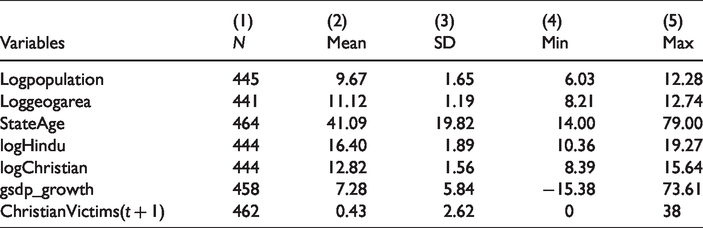
Various political, economic and social factors may also drive violent anti-Christian persecution in India. We thus employ several state-level covariates in each model estimation. Following the empirical literature on civil conflict, we include variables controlling for the natural log of a state’s population (Logpopulation), the log of a state’s geographic area (Loggeogarea), the age of a state defined as the number of years since it was formally integrated as a political unit into the Indian federation (StateAge), Gross State Domestic Product (GSDP) growth rate (gsdp_growth), and a state’s level of religious diversity measured through the variables log of Hindu population (LogHindu) and log of Christian population (LogChristian). Logged population and logged area are included to control for the idea that highly populated or geographically large states theoretically make it easier for religious conflict to break out (Eyerman, 1998). Large populations may also spur violence over scarce resources. State age controls for the finding that newer political entities are more prone to violence (Piazza, 2013). As mentioned earlier, some literature also finds that poor or uneven socioeconomic development might predict violent conflict, thus the inclusion of the GSDP growth rate variable. Religious diversity variables are included to test for the possibility that larger minority populations in a state make religious conflict more likely. It could also be the case, alternatively, that violence against Christians might be more likely in areas where they are most vulnerable and do not comprise a large proportion of the population. Most of the control variables were sourced from Census of India, an official survey capturing various demographic, economic, social and other statistics every ten years. The data from the Census pertaining to 1991, 2001 and 2011 were used to estimate projections based on Compound Annual Growth Rate (CAGR). Data on GSDP were sourced from the Reserve Bank of India and have been indexed to a common base year of 2011–2012. The descriptive statistics of the variables can be found in Table 2.
Descriptive statistics.
Results
The data for all variables were arranged into a longitudinal panel setup over the period 2000–2015, with the state-year as the unit of observation. Because the dependent variable, the number of Christians victims of Hindu violence, is an event count that does not include negative values, is unevenly distributed across observations and is likely to be dependent on the values of other observations, negative binomial regression (with robust standard errors clustered on states) is the most appropriate statistical technique to gauge the relative import of the independent and control variables on violent Christian persecution. To check for autocorrelation (as past incidents may affect the present ones) and to avoid omitted variable bias, all the models were constructed such that the dependent variable ChristianVictims (t + 1) corresponds to the number of Christian victims one year later than the given state-year observation.
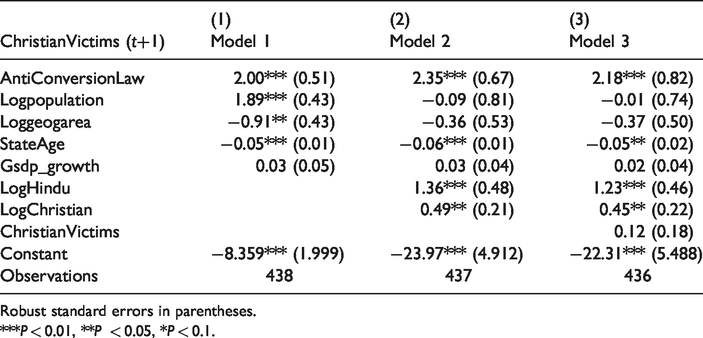
The results of the negative binomial analysis are presented in Table 3 with a number of specifications. In Model 1, we control for demographic and social factors, including log of population, log of geographical area, state age and GSDP. In Model 2, we additionally control for religious diversity by including the log of Hindu and Christian population as covariates. In Model 3, in addition to the covariates of the previous two models, we control for the lag of the dependent variable to check for temporal evidence. The results provide strong evidence for our main hypothesis that states that have and enforce anti-conversion laws are more likely to experience higher rates of violent anti-Christian persecution than states where these laws either do not exist or are not enforced.
Negative binomial models of anti-conversion laws and Christian persecution.
Robust standard errors in parentheses.***P < 0.01, **P < 0.05, *P < 0.1.
As we control for the various factors, the coefficient for the presence of an anti-conversion law holds statistical significance as well as magnitude in moving from Model 1 to Model 3. With respect to the covariates, Stateage is consistently significant in all the models. Newer states have a greater likelihood of giving rise to anti-Christian violence. As explained by Piazza (2010), India has had a history of addressing many ethnic and political disputes through the creation of new states and relatively newer regimes may be more volatile than older ones. Among the covariates for religious diversity, both LogHindu and LogChristian are found to hold statistical significance across all three models. This suggests that states with a larger percentage of either Hindus or Christians lead to more cases of violence against Christians. The lag of the dependent variable, ChristianVictims (t), by itself is not statistically significant. Importantly, adding it does not cause the coefficient for anti-conversion laws to lose its statistical significance or magnitude. This adds validity to our findings. In sum, all three models provide support for our argument that the presence and enforcement of anti-conversion laws leads to more Christians being violently attacked in the states where these laws exist compared to states where they do not.
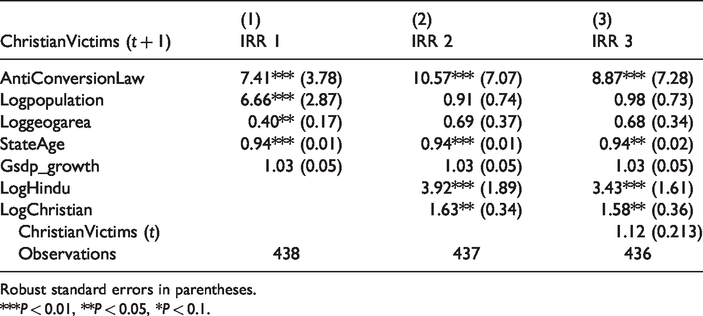
To understand the substantive effects of anti-conversion laws on violent anti-Christian persecution, we analyze the Incidence Rate Ratios (IRR) of the expected number of Christian victims of violent persecution. The IRR indicates the ratio of the rates at which events may occur. Table 4 presents the IRR for all three models. In Model IRR1, the IRR of 7.42 indicates that states with anti-conversion laws experience 7.42 times the number of Christian victims than states with no anti-conversion law. IRRs of 10.57 and 8.87 in Models IRR2 and Model IRR3, respectively, mean that states with anti-conversion enforcement are likely to experience more than 10 times and more than 8 times the number of Christian victims of violent persecution in contrast to states with no anti-conversion legislation. Across all the models, the coefficient for the presence of an anti-conversion law is found to be highly significant.
Incidence rate ratios.
Robust standard errors in parentheses.***P < 0.01, **P < 0.05, *P < 0.1.
Further, we conduct a number of robustness checks to strengthen our main findings. We report the most important of these here. First, we also controlled for general levels of communal violence (CommunalViolence), defined as the number of violent incidents involving members of different religious communities for each Indian state in each year. Expectedly, this variable holds statistical significance, while the variable for anti-conversion laws also remains statistically significant at the 1% level. This finding is indicative that states with incidence of communal violence are likely to experience more violence against Christians as opposed to those states with no incidence of communal violence. In a second robustness test, we included a variable for BJP rule as a covariate to check if the BJP being in power in a given state when the anti-conversion law was enacted influenced the dependent variable. The variable is coded as 1 if a state government was led by the BJP when the law was enacted and 0 otherwise. The result, similar to the previous robustness test, finds that anti-conversion laws continue to hold statistical significance (at the 5% level), indicating that these laws are not picking up effects of BJP rule when they were enacted. Moreover, there are only two states where the state government was led by the BJP when anti-conversion laws were passed. These results indicate that anti-conversion laws are likely to cause greater incidence of anti-Christian violence, irrespective of the political party in power or party enacting the law. In a third robustness test, we altered the type of regression used in the analysis. One of the potential weaknesses of standard negative binomial regression involves the fact that it might be inappropriate for count data that exhibit over-dispersion and excess zeros (Davis and Wu, 2009; Hilbe, 2011). It is possible that zero cases of violence against Christians may occur for different reasons—zero actual cases or zero cases reported/recorded. This may end up inflating the zeros in the response variable which, methodologically, can be accounted for with a zero-inflated negative binomial (ZINB) model as opposed to regular negative binomial regression. We, thus, ran a ZINB model. The Voung test revealed a z-value which is not statistically significant, indicating that the ZINB model is not a better fit over the standard negative binomial model that we have used, thus increasing the reliability of our findings.
In sum, our analysis, supplemented by a series of robustness tests and different model specifications, supports our claim that Indian states enforcing anti-conversion laws experience greater violent persecution of Christians than states where these laws either do not exist or are not enforced. The fact that a relatively small percentage of Indian states enforce these statutes adds validity to our finding by helping to better isolate and discern the effects of such laws on the violent persecution of Christians.
The case of Madhya Pradesh
To further see the connection between anti-conversion laws and violent anti-Christian persecution, we take a brief look at the case of Madhya Pradesh. Indian anti-conversion laws have their roots in the Justice Niyogi Committee Report on Christian Missionary Activities published by the Government of Madhya Pradesh in 1956. The report portrayed Christian missionaries as ubiquitous, predatory, under-handed and intent on the establishment of an independent Christian nation through subtle and pernicious forms of ‘force, fraud and inducement’ (Bauman, 2015: 94–95). This report, commissioned more than 20 years before the first official anti-conversion laws in India, shows that the roots of an anti-conversion culture can be traced to Madhya Pradesh. In 1975, the Indian Supreme Court upheld the constitutionality of Madhya Pradesh’s restriction on conversion in the landmark case Rev Stainislaus v. State of Madhya Pradesh. The Madhya Pradesh Freedom of Religion Act of 1968 was the second-earliest official anti-conversion law passed by a state in India, introduced one year after the Orissa bill. Under section 3 of the Act, ‘[n]o person shall convert or attempt to convert, either directly or otherwise, any person from one religious faith to another by the use [of] force or by allurement or by any fraudulent means nor shall any person abet any such conversion’ (Library of Congress, 2018) 7 Subsequent anti-conversion laws in other states would incorporate the same language into their bills. Moreover, our data show Madhya Pradesh to be the state with the highest number of cases of anti-Christian persecution in India during the time period we examine—a finding corroborated in reports by local Christian non-governmental organizations, which find especially high levels of violent anti-Christian persecution in Madhya Pradesh (Persecution Relief, 2018, 2019). These incidents include attacks on missionaries, strikes against churches and the violent disruption of Christian events. For these reasons, Madhya Pradesh deserves a closer look.
A number of recent cases reveal violence against Christians in Madhya Pradesh to be directly related to the issue of conversion. In March 2015, Hindu militants attacked a Bible convention in Jabalpur over allegations that religious conversions were taking place (NDTV, 2015). In 2016, a blind pastor, his wife and 11 others were accused of proselytizing among some villagers. They were all violently beaten by an angry mob of right-wing Hindu extremists and were charged under the Madhya Pradesh Freedom of Religion Act. In 2019, they were acquitted by the court, which found them not guilty of all charges. In 2017, a Hindu nationalist group beat Christian parents and a group of children at a railway station in Indore, accusing the parents of kidnapping the children and forcibly converting them (The Wire, 2017). Later that year, right-wing Hindu activists attacked Catholic carol singers in Madhya Pradesh's Satna district and also set a priest's car ablaze, accusing them of religious conversion (The Indian Express, 2017). In January 2018, a group of Hindu nationals broke into a pastor’s house in Jhirigamali village and beat his teenage son, accusing them of illegal conversion (Church in Chains, 2018). 8 These and dozens of other cases reveal the severity of violent, anti-Christian persecution as related to the issue of conversion. As demonstrated in many of these cases, the act of charging Christian victims of violence under the anti-conversion law indicates how it contributes to persecution of Christians by empowering Hindu vigilante extremists. In rectifying misuse of this legislation, in 2019, the new Congress Party government in Madhya Pradesh initiated the withdrawal of all cases involving accusations of religious conversion against Christians, which peaked at 264 during the 15-year rule of the BJP government in the state (Hindustan Times, 2019).
Cross-state comparisons also help show the role of anti-conversion laws in encouraging violent persecution of Christians. For example, Madhya Pradesh, Haryana and West Bengal all have a very similar ratio of Christian populations: Madhya Pradesh at about 0.23%, Haryana at 0.20% and West Bengal at 0.72%. In 2018, Madhya Pradesh witnessed three times more cases of violent anti-Christian persecution than Haryana. Madhya Pradesh also recorded more than twice the number of cases of violent anti-Christian persecution as West Bengal. Many of the Madhya Pradesh cases of persecution can be directly linked to the issue of conversion, whereas none of the cases of Haryana and West Bengal can. It stands to reason that the difference can be attributed to the enforced anti-conversion law in Madhya Pradesh and the lack of such a law in Haryana and West Bengal. In short, compared to states with about the same share of Christians that do not enforce anti-conversion legislation, Madhya Pradesh—a state that has enacted and enforces an anti-conversion law—has witnessed a substantially higher level of violence against Christians. Moreover, this violence is often explicitly tied directly to the issue of conversion.
Conclusion
As the world’s largest democracy, freedom of religion is a fundamental right guaranteed by the Indian Constitution. The people of India have the right to practice and promote their religion peacefully within the broad limits of the law in accordance with Article 25 of the Constitution. India is also a signatory to a number of international covenants protecting religious freedom, including the United Nations Declaration of Human Rights and the International Covenant on Civil and Political Rights. It is also one of the most religiously diverse countries in the world and the birthplace of several of the world’s major religious traditions, making freedom of religion all the more important.
Despite its venerable tradition of tolerance between religious communities and a legal framework supportive of religious belief and practice, India today is witnessing a serious threat to its secular character and commitment to religious freedom. One of the most important sources of its obstruction involves the passage of anti-conversion laws which are, in fact, instruments explicitly designed to curb the rights of India’s religious minorities and assimilate them into the dominant Hindu culture. Of course, no single causal factor can account for a complicated phenomenon like anti-Christian violence, but the results of this analysis reveal that these laws not only pose a serious threat to freedom of religion in the states where they exist, they also empower activists to resist conversion and provide a pretext for attacks against religious minorities, sometimes leading to violent conflict spirals. Thus, policy instruments formulated to advance social stability appear rather to be inhibiting it. This finding holds potentially important ramifications for India and beyond. Given the contemporary realities of global migration and the consequent increasing of religious diversity found in countries around the world, states need to think carefully when designing policies for dealing with their religious minorities.
There remain, however, other dimensions to be explored. One important avenue for future research would be to establish the universality of these findings by deploying a comparative perspective— testing the hypothesis for other nations as well attempting cross-country analysis. Such an approach would also be useful in understanding if anti-conversion laws have ever worked to prevent communal violence as opposed to where they have not and to unlocking the determinants of such variations in outcomes. Second, contrary to our claim that the enforcement of anti-conversion laws results in violent anti-Christian persecution, Hindu nationalists might contend precisely the opposite: aggressive proselytization efforts by Christians lead to social disruption, engender threats to the purity of Indian society and provoke a violent backlash by Hindus against Christians. Future work might test this claim by analyzing if regions of India more hospitable to Christian evangelization programs experience higher levels of anti-Christian violence. Third, we focused here on violence against Christians, but Christians are both the victims and sometimes the perpetrators of violent attacks. Future work might explore the conditions that spur violence by Christians against those of other faith traditions in India. Fourth, as an extension of Varshney’s work on the importance of civic engagement in reducing conflict between India’s Hindu and Muslim communities, future work might also explore the importance of civic engagement in reducing violent anti-Christian persecution.
Footnotes
Declaration of conflicting interests
The author(s) declared no potential conflicts of interest with respect to the research, authorship, and/or publication of this article.
Funding
The author(s) disclosed receipt of the following financial support for the research, authorship, and/or publication of this article: A start-up grant from Nanyang Technological University.
