



Abstract
Across academic and public discourse, migrant integration is normalised as a desirable outcome. This normalisation has been challenged, centring critiques on the continued coloniality of migration and integration governance. Drawing on empirical case studies, this article contributes to this research on the coloniality of integration by presenting a multi-sited analysis of the science-policy nexus of integration governance. Using text analysis, we examine three empirical case studies in which social scientists seek to impact the governance of migrant integration: (1) the overhaul of Dutch integration policy, (2) the early roots of Swiss integration policy, and (3) internationally published integration research. The paper theorises the ‘scientism of integration’ as the shared rationale according to which integration can be objectively known, measured, and managed through scientific research, while focusing specifically on how colonial modernity logics are reproduced as a result of this rationale. Firstly, we argue that the involvement of research in integration governance presents science as a solution to social disorder, positioning researchers as mitigators of this risk. Secondly, we show how the scientism of integration makes a ‘normal science’ out of a highly contested and political agenda. Thirdly, we demonstrate how these processes and positionings contribute to the (re)production of the modern/colonial social order. Science positions itself in integration governance as an objective authority, contributing to the creation and solution of the ‘integration problem’, silencing a deeply moral project.
Keywords
Introduction
Throughout Europe, policymaking on migration and integration simultaneously sensationalises and normalises discourses of ‘crisis’ to justify increasingly restrictive policies. In response to this ’crisification’, academics and organisations engaged in migration-related research have criticised the emergence of ‘fact-free’ migration policies, arguing that policymakers have largely ignored their contributions, partly to satisfy rising anti-immigrant sentiments among the electorate. In the international field of migration studies, Hein de Haas’ book How Migration Really Works (2024) became a rallying cry for an ‘honest’ debate on migration and for evidence-based migration policy. In research on the science-policy nexus in the field of migration and integration, the emphasis has likewise been on policymakers’ unwillingness to seriously engage with scientific evidence, by either ignoring research insights or ‘mis-using’ them for self-legitimation (Collett, 2019; Hunter and Boswell, 2015; Scholten et al., 2015). At moments when scientists claim policymakers are not following their recommendations and are not basing policy on ‘evidence’, the call to focus on the ‘sound science’ (Jasanoff, 2011; Van der Kist and Rosset, 2020) becomes stronger, and so too does the self-positioning of science in this field.
However, in this article, we make the opposite claim: that a big part of the problem in governing racialised and migranticised populations is the science underpinning these regimes and that scientific ‘evidence’ does not automatically make better policy. On the contrary, it may exacerbate matters by canonising racialising assumptions and reinforcing the status quo, particularly for issues for which there is a convergence between research and policy perspectives. Integration policy is a very good example, partly due to its positive connotations linking it to social inclusion that makes it a widely desirable outcome, and partly because in this field social scientists have been historically zealous to engage both with policymakers and with dominant political discourses. Migrant integration is simultaneously a salient issue across the Global North, and a prolific research topic in the social sciences (Pisarevskaya et al., 2019). Across academic discussions and public discourses, integration is accepted as ‘the most encompassing term to refer to both the process and end state by which highly globalised societies imagine they will restore unity and cohesion after large scale immigration and the diversity it brings’ (Favell, 2022: 2). This area of policymaking is shaped by research and a variety of experts claiming to explore, identify, and categorise ‘factors’ and ‘best-practices’ which facilitate or hinder immigrants in their eventual integration, feeding the science-policy nexus of immigrant integration at the national and EU level (Boswell, 2009; Penninx, 2005; Scholten et al., 2015).
Scholars have critically reflected on this science-policy nexus (Dodevska, 2024; Favell, 2022; Scheel et al., 2019; Schinkel, 2017; Skilbrei, 2020), demonstrating how funding structures draw researchers into addressing short-term policy goals, reproducing some of the essentialist worldviews that come with methodological nationalism (Wimmer and Glick Schiller, 2002) and the ‘national order of things’ (Malkki, 1995). A growing body of knowledge challenges the widespread acceptance of the concept of integration. Core critiques (see Spencer and Charsley, 2021) highlight the normative nature of the concept (Favell 2022), the negative objectification of migrants as ‘others’ when this concept is operationalised (Bonjour, 2020; Dodevska 2025; Korteweg, 2017; Rytter, 2018; Wieviorka, 2014), the outdated imaginary of society needed to make it work (Manser-Egli, 2023; Schinkel, 2017), the methodological nationalism embedded in its use (Anderson, 2019) and its narrow focus on migrants as sole ‘bearers’ of integration (Dahinden, 2016).
An additional critique highlights the coloniality of integration, that is, the modernity and colonial logics within the concept of integration and the forms of governance supporting it (Astolfo and Allsopp, 2023; Blankvoort et al., 2023; Brown, 2016; Schinkel 2018). Favell observes that ‘integration is and always was a fundamentally colonial term’ (2022: 2), and Schinkel’s (2018) stance against ‘immigrant integration’ comes with the call ‘for an end to neocolonial knowledge production’. While this important critique was hitherto mostly articulated at a theoretical level, this article contributes to the analysis of the coloniality of integration using empirical case studies across Europe, demonstrating the pervasiveness of these logics, through scientism, across time and contexts.
We present an examination of particular aspects of the science-policy nexus of integration governance, with a specific theoretical focus on how colonial modernity logics justify this governance and are (re)produced by it. We present insights from a multi-sited analysis, bringing together data from three different sites of knowledge production on integration: the civic integration programme in the Netherlands, early sociology of migrant integration in Switzerland and international research on integration in leading migration journals. What all three cases have in common is that they are all sites where research and policy become closely entangled: researchers either implicitly follow policy agendas in designing integration research or explicitly position themselves as interveners in governmental processes, while policymakers give primacy to evidence- and fact-based integration governance relying on indicators, statistics, and behavioural models.
In the text that follows, we first outline our methodology and the state of the art on which we build theoretically. Our analysis will be presented in three central findings. First, we argue that the involvement of social science in integration governance is possible due to a paradigm that sees science as the rational solution to social disorder. We demonstrate how social sciences have been, and continue to be, deeply involved with the governance of migrants, and in this way are actively shaped by current political and public discourses on migration and integration. We illustrate this rationale by showing how researchers position themselves as risk mitigators in turbulent times, while policymakers see evidence of research findings as an indispensable part of legitimisation, the solution to (preventing) social disorder. Second, we argue that the prominence of scientific monitoring in the governance of migrant integration makes a ‘normal science’ (Favell, 2022) out of an otherwise highly contested, complex, and politically controversial agenda. We analyse the role of the social sciences in cementing integrationism (see Dodevska, 2025; Manser-Egli, forthcoming) as a normal paradigm through a host of measurement and monitoring tools, assumed to be able to objectively quantify one’s integratedness into society, simplifying the complexity into a measurable and linear process. Finally, we demonstrate the implications of this scientism of integration, notably with regards to the (re)production and maintenance of the modern/colonial social order, operating on the logics of cultural distance and a modernity/non-modernity dichotomy. In the conclusion, we discuss what the three cases reveal, taken together, and reflect on the implications.
Methodology
We draw on and pool data collected within three separate research projects, to examine the relationship between scientism and colonial modernity logics in a variety of texts and across different contexts. Importantly, we acknowledge the methodological and contextual variation of our respective research projects and do not claim that this study is of comparative nature. Rather, we follow Sebastiani and Martín-Godoy in arguing that our analysis allows a focus on ‘regimes of practices and shared meaning that are consistent through multiple localisations, constructed at the intersection of different policy levels and time scales’ (Sebastiani and Martín-Godoy, 2020: 601). While other aspects of integration governance have been discussed by the authors elsewhere (Blankvoort, 2025; Dodevska, 2025; Manser-Egli, forthcoming), here we aim to analyse the coloniality of integration in the blurred intersections between science and policy across multiple levels of migrant integration governance.
All data analysed in this study is textual and subjected to thematic analysis and critical discourse analysis (Wodak, 2004). For the first case study, data was collected by Nadine Blankvoort and comprises an analysis of texts within the Dutch civic integration governance. These texts include government proceedings, policy documents, and reports authored by private research bureaus contracted by the government. The selected texts either present research on the practices which comprise civic integration, or which claim to offer scientific knowledge that has been operationalised within the civic integration policy of 2021. The second case study by Stefan Manser-Egli explores the role of social scientists in the 1990s, at the cusp of what was to become Swiss integration policy. It examines in-depth two early formative documents, both produced by social scientists: a report for the Swiss government and the urban integration guideline (so-called Leitbild) of the city of Zürich. The third case study, compiled by Iva Dodevska, analyses contemporary international research on migrant integration published in reputable journals specialised in migration studies. It draws conclusions based on 89 articles on migrant integration published in Journal of Ethnic and Migration Studies (JEMS), International Migration Review (IMR), Comparative Migration Studies (CMS), and Migration Studies (MS), as well as twelve monographs on the topic in the IMISCOE Research Series (2006-2022) published by Springer. 1
Scientism and the coloniality of knowledge
As previously identified, one main critique of integration concerns the colonial and modernity logics resting at its foundation. Coloniality, the ongoing global hegemonic model of power, is understood as surviving colonialism. Coloniality of knowledge, articulated as modernity/rationality (Bhambra, 2014; Quijano, 2007), is one way in which these powers continue to exert themselves. Scholars have long called for decolonial knowledge (Bhambra, 2014; Mignolo, 2007; Quijano, 2007; Said, 1979; Spivak, 1999), affirming ‘those modes of practices of knowledge that have been denied by the dominance of particular forms’ (Bhambra, 2014: 218). Scholars underline the need to ‘delink’ (Mignolo, 2007) and decenter, ‘queering, challenging and changing how, from where and by whom knowledge is produced and reproduced’ (Astolfo and Allsopp, 2023: 2). The practices of critically understanding the colonial logics within knowledge production are not limited to questions of migrant integration but are entrenched in our ontological understandings of ‘knowing’, and the institutions that make these claims. Engaging with these critiques requires a continuous reflexive approach to research, including the study of migrant integration, critically analysing how knowledge is produced and disseminated, and to what effect.
Recognising coloniality as a continuation of colonialism entails understanding integration discourses as rooted in the nation-state framework – a construct central to the colonial world order. Authors examining this nation-state focus have highlighted that multiple projects of preserving national identity make the governance of migrants and their integration a logical goal, while being ‘profoundly racialised projects of anti-immigrant nativism’ (De Genova, 2016: 80). Such nativist rationales are superimposed – rather than challenged – at supranational levels through ideas of ‘Europeanness’ and ‘European values’ (De Genova, 2016; Dodevska, 2025). Integration has thus been described as a process of marking the Other in relation to the homogenised, nationalised and modern imaginary of the Us (Manser-Egli, 2023), this marking being the basis for the subsequent Sisyphean task (Rytter, 2018) of transforming the Other into the Us.
Through ever restrictive and difficult integration requirements, seen throughout Europe in light of the ‘civic integration turn’ since the 2000s (Goodman, 2010), migrant integration has been described as a civilising and disciplining project, aimed at amending the ‘cultural distance’ of racialised populations and their ‘lack of modernity’ (Maeso, 2014). The focus on ‘culture’, or ‘diversity’, makes it possible to discipline and monitor racialised groups while never explicitly naming, or at times adamantly denying, the involvement of any notions of race (Sebastiani and Martín-Godoy, 2020). The governance of racialised groups and their integration has been argued to be a depoliticised and normalised project of governing Europeanness vs. non-Europeanness, with all the colonial, racist and modernity logics that make it possible for this distinction to exist (De Genova, 2016; Sebastiani and Martín-Godoy, 2020).
The disciplining of migrants in their pathway to a state of integration has resulted in their diligent monitoring (Schinkel, 2018). This monitoring assumes that integration is on the one hand necessary, a belief driven by political and societal discourses. On the other hand, it assumes that integration can be observed and measured, a belief rooted in a positivist understanding of knowing the social world. This co-productive relationship between science and society opens the possibility for a wide range of knowledge production practices which are the focus of our analysis. We start from the perspective that ‘science’ and ‘scientific facts’ are not an objective, non-normative reality, but instead are a co-produced construction, a product of close connection with social reality (Jasanoff, 1990). Understanding science in this way means that we also understand a wide range of actors, from within and beyond academic spaces, as participating in this ‘scientific’ work. Scientific actors are located in academia but also in private research organisations, and sites such as EU-bubble think tanks. These actors all participate in the production of objectivity (Jasanoff, 2011) in relation to our ‘knowing’. Their ‘scientific stories’ ‘organise phenomena bewildering in their layered complexity into clean overviews’ (Law and Mol, 2002: 3), presenting them as objective and evidence-based, and therefore something which can be unproblematically acted upon. The knowledge and facts produced, and the underlying assumptions within them, are fed back into society (Moser, 2006), actively shaping discourses.
In this article, we use the notion of scientism to refer to the conviction that social problems can be solved using scientific methods, or rigorous, objective and rational observations, measurements and predictions of social phenomena (see de Ridder et al., 2018). Though scientism remains a regularly debated concept (see Boudry and Pigliucci, 2017), in this paper we work with the critique introduced by Postman (1992), in which he describes three interrelated principles of scientism that describe how social sciences shape our understanding of truth and social order. Firstly, Postman argues that methods from the natural sciences are applied to the study of questions related to human behaviour. Secondly, from these methods, social sciences generate principles proposed as rational and objective, which organise society and the social order. Thirdly, faith in science, and in scientific knowledge, serves as a belief system giving meaning to life. These principles demonstrate how the social sciences, through the adaptation of methods from natural sciences, simplify complex social phenomena, turning them into measurable ‘hard science’, while positioning social scientists to be looked to for providing the answers to ‘wicked problems’.
Following Postman, we speak of scientism as the shared rationale according to which integration can be objectively known, measured, and managed through scientific research methods. Importantly, integration is not merely another social issue that is measured with scientific methods. We see scientism as a core component of the paradigm of migrant integration, as the assessment of the state of integration of a given society requires a constant monitoring both of the outcomes of various social systems (education, labour market, healthcare, and so on) and of the behaviour of various sub-populations defined along ethnic, racial, or ‘migration background’ lines. Therefore, the paradigm of migrant integration is not only readily subjected to scientific methods of monitoring, but this scientism has helped produce it.
This embeddedness of the idea of migrant integration in positivist and scientist (from scientism) epistemologies is demonstrated by its prominence since the earliest days of sociological research. The imaginary of integrated societies and the problematisation of Others in relationship with national communities – foreigners, ethnic and racial minorities, women, the poor, people with disabilities, prisoners, psychiatric patients – were a principal concern of twentieth century sociology (Dodevska, 2025). In responses to sweeping social, economic and political transformations, functionalist sociologists such as Durkheim and Parsons tasked sociology with safeguarding societal integrity and promoting ‘social cohesion’ (Wieviorka, 2014). As people moved from former colonies and from regions impoverished by European imperialism, the figure of the immigrant emerged as a central object of governance, replacing earlier colonial racial hierarchies. Between the 1960s and 1980s, European political elites increasingly sought to manage these changes through new policy frameworks: ‘immigrant integration’ in Germany, ‘race relations’ in the UK, and ‘ethnic minority policy’ in the Netherlands (Dodevska, 2023). Social scientists played a key role in developing the paradigms underpinning these new forms of governing racialised populations (see Schinkel, 2017). Sociology, in particular, was shaped by a coloniality of knowledge (Mignolo and Tiostanova, 2006) that did not hide its complicity with power to discipline undesirable groups, often justified through notions of their ‘cultural distance’. As we demonstrate in this paper, such complicity continues to characterise much of social research on migrants, ethnic groups, intergroup relations and particularly on migrant integration.
Science as a solution to social disorder
During the 2000s, in light of a renewed neoliberal pressure across Europe on publicly funded research, a utilitarian turn imposed expectations of societal relevance on social research (Jasanoff, 2011; Solesbury, 2001; Young et al., 2002). Politicians and intellectual elites across Europe were caught up in a new technocratic ‘evidence-based policy movement’ where policymaking aspired to be not an ideological but a rational decision-making process, taking all relevant information into consideration, free of emotion, personal interest, and partisanship (Young et al., 2002). One rationale behind involving science in policy is that a significant part of social conflict can be avoided if authorities rely on evidence-based (i.e. scientific) solutions to social ills. Science is seen as the authority of truth, even if societies remain far from the technocratic utopia of a science-based, depoliticised and value-free governance. A recent example of this can be seen in a critical debate which has risen in response to research applying insights from the natural sciences to better understand issues related to human migration, making reference to dehumanising notions such as ‘biological invasion’, ‘carrying capacity’, ‘dispersal rates’ and ‘ecological balance’ (Ahmed et al., 2025; Barbulescu et al., 2025).
Within the field of integration governance, politically salient social issues such as ‘radicalisation’, ‘diversity’, ‘multiculturalism’ and ‘cultural incompatibility’ are presented as manageable or even preventable as long as they are supported with ‘sound science’ (Jasanoff, 2011). Traders in migration-related knowledge, such as think tanks, justify this need for evidence via the argument that ‘[policy] proposals are based on facts rather than lobbying and purely political considerations’ (ICMPD, 2019: 2). Authorities share this vision; for instance, the European Commission – who is a global leader in advocating the use of ‘evidence’ for policymaking – claiming that through using data, ‘authorities are better placed to see, understand and respond to the challenges they face’. 2
Integration has become one of these ‘challenges’, for which data and scientific knowledge was seen as the basis for a trustworthy solution. Social scientists involved in integration research have taken up a role in the governance of migrants (or more broadly, of society) as risk mitigators, justifying this role by participating in the public discourse, positioning themselves as an authority of social diagnosis, and increasingly also of prevention and treatment. Two specific examples from our research illustrate how the idea of science as mitigating societal risks emerges in connection to two national integration governance regimes: in Switzerland and in the Netherlands.
Scientists as risk mitigators in Swiss integration policy
A good illustration of such reasoning in the Swiss context is a report by sociologist Hoffmann-Nowotny, written on behalf of the Swiss Science Council and the Swiss government amid political debates leading up to the ‘new’ Swiss integration policy (see Espahangizi, 2022; Manser-Egli, forthcoming). Hoffmann-Nowotny located his report, titled Opportunities and Risks of Multicultural Immigration Societies, within ‘risk research’ and described his approach as one ‘that seeks to avoid or mitigate future policy disputes through “risk prediction”’ (Hoffmann-Nowotny, 1992: 103). Inquiring into the risks and opportunities of Switzerland becoming a ‘multicultural immigration society’, Hoffmann-Nowotny concluded that, with regard to what he called the ‘new’ international and intercontinental immigration to Switzerland, the risks were likely to outweigh the opportunities. He identified these risks primarily in terms of the potential ‘permanent disintegration of immigrants’ and the concomitant ‘emergence of a multicultural society’ (Hoffmann-Nowotny, 1992: 82). He explained: Living together in a collective in general and specifically in those of the ‘community’ type is in any case only possible where its members have common values and share predictable behaviours that are charged with culturally specific meaning. If immigrants remain culturally and structurally marginal, the risk is great that they will also remain excluded from native communities. (Hoffmann-Nowotny, 1992: 86)
Accordingly, he proposed that social scientists are integral to diagnosing ‘how the unavoidable “risks” can be kept within manageable limits’ (Hoffmann-Nowotny, 1992: 89), and argued this task calls for applied integration research, determining whether certain groups of immigrants are in fact poorly integrated or not integrated at all (Hoffmann-Nowotny, 1992).
The scientific management of behavioural risk in Dutch integration policy
Whereas sociological insights informed integration policies in the Swiss case, examples from the Dutch context illustrate a shift toward managing risk at the level of the individual migrant. Here, risk is understood as stemming from behaviours perceived to hinder successful integration, behaviours that must be anticipated and preempted. The revised Dutch civic integration programme, introduced in 2021, purports to move away from relying on fines and sanctions as ‘external motivators’ for completing mandatory integration requirements – although such penalties remain in place for non-compliance. Instead, the programme emphasises the importance of individuals completing the civic integration process on their own will, aiming to prevent any stagnation along the path toward integration. This emphasis on internal motivation is encapsulated in the concept ‘spontaneous compliance’ (Blankvoort et al., 2023) which draws heavily on the insights from one important scientific input: the Netherlands Scientific Council for Government Policy’s report Knowing is not Doing (WRR, 2017).
The WRR describes its role as offering ‘science-based strategic policy advice to the Dutch government and Parliament on strategic issues that are likely to have significant long-term social and political consequences’. Their Knowing is not Doing report explores the ‘mental capacities necessary for social self-sufficiency’ (WRR, 2017: 9) and served as the foundation for the practical Guideline for Compliance in Civic Integration (VNG and Stimulansz, 2021). This guideline drafted and disseminated by the association of municipalities (VNG) was developed for municipal employees responsible for encouraging ‘spontaneous compliance’ amongst individuals subjected to integration requirements. The aim of the ‘spontaneous compliance’ approach is to take integration policy from a focus on encouraging the completion of civic integration requirements through external motivators (fines, sanctions), towards achieving internalisation of Dutch values and norms in a way that creates a self-driven process (Blankvoort et al., 2023). For this to be achieved, an intervention was considered to be required into the inner convictions (see Manser-Egli, 2025) and psychological drivers of individual behaviours. This internalisation of integration requires scientific understandings of the drivers behind migrants’ behaviour: ‘Behavioural science insights can help you recognise the behaviour of newcomers, thereby promoting compliance with agreements and rules’ (VNG and Stimulansz, 2021:2). Drawing on behavioural science concepts such as motivation, self-efficacy and stress, the guideline aimed not only to address the risk of non-compliance but to proactively prevent it, echoing the adage ‘prevention is better than a cure’ (VNG, 2024). In this way, a report grounded in the premises borrowed from behavioural sciences, such as ‘self-reliance’, ‘compliance’ and ‘prevention’, was effectively embedded within the Dutch civic integration programme. The perceived risk – lack of self-compliance – and the imagined societal consequences of dis-integration were framed as preventable provided the right behavioural knowledge was applied.
Taken together, these examples illustrate how scientific expertise operates as a central mechanism for rendering migration governable through the language of risk, whether at the level of populations or individual conduct. As described by Postman’s third principle, scientific knowledge served as a belief system and was looked to with trust to provide the tools for integration, preventing the risk assumed to accompany the arrivals of migrants. In both cases, science functions not merely as a neutral tool but as a normative framework that defines what integration is, who counts as integrated, and how deviations are to be managed. The cases discussed exemplify what Sheila Jasanoff (2010, pp. 39-43) conceptualises as the co-production of knowledge and social order: in both cases, migration is not simply described but actively constituted as a problem requiring intervention through categories such as ‘risk’, ‘prevention’ and ‘self-reliance’. The Swiss case foregrounds the role of sociological expertise in defining collective risks and stabilising distinctions between ‘integrateable’ and ‘non-integratable’ groups, while the Dutch case extends this logic into the domain of behavioural governance, where risk is internalised at the level of the individual subject.
Integration as normal science
This discourse of risk continues to occupy a central position on political agendas in liberal democracies and is a driving factor behind the ‘migration knowledge hype’ (Braun et al., 2018), a high demand (accompanied with substantial funding) for data, statistics and other evidence related to migrants, asylum seekers, settled racialised minorities and cross-border movements. Science now plays an important role in the governance of human mobility, whether directly through conducting research of politically defined issues, or indirectly by providing the necessary infrastructure to the state (e.g., tools for gathering biometric data and other surveillance technologies); whether by operating through the state apparatus (e.g., national statistical bureaus) or as an external provider from the public or private sector (research agencies, think tanks, universities, etc). Knowledge practices are, however, not mobilised merely to help governments develop and implement policies, but primarily to ‘constitute migrations as intelligible, actionable objects of policy-making’ (Scheel et al., 2019). In other words, ‘migration’ and ‘migrants’ do not exist outside of the definitions, statistics, visualisations, classifications, typologies and (analytical) categories used to delimit certain types of human activity (Boersma and Schinkel, 2015; Horvath, 2019; Scheel et al., 2019). In the case of migrant integration policy social scientists have responded with much enthusiasm to this demand for knowledge, drawing, as Postman warns, from methods originating from the natural sciences to describe and predict human behaviour. This has led to a substantial body of international scholarship that measures integration through an established paradigm of integration indicators widely adopted in national and EU policy. This has made of integration research a ‘normal science’ (Favell 2022), transforming a messy and contested topic of inter-related human behaviours into a measurable process and outcome (Law and Mol, 2002). The following two examples illustrate how the social sciences attempt to portray an observable, clear-cut and objective phenomenon out of a messy, socially constructed and politically controversial issue.
The international integration research industry
An analysis of recent scholarly publications in four migration journals and one book series by the International Migration Research Network (IMISCOE) reveals how indicators claiming to measure migrant integration are designed and applied in scholarship (see also Dodevska, 2025). Many integration research publications construct integration – in disregard of social theories – as an un-social, individualised concept, a trait or a ‘state of being’ (Schinkel, 2018) of those labelled migrants, rather than of society as a system.
Key indicators of measurement in integration research (publications in JEMS, CMS, MS and IMR, 2018-2019 and IMISCOE monographs 2006-2022) (Dodevska, 2025)
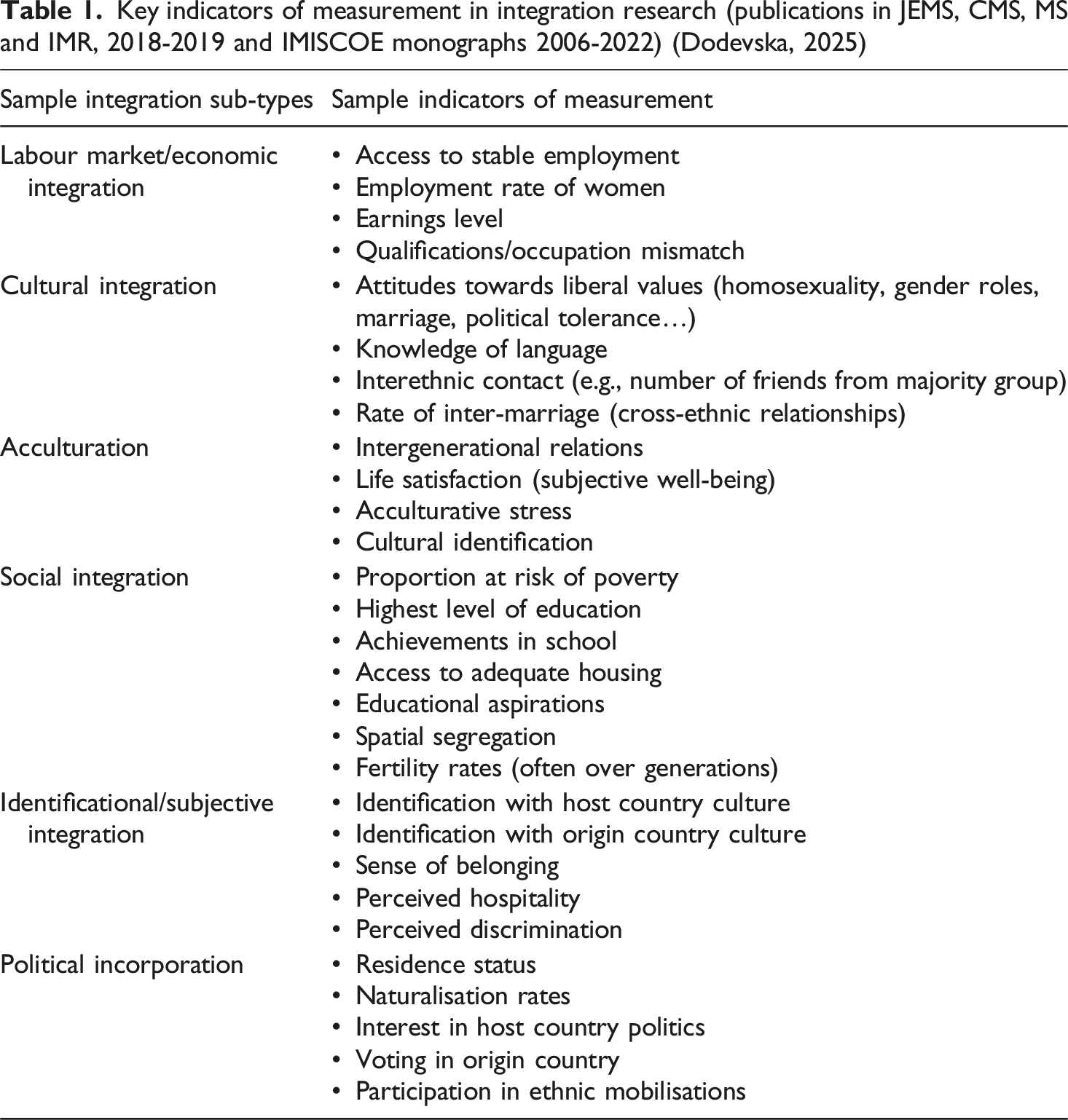
Such conceptualisations of integration articulated through indicators of measurements spill over from the sociological imagination into the politics of governing migrants – and vice versa. Currently, most European countries produce their own statistics and indicators on integration that for the most part closely resemble those used in research as shown in Table 1. For instance, in Switzerland, Akin and Banfi (2019) show that integration is monitored at a federal level through an impressive number of indicators across almost every imaginable area of social life, including culture, religion, housing, security and criminality. In the Netherlands, integration is monitored by The Netherlands Institute for Social Research (SCP) and the Central Bureau for Statistics (CBS) in their Survey on Minority Integration (SIM), which claims to gain insights into the integration of minority groups, comparing them to a group of ‘native’ Dutch citizens on a variety of indicators similar to those above. 3 The demand for more indicators, particularly in relation to norms and values, has been central to the political debate in the Netherlands, but also at the EU level, where member states have complained for the lack of comparable EU statistics on ‘cultural’ integration indicators such as ‘sense of belonging’ (Dodevska, 2024). Dutch parliamentarians tried to overcome the lack of these less tangible but more controversial statistics via a parliamentary motion for collecting data on the ‘cultural and religious norms and values of Dutch people with a migrant background’. 4 The motion was accepted in parliament but received a widespread societal critique for its arbitrary and racist assumptions. The member of parliament who submitted the notion, Bente Becker, responded as shocked by this public outrage, claiming that through data, through real numbers, we can avoid racist policymaking, instead making decisions on ‘what is actually happening in society, rather than gut feeling’. 5 This again demonstrates the pervasive belief that the scientific method is infallible: any measurement based on science is by definition non-partial and fact-based, and therefore cannot possibly be racist.
Internationally, the EU-OECD annually published indicators are the gold standard in migrant integration monitoring. Eurostat, the European Union’s bureau of statistics, gathers data to produce integration indicators in four areas: education, employment, social inclusion and active citizenship. Another cross-country example is the Migrant Integration Policy index (MIPEX) that compares integration policies (rather than ‘outcomes’) with data gathered by numerous scholars and think tank researchers largely with EU funding (see details in Dodevska, 2025). The indicators paradigm thus largely succeeded in turning a relatively controversial political agenda into a ‘normal science’ (Favell, 2022).
The science of transferring values in Dutch policy
Beyond the large-scale data monitoring indicators of integration, additional knowledge generation practices at the implementation level contribute to the normalisation of integration science. One such practice involves translating vague and contested notions of ‘values’ into research projects which seek to determine how these values can most effectively be ‘transferred’ to migrant subjects during their civic integration trajectories. In the Netherlands, since 2017, all subjects of mandatory integration, i.e. asylum migrants, family reunification migrants or more broadly any non-EU migrants (excluding Switzerland, Norway, Iceland and Liechtenstein) must sign the Participation Statement, a one-sided contractual document in which one pledges to respect the Dutch values of ‘freedom, equality, solidarity and participation’. 6 Despite critiques (see De Waal, 2017), the participation statement remained in the new civic integration programme introduced in 2022 and was expanded with an additional 12-h practical component.
Tracks for piloting approaches to value transmission as described in Regioplan report “Monitoring and Evaluating Pilots for Value Transfer to Newcomers” (Regioplan, 2017)
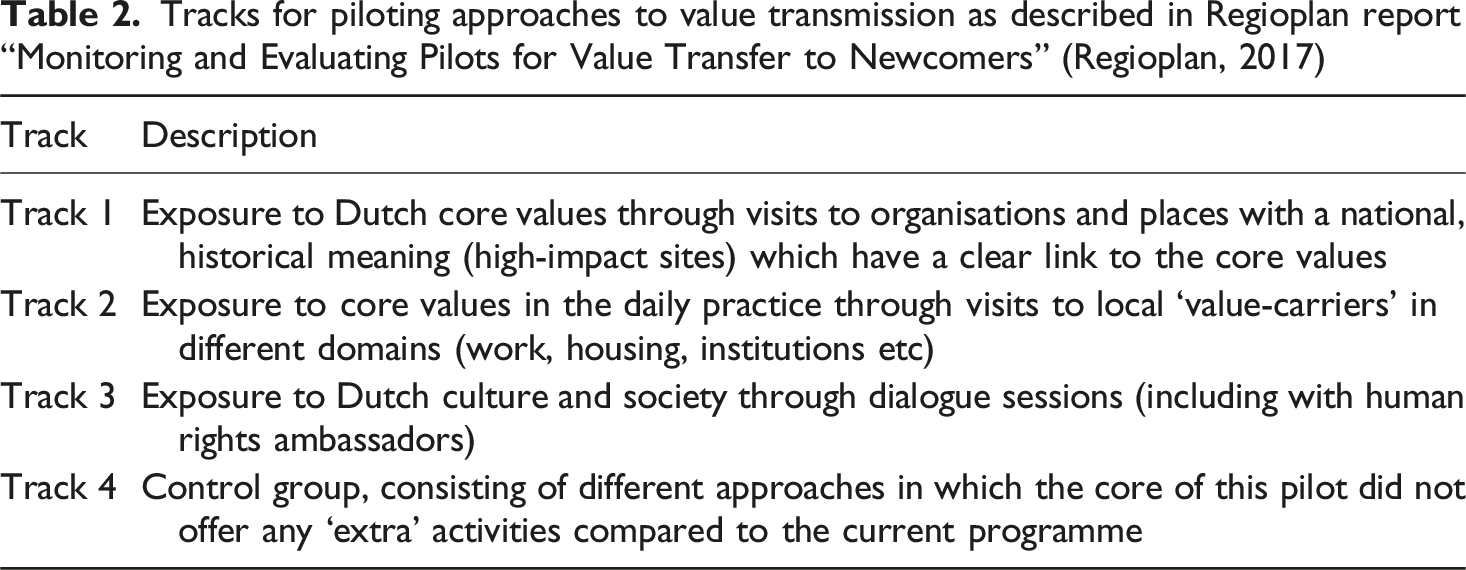
This example illustrates the adoption of positivist discourses and methodologies, such as formulating a research question around value transfer and dividing participants into intervention and control groups, which function to invoke the authority of science in legitimising both knowledge claims and policy recommendations (Jasanoff, 1990). Based on the results of this research, intensive programmes involving multiple contact moments and dialogic formats were deemed as ‘most effective’ for value transfer. These findings informed the new 12-h practical component of the Participation Statement. Classroom instruction is now paired with at least one visit to a local organisation, where subjects of integration are expected to engage with individuals deemed as ‘value-carriers’, citizens believed to embody Dutch values, such as volunteers in community centres (Kamerstukken II, 2020).
Values, which by nature are contested and non-homogeneous in liberal democracy (Manser-Egli, 2023) are transformed and simplified by commissioned researchers into manageable, measurable, and categorical understandings (Bowker and Star, 2000), achieved through rational scientific language. The science of ensuring the transfer of desirable values, just like the science of integration indicators, sells the idea of technocratic, value-free, research-based intervention into an objective social problem. This idea has the powerful effect of depoliticising the issue, i.e. concealing its political and contested nature behind a technical and ‘scientific’ vocabulary.
The re/production of the modern/colonial social order
In this section, we argue that this ‘integration science’ is produced against the background of a modern, cohesive, well-ordered and functional society. These beliefs, rooted in and foundational to colonial modernity, legitimise integrationism through the re/production of such social imaginaries. The cohesive, integrated society is the imaginary against which the risk of social disorder is constructed (section four) and empirically measured and compared (section five), but it is also the result of this co-production, hence the re/production. We show that these integration imaginaries of ordered society are deeply entrenched in a neocolonial imagination revolving around ideas of shared (liberal) values, cultural distance, and Euro-white Christian superiority. Our research on the scientific underpinnings of national integration regimes – both in Switzerland and internationally – illustrates this.
Cultural distance and modernity in Swiss sociology
Social scientists who intervened in early debates about the emerging migrant integration regime in Switzerland based their perspective on the normalisation of a ‘cultural distance’ between Swiss citizens and non-European migrants. The aforementioned case of sociologist Hoffmann-Nowotny is one such example. The question that preoccupied this structural-functionalist theorist was ‘to what extent certain cultural traits of an immigrant ethnic group are at all compatible with both the culture of the country of immigration and its structure’ (Hoffmann-Nowotny, 1992, 22, emphasis in the original; see also Espahangizi, 2022). A focal point in his analysis is the idea of ‘a sometimes considerable cultural distance between immigrants and the autochthonous population of the countries of immigration’, which must be reduced (Hoffmann-Nowotny, 1992: 23-24). As is typical for the idea of ‘cultural distance’ and (neo)colonial racial hierarchies, he draws on a gradation in the positioning of different groups (what Bakić-Hayden, 1995 calls ‘nesting orientalisms’). Hoffmann-Nowotny argues that extra-European migrants are less ‘culturally compatible’ than those from the European peripheries like Italy and Spain, whose ‘foreign workers’ (Fremdarbeiter) ‘originated from the ‘European cultural circle’ and can therefore hardly be described as ‘culturally foreign’ in a narrow sense of the word. (…) The compatibility of their cultures [with the Swiss one] can be taken for granted’ (Hoffmann-Nowotny, 1992: 25, emphasis in the original). According to Hoffmann-Nowotny, this was not the case for ‘new’ immigration from ‘less developed countries such as Turkey, the underdeveloped countries of North Africa and from many other Third World countries’ (Hoffmann-Nowotny, 1992: 26). These groups presented the greatest risk for the emergence of a ‘multicultural society’ with ‘incompatible cultures’. Hoffmann-Nowotny thus opposed multiculturalism to integration, and the former was not a desirable outcome of immigration. ‘Multiculturalism’ has not led, according to him, out of the ‘dead end of disintegration of ethnic minorities’ in countries like the Netherlands, the UK and France as far as ‘colonial and postcolonial immigrants’ and ‘foreign workers’ of ‘non-European origin’ were concerned; ‘the integration of a large part of the colonial and postcolonial immigrants did not come about’ (Hoffmann-Nowotny, 1992: 38, emphasis in the original).
Another Swiss academic involved in shaping integration policy around the same time was ethnologist Hans-Peter Müller, who developed the integration Leitbild of the city of Zürich. At the end of the 1990s, Swiss cities had developed urban integration guidelines (so-called Leitbilder) that strongly shaped debates on the new integration policy at the national level (Espahangizi, 2022). In an early version of the Zürich Leitbild, under the telling heading Modernity as Cultural Capital of Immigrants, Müller is less inclined than Hoffmann-Nowotny to reify ‘culture’ but more explicit in establishing a clear dichotomy between modern Europeans and unmodern Others, again based on cultural distance and hierarchies of modernity: The key point for our question is that not all cultural imprints are equally important and equally favourable for integration. What is decisive is the degree of similarity between the core culture here and that of the society of origin. This does not mean falling back on the old problematic concepts of culture, which more or less conceal national, ethnic or religious discrimination. ‘Culture’ here rather means a ‘way of life’ in the comprehensive sense of the ‘way of life’. Under today’s conditions, ways of life differ mainly according to the modernity of a society (Müller, 1998: 15).
The relationship between the notions of modernity and cultural distance is, for him, mediated by ‘differences in mentality’ rooted, among other things, ‘in the special importance of family, religion and patronage’ (Müller, 1998: 16). Markers of un-modernity he highlights are arranged marriages, nepotism, banishments and blood vengeance. Modernity, on the other hand, is characterised by democratic administration of power, the importance of secular education, the understanding of gender roles and the individualisation of lifestyles (Müller, 1998).
The creation of the unmodern other in international integration research
Three decades later, the language has adapted to replace such explicitly culturalist arguments with more subtle forms of denoting the civilisational superiority of Western modernity. Modernity narratives have remained entrenched in integration scholarship despite lively debate between defenders and harsh critics of the concept (see Blankvoort et al., 2021; Dodevska, 2025; Manser-Egli, forthcoming; Saharso 2019). Migrant integration remains a major focus of migration studies, being the topic of investigation in one quarter of articles in the four migration journals reviewed as part of our analysis. Here, a major theme is the same question that occupied Hoffmann-Nowotny and Müller in the 1990s, namely the cultural/modernity distance between ‘migrants’ and ‘natives’. In (mainly) quantitative studies of integration measurement, cultural distance emerges through indicators of ‘value compatibility’ (Kretschmer, 2018; Wang and Coulter, 2019) and ‘acculturation to natives’ attitudes’ (Hedegaard and Bekhuis, 2018) that scrutinise immigrants’ attitudes, beliefs and values. Markers of un-modernity continue to emerge, including problematising Muslims’ attitudes towards homosexuality (e.g., Kalmijn and Kraaykamp, 2018) or former-Yugoslav migrants’ ‘traditional’ attitudes towards gender roles (e.g., Kretschmer, 2018) as ‘empirical support’ for their lack of ‘cultural integration’. Migrant women, notably from Muslim communities, are problematised in public debates for staying at home and not contributing to the economy, and such assumptions motivate significant attention among scholars (e.g., Khattab et al., 2018). In a particular biopolitical tone, the fertility of migrant women – so called ‘fertility assimilation’ – is measured as a factor of integration in a number of publications, where groups such as Muslims and those with Latin American origins are problematised for having too many children, even generations after their ancestors arrived as migrants (e.g., Smith and Brown, 2019).
Some researchers do not restrain from drawing on a dichotomy between the ‘narrow-minded sentiments’ of migrants and the ‘high tolerance culture’ of Western European countries (Adman and Strömblad, 2018), for instance Kretschmer’s contextualisation of his study in ‘modern and egalitarian’ Germany (Kretschmer, 2018). The results of such studies then, unsurprisingly, only reproduce the initial assumptions based on the neocolonial formula European/Western = modern = superior. A notable example repeatedly resurfacing is the positioning of the liberal ideal, with its assumed universality and unquestioned moral superiority, acting as a reference point against which various ‘failures’ ascribed to ‘migrants’ are measured (e.g., in Adman and Strömblad, 2018; Kalmijn and Kraaykamp, 2018; Kretschmer, 2018; Neureiter, 2019). For instance, one study examines the factors that may ‘pull migrants in more liberal directions’: First, it is expected that the family of origin may push migrants in a more conservative direction. Second, it is expected that aspects of individual achievement in social, cultural and socioeconomic domains may pull migrants in more liberal directions. We find that Moroccan and Turkish migrants have considerably more conservative values about marriage and sexuality than natives, but there is also variation within the second generation. Both cross-sectional and longitudinal analyses for migrants indicate that the role of parents is particularly important: migrant children of religiously more orthodox parents and children of parents who were poorly integrated socially and culturally in their youth, currently have more conservative values about marriage and sexuality, even when individual characteristics are controlled for (Kalmijn and Kraaykamp, 2018: 697).
While Europe-based researchers often focus on adherence to liberal values as a marker of integration, US-based scholars commonly look at ‘inter-marriage’ as an indicator of integration (there also called ‘assimilation’). In its use, ‘marrying out’ (Alba et al., 2018) or ‘outmarrying’ (McDoom, 2019) means outside of one’s ‘ethnic group’. Such logic is not only rooted in a worldview reifying ethnicity and race, but establishes whiteness as the point of departure: the only ‘marrying out’ that matters for integration is non-whites marry into white American families. ‘Intermarriage’ between members of two different minoritised or migranticised groups (e.g., Latinos and African-Americans) is irrelevant for integration purposes. Whiteness remains the norm and the ideal towards which an integrated society should strive.
Finally, neocolonial assumptions permeate the measurement of integration not only through overt dichotomies between the ‘modern’ and the ‘un-modern’, but also more subtly through the delimitation of the subject of study. The selection of specific populations for integration monitoring implicitly suggests that certain ethnically, nationally, or racially categorised groups are more in need of oversight than others. In effect, the compatibility of some groups with the societies in which they reside is placed under scrutiny, while for others, such compatibility is presumed and never questioned – what Schinkel (2018) calls the dispensation of integration. An analysis of contemporary integration research reveals a disproportionate focus on Muslim populations within the European context (Dodevska, 2025). The over-researched Muslim subjects are identified either by religious affiliation (e.g., Joly and Reitz, 2018; Khattab et al., 2018) or by nationality linked to Muslim-majority countries, such as Morocco or Turkey, or region, such as North Africa or the Middle East (e.g., Eroğlu, 2018; Kalmijn and Kraaykamp, 2018; Keskiner, 2019). Former Yugoslavs are also an important subject group, notably in research in countries such as Switzerland and Germany that have sizable migrants from this region (e.g., Fibbi et al., 2015; Kretschmer, 2018), as well as ‘postcolonial migrants’, such as Antilleans and Surinamese in the Netherlands (e.g., Penninx and Garcés-Mascareñas, 2016). In the US context, Latinos and notably Mexican-Americans are the most researched groups.
Overall, this reflects the underlying logic of the ‘three circles model’ in Switzerland (Fibbi, 1993), which draws an assimilationist distinction between the ‘culturally close’ and the ‘culturally distant’, the latter being positioned as inherently incapable of assimilation (Dahinden, 2014). In the Dutch context, this manifests as an uncritical acceptance of cultural difference, operationalised through studies that compare migranticised groups both to one another and to a presumed Dutch cultural norm (Blankvoort et al., 2025; Helberg-Proctor et al., 2017). More than simply documenting difference, these studies treat alignment with this zero-point as the desirable outcome for integration subjects, and studies the best way to facilitate this ‘transformation of self’. This forward-focused narrative was seen in the aforementioned behavioral research that informed Dutch integration policy and that seeks to identify the most effective methods of ‘value transfer’ without interrogating the normative assumptions underpinning such efforts. For instance, one of the intervention group which municipalities were divided into focused on ‘dialogue sessions’. The aim of the dialogue being to ‘deepen awareness of cultural differences and what it means to live in the Netherlands’ (Regioplan, 2017: 18), done in sessions such as ‘Living in Freedom’, led by individuals described as ‘Human Rights Ambassadors’. Critical engagement with the assumptions of ‘cultural difference’, and the civilising logics that inform such interventions, vanish when the ‘effectiveness’ of interventions are measured through likert-scale evaluations such as ‘A woman decides to vote for a different political party than her husband’ (Regioplan, 2017: 70). These colonial logics are further obscured when individual responses are then translated to statistics which compare their ‘success’ across interventions groups and country-based categories, effectively depoliticising the normative foundations of the integration governance (Boersma and Schinkel, 2015).
Distance between cultures is established and, as previously shown, measured, always in reference to a core, and not just any but the core of (Western) civilisation; a Euro-white-Christian zero-point (Mignolo, 2011). This core operates not only as a point of comparison, but as the idealised end goal which subjects are directed towards. As we can see in the examples above, ‘modernity’ emerges as synonymous with the European core (culture) and its science. In line with Western colonial epistemology, the further away one is from the core zero-point, the less civilised, the less virtuous and ultimately, the less human one is (Lugones, 2007; Wynter, 2003).
Conclusion
This article has argued against the widespread assumption that strengthening the role of scientific evidence will necessarily lead to better and more just migration governance. By examining the entanglement of research and policy across multiple sites – Dutch civic integration policy, the entanglement of sociologists in early Swiss integration policy, and contemporary international scholarship – it has demonstrated that the problem lies not only in the misuse or neglect of science, but in the very forms of knowledge that underpin integration governance. By examining three distinct yet interconnected cases of knowledge production that informs integration governance, the article moves beyond a single-context critique to reveal the consistency and durability of scientistic and colonial logics across time, space, and institutional settings. This triangulation makes visible how similar assumptions about integration – its measurability, desirability, and normative direction – circulate between academia and policy. It also highlights how these logics are not confined to specific national contexts or historical moments but constitute a broader regime of knowledge that shapes migration governance at multiple levels. The added value of this approach, therefore, lies in demonstrating that the issues identified are not isolated distortions or misapplications of science, but structural features of the science–policy nexus itself, reproduced through diverse yet aligned practices of research, measurement, and intervention.
We have underlined that scientific practices do not merely describe migration and integration; they actively constitute them as objects of intervention, embedding normative assumptions within seemingly neutral categories, indicators, and models. Central to this dynamic is the logic of scientism, which frames complex and deeply political questions as technical problems amenable to measurement, prediction, and control. Within this paradigm, social scientists are positioned as risk mitigators, tasked with diagnosing and preventing the presumed threats associated with migration. Whether through population-level risk assessments or behavioural interventions targeting individual migrants, scientific expertise becomes a key mechanism through which migration is rendered governable. At the same time, the proliferation of indicators and monitoring tools transforms integration into a ‘normal science’, stabilising a contested concept by translating it into quantifiable variables and standardised metrics. This process obscures the fundamentally normative and political nature of integration, presenting it instead as an objective and self-evident goal.
Importantly, the article has shown that these knowledge practices are not neutral but are deeply embedded in the coloniality of knowledge. The persistent reliance on notions such as cultural distance, value compatibility, and modernity reveals how integration science reproduces a Eurocentric imaginary of a cohesive, liberal, and modern society. Migrants are positioned in relation to this imagined centre, measured against it, and governed through efforts to reduce their perceived distance from it. In this way, scientific research does not simply reflect existing hierarchies but actively contributes to their reproduction, reinforcing distinctions between the ‘modern’ and the ‘non-modern’, and between those who belong and those who must be intervened upon.
Taken together, these findings call for a critical re-evaluation of the science–policy nexus in migration governance. Rather than advocating for more or better evidence within existing frameworks, this article suggests the need to question the epistemological foundations upon which these frameworks rest. This entails moving beyond the assumption that integration can be objectively known and managed, and instead recognising the political, historical, and colonial conditions that shape both policy and research. Such a shift requires not only methodological reflexivity but also a willingness to decentre dominant forms of knowledge production and to engage with alternative perspectives that challenge the taken-for-granted categories of migration governance.
Footnotes
Acknowledgements
Earlier versions of this work were presented and discussed at the European Social Science History Conference at the University of Gothenburg (April 2023), at the ECPR General Conference at Charles University (September 2023) at the IKG Forum at the University of Bielefeld (October 2023), at the RERUFAM Conference at the University of Applied Science Brussels (April 2025) and at the IMISCOE Annual Conference, hosted by the Institut Convergences Migrations in Paris, France (July 2025). Special thanks for the comments and feedback received on these occasions which assisted in the further development of this work.

Ethical considerations
The project which comprised the data collection and analysis in the Netherlands (Blankvoort) was part of a larger PhD research which received ethical approval from the internal ethics board of the Faculty of Health Medicine and Life Sciences at the University of Maastricht:
Author contributions
See Methodology section.
Funding
The authors disclosed receipt of the following financial support for the research, authorship, and/or publication of this article: This research was supported by the Dutch Research Council (NWO), under the project number: 023.014.012; the European Commission’s H2020 Marie Sklodowska-Curie Action under the Grant number 812764; and the University of Neuchâtel and the nccr – on the move, which is funded by the Swiss National Science Foundation, under grant number 51NF40-205605.
Declaration of conflicting interests
The authors declared no potential conflicts of interest with respect to the research, authorship, and/or publication of this article.
Data Availability Statement
The data analysed in this article are publicly accessible and are referenced directly in the text.