



Abstract
This article applies the multiscalar ‘staging mobilities’ framework from the emergent subfield of mobilities design to analyse an enduring European rail travel phenomenon, interrail. This discussion extends and contributes to tourism mobilities research. Second, the article enriches previous studies of rail travel, by exploring how interrail travel is embedded in, and (im)mobilised by socio-material environments and institutional design decisions. More precisely, it explores the affordances of three objects that shape interrail mobility: the interrail pass, the RailPlanner application and seat reservations. To reach these aims, the research design intertwines multi-sited ethnography, netnography, survey and interviews. The conclusion offers theoretical reflections pertaining to the role of mobilities designs and methodical hybrids in tourism mobilities research.
Introduction
InterRail: Experience Europe without borders. (Danish National Railway Operators)
1
Interrail dates back to 1972 when the first interrail pass was distributed. The Interrail global pass is the material attempt to create a single cross-national rail travel pass that allows unlimited train travel in 30 European countries for up to a month. This complex mobility scheme is coordinated via the Eurail Group which consists of representatives from all national railway operators in Europe.
Interrail passes are marketed with slogans such as: ‘Global Pass – Free to Explore Europe’
2
or ‘Your Pass, Your Europe’.
3
This promotional representation of interrail mobility is linked to ideas of unhindered freedom and the spontaneous travel motives of backpacking cultures. Previous research aligns this travel phenomenon with the backpacker ethos as a semi-nomadic, adventuresome and character-building travel phenomenon (Johnson, 2010). Yet while more recent studies have unpacked the corporealities, mobilities and materialities of backpacking (Allon et al., 2008; Cohen, 2011; Jayne et al., 2012), the few and relatively aged interrail studies are characterised by approaches that emphasise motivational factors (Schönhammer, 1993), behaviouristic travel rationales (Fernandes et al., 2013) or overtly ordered and structural explanations (Hartmann, 1995; Klingbeil, 1994): The European Interrail ticket has contributed to young Swedes’ experience of being ‘European’ … the ticket as such seems to be regarded as a rite de passage among Swedish youth … Free from direct control of parents, forming part of a world that is neither pre-determined with regard to direction nor with regard to the time spent in a country, young people enjoy ‘Europe’ in the new brother/sisterhood of ‘interrailers’. (Hartmann, 1995: 68)
Common for these studies is that interrailers are represented as relatively inert actors very similar to the ‘generic passenger’ in the minds of planners and modellers (Cresswell, 2006). These interrail representations are relatively distant abstractions that view interrail as: ‘… merely the welling up of a deep-rooted structural element of the human condition’ (Franklin, 2004: 278–79). Subsequently, the majority of interrail studies have neglected the analytical significance of the everyday of interrail mobility; they have omitted insights into the effects of the embodied interrailer and they have overlooked the subtle, yet influential, role of mundane materialities.
In order to inform these oversights, we introduce the staging mobilities framework, as well as two analytical terms, ‘the networked self’ and ‘mobile assemblages’ (Jensen, 2013), to exemplify how interrail is performed in tension between socio-material environments infused with design decisions and situated embodied practices. In line with recent research, this aim requires us to explore the practices that must be negotiated as an interrailer (Adey et al., 2012). We extend and contribute to recent mobilities-oriented interrail studies (Johnson, 2010) by drawing on the emergent subfield ‘Mobilities Design’ (Jensen, 2014) addressing the pragmatic question: ‘What design decisions and interventions afford, enable, or prevent concrete mobile situations?’ (Jensen, 2014: 41–42). Our reply to this question is a critical analysis of three material affordances central to interrail mobility: The interrail pass, the RailPlanner application and seat reservations. Situated in the everyday of interrail mobility, we use this micro-material departure point to retrace how interrail is a highly networked travel practice shaped by the macro-design decisions of the Eurail Group, and more generally, the political landscape of the European rail network. In this sense, we inform tourism mobilities research by illustrating the subtle negotiations of designed ‘micro’ materialities and the influence of inconspicuous material interventions in everyday interrail mobility.
The following reviews recent work related to tourism mobilities, before discussing the potentials of mobilities design. The analysis then elucidates the everyday material practices of interrailers and demonstrates how they are shaped by Eurail Group design decisions. Finally, the discussion synthesises the main findings and illustrates how mobility design can inform tourism research. In particular, we provide a conceptual framework and a vocabulary through which the scale-jumping interdependencies that shape tourism mobilities may be understood and represented. In this process, we argue that the metaphor of ‘viscosity’ can be used to better understand the relational construction and inertia of mobility and thus nuance the dialectics occasionally associated with (im)mobilities (Hannam et al., 2006).
Tourism mobilities
Within the calls for a sociology of mobilities (Urry, 2000) or a ‘new mobilities paradigm’ (Sheller and Urry, 2006), an alternative science of the ‘social’ has been drawn. This includes a renewed interest in how corporealities, materialities, imagined and virtual mobilities, products and ideas relationally seep into our everyday and shape everything from the life of seasonal workers (Gogia, 2006) to the disciplining powers of governments and international corporations (Urry, 2007). In more ordinary contexts, Watts (2008), O’Dell (2009) and Bissell (2010a) apply the mobilities paradigm to study the affective and material spaces that constitute everyday train commuting. Through ethnographic accounts, they draw out the complex assemblages of rail spaces through materialities, affective atmospheres and travel practices.
Their work relates closely to contributions that intertwine mobilities research with non-representational theories (Anderson and Harrison, 2012; Bissell, 2010b; Thrift, 2008). Such contributions, for example, illustrate the non-discursive, performative and often mundane and subtle practices involved in ferry transport (Vannini, 2011), while others have looked at practices such as walking (Lorimer and Lund, 2003) and biking (Spinney, 2011). Besides empirically informing a range of relatively neglected contexts, their mobilities-cum-non-representational styles of work exemplify how the experience of mobility is conditioned and co-produced through engagements with ordinary materials such as laptops, DPAs, tickets and books, but also equally shaped by the circulation of affects (stressfulness, tiredness, excitement, irritation and so forth) which all partake in the creation of particular travel atmospheres (Bissell, 2010a). Set in the lived experience of mobility, such accounts provide a refreshing socio-material and phenomenological bent into a social science which has too often suffered from ‘over-theorization’ (Thrift, 2008: 3).
In addition, the mobilities perspective has informed tourism research in multiple settings. Hannam et al. (2014) argue that tourism is not simply one form of mobility, but different mobilities converge and are informed by tourism. These include tourism and migration studies (Williams and Hall, 2002), tourism and global insecurities (Bianchi, 2006), mobilising hospitality (Gibson and Molz, 2012) and tourism and climate change (Gössling et al., 2012). Thus, it is important to recognise that the application of mobilities theories, as well as the range of different empirical scales on which they are applied, is multifaceted, and the engagement with mobilities theories requires a clear articulation of what specific realms of mobility studies that is engaged with.
In this context, tourism research adopts the ontological tenets of the mobilities paradigm with two aims. First, a strand of tourism research reiterates the concern that mobility is more than mere linear transport from A to B, but itself a socio-material tourism experience (Fullagar et al., 2012; Larsen, 2001). Second, tourism researchers use the mobilities lens to overcome the conceptual frameworks that have informed tourism research for decades, in particular, questioning dichotomist distinctions between ‘home’ and ‘away’, ‘hosts’ and ‘guests’ and the ‘local’ versus the ‘global’ (Cohen and Cohen, 2012). While these contributions have moved tourism research into interdisciplinary, more complex and mobilities-driven trajectories, little research has linked the illustration of socio-material performances with the more systemic influence of design decisions and institutional interventions. This article focuses on the institutionalising effects of mobilities design and hereby enriches the performative narratives of tourism mobilities and interrail studies especially. Consequently, this is a reading of mobility concerned with both the everyday and multisensory experience of tourism mobility (Edensor, 2001; Sheller and Urry, 2004) and the affordances of mobilities design (Jensen, 2014).
Mobilities design and tourism research
Recently, the emergent subfield ‘mobilities design’ (Jensen, 2014) has informed mobilities research (see also Jensen, 2013, 2014; Pink and Mackley, 2013, 2014; Veijola and Falin, 2014). This field is inspired by explorations of the materiality of mobile experiences (Bissell, 2010a; Ingold, 2011; Watts, 2008) as well as concerns with the embodied and sensory dimensions of mobile experiences (Edensor, 2008; Roy and Hannam, 2013). Mobilities design emanates from a situation-oriented and pragmatic stream of thought concerned with how material interventions and design decisions enable/disable mobile events. Mobilities design research explores the complex relationship between mobile situations and design decisions that one way or the other aim at making an intervention, an act or imprint on the world (Jensen, 2013). This means exploring the physical and tangible layouts and material designs, interventionist technologies and built environments in relation to the particular effects they generate in relation to social interactions, experiences and sensations. This relates to the notion of ‘affordance’ coined by Gibson (1986) and the idea that materials have textures, shapes and abilities that (dis)allow interactions and practices. Importantly, this process is dialogical and the ‘staging mobilities’ framework (Jensen, 2013) offers a particularly insightful approach to analyse mobile situations. With the notion ‘staging mobilities’, we refer to the dynamic and multiscalar assemblages made up by designed infrastructures, embodied and socio-material performances and social interactions. To analytically approach this complex coming together, mobilities in situ are conceptualised as the situated result of these networked processes (Figure 1).

Staging mobilities (Jensen, 2013).
For the purpose of this article, we explore how interrail mobility is conceived organically ‘from below’ (through socio-material and embodied performances) and ‘from above’ (through the physical infrastructures, regulations and designed ‘hardware’). This approach extends tourism research addressing the socio-material composition of tourist experiences (Edensor, 2008; Haldrup and Larsen, 2006; O’Dell, 2009), by introducing the terms ‘the networked self’ and ‘mobile assemblages’ (Jensen, 2014). For example, we will analyse how interrailers are linked-in-motion through the everyday engagements with objects, people and technologies (‘the networked self’). As the analysis will demonstrate, interrail is a highly networked travel practice that consists of coordinating travel, negotiating seat reservations, protecting and physically filling-in travel passes and travel reports while navigating the ‘hard’ infrastructure of train networks, stations and so forth. Stating these things is our attempt to breathe life into the figure of the interrailer, which far from being an atomised individual alike the ones occasionally portrayed in computerised transport models (Adey et al., 2012) is rather a shaped and assembled ‘subject’ made up by sensations, objects, technologies and bodies brought together in transit (Adey et al., 2012)
This brings us to the fact that interrail is also nested within large and complex European rail transport systems shaped by regulations, economic institutions and design decisions. Interrail is an increasingly digitised travel practice that integrates mobile electronic devices linked to cross-national operational management systems. Besides redefining interrail practices, this intervention underlines how border-crossing communicative systems and technologies facilitate interrail mobilities. Thus, the concept ‘mobile assemblages’ is used to illustrate how interrail mobilities are woven into complex socio-technical systems that afford, restrict or prevent particular mobile practices. These two terms complement each other by addressing the systemic interplay between micro- and macro-oriented mobilities as encapsulated by the staging mobilities model.
This orientation towards a new ‘mobilities design’ agendum (Jensen, 2014; Veijola and Falin, 2014) offers novel conceptual opportunities to progress tourism research. It does so of three reasons. First, until now the surprisingly little research on tourism design has emerged through hospitality (Slack et al., 2010) and management- and planning-oriented fields (Baud-Bovy and Lawson, 1998; Zomerdijk and Voss, 2010). While this has informed the procedures of service management systems and the planning of tourism resorts and recreation complexes, the ‘vocabulary’ of mobilities design thinking is yet to be fully explored in relation to the cultural studies of tourism mobilities. This article addresses this gap by providing two new analytical terms (‘the networked self’ and ‘mobile assemblages’) for the study of designed infrastructures and their impact on embodied performances on-the-move. Second, where most tourism mobilities research has contributed with rich empirical characterisations, little research has provided conceptual frameworks through which the complex relations that shape tourism mobilities can be studied. This article applies the ‘staging mobilities’ framework (Jensen, 2013) in order to pave the way for research on tourism mobilities design thinking. Third, while many tourism mobilities researchers have been cautious not to over-animate the mobile subject (Bissell and Fuller, 2011), acknowledging that mobility and mooring points are intimately linked, research has been less good at exploring how and what design decisions actually precede and shape the material environments of mobility (Cresswell, 2012; Turner, 2007). This type of focus thus works to address how mobilities are afforded, enabled or prevented by moorings and spatial fixings points (Adey, 2006, 2007; Kitchin and Dodge, 2005) infused with politics.
Now, having illustrated the ‘staging mobilities’ framework and introduced two new terms to help unpack mobilities in situ, we move to the description of how this framework was operationalised in practice.
Mixed methods for multiscalar analysis
One of the challenges of retracing mobilities designs across scales is a methodological one. In order to gain substantial insights into the embodied experience with – and institutional decisions behind – mobilities designs, our study uses multi-sited ethnography (Marcus, 1995) as the primary approach around which the findings gained from netnography, survey and interview have been woven. We do this to not reduce ethnography to the preconditioned and conventional ‘single-site mise-en-scéne’ (Marcus, 1995: 83) but rather acknowledge interrail as dynamic and diversely produced across contexts and through multiple practices and representations. The application phase of each method, as well as their interrelations, can be visualised accordingly (Figure 2).
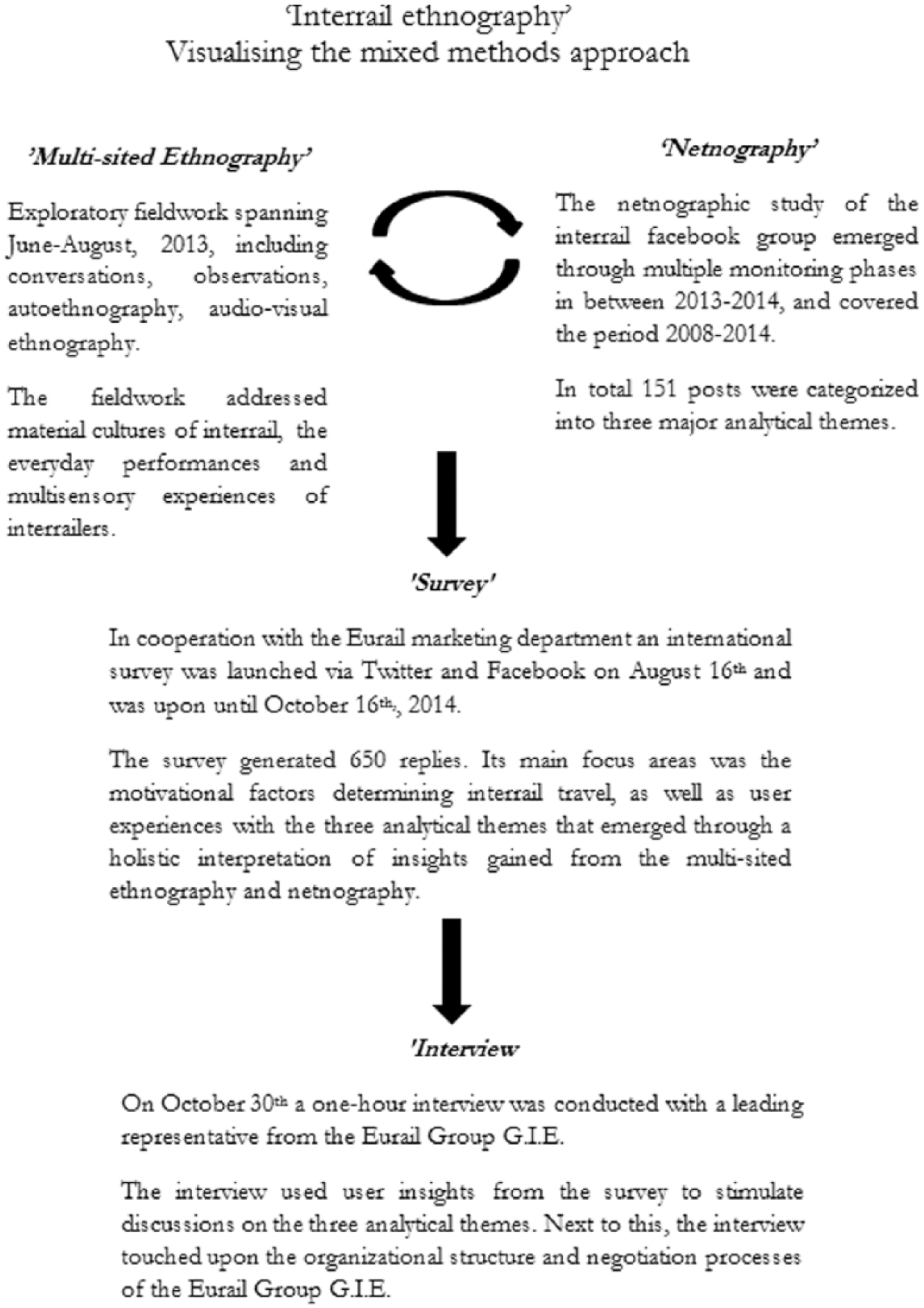
The mixed-methods approach.
Figure 2 clarifies how we methodically structured the study. The field notes derive from the lead author and are voiced by a male protagonist in his late 20s who had interrailed twice prior to the primary fieldwork. The main fieldwork unfolded between June and August, 2013. During this period, the lead author, alone and occasionally together with other interrailers, travelled across 23 European countries. The travel routes were flexible yet shaped by time restraints, economy and train availabilities. The lead author travelled across as many different Eurail member states as possible in order to get a glimpse into the cross-national (dis)coordination of interrail mobility. The majority of this journey was decided upon by the lead author, but this negotiation was more often than not shaped even complicated by local transport systems, seat reservation requirements and aged technologies. These subjective recalls provide rich examples of situated experiences, but neither claim nor attempt to represent the multitude of imaginable interrail perspectives. While other accounts could have been used, the lead author ‘wrote up’ three short snippets to animate the embodied experience with the three materialities that structure the analysis. The analysis emerged on the basis of continuous interpretation of the in-depth knowledge gained through the fieldwork and through the parallel netnographic study.
Netnography is an adaption of traditional ethnography for the Internet as a virtual fieldwork site (Mkono, 2012). Covering the period 2008–2014, this article draws on ‘archival netnographic data’ (Kozinets, 2010: 104) from the interrail Facebook group, officially managed by the interrail marketing department, and currently made up by around 220,000 members. Compared to the ethnography, this emerged as a non-participant observer format which avoided pressuring respondents into representational – symbolic – modes (Nicolini, 2013). Through this process, we found recurrent themes of discussion revolving around the interrail pass and seat reservations. Also, the recent launch of the RailPlanner application was a topical debate – and intervention – included in the analysis.
Based upon these three emergent topics, an online survey was launched in cooperation with the Eurail marketing department, running in between August and October, 2014. Respondents were asked to respond to specific questions regarding their interrail experiences andthe usability of the interrail pass, the RailPlanner application and the range of seat reservations often required. We use these open-ended replies to nuance and enrich the analysis.
Finally, we use quotes from an interview with a leading representative within the Eurail Group to link the user-driven perspectives with organisational comments. While only one interview was made, we believe the leading organisational position of the respondent as well as the richness of this in-depth conversation make up a sufficient approach to stress the design negotiations that unfold within the Eurail Group. This interview was held during the final stage of the analytical process and applied user comments from the survey to stimulate discussions on the analytical themes. As such, the interview emerged as a mutual exchange of insights which benefitted both interviewee and interviewer, and, in so doing, generated a supportive conversational atmosphere.
Latham (2003) and Carolan (2008) both suggest that the employment of traditional research methods can be ‘pushed in the appropriate direction’ to give a richer taste of the lived experiences of respondents. The complex arrangement of our methods is necessary to retrace and describe the networked and multiscalar relations that shape interrail mobilities. Also it is a novel endeavour into alternative ways of interlinking traditionally separate methodologies in tourism mobilities research. With these details now described, we provide a brief background to the interrail concept, before moving on to the analysis.
Interrail: background and characteristics
In 1972, the Interrail travel concept was formed as part of the 50th anniversary of the International Union of Railways (UiC) and its mission: ‘to promote rail transport at world level and meet the challenges of mobility and sustainable transport’ while ‘promot[ing] interoperability, creat[ing] new world standards for railways (including common standards with other transport modes)’. 4 Originally set in pro-European political landscapes, ingrained with visions of free movement and the narrowing of national jurisdictions, the interrail travel concept was born to support intercultural exchange and with a key aim of: ‘developing innovative new passes’. 5
Importantly, interrail cannot be looked upon as an ‘isolated’ travel practice, but unfolds in everyday rail spaces that include regular commuters, everyday travellers, tourists and locals. For the purpose of this article, interrail is defined as travelling by the use – requirements, benefits and shortcomings – of an interrail pass. Indeed, most interrailers can be ‘spotted’ carrying and using a range of interrail requisites. Two of the most central ones are the interconnected interrail pass and travel report and the RailPlanner application. Next to these materials, seat reservations are everyday objects that inform the interrail experience. In the following, we provide an exploration of the everyday experience with, and immobilising effects of, these three interrail materialities and link these accounts to the institutional design decisions that shape them.
Analysis
Follow the interrail pass
The quintessential material requisites of interrail are the interconnected interrail pass and travel report. These two travel documents come stapled together in the Interrail pass cover. For a pass to be valid, the pass-holder must, prior to each journey, record their travel details (personal information, interrail pass type, journey details such as date, departure time, departure station, point of arrival, train number and whether bus or boat has been taken) in the travel report (Figure 3). The Interrail Pass Guide meticulously describes this process: You must write in blue or black ink, and it is imperative to do this before boarding the train. Be very careful when filling in the date. If you make a mistake you cannot correct it, because this could be interpreted as an attempt at fraud. (Interrail Pass Guide, 2012: 5)
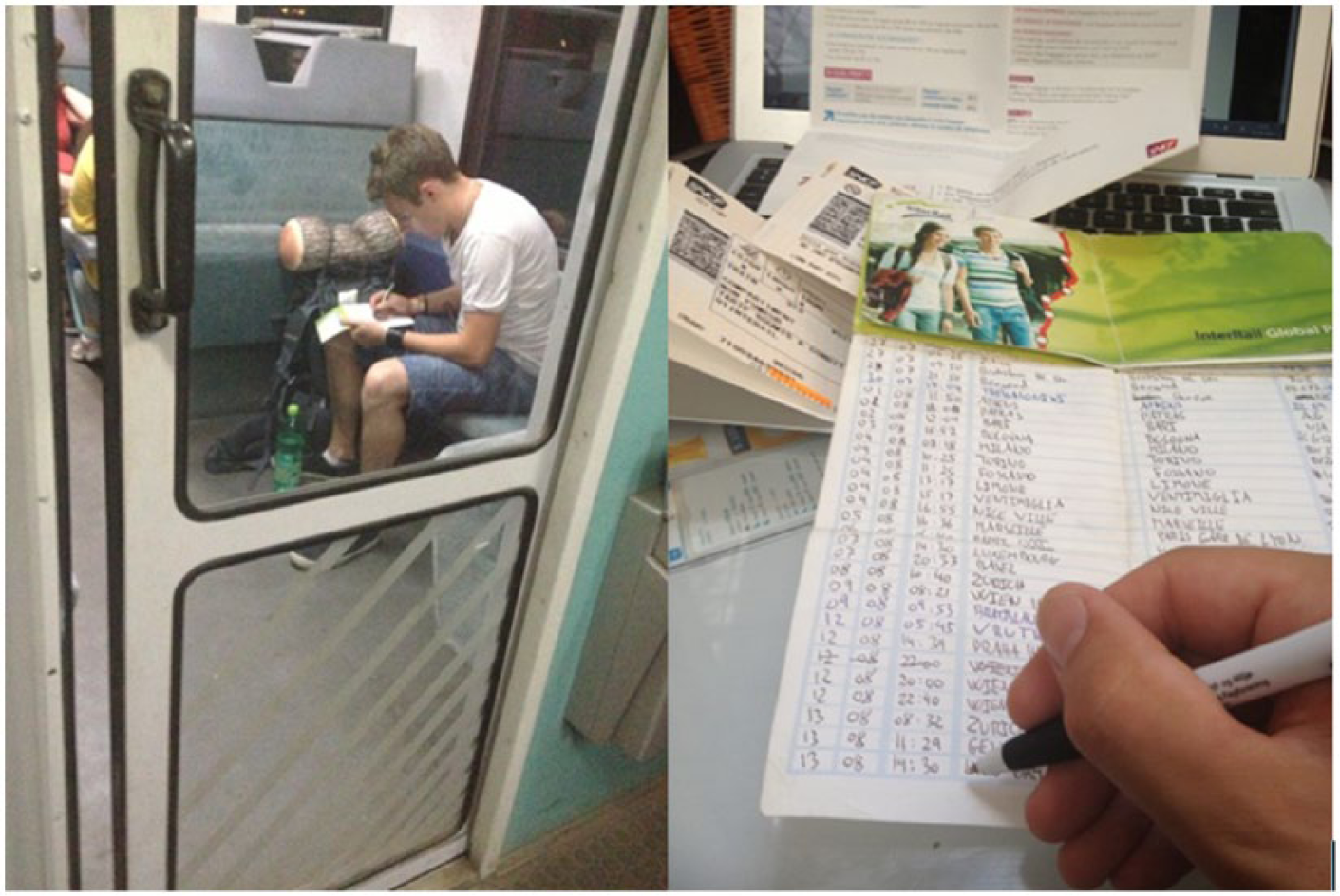
Interrailer fills in his travel report en route to Montenegro; meticulous travel reporting (private photos).
In order to physically contain these extensive travel logs, the current pass measures 21 cm in width and, when fully opened, has a length of 55 cm.
In the processes of protecting and filling-in the travel report, the minimal affordances of train carriages require interrailers to carefully use their thighs as temporary tables. The coordination between the rhythms of the train and the softness of the pass fabric (and skin tissue) makes this a particularly nervous attempt not to fill-in wrongly or break the pass and travel report. As one user notes: ‘I think it can be quite a burden at the time, because you always need a pen with you and a flat surface’ (User 341, survey respondent). So what might be seen as a simple conduit of interrail travel is in fact a complex orchestration of pen-and-paper-at-hand unfolding through the rhythms and material environments of particular trains. Bissell (2010b) describes this as ‘vibrating materialities’ which sees vibration, not as an intermediary presence but as a process that generates the very effect of different materialities while on the move.
So in these repetitive and bumpy spaces of repacking and filling-in interrail passes correctly and in time, passes fall apart and force pass-holders to fix, tape-up or join together the different pages of their worn passes with a stapler to ensure its validity. This means that particular passes transform along the routes traversed, materialising the tiring and physical ‘touristscapes’ (Edensor, 2007) of interrail. By following the transformation of a pass cover (Büscher and Urry, 2009; Marcus, 1995), we see a remarkably active texture (Figure 4).

Interrail pass cover transforms in between 27 June and 25 July 2013 (private photos).
With this example, we illustrate how a simple object, such as the cover of an interrail pass speaks as a designed ‘subject’ that dissolves through its relations with more or less enduring things. Ingold (2011) argues that focus on materiality has tended to be an abstract semiotic of dead objects. Rather, this example illustrates how materials can be invoked and ‘livened up’ through longevity narratives that illustrate how the properties, textures and aesthetics of objects transform along roads travelled. As an alternative representation, the decay of the pass manifests the inconvenient relationship between the pass design, its texture, fabric and size and the hurried, bumpy and often confined spaces of interrail mobility.
These examples point towards a misaligned operational link between the interrail pass as a managerial tool rolled out by the Eurail Group and the everyday experience of interrail. Now to nuance this material narrative, a leading Eurail representative reflects on design-issues related to the pass: The ticket size is based on railway standards. It’s defined by the regulatory environment that we are in, so you have the CIT [The International Railway Transport Committee] who defines how a ticket looks like. To start with, the product was founded ages ago, so its 40–50 years old, so it’s always been paper and the difficulty to move that to a different ticket format is related to IT and the distribution environment. Differences in ticketing standardisations, and fundamental issues of how a bar-code looks like, do we have the possibility to scan this barcode in a neighboring country, which is most often not the case. This makes it complicated to change the format. (–Leading Eurail representative, Interview (30 October 2014))
Yet while the ticket size and fabric are determined by historically rooted railway standards, and made as a design ‘compromise’, the design of the travel report also plays a central role in another organisational process: The travel reports are the basis for our revenue sharing, it’s the basis for our assessment of how much and which routes and how many kilometers the travelers take. In the end we use this information to allocate the revenues that the carriers get out of it. Even if it’s a little bit outdated, or very outdated, we did not find a much better solution. (Leading Eurail representative, Interview (30 October 2014))
In this context, interrailers are engaged to send their travel reports back to the Eurail Group upon completion of their travel since their travel routes and distances are used to distribute interrail revenues among member states. Acknowledging that this manual process is outdated considering the emergence of smart card solutions and revenue transfer algorithms, the Eurail Group points towards the difficulties in coordinating numerous and diverse national railway technologies: We might develop a bar-code standard, but who is going to check the ticket? Not all these carriers have mobile devices or scanning apps, they work with ancient mobile terminals or they don’t work with e-ticketing at all. This is really an internal and inherent problematic which is why we are so old-fashioned when it comes to the ticket. (Leading Eurail representative (interview, 30 October 2014))
With these organisational insights, our arguments come twofold. First, we illustrate how mobile situations are afforded by the particular design of the interrail pass. We unravel how the interrail pass emerges as a material conditioner for apparently ‘unhindered’ interrail mobility. Somewhat paradoxical then in relation to its marketed representation as a pass that allows a ‘Europe without borders’, interrail requires continuous stop-overs, control points and moments of immobilisation in order to manually fill-in the travel report. Also numerous attempts must be made to protect the pass from wear and tear to ensure its validity. These performances stress how interrail mobility is built into surveillance systems, rigid mechanisms of mobility control, power exercises and revenue distribution structures that all work to facilitate a highly institutionalised interrail mobility. Second, our examples illustrate how the pass is an abnormal actor within the mobility assemblages (Jensen, 2014) through which it circulates. Thus, while the pass is the designed materialisation of the Eurail Group’s strategic intentions, its irregular size, language and form are incompatible with the heterogeneous operational management systems and spatial fixing points (Adey, 2006) of the European rail network and the everyday practices of interrailers.
Having retraced how the interrail pass is infused with design decisions, let us now turn towards a topical technological intervention to the interrail experience, the RailPlanner application.
RailPlanner: mediating the interrail experience
Launched in 2013, the ‘RailPlanner’ application is a recent attempt to improve interrail travel planning (Figure 5). It is a smartphone-based interface that enables interrailers to search for all European train departures/arrivals, the type of train and whether seat reservations apply. It is an offline application which means that information is always accessible – a beneficial asset when travelling extensively on trains without wireless network connections.
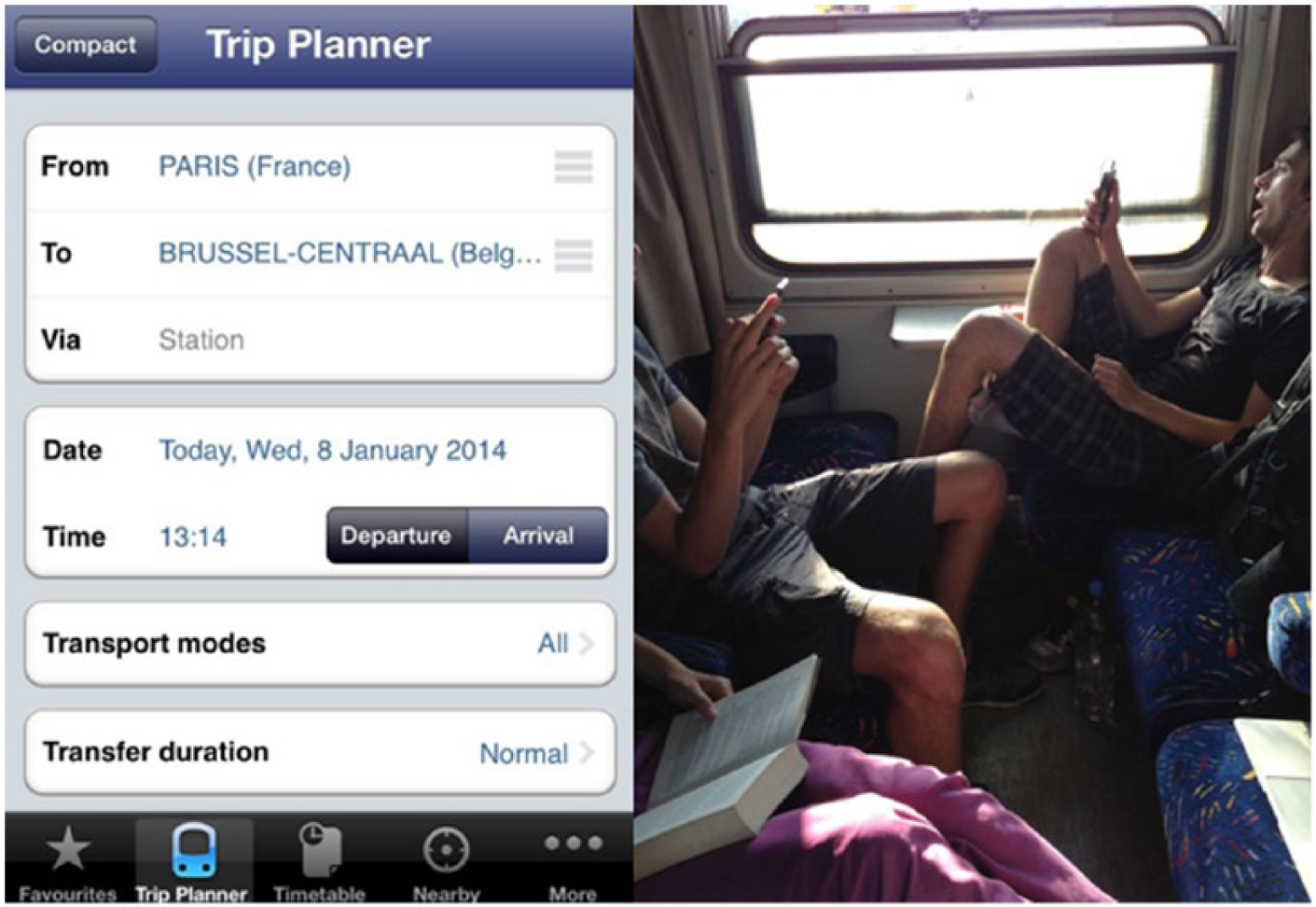
RailPlanner interface; interrailers and mobile devices (private photos).
The introduction of the RailPlanner has considerably eased the planning and experience of interrail, and interrailers embrace this technology to stay updated on train numbers, connecting train, alternative routes and so forth. Subsequently, this has changed interrail ‘skills’ dramatically, as one experienced interrailer recalls: Obviously, we didn’t have the app in 1993, so I’m the best to compare. I loved how the app helped us know which stop we were at and how I could plan different legs of a journey just by searching – no Thomas Cook, no staring at platform lists at the station. (User 255, Survey Respondent)
Arguably, then, this technological intervention changes planning behaviours, cuts travel time and reduces spaces of stressful, hurried and perfunctory incidents of trying to catch trains. Together with this intervention, interrail mobility is calibrated on the basis of the digitised rail schedules of all national railway members. This ‘objective-clock time of the modernist railway timetable’ (Urry, 2000: 192) provides an ordered temporality to the interrail experience, and interrailers increasingly study their future routes on the RailPlanner to find the most efficient routes: What an invention!!!! We used this APP so much … It is very easy to use and it works offline, so that’s so useful. We checked how late the trains go and the number of the trains! Don’t know what to do without the APP. Also very smart that you can see where you are on your travel (while the train is moving). (User 27, Survey respondent)
With the RailPlanner application, interrail materialises as a highly scheduled and technologically mediated travel practice, recursively generated through the search for train connections. Few months after its launch in 2013, 30,000 users had already downloaded the app 6 indicating its popularity among interrailers. Interestingly, it seems that albeit the pass allows for spontaneous and adventurous transport dispositions, the RailPlanner is such an accessible and innate part of extensive rail travel that interrailers prefer to have constant access to immediate information.
Somewhat problematic, however, the RailPlanner application cannot provide live information regarding delays and cancellations as well as price issues. The lead author experienced this as the RailPlanner was not capable of informing on the train transport consequences of the Greek economic crisis that left all international trains to and from Greece cancelled for an indefinite period during the summer months of 2013. As the field notes evoke: Forced to stop-over in Skopje, Macedonia! I was planning to head directly towards Thessaloniki, but all trains in that direction are cancelled indefinitely. The RailPlanner app does not cover Greece, which forces me to approach a local service assistant at Skopje train station. He recommends me to buy a ticket for the local bus provider who is running a direct route between Skopje-Thessaloniki. I show them my interrail pass, but am required to pay the normal fare for a ticket. ‘This is just unbelievable …’ I tell myself while stuffing my ‘worthless’ pass into my backpack. (Field notes, 27 July 2013)
In this incidence, the accustomed synchronicity of the RailPlanner temporality is broken which creates a frustrating travel experience based on lack of information and subsequent compromises (e.g. utilising and paying for transport systems not covered by the pass). The reason for incorrect, outdated or misleading information in the RailPlanner application is found in the digital ordering of the database.
RailPlanner is based upon the ‘Multiple European Railways Integrated Timetable Storage’ (MERITS ) database which is the International Union of Railway’s (UIC) attempt to harmonise and share European train timetables. However, with the multiple sources and different log formats of the 30 railway operators in Europe in mind, ensuring a consistent quality within MERITS is a difficult task. A leading representative of Eurail Group reflects upon this porous network: … the quality of our data is determined one-to-one by the carriers, and sometimes there is inconsistent information, which is something we cannot access, but only tell the carriers to remove in the next update. It’s up to them to determine the quality of the MERITS database. (Interview with leading Eurail representative, 30 October 2014)
In the attempt to structure the interchange of electronic data between countries, the European EDIFACT standardisation defines how data be structured for multi-country exchange. Despite this, duplicate and conflicting information within the data sets is inevitable and includes, for example, orthographical differences in naming stops and stations, varying train numbers, platforms, departure and arrival times. From this reading, the RailPlanner represents a ‘coded infrastructure’ (Adey, 2006), that is, a ‘code/space’ (Dodge and Kitchen,2009) so intimately woven into the very fabric of the interrail experience that if the system fails so does the general rail travel experience: We just used the interrail app to find out about whether we needed train reservations. The only problem we did find was that one of our trains (night train from Krakow to Prague) was not listed – hence a little panic until we visited Krakow train station. (Interrailer, Facebook, 14 August 2013)
This example reminds us how interrail mobilities are bound up in spatial fixing points such as software codes and operational management systems that shape and restrict the potentials and experiences of mobility. So we need to think of interrail mobilities in relational terms and acknowledge that mobilities are already relationally bound up to ‘immobile’ moorings. By this we mean that although the field notes above might render visible a moment of apparent immobilisation, there is, in fact, never any absolute immobility only what could be called ‘relative immobilities’ (Adey, 2006). In this context, the ordering of the RailPlanner through complex digital codes and crossing different formats and systems influence the everyday interrail experience. So contemporary interrail cannot be reduced to the simple study of rail transport and movement, but must be understood through the ‘mobility/moorings dialectic’ (Urry, 2003). This perspective recognises that interrail requires ‘fixed moorings’ such as kilometres of rail network infrastructures over which trains must travel (Schivelbusch, 1986); it includes platforms and train stations, service and maintenance centres, and, indeed, as has been the primary focus of this example, operational management systems, digital standardisation schemes for applications such as the RailPlanner to work consistently.
While the interrail pass and the RailPlanner are arguably central in the mobilities design of interrail, our final material narrative relates to another central object that affords, enables and prevents interrail mobility: seat reservations.
Scheduling spontaneous travel: seat reservations and interrail mobility
I arrive at Milan train station, well aware that I need a compulsory seat reservation for my connecting night train, EN 220, towards Paris. Life on the station is bustling with local and international travelers, and picking up my queue receipt in the service center (no ‘B173’), I notice that B024 is presently served. 150 in front of me! I nervously look at the clock, thinking that the train is likely to be sold out when I reach the counter. I decide to use the electronic ticketing machines in the main hall, but regrettably learn that it is not possible to make international reservations. Increasingly stressed of missing potential international departures, I use the interrail application to check which alternative routes that leave this evening. One particular departure appears interesting: ‘MILANO CENTRALE–GENEVE, EC 42’. Leaving in few minutes, I quickly run to the platform, approaching the conductor who requires me to pay 18 euros for the reduced interrail seat reservation price … Irritated I decide to sleep over in Milan, planning to catch a free regional train the following morning … (Field notes, 3 August 2013, Milan)
While interrail advertisements appeal to aspirations of unhindered travel, in reality, the burdening practice of ensuring seat reservations is a continuous hassle if not pre-planned properly. This field note recounts the hindering infrastructures that met the lead author in a particularly stressful event during fieldwork. Besides encapsulating the embodied experience of immobilisation, which is an increasingly important element in our understanding of mobility (Cresswell, 2012), it becomes clear how the interrail concept coincides with parallel mobility systems that restrict the mobility potentials of the pass (such as local service centres and regional ticketing systems). To avoid these hassles, the interrail marketing department regularly informs interrailers on the opportunities of pre-booking seat reservations up to 3 months in advance. In practice, however, this is a troublesome and time-consuming process: I had an illusion of Interrail being very free, and flexible but then you can’t take that train because you need to pay extra, and then they don’t sell any more seat reservations to interrailers, even though there are many available seats on the train. (User 49, Survey respondent)
This hassle with compulsory reservations not only makes up a conversational discourse and a planning problem, but it also leaves a highly material trace. Figure 6 compares the material composition of an interrailer before and after a 1-week trip:
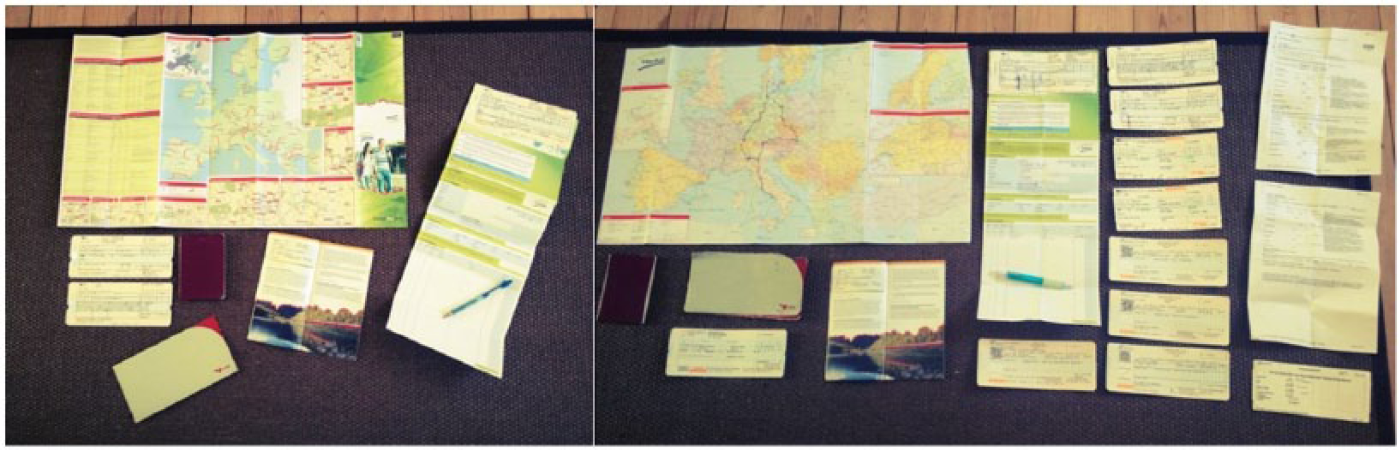
Interrail materialities, 3 May to 11 May 2013 (private photos).
Figure 6 illustrates how the original material ‘composition’ of a relatively short interrail trip develops into an amalgamation of various documents acquired along the way (including additional seat reservations, compulsory tickets and print-outs of complex travel itineraries). This is an everyday material example of the independent infrastructural and administrative moorings that configure and enable interrail mobility (Hannam et al., 2006). As conveyed in the introduction, the idea of a unifying Global Pass that opens Europe is challenged by disharmonies between administrative systems in the heterogeneous rail network of Europe. This materialises through a range of everyday situations: There were problems with booking seat reservation. It had to booked in advance. And it was very hard to book with help of the railway office in the Czech Republic. But finally we did at a Czech office. We tried to book seat reservations by phone on Deutsche Bahn – totally impossible. Firstly we couldn’t connect with English speaking staff. After ten attempts we did it. But it was totally impossible to book by phone. Because the [phone] connections were full, we had to search alternative times and with many travel changes. It is not possible by phone … (Interrailer, 21 August 2014)
Next to the practical frictions of ensuring seat reservations, another problem is the additional costs that discriminate travellers unable to afford reservations. Will (W.S., Facebook, 2 March 2014), for example, reacts strongly on a photo of a solo female interrailer, comfortably relaxing in an otherwise empty and spacious train compartment uploaded by the interrail marketing department: ‘maybe she paid 100 euros to reserve her seat after already paying £300 for an inter-railing ticket like France suggested we did, the twats [sic]’. In relation to this economic segregation of interrailers, one interrailer notes, ‘You want a tip? Go East, not West. You’ll get charged stupid amount’ (S.C.C., Facebook, 21 December 2010). This describes how seat reservation costs are asymmetrically distributed across Europe, and potentially decelerate interrail travel in Western Europe.
Reflecting further on this, the (in)access to ‘seat reservations’ either enables or prevents travel on certain routes. Cresswell (2010) discusses how mobility itself is ‘channeled into acceptable conduits’ (p. 24) and also interrail mobility is a highly channelled motion afforded by the ‘tunneling effect’ (Graham and Marvin, 2001) of high-speed rail-way corridors in Europe. Jensen (2013) describes how networked technologies create a nexus of proximity and connectivity. This encapsulates the notion of interrail mobility as being ‘viscous’ in the sense that it slows down, speeds up and ‘stretches’ potential travel distances depending on the specific mobile assemblages through which it is hosted. As inconspicuous as they may appear, seat reservations grant not only the right to certain seats, but the right to speeds and mobility potentials. Such institutionalising material structures contribute to mobile segregation: the mobility of some means the immobility of others. Interrail mobility is thus embedded into particular socio-technical systems that enable or prevent interrail mobilities. Seat reservations are highly mundane yet omnipotent material conditioners for interrail mobility which (im)mobilise interrailers, and work as incentives to travel by alternative routes, and arguably with different comforts and speeds.
Now, having retraced some of the complexities inscribed into three rather ordinary objects that shape the interrail experience, let us recap the main points of the analysis and point towards the conceptual implications of mobilities design to tourism mobilities research.
Designing tourism mobilities
The analysis sheds light on how interrail unfolds in everyday material environments infused with design decisions that influence and traverse different scales (e.g. experiential, organisational, transport political). Rather than reducing these design decisions to representations of organisational discourse of the Eurail Group, we demonstrated how they trickle down into the micro-materialities and everyday experience of interrail. The multiscalar analysis describes how interrail is enacted through the complex assemblage between socio-technical systems (such as the MERITS database or regional transport networks), organisations (such as the Eurail Group), designed materials (such as the interrail pass, the travel report and the RailPlanner) and market communication discourses. By retracing how these different scales of influence come together in everyday negotiations, we see interrailers as ‘networked selves’ (Jensen, 2014), that is, relationally conceived mobile subjects embedded in networks that shape interrail mobility. With this, we remind that interrail, and tourism mobilities in general, unfold organically ‘from above’ and ‘from below’.
First, institutions, regulatory frameworks and designed infrastructures shape the potentials of mobility ‘from above’. Importantly, these structures cannot be reduced to a singular scale, but are complexly patterned across different scales which mean that they are not always synchronised. For example, the market communicated ideal of free rail mobility is contested by seat reservations which represent the neoliberal market rationales of national railway operators as well as the lingering jurisdiction zones within the European rail network. Furthermore, the political ambitions of constructing high-speed rail lines across Europe have intensified passenger control and surveillance, both contributing to the institutionalisation of interrail mobility. Next to this, the RailPlanner example has shown how ‘code/space’ (Kitchin and Dodge, 2005) is increasingly influential to interrail. The application illustrates how interrail mobility is afforded by informative, yet also fragile and imprecise, digital systems that traverse national and organisational boundaries.
Second, through situated and embodied performances, mobility is negotiated ‘from below’. We have shown how material interventions and design decisions have (im)mobilising effects on the everyday and embodied experience of interrail. Importantly, with this multiscalar approach, we recognise that interrail cannot be reduced to either ‘transport political’ discourse or the ‘performative’, but must be understood through the complex and dynamic interactions of ‘people in motion mediated by material sites and networked technologies’ (Jensen, 2013: 5). The terms ‘mobile assemblages’ and the concept of ‘the networked self’ are particularly useful in linking the complex and politicised material environment of mobility with the various layers of technological, social and practical experiences of interrail.
Generally then, three topics emerge from addressing our opening question: what design decisions and interventions afford, enable or prevent concrete interrail situations? First, our critical account challenges previous representations of interrail as either overtly ideological or symbolic inscriptions into the backpacker travelling ethos (Klingbeil, 1994; Schönhammer, 1993). We have demonstrated that interrailing is an embodied experience including incidents of immobilisation and everyday hassles with designed objects. As such, we have identified some of the scale-jumping complexities that afford interrail mobility, and remind tourism mobilities researchers to interlink the description of socio-material and situated performances with the institutionalising structures and politicised material environments that shape, afford or even prevent them.
Second, the asynchronous transport-political rail landscape in Europe means that while the rail infrastructure in Western Europe has seen a rapid technological development in both hardware and software, Central- and Eastern Europe is still largely dependent upon relatively worn train carriages and outdated operational management systems. In this setting, interrailers must ponder whether to travel through the costly, comfortable and rapid spaces of Western European rail networks, or through cheaper, yet slow-paced alternatives in Central- and Eastern Europe. In this systemic divide, interrail emerges as a highly conditional travel practice. Thus, the European rail network can be conceptualised as a network of ‘fractional coherence’ (Ren et al., 2010), in which technologies, institutions and regulations are nationally negotiated to enable diverse interrail mobility potentials. Interrail mobility emerges as a relative subject and ‘viscous’ in the sense that it comes into being through different velocities, resistances and frictions. The figurative concept of viscosity in terms of mobility is here used as a way to nuance the crude dialectics between mobilities/moorings in favour of more relative conceptions of mobility (Adey, 2006).
Finally, through our empirical examples of the micro-materials of everyday interrail mobility, we have opened the avenue for further mobilities design research to unravel: ‘… the qualitative, pragmatic and situational properties of things and objects rather than some abstract notion of the material’ (Jensen, 2014: 239). This aim traverses tourism and mobilities research, and calls for further analysis of the design intentions and politics embedded into the ordinary materials that shape mobilities.
Conclusion
In this article, we asked what design decisions and interventions afford, enable or prevent concrete interrail situations. We addressed the multiscalar character of these material interventions, by illustrating how interrailers are ‘locked into’ material networks and socio-technical systems that condition, regulate and institutionalise interrail mobility. Our analysis shows that interrail is enacted ‘from below’ through embodied experiences and material practices and ‘from above’ through the design decisions, regulations and institutions that host rail mobility. In doing so, our article contributed threefold.
First, following the emergent ‘mobilities design’ subfield, we have provided tourism mobilities research with a vocabulary through which to further explore the designed material environments of tourism mobilities. Informed by rail mobilities studies (O’Dell, 2009; Watts, 2008), we have drawn on Jensen (2014) to suggest the concepts of ‘mobile assemblages’ and ‘the networked self’ to be applied in tourism mobilities research. Together with this, we introduced the ‘staging mobilities’ framework (Jensen, 2013) as a heuristic framework through which to decipher tourism mobilities through multiscalar analysis. Combined, these concepts remind us that interrail mobility is ‘viscous’ in the sense that mobility potential is continuously negotiated and stretched through complex patterns of materials, technologies and transport systems. Also, it has shown how materials can be invoked with agency by retracing, for example, the transformation of a simple object such as a pass cover.
Second, through our socio-material analysis, we have argued that while striving to be a transport ‘key’ to a borderless Europe, the interrail pass, rather paradoxically, is incapable to fulfil such intentions. Multiple operational management systems, the bordered transport zones of rail Europe, the privatisation of the transport sector and neoliberal railway market rationales increasingly compromise the rolling out of an inclusive and truly inter-national rail pass scheme in Europe.
Finally, our article has sought to rethink methodical habits in tourism studies. Through the integration of four traditional research methods, we illustrated how tourism mobilities research can be animated innovatively through pragmatic methodical hybrids. Importantly, the aim has not been to reduce the qualities of each separate method, but to urge tourism researchers to think with more inclusive methodical ethics. While this article has exemplified how such multi-methodical style of work can emerge, further research is needed to experiment with, substantiate and formalise methodical frameworks for retracing tourism mobilities across scales and contexts.
Footnotes
Declaration of conflicting interests
The author(s) declared no potential conflicts of interest with respect to the research, authorship, and/or publication of this article.
Funding
The author(s) received no financial support for the research, authorship, and/or publication of this article.