




Abstract
This study examines how tourists experience authenticity and the ethics of “hill tribe” trekking in northern Thailand, and what they learn as a result of their touristic encounters. A “netnography” methodology was used to analyze on-line data from travelers’ touristic encounters with highland people in two sites. The first was the on-line reviews, blogs, and videos of travelers’ experiences in Baan Tong Luang, a multi-ethnic “hill tribe village” tourist attraction outside of Chiang Mai. The second was the blog and video reviews of visitors to three exemplary “community-based tourism” highland village sites. Findings show a variety of complex understandings of authenticity, both “objective” and “constructivist.” For community-based tourism reviewers in particular, authenticity was understood as a hybrid, fluid concept which derived from meanings ascribed to objects, practices, and place; personal relationships with hosts; and opportunities for cultural learning afforded visitors.
The notion of authenticity has been roundly debated in the tourism literature over the past several decades (Cohen, 1988, 2002, 2007; Cook, 2010; Kontogeorgopoulos, 2003; Steiner and Reisinger, 2006; Taylor, 2001; Wang, 1999; White, 2007; Yang and Wall, 2009). From early conceptions of “objective” authenticity as a fixed, universal property, theorists have moved on to relativist understandings of authenticity as socially constructed by different stakeholders, imbued with personal, negotiated meanings, and further to postmodern concerns with the “illusion of authenticity” or “hyper-reality” (Brown, 2013; Reisinger and Steiner, 2006; Yang and Wall, 2009). Authenticity becomes a “projection of tourists’ own beliefs, expectations, preferences, stereotyped images, and consciousness onto toured objects, particularly onto toured Others” (Wang, 1999: 355) and fundamentally involves the question of “who has the right to authenticate” (Zhu, 2012: 1497). An understanding of authenticity as an existential phenomenon attached to constructions of personal identity then emerges: “Existential authenticity … describes the way in which tourists, by participating in holiday activities, can construct their identity to experience a more authentic sense of self” (Sims, 2009: 324).
In indigenous and ethnic tourism, hosts and local tourism operators at times negotiate and co-create notions of authenticity together with visitors (Taylor, 2001; Xie, 2011). In this negotiation, the importance of long-standing concepts of “staged authenticity” (Goffman, 1959; MacCannell, 1973) is evident: tourism producers decide what forms and levels of authenticity to stage for tourists, and tourists decide whether and how this staging is “authentic” for them (Daugstad and Kirchengast, 2013; Wang, 2007). Tourists may negotiate a “customized authenticity” in the staging of attractions, wherein they expect to find both exotic “otherness” and, paradoxically, a familiar “sense of home” (Wang, 2007). In MacCannell’s (1973) early descriptions of staged authenticity, the front region or “frontstage” comprises the tourism spaces which are constructed and managed for public consumption, spaces “where tourists (audience) meet the hosts (performers)” (Zerva, 2015: 517). The “backstage” is the non-touristic space which is private, informal, and unmanaged, “where the Other lives comfortably its reality in secrecy and intimacy” (Zerva, 2015: 517). Tourists can be variably exposed to a continuum of six possible combinations of front and back regions (MacCannell, 1973: 598): (1) a front region where hosts meet visitors, (2) a touristic front region decorated to appear like a back region, (3) a front region completely organized to look like a back region, (4) a non-touristic back region that is open to outsiders, (5) a “cleaned up” back region which tourists are occasionally allowed to glimpse, and (6) the backstage social space that is out of bounds to tourists.
As Taylor (2001) makes clear, even in staged tourist experiences, the sincerity of the relationships between visitors and hosts can be experienced as existential authenticity, with long-term contacts resulting in greater depth of feeling. Conran (2006) similarly argues that tourists search for intimacy as a form of authenticity in their encounters with hosts. As she puts it, “… the intimate experience supersedes the desire for object authenticity, which may be perceived as superficial or secondary to the more humanist desire for reciprocal interaction” (Conran, 2006: 275). Gnoth and Wang (2015) elaborate on this feeling of communitas and existential authenticity conferred in personal interactions with others, even while culture is staged and commodified: Existential authenticity-oriented tourists … are able to experience authenticity in the context of the commoditization of culture, because a humanistic orientation makes them have an empathic understanding of local people’s rights of development. However, there is the precondition that the commoditization does not violate the basic principle of sincerity and trust, and the commercial presentation of authenticity is not beyond the threshold of tourists’ tolerance of certain “acceptable” reproductions. Such judgments thus rely on how much tourists know and their willingness to question and learn. (p. 171)
The idea of “post-tourists” who focus less on sincerity, intimacy, or authenticity and more on joyfulness, fun, play, and personal meaning in tourism experiences has also been postulated (Cohen, 2003; Urry, 1990). The post-tourist is a consumer “who embraces openly, but with some irony, the increasingly inauthentic, commercialised and simulated experiences offered by the tourism industry” (Smith et al., 2010: 130). Cohen (2003) describes post-tourists as
… more reflective and sceptical, refusing to take images and representations of sites and sights at face value; but they are also more open-minded and less fussy about “authenticity”—tending to accept the view that “authenticity,” like the “primitive,” has largely vanished from the contemporary, “post-modem” world. Instead of looking for “origins,” they seek enjoyment of “surface” experiences … “post-tourists” are more prepared to get involved with all their senses …, and to participate in events …, rather than merely observing them, even if they are aware of the fact that these events are commercially staged for tourists, rather than spontaneous local affairs. (p. 6)
In a recent contribution to the authenticity debate, Cohen and Cohen (2012) propose a shift in focus from tourist experience to an examination of the social processes of authentication and argue for two types: “cool” authentication and “hot” authentication. Cool authentication involves external “authenticating” experts and authorities (e.g. United Nations Educational, Scientific and Cultural Organization (UNESCO), government agencies), certifying the objective authenticity of a site or event. Alternately, tourists’ collective practices—the “immanent, reiterative, informal performative process of creating, preserving and reinforcing an object’s, site’s or event’s authenticity … by and between visitors” (Cohen and Cohen, 2012: 1300)—comprise a social process of anonymous, emotionally laden “hot” authentication, based largely on tourist beliefs about an event or site. As Mkono (2013) argues, hot authentication increasingly takes place through the social media of the Internet, within and among “communities” of tourists who post and read travel reviews. Moreover, by participating “in the contestation, confirmation, creation and reinforcement of objects’ authenticity status, (tourist reviewers) share in the political power that immanently and perpetually invalidates and validates attractions” (Mkono, 2013: 217).
The purpose of the article is to examine how theoretical understandings of authenticity, staging, and negotiation play out in on-line communities of travel reviewers who have reported on their touristic experiences of “hill tribe” attractions in northern Thailand. Two contrasting research sites were chosen to highlight potential differences in reviewer experiences and understandings of authenticity. The first was the mass tourist “ethnic theme park” of Baan Tong Luang, an artificially staged “hill tribe village” comprising several disparate highland groups collected together in a model rural community near the city of Chiang Mai. The second was the community-based, small-scale, long-term tourism adopted by several remote highland villages as a means to promote cultural preservation, environmental protection, and local livelihood. The contribution of the study is mainly in understanding how an on-line “community of practice” of travel reviewers Mkono (2013) understands notions of authenticity in relation to highlander tourism in northern Thailand. These on-line publics are increasingly important in shaping destination images in tourism and are sources for a variety of other tourism information for a growing number of travelers (Mkono, 2012b; Mkono and Markwell, 2014), but are under-researched. This study helps to address this gap.
In light of the tourism literature on authenticity, the study considered the following questions: How can visitor experiences in the two different types of highland trekking sites be understood as embodying objective, constructive, or existential authenticity (Wang, 1999)? Are these “post-tourists” (Cohen, 2003)? How might reviewers’ experiences be characterized in terms of staged authenticity, front and back regions, and customized authenticity (Daugstad and Kirchengast, 2013; MacCannell, 1973; Wang, 2007)? How do the on-line communities ascribe to the external discourses of authenticating authorities in “cool” authentication or participate in the social processes of “hot” authentication (Cohen and Cohen, 2012) as they contest, confirm, create, or reinforce their own concepts of authenticity (Mkono, 2013)?
Scholarship on hill tribe tourism
As with other ethnic tourism, many tourists participating in the hill tribe tourism of northern Thailand are looking for an objective “authentic” touristic experience characterized by images of remote, primitive, and pristine indigenous highland people (Cohen, 1989). They expect colorful costumes, traditional homes, foods, crafts, rituals, spiritual practices, and subsistence livelihoods without material evidence of modern technology (Conran, 2006; Leepreecha, 2005). Tourism operators, local entrepreneurs, and selected villagers are often happy to meet these tourist demands (Cohen, 1989): Hmong, Karen, Lisu, Akha, Yao, Lahu, and other highland people have found their villages, homes, clothing, jewelry, spiritual beliefs, cultural customs, and livelihood practices a ready commodity to be staged and sold to tourists. Many highland communities have themselves adopted, either by choice or resignation, a marketing strategy of “staged authenticity” and the pre-packaging and sale of cultural goods and experiences to meet tourist expectations and preferences (Cohen, 1989; Conran, 2006; Johnson, 2007; MacCannell, 1973).
In examining the “alternative” tourism associated with highland trekking in northern Thailand in the 1980s, Cohen (1989) proposed that there was both a communicative and substantive staging of “hill tribes” and “jungle trekking” by tour operators, but that tourists were not aware of this staging and in fact believed themselves to be experiencing objectively authentic “hill tribe” culture and lifestyle. The “communicative staging” of jungle trekking experiences in advertisements first presented a plausible picture of jungle treks as “rough” adventure tours to visit “remote and primitive” highlanders catering to the desire of young trekkers looking for “authentic” highland experiences. Cohen (1989: 58) argued that because this communicative staging was “done subtly and discreetly, so as not to rouse the prospective trekkers’ suspicions,” trekkers did not realize that the attractions were being staged. This deceit then continued during the material staging of the tours (Cohen, 1989): The trekker is led to believe that he [sic] is not only an observer but also a participant in tribal life, while in fact he moves within a “mini-environmental bubble” provided by the tourist establishment. The food which he is served is not “tribal” as advertised, even if it is also not ordinary tourist fare. The tribal hosts in whose houses he stays are paid by the guide for their hospitality. The traveler is led to believe that he could participate in spontaneous tribal dancing and singing, when in fact tribal dances tend to be performed for a fee—though by “authentic” tribal dancers. Finally, even the jungle guides, while different from the well-bred “townguides,” are often “playing the native” and seeking to establish personal rapport as a means to further their reputation, and thus, their business. (p. 59)
In these terms, Cohen (1989) presented highland trekkers to northern Thailand in the 1980s as young and somewhat naive, (happily) taken in by the subtle and sophisticated staging of tours. He argued that this is because “(trekkers) are not in a position to discover the nature of that staging, since they are generally unaware of the wider political, economic, and social processes which are presently transforming the life of the tribal people” (Cohen, 1989: 58).
Since the early work of Erik Cohen (1982, 1983, 1988, 1989, 1992) on authenticity and various other aspects of “hill tribe” tourism in northern Thailand, questions of highland tourism and cultural commodification, authenticity, negotiation, and resistance have continued to be debated for this setting (Bartsch, 2013; Conran, 2006; Dearden, 1991, 1993; Dearden and Harron, 1994; Evrard and Leepreecha, 2009; Hayami, 2006; Ishii, 2012; Johnson, 2007; Michaud, 1997; Mostafanezhad, 2013; Novelli and Tisch-Rottensteiner, 2011). Three main themes in scholarship on highland tourism in northern Thailand have emerged.
The first theme (beyond the scope of this article) explores the impact of tourism on various aspects of cultural change and development experienced by highland people (Bartsch, 2013; Dearden, 1991, 1993; Dearden and Harron, 1994; Ishii, 2012).
The second takes up the debate over authenticity and proposes several reconfigurations in thinking (Conran, 2006; Johnson, 2007; Novelli and Tisch-Rottensteiner, 2011). Findings of a recent study by Novelli and Tisch-Rottensteiner (2011), for example, showed that tourists who visit highland villages in Thailand still expected an (objective) “authentic” experience, but that globalization, development, and the “Western lifestyles” of highland villages mean that many visitors are disappointed. Another study by Johnson (2007), by contrast, found that Western tourists developed a “truer sense of self” through their social interactions with highlanders in northern Thailand; that is, they felt a sense of “authentic humanity” (i.e. existential authenticity). However, because visitors’ preconceptions of (objective) authenticity continually differed from the reality they found in tourist spaces, they also experienced “a sense of anxiety about the truth of interactions between the tourist and the toured” (Johnson, 2007: 153). Conran’s (2006) study of authenticity in tourists’ experiences of highland trekking likewise showed that tourists’ interpretation of “authentic” experiences was “highly correlated with their ability to procure an intimate encounter with the toured Karen (highland) people” (p. 274). As she argues, “ultimately, the intimate experience supersedes the desire for object authenticity, which may be perceived as superficial or secondary to the more humanist desire for reciprocal interaction” (p. 274).
Finally, the third area of scholarship on highland tourism in northern Thailand moves beyond solely tourist perspectives to examine how authenticity is negotiated and contested by highland communities (Evrard and Leepreecha, 2009; Hayami, 2006; Michaud, 1997; Mostafanezhad, 2013), who increasingly exercise their right to authenticate their own cultures (Zhu, 2012).
Methodology
The study adopted “netnography” as a methodology to understand touristic encounters with highland people in northern Thailand. As context for the study, the author has conducted field research with highland minority people and tourists in Thailand and Southwestern China for 15 odd years. As with other forms of tourism, “hill tribe” tourism in northern Thailand has experienced a proliferation of destination websites and web-based travel review sites, and an increasing number of tourists are posting, reading, and evaluating their experiences on-line. In this “digital tourist era,” in fact, on-line communication has in itself “become part of the tourist experience” (Wu and Pearce, 2014a: 463).
In tourism studies, netnography is “a novel adaptation of traditional ethnography for the Internet as a virtual fieldwork site” (Mkono, 2012b: 255) and an increasingly popular research methodology in tourism studies (Mkono and Markwell, 2014). In this approach, digital data are collected from traveler blogs, on-line tourist reviews, travel message boards, and other virtual tourism Internet media and analyzed thematically. Netnography has been used to study topics such as tourist motivation (Podoshen, 2013; Wu and Pearce, 2014b), perceptions of risk (Björk and Kauppinen-Räisänen, 2012), the “othering” of food (Mkono, 2011), medical tourism (Hallem and Barth, 2011), and the authenticity of tourism experiences (Lamont, 2014; Mkono, 2012a; Osman et al., 2014).
Netnography has both strengths and limitations as a methodology in tourism research. Its strengths include being relatively fast, simple, and inexpensive; allowing access to naturalistic, unprompted insider experiences, perspectives, and reflections (and in some cases, to candid, anonymous data on sensitive or controversial topics); and capturing the exchange of tourism information on the Internet, perhaps the most important contemporary arena for traveler communication (Björk and Kauppinen-Räisänen, 2012; Mkono, 2012b; Mkono and Markwell, 2014; Wu and Pearce, 2014a). There are also limitations to the approach. As a form of archived digital data, Internet sources and their authors cannot (always) be queried or directed by researchers; authenticity of sources and data cannot (normally) be verified; researchers have access to only verbal and visual communication, and some websites may manipulate data for marketing purposes (Mkono, 2012b).
The ethics of the researcher’s role in netnography is also important to consider. When researchers are entering into an active on-line community as participant observers querying and directing communication, they should fully disclose their identities and motives, obtain informed consent, and conduct member checks with key informants (Wu and Pearce, 2014a). However, when accessing blogs or review sites as non-participant observers (much like historians doing archival research), there is no compelling need to communicate research objectives or obtain consent since these are public, sometimes anonymous Internet fora, and posts have often been made months or years before (Björk and Kauppinen-Räisänen, 2012; Mkono, 2012b).
Study sites
In the study, a non-participant observer “netnographer” role was adopted to examine on-line data from travelers about two types of touristic encounters with highland people of northern Thailand. Thematic analysis involving a “constant-comparative” process of data analysis (Jennings, 2005: 109) was used in data analysis for both sites. In this process, initial “codes” (hypotheses) were identified across reviews, “tested” across the data set, and then solidified as “categories” or findings. The first site comprised a set of on-line reviews, blogs, and videos of travelers’ experiences in Baan Tong Luang, a multi-ethnic “hill tribe village” tourist attraction opened outside of Chiang Mai in 2005. The Baan Tong Luang has no website of its own, and traveler reviews comprise the main on-line source for destination images. The attraction is also mentioned on several tour operator websites, where it is described as an “Eco-Agricultural Village” which brings together seven ethnic minority highland people (Karen, Lahu, Palong, Hmong, Kayan, Akha, and Yao) in one location and offers “living exhibits” of traditional housing, livelihood, agriculture, and cultural activities for each group. Baan Tong Luang’s main attraction for tourists is the presence of “long-necked” Kayan (Padaung) women (so-called because they wear brass rings to extend their necks as a mark of beauty) and a “hill tribe” handicraft street market.
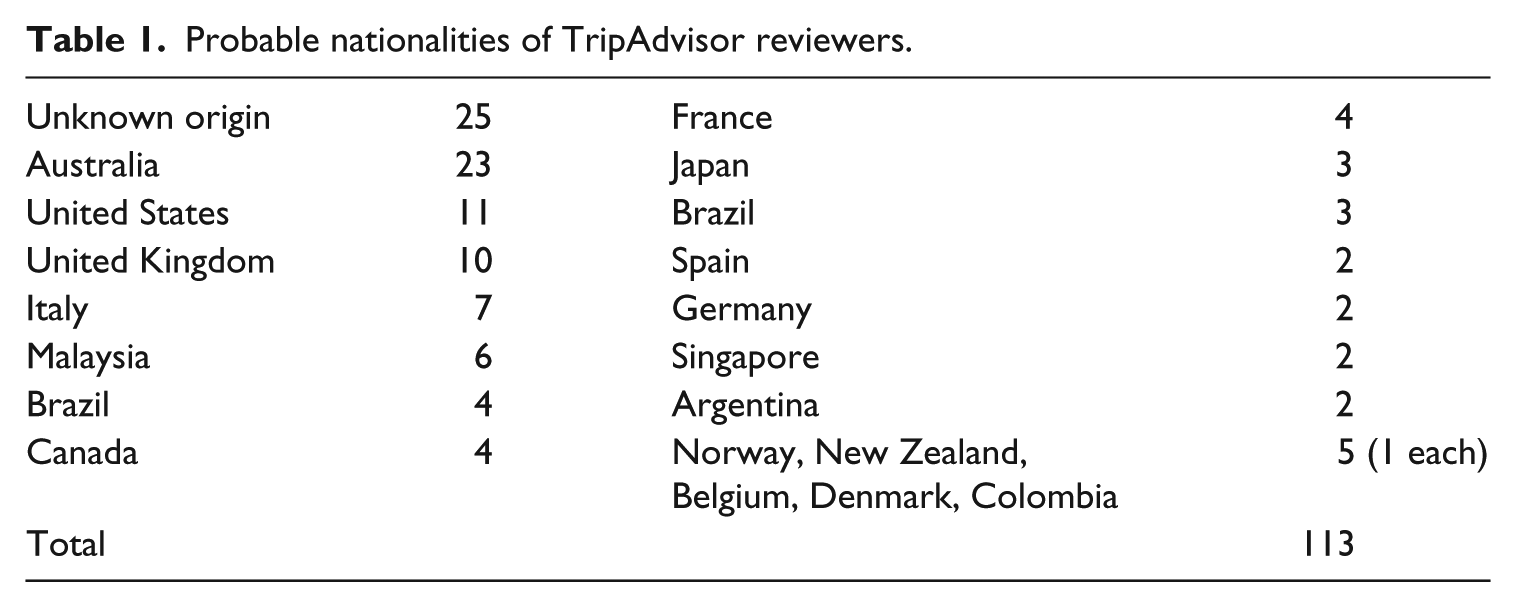
Data on traveler experiences of Baan Tong Luang came from a complete set of 113 TripAdvisor reviews, 10 traveler blogs, and 9 videos which were posted on-line at the time of the study. TripAdvisor reviews were from one to three paragraphs long (25–600 words); blogs ranged from two to five pages and videos from 2 to 8 minutes long. All blogs and videos were in English, and all except two likely had “Western” authors (based on attributions in the text and photos). The blog and video content of the two non-Western (Asian) authors did not differ substantially from the others. For TripAdvisor reviews, it was only possible to ascertain probable nationalities based on locations posted by reviewers (Table 1). The reviews of non-Western authors again did not differ substantially from the group as whole. In the category “Unknown origin,” all reviews were in English, and all except one had English names or monikers. Of the 112 reviews, 21 were in languages other than English: Italian, Japanese, French, Portuguese, German, Spanish, and Norwegian. These were roughly translated using Google Translate and found to be almost identical to English reviews. None was quoted in this article. Although TripAdvisor supports uploads of reviews in the Thai language, there were no reviews in Thai and there is no TripAdvisor site in Thai. Thus, it is safe to conclude that the data here predominantly represent the perspectives of English-speaking Western tourists, a limitation of the study.
Probable nationalities of TripAdvisor reviewers.
The second touristic encounter examined is that of visitors to three exemplary community-based tourism highland village sites in northern Thailand. These villages were identified as such by the Thailand Community Based Tourism Institute, Thailand Community Based Tourism Network Coordination Center, and Population and Community Development Association, the major non-governmental organizations (NGOs) promoting community-based tourism as a form of sustainable community development for highland people. The three village sites—Baan Huay Kee Lek, Baan Lorcha, and Baan Huay Hee—are all long-standing, award-winning community-based tourism sites and among the few with in-depth traveler blogs on the Internet. None of the sites has a dedicated website; however, all three are described on NGO websites as examples of “alternative” and sustainable community-based tourism. In contrast to the “ethnic theme park” style of Baan Tong Luang, the three villages attract a self-selected group of travelers interested in long-term, personal engagement with community members. Data from traveler experiences with community-based tourism in the three villages included the complete set of all English-language blogs available on-line at the time of the study: eight traveler blogs and seven videos. Blogs were fairly lengthy, in-depth texts (one to three pages; 500–1200 words). All were clearly authored by Western visitors, as was the case for a majority of the Baan Tong Luang reviewers. A single TripAdvisor review of Baan Lorcha (90 words) was located, but none for Baan Huay Kee Lek or Baan Huay Hee. Thus, the characteristics of the visitors for the two study sites were quite different, as noted above, as were the sample sizes.
Findings
The images of highlanders constructed by reviewers to a large extent reflected the differences between the conventional mass tourism of Baan Tong Luang and the alternative trekking tourism of the community-based tourism villages. Most visitors to Baan Tong Luang expected to have a quick and easy car ride to the site, and once there, to be “entertained” by “authentic” highlanders for an hour or two before moving on to another local tourist attraction. In contrast, the community-based tourism excursions involved smaller groups, longer and more physically challenging travel to fairly remote village sites, longer “cultural immersion” stays, and visitors generally more interested in cultural exchange, experiential learning, and community development. The result was multiple, sometimes paradoxical conceptions of authenticity among tourist reviewers of the sites. These ranged from objective and constructive authenticity, to various forms of existential authenticity among what might be termed “post-tourists” (Cohen, 2003) at Baan Tong Luang and “existential authenticity-oriented tourists” (Gnoth and Wang, 2015) at the community-based sites.
Baan Tong Luang: authenticity in the “human zoo”
About half of the reviewers of Baan Tong Luang expressed a belief in the “objective authenticity” of the site (Wang, 1999): they imagined they would find a variety of different highland people living together in a village setting in traditional houses, wearing traditional clothing, practicing traditional agriculture, making authentic “hill tribe” food and handicrafts, and warmly welcoming visitors to their village. Above all, they expected to see “long-necked” Kayan women and come away with photos, videos, and perhaps souvenirs of these and other colorful “hill tribes” in the village. In this way, they were subscribing to the stereotypical images of “hill tribes” promoted by the Tourism Authority of Thailand, travel guidebooks, and local tour operators (Cohen, 1989; Leepreecha, 2005; Trupp, 2011). These were external authenticating authorities whose “communicative staging” had “certified” the objective authenticity of the tourist attraction through a process of “cool” authentication (Cohen, 1989; Cohen and Cohen, 2012).
After arriving at Baan Luang Thong, however, the visitors were disillusioned by what they saw as a lack of objective authenticity at the site: they found a poorly staged and performed ethnic theme park (Yang, 2011). That is, along MacCannell’s (1973: 598) continuum of staged authenticity, they expected to experience an authentic, non-touristed backstage. What they found instead was a frontstage organized to look like a backstage. They saw traditional houses, gardens, fields, tools, and musical instruments; conversed with local people who were wearing traditional clothing; and even tried on traditional clothing themselves (including Kayan neck rings, a potent symbol of authenticity for many). However, they were also forced to pay what they considered to be exorbitant entrance fees for these privileges, and many did not encounter what they believed to be “real” hill tribes, as they had been promised. They felt cheated; some were angry. What they had hoped would be an intimate cultural experience became merely an economic transaction, as were their purchases of what many now perceived of as “fake” hill tribe products, displayed and sold by villagers. They had hoped to see “authentic” hill tribes; what they found instead was a “human zoo.” In this, they fundamentally believed that they, as visitors, not only had “the right to authenticate” (Zhu, 2012: 1497) but also that this right had been violated.
About half the reviews of Baan Tong Luang presented an image of the village in negative terms, most commonly as a staged “human zoo” or “tourist trap.” Reviewers characterized Baan Tong Luang as “a completely staged tourist trap,” “a pure touristy spot with all artificially setup,” “a sorry joke,” “very, very disappointing,” “almost disneylike,” “tragic,” and a “Sad Exploitation of Human Exhibit,” peopled by “Giraffe women.” It was an “uncomfortable” experience, like “looking at monkeys.” One chagrined reviewer reported how she “caught” a village resident acting out of “authentic” character: This place is clearly set up for tourists … it is in no way genuine …. We even caught one of Longneck Village ladies on her mobile phone. When her friend saw us coming she warned her and the phone was quickly hidden.
Like other Western tourists visiting highland villages in Thailand (Johnson, 2007; Novelli and Tisch-Rottensteiner, 2011), these reviewers expected an objective authentic experience and were disillusioned by evidence of “Western” development in the village. Under the heading, “Tribal human zoo,” one reviewer reinforced the perception of a deceitful staging of authenticity: The whole village is a prop to earn tourist money. Those people were mostly illegal refugees from Myanmar who are permitted to live here for free as the Thai government refuses to issue identification documents. Even the children must pay school fees. Real living does not happen here as home kitchens are either non-existent nor in working order. We noted that the stacks of fire wood have been sitting for a long time. Also noted the absence of planted herbals traditionally used for their cooking. Lots of mass produced merchandise available for sale everywhere. Handcrafted goods are the exception. We really felt cheated for paying an exorbitant entrance fee for a photo shoot event.
A second, smaller group of about one-third of the Baan Tong Luang reviewers, who might be characterized as “post-tourists” (Cohen, 2003; Urry, 1990), were less concerned with objectivist ideas of authenticity than with enjoying themselves and getting to know local people. They enjoyed talking together with villagers, playing music, singing, and exchanging family photos. That is, they were expressing an inter-personal existential authenticity (Wang, 1999) which involved feelings of sincere, intimate, and reciprocal relationships with their hosts (Conran, 2006; Taylor, 2001) even while understanding that they inhabited a manufactured frontstage tourism space at the site. Visitors’ feelings of “touristic communitas” (Gnoth and Wang, 2015; Wang, 1999) allowed a certain empathy and understanding of the local villagers’ situation as refugees and as people like themselves, who were just trying to make a living. Thus, unlike the highland trekkers in northern Thailand studied by Cohen (1989), these reviewers were not taken in by the “communicative staging” of Baan Tong Luang, but found existential authenticity in their relations with local people.
Although post-tourist reviewers acknowledged that the ethics of visiting Baan Tong Luang were complex, this did not necessarily preclude visiting. As one reviewer put it, “If you have high moral standards and more time and money available …. Do the real thing! Otherwise enjoy—take a few pics, dress up, buy a slightly expensive souvenir or two and move on.” Another suggested first learning about living conditions and benefits for the villagers before making a decision about visiting: “I (would) like to advise all who plan to visit the village to heed my advice to research before dropping in to discourage the exploitation of these poor folks.” One reviewer reminded readers that “they are people … not just exhibits.” Other reviewers implied such interactions were personally meaningful in a manner which might be characterized as intra-personal existential authenticity, involving a re-thinking of self-identity (Wang, 1999): “To actually meet and experience these people was very touching … it is their homes, and their families.” A review entitled, “Go beyond the souvenirs and photos” elaborated on this perspective of visitor identity: This is a exhibition village, so of course you cannot expect to be really close to their actual village. But we got to meet really nice people there …. If you are some snotty tourist who is just after photos, then you’ll probably not have a very good time. But if you go beyond the souvenirs and photos and actually take time to talk you them, you’ll learn a lot more: about their life in Thailand, etc. You’d be surprised on a number of things we all have in common.
Other reviewers shared a post-tourist perspective, arguing that tourism at Baan Tong Luang not only provided villagers economic benefits but also helped to preserve their cultures: What this place is, is a compound where a few dozen people from each of several tribes live in houses which double as shops from which they sell their wares, dressed in traditional costumes. Do they really live there or at the end of the day do they jump into their Toyotas and drive back home to their a/c and colour TVs? I think it’s real, and despite some misgivings, I think it does help them and do something to preserve this way of life …. For us, it’s a fun opportunity to gain a little insight into how these people live (many still do), take some photos and be parted from some of our money, in the knowledge that it’s going to a good cause …. You have to respect people, including many young people, it seems, who see the value in keeping their traditions alive.
Another reviewer recognized that living in an artificial, yet comfortable village which generated a livelihood through tourism income was preferable to highlanders’ former austere living conditions: There are 6 hill tribes represented there, and these are not people playing dress-up … they have relocated there, at the request of the landowner, to live, work, and multiply there. They get to keep their old ways of live, do what they’ve done for 100’s of years, in a quiet setting with ample land and the same comforts they had back in their home villages. The difference? They aren’t starving here.
Finally, there were those post-tourists who found the village to be a meaningful educational experience as a “living” ethnology museum of highland people. That is, even while they understood the site as a commodified staging of culture, it was an “acceptable” (Gnoth and Wang, 2015) and pleasant reproduction and was thus existentially authentic. Under the heading, “A Living and Breathing Museum,” one reviewer, among several others, elaborated on this perspective: … a visit here is a concise snapshot of traditional villages and culture …. The villages here are set up adjacent to each other so you can wander from tribe to tribe, between the rice paddies, see how they cultivate their crops and in front of each house they set up stalls selling the crafts they make which makes it seem like an old market. The ladies are all dressed in traditional costume which is nice because even on treks you don’t necessarily get to see villagers in costume …. I think that Baan Tong Luang is much like a living and breathing museum. It may lack in some authenticity for more serious travellers, but it’s interesting and pleasant nonetheless and I would recommend it for everyone else.
Community-based tourism: hybrid and existential authenticity
All the community-based reviewers, like a portion of Baan Tong Luang reviewers, understood objective authenticity to be less important than existential authenticity. Unlike many reviewers of Baan Tong Luang, however, they were not “post-tourists” accepting, with irony and fun, a commercialized simulation of a highland village (Smith et al., 2010). Rather, they took a constructivist perspective on authenticity (Wang, 1999), understanding it as a fluid, hybrid composition of traditional and modern life. Reviewers recognized that some cultural events were staged, but saw this as an “authenticating right” (Zhu, 2012) of their hosts in presenting their community to outsiders. Unlike the naive highland trekkers of northern Thailand in the 1980s discussed by Cohen (1989) and other more recent tourists to the region (Novelli and Tisch-Rottensteiner, 2011), these reviewers did largely understand the nature of staging and were generally aware of wider political, economic, and social issues affecting highlanders. Above all, they found existential authenticity in intimate and sincere relations (Conran, 2006, Taylor, 2001) with highland villagers. They constructed these human relations through long-term stays with village families, a desire to learn about local culture and livelihood, and an ethos of contributing to community development through their presence as tourists.
Travelers to the community-based tourism sites presented complex and at times paradoxical images of “authentic” and traditional cultures being preserved, but also of cultures evolving into hybrid forms in the face of increasing contact with the Thai lowlands, electronic media, and international visitors. In contrast to the frontstage access perceived by reviewers of Baan Tong Luang, reviewers visiting the three community-based tourism villages saw themselves mostly as going into a backstage social space normally out of bounds to tourists (MacCannell, 1973). However, they also acknowledged that they, like visitors to Baan Tong Luang, were sometimes in a front region staged to look like a back region. They saw this as a form of customized authenticity (Wang, 2007) which could be acknowledged and negotiated with their hosts. For reviewers, this authenticity comprised an evolving hybrid of old and new: Despite the authenticity of village life in Huay Kee Lek, many Akha villagers ride motorbikes into Chiang Rai during the day to work in factories, government positions and private businesses. They wear suits or normal clothes. The traditional garments you see are reserved for special occasions, special visitors or for those who continue living in the traditional manner. Village life still continues in much the same way as it has for years, except modern life is creeping in slowly. And this is fine, evolution happens everywhere. We saw the mix of old and new with women weaving grass and drying beans in the sun, taxi drivers lazing about on bamboo platforms and young soldiers standing around in groups laughing and chatting. Pigs and roosters ran round our feet and children played in the dirt in their backyards or under their homes built on wooden stilts.
Visitors to community-based tourism villages also recognized the contradiction inherent in tourism development and the preservation of traditional cultures. However, highland villages were seen as communities capable of self-determination; unlike Baan Tong Luang, villagers were seen as largely in control of the shape and direction of tourism development in their villages. As one reviewer noted, the problem of tourism changing traditional cultural practices and beliefs thus belonged to community-based tourism villagers to solve: Although it is hoped responsible tourism can lift the villagers out of poverty the paradox of development is ever present. How do we preserve and protect the authenticity of the cultures for the tourists’ experience—yet raise the standard of the villagers living without devaluing the tourism product? Ultimately that is a question the villagers of Ban Lorcha will have to answer.
Like the Western trekking tourists in northern Thailand studied by Johnson (2007), the reviewers of community-based tourism sites appeared to be searching for a “truer sense of self,” that is, an intra-personal existential authenticity (Wang, 1999) in their social engagement with highlanders in northern Thailand. In their “humanist desire” for intimate social interaction, reviewers also expressed an inter-personal existential authenticity (Wang, 1999) similar to that identified by Conran (2006) for highland trekking tourists in Thailand. One reviewer emphasized human interactions and experiences as key to cross-cultural learning: They treat every guest as kings and are, like the guests, very interested in exchanging cultures. As a tourist, it is the ultimate experience for gaining more inside [sic] into the Akha culture. Sleeping, eating, drinking, talking and laughing with the Akha’s are part of exchanging culture. And even without a translator you understand so many things about their way of living already.
Travelers to community-based tourism villages presented these sites as fertile sites for visitor learning, education, and cultural exchange. In contrast to the lack of educational resources experienced by visitors to Baan Tong Luang, once arrived at the villages, travelers noted especially the signage, local guides, and family hosts as educational resources. One reviewer said, for example, “Throughout the tour route well placed, clearly written notice boards explain the most important aspects of the tour. Included are cultural and historical points and advice on how to behave. These are all written in English.” Another reviewer talked about knowledge provided in the visitor orientation: The tour starts with an orientation to the village, its history and the make up of the villagers. Some of the issues facing hill tribes are touched upon but not explained in depth. The importance of the traditional culture and beliefs are explained and the do’s and don’ts during the visit.
All reviewers described what they had learned about community-based tourism in contrast to other forms of “hill tribe” tourism. Typically, this included an explanation of how the village community-based tourism project began, its objectives, and how guests, resources, and benefits were distributed in the village. One reviewer summarized his overall impressions of community-based tourism as follows: This is tourism that aims to show the visitor the local traditions, values and lifestyle whilst conserving the value of the individual culture and environment. Visitors can stay overnight or join the rural people in their daily lives in an effort to increase understanding and respect for each other. This form of tourism allows the villagers to maintain their traditional skills, control the tourism income, pursue their normal life and preserve their cultural and natural heritage.
In community-based tourism visitor accounts, there was seldom, if ever, any sense that tourists were being cheated or villagers exploited, as was the case in Baan Tong Luang. Instead, there was often an enthusiasm and feeling of goodwill expressed for the tourism experiences offered to visitors, a sense of being fairly treated in their economic exchanges with villagers, and a perception that monies spent would benefit the community. Visitors recognized that they brought tourism income to villagers, but they saw this as a fair trade transaction benefitting both villagers and tourists: visitors were billeted in local homes; ate home-cooked meals with local families; participated in agriculture, livelihood, and cultural activities; and were taken on forest treks with local guides, and happily paid local people for these experiences. One reviewer, for example, explained his understanding of how tourism revenues helped the village he had visited: In exchange for a modest entrance fee, visitors receive a full guided-tour of the community with villagers demonstrating daily activities. The entrance fee pays for development costs, maintenance and operating expenses. Villagers take turns working at the various jobs and receive a daily wage set by the village committee. They can also produce handicrafts to sell in the community shop. A percentage of all profits are deposited into a village development fund to assist orphans, widows and the elderly.
Discussion
In the current age of the Internet travel planning (Standing et al., 2014), it is surprising that any Western tourist intending to visit northern Thailand “hill tribes” would not read on-line reviews, blogs, websites, and other media before planning their trip. It is of course possible that some travelers still prefer serendipitous travel without carrying with them the preconceptions of anonymous on-line reviewers or that they simply choose to disregard reviewer assessments, even when they themselves post reviews. In the main, however, it is likely that social media, and on-line reviews of tourist attractions in particular, have wide resonance as a collective form of “hot” authentication for tourism sites (Mkono, 2013), with each review either reinforcing or negating elements of authenticity produced in the “cool” authentication of external experts and authorities (Cohen and Cohen, 2012) or creating new elements. Thus, in the on-line evidence of the “hot” authentication of reviewers of Baan Tong Luang, one prevalent theme described the site as a “human zoo,” belying reviewer expectations of objective authenticity (Wang, 1999) which posited “hill tribes” as “primitive” and untouched by modernity (Cohen, 1989). Meanwhile, competing themes portraying existential authenticity in meaningful human relations with highlanders and a “living museum” were also developing. On-line reviews of the community-based highland tourism sites described a hybrid authenticity constructed of the traditional and modern, and existential authenticity in human relations with villagers, the process of learning about local culture, and tourist contribution to community development.
One group of Baan Tong Luang reviewers expected objective authenticity (Wang, 1999) of highlanders as “primitive” and “exotic,” corresponding to stereotypes reinforced in cool authentication of the site by the Tourism Authority of Thailand and tour operators (Cohen, 1989; Leepreecha, 2005). Once on site, reviewers were chagrined to find a staged, “fake” tourist attraction and were annoyed at having overpaid for it. That is, they sought backstage authenticity but found only touristic front staging (MacCannell, 1973). In this, they fundamentally believed they had the right as tourists to assess the authenticity of the site (Zhu, 2012). Another group of reviewers also recognized the staging of authenticity as such, but as “post-tourists” (Cohen, 2003) nonetheless enjoyed its performance as a contrived tourism attraction. Even with only frontstage access, these reviewers (as audience) could meet highlanders (as actors) and get to know them through the sharing of conversation, family photos, music, and stories. In other words, these reviewers described an existential authenticity where “sincerity” in meaningful relationships between hosts and guests (Johnson, 2007; Taylor, 2001) and “intimacy” (Conran, 2006) were most important. In short, even in the staged “human zoo” of Baan Tong Luang, an intimate and sincere experience in human relations with villagers meant that existential authenticity superseded objective authenticity.
Reviewers of the community-based tourism sites were not so much “post-tourists” looking for fun and meaning in a simulated tourist attraction, but “existential authenticity-oriented tourists” (Gnoth and Wang, 2015: 117) who accepted authenticity as a mix of old and new traditions, and moderate staging at the site. While they hoped for backstage access (MacCannell, 1977) to highlanders’ lives, they also believed the community had the right to present its own forms of authenticity to tourists (Zhu, 2012) and therefore accepted frontstage access or customized authenticity (Wang, 2007) negotiated with their hosts. This humanistic orientation gave them “an empathic understanding of local people’s rights of development,” and since the staging of the site did not “violate the basic principle of sincerity and trust” (Gnoth and Wang, 2015: 117), they saw their experience as existentially authentic. Unlike Cohen’s (1989) naive trekking tourists of the 1980s and those more recently studied by Novelli and Tisch-Rottensteiner (2011) and Johnson (2007), reviewers of remote community-based highland villages did not expect objective authenticity, nor were they disappointed by incursions of “inauthentic” Western culture and technology.
As Taylor (2001) argues, in these forms of community-based cultural tourism, where tourists are “absorbed” into an intimate and educational cultural experience with local people, “sincerity” of exchange and relationships is more important than objective authenticity. The community-based tourism reviewers had intimate, personal experiences of sleeping in villagers’ homes, sharing meals, participating in livelihood and cultural activities, and exchanging ideas and experiences with hosts over the course of several days. This type of visitor learning as “interactional experience or cultural exchange may allow for both the hosts and guests to experience something more culturally meaningful and reciprocal, whereby the gaze is no longer unidirectional” (Conran, 2006: 263). Thus, the community-based tourism guests at times performed their own cultures for hosts—in songs, stories, dances, and music—and were as such subject to their hosts’ gaze, just as the reverse was true. In this sense, visitors enacted a type of reciprocal intra-personal existential authenticity (Wang, 1999) in their relationships with hosts, predicated on shared values of cultural exchange and sincerity.
Like the Western trekking tourists in northern Thailand studied by Johnson (2007), reviewers of both sites may also have developed a “truer sense of self” through their social interactions with villagers—a sense of “authentic humanity” or inter-personal existential authenticity (Wang, 1999). While reviewers did not express nostalgia or romanticism for an idealized way of life in remote highland villages, they did recount feelings of joy and transcendence at the beauty of the forest and mountain wilderness around the highland villages they visited. In this respect, they perhaps found a remedy to the loss of self in modernity—a more fully satisfying “existential state of Being that is activated by tourist activities” (Wang, 1999: 352). However, without more in-depth data on how various community-based tourism experiences may have shaped visitor identities, that is, how highland tourism might offer “opportunities to encounter one’s authentic self” (Steiner and Reisinger, 2006: 299), such determinations are difficult to make.
Conclusion
It is possible that the age of naive Western tourists hoping to find objective authenticity in ethnic tourism attractions, such as highlander villages in northern Thailand, has been eclipsed by the information, reviews, and communities of tourists increasingly discussing their experiences and views on-line. These contribute to a fluid, hybrid, and existential “hot” authentication of sites easily available to anyone planning a trekking or tourism trip. Far from being unthinking and gullible consumers of staged authenticity, many Internet-based tourist reviewers appear to have reflected deeply on their ethnic tourism experiences. In this study, reviewers described a broad range of understandings of authenticity, sometimes as objective authenticity (in the case of Baan Tong Luang), but also embracing multiple social constructivist and “post-tourist” existential perspectives. For community-based tourism reviewers in particular, authenticity was understood as a hybrid, evolving concept. For them, authenticity resided not only in meanings ascribed to artifacts, objects, practices and place, but also in the quality of their personal relationships with hosts, and the many opportunities for cultural learning and exchange afforded them as visitors to the villages.
Footnotes
Declaration of conflicting interests
The author(s) declared no potential conflicts of interest with respect to the research, authorship, and/or publication of this article.
Funding
The author(s) received no financial support for the research, authorship, and/or publication of this article.