




Abstract
This article examines the discursive structure of several popular travel blogs to understand the relationship between authenticity and self-branding. Instances of present-day “canonical” blogs are examined, showing up high on Google searches, attracting significant audiences, and featuring on “best of” lists presented by other websites. Through a discourse analysis of the blog’s About pages, it is shown that professional bloggers reconcile the search for a self-dependent and inward-turned existential authenticity with the performance of self-branding techniques. Bloggers construct an image of a resilient self in times of hardship, while acting as travel and life coaches and ensuring their readers that such a nomadic lifestyle is attainable for anyone who really wants it. Simultaneously, there is an unmistakable influence of socio-economic resources that these travelers have at their disposal. The enmeshing of authenticity and self-branding results in a discourse in which it is possible to both sell and become oneself.
Introduction
When Dave and Deb, the couple behind the travel blog The Planet D, first started discussing how to become full-time travelers, they had all kinds of ideas. In a promotional video, Deb tells how they were considering either teaching English as a second language or opening a bar in Honduras. In the end, the couple decided to put themselves on the map as “Canada’s adventure couple,” aspiring to show the world how adventure is for everyone. “If two regular people can do it, everyone can,” Deb says smilingly. Percussive island groove music kicks in, accompanying a sequence of adventurous travel images. 1
We are visiting the About page of The Planet D, a popular travel blog receiving about 150,000 unique views per month. 2 In the introductory video, we have just been watching, the couple maintaining the site highlights the importance of self-branding. Earning money by traveling, Deb explains, requires years of marketing, saving money, and commitment. “We weren’t a known commodity. Who would hire someone they had never heard of?” Dan and Deb fashioned a self-identity, performing the tasks necessary to obtain and support it. Halfway through the video, though, the music abruptly changes—the upbeat Caribbean tune makes way for a meditative, cinematic soundtrack. Deb describes how she and her husband are getting rid of all their stuff so as to be devoid of possessions. “I feel so much more enriched now, not having the need to show off the things that I have … My priorities have changed, it is about the experience now.” In a matter of seconds, we have switched from a language of strategic self-branding in order to consolidate an income, to a very specific appeal to authenticity. These travelers are arguing that their journeys accommodate a state in which one can be true to oneself, contrary to the frustrating limitations of their former lives in Western society. Their video demonstrates a paradox in travel blogging: on the one hand, the dissatisfaction with conventional middle-class trajectories and the desire to escape them. On the other hand, the salability of an exceptional lifestyle, the impression management involved in selling it, and the need to secure an income to keep traveling.
This article aims to contribute to empirical studies of identity and authenticity in travel writing by discursively scrutinizing About pages on professional travel blogs—that is to say, commercialized blogs that (potentially) offer a source of income to their writers. Constructivist in scope, it investigates the ways in which the rhetoric of existential authenticity operates within the systems of persuasion and self-branding that operate in these blogs. It seeks to engage with theories on socially constructed authenticity, and the bourgeois culture within which this authenticity appears. At the same time, its goal is to underline the multifariousness of authenticity, and to show how readily the concept is reduced to a function of strategic self-branding. To these ends, first an overview is offered to the seemingly irreconcilable concepts of authenticity and self-branding, forming the main paradox from which the analysis derives. Next, the choice of corpus is explained, as well as the methodology to analyze it. The analysis of the blogs specifically targets their About pages; the space where bloggers reveal their background and motives, and position themselves in the travel blogosphere.
The revolving doors of authenticity
The concept of authenticity in tourism studies is famously contested. While in heritage studies it remains a concept of vital importance (cf. Bobot, 2012), several sociologists have posed that it serves as an essentialist or materialist concept (cf. Bruner, 1994; Handler, 1986), or as too simple a notion to explain tourism (Urry, 1991: 51). Yet its allure remains, an anchor point in the language of tourism, used in advertisements and travel writing alike (Culler, 1990: 4). The insights of authenticity might best be disclosed from a data-driven perspective—not asking “what is authenticity?” but rather “how is authenticity used?” (Cole, 2007; Rickly-Boyd, 2012), and the analysis in this article aims to do just that. Since an extensive elaboration on all the interrelated conceptualizations of authenticity runs the risk of eclipsing said analysis, what follows next is a brief elaboration on its main conceptualizations.
In the objectivist sense (Boorstin, 1992; MacCannell, 1973), 3 authenticity refers to an intrinsic property or quality that makes it possible to distinguish between genuine and fake, production and reproduction, and original and copy (cf. Lau, 2010). The epistemological essentialism apparent in this concept has raised questions since its first appearance; a frequently offered alternative frame is that of constructivism, in which authenticity (along with culture in general) is regarded as emergent, performative, and socially negotiated, as part of the “political economy of taste” and the right to authenticate (Bruner, 1994; Olsen, 2002). The third conceptualization of authenticity is that of existential authenticity, an experience-based category (Noy, 2004; Steiner and Reisinger, 2006; Wang, 1999) standing in a long tradition of continental philosophy that explores the nature of becoming a wholesome, fulfilled and unified subject. Existential authenticity refers to an existential state in which one exists in accord with one’s sense of one’s self, asserting one’s will when confronted with choices, finding the courage to face the anxiety of the meaninglessness of existence, or to reject the limiting conformity of an identity shaped by external motivations. In the Heideggerian sense, authenticity means to be “eigentlich” (eigen as own, proper, peculiar); taking responsibility for being one’s own (Heidegger, 1996).
It is important to underscore that existential and constructivist perspectives on authenticity are not mutually exclusive; in fact, existentialist language often functions as a rhetoric asset within a constructionist framework. This becomes clear if we look at the commoditized and consumerist economic context in which existential discourses are situated. The discourse of being or becoming oneself is incorporated in many a marketing strategy—its most overt application arguably can be found in the practice of self-branding. Emerging in the late 1990s, self-branding is the metaphorical expansion of the practices of marketing of branded goods and services into the realm of individual workers, freelancers, and entrepreneurs. It pertains to the conscious construction of a self-image in order to produce cultural or material profit (Hearn, 2008); a form of persuasive communication that works to colonize the lived experience of consumers in the interests of capital accumulation. Individual strengths and uniqueness are used as promotional tools toward a target audience (Shepherd, 2005): self-branding serves to produce identity by “taking control of the processes that affect how others perceive you, and managing those processes strategically to help you achieve your goals” (Montoya, 2002: 7; cf. Hemetsberger, 2005). Explicit self-packaging is emphasized; here, authenticity depends not so much on individuals’ internal sets of skills, motivations, and interest but rather on how effectively they are branded (cf. Lair et al., 2005: 308).
The authority of the exciting, individually scripted representation of reality over reality itself, has invited the postmodern study of authenticity (Wang, 1999). Postmodernist studies focus on the experienced lack of authenticity, with concepts such as simulacra (Baudrillard, 1994) or hyper-reality (Eco, 1986), and protagonists such as the post-tourist (Feifer, 1985): fragmented and ironic selves who are no longer interested in authenticity in its objectivist or existential sense. Put in aphoristic form, the postmodernist framework holds that the more authentic the representation is, the more real we should consider it to be (McCrone et al., 1995: 46). And while this notion seems distant from the existential viewpoint, the two perspectives can be taken as synonymous. A recent example of this can be found in Kane (2012), who offers a Bourdieusian critique of the mythologies surrounding adventure tourism. According to Kane, adventure tourists use blogs in order to “highlight mountaineering myths, otherness, unique distinction and recognisable authenticity” (p. 270) and thus acquire mountaineering adventurer identity, which in Bourdieu’s terms is considered a form of symbolic capital. In this interpretation, authenticity is a purely strategic construct determined by dominant individuals (such as tour guides), which tourist narratives must align with in order to be recognized at all. When summarizing the authenticity discussion, Kane adopts the moniker of “postmodern existential” authenticity (ibid., p. 271). While this conflation rightfully shows that the existentialist discourse is put to use to acquire symbolic capital, it is also important to emphasize that, if we care to analyze people choosing global travel as a primary modus videndi, we should regard authenticity as a layered concept: it is both a determining function in the process of self-branding and an attempt at creating new scenarios and pathways for better self-understanding, possibly subverting western societal parameters.
Analyzing travel blogs
The alleged “death of the blog,” 4 like other obituaries of reified social trends, is misleading. As Jodi Dean (2010) puts it, “a sure sign of the triumph of a practice or idea is the declaration of its death” (p. 33). Despite their continuous procedural mutation and variation (from static blogrolls to microblogs to social media profiles), which makes it hard to say what the formal boundaries of a “blog” are, it is also clear that blogs are still a popular and influential communication medium, within which travel blogs represent 28 percent (Bosangit et al., 2012). 5 Blogging is also increasingly a branded practice; according to a 2013 Technorati report, blogs are the third most influential digital resource when making overall purchases, behind retail websites and brand websites. 6 When it comes to travel blogs, some have argued that in this genre the commercial focus is not always present. Arguably, travel discourse makes use of a more personal language, whereas tourism discourse employs the impersonal, factual and commercial language familiar from tourism advertisements (Dann, 2012; Meshaw, 2005; Robinson, 2004). Yet, the discourses associated with travel and tourism can also intertwine, as bloggers rely on a travel discourse of going off the beaten path while being encapsulated in a touristic system of advertising and, in the case of using a blog service, uniform content organization (Azariah, 2012a).
Several theorists have stressed the difference between blogging and diaries or autobiographical stories (cf. Chandler, 1998; Hardey, 2002). Blogs present the autobiographical subject in a fragmentary and reverse-chronological manner. Instead of focusing on the anticipation of the holiday or the narration of holiday stories on return, a typical blog presents writing during the trip. Scrutinizing blogs, researchers are thus able to investigate “the dynamics of everyday life from an unadulterated first-person perspective” (Hookway, 2008: 107). Yet it should not be forgotten that blogs also contain (relatively) fixed elements, such as the About page on which authors depict themselves, and an advertising page containing marketing metrics such as site traffic, site rankings, and reader profiles to attain advertising revenues, speaking arrangements, sponsorships, and so on. Blogs are consequently often researched in the context of consumer research, destination branding, and digital influence (Akehurst, 2009; Bosangit et al., 2009; Magnini et al., 2012), although some discourse analytical studies of travel writing have also taken an interest in them (Azariah, 2012b). Keeping in mind that tourism plays a crucial role in the creation of life narratives (Ryan, 1995: 95), understanding travel writing as a sphere for the construction of identity seems indeed important.
To explore the ways in which existential authenticity and self-branding are expressed and negotiated, this article proposes a discourse analysis of both text and images within a series of About pages on travel blogs. It takes a special interest in the doxic function of the semiotic resources: the way in which shared values and beliefs are put to use for verbal efficiacy (cf. Amossy 2002). Discourse analysis stresses the performativity of language (Butler, 1990): social actors semiotically situate themselves in certain groups and categories, while performing desirable versions of their identities by taking on a face, footing, or role (Blommaert, 2005). Within this performance as a certain persona, the speaker is oriented toward a dialogical uptake of their utterances but also normatively toward an implied reader or “superaddressee” whose absolute and full understanding is presumed (cf. Bakhtin, 1981).
A travel blog, for our current purposes, can be defined as a set of personal webpages and entries served from a single web domain, created and operated by one or multiple authors, dedicated to planned, current, or past travel by the same authors (excluding services such as Facebook, Tripadvisor, or Travelpod). Further, the blogs all contain an About section detailing the identity of the author. Furthermore, these individually created blogs attract a significant audience; they are typically highly visible in search engine results since they are usually linked to and updated frequently (Xiang and Gretzel, 2010). Entering the broad search term “travel blog” in Google, for example, yields five of the blogs studied here on the first two search pages. 8
This leads to the question of how to measure reputation. Websites were selected based on their “hypertextual popularity”: their appearance on lists presented by other popular travel websites. There is a significant number of websites offering an aggregate top-tier list of travel blogs, making use of ranking systems such as Alexa, SEMRush, or Compete. 9 A number of caveats arise when using such data: all these aggregate lists weigh popularity factors differently and take different blogs into account in the first place. Moreover, not every list is transparent as regards the exact criteria and methods with which data are processed, and ranking systems are obfuscated regarding their algorithmic specificity. In short, it is impossible to provide a completely balanced list of popular websites. The goal here is modest: to provide a contingent list that nevertheless includes some of the most popular travel blogs during the course of 2013 and 2014. For this reason, four pre-existing lists from aggregate websites were used. 10 These lists were selected so as to take into account different ranking systems. The websites that appeared in at least two of them were extracted. The same procedure was performed 1 year later, after which the lists were combined in order to see which blogs appear in both of them. This leads to a corpus of 36 blogs (Figure 1) that have remained popular for over a year, by a very specific type of Western travel blogger: people who were somehow able to put themselves in the spotlight of several discursive and commercial systems determining popularity.
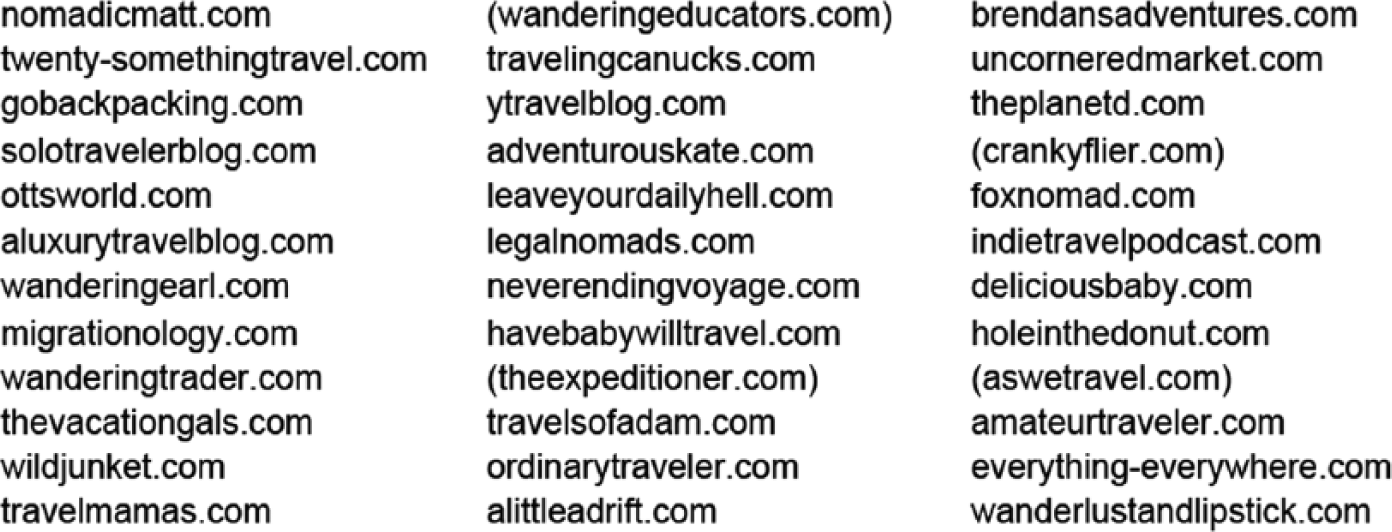
Corpus of selected travel blogs.
As indicated, the analysis focuses primarily on the About page of these travel blogs: the space where bloggers reveal their background and motives for traveling, blogging, or both, while positioning themselves in the travel blogosphere. About pages on these blogs are about 500 words long, and typically introduce the reader to the motives of the traveler, as well as highlights from their peripatetic life. As such, the About pages form the space where the brand is crystallized. Advertisement pages—another fixed element on travel blogs on which self-branding mechanisms appear—are also taken into account, if available. Four blogs from the generated list were not taken into account and are put between parentheses in Figure 1, as they did not include any self-revealing information on their About page. The analysis consists of four themes that emerge from the data: class-related backgrounds, existential authenticity, author/reader relationships, and self-branding methods.
Background and class
To start, we should get acquainted with the bloggers: the first question we may ask pertains to their backgrounds. Shannon from A Little Adrift “grew up in a sleepy town in Florida,” while Robert from Leave Your Daily Hell 11 notes being “a (relatively) ordinary 28-year old, who grew up in a (relatively) ordinary family in the (extremely) ordinary midwestern United States.” 12 Especially the second blogger, here, emphasizes his perceived ordinariness using an ironic voice, which of course implies not being so ordinary after all—at least, not as much as his place of origin. In a form of spatial anchoring (cf. Johnstone, 1990), the American mid-west is used not just as a spatial reference but because of its marginal connotation. These sentences serve a directive purpose: convincing the reader that being an extraordinary global nomad is something that can be learned—and indeed, taught. The bloggers from The Planet D 13 make the same point, but more explicitly: the website’s subtitle reads “Adventure is for Everyone,” and with that motto the bloggers “aim to prove that you don’t have to be an uber-athlete, adrenaline junkie or a part of the ultra rich to be an adventurer!” Throughout the corpus, we find more of these expressions of ordinariness, which emphasize the bloggers’ humble origins juxtaposed with the distinctly extraordinary life that they have carved out for themselves. Marcello from Wandering Trader 14 tells an archetypical story of self-made success—coming to the United States with nothing at a young age, working multiple part-time jobs while studying, and so on. The pictures and the captions accompanying the story reinforce the blogger’s current successful lifestyle (Figure 2).
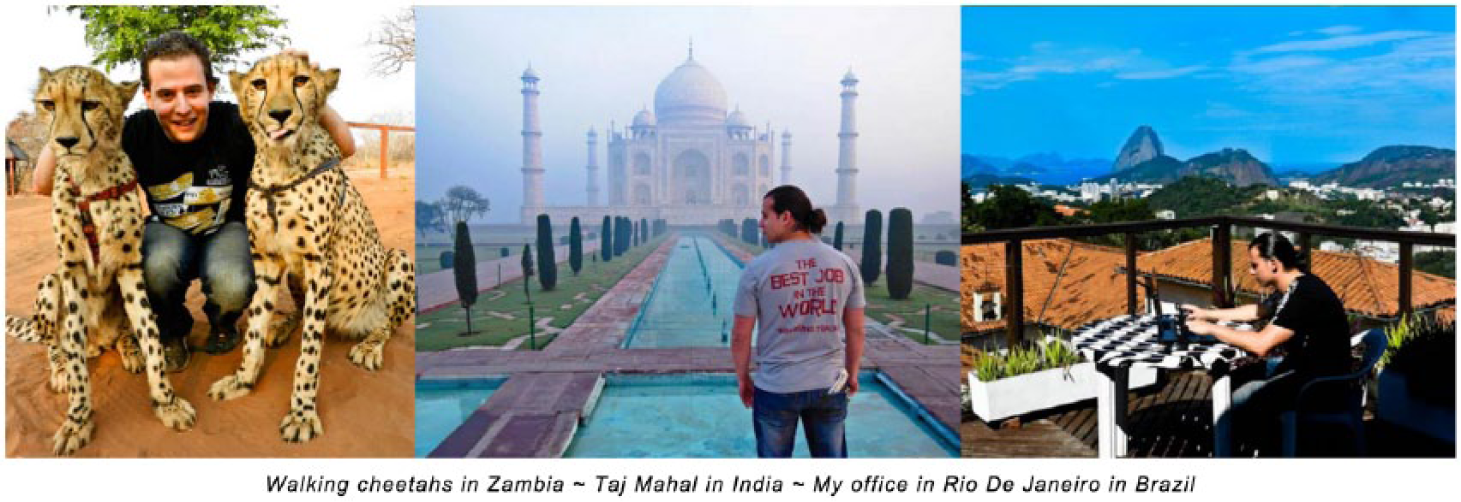
Screenshot from Wandering Trader’s About page.
The blogger offers snapshots of the extraordinary life of a cosmopolitan; a visual tricolon of doxic exoticism, including masculine felines, the mythical frame of the Taj Mahal, and a mountain vista forming the backdrop of the blogger’s office. His T-shirt on the middle picture, reading “the best job in the world,” is itself an advertisement for Wandering Trader and affiliate websites, where users can apply for day trading seminars: the blogger teaches others “how to have their own freedom and leave (sic) a life of financial freedom through day trading.” 15 The narrative of humble beginnings serves as proof of the manufacturability of the blogger’s life, and the possibilities readers have to replicate this narrative (more on this further below).
For now, this focus on ordinariness leads to the question of what kinds of previous jobs these bloggers have had. The type of anti-touristic “travel” on offer in these blogs has often been found to be the preserve of mainly white, middle class, relatively wealthy and educated people (see, for example, Week, 2012). It indeed turns out that, apart from a university diploma (which is held by at least 30 out of 32 bloggers),
16
several of the bloggers analyzed here were previously employed as writers—and continue to offer themselves in the capacity of freelance writing. The past may be construed as common or unremarkable in contrast to the present—but it does seem of some importance: Gary Arndt from Everything Everywhere
17
, after introducing his younger self as an unwordly denizen, sold his business to a multinational corporation, granting him enough money to support himself on the road. Corinne of Have Baby Will Travel
18
describes herself as “a veteran television producer who enjoyed a successful career with Canada’s largest broadcaster.” And Sherry from Otts World
19
writes, “I quit my corporate IT job in 2006 and said goodbye to blackberries, meetings and New York City.” She further notes that
my eyes were opened to possibilities and the beauty of simplicity; I didn’t want to go back to my old corporate existence. Instead I sold my possessions and relocated to Vietnam to teach ESL, do photography, and continue building a blogging and writing presence.
The blogger demonstrates a dislike of the type of excess that comes with a successful career. Of course, the alternative scenario she presents fits in with the spiritual movement since the 1970s of “turning East” (Cox, 1977; Mehta, 1994 [1979]). It involves the upper-middle-class involvement with, and subsequent commodification and marketing of, eastern religion. While this blogger has determinately turned away from branding products, she is still branding herself, reconciling her search for an existentially authentic, “simple life” in the East with the branding techniques reminiscent of those she employed in her former profession. Taking photos and teaching to foreign children, the two things the blogger has undertaken abroad, are well-known forms of capital that reinforce the “adventurer” traveler identity. While the location may have changed, the branding logic stays the same.
The paradoxical simultaneity of corporate success and anti-corporate sentiments has been captured by David Brooks’ concept of “bohemian bourgeoisie” (wittily abbreviated as bobo). Bobos are the highly educated, successful individuals in the open-ended meritocracy; the managerial class of the late twentieth century. However, they are also influenced by the discourse of the 1960s “critical generation.” Criticism, thus, has become part of the system. Bobos have grown up in a late modern corporate environment, with an authenticity lexicon of “thinking outside the box” and praising misfits, artists and rebels, while having a negative disposition toward any mainstream outings of luxury (Lindholm, 2008: 59). As Brooks (2000) puts it, they are “affluent yet opposed to materialism. They may spend their lives selling yet worry about selling out” (p. 41).
While nearly all the bloggers here are part of the well-educated higher middle class, several of them highlight the fact that they had left home without a noteworthy savings account (such as Nomadic Matt 20 or Derek from Wandering Earl 21 ). This theme of frugality resonates with findings by Week (2012: 192), who has noted that adventure travelers share a tacit assumption that they are less wealthy than those who are involved in mass tourism. Yet, while there are obvious gradations in financial success, the discourse of authenticity remains notably consistent throughout the blogs. Wandering Earl, for instance, classifies himself as a “new breed of explorer”: travelers who are both responsible about their environment and who “confidently embark on missions to accomplish their life goals and to achieve their wildest dreams. They live unconventionally, according to their own terms.” 22 The call for socially responsible travel, complying with existential authenticity as a sensibility toward an alternative scenario to the late modern working and living ethos, and a focus on community and accountability (cf. Guignon 2004; Heynders 2014). This however is paradoxically connected to the discourse of efficient and individual self-realization—a combination that warrants further exploration.
Authenticity as efficiency
Travel bloggers consistently point toward inner self-realization, chasing one’s own personal dream. The choice to leave everything behind is presented as an act of rebellion against the social norm, an “I” or an “us” against the world. The traveling couple from Uncornered Market
23
notes how their friends and families asked whether they were crazy when they started traveling, and Stephanie from Twenty-Something travel
24
submits a similar idiosyncratic motive:
Most of us (particularly in the US) have been told our entire lives that there is a specific life model we need to follow: go to school, get a job, get married, have kids, work work work, retire and THEN maybe if you are in good health and financially secure you can do some traveling. Well I’m not buying it. There is no one size fits all path to a happy and fulfilled existence.
A discursive pattern emerges in these blogs: the perseverance and trust in intrinsic motivations, despite illnesses or other setbacks, combined with a refusal to accept the linear path that neoliberal society presents; an existentialist narrative of freedom to become oneself in spite of the proto-capitalist logic of commodity ownership and regulated work. However, this always happens in conjunction with an appeal to the logic of efficiency and usefulness by which this alternative lifestyle should be constructed. Nellie and Alberto from WildJunket 25 explain that travel, to them, had a very pragmatic appeal: “We wanted to lead an extraordinary life and travel was our outlet to do so.” Mark from Migrationology 26 offers a similar motive when he notes that he “set a goal that I would never teach again, and that I would find a way to make a living online.” And Stephanie from Twenty-Something Travel continues her previously cited advice by saying she means it in “the most practical, least hippy-dippy way possible.” These motives may have little in common with existential authenticity in the philosophical sense, but the rejection of external motivations and the drive toward self-ownership are obviously inflected by its discourse. However, in these instances the road toward authenticity primarily involves taking control and strategically organizing and commoditizing one’s self-development.
We can further recognize an existential sensibility in the several stories of illness and disease to be found on these blogs. Bloggers describe being suddenly struck with the need to stay on the road, comparing it to a sense of addiction. Derek from Wandering Earl writes: “It was exactly three days into my first trip back in 1999, as I celebrated the Millennium at Angkor Wat in Cambodia, when I became inflicted with an untreatable addiction to world exploration.” In other instances, the motive for leaving is more literally connected to illness. Barbara of Hole in the Donut
27
was at some point stricken with Lyme disease. At that point,
I promised myself that when I recovered I would find a way of living that focused on those things that bring me joy. As soon as I was healthy enough, I left my job, strapped on a backpack, and traveled solo around the world for six months.
This is a serious and earnest narrative of illness, existential realization, recovery, and the fulfillment of the newly found insight. We see something similar happen with Dan from Uncornered Market: he “went to India by himself, discovered another planet located on Earth, and fell terribly ill (dengue fever). He eventually recovered and has struggled with various bouts of the travel bug ever since.” Marcello of Wandering Trader, while not falling ill, mentions “getting kidnapped and detained in some of the most dangerous places in the world,” while Kate from Adventurous Kate 28 has “been shipwrecked in Indonesia,” and Beth Whitman from Wanderlust and Lipstick 29 has “had a hand grenade pulled on her in Cambodia.”
These narratives of perseverance and danger can be interpreted as forms of capital for the adventure traveler identity (cf. Kane, 2012); intense physical confrontation with the world is beneficial to the discursive construction of authenticity. At the same time, these events and experiences should not be solely understood as strategic discourse. Sociologist Stephen Lyng has labeled these consciously sought after, high-risk situations as “edgework” (2005). They allow educated, middle-class Western people to resist the experience of being controlled by society, to differentiate themselves from the comforts, safeties, and moderations of their native bourgeois society, and offer a Weberian re-enchantment of the world. Yet, as Lyng himself notes, there is a paradoxical synergy between the skills, competencies, and symbolic resources of edgework practices and the imperatives of late modernity, such as the necessity to take voluntary entrepreneurial risks in order to achieve better results. In this context, the interest in dangerous scenarios that these bloggers share can be seen as a procuration of skills that will be useful once they return home.
Yet, the relationship these bloggers have with their Western homes and backgrounds is more complex. These are perpetual travelers, and the question arises whether or not these bloggers want to go back home at all. How do these bloggers relate to time and the temporariness of their travels? A valuable pointer can be found in the counterpart of Lyng’s edgework of “facing death,” which is often employed in the blogs: following or living your dream, or living life to the fullest. Caz and Craig of Y Travel Blog 30 note that “life is short and there never will be a perfect time for you to live your dreams,” while Christy and Scott of Ordinary Traveler 31 notify their readers that “life is too short to do something you don’t love.” Indeed, these axioms of “living in the moment” are reminiscent of the present-tense awareness that belongs to an existential mindset. True adventure is “temporally bracketed” (Redfoot, 1984: 293), and the adventurer is the prime example of the ahistorical human: “On the one hand, he [sic] is not determined by the past …; nor, on the other hand, does the future exist for him” (Simmel, 1971: 90). However, constantly reminding oneself that time is limited, and that life should be maximized, very much implies historical awareness. This awareness seems much more prevalent than any form of “tourist angst” (Fussell, 1980; MacCannell, 1989)—the feeling tourists display toward fellow vacationers whenever they come into contact with, and seek to distance themselves from, them. Here, we recognize not an interpersonal angst directed at others, but an intrapersonal angst of the temporariness of travels and lives.
This phenomenon can be further highlighted when we see what happens as these bloggers do get back home. Corinne from Have Baby Will Travel 32 was “lured back to Canada’s largest media company,” returning to her former job and maintaining the narrative of corporate success after the journey has ended. The bloggers from Traveling Canucks 33 note that “the lessons learned from long-term travel gave us the courage to pursue life’s next great challenge—raising a family.” Here, the goal-oriented and efficient project of traveling is followed up by another (albeit stationary) one. Yet, the bloggers who have returned and keep maintaining their blog usually add a clause reassuring the reader that this sedentary behavior does not undermine their identity as travelers. Adventurous Kate, when settling with her boyfriend in London, noted: “I will absolutely keep up the traveling, both solo and with him!” and the Travels with Adam 34 author, while living in Berlin, is “continually traveling around Europe and the rest of the world.” These bloggers show a reconciliation of identities: being both an erratic, youthful nomad and a stable homebuilder. Their traveling should be seen as part of a configurable and modular lifestyle.
The author/reader relationship
Let us now consider how bloggers relate to their audiences. Several of the authors, once inspired by others to start their peripatetic lifestyle, aim to pass down the same inspiration to their readers. As Nomadic Matt puts it: “This website is here to inspire you the way those five backpackers in Thailand inspired me.” Brendan of Brendan’s Adventures
35
quotes himself on his About page: “If you seek guidance you need not look further than your own desires—Brendan van Son.” And Dave and Deb from The Planet D believe “that everyone has the potential to live their dreams.” The narrative of chasing one’s personal dream mentioned above is thus projected upon the reader. We can start to fill in the characteristics of the superaddressee in these blogs: the reader, first, is someone in need of narrative inspiration to conquer their fears and doubts. Caz and Craig from Y Travel Blog claim to provide precisely that inspiration when addressing their superaddressee:
We’re here to tell you your life does not have to fit in a box. Screw the picket fence, the full-time job that sucks you dry, and the monotonous peak hour traffic runs. You can have this, if you want it. But, we’re pretty sure you don’t.
The condescending voice of these bloggers is targeted at a reader who—on his or her own—does not dare to cross the barrier that these bloggers have left long behind them. The same holds for Robert of Leave Your Daily Hell, 36 whose blog name alone is quite telling. His hope is to inspire his readers—“not only to travel, but to begin living the life you want.” This leads to the next trait of the superaddressee: (s)he is unhappy with the repetitive and work-centric life in neoliberal society. Yet, at the same time, the type of self-realization that bloggers provide is related to neoliberal agency (cf. Gershon, 2011). Regardless of background and starting point, these people are considered to be responsible of themselves and able to realize their dreams.
In the end, insomuch as these travelers are bloggers, traveling the world seems a means to a different end. Bloggers present themselves as both travel and life coaches, who inspire their readers to do what they already felt in their hearts but lacked the courage to do. Janice from Solo Traveler Blog 37 explains to her future investors on her Advertise-page how “the blog encourages people to reclaim their right to time by themselves … to find strength in being who they are, doing what they want, when they want, if only for a short time.” 38 Such an existential but temporary attunement to the self fits perfectly in the modular, continuously reconfigurable and personally configured authenticity ethos of late modernity. Some bloggers seem so eager to empower their readers in this regard that one senses a degree of pressure. Derek from Wandering Earl implores his readers: “Will you join us as well? The world would certainly be a much better place if you did.” Stephanie Yoder from Twenty-Something travel, meanwhile, hopes to demonstrate that extensive travel “is a viable and even a responsible option. The world is there, waiting for you, if you’re willing to make it happen.” Not just an inward endeavor or an autonomous choice, traveling and following one’s dream become a moral responsibility that readers ought to answer to. Yet, this responsibility seems primarily located within the individual, and not at the community from which these travelers come, or to which they are heading.
A peculiar friction arises here between two goals that these bloggers have in mind for their readers: they have to idiosyncratically travel, but they also have to keep reading the blog. This friction appears when the metaphor of travel is employed to sway visitors into reading the blog’s stories. On the About page of The Planet D, after a long string of photos showing the traveling couple at impressive locations, the last sentence reads: “Anything is possible you just have to want it bad enough. So tuck in, grab a coffee and be inspired.” Anil of foXnoMad 39 asks his readers, “Want to travel more? Sign up to get my latest posts in your inbox.” And Craig and Linda from the Indie Travel Podcast 40 urge their readers to “get outside and travel,” followed by a button titled “start here,” which links to another blog page. Strikingly, the act of reading the travel narrative becomes a replacement for traveling. For the author, this is an act of differentiating himself or herself from the superaddressee. One is traveling the globe and living the dream, the other is reading the stories from a home computer. Fussell (1980), noting a similar point, has observed that there are two voyages presented to the addressee of travel stories. Of course, there is an exterior journey abroad—but there is also an interior voyage into the author’s mind and the reader’s brain. While bloggers are consistently underscoring the reproducibility of their narratives, the scenario they provide to their readers is also a confined one, involving an inward instead of an outward movement.
Adding to this is the fact that a comment section, where the audience might respond to the blogger, is present on only five of the About pages examined here. On most blogs, comments are prohibited on the About page only. As such, bloggers can stay in control of their self-representation, while reinforcing the authority position they assume vis-à-vis their readers. Keeping feedback restricted can also be a way of securing advertising revenue, as advertisers might be concerned about being associated with an “unclear” brand where any Internet user can in principle contribute whatever they like to it, or even take the discussion to “uncomfortable” directions.
Reliable self-brands
Looking at the self-branding strategies that these bloggers mobilize, several voices and footings can be discerned. The bloggers strategically write themselves into a particular niche market, and by doing so demonstrate the purchase of authenticity across different traveling genres and niches. At the same time, they do not operate in complete isolation of each other. Professional travel bloggers are placing comments on each other’s blogs, 41 referring to other bloggers on specific outlink pages, 42 acting as guest writers on other blogs to generate and circulate content 43 and visiting travel blogging conferences such as TBEX. 44 Many of the bloggers in the corpus are related to each other through these infrastructures, showing how they both reinforce each other’s brands and create a travel blogging community by sharing experiences and responding to each other’s stories.
Adventure travel is the most popular market niche with these bloggers: there are several sub-niches targeted at budget travel, people traveling solo, as a couple, or with their families. Food-related travel is also a recurrent theme, revolving around indigenous exotic food. Jodi from Legal Nomads 45 focuses on affordable street food in Southeast Asia, while Mark of Migrationology 46 connects his genre of culinary blogging to the same type of existential discourse we have seen above: his blog aims to “serve you mouthwatering food, but my other goal is to inspire you to get out of your comfort zone, set goals, and pursue what you’re most passionate about.” In other cases, bloggers do not offer a distinct genre of writing, but simply underline their marketable identity. Robert from Leave Your Daily Hell perhaps provides the most compelling example (Figure 3).
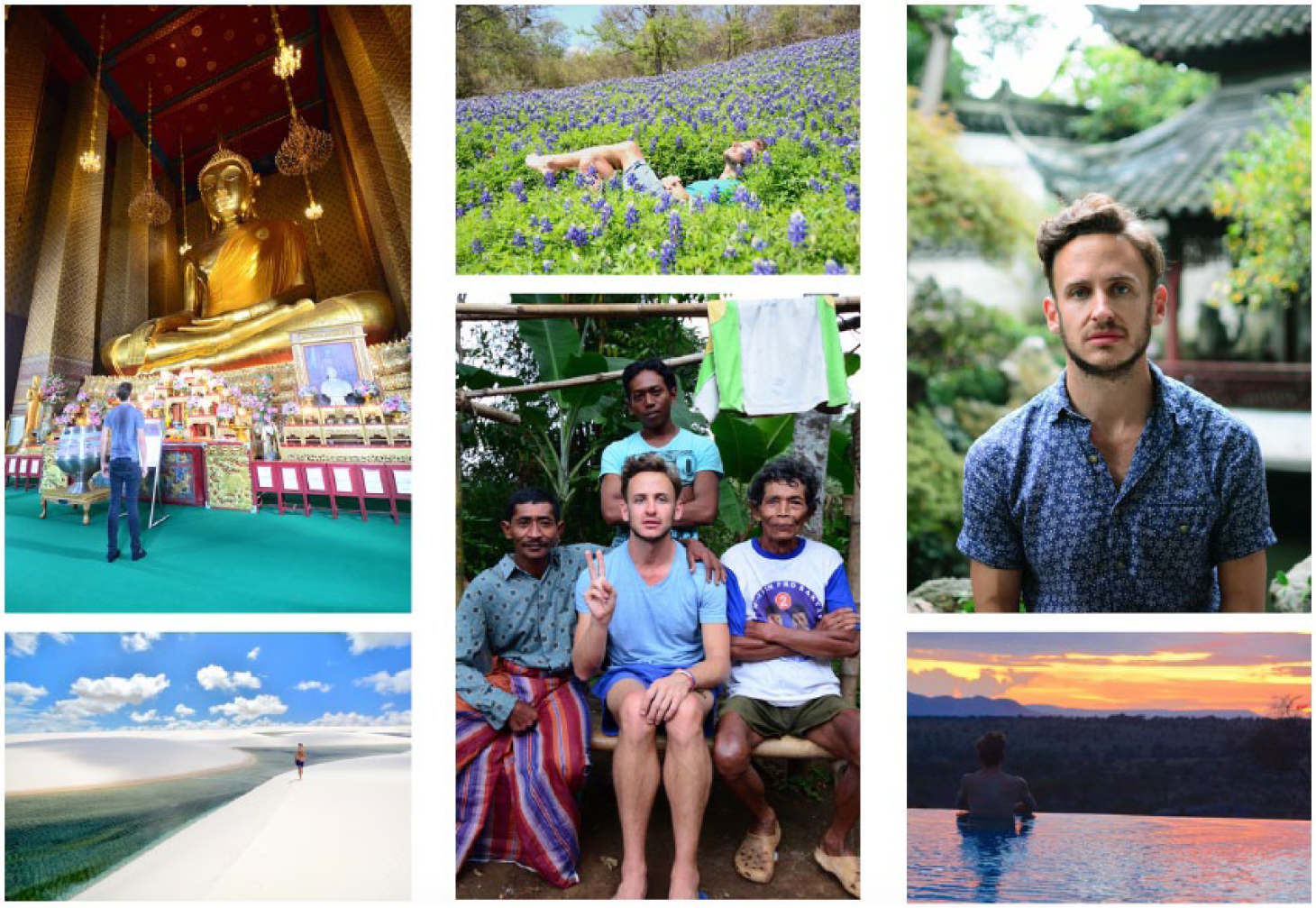
Screenshot from Leave Your Daily Hell’s About page.
Here, the blogger depicts himself as “the ideal travel blogger” for his potential commercial partners. Advertising incitement is given through a compilation of photos depicting different sceneries, resembling typical travel advertisements (deserted beaches, indigenous people, “foreign” culture, and so on). The heavily stylized photos are an important part of the traveler identity: the photographer, here, frames himself as an artist rather than a tourist (cf. Week, 2012) by subscribing to a typical visual language where no other tourists can be seen. The function of these photos is to connect “place to face”; locations are inserted as commodities to increase the value of the marketed self. These representations of waywardness are reminiscent of those on the page of Wandering Trader—yet, while that blog uses pictures to show the reproducibility of a certain narrative (one would be able to do the same if one would start day trading), the voice of this blogger is not aimed at readers but at companies, in order to show his proficiency in the visual codes of global travel. These codes borrow from the register of existential authenticity: the pensive, meditative and carefree indexes in these pictures, spiritual signs and pictures with indigenous people all communicate a sense of waywardness and wholesomeness.
Further to be found on these Advertise, Media, or “Work with me” pages are indications of the kind of audience the bloggers attract and the market value their product holds, often referring to the metrics of industry leading corporations such as Google. Bloggers detail the number of people visiting the blog monthly, offer demographic data, and present social media statistics. Several of them add logos of global brands that they have worked with. Alongside these figures and graphs they offer all kinds of advertising services, such as affiliate links, banners, sponsored posts, reviews, social media campaigns, bespoke content, sponsored trips, contests and giveaways, or speaking engagements. These are all tried and tested business practices of “co-branding” (Blackett, 1999): the blogger’s authorial persona is connected to and reinforces other brands, such as guides, booking companies, and credit cards. And of course, this works both ways: the use of brands involves a vastly complex network of relations determining credibility and social capital, especially in the context of traveling versus tourism (the use of Lonely Planet tour guides, for example, might be regarded as a lack of true expertise when it comes to adventuring). It then comes as no surprise that bloggers show a highly strategic attitude when it comes to being connected to certain brands. There are differences between these bloggers in their willingness and skills to brand their content; Nomadic Matt, for example, explains he attains his resources from affiliate links and travel books. Both are offered on his “travel resources” page. Several links refer to the companies the blogger considers “the best companies out there and the ones that continually offer the best deals.” 47 While Nomadic Matt underscores that the commission he earns for these sponsored links does not influence his judgment, the reader cannot be sure where exactly the authentic meets the brand. In the footer of the page, the author adds that “some of the links above are affiliate links”—meaning it is impossible for the reader to tell whose interests are served with these links, and whether the blogger is offering a service for personal or financial reasons. In a similar vein, Robert from Leave Your Daily Hell promises to “discreetly weave your brand into a relevant article, either new or existing, that engages the full attention of my audience.”
The entanglement of commercial interests in personal stories creates tension: it could potentially cause harm to the credibility of bloggers in the eyes of their readers. Therefore, several blogs contain disclaimers about the compromises that their creators have to make, and make sure to mention/highlight the services that they do not offer. The blogger of Leave Your Daily Hell, when discussing sponsored reviews, adds: “The bad news? I don’t write positive reviews in exchange for money.” The writers of Y Travel Blog state: “Please know that all reviews will be honest … Our readers come first, and it is always our intention to provide them with the best information and honest advice.” 48 Professional travel bloggers tread the fine line between revenues and credibility—all the more so because tourists typically worry about the reliability of the stories they are told, the honesty of their guides, or the friendship of the natives (Lindholm, 2008: 48). To counteract this wariness, authenticity becomes an important selling point, strikingly similar to the ways in which “indigenous” people market their culture and commodities as “real.” The media kit of Uncornered Market provides an example: it explains how the blog offers “long-form articles to plant the seed of purchase in a reader’s mind.” 49 The document consists of 15 slides with detailed information on audience profiles, campaigns, testimonials, and so on. The second to last slide, importantly, merges this marketing voice with one of the authenticity (Figure 4).

Screenshot from Uncornered Market’s Media Kit.
The marketing slogans on the slide integrate words from an authenticity register, such as “depth,” “meaning,” and “experience” into a corporate logic. Especially striking are the last two sentences: they start with “This is what differentiates us,” which is followed by a rather formulaic image: the backlit couple, overlooking a sunset. While the “personal” or “individual” is the key selling point here, it is supposed to be found in a generic, very much culturally recognizable and established imagery. Yet it is important to underscore that this doxic force does not make these personae are any less “real.” As Goffman (1959) puts it,
No claim is made that surreptitious communications are any more a reflection of the real reality than are the official communications with which they are inconsistent; the point is that the performer is typically involved in both, and this dual involvement must be carefully managed lest official projections be discredited. (p. 168)
The point is that the doxic personae on offer here are a specific—and succesful! — presentation of self. This presentation is targeted toward an audience, which on the About page immediately needs to be told what kind of brand and/or person they are dealing with, in order to maximize their attention. How these culturally recognizable personae influence the narratives in the blog itself is a matter to be dealt with elsewhere. What we can surmise now is that existential authenticity offers a powerful and influential representational discourse for introducing the traveling self.
Conclusion
Professional blogging needs to be seen as a paradoxical and complex practice, a convergence of existential sensibilities, doxic imagery, and strategic self-management. In it, we can discern fundamental dissatisfaction with the roles that late modern occidental society provides. Yet, at the same time, the logic of that very society extends into the narratives that are supposed to offer an alternative. Bloggers insert discursive features and doxic, culturally recognizable personae in order to successfully brand themselves. This shows how any meaningful difference between the language of tourism and travel (cf. Dann, 2012; Meshaw, 2005; Robinson, 2004)—in which one refers to an impersonal, commercial language and the other to a personal narrative—becomes impossible to uphold when it comes to professional travel blogs.
The main motive that emerges in these blogs is about attaining a certain type of freedom: the evacuation from a fixed job and home, and renunciation of possessions and luxury. This is much in line with John Urry’s (2011) idea that travel, most importantly, consists of a temporary breaking with the established routines and practices of everyday life, a call to freedom from social requirements. These bloggers make appeals to an abbreviated and curtailed form of existential authenticity; it is not freedom as Heideggerian “thrownness,” which implies and requires both a personal struggle against alienation and an acute sense of responsibility for others. Instead, the responsibility primarily pertains to efficient realization of a certain lifestyle. The recurrence of high education, previous success, or financial stability in the bloggers’ backgrounds is striking in this context, and begs the question whether these global travels are really “available for anyone.” This is of course nothing new: Bourdieu already described the assumption of classlessness in connection to the emergence of a new petite bourgeoisie: “They see themselves as unclassifiable […] anything rather than categorized, assigned to a class, a determinate place in social space” (in Urry, 2011: 105). This is quite contrary to the postmodernist suggestion that in self-branding, successful images and representations are more important than social reality. Moreover, the logic of usefulness, efficiency, and comfort are part of a distinctly middle-class discourse—they coincide, for example, with Franco Moretti’s (2013) keywords of the bourgeois. The persuasiveness of the type of authenticity we encountered—a promise to elevate an already successful life to even loftier heights—should thus be contextualized by a class distinction.
The central tendency of the travel blogger discourse has to do with reconciling two seemingly incompatible lifestyle choices. Bloggers present themselves as regular, everyday people, but also note how they go against the grain. Some note how one can build a career, or have children, and travel the globe. Others accentuate how to travel and save money. Underneath these constructions lies the most important paradox running through professional travel blogs: the ability to both become and sell yourself. The trajectories of existential authenticity and self-branding in this mode of current-day global travel have intersected.
Footnotes
Acknowledgements
The author would like to thank Piia Varis, Odile Heynders, and the anonymous reviewers of Tourist Studies for their valuable feedback on earlier versions of this article.
Declaration of conflicting interests
The author(s) declared no potential conflicts of interest with respect to the research, authorship, and/or publication of this article.
Funding
The author(s) received no financial support for the research, authorship, and/or publication of this article.