



Abstract
This article focuses on two Catholic pilgrimages in Bosnia–Herzegovina in order to analyse the similarities and differences between them with regard to forms of religious tourism and variety of interpretations of pilgrimages. Based on ethnographic data gathered in Bosnia–Herzegovina, the discussion focuses on micro-level processes and their structural frames. Regarding the frame analysis, the article provides an analysis of the tourist, transnational and ethno-religious frames that have shaped and still affect these two pilgrimages, including how they are experienced and interpreted by local pilgrims and the local population within a context of a post-conflict society. The main focus is on pilgrims’ responses to various frames, forms of guiding and definitions of situations which they encounter during their journeys. It is maintained that pilgrims’ responses reveal different interpretations of the frames, which are combined with dynamic impression management and identity switching between roles as pilgrims, guides, tourists and (trans)nationals.
Introduction
A large number of pilgrimage sites exist in the Western Balkans – Christian Orthodox, Muslim and Catholic. This article focuses on the two largest Catholic pilgrimages in Bosnia–Herzegovina. The first is the Virgin Mary pilgrimage in Medjugorje, Herzegovina, and the second is the St. John’s Pilgrimage in Podmilacje, Bosnia. Medjugorje is close to the city of Mostar in southern part of the country. It is a relatively new pilgrimage site but has become one of the largest Catholic pilgrimage locations in the world (Aleksov, 2004; Leutar et al., 2007; Margry, 2009). Podmilacje is near the town of Jajce in central Bosnia and is not as internationally well-known as Medjugorje. Nevertheless, Podmilacje is the second-largest pilgrimage in Bosnia–Herzegovina, after Medjugorje. It is also the oldest Catholic pilgrimage in the country and attracts thousands of pilgrims every year (Osmankovic et al., 2007).
We will compare Medjugorje and Podmilacje in order to analyse similarities and differences between them with regard to forms of guiding, categories of pilgrims and the local populations’ experiences and interpretations of these two pilgrimages. Inspired by previous research (Cohen, 1985; Skrbis, 2005; Stausberg, 2011; Turner and Turner, 1978; Vukonic, 1996) and ideas borrowed from Goffman’s (1956, 1974) ‘dramaturgical analysis’ and ‘frame analysis’, we intend to explore two sets of research questions. First, we investigate which categories of pilgrims and guides are attracted to these two pilgrimages and which roles, motivations and identities dominate their journeys. We will be primarily interested in local and not international pilgrims and guides. Here, it is maintained that local guides and pilgrims have multi-dimensional motivations, interpretations and identities and that the boundaries between different motivations, experiences and identities fluctuate (Stausberg, 2011; Vukonic, 1996). Nevertheless, we believe that it is possible to identify and systematically analyse variations in the forms of guiding, the experiences of journey to the pilgrimage sites and interpretations of the two sites.
Second, we explore how the dynamic of their identity change is influenced by the structural frames. Here, the frame analysis includes several inter-related dimensions, such as the location of the pilgrimage, its history, tourist potential and surroundings. It is also acknowledged that ethno-nationalist divisions and ethno-religious animosities are part of peoples’ realities in post-conflict Bosnia–Herzegovina and that both pilgrimage sites were directly and indirectly affected by civil war. Therefore, our analysis includes the ethno-religious dimension of the structural frame and relates it to local interpretations of the pilgrimages and pilgrims’ self-presentations.
Relevant previous research
A large number of studies on tourism and religion and forms of guiding have been published in the last three decades (e.g. Cohen, 1985; Feldman, 2007; Stausberg, 2011; Timothy and Olsen, 2006; Turner and Turner, 1978; Vukonic, 1996). Some of the previous studies have direct relevance for our article on the two pilgrimages, while the others provide the theoretical frame for our analysis. The previous relevant studies can roughly be divided into two categories. The first category consists mainly of studies on religious pilgrimages in Bosnia–Herzegovina. These studies focus almost exclusively on the Medjugorje phenomenon (e.g. Aleksov, 2004; Leutar et al., 2007; Skrbis, 2005). A single exception in this regard is Osmankovic’s (2007) review of pilgrimages in Bosnia–Herzegovina, which, in addition to discussions about Medjugorje, also includes a short description of the Podmilacje pilgrimage, the Muslim Ajvatovica pilgrimage and other, smaller, Catholic and Muslim pilgrimage sites in Bosnia–Herzegovina. Studies of Medjugorje focus on different topics, such as people’s motives for visiting Medjugorje, the reactions of the political elites regarding the Medjugorje pilgrimage and the Vatican’s view of the phenomenon (Aleksov, 2004; Leutar et al., 2007; Margry, 2009).
Some of above-mentioned studies also include more general discussions concerning different forms of religious tourism and the complexity of roles, motivations and identities of religious tourists and pilgrims which we also may find in studies of pilgrimages undertaken in other countries (Stausberg, 2011; Timothy and Olsen, 2006). In this category, probably the most relevant study for our discussion is made by Vukonic, who was among the first to focus on journeys to Medjugorje. Vukonic proposes a model where he distinguishes between traditional tourist journeys, religious tourist journeys and other forms. He also adds that the distinction between religious and secular tourists contains a variety of motives and people, inter alia those who are more tourists than pilgrims and those who are more pilgrims than tourists (Vukonic, 1996). In Figure 1, we present a version of Vukonic’s (1996) model.
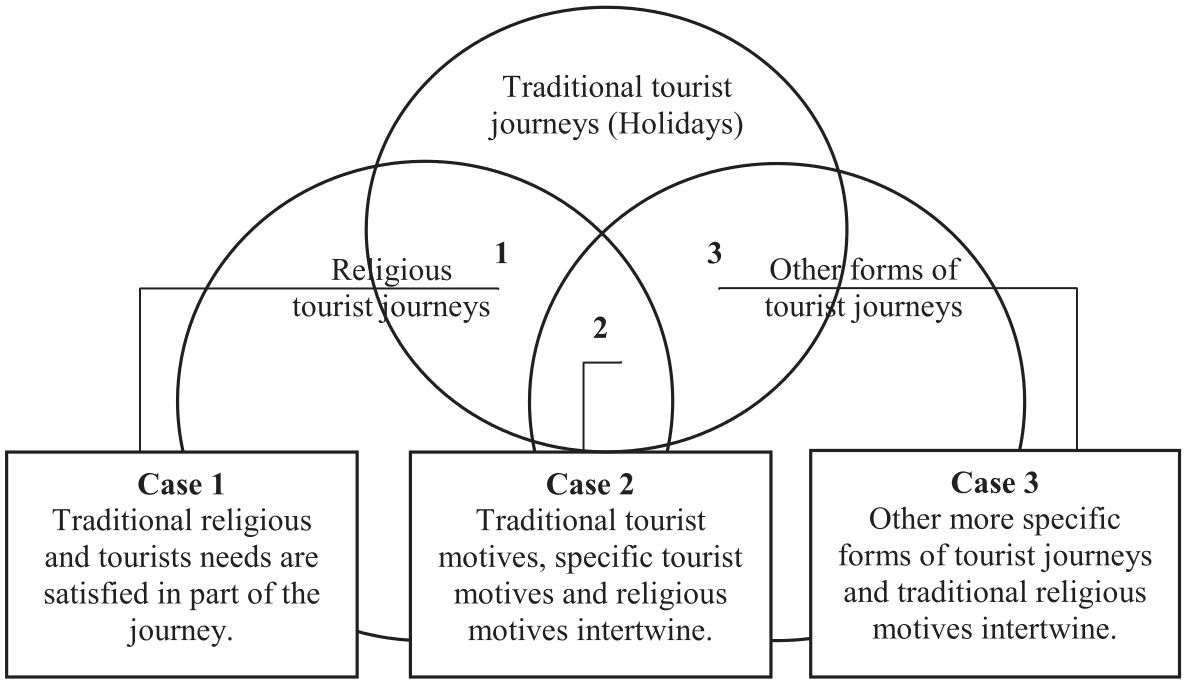
Categories of tourist journeys.
As the model proposes, the secular and religious motives of the tourists intertwine. In a way, the model also follows Turner and Turner’s (1978) suggestion that the boundaries between the tourist and the pilgrim are often blurred and that the behaviour of the traveller may frequently switch from tourist to pilgrim and vice versa (see also Olsen, 2010; Stausberg, 2011; Vukonic, 1996). In line with above-mentioned studies and proposed typologies, we are going to argue that guides and visitors to Medjugorje and Podmilacje switch between different roles, motivations, interpretations and identities.
The second category of the studies that is relevant to this article includes a vast body of contemporary sociological research which suggests that ‘the self’ is not something we are, but an object that we actively construct and perform through daily social interaction with others. In addition, studies suggest that the self and role-taking is also conditioned by more general circumstances and the resources available to it (Cohen, 1985; Goffman, 1956, 1974; Valenta, 2009). We believe that we may analyse how the involved actors deal with their multiple motivations, roles and identities through the use of certain key ideas borrowed from Goffman’s (1956, 1974) dramaturgical and frame analysis such as ‘performance’, ‘definition of situation’, ‘stage’, ‘role-taking’, ‘impression management’ and ‘frames’. Several of these concepts are already used in literature on tourism and pilgrimage. Cohen (1985), in his analysis of the components and dynamics of a tourist guide role, discusses social, instrumental, communicative and other components of the tourist guide role, and how they are involved in the role performance of Professional and Original guides. For example, he points out that Professional Guides through certain components of their performance induce tourists to ‘accept a staged attraction as authentic’ (Cohen, 1985: 26). Adler (1989) and Perkins and Thorns (2001) also use the concept of ‘performativity’ to describe how different categories of tourists perform certain duties and fulfil expectations of the other (Skrbis, 2007), and Feldman (2007) discusses how guiding performances may influence interpretations of a pilgrimage site in a strongly politicized, multi-ethnic context.
Inspired by these studies, we analyse how the frames of interaction, the forms of guiding and the dynamic of role performance of local guides and pilgrims influence, each in its specific way, religious, tourist and inter-ethnic interpretations of the two pilgrimages.
Method
The data for this article were gathered through ethnographic fieldwork. We have travelled to Bosnia–Herzegovina frequently in the last 10 years and have also visited the pilgrimage sites and the surrounding local communities on several occasions. During our visits to the country and the pilgrimages, we gained an extensive understanding of the religious, transnational, tourist and ethnic frames that influence the country and the two pilgrimages. During our visits to the pilgrimages, we had the opportunity to observe and interact with different categories of visitors to the pilgrimage sites. We interacted with local people, in different informal contexts, who have visited the two pilgrimage sites or who are linked to them in one way or another.
These ethnographic data were supplemented by an exploration of a large number of pilgrims’ blogs and other accounts, which provide ‘thick descriptions’ and interpretations of the pilgrimage to Medjugorje and Podmilacje. We have also explored local reports, newspapers, websites and guidebooks which offered and reflected various interpretations of the two pilgrimages and their surroundings. Pilgrims have also shown us hundreds of photographs they have taken during their journeys, and they have discussed them with us. We found that the photographs and the pilgrim accounts related to them were a very important source of information on how the sites are interpreted. Most of the data from local pilgrims and local population were gathered in Bosnia–Herzegovina between 2010 and 2013.
Both data gathering and data analysis were influenced by hypotheses and impressions that we formed during the course of the study. For example, in the early stage of data gathering we gained the impression that the local population and the pilgrims had differing experiences of the two pilgrimages. We were also sensitive to emerging categories of pilgrims. In order to compare the perspectives of different informants and give nuance to the emerging categories we considered relevant to our study, we spoke with walking pilgrims, pilgrims who travel to the pilgrimage by the car and by other means of transport.
We have also included pilgrims to Podmilacje, pilgrims to Medjugorje and those who have visited both pilgrimages. The last group was especially interesting to us since these people compared their experiences of the two pilgrimages. We also spoke with the local population from both Catholic and non-Catholic backgrounds in order to grasp the local interpretations of pilgrimages. In total, we had contact with more than 40 people. The key informants were interviewed several times.
Description of the context
The concept of ‘frames’ may be associated, according to Goffman (1974), with external structures that organize people’s interpretations of everyday experiences. As Snow (1986) points out, frames are ‘schemata of interpretation’ that ‘organize experience and guide peoples’ actions in various situations’ (p. 464). The Medjugorje and Podmilacje pilgrimages are embedded in complex external structures and frames which may influence peoples’ experience and interpretations of the two sites. In this section, we shall focus on several aspects of frames, including the recent history of the pilgrimages and their tourist infrastructure.
Recent history and development of the two pilgrimages: similarities and differences
In Medjugorje, during 1981 a group of local children allegedly saw an apparition and spoke with the Virgin Mary. Shortly after, the first groups of pilgrims, primarily from the local Croat Catholic population started to visit Medjugorje (Aleksov, 2004). Since Medjugorje was located in the area regarded by the Yugoslav Communist authorities as a Croatian nationalist stronghold, they suspected the alleged apparitions in Medjugorje of being another expression of Croat anti-Communist sentiments and Croat nationalism (Aleksov, 2004). Therefore, the Communist authorities responded by repression; they banned the religious gatherings and arrested and imprisoned local priests who supported the development of Medjugorje pilgrimage. However, since 1985 the authorities gradually started to change their stance towards the pilgrimage, recognizing its economic potential. In the late 1980s, Medjugorje became a large Catholic pilgrimage site attracting hundreds of thousands of pilgrims from around the world. From then on to the present, religious tourism to Medjugorje has become an integral part of the Yugoslav, and later the Bosnian–Herzegovinian and Croatian, tourist industry. During the 1990s ethnic conflict, Medjugorje was not directly affected by the civil war, but the number of religious tourists declined in the early 1990s. Since the war, Medjugorje has become one of the largest Catholic Marian pilgrimage destinations in the world and it is claimed that more than 40 million people have visited Medjugorje since 1981. 1
While Medjugorje is an internationally well-known pilgrimage site, the St. John’s Pilgrimage site in Podmilacje in Central Bosnia has never achieved such international success. It is estimated that 100,000 people visit the St. John’s pilgrimage site in Podmilacje every year – a relatively small number compared to Medjugorje, where the estimated number of visitors is between 1 and 2 million (Osmankovic et al., 2007). However, Podmilacje has a much longer tradition and is probably the oldest pilgrimage site in Bosnia–Herzegovina. It is believed that the church at the site originates from the fifteenth century. The pilgrimage has been known for centuries and attracted believers, primarily Catholic but also those from other religions, who came to pray for the sick and in hope of healing (Osmankovic et al., 2007).
The two pilgrimages also differ in other ways. For example, Medjugorje attracts large numbers of pilgrims worldwide throughout the year but the largest gatherings arrive on 25 June, while the St. John’s pilgrimage site does not attract large groups of pilgrims through the year except on 23 and 24 June, when tens of thousands of people visit the site.
Medjugorje has been the subject of controversy from its very inception and is associated with ethno-nationalist sentiments (Aleksov, 2004; Skrbis, 2005). Unlike Medjugorje, the St. John’s pilgrimage site in Podmilacje has not been seen as controversial. It is located in an area which was known as a Partisan-Communist stronghold during World War II (WWII). Since it had a long tradition and was located in a multi-ethnic and multi-conventional area, the Yugoslav Communist regime did not associate Podmilacje with anti-Communist and nationalist sentiments. However, during the civil war in 1990, ethnic groups in the area (Croats, Serbs and Bosniaks) were involved in severe conflict and the St. John’s pilgrimage fell victim to nationalist sentiments. The site was attacked and destroyed by Bosnian–Serbian forces who occupied the area in 1992. The conflict also resulted in atrocities and the forced migration of local population. In 1995, Serbian forces were pushed out of the area and away from the pilgrimage site, and in 2000 the church was rebuilt, helping the shrine to regain its status as the country’s second-largest pilgrimage centre (Osmankovic et al., 2007).
The largest proportion of pilgrims to Podmilacje consists of local Catholic pilgrims. Traditionally, large numbers of pilgrims to the St. John’s pilgrimage were Catholic pilgrims who walked to Podmilacje from different municipalities, which may be dominated by Serbs and Bosnian Muslims. On the other hand, Medjugorje attracts a much more diverse group of visitors; a large proportion of visitors are foreigners who combine the pilgrimage with summer vacations at the Adriatic coast and visits to secular tourist attractions.
Podmilacje is scarcely advertised internationally, while a great number of specialized tourist services and agencies around the world advertise trips to Medjugorje as a part of their tourist services or as their speciality. One can find Medjugorje societies and groups all over the world, as well as magazines and bulletins that, often via the Internet, plan, guide and advertise Medjugorje pilgrimages. This large and complex ‘tourist machinery’ results in various types of visitors, religious tourists and pilgrims and in a variety of international, local, religious and secular forms of guiding. In the following sections, we will identify types of visitors and guides and discuss how some of the described structural frames are related to their multiple motivations and to the interpretations of the two pilgrimages.
Types of visitors and the roles they perform
Recall the model we presented earlier in the article. In what follows, we associate case 1 presented in the model (see Figure 1) with individuals who combine religious journey with traditional tourism, that is, those who combine holidays at the Croatian coast with a visit to Medjugorje and specific visits to the Old Bridge in Mostar. Case 2 in the figure may be associated with people who combine a visit to Medjugorje or Podmilacje with holidays at Croatian coast and their regular transnational practices. We associate case 3 in Figure 1 with people who combine hiking through the Bosnian countryside and wilderness with a religious pilgrimage to Podmilacje. In what follows, these three cases will be discussed and compared.
Medjugorje: self-presentations and roles of visitors and guides
Pilgrims’ actions, including their identity performances during their pilgrimage to Medjugorje and Podmilacje, are influenced by the sites’ tourist frames, ethno-religious and transnational frames. One important element of Medjugorje’s growth as a pilgrim destination is the close cooperation between local and international actors, who work with religious travel agencies and the secular tourism industry to offer various sorts of visits to Medjugorje. We can thus distinguish between several categories of local and foreign visitors and pilgrims to Medjugorje. Inspired by Vukonic (1996), we call the first category of pilgrims to Medjugorje ‘traditional religious pilgrims’ that are ‘more pilgrims than tourists’. These visitors to Medjugorje often arrive via tour groups organized by associations and religious tourist agencies. Another category of traditional religious pilgrims are those who walk to Medjugorje from neighbouring municipalities. Others travel to Medjugorje by bus, some of them from neighbouring countries, via organized bus trips with passengers and guides who emphasize the religious aspect of the journey (Delakorda, 2012; Halemba, 2011).
We can distinguish between professional and non-professional guides, religious and secular tourist guides, foreign and native guides, and so on (Stausberg, 2011). Some groups of pilgrims to Medjugorje include priests and ‘spiritual leaders’ who directly or indirectly function as guides and organizers of the journey. 2 These people are affiliated with the church and contribute to define pilgrimage. Delakorda (2012), who participated in a bus pilgrimage from Slovenia, describes the role of these sacral ‘guides’ in this way:
The leader encouraged us to open our hearts with Rosario Prayer and openly speaking about out motives for making the pilgrimage … Upon arrival at Medjugorje a Slovenian representative of the Franciscan order offered us a greeting and noted that we should behave in Catholic way as good pilgrims. (p. 11)
When in Medjugorje, native/local professional guides affiliated with the local tourist guide association take over and guide some of the pilgrims. This category of guides contributes to religious experience since they are meant to lead visitors to God (Delakorda, 2012; Dugandzic, 1999). Delakorda indicates that on their journey home, pilgrims are encouraged by the guides/spiritual leaders to discuss ‘the spiritual fruits’ of their pilgrimage. As a result, the traditional religious pilgrims maintain their identity as genuine pilgrims and devout Catholics through the largest part of the journey (Delakorda, 2012; Halemba, 2011). Yet, there are also exceptions here. Some traditional religious pilgrims, for example, those who come from other continents, often stay for several days in Medjugorje. These people often combine religious pilgrimage with short trips to the Croatian coast and the city of Mostar. Indeed, an important aspect of the frame that influences the dynamic of identity change in people who visit Medjugorje is the proximity of the Croatian coast and tourist hot-spots such as Dubrovnik, the Makarska Riviera and Split. Consequently, some people who visit Medjugorje are ‘more pilgrims than tourists’, while others are ‘more tourists than pilgrims’ (Vukonic, 1996). The latter category spends their summer holidays at the Croatian coast, which attracts millions of tourists each year. These ‘traditional tourists’, who are spending their summer holidays at the Croatian coast, can drive to Medjugorje in a few hours.
To summarize, we propose several categories of people among visitors to the pilgrimages including ‘religious tourists’ and ‘traditional tourists’ and the mentioned nuances or ‘mixtures’ of the two categories. Within these categories we find members of the Croatian and Bosnian–Croatian diaspora, who combine visits to their home country with a summer holiday at the Croatian coast. We will discuss this category in more depth later in the article, but first we want to clarify the link between the local variations in the ‘definition of the situation’ and the above-mentioned dynamic of visitor identity switching.
Definition of situation and identity switching
According to Goffman (1956, 1974), the frames of interaction, including the ‘definition of situation’, have an impact on peoples’ performances. Goffman claims that actors involved in interaction will usually try to maintain the existing definition of the situation. 3 The actors will avoid disruption of this ‘interactional modus vivendi’ (Goffman, 1956: 21) through careful adjustments of their performance, which he calls ‘the techniques of “impression management”’ (p. 203). Different frames and different definitions of situation result in dynamic and flexible performances among pilgrims. While they are in Medjugorje, the ‘religious tourists’ participate in various religious activities and gatherings, including visits to people who allegedly have continuous apparitions and contact with the Virgin Mary, but during their stay in the area their identity work includes oscillations between the identity of the traditional tourist and the identity of the genuine religious pilgrim. As we already noted, many of the guided tours offered to tourists at the Croatian coast are formed as traditional tourist trips, in which Medjugorje is one of several destinations to visit during a short 1- to 2-day visit to Bosnia–Herzegovina. Different locations have different histories and offer different itineraries and tourist attractions, along with different guiding. This, in turn, produces specific definitions of situations. These definitions of situation influence tourist interests and consumption among the aforementioned categories of visitors. Different definitions of situations during the journey also result in role-switching of various types of the tourists and pilgrims.
At this point, we should stress that the types of journeys, tourists and pilgrims defined by Cohen and Vukonic should not be regarded as fixed categories but as Weberian ideal types (Olsen, 2010). Tourists do not have fixed motivations for their trips, but shift roles and motivations according to places, people and experiences at the trip (Olsen, 2010; Stausberg, 2011; Vukonic, 1996). Indeed, ‘traditional tourists’ appear as ‘religious pilgrims’ as they conform to definitions of situation and itineraries enhanced by the religious majority in Medjugorje and the aforementioned categories of guides. They purchase religious souvenirs and visit sacral places together with ‘genuine’ religious pilgrims. Some also participate in the Mass and join guided tours to the ‘hill of apparitions’ although they told us that they did not consider themselves particularly religious. Similarly, ‘religious pilgrims’ adjust their role play according to situation during the same trip. For example, while they are in Medjugorje they embrace the role of devoted believers including praying the Rosary, participation in Mass and climbing the way of the cross and stopping and praying at each station. However, pilgrims do not have a problem with shifting roles. After their departure from Medjugorje, many visit Dubrovnik and Mostar where Catholic religious tourists become curious secular tourists. They visit the Old Bridge in Mostar and other tourist attractions and engage in secular tourist consumption including participation in guided tours offered to any other secular tourists.
How can these role shifts be related to forms of guiding and actions of the guides? It seems that guides go through equivalent shifts. If the above-mentioned destinations are included in the same itinerary, which they often are, the guides who were with pilgrims in Medjugorje go through a similar role change. They switch from religious to secular forms of guiding and guide pilgrims into local secular tourist consumption which sometimes may also include cooperation with local secular guides in Dubrovnik and Mostar. These people also visit Muslim religious sites as secular tourists since the itineraries of guided tours in Mostar usually include visits to the Muslim-dominated part of the city and visits to the Old Bridge and old Turkish houses and buildings including Karadjoz bey’s, Koski-Mehmed Pasha and the seventeenth-century Tabacica mosque.
At this point, it should be noted that Mostar is still a politically and ethnically divided city where the one side of the city is dominated by Bosniaks (Muslims) and the other by Croats (Catholics). The tensions between Croats and Bosniaks are still high, and on several occasions religious symbols were used in boundary making between the groups. 4 Nevertheless, it seems that the above-mentioned visitors seldom become part of the ethno-religious tensions that destabilize the city of Mostar owing to the flexibility in their performance adjustments to different situations. We have the impression that the local non-Catholic population of Mostar does not perceive pilgrims through the local, ethno-national frame. 5 The locals experience most visitors primarily in the role of ‘traditional tourists’, and as such, they are welcomed because they contribute to the local economy through their tourist consumption.
Pilgrims and guides in St. John pilgrimage in Podmilacje
Who visits the St. John pilgrimage in Podmilacje? Who guides the pilgrims, and how do they respond to various frames? According to Cohen (1985), ‘a tourist system can be conceived as having a touristically well-developed central region, surrounded by touristically poorly developed peripheral areas’ (p. 24). Medjugorje, together with the Adriatic coast and city of Mostar, belongs to the central region of the tourist system with a large variety of visitors, organized tours and professional guides. The St. John pilgrimage in Podmilacje clearly appears as a peripheral area which attracts a much smaller number of pilgrims. As we have already mentioned, most pilgrims in Podmilacje are Croats from the region and it seems that the largest proportion of visitors to Podmilacje may be categorized as ‘traditional religious pilgrims’. Within this general group, we can distinguish between those who come by bus and car and those who walk to the pilgrimage. We also differentiate between those who travel short and long distances. Among those who drive, we find not only local residents but also many Bosnian emigrants, who live in neighbouring countries and combine visits to relatives with visits to the St. John’s pilgrimage on 23 and 24 June.
Indeed, it is striking how many cars with foreign plates arrive at the St. John’s pilgrimage to participate in religious gatherings held on 23 and 24 June. The identity of visiting Bosnian emigrants, their participation in pilgrimage and their visits to the area in general may be understood within religious, ethno-national and transnational frames (Skrbis, 2007; Valenta and Strabac, 2011). Several studies indicate that migrants visit pilgrimage sites in their homeland as a part of their transnational practice and diaspora tourism (Frey, 1998; Skrbis, 2007; Stausberg, 2011). 6 Among many different forms of migrants’ transnational activities, such as sending remittances, house-building projects in homeland and frequent telephone and Facebook contact with friends and relatives in Bosnia (Valenta and Strabac, 2011), Bosnian migrants also frequently visit their home country. During their visits, many participate in various cultural and religious gatherings that contribute to define local communities and maintain solidarity between community members, including those who stayed and those who left. Those who left, but who frequently visit the area, are embedded in complex local networks and have multiplex relations with the locals. They are engaged in various forms of transnational exchange with non-migrants (Valenta and Strabac, 2011), and oscillate between several self-presentations, religious and secular, depending on different frames of interaction; the role of devoted Catholic and pilgrim is only one of these.
Walking pilgrims
For the local population of Central Bosnia, probably the most visible pilgrims are those who walk to pilgrimage in Podmilacje from different parts of Bosnia. This form of pilgrimage often requires long hiking trips and sleeping in tents. Some of the pilgrims walk barefoot for parts of the journey in order to heighten the merit of their pilgrimage. Although we can categorize most of the walking pilgrims as ‘traditional religious pilgrims’, it seems that for many pilgrims in this category this form of pilgrimage is not only a religious experience since they can also switch between religious and secular roles during their journey. We met several pilgrims who defined themselves as devout believers and frequent churchgoers and who walk to St. John’s pilgrimage each year. Using Vukonic’s (1996) typology, we would place most of these people into the ‘traditional religious tourists’ category, and our impression is that they are ‘more pilgrims than tourists’. Yet, when asked what motivated them to take the 2-day walking trip to Podmilacje, some pilgrims implied that walking the pilgrim paths through Bosnian mountains and villages was worth the trip itself. The people we spoke with also indicated that some of the walking pilgrims are also active members of various secular mountaineering and hiking associations and frequently participate in other, religious and secular, hiking trips. In these cases, it would be difficult to distinguish which of their interests, motivations, identities and roles was the most prominent – the interests of a devout Catholic or a passionate hiker. For example, it was difficult for several pilgrims we met to decide what was more valuable, that is, the physical effort of walking to the Podmilacje or attendance in the Mass at the pilgrimage site. However, it should be noted that the above-mentioned fluidity of motivations, roles and interpretations of the pilgrimage is not unique for Podmilacje as Crain’s (1992) study on La Rocca and Frey’s (1998) on Compostela have shown.
According to the typology and the model we presented earlier in the article, a more specific form of tourist journey and set of traditional religious motives intertwine; the interests and behaviour of the traveller may frequently switch from tourist to pilgrim. We argued that the dynamic of switching can be analysed with the help of interactionist theory (Goffman, 1956, 1974). Different definitions of situations and different aspects of the frames also influence the dynamics of identity switching along the pilgrim–hiker/tourist dimension. For example, during their hiking to Podmilacje, walking pilgrims take photos of themselves and the scenery and act as any other secular hikers would. When they arrive at the pilgrimage site, they take selfies and subsequently again take the role of devoted believers and participate in the variety of religious rituals that the site offers.
Furthermore, the frames, including changes in definitions of the situation during the journey as well as relationships with other people and locations, also influence the dynamics of identity switching along the pilgrim–guide dimension. Cohen argues that professional guides operate in the central region of the tourist system and that informal, local guides operate on the periphery of the system. According to him, ‘these locations in the system endow each with his distinguishing role-profile’ (Cohen, 1985: 25). Indeed, unlike the Medjugorje pilgrimage, which is supported by a large and well-established tourist and guiding infrastructure that produces ‘a staged domesticity of Medjugorje’ (Skrbis, 2007: 326), the Podmilacje pilgrimage is mainly based on informal forms of guiding. Most pilgrims are insiders, in one way or another, and are familiar with the area. However, many prefer to travel with more experienced pilgrims who take the role of non-professional guides and pathfinders in specific situations. Although the walking pilgrims rely on informal guiding from more experienced pilgrims, this does not mean that such forms of non-professional guiding do not require certain skills. When the situation calls for these skills, the guide identity of the most experienced fellow pilgrims is actualized and their knowledge and behaviour contribute to the definition of situation and interpretations of the pilgrimage. At this point, we should note that the pilgrimage to Podmilacje often includes walking through the areas, town and villages that were severely affected by the civil war.
Owing to the war and the ethnic cleansing which was part of it, large areas of Bosnia are still depopulated or full of mines. Both the Catholic and non-Catholic populations encountered by pilgrims on their trip have experienced atrocities and ethnic cleansing. For walking pilgrims, it is necessary to interact with these people. Among other things, locals may provide pilgrims with updated information on roads and suitable resting sites as well as where they can refill their water and food supplies. Inexperienced walking pilgrims may be unsure how the villagers should be approached. Experienced pilgrims have already established relations with villagers and know how to deal with them, and often take the role of guides when necessary. Through friendly interactions with local non-Catholic population, these informal guides contribute to inclusive inter-ethnic interpretations of the pilgrimage.
Local interpretations of Podmilacje
Most of the above-mentioned aspects of switching have already been described extensively in studies on walking pilgrims (see, for example, Frey, 1998). While we shall not elaborate on this debate further, we intend to focus on local ethno-religious interpretations of the two pilgrimages. Can we see differences in experiences and interpretations when we compare Podmilacje with Medjugorje? Most of the Podmilacje pilgrims we met have also been in Medjugorje. When asked to compare these two pilgrimage sites, they emphasized the informal and interpersonal dimensions of the Podmilacje pilgrimage. Indeed, the contrast between informal, on one hand, and institutionalized and commercialized, on the other, is striking. Medjugorje has more than a hundred professional guides affiliated to the local tourist guide association. It also has a large number of restaurants, hotels, apartments to rent and souvenir shops.
How do informal forms of guiding influence local interpretations of Podmilacje? Podmilacje does not have any tourist facilities and the pilgrims rely on self-help and informal guiding. Pilgrims, who want to sleep and rest at the pilgrimage site, have to use their sleeping bags and tents, and if they need food, fruit, beverages and souvenirs, they can buy them from street sellers at temporary stalls. These factors make the Podmilacje pilgrimage appear less organized, a more traditional and local site, in contrast to what Skrbis (2007) calls the Medjugorje’s tourist industry’s superficial and staged intimacy and domesticity.
What is the ethnic frame of Podmilacje pilgrimage and what are the local ethno-national interpretations of St. John’s pilgrimage in Podmilacje? The conversion of Croatian nationalist discourse and Medjugorje apparitions which Skrbis (2005) indicated in Medjugorje was not evident in Podmilacje. On the contrary, we gained the clear impression that, in the local frame of interpretation, Podmilacje is seen as an inclusive pilgrimage site. Podmilacje pilgrims whom we interviewed did not link St. John’s pilgrimage in Podmilacje with their ethno-national sentiments. Furthermore, the ethnic symbols, including Croatian flags, are not visibly displayed in Podmilacje, in contrast to their frequent display in Medjugorje. Although the pilgrimage site and the church at the site were destroyed by the Serbian forces during the civil war, it seems that pilgrims, guides, pathfinders and the local priests emphasize the multi-ethnic character of the pilgrimage. Mass media coverage also places emphasis on St. John’s pilgrimage and its attraction not only to Catholics but also Bosnians from other religious communities. Last but not least, Podmilacje pilgrims claimed that they have never experienced interactions with the local non-Catholic population as problematic. According to pilgrims, the local non-Catholics whom they encountered during their journeys were either helpful or indifferent. It seems that the local Bosniaks and Serbs do not associate these pilgrims with Croatian religious nationalism but see pilgrimage as an inherent part of local culture and tradition.
In sum, it seems that St. John’s pilgrimage in Podmilacje, including the thousands of pilgrims who walk through multi-ethnic and multi-religious areas, towns and villages, does not contribute to ethnic tensions in the area. Rather, we obtained the impression that the positive experience of the journey and interactions between pilgrims, informal guides and locals remind people of their long multi-ethnic and multi-religious common history. In these local frames of interpretation, the pilgrimage may enhance inter-ethnic contact and may contribute to reducing inter-ethnic animosities and post-conflict tensions that are still evident in Central Bosnia.
Local interpretations of Medjugorje
How do ethno-national frames influence interpretations of the Medjugorje phenomenon? According to Halemba (2011), there are several interpretations of the Virgin Mary’s pilgrimage in Medjugorje. In line with Skrbis (2005), she distinguishes between national, transnational and cosmopolitan experience of the pilgrimage. The national experience of Medjugorje seems to have both parochial and ethno-nationalist character (Bax, 2000; Halemba, 2011; Skrbis, 2005). Skrbis (2005) described how Medjugorje apparitions have been closely related to Croatian religious nationalism and used in Croat war propaganda. According to him, Medjugorje is seen by Croats as a ‘Croatian apparition’ where Croatian national symbols are combined with religious symbols (Bax, 2000; Skrbis, 2005). Skrbis (2005) points out that ‘Croatian and religious iconography’ have melded together (p. 454). Indeed, pictures of pilgrims who visited Medjugorje as late as 2011 indicated that the front facade of the church in Medjugorje was still covered by a large flag of the para-state ‘Herceg-Bosna’. 7 We have also met Croats who regularly visit Medjugorje and who claimed that ‘Medjugorje is the religious and spiritual heart of Herceg-Bosna’.
On the one hand, the Medjugorje phenomenon may be seen as a factor that indirectly contributes to maintaining tensions between ethno-religious groups in Bosnia–Herzegovina. Yet, it cannot be denied that Medjugorje also possesses a universalistic Christian appeal which is strongly emphasized by the priests and its religious ceremonies are frequently held simultaneously in several languages by priests from all over the world. According to Halemba (2011), these international religious performances indicate Medjugorje’s transnational and cosmopolitan character. Indeed, the international character of the Catholic community and the Catholic Church is emphasized and celebrated in Medjugorje. The shrine undermines parochial sentiments, and one might claim that international pilgrims ‘bring the world’ and development to an area that initially was backward and underdeveloped. Yet, it can also be argued that, in its local, Croatian frame of interpretation, the aforementioned transnational and cosmopolitan ‘emotional unity with national difference’ indicated by Halemba 8 does not include other local, non-Croat populations. Indeed, in its local Croatian ethno-national frame, the pilgrimage may actually contribute to maintaining the boundaries between the groups. In this local frame of ‘cosmopolitan’ interpretation, the ‘in-group’ includes Croats and all other Catholics of the world, while the ‘out-group’ includes local Bosniak (Muslim) and Serbian (Christian Orthodox) populations. In other words, from the local point of view, Halemba’s argument that transnational emotional unity ‘undermines the alleged solidity of national project’ 9 may seem too optimistic.
How do guides influence local interpretations of Medjugorje? It seems that guides tend to combine the above-mentioned ‘cosmopolitan’ and ‘national’ interpretation of the pilgrimage, but through careful ‘impression management’ aim to avoid provocation and conflicts in inter-ethnic encounters. At this point, we should note that the religious nationalism is not necessarily directly translated into daily interactions with the mentioned out-groups when taken out of the site’s local frames. We maintain that oscillations between local interpretations of the site, including the visitor’s own identity displays and role-taking, depend considerably on the definition of the situation and people with whom he or she interacts. Medjugorje is placed in West-Herzegovina, which is a Bosnian Croat nationalist stronghold, and several of our Croat and non-Croat informants still associate the area with Croat nationalism. However, the pilgrimage site does not seem to be often discussed or criticized by other groups in Bosnia–Herzegovina. We acknowledge that religious and Croatian forms of iconography have combined in Medjugorje, as Skrbis (2005) argues. However, the ethno-religious expressions and iconography do not necessarily directly provoke the local, non-Croat population as they are usually displayed and performed ‘back stage’ 10 (Goffman, 1956). Croatian pilgrims and guides will adjust and moderate their performances in encounters with local, non-Croat others, especially when they are outside their majority frame. For example, we observed on several occasions how visitors to Medjugorje become more sensitive regarding the display of their national sentiments and ethno-religious markers when they were in areas dominated by other ethnic groups. Our general impression is that most Bosnians, including Bosnian Croats who have strong nationalist sentiments, usually restrain from nationalist and racist statements in inter-ethnic encounters. Through such ‘impression management’, local people, both guides and pilgrims, avoid awkward situations in a Bosnian post-conflict environment. Such general demeanour, combined with the regular switching between role performances of pilgrim, guide and tourist, contributes to reducing conflict levels in inter-ethnic face-to-face interactions during the journey to and from the pilgrimage site.
Conclusion
In this article, we developed a frame analysis of the two largest pilgrimage sites in Bosnia–Herzegovina. Two central arguments were stated. First, it was argued that the two pilgrimage sites had different tourist and multi-ethnic frames. Second, it was maintained that the structural frames of the two sites produce different forms of guiding, local interpretations and attract different categories of visitors. While both pilgrimages attract local, Catholic populations and Bosnian–Herzegovinian migrants who visit the country as a part of their transnational practices, only Medjugorje can be characterized as an internationally well-known pilgrimage that attracts visitors from all over the world. Medjugorje has also a large tourist potential and attracts pilgrims and tourists, many of whom combine visits to Medjugorje with secular forms of tourist activity such as visits and holidays at Croatian coast. In other words, Medjugorje appears as a touristically well-developed central region and Podmilacje as the periphery of the system.
As Medjugorje became an internationally well-known pilgrimage, it also developed its infrastructure and tourist networks. The machinery of Medjugorje’s tourist industry includes a variety of itineraries and forms of guiding, and multiple categories of visitors catalyzed through tight international connections between the pilgrimage site, the Church and the secular tourist industry. In contrast, St. John pilgrimage in Podmilacje is a traditional type of pilgrimage which primarily attracts people from the region. Compared with Medjugorje, the tourist and guiding potential of Podmilacje remains an underdeveloped periphery of the system. However, Podmilacje appears as a more traditional and authentic site with more informal itineraries.
Our frame analysis and dramaturgical analysis of Medjugorje and Podmilacje also support a more general argument concerning the ‘fluidity of tourist identity’ posed in previous studies on religious tourism. While previous studies focus primarily on ‘multi-motivational mix of tourist aspirations’ (Vukonic, 1996: 60), this article used the interactionist concepts of ‘definition of situation’ and ‘impression management’ and related them to tourist, transnational and multi-ethnic Bosnian–Herzegovinian frames. It is maintained that Medjugorje is an international and transnational pilgrimage, but with parochial and exclusive ethno-religious local interpretations. Podmilacje is a regional pilgrimage but appears to have more inclusive ethno-religious local interpretations.
It is also acknowledged that differences between systems’ central regions and peripheries are also clearly expressed in different forms of guiding (Cohen, 1985). In the well-developed central region of the system, which includes Medjugorje, Mostar and the Adriatic coast, various categories of professional guide contribute to the smooth accomplishment of the pilgrimage and reproduction of its staged authenticity. In the poorly developed periphery of the tourist system, in Podmilacje, there is an absence of professional guides, but it is clear that local, non-professional guides and pathfinders contribute to the authenticity of the St. John pilgrimage. Through their role performance and local knowledge, they also mediate its image as traditional pilgrimage, which still stands out as an inherent part of local multicultural tradition.
This article may be of general interest to scholars working with frame analysis and issues related to links between the definition of situation, forms of guiding, role-taking performances and the self. Last but not least, the article may also be of interest to researchers concerned with ethno-religious tensions and pilgrimages that are located in post-conflict societies. We have focused on the dramaturgical nexus of ethno-religious, tourist and transnational frames of post-conflict societies using two Christian, Catholic pilgrimages as case-studies, but it may be equally relevant to use a similar approach in analysis of non-Christian pilgrimages. For example, many Muslim pilgrimage sites, both those of international significance (such as Al-Aqsa mosque in Jerusalem and Hala Sultan Tekke in Cyprus) and smaller, local ones such as Ajvatovica in Bosnia–Herzegovina, are embedded in complex multi-ethnic frames.
Footnotes
Funding
The author(s) received no financial support for the research, authorship and/or publication of this article.