



Abstract
This article analyzes encounters with tourism promotional materials as acts of legitimation. I argue that legitimation constitutes an integral part of tourism promotion as communicative act. Through legitimation, producers of promotional materials affect and persuade the viewers of those materials, transforming desires and engendering tourism activities. Tourism promotion therefore constitutes a micro-social interaction between producer, viewer, and materials, and much of the “work” done through this interaction can be analyzed as legitimation. Drawing on recently developed frameworks for semiotic and discourse analysis, I examine a set of promotional brochures and websites published in Qiandongnan, a region in southwest China.
Introduction
The expansion of the global tourism industry has brought with it a proliferation of tourism promotional materials. While such promotion occurs increasingly in the online world of websites and social media, the basic elements of more traditional print and video advertising remain: texts, images, and sounds displaying the people and places to be encountered by any would-be traveler. Due to the spatial distance separating the potential traveler from their destination, mediated promotion remains highly important in selling tourism to people who may not have first-hand, embodied experience with the forms of tourism in question. Promotion therefore remains integral to the operation of tourism in its various contexts and guises.
Promotion’s role in the tourism industry has stimulated hundreds of scholarly analyses, ranging from positivistic attempts at improved marketing (e.g. Baloglu and McCleary, 1999; Beerli and Martin, 2004; Blain et al., 2005; Buhalis, 2000; Doolin et al., 2002; Middleton, 1988) to critical deconstructions of the power relations embedded in and furthered by tourism discourse (e.g. Ateljevic and Doorne, 2002; Morgan, 2004; Pritchard and Morgan, 2000, 2001; Yan and Santos, 2009). While these analyses generally agree that tourism promotion influences the world, they conceptualize this influence in a variety of ways, ranging from acts of individual persuasion to broader processes of socialization or commodification. In this article, I develop one such conceptualization, arguing that much of the “work” done by tourism promotional literature can be analyzed as a process of legitimation. Legitimation is a key aspect of tourism promotion, in which the producer of the promotional materials, the readers or viewers of the materials, and the materials themselves interact in micro-scale social event, and through which producer and materials affect and persuade readers or viewers. A focus on the micro-level textual practices and strategies of legitimation, I suggest, allows for attunements to the work of tourism promotion as situated, diverse, and complex.
In the remainder of the article, I first review existing studies of tourism promotional literature, after which I discuss my key concept of legitimation. I then lay out a framework for analysis of legitimation from Van Leeuwen and Wodak (1999), Vaara et al. (2006), and Van Leeuwen (2007), and conduct a case study of tourism brochures and websites from Qiandongnan, a region in southwest China.
Tourism promotional literature
Tourism promotion occurs through a range of materials, including websites, brochures, guidebooks, magazines, public advertising, and television programs. A review of the tourism studies literature reveals numerous analyses of such promotional media, with varying yet overlapping conceptualizations of the “work” that it does.
One conceptual strand focuses on how materials “produce” and “reproduce” place and landscape, the contexts for tourism (e.g. Bickford-Smith, 2009; Cloke and Perkins, 1998; Johnston, 2006; Larsen, 2006; Morgan, 2004; Young, 1999). In general, this strand’s notions of “production” analogize the process by which tourism sites become comprehensible and meaningful for tourists. Place production, notes Young (1999), is bound up with processes of selling travel destinations, aiming to construct “a mythology designed to appeal to and attract tourists” (p. 375). Other studies similarly theorize tourism promotion as a process of cognitive or affective “destination image” formation (e.g. Baloglu and McCleary, 1999; Beerli and Martin, 2004; Chon, 1990; Fakeye and Crompton, 1991; Garrod, 2009; Gartner, 1993). Cloke and Perkins (1998), however, argue that representations of tourism places also have a role “far beyond” persuasion, in that they stimulate an “imaginary construction of reality” that allows tourists to “begin their attempts to understand that place” (pp. 187–188). Tourism promotion, in other words, is a means through which sites acquire significance, both as travel destinations and as places more generally.
A second strand focuses on how materials contribute to the commodification of places (e.g. Cloke and Perkins, 2002; Dorsey et al., 2004; Hall, 1997; Hopkins, 1998; Selwyn, 1993). This process, notes Hall (1997), is closely related to, if not synonymous with, the process of place production: “Places are now commodities to be produced and consumed” (p. 65). As with the aforementioned production of place, commodification of tourism sites involves a process of myth-making. Tourism commodification, argues Hopkins (1998), requires the production and spread of “ideals and images” that give “meaning, identity, and value to a particular brand of place” (pp. 78–79). These myths, however, are as much negative as positive, in that they also obscure the “commonplace character” of places, hiding elements that might detract from idealized representations. In other words, it is a certain image of a place that is advertised and consumed, rather than a place per se.
A third strand focuses on how the imagery of promotional materials is reproduced through tourists’ own photography and videography (e.g. Caton and Santos, 2008; Garrod, 2009; Jenkins, 2003; Stylianou-Lambert, 2012; Urry, 1990). Urry (1990) describes a “hermeneutic circle” whereby places seen by visitors in promotional media photographs become objects of travel and further photography: What is sought for in a holiday is a set of photographic images as seen in tour company brochures or on TV. While the tourist is away, this then moves on to a tracking down and capturing of these images for oneself. (p. 140)
These place images then return to tourists’ homes where they are shown to other potential tourists, and the circle begins anew. One function of tourism promotion, then, is its own self-reproduction, with the images of promotional media being replicated and spread away from formal promotional channels.
A fourth strand focuses on how materials build and maintain forms of identity, including gender identity (e.g. Caldas-Coulthard, 2008; Pritchard and Morgan, 2000; Sun and Luo, 2015), class identity (e.g. Thurlow and Jaworski, 2006; Thurot and Thurot, 1983), national identity (e.g. Bhattacharyya, 1997; Nelson, 2005; Pritchard and Morgan, 2001; Waitt, 1997), ethnic identity (e.g. Ateljevic and Doorne, 2002; Bruner, 1991; Buzinde et al., 2006; Yan and Santos, 2009; Yang, 2011), cultural identity (e.g. Holman, 2011), and racial identity (e.g. Mellinger, 1994). Such studies generally argue that representations of tourists and/or host populations tend to assign and strengthen beliefs about identities of their social groups. As with place production, this process is often described in terms of meaning-making (e.g. Bruner, 1991: 240; Nelson, 2005: 134) or the creation of mythology (e.g. Pritchard and Morgan, 2000: 891; Waitt, 1997: 48). Bhattacharyya (1997) argues that tourism discourse functions to “mediate” relationships between hosts and guests, offering a “cognitive framework” through which others are perceived (p. 342). For many analysts, however, this identity construction does not merely facilitate meaningful tourism experiences but also reinforces relations of power and domination between the groups represented by tourists and hosts (e.g. Pritchard and Morgan, 2000, 2001).
Studies of tourism literature have therefore taken up a wide range of theoretical and analytic frameworks. The analysis in this article accords most closely with an additional conceptual strand, one focusing on how tourism promotional literature persuades individual actors to become tourists or enact tourist activities through linguistic or other communicative strategies. Chalfen (1985) calls for “attention to how holiday or tourist brochures ‘work’ as part of a communication system,” and urges analysts to “study the communication system that allows tourist brochures to be meaningful to participants” (p. 104). Dann (1992), for instance, describes a number of “sociolinguistic techniques” by which promotional literature manages unfamiliarity for tourists, techniques including the use of simile, metaphor, and local languages (p. 60). Mocini (2005) similarly identifies a list of “linguistic devices” used by brochures, including isotopies and imperative statements (p. 154). Others locate the persuasive power of tourism literature in the use of “emphatic and highly evaluative” language (Gotti, 2006: 27) and the use of “hyperbolic language and glamorous images” (Ip, 2008: 4). Such formulations emphasize tourism promotion’s power of persuasion while putting analytic focus squarely on the encounter between tourists as “active participants” and the promotional literature (Chalfen, 1985: 104). This is not to say that such literature is isolated from discourses of place or identity, but rather to focus on the way such discourses are contextualized and interpreted in particular communicative acts (Rojo and Van Dijk, 1997; Vaara et al., 2006). In this article, I build on these ideas through the application of the concept of legitimation to the analysis of tourism promotional literature.
Legitimation
As part of his theory of “social semiotics,” Van Leeuwen (2005) proposes that we treat text and imagery as “semiotic resources” rather than signs, arguing that the effects of writings and images always stem from how they are used rather than simply what they mean. Semiotic resources, he argues, have semiotic potential, defined as a “potential for making meaning,” that is theoretical and/or actual: In social semiotics resources are signifiers, observable actions and objects that have been drawn into the domain of social communication and that have a theoretical semiotic potential constituted by all their past uses and all their potential uses and an actual semiotic potential constituted by those past uses that are known to and considered relevant by the users of the resource, and by such potential uses as might be uncovered by the users on the basis of their specific needs and interests. (Van Leeuwen, 2005: 4)
Van Leeuwen compares the concept of “semiotic potential” to Gibson’s (1979) concept of “affordance,” in that each describes entities as having potential uses which nevertheless depend on “[users’] needs and interests and on the specifics of the situation at hand” for actualization. Meanings, in other words, are “both objective and subjective” (Van Leeuwen, 2005: 4–5).
The following analysis consists of my response to the text and imagery I encounter in the case study. It is thus an account of their actual semiotic potential in the particular context of my encounter and only a gesture toward their full theoretical semiotic potential, which, as I will argue below, is both heterogeneous and constantly evolving. This actual semiotic potential emerges from the intersection of the words or images in the materials and the memory and knowledge of the reader or viewer of those materials. Charles Sanders Peirce (1958) refers to such memory or knowledge as “collateral observation” or “collateral information,” defining it as “previous acquaintance with what the sign denotes” (pp. 136–137). Peirce’s semiotic system resembles Van Leeuwen’s in distinguishing between objective theoretical meaning based on common usage as a sign, what he calls the “Immediate Interpretant,” and subjective actual meaning based on the history of a particular interpreter, what he calls the “Dynamical Interpretant.” Peirce’s (1958) Dynamical Interpretant, however, denotes the interpretative act itself, the “actual effect” the sign has on its interpreter, rather than its actual interpretive potential (p. 211). As Knudsen et al. (2016) note, “meaning” for Peirce “is many things—a thought, a sensation, an emotion” and “is also a thing that puts us in motion” (p. 247). Instead of rooting actual interpretive potential in the interpreter’s knowledge of “past uses” of signs, as Van Leeuwen does, Peirce roots this potential in the interpreter’s collateral information, what Michelle Metro-Roland (2009) describes as that which “one can bring to bear on the process of interpreting” (p. 274). This collateral information, Metro-Roland (2009) argues, comes more broadly from interpreter’s history and experience with what the sign signifies, rather than simply from their knowledge about usage of the sign, thus giving Peircean semiotics an account of “cultural context” richer than that of social semiotics (pp. 271–272). Following from this, we can reformulate the concept of “actual semiotic potential” as a potential for dynamic interpretation constituted by collateral information.
I therefore, in encountering promotional text and imagery from Qiandongnan, bring to bear not only a knowledge of the Chinese language but also information such as memories of visits to Qiandongnan and other travel experiences, information which becomes an element of interpretive acts. The role of the sensing body in tourism activity, as Knudsen et al. (2016) argue, makes more-than-linguistic knowledge or “embodied habit” particularly important as collateral information for the interpretation of tourism advertising (p. 46). The bearing of collateral information, moreover, makes promotion an individualized, particular act: “Peircean collateral observation is an individual’s cache of tacit, doing-based knowledge and codified, written knowledge.” Knudsen et al. (2016) thus conclude that collateral knowledge is “partly individual” and “partly held in common” (p. 47). Presuming that, despite shared knowledge, no two individuals’ experiences and memories of the world are exactly alike, their collateral knowledge and interpretative acts cannot be exactly alike either.
In this case study, the semiotic potential I examine is that of legitimation. In their seminal work The Social Construction of Reality, Berger and Luckmann (1966: 110–122) theorize the role that legitimation plays in social institutionalization. Defining legitimation as an “objectivation of meaning,” they see its function as the maintenance of the “institutional orders” of societies through the bestowal of “cognitive validity” and “normative dignity” on those orders and, conversely, the prevention of meaningless and chaos. In addition, it shapes the individual as a “mode of being” within those societies and ensures that their identity is perceived as correct. Legitimation therefore both orders societies and socializes individuals to operate correctly within societies. For Berger and Luckmann, the actual processes constituting legitimation are diverse, including such practices as explanations, proverbs, histories, and mythologies.
Drawing on Berger and Luckmann’s ideas, Van Leeuwen and Wodak (1999) and Van Leeuwen (2007) further develop the concept of legitimation as an element of communication. Van Leeuwen (2007) defines legitimation as that which “adds the answer, sometimes explicitly, sometimes more obliquely, to the question ‘Why’—‘Why should we do this?’ or ‘Why should we do this in this way?’” (p. 93). His use of the pronoun “we” gestures toward a social conception of legitimation, and he refers to the object of legitimation as “social practices.” Rojo and Van Dijk (1997) take up similar ideas but with a particular focus on legitimation as a “higher level sociopolitical act” carried out by and for groups or institutions (p. 531). Analyzing the speech of a government official, they refer to their analysis as showing the relations between “micro” linguistic acts and “macro” sociopolitical processes. These and other conceptualizations of legitimation therefore highlight the social context in which they occur and are effective.
Vaara et al. (2006) similarly define legitimation as “micro-level textual practices and strategies” used to “(re)construct senses of legitimacy/illegitimacy” and to “persuade and convince” (p. 791). Following Fairclough’s (2003) ideas about discourse analysis, they call for attention to “concrete discursive practices and strategies” rather than already established legitimacies (Vaara et al., 2006: 793). Vaara et al. echo Berger and Luckmann in characterizing legitimation as a means to institutionalization, and note the links between micro-level textual practices and macro-level ideologies. They argue, however, that attention to micro-level processes reveals legitimation to be a “temporal, context-specific, ambiguous, and even contradictory phenomenon” (Vaara et al., 2006: 791). Analyzing media accounts of a corporate merger, they find that journalism often adopts multiple perspectives and contrasting values in its attempts to legitimize organizational processes. In this conceptualization, legitimation is less a unified achievement and more a multivocal, fragmented, and contested process. While macro-level social context structures the process of legitimation, attunement to specific legitimation strategies and practices suggests that this structuring occurs through diverse actors with conflicting interests.
A focus on legitimation as micro-level textual practice therefore allows the analyst to treat the reception of promotional literature as a social event (Fairclough, 2003: 8), a micro-social interaction between producer (the person who creates the promotional literature), literature product (brochures or websites), and receiver (the person who reads or views the promotional literature), through which the producer and product legitimize various acts of tourism. Events, in other words, occur not only at the level of systems or social groups but also at the level of individual encounters and interactions. The latter level is highly relevant in tourism advertising, which, in contrast to texts which legitimize the actions of texts’ producers or the groups or institutions they represent (e.g. Rojo and Van Dijk, 1997), aims largely to legitimize the potential tourism practices of individual readers, practices such as movements, activities, and purchases. While producers are among tourism promotion’s interactants, they generally remain hidden from receivers who encounter promotional literature (Knudsen and Rickly-Boyd, 2012: 1253).
A focus on legitimation also allows the analyst to treat the event of reception as transformative, in the sense that legitimation in tourism literature is persuasive at an affective and cognitive level, arousing responses in those who read or view it and engendering the acts of tourism being legitimized. Franklin (2004) argues that “tourism is not just what tourists do at tourist sites, it is also how they came to be created as tourists,” and calls for attention to “where [tourist] desire originates from” (p. 278). Encounters with promotional literature constitute one such origin of desire, engendering actions and orientations through both cognitive and affective dimensions. Peirce (1958) refers to this engendering of action as the sign’s “Final Interpretant,” the third step following from the Immediate Interpretant and the Dynamical Interpretant (p. 139). This Final Interpretant, however, is not “final” is the sense that it is fixed, because the unending increase of collateral knowledge ensures that interpretation is always evolving (Knudsen et al., 2016: 247). The bearing of collateral information, moreover, implies that tourism promotion is not a one-way process of symbolic inscription, during which tourists, as MacCannell (2011: 50–53) claims, are separated from “their own pleasure” by misleading yet irresistible fantastical images. Fantasies are built out of “real” world experience (Van Leeuwen, 2005: 103), and tourism fantasies must be recognizable to be meaningful (Rickly-Boyd et al., 2014: 65). Legitimating literature does not “predestine” tourists’ desire (MacCannell, 2011: 183), but rather continually transforms it in interaction with situated readers bringing to bear particular collateral information. Memories of promotional materials, moreover, are also incorporated into readers’ collateral knowledge and brought to bear on later interactions with tourism sites (Knudsen and Rickly-Boyd, 2012; Metro-Roland, 2009).
Following from this focus on legitimation as event and process, we can reformulate Berger and Luckmann’s concept of legitimation as the maintenance of institutional “orders” and speak instead of legitimation’s contribution to diverse tourism “orderings” of objects and processes, orderings which are both contingent and precarious (Franklin, 2004; Van der Duim, 2007; Van der Duim et al., 2013). Legitimating materials interact with tourists, hosts, sites, and other entities acting in particular contexts of space, time, knowledge, and desire, and its effects depend on these contextual factors (Fairclough, 2003: 8). These actions as Final Interpretants are never stable but always evolving. This contextuality implies that legitimation is not a transmission of information or imposition of action identical for all other individuals within a sociopolitical sphere. It is not imposed homogenously on a receptive society but is rather an event of encounter involving receptive but agentive individuals with collateral knowledge borne out of particular histories.
What I aim to illustrate here is tourism legitimation as this contingent process of individualized encounter and interpretation. To foreground this contingency, I only analyze my own reading of and reaction to the promotional materials. Some examples of the collateral information that was brought to bear as I encountered the case study materials are mentioned in the analysis below. This method is not necessary for an analysis of legitimation, which can involve any number of variously situated receivers, but it is sufficient for such an analysis. On one hand, analyzing multiple receivers of legitimating materials can aid in getting a perspective on different stores of collateral information that could be brought to bear or on different understandings of tourism sites derived from promotional materials. There is undoubtedly a much wider range of knowledges, discourses, memories, and habits that could be brought to bear on these materials by receivers other than me, in particular those pertaining to aspects of a “common” Chinese culture such as medicine and literature. In theory, there is even a full theoretical potential embodied at any given moment in the sum of all possible receivers of the materials, albeit a constantly evolving potential. On the other hand, this potential does not imply any fully homogenous set of collateral information or understandings shared across Chinese or other societies that is more accurately described by increasing the sample size of analysands. Analysis of multiple receivers of tourism promotion, moreover, does not get one closer to the legitimating nature of promotional activity, which is necessarily situated, unstable, and constantly evolving.
Legitimating materials also point toward the complexity of tourism’s interactions through their representation and legitimation of all manner of tourism elements and relations. Inasmuch as tourism is a “social” practice, promotional materials such as those from Qiandongnan suggest that we might reconfigure the social of tourism to include buildings, foods, animals, forms of transportation, and so on (Latour, 2005; Van der Duim et al., 2013: 8–9). The tourism engendered by such materials therefore constitutes a heterogeneous and shifting set of practices, and the ways those materials legitimize tourism express that heterogeneity and instability.
Forms of legitimation
In addition to their conceptualization of legitimation, Van Leeuwen and Wodak (1999) develop a methodological framework for the analysis of legitimation in texts and other forms of communication, and other scholars develop or extend this framework in various ways (e.g. Vaara et al., 2006). Analysts have taken up these frameworks in a number of different case studies, including studies of education materials (Van Leeuwen, 2007), news media (Fitzgerald and O’Rourke, 2016; Maier, 2011; Vaara et al., 2006; Vaara and Tienari, 2008), political cartoons (Mazid, 2008), political speeches (Oddo, 2011; Reyes, 2011; Rojo and Van Dijk, 1997), and visa applications (Van Leeuwen and Wodak, 1999). Here, I apply it in a study of tourism promotional literature.
According to Van Leeuwen (2007: 92), there are four primary types of legitimation. First is authorization, or “reference to the authority of tradition, custom and law, and in persons in whom institutional authority of some kind is vested.” Authorization, in other words, confers legitimacy “because so-and-so says so” or “because this is what we have always done” (Van Leeuwen, 2007: 94). Dann (1996) identifies a similar strategy of “testimony,” the use of known personalities to “lend support” to advertising, as a key element of tourism promotion (p. 176). Authorization in tourism materials includes references to official tourism site designations, quotes by authority figures, popular understandings, literary works, and past visits by other travelers.
Second is moral evaluation, or “reference to value systems.” Evaluation confers legitimacy through the linking of activities to moral value systems. Van Leeuwen (2007) argues that such value systems “not made explicit and debatable” in texts but are “only hinted at” through language which “triggers a moral concept” (p. 97). He further distinguishes between “cultural” moral orders and “natural” moral orders, referring to evaluation through reference to natural moral orders as “naturalization” (Van Leeuwen, 2007: 99). In this case study, I include aesthetic evaluation within the category of moral evaluation, recognizing aesthetic values such as beauty, pastoralism, and sublimity as key elements of tourism promotion and activity (Rickly-Boyd et al., 2014: 64–66). Examples of evaluative language in tourism materials include adjectives, adverbs, or analogues (metaphors or similes) which characterize various elements of tourism practice and suggest a quality of goodness or desirability for these elements.
Third is rationalization, or “reference to goals and uses of institutionalized social action.” Van Leeuwen (2007: 101) describes rationalizations as “purpose constructions” based on a logic of means and ends, while Vaara et al. (2006: 800) describe them as reference to the “utility or function” of some action. Van Leeuwen further distinguishes “instrumental rationalization” or the achievement of goals from “theoretical rationalization” or the restoration of a natural order. The latter, he argues, involves claims that particular actions are “appropriate to the nature of [their] actors” (Van Leeuwen, 2007: 104). Rationalization involves the linking of two processes in a conditional or causal relationship, in which the enactment of one process, some activity, precipitates the enactment of another process, the achievement of an objective or state. In tourism materials, this is often a matter of linking tourism activities to beneficial outcomes.
Fourth is mythopoesis, or “reference to narratives whose outcomes reward legitimate actions.” Van Leeuwen (2007) notes that mythopoetic legitimation occurs through stories in which protagonists either are “rewarded for engaging in legitimate social practices” or encounter “unhappy endings” for engaging in illegitimate practices (pp. 105–106). Mythopoesis, in other words, is a narrativized form of evaluation, rationalization, or normalization offering examples of how and why actions are legitimate or illegitimate. Tourism materials, for instance, include stories of visitors who are rewarded in various ways for visits to tourism destinations.
Vaara et al. (2006) separate out Van Leeuwen’s concepts of naturalization and theoretical rationalization and bring them together as a fifth type of legitimation, normalization, or “reference to normal or natural functioning or behavior” (pp. 797–798). Normalization, in other words, simply attempts to “render” something as “normal or natural.” Tourism promotional materials often claim the capacity of tourism to restore a natural state of being or furnish a natural environment. Such claims, according to much tourism studies scholarship, stem from tourists’ search for “authentic” objects, sociality, or selfhood, a search driven by the alienation they experience in modern or capitalist societies (MacCannell, 1989; Rickly-Boyd, 2012; Selwyn, 1996; Wang, 1999). Contemporary society, in other words, violates the normal functioning of human individuals or groups, and tourism represents a vehicle by which to return them to this normal functioning. Following from this conceptualization, legitimation by normalization becomes particularly pertinent as an element of tourism promotion.
Many uses of Wodak and Van Leeuwen’s framework focus on texts, and my focus here is largely on texts as well while briefly extending the analysis to imagery. I identify and analyze all five types of legitimation in the text and imagery of a set of eight brochures and websites from Qiandongnan. These brochures and websites, I argue, do not only signify various elements of tourism such as activities or places but also legitimize tourists’ enactment or encounter of those elements.
Tourism in Qiandongnan
Tourism has a long history in China, but state-initiated political, economic, and social reforms in the period since the founding of the People’s Republic of China (PRC) in 1949 have precipitated the development of tourism in new directions. Between 1949 and 1978, the PRC regime, according to Sofield and Li (1998), was “unaccepting of tourism as a form of economic activity,” developing it instead as a means to justify and preserve their political power (p. 369). During this time, the regime tightly restricted entry into and movement around the country, and state-provided tours for foreign visitors focused on displaying the “material achievements of communism.” After 1978, policies of “reform and opening up” initiated under the leadership of Deng Xiaoping precipitated a shift away from socialist development strategies and toward capitalist ones, resulting in both changes in and expansion of China’s tourism activity. Although such activity continued to promote the PRC regime, planners increasingly oriented tourism development toward the pursuit of economic profit in the new market economy. The economic growth that followed the post-1978 reforms, meanwhile, contributed both to increasing investment into the tourism industry and to increasing disposable income among PRC citizens (Nyíri, 2011: 5); the latter has stimulated the growth of the domestic tourism market, and a World Travel & Tourism Council (WTTC, 2016) report claims that 88 percent of spending on tourism in China in 2015 came from domestic visitors.
The PRC state, however, has maintained its involvement in the country’s tourism industry, and since 1993 there have been a number of national-level campaigns aimed specifically at promoting the development of tourism (Airey and Chong, 2011: 173). Such campaigns have occurred not only at the national level but also at regional levels such as the province. Tim Oakes (2000) claims that such regional campaigns have received a particularly strong impetus in China’s poorer inland regions. Jenny Chio (2011) also notes the recent occurrence of state campaigns aimed specifically at promoting tourism development in rural areas of China. National and regional tourism promotion efforts, meanwhile, have contributed to a proliferation of new promotional literature seeking to attract visitors to China’s various tourism destinations and sites (Nyíri, 2011: 11–14).
My case study focuses on tourism literature from Qiandongnan, a mountainous prefecture in China’s Guizhou Province. This study emerges out of a larger project on tourism in Guizhou for which I conducted fieldwork in 2012 (Bratt, 2014); that larger project itself grew out of a 1-year stint working as a teacher in Kaili, the capital of Qiandongnan. Government agencies and businesses in Qiandongnan have followed national trends and increasingly promoted tourism development in the post-1978 period. According to Oakes (1998), during the 1980s, the PRC state designated both nature parks and farming villages inhabited by the prefecture’s various minority groups as tourist sites in Qiandongnan. Initial tourism promotion efforts by the Qiandongnan government concentrated on “ethnic tourism” in minority villages, and Qiandongnan drew a large percentage of its visitors from outside China. Since the 1990s, though, Oakes (2011) claims that many villages in Guizhou, including those of Qiandongnan, have become increasingly popular tourism destinations for China’s urban residents. Today, the types of tourism destinations advertised for and visited by tourists in Qiandongnan vary widely and include sites such as hot spring resorts, canyons, and historical towns. Despite this diversification, destinations continue to be concentrated in outdoor, rural sites promoted in terms of their distance from China’s crowded and polluted urban centers.
All eight brochures and websites analyzed in the following section were published by local government agencies in Qiandongnan and were first collected and/or viewed in 2012 and 2013. I selected these somewhat arbitrarily from a larger pool of materials I encountered during this time. The key criteria for their selection were that they each have a relatively large amount of text and that, in the case of some materials that advertise individual counties within Qiandongnan, they represent geographically diverse areas of the province (Figure 1).

Promotional materials for two counties within Qiandongnan: Congjiang Travel (Congjiang County Bureau of Travel) and Danzhai Travel (Danzhai Bureau of Travel).
Analysis
A few passages illustrate the various modes of legitimation enacted in Qiandongnan’s promotional materials. The brochure Congjiang Travel (Congjiang County Bureau of Travel) contains an introductory text introducing tourism in Congjiang, a county of Qiandongnan: 千峰竟秀、河流纵横,造就了一派秀美、雄奇,险幽的自然景观 … 从江是一片尚未受到污染的净土,是远离喧嚣修复人类疲惫心灵的最后家园和天然氧吧,是返璞归真、回归自然的乡村体验旅游胜地。从江正以“原生的民族文化,原始的自然生态,远古的历史烟尘” 欢迎来自海内外的嘉宾! Numerous peaks and criss-crossing rivers create a beautiful, magnificent, and secluded natural landscape … Congjiang remains an unpolluted pure land, a place to escape noise and restore tired souls, a natural oxygen bar, a rural travel experience for returning to the genuine and the natural. Congjiang’s “original minority culture, primeval natural ecology, and ancient historical traces” welcome guests from near and far!
Like many other forms of tourism promotion, this passage legitimizes Congjiang as tourism destination in terms of its cultural, historical, and spatial distance from modern life. It rationalizes such tourism by reference to the restorative effects of silence and clean air, and memories of China’s polluted and crowded urban centers appear in my mind. It elicits aesthetic concepts of beauty and sublimity, an effect reinforced by juxtaposed images of water and mountains. Images of karst landscapes I had seen in other media imagery and in classical Chinese painting quickly come to mind here. The passage also normalizes the space in terms of a “natural” moral order of authenticity and purity and implies human belonging within this order by describing movement into that space as a return. Such normalization is apparent in other passages as well, such as this one from the website Congjiang County Travel (Congjiang County Bureau of Travel, 2013): 人与土地的脱离是现代人的一种畸形,一种病态,而且还是一种危机和大悲剧的根源 … 弗洛伊德的文明哲学是对的,因为他认为,在文明化的价值和人的本能要求之间存在着一种永恒的、不可避免的冲突。正因为有这种冲突,所以城市人就向往着乡村,想看看原生态的东西。 The division between humanity and the land is a kind of abnormality and pathology, as well as a kind of root cause of crisis and tragedy … Freud’s philosophy of civilization is correct, as he believed that civilization’s values and human instincts exist in perpetual, unavoidable conflict. Because of this conflict, urban residents long for the countryside, and wish to see the world’s original ecology.
In this passage, authorization comes in the form of psychoanalytic expertise, analogizing urban life as illness and disaster while naturalizing the rural as the site of proper human functioning.
Other authors are more positive toward cultural activity, as in this passage from the website Danzhai Travel (Danzhai Bureau of Travel, 2013), describing a festival held in Qiandongnan’s villages: 据说,翻鼓节是由古代的鼓藏节演变而来的,每年春、秋各过一次。翻鼓节期间,各地都要组织跳铜鼓舞、斗牛、跳芦笙、跑马、斗鸟、对苗歌等活动,方圆村寨的亲朋好友和群众前来庆贺,人山人海,非常热闹。翻鼓节,既是祭祀祖宗、迎接春天、祈祷丰收的节日,也是人们联欢娱乐、交友寻偶的节日。 It is said that the drum festival evolved from the ancient guzang festival, occurring once every spring and autumn. During the festival, many places organize activities such as drum dances, bull fighting, lusheng dances, horse racing, bird fighting, and Miao songs. Family and friends from all around the village come to celebrate, and the crowds make it extremely lively. The drum festival is also a time to worship ancestors, greet the spring, and pray for good harvests, as well as a time for enjoyment and meeting friends.
In this instance, the passage authorizes the festival by reference to its status as an ancient and regular tradition. Rather than that of seclusion, the moral value system embodied here is one of sociality and hospitality, with the local population highlighted as active participants in the proceedings. Aesthetic values also emerge through allusions to sensory qualities of sound and motion as part of the festival experience. I have visited these festivals before, and visual and aural memories of those visits come to mind. Another passage from Congjiang Travel (Congjiang County Bureau of Travel) describes an activity combining cultural and restorative attributes: 洗药浴是从江瑶族同胞的传统习俗,药浴既可健身、洁体,又可防病、治病。在瑶寨,家家户户都有两只大木桶,一只专供药浴用,另一只用来接盛自来水。瑶寨人们用楠竹做水枧,把泉水从山上引到家里 … 药浴后,全身大汗淋淋,消除疲劳,舒精活络,一身轻松。 Medicinal bathing is a traditional custom of the Yao people, and is able to build physical fitness, cleanse the body, and prevent and heal diseases. In Yao villages, every home has two wooden tubs, one for bathing and one for holding fresh water. The Yao use bamboo to make soap, and draw spring water from mountain tops … After bathing, the entire body drips with sweat, fatigue is eliminated, vitality is calmed, nerves are activated, and one is entirely relaxed.
This passage offers an explicit rationalization of a tourism activity as a means to bodily health and relaxation, while simultaneously authorizing that activity as a form of local ethnic tradition and normalizing it in terms of its rural location and usage of natural materials. While I have not taken a Yao bath, I can imagine what is described based on similar experiences.
Aesthetic evaluation often occurs through passages of parallel prose, with short, detailed portrayals of landscape elements coming in quick succession. The following lines come from the website Original Ecology Qiandongnan (Qiandongnan People’s Government, 2013): 龙鳌河两岸,仙石妙生,洞奇险性,摩石莫测,绝壁诡谲,风景奇异。 Along both sides of the Longao River are fantastic rocks, dangerous caves, unpredictable stones, treacherous cliffs, and strange landscapes. 境内沟壑纵横,谷深千米,山势巍巍,野岭叠翠。 Within this area are crisscrossing ravines, deep valleys, lofty mountains, and remote peaks.
The use of successive four-character phrases in these passages follows a long tradition of syntactic parallelism in Chinese-language landscape poetry and travel writing (Chang, 1986; Hargett, 1989; Plaks, 1988). Such passages are also replete with adjectives triggering aesthetic or moral values. A notion of sublimity, for instance, emerges from these lines’ references to danger, treachery, and remoteness. As I read, I envision a river passing through a narrow gorge. A line from Congjiang Travel (Congjiang County Bureau of Travel) elicits a more pastoral aesthetic: 而江岸两边草地青青,牛儿悠闲,卵石莹莹; 远方山峦如游龙走蛇,古树参天,梯田叠叠,榕荫映寨,让人只身仙境人间。 Along both sides of the river are green grass, relaxing oxen, and sparkling pebbles; distant mountains like dragons and snakes, ancient trees reaching to the sky, terrace fields layering on top of one another, a village resting in the shade, all compelling people to stay in this paradise.
Apart from the detailed description of the landscape, a reference to the site as “paradise” offers a moralizing analogue for the site as a whole.
Other passages from Qiandongnan promotional materials structure their texts as first-person narratives describing the authors’ visits to sites. On the website Guizhou Qiandongnan (Qiandongnan Prefecture Bureau of Travel Development and Scenic Spot Management, 2013), for example, the author describes a visit to a rural village, narrating the journey to the site and various activities undertaken there before concluding with the outcome of the visit: 一派温馨而美好的田园风光,一座宁静而朴素的古村落,一幅美丽而动人的水墨画,我醉了 … 从相识到相知,从相知到别离,我离开西江苗寨已经数月了,在繁华都市的阑珊灯火中,我总是情不自禁地想起那令人心醉的黔东南千户苗寨。 A warm and beautiful rural scene, a peaceful and simple ancient village, a beautiful and moving ink painting, I’ve become intoxicated … From acquaintance to friendship, from friendship to farewell, I’ve already been away from Xijiang Village for several months, and, in the dim lights of the bustling city, I can’t help but think of that intoxicating village in Qiandongnan.
This author includes many acts of legitimation similar to those mentioned above, including moral values of authenticity and aesthetic values of beauty and the picturesque. As the conclusion to a longer narrative, the passage can also be read as mythopoetic, showing how a visit to the village rewards the author with feelings analogized as intoxication and friendship. This portrayal of self-transformation at the end of the passage thereby construes the activities described in the rest of the passage as legitimate actions.
Imagery also works in tandem with text to legitimize Qiandongnan tourism in various ways. One page from the brochure Rongjiang (Figure 2, left) has a tagline “Return to the East” above several photographs, including one of a smoke-filled cluster of wooden houses surrounded by forest, one of a man with a dozen dead fish strapped to his head, and one of people standing alongside decapitated oxen heads. Reference to the “East” as the destination of return functions as normalization, evoking notions of oriental authenticity and a capacity to restore an authentic state of being. The prominence of earth tones conjures a mood of naturalness, the dark tinges of the photographs suggest seclusion, and the displays of dead animals as attire and ritual objects trigger concepts of exoticism. At the same time, the forest landscape feels familiar, and I recognize the clothing and architectural styles from previous experiences in Qiandongnan. Another page, from the brochure Qiandongnan Travel (Figure 2, right), advertises a white-water rafting site. Photographs evaluate the rafting experience as alternatively calming and exciting. Participants’ facial expressions rationalize the experience in terms of outcomes of joy or fear, and I empathize based on prior experiences. The page’s text legitimizes the activity through reference to the natural healing capacity of the water, giving further meaning to the water splashing in the photos.
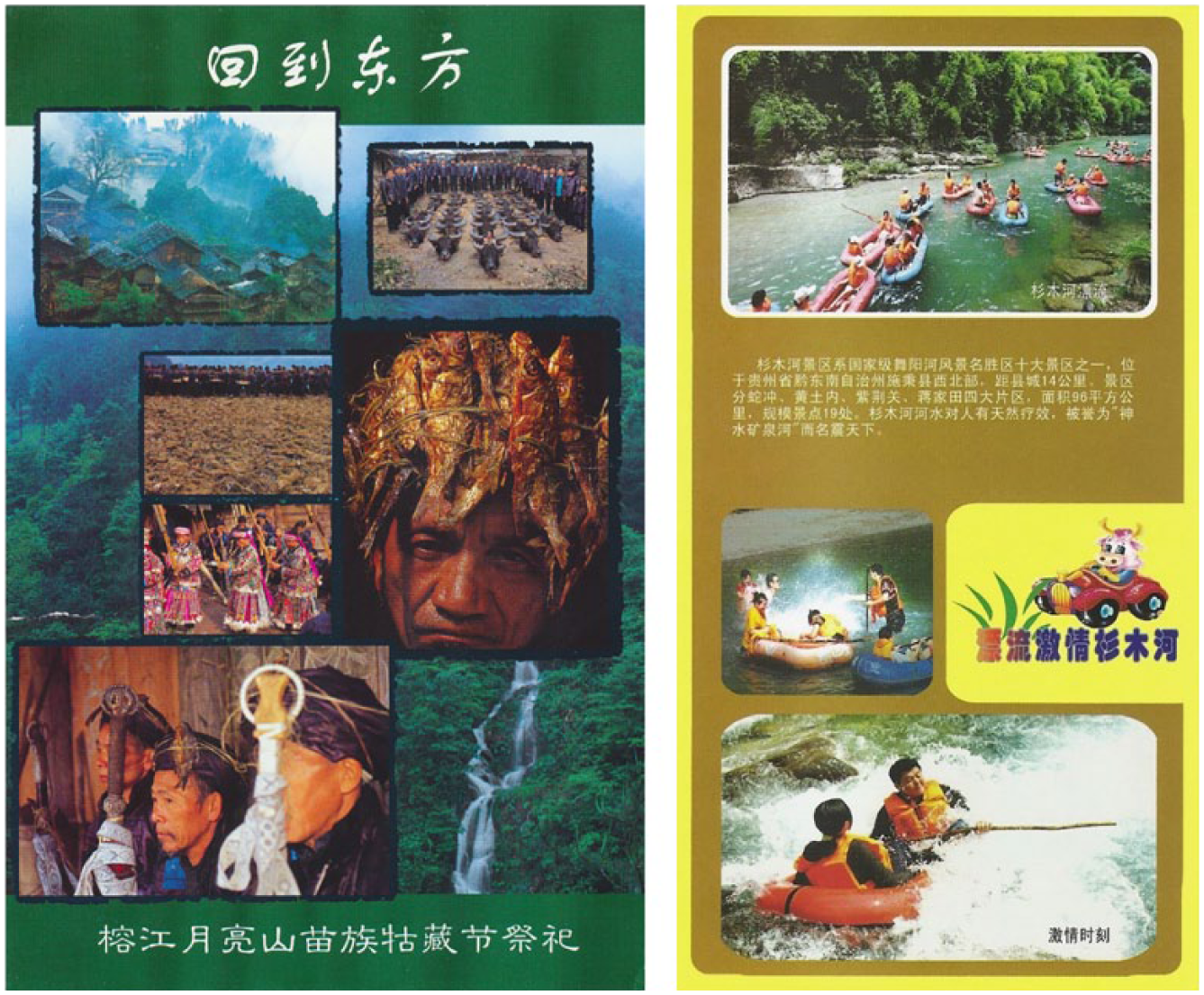
Promotional materials from Qiandongnan: Rongjiang (Rongjiang County Center for Travel Information and Advice) and Qiandongnan Travel (Qiandongnan Prefecture Bureau of Travel Development and Scenic Spot Management).
The illustrations given here do not exhaust the ways that Qiandongnan materials legitimize the tourism activities they advertise. Materials authorize tourism through reference to designations by governments or non-governmental organizations (NGOs) and to quotes from experts and literary works. They evaluate it in terms of values including uniqueness, diversity, and mystery. They rationalize it as means to education and local economic development. The diversity of desires and potentials bound up in tourism therefore become apparent through the diversity of modes of persuasion taken up by its promoters.
Conclusion
Tourism promotional materials from Qiandongnan legitimize tourism in a variety of ways, and analytic frameworks oriented around the concept of legitimation allow for an accounting of the affective and persuasive work done by such materials. Different forms of legitimation constitute communicative practices and strategies engendering affection and persuasion of the people who read or view promotional materials, and legitimations therefore act as potential origins of tourist desire. Authorization, evaluation, rationalization, normalization, and mythopoesis all appear as distinct yet overlapping and comingling strategies of legitimation in materials from Qiandongnan. This case study suggests that this framework will be applicable in other cases as well.
In addition to allowing for analytic clarity, methodological frameworks oriented around legitimation also allow the analyst to treat micro-scale interaction between tourists and promotional materials as a situationally specific social event. While the analyst may not be able to account for the full theoretical semiotic potential of any legitimating medium, one can illustrate the process of legitimation through an analysis of semiotic potential actualized in one’s own encounter with the medium. Such analysis, moreover, brings out numerous macro-level discourses streaming through the communicative event, suggesting a limitation to characterizing its semiotic potential in terms of any particular social or economic process.
This case study also gestures toward the heterogeneous, contextual, and shifting nature of tourism promotion’s “outcomes.” Promotional materials represent the where, what, how, and why of tourism as highly variegated and dependent on diverse spatiotemporal contexts and individual orientations. In the case of Qiandongnan, China-wide processes of urbanization and environmental degradation have stimulated the advertisement of the prefecture’s outdoor spaces and the numerous objects and processes that constitute them. Inasmuch as tourists stick to the script, their experiences are likely to be equally heterogeneous and context-specific and to involve equally numerous interactions.
The prevalence of legitimation as an element of tourism promotion therefore suggests that the act of legitimation need neither be conceptualized narrowly as the purview of powerful political or business actors, nor be demonized as protecting those actors’ interests through the maintenance of social order. Tourism promotion may legitimize tourism’s institutionalization by exploitative state and capitalist regimes, particularly in its “normalization” of certain social groups as adherents of a natural, rural, and ahistorical way of life. It may also legitimize tourism as movement or healing, as embodied sensory experience, or as an aesthetic stance toward the world. It can be turned against exploitative social orders as an opening toward eventfulness and connectivity. Legitimation is an integral part of communication, and ought to be affirmed when it pushes toward orderings rather than orders.
Footnotes
Acknowledgements
The author wishes to thank Scott O’Bryan, Sue Tuohy, and Daniel Knudsen for guidance on the thesis out of which this article grew, and Kevin McHugh and three anonymous reviewers for comments on earlier drafts of the article.
Declaration of Conflicting Interests
The author(s) declared no potential conflicts of interest with respect to the research, authorship, and/or publication of this article.
Funding
The author(s) received no financial support for the research, authorship, and/or publication of this article.