



Abstract
Living history performances attempt to create “authentic reproductions,” presentations that aim to present the past in the present as accurately as possible. Such performances have a tendency to present a single interpretation of history as the only interpretation possible. This article analyzes the performance Masada Live by the Asphalt Theatre company as an alternative living history performance. Masada Live uses theatricality to call attention to the constructed nature of the performance, creating a space for a more nuanced and critical understandings of a history.
Masada is the most significant nationalist site for the state of Israel. From the late 1800s when Jews immigrated to Palestine to escape the pogroms of Europe to today, Masada has been integral to connecting Jews to the land of Israel, physically, through the ancient history of the site, and ideologically, through the story told about the site. Over the course of the last 150 years, the goal of the story has changed (see Ben-Yehuda, 1995; Zerubavel, 1995: xix) but the structure of the story remains consistent. Around the year 73 CE, after the fall of Jerusalem and the end of the first Jewish-Roman war, a small group of about 250 Jewish fighters and their families vowed to maintain the fight against the Romans. This group, known as the Sicarii, took over Masada, a nearly deserted Roman fortress in the middle of the Judean dessert. Determined to stamp out any signs of resistance, the Roman army surrounded Masada, built a ramp to the top of the mountain fortress, and laid siege to the Sicarii. Knowing that the end was near, the Jews defied the Romans once more and opted to take their own lives. The story has taken on a mythic status and is an indelible part of Israel’s identity, leading many to accuse Israel of having a “Masada Complex,” a willingness to do anything to prevent being surrounded by enemies (see Zerubavel, 1995: 209).
In 2011, while conducting participant observation fieldwork at Masada, I was put in touch with Moshe Hanuka, the director and founder of Asphalt Theatre. Most of my time on the mountain was spent studying how people were guided from point to point, and generally speaking, tourists heard the same basic story and the Sicarii are painted in a generally positive light. 1 Unlike traditional guided experiences, Asphalt Theatre presents a staged performance called Masada Live that is booked in advance by tour groups as part of their trip to Masada. The theater company derives their name from the rich asphalt deposits in the Dead Sea region, surrounding Masada National Park. Moshe 2 explained that the initial idea for a performance at and about Masada “was just a proposal, but when I came here, I don’t know. I was taken by the mountain. I was entranced” (Hanuka, 2011). In the years since its inception in 1997, Asphalt Theatre has created a number of performances with themes ranging from biblical history to musical comedy, all of which rely on clowning and physical theater. Masada Live, in part because it was their first performance and in part because of their felt connection to the site, remains a site-specific performance. Both Moshe and Eitan Campbell, the Director of Masada National Park, view Masada Live as an enrichment program that enhances the tourist experience of the site (Campbell, 2011: Personal Interview; Hanuka, 2011: Personal Interview), and thanks to Campbell’s support, when I met them in 2011, Asphalt Theatre had the relative freedom to perform with few constraints. Moshe explained that his hope is that through viewing the performance, tourists will develop a strong appreciation for the site. Masada Live is performed in English or Hebrew and is shaped slightly differently depending on the religious and cultural make-up of the tourists in the audience. When I viewed the performance in 2011, it was for a Jewish youth group from the United States.
After contacting him about my research, Moshe arranged for me to meet the group before they performed at Masada. After the performance, I interviewed Moshe and the other members of the company. Then, over the course of developing this essay, I stayed in touch with Moshe in order to clarify certain aspects of the performance and to make sure that I was accurately representing his work. In my analysis of the performance, I found that by highlighting the gap between an authentic past and the performed present, Masada Live serves as a model for site-specific performances that help tourists create a unique and critical connection to an historical site, and that may serve as a corrective to many of the issues faced by living history performances. These possibilities are neither dictated nor directed by Asphalt Theatre, but instead are left up to the audience to embrace, or not. In other words, while Moshe and Asphalt Theatre are not primarily concerned with alternative readings of the Masada myth in particular, and how history is constructed in general, I found that the performance Masada Live, by incorporating theatrical techniques eschewed by traditional living history performances, creates space for challenging dominant histories.
At issue with living history performances is the use of theatrical realism to support the authenticity claims of living history sites. Edward Bruner (2005) refers to living history museums as “authentic reproductions” (p. 149), marking both the work of archivists and other researchers to maintain fidelity to the past (authentic), and to the constructed nature of such sites (reproduction). Bruner (2005) argues that when tourists visit these sites, they want to engage with the reproduction as though it were authentic and, hence, allow themselves to be persuaded by the curators, producers, and performers at such sites (p. 147). Barbara Kirshenblatt-Gimblett (1998) explains that as a compliment to living history sites, living history performances can enhance the perceived authenticity of the history presented. She argues that mimetic performances can expand the boundary of a site “to include more of what was left behind, even if only in replica” (p. 20). Performers in mimetic displays present actions and artifacts as though they were a “slice of life lifted from the everyday world” (p. 20). From this perspective, living history performances, as representations of the past, contribute to the authenticity of the site, the objects on display, and the historical actions involved in the performance.
Of course as Shepherd (2002) notes, it is in part the “cultural lens of the seeker, which … guides the direction in which authenticity is sought” (p. 191). Presumably, just as theater goers anticipate the convention of the imaginary “fourth wall” separating them from the action on stage, tourists witnessing living history performances are expected to buy into the convention that time has collapsed between them and the performers. Hence, the authentic at living history sites is perceived through how well the directors, curators, and performers of a site understand the cultural lens of visiting tourists. Scott Magelssen argues that these attempts at mimesis by living history sites can obscure the constructed nature of the performance so the viewer can easily forget that the “slice of life” was cut by one person to meet the cultural expectations of others. Magelssen (2007) finds this particularly alarming, explaining that the tourists/audience “though no longer constrained to tiered rows of theatre seats, [are] nonetheless guided into a passive acceptance of specific narratives” (p. 124). While living history performances give tourists a glimpse into the past, for Magelssen it is a very specific and well-rehearsed glimpse. As Gotham (2007) points out, though, there is an unpredictable push and pull between producers and consumers of tourist sites when it comes to the meaning of the site/experience. While tourists may visit a site with a cultural lens, they also bring their own individual perspective to what they see. Kaul (2007), following Wang (1999), defines authenticity as an existential experience, one “in which a person is completely attuned to and embedded in the phenomenological moment” (p. 712). Following Culler (1998: 5), I would add that what is felt as authentic in any given moment will still be embedded within cultural signs that compelled a person to visit a site in the first place. The mimetic performance, even though it can never be the thing it represents, may be perceived as authentic should the performance, the tourist’s personal expectations about the performance, and the cultural signs influencing the performance all resonate.
Rebecca Schneider (2011) argues that mimesis can be “a powerful tool for cross- or intra-temporal negotiation, even (perhaps) interaction or inter(in)animation of one time with another time” (pp. 30–31). Because the mimetic performance can never truly be the thing it represents, argues Schneider, and because tourists are left to fill in the gap between what they see and what they expect, mimesis affords us the opportunity to examine the gap between what is, and what might have been. By re-performing the past, there will inevitably be mistakes, or things we don’t get exactly right. Schneider argues that in the moment of the mistake we see our inability to remember the past perfectly and, hence, gain a critical perspective. More often than not, though, instead of embracing and interrogating such mistakes, living history performances do their best to make audiences feel as though the history they witness is accurate (Magelssen, 2007: xiv).
Kirshenblatt-Gimblett (1998) explains that this feeling of authenticity is achieved by performers “actively forget[ting] what came after the very moment they are reenacting” (p. 197), pushing audiences to make the connection from their own present to the past being performed. The problem, as Magelssen points out, is that living history performances interpret the past with the values of the present (Magelssen, 2007: 42), encouraging audiences to forget that the values that guided past actions might be different from the values we hold today. In this respect, living history museums and performances are similar to other presentations of history, and call to mind Walter Benjamin’s “angel of history.” In his analysis of Paul Klee’s painting Angelus Novus, Benjamin critiques the fetishization of progress, describing an angel unwittingly blown forward by the winds of progress. With his eyes fixed on what has come before, the angel of history sees what we cannot: “Where we perceive a chain of events, [the angel] sees one single catastrophe which keeps piling wreckage upon wreckage and hurls it in front of his feet” (Benjamin, 1986: 257). In this conception, if we embrace a particular history, we glance backwards and see a chain of events, the progress that we have made since the past. If we don’t embrace that history, though, we can feel like the angel, helplessly propelled into a future built on the rubble of the past.
The inability of performances to get the past exactly right, though, is what makes living history performances compelling, both as a representation of the past and as possible critiques. Most living history performances rely on realistic theatrical approaches. For Magelssen (2007), realism discourages audiences from considering different narratives or alternative interpretations (p. 127), so the pleasure of watching these performances derives from seeing how closely they resemble our expectations of the past. Avant-garde theatrical practices, though, can encourage a more critical view of history. In his critique of Hanoch Levin’s The Boy Dreams, Freddie Rokem argues that theatrical space can help us understand the effects of unfettered progress. Inspired by Benjamin’s conception of the angel of history, Rokem (2000) explains that by using avant-garde techniques to stage characters effected by history in the same way that Benjamin’s angel is effected, the hopes of the audience meet the helplessness of the characters, providing “a way of reading and performing the failures of the past through a possible completion of history” (p. 97, emphasis added). By shifting the focus from history to performance, the recognition that there are other ways to present the past and other versions of history become more apparent for tourists/audiences. The possibilities of such an approach can be seen in Masada Live. The performance relates the story of three Sicarii who fell asleep just before the mass suicide and woke up almost 2000 years later. In an image of an angel evoked early in the performance, we get the sense that the history we know about Masada might not be the only version out there. In contrast to Benjamin’s angel concerned with how versions of history are left behind in the name of progress, the angel in Masada Live, one which I call the angel of living history, thrusts the characters from the ancient past into the present. As the characters interact with the audience, we recognize how uncomfortable the values of the past feel today. The performance, through how the story is told and through the story itself, highlights distinctions between the past and the present, and between authenticity and reproduction. As a poetic motif, the angel of living history parodies living history performances, opening up a critical space for audiences to reflect on how the past finds itself in the present.
In order to tell their story, Asphalt Theatre relies on physical theater, using bodies to showcase actions and settings from the past. Instead of trying to recreate how something was done in the past, physical theater practitioners focus on how their bodies and actions can invoke the sense of a past event. Rather than striving for authenticity, a master of physical theater draws an audience in precisely because their performance looks like, but is not the thing it represents. Ana Sanchez-Colberg (1996) identifies physical theater as a hybrid form, with a “legacy in both avant-garde theatre and dance” (p. 40). More than a stylized, “bodily based” form of performance, physical theater “extends discursive practices within the relative and tense relationship between the body/text/theatre reality which goes beyond mere representation via the body” (Sanchez-Colberg, 1996: 40). Bodily action, as it relates to the text and the theatrical setting, becomes something more than reenactment or representation.
Related to their use of physical theater, the performers in Masada Live alienate the audience from the action on stage. A method developed largely by Bertolt Brecht, alienation is meant to create a critical distance between the audience and the action of the play. Instead of relating to the characters, Brecht wanted performances to come off as so foreign that we laugh at the character’s misfortunes and cry at their joys (Brecht, 1964: 71). For Brecht, alienation helps the performer control how and when an audience reacts. One way to do this is through helping the audience recognize that discourses are socially constructed. Sanchez-Colberg (1996) explains, “To uncover the process of formation and formulation presupposes the capability of that gestus,
3
and consequentially, the social relationship which originates it, to be altered” (p. 41). Even the simple action of a performer pantomiming an archer nocking an arrow can compel an audience to question how they are able to recognize the mechanics themselves, how they might do archery, and how/why their action might be different from the actions of the performer. Furthermore, Asphalt Theatre alienates their audience through the stories they tell. While Brecht pushes performers away from creating empathetic characters and stories, he makes it clear that emotion can be an integral part of alienating an audience. As a character develops through the performance, as he initiates more and more relationships with other characters, consolidating or expanding himself in continually new situations, [he] produces a rich and sometimes complicated emotional curve in the spectator, a fusion of feeling and even a conflict between them. (Brecht, 1964: 101)
Unlike traditional guided tellings of the Masada story, which attempt to help tourists relate to the Sicarii, the characters in Asphalt Theatre’s Masada Live make such a connection difficult, if not impossible. By evoking emotions traditionally absent from the Masada story, and through their use of physical theater, the performance distances the audience, creating a space to assess our present in relation to the events portrayed.
The first alienating aspects of the performance are the costumes, props, and musical instruments, all handmade by Asphalt Theatre. Moshe said that he did this for two reasons. First, while he is not trying to create a performance that recreates life as it was 2000 years ago, he wants his audience to get a sense of that life. Although a part of the costume is made to give a cartoonish feel to their characters, the rest of the handmade costumes and instruments are made to transport the audience back in time. The sandals in Figure 1, for example, were handmade to look like an ancient pair of sandals found during the excavation of Masada. This attention to historical detail, however, is contrasted with the odd skullcaps that the characters in Masada Live wear (Figure 3). The skullcaps, made of cloth, give each character a goofy look while the rest of the costume gives the viewer a semblance of what life was like in ancient Judea. Hence, the costumes instruct us how to see the past: with a bit of levity and the feeling that it is not the past, but that it is also not not the past (see also Schechner, 1985: 112). They highlight what Schneider (2011) refers to as the “both/and” of theatricality, the conundrum “in which represented bumps uncomfortably […] against the affective, bodily instrument of the real” (p. 41). Asphalt Theatre’s attention to historical accuracy, but only to a point, makes the audience aware that the performers are authoring this history, and are also actively working against that authorial voice becoming authoritative.
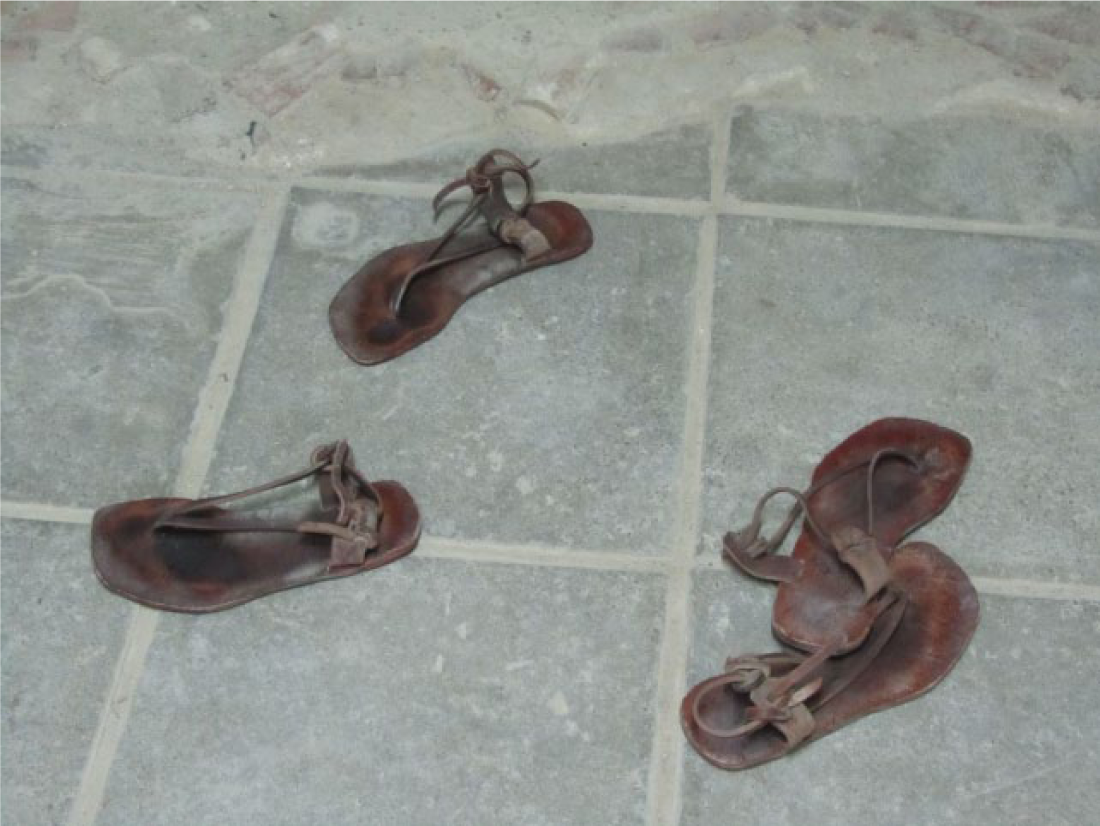
Handmade sandals, photograph by author.
The second reason Asphalt Theatre creates their costume pieces from scratch and uses materials that would have been available to the Sicarii at Masada is to feel more connected to the story they are telling. As Moshe said, “We need to feel what it was like so the audience will see and understand the history” (Hanuka, 2011). This contention is shared by many living history performers. Kirshenblatt-Gimblett (1998) discusses how Plimoth Plantation places authenticity “not in the artifacts per se or in the models on which they are based, but in the methods by which they were made—in a way of doing, which is a way of knowing” (p. 196).
Hence, the “authentically reproduced” costume pieces like the sandals (Figure 1) and the musical instruments (Figure 2) help the performers connect to the characters they are portraying. At the same time, the clownish skullcaps (Figure 3) work as a reminder to performers and audience alike that there is something inauthentic about the performance—something that doesn’t quite translate to the present. What most living history performances try to mask, the fact that the actors performing are from the present, Masada Live places front and center. The effect is a continual sense of alienation, reminding the audience that these characters and the stories they tell are, at least to some extent, made up. The sense of alienation continues throughout their performance, from the story they tell to the physical way they tell it.
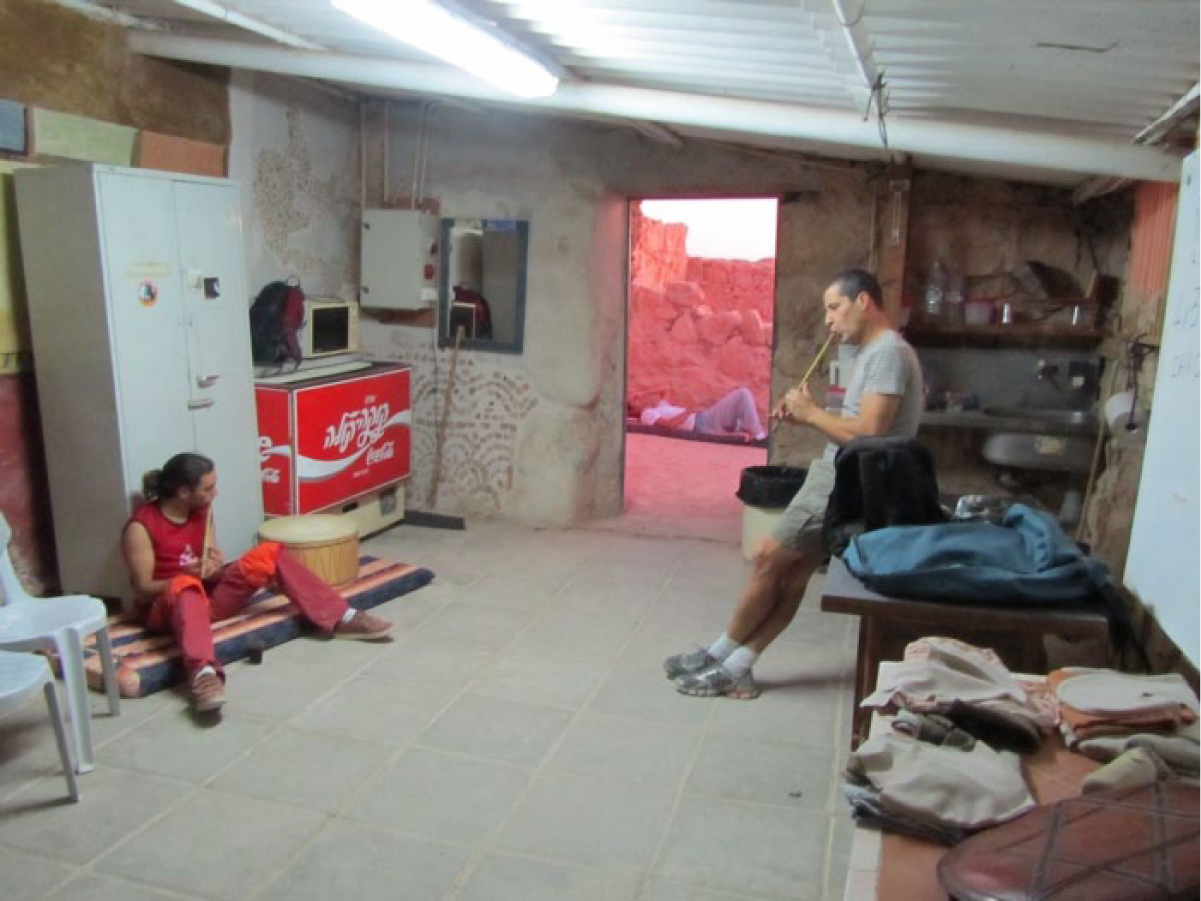
Handmade flutes and drum, photograph by author.
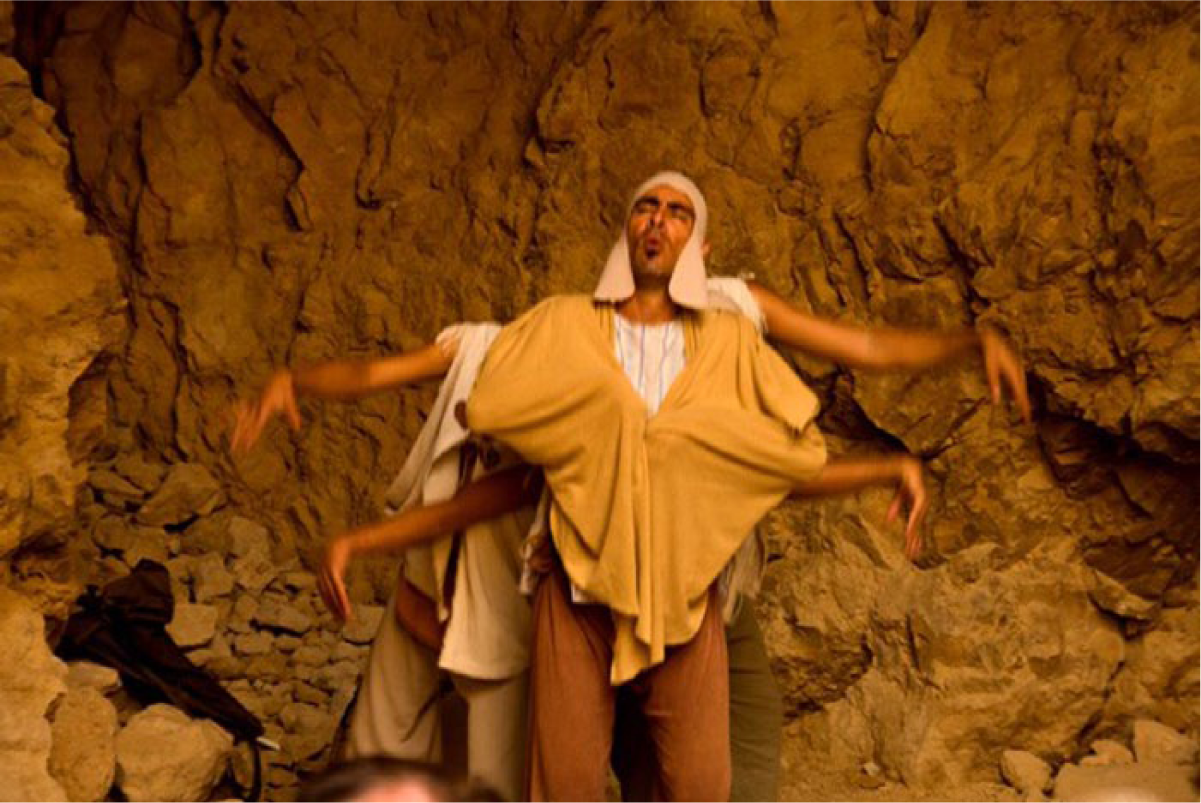
The angel, photograph from asphalt.co.il.
The audience for the performance, an American Jewish youth group, is gathered together by their guides, about 100 yards from the stage. After a few minutes, we notice Moshe and his co-performers Idan and Ori sneaking around a building and stealthily making their way toward us. When it becomes clear that they have been spotted, they charge at us and demand to know who we are and what we are doing at Masada. The three are trying to root out any Romans that might be hiding within our group. Moshe says that if we are Romans we will be killed, and asks us our names to verify that they are Jewish, and not Roman, but still unsure after hearing a few of the names, the performers begin interrogating members of the group about what they are doing at Masada. Once the performers are finally satisfied that we are not Romans, all pretense of aggression drops away, they begin to joke with us, and invite us to follow them to the stage area. Moshe and Idan begin playing flutes and Ori beats a drum hanging over his shoulder. We follow them to the stage and they continue to play until we all take a seat. They joke around with us a little more, and once everyone is settled, they begin the formal performance.
They introduce themselves as Rechavya (Moshe), Tzfanya (Idan), and Shmaya (Ori), and tell us that they were defenders of Masada. With great bravado, Tzfanya struts to center stage and demonstrates how the Jewish warriors at Masada fended off the Romans. Nocking an invisible arrow into an invisible bow, he uses his great strength to show us how “the warriors would shoot arrows at the Romans.” With mounting effort and energy, he displays how warriors would “throw spears at the Romans, throw buckets of boiling oil …!” As Tzfanya approaches the audience with battle rage in his eyes, preparing to douse us in burning oil, Rechavya interrupts, pulls Tzfanya back, and reiterates that it was the warriors that did these things, not the three of them. Rechavya says, “We used to pass buckets of rubble to fill up the hole in the wall.” Tzfanya’s face, which, moments before was lit by a righteous rage, is now deeply despondent as the oil in his bucket turns to rubble which he sluggishly carries away. We learn the three were responsible for menial tasks no one else wanted to do. These are not the heroes of Masada most tourists visiting the site learn about. There was no bravery or valor in the battle and, from the fact that they were standing right in front of us, there was clearly no falling on their own swords. They say that this is because of “the problem.” Before explaining what “the problem” is, though, Rechavya acts out what it was like when Elazar Ben-Yair, the leader of the Sicarii, declared that they should fight. As Rechavya says the word “Romans,” Tzfanya and Shmaya take out noisemakers, rattle them around, shout out “Romaaaaaans!” and then spit on the ground, “Ptui!” in a display of disgust. This becomes an ongoing theme throughout the performance. Any time a group is mentioned that Tzfanya and Shmaya do not like, they drop what they are doing, yell and rattle their noisemakers, and spit on the ground, “Ptui!” to their great dismay, rather than have them prepare to battle their hated foe, Ben-Yair assigned the three to guard the southern, “deserted” tower, that no one would ever consider attacking.
Resigned, they assumed their post. They climbed the tower, looked around, and tried to stand guard, but as time went on, they “winked,” they “blinked,” they “fell asleep.” Falling asleep, we find out, is “the problem.” The three are hopelessly sick with narcolepsy. So as the fighting raged between the Romans and the Sicarii, our protagonists slept. And as it became clear that the Romans would breach the fortress walls, they continued to sleep. And finally, as their compatriots entered a pact to take their own lives, the trio slept on. When they eventually awoke, they found the mountain deserted. Stranger still, they came to realize that they, as Rechavya says, “All three share the same dream. And in our dream an angel is revealed to us saying, ‘keep the seed of Israel on Masada. I will give you signs and miracles to find your match’.” The angel commands them to stay at Masada, and lets them know that they will eventually receive a sign. They tell us that the arrival of our group must be the sign they were waiting for. The three are so excited that they can hardly contain themselves. They work together to create the angel, to replay for us what the messenger of God told them (Figure 3). Rechavya tucks his arms into his shirt, and Tzfanya and Shmaya stand behind him, their arms serving as the angel’s wings. After Rechavya says the line “… to find your match,” Shmaya breaks away and says, “Say we want to marry today!” Rechavya scolds the others for trying to push the story too fast, but then quickly finishes his spiel as the angel saying, “Yes, yes, find our match and marry and be happy.”
Tzfanya then addresses the audience with a sly grin and endearing, childlike excitement, saying “And since you are here, this is a miracle! And a sign from God!” Shmaya jumps in, adding “that the time is right and that the time is come!” And finally, Rechavya concludes, “and so, whoever is not married, please raise her hand.” Then, the three enter the audience and each chooses himself a bride. As they choose their brides, it becomes clear that the rest of the performance will be about making the brides-to-be feel comfortable about their soon to be husbands. The words of the angel from their dream, after nearly 2000 years, are finally coming true. And, apparently, the angel doesn’t seem to think that the brides-to-be should have any problem with conforming to the desires and expectations of a different era.
As noted earlier, this angel represents what I call the angel of living history. Whereas Benjamin’s angel of history can only look back and watch as the detritus of the past is strewn away and forgotten, the angel of living history faces forever forward, as blissfully unaware of the wreckage as Benjamin argues we often are. Benjamin’s angel of history laments our forward motion and reminds us that the path of history is not straight and simple, but complex and marked by innumerous attempts at recording, defining, and attributing meaning. Benjamin’s angel sees these attempts as markers of the destructive nature of using the past to justify or explain our present situation. The angel of living history, however, urges us on. There is no wreckage, at least none that he seems to see, so the past, in the present, makes perfect sense. The world today may be different, but never so different that we cannot relate to those who came before us. In other words, the assertion by the angel in Masada Live that the protagonists could travel 2000 years into the future and live exactly as they had in the past might be comforting to the characters in the performance, but is disconcerting to us in the present. The angel of living history alienates us from the history performed and pushes us to question how the past connects to the present.
After the brides are chosen, and to the uncomfortable laughter of the audience, the three declare that their new wives will live with them and that Masada, a site famous for a mass suicide, will now become a “fortress of love.” Then they explain how Masada was built, and how to build walls that will last 2000 years (despite the obvious fact that they are standing in front of a crumbled reconstruction of a wall). Tzfanya crouches down in the middle of the stage, saying, “First of all, you have to take a heavy base stone.” Then Shmaya joins him saying “and above it, a lighter stone,” pulling himself up to stand on Tzfanya’s shoulders. The balancing act elicited an array of “ooh’s” and “ahhh’s” from the audience. Then to display the tower, Rechavya stands facing Tzfanya, and Shmaya flips himself upside down so his shoulders are supported by Rechavya and Tzfanya, and his feet are sticking straight up in the air. The seeming effortlessness of the acrobatics is striking, and the image created, that of an ancient Roman spire, is a remarkable testament to the power of physical theater to invoke imagery. They then create a series of vignettes of the daily life of Masada, including bathing, fetching water, cooking, and eating. All the while, the actors use their bodies to demonstrate the buildings and the actions of the other people they lived with. This section ends when Rechavya explains that the most precious memory he had was from the day that Shmaya was born. In their most humorous, albeit grotesque use of physical theater, Tzfanya mimes going into labor, Rechavya commands him to push and slowly but surely, and to the delight of the audience, Shmaya’s hands suddenly appear out of nowhere between Tzfanya’s legs, followed quickly by his scrunched up face. Rechavya rushes over to catch Shmaya who begins mewing like a newborn baby.
Just as the story alienates us through the angel, the physical birth of Shmaya is also alienating. While most living history performances strive for authenticity, there is no way for three men to actually give birth. Shmaya being born on stage, then, is a bit disconcerting, but it also has the effect of establishing a powerful connection between the three characters. The acrobatics of the moment certainly highlight the theatricality, but in recreating a very touching, though humorous scene, we see what Schneider means when she discusses theater’s disconcerting juxtaposition of the real and the staged. There is nothing real about the birth of the character Shmaya, but the performance of the birth is uncanny in its ability to translate the experience of birth to the audience. The boisterous but uncomfortable laughter from the audience highlights this performance’s ability to make what was past seem real, even though we know that neither the past event (the story of the character Shmaya being born), nor the stage event (the acrobatics) are real acts of childbirth. While we find delight in the performance, the physical theater is a constant reminder that the performance is striving for something other than mere representation.
After demonstrating the birth of Shmaya and highlighting the unique bond the three share, the characters return to a discussion of Jews and their enemies. They explain to their future wives in the audience that if they had been awake, they would have captured and killed any Romans they came across. In order to display their skills, they begin an extended juggling routine/competition. It starts with the three juggling weapons together, then each of them individually displays his juggling skills. In the midst of their juggling, they slash out with their weapons, explaining how they would stab and attack the Romans. After Rechavya and Shmaya have their turn with swords, Tzfanya takes the center stage with his spear. He juggles and spins the spear before jabbing his spear hard into an invisible Roman. He gives the spear a good twist, and then flings the impaled Roman over his shoulder. Then, repeating the display, he skewers 10 Romans! Now panting, he works up more energy before announcing that he will kill 200 Romans! With a long, hard jab and twist, he successfully kills the 200 and throws them onto his growing pile. Finally, he boasts that he could kill 1000 Romans. We watch as he tries to work up the courage but fear overcomes him at the last moment, and he drops his spear, running off the stage in horror. Exasperated, Rechavya says, “If we only had an actual Roman, we could show you how brave we are! How we would defeat the Romans.” Enlisting an audience member to play the role, and after a number of unsuccessful attacks on the volunteer Roman, they realize that in order to beat a Roman, they have to “fight like a Roman.” Shmaya jumps up and is deftly caught by Tzfanya and Rechavya who use him as a battering ram to knock down the Roman soldier. To celebrate their victory, they sing another hymn and once again the audience joins by clapping and dancing. When the song is over, they thank the audience and conclude the performance.
As noted earlier, whenever Rechavya names a person or a group they don’t like, Tzfanya and Shmaya spit on the ground. At one point, in the midst of trying to figure out how to kill the Roman, Shmaya and Tzfanya get into a fight over who is better equipped to kill the soldier. Before long they are choking each other and Rechavya has to intervene. He says, “You know, you remind me of 2000 years ago. Just the same. Fighting each other, divided. You are hurting each other instead of fighting the Romans! Who are we?” The others respond, “Zealots!” 4 Rechavya then reminds his fellows, “We did not fight the Romans alone.” He begins to list other groups of Jews that fought the Romans, and with each group, Tzfanya and Shmaya respond by spitting on the ground in disgust, “Ptui!” Fed up, Rechavya finally asks, “You are never out of spit?” and Shmaya responds, “Ah, we have enough spit for all of Israel’s people.” Rechavya reminds them that during the war, in Jerusalem, it was the Sicarii who destroyed the food supplies of other Jews and caused the city to fall. He says that they had to unite with all the Jews, just like King David united the 12 tribes of Israel, in order to be victorious.
By this point in the performance, the audience is clearly alienated from the actions of the characters on stage. The past, in the present, seemed absurd when they presented us with the choosing of the brides, but we can write it off as antiquated social norms and still see the Sicarii as heroes. Here, however, we see that the characters make no qualms about the fact that, given the power, they would kill anyone not like them, Jews included. Presenting the Sicarii as an antagonistic group is different than the way they are typically presented by guides. To the best of their ability, guides present Masada to their tour groups so the story is clear and so there is less ambiguity about the intentions of the Sicarii. For guides, the site is important because it plays the role of verifying the events of the past: it is the authentic place that reminds tourists that the events actually happened, right here, just as their tour guide or guidebook says. In contrast, Asphalt Theatre’s interpretation is not bound to any artifacts or structures at the site. They speak freely about their characters’ lives, desires, and beliefs and are, hence, able to talk about the daily life of the Sicarii without being bound only by what archaeologists know. Whereas a guide relies on artifacts and the archaeological authority of the site, performers representing the past can easily add cultural elements, like hymns and folktales, to their performance, and can present us with characters that highlight the complexities of the past. Such performances can still evoke a sense of authenticity, but one tied to the tourist’s expectations rather than an historical authority.
Understanding the characters as representations of people who had hopes, fears, desires, and a number of shortcomings, helps the audience see how the ancient Sicarii were real people and not just characters in an abstract story. As an audience, we are drawn into the performance because of the theatricality, but we are also left questioning the motives and actions of the characters. We don’t see the performers as strong warriors protecting the integrity and the legacy of the Sicarii of Masada. Instead, we see clowns—masters of showmanship with a few unnerving values. Additionally, some of the strengths and values they hold dear, like the blind courage to fight no matter what, are not values they actually possess. These characteristics, combined with their use of humor and their focus on the quotidian aspects of the everyday lives of the Sicarii, undermines the authority of the mythic story by parodying current day representations of characters from the past.
For example, guides, placards at the site, and popular representations like the mini-series, Masada, focus on the familial nature of the Sicarii. They make it clear that this battle was Roman against Jew. A story often told is of the Romans using Jewish slaves to build a ramp to the top of the mountain. These popular texts tend to tell us that what stayed the hand of the Sicarii was knowing that to stop the ramp from being built meant killing fellow Jews. In these tellings, the hatred that the Sicarii felt for the Romans was not enough to cause them to kill innocent Jews. In Masada Live, however, only the Sicarii were worth dying for. As other groups of Jews are mentioned during the performance, Tzfanya and Shmaya shout the name of the group in derision and then spit on the ground in a display of disgust. While many historical accounts suggest that infighting among the Jews was a significant factor in their defeat during the Jewish-Roman war, few people at Masada bring up these aspects of the history. For example, Josephus (1984) described how the Sicarii at Masada massacred the Jews at Ein Gedi in order to steal their food and supplies (p. 266). While attempts by historians have been made to bring to light how that history has been silenced in Israeli cultural memory (Ben-Yehuda, 1995: 79), and archaeological digs lend strong evidence to the ancient massacre (Feldman, 2004), rarely are the Jews at Ein Gedi, or any other Jews from the time period, brought up in guided tours of Masada.
Additionally, while there is something noble in standing against an army 40 times the size of your own and opting to die with those you love rather than risk a different fate, the parody reveals another side of this history: one person standing against 40 is reckless, and claiming that the one is good and everyone else is evil is absurd. For many Jews in Israel and abroad, the story told in popular culture remains a sacred cultural artifact. The parody, on the other hand, challenges how the story should be told and why we should continue telling it. In their explanation of Bakhtin’s conception of parody, Morson and Emerson (1990) point out that parody “is the ‘corrective of reality’, always richer and more contradictory than any single genre or word can express” (p. 434). The performance, Masada Live, is not arguing that the story of Masada should not be told. Rather, among all the different ways that the story is told—from history books to guided tours—they remind us that the questions of who is telling, how they are telling it, and why they are telling it, remain important. Tourists watching can easily enter a conversation not just about which aspects of the story to tell, but also how the story has been told, to whom, and to what ends. It does not suggest that we should get rid of a history. Rather, it brings to mind, as Schneider (2011) makes clear, questions about how one time period remembers another: “with whom do we affiliate? To whom do we attribute event? Who do we count among associates? Among ancestors? Who among generations? Who within history? Who without?” (p. 59).
Parody is meant to make us laugh. In the case of Masada Live, we laugh at characters that would otherwise be considered sacred. Morson and Emerson (1990) argue that this laughter has two major effects. First, it undermines authority, “but only authority with pretensions to be timeless and absolute” (p. 435). One thing we learn from watching tour guide performances is that the story of Masada is used for a number of different ends, depending on the goal of the tour (Gratch, 2013: 29). Since the basic story remains the same throughout these tellings, the story itself gains a timeless quality. In the performance Masada Live, however, the story never ends. The performance concludes with the characters defeating one Roman soldier (even though they acknowledge that it wasn’t a real Roman soldier) and then singing a hymn to their audience/wives-to-be. There is no coda or moral given to the audience. Rather, we are left with a number of cartoonish images: a man giving birth to another, a man killing 200 others with a single blow, three men transforming themselves into battering rams, catapults, and ramparts. While we know that these are not real historical figures, they remind us that a representation, no matter how convincing, will never be the figure or object that it represents. The exaggerations they blatantly display remind us that there may be other, more subtle exaggerations that we may not be aware of. Morson and Emerson (1990) explain that as we laugh, we undermine the historical tradition that brought us to the story we find ourselves laughing at (p. 442).
The laughter of parody also helps us forget. Whereas stories told by guides continually contend that the past can help us better understand our present, Masada Live makes it almost impossible to understand this past, let alone apply it to the present. Even the characters argue that what is normal for them, the hatred of other, similar groups, might not be productive. They make it possible to forget how Masada has been used and how certain actions have been conducted under the auspices that the Sicarii were fighting a noble fight. Noble or not, Masada Live reminds us that it was ridiculous. Whatever else the Sicarii were, we see from the performance that they were also vengeful, fighting an impossible fight, and possessive of a value system that seems, in many ways, contradictory to our own: fundamentalist and extremist. Since the 1920s, Masada has been used for a number of political ends. From the foundation of the state of Israel, to the maintenance of a tight border control policy, to garnering the international support of Jews in the Diaspora, to connecting those Jews in the Diaspora to their Jewish roots (Cohen, 2008; Zerubavel, 1995). While I am not saying that these ends cannot be justified, the parodic performance reminds us that when we drag the past into the present, we run the risk of ignoring the wreckage we might drag with us. Traditional living history performances run this risk by comfortably representing the past in the present and often ignoring the tension between the values of the past and those of the present. Playing with this tension and making audiences question how we remember the past, though, can be a productive approach for learning a history. It reminds us that remembering and forgetting go hand in hand.
A common act of forgetting employed by traditional tours at Masada is the infighting among Jews during the Jewish-Roman war, and the public assassinations, mass murders, and other acts of terror carried out by the Sicarii. The almost ubiquitous use of the term “Zealot” over the term “Sicarii” is just one example of this iteration of forgetting employed by traditional guided experiences. Such forgetting is aimed at helping contemporary audiences consider the Sicarii in a positive light. Masada Live, however, presents us with a more complex history, one that is as connected to fundamental extremism as it is to folk culture. The characters have little regard for contemporary concerns as they are still rooted to the past from which they come. In other words, they not only remember the past but they also leave out the present and all that led to it. It is up to the audience to trace the path from the characters they see in front of them to their own touring of the site. In other words, as an audience we see the angel of living history barreling toward us. The choice to uncomfortably situate the past in the present leaves us with clear questions about how the story we hear has come to be venerated. Connecting the dots between the past presented and the present we live requires a critical return to how the story is told.
Traditional living history performances try to make audiences feel comfortable with the past in the present. We might imagine, for example, tourists coming upon a group of performers acting as Sicarii, explaining how to cut the leather for sandals or relating what it was like to fight the Romans. The goal of such performances is to make the past feel accessible by us in the present. This access is problematic insofar as no matter what is remembered through the living history performance, the act of editing history is masked. Elizabeth Jelin (2003) explains that “all policies for conservation and memory, by selecting which artifacts and traces to preserve, conserve, or commemorate, have an implicit will to forget” (loc. 355). Whether the forgetting is a practical matter (there will always be too much to remember) or an ideological one—removing histories of subjugated populations from official historical narratives—it implies an active attempt to leave something out. Traditional living history performances try to make forgetting as invisible as possible, so even when the audience recognizes that something is left out, that something might seem of little consequence. For as Andreas Huyssen (2003) argues, “Once we acknowledge the constitutive gap between reality and its representation in language or image, we must in principle be open to many different possibilities of representing the real and its memories” (p. 19).
Masada Live acknowledges the constitutive gap. The characters, having woken up after nearly 2000 years have no knowledge of the current political climate of the Middle East, the history of the various Arab-Israeli and Arab-Jewish conflicts, the founding of the state of Israel, the Holocaust, pogroms, inquisitions, ghettos, and everything else that has been a part of the Jewish Diaspora. The characters in Masada Live don’t say anything about our past. Instead, they focus on presenting their present, an image from our past. They never tell us why we should watch them or what we should learn from watching them. There is also no end to their story; what comes next is up to the audience. If the performers forget well enough so there is a clear gap between the performance time and the present, the audience has to struggle and add their own context and criticism to the performance they witnessed. The performance, through its own displays of forgetting, can help the audience to criticize what they remember and why they remember in that way.
Conclusion
In her discussion of living history presentations, Schneider (2011) argues that performance is often “a battle concerning the future of the past” (p. 4). Tour guides use the past to actively address the different possible futures the site could have, and make arguments about why a particular image of the past will better serve the present. Where one guide foresees a war with Iran and is, hence, able to use the site to argue for a preemptive strike (Gratch, 2013: 44), another sees the secularization of world Jewry as an increasing problem, and Masada as a site to rebuild a connection to Judaism (Gratch, 2013: 40). These interpretations, however, are often presented as the logical connection between the past and the present. Performances like Masada Live can be employed to invite audiences to take a more critical approach to how we commemorate and remember the past. Of course, a staged performance like Masada Live is not the only way to achieve this possibility for an audience. As Jonathan Wynn (2011) points out, the traditional tour, through the guide’s own performance of identity, can also be a vehicle to explore different historical tellings.
The forgetting that Masada Live presents is jarring and affords us the opportunity to be critical of how we remember and use our past. The Masada story is a part of the national myth of Israel, a myth that perpetuates the imminent threat posed by outside forces. Representational performances can offer a venue to reimagine how the myth is presented, and ask important questions that should be asked of all national myths: Who does this myth serve? How does it serve them? Who is left out? Who remains silent? Rather than being part of a continuous, uninterrupted story that brings us from then to now, representations of the past necessarily stage two time periods together. By highlighting the tension between the past and the present, it becomes easier to question why the tension is there in the first place.
Footnotes
Declaration of conflicting interests
The author(s) declared no potential conflicts of interest with respect to the research, authorship, and/or publication of this article.
Funding
The author(s) received no financial support for the research, authorship, and/or publication of this article.