



Abstract
There is a growing interest in the anthropology of pilgrimage. However, as Mesaritou et al. have pointed out, the role of pilgrim guides is often peculiarly absent in the literature. The ethnography in this article builds on several pilgrimages together with a local pilgrim guide in West Java. Using this case as an example, the aim is to spur a general interest in how knowledge and authority are constructed when it comes to sites lesser known to the tourist industry (knowledge which may preexist at places that later develop as tourist sites). A key analytical question raised in this article is how guides achieve legitimacy when there exist no authoritative texts or accumulated knowledge about the site. To understand this, I introduce the analytical concept of ‘productive complicity’. The concept is used to describe how an intersubjective understanding about representations of a transcendental reality is developed at the pilgrim site. Being engaged in productive complicity enables pilgrims and their leader to collaborate in ‘reading’ the signs of transcendental presence, to reach agreement that their expectations of the pilgrimage have been fulfilled and to reinforce the legitimacy and authority of the pilgrim guide. The concept of productive complicity is easily transferred to other situations and could be used by scholars to bring out new perspectives on how pilgrim guides as well as tourist guides establish their authority.
Introduction
Ibu Enok is a female pilgrim guide (locally termed Juru Kuncen) in West Java, practising in a predominantly Islamic environment, although she does not occupy any formal position in the local religious hierarchy. 1 People turn to her when they are in distress and in need of help or consolation. Apart from guiding groups of pilgrims to Mount Sunda, she practices healing and offers spiritual guidance at her home. She stresses that she is a Muslim, but claiming to be able to communicate with ancestors means she treads contested boundaries between the realm of tradition and what is considered to be proper Islam by local imams. In Sundanese thought systems, a great amount of ritual attention is paid to maintaining a correct relationship between the visible and invisible worlds (Wessing, 1978, 1993, 2006). 2 However, these borders can also be porous and permit interchange between the transcendental and mundane worlds (Wessing, 1999, 2006, 2010: 54). It is this porosity that is exploited by Ibu Enok. The ethnography below describes her efforts to establish herself as a pilgrim guide and mediator between the living and their ancestors. In this, her quest is not to erect or maintain borders but to exploit their porosity and enable direct contact with the ancestors. Through her practice, it becomes clear that the borders between spirits and humans must be made visible so that they can both distinguish and bring together the two realms.
Traditions, such as ancestor veneration, have become a topic of intense debate in Indonesia, both among conservative and radical groups (Bubandt, 2014; Davidson and Henley, 2007). The renewed interest in traditions after the fall of the military regime in 1998 has evoked religious as well as political responses and the borderlands between religion and tradition as well as to transcendental realities are claimed by various figures, of which the Juru Kuncen (literally, master of the keys, but also healer, ritual specialist and pilgrim guide) is one. Since these borders are disputed, evidence (bukti) of a person’s power and knowledge is important to sustain their claims to legitimacy and authority in dealing with them. Using the concept of ‘productive complicity’, this article explores how this is achieved through the interactions between the pilgrim guide and the pilgrims.
The article starts by situating this study in research on pilgrimage tourism after which follows a presentation of the analytical framework (the persons, the place and the text). The article continues with an explanation of the concept of ‘productive complicity’. A note on fieldwork and data collection is followed by a description of the Juru Kuncen’s role and how it relates to that of other pilgrim guides. The three terms ‘persons’, ‘place’ and ‘text’ are then used to structure the ethnographic material. In the last section, which deals with the ‘text’ of pilgrimage, I return to the concept of productive complicity to help explain the nature of the legitimacy ascribed to the pilgrim guide. 3
Pilgrimage tourism
In a broad sense, this article is situated in research on pilgrimage tourism. In her comprehensive state-of-the-art article on how to define pilgrims and tourists, Collins-Kreiner (2010) notes that in research focusing on practices such as Eade (1992) ‘the ties between tourism and pilgrimage are unclear, blurred, and poorly classified’ (p. 29). Motivations, movements or other practices do not keep tourists and pilgrims clearly apart, even though in ideal cases distinctions can be made by researchers as well as practitioners about pilgrimages as ‘an act of faith’ (Digance, 2006: 37). Yet, as will be presented below, a term such as ‘an act of faith’ fits poorly with the pilgrimages described in this article. Even if one opts for a straight-forward definition for classifying pilgrims such as ‘journeying to a sacred place or shrine as a devotee’ (Griffin, 2007: 16), activities of devotees at shrines often include buying souvenirs, recreation and relaxation (Dallen and Olsen, 2006). People through their practices, and perhaps especially so pilgrimage tourists, do not seem to be restricted by these categories but move rather freely between them. Although the distinction between pilgrims and tourists constitutes an academic enigma (Badone, 2014), pilgrimages have been ‘embedded’ rather seamlessly into the tourist industry and vice versa (Aukland, 2017).
Moving into the specific case of pilgrimages to Mount Sunda, the difficulty to distinguish between pilgrimage and tourism becomes even more problematic, blending in notions of a family picnic. The local term used to denote the practice of visiting sacred places is ziarah. In Java, these visits were traditionally conducted by individuals praying, fasting and meditating at graves and other places alleged to be conducive to accumulating power (Anderson, 1990; Pemberton, 1994). Today, a more common format for these visits is a group of people led by a pilgrim guide. The ziarah described in this article was characterised by being religiously motivated in the sense that people used prayers to reach out for help from their ancestors. However, it was also shrouded by an aura of familiarity and conviviality (Hellman, 2017). The participants brought snacks, tea and coffee and the mood was very much of a picnic with friends. Some of the participants even bought oleh-oleh, small snacks mandatory to bring home after making a tourist trip. What distinguished the event according to the participants was that it included elements of struggle (perjuangan). Without hardship there is no ziarah was a phrase often repeated. The hardship though was the kind experienced when hiking (sweating, lighter exhaustion, etc.).
As will be evident in the article, the pilgrimage guide, Ibu Enok, oscillates between the role of being a good neighbour, a guide, spiritual leader and knowledgeable elder. The strength and specific character of these pilgrimages lies in their combination of conviviality and reverence. The atmosphere of the event moved between deep concentration, religious supplication and cordiality. People did not explicitly refer to themselves as either pilgrims or tourists; they preferred saying that they were part of a group making a ziarah. All ziarah in which I have participated have included aspects of religious protocol as well as relaxation and sightseeing (in terms of learning about the place and its history). In the case described in this article (which also corroborates with the other cases I took part in), one of the strengths and compelling force of the event was the fact that the visit blended religious experiences with a mode of family outing and educational aspects (Hellman, 2017) making the participants familiar with Sundanese history. The ziarah had as its goal to approach ancestors, who, even if from a far distance, were supposed to have a relation to either people in person or at least the Sundanese and in that respect are part of the ethnic and local community, and in a sense the pilgrimage brought the ancestors into the family.
In the text, I have chosen to keep the word ‘pilgrims’ for people taking part in the visit to Mount Sunda and consequently used the term ‘pilgrim guide’ for Ibu Enok. The reason for this is twofold. The most important is that people themselves define the visit as a ziarah ke tempat keramat (usually shortened to ziarah) – a visit to a sacred place. Although ziarah literally means ‘visit’, it is conventionally translated into pilgrimage in English. The visits to Mount Sunda do include aspects of education as well as relaxation, but the main reason to undertake the trip is to get in contact with transcendental forces and to make these forces influence social life, in that sense corresponding to Griffin’s (2007) basic definition of a pilgrimage. Second, in Islam ziarah is used to contrast visits to graves and holy places with the hajj (which is considered the pilgrimage proper) and umrah which is a visit to Mecca outside the hajj. Hence, classifying the visit as a ziarah makes it a religious endeavour. Building on my experience from taking part in ziarah to Mount Sunda and other places, the participants use the term to define the visit as basically religious but not to be mistaken for a hajj. In that way, the term pilgrims in this case makes sense from an emic as well as etic perspective, although, as will be evident in the ethnography, the visit does blur the borders between tourism, leisure, education and religious experiences.
Taking my point of departure in Coleman’s (2002) pledge that what makes researchers and travellers to regard ‘people as pilgrims will inevitably change over time’ (p. 362) and that a productive approach is to ‘making points about human behaviour through using “pilgrimage” as a case-study rather than focusing on the institution itself as a firmly bounded category of action’ (p. 363, italics in original), I take the practices of how to create legitimacy through establishing knowledge about a sacred place as the object of research. In this way, the particular form of the ziarah to Mount Sunda becomes part of the explanation.
The persons, the place and the text
In this article, I work with an analytical framework adapted from Eade and Sallnow’s (1991) and Mesaritou et al.’s (2016) triad based on the notions of persons, place and text. To this, I add the concept of productive complicity. The main characters (persons) in the pilgrimage described below are the pilgrims and their pilgrim guide (and to some extent me, the anthropologist), while the place is Mount Sunda. The pilgrims and their guide ascribe meaning not only to the place but also to events and experiences in the mountain that underscore their shared understanding and prove the authority and legitimacy of the pilgrim guide. These meanings are a product of the interaction at the pilgrimage site, the pilgrims’ expectations of what would happen and their knowledge of the guide’s merits. In the case presented below, there is no ‘authoritative text’ (Eade and Sallnow, 1991: 9) to guide interpretations of what happens at the pilgrimage site or the way to travel there. Instead, I have used the term ‘text’ to refer to the interpretations given by the pilgrims and their guide of the landscape and the representations they encounter. The mountain (the place) plays only a minor role in the official history of the region and its sacredness relies on the pilgrim guide’s knowledge and ability to convince the pilgrims of her authority. I propose that her authority emerges from a productive complicity in which persons, places and texts (in form of interpretations) are entangled to produce specific knowledge about the pilgrimage and to legitimise the guide’s mediations of transcendental powers.
Productive complicity
While conducting fieldwork, a relationship evolved between me and the pilgrims, and between us and the guide based on what I have termed productive complicity. The term is adapted from an article by George Marcus (1997) in which he discusses the complicity between informant and anthropologist that occurs during anthropological fieldwork. Marcus (1997) uses the term to refer to a form of ‘mutual interest between anthropologist and informant’ (p. 89) as they both become aware of a ‘here where major transformations are under way that are tied to happenings simultaneously elsewhere, but not having a certainty or authoritative representation of what those connections are’ (p. 96, italics in origin). As an outsider, the anthropologist makes explicit ‘forms of anxiety that are generated by the awareness of being affected by what is elsewhere without knowing what the particular connections to that elsewhere might be’ (Marcus, 1997: 97). A joint project thus evolves in which the anthropologist and informants together try to understand the agents and powers of this ‘elsewhere’. While Marcus uses the notion of ‘elsewhere’ to describe another place in a global web of connections, I am here using the term with reference to the powers of a transcendental other world that is only partly known by the pilgrims, the guide and the anthropologist although we were all interested (for different reasons) in understanding how these forces can influence the here and now.
Our shared interest created an affinity between fieldworker and informant that arose from our ‘mutual curiosity and anxiety about [a] relationship to a “third,” which could affect our interaction and made us build a relation of “complicity” in relation to the influence of that “third”’ (Marcus, 1997: 100). In our case, this third party was the ancestors that inhabit Mount Sunda. We were all concerned to learn about the ancestors’ transcendental powers and how they could be harnessed to influence the here and now positively. The bond between us was very much based on an ‘unexpected affinity/complicity – more cognitive than ethical – between the fieldworker and the … informant’ (Marcus, 1997: 104). Beyond this, as I will describe, there also evolved an affinity between us and the pilgrim guide. This complicity was productive in that we all wanted to know about the presence of the ancestors and to understand the phenomena we encountered and, despite our different motivations, this led to the production of knowledge that helped us make sense of pilgrimage.
Fieldwork and data
Since 1995, fieldwork have been conducted intermittently in West Java. The region is known as a strong hold for Islam (Glicken, 1987) which has been the major religion since mid-sixteenth century (Cribb, 2000). After Indonesia’s independence in 1945, West Java has been the location for several Islamic uprisings, for example, the Darul Islam movement (Dijk, 1981). However, as in other parts of Java, it is also a place where the belief in ancestors and traditional elements in religious practices are still strong (Wessing, 1978, 2006), although not always publicly announced (Hellman, 2013). The mountain areas around Bandung are known as the Parahyangan which is translated as the abode of ancestors, or where ancestors like to assemble.
From 2002, three different projects have been conducted with relevance for this article: one on fasting rituals (Hellman, 2006), a second on pilgrimage (Hellman, 2011) and a third on the role of ancestors in modern Indonesia (Hellman, 2013). 4 This article draws on data from all three of these projects. On the basis of interviews and participant observation, I have become well acquainted with the people described in the article and the context of their lives. I have known Ibu Enok since 2002, lived in her village and participated in several pilgrimages she has organised. I have also taken part in the ritual work that she and other Juru Kuncen perform in their homes. In addition to this, several pilgrimages have been conducted to well-known tourist destinations as well as to local sacred sites with other pilgrim guides. In the field, standard anthropological methods have been applied, mixing participant observation with formal interviews and everyday conversations. The interviews were recorded while conversations have been jotted down in note books and then transferred into a field diary. During pilgrimages, pilgrims as well as pilgrim guides have been formally interviewed as well as informally spoken with. Most of the participants (including the guides) have been interviewed before and after the completion of the pilgrimage. Participant observation has in this case meant living in the same village as the majority of the informants and taking part in their daily lives including religious rituals. I have aimed to participate in as much activities as possible. The main tool for collecting data has been field notes which have then been transcribed into more comprehensive field diaries. All references to material in the text are from these field diaries. Building on classical anthropological analysis stemming from Geertz’s notions of thick descriptions (Geertz, 1973) continued and adapted in the tradition of interpretative anthropology by authors such as Abu-Lughod (1986) and Li (2007), the data are produced through an ethnographic analysis which places field notes in the context of local meaning making and the structures forming and framing these processes.
Pilgrim guides: the Juru Kuncen
One evening I walked up the small road to Ibu Enok’s house to discuss the possibility of conducting a pilgrimage to Mount Sunda. She is 45years old and is married with four children. Her house is situated at the edge of the village, and in socio-economic terms she belongs to the lower middle-class stratum of the village. She told me that she had just received a call (wangsit) from the ancestors of Mount Sunda, and since I happened to turn up at this moment, she took it as a sign that I was to be included in the invitation. This ability to finding meaningful patterns in seemingly random events is one way for people to claim knowledge of invisible connections, and my conversations with Ibu Enok were often marked by this kind of claim.
When I ask her to describe herself, she says,
I am a Juru Kuncen. If there are people who have wishes, such as wanting to be promoted, or to expand their knowledge, I can guide them in the right direction. To have your wishes fulfilled you must meet a spirit to initiate communication with the otherworldly. After that comes the step of the nine Wali Songo [the nine saints who are alleged to have spread Islam on Java]. The third step is the Prophet Mohammad. It is always that way. You have to start with the ancestors, then our request is communicated all the way up to Allah and down again through the same line of communication. Whether or not you get what you want depends on your faith, but the people that have accompanied me have received what they wished for, like getting a house, gold, or business. (Interview with Ibu Enok)
For tourists as well as pilgrims who visit sacred places (tempat keramat) in Java, the Juru Kuncen plays a particularly important role as a guide and ‘key’ to the place (Doorn-Harder and de Jong, 2001: 344–347; Fox, 2002: 160–172; Jamhari, 2000: 76–78, 2001: 92–100; Suprianto, 2007: 109–113; Wessing, 1978: 102). The Juru Kuncens are the custodians of graves and holy sites. They safeguard the secrets of the place and implement religious protocols. They also act as keys to historical knowledge. The pilgrim guides described by Valenta and Strabac (2016), Kawashima (2016) and Banica (2016) play similar roles to the Juru Kuncen in their capacity to assist and provide knowledge about local history and religious protocols. Delakorda’s (2012) description of the power struggle between Friars, visionaries and spiritual leaders guiding pilgrims to Medjugorje (Slovenia) is also reminiscent of the situation in Java with competing guides, with some formal and others informal, and some focused on the tourist industry while others focus on religious history and experience. The duties of the Juru Kuncen in Java seem to be more complex than that of many other guides as they not only show people how to perform at the site and are knowledgeable of its history but also control the interaction between transcendental forces and humans. Sometimes they also offer interpretations of the signs and dreams that arise from these interactions. They differ from most of the guides described by authors such as Valenta and Strabac (2016) and Delakorda (2012) in that they are guardians as well as tourist guides and religious leaders.
Ibu Enok’s behaviour shares certain features with the Juru Kuncen at established pilgrimage sites and pilgrim guides more generally (cf. Kawashima, 2016; Valenta and Strabac, 2016). However, there are also some significant differences. Like the guides Valenta and Strabac (2016) describe, the Juru Kuncens normally cater for the relatively new phenomenon of pilgrimage tourism (Doorn-Harder and de Jong, 2001; Ebadi, 2016). They keep order when a large crowd gathers at the same place and they provide information and services for these short-term visitors who know little about the site. Ibu Enok, on the other hand, guides small groups of pilgrims not only to the site but also through its transcendental cartography – the ‘map’ of powerful places in the mountain that was revealed to her by ancestors through dreams. Her responsibilities are not limited to taking the pilgrims to the site and telling them its history. She also interacts with transcendental forces and mediates between the pilgrims and the spirits. At formal pilgrimage sites, the Juru Kuncen may guide pilgrims in religious protocols, but they do not act as mediators of spiritual powers in this way. Moreover, at large tourist and pilgrimage sites in Java, such as the graves of the Wali Songo, the position of the Juru Kuncen is inherited and kept in particular families. Also, the Juru Kuncens at other sacred sites in Java are all men. Since Ibu Enok does not have the privilege of heritage, she must demonstrate her special skills. She has undertaken long periods of asceticism, fasting and meditation to develop the powers she claims to have. Using these powers to become possessed or identify signs of the ancestors’ presence, she promises pilgrims a possibility of communicating directly with them.
Since the Juru Kuncen is so crucial for conducting a pilgrimage, Ibu Enok is presented more fully below. It is important to understand how her background affects the pilgrims’ response to her and to the representations of the ancestors they meet on Mount Sunda.
‘The persons’: Ibu Enok, the pilgrims and the transgression of social boundaries
As described above, the term Juru Kuncen is usually reserved for the ‘caretaker’ of sacred places, tombs and pilgrimage sites. However, people who call themselves Juru Kuncen also deal in healing, spirit possession and religious teaching. This means that the distinction between a Dukun (a healer who is knowledgeable about magic), Juru Kuncen (caretaker of sacred places) and even Kyai (Islamic religious teacher) is somewhat unclear. The position of Juru Kuncen is respected but also exposed and sometimes risky. Ibu Enok used to call herself Dukun but she has changed this to Juru Kuncen because of the many atrocities committed against Dukuns (see, for example, Barker, 1998; Campbell and Connor, 2000; Herriman, 2006; Konstantinos, 2006; Sidel, 2007; Siegel, 2006). People now address her as Juru Kuncen and this reflects her role as a guide to sacred places (tempat keramat) and mediator between this world and transcendental forces.
A steady stream of people pass through Ibu Enok’s house to ask for help with various matters. Usually, the client describes their problem to Ibu Enok, who then withdraws into a room at the back of the house to burn incense and receive advice from the ancestors. She then returns with water or mantras that have been charged with extraordinary powers from the ancestors for the client to use. Ibu Enok says she received her powers from Loro Kidul (mythological Queen of the South Sea) and from ancestors residing at Mount Sunda. They provide the help she offers people. By spending long periods of time fasting and meditating, she has primed her body for spirit communication. ‘They [the ancestors] stand here, just behind my back’, she says, pointing behind her. When she explains, she places herself at the bottom of the line of mediation although she is the ‘key’ (kunci) to this line of mediation and thereby the link to ancestral reality. Her mediation enables rewards (rejeki) to travel downwards, from God through ancestors to humans.
It is not unusual for women to possess knowledge about healing, but Ibu Enok is the only woman in the vicinity who actually leads groups of people to Mount Sunda and challenges the male dominance of mountain guardians. The groups that she guides include both men and women and they come from the village as well as further afield. Ibu Enok not only mediates between different levels of reality but also transgresses the conventional borders between male and female spheres and modes of interaction. Her speech and body movements are expressive and self-assured and contrast with the ideal of submissiveness that women are supposed to demonstrate in public. For example, she smokes in public and this is extremely rare for women in the village. She also transgresses gender borders in more formal contexts. For example, she participated in a tahlilan (collective prayer) to commemorate a dead relative. Each evening for 7 consecutive days we assembled at the house of the deceased to pray, eat and socialise. The formal, Islamic part of the event was led by the local religious teacher (ustad). He gathered the men in a large circle on the floor in the living room and guided them through 1 hour of recitation. The women, children and more distant relatives (male and female) followed the prayers from the rooms at the back of the house. However, one evening, Ibu Enok remained in the circle of men when the tahlilan started and she participated in the recitations. Before the ceremony began, she was also taking active part in the social interaction in the living room, an area usually dominated by men. During the social part of the ritual, women tend to withdraw to the gender mixed group at the back of the house and they never participate in the collective praying in the reception room. Dayat, a close friend and relative of the deceased, commented on this with an embarrassed laugh and said, ‘Well it is usually only men, but yes, Ibu Enok did participate’. No one could recall ever having seen a woman participate like this in the tahlilan.
When I talked about Ibu Enok’s participation with Liz, who is married to the son of the deceased woman for whom the tahlilan was held, she said it was an exceptional event, but Ibu Enok is knowledgeable (pintar) and a bit different. ‘Just look at her fingernails’, she said (on the left hand they are turning into long claws). ‘Some people call her a heathen (musrik)’, she explained but hastily added that they are mostly immigrants from east and central Java. She told me that Ibu Enok had been called Abah Enok (Abah is a male way of addressing people) for a while and this was strange. When I asked Ibu Enok herself about the tahlilan, she said that she had grown up as the only daughter in a family with seven brothers and that was why she was just as comfortable socialising with men as with women.
Although Ibu Enok is often considered somewhat out of the ordinary, her local belonging was never questioned and the idea that she could be musrik was dismissed as the opinion of non-locals. Overall, while Ibu Enok stands out, she is socially well integrated into the village and takes part in everyday social interaction as well as ritual events.
Ibu Enok is respected for her knowledge but also known as a border crosser. She was paid respect in the way she was addressed, she was acknowledged as pintar (knowledgeable) and people seek out her help when in distress. She was also paid respect in more subtle ways, the best place in the truck was always reserved for her, we always waited for her to finish her coffee before starting different chores during pilgrimage, for example. Those who participated in the pilgrimage to Mount Sunda were all familiar with Ibu Enok and several of them also took part in the tahlilan described above. Through her own actions and explanations and other people’s explanations of her behaviour, she is dialogically woven into the life and minds of the community as someone with extraordinary powers. She brings this personal story with her when she guides the pilgrims.
The pilgrims who participated in the event described below all came from the area and knew Ibu Enok either in person or by reputation. Interviewing each of the pilgrims before, during and after pilgrimage, it became evident that they all had individual reasons to join, often formulated in material terms, such as wanting a new job, becoming pregnant or safeguarding a future journey that they wanted to achieve by asking for help by ancestors in the mountain. However, they lacked knowledge about the ancestors and how they could influence the lives of those who prayed to them and in that sense needed the knowledge and guidance of Ibu Enok. As became evident during pilgrimage, they regarded the ancestors as real actors but also, to borrow Marcu’s term, as an ambiguous ‘third’ since they did not know how to approach them and how to persuade them to help, for that they needed the expertise of Ibu Enok. Ancestors may influence one’s life but in unpredictable ways (Wessing, 2016). The pilgrims also knew little of Mount Sunda and its history. However, they did know that there are charlatans and fake Juru Kuncen, Kyai, Dukuns and others who will try to make money out of one’s misery. Ibu Enok therefore had to prove her credibility. Even though she was accepted as a knowledgeable ‘pintar’ person, there are always other Juru Kuncen ‘competing’ with each other and it is important to prove the credibility of one’s knowledge. In that way, bukti becomes an important concept.
Contested border practices and the need for validation (bukti)
In the discursive interface between tradition and Islam in Java, pilgrimages to local sites of worship (tempat keramat) are pivotal to the question of how to relate transcendental and human realms of reality (Chambert-Loir and Reid, 2002). Although pilgrimages to sacred places are a ‘controversial subject’ in Islam (Ebadi 2016: 72), in Indonesia, pilgrimages to the tombs of the Wali Songo and to graves of particular ancestors are politically important for establishing a leader’s legitimacy (Bruinessen, 2002; Quinn, 2004; Suprianto, 2007).
This controversy and debate about who may legitimately interpret these fields of knowledge coloured my first visit to Mount Sunda and the way Ibu Enok navigated local religious discourse. A group of young men invited me to join them on a pilgrimage. They contacted a Juru Kuncen and began planning the trip. However, I noticed that the trip was being mentioned less and less in our conversations. Then I learned that they had approached a Juru Kuncen who refused to take me since I was not a Muslim and he claimed that Mount Sunda was a local version of Mecca. I took this to mean that this was the end of the idea, but without my knowledge, the group continued to look for a way to continue with the plans for the pilgrimage.
About a week later, they turned up again and announced that they had found another Juru Kuncen who was prepared to guide us. This was Ibu Enok.
Ibu Enok was of the opinion that outward profession of religion has nothing to do with who has the right to visit Mount Sunda. What matters, she argued, is the person’s intentions (niat), and ordinary people are not qualified to judge the intentions of others. She maintained that if the ancestors did not approve of a person visiting, they would prevent them from arriving safely at the site. They would make sure the person lost their way, had an accident or was in some way prevented from getting there.
The pilgrimage thus positioned questions about power in a specific social context. My decision about whether to accompany Ibu Enok or not was going to influence local power relations. The validation (bukti) of a Juru Kuncen’s knowledge is decisive in shaping the relations between different ones. It was important to Ibu Enok to prove that the knowledge that influenced her decision to take me along was correct and acknowledged by the ancestors, especially since it went against the rules announced by other Juru Kuncen concerning Mount Sunda and Islam. She was taking risks because everything had to go well on the trip to the mountain to show that her decision was correct and her knowledge authentic (in contrast to that of the other Juru Kuncen). In that case, it would constitute evidence (bukti) of her ability to communicate with the ancestors. I decided to join the group and it became the first of several visits to Mount Sunda.
The ‘persons’ setting out on this trip hence knew each other in some way, either by hearsay or in person and Ibu Enok was recognised by them as a knowledgeable person with a capacity to cross borders.
‘The place’: Mount Sunda and crossing the threshold to the transcendental
We arrived at the base of the mountain on the back of a lorry early in the morning. Then began our final ascent on foot. Before we entered the forest, Ibu Enok took a moment to burn incense, announce our arrival to the ancestors and ask for permission to continue.
Mount Sunda is not mentioned in the ethnographic literature of Java and its location is not commonly known. The mountain is not a particularly high or conspicuous and in fact has a reputation for being able to ‘conceal’ itself and others – for example, providing shelter and protection to guerilla soldiers during the struggle against the Netherlands. To people specifically interested in Sundanese history and mythology as Ibu Enok and other Juru Kuncen, Mount Sunda is said to denote several places (often nine different) in West Java that are remains from an enormous volcanic eruption. Depending on whom ones speak with, these places are put in different hierarchical positions to each other. According to Ibu Enok, the specific Mount Sunda we visited was the place where ancestors from whole of Java met and held their deliberations and in that sense the major and foremost of all the Sunda Mountains.
We slowly made our way up the mountain on slippery and muddy paths. Three hours later, sweaty and soaked by the rain, we had reached our destination. A fellow pilgrim and I arrived before the rest of the group and we tried to start a fire to boil water. However, the fire would not catch until Ibu Enok arrived and uttered the correct mantra to ask permission to light a fire in the mountain. We were mildly scolded but more importantly, this incident was used as the first piece of evidence (bukti) of her knowledge. Ibu Enok pointed out to us that if she had not asked permission beforehand, we would not have succeeded in either making the trip or even starting a fire. We were now at the abode of the ancestors and we were dependent on her.
After settling in, we gathered to pray (permohonan) at the grave of Eyang Sepuh (Figure 1), one of the ancestors buried in the mountain. 5 Offerings of incense, food, coffee, tea, biscuits, fruit, meat and rice were prepared and placed on trays. The prayers and recitations were taken from Al Koran and directed to Allah as prayers for the dead. The offerings, on the other hand, were very personal. Each ancestor has their own peculiar tastes and the Juru Kuncen has to know the preferences of each and every one. It is crucial to know the correct words and offerings to establish contact with the ancestors.
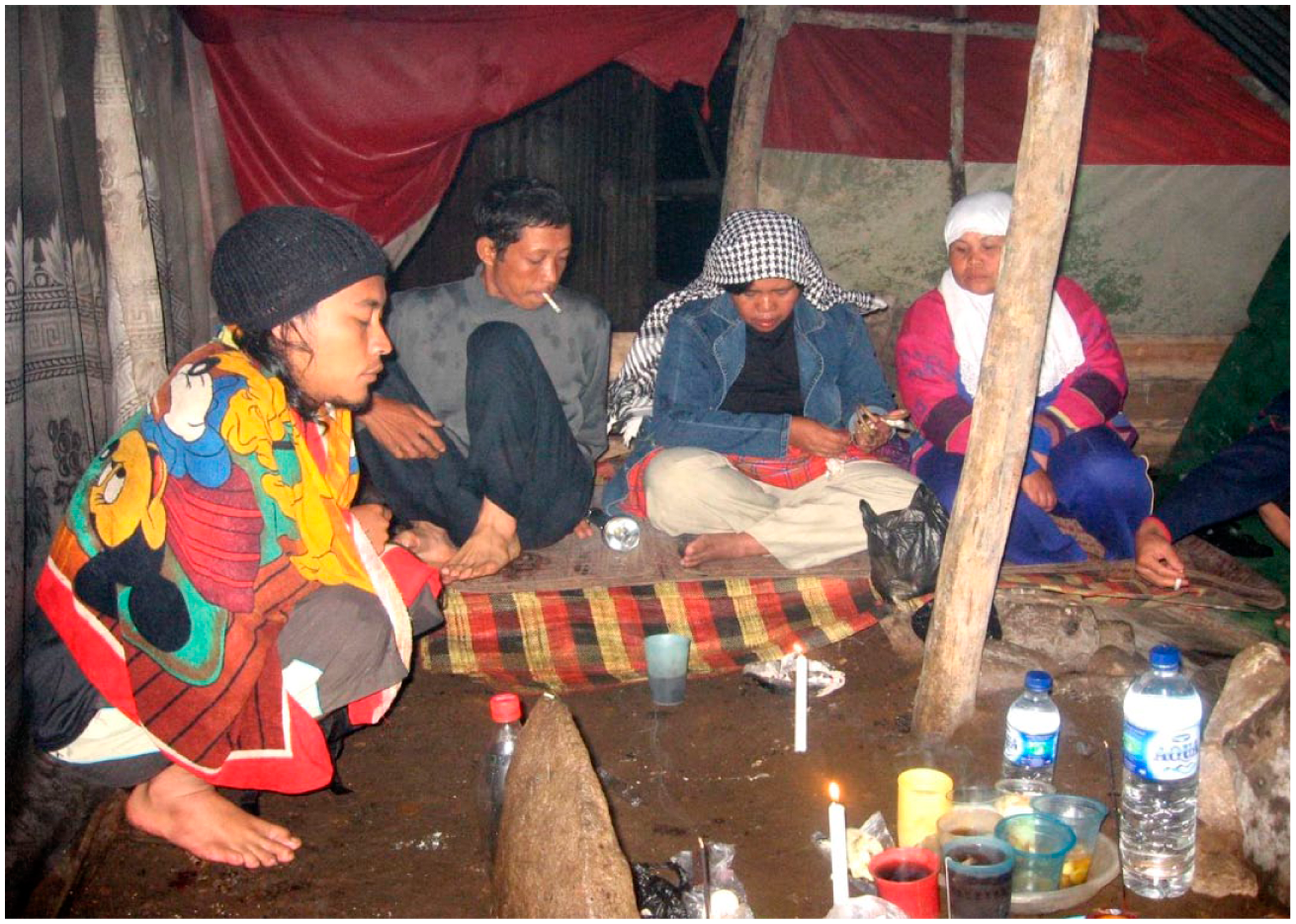
Eyang Sepuh’s cemetery.
In the permohonan (and in several consecutive permohonan over the following days), Ibu Enok asked the ancestors to fulfil the wishes of the pilgrims. After the formal part of the recitation, the spirit of Eyang Sepuh possessed Ibu Enok’s body and spoke directly to the group, assuring them that the ancestors accepted our presence. After coming out of trance, Ibu Enok returned to our camp, while some of the pilgrims stayed at the grave to continue praying and to convey their individual wishes. Personal belongings, such as wallets, make up and water, were left to be blessed and empowered by the ancestors. Ibu Enok’s mediation enabled the pilgrims to establish a personal relationship with the ancestors of the mountain on the first day of the pilgrimage.
This kind of communication was performed regularly during our stay. Incense was burnt and small offerings were placed on a tray while Ibu Enok silently recited. When we later carried out circumambulations of the mountain, a small permohonan like this was performed each time we approached spots where ancestors resided and a more elaborate one, like the one carried out on our arrival, was repeated the night before our departure. During the more complex ceremonies, ancestors possessed the body of Ibu Enok and communicated directly with the group and she became a vehicle for the ancestor’s voices.
Late on the first evening, I was invited to watch the ancestors eat. The pilgrims said that if, as a western scientist, I had any doubts about the reality of ancestors, they would now show me incontrovertible evidence (bukti) of their existence. They woke me up that night and excitedly told me, ‘Look, there they are’. In the moonlight we could see civet cats eating from the offerings placed at Eyang Sepuh’s grave. The pilgrims pointed out that the cats were being selective about which offerings to choose and this revealed which ancestor was visiting since each has its special tastes. When I asked why they looked like animals, I was told that the ancestors take a form we recognise so as not to frighten us. In the morning, Ibu Enok was satisfied that all the offerings had been eaten during the night. This was interpreted as further evidence that we had all been accepted and that she had chosen the correct offerings. A similar event occurred the following morning when a civet cat approached us. Ibu Enok immediately noted that it is extremely unusual for these animals to appear in daylight. She said it was a female ancestor shapeshifting into a cat because she wanted to become acquainted with us, and nobody questioned her interpretation.
There are also legends that connect recently deceased people to this place. During our stay, Ibu Enok told us fragments of the history of the mountain. She told that it is an especially important place for the ancestors to convene but she also told stories of accidents that have occurred in the mountain and of famous people who had visited it. One story was that of an aeroplane that crashed into the mountain because it is able to become invisible. Thus, Ibu Enok guided us through the mountain’s story by interweaving its spiritual powers with mundane events. Since there are no written sources about the history of the mountain, Ibu Enok claimed that all she knew had been revealed to her by the ancestors. When we later found traces of an aeroplane as well as a cave whose location had been revealed to her in a dream, this supported her contention that the ancestors were the true source of her knowledge.
On the second day, we ventured further up the mountain to the cave of Sangkuriang (a famous figure in Sundanese mythology). Before we entered, Ibu Enok again asked permission (permohonan). Water was dripping from the roof and from one spot it was spouting out like a shower. We all gathered under the ‘shower’ to benefit from the power of the water while one of our compatriots recited some verses from Al Koran. People began filling plastic bottles with the mud and water that was considered to be blessed with extraordinary powers. Ibu Enok was pleased that we all re-emerged from the cave without any accidents, and she saw this as the ultimate evidence (bukti) that the ancestors had accepted us and that her knowledge about who could visit the mountain was authentic and correct (Figure 2).
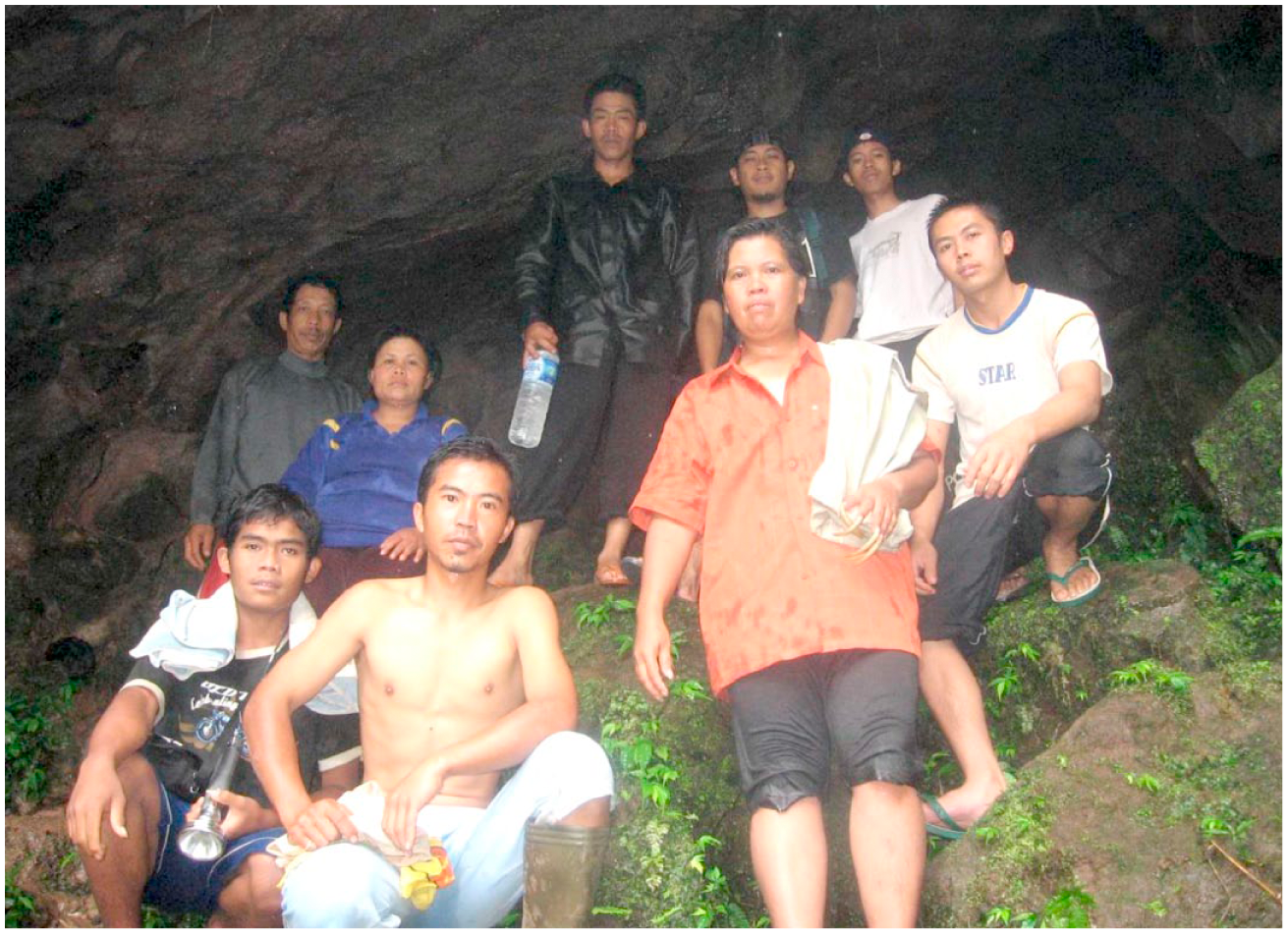
Outside Sangkuriang’s cave.
The fact that we actually reached the cave, which is often impossible because of the rain and mud on the trails, and that no one became afraid or fled from the cave, was taken as further evidence that the ancestors had accepted our intentions.
Ibu Enok and the pilgrims repeatedly pointed out various ‘curious phenomena’. Someone asked, ‘Did you see the wind blowing in the tree [when there was no wind otherwise]?’ Another asked, ‘Did you sense the trembling of the rock when we climbed it?’ And another, ‘Did you hear the rumbling in the cloudless sky?’ Sounds, light and movements that seemed ‘out of place’ were noted as signs of a transcendental presence. Strange phenomenon, like the shapeshifting cat and the fact that there was plenty of water high up in the mountain even during the dry season, was taken as a sign of the ancestors approving of and providing for the visitors.
Ibu Enok set the scene for this endeavour with her invocations, particularly during the first permohonan when Eyang Sepuh possessed her body and addressed the pilgrims. She made the invisible border between this and the transcendental world perceptible by mediating the voice of Eyang Sepuh, but it was also clearly permeable to the words and by consequence (hopefully) could also reward pass between the realms. She made it possible for each person to distinguish between the different realms of existence and thus become aware of and acknowledge signs of the transcendental. The pilgrims had to accept that phenomena that would normally be considered ‘natural’ were in fact signs of a transcendental realm. Trees, stones, wind, mud, water and animals became important markers of both the border between humans and ancestors and of a space that the two groups could share.
‘The text’: the result of productive complicity
Communication with the ancestors also takes place at other rituals, such as weddings, funerals and circumcisions. On these occasions, it is hoped for that these invisible powers will provide blessings, but the ancestors do not necessarily become present in person and there is no need for individuals to acknowledge their presence. Ritual activities in Sundanese society are preoccupied in erecting and maintaining these borders between the seen and unseen realms of reality (Wessing, 1988). A successful pilgrimage, on the other hand, leads to a direct and individual exchange with the ancestors. Mount Sunda provided the pilgrims with an opportunity to establish a connection with the realm of ancestors through an active engagement with borders. In the mountain, it was possible to break the constraints that govern everyday experience and make the invisible become visible. A momentary permeability enabled the Juru Kuncen to engage with the ancestors so that the pilgrims could approach them with their wishes.
In my field notes, it is apparent that the pilgrim guide’s practices and knowledge function as ‘keys’ for visualising the porous border to transcendental realities, releasing meaning and, hopefully, rewards. When the guide activates this permeable border, it enables pilgrims to send prayers, wishes and offerings to the transcendental world and receive rewards from the ancestors. It also enables direct communication, the exchange of words, between the two domains. It is skill in ‘working’ these borders that lies at the heart of the pilgrim leader’s duties. 6 The capacity to establish a relation to a transcendental world ‘beyond the known’ (Morinis 1992: 1) is essential to the Juru Kuncen’s legitimacy. However, not being able to fall back on an inherited position, no authoritative texts or accumulated storage of knowledge, Ibu Enok has to achieve her legitimacy as a Juru Kuncen otherwise. She has to establish her own text together with the pilgrims.
I have chosen to regard the knowledge created at Mount Sunda as a form of text. The practices we conducted (praying, showering in caves and so on) and the conversations we had about ‘peculiar phenomena’ helped change the perceptions of the participants so that they could experience something beyond the everyday. Their interpretation of sensory stimuli that would not normally indicate the presence of ancestors now became means for evaluating the Juru Kuncen’s claims of being able to communicate with transcendental forces. I was asked time and again whether I sensed, saw or heard the same things as the rest of the group when we were approaching representations of the ancestors. If I did, then this was taken as evidence (bukti) of my becoming aware of the ancestors and also as proof of Ibu Enok’s powers and knowledge. Siegel writes that bukti means that ‘what the speaker expected was born out’ (Siegel, 2006: 118). It is not counterproof or support for one side of an argument but validates and confirms what one already knows. Bukti implies that ‘[a]fter the fact, the uncanny event is claimed to have been anticipated’ (Siegel, 2006: 118). Siegel’s analysis deals with sorcery, in which bukti is a confirmation of a sorcery allegation. In contrast, in the case described here, bukti did not imply distrust or suspicion of evil but simply indicated shared knowledge between Ibu Enok and the pilgrims. Because they knew her background and who she was in ordinary social life, they knew that she had powers to transgress borders and was pintar (knowledgeable). In other words, they knew that she was a border crosser before they climbed the mountain with her, so the successful pilgrimage membuktikan (the verb derived from bukti, meaning confirmed) what they expected to happen. Without ‘ritually’ primed bodies or mystical knowledge of our own, the pilgrims and I were dependent on Ibu Enok for access to the ancestors. As was the case in the permohonan but also to get permission to make a fire or getting information from them about the mountain. We had to use our senses to validate her knowledge of a transcendental reality of which we became aware by noticing the signs provided by ancestors. We therefore shared an interest in ascribing meaning to observations that confirmed Ibu Enok’s knowledge and skills. Our expectations and pursuit of bukti resulted in a productive complicity which made the invisible ‘third’ (the ancestors) visible and made the borders between the mundane and the transcendental both perceptible and permeable.
Concluding remarks
It was not the asceticism of the individual that determined whether the pilgrimage was successful or not. The membrane between the world of the living and that of the dead ancestors was activated by the Juru Kuncen. These were practices that the pilgrims were witnesses to rather than participants in. For the success of the pilgrimage, the group relied on Ibu Enok’s knowledge and skills. This meant it was important to find confirmation of the fact that they were sufficient to enable communication and exchange through the different realms of reality existing at Mount Sunda (‘the place’), because the pilgrims’ wishes had to be communicated to the ancestors and the ancestors’ rewards and guidance had to be mediated back to the pilgrims through her. During the pilgrimage, we (the ‘persons’ of the pilgrimage) engaged in a productive complicity that yielded shared knowledge that validated Ibu Enok’s skills in making the ‘threshold’ (Turner, 1974: 197) to another reality visible. The complicity between us and Ibu Enok thus produced a ‘text’ that contained explanations of what we experienced. This text confirmed Ibu Enok’s legitimacy as a guide who could enable contact with ancestors by alerting us to visible markers of the borders between the visible world of humans and the invisible realm of the ancestors.
Footnotes
Funding
The author(s) received no financial support for the research, authorship and/or publication of this article.