




Abstract
Drawing from assemblage thinking, this article explores the complexity of urban tourism conflicts. The case study of a playful urban intervention in Barcelona exhibits the connections that link place-based activism, local identity construction and sense of place in relation to the tourism development. The productive case study, called Fem Plaça (Let’s make the square), highlights the more proactive rather than merely reactive role of inhabitants. Moreover, it allows for a better understanding of protest as a series of relational, processual practices of empowerment, overcoming the efficiency rhetoric that values a process only for its final success. Finally, this study strives to expand the tourist analysis to the performance and performativity of the local people’s disaffection in urban contexts to ensure a broader comprehensiveness in the tourist academic field.
Introduction
This study concerns local social conflicts and recent mobilisations related to the dominance of tourism in urban space. This ever-increasing ascendancy inside most cities’ development agendas involves broader forces and invites researchers to adopt a holistic approach (Stronza, 2001). Therefore, tourism scholarship seriously should consider new forms of protest, the affected areas and different forms in which cultural and social manifestations act strategically in urban areas that are experiencing abrupt changes, both symbolically and materially. While it might be superficial to say a global revolt has surfaced against tourism, conflicts certainly are surrounding it presently (Colomb and Novy, 2016). This is the case in many cities across Europe and elsewhere, for example, Berlin and Lisbon, where signs can be found in streets bearing messages such as ‘Tourists go home’, ‘Too much tourism kills the city’ and ‘Terramotourism’. Protests have been held in Venice, with protesters yelling slogans such as ‘Venexodus, without Venetians, there will be no more Venice’ and ‘The city is for the people who live in there’ (Figure 1).
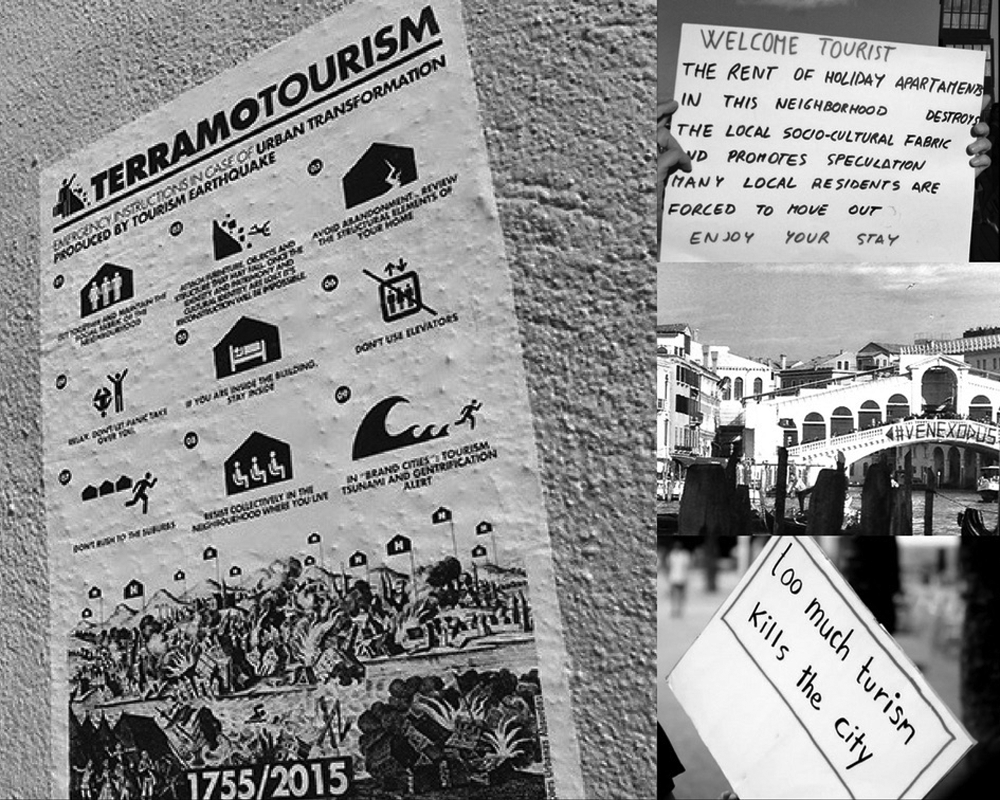
On the left, a flier in Lisbon compares the effects of the earthquake in 1755 to the current negative consequences from tourism on the urban fabric. The top and bottom images on the right show billboards displaying slogans in Barcelona in August 2014. The middle-right image shows a banner in Venice during the Venexodus protest in November 2016 (Personal assemblage by the author; author’s photos).
Another paradigmatic example can be found in Barcelona, known worldwide as a major tourist destination since the early 1990s. Here, in recent years, local residents and grassroots movements in popular tourist neighbourhoods have been making their voices heard, debating the negative impacts that mass tourism has had on the city’s urban fabric and on locals’ daily lives (Colomb and Novy, 2016). The Catalan capital is a productive case study from which to approach urban tourism as a fragmented and multifaceted phenomenon. Moreover, it provides for interesting insights into the emerging types of conflicts. The practices of a neighbourhood movement called Fem Plaça (FP), meaning ‘Let’s make the Square’, will help in analysing one form of response to tourism and its impacts, focusing on reclaiming public spaces from privatisation efforts. In doing so, this study will be divided into five sections. The theoretical section, ‘Questioning urban tourism’, aims to frame a field with porous borders and highlights the lack of scholarly tourism attention paid to the heterogeneity of practices connected to urban tourism conflicts. Then, assemblage thinking in the methodologies section lays the basis for the comprehension of urban performances, focusing on the interconnection between sensibility and materiality and between relationality and process. The concept of assemblage will be useful in showing how the social production of space comprises dialogical activity that couples the material and immaterial, as well as human and non-human entities (Muecke and Wergin, 2014). This concept will be used to analyse the contingent, generative nature of the emergent FP project that, once a month, temporarily occupies a square in the city’s old district. Subsequently, the third section, ‘Fem Plaça urban background’, introduces a case study on Barcelona. After reviewing the main points that have determined the key role of tourism in development politics, I propose an empirical description of the specific case study in ‘Making sense of the Square’. In ‘Grasping the Fem Plaça significance’, I argue that through the lens of assemblage thinking, a more proactive, rather than merely reactive, role among inhabitants emerges. Through such actions, participants try to find meaning and empower (Appadurai, 2004) their community. Performing a playful protest within a specific action space and with a rhythm of its own, produced by the combination of the material and human, FP highlights how urban time-space is multiplied and co-produced within a conflicting situation. In this way, FP helps capture the liveliness of urban-dwelling interventions as open processes in the context of urban conflict, overcoming the efficiency rhetoric applied in ex post analysis that values actions of resistance only for specific goals. I conclude by discussing how this study can be used by tourist scholars to expand on the extant literature concerning local populations’ disaffection with urban tourism contexts to ensure broader comprehensiveness in the academic field.
Questioning urban tourism
Since the 1970s, due to urban industrial crises, cities have been going through several changes involving a restructuring of their economic bases (Colomb and Novy, 2016). Forced into global inter-urban competition to generate economic growth, urban politics have turned into politics of economic development. In such a situation, tourism, with its economic potential, became an intrinsically neoliberal tool, emerging as a plus-value, revenue-generating unit (Harvey, 2012) used by local governments to achieve competitive advantages. At the same time, this new set of market-oriented strategies has been accompanied by a partial destruction of institutional arrangements with the emergence of private-sector growth, which, on the whole, transformed urban fabrics into productive centres. Critical extant research on how globalisation and neoliberal spatial policies have affected the city in favour of private profit and semi-public use can be found in abundance (Holston and Appadurai, 1996; Mitchell, 2000). A large portion revisits the ‘Right to the City’ (Castells, 1977, 1983; Lefebvre, 1968), and strong academic attention has been paid to the emergence of social formations to resist the homogenisation forces of the capitalistic city (De Souza, 2006; Edensor et al., 2010; Hou, 2010; Long, 2013; Mould, 2014), in which public space have become commercialised through gentrification processes (Degen, 2008).
Nowadays, the tourism industry (and private investments related to it) has been identified as one of the most powerful sectors in redefining urban fabrics and local people’s quality of life. Therefore, seeking to enhance a radical critique of tourism that includes issues of power, inequality and development processes in contemporary cities (Bianchi, 2009), local disputes related to urban tourism enter into the aforementioned debate and represent a substantive turning point – a new focus in the actual ‘critical turn’ in tourism studies. This explicitly political project challenges the field’s dominant discourses of business prerogatives (Ateljevic et al., 2007), putting forward a paradigmatic changeover in tourism thinking and embracing distinct perceptions (Pritchard and Morgan, 2007), such as those of local residents.
In the specific case of Barcelona, a body of literature exists on urban-development policies that converted the city into an international brand (Calavita and Ferrer, 2000; Capel, 2005; Degen and Garcia, 2012; Delgado, 2007b). Concurrently, considerable research has been devoted to grassroots movements connected to the great tradition of activism in the country since the end of Franco’s dictatorship in 1975, the 15M Indignados Movement (Hughes, 2001; Lois-González and Piñeira-Mantiñán, 2015) and the mobilisations that started on 15 March 2011. However, only recently have the claims of local people organising against the touristification of public space aroused the interest of Spanish scholars (Arias-Sans and Russo, 2016; Milano and Onghena, 2015), with the topic remaining relatively unexplored within Anglophone tourism research. Little systematic analysis has been directed towards the rise of urban tourism as a source of local discord and the repertoires of action used to express this discontent. Recently, some valuable detailed findings have been produced (Colomb and Novy, 2016; Arias-Sans and Russo, 2016), but the subject is on a continuous ascendancy within the contemporary urban fabric. In the book Protest and Resistance in the Tourist City, Colomb and Novy (2016) aimed to interconnect urban studies with tourism studies while examining different experiences in 16 cities across Europe, North and South America, and Asia. The chapter ‘The right to Gaudí: What can we learn from the commoning of Park Güell, Barcelona?’ (Arias-Sans and Russo, 2016) offers a detailed overview of the struggles generated in Barcelona in the Park Güell neighbourhood, whose monumental section is no longer publicly accessible. The authors provide new insights into the plurality of divergent interests and positions among a group of local residents who shifted the question from ‘how to protect the city from tourism’ to ‘how we compose the city along with tourism’ (Arias-Sans and Russo, 2016). Despite this, there is still little information on other forms of less politically confrontational activist aggregations and strategies developed by local residents to deal with the perception of tourist invasions and the subsequent disruptions in their daily lives.
Only one other analysis of FP has been produced, by Saltzman in 2017, part of the collection Spain After the 15M: the 99% Speaks Out. In her study, the author highlights how this everyday protest aims to avoid creating controlled and hyper-regulated public spaces. My aim here is to enrich extant literature on FP by focusing on how, through materiality, the sense of place is constructed in relation to the presence of tourists. Moreover, this empirical research seeks to contribute to broader debates about the practices of resistance about touristification, pointing out the connections that link place-based activism, local identity construction and sense of place.
Methodologies: towards an FP understanding
FP is the name of an urban collective and event that takes place each month in a different square of Ciutat Vella, the old district of Barcelona. It includes a monthly urban strategy (De Certeau, 1984), identified by the organisers themselves as ‘the act to go out in the street’, carrying several implications and meanings. Seen from the outside, this ‘urban happening’ does not present a strong feature of protest, but, as explained below, the initiative comes from the idea that people should be able to exist comfortably in public spaces that are controlled more and more by the private sector.
The first intervention was organised in March 2014. When I arrived in Barcelona in April 2014 for my ethnographic fieldwork, I was interested in the touristification processes and the way inhabitants faced this situation without having clearly defined the case study. I first attended meetings in Ciutat Vella that were more formal, for example, neighbourhood assemblies, to gain a general sense of the situation. I learned about this monthly event, in which I took part until December of that year. The events and assemblies were supported with an email exchange, using the FP mailing list and activities on Facebook, as well as demonstrations during the summer months, which helped me better contextualise the mood of discontent in the city. It is important to note that it was during summer 2014 when the episode involving three naked Italian tourists running through La Barceloneta (Kassam, 2014), a working-class neighbourhood close to the seaside, during the day sparked several protests in the old district against ‘drunken and uncivil tourism’. I was completely immersed in this turmoil, in which various residents’ associations got together for almost-daily demonstrations, and I decided to join FP to have a more proactive role than that of a mere protestor. Hence, the data were collected mainly through engaged participation, which allowed me to be both a researcher and an active participant. Accordingly, such positionality placed more emphasis on my participation, from which a further methodological choice was derived. To reduce the inevitable relation of power that is normally established between researcher and respondents, I built my investigation upon narrative methods with no recorder or structured interviews during my social encounters. I preferred relying on other techniques towards which I feel a greater inclination, that is, photography, which was not chosen to be independent from other methods, such as field notes or observant participation, but rather as a complementary medium (Pink, 2007). While my first tentative visual outcomes in the research relied on pictures to communicate more vividly the construction of a ‘vernacular square’ in which FP performed its actions, I later began to analyse my own photographic practice, through which I came to understand more fully the place and sensations transmitted during the meetings (Kroon, 2016; Rose, 2008, 2014). Transcending the limitations of verbal discourse in the field, this tool allowed me to open spaces of understanding and explore embodied performances (Scarles, 2010). It provided me with an opportunity to relive my experience visually and access the practices of which I was a part. Hence, I was able to comprehend more deeply the ways in which FP came into being, and at a later stage, photos triggered further reflections on the data collected. I became aware that, while taking pictures, I was more focused on specific inner details and materialities of the event. Subsequently, this sort of autoethnography (Scarles, 2010) suggested a different interpretation of FP and led to the decision to move away from the subject–object division in favour of an understanding of a more fluid process focused on the specific dynamics that structured the monthly events.
For this reason, I propose using assemblage thinking to explain the processuality of the FP action. I argue that this theoretical framework can approach complex phenomena, such as tourism, in which different socio-spatial dimensions coexist and co-function, either concordantly or in conflict (Briassoulis, 2017). Accordingly, I consider assemblage theory to be a useful orientation for better understanding the potentiality of actors and sites in relation to recent local events (McFarlane, 2009, 2011b) in Barcelona. This is because assemblage works as a sort of anti-structural concept that stresses the notion of multiplicity (DeLanda, 2006; Deleuze and Guattari, 1993), which is useful for describing tourism phenomena as complex, coupled, human–environment systems in which the ephemeral and decentralised emergence of the actors involved is constantly present simultaneously (Marcus and Saka, 2006). It is the kind of approach that argues for a more conceptual openness to the unexpected (McFarlane, 2011a). Hence, it can capture the heterogeneity and be an appropriate tool to explore how groups are performed continuously and agencies debated incessantly while remaking and interacting with urban spaces (Jacobs and Merriman, 2011) in a processual, socio-material perspective (Müller, 2015; Müller and Schurr, 2015).
For the specific purpose of my research, the assemblage approach represents a key effort towards emphasising the depth and potentiality of sites and actors in terms of their histories, the labour required to produce them and their capacity to go beyond the sum of their connections (McFarlane, 2011a). Assemblage is not a given entity, but a temporary product provided by a specific assembly of desires and materialities (Dovey, 2010; Müller, 2015) with a particular ongoing reconfiguration (Barad, 2003) that is historically and geographically contingent, aiming to renegotiate reality and set the groundwork for social disagreement (DeLanda, 2006). It is a useful approach that is necessary to re-examine the experience of ‘FP-direct action’ and deconstruct the emergence of this dynamic coordination of emotional and political aspects.
The FP urban background
The roots of urban activism in Barcelona lie in the great tradition of neighbourhood associations of the late 1960s and 1970s, as they were an integral part of the urban decisions of that period (Castells, 1983). This form of participation began to lose its importance ever since planning for the Olympic Games in 1992 secured employment for several activists in political circles, private investments increased and the image-brand of the ‘Barcelona Model’ began dominating discourse (Calavita and Ferrer, 2000; Capel, 2005; Delgado, 2007b; Saltzman, 2017). Now, a rebirth among these associations can be observed, certainly influenced by factors such as the real estate bubble, Spain’s 15M movement and its catalysing of power apart from the CiU (Convergència i Unió 2011–2015) city council’s decision to respond to the economic crisis by investing more heavily in the private sector through mass tourism (Saltzman, 2017).
This urban-development strategy, linked to tourists’ demand for particular settings and services, has been implemented rapidly through local and external investments that have worked towards helping businesses lure the tourism economy (Colomb and Novy, 2016), leading to gentrification processes and inequalities between different areas and social groups in the city (Degen and Garcia, 2012; Delgado, 2007b; Navarro Yáñez, 2013). Barcelona moved from the motto ‘Restore the city to its citizens’ during the early 1980s, soon after the end of the Franco dictatorship, to ‘Barcelona, posa’t guapa’ (‘Barcelona, make yourself pretty’, used during the mass restructuring for the 1992 Olympic Games), ‘Barcelona: la millor botiga al mon’ (‘Barcelona: best shop in the world’, an annual award aiming to contribute to dynamism and improvement among the city’s commercial initiatives) and ‘Visc(a) Barcelona’ (an institutional promotion that plays with the double meaning ‘visca’/’visc a’, the first spelling of which in Catalan means ‘Hooray, Barcelona’ and the second meaning ‘I live in Barcelona’), used to promote the Catalan capital as a desirable city with its urban projects ‘Made in Barcelona’. The city passed from a form of barcelonismo, based on a fervently urban and transformational optimism to ensure architectural quality on an intermediate urban scale, to barcelonitis (Delgado, 2007a), that is, a sort of exaggeration of the initial pride, a disease in which the Barcelona model of local urban regeneration went out of fashion in favour of a staging simulacrum for ensuring the international brand and its tourist image.
In the past 25 years, there has been no significant population growth, with the population dropping slightly from 1,643,542 in 1991 to 1,613,393 in 2014. Conversely, in the past few years, the number of tourists has grown steadily. In 2014, the city hosted 7.5 million visitors (Cordero, 2014), according to data released by the public–private consortium Turismo de Barcelona (2015). Tourism, once occasional in time and precise in territory, has been reaching a permanent and pervasive dimension, thanks to rapid proliferation. From museums to cruise tourism, through simple leisure tourism, the tourism fields of action have continued to expand their pervasiveness with ever-increasing participation of different actors. Facing this restricted urban environment, several interdependent and heterogeneous organisations started to arise around rhizomatically (Deleuze and Guattari, 1993) to point out their disagreement with mass tourism (including housing activists, groups against privatisation of public spaces and environmental groups concerned about pollution from cruise ships). FP, which invites people to go out and enjoy the square and street life, is part of this opposition, in which a wide range of locals from different backgrounds have been dedicating their knowledge to spotlighting local needs that they believe are not being met or managed efficiently by institutional powers (Novy and Colomb, 2013). The idea comes from a deep sense of failure with respect to classical protests. As one of the organisers explained, in the summer of 2013, a demonstration was organised against the Pla d’Usos, a plan for further deregulation of licences for tourism in the district of Ciutat Vella. The plan included suspending official protection for several historic buildings and allowing more restaurants and cafés to fill public spaces with private seating. Thanks to this ordinance, between 2011 and 2013, bars with outdoor terraces increased 11 percent, from 3882 to 4341 (La Vanguardia, 2013). Of these bars, 50 percent, according to surveys from 2014, did not follow all regulations, such as occupying only half the sidewalk and limiting tables. In addition to the aforementioned Pla d’usos, FP opposes the Lei de Civisme (Civility Ordinance), adopted in 2005 by the Barcelona City Council to regulate activities in public space (Ajuntament de Barcelona, 2005; Galdon-Clavell, 2015). According to this ordinance, it is forbidden, without official permission, to paint or hang posters, play music, consume alcohol, distribute food or engage in artistic activities in public spaces. As nothing changed after the 2013 protest and being immersed daily in such a hyper-regulated context, FP organisers thought an alternative demonstration was needed.
Making sense of the square
During my first weeks in Barcelona, I was attending some assemblies hosted by the neighbourhood association of Ciutat Vella (Associacion de Veins, whose activities date back to the end of the Franco dictatorship). On these occasions, people were discussing the construction of a new hotel in the neighbourhood and how they could oppose it. The discussions normally were chaired by the president of the association, an architect and a lawyer who tried to provide technical clarifications and explain the legal legitimacy of the new hotel, as well as the rights of citizens to act. During these meetings, I familiarised myself with another action group formed by some members of the aforementioned association and local residents and collectives active in the district. It was a more youthful and dynamic association, called Xarxa Ciutat Vella (Ciutat Vella Network). While the neighbourhood association focuses more on technical assemblies, Xarxa represents a new, heterogeneous, proactive group with alternative initiatives. Its purpose is to bring together the strengths of people from different social organisations to establish self-managed initiatives against touristification and other problematic conditions affecting the neighbourhood, such as immigration and environmental-sustainability issues, among others. One of these new initiatives was FP, born as an event and later established as a collective that identifies itself within a political positioning of people who not only request, but also propose, shaping the group as an active player that emerges from this sampling of field notes collected during several meetings: Why not do something that serves as a protest, but also as an entertainment? To trigger the social networks of the neighbourhood so that any of its inhabitants can take part in a project that occurs in the places where they live. (Field notes, August 2014) Here, we are trying to fix the world and straight from the street (laughter). (Field notes, October 2014) It is very difficult to stay in a square without having to sit in a bar and consume something. We were there, in the square, thinking about how to occupy it with a thousand ideas and a lady from the window up above said she just wanted to come downstairs with a chair and have a beer. (Field notes, July 2014)
What the participants of FP complain about is the gradual transformation of the city centre, in a postcard designed for its consumer-tourists. They have nothing against the tourists visiting Barcelona; rather, they are denouncing the city’s effort to reinvent Barcelona as a major European tourist destination, a kind of theme park for tourists and leisure practices: Ciutat Vella is becoming like Venice; there is no solution. It is a situation we cannot stop. How can one stop it? If people want to go to a city because it is fashionable, they simply go! (A neighbour) It is not that we are against tourism; we, ourselves, are the first to be tourists, or we would like to be. The problem is when you create a monoculture. When you create a monoculture, everything around is being destroyed. We are not Guirilandia. (‘Land of foreign tourists’) (Figure 2)
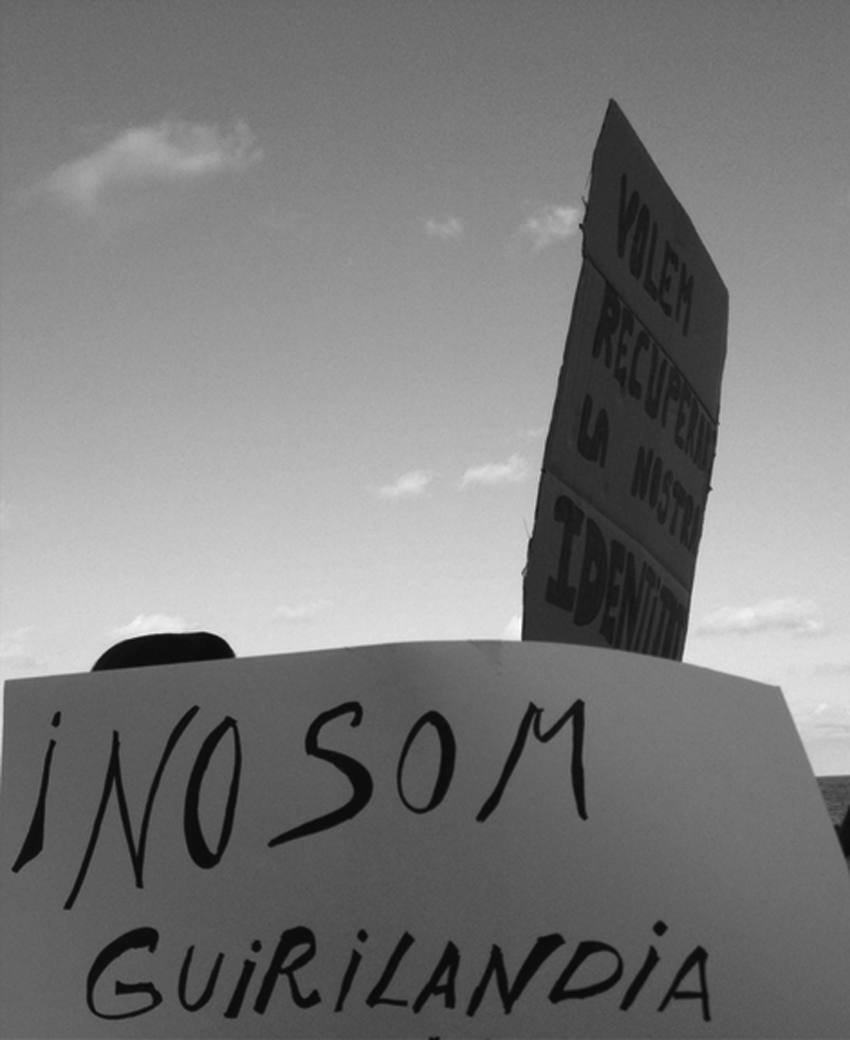
‘We are not Guirilandia’; ‘We want to recover our identity’. The picture shows two banners tied to a manifestation in La Barceloneta in August 2014. Guirilandia, or ‘land of guiris’, is an emic term that literally means ‘Land of foreign tourists’. It is a metaphor used by local people to refer to the idea of Barcelona inappropriately viewed as a theme park (Author’s photos).
This group’s intention is to appropriate a place – not by asking permission but without creating violent confrontations – and establish a series of activities and values that imbue their square with a broader sense of sociability. FP softens the edges of protest, but clearly indicates against whom and for whom they take to the streets to demonstrate. It is a political action, and organisers are well aware that they are protesting playfully, though ‘not celebrating a birthday’ (Field notes, 2014). The message that they want to represent and the conscious effort to remain in the square are clear. For this reason, to put more strength into their actions and reclaim public spaces as places of coexistence, when choosing a square, they address those whom they feel are part of a collective memory of the neighbourhood, with a strong emotional attachment to the people – a square they feel no longer belongs to them, a square that suffered gentrification and now contains a high concentration of bars. They see how such a space has changed its shape and use, and then subsequently occupy it for an afternoon.
Not knowing exactly what to expect and without great expectations, the first time I arrived at an FP protest, the event already had begun. I found myself in front of a square inside the square. Faced with the static behaviour of people sitting outside the pubs, there was a different dynamic in the inner square, almost the opposite of the outside, created by the interactions between people and material objects, which ensured actions inside formed a delimited setting. This enclosure was possible thanks to a previous FP action, particularly because of a group of architects who studied the planimetry of the chosen square in advance. Once people begin to gather in the predefined location, the first action carried out is defining the portion of the square that FP wants to use as its space and within which its actions will take place. This is quite a simple action, but it creates a strong visual impact: photos and maps dense with meaning hanging on ropes lined with hooks connected to trees or street lamps. The photos depict past events, the planimetry of the specific square in which they are, and maps depict portions of the district that have undergone profound changes. Some photos are of neighbours accompanied by critical phrases (Figures 3 and 4).
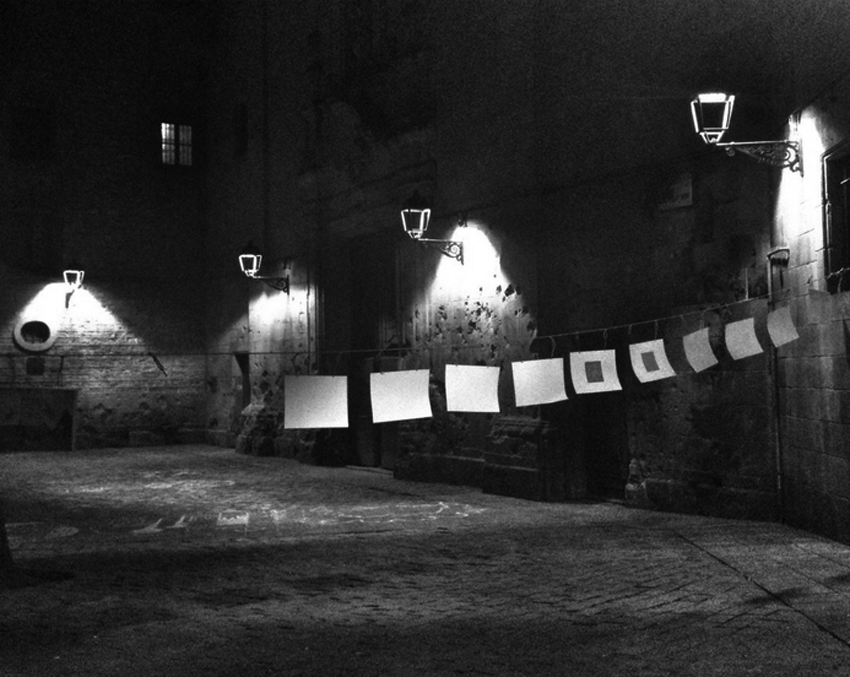
Details of the delimitation of the space action. This photo was taken at the end of the event, and it shows hanging pictures and some sketches on the floor made with chalk. San Felipe Neri Square, Ciutat Vella District, 19 August 2014 (Author’s photo).
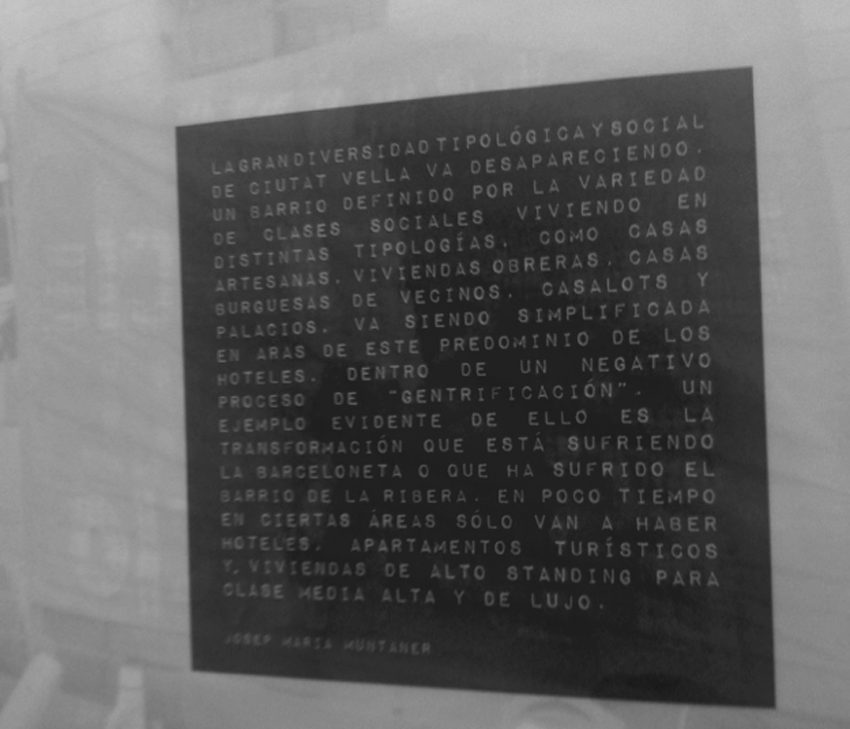
‘The great typological and social variety of Ciutat Vella is disappearing. A neighbourhood defined by the variety of social classes and lifestyles in different housing types, such as artisan houses, public houses, bourgeois houses and palaces, is being simplified by this predominance of hotels through a negative process of gentrification. An obvious example is what La Barceloneta is suffering or what La Ribeira has suffered. In a short period, in certain areas, there will only be hotels, tourist apartments and high-class housing for half-class and luxury people’. Details from one of the photos are used for every event to delimit the space. Plaça de la Barceloneta, Ciutat Vella District, 21 July 2014 (Author’s photo and translation).
In this context, the main players are the neighbours who become visible and involve themselves through everyday actions. Along with the delimitation, another important action to guarantee the spontaneity of the meeting is to set up, inside the perimeter, an area dedicated to commonality. The organisers bring tables and a few stools or chairs to allow participants to sit, and they set up an improvised buffet with dishes and snacks that people brought from home to share. Moreover, in the preparatory phase, it is important to issue an open invitation to inform other neighbours about the event. Alongside classical leafleting, additional communication media such as Facebook are used to nurture engagement with different and younger age groups. Then, to emphasise the recreational nature of the protest, the meeting time is always around 5 p.m., when kids are out of school. This is another strategy: by involving children, the purpose is to occupy the space in a spontaneous way, using the area fully and in a manner different from adults. The objective also is made clear by a banner that says, ‘Recuper l’espai public com a lloc de convivencia’ (‘Let’s regain public space as a space of coexistence’), written in Catalan, without any translation to other languages (Figure 5). Clearly, such a decision emphasises the desire to create a worthwhile experience for participants that excludes foreign tourists, with the potential risk of perpetuating a permissive image of a lively Barcelona.
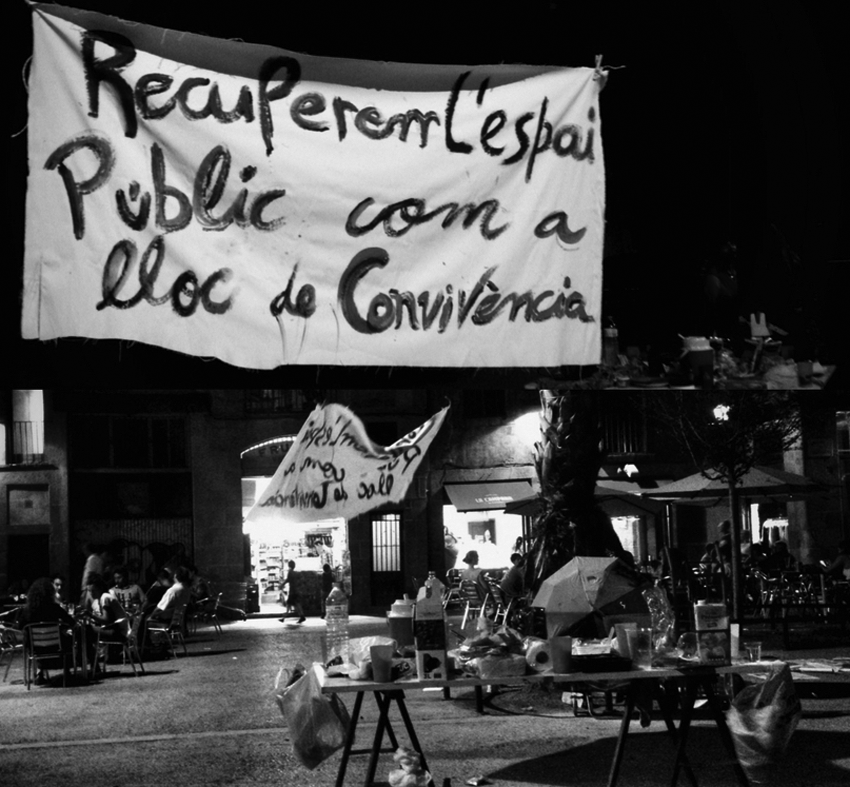
A banner with the Catalan slogan ‘Let’s regain public space as a space of coexistence’ and a table with snacks (Author’s photos).
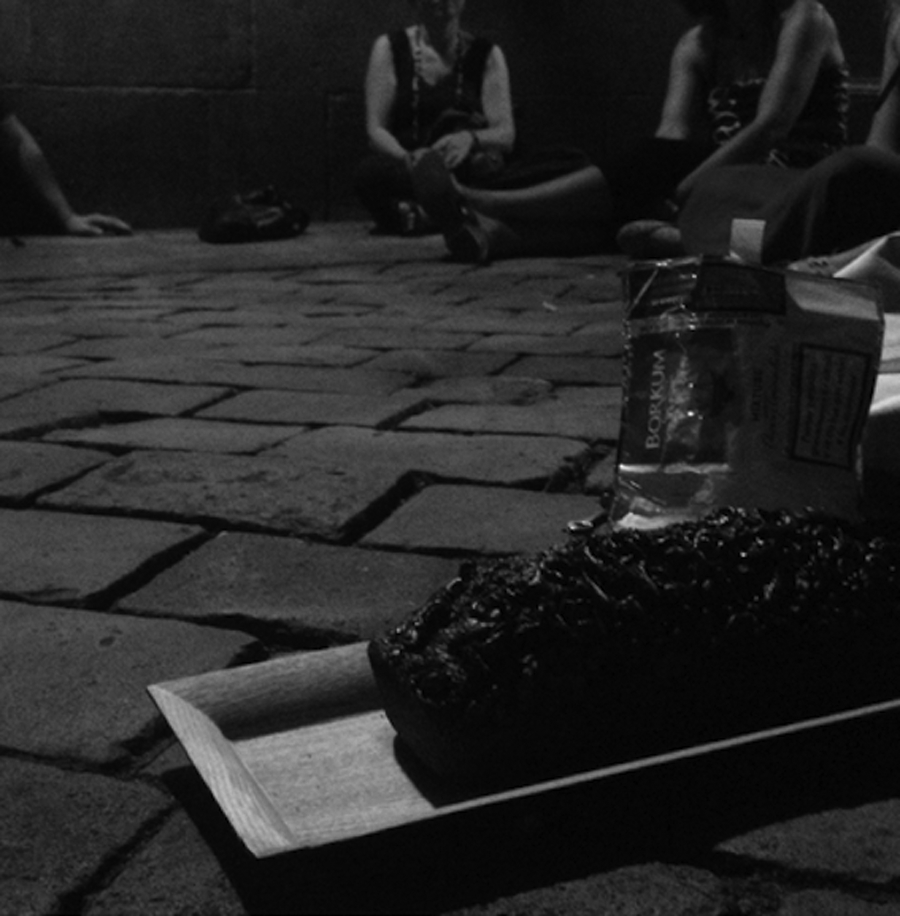
People bring bread and chocolate – traditional snacks that are simple, yet full of value, especially for older residents. Such snacks, as some participants say, represent a means of memory appropriation (Field notes, 2014) for the construction and legitimisation of their social (and historical) identity in opposition to the homogenisation of practices in the neoliberal city. It is evident in these activities how FP represents a response to the desire to do something different from standard protests, to emphasise a desire to confront these urban interventions with a cheerful spirit. Usually, in addition to snacks, chalk is used to demarcate the field of action further, together with ropes and pictures, which are then left on the ground so that anyone can write or draw on the pavement.
Accordingly, recreational activities also serve as further space demarcations, turning them into peculiar places characterised by specific actions. This manner of defining spaces contributes to enhancing the chosen slogan, ‘Let’s make the Square’, which is both inclusive and exclusive, and contributes to creating a square in the square with dynamics that differ and almost oppose the traditional rites of sitting comfortably at pub tables.
While participating, I felt like I was part of an open process that sought to recover autonomy and social inclusion: people of different ages came together in recreational areas dedicated to conviviality in which they move around, play and sit here and there talking about the daily affairs of the city. Normally, during the events I attended, there were about 30 people enjoying this way of living in the square. After a couple of hours, people started to leave, and an informal briefing closed the event. Usually, the organisers and a few more stayed, coming together in a sort of agora, or ‘ritualised space’ (Figure 6). Then it was time to restore the previous visual context, in which the organisers clean up the area and then everyone leaves.
Participants sit in a circle during the closing discussion of an FP event (Author’s photo).
The closing discussion becomes the symbolic centre of the meeting, in which people express their impressions of the just-finished FP event. Moreover, decisions regarding the following month’s event are debated, with suggestions for new places or alternatives for differentiation – always in an ongoing process that differs from the previous one – in a horizontal organisational structure in which everyone can contribute. It was at this moment that I could assist in the decision to customise the invitation and the event. During my fieldwork, for example, ‘Fem Plaça, Fem Platja’ (‘Let’s make the square, Let’s make the beach’) was proposed, as the subsequent meeting place was a square near the seaside in August. For this particular FP event, it was suggested that participants bring, aside from the usual snacks, sardines and typical dishes consumed at the beach during the summer months by locals, and to write on a banner ‘In Barcelona, we are like sardines in a box’. At the end of October, the slogan was ‘Fem Plaça, Fem castanyada’ (‘Let’s make the square, let’s make a chestnut-roasting party’). This confirms that these were not mere efforts to make the events attractive; rather, they emphasised local traditions, embedded and performed as political acts. The adaptation of food, the location and the tools to define the space became activities and objects of the assemblage, as a whole, a means of protest that opens up a specific space to social disagreement with the aim of renegotiating the socio-spatial polarisation of the city in which FP participants feel uncomfortable.
Grasping the FP significance
Public space is not, in itself, a space for emancipation, but it can be disruptive, active and generative (Massey, 1999). Be it the beach or the square, in any urban space in which an event takes place, FP uses an aesthetic and a language that express a social positioning within which its participants want to be included. The space they create is linked to the emergence of new social relationships that act to meet the needs that members view as common through the exchange of information. The practices, briefly described in the previous section, highlight the spatiality of urban assembly as a constant relational co-production in which the possibilities for dwelling in the public space are altered and generated. Combining disparate elements, human and non-human, which in their totality define a set of embodied and multi-sensory performances (Crouch, 2002), this example of direct action shows the contradictions in the contemporary neoliberal touristic landscape and offers a critical viewpoint on the instrumental use of it. The way FP occupies public spaces is a type of challenge that also must be understood in relation to the facts of 15M. After 2011, activists relocated on a smaller local scale, working on more specific conflicts at a micro level (Walliser, 2013). FP outlines a particular conception of local, place-based resistance expressed within the neighbourhood. Although the seemingly festive atmosphere might suggest simplicity in the event, it actually politicises the space through strategies and tactics (De Certeau, 1984). This example of urban intervention, articulated in a specific situation, is just one of many (Nicholls et al., 2013) in which the district acquires increasing importance, and squares intended as spaces of contestation become places where people can self-organise in social ceremonies used to reclaim public spaces. Playful actions are performed in small-scale spaces, in which political actions are transformed into rituals to strengthen relations between neighbours and stimulate the emancipatory potential of everyday spaces. FP is a self-organised form of a do-it-yourself (DIY) project, an ad hoc problem-solving effort carried out through activities capable of returning social life to these sites. It blends old protest terms, such as ‘occupation’, with newer terms and concepts, for example, ‘Post-It city’ (Peran, 2008), which emphasise a non-standard, temporal use of public spaces (Ferreri, 2015).
Assemblage thinking helps in understanding that while performing their playful protests, the individual artefacts, such as photos, food and the apparently simple actions of drawing or playing, acquire added value and a potentiality that exceed their common functions, constituting a new socio-political feature. These non-human agents are not simply practically useful but also play an active part in conditioning the development of the events’ possibilities.
Assemblage thinking facilitates the interpretation of the purpose of FP, which illuminates the urban via textual and material means, expressed in temporal and ephemeral occupations that appear and disappear without leaving visible or tangible marks, but certainly ideological ones in the minds of participants feeding from time to time on the raison d’etre of their movement. FP confirms the urgency of community spaces for citizens, not just to promote the destination. It appropriates spaces by drawing, metaphorically and literally, a new setting that points to the spontaneity of normally denied daily practices allocated in separate spaces standing in for a specific social ordering (Degen, 2008). This specific urban happening acts on the space in which it subjectifies its ideas and also renews the sense of belonging and collective identity of the collective itself. It shapes the space and the agents themselves in a relation of reciprocity. The symbolic creation of a square inside the square engages with the physical occupation that acquires both a strong symbolic significance of inclusive setting and affects the participants themselves, reinforcing and legitimising further agentic behaviours of simple spontaneous acts. In this sense, actions shape the location and overlap with different spatial relations, each of which is characterised by its own sense of meaning (Agnew, 2002) and peculiar rhythm.
FP’s effort to reclaim inclusiveness in public spaces shows that apparent optimistic, orderly and fixed neoliberal spaces mask relationships of control and standardisation (Mitchell, 2000). Hence, this kind of action reverses the actual logic of urban landscape, showing that alternatives are possible. Time and space can no longer be thought of as some matrix within which activities occur (Crang, 2001); rather, they are multiple and co-produced (Latham and McCormack, 2004; May and Thrift, 2001). Through sociomateriality, FP beats to an inner rhythm that contributes to feeding contingent, proactive and local place-making in opposition to the perception of placelessness. These actions are motivated by a collective sense of place that constitutes reclaiming all those practices that neoliberal policies and the historical moment exploit for economic gain and returning them to the social sphere. A peculiar time-space (Crang, 2001) is created in a process of interrelations involving forms that are shifting and always are under construction.
Conclusion
In the past 2 years, FP meetings have continued to take place. During my final days of fieldwork in December 2014, FP organisers were discussing whether the event had to remain something symbolic and held monthly or, better yet, a daily practice people carried out whenever they wanted.
In the summer of 2016, the Barcelona City Council started to work on the ordinance for bars and restaurants. What seemed initially to be a reform that would have reduced the number of outdoor seats in the public space turned out to be a further concession, and since the beginning of 2018, bars and restaurants can occupy up to 60 percent of the sidewalk. FP has kept on being organised, but not month to month. In the meantime, some organisers have joined other local groups for a campaign to collect signatures for the revision of the new ordinance. Moreover, new associations have arisen, such as ABTS (Assemblea de Barris per un Turisme Sostenible, ‘Assembly of Neighbourhood for Sustainable Tourism’), a set of entities and associations from different districts of Barcelona that, beginning in 2016, joined to carry out critical work and mobilizations to oppose the dominant discourse about tourism based on the Barcelona brand.
This chain of events keeps on reiterating a more receptive attitude of the great profusion of associations and emergent local actions. Hence, it highlights how ‘small p’ politics and the everyday have been trying to influence ‘large P’ politics in relation to the development of tourism. All this implies some related observations. First, as these developments are ongoing with the objects of protest shifting rapidly (e.g. efforts against Airbnb were not underway in 2014), this study suggests interpreting the field with fresh perspectives in which assemblage thinking has offered the possibility of a different emphasis in relation to the whole. It allows for comprehending local actions from the inside, investigating the inner dynamics of the embodied performances of local people who feel dissatisfied with the urban economic-development strategies and the ever-increasing power of the private sector. In this way, a more proactive role for the city’s residents emerged, concerned with continuing trajectories and overcoming efficiency rhetoric that values a protest only for its ultimate specific success. Second, as a consequence, the current period points to a more articulated conception of urban tourism and the local discontent it elicited. Despite urban disputes having recently differentiated themselves in so many ways and directions, until now, broad attention has been paid mainly to the context, actors and results. The proliferation of different forms of tourism contestation requires broader tourism research that focuses on repertoires of action to document how local people make use of their culture to oppose processes of commodification. This leads to one final suggestion. Local residents’ performance and performativity (Bærenholdt et al., 2004; MacCannell, 1999) in relation to tourism development in specific contexts should be included in the existing dialogue among the nature of discourse and representations in tourism (Ateljevic et al., 2007). Future research is needed to map the sense of identification and the liveliness of urban-dwelling interventions that allow for informal and varied activities to happen inside standardised spaces of which tourism is one determinant. This means articulating not only regarding tourists but also in relation to the contested sense of place, ensuring broader comprehensiveness in this field of study.
Footnotes
Declaration of conflicting interests
The author(s) declared no potential conflicts of interest with respect to the research, authorship, and/or publication of this article.
Funding
The author(s) received no financial support for the research, authorship and/or publication of this article.