




Abstract
The Chinese outbound market exerts a substantial economic impact on the Japanese tourist industry. Yet history-inspired disputes between the two nations often cause fluctuations in the market. Through a qualitative inquiry with 27 interviewees, this study explores how the Chinese Cohort 60’s memories of, and emotions toward, Japan have evolved in the past 60 years and how the interplay of memories and emotions explain the cohort’s intention to visit Japan. Three subgroups emerged from the interview data, which exhibited different degrees of travel intention that were attributable to the variation of their memories of Japan. While all three subgroups held the declarative memory of the anti-Japanese war, regions of interviewees’ origin and their family histories were found to be significantly related to their distinctive emotions toward Japan. A Memory-Emotion-Time framework is developed that illustrates how memory and emotion influence one’s travel decisions in the context of history.
Introduction
The issue of collective memory and emotion in tourism studies has received considerable critical attention. For example, dark tourism and heritage tourism contribute to an important literary genre that has sought to determine the interplay of collective remembering and tourism that convey “historic preservation efforts” (p. 1) and significance of the historical past (Bajc, 2006). Collective memories are observed to be “dynamic because of their relation to the present” (Inuzuka, 2013: 133). They play an important role in the maintenance of modern life. Tourist places embodying cultural, social, and political significances provide the platform for people’s “confrontations” (Edensor, 2001: 62) with strangeness and otherness, and at times instigate one’s complicated emotions toward where they visit and what they see. Along with this situation, there is an increasing concern over how memory and emotion facilitate the tourist experience in places where tourism development intends to be “innocuous” (Stokowski, 2016: 254) but may also spark a tourist’s opposing sentiment and discomfort.
This article will give an account of relatively unique experiences to a generational cohort of Chinese nationals, and seek to examine their journey of emotions when they deal with traveling to Japan. To date, tourism researchers have treated Chinese outbound tourists as a heterogeneous market in some detail, though the effort may still be at a preliminary stage. For example, Li et al. (2013) segmented the market into three groups by lifestyle. This study, on the other hand, adopts Huang and Lu’s (2017) idea on generational differences among the Chinese. Modern China has undergone various socioeconomic reforms and experienced national policy changes in the past decades, and these important historical periods have formed different generational cohorts in the country (Huang and Lu, 2017). Members of a generational cohort share a set of beliefs, expectations, and behaviors that remain relatively stable throughout their lifetime (Inglehart, 1997).
How a generational cohort is defined varies from society to society and from discipline to discipline. Scholars of Chinese studies usually use historical events as references for cohort categorization (e.g. Broaded, 1990; Fam et al., 2008). In particular, the establishment of the People’s Republic of China in 1949, the Great Leap Forward movements in 1958, the Cultural Revolution from 1966 to 1976, and the Open Door Policy that initiated in 1978 were hallmark events in shaping Chinese society today. Egri and Ralston (2004) found that Chinese nationals born around these chronicle periods hold different personal values, such as openness to change, self-enhancement, and pursuit for personal power. At the same time, collective memories of China may vary across cohorts. Wang and Wu (2002) suggest that the year of 1965 was a demarcation separating earlier generations from the later ones. Chinese born before 1965 value self-sacrifice for the homeland, and those after 1965 take pride in personal achievements and are more open to foreign cultures (Fam et al., 2008). Therefore, this article considers the year of 1965 as distinctively important and relevant in studying Chinese tourists.
Egri and Ralston (2004) define the period from 1960 to 1965 as the late Consolidation Era. Chinese nationals born during this period have long been a subject of interest for political scientists and historians. In a 1979 study, Yahuda briefly described them as the new generation because they were not old enough to have participated much in social activities, yet they had an unprecedented opportunity for higher education after the Cultural Revolution, and participated in the National Higher Education Entrance Exam that resumed in late 1977. This opportunity afforded by the educational policy change would affect their political consciousness later on. Broaded (1990) argued that the educational policy changes in the late 1970s created a unique cohort with several subgroups of various family backgrounds. With the age group as the common denominator, the membership of this cohort emerged through subsequent social movements that had formed the cohort’s shared value orientation (Egri and Ralston, 2004). Following these guidelines, this article focuses on this generational cohort’s travel intentions to Japan, specifically their emotional reactions to Japan as a tourism destination. In the article, this group is named the Chinese Cohort 60’s—CC60’s in abbreviation.
Due to the nature of the study, it needs to be addressed first that history and war are perhaps at the heart of Chinese people’s understanding of Japan. The Sino-Japan relation has experienced several uncertainties due to the two countries’ different reconciliation efforts after the Second World War (Chung, 2012). Chung (2012) suggests that their economic and political ties operate in two separate domains, hence the phrase “cold politics, hot economics” (p. 89). Given the background, it would be meaningful to document how the Sino-Japan tourism is influenced by the diplomatic dynamics between the two countries. However, existing expositions in tourism are still limited. Therefore, this study offers some important insights into how collective memory operates in the case of CC60’s and examines (1) how the progression of history has shaped CC60’s memories of Japan, (2) how these memories are linked to their various emotions toward Japan, and (3) how the interplay between memories and emotions explains their intention to visit Japan. With the backdrop of the painful and sensitive past between China and Japan, the study uncovers the inevitable link between historical conflicts and present-day tourism in a bilateral relation. It identifies the role of memory and time in building the complexity of emotions and behavior intentions. Furthermore, the study makes an original contribution by arguing whether knowledge of the past may legitimately dictate one’s tourism-related decision-making in the present.
Literature review
Development of Chinese outbound tourism
The development of Chinese outbound tourism initiated after China’s Open Door policy launched in the 1980s. Along with economic successes in the other commercial sectors in the recent decade, it has been observed that Chinese tourism in general has gained attention from industry professionals and scholars in academia. Although Chinese outbound tourism may still be in “a preliminary stage of development” (Dai et al., 2017: 253), extensive literature has been dedicated to document the “footprints of Chinese tourists” (Law et al., 2016: 2654) worldwide. Law et al. (2016) suggest that major topics covered have been on market segmentation, motivation, and behavior during travel. In other words, market-oriented themes are still popular. For example, Li and Ryan (2018) recently examined Chinese tourists’ souvenir shopping experiences in North Korea and demonstrated four key aspects of such experiences. Li et al. (2010) forecasted the size of the Chinese outbound market from a demand perspective and proposed possible ways to segment and target Chinese tourists. On the other hand, a series of review articles on Chinese outbound tourism have also been published since a decade ago (e.g. Keating et al., (2015), Cai et al. (2008) and Keating and Kriz (2008)). These studies contemplate the general trends in Chinese tourism research.
Although the Chinese outbound tourism research has flourished, some critical issues remain for scholars to reflect on. In the review of Chinese Outbound Tourism 2.0 edited by Xiang (Robert; Li, 2016), Pearce (2016) raised his concern on the media’s heavy attention on China’s outbound tourism that may have created an illusion that is twofold. On one hand, the market welcomes Chinese outbound tourists for economic benefits, hence Chinese tourists may be treated only as consumers; their mental and spiritual state during travel is yet to be fully examined. On the other hand, there exists an unspoken message in academia now that “growth (of Chinese outbound tourism) is good” (Pearce, 2016: 239). In reality, growth is supposedly positive, but it may merely encourage quick commentaries on certain tourist behaviors and tourism products, instead of interpretations with great depth on the Chinese tourists. In response to Pearce’s (2016) call for “spiritual journeys of the new tourists” (p. 240), this work presents one approach to incorporate history and war in the analysis of this market.
When studying Chinese outbound tourism, it is also important to recognize that Chinese tourism activities are widely overseen by the government, given that China has been an authoritarian state, from its previous era of planned economy to the current state-owned capitalism that supports an open market economy (Overholt, 2016). Tse (2011) suggests that administrative and political actions may have been implicitly implemented by the National Tourism Administration of China (CNTA) to maintain “a net positive balance in tourism trade” (p. 498) between outbound and inbound travel. It implies that the CNTA strategically monitors China’s tourism development, as Tse (2011) argues, supervising many aspects of travel and tourism, such as attractions, tourist-host interactions, and visa policies, and “creating a social order” (p. 498) that fulfilled administrative goals. Similarly, Tse (2013) also suggests that tourism development in China is backed by certain “political agenda” (p. 1). These indicate that tourism may not be viewed as purely an economic activity, and this may be particularly true in the Chinese context. These commentaries have great implications for this study, which argues that sociopolitical factors should be taken into consideration in understanding Chinese tourism and the Chinese tourists.
Collectivity in society
Social science scholars established the notion of collectivity through a broad spectrum of theories, within which the works of Durkheim, Althusser, and Jung were instrumental in defining collective consciousness as “the condition of the subject within the whole of society, and how any given individual comes to view herself as a part of any given group” (Piepmeyer, 2007, para. 1). Collective consciousness and other related terms, such as social solidarity (Durkheim, 1960) and collective unconscious (Jung et al., 2014), are understood as a shared sense of being together with others in a single or unified experience (Combs and Kripner, 2008). They as a whole articulate how individuals are integrated into a consolidated society. Such notions are fundamental to this study in that they provide a conceptual background under which the collective mind and behaviors of the Chinese tourists can be further analyzed.
Examining collectivity in the Chinese context also requires a comprehensive understanding of China’s sociopolitical changes through the course of history. Collectivity to a great extent is one important component of China’s national identity. After the Xinhai Revolution in 1911 that overthrew the Qing Dynasty, China found itself in turbulence with European powers that had entered the country with imperialist interests (Friedman, 1994). Nationalism developed gradually when China’s elite class started reflecting on what China was to become in the early twentieth century. The “anti-imperialistic perspective” (Friedman, 1994: 67) further enhanced patriotism in China, and the anti-imperialist sentiment created a united front against the West. From this perspective, China’s struggle in facing European challenges cultivated the growth of collectivity among its people. However, the anti-imperialism sentiment alone might not be sufficient to form true collective consciousness. China was in need of an ideology that could guide its people to achieve victory over the Europeans and modernization. This was when Mao and the Chinese Communist Party entered the stage of history.
The establishment of Chinese Communism took place after Marxism-Leninism was introduced through the May Fourth New Culture Movement of 1919, which “paved the way for the acceptance” of the ideology (Jen, 1970: 140). Marxism-Leninism became the theoretical foundation for Chinese Communism. Although political scientists have suggested that China’s road to Communism did not exactly follow Marxism-Leninism, its influence on China was paramount (Chai, 2003). Meisner (1971) suggests that Maoism linked to Marxist-Leninist thoughts promoted the notion of “the people” as a collective whole, and the people’s “revolutionary actions and collective potentialities” were critical for China’s class struggle that eventually led to “a unified proletarian entity” (p. 19). In other words, the Chinese revolution was driven by the unitedness of its people, and as Pye (1993) suggests, nationalism—a collective theme throughout the history of modern China—was demanded and “the mystique of patriotism” (p. 108) was harnessed by the Communist Party for China’s modernization. This is to say that collectivity in China is not only social, but also political. And the construction of such collectivity had been developed and intertwined with China’s historical and ideological changes. The findings of this study, as demonstrated in the later sections of this article, presents some evidences on how Marxist-Leninist-Maoist thought may have shaped the Chinese view on the Sino-Japan relation.
In addition to the political perspective of China’s collectivity, its roots in Chinese traditional values are also worth mentioning. Confucius doctrines have been the guiding principles for the social, political, and domestic life in China. One important concept derived from Confucius values is guanxi that denotes “relations” and “connections” in the Chinese context. Smart (1998) suggests that guanxi questions conventional understanding of kinship as the only core of society. This is because human relations in China evolve around not only bloodlines, but also the social distance between two individuals. This notion is comprehensively introduced by Dr Fei Xiaotong, perhaps the most prominent scholar of “archeology and sociology in 20th century China” (Ashley and Crowther, 2016: 52). In his theorization of Cha-Xu-Ge-Ju (差序格局), which translates to “the differential mode of association” in English, Fei suggests that individuals in Chinese society are linked via “overlapping social networks” (Ashley and Crowther, 2016: 52), and this extends the notion of family understood in the West as something with “clearly demarcated boundaries” (Zhong, 2013: 80). Family in the Chinese context does not necessarily have defined boundaries, but expands based on social circles. Individuals in such social circles may be considered as “family members” for each other depending on emotions, attitudes, status, and circumstances, even though they are not necessarily related by blood. Fei also suggests that guanxi is flexible in China, and social circles may expand given specific conditions. This has two implications on the characters of Chinese society. First, the Chinese organize themselves in “families,” unlike in the West as individuals, to conduct social activities. This presents an ideal condition for the emergence of collectivity as the individual is overshadowed by the social circle. Second, in issues involving a non-Chinese party—a foreign country, government, or business organization—the Chinese are likely to position themselves against the non-Chinese that are considered “others” or “outsiders” excluded from the grand Chinese social circle. This conception is pertinent to this study that explores the Chinese view of Japan in the midst of political complications between the two countries.
Memory, emotion and tourism
Memories, similar to identities, are socially constructed (Halbwachs, 1992). Memories are both individual and collective. People of the same time and space share collective memories of the past. They are constructed around mnemonic practices in the forms of stories, images, and sounds (Yang and Yue, 2005). Historians call this process of constructing collective memories collective remembrance. Movies, textbooks, songs, poems, and novels are commonly used instruments for collective remembrance. Discourse studies have extensively documented media’s influence on collective memory. Noy (2017) argues that collective memory itself is not a submissive vessel to contain information; rather it “transpire(s) in specific material and semiotic settings” (p. 1). Media, in various forms, serves as one of such materials and settings. Yin and Yun (2009) also argue that mass media in particular is used by government and society as an institution for memory preservation. The power of media resides in its ability to deliver visual, verbal, and textual “representations of the past and present more extensively and rapidly” (Yin and Yun, 2009: 590). Therefore, media forms play a critical role in a culture’s and a group’s inheritance of memory.
Stored in individual minds, collective memories do not have political or social implications (Reilly, 2011). But collective remembrance does. When memories are openly expressed and publicly narrated, they are in fact serving certain political interests (Ashplant et al., 2000). So collective remembrance is a deeply political process (Reilly, 2011). But, one cannot entirely deny the credibility of collective remembrance just because of its political implications. Such remembrance is and has to be based on history for it to be accepted and remembered by a nation’s people, who are the ultimate consumers of these memories (Coble, 2011).
A great body of work has established the link between collective remembrance and tourism. In her conceptual paper, Bajc (2006), from a sociological perspective, provides an extensive review of how memories of heritage, violence, and war are materialized and reconstructed through tourist objects and symbols, such as memorials, museums, and ethnic clothing. For her, tourist settings act as an agent between the past and the present. Anthropologist Cassia (1999) also suggests that tourism offers a place for memories where history and heritage can be negotiated. In addition, tourists express nostalgia at heritage sites (Marschall, 2012) and commemorate war victory at monuments (Rivera, 2008; Smith, 1998; Winter, 2009). Many scholars have also recognized that memories are carried by not only people, but places as well. Tourists may travel to a destination that triggers their memories, and the destination itself is not designed to be a commemoration ground. For example, Bechtel (2016) examined how the region of Galicia had become a place for tourists from a variety of backgrounds to rediscover their “childhood” and “family history” before and after the fall of Communism in East Europe (p. 206). Turning places into a memory land is also the case for Chinese tourists visiting Japan. While Japan may not be marketed as a heritage site for the Second World War, many Chinese tourists relate the country with war memories. Therefore, this study extends the possibility of memory studies by devising a new approach to collective remembrance and tourism.
Memory is closely linked to emotion, for emotion enhances memory (Adelman and Estes, 2013) and emotional memories shape people’s sense of who they are and their broad perceptions of the world (Reisberg and Heuer, 2003). The interplay between memory and emotion has drawn academic attention from neuroscientists and behavior scientists in developing the field of affective science. In comparison, tourism scholars may have not given enough attention to the inseparable relation between memory and emotion. Although the link between memory-tourism (as in heritage tourism) and that between emotion-tourism (e.g. Buda et al., 2014) has been established separately, memory and emotion have not been explicitly incorporated in the (English) tourism literature as a “dynamic duo.” Therefore, this study ventures into the integral idea of memory-emotion-tourism in the case of Sino-Japan tourism.
China’s collective memory of Japan
The war history with Japan has been a major focus of the bitter collective remembrance in China. Tunnel Warfare [地道战] and Landmine Warfare [地雷战] were two classic anti-Japanese war movies produced in the 1960s. After normalization of the Sino-Japan relation in 1972, history-related tensions were politically alleviated. Mao preferred to downplay the atrocities suffered by the Chinese (Coble, 2011). For almost 10 years China held “benevolent amnesia” on Japan’s wartime crimes (Reilly, 2011: 465). Their partnership developed substantially. China sought Japanese investment for its economic growth; and Japan relied on China’s raw materials for its own development (Taylor, 1996). However, “nationalism” reappeared in China’s Japan policy in the late 1980s following the 1982 history textbook controversy (Ku, 2014). Since then, the Japanese government has been criticized for its right-wing shift. Today the collective memory of the Sino-Japan war in China is more visible than ever after China has emerged as a global power (Coble, 2011). War-themed episodes have mushroomed on Chinese television. More than 70 anti-Japanese TV series were aired in 2012 alone (Murong, 2014). The anti-Japanese sentiment has intensified because of a series of disputes over Diaoyu Islands and Japanese Prime Minister Shinzo Abe’s visits to the Yasukuni Shrine. To further publicly denounce the war, China held the first National Memorial Day on 13 December 2014 to commemorate the Nanjing Massacre.
China’s collective remembrance of Japan underwent several stages. The Chinese nationals’ attitudes and emotions toward Japan also experienced peaks and troughs. In particular, CC60’s emotions might have encountered a relatively high degree of fluctuation over the years, which may correlate with their exposure to the collective remembrance of the war history and other war-related derivatives. The study posits that CC60’s who have frequent contacts with the collective remembrance of war are more likely to hold negative attitudes and emotions toward Japan as a country and as a tourism destination. In addition, situational variables, such as family history and past consumption experiences of Japanese products, are relevant to the understanding of how the CC60’s memories are activated and manifested in their behaviors. The study posits that personal conditions and life experiences of the CC60’s are highly likely to influence their attitudes and emotions toward Japan as a country and as a tourism destination.
Two classes of CC60’s
CC60’s started their life in a socially chaotic China. From 1960 to 1965, the nation was recovering from two disasters (Figure 1): the Great Leap Forward (1958–1960) initiated by Maoist radicalism (Garnaut, 2013) and the Three-Year Famine (Gao, 1987). The nationwide famine created a large undernourished population, including children who were conceived or born during the time (Chen and Zhou, 2007). So members of the CC60’s might have experienced malnutrition caused by serious food shortage during childhood. In 1966, China fell into another sociopolitical turmoil—the Cultural Revolution (Gao, 1987), which resulted in an unprecedented adverse impact on society in general (Zhang et al., 2007), and took a toll on the lives of the Chinese youth in particular. Their opportunity for education was taken away. The nationwide normal educational curriculum was completely removed (Zhang et al., 2007). CC60’s hardly received any formal elementary and high school education. Under Mao’s directive to shorten the period of schooling, CC60’s and other students were guided to only participate in physical labor on farms and in factories. Formal education was characterized as useless or even a farce (Cheng and Manning, 2003). At the same time, CC60’s were heavily fed on Mao’s ideology. Quotations from Chairman Mao (also known as the “Little Red Book”) was used as a guide for daily life. Through studying Mao’s words and thoughts, CC60’s gradually developed deep loyalty toward Mao and Maoism (Lifton, 1968). Their faith in the Communist Party was cultivated from a very early age. And their beliefs and values since then have been heavily influenced by the State. Many members of the CC60’s eventually became devoted followers of the Communist government.

A timeline of CC60’s.
CC60’s were given the opportunity for higher education when Mao’s death in 1976 ended the Cultural Revolution. Knowledge again became the core impetus of social modernization, with the reinstatement of the college entrance exam (Li, 2013). However, only 4 percent of high-school graduates over the prior 10 years would find places at institutions of higher education (Yahuda, 1979). In other words, only a small number of CC60’s were fortunate to complete their undergraduate degree. As a result, there existed two gaps among CC60’s members: knowledge and income. The knowledge gap between those who attended universities and those who did not may result in different understanding of, and the outlook toward, the world. In this study of their attitude toward Japanese tourism, educational differences may cause varying results. The knowledge gap is likely to result in an income gap. In the early 1980s after the Open Door policy initiated, China was in great demand for college graduates, whereas there was still a supply shortage. Therefore, CC60’s with a bachelor’s degree were guaranteed stable jobs and income mainly by state-owned enterprises and institutions. As time went by, the economic status of the two classes diverged, as well as their consumption behaviors. Hence, the study posits that education and income levels influence CC60’s attitudes toward Japan as a country and as a tourism destination.
Comparing personal and national histories in China, one may observe that the two intertwined with each other. CC60’s and China the nation experienced hardships together from 1960 till the late 1970s. Since the early 1980s, CC60’s have witnessed the modernization of China while themselves gradually transforming into the nation’s middle class. In other words, CC60’s have benefited from China’s rise for their own life advancements. This implies that Cohort 60’s overall loyalty toward the Communist Party and government may have been further enhanced in the past half century. Consequently, their daily decision-making could still be subject to the voice of the State.
Method
The study adopted the approach of in-depth and semi-structured interviews to explore CC60’s emotions toward Japan and their intention to visit the destination. The investigators recognized that a survey instrument could be one approach for this study. However, several disadvantages were considered for this case. One was that surveys for this study might be cost- and time-consuming. Due to the size of the target population—that was all CC60’s in China—a very large sample size was needed to ensure validity and reliability. Another concern was whether survey was appropriate for this work. The aim of this work was to present personal narratives to paint a picture of the Chinese prospects of Japan. While being able to collect a broad array of ideas, evidences from surveys might be insufficient to contextualize the findings. Finally, survey data in general are “collected in standardized forms” (Kelly et al., 2003: 261). This would not be suitable for this study that looked for participants’ personal experiences with Japan. Therefore, a qualitative approach was adopted.
Data collection and analysis
Practical constraints limited the investigators’ access to potential interviewees from the CC60’s group. Because the researchers resided in a college town in Midwest USA, recruiting native Chinese aged from 52 to 57 from the nearby population was difficult. Therefore, snowball sampling was used to recruit interviewees. The recruitment method is often considered a technique appropriate for qualitative research, especially when potential interviewees are hard to find (Vogt et al., 2012). CC60’s members suited for this study would be someone with substantial life experiences in China. The researchers started from acquaintances in their social networks. About 85 percent of the interviewees were recruited through network references.
During the recruitment, three criteria were followed. First, all interviewees should be born between 1960 and 1965, thus satisfying the definition of CC60’s. Second, interviewees’ places of origin should be diverse. The study assumed that people from regions that were severely invaded by the Japanese troops held stronger animosity toward Japan. Twelve Chinese provinces were identified in five geopolitical regions. 1 It is noteworthy that only one interviewee from the Northeast (formerly Manchuria, a Japanese colony) was recruited due to the limitation of snowball sampling. This posited a risk of overlooking information from this part of the country considering its intensive history with Japan. However, including sizable samples from this region might also produce a biased result of the Chinese views of Japan in general. The third condition to be met was that interviewees’ occupations and education levels should be diverse. Given the Japanese visa requirements for Chinese nationals, 2 it was reasonable to specifically target populations with a considerable disposable income for international travel. Hence low-income earners were not suitable and hence not recruited for the study.
Questions in the semi-structured interviews were grouped into four parts. The first part obtained interviewees’ first associations with Japan. Memories, both individual and collective, were the core interest of the study. The second part inquired about CC60’s memories of Japan during different stages of their lives. The questions consisted of (1) channels through which Japan-related information was obtained during childhood, elementary school, high school, and college and (2) interviewees’ emotional reactions to the information obtained through these channels. The third part focused on interviewees’ prior travel experiences in Japan and future travel intentions. Finally, demographic information was collected. The interview questions were initially drafted in English and later translated into Chinese by two of the three investigators. The second investigator audited the translation to ensure accuracy. All three investigators were bilingual in Chinese and English.
Due to locational differences, multiple communication channels were utilized in the process, including telephone calls, Skype voice chats, and WeChat video chats (WeChat is an Internet-based instant messaging platform in China). All in-depth interviews were conducted in Mandarin Chinese, with each lasting for approximately 30–50 minutes. Interviews were digitally recorded with the permission of the interviewees. In organizing and processing the data, grounded theory was applied to analyze the final texts transcribed from verbatim. Grounded theory (Glaser and Strauss, 1967) was considered the most appropriate for data analysis in this study for two reasons. One was that the theory was developed upon symbolic interactionism, an approach to enquiry about human conduct and group behavior, specifically about collective social definitions (Goulding, 2002). This aligned with the concept of collective remembrance in this study. The other reason was that the method involved a systematic study of the relation of individual’s experience to society and to history (Christina, 1998), both of which set the background and context of this study.
Open coding, the first step of the coding process, was applied to identify phenomena and themes embedded in the textual data. Then during axial coding, open codes were categorized into subgroups based on their underlying connections. Finally, selective coding was used to develop core categories, around which other phenomena emerged. Table 1 demonstrates the entire coding process.
Example of coding process.

A total of 15 male and 12 female participants were interviewed (Table 2). Of the interviewees, 56 percent were born between 1962 and 1963. Nine (33%) interviewees from North China and seven (48%) from South Central China constituted 59 percent of the sample. The sample represented a diverse body of professions, such as medical doctors, university instructors, project managers, and small business owners. A total of 89 percent of the interviewees completed at least one tertiary-level education program with either a bachelor’s or master’s degree; 18 (67%) self-identified as earning a medium income in China, while eight (30%) earned upper-medium. Only one interviewee self-identified as a high-income earner. Most interviewees never visited Japan. For those who had visited, the main purpose was leisure trips arranged by travel agencies. Only two interviewees visited Japan for business purposes. It is worth noting that all interviewees were Han Chinese—the majority group in China. Due to the nature of snowball sampling, members from minority ethnic groups in China were not reached out to for this study. Therefore, the findings may not reflect situations of these minority groups.
Sample profile (N = 27).

Reflection on the interviews
It is necessary for the investigators to reflect on some of the challenges encountered in this study. During the interviews, the investigators experienced what Anyan (2013) calls “power asymmetry” (p. 2) prevalent between interviewers and interviewees in qualitative research. Power is an important element in discourse, and is constructed by the status and background of the dialoguers involved in a conversation (Anyan, 2013). Because interviews are thoughts exchanged by two sides (Kvale, 1996), the interviewee exercises a certain degree of authority over the topic as the interviewer leads the discussion. And sometimes, the power of the interviewees surpassed that of the interviewer. This situation was experienced during the course of this study by the investigators.
Recall that the interviewees were in their fifties, and perhaps considered themselves with extensive knowledge about the Sino-Japan war. At the same time, two of the investigators were then doctoral students in their late twenties. On one hand, the age gap created a situation where the interviewees seemed to see themselves as educators of history in front of the investigators. While the study provided them with an opportunity to express their emotions, it also was utilized for them to play an “authoritarian” role. For example, the investigators found themselves to be offered suggestions on what questions to ask in the future and how the manuscript should be structured. The enthusiasm of the interviewees, which was appreciated by the investigators, amplified the power dynamics (Kvale, 1996) between the two sides.
On the other hand, the same cultural background shared by the interviewers and interviewees enticed the latter to pose some unexpected questions for the former. For instance, a few interviewees asked “don’t you already know this?” when inquired about their emotions toward Japan. The investigators were assumed to supposedly have the same feeling toward Japan as the interviewees, when in fact holding an objective stance during the conversations. In fact, this was not a unique situation. Similar cases were reported by Merriam et al. (2001) about African researchers interviewing African businesswomen, in which the latter insisted that the former should already know the answer. Therefore, “positionality” is an important element to consider when the two sides of an interview are both “insiders” of a situation (Merriam et al., 2001: 405). For this study, the investigators followed what Dressel and Langreiter (2003) suggested, that an interviewer’s (cultural) closeness to the interviewee, should not influence the objectivity of the result.
Findings
The distinctive three
Three distinctive groups of CC60’s have emerged from the data analysis. They are the Exploratory, the Enthusiastic, and the Conservatives. Two reasons may support that the categorization is appropriate and necessary for this study. First, the categorization is a natural result of the data analysis process based on grounded theory. Researchers adopting grounded theory generate findings “grounded in the data” (Morrow, 2017). After data analysis, the investigators found several themes that eventually led to the three groups of CC60’s. Second, the categorization is related to how the findings may be applied in practical terms. The study posits that Chinese tourists are not a homogeneous group. Chinese in general are diverse; however, this situation has not been given enough deserved attention (Pieke and Barabantseva, 2012), particularly in the tourism and hospitality literature. In several disciplines, such as economics studies, regional disparities in China have been addressed in terms of unemployment (e.g. Marukawa, 2017) and other economic indicators (e.g. Chen and Haynes, 2017). The multifaceted realities of the Chinese population based on geography and ethnicity deserve further attention in the tourism literature. In the case of CC60’s, their regions of origin may have allowed them varying degrees of exposure to Japan. Hence, it is reasonable to differentiate amongst the interviewees.
The findings of the study suggest that family histories and regions of origin are noted to be major differentiating factors of the three groups. Income and education are comparatively insignificant factors in CC60’s behavioral intention to travel to Japan, as the interviewees have similar education experiences and income levels. Most of them also hold socially respected occupations. However, their perceptions of Japan have diverged greatly across their individual life courses. In addition, whether gender has an impact as strong and prevalent as the other factors cannot be confirmed in this study with the CC60’s. Gender has been recognized as an important element in Asian tourism (e.g. Khoo-Lattimore and Mura, 2016; Yang et al., 2017). In this study, both female and male interviewees expressed emotional reactions to Japan, though at different degrees and based on varying reasons tied to family histories and regions of origins. The characteristics of the three groups are illustrated in Figure 2.
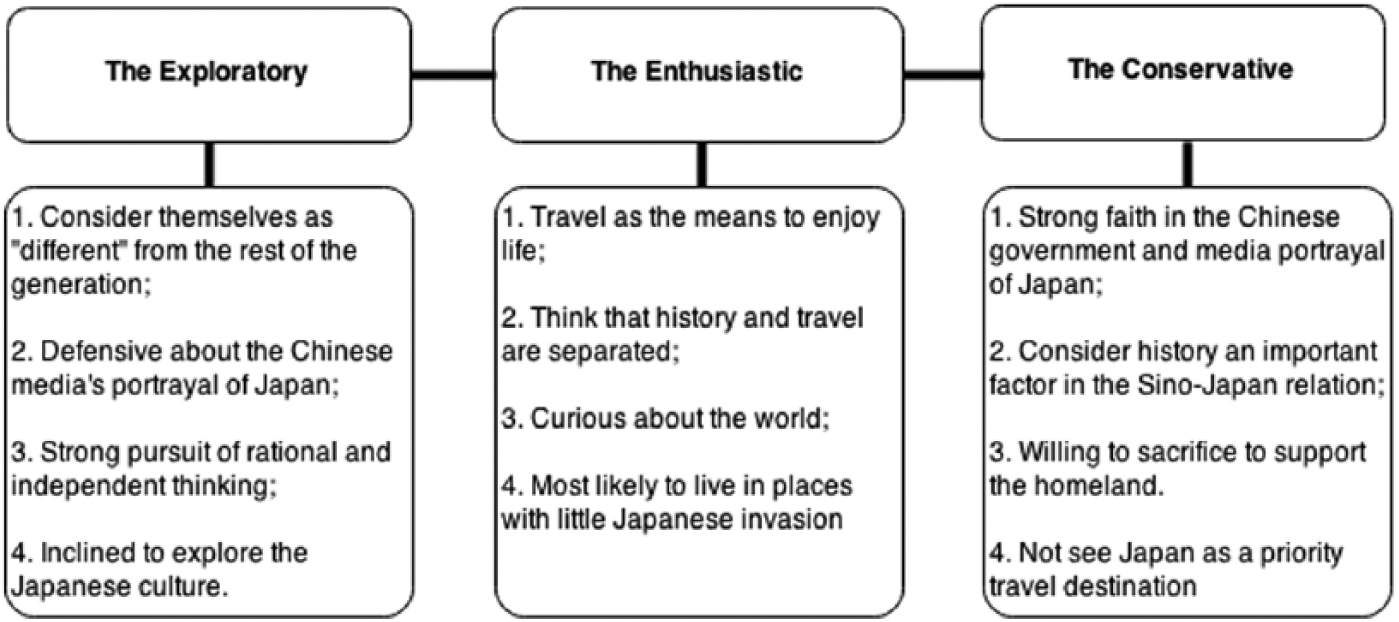
Characteristics of subgroups of CC60’s.
The Exploratory Group
The Exploratory Group described themselves as the most rational among the three. Their regions of origin are likely to be East China, including provinces like Anhui, Jiangsu, and Shandong. It should be noted that several interviewees in this group are based in Nanjing, Jiangsu Province, where the Nanjing Massacre took place in 1937. While maintaining a serious attitude toward history, they were open to the idea of visiting Japan during the interviews. Six out of the seven Exploratory Group members had experiences with Japanese people through leisure travel or business partnership with a Japanese company. Two grew up in affluent families that had close contacts with Japanese immigrants to China during the war. One interviewee in the Exploratory Group appreciated Japanese literature and novelist, such as The Tale of Genji (源氏物语) and Natsume Soseki (夏目漱石). All seven interviewees in the group described themselves as “different from (the typical) others in their generation.” “A typical person in this generation,” explained by the interviewees, was “brainwashed” by the Communist ideology during the Cultural Revolution, and someone with strong faith in the central government. For members of the Exploratory Group, the mindset of “the typical others” was formed in Mao’s China, and such a mindset should not be encouraged in today’s world. The Exploratory claimed that “their generation” needed to treat the Sino-Japan relation in “the correct way.” Although not explicitly explained, the meaning of “the correct way” was expressed in many forms throughout the interviews. First, “rationality” was necessary for Chinese when dealing with Japan-related issues. The Exploratory criticized the widespread anti-Japanese sentiment, stating that “those irrational people” that refused to use Japanese products were not looking at the “big picture.” They expressed that a sales decline of Japanese products would only result in “the loss of employment of Chinese factory workers.” Second, independent thinking should be emphasized. The Exploratory only treated anti-Japanese movies and television episodes “as entertainment.” They were unhappy about the media’s portrayal of Japan, refusing to believe the “exaggeration” in the stories narrated by the state-owned media. They hinted their doubts about the political idea delivered by the media, suggesting that “irrational people were more acceptable of these political messages.” The Exploratory admitted that they also watched these TV programs, but emphasized that the action was “forced.” One interviewee clearly complained: “when 80% of the TV stations air anti-Japanese programs, and the rest only show non-sense programs, I really have no choice.”
Although the most frequently used phrase was “history is only history,” history in fact still exists in the Explanatory’s mindset. But history did not prevent them from traveling or wanting to travel to Japan. The anti-Japanese war was a reminder for the Exploratory to reflect on the difference between the Chinese and Japanese ethnicities. This group is found to be greatly interested in learning about the Japanese culture in order to understand “how such a small country bombed by nuclear weapons became the world’s second largest economy.” They retain strong curiosities about “the Yamato-minzoku (大和民族),” “entrepreneurship,” “quality management,” and “service spirit” of Japan. So the Exploratory would travel to Japan with a purpose to engage with the local people and culture. During the interviews, some clearly asserted that “buying commercial products” was not the main purpose of the trip. Instead, the goal should be to critically examine “the social order” of Japan and “the everyday life of Japanese people.” However, the Exploratory’s emotion toward Japan was not all admiration. Negative emotions toward Shinzo Abe, the Prime Minister of Japan, were expressed multiple times when “Diaoyu Islands” and “Yasukuni Shrine” were mentioned in the interviews. One interviewee from Nanjing recalled that she developed the association with the Nanjing Massacre in 1937 after seeing the number “37” on the street during her visit to Japan. These evidences imply that the Exploratory are still sensitive to certain symbols and concepts related to the war. But they are likely to be at a pacifist position when facing Japan-related issues.
The Conservative Group
Members of the Conservative Group (hereafter the Conservatives) held a high degree of animosity against Japan during the interviews. They were in fact the ones referred to, by the Exploratory, as “the typical others.” Many of the Conservatives reflected on their vivid childhood memories of the war during the interviews. Interviewees from North, Northwest, and Northeast China expressed resentment against Japan. Such hostility was often described by the Conservatives to be “comparable to the sentiment that the Jewish people would hold toward Nazi Germany.” 3 Due to severe attacks by the Japanese in their hometowns, such as Hebei and Liaoning Provinces, the Conservatives were able to list several examples detailing the brutality of the Japanese troops. Words like “killing,” “raping,” “robbing,” “hiding from the Japanese,” and “carnage of the whole village” frequently surfaced in the interviews. They constantly used “the Japanese devil” when referring to Japan. For the Conservatives, the sources of their memories of Japan came in two forms. One was secondhand stories told by their parents or grandparents who witnessed or heard about the war atrocities. The Conservatives grew up listening to these stories and never doubted about their reliability and accuracy. The second form was based on true family experiences. Some of the Conservatives’ family members or neighbors were direct victims of the war. One interviewee recalled that a granny living in her neighborhood unfortunately became infertile after being assaulted sexually by a group of Japanese soldiers during the war. Another interviewee’s father experienced lifelong health problems because he was physically bullied when working as a construction worker recruited by the Japanese military. These stories were usually the interviewees’ initial association with Japan, and were told in a sad tone. Because the research topic was briefly communicated with the participants prior to the interviews, several claimed that they would never visit Japan even before any questions were asked.
The Conservatives considered themselves “nationalist.” They repeatedly emphasized that “nationalism” was the reason for their hatred. One explicitly stated, “any Chinese that love his country should hate Japan.” In other words, for the Conservatives hatred against Japan was equivalent to loyalty to China. Many affirmed that hate should be the only emotion that all Chinese people share toward Japan. In addition, they believed that “all Chinese people should be alert of Japan’s militarist expansions.” Furthermore, the Conservative still viewed Japan as “the enemy” or at least “competitor” with China on political and economic matters. A few described Japan’s recent economic downturn as “cheering for China,” and few felt sympathy for Japan’s Tohoku earthquake and tsunami in 2011 when the incident was mentioned.
One surprising finding was that the Conservatives were aware of the political agenda behind the biased portrayal of Japan in Chinese media. But they seemed to intentionally seek such media influence. They had regularly followed news reports and talk shows about the Sino-Japan relation. Watching war-themed drama episodes had become a hobby. As one admitted: “these TV episodes are probably half true, but they give me energy and I can contribute to my country even more.” Another important finding was that the Conservatives admitted to have been “brainwashed” by Communist ideas distributed by the government. But they had “no other choice but to follow the government.” When asked about travel intentions, not every interviewee rejected the idea. While the Exploratory tended to avoid any symbols related to the war, the Conservatives seemed proactive in seeking them. One interviewee expressed that she would be willing to visit the Yasukuni Shrine, a Shinto shrine to commemorate Japanese soldiers that died in the war, “just to see the dead enemies.”
The Enthusiastic Group
Interviews with the Enthusiastic Group were different from the other two because the focus was more on travel and less on history. Members of this group (hereafter the Enthusiastic) mainly live in South-Central China and partly East China, notably Fujian and Guangxi Provinces. Their families almost had no firsthand experiences about the war, likely because their areas were not seriously attacked by the Japanese military on the ground. They were named “the Enthusiastic” because of their passion for travel. All of them had been to Japan and constantly looked for new destinations to travel to. Approaching their retirement age, the Enthusiastic viewed travel as “a way to fulfill life.” They were not found to be bothered by the Sino-Japan history while in Japan, because they considered “history and travel as separate businesses.” The Enthusiastic joined group tours with their neighborhood friends to visit Japan. Similar to other first-time visitors to Japan, their itineraries included major sightseeing attractions in and around Tokyo, such as Tokyo Skytree, Tokyo Tower, the Imperial Palace, Fuji Mountain, and the Ueno Park. When describing their feelings during the trips, the Enthusiastic often used words like “enjoyment,” “interesting,” “happy,” and “amazing” that conveyed positivity about Japan. During the interviews, they expressed that taking a trip to Japan was “for relaxation” and they “deserved the vacation after retirement” since they had worked hard for their whole life.
When asked to reflect on how the Sino-Japan relation might negatively affect their travel experience in Japan, the Enthusiastic quickly denied such a possibility. For example, one interviewee smiled after hearing the question, and insisted that “the trip had nothing to do with politics.” Another observation of the Enthusiastic from the interviews was that they expressed little interest in discussing about history and war. These topics seemed irrelevant to their impressions of Japan. However, one commonality shared by the Enthusiastic with the other two groups was the negative emotion toward the current Japanese government led by Prime Minister Shinzo Abe. Similarly, the disputes over Diaoyu Island and the Yakusuni Shrine triggered brief discussions about politics that implied some of their negative views of Japan. However, the negativity was not as strong as for the other two groups. In addition, it is worth noting that the investigators did not sense the strong will of the Enthusiastic to return to Japan. As mentioned earlier in this section, the Enthusiastic was constantly looking for new ideas for their vacations. Therefore, their reluctance to revisit Japan might be motivated by their interests in other tourism destinations, not necessarily by history and politics.
The framework of memory—emotion—time
The interviews provided a substantial amount of information about how CC60’s memory of and emotion toward Japan had changed over the past 50 years. The three groups of CC60’s shared both similarities and differences in their perceptions of Japan throughout the various stages of their lives. The framework of Memory—Emotion—Time (Figure 3) depicts three courses of memory and emotion development presented as three arrow lines, which in this article are called “travel intention lines.” The X-axis represents time from CC60’s birth year (1960) till present. Memory and emotion each holds one Y-axis with two directions indicating positivity (denoted with a plus sign) and negativity (denoted with a minus sign). The arrow lines embody both the memory and emotional journeys of the CC60’s. The trajectory of a travel intention line indicates how likely an interviewee is to travel to Japan, given the positive or negative image of Japan associated with one’s memory and emotion. Segments of a line above value zero suggest one’s open-mindedness about Japan and the possibility to travel there. Segments below imply the denial of Japan as a travel destination and the recognition of the country as a political and military opponent to China. Each of the three lines represents one group of CC60’s, illustrating the progression of their Japan-related memory and emotion over the years.
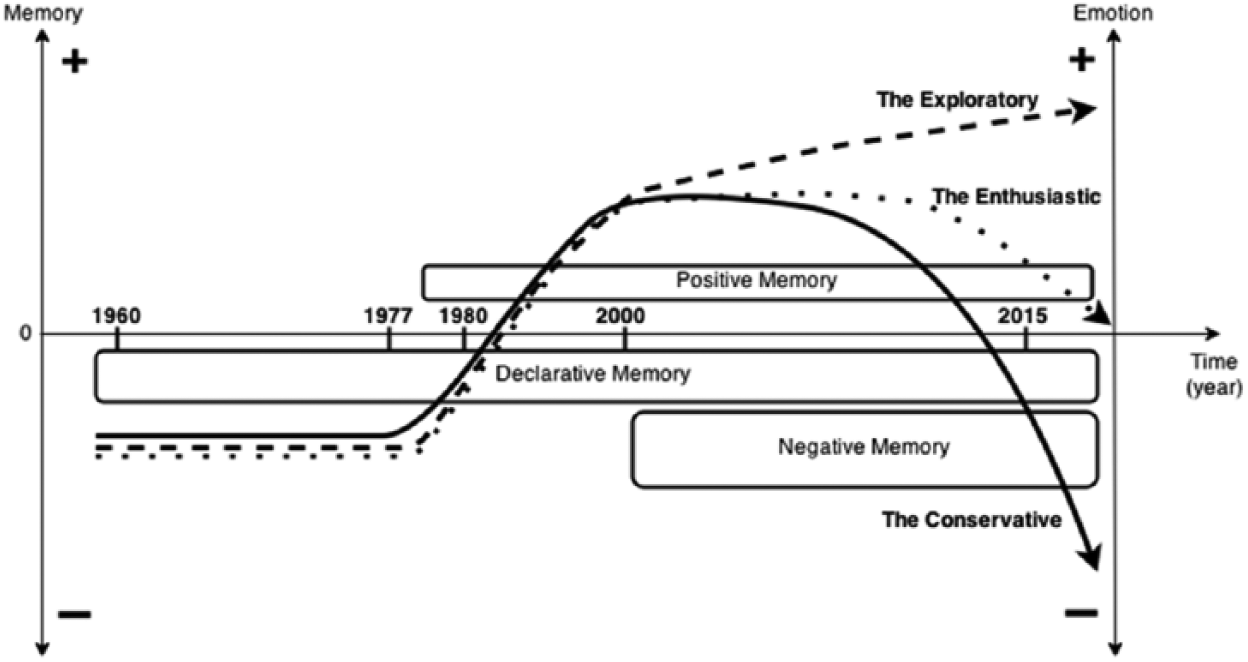
A framework of memory—emotion—time.
The consistent part of all interviewees’ memories was the collective remembrance of the anti-Japanese war. The memory started to construct in the mid-1960s when the CC60’s were first introduced to the idea of “Japan” by family members, elementary school teachers, and classic war-themed movies. Information during this period heavily targeted on Japan’s cruelty. So many CC60’s members developed a fear of Japan from an early age. From 1967 to 1976, China became secluded from the outside world and the whole nation focused on social and political class struggles (Hung et al., 2007). Also, due to the lack of formal education curriculum, the CC60’s did not receive much history information in middle school. Although Sino-Japan relation was normalized in 1972, the CC60’s were perhaps too young to remember the event. Therefore by the end of the Cultural Revolution, the CC60’s memory of Japan was the same as their earlier ages, and their emotions remained constantly negative. In addition, such a memory had become declarative and permanently stored. This early childhood memory has been carried over until today, and is ready for access at any point in time.
In 1978, China’s Open Door Policy was implemented to revitalize the stagnant economic conditions (Quach and Anderson, 2008). China signed the Peace and Friendship Treaty with Japan accompanied by commercial agreements (Taylor, 1996). Positive information about Japan started to be continuously encoded into Cohort 60’s memory during the time. Two themes consistently emerged from all 27 interviews. One was the popularity of Japanese household products such as televisions, refrigerators, and cameras. Brands like SONY, Panasonic, and Sharp were frequently mentioned. Interviewees’ reactions to these products were uniformly positive. Many associated “Japan” with “trust” and “reliable quality.” The second theme that emerged related to the entertainment industry. All interviewees expressed keen interest in TV series Akai Giwaku (赤い疑惑) and movie Kimi yo Fundo no Kawa o Watare (君よ憤怒の河を渉れ), two media products that became popular in China in the 1980s. It is interesting to mention that the latter introduced Hokkaido, where the cinematic story takes place, to the Chinese audience as a tourism destination. The lead actors and actresses from the TV series and movie became household names. Until the late 1980s, the CC60’s possessed highly positive emotions toward Japan. But the early 1990s became a shifting point for their feelings. Positive memories still existed. But as the rising nationalism emphasized on China’s victimization during the war (Coble, 2011), anti-Japanese sentiment slowly reemerged. Around the 2000s, continuous media coverage on historical disputes and burgeoning anti-Japanese programs had not only activated the declarative memory from CC60’s childhood, but also added negative information to the working memory. Eventually, the emotional development of the three groups substantially diverged.
Rationality encouraged the Exploratory to examine the whole situation with both positive and negative memories. On one hand, they reprehended “Japan’s attitude toward history” as “inappropriate.” On the other, they differentiated the “rightwing government” from Japan’s “friendly people,” “quality service,” and “advanced technologies.” The conflicted situation provoked their curiosity, and they became destined to discover Japan in person. As indicated in the framework of Memory-Emotion-Time (Figure 3), the combined effect of positivity and negativity resulted in a gradual upward trajectory of their travel intention line.
For the Conservatives, the retrieval of the childhood memories became much more painful under the media influence. They explicitly questioned about Japan’s “militarism,” claiming that the war atrocities were “unforgivable.” Frequent exposure to the media only reinforced their anti-Japanese emotions. Many admitted that their rage was more of a result of the recent disputes between the two countries. One said that she “was never anti-Japanese until after college graduation.” At this time, the positive memories from the 1980s were irrelevant since they were not strong enough to offset the hatred. As a result, the Conservatives’ travel intention line was observed to take a sharp decline (Figure 3).
As for the Enthusiastic, the slope of their intention line remained almost constant. Their memory contained mostly positive information about Japan from previous leisure trips. However, Japan for them was one of the destinations “on the list.” And their repeat visits were “very unlikely” when there were other vacation choices. Therefore, the travel intention line dropped to zero.
In general, prior contact with Japan is one differentiator among the three groups. Both the Exploratory and the Enthusiastic have had experiences with Japan’s people and culture on a personal or business level. They obtained firsthand information about Japan through social relations or tourist activities. The brutal past is only one part of the entire reminiscence. Their negative emotions from earlier years have been overcome by positive memories of Japan. In contrast, the Conservatives have been passively given secondary information by a third party (e.g. China’s state media). They allow the “devil image” of Japan to be repeatedly painted. Playing the “victim” role proclaimed by the media, the Conservatives are unlikely to abandon their memories of history and war. However, they may have the righteous reason to do so due to their families’ direct contact with the Japanese military. Different from other groups, the Conservatives have to face family traumas caused by the war. From this perspective, Japan is a personal and family enemy. They are unable and unwilling to “come to terms” with Japan.
Conclusion and discussion
The main goal of the study is to investigate how the collective memory of Japan has shaped the Chinese Cohort 60’s emotions and views of Japan, which subsequently influenced their travel decision-making in regard to Japan. The framework of Memory-Emotion-Time is developed to demonstrate the interplay between memory, emotion, and travel intention in the context of the Sino-Japan relation. The CC60’s complex emotions toward Japan have been changing through history and time. The collective memory of Japan evolved through critical stages of the Sino-Japan relation. The anti-Japanese war has had prominent influence on CC60’s emotions since their childhood. From the late 1970s to the early 1980s, young CC60’s personal life benefited from the reinstated bilateral relation that introduced Japan’s commercial products to Chinese households. The CC60’s were also culturally engaged with Japan through imported media products. Movies and TV episodes became their emotional support after the long and dark Cultural Revolution. Nevertheless, the end of the twentieth century marked the sudden shift of Sino-Japan relation. Consequently, three subgroups of CC60’s emerged as the Chinese state media started to portray China’s victim role during the war. First, regions of origin separated the Enthusiastic from the other two groups that are from provinces in the North and East China that were severely attacked by the Japanese. Based on the interviews, this group holds the lowest degree of animosity toward Japan. Second, personal experiences with Japan distinguished the Exploratory from the Conservatives. The former developed tolerance for different opinions about Japan-related issues. Their pursuit for the “true” Japan has encouraged them to visit the country. Because of agonizing family history, the Conservatives still hold a grudge toward Japan. Their impression of Japan to a certain extent is fictional due to their excessive exposure to China’s negative media coverage about Japan. Their negative emotions can be easily intensified by the vulnerable bilateral relation. As a result, they are strongly against traveling to Japan.
Memory and emotion are two important concepts for studies about populations that have witnessed drastic historical changes in society. And the CC60’s is one such population. By investigating memory and emotion in the context of Sino-Japan tourism, this study initiates a dialogue between memory, emotion, and time. Two pivotal perspectives are established. First, memory and emotion are not always personal. Although they are possessed and expressed individually, collective consciousness and social collectivity in general determine that sociopolitical institutions administer the production of memory and emotion. The life courses of the CC60’s provide solid evidences that their Japan-related memory and emotion have been maneuvered by history and the special interests of the government. Second, memory and emotion develop simultaneously. So, to understand one means to understand both. Memory is the cause of emotion, and emotion may govern which part of memory is to be deployed in certain circumstances. While members of the CC60’s have observed the same development process of the Sino-Japan relation, they choose to use different memories from different time periods, either positive or negative, to substantiate their emotional positions on Japan-related issues, including their travel decision-making.
This leads to a critical question on whether an individual is and should be free to make travel-related decisions independently. In the case of the Sino-Japan relation in which collective memory is shared by many Chinese, is it appropriate to allow memories of war to constrain one’s personal freedom to enjoy a destination? Furthermore, is it legitimate for the state to control people’s travel decisions that are essentially a personal matter? The study reveals that members of the Conservatives are likely to be against the idea of visiting Japan, and disprove Japan’s status as an enjoyable destination. However, this view may be contrary to the reality that Japan is in fact a popular tourism destination. The Japan National Tourism Organization reported that 2.3 million international visitors arrived in Japan in September 2017 alone, and Japan’s popular culture, such as pop music and animation, has successfully attracted global tourists to visit the country (Seaton and Yamamura, 2014). This is to say that the CC60’s may have willingly given up the opportunity to vacation at this destination, denying their own right to leisure and enjoyment in life. In addition, they see their denial of Japan as a moral conduct and support for Chinese nationalism. Therefore, travel decision-making for the CC60’s may not be only a personal choice, but a political one.
China has advanced drastically in the past half century; yet Chinese people’s memories of war, poverty, political turmoil, and foreign relations remain fresh. This is especially true for the CC60’s that have lived the struggling process of China’s rise. Therefore, their views of foreign destinations, landscapes, sceneries, and things in general are particularly complex. Outbound travel for today’s Chinese is a way to engage with the outside world, in which there are ideological friends and opponents, trade partners and competitors, and former war enemies. How Chinese tourists adjust their perceptions about and negotiate their social positions at a place deserves scholarly attention. In fact, studies in this direction have emerged. For example, Chan (2006) examined Chinese tourists’ interactions with the Vietnamese host community in border tourism, documenting a new host–guest relation between two non-Western parties. Qiu et al. (2017) reported that history and war may not be a prominent factor for young Chinese when it comes to traveling to Japan. Studies like this may challenge existing knowledge and framework in tourism that have long expressed Eurocentric views. How the Chinese outbound tourists, who may be ideologically different from the rest, comprehend their own position in relation to the foreign “others” in a leisurely process is worthy of investigation.
Although the study reveals various perspectives of the CC60’s negative memory and emotions, it is still possible for travel agencies and destination managers to design itineraries based on the CC60’s positive memory of Japan. For example, a nostalgia trip may be arranged for them to visit the shooting locations for Japanese movies that became popular in China in the 1980s. It may enhance their positive image of Japan over time. In fact, using cinematic tourism in public diplomacy is not new. A relevant case was the effort by the Spanish government under Generalissimo Francisco Franco to invite Hollywood movie production to Spain, in order to enhance Spain’s image in the United States after the Second World War (Hart, 2015). Similarly, enhancing Japan’s soft power and positive image through nostalgic movies may motivate CC60’s intention to visit the country.
Suggestions for future research
The study may provide a comprehensive review of all possible conditions that have affected Chinese people’s views of Japan. Unexplored conditions may include interviewees’ exposure to social media information about Japan (e.g. Tseng et al., 2015), to word-of-mouth marketing of Japan as a destination (e.g. Ishida et al., 2016), and to local experts’ recommendations (e.g. Wang et al., 2006). Future qualitative studies may address these factors through interpersonal interviews. Among the explored factors in the study, education was found relatively irrelevant to the interviewees’ emotions toward Japan. One potential reason may be that formal education in China about the Sino-Japan war and history is developed within a nationalist framework. For example, Yoshida (2006) suggests that the Nanjing Massacre is taught to “promote patriotism and nationalism among the youth who had not experienced the PRC’s liberation of China from Japanese militarism” (p. 102). Note that history education in China may start as early as from middle school. This is likely to result in students’ similar views of Japan as “an enemy.” And it can be difficult to change these views when the students become adults, regardless of their terminal education degree. Therefore, the homogeneity of students’ formal earning experience in China may have led to education’s relative insignificance in differentiating the interviewees’ opinions. In addition, gender’s role in triggering CC60’s memories and influencing their views of Japan may deserve further analysis. Gender differences may connote distinct experiences particularly in history- and war-related tourism studies. In conclusion, this article aims to initiate discussions on the socio-historical impact of the Sino-Japan relation on tourism. The authors are open to other scholars’ critiques and comments in future studies.
Due to practical constraints, the study cannot provide an all-inclusive perspective on the Chinese views of Japan. The current profile of interviewees may be improved by increasing the number of participants from each geographical region. In particular, the study addresses a few opinions of those residing in Northeast China—formerly Manchuria, a Japanese colony during the Second World War. This chapter of history may inspire unique perspectives of those from Northeast China about Japan as a country and a destination.
Footnotes
Declaration of conflicting interests
The author(s) declared no potential conflicts of interest with respect to the research, authorship, and/or publication of this article.
Funding
The author(s) received no financial support for the research, authorship, and/or publication of this article.
