




Abstract
This article argues that considering individuals’ skills is fundamental in explaining tourists’ practices. Navigation here is conceptualized as one of the spatial stakes that individuals must address when they inhabit a city. From this question, this article emphasizes the fact that coping with space should not be taken for granted but requires skills that relate to individuals’ own levels of experience in terms of the practices of places. To this end, this article first engages in a theoretical discussion of Goffman, Ingold and Wittgenstein’s ideas. Then, at the empirical level, importance is given to tourists’ experiences, as they describe their ways of coping with space. Through an original mapping of their itineraries in Los Angeles, we examine tourists’ justification process concerning their ‘régimes d’action’.
Introduction
The skills that individuals possess are crucial in understanding tourist practices in a metropolis, and we address this issue in this article. Following very recent theoretical focus on practices in tourist studies (De Souza Bispo, 2016; Lamers et al., 2017), this article makes a step further by highlighting one idea: practices depend on the mastery of techniques. Indeed, tourists’ practices have been richly investigated by various framework, through the concepts of gaze (Crang, 1997; Perkins and Thorns, 2001; Robinson, 2014; Zhang and Hitchcock, 2017), performance (Baerenholdt et al., 2004; Coleman and Crang, 2002; Crouch, 2004; Edensor, 2002; Larsen and Urry, 2011), experience (Bolderman and Reijnders, 2017; Chronis, 2015; Lu et al., 2015; Matteucci, 2014; Sharpley and Stone, 2011; Suvantola, 2002; Uriely, 2005), embodiment (Crouch, 2000; Pons, 2003; Pritchard et al., 2007; Small and Darcy, 2011a), encounter (Crouch, 1999; Crouch et al., 2001; De Jong, 2017), consumption (Cunin and Rinaudo, 2008; Rakic and Chambers, 2012; Zhao and Timothy, 2017) or behaviour (Cohen et al., 2014; Wang, 2004). But very little attention has been paid to the concept of skills.
Similarly, relatively few studies have focused on the way that tourists dwell in a metropolis: given the quantitative importance of urban tourism, it is curious that very little attention has been given to questions about how tourists actually use cities. […] Most of these early research studies were case study applications, seeking to demarcate the CBD usually based on supply facilities, as being easier to recognize and map, rather than on tourist demand. It is much more difficult to collect data on the behavior of the individual tourist. (Ashworth and Page, 2011)
Despite the growing research on this issue (Freytag, 2008; Hayllar et al., 2008; Larsen et al., 2011; Le-Klähn and Hall, 2015; Ritchie et al., 2011; Salas-Olmedo et al., 2018; Selby, 2004a; Selstad, 2007; Simpson, 2016), the same understanding was established recently: ‘very few studies have undertaken contemporary analyses of tourist experiences in cities therefore their spatial behavior is not well understood’ (Wearing and Foley, 2017). This article contributes to fill this gap through the analysis of tourists’ strategies in navigating Los Angeles.
Several recent works have focused on navigation issues (Amit and Knowles, 2017; McFarlane and Silver, 2017; Saltes, 2018). Most of the papers focus on everyday mobilities. Classic paper already attempted to explain how people move inside a city by driving (Sheller and Urry, 2000; Thrift, 2004) or the act of driving (Edensor, 2004). More recently, driving, as an everyday cultural practice of mobility, has been considered as gambling (Redshaw and Nicoll, 2010) or as a unique and non-reproducible event (Pearce, 2017). Aiming at satisfying (Cass and Faulconbridge, 2017) mobility, it has been shown that commuters incorporate valued dispersed practices into mobility that generate affective satisfactions. Just as importantly, other research investigates what kind of resources individuals need to manage everyday mobility (Peters et al., 2010). Crucially, this article emphasizes the distinction between the ‘projects’ people want to achieve and the ‘passages’ they need to go through in order to do so. Individuals permanently use competencies of negotiation: Melissa Butcher considers Delhi’s Metro as a site for the deployment of skills to navigate diverse urban space and to manage spatial negotiations, with all the situations of unfamiliarity and inequality that mobility can generate (Butcher, 2011). Similarly, historical research has shown how new social skills (in handling crowds and strangers) were developed by railway travel experiences in the late 19th century (Löfgren, 2008). These negotiations also concern self-identity; people who cycle in the United Kingdom are caught between two threats: appearing too competent as a cyclist and appearing not competent enough (Aldred, 2013). All these researches tend to show that practices result from what has been called a spatial apprenticeship (Buhr, 2018): focusing on migrants in Lisbon, the study shows a know-how underlies their mobility practices. The ways migrants learn to use city spaces shape their access to urban resources (Buhr, 2018). But what do individuals really learn? What about off-daily practices, tourist mobilities?
Indeed, one can argue that this navigation issue is more crucial to tourist practices. Navigation is at the heart of being in a place as a tourist 1 because tourist practices in a metropolis are fundamentally based on the discovery of the urban place (Equipe MIT, 2002). Moreover, the challenging character of navigation is widely attenuated for individuals when they are in their everyday spaces: they use navigation to move around, and their practices are regulated by habits and routine. This attenuation is not the case when individuals are in a tourist place. The visited metropolis is an unknown space for them, is unfamiliar, and individuals do not have habits and much resources with which they must cope for a limited time. In this sense, the tourist situation is the true laboratory to understand how individuals achieve navigation. There is an important specificity regarding Los Angeles; unlike the ‘classic model’ of the metropolis where the tourist space is concentrated in the downtown area and is accessible by foot, we first observe in Los Angeles the important dispersion of the main tourist places (Fainstein and Gladstone, 2001) and that pedestrian metrics are irrelevant to moving around in the tourism space (Lucas, 2011). Compared to these characteristics, we can argue that the difficulty for tourists in resolving this spatial stake of navigation is more important in Los Angeles than it is in a classic tourist metropolis.
Specifically, Los Angeles is not a normal tourist city: ‘nobody walks in L.A.’. Indeed, the choice of this metropolis as a case study is justified by its incredible urban sprawl (Scott and Soja, 1998; Sitton and Deverell, 2001), its historically fragmented spatial organization – the metropolis has not been articulated around a centre for a long time (Fogelson, 1993) – and the very important salience of automobile metrics (Bottles, 1987). Specifically, regarding the management of distance in Los Angeles, Jack Katz (2001) developed a very precise ethnomethodology of emotions and offered a social-psychological description of what makes individuals angry when they drive in this metropolis. In another style, Reyner Banham (1971) considered the freeway system to be one of the four ecologies that constitute Los Angeles and described what it means to drive in this city: the actual experience of driving on the freeway prints itself deeply on the conscious mind and unthinking reflexes. As you acquire the special skills involved, the Los Angeles freeways become a special way of being alive […] If motorway driving anywhere calls for a high level of attentiveness, the extreme concentration required in Los Angeles seems to bring on a state of heightened awareness that some locals find mystical. (p. 214)
These two studies explicitly show how it can be difficult and painful for residents to navigate in this metropolis, but as suggested by Banham, they develop skills to achieve this practice with success. However, how does navigation work for non-residents, individuals who are not used to dealing with such situations and who have no habits and no routine similar to tourists?
The navigation issue gives us an opportunity to obtain an overview of how tourists navigate in Los Angeles and how tourism practices shape this urban space. It allows us to analyse tourists’ practices and to appreciate this metropolis as an inhabited place by tourists. More precisely, this article aims to emphasize how the variable size of tourists’ navigation in Los Angeles must be explained not only by individual taste but also by the skills that they have or that they lack. Navigation is used to reveal the ease with which individuals cope with a new space. The analysis proceeds in two steps. The first section outlines the theoretical framework in which this discussion is included, to demonstrate the main points. The second section provides an empirical demonstration; from original maps of some tourists’ itineraries in Los Angeles, we describe and analyse how individuals address navigation in a very different way. An important place is given to individuals through their discourses to follow them in their own explanation of their ways of inhabiting Los Angeles touristically.
Navigation as a spatial stake
This article emphasizes the following point: navigation is a challenge for everybody, and skills are crucial to understand how individuals embrace it. This ability issue has been highlighted for wheelchair navigation (Beale et al., 2006; Kasemsuppakorn et al., 2015; Kasemsuppakorn and Karimi, 2009; Saltes, 2018) and for disabled tourists (Kwai-sang Yau et al., 2004; Small and Darcy, 2011b). Research describes the strategic ways in which disabled people use mobile devices to navigate in space (Saltes, 2018): the author introduces the concept of ‘embodied practices of mobility’ to account for the ways in which disabled people negotiate access and inclusion. Space is not passively perceived, but rather actively challenged and reconfigured (Saltes, 2018). But urban navigation is also a challenge for individuals without disabilities: previous paper shown the challenge of the wayfinding within mobilities and what it takes emotionally to ‘change lanes’ (Laurier et al, 2012). Within tourism studies, works have discussed the representation and identity issues in the maps of tourism spaces (Hanna and Del Casino, 2003) or the virtual embodiment in the experience of map spaces in an auto-ethnographical way (Rossetto, 2012), some research giving a methodological input to understand tourists’ itineraries in rural areas (Popp and McCole, 2016). There has been a recent increase in works regarding effective itineraries that track tourists with GPS (Dejbakhsh et al., 2011; Lee and Joh, 2010; McKercher et al., 2012; McKercher and Lau, 2008; Pettersson and Zillinger, 2011; Shoval and Issacson, 2007). These surveys draw the itineraries of individuals in one place very precisely. Indeed, GPS has become an important tool that helps individuals to organize their moves and provides them information on where to go but does not help them to use this information. We must consider these previous studies to be a first important step in the analysis, and we need to then examine the why and the how of navigation.
As a new research method, GPS has begun to have a significant impact on navigation as a practice. As expressed by Valérie November, the common experience of using digital maps on a screen has vastly extended the meaning of the word navigation from a mimetic interpretation of maps – which relies on a resemblance between the signs on a map and a territory – to a navigational interpretation that emphasizes the establishment of some relevance that allows a navigator to align several successive signposts along a trajectory (November et al., 2010). Obviously, this new modality of way-finding has significantly changed the way that people use spaces and how they interact with the environment. Some research has argued that ‘GPS-based car navigation might disengage people from their surrounding environment, but also has the potential to open up novel ways to engage with it’ (Leshed et al., 2008). According to these authors, one of the main consequences of this tool-dependency is the decline of individuals’ self-capability: our field study results show a few instances of de-skilling, not only of navigation and orientation skills, but also of social skills. Some of our users reported that they rely on the GPS to find places they want to go to and to get them effectively to their destination. Hence learning to read and navigate using traditional paper maps, memorizing a route, and maintaining social interactions with others inside and outside of the car are reduced. (Leshed et al., 2008)
When it is easier to go somewhere, people are less competent on their own. However, this technology definitely helps individuals to know without effort where to go and what to do, but does this knowledge make individuals more able to manage distances and move from one point to another point?
We support the idea that GPS provides only information; individuals still must use this knowledge to arrive at their destination. It may be more accurate to regard the use of GPS as the revision of existing skills: ‘after all, navigation with driving is an activity already constrained by machines of many sorts, and adding one more machine does not necessarily radically de-skill the activity’ (Brown and Laurier, 2012). These authors present GPS instructions as ‘puzzle pieces that must be assembled so that the driver has to make out what they could mean, sometimes needing to make wrong manoeuvres to be able to do that, looking around, asking questions of passengers, all to produce suitable instructed action’ (Brown and Laurier, 2012). Even if this will be easy in many cases, ‘at other times drivers are not able to understand the GPS at all, and resort to abandoning its use, or even abandoning their journey’ (Brown and Laurier, 2012). An important point is that navigation still remains a challenge even with a GPS. To further develop this perspective, we can follow a recent proposition that suggests the examination of navigation and mobility issues through the concept of ‘tacking’ (Amit and Knowles, 2017) as a frame to examine the creative processes of navigation as people attempt to improvise in response to new information or changed circumstances, which necessitates real-time adjustments (Amit and Knowles, 2017). Indeed, navigation involves ‘a succession of choices over the course of changing circumstances, an important aspect of moving around these shifts being the capacity to improvise, to navigate a change of course, to make new choices, to respond to new possibilities’ (Amit and Knowles, 2017). This article supports the idea that this capacity of adaptation comes from skills that individuals already possess.
To offer a better conceptualization of this issue, I propose considering navigation as a spatial stake. This approach reflects the use of space as a matter for individuals. Indeed, the use of society’s spatial dimension by individuals is often implicitly taken for granted. In contrast, the theoretical position here emphasizes the idea that it is not obvious for an individual to cope with space. More precisely, the first conceptual point that is supported is that each place, every spatial situation – from the scale of a room to the scale of the world – corresponds to a gathering of spatial stakes that all individuals must constantly manage and that everybody must face in any spatial situation. Some main spatial stakes can be distinguished such as placements, limits and distances (within which we can find the navigation trial). These stakes have varying difficulties (especially according to the size of the place, because the hypothesis is that when the place is larger, these stakes are more complex) and closely overlap; if the argument focuses on navigation, we observe how questions of placement (here, through the choice of hotel) and the mastery of distances are interwoven. Strictly linked to the question of how individuals manage distances, navigation can be commonly understood ‘as a set of practices that facilitate crossing spaces separating distributed points’ (Amit and Knowles, 2017). More, as expressed by authors, navigation involves the trajectories connecting these points; it carries plans, strategies for achieving them, a sense of destination and above all supposes the use of the appropriate technologies (walking, driving, riding trains, bicycles, etc.) to deal with this distance.
Navigation corresponds in this text to necessity; it is increasingly more crucial in urban and mobile societies for individuals to plan and execute an itinerary (Lussault, 2013: 46, trans. by the author). In this sense, navigation does not simply involve going from one place to another place and putting some points on a map, which is at the heart of this spatial stake, but more fundamentally involves how individuals articulate different places together. As suggested by Tim Ingold, ‘it remains a challenge, however to account for everyday skills of orientation and way-finding’ (Ingold, 2000: 219). Going further, the author actually draws a distinction between the local person who knows quite well where he is, or in what direction to go, and the map-using stranger for whom ‘being here’ or ‘going there’ entails the ability to identify one’s current or intended future position with a certain spatial location. Here again, the author engages us to consider navigation as a true problem that requires skills to address. However, we differ in this article from Ingold’s theory on one important point: he draws a distinction between the ‘skilled local’ and the ‘unskilled stranger’ because skills are strongly associated with one’s environment in his theoretical framework. However, even in the everyday space, individuals sometimes need a map, and even a ‘stranger’ has skills. Without denying the importance of the environment and routines regarding how individuals cope with space, I argue that skills allow adaptation.
An explicit attempt to work on this question of ‘skills’ in Tourism Studies has been made for the Taiwanese ‘independent tourist’ (Tsaur et al., 2010). Observing that ‘little academic attention has been paid to the knowledge and skills of independent tourists’, these scholars develop a quantitative and statistical method, through a factorial analysis which is quite abstract: built on an online questionnaire, this study proposes correlation coefficients and factor model to bring out some hypothetical items and factors relevant when travelling. A similar approach was also used to study the ‘generic skills’ of backpackers (Pearce and Foster, 2007). It was organized around a framework gathering 42 items and attributes in eight different categories. Distinctively, our qualitative approach focuses on how do individuals need to achieve effectively their practices, in situ.
Moreover, this article relies on two recent theoretical input in French geography. The first one proposes that each individual owns elementary spatial skills (Lussault, 2009). However, we argue that these skills must not be taken for granted and that they are not elementary; everybody is not able to cope with space at the same level. The challenge is to understand these differences and the consequences regarding the use of space. For this purpose, we here change the perspective to initiate the analysis from the spatial stakes (the matters) that necessitate the mobilization of skills; we then can understand how individuals manage this spatial test in different ways, according to their skills. Navigation is one of these spatial stakes. The second theoretical proposition asserts that individuals need three types of skills to cope with space: ‘cognitive skills (such as knowledge of locations), behavioral skills (for skiing, tanning on the beach, strolling in the city, etc.) and instrumental skills (using a ticket machine, driving a car, etc.)’ (Lussault and Stock, 2010). But can we really talk about ‘cognitive skills’?
The academic research has mostly studied the people’s capacity to act in the opposite way – it focused on disabilities. To think about what individuals are able to do, we must establish, following Theodore Schatzki, a distinction between three different registers of capacity: a person can (a) be physically able to do something, (b) be ‘able to X’ in the sense of knowing how to do so and (c) be socially able to do something in the sense that others’ actions facilitate and/or do not prevent him from doing it (Schatzki, 1996: 161). In this quote, skills correspond as a know-how, but what does this ‘know-how’ refer to?
We define skills as the ‘mastery of body techniques’. This expression, ‘mastery of techniques’, comes from Wittgenstein (1958): the grammar of the word ‘knows’ is evidently closely related to that of ‘can’, ‘is able to’. But also closely related to that of ‘understands’ (‘Mastery’ of a technique). […] To understand a language means to be master of a technique. (§150 and §199)
Starting from here, we can discuss this mastery for rethoric, cognitive or linguistic techniques – we could use the word ‘competences’ – but we can also examine the use of the body and the tools (the use of tools going through our body). Those are skills. Indeed, the body is the first and ultimate tool if we allude to Goffman (1971) – the body as a vehicle – or to Mauss (1973) who spoke about the ‘technics of the body’. We can find this perspective in Goffman’s work when he says that the world that surrounds an individual ‘is likely to be vulnerable to moments of stress when acquired competencies break down and the individual is thrown back momentarily on inadequate mastery’ (Goffman, 1971: 248).
Focusing on skills makes us fully consider the body as a ‘tool’ (even if this word is not proper), while most of research focuses on it as representation of a self: ‘much work in the sociology of the body has been devoted to an analysis of body modification and maintenance; that is, to practices such as diet, exercise, body-building, tattooing, piercing, dress and cosmetic surgery’ (Crossley, 2005). A same assessment can be made about tourism studies: for example, the classic encounter approach considers the ‘expressive, intersubjective and poetic encounter mediated through the way the body is engaged actively in space’ (Crouch et al., 2001). Indeed, ‘places become significant through our own and other people’s bodies […] space is transformed as social by a shared feeling of bodily activity, excitement, even queuing to see a site/sight’ (Crouch et al., 2001). Examining the ‘sensuous’ dimension of the practices, this relational approach apprehends emotions, feelings and identities, as ‘touch, smell and other senses are part of the tourist’s competence of making sense’ (Crouch et al., 2001). Taking another point of view, this article investigates the ‘technical’ aspect of tourists’ practices: the individuals’ means of action to cope with an unfamiliar place. Fundamentally, it draws upon a pragmatic perspective, in the sociological sense (Boltanski and Thevenot, 2006). This article insists on the idea that everybody is not able, at the same level, to deal with space, and this inequality refers to a different level in the mastery of techniques.
Methodology
To appreciate the way that tourists cope with these spatial stakes and the skills that they use (or not), the argument in this article is based on approximately 70 semi-directive interviews that were performed during four field trips to Los Angeles between 2010 and 2013 (Lucas, 2014). Most of these interviews were conducted (a) in the hall of a middle-class hotel (Motel 6, on Whitley Av., perpendicular to the Walk of Fame) and (b) in the public space (to try to avoid a priori selection and bias regarding individual profiles), more particularly, on the walkway in Hollywood Boulevard (the point of view on the Hollywood Sign because it is a main tourist attraction); some other interviews were conducted in Chicago (thanks to a random encounter with one Australian tourist) or in Switzerland (working place). As a qualitative methodology, the purpose was to reach the largest sociological diversity and the most different ways of coping with space. Finally, the tourists interviewed were mostly coming from United States and European countries, with different profiles with respect to ages, incomes, gender and ways of travelling (alone, in couples or with a group of friends). The interviews were recorded to repeat the conversations and capture the entire and exact discourse from tourists; these interviews were supported by questions that asked the tourists to reflect on their stays in Los Angeles to understand where they have been, what they did, their motives and their personal ways of dealing with the spatial stakes. Beyond these main themes, the interview protocol involved questions based on couples of oppositions (easy/difficult) (can/cannot) to reveal the ability of the individuals to use techniques. A focus on the points of view of individuals allows us to capture their discourses regarding their own practices; we follow their thoughts and analyse them in a justification process concerning their régimes d’action (Boltanski and Thévenot, 2006) and the way that they navigate in the metropolis. An analysis of the interview contents made it possible to reveal the characteristics that emphasize the mastery (or not) of techniques by the inhabitants of Los Angeles: through the lexical field of ability – for instance, the use of words such as ‘I couldn’t’, ‘I didn’t know’ – we can measure how important skills are to cope with this spatial stake. Then, from these interviews, it was possible to reconstitute and map approximately 30 itineraries (Lucas, 2014). The few examples that are analysed here must be considered ideal types; these cases are among the most illustrative of all the interviews that were conducted and allow the presentation of the decisions and choices that prevailed in the setting and the performance of the tourists’ itineraries in Los Angeles. A focus on a particular situation allows us to deconstruct the discourses and expose the gap between what individuals intended to do and what they were finally able to do.
Tourists’ effective navigation in Los Angeles
How do tourists effectively navigate? This article investigates the (different) ways in which tourists as a whole occupy Los Angeles to better understand and explain their actions to articulate and link the different places that they are going to. We do not make any value judgements concerning the individuals, and there is no good or bad. The aim is a better description and analysis regarding individuals’ different ways of adapting within space and how they adapt according to their own expectations. Specifically, we examine this pathway stake through spatial optimization logic to know-how and the manner in which tourists move around in Los Angeles. We proceed in two steps with these results of the empirical survey; first, we display examples of small itineraries and we then display examples of broader itineraries. We progressively develop the idea that individual skills (the mastery of techniques) and their past experiences (in terms of the practice of places) are important to understand the different ways that tourists interact within space in Los Angeles.
Small and constrained navigations
Spatial optimization logic is central to the manner of coping within space in Los Angeles for Jérôme (Switzerland, 30 years old) and his wife. They did not use to travel frequently; they have relatively low experience in terms of previous spatial experiences.
They rent a car, similar to all European tourists, to take a ‘California grand tour’ with Los Angeles as the starting and ending point: We did the list of what we want to see. It was Universal Studios in the North and Hollywood Boulevard in the North, too. We also wanted to listen to a concert of classical music in the amphitheatre of the Hollywood Bowl, which was also in the North. So, as all was centred there, we chose a hotel there. […] For the concert, it was a little bit by chance. When we looked at the maps, we saw this big amphitheatre. In addition, I do not remember how I knew about the opening of the season the first night we were here: they were organizing a big concert with all the 9th Symphony of Beethoven with a chorale. And, when we should be in Santa Monica, there was another concert, which we were more interested in, a nicer music, Tchaïkovsky, Russians… we preferred this concert, but as we were staying in Santa Monica, a place that was on the opposite side of the city, we told ourselves it’s better to go there when we were 20 minutes away by foot rather than 1 h by car […] For the second stay, we wanted to stay in the same place as the first, but as we had spent all summer without going to the beach, we said it would be more fun to end by doing something more quiet, to have some rest and stay at the beach during the day.
We observed that it seems to be a restrictive way of staying in Los Angeles by planning two 1-day stays in the nearby surroundings of their hotel: the first stay in Hollywood and the other stay in Santa Monica (Illustration 1). Jérôme and his wife explicitly say that their stay is organized to move as little as possible, and thus they missed the concert that they preferred. We understand how these tourists cannot totally achieve all the activities that they would like to achieve (they know what kind of concert were performing during their stay) because they do not know how to address this spatial configuration. This way of dealing with space – and, in a certain way, to ‘unpath’ in Los Angeles – results from their difficulty to manage the scale of the agglomeration, the configuration of the tourist space (with places relatively scattered within the urban area) and the metrics. If they rented a car, they did not master this means of transportation in Los Angeles – Jérôme says in another part of the interview that ‘Yes, it was very stressful’ (to drive) – and they used a car as little as possible. Moreover, they chose their location for accommodations to limit their travel and guarantee proximity to the places where they prefer to go. This practice denotes a true apprehension of this urban space to discover and explore it; this is an apprehension that is shared by many tourists (as it appeared during the interview), even if the pathway is generally more developed.
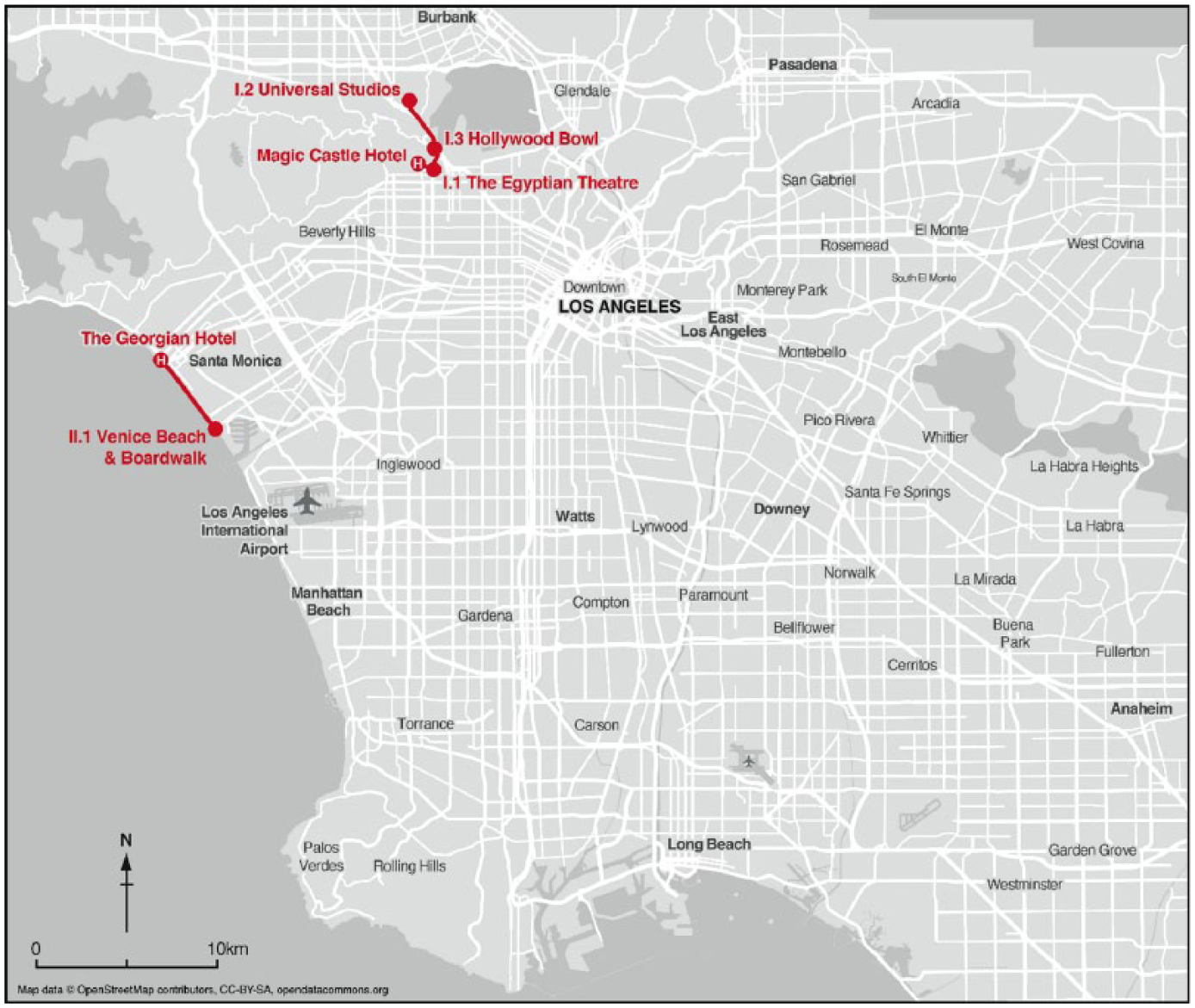
Jérôme’s itinerary.
This is the case of Sujin (South Korea, 21 years old). She visits Universal Studios (B) the first day. She goes by bus to Santa Monica on the second day (E), walks on the oceanfront to Venice and then returns by bus to her hostel that is located in Hollywood. She spends the morning of the third day in Beverly Hills, by bus, and walks on the central part of the Walk of Fame in the afternoon. For her fourth and last day, Sujin goes on a tour in a tourist van in the morning and stays again in the same part of the Walk of Fame in the afternoon (Illustration 2). A large part of Sujin’s 4-day stay is contained within a small area near her hostel in Hollywood. This young tourist, who has few spatial experiences, visits few places in Los Angeles compared with how long her stay is; spatial optimization logic plays a large role in her actions. This way of coping with space is due to her difficulty in using public transportation; for instance, she goes in a private Korean shuttle to Universal Studios, which has a subway station next to her hotel. She also uses a cab to go to the airport. She does not really master public transportation, and we understand how it is difficult for her to move around in this metropolis: No, it’s not easy! Before I took a bus, I searched a lot on the Internet; I saw all the maps and rides. I wanted to visit the Getty Center but it was too far to get there from my hostel. I just used public transportation, so it was hard to get there, and I couldn’t go. I didn’t want to go far from my hostel because I’m travelling by myself so the priority is on my safety, and I stay around here.
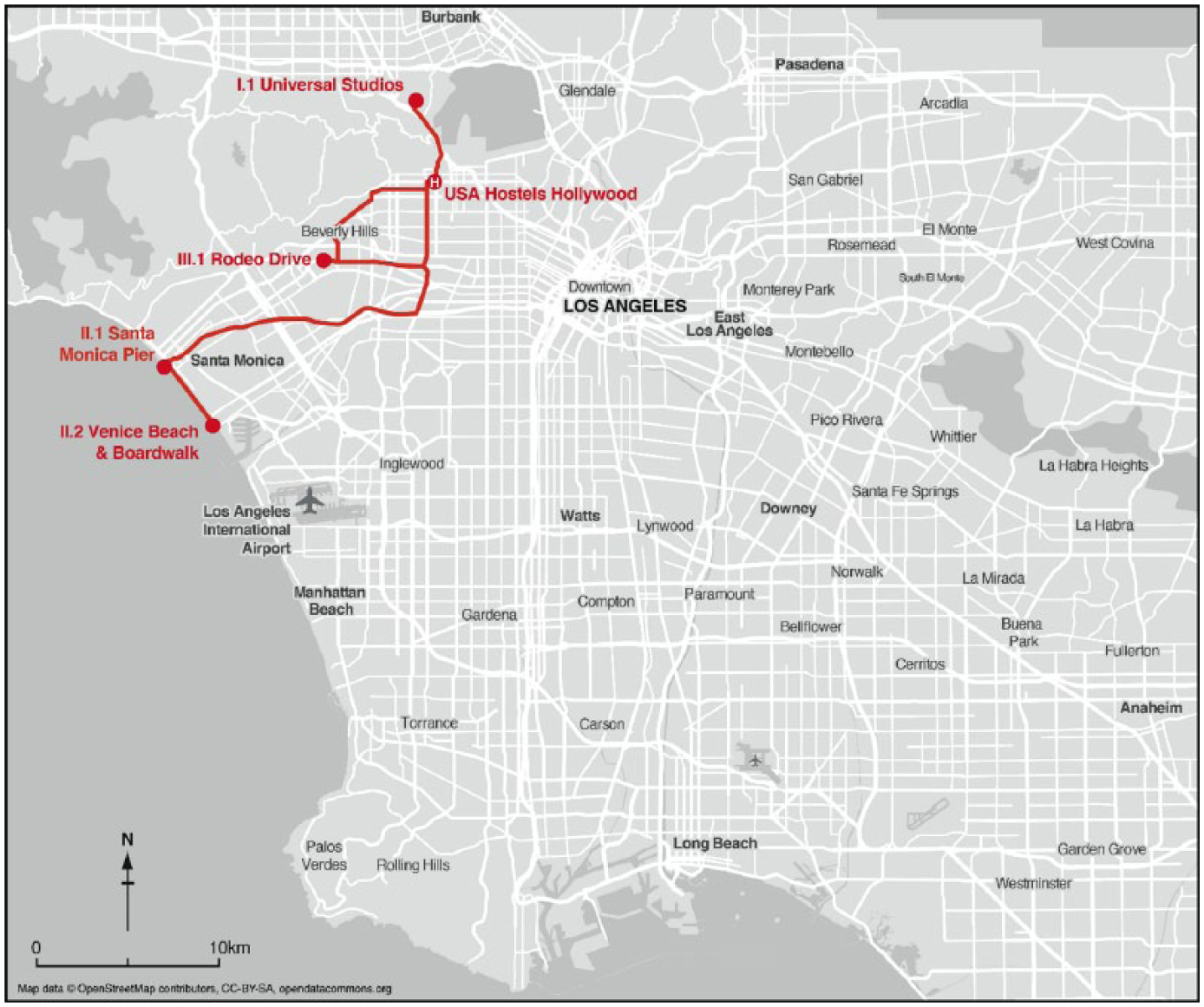
Sujin’s itinerary.
Similar to Jérôme, we note that Sujin cannot exactly reach the place she would like to go: she could not go to the Getty Centre. Yet, it is not really the public transportation system that made this visit impossible; a bus goes to this museum, but Sujin does not know how to use it because she does not master this transportation system. In the following account, Pierre and Fabienne (Belgium, 50 years old) give a totally different point of view on how it is possible for tourists to move around and discover Los Angeles through public transportation: Yes, it’s very simple. We can do everything with the local means of transportation. There are fewer constraints: we really wouldn’t need a car at all. With a simple map, we move easily. There is good servicing, we wait 5 minutes, maximum. It’s clean, there are a lot of buses, there is air conditioning, and it’s cheap.
With these two examples, we illustrate how tourists’ practices and their ways of dealing with space involve their knowledge and the mastery of techniques that relate to transportation. The implicit hypothesis that is suggested here is that their capability is linked to their previous experience in terms of exploring new places (they use to travel a lot, as it appears in the interview). We now analyse the strategies of tourists who achieve wider itineraries in Los Angeles.
Large and flexible navigations
This touristic way to use space in Los Angeles is a minority; a large number of tourists rent a car in this metropolis. This is the case for Valentine and Ludovic (France, 24 and 26 years old, respectively). Small movements and spatial optimization logic are not really a preoccupation in their way to achieve a pathway during their 2-day stay in Los Angeles (Illustration 3): We saw the Walk of Fame Sunday night when we arrived. Yesterday, we went to Warner Bros Studios (B); we wanted to do Universal Studios, but it was really expensive! […] Then, we ate at Pinks Hot Dog (C), and we went to a museum, the LACMA (D), for an exhibition about Tim Burton. I discovered it by chance in a magazine in the aircraft. At the end, we wanted to go to Santa Monica, but we were tired, so we turned off right to Venice Beach. We took an aperitif there, looking at the sunshine. Today, we go to the Walt Disney Concert Hall (G) and to the Getty Center (H). It seems it’s a must see; they bought some paintings of Van Gogh.
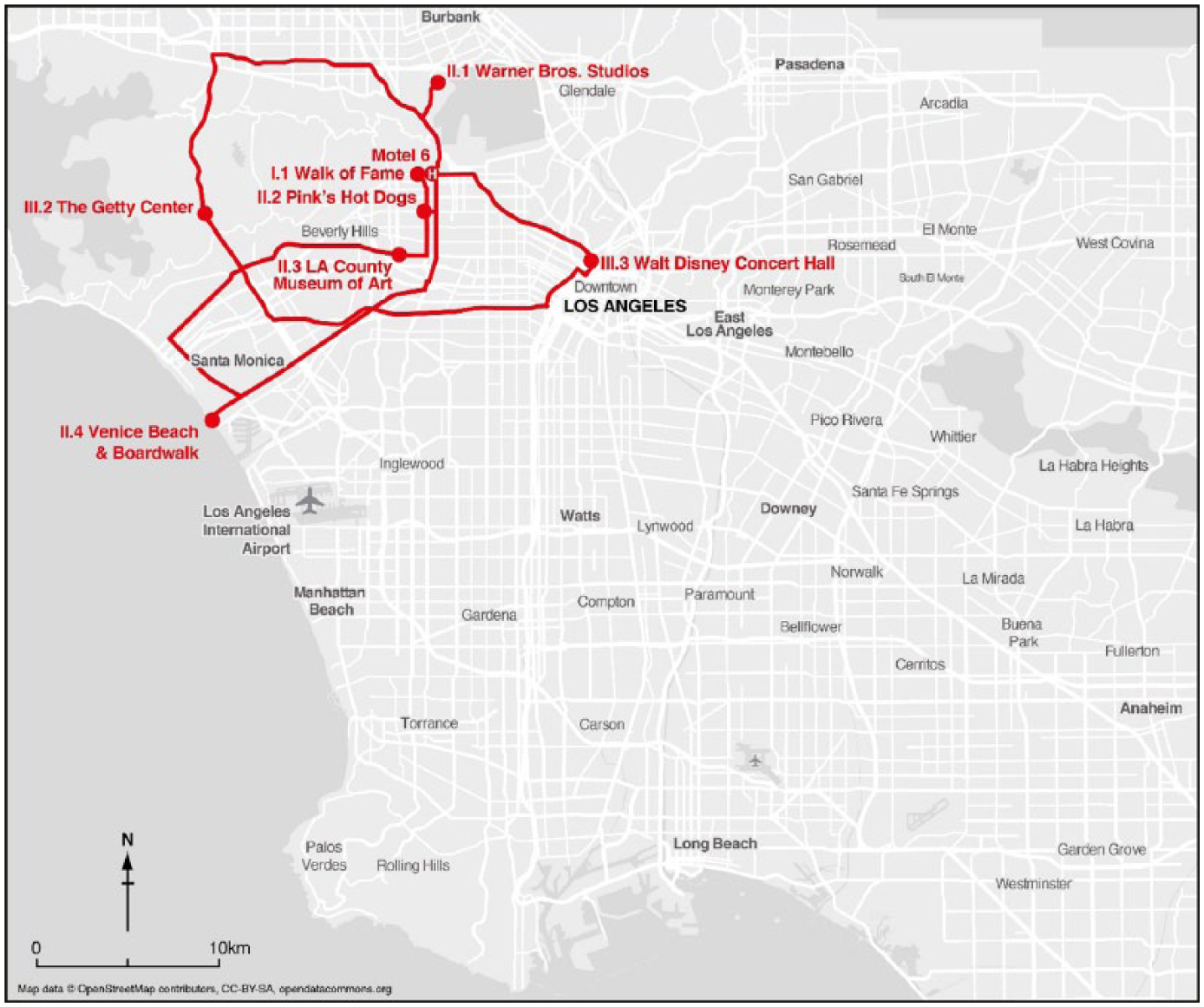
Valentine and Ludovic’s itinerary.
This passage helps us understand an important contrast in terms of coping with space and, more specifically, of managing the pathway stake compared with the first group of tourists; the number of visited places is higher in this case. This higher number of visited places occurs because of the tourists’ important background knowledge of Los Angeles; they are fully aware of what there is to do and see, even a temporary exhibition. Their previous experiences in terms of visiting new places are quite important. What allows them to use this information efficiently and to use it easily is first-hand experience that is reinforced by their experience in the cultural context of the American way of life; they had been staying in North Carolina ( ‘it’s been one year we are in this country, so we have some habits’). These tourists can enjoy all the resources that are offered by the urbanity of Los Angeles, a metropolis that they visit intensively. This way of navigating deeply stems from their skills: informed of what to do, they also know how to use a car in Los Angeles. Moving and driving in the city are not a problem; they take a detour to have lunch at a famous fast food restaurant (this restaurant is identified in the guidebooks, which is a new confirmation of how this tool can inform tourists’ decisions). In a broader and more important sense, we notice that these tourists know how to cope with the spatial stakes in Los Angeles, master the techniques and have the ‘ability of adaptation’ regarding what they plan to do; these skills allow flexibility in their itinerary.
This is the same situation for Michel (Switzerland, 40 years old) who travels with his wife and two girls (Illustration 4); this spatial optimization logic has a lesser influence on their way of discovering and dealing with space during their 2 days in Los Angeles. On the first day, they go from their hotel, which is located near the airport, to the Getty Villa, which is their goal in the metropolis. From this museum, they travel to the Walk of Fame through Sunset Boulevard, before driving through downtown back to their hotel. They start the second day by going to the Walt Disney Concert Hall (downtown), and they then go to Griffith Observatory, where they spend 2 hours. After this, they drive on Rodeo Drive and then visit UCLA, still without stopping, before they spend the end of the day at Venice Beach; they do not visit the neighbourhood but instead stay on the beach. We clearly understand that the pathway of these tourists is thrifty neither in kilometres nor in the time that is spent in the car: - We did 150 kilometres in two days in this city. If you bring back to the scale of the travelling we used to do there (in Switzerland), it’s almost like changing countries. In addition, here, it’s just inside the city! - Because if we mentally redraw your itinerary, you do the first day in a loop in one direction, and the second day, you do the same loop but in the other direction! - Well, I would say that the itinerary has been made … the logic of the pathway is for each day if you want. We didn’t have a solid idea of what we were going to do. We hadn’t made a plan from the beginning for the two days. We said first, we want to go to Getty. And in the evening, we looked at what we could do the next day. - So, there is no wish to make your visit thrifty? - No, no. No, because we hadn’t experienced these distances before. It’s just at the end of the first day that I realized that. I couldn’t imagine that we really could drive for one hour on Sunset Boulevard … I was surprised by the distance.

Michel’s itinerary.
These tourists really do not divide the city in areas (for instance, one day on the beach and the west side, the second day for Hollywood, Beverly Hills, the observatory and downtown). They make the same path twice in different ways. Spatial optimization logic is not their technique of dealing with space in Los Angeles. Of course, their choice of a place near the airport increases the distances and the length of their itinerary. If the driving-for-hours experience is not really a nice experience, it is not a problem for them; they can complete the trips that they want to make with a true adaptation ability (it is because it is cloudy that they do not go to the beach the first day; this means that rather than being constrained in their practices by the weather – by being forced to go to the beach to avoid one more journey – they prefer to get there the next day, by driving more kilometres). Without ever being completely absent, we note that they really do not develop a strategy of spatial optimization; they are not limited in their trips because of their skills or their know-how. These tourists easily can manage the space and the distances in Los Angeles by mastering their techniques and can achieve a very important navigation in 2 days.
Conclusion
There are significant differences in the ways that tourists cope with space in Los Angeles; navigation can be very short or very developed not only according to individual taste but also more essentially because of skills that they do or do not have. One of the main arguments that is conveyed here is that the breadth of navigation reveals the ease of some tourists in coping with space and with spatial stakes in Los Angeles. We have seen how some tourists cannot visit the places that they want to, and they stay in the city with many constraints and conduct quite small itineraries. We have also seen that other tourists who have sufficient mastery of techniques can complete the trip that they want, within a large and flexible pathway. In a broader sense, we provide example that how individuals, without disabilities, cope with space must not be taken for granted in Los Angeles. This does not mean that an individual is unable to ‘dwell touristically’ in a place, but rather that there is nothing obvious, and constraints may be relatively important.
Social, gender, economic and cultural dimensions play an important part in tourist practices: it has been highlighted in numerous previous research. These indicators do not explain entirely the way individuals inhabit touristically a place. The selected cases deliberately show two very different tourists profiles (one young woman from South Korea and one mid-30 couple from Switzerland) for whom it was not easy to navigate in Los Angeles. Yet, during the field works, we interviewed a young woman for whom it was easy to drive there on her own: the gender bias must be nuanced. For the two other main cases, in which it was easy for individuals to navigate in this metropolis, profiles also were quite different, with one young couple and a family with mid-40 parents. But we also met a group of mid-30 families travelling together for whom the city of angels was quite scary: to be in group does not necessarily make it easier to move around in a metropolis. A quantitative representativeness was not the purpose, we just bring out some ideal-types cases: more cases could have been brought from the empirical research (Lucas, 2014).
This article tried to emphasize the following idea: individuals do not cope with space in the same manner, not only because of their different motives, tastes and economic means but also because they do not have the same level of skills and the same mastery of techniques to deal with these spatial stakes in a given environment. The true point is to consider the trade-offs undertaken by individuals in their ways of dealing with space. If someone cannot drive in Los Angeles, they can use a cab (more expensive, so they need more economic capital), now even an über, or use public buses, cheaper but longer. There is no good/bad way of doing: the only judgement of value is the success of the practice (that means did a tourist achieve what he or she wanted to do). It is possible to navigate as a tourist in Los Angeles both by bus or by car, but only by mastering the chosen means of transportation, knowing how to use it. The ways that individuals cope with space involves their capability of addressing the spatial stakes, especially in the trade-offs regarding placement (where they choose to stay) and how they manage distances, which are closely linked to the way-finding issue.
Yet, it does not mean that individuals with high level of skills are all powerful: their mastery of techniques is always at proof of one specific situation. In the end, we can make the hypothesis that all tourists in Los Angeles were, before going there, thinking they had enough skills and resources to cope with this place; people who think that they will not be able to deal with this metropolis simply do not go there. But the probably true discriminative point is not ‘to be or not’ in one place: we support the idea that skills are fundamental to understand the ways of doing with space. Moreover, it is not a mere ‘you can’ or ‘you can not’ dichotomy: skills, as mastery of techniques, must be seen as a question of degree. We notice how cognitive, behavioural and instrumental dimensions are fundamental to achieve practices. Rather than to talk about ‘cognitive, behavioural and instrumental skills’ (Lussault and Stock, 2010), we may argue that an individual needs the mastery of technique at a triple level to achieve a practice (a) of his own body, (b) of the functioning of potential tools and (c) of the rules (of the biophysical and social environment). Skills, defined here as the mastery of techniques (whether they are just about the body or the use of one tool), must be clearly distinguished from knowledges (simply defined here as information). To know something – where to go, what to do – does not mean we are able to do it.
Indeed, two more important elements, which we do not develop in this article, must consider a better understanding of how individuals deal with space. The first one is a stock of knowledge, to use an expression of Schutz (1972), which corresponds to all the cognitive resources that are possessed by individuals. These information constitute a first step for action: skills are literally put into practice – the desired purpose in the most appropriate manner. The second point refers to all the experiences of mobility that an individual accumulates during his or her life: someone can only master a technique after performing it again and again. Further research will have to understand how someone becomes an experienced tourist, that is to say, how a lifelong accumulation of tourists and mobility practices improves (or maybe not) the individual’s capability to cope with space.
Footnotes
Authors’ Note
Leopold Lucas is now affiliated with University of Lausanne, Switzerland.
Declaration of conflicting interests
The author(s) declared no potential conflicts of interest with respect to the research, authorship, and/or publication of this article.
Funding
The author(s) disclosed receipt of the following financial support for the research, authorship, and/or publication of this article: This paper was written during an ‘Early PostDoc Mobility’ fellowship from the Swiss National Science Foundation. The author would thanks Miles Irving (UCL) for his help about maps’ appearance issues.