



Abstract
Festival branding is undergoing a revolution based on the consolidation of new communicative behaviours in virtual brand communities (VBCs), above all, channelled through social media platforms. Although the literature on festivals has analysed engagement in VBCs, this study provides an in-depth observation of the profiles of festival VBCs users, how they modulate engagement attributes and behaviours and how these relate to their engagement focus, highlighting festival branding while also considering other main focuses (i.e. social capital creation and place-making). Thus, this article aims to characterize these elements in festivals’ VBCs through a multidimensional analysis of nearly 2150 entries in the Twitter and Facebook VBCs of one of the most prominent music festivals in Europe, Sónar (Barcelona). Moreover, it does so through a longitudinal observation covering a whole year, showing the relevance of ongoing communication to festival success. The results show the benefits (for organizers as well as other users) of understanding these elements and their mutual relationships.
Introduction
The consolidation of information and communication technologies (ICT) has created a new context to analyse the relationship between festival organizers and other users, as festivals now take place in both physical and virtual spaces. Among these virtual spaces, social media platforms play a major role in the emergence of communities around a festival’s brand, the festivals’ virtual brand communities (VBCs). These communities are specialized, non-geographically bound, online communities, based on social communications and relationships among a (festival) brand’s consumers (De Valck et al., 2009) that are transforming the user–brand relationship, empowering diverse users’ profiles (Hvass and Munar, 2012) and facilitating engagement with the festival, its related community and the destination. By engagement, we can follow the definition proposed in the exhaustive work of Brodie et al. (2013): ‘an interactive, experiential process, based on individuals’ engagement with specific objects (e.g. brands, organizations), and/or other brand community members’ (p. 112). This engagement has also been characterized as being a behavioural construct, resulting from a range of diverse motivational drivers and expressed through diverse cognitive (mental constructions) and affective (emotional expressions) attributes (Hollebeek et al., 2014; So et al., 2014).
Linked to the emergence of these VBCs, Rothschild (2011) affirms that festivals with a defined virtual strategy are noticing a revenue increase. But this strategy calls for new competences, as these VBCs are essentially user-focused and based on the co-creation of narratives (Gyimóthy and Larson, 2015) through user-generated content (UGC) (Schmallegger and Carson, 2008). Therefore, festival organizers need a solid knowledge of these users’ profiles and how they engage with their festival brand if they want to boost festival branding, attendance and revenues (Marine et al., 2017).
This need opens up the first research problem, as although recent references (MacKay et al., 2017) have made an effort to describe some engagement in festivals’ VBCs, there is little in-depth analysis of how this engagement is modulated by the different composition of users in each VBC. Besides, more information is needed about the real focus of user engagement, going beyond the pure festival branding to find other focuses such as community building, social capital creation and/or the destination’s image projection. Knowing these different interests, organizers (and other users, such as destination marketing organizations (DMOs), for instance) could enhance this engagement to achieve different objectives (improving revenues in the case of the festival or attracting more visitors in the case of a ‘festination’).
Finally, more data are needed on how this engagement evolves over time; most of the related studies have focused on the analysis of communication during the event or in the moments before and after it in equal measure, following the assumption that VBCs users could be mostly identified as attendees who are planning their attendance at the festival (Lee et al., 2012). Our premise is that festival organizers and other users are engaging throughout the whole year and that this is important for sustaining interest and/or attracting new users.
Given this, the present research aims to perform an in-depth characterization of festival VBCs user engagement by decomposing, grading and relating its characteristics in these virtual communities in addition to observing the relevance of the different stakeholders in this process and its evolution over time.
Literature review
From generic to VBC engagement conceptualizations
User (especially consumer) engagement has gained much attention in recent marketing literature because it reveals a relationship with various important brand performance indicators (Harrigan et al., 2017; Hollebeek et al., 2014). Originating in public relations concepts such as ‘dialogic engagement’ (Kent and Taylor, 2002), the idea has been developed in terms of the interaction between users and brands. In their extensive literature review, Brodie et al. (2011) show that the consumer engagement process is highly interactive and based on several sub-processes or behavioural manifestations, including learning, sharing, advocating, socializing and co-developing, and finally it has many consequences, including loyalty and satisfaction but also empowerment and connection bonding.
From these seminal propositions, different references have proposed diverse multidimensional engagement conceptualizations. This is the case of Calder et al. (2009), who propose two cognitive (temporal, utilitarian) and four affective (stimulation and inspiration, social facilitation, self-esteem and civic mindedness, intrinsic enjoyment) dimensions, or the observation of Algesheimer et al. (2005), who propose cognitive (utilitarian), affective (hedonic) and also behavioural (social) dimensions. Hollebeek et al. (2014) compiled the previous literature to affirm that engagement is a user’s positively balanced cognitive, emotional and behavioural brand-related activity during, or related to, specific consumer/brand interactions. And, in the tourism context, So et al. (2014) agree with the fact that a multidimensional approach will capture the full complexity of consumer/user engagement and propose five main factors (identification, enthusiasm, attention, absorption and interaction) and a conceptual model of customer engagement in which these dimensions are related to potential engagement antecedents and consequences.
Inspired by these ideas, diverse authors have explored the consumer engagement characteristics in the emergent and disruptive context of VBCs developed on social media platforms. According to authors such as Lange-Faria and Elliot (2012), social media are a perfect environment for the creation of virtual communities where users engage, collaborate and share information with others in real time, with no constraints of time or geography. Therefore, beyond sharing information about a brand, a VBCs offers the potential for socializing around this brand, creating a sense of belonging that provides its users with security (Wang et al., 2002). Thus, we could talk about the existence of a social motivation to engage that coexists with the original branding motivation, empowering motivational and interactive communication (Kiráľová and Pavlíčeka, 2015).
In addition, diverse authors (Ghazali and Cai, 2014; Yoo et al., 2011) have been interested in the stakeholder structure of these virtual communities, highlighting its importance in terms of providing organic information sources where ‘travel opinion leaders’ play a key role in transmitting information to other travellers. Regarding this, Habibi et al. (2014) have characterized social media-based brand community members who share experiences online as ‘gurus’, admirers or marketers, and have gone a step further by identifying five dimensions that characterize such VBCs and finding a proliferation of sub-brand communities. On the other hand, authors such as Oliveira and Panyik (2015) have drawn particular attention to non-professional users, professional travel bloggers and travel journalists, who have also acquired a prominent role in this VBC.
Nonetheless, most of the literature regarding engagement in these virtual communities has focused on other important dimensions rather than the stakeholder structure. Probably the most commonly referenced study in this regard is that by Dessart et al. (2015), who signalled the existence of different cognitive (attention, absorption), affective (enjoyment, enthusiasm) and behavioural (learning, endorsing, sharing) sub-dimensions and their connection with two engagement focuses or motivations: brand focus and community focus. Here, the findings are in consonance with previous assumptions regarding the relevance of social motivations beyond the obvious need for receiving and sharing information about a brand.
These same motivations open another research path connected with engagement: studying users’ motivations to create and participate in VBCs. The branding motivation, linked with supporting a brand, is undoubtedly the most widely reported one, as brands create and participate in these communities on diverse platforms to improve promotion (MacKay et al., 2017; Schmallegger and Carson, 2008), recognition and experience (So et al., 2014) or loyalty and satisfaction (Brodie et al., 2011). Nonetheless, although conversations in VBCs are usually guided by brands’ community managers, they are increasingly being built in a process of co-creation among different users. This is precisely associated with the other motivations (social, community value) highlighted in the literature conceptualizing VBCs and also found by Dessart et al. (2015). Now, brand managers need to harness the inherent marketing intelligence when people are being social in these VBCs and use socialness to increase visitor numbers (Lee et al., 2012; Marine et al., 2017). Socialness is one of the main characteristics of social media platforms and their VBCs, as users become the centre of sociality (Wittel, 2001).
User engagement in festivals’ VBCs
Despite diverse authors (Mossberg and Getz, 2006) pointing out that festivals can be managed as brands, engagement has not received such detailed attention in the analysis of social media in the related literature (MacKay et al., 2017). However, festivals are an especially interesting ground for analysing engagement, because their hedonic nature makes them an ideal setting in which to test the relevance of affective attributes in VBCs narratives. Moreover, festivals’ VBCs can also be a good example for observing the weight of socialization motivations in comparison to pure branding motivations, in a context where the consumption is social by nature. But festivals’ VBCs could also be interesting to study because although the event occurs over a limited period of time (d’Astous et al., 2006), its brand could be communicated beyond that moment. Finally, it could be interesting to observe how the prevalence of some user profiles could bias all these elements.
In the festival context, branding motivation has been frequently reported in relation to the organizers’ need to improve promotion, recognition, loyalty and satisfaction (MacKay et al., 2017). However, various authors have emphasized the potential of VBCs for socializing users beyond branding, resulting in the development of social capital and cohesiveness (Arcodia and Whitford, 2007; Crespi-Vallbona and Richards, 2007; Morales Pérez and Pacheco Bernal, 2018) or engendering a heightened sense of belonging (Curtis, 2010). Meanwhile, Flinn and Frew (2014) recommend that festival organizers understand this socially mediated consumer lifestyle and Finkel (2010) connects social capital creation with the development of place identities.
Moreover, the VBC structure, in terms of the presence and relevance of different stakeholders, is important once again. Organizers must consider the fact that, depending on their interests, different users will search for and share information about the festival on various social media platforms, creating diverse VBCs. The scope and functionality of every platform will change depending on the purpose of the organizer’s presence, but also on the different stakeholders that compose the VBC (Garay and Morales Pérez, 2017; Morgan et al., 2003). Furthermore, taking into account the ephemeral nature of festivals, various authors have considered the need to observe the behaviour of their related communities before, during and after the time at which the event takes place. Flinn and Frew (2014) showed that diverse engaging experiences take place in the different stages of festival consumption, while MacKay et al. (2017) found that engagement peaked before and after the festival and suggest that organizers maintain sustained engagement to contribute to a stronger festival reputation.
Methodology and data analysis
Sónar
The Sónar International Festival of Advanced Music and New Media Art (Sónar Barcelona) was selected for this study because of its technology and innovation profile, its massive international audience and its creation of a variety of experiences around it. Sónar Barcelona, organized for the first time in 1994, takes place in July and has been divided into two parts since its inception: Sónar by Day and Sónar by Night. The last edition (2018) had 126,000 attendees and earned the city close to €126 million. Sónar also has a considerable history of VBC existence on diverse social media platforms. This is relevant because, as Leung et al. (2013) indicate, most of the tourism and hospitality literature (including festivals) has focused its analysis on a single platform, namely Facebook, and Sónar (with over 474,000 followers on Facebook and nearly 130,000 on Twitter in 2018) offers a good opportunity to observe the particularities of VBC user engagement and motivations on various consolidated platforms.
Data collection and sampling
To observe how engagement occurs in Sónar’s VBC, we carried out an exploratory and sequential design consisting of an initial qualitative data collection and analysis phase, followed by a quantitative translation into codes, enabling us to introduce a quantitative analysis phase (Creswell and Clark, 2017). The initial qualitative data collection was performed analysing conversations on Sonar’s official Facebook page and Twitter account, where the organizers and other users construct the aforementioned VBC (Garay and Morales Pérez, 2017). With over 2200 million users and 500 million users, respectively, Facebook and Twitter are the most prominent platforms in terms of the development of VBCs because of their interpersonal communication and networking capabilities (Sevin, 2013). Entries (tweets and retweets on Twitter; posts and comments on Facebook) generated from 9 months before the 2016 edition to a month after were collected in XLS format using NCapture® for both platforms. Nearly 12,000 entries (5007 tweets and retweets in the Twitter database and 6992 posts and comments in the Facebook database) were obtained and were suitable for qualitative and quantitative data analysis using NVivo10®.
After compacting and filtering the databases for each platform (deleting repeated and/or invalid inputs), we divided the information into different periods. In addition to the ‘pre’, ‘during’ and ‘post’ periods proposed by the literature (MacKay et al., 2017), we added a new category called ‘others’, covering information from one edition to the next. This enabled us to address all the phases of festival production and consumption and obtain knowledge of the extant data by analysing all the potential user engagement throughout the year. Thus, we divided the periods into ‘Others’, including all the available captures from 11 months before the event until 1 month before; ‘Before’, starting a month before the event; ‘During’, covering the days the event was held (16–18 June 2016); and ‘After’, from the day after the event ended until 1 month later. From these populations, data were obtained by choosing a random sample of each time-period population that met the criteria of a 5% sample error, a 95% confidence level and a distribution of responses of 50%. Table 1 shows the time distribution of Twitter and Facebook entry populations and the samples obtained.
Twitter and Facebook populations and samples. Number of entries.

Source: Authors’ own work.
Content analysis
Beginning with the coding process, with several studies suggesting that online branding in VBCs is progressively going to be a negotiation process between diverse users with various motivations (Sevin, 2013), the next step was to conduct a stakeholder analysis of our two VBCs (Twitter and Facebook). Thus, we studied the profiles of users who were introducing entries in our samples and codified them into the most common stakeholder/user dimensions detected in the recent literature on events and festivals (Van Niekerk and Getz, 2016). In this case, while Twitter user codification was easier because the public profiles were more commonly accessible, Facebook required a more in-depth analysis of user profiles assisted by the content of the posts and comments. As can be seen in Figure 1, while the Twitter VBC is mainly composed of the festival organizer and music and cultural sector users, the Facebook VBC mainly comprises general users, both event attendees and generic Facebook users. We have created this category because most users were not identifying themselves as attendees (past, present or potential attendees, in fact) in a strict sense and, what is more important, most of the attendees and other non-professional users (including residents) were sharing a common narrative showing their interest in the festival.
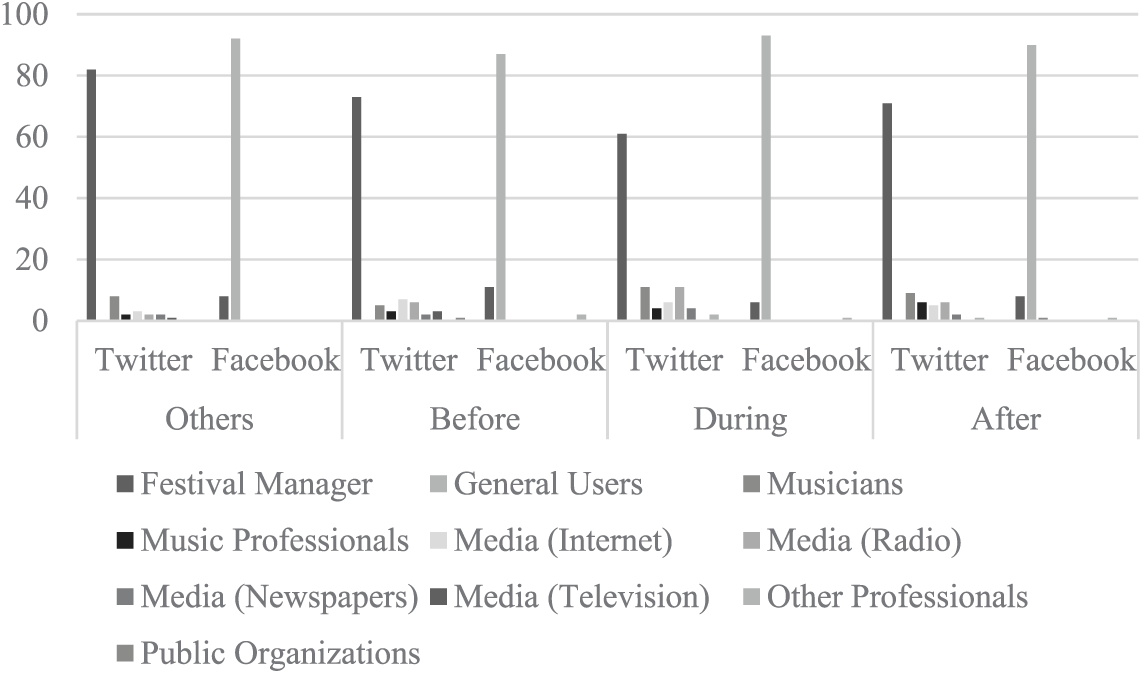
Stakeholders’ dimensions by platform. Entries in percentage.
Coding process
Once the information was categorized by user profile, we proceeded to conduct a second content analysis, consisting in coding all the information found in the Twitter (tweets and retweets) and Facebook (posts and comments) entries. First, each entry was coded according to a draft coding map based on previously presented literature on VBC users’ engagement attributes, behaviours and focuses. We decided not to use the term ‘motivation’ because it can be considered as a deeper psychological construct that cannot be interpreted based on an analysis of content alone. Instead, as presented in the literature, the focus has also been used to denote users’ purpose of engaging in brand communities. From this first codification we extracted key themes and topics from this literature and progressively developed a more inclusive coding map to capture and organize the range of likely strategies. Although most of this content was in English, we have analysed content in Spanish and Catalan at the same level.
It is important to add that this step was carried out in each VBC (Twitter and Facebook), but considering that the dimension proposal could be useful for both and, therefore, also generalizable to other VBCs formed in other social media. Moreover, it is important to clarify that each platform (Facebook, Twitter) was encoded by a single author. Nonetheless, to ensure inter-coder reliability, all authors reviewed 15% of both samples, finding inter-coder agreement percentages between 80% and 90% for the reported dimensions, which validated the subsequent individual coding process (Lavrakas, 2008).
Thus, from the observation of each dimension in our qualitative analysis of the entries on Twitter and Facebook, the final coding map includes new sub-dimensions that complete previous proposals and allow us to observe the degree or level of each. After our joint analysis of the Facebook and Twitter samples, we agree that two new affective ‘affection’ sub-dimensions or degrees expressing possible disaffection (disaffected) or passivity in affective communication (emotionally passive) should be introduced, which could also be related with previous proposals. Furthermore, considering the four affective dimensions, it was possible to interpret them as a gradation of affective expressions. We proceeded similarly in the case of the cognitive dimension, where, in addition to the sub-dimensions proposed by authors such as Dessart et al. (2015), we again considered a gradation of these sub-dimensions and the possibility that cognitive communication could be neutral (cognitively passive sub-dimension).
Likewise, we also propose additional sub-dimensions of engagement behaviour that, although in this case are not exclusive and do not indicate a specific degree, do represent a certain development of the capacity for engagement, from the simple action of asking to begin a dialogue with other users. The study therefore reiterates the original proposals of some of the authorities on engagement (Kent and Taylor, 2002) in terms of highlighting its dialogical capacity. Furthermore, going beyond the traditional branding motivation, socialness is precisely one of the main characteristics of VBCs (Dessart et al., 2015). Based on our qualitative analysis, we understand that this socialness is linked to the concept of social capital, referring to the stock of social confidence that allows users’ resources (in this case information) to be transformed into collective attributes (Van Staveren and Knorringa, 2007).
Moreover, festivals, as tourism products, are important resources in the adoption of destination branding strategies (Richards and Wilson, 2004) that seek to leverage fixed cultural capital in an increasingly competitive and differentiated environment. Prentice and Andersen (2003) show that festivals can effectively reposition a destination, or even modify a whole region’s image. They can recreate the public perception and knowledge of destinations (Hede et al., 2005), projecting them outwards (Boo and Busser, 2006) and contributing to the creation of place-based brands (place-making) (Hankinson, 2004; Richards, 2015). Consequently, if VBCs are one of the preferred channels for promoting festivals and therefore destinations, it is no surprise that in our first content analysis we found entries that reveal this ‘place-making’ as one of their users’ focuses.
The construction of this final coding map was fundamental for our last content analysis of each VBC (Twitter and Facebook), which consisted in codifying all the entries in our samples based on our proposed engagement dimensions. With this methodology, we were able to conduct a joint analysis of all the VBC users’ characteristics, since each entry (tweet, retweet, post, comment) was coded with one of the affective attributes and one of the cognitive attributes, as well as with one or several behaviours and focuses. It is important to mention that, following our initial design, this codification was quantitatively translated (assigning 1 if the code was present in the tweet or post and 0 otherwise). In addition, having a multi-period sample and having detected the users’ profiles in each VBC, we were able to add a multidimensional analysis, knowing which users emitted each entry and in what period. Therefore, by analysing all these elements we obtained the results presented below.
Results
Sónar VBC narratives
Before beginning to characterize user engagement, it is important to clarify the main content projected in each VBC. Figure 2 shows the 100 most-reported concepts on Twitter and Facebook, revealing some major trends. On Twitter, beyond festival mentions, we can see the importance of explicit references to some user profiles, such as musicians, journalists and bloggers, as well as musical/cultural manifestations (in concepts such as artists, music, house and techno). This confirms that this VBC gives prevalence to a narrative directly related to the cultural manifestation of this event. Meanwhile, in the Facebook VBC, concepts related to the interests of the platform’s users and those attending the event (tickets, day, check, watch) appear with much greater frequency, and we observed these users’ expressions and some of the most reported user names. Moreover, place-making is also evident: while Sónar highlights the name of its main venue (Barcelona), on Facebook we detected other cities (Bogotá, Buenos Aires) that also host the festival at different times of the year.
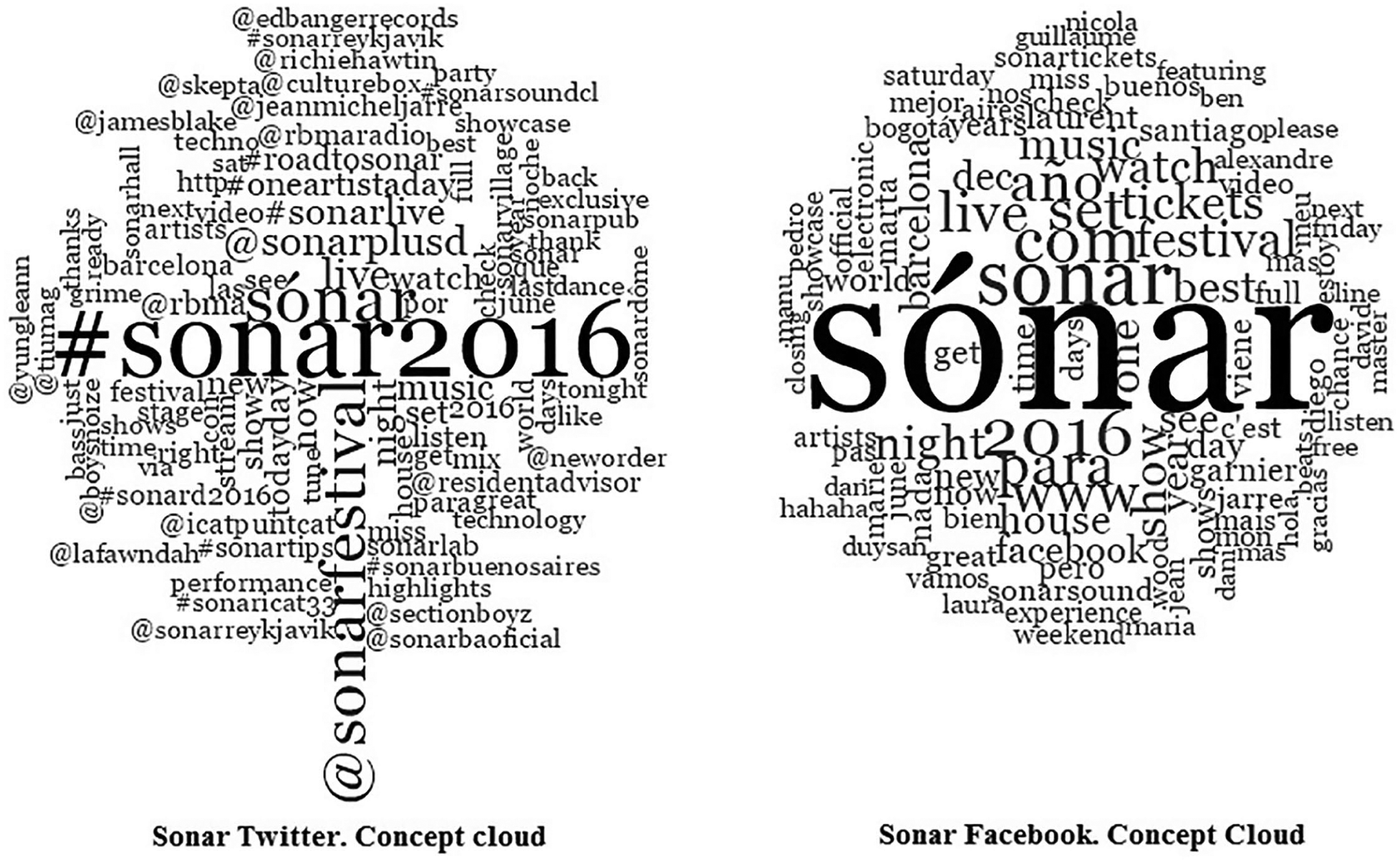
Sónar VBC’s 100 most-reported concepts.
Sónar VBC engagement characteristics
Dimensions and sub-dimensions arising from the coding process for each period allow us to analyse how engagement is constructed over time (see Table 3). In the case of Facebook, all sub-dimensions are present, although the codes indicating a minor degree of affection and cognition are comparatively less important (on Twitter, on the contrary, these sub-dimensions are missing). While on Facebook this is due to the free manner in which general users participate in the conversation and the minimal leadership role of the festival organizer, on Twitter, where the music/cultural sector plays a central role, negative or null sub-dimensions have no place.
Regarding the affective attributes, there is a significant predominance of entries coded as ‘emotionally passive’ (see examples in Table 2), always exceeding 50% of the total. Nevertheless, the Facebook VBC shows a higher affective engagement with the festival, represented by the presence not only of high emotions revealed in the ‘excited’ or ‘pleased’ sub-dimensions, but also of more critical feelings in the ‘disaffected’ sub-dimension. Furthermore, the emotiveness increases for both platforms just after the festival is held (‘after’ period), which is directly related to the evaluation of the festival or the performances, and therefore the experiences people had. In the case of Twitter, the sum of excited and pleased responses clearly increases at this moment, while on Facebook the pleased comments increase at the same time as the disaffected ones. Below, we present some examples for both VBCs:
Coding map. Engagement’s affection and cognition attributes, behavioural manifestations and focuses.

Source: Authors’ own work.
Twitter (After/Musician/Pleased/Dedicated/Sharing/Festival Branding/Social Capital): Thank you @SonarFestival for one of the most amazing experiences in my life. Proud to make it at the @RBMA stage!
Facebook (After/General User/Pleased/Dedicated/Evaluating/Festival Branding): Best ever, I don’t even call it a concert; it was a multi-sensorial awareness experience where every second has a remarkable message.
Facebook (After/General User/Disaffected/Dedicated/Evaluating/Festival Branding): I think that closing SonarCar was the stupidest idea you ever had, was impossible to get in, full of people. I didn’t have the chance to see Laurent Garnier and I was really disappointed.
In relation to the cognitive attributes, Table 3 shows the predominance of the ‘attentive’ and ‘dedicated’ codes on Twitter, which require attention from the other users. It is interesting to observe the growth of ‘dedicated’ entries in the period prior to the start of the festival, due to the organizer’s and other users’ (musicians, media) need to detail the main milestones of the event. For example:
Distribution of codes by sub-dimensions and period. Percentage in each sub-dimension.

Source: Authors’ own work.
Twitter (Before/Festival Organizer/Emotionally Passive/Dedicated/Sharing/Festival Branding/Social Capital): Traditional music and modern production methods collide at #sonar2016. Stream our playlist of the key artists https://t.co/pnREdLrFjb
However, general users on Facebook move between ‘cognitively passive’ or ‘attentive’, as their contributions are more personal than professional. Furthermore, on this platform, posts are more similar to tweets, as they share information about the festival but also about cultural elements related (directly or indirectly) to the event, while comments are more personal:
Facebook post (Before/Festival Organizer/Emotionally Passive/Dedicated/Sharing/Festival Branding/Social Capital): In 2 weeks’ time the mighty New Order will take to the stage at Sónar by Night for a highly anticipated show in support of their new album Music Complete [. . .].
Facebook comment (Before/General User/Pleased/Attentive/Dialoguing/Social Capital): That makes me feel old, it’s the album that made me really get electronic music.
Concerning the codification related to engagement behaviours, in the case of Twitter, the most usual behaviour is linked to sharing information, always exceeding 70% of the total and reaching almost 80% in the period prior to the event. Meanwhile, dialogue is the main behaviour aspect observed on Facebook, moving towards 60% and 70%, in three directions: between the organizer and general users and vice versa, and among general users themselves. This dialogic structure is the most important characteristic of the Facebook platform for engagement (and social capital) construction. In addition, both platforms present a greater weight of ‘evaluating’ for the ‘after’ period, when users comment on their impressions of the performances or remember the festival highlights. We present an example of each of these behaviours below:
Twitter (Before/Musicians/Excited/Dedicated/Sharing/Festival Branding/Social Capital): We’re building something new for @SonarFestival next month. It’ll be @NoMansSky. But louder. And unique.
Facebook comment (After/General User/Emotionally Passive/Dedicated/Sharing/Dialoguing/Festival Branding/Social Capital): Hi Fabrice, you can find most of the tracks that Laurent played on the Playmoss playlist here! Happy listening!
Twitter (During/Festival Manager/Excited/Dedicated/Sharing/Evaluating/Festival Branding/Social Capital): Boy better known @skepta has the crowd eating out of the palm of his hand at SonarPub #sonarlive.
Looking at the relationships between behaviours with affective and cognitive attributes, starting with ‘sharing’, on Sónar’s Twitter there is a significant association (X2 = 13.494, df =2, p = 0.01) between this behaviour and the emotionally passive and cognitively dedicated attributes (X2 = 11.394, d = 2, p = 0.03). Meanwhile, in the case of Sónar’s Facebook, dialoguing behaviour has a positive association with cognitively passive attributes (X2 = 115.585, df = 1, p = 0.00). Evaluating behaviour has a notable association with excited and attentive attributes, both on Twitter (X2 = 100.728, df =2, p = 0.00 and X2 = 15.260, df = 2, p = 0.00) and on Facebook (X2 = 318.240, df = 3, p = 0.00 and X2 = 69.316, df = 2, p = 0.00).
Regarding the users’ focuses behind these conversations, and as seen in previous entry examples, ‘festival branding’ and ‘social capital’ stand out on both platforms and usually appear together in the codification process. The main difference is that while on Twitter the organizer seeks to build relationships with the cultural sector and media professionals (to promote together and interweave and strengthen relationships), on Facebook the target is general users, who are also building relationships with each other. Through comments, general users discuss different aspects of the festival, but use the festival’s official Facebook page to socialize (meet or invite other people to meet). By doing so, they are constructing their social capital around the festival, but at the same time demonstrate a direct engagement with it. ‘Place-making’ appears in a secondary position (sometimes marginal in the case of Facebook), but it gains importance on Twitter and in the ‘others’ period, when Sónar goes international and its various venues are mentioned, publicizing these destinations but also identifying the festival as a truly international event. Below is an example of the place-making focus in each VBC:
Twitter (Before/Festival Organizer/Emotionally Passive/Attentive/Sharing/Festival Branding/Social Capital/Place-Making): Three of Barcelona’s top chefs will be taking over the kitchen at the Sónar by Day VIP area. Only a few tickets left.
Facebook post (Other/Festival Organizer/Excited/Attentive/Sharing/Festival Branding/Social Capital/Place-Making): The great Hot Chip pay homage to two other greats in the video for their cover of ‘Dancing in the Dark’! Don’t miss them at Sónar São Paulo (Nov 28th), Sónar Buenos Aires (Dec 3rd), SonarSound Santiago (Dec 5th) and Sónar Bogotá (Dec 7th).
By observing the associations of the main focuses with the attributes, our results highlight new trends. First, festival branding is significantly associated with excited attributes on Facebook (X2 = 278.759, df = 3, p = 0.00) and with attentive attributes on Twitter (X2 = 30.612, df = 2, p = 0.00) and on Facebook (X2 = 181.834, df = 2, p = 0.00). Second, social capital is associated with the emotionally passive attribute in the case of Facebook (X2 = 101.972, df = 3, p = 0.00), as well as with the attentive attribute on Twitter (X2 = 30.612, df = 2, p = 0.00) and Facebook (X2 = 6.981, df = 2, p = 0.03). Looking at the associations of the focuses with engagement behaviours, the results show new relevant relationships: festival branding is significantly associated with evaluating behaviour in the case of Facebook (X2 = 141.694, df = 1, p = 0.00) and Twitter (X2 = 4.352, df = 1, p = 0.03). Festival branding is also associated with sharing in the Facebook VBC (X2 = 60.970, df = 1, p = 0.00). Meanwhile, social capital shows associations with dialoguing behaviour in both VBCs (X2 = 8.574, df = 1, p 0.03 on Twitter and X2 = 159.417, df = 1, p = 0.00 on Facebook).
User perspective
Regarding how engagement is held from a user’s perspective, Table 4 presents the results for the most important users (as seen in Table 2) on both platforms: the festival organizer in the case of Twitter and general users on Facebook. On Twitter, the festival organizer participates mainly with passive emotiveness, although he or she increases affection to express gratitude and memory or to connect with the community for the next edition of the event in the ‘after’ and ‘other’ periods. An example of this finding is as follows:
Codes by user. Organizer (Twitter) and general users (Facebook). Percentage of the total inside each sub-dimension.

FB: Facebook.
Source: Authors’ own work.
Twitter (After/Festival Organizer/Pleased/Dedicated/Sharing/Festival Branding/Social Capital): Thank you to all the fans and artists who made this #sonar2016 so special. See you . . . around the world in 2017!
Moreover, the festival organizer’s participation is guided by a remarkable degree of cognition in the tweets (attentive), which increases to ‘dedicated’ in the period prior to the start of the event, due to the need to disseminate information about the festival. An example of this observation is as follows:
Twitter (Before/Festival Organizer/Emotionally Passive/Dedicated/Sharing/Festival Branding/Social Capital): Start planning your Sónar. Full performance times and stages online here #sonar2016.
The festival organizer principally participates by spreading and/or sharing information (‘sharing’) but increases the evaluation entries (‘evaluating’) in both VBCs during and just after the event. Regarding the focuses, in some of the previous examples we can appreciate the importance of ‘festival branding’ in conjunction with ‘social capital creation’ and the increase of the relative weight of ‘place-making’ for the rest of the year, when the organizer promotes its own event and associated events more, particularly through Twitter, as in the following example:
Twitter (During/Festival Organizer/Pleased/Dedicated/Sharing/Evaluating/Social Capital): False alarm . . . ‘Love Will Tear Us Apart’ is tearing us apart in a million pieces. Thank you @neworder.
General users, who predominate on Facebook, differ from the organizer in various aspects. The emotionality of their contribution, both in positive and negative affection attributes, is higher and expressed mainly ‘during’ and ‘after’ the festival is held and experienced. In this sense, there is a direct emotional engagement with the festival that is constructed through sharing or remembering experiences, when the higher emotion ‘pleased’ acquires importance. On the contrary, disaffection is directly related to ‘evaluating’ behaviour, one of the most relevant during these periods. An example of these findings is as follows:
Facebook comment (After/General User/Pleased/Attentive/Sharing/Evaluating/Festival Branding/Social Capital): Avril Take look, here it is I told u!! Memorable.
Facebook comment (After/General User/Disaffected/Attentive/Evaluating/Festival Branding): Shame culturebox didn’t cover Jean Michel Jarre.
Regarding the conversation focus, as can be seen in some of the previous examples, general users also contribute mainly to ‘festival branding’, combining it with ‘social capital’. General users co-create ‘festival branding’ from a very affective and lived perspective and they do so in a dialogic manner and combined with social capital focus. Despite ‘sharing’ information just before the festival and interacting or ‘asking’ during the event, general users also discuss the festival and by doing so generate socialization and become principal actors in festival branding creation.
Discussion and conclusion
As indicated, this study offers new insights regarding user engagement in festivals’ VBCs. In contrast to previous studies, it compares two VBCs from two different platforms (Facebook and Twitter), allowing an in-depth analysis of their stakeholder structure and evidencing how this structure influences the prevalent attributes, behaviours and focuses of their engagement. From a methodological point of view, different elements can be emphasized. Collecting previous findings (Brodie et al., 2011; Dessart et al., 2015; So et al., 2014), but also expanding on previous research (MacKay et al., 2017; Richards, 2015; Taylor and Kent, 2014), our study proposes a new gradation of analysis for engagement attributes and new engagement behaviours and focuses, highlighting the proposal of adding place-making as an alternative or complementary focus to festival branding and social capital creation. The study also proposes an analysis of the main associations between these attributes, behaviours and focuses using a qualitative interpretation and a quantitative translation of them.
Furthermore, this new insight is also possible because the analysis has been performed over a whole year, thereby taking into account a long period of time that transcends the traditional view of festival consumption before, during and just after the event. This analysis also considers the existence of ongoing communication between the users of the VBC, which has a direct impact on the engagement process. This last finding shuns consumer-centric visions and would be related to a progressive separation of the communication in the VBC from strict attendance (consumption) at the festival. In fact, although the expression of the attendees is still relevant (especially when this is carried out), non-attending but engaged users also gain importance. Besides, this is in total consonance with the extensive literature that explains the importance of festivals in the creation of a destination’s image, beyond the few days over which the event is held (Garay and Morales Pérez, 2017).
Going into a more in-depth assessment of these results, while the most reported affective attribute for both platforms is ‘passive’, Facebook users’ comments tend to be more emotionally intense and spontaneous. Moreover, emotiveness increases for both platforms just after the festival, due to the increase in the evaluative behaviour by the organizer and general users. Finally, regarding cognitive attributes, while an ‘attentive’ projection of information predominates on Twitter, Facebook is dominated by a more ‘cognitively passive’ conversation. Regarding engagement behaviours, while on Twitter the need to share information predominates, the Facebook platform is used essentially with the aim of developing dialogues that would be useful to co-create narratives and boost feelings of involvement. Therefore, on Twitter, the organizer and the other users are taking advantage of this VBC to promote the event and themselves (Marine et al., 2017), while on Facebook, general users, through their constant dialogue, become the centre of sociality (Flinn and Frew, 2014). This finding harks back to one of the initial aspirations of engagement theorists (Taylor and Kent, 2014), who have always paid special attention to dialogic engagement.
The study also confirmed the idea of the common presence of festival branding and a sociality focus in these VBCs (Dessart et al., 2015). Nonetheless, our findings expand this assumption by corroborating that socialness is manifested through different needs in each VBC depending on their stakeholder composition: in the case of Twitter it is related to consolidating sector-based relationships and the need to manage resources in a more sustainable way. In the case of Facebook, it is closely linked with the construction of civic engagement. Moreover, just as place-making has traditionally been associated with the projected image of destinations (Richards, 2015; Sevin, 2013) and has also recently been related to engagement with this image, the results of this study reinforce the need to consider the growing importance that destination image has for such internationalized events. Regarding this, we have seen how Sónar associates itself with the image of diverse and differentiated destinations (Barcelona, Reykjavik, Copenhagen and Buenos Aires), while offering these cities an interesting opportunity for promotion by linking them with the innovative and pro-technological image of this festival.
The study also reinforces the need to develop a stakeholder analysis of these kinds of processes (María Munar, 2011; Sevin, 2013), but adding the proposal to do so understanding the main engagement attributes, behaviours and focuses of these users. Based on the user profile, we have shown how Sónar’s Twitter VBC is focused on engaging with the professional music sector (acting as a hub of cultural dissemination), while the Facebook VBC engages general users (attendees and other non-professional users). This is relevant because it conditions the type of engagement and the main focuses that predominate in each VBC.
Moreover, while most of the literature emphasizes the analysis of the planning stages (Lee et al., 2012), we have considered the ideas of regarding the need to stress the importance of ongoing communication to festival success. This has been useful in understanding that this festival’s engagement does not show peaks in some periods but is rather an evolution of engagement dimensions and sub-dimensions spanning a whole year. Here, the ‘other’ period, situated between the festival’s editions, has proved to be especially relevant for the festival not only to maintain engagement during the year, but also to construct and reinforce socialness with other users: essentially the cultural sector on Twitter and general users on Facebook.
Managerial implications
There are diverse implications for festival organizers and DMOs regarding the results of this study. They need to be aware of the following:
(a) The potential benefits of being in contact with other users in the intermediate period between one edition and another, when engagement can be sustained, developing a relationship hub with the diverse VBCs.
(b) The effectiveness of modulating and managing the narrative of these VBCs in such a way that they can improve the festival and destination branding.
(c) The positive impact on this branding that can be gained by knowing what motivates users in these VBCs and how these focuses are associated with the previously mentioned attributes and behaviours.
(d) How to exploit the benefits of associating festival branding with all the socialness potential of these platforms by knowing which user profiles lead the conversation in each VBC.
This study is not without limitations. First, although the Sónar festival illustrates unique activities and processes, to enhance generalizability, many festivals with similar characteristics should be considered and this should be extended to other cultural industries. In addition, the study has not considered to what degree the festival organizers on each platform have a premeditated strategy of discourse, or whether it is their individual profile that ultimately conditions the discourse. In this sense, studies such as the present should be accompanied by a new qualitative analysis in which selective interviews with organizers themselves are carried out. Another terrain that has not been explored is the diversity of strategies employed by festival organizers and the difference between public and private organizers. In addition, from the demonstration of the importance of ongoing communication throughout the year, it would be interesting to observe how this influences the loyalty to the brand of certain stakeholders as well as actual attendance at the event. Finally, another relevant aspect would be whether the engagement process for general users is affected by festival attendance and the possible relationship with the destination (as a tourist or a resident).
Footnotes
Declaration of conflicting interests
The author(s) declared no potential conflicts of interest with respect to the research, authorship, and/or publication of this article.
Funding
The author(s) received no financial support for the research, authorship and/or publication of this article.
