




Abstract
The place-making practices of tourists have long captured the attention of tourism researchers. This article examines how the everyday practices of backpackers contribute to place-making in the enclave and the hostel – two places common to backpacker destinations. Using participant observation supplemented by interviews, the research revealed these places to be characterised by a range of extraordinary and mundane backpacker practices and mobility rhythms. Places inhabited by backpackers were in constant flux and ‘co-created’ via practices in conjunction with an array of other phenomena. As backpackers interacted with one another, other people and the various materials, temporalities and environments that were present, they inadvertently contributed to place-making processes. The research shows how mobile people make place and extends understandings of how backpacker lives are lived. It demonstrates the centrality of practices to both place and mobility, highlighting the importance of tourist actions – rather than industry directives – to place-making in tourism.
Keywords
Introduction
The place-making practices of tourists remain a consistent topic of study for tourism researchers (Crouch, 2002; Hultman and Hall, 2012; Lew, 2017; Sofield et al., 2017). This article applies a mobilities perspective to explore the place-making practices of backpackers. Backpackers have a highly dynamic relationship with place and mobility. In the words of Allon and Anderson (2010), backpackers ‘not only travel through but also dwell in place’ (p. 11). The dynamic sociality of backpackers and their various mobilities have also made them a consistent topic of interest for mobilities researchers (Allon et al., 2008; Germann Molz and Paris, 2015; Gogia, 2006; Iaquinto, 2018; Jayne et al., 2012). Understanding how backpackers make place while mobile may deliver new insights into destination formation and evolution, and help explain how backpacker lives are lived. It may also be of interest to tourism marketers and managers seeking a more emic perspective of how backpackers engage with destinations, facilities and infrastructures.
Lew (2017) distinguishes between ‘place-making’ undertaken by individual tourists in their everyday actions, and the more formal ‘placemaking’ carried out by governments and tourism authorities. Then there is also a form of place-making carried out by community members in which tourism is not a major motivating factor but which nonetheless has tourism implications (Sofield et al., 2017). Following Lew’s (2017) terminology, this study is focused on backpacker ‘place-making’. Backpackers have had a profound influence on the character of various places around the world, as their desire to travel ‘off-the-beaten-track’ has brought new destinations to the attention of the tourism industry (Hampton, 2013; Pryer, 1997; Westerhausen and Macbeth, 2003). Scholars have provided industry and community perspectives of backpacking (Hampton, 2013; Pryer, 1997; Welk, 2010), engaged with backpacker identity formation and experiences (Bui et al., 2014; Chen et al., 2019; Zhang et al., 2018), and considered the everyday practices of other tourist types (Edensor, 2007; Obrador, 2003). Yet, little is known of how the practices of backpackers contribute to place-making processes.
Based on fieldwork with backpackers in Australia, this article will examine how backpacker place-making practices contribute to the character of two well-known backpacker places: the enclave and the hostel. These were chosen because they are common to popular backpacker trails around the world. For example, various enclaves and hostels can be found along the backpacker trails of Southeast Asia and Australia (Cohen, 2018; Howard, 2005; Welk, 2010). Both enclaves and hostels have received a substantial amount of attention from backpacker researchers (Cohen, 2018; Howard, 2005; O’Regan, 2010; Westerhausen and Macbeth, 2003; Wilson and Richards, 2008). This study explores the practices of backpacking to illuminate how they contribute to place-making in the enclave and the hostel. As Lew (2017) argues, place-making is often inadvertent, but understanding how tourist practices contribute to place-making processes can provide important information about destination development and also about how people live their lives as tourists.
Mobilising place in tourism studies
Tourism has long been an important topic for mobilities researchers (Sheller and Urry, 2004). Scholars of tourism mobility have examined corporeal travel, mobility-related politics, mobile technologies, and how the mobilities of tourists often depend on the immobility of others (Hannam, 2014). The mobilities paradigm has been highlighted for its ability to overcome fixed binaries such as home/away and work/leisure (Cohen and Cohen, 2012), while backpacker mobilities have been explored in relation to technology, globalisation, sustainability and the role of alcohol in (dis)enabling movement (Germann Molz and Paris, 2015; Gogia, 2006; Iaquinto, 2018; Jayne et al., 2012).
According to Sheller and Urry (2006), focussing on mobilities challenges the ‘sedentarism’ of social science in which stability is taken for granted while flux is positioned as abnormal (p. 208). It acknowledges the importance of mobility to people’s lives and by doing so, turns mobility into a foundational aspect of social scientific inquiry. This is not to say that social scientists were completely unaware of the importance of mobility prior to the emergence of the mobilities paradigm. Cresswell (2010), for instance, points out that disciplines such as geography, sociology and spatial science, among many others, have long shown a strong interest in ‘things and people on the move’ that extends back to at least the 1920s (p. 18). Nor are mobilities researchers unaware of the importance of stillnesses, stoppages and moorings to mobility processes (Bissell and Fuller, 2011). Instead, it signals a theoretical shift from a focus on static manifestations of social life to the mobilities that connect them (Cohen and Cohen, 2012).
The study of place has a rich history, particularly in geography (Cresswell, 2004; Relph, 1976; Tuan, 1977), but a range of disciplines have also contributed insights into place-making (Sofield et al., 2017). From an urban planning perspective, place-making is based on improving the liveability of communities, while in architecture, the aesthetics and design elements of place-making are emphasised. Meanwhile, the work of Doreen Massey (1993, 2005) continues to be highly influential on contemporary understandings of place. While Massey’s (1993) research was more about how a sense of place is created, the notion that places emerge through relationships and social interactions was a key insight. Instead of contrasting place with all that is outside it, Massey (1993) defined places in terms of their linkages with other places and so places can be thought of as possessing openness and as always being in flux. Over the past 15 or so years, the mobilities paradigm has contributed to the ongoing debate on place and further emphasised an understanding of place as highly dynamic, endlessly unfolding, open and relational (Adey, 2010; Anderson, 2012; Sheller and Urry, 2006).
In understanding both place and mobility, this article draws on a range of theoretical and empirical work on place, particularly that of Cresswell (2004, 2009, 2010). Every place, according to Cresswell (2009), is comprised of materiality, meaning, and practice. Materiality includes the ‘stuff’ of which place is made and the things that pass through place. However, ‘stuff’ is not straightforward as it is always being built up, broken down, shifted around, and it can take many different forms. Meaning refers to the associations and connections people have with place. Meaning can be shared or contested, personal or social, but always open to contestation and reinterpretation. Practice describes what people do in place. It might refer to significant moments in history or refer to everyday activities such as shopping or working, which only occur in certain places at certain times but which highlight how places are ‘continuously enacted’ through the repetition of practices (Cresswell, 2009: 169). Materiality, meaning and practice are interconnected. For instance, the material structure of place enables some practices while disenabling others (Cresswell, 2004). Meaning will help to determine which practices are ‘in place’ or ‘out of place’ and the times at which such practices are acceptable or unacceptable (Cresswell, 2004).
In contemporary human geography, place is understood relationally, as a nexus emerging at particular moments in space and time (Anderson, 2012; Massey, 2005). Place is thus considered to be highly dynamic and in flux – ‘constantly performed through the “gathering” of materials and movements’ (Merriman, 2009: 138) and forever ‘open to conditionality and emergence’ (Anderson, 2012: 571). A relational perspective means that places are defined in terms of their mobilities and their connections with other places, and so mobility and place are thought to produce each other (Adey, 2010; Massey, 2005). Tourist destinations evoked through practices are produced by the actions of people such as tourists and locals rather than the product of marketing or industry-led design (Bærenholdt et al., 2004; Crang, 2011; Crouch, 2002).
Cresswell (2010) argues mobility is an entanglement of movement, representation and practice. Movement acknowledges that people, things and ideas move. Representation indicates how mobility is understood. For example, depending on the context, mobility can be associated with freedom, boredom or oppression. While practice refers to how mobility is felt in the body. It describes the ways mobility might be painful, tiring or exhilarating. Practice can also denote everyday mobility practices such as cycling or it can describe how social processes and habits become embodied. Thus various intersections exist between the concepts of mobility and place. However, mobility and place were for a long time considered to be in opposition. The concept of ‘topophilia’, or love of place, was thought to emerge out of a sense of belonging and being fixed in place (Cresswell, 2004; Tuan, 1977). Yet, mobilities researchers have demonstrated that profound attachments to place can still be made under highly mobile conditions. The term ‘tropophilia’ was coined to describe the ways long-term travellers exhibit a ‘love of mobility, change and transformation in the person-place relation’ (Anderson and Erskine, 2014: 130). Thus mobility does not necessarily break the links between people and place but rather transforms their already dynamic relations.
Places are not backdrops for human action nor are they discrete entities unconnected from other places. Rather, people and place are inseparably linked. As Obrador (2003) put it, ‘places haunt us at the same time that we haunt them’ (p. 50). Mobilities researchers argue against a clear distinction between people and place, preferring to consider place to be produced contingently by the coming together of practices, objects, materials and technologies, among other factors (Hannam, 2014). Tourist mobility thus plays a role in place-making since places become tourist destinations by the mobilities of tourists (Bærenholdt et al., 2004). Distinctive relations between practice, mobility and place are enacted through backpacking. Backpackers have a constantly fluctuating relationship with place as they visit multiple destinations but also become semi-permanent residents in certain areas (Allon et al., 2008). Backpackers may also enact a moving place as they travel across the country via bus, train, car or plane. Thus in backpacking, places are not just ‘static and sedentary’ but may also emerge ‘through the meeting of movements’ and the alteration of practices (Anderson, 2012: 575).
In the work of Cresswell (2004, 2009, 2010), both mobility and place include some understanding of meaning, whether it is ‘meaning’ in place or ‘representation’ in mobility. Both refer to how place and mobility are understood. But while meaning can be personal and individual, representation is more about how mobility is understood in various media such as in movies or advertisements, which then helps to cultivate shared understandings (Cresswell, 2004, 2009, 2010). Mobility and place also include a sense of practice as both are performed. Places can become touristic via the mobilities of people as they engage in various embodied mobility practices such as snorkelling, snowboarding or hiking. Conversely, practices of immobility can transform a place into a tourist destination by the presence of people sunbathing, lounging or pausing to take photographs. This study pays particular attention to practices as it is via embodied practices that tourists involve themselves in place and through which the organic, spontaneous forms of place-making that are of interest to this study are believed to occur (Bærenholdt et al., 2004; Granås, 2018; Lew, 2017; Obrador, 2003).
Backpacker places
Once associated with the counterculture, backpackers are now found all over the planet and originate from an increasingly diverse range of countries (Cai et al., 2019; Nok et al., 2017; Richards and Wilson, 2004; Zhang et al., 2018). They may travel fleetingly through multiple countries then reside in one place for months at a time, all within the space of a single trip (Falconer, 2013). Backpackers are typically low budget, loosely organised and semi-independent tourists (Falconer, 2013). But as backpacking has become increasingly diverse, there is now substantial variability in terms of budget, travel duration and level of independence from the mass tourism industry (Germann Molz and Paris, 2015; Sørensen, 2003).
The two places of interest in this study – the enclave and the hostel – exemplify the fluctuating mobilities of backpackers as they move through and reside in place (Allon and Anderson, 2010). Examining backpacker practices in these two places will help to illustrate the dynamic relationship between tourist practices and place (Germann Molz, 2008; Obrador, 2003). The type of place-making of interest in this study is that which occurs via the ‘organic and unplanned actions of individuals’ (Lew, 2017: 448). Such actions are shaped in part by the ways backpackers interact with the materiality of the environment, with each other, local people and with various transportation infrastructures, technologies and social norms. Understanding backpacker practices and how they interact with various features of place will provide a better understanding of the role of practice in place-making processes. It will also bring to light how everyday backpacker practices contribute to the character of the enclave and the hostel.
Backpackers have long been known to gather together in enclaves, which are usually commercial areas of cities or rural areas with natural attractions in which a range of infrastructures and businesses catering to backpackers have emerged (Cohen, 2018; Hottola, 2005; Wilson and Richards, 2008). The relative familiarity, comfort and services provided to backpackers in enclaves make them central meeting points along popular backpacker trails, maintaining the backpacker ‘scene’. A key characteristic of backpacker enclaves is that they are porous in the sense that local people and various non-backpackers are able to enter (Cohen, 2018; Wilson and Richards, 2008). The international atmosphere enclaves provide has been known to appeal to locals (Howard, 2005), while their ability to provide a refuge from the intensities of foreign encounters has been known to appeal to backpackers (Hottola, 2005). Thus enclaves serve different purposes for locals and backpackers.
Hostels are one of the most recognisable backpacker places, playing a key role for backpackers as an ‘institutional infrastructure that enables, structures and represents their mobility’ (O’Regan, 2010: 88). While backpackers may utilise other forms of accommodation (Zhang et al., 2018), the use of hostels remains an important way of distinguishing backpackers from other tourists (Chen et al., 2019). Even more than the enclave, the hostel can provide backpackers with a refuge that enables them to mediate their exposure to various unsettling encounters with Otherness while intensifying encounters with other backpackers (Hottola, 2005). While acknowledging the practices of various actors would contribute to the place-making processes of the enclave and the hostel, the focus of this study is on backpackers.
Methods
This research used a qualitative approach, specifically participant observation supplemented by interviews. Participant observation was the dominant method because it enabled a range of backpacker practices to be noted, from the mundane, to the extraordinary and the inadvertent. As place-making often occurs inadvertently via the spontaneous and improvised practices of individuals (Lew, 2017), backpackers might not be able to identify all of their place-making practices upon questioning, making participant observation the main method for apprehending their various practices. However, to account for the possibility backpackers were able to converse about their practices, interviews were used to support observational methods. Interviews also suited the conversational and social atmosphere of backpacking (Reichenberger, 2017). This article emerged from a broader research project on backpackers conducted in Australia and completed in 2015 that explored the influence of mobility upon backpacker practices of sustainability. Throughout the fieldwork, the author lived as a backpacker across Australia, staying in hostels and moving about via backpacker transportation infrastructure, which presented numerous opportunities for participant observation and interviews.
As Australia is a highly developed backpacker destination, it was an ideal location in which to conduct this project. Less developed backpacker destinations may lack enclaves, and may not have such a well-developed backpacker transportation infrastructure, which would have limited the study. Fieldwork was conducted in four different destinations across Australia: Melbourne, the Fraser Coast, Alice Springs and Cairns. The fieldwork was conducted across these various locations to account for the variety of backpacker experiences available in Australia. Overall, 101 backpackers were interviewed and a 2-month period of participant observation was conducted.
Most of the backpackers who were interviewed were European – usually from the United Kingdom or Germany. There were also some Asian backpackers from Taiwan, Hong Kong and South Korea. The youngest backpackers were 18 and the oldest were in their late 60s but most were in their 20s or 30s. There was roughly equal gender distribution but more women than men. Interviewees are quoted using pseudonyms and their nationalities. Backpackers of similar demographics were observed during participant observation. The backpackers encountered in the field were quite diverse and included Korean students, Irish school teachers, Taiwanese nurses, British retirees, a former French paratrooper, a Greek backpacker who had been travelling for decades, a Belgian software designer, a Japanese bar tender and a Dutch urban planner. There were backpackers from all career stages, from recent high school graduates to retirees, although most could be considered middle class.
The author’s status as a backpacker/researcher was intentionally made apparent to backpackers encountered in the field, however it was not practical to inform all backpackers all of the time. But as backpackers commonly discuss travel plans and previous travel experiences, it provided an ideal opportunity to discuss the research project. Upon revealing the author’s researcher status, backpackers were either indifferent or were intrigued to learn more about the project which triggered further discussion. In gaining access to backpacker hostels, the research would be explained while making a booking or at the reception desk when checking into a hostel. Access was never denied. Interviewees were recruited in hostels. The research was explained briefly and a question to participate in an interview was posed. Backpackers were identified through their use of hostel accommodation and also via the use of a screening question – ‘are you a backpacker?’ – at the start of each interview, an approach common in backpacker research (Reichenberger, 2017). While some respondents in other studies have answered ‘no’ to this question (Zhang et al., 2018), all interviewees in this study answered ‘yes’.
During interviews, backpackers were questioned about their travel itineraries, activities and practices while in Australia. They were asked about their daily activities, what they spent their money on and the extent to which they socialised with backpackers and non-backpackers. Most participant observation took place in communal areas of hostels such as in kitchens, lounge areas and in public places frequented by backpackers. Silence was also an important tool for research. Letting others talk and allowing the smooth unfolding of events in backpacker settings was essential to apprehending the relations comprising each place. The use of silence was motivated by the recognition that important insights are often inhibited by an overly talkative researcher (McDowell, 2010).
Interviews were recorded with the consent of the interviewees. Interviews were not transcribed. Instead, detailed notes were taken during frequent listenings while relevant themes were noted and choice quotes recorded verbatim. Full transcription was not undertaken because it was not required. Transcription is more than just an administrative task, but a way to interpret data meaningfully (Halcomb and Davidson, 2006). Since the researcher was able to interpret the interview data in a highly meaningful way without transcription, it was deemed unnecessary. A notebook and laptop were used to record reflections and observations on a daily basis. These data were also analysed manually via repeated readings of field notes in which reflections were documented. Over the course of fieldwork, the chosen methods enabled many practices to be encountered, and the various ways such practices intersected with backpacker mobilities, materials, technologies, infrastructures and experiences were reflected upon and recorded. A wealth of material was thus collected that addressed the place-making practices of backpackers.
Enclave
As there are multiple backpacker enclaves in Australia, this account is derived from fieldwork conducted in Cairns, a well-known enclave on Australia’s east coast. It is a city with a population of 160, 285 with a downtown area thoroughly designed for tourism and bustling with a range of cafes, clubs, bars, restaurants, supermarkets, as well as a night market with food stalls and tourist souvenirs (Harding et al., 2017). At the eastern end of the city centre is the Cairns Esplanade – a large public park with an artificial saltwater swimming pool known as the ‘Esplanade Lagoon’ open to the public and patrolled by life guards. Cairns’ tropical climate, proximity to the Great Barrier Reef, international airport and abundance of backpacker hostels help make it a ‘backpacker hot spot’ (Harding et al., 2017: 237).
Opportunities for socialising with other backpackers is one of the appealing features of enclaves and is part of what defines them as particular types of backpacker destinations (Cohen, 2004). The centre of Cairns has about a dozen backpacker hostels, several backpacker travel agents, while many of the clubs and pubs cater to backpackers by offering drink and/or food specials on certain nights of the week. While local residents usually have work responsibilities, some backpackers can party on any (or all) nights of the week. While not all backpackers were interested in partying, and some found full-time employment in Cairns in the retail or hospitality sectors, the local clubs and pubs in the centre of Cairns often attracted a large number of customers even during the middle of the week. While waiting for a Greyhound bus at around midnight on my last night in Cairns, a Scottish backpacker described how he had spent his time: I’ve spent about $A6000 in Cairns in two months. I went to the Great Barrier Reef, did some day trips, stayed at a hostel with 30–40 other regulars where we had a routine. Tuesdays was PJ O’Brien’s (an Irish pub), Wednesdays was trivia at another pub, on Thursdays we watched a match but now I’ve run out of money so I’m going to Mt Isa to work at a bottle shop. (Recorded in diary notes, Cairns)
Backpacker rhythms and movements play an important role in shaping the character of enclaves. Referring to himself and other backpackers as ‘regulars’, the Scottish backpacker quoted above helped to reveal the importance of repetitive backpacker movements to the character of enclaves. The spatio-temporal qualities of this place were shaped by the repeated movements of backpackers. The rhythms of mobility (Edensor, 2010) produced by backpackers as they arrive in Cairns, check in to their hostels, visit the reef and depart also help to constitute the enclave. Collectively, such rhythms present place as a ‘spatio-temporal event’, highlighting how it is always in a state of flux (Massey, 2005: 130).
While enclaves have been known to be places in which backpackers socialise mostly with one another (Cohen, 2018; Howard, 2005), Cairns involved frequent encounters between backpackers and locals, as well as between backpackers and different types of tourists. Despite being a backpacker hub, Cairns was also a functioning city and popular with other tourist types. Backpackers, locals and other tourists would interact not only in some of the bars but also in the markets, supermarkets, cafes and particularly at the lagoon located along the foreshore at Cairns Esplanade. Participant observation was made difficult in public areas because backpackers were often indistinguishable from the local community and other tourists. This made the interview method important for understanding how backpackers acted in enclaves: Yesterday in the park locals were there and you could play soccer with them but I needed shoes. So I went back to the hostel, got my shoes, and played with them. (Ruben, Dutch) I like the fact that Australians will say ‘hey, how you going?’ to a complete stranger just because they are there. I’ll probably go home and be this social and people will look at me like I’m a freak, it’s not the British way. (Leanne, British)
While backpacker place-making practices are the concern here, it is important to recognise that the practices of various non-backpackers also contributed to the overall character of the enclave. Locals played a role via their interactions with backpackers in public places. As Harding et al. (2017) wrote, Cairns has a ‘hearty hospitality’ that can make even ‘a short stroll turn into an impromptu social event’ (p. 229). A city populated by people who are welcoming of outsiders combined with parks and the Esplanade Lagoon as materials enabling interactions fostered collective place-making in the enclave. As the backpacker quotes above indicate, Leanne was able to interact with a ‘complete stranger’ while Ruben was invited to play soccer with locals, making Cairns a unique type of enclave. Cairns’ status as a backpacker enclave was produced not by an industry-led process of ‘placemaking’ but via a type of bottom-up ‘place-making’ (Lew, 2017) emerging out of a spontaneous confluence of local and backpacker practices combined with materials such as public parks, soccer balls and shoes.
In some enclaves, backpackers and locals may interact in the context of service provision but not on an interpersonal level. On Bangkok’s Khaosan Road, locals would enjoy the international atmosphere but avoid interacting with backpackers (Howard, 2005). For backpackers in India, enclaves were a way to reduce interactions with locals (Hottola, 2005). But in Cairns, interactions between backpackers and locals were commonplace. Howard’s (2005) distinction between functional types of enclaves which provide conveniences and those which provide attractions does not apply to Cairns because it provided backpackers with both. Similarly, Cohen’s (2004) distinction between urban and rural enclave types is also unsuitable with Cairns merging elements of both. Nor was Cairns a place in which reality could be suspended (Wilson and Richards, 2008), as the everyday lives of Cairns’ residents simultaneously unfolded among backpacker activities and actions. It is a functional city inhabited by tourists and locals who work in a range of industries including tourism, located in a remote tropical region beside an immense marine ecosystem of tremendous global significance.
In addition to vigorous activities such as snorkelling and partying in bars, Cairns also provided an opportunity for more languid place-making practices. Similar to backpackers in other enclaves (Howard, 2005), those in Cairns spent much time looking for work, socialising, meeting new travel companions, checking emails, lounging by the lagoon, scrolling through their phones, drinking alcohol or playing cards. Backpackers who are travelling long distances across Australia and partaking in mobile practices such as snorkelling will also intersperse that activity with periods of slowness and rest. The following diary entry provides a sense of the types of practices performed during periods of rest: We looked at photos from last Friday night at Gilligan’s bar (everybody was drunk). There were pictures of Babinda Falls ‘where the Mysterious Girl video (by 90s pop singer Peter Andre) was filmed’, people flicking their hair ‘like in the shampoo commercial’ and pictures of turtles at the reef. We spoke about what to do for New Year’s Eve and how weird (to them) it will be having Christmas in the summer. Apparently sausages are bad in Australia and ‘you can’t get a decent fry up even for 20 bucks’. (Diary notes, Cairns)
In the enclave, backpackers were always engaged in a form of ‘doing place’ (Jayne et al., 2012: 211) participating in whatever activity was provided, whether it was shopping, snorkelling, clubbing or surfing. By partaking in such activities, backpackers animated the enclave, bringing it to life with everyday practices of socialising, drinking and partying, as well as via extraordinary practices such as snorkelling and diving on the Great Barrier Reef. While inadvertent, it was via this combination of ordinary and extraordinary practices performed by backpackers that contributed to place-making in the enclave. The enclave was made by the practices of backpackers as they were doing place, and as their practices merged with the materiality of place and the practices of other tourists and locals. So backpackers were doing place and making place simultaneously.
Such dynamism gave enclaves an alternating temporality, characterised by a rapid unfolding of the present moment during exhilarating new experiences such as snorkelling on the Great Barrier Reef then a languid unfolding as backpackers scrolled through photos on their phones or played cards. This array of practices also helped to connect the enclave of Cairns with other places. Backpackers would continue to scroll through photos elsewhere, viewing the ones taken in Cairns in new places. This suggests place-making among backpackers has temporal aspects. Their everyday practices of photographing and scrolling through photos provides a way to carry previous destinations into new ones and make their past experiences reside in the present, regularly connecting Cairns with other backpacker places.
Of course, not all backpackers would divide their time in such ways, as some opted to spend most of their time relaxing by the lagoon rather than clubbing or snorkelling. But collectively, the diverse array of activities engaged in by backpackers in Cairns helped to demonstrate how place is not a fixed background but a lively ‘zone of entanglement’ (Ingold 2008: 1796) in which people are engaged via a ‘skilful practical absorption’ (Rose, 2012: 759). The enclave of Cairns was brought to life via alternating backpacker mobilities combined with a range of extraordinary and mundane practices performed by backpackers, such as snorkelling on the Great Barrier Reef and lounging by the lagoon. The reef and lagoon, along with the clustering of backpacker businesses, were important ‘materials’ (Cresswell, 2009) comprising this place. The ways backpackers engaged with these various materials in their practices contributed to place-making.
Hostel
The place-making abilities of backpackers, in the form of their mundane and laidback practices, produced the hostel as a place characterised by rhythms of silence and socialisation, encounter and avoidance. The defining feature of the hostel is the unavoidably close proximity with strangers. Personal space is compromised where dorm rooms routinely sleep six or more people. Shower cubicles and toilets are the only private areas. To cope with this, backpackers perform a type of sociality that is between friendliness and civil inattention. Negotiating interactions with other backpackers requires a respect for privacy and also an openness to conversations if they are presented. Backpackers maintain this balance through the selective use of silence, as I describe in field notes: There are a lot of silences at backpacker hostels. Normally people are awkward with silence. Not so much here at hostels. It’s even more striking since we are strangers. It’s surprisingly easy to be in a kitchen in silence. Cooking, eating or sitting at a table with five to six of us just sitting comfortably in silence. You could leave the conversation at will without excusing yourself. There was also no planning about meeting up later unless you sort of got to know the person better. Backpacking affords a different way to spend leisure time. It’s active and collective. It’s spent with other backpackers. But not really ‘doing’ anything. (Diary notes, Tennant Creek) Backpackers seem to alternate between being very social and very withdrawn. You can sit next to them over dinner and they won’t say a thing. But say hello to them and you can talk for an hour. (Diary notes, Rainbow Beach)
The stereotypical perception of hostels is of highly rowdy places, and during fieldwork across Australia this was indeed true on occasion, but some hostels were very quiet. Participant observation in numerous hostels in Cairns and in other field sites revealed variations in terms of demographics of the backpackers each appealed too. Hostels on the east coast attracted the gap year/student market, typically younger backpackers in their late teens and earlier 20s. Hostels in inland Australia were more popular with older backpackers from professional backgrounds in their mid-20s to early 30s. This is likely because the east coast of Australia is a well-established backpacker destination. Travelling away from the east coast is costlier and also requires a more adventurous travel outlook, which is less common among younger backpackers.
There were also some notable differences between hostels in the enclave and those outside it. Those in the enclave would often provide backpackers with a wider range of services, such as travel agents, Internet café-style facilities and vouchers providing discounts at local restaurants and bars. Backpackers also stayed longer at enclave-based hostels as more entertainment opportunities were available. Enclaves were often attractions in their own right, so hostels within them required more services to support longer stays. Outside the enclave, hostels were used by backpackers to break up long overland journeys so they were characterised by a quicker turnover.
While the hostel has been known as a setting for the performance of backpacker identity and status (O’Regan, 2010), it is also a residence for backpackers who must find ways to make themselves comfortable in foreign places. Researchers have highlighted the importance of everyday practices in enabling highly mobile people such as tourists to dwell in their mobilities (Germann Molz, 2008; Obrador, 2003). For instance, the performance of various ‘acts of habitability’, such as making oatmeal and coffee every day for breakfast, helps tourists enact a sense of belonging on the move (Germann Molz, 2008: 328). Such ordinary, habitual practices have been foregrounded by other tourism researchers for their entanglements with place-making processes and mobilities (Edensor, 2007; Obrador, 2003). It was via everyday backpacker practices such as cooking dinner, cleaning dishes and watching television that gave the hostel its specific character. In field notes, I recorded various accounts of everyday mundane practices conducted by backpackers in hostels: The long waits for the showers every morning, the backpackers shaving, brushing their teeth and hair, backpackers eating cereal or fried eggs in the morning and pasta at night. There are backpackers hanging around charging their phones and laptops, using Facebook, watching DVDs, doing laundry. Different pairs of shoes for different social occasions lined up neatly under beds. (Diary notes, Rainbow Beach) Sitting at a table outside with two backpackers playing on their phones. A backpacker came out of his room to eat some ice cream, while another makes an omelette. The two backpackers who had just eaten start watching TV. I join them and we watch movies all afternoon. Later that evening, five of us walk to the supermarket and buy food as one of them promises to cook dinner. (Diary notes, Tennant Creek)
Hostels were constituted by the repetitive mundane practices of backpackers. As Lems (2016) argued, ‘habits and daily practices’ are essential aspects of place-making, particularly for people on the move, as they enable mobile people to inhabit place amid transience (p. 323). In the hostel, backpackers made place by performing the types of practices described above. Rather than a retreat from place, such practices were essential for animating place and provided a way for backpackers to manage encounters with other backpackers that were heightened because of the close confines of the hostel. The repetition of practices that were mundane, such as chatting, cooking, eating, grocery shopping and watching television, enabled stability amid the shifting and transient nature of backpacker travel. For highly mobile backpackers, it was through such practices that foreign places became knowable, providing a way to manage the intensities of backpacker travel.
One such mundane practice that helped backpackers to establish a sense of stability amid transience was communal cooking. Performed on a daily basis, communal cooking was often established after a period of time in which familiarity through repeated encounters in the hostel kitchen and other common areas had occurred. Establishing such arrangements was dependent on the ability to share a common language, often English. Large age differences between backpackers were not a barrier to establishing such arrangements. Older backpackers often initiated sharing and were more likely to eat a diverse and nutritious diet, making them a popular addition to a cooking group. Hostels give backpackers a way to regulate exposure to unpredictable encounters with unfamiliar locals and public space, limiting interactions to more predictable encounters with other backpackers (Hottola, 2005). But the materiality (Cresswell, 2009) of hostels, in the form of their cramped confines, then intensified encounters with other backpackers, necessitating the strategic use of silence as a mediating tool.
The confines of the hostel also promoted the performance of communal mundane practices. Hostel kitchens were often woefully ill-equipped to deal with the quantity of backpackers they receive. There was commonly only about four pots and pans and one or two stoves in hostels that accommodated around 100 people. In such a situation, backpackers would talk with each other to organise shared cooking arrangements. Such arrangements were enabled not only by hostel confines but also by its sluggish temporalities. Within hostels, the present moment unfolded at a slow pace but it was not boring. Rather, the slowness of the present moment enabled affinities to form between backpackers. Such affinities were essential to place-making. The hostel became a backpacker place through the performance of mundane backpacker practices made collective via the affinities emerging between backpackers. The (lack of) materials were essential to this process, as the small shared spaces of the hostel and meagre cooking facilities required collective cooking practices. Thus, the hostel became a backpacker place not by any directives handed down by management but through the spontaneous actions of backpackers who transformed hostels into places of activity and sites of collective practice (cf. Lew, 2017).
Connecting the enclave and hostel
As Massey (1993) has argued, places can be understood via their relations with other places, so it is important to consider how the enclave and the hostel were connected. Enclaves were defined by their openness. They enabled encounters between backpackers and the various non-backpackers who also congregated there, and also with novel environments and activities (cf. Wilson and Richards, 2008). However, the intensity of such encounters and the energetic mobility practices the enclave involved required a respite. The hostel then provided a ‘sanctuary’ inside the enclave, a place for backpackers only (cf. Hottola, 2005). Its practices were mundane and laidback, in contrast to those of the enclave which were often extraordinary and active.
Each of the hostels in Cairns was connected to one another via the contribution they made to the status of Cairns as a hub for backpackers. Within the hostel, place-making occurred via mundane backpacker practices in conjunction with the materiality of the hostel. The small kitchens, the compact dorm rooms, the lounge room with a television and DVD player, the ‘free food’ shelves, shared refrigerator, crowded bathrooms and communal outdoor areas influenced the performance of mundane backpacker practices such as cooking, dishwashing and watching television. Such practices were made collective not only by the numbers of backpackers but the close confines of the hostel, while each practice relied upon the presence of particular materials in combination with the abilities of backpackers to perform them and negotiate shared spaces.
But enclave-based hostels were also connected to hostels outside the enclave via the place-making practices of backpackers. Within enclaves there are numerous backpacker travel agencies and a concentration of backpacker transport infrastructure. There is also the opportunity to take and share new photographs, while (re)viewing old photographs in a new place. Backpacker practices such as tour booking, photographing, checking emails and arranging transport were some of the place-making practices of the enclave that connected it to hostels outside the enclave, other enclaves and other backpacker destinations. Photographs of places outside the enclave were viewed within the enclave, while new photographs were taken and shared with people located beyond the enclave via social media. Connections between the enclave and the hostels located outside of it were further maintained by the overland journeys of backpackers. Hostels outside the enclave then provided a respite from the fatigue caused by travelling long distances overland.
Despite their highly mobile lifestyles, backpackers were always acutely aware of place. Over the course of 101 interviews and 2 months of participant observation, no backpacker notably confused their current destination with another, providing insights into backpacker place-making processes. While practices are undoubtedly central to an analysis of place-making (Cresswell, 2009; Lems, 2016; Lew, 2017), it is also important to consider how practices are connected with the materiality of place. Clearly, backpackers are not performing practices in a vacuum but in a world furnished with objects, materials, artefacts, weather and living things (Ingold, 2008). This confluence of factors will differ in each backpacker destination, giving every place its own specific character and helping to explain why backpackers demonstrated a strong awareness of place.
Backpacker place-making practices performed in the enclave and hostel merge with, and often depend on, the various materialities and specificities of each place. The enclave of Cairns was furnished with bars, cafes, hostels, boats, diving equipment, a tropical climate and coral reef. This specific arrangement of materials and climate enabled the extraordinary practices of snorkelling and scuba diving, and provided the setting for backpackers to share the idea that such practices are desirable. Thus, the transformation of Cairns into a backpacker enclave depended not only on backpacker practices but on a particular arrangement of materials combined with the engagement of locals in the provision of services to backpackers. Place-making is not a one-way process in which backpackers perform practices in a void. Their place-making practices were engaged with, and reliant on, an interplay involving the materiality of place, and the practices of tourism workers and locals.
Conclusion
The purpose of this article was to expand our knowledge of the place-making practices of backpackers. Two of the most well-known types of backpacker places were examined – the enclave and the hostel. These two places were characterised by specific mobility rhythms and practices of backpackers as they interacted with the various practices of other tourists and locals, as well as the specific materials, temporalities and environments present at each place. While practices are central to place-making processes, an array of other phenomena played an important role. Thus places are constantly being made and remade. In Cresswell’s (2009, 2010) frameworks, place is highly dynamic, comprised of an interplay between materiality, meaning and practice, while mobility is comprised of an interplay between movement, representation and practice. Figure 1 shows the relationship between place and mobility, the various elements of which they are comprised, demonstrating the centrality of practice to both.
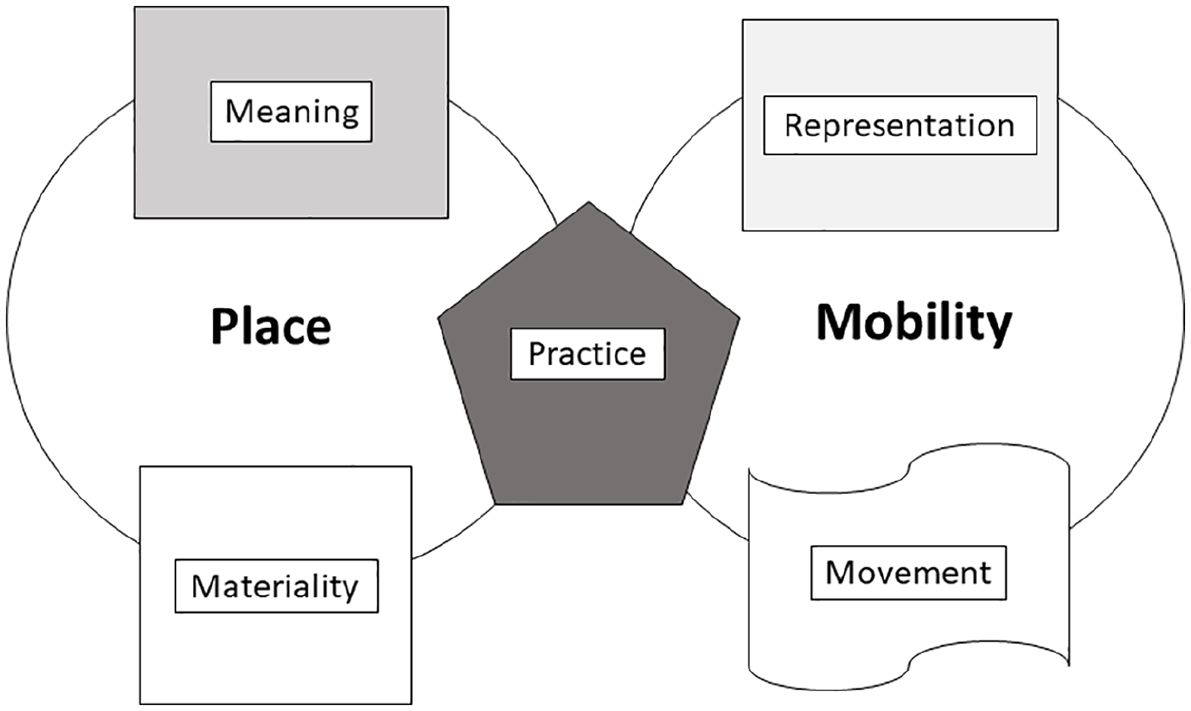
Intersections of place and mobility.
To convey that meaning and representation are similar yet distinct, both are displayed using the same shape but with different tones. Movement is presented as a flag or wave shape, while materiality is represented as a square block. Practice is located in the centre of Figure 1 linking place and mobility together as it is a major element of both. It is displayed as a pentagon because it is the fifth component in the figure. All elements are of course essential, but when attempting to understand the role of tourists in place-making, this article has argued it is important to pay attention to practices. In further recognition of the importance of backpacker practices to place-making processes, Table 1 lists an array of tourist and mundane practices performed by backpackers in the hostel and enclave. As practices are never performed in empty space, Table 1 also includes various associated materialities and meanings.
Backpacker practices.
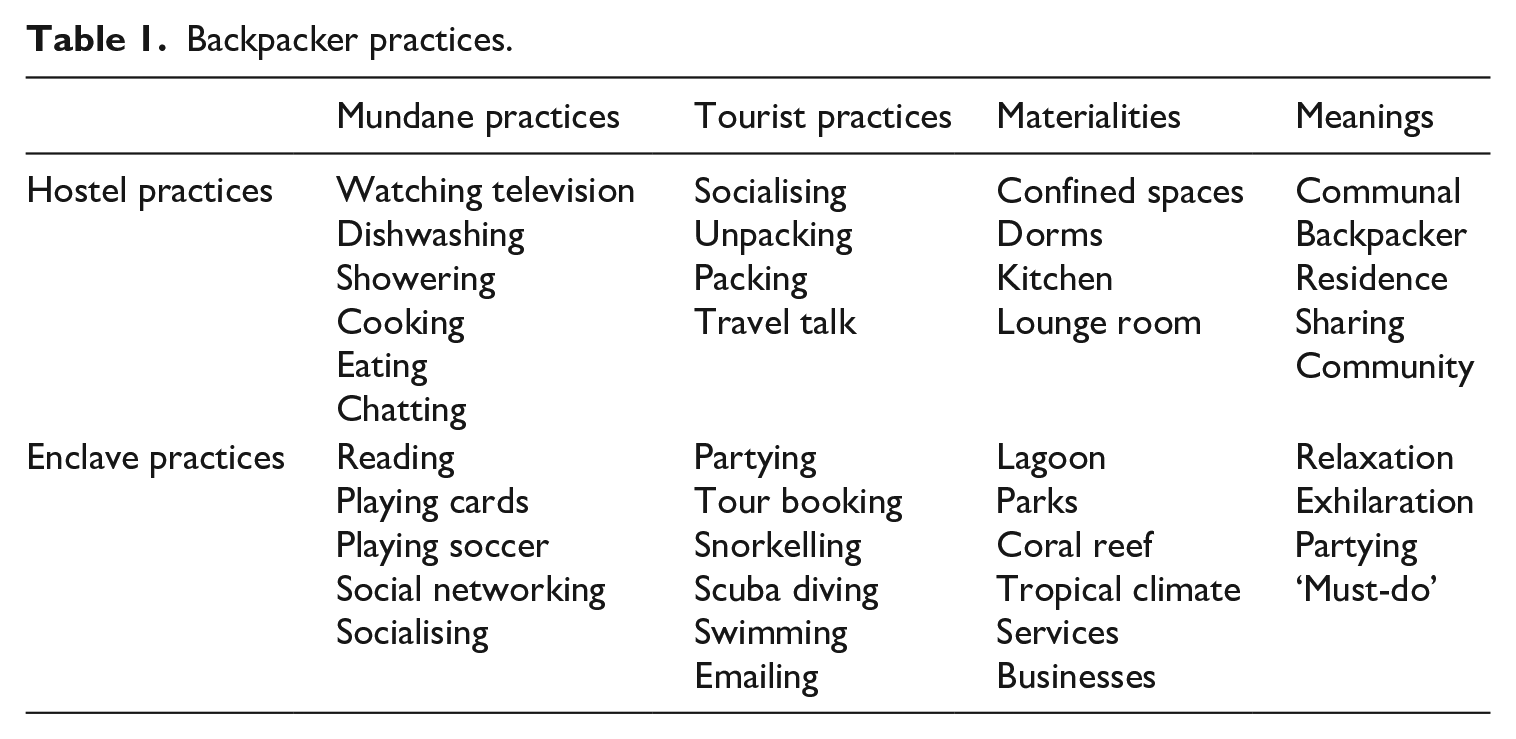
The character of the enclave was shaped by the repetition of backpacker mobilities as they moved between various attractions within place, such as from the pub, to the park, to the reef and back to the hostel. In the enclave, practices were both extraordinary and mundane, involving snorkelling and/or diving on the Great Barrier Reef combined with activities such as checking emails and playing cards. In the hostel, mundane practices such as cooking and watching television were interspersed with daily rhythms in which the hostels were alive with backpacker activity in the mornings and evenings but became quite still through the middle of each day. When backpackers travel overland, they link the enclave to a network of hostels, while each hostel is brought into being via mundane practices.
For mobilities researchers, this study has highlighted how the phenomenon of backpacking can inform questions of how mobile people make place and the various mobility rhythms and practices that are used to accomplish this. For backpacker researchers, this study extends understandings of how backpacker lives are lived, their forms of socialisation and their multiple meeting places. For those interested in tourist place-making, it is important to recognise the contribution of tourist practices to the character of destinations and the infrastructures of accommodation and transport that connect them. After all, destinations are not necessarily commodities to be exploited by the tourism industry but are also ‘fluid and fragile set(s) of associations temporarily fixed’ (Crang, 2011: 213). This article has shown how tourist practices provide a significant degree of fixity.
As with any study, there were some limitations worth discussing. This study was concerned with the backpacker-driven ‘place-making’ rather than the industry-led ‘placemaking’ (Lew, 2017). Future studies could examine placemaking in the backpacking context to explore the role of the industry in making place (cf. Welk, 2010), or the role of community members (cf. Sofield et al., 2017). It would be useful to examine backpacker place-making in less established destinations and to understand backpacker practices from the perspectives of resident communities. Decentring practices and foregrounding materials or meanings may also lead to new insights. As backpacking continues to evolve, more studies will be needed to keep up with such a rapidly changing phenomenon.
Footnotes
Funding
The author(s) received no financial support for the research, authorship and/or publication of this article.
