



Abstract
Post-disaster research relating to tourism tends to focus on broad economic measures that can miss local-scale actors and contemporaneous impressions by tourists and tourism-based business owners in places undergoing recovery from a disaster. Hurricane Harvey, a Category 4 storm, swept across coastal Texas in August 2017. Many of the communities affected by Harvey have economies largely based on family recreation. Interviews in Rockport–Fulton, Texas, with tourism-oriented business owners, staff, and tourists during the Independence holiday provide qualitatively robust accounts of the community’s first major summer event following Harvey and highlight the importance of social networks and place attachment to bringing tourists to the recovering area. Furthermore, we discuss the chain tourist’s role in the recovery of affected locations and consider strategies to draw on these social networks to increase the number of tourists visiting the recovering communities.
Introduction
On 25 August 2017, Hurricane Harvey, a Category 4 storm on the Saffir-Simpson Hurricane Wind Scale (SSHWS), made landfall along the central Texas coast near the community of Rockport, Texas (Figure 1). This historic storm wrought extensive damage in Rockport, and neighboring Fulton, Texas, and severely impacted their tourism industry. Year-round tourism, marketed to families, drives Rockport’s and Fulton’s economies. Prior to Hurricane Harvey, the tourism industry employed 1300 people and contributed US$1.4 million to municipal revenue (Karacostas, 2018). Both communities welcome beachgoers in warm, summer months; Winter Texans escaping the northern cold in winter months; birdwatchers following summer and winter migrations; and recreational anglers throughout the year. As part of their tourist branding, these communities host many annual events and festivals to attract family tourists. Local family friendly festivals, including art festivals, food festivals, maritime activities, and nature-based celebrations, reflect Rockport–Fulton’s collective coastal identity and offer an opportunity for social bonding, construction of social networks, and reinforcement of community identity (Lavenda, 1997; Quinn and Ryan, 2019). These social interactions, and the building of social networks, generate economic returns in addition to community benefits (Rao, 2001). Prior to Hurricane Harvey, the annual Rockport Festival of Wine and Food attracted nearly 2000 visitors with tickets ranging in price from US$25 to US$100 per person (Texas Festival of Wines, 2018). Tourists rent hotel rooms, dine at area restaurants, and shop at local stores as well as spend money with event vendors. Because of this, recovering the tourism industry in communities like Rockport–Fulton has become an essential component of long-term recovery strategies from Hurricane Harvey.
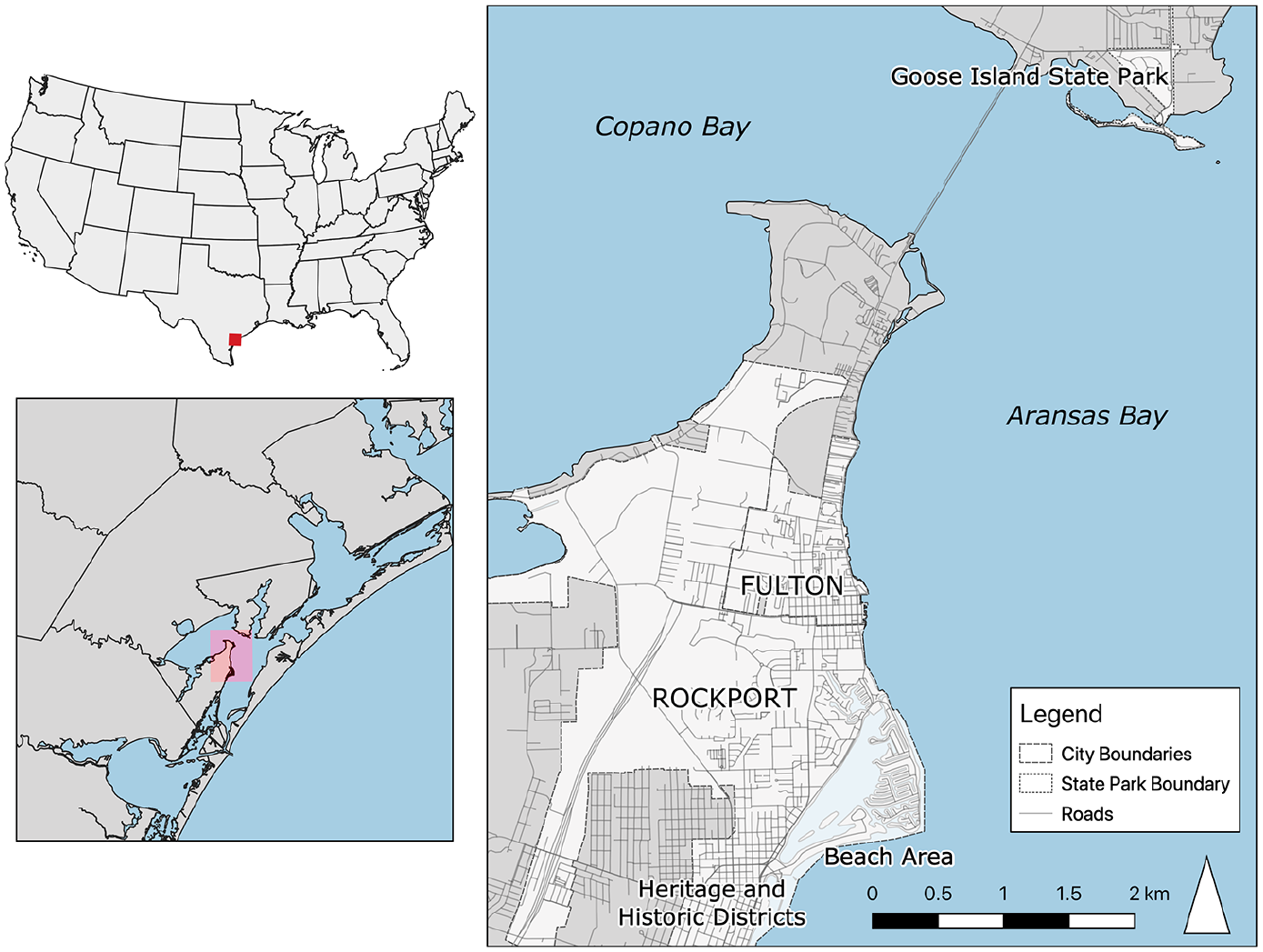
Rockport–Fulton, Texas study site.
Previous scholarship identifies the importance of accurate communication on the post-disaster recovery status of the affected community through a variety of media outlets (Faulkner and Vikulov, 2001; Young and Montgomery, 1998). The ability to counter negative images of the affected place in the media and accurately inform potential tourists of the recovery conditions greatly shapes how and when the community recovers (Faulkner, 2001). Furthermore, who delivers the message matters, and famous celebrities encouraging tourists to visit affected locations has proved an effective marketing strategy (Walters and Mair, 2012). To this end, Rockport–Fulton delivered a multipronged market communication strategy that included celebrity endorsements with recovery status updates post-Harvey.
The Rockport–Fulton Chamber of Commerce (RFCC) embarked on a multimedia marketing campaign to rebrand the area’s post-disaster image. Using the slogan, “Find yourself in Rockport-Fulton,” the new campaign highlighted how to be a volunteer-tourist to help those recovering and featured country musician George Strait in radio and television commercials (Karacostas, 2018). Launched in 2018, the slogan appeared on a variety of mediums, including brochures, shirts, the RFCC website, and billboards across the state. The marketing campaign cost US$250,000, with an additional US$150,000 from in-kind contributions, which primarily consisted of radio and TV air time on Texas stations. The campaign included 1200 billboards covering 75 percent of the state, print ads, radio and TV commercials, and a full digital campaign (RFCC personal communication, 2018). Rockport–Fulton’s well-coordinated rebranding and marketing campaign reflects tourism-recovery best practices as established in the literature (Faulkner, 2001; Walters and Mair, 2012).
Yet, as important as orchestrated marketing campaigns can be, our research indicates that in Rockport–Fulton during the study period, social networks, familial ties, and place attachment played an important role in economic recovery patterns. The family-based tourism that Rockport–Fulton depended on prior to Hurricane Harvey emerged early as a key component of its post-disaster recovery. Family tourism, which accounts for nearly 30 percent of the worldwide leisure travel market, reunites family members at tourist destinations to spend quality time together (Schänzel et al., 2012). Families view leisure travel as a means to strengthen their relationships (Carr, 2011), particularly as family structures change (Schänzel and Yeoman, 2015). Smaller sized family units, in combination with geographically dispersed extended families, have resulted in “re-connection holidays” where extended families across generations reunite and vacation together (Butlins, 2012). Thus, leisure travel reinforces these multigenerational bonds and promotes social and familial capital (Schänzel and Yeoman, 2015). Prior to Hurricane Harvey, Rockport–Fulton depended on an established family tourism industry; the social network underpinning this family tourism industry continues to play an important role in the long-term recovery of the community. In this article, we examine loyal repeat visitors returning to post-disaster landscapes, identify a subset of these tourists, and consider their role in disaster recovery.
Families and tourism
Leisure tourism represents a large international market: 74 percent of all US domestic trips in 2017 were for leisure purposes (US Travel Association, 2019). In the United States, domestic and international leisure travelers spent US$717 billion in 2017, with food services and lodging as the largest categories of expenditures (US Travel and Tourism, 2018). Summer months serve as the peak travel season with the Fourth of July holiday as one of the busiest times for US travelers (American Automobile Association (AAA), 2018). During the 2018 Independence Day holiday, 46.9 million US travelers vacationed 50 miles or more from their homes, a five percent increase from 2017 and the largest volume of travelers since record-keeping began in 2000 (AAA, 2018). Despite families representing the fastest growing market within leisure tourism (Travel Agent Central, 2019), families remain an understudied area within tourism research (Schänzel et al., 2012).
Changing family compositions (Dumon, 1997) and identifying who is included in the definition of family tourism (Carr, 2011) are considerations researchers must address. The composition of families is shifting from the nuclear family structure to more diverse family forms. This diversity requires family tourism research to consider a wide range of vacation experiences, including blended families (Dumon, 1997); inter-generational or vertical families (Yeoman et al., 2012); single-parented households (Yeoman et al., 2012); and same-sex families (Hughes and Southall, 2012). Rather than family units (i.e. nuclear family), Yeoman et al. (2012) identifies family networks that are often geographically dispersed as playing an increased role in child raising and family composition. These family networks are more socially derived than biologically derived as more people raise non-biological children. Decreasing rates of childbirth is also changing the family structure with fewer to no children in the family network (Yeoman et al., 2012). These changes in family composition require an evolving tourism market to meet the wide range of needs and wants for these leisure travelers.
Diversity in family composition leads to a variety of activities and experiences that families seek for their vacations. A 2017 US Family Travel Survey identified three categories of family leisure travelers: cautious travelers who focus on safety and prefer theme parks; hassle-free travelers who prioritize convenience and prefer all-inclusive vacations and cruises; and intrepid travelers who seek out new experiences, places, and cultures (Minnaert, 2018). Family leisure travel also involves visiting friends and relatives (VFR). In an AARP 2017 survey seeking to identify travel motivations among three generations, Millennials, GenXers, and Baby Boomers, 57 percent of Baby Boomers indicated that spending time with family and friends was a top motivator for travel, followed by 51 percent for GenXers and 49 percent for Millennials (Gelfeld, 2017). VFR tourist motivations are also diverse (Moscardo et al., 2000). Some VFR travelers travel to see family and friends for special occasions like weddings or reunions. Whereas others incorporate family and friend activities into their leisure travel and seek other pursuits while vacationing. Backer et al. (2017) argues further that VFR travelers are not homogeneous; rather visiting friends (VF) and visiting relatives (VR) are distinct submarkets based on different preferences for accommodations and length of stay. Regardless of subtype, VFR travelers seek opportunities to connect with their social networks, and VFR tourism serves as a means to reconnect geographically dispersed family and friends (Larsen et al., 2007).
It is not surprising then that the motivation for family travel is often centered on building social connections, strengthening bonds, and making memories (Carr, 2011). Family vacations provide quality time together away from the distractions of daily life (Shaw et al., 2008). Family heritage and place attachment also serve as motivating factors for family leisure travel as tourists seek journeys to ancestral and familial homes (Etemaddar et al., 2016; Marschall, 2015; Quinn and Ryan, 2019). These journeys are made by survivors and their descendants who were forcibly removed from their homes due to disasters or political unrest and often result in a diaspora where individuals live outside of their traditional homeland (Etemaddar et al., 2016). Sudden, extreme events that permanently alter the landscape disrupt strong place attachments (Brown and Perkins, 1992), leaving survivors to long for the places they knew and loved prior to the event (Erikson, 1976), and motivating survivors and their descendants to (re)experience the sense of place of an altered landscape, (re)establish a direct relationship with the locale, and (re)connect personal accounts to the larger historic experience (Marschall, 2015).
Post-disaster recovery and tourism
Relatively few studies examine tourism recovery patterns after hurricane events along the US coast as evidenced in the literature review conducted by Mair et al. (2016); however, a robust literature exists examining the recovery of biophysical and human systems after environmental disasters. The recovery of forests (e.g. Weishampel et al., 2007), wetlands (e.g. Reja et al., 2017), beaches (e.g. Sexton, 1995), and fisheries (e.g. Munroe et al., 2013) following hurricanes is well documented. The scholarship also documents the impacts and recovery trajectories of human systems, including various political, social, economic, and built-environment dimensions of coastal recovery. Research indicates that a successful recovery takes time and continues long after the immediate response period (Kates et al., 2006). Furthermore, post-disaster conditions accelerate economic pressures already in existence prior to the event, causing either rapid economic gains or declines during the time-compressed recovery period (Pais and Elliot, 2008). In terms of the built environment, urban areas recovering from disasters tend to experience increases in geographic size, decreases in land-use diversity, and accelerated land development (Haas et al., 1977; Hagelman et al., 2012). These recovery patterns reflect the unique, local sociocultural, political, economic, and physical landscapes of the affected community (Kato, 2018). Therefore, for communities with tourist-based economies, post-disaster recovery is intimately tied to the recovery of the tourism industry. In the case of the US coast, tourism is highly dependent on access to natural amenities, including beaches, parks, and fisheries (Ullman, 1954). Hurricane damage often disrupts or impedes access to these amenities, resulting in a negative impact on tourism-based economies (Kim and Marcouiller, 2015). For example, Woosnam and Kim (2013) observed decreased park visitorship after major hurricanes along the US coast.
Disaster tourism
As catastrophic, loss-causing events become more frequent (Wisner et al., 2004), so too has the interdisciplinary research exploring the intersections of tourism and disaster. This rapidly growing body of work includes scholarship examining both the disaster planning needs at tourist destinations and resorts (Murphy and Bayley, 1989; Sheppard and Williams, 2016) and the post-disaster recovery of tourism and affected places (Tucker et al., 2017; Yan et al., 2017).
Communities often experience uneven recovery following a disaster (Fussell, 2015). This variability is also visible in post-disaster tourism. Some communities are marked as places to avoid, causing a second wave of economic loss as tourists do not return after the extreme event. For example, tourist numbers remained low in Phuket, Thailand, following the 2004 Indian Ocean tsunami (Ichinosawa, 2006). Other locations, however, experience a surge in visitors attributed to curiosity related to the damaged landscape (Biran et al., 2014; Rittichainuwat, 2008; Yan et al., 2016), increased awareness of a post-disaster locale due to heavy media coverage (Faulkner and Vikulov, 2001), or extensive marketing efforts (Biran et al., 2014). For some communities, the disaster site itself becomes a tourist attraction for commemorative activities (Veil et al., 2011) or as a form of dark tourism (Tucker et al., 2017).
Many communities recovering from a disaster distance themselves from dark tourism. The way the community perceives tourists and associated tourism activities is important to sustaining the tourism industry, particularly in a post-disaster context (Lin et al., 2017, 2018). In Japan following the 2011 disasters, Blue Tourism initiatives gained community support as a way to link the traditional industries and cultural identity of the community while allowing for commemoration and visitor activities (Lin et al., 2018). Positive or negative community perceptions or attitudes toward tourists and tourism activities are important indicators of residents’ support or opposition for the local tourism industry (Carmichael, 2000), thus playing an important role in determining the success or failure of the tourism industry (Sharpley, 2014). Scholarship identifies exogenous and endogenous attributes that influence community perceptions of the tourism industry ranging from residents’ socio- and demographic statuses, propinquity to tourist attractions, and varying forms of tourists and tourism activities (see Sharpley, 2014 for a detailed review). Taken a step further, community-based tourism (CBT) emphasizes community involvement in issues governing the tourism industry and tourism development. With an overall goal of producing a sustainable and resilient tourism industry, community participation in tourism planning seeks a bottom-up approach over more traditional top-down management strategies (Tosun, 1999). In other words, CBT purports to offer “win–win” situations for residents and the tourism industry. The concept of community and the inclusivity of CBT approaches, however, is contested in the literature (e.g. Blackstock, 2005; Mair and Reid, 2007).
Other examples also showcase motivations driving tourists into post-disaster areas not rooted in the macabre (Foley and Lennon, 1996). The number of tourists visiting post-Hurricane Katrina New Orleans (Miller et al., 2017) and Christchurch, New Zealand, following the 2010–2011 earthquakes (Tucker et al., 2015) increased markedly. In New Orleans, Miller et al. (2016) observed tourists seeking experiences related to the recovery of the area, termed phoenix tourists. Attracted to disaster images with “re-imaged, re-packaged and re-sold. . .recovery narrative[s]” (Miller et al., 2017: 200), phoenix tourists encounter a post-disaster narrative that shifts from one of tragedy to one of renewal. Similarly, Tucker et al. (2017) observed tourists seeking narratives of hope and renewal in Christchurch, New Zealand, after the 2010 and 2011 earthquakes. Once at their destinations, tourists experience the recovering landscape and the continued need for “federal aid, volunteer labor, and tourist revenue,” furthering recovery and reducing disaster fatigue (Pezzullo, 2010: 99). In this way, tourism can augment economic recovery by encouraging early returning tourists’ social networks to view the site of a tragedy as a destination.
In addition to understanding the motivations and experiences of tourists visiting a recovering landscape, there is a robust body of work on tourism disaster management, including frameworks to avoid or mitigate disasters and crises in the tourism industry (Faulkner and Vikulov, 2001). Since tourists avoid locations associated with social, political, and environmental instability (Sonmez and Graefe, 1998; Taylor, 2006), rebranding campaigns change the public perception of a location (Young and Montgomery, 1998). For example, countries used a variety of rebranding messages to repair their images following the 2010 Arab Spring political uprisings, including hosting international sporting or cultural events to bring positive media coverage; highlighting the progress since the political unrest; and dissociating from negatively perceived geographic regions like the Middle East (Avraham, 2015). Yet, Walters and Mair (2012) found that regardless of disaster messaging and rebranding, repetitive visitors who visited the area five or more times prior to the disaster, were more likely to return to the affected location within the first six months of recovery than those who visited less frequently. This finding highlights the importance of social networks and attachment to place for post-disaster tourism.
Given this importance, we engage with the family tourism and CBT literature to explain a local phenomenon motivating the return of tourists to coastal Texas during the Hurricane Harvey recovery that capitalizes on loyal repeat visitors. Drawing on the human geography concept of chain migration, which underscores the role of social networks in attracting migrants to a particular location (McDonald and McDonald, 1964), we employ the term chain tourism to understand the social roles and attachment to place contributing to post-disaster tourism along the Texas Gulf Coast. We ask how chain tourism informs tourists’ experiences and expectations when visiting a place recovering from a disaster event. Finally, we consider the implications of chain tourism for disaster recovery and tourism management.
Methods
We conducted 61 semi-structured interviews with tourists and 18 semi-structured interviews with owners and operators of tourism-based businesses in Rockport and Fulton, Texas, over the US Independence Day holiday from 3 to 5 July 2018 following methods established by Rubin and Rubin (2005). Tourist interviews occurred at popular attractions, including a state park, city beach, marina, and in the historic business and heritage districts. Tourist interviews consisted of questions related to their rationale and motivations for visiting Rockport–Fulton in the context of disaster recovery and their perceptions of the recovery effort. Business owner and operator interviews took place at business locations and consisted of questions related to their perceptions of post-Harvey recovery related to tourism and their business operations. We analyzed the interviews from both tourists and business owners/operators, using Critical Discourse Analysis (CDA) to elicit themes regarding their perceptions of recovery efforts and tourist motivations for selecting Rockport–Fulton for vacations. Following established CDA methods, we examined text structure (e.g. use of active or passive voice), vocabulary (e.g. word choice), and grammar (e.g. transitivity) to understand the social construction and condition of participants’ responses (Fairclough, 1992). We used descriptive statistics to analyze demographic data regarding tourist age, length of stay, visit frequency, and hometown. To increase the reliability and validity of our interview data, we triangulated this dataset with participant observation at 18 tourism-sector businesses, such as retail, restaurants, hotels, and tour companies. Following Dewalt and Dewalt (2002)’s participant observation methods, we observed the businesses people visited to gauge the volume of business activity, the number of employees working during the holiday week, and the amount of people visiting tourist locations around town at varying points of time (e.g. beach, park, business district). We also gathered data from the local chamber of commerce regarding their post-disaster branding and advertising activities as well as guest log data during the Fourth of July holiday week.
Study site
Hurricane Harvey first made landfall near the coastal communities of Rockport (10,500 residents), and neighboring Fulton (1500 residents; US Census, 2018), sustained extensive damage. Strong winds destroyed structures and uprooted trees while Harvey’s storm surge inundated the marina wrecking piers, docks, and boats (Blake and Zelinsky, 2018). Over 50 percent of all structures in Aransas County (Rockport is the county seat) experienced damage. The County Courthouse and the Rockport Center for the Arts, for instance, were damaged beyond repair (Acota, 2018).
Tourist demographics
Of the tourists interviewed, the average age was 45.4, the mode was 40, and the range was 19–75 years of age. We interviewed 32 females and 29 males. On average, the tourists vacationed for 4.2 days in the Rockport–Fulton area, with a range from 1 to 10 days. Interview participants represented 20 different communities within Texas. The majority of tourists traveled to the area from Bexar County (40.9%; approximately 240 km) and Travis County (11.4%; approximately 290 km; Figure 2). Bexar County is home to San Antonio, the second most populous city in Texas, and Austin, the capital of Texas, is located in Travis County.
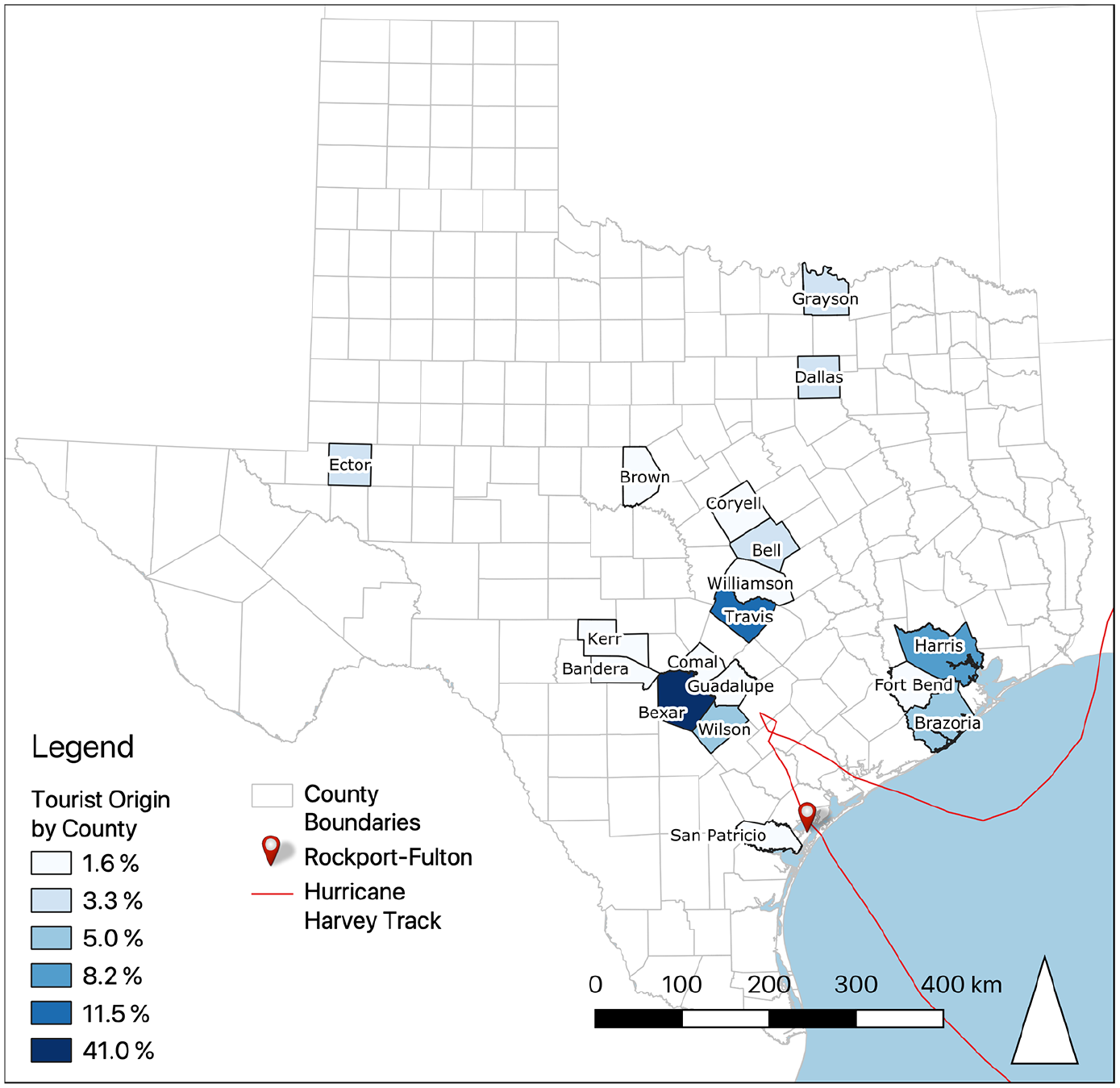
Counties of tourist origin.
Findings
Two primary themes emerged from our analysis. An overwhelming majority of our respondents indicated that (1) previous personal attachments to the geographic area (place attachment) and (2) a desire to reconnect with local family networks were the most important drivers of the Fourth of July holiday tourism in post-Harvey Rockport–Fulton. Interviews with local business owners supported both themes. In addition, our analysis identifies a unique subset of repeat tourists and their potential role in disaster recovery.
Chain tourism
Many tourists visiting the Rockport–Fulton area return annually, and many recounted strong familial ties to the area as a primary reason for their return. Of the 61 tourists interviewed, 80.3 percent visited Rockport–Fulton at least once before and were classified as repeat visitors. Approximately, 20 percent were visiting Rockport–Fulton for the first time during the 2018 Independence Day holiday. Of the return visitors, 10.2 percent owned a second home in the area; an additional 10.2 percent mentioned a relative either currently or previously owned a vacation home in the Rockport–Fulton area. We classified individuals with second homes or family vacation homes as repeat tourists given that they regularly visit the area and the potential role they can play in post-disaster recovery when hotels remain shuttered.
Of the repeat visitors, 26.5 percent identified they “come every year” with many visitors indicating they have “been coming a long time.” Some noted they have been vacationing in Rockport–Fulton “for over 25 years”; “on and off for 30 to 40 years”; and one couple in their early fifties estimated they have been “coming most of [their] lives.” One repeat visitor summarized the generational tourism common in Rockport–Fulton by explaining that it is a “tradition. . .[they] come every year.” Another repeat visitor described their emotional connection to the place by saying Rockport–Fulton has “good people, [they’re] like family. See [them] every year, see everything they went through.” Other repeat visitors further illustrated the strong social factors attracting them to Rockport–Fulton, by describing the area as the “place we know,” “a family-tradition,” and the site of “family reunions.” Some tourists do not particularly like Rockport–Fulton, yet are pulled to the area by their family. One tourist mentioned that she comes to Rockport often for “family” but “likes Port A[rthur, Texas] better.”
Familial traditions and close ties between repeat visitors and the Rockport–Fulton community were also evident throughout our participant observations. While sitting at a local cafe talking with the owner, a long-time customer walked into the store with their sister. We observed the owner greet the customers with hugs and welcomed them back to town. It was their first visit to Rockport–Fulton since Hurricane Harvey. These long-time customers and their large extended family reconvene at Rockport every year for a family vacation and reunion. The siblings, who started coming to Rockport as children, return each year with their now adult children, who in turn bring their children. As the store owner explained, “generation after generation comes to Rockport, [people] bring [their] kids. [It is a] family thing.”
The remaining 24 percent of the tourist participants were first-time visitors to Rockport–Fulton, and many of them identified their social connections as strong factors attracting them to the Rockport–Fulton area. Importantly, almost half of first-time visitors (45%) indicated they selected Rockport–Fulton for their vacation based on the recommendation of or through direct invitation by friends or family who routinely vacation in the area. For example, first-time visitors said repeat visitors to the area had suggested Rockport–Fulton as a vacation destination and offered tips on “where to get fish” or locations to sail their boats. This suggests that repeat visitors actively recruited new visitors to the recovering landscape via their social networks.
The notion of a “family-friendly atmosphere” was another pull factor commonly expressed by both repeat and first-time tourists. The family friendly theme was most pervasive among repeat visitors. Many repeat tourists reported that they have been visiting the area “all [their] lives.” These tourists recounted stories of visiting relatives, particularly grandparents, who owned homes in town. Part of the family friendly attraction included the beach, which one repeat tourist touted as the “nicest beach in the area.” Other visitors’ comments also emphasized the importance of Rockport’s beach to their vacations. In particular, tourists specified the beach, which is certified as a Blue Wave Beach by the RFCC, as a family friendly destination in the area. As promoted by the RFCC (2018) website, “a Blue Wave Beach is clean, managed responsibly and has a focus on the protection of human health and the environment. Blue Wave Beaches are litter free, have handicap accessibility, public restroom facilities and swimmable waters.” With this definition, RFCC emphasizes amenities appealing to families with children. This sentiment was reflected by a repeat tourist who emphasized that Rockport’s beach is “cleaner” than others and the shallow depth makes “it good for kids.” Still others credited the atmosphere of the town as appealing to the family friendly culture. One repeat tourist commented that his family preferred the “quieter beach” and “laid back” atmosphere of Rockport–Fulton, which reflected a “small town feel.” This family friendly culture and sense of place pull him and his children back to the area each year.
First-timers also indicated the family friendly nature of the area was a strong pull factor, which was often reinforced or suggested through their wider social networks, including recommendations from friends and family as well as through social media outlets. For example, some first-timers mentioned they selected Rockport–Fulton because “it’s a great place to spend time with [their children or grandchildren].” Others mentioned that they selected the area based on the advice of a close friend or family member, who had previously vacationed in the area. Still others found Rockport via Internet searches targeted at locating family friendly destinations. For example, one couple, visiting for the first time, explained that they “googled best places in Texas for families” and liked that there is “no alcohol [allowed] on [the] beach” in Rockport.
Taken together, our findings indicate that social ties, place attachment, and a family friendly atmosphere keep people returning year after year to the Rockport–Fulton area. Social networks and the area’s reputation also assist in recruiting repeat visitors’ friends and family members (first-time visitors) to the area. From these findings, we identify a subset of loyal, repeat tourists visiting post-Harvey Rockport–Fulton. Drawing on the geographic concept of chain migration, we employ the term chain tourism to describe the powerful influence pre-storm place-attachment and regional familial ties play in the overall recovery of an impacted community. Chain migration, a component of network-based migration theory, describes the sequential movement of people to a new location (Hiebert, 2009). Chain migration occurs when immigrants secure work in a new location and are followed by successive waves of migrants, including relatives and others from the same cultural hearth (McDonald and McDonald, 1964). Typically, one person relocates and then is followed by their family members once they have established themselves. This facilitates the migration of acquaintances and members of the same social network: (Hugo, 1994).
Chain migration indicates that the mover is part of an established migrant flow from a common origin to a prepared destination. An advance group of migrants, having established themselves in a new home area, is followed by someone and subsequent migrations originating in the same home district and frequently united by kinship or friendship. (Getis et al., 2018: 203)
In this way, the tourist experience of the Rockport–Fulton area mimics chain migration and marks a difference between other types of tourism.
Chain tourists commonly occur across multiple generations and exhibit strong place attachments and social networks. A key distinction between loyal, repeat visitors and chain tourists is that chain tourists actively work to recruit new visitors through their social networks. Moreover, in the context of Rockport–Fulton, chain tourists communicated the disaster recovery status across their social networks, first at the scale of family and close friends and then extending to acquaintances. Our interviews with tourists indicate families, already familiar with Rockport–Fulton, were among the first to return; they assessed the damages/changes and reported to their broader social networks the status of the affected area. The accounts of these early visitors attracted tourists to the area during the 2018 Fourth of July holiday. In addition, chain tourism includes aspects of VFR tourism; however, the repetitiveness of chain tourists visits to the area, their emphasis on place attachment, and their use of social networks distinguish them as a unique subset of VFR tourism. Chain tourists make repeat, often annual, visits to their destinations. The motivation to visit their preferred destination is derived from a strong attachment to the place itself—its qualities and familiarness, its physical and built landscapes—but also informed by strong familial ties and social networks that pull visitors to the destination frequently.
For the generational tourists commonly found in Rockport–Fulton, returning to the area’s Fourth of July festivities is an expected way of life not to be dissuaded by a recovering community. This was most evident on the Fourth of July, where repeat tourists arrived at the bay and beach area early in the morning to secure their usual spots for the traditional firework show after dark. We observed tourists arriving at the areas between 8 a.m. and 10 a.m. in the morning. Their arms filled with tents, camping chairs, grilling equipment, and groceries. One or two people conducted most of the preparations for the day. These tourists indicated that they were holding the space until their families and friends arrived. One repeat tourist explained that he was reserving “his spot,” the same 4.5 m × 4.5 m plot where he and his family have celebrated the Fourth of July for the past six years. By tradition and necessity, every year, he arrives at the bay front early to claim and protect his cherished spot from others. As if to add credence to his claim, during our conversation, he pointed to the four palm trees we were standing under and gestured about how tall they have grown over the past six years. He and his family cherish their location to view the fireworks, which showcases a strong place attachment to not only Rockport, but that particular site along the bay. This strong place attachment is indicative of the pull factors we observe in chain tourism.
As observed with family heritage tourism (Etemaddar et al., 2016; Marschall, 2015; Quinn and Ryan, 2019), a strong sense of place draws the chain tourist back each year. These repeat visitors value their family history in that location and want to continue with their traditions. In this way, their familial legacy becomes part of the collective narrative. This was especially apparent with the “family-friendly” focus many tourists reported. They themselves came as children and now want their children to experience the same place. Importantly, they also recounted stories of inviting family friends and neighbors to experience this place they grew up cherishing. We observed this family friendly narrative reinforced through the advertisements and brochures at the RFCC visitor’s center where signs displayed children with their parents at the beach and inter-generational families dining out. Business owners also echoed this narrative; one described their cliental as tourists who “return every year” to shop, dine, and play at the beach. They lamented the slow return of hotels as detrimental to their business because tourists “can’t stay where they usually do.” It is important, however, to note that chain tourists referencing the family friendly draw of Rockport–Fulton reflect heterosexual parents with children, often in a multigenerational family setting. This brings us to the question of whether only a heteronormative definition of family friendly is being represented. As discussed by Muller Myrdahl (2009: 289) in her critique of the Women’s National Basketball Association game spaces, “‘family-friendly’ is not encompassing of all families. . . Instead, ‘family-friendly’ is an exclusive model that targets an idealized middle-class, heterosexual family of consumers.” Although not the focus of this study, this potential exclusion is especially problematic given the focus on attracting people to Rockport–Fulton to help bolster recovery efforts.
Chain-tourist perspective of the recovery
When asked about whether they noticed any visual reminders of Harvey recovery during their vacations, all tourists indicated they did observe some reminders. One repeat visitor commented that the reminders are “everywhere you look” since “this area took the brunt of the damage” from Hurricane Harvey. Another repeat tourist qualified her perception by stating, “looks like [its]. . . cleaned up. . . back to going from vacation perspective, maybe not residents’ perspective.” The first-time visitors to Rockport–Fulton frequently identified the “torn apart buildings,” “tarps,” and fallen, dying, or dead “trees” as visual reminders.
Chain tourists, however, expressed unique views of the recovering landscape. Many chain tourists qualified their response by adding that they noticed things were different because they come every year. For example, one respondent, who was camping for the holiday week with a large group of repeat and first-time visitors, looked up overhead at the spotty tree canopy when asked about visual reminders of Hurricane Harvey. She highlighted the “absence of trees” and that the “natural aspects are different” than from their previous visits. It was very noticeable to the repeat visitors in her group “because [they] stay [here] every year”, while the first-time visitors did not acknowledge the lack of canopy. In establishing the frequency of their visits, chain tourists claim insider knowledge and differentiate themselves as authorities on the landscape. Their purported emic view of the Rockport–Fulton area is significant because it shapes how they perceive the recovering landscape. Chain tourists, those who were both repeat visitors and inviting friends and family to the region, were more likely to note positive signs of recovery rather than detail the damage still present across the landscape. One chain tourist commented that he “see[s] houses with new paint, [people] working on housing” while another, who owns a vacation home in Rockport, said, “more things opened this week, seen a lot of ads. . ..[there are] more people than I thought [would be here], but less than in past years at the beach. Some shops opened up just for this week.” Still another chain tourist identified a positive social outcome from Hurricane Harvey, “folks bonding and working together” to assist with the recovery. Altruism is frequently observed in the immediate response to an event and during the recovery period by local residents, first responders, and volunteer groups (Fischer, 2008); however, our findings suggest chain tourists also participate in a recovery narrative highlighting community wellbeing.
Taken together, chain tourists’ positive views of Rockport–Fulton’s recovering landscape mirror phoenix tourism, where the narrative is shifted from one of tragedy to one of renewal (Miller et al., 2017). Yet, the Rockport–Fulton example indicates that tourists contribute to the rebirth narrative instead of consuming a narrative created by local tour guides. In this way, chain tourists take on an active role in shaping the recovery narrative. Given their strong social network, this has potential implications for recruiting others to the recovering landscape.
In addition to contributing to the recovery narrative, chain tourists also contribute to the remembrance of what the place was prior to the event. Through their examples, we observed that chain tourists demonstrate strong place attachment and even a nostalgic view of the pre-Hurricane Harvey landscape. One chain tourist expressed that they were “delighted” to return to Rockport–Fulton but confided: “I almost had a heart attack” when driving in and seeing the town for first time, “I grieved.” The chain tourist who traveled to the coast with family including repeat and first-time visitors invited to vacation with them, continued, “I was driving around with my sister and felt something is wrong here. [I] kept asking, what was there [before Harvey]?” He commented that during their initial drive through town, they observed new construction, pointed out the downed palm trees, and reminisced over closed stores. They nostalgically recalled the closed shop that sold them their favorite chair. In this way, chain tourists mourned and idealized the former landscape. Chain tourists longing for the past landscape reflects Fried’s (1963) observations of the nostalgic descriptions of former homes provided by residents forced to relocate from their neighborhoods. Thus, an attachment to and strong sense of place, emphasized throughout our interviews with chain tourists, has important implications for recovery efforts. Chain tourists consistently revealed they were drawn back to the Rockport–Fulton area, not discouraged by the Hurricane Harvey recovery. If anything, their desire to return was stronger as many indicated they wanted in some way to assist in the recovery of the area.
Chain tourism and disaster recovery implications
A strong attachment to place and claimed emic knowledge of the local social, built, and physical landscapes, indicate chain tourists identify as active agents in the post-disaster recovery process. Unlike visitor motivations identified in dark tourism studies (e.g. Biran et al., 2014; Yan et al., 2016), chain tourists are not voyeurs of a recovering landscape nor are they driven by curiosity to visit Rockport–Fulton. Instead, chain tourists see themselves as playing a role in the recovery process because of their personal and family history in the area. Both the chain tourists’ motivations more closely resemble the research on family heritage travel as displaced populations, and/or their descendants, return to their former homes due to their strong attachments to place and social connections to the landscape (Etemaddar et al., 2016; Marschall, 2015; Quinn and Ryan, 2019). Chain tourists return because they possess a commitment to a place that has hosted their family for generations. Furthermore, chain tourists identified as having a vital role in helping the community recover from Hurricane Harvey. By vacationing in the Rockport–Fulton area, chain tourists support the local economy, generating sales for small business owners who depend on tourism for economic survival and encourage new visitors to travel to the area and spend their money in support of these small businesses. Furthermore, the small businesses owners, many of whom participate in the RFCC initiatives to increase economic resilience following Hurricane Harvey, recognize and celebrate the return of these tourists. In this way, the community embraces the tourists and co-creates the sense of place and community with these returning visitors (Hamilton and Alexander, 2013).
For these reasons, we argue that chain tourists would return to the Rockport–Fulton area to vacation regardless of post-disaster rebranding efforts. In fact, only one interview participant mentioned the advertisements, specifically the billboards, and commented that they had already made plans to travel to the Rockport–Fulton area before viewing the signage. Similarly, Walters and Mair (2012) found that returning visitors were more likely to visit the communities recovering from the 2009 Australian Bushfires. Yeoman et al. (2012) emphasizes, in a non-disaster context, the importance that word of mouth and social networks play in attracting tourists for leisure travel, the family has become the fastest growing source of influence for holiday purchases (p. 38). This raises questions about marketing endeavors after a disaster as chain tourists may serve as advertisement in the form of disaster-recovery ambassadors, recruiting friends and family to visit the recovering community.
Given their extensive social networks and potential for crafting positive recovery narratives, perhaps a more effective approach for local communities would be a partnership with chain tourists and to prioritize the restoration of services chain tourists expect. Tourists repeatedly lamented the closed restrooms at both the beach and state park (Figure 3). Several day-visitors commented they usually stayed overnight in Rockport–Fulton, but with the closed restrooms at the park campsite and limited hotels open for business, they only made a day-trip. The result is lost revenue for local businesses at a time when they most need it and business owners frequently commented on the limited hotels and amenities available for returning tourists. One business owner cited that the “hotels [are not] available,” they typically “work with 10 hotels [for events], but only worked with four because that’s what [was open for the Fourth of July].” Adding to their frustration, they did not see Rockport–Fulton as “a place of destination” due to lack of attractions, “we’re one of three right now,” citing the closure of the arts center and ongoing rebuilding of the historic mansion. Albeit, reconstruction takes years (Kates et al., 2006); yet when chain tourism is the dominant force driving people to return, the restoration of basic tourist services, such as restrooms, may be just as important use of resources as post-disaster marketing.

Closed bathrooms at the main beach in Rockport on 4 July 2018.
Conclusion
Our study is informed by previous research in family leisure tourism, disaster tourism, community tourism, and hazards studies. Taken together, this interdisciplinary perceptive allowed us to identify an emerging tourism niche driven by social networks and place attachment. Through our analysis of the Rockport–Fulton, Texas, recovery, we introduced the phenomena of chain tourism, a type of loyal, repeat visitor that actively draws new visitors to a location. Chain tourists are repeat visitors that exhibit family ties to a location spanning multiple years to generations. Through their strong attachments to place, they often recruit and draw their family and friends to Rockport–Fulton for vacation. Furthermore, the chain tourist can play an important role in disaster recovery as they offer positive narratives of renewal and are not deterred from visiting the post-disaster site. Our work presents a complementary option to rebranding and marketing campaigns for attracting tourists to a post-disaster area and raises the question of whether locations with chain tourism served better in managing their resources to focus on services that chain tourists use so that they can recruit additional visitors.
By presenting the idea of chain tourism and offering ways in which chain tourists are active agents in disaster recovery, we identify future opportunities to further explore this phenomena and overcome the limitations of our case study approach. Additional work is needed in other cultural contexts and post-disaster settings to understand whether and how chain tourism contributes to post-disaster recovery. Specifically, future work is needed to understand the ways in which chain tourists recruit new visitors to the location. By studying the social networks of chain tourists through face-to-face and social media forums, we could better understand their role as agents in disaster recovery. In addition, we need to study chain tourists over the long-term recovery of a tourist destination (i.e. years) to understand their realized impact on post-disaster communities. Finally, work is needed to understand the presence of chain tourism outside of a post-disaster recovery context.
Footnotes
Declaration of conflicting interests
The author(s) declared no potential conflicts of interest with respect to the research, authorship, and/or publication of this article.
Funding
The author(s) disclosed receipt of the following financial support for the research, authorship, and/or publication of this article: This research was funded by a grant from the University of Colorado Natural Hazards Center through its Quick Response Grant Program, which is funded by the National Science Foundation Grant No. CMMI1333610.
