



Abstract
This study adopted an interpretive approach in understanding the development of the package tour industry in China and the Chinese tourists’ behavioral changes in consuming package tours, via two data sources—in-depth interviews with senior tour guides and tour operators, and content analysis of OP task sheets collected over a span of 30 years’ time. The findings revealed that substantive changes had taken place in all aspects including group structure, destination selection, itinerary, core tourist activities, supporting arrangement, personnel, and peripheral items of the package tours. The result has also shed light on the future trends and the challenges ahead, especially in the post-COVID era. Implications to tour operators and tourism marketers are discussed.
Keywords
Introduction
The tourism industry in China has flourished for decades. According to statistics that CAIE (2021) has released, the country enjoys a steady increase in terms of number of trips that the Chinese tourists took in the past decade. The increase of domestic trips had kept at a double-digit increase 10 years prior to the breakout of the pandemic (CAIE, 2021). In 2019 alone, the total number of domestic trips reached 6.006 billion (CAIE, 2020). Outbound trips had also enjoyed a steady growth in the last decade. The pandemic has stroked outbound trips in these two years, but the number of domestic trips has bounced back quickly. In the first six months of 2021, the total number of domestic trips reached 1.87 billion in China (CAIE, 2021). In the same manner, the number of travel companies have been increasing steadily, as the Chinese tourists like to travel in tour groups. According to statistics from the CAIE (2020), the total number of travel agencies in China reached 38,943 by the end of 2019, which was 8.17% more than that of 2018.
Aside from the increase, many big changes have taken place to the package tour industry in China. Development of information and communication technology (ICT) in the past few decades has been one of the main change agents transforming every aspect of tourism operation, including the business mode of package tours (Castillo-Manzano and López-Valpuesta, 2010; Lam and Cheung, 2009; Lin, 2017; Ma et al., 2003). The creation of online travel agencies and various online retail platforms have made travel booking much easier, crystalizing all necessary information that the tourists desire to obtain. This has greatly crippled the travel agencies’ traditional profit model, which is largely based on information asymmetry and price advantage of bulk purchase (Lin and Kuo, 2019). Moreover, rapid infrastructure development in China in the past decades has made travel much easier, with increased choices available. For example, high-speed rail has brought the cities in China closer. It has not only offered a comfortable and convenient alternative means of transportation, but also enabled accessibility to destinations in peripheral areas (Gao et al., 2019), which in turn enables tourists in those areas to add to the total pool of travelers. In addition, the improved road conditions and rapid increase of private car ownership have made self-drive tourism a popular option (Qiu et al., 2018). The recent breakout of COVID-19 pandemic has been accelerating changes in various aspects. Increasingly, tourists display varied behavior in consuming tourism-related products.
Indeed, both tourists and the package tour industry in China have undergone tremendous development in the past three decades. Yet few scholarly enquiries have been made to understand which aspects have changed and how, what has caused the changes, and in what direction is this market developing toward. A lack of such understanding could undermine further development and marketing efforts. Therefore, the objectives of this study are to fill these gaps. In addition, Chinese tourists’ behavior in the post-COVID era is also explored. Theoretically, the study adds to the scholarly knowledge on tourists’ behavior in package tour and the evolution of package tour operation. Practically, the result of the study may be of important reference for the travel operators in redirecting their further development and marketing strategies.
Literature review
Package tour
Package tours have been in existence for over 140 years since Thomas Cook organized the first package tour in history (Archer and Syratt, 2012), although it became widespread only in the recent half century. There are a few other terms such as “all-inclusive tour,” or simply “inclusive tour” (Middleton, 1991), and “all-inclusive group package tours” (Chen et al., 2019), but they bear similar meanings. Package tour is defined as “the combination of components of a vacation (such as accommodation, transportation, entertainment, and meals) which are sold to the consumer as a single product at a single price” (Sheldon, 1986: 351). So typically, a package tour may include all necessary and desired components such as transportation (land, sea, air, to/from destination), accommodation (and mostly meals as well), sightseeing activities, insurance, and other activities (Archer and Syratt, 2012), but the number of items included may differ considerably from one package to another. Enoch (1996) discussed four key features of a package tour, including an effective and rational way of achieving touring goals in the destination, being less expensive, tourists having no say in itinerary design, and being inflexible due to the contractual nature of the package.
The business model of the package tour is that the tour operators purchase the above components from different suppliers at bulk price, often a substantively discounted rate, and assemble them into different packages for different customer segments at a higher price than the purchase price (Sheldon, 1986). So, in essence, tour operators act as intermediaries (Reimer, 1990). The tour operators may directly sell the products to the tourists or market them via travel distribution channels.
Life cycle of tourism products
Theories on product life cycle (PLC) suggest that products follow a general pattern of introduction/development, growth, maturity, and decline, which comes in a bell-shaped curve (Golder and Tellis, 2004; Levitt, 1965). The introduction/development stage features uncertainties and trials, and consequent slow sales; as consumer acceptance spreads and demand increases, the growth stage sees accelerated sales and market expansion; it reaches maturity stage when market saturation is evident and the demand starts to level off, and the decline stage appears when sales go down (Golder and Tellis, 2004; Levitt, 1965). Apart from the above general pattern, studies have indicated that the PLC patterns can come in various shapes, and possibly several cycle and re-cycle patterns (Rink and Swan, 1979). The PLC theory is deemed powerful because it can effectively facilitate strategy formulation in different stages of product development (Levitt, 1965). On the other hand, the PLC is criticized for its over simplicity and vagueness. Prior studies have attempted to identify the turning point of each P LC stage (e.g. Golder and Tellis, 2004), and found that the duration of each PLC stage differs considerably by product categories and contexts.
The PLC theory has been applied in the tourism industry as well. New theories have been developed based on the PLC theories. For example, Butller’s (1980) seminal work on tourist area life cycle (TALC) has contributed substantively to scholarly understanding on the evolution of the life cycle of tourist destinations. Other researchers such as Oppermann (1995), Moss et al. (2003), and McKercher and Wong (2021) have tried to understand the rise and fall of the popularity of destinations in different parts of the world based on Butler’s TALC model, and identified the general applicability of the PLC theory in the tourism field. But, as the above studies also noted, the cycle patterns differ from context to context, contingent on factors such as generational difference (Oppermann, 1995) and evolutional contexts (McKercher and Wong, 2021). The all-inclusive package tour, as a popular tourism product, has existed for decades in China. Yet its product life cycle remains little investigated. Whether it has followed the general PLC pattern and in which stage of the PLC it is remain unknown.
Package tours and tourists
Tourists consider traveling via package tours for various reasons. Prior studies have attempted to understand their motivations and areas of concern. The overall starting point seems to be related to convenience (worry-free travel), economic concerns, and safety (e.g. Chen et al., 2019; Quiroga, 1990), while specific concerns can be anything that is related to the components of package tours discussed above, including itinerary, transportation, accommodation, meal arrangement, shopping and other leisure activities, as well as the personnel arrangement such as tour leaders and tour guides (e.g. Lin and Kuo, 2019; Liu and Wu, 2006). For example, Bowie and Chang’s (2005) study on a mixed international package tours confirmed the importance of itinerary planning. Many factors influence the design of the itinerary, subject to the business model of the tour (Wong and McKercher, 2012), as well as the operators’ understanding of the tourists (Enoch, 1996). The tourist’s budget also influences the choice of itineraries. For example, low-budget tourists may favor itineraries that contain as many attractions as possible, but high-budget tourists instead look for unique experiences via customized itineraries (Chen et al., 2019). Political orientation can sometimes also play a role in attraction selection (Wong and McKercher, 2012).
Other components of the package tour are also of great concern. Wong and Kwong (2004) tried to understand Chinese tourists’ selection criteria of package tours. They identified eight factors (out of 24 items) important for tourists, including tour arrangements and service quality, attractions, hotels and airlines, TV promotions and customer care, routing, personal interests, word-of-mouth, and time. Among all items, safety is regarded as the most important (Wong and Kwong, 2004). For Taiwanese, the most important considerations regarding package tours to Japan include attraction selection, accommodation arrangement, length of stay, dining arrangements, price, and transport, as well as season (Liao and Chuang, 2020). Wang et al. (2007) tried to develop a scale for measuring tourists’ satisfaction with package tours, and they identified six important areas, including transportation, accommodation, shopping, optional tours, tour guide, and tour leader. Jin et al.’s (2014) study among the Chinese Generation Y tourists revealed that the younger tourists also care about the above six areas, but they are more particular about the tour guides and tour leaders than other concerns.
The COVID-19 pandemic which broke out in the end of 2019 has been greatly influencing the behavior of the Chinese tourists (e.g. Huang et al., 2021; Wen et al., 2020). Tourists are more cautious of the selection of destinations as well as their way of traveling. Huang et al. (2021) did a nation-wide survey on the changing preference of the Chinese tourists and found that they are now looking for destinations with natural sceneries that are not too far away, and the trips are shorter in duration and are often done in a free and individualized mode. Wen et al. (2020) have similarly identified several changes that the Chinese tourists may have, including the selection of destinations, travel group size, public holiday avoidance, service preference, and transportation preference. Scholars believe some of the changes will be stabilized and become a new norm (e.g. Huang et al., 2021). Cheng and Zhao (2021), focusing on the tourists’ displayed behavior, identified that the tourists are now more particular about social distancing and mask wearing.
To summarize, the package tour industry has been an important intermediary that integrates both the supply and demand sides of the tourism industry. Prior studies have touched on various aspects of the Chinese tourists’ behavior in taking package tours. However, since China has undergone rapid development in all aspects, tourists’ behavior has been changing fast as well. Yet, no study has tracked the behavioral changes of the Chinese tourists in package tours over the past three decades. This often leads to partial understanding of the Chinese tourists, which may harm marketing effectiveness on the suppliers’ side. The aim of this study is to fill this gap.
Methodology
This study adopted a more interpretive approach, and investigated via two main data sources—in-depth interviews with senior tour guides and tour operators and content analysis on the operator (OP) task sheets over the past 30 years. The OP task sheets provided evidence on the what aspect, while the senior tour guides and tour operators were able to share the background of the changes (the why and the how aspects), thus constituting ideal triangulation (Decrop, 1999).
To examine the Chinese tourists’ behavioral changes over the years, four stages were roughly delineated, including the 1990s, 2000s, 2010s, and during COVID-19. Although there are no clear-cut dividers between the above three stages, evident era markers exist for all three stages of tourism development in this country. The 1990s witnessed rapid development of domestic tourism, including package tours. Zhang et al. (2005) noted that domestic tourism was treated as normal consumption in China starting from the early 1990s. The state government issued policies to speed up the development of the tertiary industry (Zhang et al., 2005). The number of travel service companies grew substantially from 1561 at the end of 1990 to 8993 in 2000 (Zhang et al., 2005). In the 1990s, distance communication mainly relied on landline phones, fax, pagers, and mails. The 2000s started with China’s joining the WTO; outbound tours started to develop significantly in this decade. A great number of overseas destinations were included in the “Approved Destination Status” list (Yang et al., 2009). Widespread use of social media has greatly facilitated communication. Mobile phones started to gain wide usage in China. The state government further promoted the holiday economy by stipulating three weeklong holidays in a year starting from the turn of the century (Shen et al., 2018). In 2011, Tencent created WeChat, which has revolutionized communication channels among the Chinese people, as well as between tourists and tour operators. Smartphones gained wide usage in this decade. Outbound travel has become widespread. Tourism Law came into effect in 2013 (Ma et al., 2015), with the main purpose to protect tourists’ rights via regulating the behaviors of the travel agents, tour guides, as well as the mass tourists and other stakeholders. High-speed rail achieved a significant breakthrough (Gao et al., 2019), and the number of privately-owned cars gained rapid increase (Qiu et al., 2018). As the tourism industry has been seriously affected by the pandemic, tourists’ behavior with package tours starting from early 2020 was taken special note of, and is also reported as a separate stage.
Data collection
In-depth interviews
Informants were purposefully selected and approached. Most informants had more than 20 years of tour guiding experience, and nearly half of them had witnessed the last three decades of package tour development. Some had already taken up managerial roles (managers, deputy general managers, or even CEOs), but it was ensured that all informants had been active in package tour operation or tour guiding. The identification of the potential informants was based on snowball sampling and referrals, and they were recruited from a wide geographic network in China. Sixteen informants agreed to be included in the interviews. Table 1 presents the informants’ profiles.
Profiles of the informants.
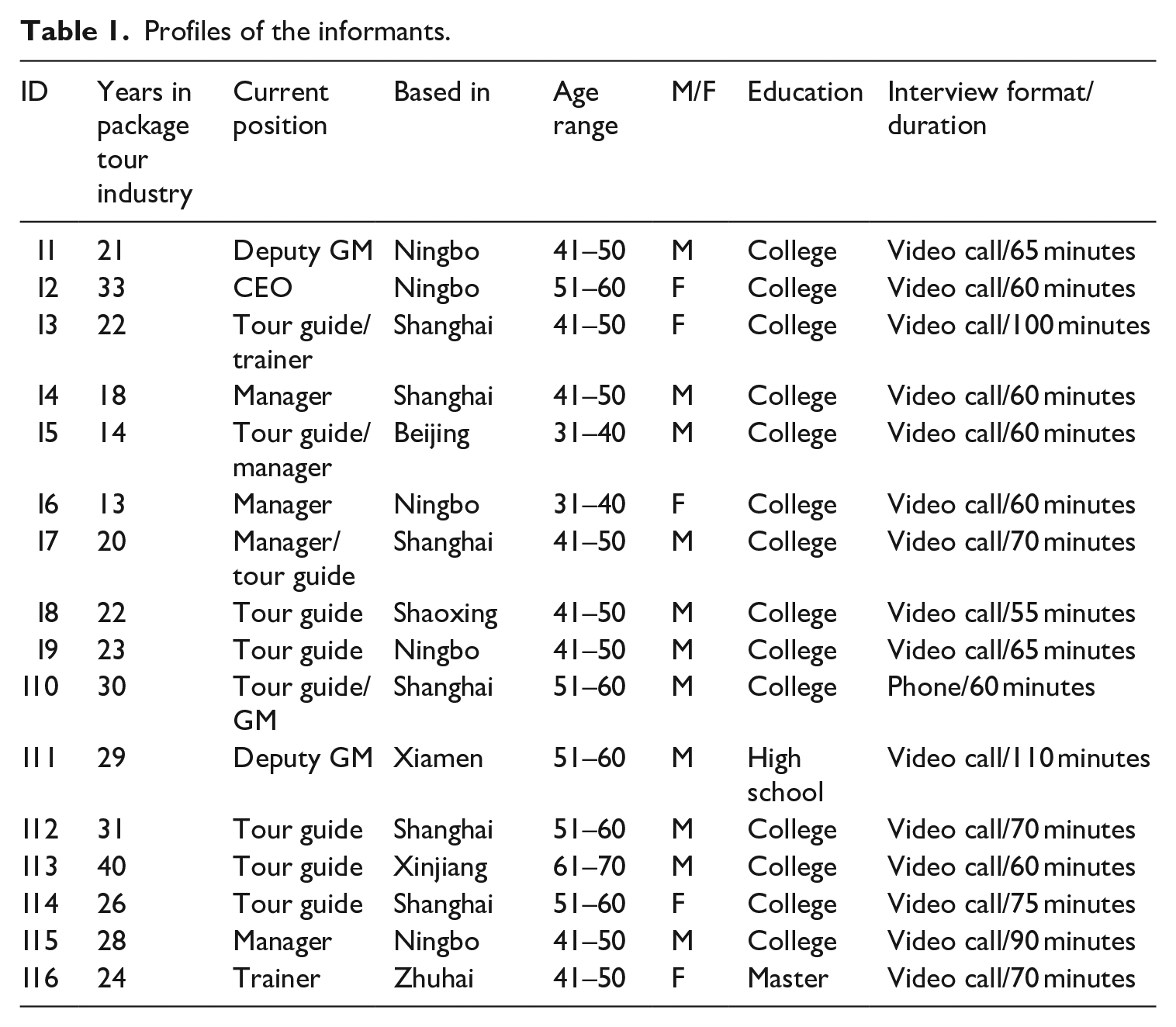
The above interviews mostly took place in one-on-one video call format (only one interview was done in phone call format) during the first quarter of 2021, since physical meetings were not encouraged due to the pandemic situation. Prior communication on the purpose and content of the interview was done via WeChat. Most interviews lasted for more than one hour. During the interviews, the informants were invited to share about their work experiences with package tours and the tourists in general. Specific questions then followed, including a chronological reflection of package tour development and Chinese tourists’ behavioral changes over the past 30 years, depending on their years of experience in this industry. For those whose experience fell short, especially Informants 4, 5, and 6, they were encouraged to share information and stories that they had learned from their seniors. In addition, the informants were also invited to share their observation of the tourists’ behavior in the post-COVID era. To facilitate their recollection and comparison over the years, the interviewees were invited to scrutinize itinerary details using the same tour routes (e.g. four-day tour in Beijing) as examples. The first column in Table 3 was used as a prompt content to solicit detailed answers. The informants were also invited to comment on the key forces driving the changes, as well as future prospects and trends of this business sector. All interviews were digitally recorded upon the informants’ consent. Verbatim transcripts were conducted shortly after the interviews.
OP task sheets
Travel agencies usually issue OP task sheets to tour guides, which include all necessary details that the tour guides should act on and contact with. The task sheets adopted by different travel agencies in different regions vary in many aspects, but there are a few common areas, such as itinerary arrangement, meal arrangements, accommodation, transportation (city and inter-city transport), and policies on peripheral services. More importantly, OP task sheets often serve as a contractual document that the tour guides have to adhere to strictly, as deviations from the specifications in the task sheets may generate either extra cost or tourist complaints. Strict adherence to the scheduled itinerary has been re-enforced since the establishment of the Tourism Law in 2013 (Ma et al., 2015). The itinerary appears in the OP task sheet is also communicated clearly to the tourists and included in the product contract. Tourists are obligated to follow the scheduled itinerary unless permission from the members of the entire group is obtained.
In total, 96 OP task sheets were collected (12 from the 1990s, 38 from the 2000s, and the rest from the most recent decade, only three from the COVID affected period as the number of tourists choosing package tours decreased drastically during this period) from three different travel agencies located in three cities, including Shanghai, Ningbo, and Xiamen. The itinerary sheets contained the most important and essential information of a package tour, so this data source provided unscreened information on the evolution of package tours over the years. Approval was obtained from the respective travel agencies for the inclusion of the 96 OP task sheets in this study. Anonymity and confidentiality were fully ensured in the process.
Data analysis
The content of OP task sheets varies considerably, including variation in routes, destination(s), length, price range, origin of the tour group, type of travel agency, tour category, tourist segment, and clientele. In order to standardize the unit of analysis, package tours that share common destinations and length of duration were clustered for analysis. Common areas were examined, such as attraction selection, same day itinerary (number of attractions and number of activities included, as well as starting and finishing time), meal arrangement (number of meals included, content of the meals, price of the meals, etc.), accommodation arrangement (mainly standard and category), shopping activities, insurance, and other policies.
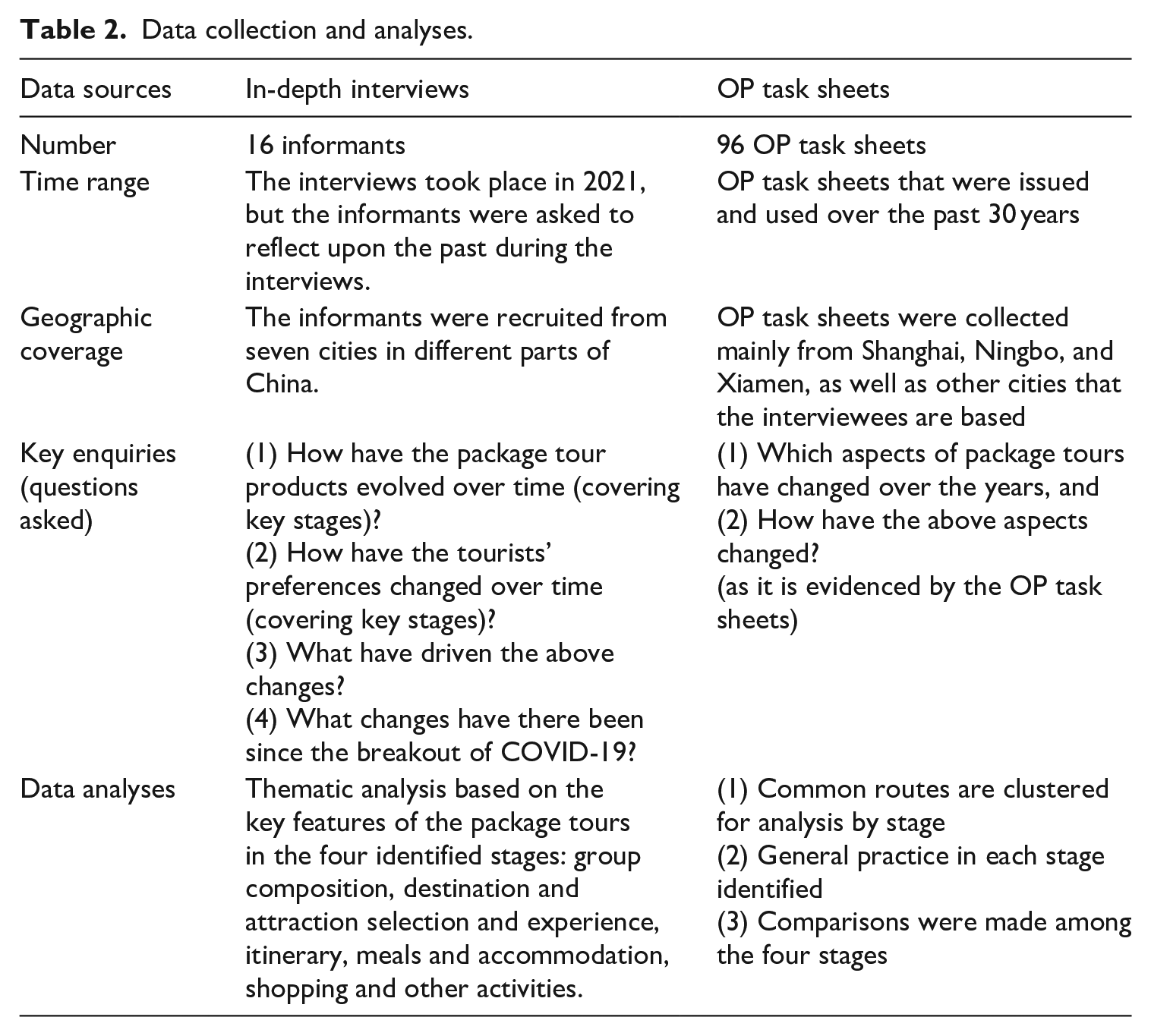
In-depth interviews, on the other hand, have generated more overarching content on the topic. Analysis of the in-depth interviews was done in a thematic manner. NVivo 12 was used to facilitate data organization and categorization for both data sets. Themes derived from the interview transcripts were triangulated by observable evidences from the secondary data of OP task sheets, and vice versa. To ensure reliability and validity of the content analysis, it is important to establish a coding scheme and maintain consistency of the coding process (Potter and Levine-Donnerstein, 1999). The coding scheme was initially established based on the key themes identified in literature, that is, key features of a package tour. To consolidate the coding scheme, two researchers worked on two transcripts and three OP task sheets from each stage manually and independently, and the coding result was cross-checked. Discussions were held on areas that the two coders had different results until a consensus was reached. The coding scheme was adjusted accordingly. The rest of the data was coded in NVivo. To further ensure accuracy, the main findings (Table 2) were sent to the informants for verification, and corrections were made accordingly.
Data collection and analyses.
Findings
The above data analyses have led to a detailed understanding of the changes that the package tour industry in China has been undergoing in the past thirty years or more. To quote one of the informants (I10), “It has gone through earth-shaking changes in the past few decades.” From luxury offerings only for elites and rich people, to a common product for the mass market, package tours in China have indeed undergone substantial development. The changes have been profound and involve group structure; destination selection; itinerary; core activities such as attraction selection and in-attraction activities; supporting arrangements for meals, transportation, and accommodation; peripheral items such as insurance, tipping behavior, and shopping commissions; and other non-core services such as provision of bottled water. Table 3 presents the areas of change and trends in the 1990s, the 2000s, the 2010s, and the post-COVID era.
Chinese tourists’ behavioral changes and the development of package tours.
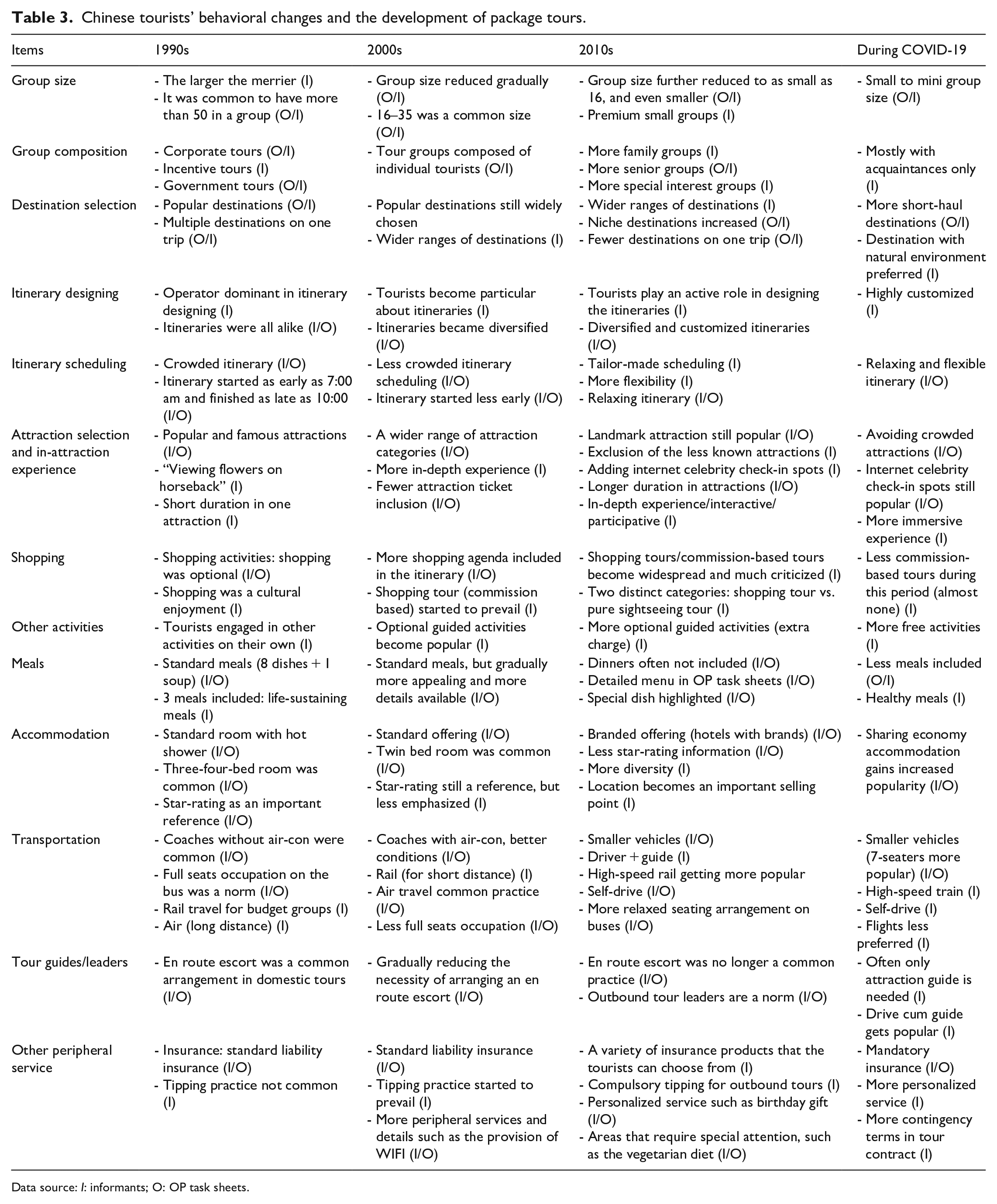
Data source: I: informants; O: OP task sheets.
Group structure
Package tour groups often came in large sizes before 2000; the larger the merrier. Informant 1 shared, “Tour groups over 100 were common at that time. Often three to four tour guides work together to receive two to three buses.” Informant 15 said, “Using a big-size loudspeaker was a common equipment in the last century, since the tour groups were mostly big.” Package tours were not a consumption for mass tourists at that time. Instead, government departments, organizations, institutes, and corporations organized group tours (via travel agencies) as a type of reward and incentive mechanism. This practice gradually decreased in the 2000s. Instead, many tour groups were individual tourists who booked package tours via travel agencies. There were less mega groups. In the most recent decade, tourists started to feel less comfortable to travel with people they didn’t know, and preferred to travel with friends, family, and close colleagues, or people who shared similar interests. Therefore, smaller groups or premium groups started to appear. A loudspeaker was therefore no longer a common equipment for tour guides. Informant 4 mentioned, “now people have become less willing to join a group where people do not know each other, this is also out of their fear of contracting virus.”
Destination selection
When it started, the destination choices were limited to a few most famous cities/destinations domestically, such as Beijing, Xi’an, Guilin, Hangzhou, and Shanghai. These popular destinations are still widely selected, especially with the less experienced tourist segments. On the other hand, the experienced segments are looking for niche destinations that can offer novel and unique experiences. Therefore, the change lies in the extended range of choices.
Package tours in the last century contained the feature of “viewing the flowers on horseback” (a traditional Chinese expression, meaning to have a brief look only). Tours including three cities of Kunming, Dali, and Lijiang in Yunnan Province in a three to four-day tour was a common practice. Informant 2 recalled that the tour groups had to spend most of their time traveling from one city to another, as intercity travel could take much longer due to less developed infrastructure in China 20 years ago. But gradually, people have acquired more disposable income, so traveling for leisure has become common. Some tourists go on tours almost every holiday. Although some former practices remain, the trend is that the tourists want fewer destinations on one trip, and more in-depth experience in the destinations.
The 2010s saw an increase of niche and less known destinations favored by the Chinese tourists. Informant 10 in Shanghai and Informant 11 in Xiamen both commented on the challenges that the package tour industry has faced within the past two decades. The OTAs have been offering similar package tours, but at a much lower price. Travel agencies are struggling with price wars.
There are so many me-too products available, so the competition is who can offer the tours at a lower price. So what we have been doing in recent years is to create tours that are different from others, not offered in OTAs. But of course, our price is high. (I11)
The break-out of the COVID-19 has accelerated this trend. Destinations with more natural sceneries are getting more popular. Some of the destinations may not even be so famous, but they are accessible within a few hours’ drive. Echoing Enger et al. (2020), informants such as I12 shared self-driving tours to short haul destinations with people they know is also out of safety concern in the post-COVID era, so as to reduce probabilities of contracting the corona virus.
Core tourist activities: Itinerary, attractions, and other activities
Itinerary design was dominated by the travel agencies in the last century, when ICT development was not widely adopted yet. The components of the package tour were preassembled. There was a high level of homogeneity in product offering among the travel agencies. The tourists, not being experienced in tourism, did not usually intervene in the itinerary designing process. But now, Informant 8 shared, tourists often negotiate with the travel agency for a commonly agreeable itinerary, including what to see and what not to see, where to stay and how much time to be allocated for the attractions, especially the major ones; that’s why there are more customized tours now.
In terms of attraction selection and itinerary arrangement, the change has also been profound. To include as many attractions as possible on one trip, and to make the day’s schedule as crowded as possible, was a common practice in the past, evident both in the OP task sheets and the interview transcripts. For example, one OP task sheet from the late 1990s shows three or four attractions in one single morning in a medium-sized city such as Ningbo, and the itinerary started at 7:00 a.m. This type of tour was highly valued, and tourists took it as value for money. For many tourists in the past, taking a tour for leisure purposes was a luxury. It might be a major decision for a family or an individual to go on a tour, as the cost might be one or two months family income. Therefore, once they were on the tour, they tried to maximize their itinerary, and “see as much as possible, and make every minute count” (I14). Looking at the OP task sheets from travel agencies in Xiamen now, usually only two attractions are included in one morning, and the itinerary starts typically at 8:00am; some even start as late as 9:30am, with a customized name for the tour—“Lazy People’s Tour” (I11). According to Informant 11, this type of tours is particularly popular among the younger groups. This trend continued in the COVID affected period. Although the number of package tours dropped drastically during the pandemic affected period, those that do take place feature a higher level of customization and flexibility.
Taking a look at what attractions have been selected in the tours over the past 30 years, popular and landmark attractions have been included consistently. “When people visit Xiamen, they still go to Gulangyu, the most famous attraction in this city,” (I11). But gradually more diversified attractions have been included. Development of social media in the most recent decade has created a new tourist behavior, called check-in culture, which means that the tourists like to visit places that are popular in social media.
The above change is also reflected by the time scheduled for attractions. The trend is that tourists now stay longer in the attractions, especially the key attractions. Comparing OP task sheets that include the same attractions, time spent on major attractions has more than doubled now compared to the last century. I10 shared that in the past, it took only an hour and a half for a major attraction like the Forbidden City in Beijing, one of the icon attractions. Now it takes at least four hours, with so many stories to tell in the imperial city that housed two major dynasties in Chinese history. Apart from listening to the stories, tourists look for memorable experiences and like more participative and interactive activities. Wearing the royal robe or costume and taking a picture in them is one of the examples.
Shopping has been a common tourist activity, so its inclusion in the tour itinerary has remained over the years. But in the last century, shopping was often treated as an enjoyment similar to other cultural activities. It was done in a casual manner. However, as travel agencies relied more on shopping commissions for profit, more shopping activities were included in the itineraries, especially after the turn of the century. Some tours had taken the extreme course to rely purely on shopping commissions. When shopping became compulsory and pressurized, the package tour arrangement attracted much criticism, as the informants reported. This criticism is evident in Wong and McKercher’s (2012) study. The Tourism Law was effective in containing malpractices, as most informants agreed. But the travel agencies faced challenges in lowering the cost of the package tour, as many tourists want lower prices, but at the same the agencies still need to make decent profits. “So gradually, two distinct package tour categories appeared in the market – the pure sightseeing tour versus the shopping tour” (I12). In the pandemic affected period, pure shopping commission tours are less selected, “almost none,” as informants shared.
Supporting arrangement
Overall, the OP task sheets, since the adoption of the electronic versions, are much more elaborate and detailed. Information regarding meals, accommodation, and transportation now appear in greater details without the need for further interpretation. Tourists’ increased awareness of rights protection was another trigger for this change.
When it started, many package tours did not include meals. “Tourists from the northern part of China would bring DaBin (a type of pancake), and eat DaBin whenever they were hungry. . .” (I2). Tourists saved every penny possible to maximize their sightseeing opportunities in the 1980s and early 1990s. Tour groups in the 1990s started to include meals, but the main concern of meal arrangement in the past was to have enough to eat, so the descriptions in the OP task sheets were usually limited to how many dishes were included in each meal. A typical description of lunch was “eight dishes plus one soup for a table of 10 tourists”; I10 described them as “life-sustaining meals,” as they were not delicious but cost was minimum. But gradually, especially after the print version of the task sheets became available, more information appeared in the task sheets, including the content of the dishes, cultural background of the dishes in the destinations, and condition of the restaurant, to ensure quality. Informant 7 shared that it is now a common practice to include specialties of the destinations in the menu description (e.g. salty duck in Nanjing, and Beijing duck in Beijing).
As for accommodation, typically the description on the OP task sheet in the 1990s and the 2000s would be the offering of “standard twin bed room with hot shower,” sometimes with star information—how many stars the hotel had. It is now more a choice of branded offerings. Most itinerary sheets now show hotel name, brand, and location, so that the tourists can search relevant information online and make sure it is something acceptable to them. As the tourists now have more disposable income, their hotel choices have become more upgraded and diversified. Three to four people sharing a room was a common practice in the 1990s. Now the tourists are less willing to share rooms with people they don’t know. An emerging trend, before and during the pandemic affected period, is the increased popularity of the sharing-economy accommodations.
As for transportation, both trains and flights were common for domestic traveling in the 1990s and the 2000s. But flights were usually preferred because trains in China in the last century and early this century were not in good condition and the speed was low. But as high-speed rail and trains of superb quality have been developed, more and more tourists are opting for rail transport. It is more convenient, more comfortable, and more predictable time-wise. In addition, the high-speed rail service has enabled the package tours to include a wider range of niche destinations where flights don’t go directly. Buses or coaches without air-conditioning were common in the 1980s and 1990s. But the conditions have greatly improved in the new century. Although the use of coaches is still common, there is a new trend of using smaller vehicles, especially for smaller groups. Self-driving, especially for short-distance travel, is now common for the individual Chinese tourists. It has also appeared in package tours, especially after the break out of the pandemic.
Personnel and peripheral items
Peripheral items such as tips, insurance, and other service items such as provision of bottled water included in the OP task sheets over the years also reveal interesting changes. For example, tipping policy used to be stated as “forbidden to receive” in the last century; but it has gradually changed to “not encouraged to receive,” and further adjusted to “not allowed to claim,” if the tourists do not tip. The inclusion of insurance has also seen changes, from basic travel agency insurance to a variety of travel insurance packages that the tourists can choose and decide for themselves. The tourists’ knowledge and awareness about insurance, and the development of insurance businesses and the availability of all sorts of insurance products are the two main reasons for this change.
Another big change involves the assignment of an en route escort (similar to the role of tour leader) for domestic tours, which was a common practice in the last century and beginning of this century, also an important service feature that influenced tourists’ satisfaction in the past (Shen, 1999). As Chinese tourists were not experienced in traveling, they were not familiar with many en route arrangements and travel procedures such as how to check in at the airport. Communication with local tour guides and suppliers was another big issue. Hence it was necessary for the organizing travel agency to assign an en route escort. But this role, which bears a high cost, became unnecessary and is now seldom arranged for domestic tours, although it is still a common practice for outbound package tours for various reasons, such as language barrier and unfamiliarity of practices in foreign destinations.
Discussion and conclusion
Taking the above findings together, the landscape of the package tour industry has undergone enormous development over the past three decades in China. The development of the package tour industry in China in the past thirty years or more generally echoes the PLC theory (Levitt, 1965) and prior theories on tourism product life cycle (e.g. Butller, 1980), in that a clear pattern of emergence, growth, flourishing but savvy, and caution stages was observed. However, the evolutional path of this industry and the tourists’ behavioral change are intertwined with the development of economy, socio-cultural trend, infrastructure, as well as the rapid development of the information and communication technology. The government’s encouragement in developing tourism, which can be evidenced by the increased holidays (Shen et al., 2018), rigorous policies and regulations for the tourism industry (Ma et al., 2015), the fast-developing consumerism (Gerth, 2010), the growth of professional service force (i.e. tour guides), have further fueled the acceleration and at the same time improved qualifies of the product and service offerings. Figure 1 tries to encapsulate the above findings.

Evolutional path of the package tour industry and tourists’ behavioral change in China.
Compared to Western countries, the package tour industry in China started much later, only in the end of 1980s and the beginning of 1990s, but the evolution from the emergence stage to the growth stage, and further to the flourishing stage, was rapid. Within less than 30 years’ time, package tour has evolved from elite consumption to mass consumption. While consumerism played a big role (Gerth, 2010), opportunistic practices such as the pure commission-based tours (Wong and McKercher, 2012) have created much criticism. The Tourism Law which was implemented in 2013 thus played a big role in further regulating the market (Ma et al., 2015).
The flourishing stage saw both the increased demand of package tours when it became mass consumption, but this stage also saw the increase of the digitally empowered and savvy tourists. ICT has greatly empowered the tourists (Bowen and Whalen, 2017). Consequently, the services the tourists need from the travel agencies now are very different. They no longer need superficial introduction, but they desire products and services that are not available from the online travel agencies (OTAs) or that cannot be easily assembled by themselves. On the other hand, the COVID-19 pandemic is not only a disrupter, temporarily suspending many travel businesses, but also a transforming agent, changing tourists’ consumption behavior with package tours. Although tourists’ behavior in this time period mainly features the word “caution,” this word may stay for longer time, even after the pandemic, along with new demand. Indeed, the tourists now have much bargaining power, thanks to the rapid development of information technology and the many choices available in the market. As the PLC theory suggests, when there are too many product providers in the market, differentiation is more than necessary to avoid me-too products (Levitt, 1965).
The above driving forces have substantively changed the business model and main features of package tours, as researchers noted previously (e.g. Enoch, 1996). For example, visiting the largest number of sites is no longer a feature for many package tours in China. Package tours can sometimes be more expensive, due to the fact that travel agencies can no longer make profit from the price gaps; and instead of having no say in the design of the itinerary, the tourists now play an active role in recommending the components to the itinerary. The overall development trends can be summarized as follows:
From luxury and elite consumption to mass consumption
From mega groups to smaller groups
From popular destinations only to a wide range of destinations including the niche ones
From crowded itineraries to flexible and relaxing itineraries
From mass homogenous products to a wide range of products including highly customized, heterogeneous, and specialized tour products
From sellers’ market to buyers’ market
The result of this study provides useful reference for further grooming of the package tour industry in China. The thriving of the future package tour industry will rely on a revamped value proposition. For example, package tours that feature differentiation, customization, a high level of professionalism embracing the concept of “tourism plus,” and a high level of specialization may find their way into the new round of competition. To achieve this result, strategies such as cross-sectional collaboration and cooperation are highly recommended, which enables sharing of resources and expertise. In addition, upgrading service to meet the demand of the new elites and the health-oriented tourist behavior in the post-COVID era in China is necessary and viable. ICT facilitates tourism in many aspects, but a well-designed and implemented tour effectively saves time and energy for the tourists, at the same time offering comfort and convenience. The role of the tour guides and tour leaders needs to be re-examined.
Tourism marketers need to take into consideration the high level of heterogeneity and diversity of the Chinese tourists. Gone is the era of one-package-accommodating-all. It is advisable for the travel agencies to carefully reposition themselves considering the market segments and the products that they are capable of. Small and medium-size enterprises should focus on certain segments only, instead of targeting all. Different marketing channels and tactics should be applied to reach and attract different market segments. For example, the senior segment, a segment with great potential in China, still welcomes face-to-face communication and relies on traditional word-of-mouth. Tourists’ behavioral changes during the pandemic affected period seem to be well addressed by the travel operators. While some of the changes, such as a favor of short-distance trips, might not stay, other changes, such as health-oriented travel preference might become a new normal. Travel operators and marketers need to be vigilant on these changes and new normal, so that more pertinent products can be created and offered.
Theoretically, the study adds new nuance to the concept of tourism product life cycle by delineating four development stages. The result of this study also serves as an important update to scholarly knowledge on the development of package tours and the Chinese tourists’ behavior in consuming package tours. Many aspects of the existing understanding of the package tour operation and tourists have evolved, including tourists’ consumption behavior, business model of package tours, and key features of the tours.
This study is a pioneer attempt in providing a broad-based description of the evolution of the Chinese package tour holiday market, which lays ground for future enquires in this area. Continuous monitoring of the package tour PLC evolution, especially in the post-COVID era, is important to provide timely reference for future strategic decisions. Special attention needs to be paid to the innovations currently being applied, as they might change the evolution direction of the package tour PLC. Inter-generational and inter-segmental difference is another area that needs further investigation. The vast range of tourist segments, along with the heterogeneity of tourists’ behavior (Chen et al., 2019), warrants a careful segmentation study before stereotyping what the Chinese tourists are like and what package tour products are suitable for them. Since the current study takes the perspective of senior tour guides and tour operators only, future study may consider taking the tourists’ perspective, so as to obtain a more comprehensive understanding of the development of package tours as well as the future prospects of this business. A mixed-method approach may help in obtaining a further understanding of this topic from both operators’ and tourists’ perspectives.
Footnotes
Funding
The author disclosed receipt of the following financial support for the research, authorship, and/or publication of this article: This study is supported by Macao Institute for Tourism Studies (Grant No. 111/DP/2021).
