




Abstract
Mauritius is a multilingual island, where there is a linguistic and literacy paradox. While Mauritian Creole dominates as the spoken language of the population, English and French are the main print languages, as well as the main languages of literacy and education. In such a complex situation, preschool is an interesting terrain in which to observe children's first official introduction to the printed word. The aim of this paper is to consider the ways in which preschool teachers expose children to print and decoding skills and some of the factors shaping their choices and pedagogical practices. This paper uses data from a longitudinal case study, using an ethnographic approach, to describe and analyse the strategies used by three teachers as they expose a group of four- to five-year-olds to the printed word in a government preschool. I argue that in foreign language contexts such as Mauritius, children's exposure to the printed word is often cosmetic and educational, with emphasis on the direct teaching of some decoding skills. I also argue that the relationship that the children build with print is one of seriousness, associated with schoolwork, thus playing down the meaning-making, more playful and more entertaining functions and uses of print. This is related to local linguistic, sociocultural and educational factors.
Introduction
Fifty years ago, Mary Clay (1966) coined the term ‘emergent literacy’ (EL) to describe the reading and writing behaviours that precede formal literacy instruction and that develop into conventional literacy (Sulzby, 1985). EL, as an approach to the investigation of children's exposure to literacy in early childhood, takes a social constructivist stance, arguing that children rely on the experience of the environment in which they grow upto constitute the functions and uses of literacy. The interest in children's EL has been fuelled by the view that EL skills contribute to a smooth transition from home to school (Lynch, 2008), which facilitates literacy development, consequently leading to educational progress and achievement. Hence, over the past half-decade, there has been a growing body of evidence-based research that has adopted an autonomous view of literacy and that has investigated the ways in which home and preschool literacy practices feed into and impact upon children's oral and decoding skills. Much of this research has been carried out with monolingual children in developed countries, especially amongst children from white middle-class American literate families (Reyes, 2006). Some more recent studies have also been carried out in low socio-economic American communities (Foster et al., 2005), in low socio-economic Israeli communities (Aram and Biron, 2004; Aram and Levin, 2001; Korat et al., 2003; Levin et al., 2001, 2002), and among immigrants in the Netherlands (de Jong and Leseman, 2001) and the USA (Lynch, 2008).
With the increasing numbers of immigrants in Canada, the USA, the UK and Australia, and against a backdrop of an increasingly conservative educational system that has replaced bilingual policies by English-only language-in-education policies, researchers have become more aware of the linguistic and educational challenges facing immigrant communities. These challenges are related to the mismatch between immigrants’ home language(s)/learning culture and those of the school. This body of research has tended to be celebratory of the ‘funds of knowledge’ (Moll et al., 1992) that immigrant children bring from home, arguing that such a wealth of multilingual language and literacy practices in the home and community can be used as educational and emotional resources to create bridges between home and school early literacy experiences (Gregory et al., 2004). Although this body of research is sensitive to the plight of second language and literacy learners in second language contexts, there is still a paucity of research in foreign language contexts, often post-colonial settings, such as Mauritius, where the children's home language is largely unwritten and where the school languages and school literacies are different from the children's home language (Abd-Kadir et al., 2003, cited in Kennedy, 2006).
The aim of this paper is to fill this void by considering Mauritian preschoolers’ exposure to the printed word in a preschool context, with special focus on their exposure to print and their initiation to decoding skills. In the first part of this paper, I will briefly introduce the sociolinguistic situation of Mauritius, highlighting the prestige of the European languages in comparison to the local French-lexified Creole in the social and educational domains. In the second part, I will describe the theoretical framework that will be used to analyse children's exposure to the printed word, before discussing the discourse on literacy in the preschool curriculum in Mauritius. In the third part of this paper, I will describe the research methodology, and then discuss the findings of a year-long ethnographic case study, while focusing on children’s exposure to the printed word in a preschool in Mauritius
Mauritius: A brief sociolinguistic overview
An island in the Indian Ocean, Mauritius has a population of some 1.2 million inhabitants. Mauritius has no indigenous peoples; its population comprises descendants of French colonisers (18th century), British colonisers (19th century) and immigrants (African and Malagasy slaves, Indian indentured labourers and Chinese merchants – Eriksen, 1994), who brought with them their religions, cultures and languages. As an ex-French and ex-British colony, Mauritius reifies French and English as the two prestigious languages. While French is the social language of prestige, dominating the written media and considered as a second language, English is the de facto official language of administration, government and education, hardly used socially by the population and considered a foreign language. Both French and English are taught as compulsory languages in primary and secondary schools and both these European languages dominate the local linguistic landscape (Gorter, 2006). Robust markers of ethnic and religious identity in an island conscious of its diversity, some Oriental languages (Hindi, Urdu, Tamil, Telugu, Marathi, Mandarin and Hakka – Rajah-Carrim, 2007) are also taught in schools and are used for religious purposes.
In Mauritius, there is also a local lingua franca that some 80% of the population use as a home language; it is a French-lexified Creole, which we will refer to as Mauritian Creole (MC). Although a number of proposals for an orthography of MC have been made over past decades by various individuals and groups (Mooneeram, 2007), it is only recently, in 2004, that the government commissioned a standard orthography for MC with the aim of introducing it into the education system. Yet, to date, MC is still excluded from the education system as a language of literacy and a medium of instruction. The government has recently worked on a formula to introduce MC as an optional subject in government primary schools in 2012. Despite efforts made by individuals and groups to standardise and elaborate MC, culminating in a first all-Creole dictionary (Carpooran, 2009), the use of written MC is limited to certain specific domains, e.g. in select local literature (Mooneeram, 2007), in some adult literacy campaigns (Mooneeram, 2009), in computer-mediated communications such as texting and e-mailing (Rajah-Carrim, 2008, 2009), in church (Rajah-Carrim, 2008) and in some Muslim madrassas (Auleear Owodally, 2008, 2011). While some of this writing is done in various standardised forms, much is done in organic orthographies (Sebba, 2007).
In terms of language-in-education policy, unlike other post-colonial contexts such as South Africa, which has an overtly multilingual language-in-education policy, Mauritius has a covert multilingual language-in-education policy that promotes colonial and international languages but downplays the children's home language as a language of literacy. The 1957 Education Ordinance, which is the colonial document regimenting the present local language-in-education policy, reads (as quoted in Sonck, 2005, p. 40, emphasis added) thus:
In the lower classes of Government and aided primary schools up to and including Standard III, any one language may be employed as the medium of instruction, being a language which in the opinion of the Minister is most suitable for the pupils. In Standards IV, V and VI of the Government and aided primary schools the medium of instruction shall be English, and conversation between teacher and pupils shall be carried on in English; provided that lessons in any other language taught in the school shall be carried on through the medium of that language.
From this policy, it is clear that in preschools and in the first three years of primary schooling, teachers can choose the language of literacy. However, given that the main school textbooks are in English (English, maths and environmental studies textbooks) throughout the education system, English has become de facto the main language of literacy and the main medium of instruction from the first year of primary education. Hence, for the time being, Mauritian children do not learn to read and write in their first language, MC. It is in such a context of mismatch between the children's home language and the school, social and print languages that preschool teachers have the complex and challenging task of initiating preschoolers to the printed word.
Theoretical framework
Although the literature on literacy has distinguished between autonomous and ideological models of literacy, in this paper I align myself with Cummins (2005, cited in Pahl and Roswell, 2005), who argues that these two paradigms can be seen as complementary rather than competing frameworks for literacy research. I adhere to the view that there are skills that underlie early literacy development and to the view that children need to be aware of print and recognise the alphabet (for alphabetic languages) in order to start reading. Moreover, I believe that there is a crucial need to situate the development of these EL skills in their social, historical and cultural contexts, as these specific contexts determine and constrain the literacy experiences that are provided to young children.
Since there is, as yet, little theoretical literature that covers children's EL experiences in a context where their dominant home language is a largely unwritten language and mostly invisible, I will draw upon the available literature on: (1) the print/decoding component of EL; and (2) a social view of bilingualism and biliteracy, to frame my investigation.
Emergent literacy: Learning about print and learning to decode
While the generic term ‘emergent literacy’ (EL) has been widely utilised in the research on early childhood literacy, in recent decades there has been convergence to the view that EL is not a unitary construct. Gest et al. (2004) describe EL as consisting of the following two major components: (1) print/decoding skills, which consist of print knowledge, the alphabetic principle, phonological/phonemic awareness; and (2) oral language skills, such as comprehension. The oral language skills component of EL among preschoolers in Mauritius has been covered elsewhere (Auleear Owodally, 2008). In this paper, I will focus on the print/decoding component of children's early exposure to literacy, which I refer to as the printed word, with particular focus on the preschool setting.
One aspect covered by the literature on children's decoding skills is children's exposure to print in their physical environment. Dickinson and DeTemple (1998; also refer to Durkin, 2004; Neuman and Roskos, 1992; Soderman et al., 1999) use the term Preschool Classroom Literacy Environment (PCLE) to highlight the importance of preschool in providing a print-rich environment. Print-rich classrooms are described as print laboratories, filled and flooded with print (Hoffman et al., 2004). They include print-related areas, such as a library and a writing centre (Soderman et al., 1999; Vukelich et al., 2002), which contain ‘written notes, letters, books, labels, newspapers, magazines, and other reading materials. Crayons, pencils and paper, chalkboards, and other writing materials are readily available’ (Lauritzen, 1992, p. 535). Lauritzen (1992) also describes a literacy-rich environment as being one in which there are people who model the uses of reading and writing in real-life situations. In the preschool setting, teachers often model the uses and functions of literacy; they also model literacy practices by reading aloud for the children (Neuman 1999; Taylor et al., 2000), or by encouraging children's independent reading and writing (Durkin, 2004; Soderman et al., 1999). In a print-rich environment, children develop concepts of and positive attitudes to print.
Another aspect of learning to decode is the alphabetic principle, which Peregoy and Boyle (2005, p. 171) define as ‘the idea that language sounds are represented by letters and letter sequences’. This concept has been largely used for native speakers, but McBride-Chang and Treiman's (2003) findings attest to the power and utility of the alphabetic principle for children learning to read English as a second language. More than making the relation between symbol and sound, Dickinson and DeTemple (1998) and de Abreu and Cardoso-Martins (1998) argue that the ability to identify letters has a positive influence on reading.
The third component of learning to decode is phonological/phonemic awareness (PA), which describes the understanding of the sound structure of language, i.e. that language is made up of words, syllables, rhymes and sounds. Meanwhile Adams (1990), Bryant and Goswami (1990) and Muter and Snowling (1998) maintain that PA impacts positively on reading achievement and spelling skills, and Krashen (2002, 2004) argues that PA is not essential for literacy development. Freeman and Freeman (2000) propose that PA is a consequence of reading experience and print exposure rather than a direct causal factor in explaining either decoding or reading comprehension development. In the local context, since Mauritian children are taught to read English using the look-and-say method in primary school, rather than a phonics approach, to include PA in my observation schedule would be redundant. This is in line with the view of McBride-Chang and Treiman (2003), who argue that it is difficult to test Hong Kong children's letter-sound knowledge specifically because these children are taught to read English using the look-and-say method (Holm and Dodd, 1996, cited in McBride-Chang and Ho, 2005), rather than by associating letter names and phonemes.
The literature on EL experiences has also foregrounded parents’ and teachers’ role as expert others, revealing that parents and teachers provide indirect, rather than direct, instruction to children. This is possibly related to the fact that the explicit teaching of literacy and academic skills in preschool is contested (Bowman et al., 2000, cited in McDonald Connor et al., 2005) in the European-American world. However, there is some evidence that some teachers provide direct literacy instruction and that these teaching practices can have positive outcomes. For instance, McDonald Connor et al. (2005) provide evidence that early reading instruction can have a positive influence on preschoolers’ EL growth. Connor et al. (2004) and Taylor et al. (2000) state that teachers who spend more time on academic activities tend to have students who demonstrate greater gains in reading skills. With respect to second language learners, Roberts and Neal (2004) carried out an intervention programme containing explicit instruction. They found clear evidence that ‘children at the very initial stages of English acquisition could learn both linguistic comprehension and decoding-related components of early literacy from explicit group instruction’ (Roberts and Neal, 2004, p. 283). These few studies have raised awareness of the different direct and indirect strategies used to expose children to decoding skills (Weigel et al., 2010); they underline teachers’ and parents’ role in mediating culturally specific ways of understanding and participating in literacy experiences (Kelly, 2004).
A social view of literacy: Bilingualism and biliteracy in context
In the global context where there is geographical mobility, especially apparent in countries like Australia, the UK and the USA, there has been growing concern for immigrant children's language, literacy and educational development in languages that differ from their home languages of literacy. Work by scholars such as Gregory et al. (2004), Gregory and Kenner (2003), Kennedy (2006), Li (2006), Sneddon (2000) and Volk and de Acosta (2001) has highlighted the complex language and literacy experiences that immigrant children bring to school from their homes and communities. This literature, which largely adopts a social view of literacy (Street, 1995), has critiqued the deficiency approach taken by curricula and teachers, especially those teachers who have little knowledge of the cultural and ethnic diversity of their students and their ways of learning outside the school (Li, 2006), in their ways of dealing with immigrant children.
Other than research on immigrant populations, there has also been some research on low-income African American English (AAE) speakers. Vernon-Faegans et al. (2001) and Craig and Washington (2004) have enumerated and discussed the decoding and vocabulary challenges that AAE speakers face as they learn to read and write in Standard American English, highlighting the need for a holistic approach when considering these language and literacy challenges. While AAE speakers speak a non-standardised variety of American English in American schools, they share with immigrants the status of being English language learners who are immersed in an English-speaking environment that distinguishes Standard English from the language that they use and speak at home.
Over past decades, there has been growing concern for English language learners and suggestions have been made about the ways in which literacy instruction could be improved to respond to their needs, while at the same time drawing from their multilingual resources. This multilingualism-as-a-resource approach, where home resources are not only valued but also used to build bridges between home and school, has been adopted by some researchers engaged in action research in the West (Kennedy, 2006) and in South Africa (Bloch, 2006). Although much of the Eurocentric research makes regular reference to English language learners (see Strickland and Schickedanz, 2004), the underlying assumption is that these English language learners are in a second language context where English is the oral and written language of the environment.
In the first decade of the 21st century, there was some research on EL experiences in South Africa (Bloch, 2006; Prinsloo, 2005), a country that has adopted an ‘additive bilingualism’ approach in its post-apartheid official multilingual language-in-education policy. The work of Carole Bloch, in such projects as the Battswood Biliteracy Programme, which takes a social view of literacy, has pointed out the challenges faced by schools in implementing a multilingual policy. Some of these challenges include parents’ positive attitudes to an English-medium education and parents' reluctance to move towards mother tongue literacy/education; Alexander (2007, p. 17) refers to as this as the ‘static maintenance syndrome’. The experience of South Africa reflects what Hornberger (2002, p. 30) says about the difference between policies and ‘implementational spaces’ for policies to be translated into successful pedagogies.
While the above literature has dealt with contexts where there is home, community or official support for the development of emergent bilingual and biliteracy skills, there has been far less (if any) research on EL experiences in post-colonial contexts where children's home language is rarely used in its written form and where English is a foreign language but, paradoxically, a dominant print and school language. In order for me to investigate the ways in which preschool teachers create an environment conducive to EL development among Mauritian preschoolers, I propose to use the following working description of EL in order to frame my methodology and analysis: EL consists of a set of skills (oral/decoding), the development and use of which are embedded in certain practices, which are informed by and which inform the particular social and cultural contexts in which they occur.
The Mauritian education system
As background to investigating children's EL experiences in the preschool setting, it is important briefly to refer to the position taken on the EL issue in the two official documents that frame and regulate preschool education: the 2003 Pre-school Programme Guidelines (3–5 years) (Ministry of Education and Scientific Research, 2003), which provides guidelines on the general aims and objectives of preschool education in Mauritius, and the preschool teacher training manuals. 1
Both the 2003 preschool curriculum and teacher training manuals adhere to the general principles of EL, describing literacy as a developmental process. The curriculum clearly states that one of the roles of preschool is to initiate children to print and to socialise them into a print world. The document specifies that preschool should provide a ‘print-rich environment’ (p. 29) where children will be motivated to ‘understand the functions of print, experiment with print, seek and engage in literacy experiences, use books and a variety of texts for pleasure and information’ (p. 10). The curriculum and teacher manuals also describe the importance of a library corner and reading, stating that (Ministry of Education and Scientific Research, 2003, p. 43):
Children surrounded by storybooks, signs, alphabet blocks etc … do not need to be taught about letters. They will learn them, as they are ready. Spontaneous efforts to form letters will vary in timing and intensity from child to child. Focus on print and pictures, for all children, must be meaningful, as in hearing stories read from a book, or seeing one's spoken words transformed to print.
Interestingly, the curriculum remains silent on the language issue, failing to engage in the specificities of the local language situation.
As for teaching reading and writing, although the teacher training manuals acknowledge phonics as a possible approach to teaching reading, they favour the ‘whole language approach’ (Ministry of Education and Scientific Research, 2003, p. 39). During their training, teachers are advised to help children read their own names and recognise environmental print, as well as practise storytelling, storybook reading and the reading of big books, as a stepping stone to children's drawing, which will eventually transform into writing (Ministry of Education and Scientific Research, 2003, p. 41). Teachers are also advised to transcribe children's own language when writing on their drawings (Ministry of Education and Scientific Research, 2003, p. 41):
[I]f the children say what is taking place in the drawing, and this is written under their drawing, in their own precise words, (without being subjected to an approximate translation by the educator), then the purpose of motivation for writing will have been achieved.
The discourse adopted in both documents reflects the spirit of the EL approach, which emphasises children's immersion in a print-rich environment while downplaying the teaching of discrete skills. What is also implicit in the documents is the use of the children's home language as a resource for creating meaningful links between oral and written language. How these guidelines, which can be understood as being supportive of first language literacy and multilingualism, are implemented is the question that we will try to address in a case study of teachers’ pedagogical practices as they initiate preschoolers to print and decoding skills in a Mauritian preschool.
Purpose of the study
The purpose of this study is to examine preschoolers’ exposure to print and decoding skills in a context where the children's home language is an unstandardised language, which is rarely used in any written form and which differs from the dominant print school languages.
The research questions that will be addressed in this paper are:
In what ways are children in the observed preschool exposed to print and initiated to decoding skills in the preschool setting by preschool teachers? What factors can explain these teachers’ pedagogical choices and practices?
Research design and methodology
Since there is scant literature (Tirvassen, 2001, 2005) on language and literacy practices and experiences in preschools in Mauritius, a pilot study was carried out in six government preschools in an urban area of Mauritius in 2004 (Auleear Owodally, 2010a), where preschool teachers were observed over two days in their respective preschools and interviewed. Although this cross-sectional approach revealed some fairly consistent patterns of language and literacy instruction practices, it failed to provide in-depth insights into or understanding of teachers’ pedagogical choices, ideologies and motivations as they engaged in these practices. Hence, an ethnographic approach to the case study (Gilham, 2000) was used to collect data in 2005, for a doctoral thesis on EL in preschools in multilingual Mauritius (Auleear Owodally, 2008); it is this corpus that I draw upon for the present paper.
The ethnographic approach was informed by researchers such as Corbett (2003), Griffiths (2000) and Nunan (1992), who argue that ethnography can give comprehensive descriptions, provide deeper understandings of learning in classroom contexts, and explore the policy and reality interface, before attempting to propose changes that might be perceived by the target group as inappropriate and unnecessary. Ethnographic researchers aim to observe participants in their natural setting and to be holistic in their attempts to deal with social phenomena in all their complexity (Hammersley, 1990). The choice of the case study, as a ‘contextualised contemporary phenomenon within specified boundaries’ (Hatch, 2002, p. 30; Opie, 2004, p. 74), came from a desire to pay close attention to the social, political and other contexts (Stake, 2005), the importance of which has been highlighted by the literature, which conceptualises literacy as a socially, culturally and historically situated practice (Street, 1995).
The preschool chosen for the case study was one of the schools visited during the pilot study. In this government preschool, the management and teachers expressed their willingness to have me visit the preschool, one day per week, over one year. The head teacher, preschool teachers and parents were informed of the general aims of the study at the beginning of the year. Data were collected longitudinally, with the aim being to provide a ‘thick description’ (Geertz, 1973, p. 5) of the pedagogical context of children's early English language and literacy experiences in a Mauritian government preschool. Although this larger study acknowledged the importance in preschool of the development of oral skills in English as a precursor to literacy in English this paper will focus on one aspect of Mauritian children's EL skills, i.e. their exposure to print materials and their initiation to decoding skills in the preschool setting.
The observed preschool: PSA
The chosen preschool, which I will refer to as PSA, is attached to a government primary school and is among the high-performing primary schools in Mauritius, with a pass rate of some 80% for the end of primary cycle exam. Given the aim of this paper, I will consider three teachers from PSA as the main focus of this research (Callins, 2006) and the key informants (Merkens, 2004). They are all female, middle-aged, with families; they all underwent upper secondary education and are professionally qualified; they each have between 16 and 19 years of teaching experience; and they are native speakers of MC, a language they use in their day-to-day lives. I will henceforth refer to them as T1, T2 and T3. The children attending PSA come from lower middle-class families and are native speakers of MC. In the preschool, they use MC to address each other, the teachers and the helper. They have some understanding of French, because of the linguistic proximity of French to the French-lexified Creole that they speak and because most cartoons are broadcast in French on the national television channels. Furthermore, English is a foreign language for them, a language that they do not hear in their home or social environments.
Data collection procedures
Ethnographic tools of data collection were used: document analysis; non-participant observation using video-recording, audio-recording and field notes; and teacher interviews.
Document analysis was carried out with the aim to consider the interface between policy documents and classroom practices. Atkinson and Delamont (2005) have pointed out that the analysis of spoken language remains firmly embedded in studies of organisational contexts, processes of socialisation and routines of work. Document analysis consisted of examining the weekly plan, written by the observed preschool teachers collectively and containing a ‘Reading/Writing’ section. I also analysed the daily plans, written by individual teachers and containing a ‘Reading’ section and a ‘Writing’ section. These sections detail the activities to be carried out, the objectives, the procedures and the modes of evaluation.
In order to obtain a holistic picture of preschool teachers and learners in their naturally occurring environments (Chilisa and Preece, 2005; Hammerseley, 1990), and in order to take into account the people who participated (Flick et al., 2004), I was a non-participant observer at PSA. In my observation of the children's exposure to print and initiation to decoding skills, I was guided by my reading of the literature. I video-recorded relevant moments and took notes on all activities containing exposure to and use of print and decoding skills: reading, writing, looking at print, modelling the use of print and talking about print, as well as the direct and indirect teaching of decoding skills. Samples of writing, drawing or scribbling were also video-recorded and filed as artefacts.
Finally, year-long unstructured interviews were carried out with PSA teachers, using the stimulated recall technique. The data obtained from these interviews were kept as field notes. Post-observation interviews were also carried out, which included questions about the school literacy environment, teachers’ personal literacy practices and teachers’ engagement in direct and indirect literacy instruction.
Data analysis procedures
Print exposure and initiation to decoding skills: Emerging codes for data analysis
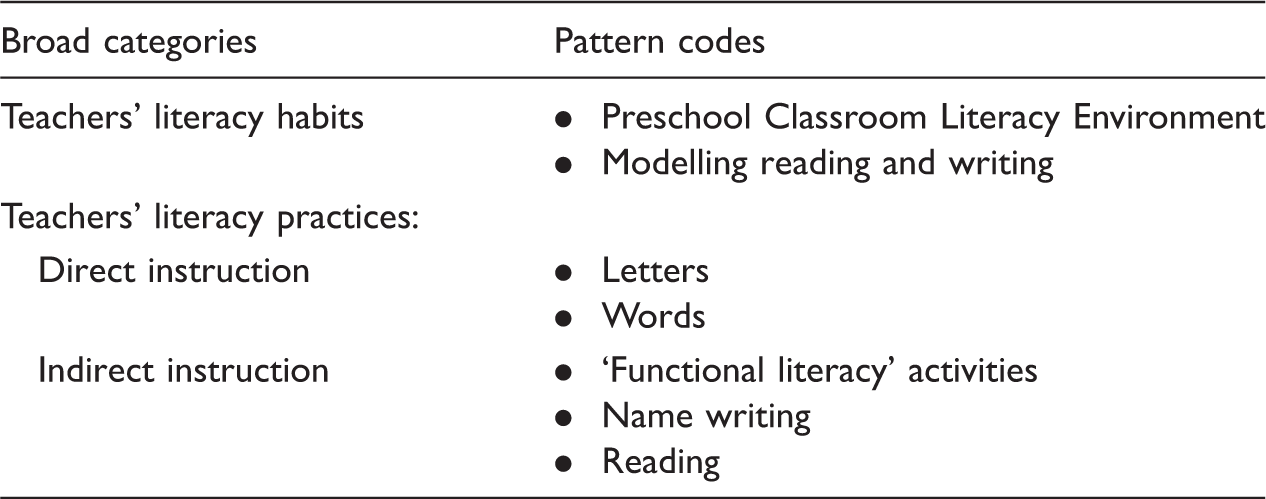
For the purposes of triangulation, I referred to the data generated from the interviews, and from the daily and weekly plans. These plans were consulted to consider the relationship between the intended and the taught curriculum, and to find possible explanations for teachers’ practices as they exposed children to print.
One of the concerns of critics has been the ‘trustworthiness’ of data collected using ethnographic tools and analysed qualitatively (Opie, 2004, p. 71). In order to enhance the reliability of coding and analysis, peer debriefing sessions were organised. A colleague and academic: (1) came to PSA to observe one session in the first term and second term; (2) viewed a selection of the videocassettes; (3) read a selection of transcripts and the data analysis; and (4) gave feedback.
Findings
Preschool classroom literacy environment
The PSA classroom contains three groups of tables (two tables per group, one for the older children and the other for the younger children), each of which is supervised by a teacher. All the tables are in the centre of the classroom (Figure 1). The walls are covered with charts (ready-made and produced by teachers) that are predominantly in English. There are also three boards, used to display the children's artwork: drawings, paintings and printings are displayed with their names (written by their teachers or themselves), the instruction for each activity, and the day and date (usually written in English) (Figures 2 and 3). The physical display of materials is important for the Teacher Educator Supervisor (TES), who often assesses teachers on the quantity and quality of charts and mobiles.
Classroom plan. Print materials on walls. Print (English and French).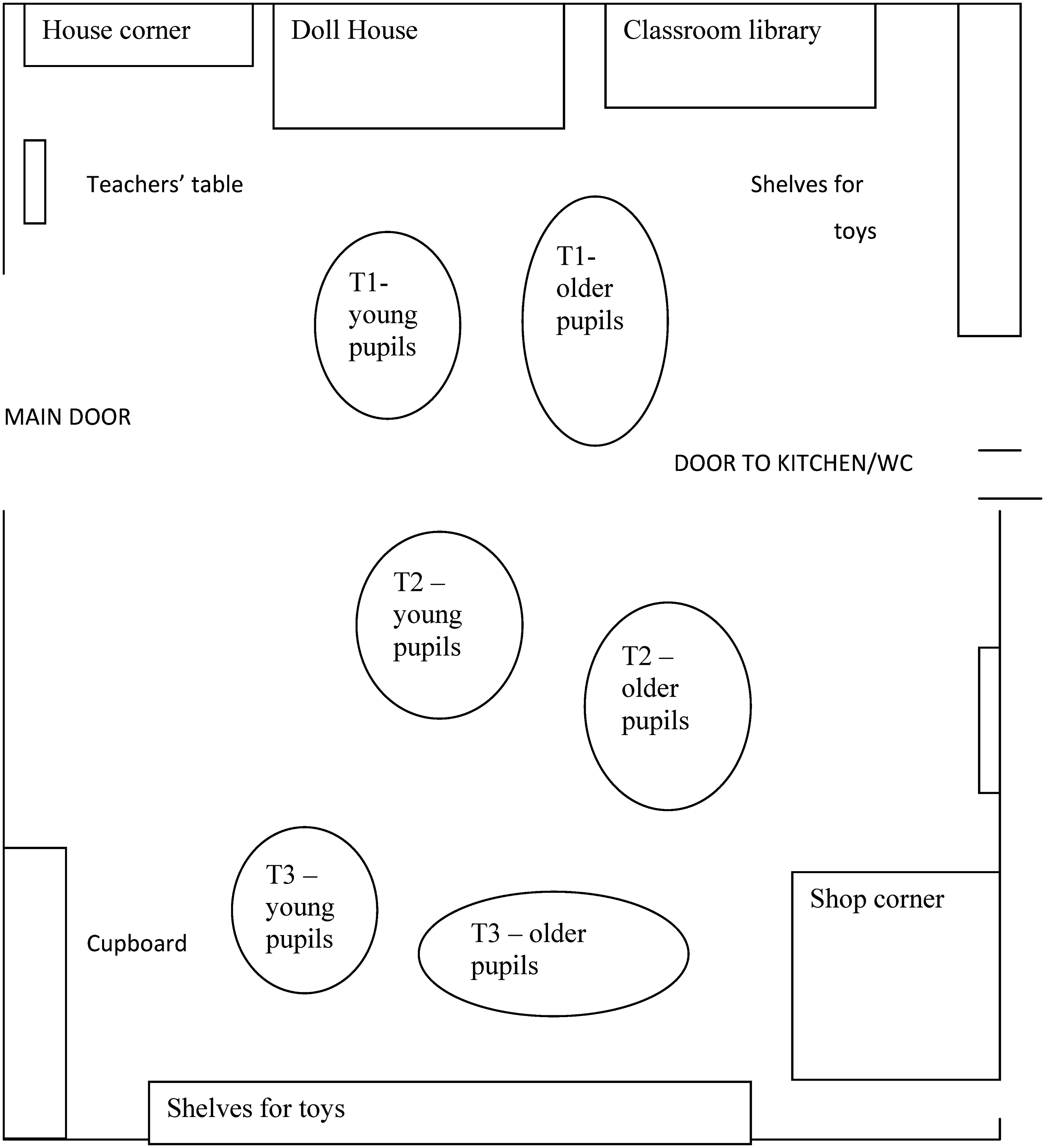


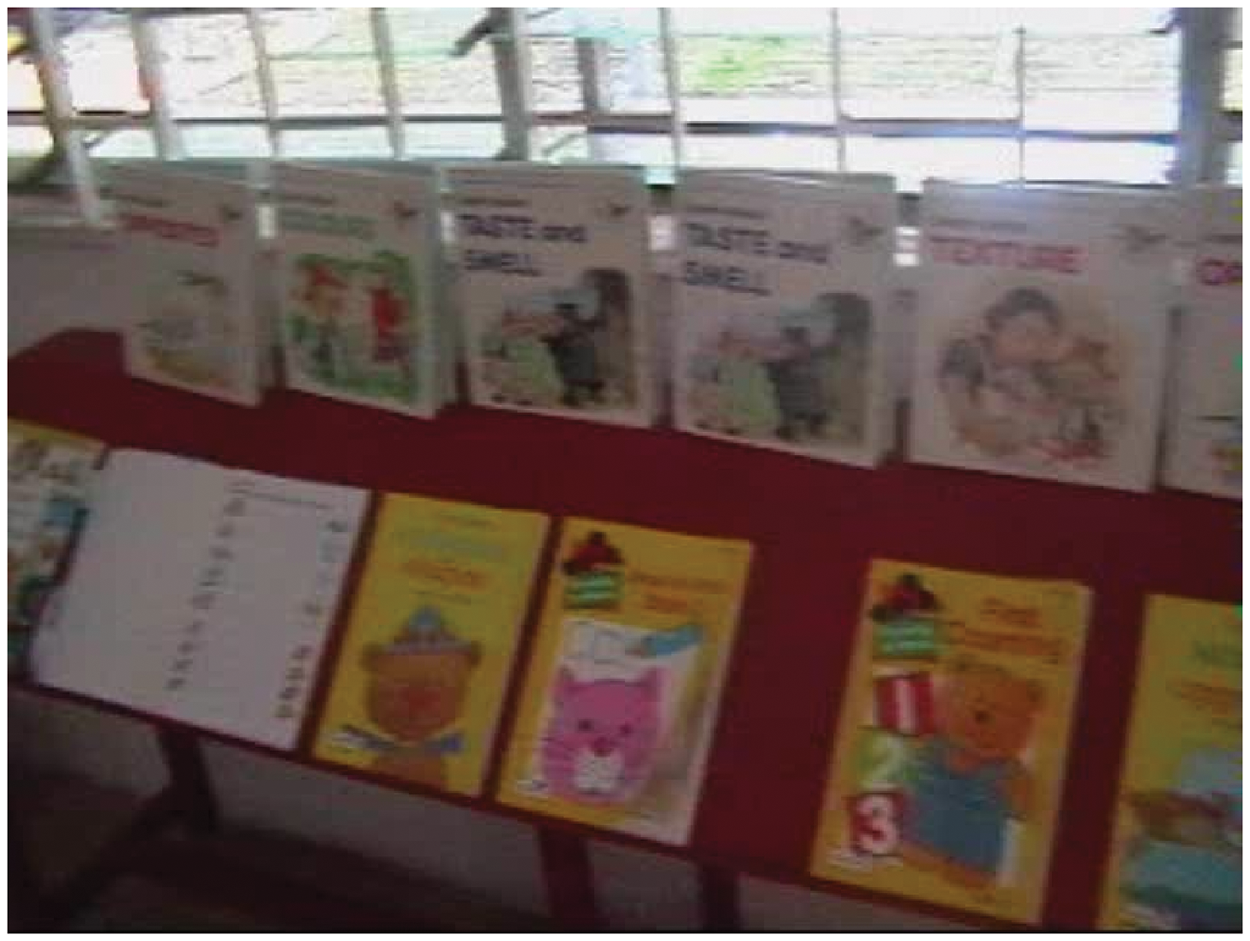
Around the periphery of the classroom are various ‘corners’. The kitchen/doll corner contains kitchen utensils, mattresses and dolls. The classroom library can accommodate six to eight children at a time. It has open shelves (used to partition the classroom library from the rest of the classroom), furnishings (a table, a bench and four chairs), open-faced and traditional bookshelves, library displays (ready-made charts, with songs and rhymes, on the wall – in English) and props, all of which are identified as desirable features for the classroom library (Morrow and Weinstein, 1986; Neuman and Roskos, 1992, cited in Neuman et al., 2001) (Figures 4 and 5). There are between 100 and 150 books, in English and French, in the classroom library. PSA teachers do not however totally agree on the languages of the books. T1 says the books are in English and French; T2 says that most of the books are in English, but there are also French books; T3 says that the books are in English, French and maybe Creole. This gives an indication of the extent of PSA teachers’ familiarity with their own classroom library. The shop corner contains boxes and cartons, which are available on the local market, for the children to play with. The linguistic landscape (Gorter, 2006) in which the children are immersed is one where the European languages are visible, thus making them valued in the educational space. There are also tables for puzzles, games, pencils, coloured pencils, scissors, paint, paintbrushes and so on.
Classroom library 1. Classroom library 2.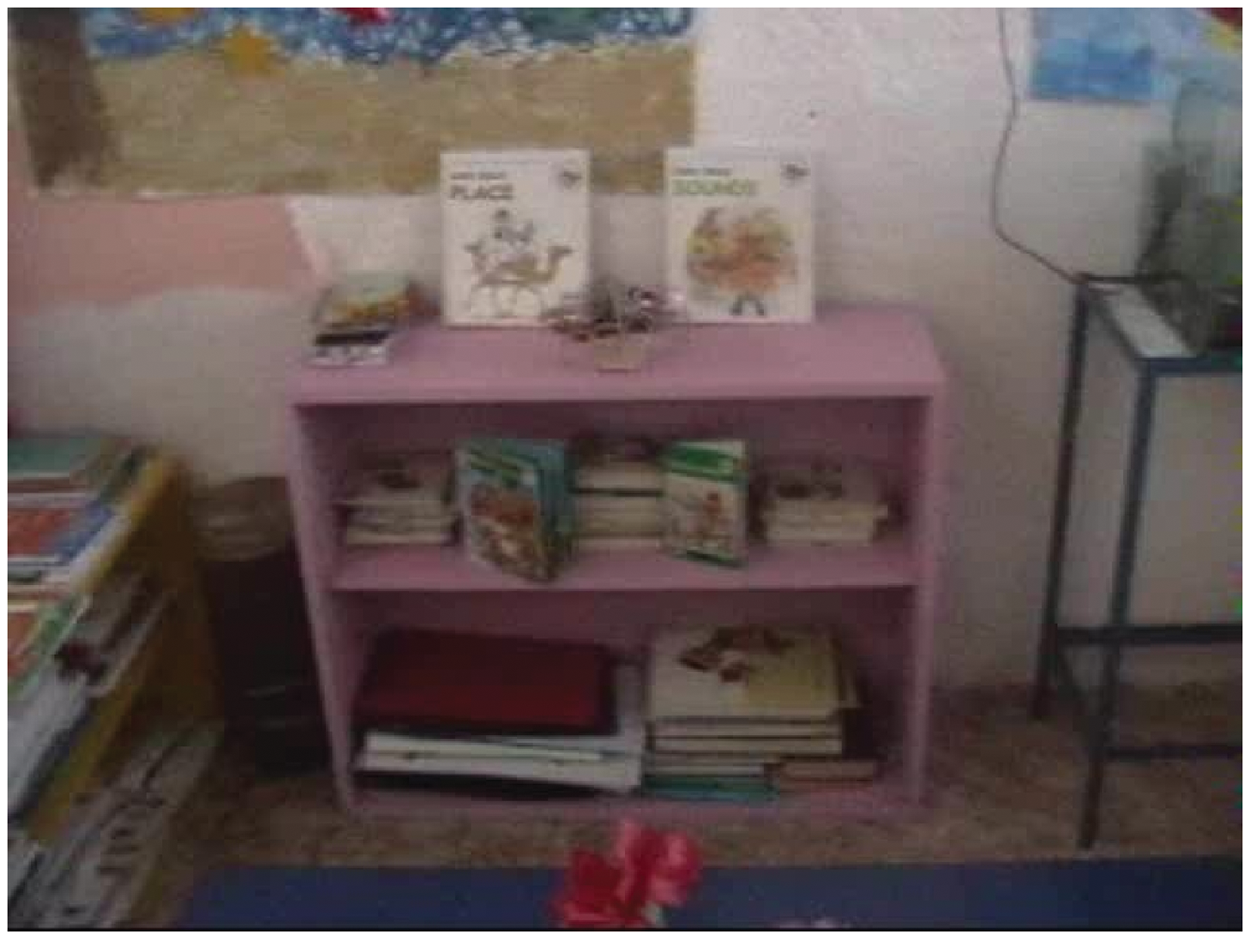
Teachers’ modelling of reading and writing
It was observed that PSA teachers demonstrate the uses and functions of print in the classroom. On a daily basis, PSA teachers were observed making the roll call. They also sit down and write their daily notes during the first 30 minutes of class, while the children are engaged in free play, and they prepare the worksheets on loose pages of paper by hand (they do not have access to a photocopier) (Figure 6). Before they start the morning whole-class assembly, the teachers sit down around the teachers’ table and hand-copy the worksheets, at the top of which they often write the instructions for each activity (always in English), the day and date, as well as the children's names.
Handmade worksheet.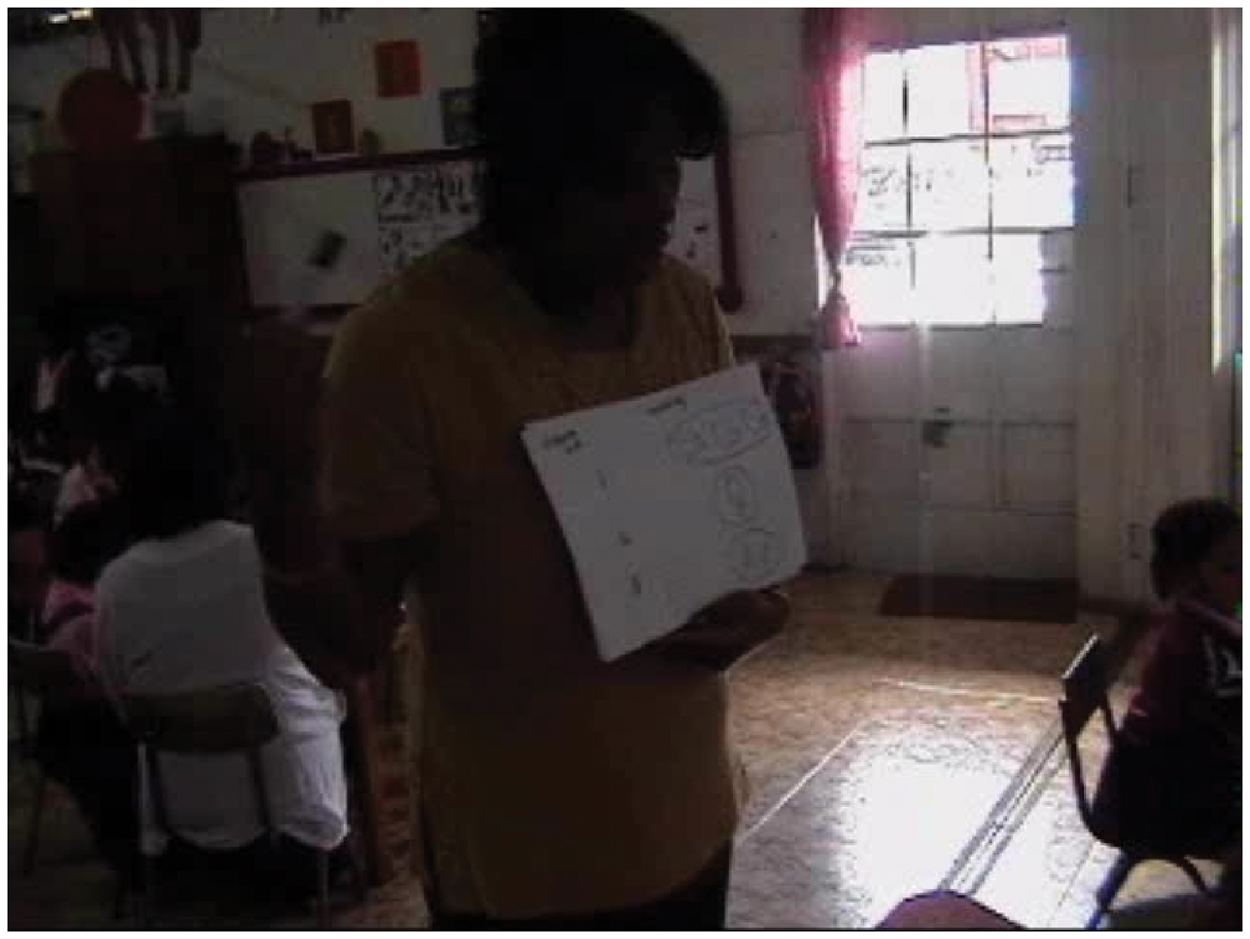
On a more infrequent basis, PSA teachers were observed: writing their weekly plans (once a week); writing their requests for leave of absence; reading a few newspaper articles on education, brought in by one of the teachers, at lunchtime; and writing the lyrics of songs that they were not totally familiar with (on one occasion, T1 wrote the words of a Creole song on a small piece of paper and stuck it discreetly beside a chart). PSA teachers were also observed using a copybook to record important school events. For the June mini-outing and the end-of-year lunch, a copybook was used to record financial contributions to the activities; for the mini-concert organised for music day, a copybook was used to record the name of each child and the songs they would sing.
PSA teachers confirmed these observed activities and added a few more in the post-observation interviews: filling in admissions forms, writing letters to invite parents and teachers to meetings, writing reports on outings and writing minutes of meetings. The print-related activities described above are mostly documentary activities. They are part of the work procedures that are used to control, regulate and monitor workers (Watters, 1996). In fact, these teacher-produced documents were inspected by the TES on each of her visits. In her description of the uses of literacy, Heath (1986) does not include the functions of regulation and surveillance as being part of literacy practice. The Mauritian preschool is an example of the extent to which the uses and functions of literacy are context specific and culture bound. Mauritian society thrives on excessive bureaucracy and paperwork, and the uses of literacy in the school context reflect this.
Direct instruction
Under this code, two main types of activities were observed: those dealing with individual letters, and those dealing with whole words.
The alphabet: Sample of daily notes

From the year-long observations, it appears that the objective of the activities, as articulated in the daily notes is, in fact, a description of the activities. Moreover, it was observed that PSA teachers initially started teaching the alphabet (1) on a letter-by-letter basis, (2) in alphabetical order and (3) as a planning activity, stopping at the letter E. PSA teachers also taught a few more letters (M, P) in a more ad hoc manner during the rest of the year. These were taught as aside activities, carried out when the children had finished their main class activity: children who had completed their worksheets were sometimes given a letter to copy on the reverse side of their worksheets or on a separate piece of cheap kitchen paper (while their worksheets were of good-quality white photocopy paper). As far as direct teaching of the alphabet was concerned, teachers were in an ambivalent position. While they were formally told not to teach the letters of the alphabet by the TES from the Preschool Trust Fund (the institution that oversees their profession), they said it was their duty as preschool teachers to introduce the children to some letters before they entered primary school. They reported that when children go to primary school without any decoding skills, Standard 1 teachers complain to the parents, who in turn come to the preschool to complain to them.
Preschool teachers also stated that there was parental pressure to teach the alphabet to their children. In fact, some critical incidents were observed over the year that indicate how, through their daily contact 2 with preschool teachers, parents exert some form of pressure on them to teach their children the letters of the alphabet. On one occasion (17 February 2005), T1 reported that parents put pressure on teachers to teach their children ABCD, sometimes as early as age three, because parents are academically geared. On another occasion (17 March 2005), T3 stated that one of her students had been slapped at home because he could not write all his letters. She also said that a pupil's parents came to ask her whether she would teach their son to write his letters. She then explained to them that he could not even draw. T3 also reported (25 August 2005) that the parents of three-year-olds sent double-line copybooks to school in order for their children to start learning to write their letters.
Words. Classroom observations reveal that PSA teachers systematically taught the children to write their own names, and then their surnames, through copying. PSA teachers also taught the children to write words related to the daily theme by copying them. Over the year of observation, word copying was a very regular activity in PSA, and occurred within the structure of daily group activities. First, at circle time, the teacher talked about one aspect of the theme being covered that week. Then, the teacher asked the pupils to make a drawing about one aspect of the theme discussed. PSA teachers were sometimes very precise about what the children should draw, guiding the children to make a specific drawing. When the child finished drawing, the teacher asked each child to describe what s/he had drawn – the aim of teachers seemed to be to elicit the word (French or English) taught during the plenary session. Finally, the teacher wrote down, for the child to copy, the word provided by the learner or provided by the teacher in case the learner did not remember it (or gave the Creole word for it). The teachers tended to write the same phrase (English/French) on all the children's drawings. Interestingly, there was almost equal numbers of English and French written words over the year, which indicates PSA teachers’ endeavours to introduce both English and French written forms. Moreover, while only the main English noun was written on drawings, for French, phrases (determiner + noun) were used: this is probably related to the fact that children are more familiar with French than English. Despite the 2003 curriculum guiding teachers to transcribe the children's exact words onto their drawings, it was also observed that PSA teachers did not elicit free (Creole) discourse from the pupils with the purpose of writing it down. They also never wrote down the children's Creole words and phrases to describe any of their drawings. Instead, they translated the children's words into French or English before writing them down. PSA teachers used copying, ringing and matching, respectively, as the main strategies for teaching writing.
Figure 7 is a good example of the way in which PSA teachers juggle with bilingualism and biliteracy in class: while the instruction for the guided drawing is clearly in English – ‘draw eggs under the hen’, the phrase then written by the teacher, which the child copies, is in French – ‘une poule’.
Copying the teacher's words.
The post-observation interviews confirm the teachers’ use of this copying strategy over the year and reveal that PSA teachers used the copying exercise for a number of functions: to develop learners’ oral skills (through questioning), decoding skills (recognising letters) and writing skills (hand–eye movement and coordination). Interviews also indicated individual differences in teacher beliefs and practices: while T1 and T2 were enthusiastic about the direct teaching of word writing and were ready to acknowledge that they did this, T3 voiced her reservations about this approach. She revealed, in an informal conversation, that in some of the other government preschools where she had worked, children were allowed to draw freely and, if they produced any writing, it was of their own initiative. For her, drawing is the natural precursor of writing and if children cannot reproduce visually on paper what they see, they will not be able to write. However, when she joined PSA and teachers there used the copying exercise, she did the same to fit into the school ethos.
It was also noted that, in the last term, PSA teachers asked parents to send in a double-lined copybook, in which they made the children copy the words that they would encounter in Standard 1, e.g. man, woman, boy, girl, box, mug. PSA teachers drew columns in the children's copybooks, made a drawing at the top of each column with the corresponding English word written underneath it, and then the children copied the word in the column, down the page. Children appeared to enjoy this activity as it made them feel ‘big’.
Indirect instruction
‘Functional literacy’ activities. PSA teachers were observed to include what they called ‘functional literacy’ activities in their classroom. This activity, which appeared in the weekly plan four times during the year, was described in the teachers’ daily notes (Table 3), with an example shown in Figure 8.
A ‘functional literacy’ activity. Daily plan: A ‘functional literacy’ activity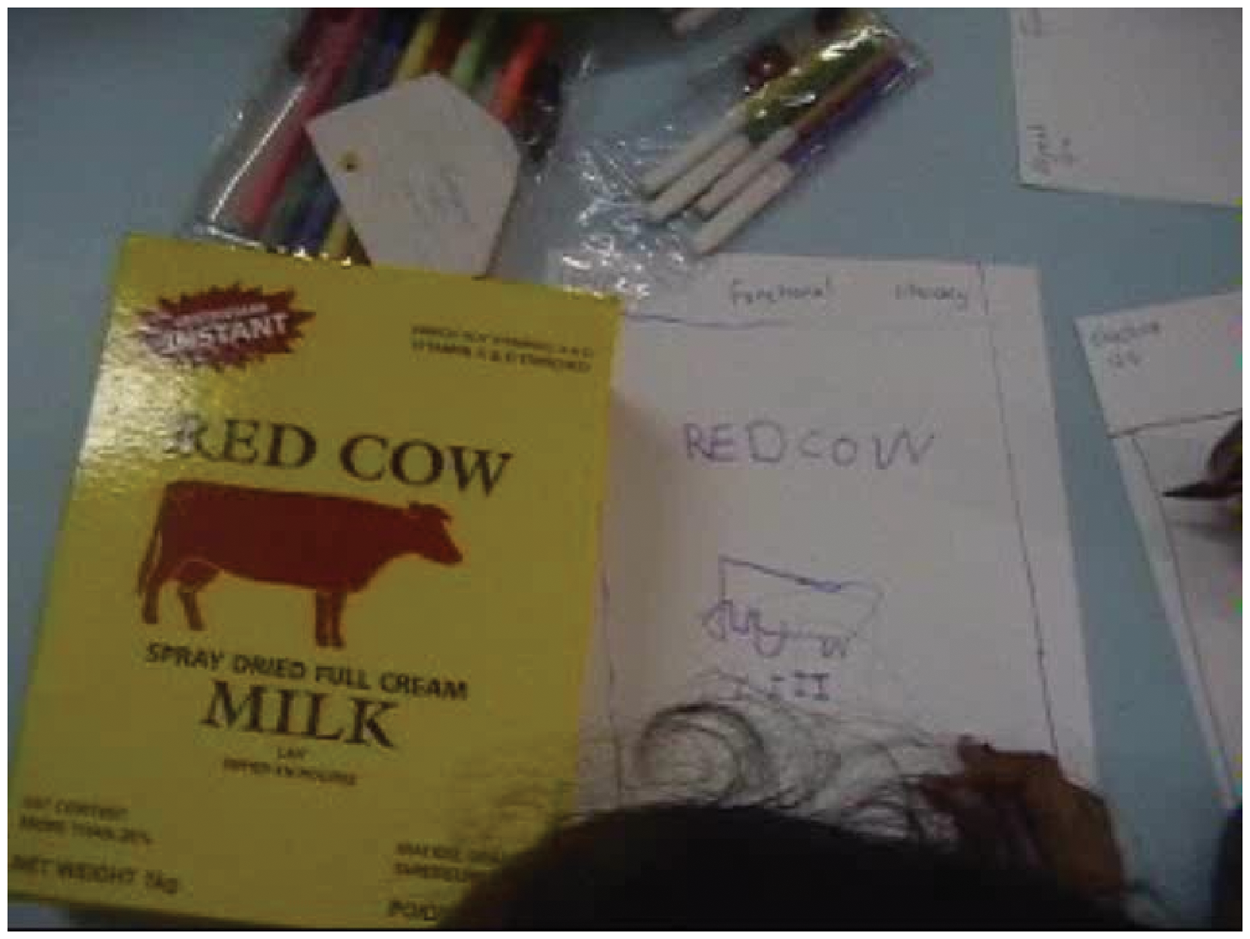


Apart from the boxes from the shop corner, PSA teachers were also observed taking books from the classroom library to carry out a similar activity (field notes, 23 May 2005). This activity is a variation of a ‘copying’ activity. According to T2, the aim of this ‘functional literacy’ activity is to make the children aware of and teach them that there is print in their immediate environment. Since the preschool print environment is predominantly in English and French, and since the children regularly copy English and French texts, which parents see when they visit the preschool, this reinforces local language ideologies about the European languages being the acceptable and desirable print languages. Children are in fact socialised into seeing English and French texts as normal print languages, internalising the view that these languages are superior print languages.
Name writing. While PSA teachers write the young children's names on their drawings, they encourage the older children to write their own names on their work. For the older children, who took more time to learn how to write their names, PSA teachers gave them a name-copying activity (Figure 9).
Practising name writing.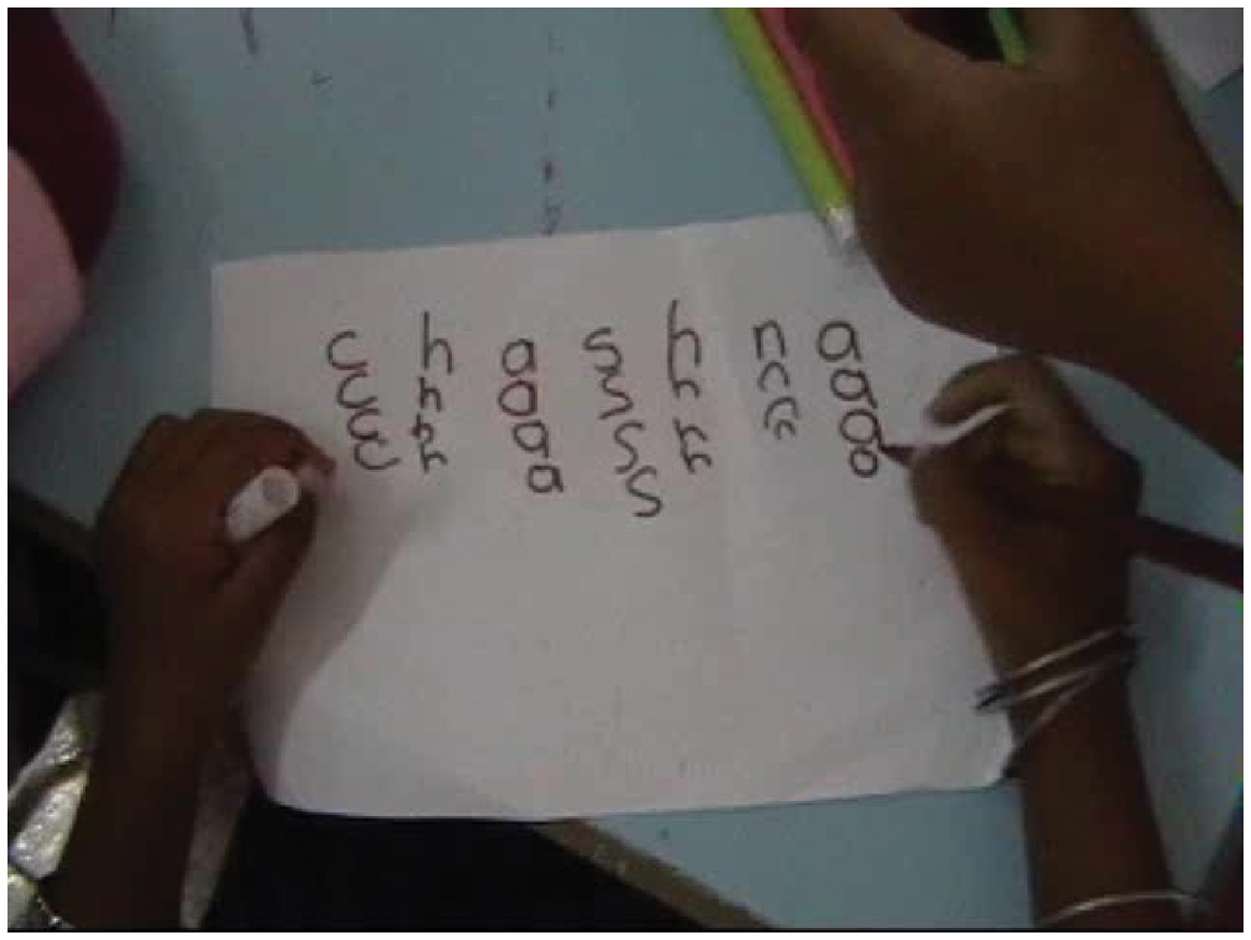
As seen in Figure 10, one of the children writes his name from top to bottom, rather than across the line, as he probably finds it easier to use the copying strategy and write the same letter each time. Done this way, the exercise loses some of its meaning.
A child writing from top to bottom.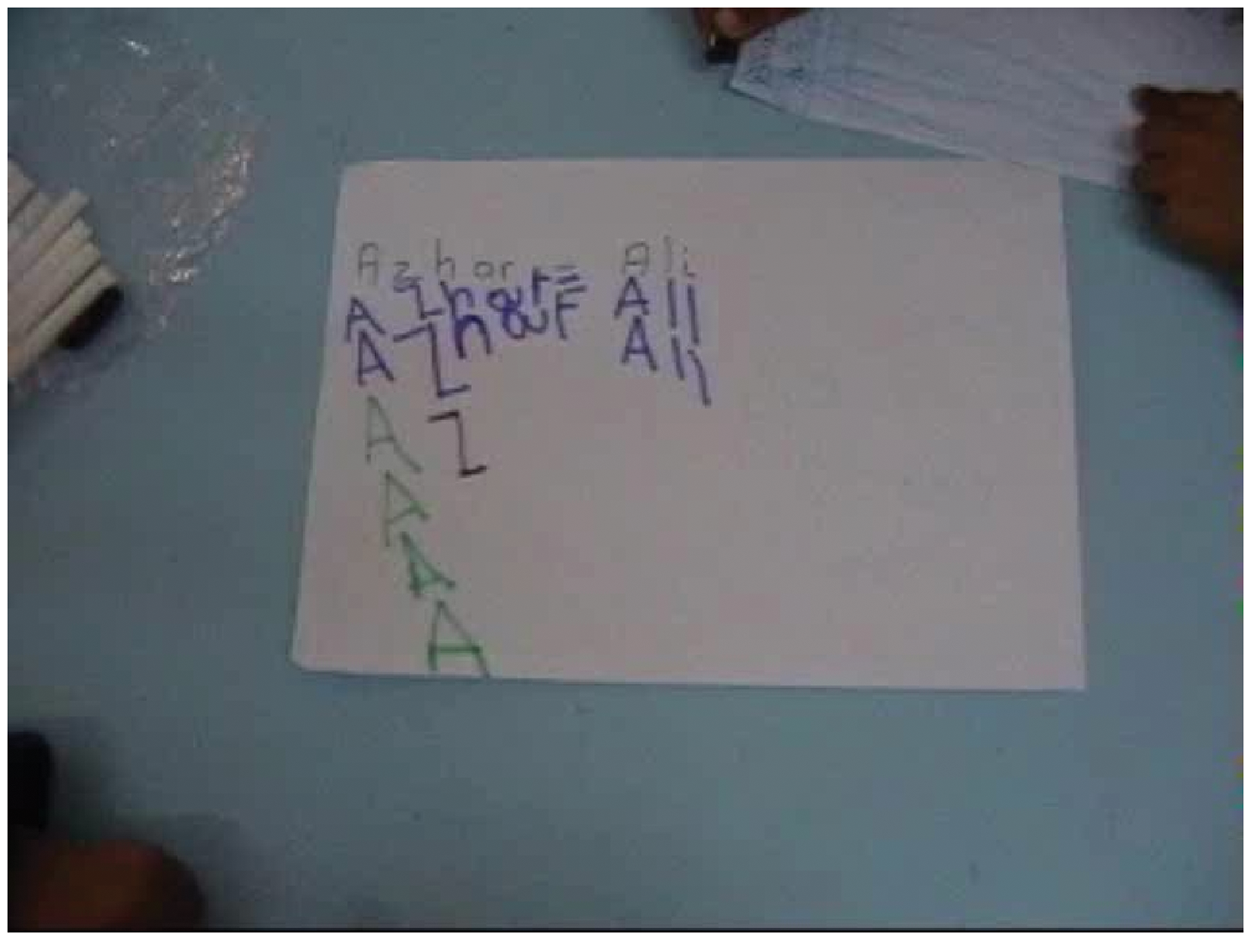
Reading: The use of books. The classroom observations indicate that books were rarely used in daily class or in small-group activities in PSA. On one occasion, T2 used a book to show the children a picture of a sea turtle. On another occasion, T1 used a book to read a short passage about crocodiles. Since the text was in French, the teacher read in French and then translated into Creole. On yet another occasion, during one of the visits of the TES, a teacher took the smaller children to the library and read to them from a book (in French), while the older ones were doing their written maths worksheet.
Daily plan: ‘Library corner’ activity

These library sessions were used primarily to make the children aware of how to correctly place the book in front of them, the direction in which to turn pages, and how to care of a book. In other words, these sessions presented the book as a physical object, as an objet d'art to be handled with care, rather than as an entertaining and informative tool.
Daily plan: Storytelling activity

During the post-observation interviews, I asked PSA teachers how often they tell or read a story to the children in a typical week. T1 said ‘every Friday’, T2 said ‘one to two times a week’ and T3 said ‘once a month’. As well as not agreeing with each other on the frequency of reading sessions, the teachers’ claims did not tally with their weekly plans. Despite the official presence of ten storybook sessions in the weekly plan and the PSA teachers’ claim to engage in fairly regular storybook reading, it was observed that the scheduled weekly storybook reading sessions did not always take place. For instance, on one occasion (field notes, 3 May 2005), I enquired which story had been read in the scheduled reading session (programmed for the eve of my visit). T1 explained that they had not had time for the story session as that had been the first school day after the Easter break. On another visit (field notes, 12 July 2005), I asked T3 which story she was planning to read that Friday. She mentioned that weekly plans are generally flexible and that they might actually not have time to read to the children that week.
Since my regular weekly visits to PSA did not coincide with any story reading sessions, I arranged with T1 to attend the session scheduled for Friday 30 September 2005. I acknowledge here that interpreting a story reading session carried out at my request is methodologically limited and therefore needs to be interpreted with extra caution. However, since I wanted to observe the language used by the teacher to tell the story and the interaction between teacher and pupils, I was confident that the immediacy of the context would be more powerful that any preparation for the story reading session might have been. T1 went to the library corner and selected a book, Blanche Neige et les Sept Nains (Snow White and the Seven Dwarfs), a classic fairy tale. T1 says she chose a French book for the children's ease of understanding; English storybooks are hardly used because the need for translation diminishes the children's enjoyment. She then took her group of pupils (n = 14) for the story-reading session, while the rest of the class (n = 38) carried on with the class activities in the same classroom; the noise was audible. Since there was not enough room for all the children in the classroom library, the children were required to move their chairs and place them in a semicircle in one corner. T1 started by asking the children if they knew any stories and if their parents ever read to them. Most of them said they were never read to from a book at home, though some said that they were told stories; two children mentioned Le Petit Chaperon Rouge (Little Red Riding Hood) and Pinocchio; one child said that he was read to at home, and he was able to retell the story of Les Trois Petits Cochons (The Three Little Pigs) at the teacher's request. Placing the fairly small storybook on her lap during the whole session, T1 read the story. During the reading session, T1 recurrently switched to MC to interpret the story. She also regularly stopped to ask questions (in French and MC) in order to check whether the children had understood. After she had read one third of the story, which took some twenty minutes, the children were no longer concentrating, so she said that she would read the rest of the story the coming Tuesday.
It is interesting to note that in arranging the children a round her in a semicircle and in changing the tone of her voice as she was imitating the stepmother, she was abiding by the tips mentioned in the teacher training manual: ‘The teacher as story-teller: seating arrangement; role play story, hold book for children to see; do not interrupt story reading session, allow children to choose books, have as many story reading/telling times as possible in the day’ (Mauritius Institute of Education and Mauritius College of the Air, 2003a, p. 42). This ‘by the book’ approach might have been driven by my request for a reading session and by my presence in the classroom. The switches to MC during the reading session indicate that the teacher was not confident that the children were understanding the whole story as it was being read in French. MC was used as a support language in a class where all the children are native speakers of MC and use MC to communicate with each other, the teacher and the helper. The teachers, however, tended to use more French with the children, with occasional switches to MC (Auleear Owodally, 2010b). The storybook reading sessions illustrate the linguistic challenges teachers face when reading to children in a language that is different from their home language.
Discussion
In light of the above findings, it is apparent that there is a discrepancy between the spirit and the discourse of EL found in the 2003 curriculum and teacher training manuals, and classroom realities and pedagogical practices in PSA. Although teachers could be held responsible for what takes place in the classroom, this would be a simplistic view. The language ecology model (Hornberger, 2003; Mühlhäusler, 1996), Cortes's interaction model (in Freeman and Freeman, 2001, p. 2) and Brofenbrenner's (1979) social-ecological model suggest that teaching and learning are part of a complex situation that contributes to shaping teachers' choices and practices. In the coming discussion, I take a holistic approach to explore some of the reasons why PSA teachers adopt the observed practices when initiating children into print and decoding skills in preschool.
The language factor
The sociolinguistic context in which preschool teachers and learners find themselves can be described as an awkward situation: although they are immersed in an MC-speaking environment, English and French are the dominant languages of education. The term linguistic paradox was used by Bissoonauth and Offord (2001) to describe this situation, but the term conceals a more profound paradox, which is a literacy paradox. While most Mauritian children speak MC, they are surrounded by print at school that largely excludes MC in its reproduction of the local linguistic landscape (Gorter, 2006) where road signs, billboards and advertisements are for the most part in English and French. This might explain why the teachers find it so difficult to make direct reference to the print that surrounds them. If we refer to Figure 3, the uses of water are written in English on the teacher-made poster, English being a language that the children do not speak and a language that is not part of their environment. The conversation on the theme of water was teacher-directed, with the teachers asking questions in French. The children's answers were in MC. During the week when teachers worked on that theme, they made reference to the drawings on the poster to elicit the uses of water from PSA children. However, since the children always responded in MC, the link that could have been made between the spoken and written word was lost. Similarly, if we consider the functional literacy activity, its aim is to make children aware that there is print around them and that this print carries meaning. However, this literacy activity turns into a language lesson as the teacher feels that she has to explain the meaning of ‘Everyday’. By focusing on the English word, the opportunity to teach the alphabet and the relationship between phoneme and grapheme is lost. Hence, in subtle ways, the language factor becomes a barrier to meaningful exposure to print and the literacy paradox contributes to the cosmetic way in which preschoolers are introduced to print.
The language barrier also comes across very strongly in the reading sessions, or the near absence of reading sessions, at PSA. First, the ten planned storybook reading sessions over the year by and large under-represent the daily storybook reading mentioned in the teacher training manuals, they also under-represent the teachers’ (T1 and T2) claims for the number of story reading sessions they have over the year, and they under-represent a practice considered a standard daily activity in developed countries. Conversely, these ten planned storybook reading sessions probably over-represent the actual storybook reading sessions that occurred over the year. This does not mean that PSA teachers are not aware that they should read: the fact that they include storybook reading activities in their official weekly plan, and the fact they claimed to be reading more often than they actually did, indicate that they are aware of the importance of reading and of the necessity for them to read storybooks to the children. Yet, there is a general paucity of storybook reading activities, which appears to be a fairly general phenomenon across the preschools visited during the pilot study and in South African preschools (Bloch, 1999), and this could be related to a lack of reading materials. However, Mauritius cannot be said to fit the developing country paradigm, where the term ‘book famine’ (Walter, 1996, p. 133) has been used to describe the extreme scarcity of reading materials. In fact there are between 100 and 150 books in the class library (Figures 4 and 5). Hence the data from PSA suggest that the presence of books in a library does not necessarily ensure that pupils and teachers will actually read the books and develop a reading habit or culture. A study carried out by Auleear Owodally (2005) among Standard 5 pupils in two government primary schools also indicated that the presence of a school library does not equate to its (regular) use by students. Similarly, Commeyras and Inyega (2007), who did research in Kenya, also say that the availability of instructional materials and resources does not guarantee regular use. Dlamini's (2003) experiment with secondary school pupils in Swaziland – where she provided access to library books – also indicated that despite having access to library books, pupils failed to develop a reading culture. Dlamini suggests that the experiment failed because it was carried out too late in the pupils’ lives and hypothesises that the same should be carried out with younger primary school children for a reading culture to develop. The PSA experience is an example of a situation where preschool teachers are literate, are provided with adequate libraries, and have children who are young enough to develop a reading culture, and yet fail to do so. This illustrates the difference between illiteracy, the inability to read, and alliteracy, the absence of reading. So why is there such hesitation on the teachers’ part to read to the children?
The inability to read storybooks regularly has been associated in the literature with linguistically unsuitable books. Elley (1996) observed that a number of libraries in the developing world lack storybooks in the readers’ first language. This is the case in PSA, where the classroom library is full of French and English books, languages that are second or foreign to the children, but contains only a couple of Creole storybooks, which were lost in the library and not scheduled in the storybook reading sessions. This situation at the level of the preschool class library replicates the state of affairs in Mauritian libraries, which are full of books in European languages but lack books in MC, thus reinforcing local language ideologies about the supremacy of English and French as print languages and valuing these languages as languages of literacy and of knowledge. There are practical reasons (unavailability of Creole books, compared to the availability of English/French books), attitudinal reasons (positive attitudes to European languages compared to MC) and financial reasons (it is economically safer for bookshops to invest in English/French books than it would be to invest in MC books because of limited readership in MC) that explain this state of affairs which is not atypical of African contexts. Banda (2003) says that when there are more materials in English than in the local language(s) outside the classroom, it fuels the perception of English being the power language and hence the key to genres of power, and Bloch and Edwards (1999) claim that there are warehouses full of children's books in African languages in South Africa which nobody wants or can afford to buy.
There was one critical event that forcefully revealed the linguistic ideologies (Woolard, 1992) underlying and influencing PSA teachers’ choices of language(s) of literacy and practices. On 25 August 2005, the teachers presented me with a book of stories in MC that they had been offered by the Pre-School Trust Fund to read to the children: Sa bann pli zoli zistwar: Ses plus belles histoires (His Most Beautiful Stories – in MC and French) by Fanfan, a popular local séga singer. An analysis of the 73-page book revealed 11 stories (in French and MC), six full-page painted etchings, five half/part-page etchings and five part-page sketches. PSA teachers expressed their reservations about the book for a number of reasons. First, they claimed that the language was vulgar. Second, they mentioned that the book was not at the level of the children in terms of complexity of language. Third, they said that the book contained too many stories and too few illustrations. Finally, they declared that they had no competence in reading in Creole, since they had received no training. Hence, this book was not placed in the library and was not utilised. In fact, when T1 read to the children, she chose a French book. This reading session turned out to be a time- and energy-consuming activity since the language of the storybook was not in language that the children readily understood. Thus, T1 translated the story into MC and interpreted it in MC, so that the meaning would come across more clearly to the children. It thus seems that the teachers’ attitudes to MC, reflective of the attitudes of Mauritians to MC (Rajah-Carrim, 2007) and of Creole speakers worldwide to their language (Siegel, 1999), hinder them from making use of their language and the language of the children as a language of storytelling and of literacy.
Introducing preschoolers to the printed word in an environment where their home language is not standardised, valued or popular in its written form is clearly a challenge for any preschool teacher. In such a situation, the importance of contextualised teacher training is not to be underestimated. Yet, the curriculum and the teacher training manual seem to take an overtly theoretical approach thus failing to provide guidelines on the ways in which teachers can develop appropriate pedagogical strategies to initiate children to literacy in the face of a complex sociolinguistic context. If storybook reading is considered, the curriculum and the teacher training manual describe reading as a normal feature of the preschool setting, but falling short of engaging with the complexities of reading English and French books to young native speakers of MC who have little, if any, proficiency in these languages. The teacher training manual does not enlighten teachers about the strategies that they might use to introduce children to entertaining print in languages that they do not know. In brief, the teacher training manual does not problematise reading in the local context. Failing to empower teachers to read storybooks in MC through contextually relevant training, the teacher training course does not help them to challenge the dominant language ideologies about the inappropriateness of MC for reading storybooks to native speakers of MC.
In similar fashion, the 2003 curriculum and the teacher training manual fail to acknowledge the difficulties, both in terms of practical problems and attitudinal challenges, teachers would face if they were to adopt the recommended whole-language approach to literacy instruction. Both documents state:
if the children say what is taking place in the drawing, and this is written under their drawing, in their own precise words, (without being subjected to an approximate translation by the educator), then the purpose of motivation for writing will have been achieved. (Ministry of Education and Scientific Research, 2003, p. 41; Mauritius Institute of Education and Mauritius College of the Air, 2003b, p. 21)
However, they do not take into account the fact that, in Mauritius, while most preschool children and teachers are native speakers of MC, most teachers are not literate in MC. Indeed, during the year spent at PSA, not once was a teacher observed writing children's MC words verbatim as they produced learner-initiated creative texts in MC. Since Creole literacy does not form part of the education system, PSA teachers do not know how to read, write or spell in Creole; nor do they know how to teach children to read, write or spell in MC. Moreover, although various orthographies have been proposed for MC (Mooneeram, 2007), there is no nationally recognised standardised orthography. It is only recently, in 2004, that a harmonised orthography was proposed and an all-Creole dictionary published (Carpooran, 2009). This practical difficulty with regards to MC orthography is exacerbated by teachers’ negative attitudes to Creole as a language of literacy, attitudes that make them feel insecure and uncomfortable with writing in MC. PSA teachers expressed strong reservations about L1 literacy and L1 education in the post-observation interviews, saying that if the exams are in English, then what was the use of teaching MC or teaching through MC? Such findings about attitudes to MC as a written language replicate those of Rajah-Carrim (2007). Using the whole-language approach, which assumes teachers’ literacy proficiency in the language being written down, is thus a major challenge for Mauritian preschool teachers, a challenge that their training does not prepare them to meet.
Mauritius: Cultural specificities
With its insularity, its colonial past, its heterogeneous population, its efforts to become a developing nation and its competitive education system, Mauritius has certain cultural specificities that can be evoked in order to explain some of the pedagogical practices preschool teachers use as they initiate children into the worls of the printed word.
While reading for pleasure is a popular practice in European and American preschool contexts, as is evidenced in the rich literature on the importance of pleasure storybook reading for young children, it is not necessarily a common practice in Mauritius
Like other post-colonial settings, Mauritius also has a copying culture. Unable to adopt a whole-language approach to literacy instruction for the reasons discussed above, teachers were observed to rely on a more timid bottom-up skills-based approach, which involves ‘copying letters and words’ types of activity. The data indicate that copying dominates as a strategy to teach literacy: children copy their names, they copy letters of the alphabet, they copy the words that teachers write on their drawings, they copy the words written on boxes and in books. Although it is true that learning to write is done through copying, Garton and Pratt (1998) argue that the traditional approach to writing can lead children to develop strange notions about the reasons for writing, downplaying creative written language production and often reducing the child to a passive recipient, one who is only expected to copy and repeat what s/he sees in tightly controlled school activities. This is clearly exemplified in some children writing from top to bottom when asked to copy their names (Figure 10). Students are not initiated into exploring the purposes of the texts they are made to write/copy: this writing activity type is not embedded in the social activities of everyday life (Currie and Cray, 2004). The writing system is thus brought down to a ‘school subject, divorced from its social purposes and functions’ (Ferreiro, 1992, p. 149). Garton and Pratt (1998) propose that learning to write consists of a diverse range of skills and understandings: (1) early distinctions (child distinguishes a drawing from writing); (2) letter formation and printing skills; (3) functions of the written word; and (4) putting the message into writing. The data here suggest that PSA children might not go beyond the development of the basic skills described in the first two stages.
Related to the issue of copying is the observation that PSA children did not show evidence of experimenting with creative writing in the preschool classroom. Read against the literature on emergent writing, the data from PSA reveal that children's writing development lacked experiments with invented spelling (Wilde, 1991, cited in Kamii et al., 2001; Lipson and Wixson, 2004), 3 and that the students did not explore the relationship between letter form and sound, which is a usual stage in the development of literacy and writing in first language learners and which promotes PA. It seems that this is closely related to language issue: if Mauritian children produce written texts, they should be in MC. Since the environment is not supportive of them writing in MC, in the sense that the environment does not encourage the children to experiment with and explore the conventions of writing through creative writing, they do not write texts on their own. For them, in the school environment, writing is associated with correct spelling. Kress (2000) makes the distinction between writing and spelling. He says that while the former tends to be the children's interest and focus, the latter tends to be the school's interest. The data here suggest that the school's interest overwhelms the child's interest, and so the child is socialised into becoming a school subject. This, however, cannot be taken out of context as ‘Spelling is not about fashion, but about the anxieties produced by wider and deeper social, cultural and economic factors’ (Kress, 2000, p. 7). Since teachers form part of a culture where correctness is valued, they emphasise the practice of correct spelling from preschool level. Indeed, the local educational and literacy culture can be characterised as a prescriptive culture with behaviourist language teaching approaches, with notions about developing early and good habits of correct spelling.
As well as there being practical reasons why teachers use copying as a popular print/decoding activity, copying has ‘cultural resonance’. Memorising, to which copying is related, is a practice observed in the madrassah in Mauritius (Auleear Owodally, 2011), as in madrassahs in other parts of the world (Maddox, 2005; Wagner, 1986) and among Chinese learners (Li, 2006). In fact, Dyson (2010) has problematised early Western conceptualisations of copying, illustrating the complexities associated with copying and suggesting that copying mediates relationships. The cultural resonance of copying in the Mauritian setting might explain why, throughout the year, there was hardly any evidence of young children being given the opportunity to experiment with invented spelling in the preschool context or with producing such texts on their own.
Although I would not go as far as to say that the literacy-related activities carried out in PSA are decontextualised, that they are not situated in ‘communities of practice’ (Gee, 2000, p. 50), I would argue that literacy is essentially associated with the formal, the institutional and the school. Very early in the education system, PSA children are socialised into approaching literacy in a culturally specific way, where attention and rigour are emphasised, and where the more functional, pleasurable and creative purposes of literacy are underplayed. This might have an impact on their attitudes to and their relationships with print.
The washback effect of Standard 1
The teachers’ negative attitudes to written MC and their immersing of the children in the formal languages of literacy cannot be dissociated from the local educational system within which the preschool is firmly grounded. According to official figures, the gross enrolment rate was 96% at preschool level and 101% at primary school level in 2009 (Central Statistics Office, 2010). Like many post-colonial, fast-developing countries, the education system in Mauritius is highly competitive, with a selective examination at the end of the primary cycle (which determines the quality of secondary school children go to) and at the end of the secondary school system (where scholarships are offered to a small group of students). This culture of competition trickles down to the preschool sector and preschool teachers feel they have to prepare children for Standard 1. For instance, PSA teachers train the children to develop certain eating and seating habits in view of the culture of Standard 1. PSA teachers also said that they have to ‘discipline’ the children to face the shock of Standard 1, where the children have to work regularly for the whole day from 9.00 am to 3.20 pm, and where they have to eat on their own because primary school teachers do not have the time to feed forty children during the short break time. Similarly, throughout 2005, PSA teachers repeatedly made reference to the Standard 1 syllabus and the pressure they felt the syllabus exerted on them. This perceived pressure arguably had a washback effect on their teaching practices (Spratt, 2005).
One particular example of the washback effect of Standard 1 is the teaching of the alphabet and word copying. Although teachers are explicitly told to avoid direct teaching of the alphabet and words by the TESs who visit them, PSA teachers do engage in some alphabet teaching and word copying. Wright (2001, p. 62) says:
… rather than failing to understand, the teachers may instead be choosing to interpret the L2 curriculum in their own ways, and that these choices are based on their own concerns about what is best for the students, what is possible given the constraints of their material circumstances, their beliefs about the students and their families, and in some cases, awareness of their own capabilities and limitations as teachers.
In their pedagogical choices and practices related to literacy instruction, the teachers demonstrate their agency; they resist and contest the curriculum guidelines, the training manual and the TESs. However, despite the fact that they have agency and choices, these choices are limited by the local context within which they operate (cf. Fisher, 2010). Believing that it is their duty to prepare preschoolers to meet the literacy challenges of Standard 1, but not having been trained to do so effectively, they adopt literacy instruction strategies that are rooted in their own school experiences (cf. Volk and de Acosta, 2001) and reflect the practices of the local community.
An analysis of the Standard 1 textbooks suggests that the fears of preschool teachers may be justified (Auleear Owodally, 2008). While the Standard 1 English textbook introduces children to graphemes, assuming that the children have limited notions of literacy, the maths and environmental studies Standard 1 textbooks record complex written instructions in English. Similarly, there is a gap between the English and French textbooks. In a comparative analysis of Standard 1 French and English textbooks, Auleear Owodally (2007) argues that while the French textbook introduces Standard 1 learners to whole texts in French, thus assuming that children have certain oral language and such decoding skills, the English textbook introduces learners to individual letters, thus assuming that children have no such decoding skills. The lack of coherence among the Standard 1 textbooks thus exerts some pressure on preschool teachers to ‘prepare’ the children for the challenges of the first year at primary school.
Conclusion
In this paper, I have described and analysed teachers’ pedagogical practices as they expose children to print and to decoding skills in a Mauritian preschool, highlighting the various challenges met by the teachers as they attempt to do so. These findings suggest the importance of considering the complex ways in which linguistic, cultural and educational specificities, often mediated through language ideologies, constrain teachers as they attempt to build bridges between the theoretical discourse on EL, which they have been exposed to through the curriculum and teacher training, and their own pedagogical choices and practices. These findings challenge researchers and practitioners, across contexts and exposed to a Eurocentric research base, to rethink their assumptions about literacy and literacy instruction. This case study also reveals how implementational spaces (Hornberger, 2002) are firmly situated in social and cultural spaces. In post-colonial contexts such as Mauritius, such spaces are themselves caught between the vestiges of a colonial past and the pressures of a globalised world where European languages, especially English, have pervasive force. Although some countries (e.g. South Africa) have adopted a multilingual language-in-education policy, teachers still face the challenge of dealing with their own language ideologies and attitudes to English, given the power of English inside and outside the classroom. Hence, it seems that the successful implementation of multilingual language-in-education policies could lie in the provision of enhanced English language teaching and enhanced English literacy instruction. In such cases, mother tongue literacy will not be perceived as a threat or a tool used to ghettoise people. Any change in language policy will also require heavy investment in reading materials and teacher training, as well as work with teachers, parents and communities on the value of multilingual education. This is a challenging task in a context where stakeholders are part of an education system that has long valued literacy in European languages while devaluing mother tongue literacy.