



Abstract
With the revolution that has taken place in the functionality and uptake of portable networked ‘smart’ technologies, educators are looking to see what potential applications such technologies might have for school education. This article reports on a study on the use of portable personal computing devices in the early years of schooling. Specifically, it focuses on emerging patterns of use of Apple iPads in an Australian Preparatory (first year of compulsory schooling) classroom during the first year of implementation of these devices. We draw on student and teacher interviews and classroom observation data to provide a research meta-narrative of the intentions, practices and reflections of a ‘first year out’ teacher, and to discuss points of tension found in the contested space of early years literacy education, which are highlighted when potentially transformative technologies meet institutionalized literacy education practices. Our findings suggest that the broader policy and curriculum context of early years literacy education, and institutionalized practices found in this space, is potentially at odds with teacher-held intentions to transform learning through technology use, particularly with respect to tensions between print-based traditions and new digital literacies, and those between standards-based classroom curricula and more emancipatory agendas.
Keywords
Introduction
This article reports the findings of a qualitative study investigating the use of Apple iPads to support literacy learning in the early years of schooling. The study is located in the state of Victoria, Australia, in a small rural, state-funded primary school and focuses on the Preparatory or ‘Prep’ year, which is the first year of compulsory schooling in this state, with children usually aged, or soon to turn, five years old at the beginning of the school year. The study was instigated after anecdotal stories of innovative practice as, in June 2010, this school became the first in its district to purchase iPads for student use and placed them in the care of the Prep teacher and her 20 students. The article is a story of innovation in a broader context of curricular conservatism. It is a story of a ‘first year out’ teacher navigating a path between her innovative vision for classroom teaching and learning, the allure of established classroom practices, the ‘push’ of commercial content, and the conservatism of the broader context. It is also a story of the social construction of a technological artefact as it is contextualized and re-contextualized within a particular educational setting.
Goodson (2003) argues that stories should be located, because it is the interplay between a particularized story and social context that leads to new understandings. As an introduction to these stories, we first locate the meta-narrative presented by providing background information about the Australian curricular context as it pertains to early years literacy and the positioning of information and communication technology (ICT) within this context. With reference to this context, children’s capabilities in out-of-school techno-literacy practices are also discussed. We then locate the study by providing details particular to the research site and to the research relationships and pedagogical perspectives that influence and frame the arguments presented here.
Policy context: Early years literacy in Victoria, Australia
An important aspect of the broader context of this study is the practices that currently dominate early years classroom literacy teaching in Victoria and elsewhere, the discourses that compete within this pedagogical space, and the interactions between these discourses and practices and those constructing ICT use in primary schools. Early years literacy education was historically, and continues to be, a highly contested field (Snyder, 2008). As in the UK (Layton and Miller, 2004) and the USA (Goodman, 2011), in Australia large-scale reviews of literacy teaching (e.g. the National Reading Panel (NICHHD, 2000) in the USA; the Rose Report (Rose, 2006) in the UK; and the National Inquiry into the Teaching of Literacy (NITL, 2005) in Australia) have supported the development of centrally mandated standards-based curriculum frameworks composed of stipulated ‘essential’ knowledge and skills which, particularly in the area of literacy, are enforced via regimes of teacher in-service training, teacher-administered assessment and external testing and reporting. The focus of national reports on ‘evidence’ privileges the explicit teaching and testing of sequentially mastered traditional literacy skills (Oakley and Fellowes, 2011). Early literacy in the Victorian Essential Learning Standards (VELS) (State Government of Victoria, 2007) curriculum focuses heavily on traditionally conceived print-based skills which run in tandem with stringent accountability policies and practices and, through the Early Years Literacy Program (EYLP), ‘coaches’ work with teachers to collect data and guide assessment (Auditor General, 2003; State Government of Victoria, 2010). Ohi (2008: 102–103) argues that EYLP positions teachers as implementers, ‘… [prescribing] when and how to teach by the implementing of a set protocol for the reading hour, a small range of instructional methods and prescribed assessment tasks’. Thus, the broader context of this study is one in which schools are charged with responding to the demands of government departments that are characterized by cultures of compliance and audit (Groundwater-Smith and Mockler, 2009).
While the Victorian Curriculum Assessment Authority (State Government of Victoria, 2007: Overview n.p.) urges the uptake of ‘flexible and creative learning’ and curriculum statements support a focus on digital learning and identify ‘the creative and productive use of technology as an indicator of a successful learner’ (AMCEETYA, 2010: 2), these broad curriculum goals are overshadowed by an assessment and accountability regime that is based on a traditional encoding and decoding view of literacy (Lankshear and Knobel, 2003). Despite government commitments to ‘unlock the full potential of digital technology in our schools’ (DEECD, 2006: 10), and the Victorian Early Years Learning and Development Framework for Children from Birth to Eight Years (VEYDF) (State Government of Victoria, 2009: 22–29) linking ICT to ‘exploration and experimentation’ and ‘imaginative and creative play’, the early years curriculum, assessment and reporting policies continue to privilege student mastery of print-based skills. In this regard, the policy context found in Victoria and other Australian states is similar to that found in England (Burnett, 2009) and the USA (Wohlwend, 2010).
The focus of early years literacy curricula and policy-stipulated classroom practices is at odds with contemporary understandings of multiliteracies (Anstey and Bull, 2004; Cope and Kalantzis, 2000; Kress, 2000; Lankshear and Knobel, 2003; Unsworth, 2002) and technologically constructed childhoods (Fleer, 2011), which point to the inadequacies of solely print-based literacy for equipping students to participate in contemporary societies, and to a need to re-conceptualize curricula to include an expansion and fusion of modes (Davis, 2008; Kalantzis et al., 2010; Underatuin, 2011). In this context, teachers receive contradictory messages about the role of ICT in early literacy learning. Although policies gesture towards innovative uses of ICT, acquiring teacher-directed mono-modal print and linguistic skills remains dominant in early years curricula, and everyday realities that include external expectations from principals, parents and government make it risky for teachers to use ICT for literacy learning (Whitebread et al., 2005), except as a means to practise and reward print-based literacy skills. It is little wonder that the research focus on new technologies and young children’s literacy development in the USA, the UK and Australia is skewed towards studies of alphabetic text encoding and decoding, albeit in an area identified as minimally researched (Lankshear and Knobel, 2003). Meanwhile, early literacy learners inhabit in-school and out-of-school scenarios that, in many ways, contrast with, rather than complement, each other and where teachers are expected to negotiate productive ways forward for their students while also satisfying the diverse demands of all stakeholders (Honan, 2009; Ottesen, 2007; Rowan and Honan, 2005).
Even though what counts as literacy is constantly being redefined and broadened, classroom practices continue to position technology narrowly. Commercial ‘skills and drills’ applications, harnessed to a trajectory related to levels of literacy competence, constrain and devalue student enactment and position literacy learning as a ‘struggle’ to encode and decode rather than a means of pleasurable self-expression (Burnett, 2010; Lankshear and Knobel, 2003; Marsh, 2005; Rowan and Honan, 2005). Beneath a veneer of curriculum rhetoric that largely ignores the profound changes in screen-based rather than page-based literacy (Marsh, 2005), technology usage is generally restricted to the familiar territory of entrenched and closed literacy methods designed for passive recipients.
There are growing calls to build upon children’s out-of-school interactions with digital tools and media and to penetrate the old dispositions of the literacy block mantra in school programmes (Burnett, 2010; Honan, 2009; O’Mara and Laidlaw, 2011; Rowan and Honan, 2005; Yelland, 2005). When offered tools and encouragement, young children present as competent users and producers of media texts, engaging in literacy practices deserving of recognition and respect in their own right, rather than acknowledgement only as antecedents of a defined literacy skills trajectory (Marsh, 2004; O’Mara and Laidlaw, 2011; Rowan and Honan, 2005). Touch-screen devices in particular encourage intuitive participation in open-ended games and apps (Verenikina and Kervin, 2011). Reflecting on the home techno-literacy practices of their own Australian and Canadian children, researcher-parents O’Mara and Laidlaw (2011) detail how their children took innovative risks as creators, designers and experts when unfettered by the pedagogical practices of schooling or their commercial manifestation as designated ‘education’ apps promoting traditional print-based literacy skills. Curriculum models that limit learning goals and assessments to traditional alphabet text-oriented performances are identified as being at odds with burgeoning out-of-school mobile literacy affordances and the familiar and fundamental features of children’s everyday lives (Marsh, 2005; Yelland, 2005).
Locating the study
The geographical location of the study upon which this article draws is a small state primary school located in rural Victoria, Australia. Although the school buildings are in poor repair and are scheduled for replacement, the school is well resourced with ICT for teaching and learning. The principal reports that using ICT to “transform” learning is one of his passions. The school was one of the first in its district to install interactive whiteboards in its classroom and the first to purchase iPads for student use. Participants in the study included the Prep grade classroom teacher, the principal, 12 Prep students from the 2010 school year cohort and 10 from the 2011 cohort. Data collection commenced in August 2010, when the 2010 Prep students were in the third of four terms that make up the Australian school year. It continued through to 2011, with a new group of Prep students commencing school in February of that year. The project is ongoing; data included here take us up to September 2011, just over 16 months since the school’s initial purchase of four iPads (first generation), which were placed in the Prep classroom for student use, complementing the existing six iPod Touches. Since this initial purchase, a further two second-generation iPads have been purchased for the prep classroom (this includes an iPad that has been purchased for the teacher).
Our data-collection methods can be broadly described as ethnographic fieldwork (Atkinson, 1990; van der Waal, 2009). They included: both formal and conversational interviews with the teacher, the principal and the students; observation of classroom activities and behaviours; and the collection of artefacts such as students’ work samples and curriculum framework documents. A combination of interviews and classroom observations was used to generate data about the Prep students’ skills with, and making use of, the iPads, and their attitudes towards them. The school principal was interviewed about his beliefs and aspirations in relation to ICT in the school, his reasons for purchasing the iPads, and his rationale for placing them in the Prep classroom. The Prep teacher was formally interviewed on three occasions about her background in ICT, her beliefs about its application in the Prep classroom, her classroom practices in relation to the iPads, and her vision for the future. Numerous email exchanges also took place between the teacher and the researchers and between the teacher, the principal and the researchers.
Twelve Prep students were formally interviewed, having been selected based on their availability to leave the classroom at the time of interviewing and their parents’ provision of written consent for participation. Six of these students were interviewed in Term 4 of 2010, six months after the school purchased the then recently released first-generation iPad. These students, together with their classmates, had also had access to six iPod Touches since the beginning of the year, primarily for use in their literacy block learning-centre rotations, 1 and had been using the iPads for two terms in the same manner. The remaining six interviews took place in Term 1 of 2011, when the Prep room housed four first-generation iPads and two second-generation iPads. In the student interviews, individual students demonstrated the use of the iPads to the researchers. They were questioned about their use of the devices in class as well as outside of school, and about their preferences for and attitudes towards these devices and the apps they contained, and towards other resources available in the Prep classroom. Interviews ranged from 12 to 40 minutes in duration (177 minutes in total).
The Prep classroom was formally observed and videotaped on four occasions and included a combination of whole-class observation and zooming into individuals or small groups of interest. For all data-collection activities, two researchers were present, which in the classroom observations afforded the incorporation of some questioning of participants as they completed their classroom work. During three of the classroom observation sessions (Term 3 and Term 4, 2010 and Term 1, 2011), a small group of students were using the classroom iPads and iPods as part of the literacy block rotation, variously using gamified literacy apps and interactive e-book apps. For the fourth classroom observation (Term 2, 2011), the students were using the iPads to produce their own audiovisual alphabet books, using a combination of production tools. During this fourth classroom observation session, the researchers were participant observers who, at times, during what was a complex classroom activity, helped the classroom teacher to manage the learning activities and to support students in the completion of their work.
Together, these data provide insights into the students’ attitudes towards and proficiency with the devices, the teacher’s classroom practice – her intentions, her reported and observed practices, and her reflections – the teacher’s vision of the potential for integrating these devices into the Prep classroom, and the broader organizational context of this work.
The authors are university researchers and teacher educators with close and multifaceted professional relationships with this primary school; as well as being ‘external’ researchers, we have also visited the school in relation to other projects as consultant experts, and as academic supervisors of our university students during pre-service professional placements. Some of the teachers at this school are alumni of our own university department, and some of the members of the school community are known to us by virtue of our membership of the broader regional community in which the school is located. As such, our status in relation to the research field is complex. We are ‘outsiders’ in that we are not members of the school community or staff; however, the duration and frequency of our time in this small school, and particularly in the Prep classroom, to organize and conduct interviews and observations, has led to an atmosphere of familiarity and intimacy in our relations with students and staff members. In this way, our status as ‘insiders’ or ‘outsiders’ (Adler and Adler, 1994) is not straightforward and this is evidenced in the range of roles we have played when undertaking research activities. For example, audio-recorded individual interviews, where predetermined interview questions work to support an ‘outsider’ status and more formal interaction, contrast with classroom observations that were increasingly made from the perspective of a participant-observer who is both assisting with teaching and learning activities and making records of classroom activities and behaviours. Our relationship with the Prep teacher is similarly complex and multidimensional, at times performed as the researcher and the researched (as manifest in the authorship of this article, which does not include the teacher), at other times as critical friend and practitioner, and at others as classroom assistants and teacher-in-charge. Our insider-outsider status afforded a number of advantages, such as developing a rapport with the teacher and students that supported the sharing of confidences. The student participants were very young and, due to our familiarity with the school and this classroom, we were afforded numerous occasions to explain, both formally and informally, the research to these young children. At the point of inviting a participant student to withdraw from the classroom for interview or to volunteer an opinion, explanation or demonstration in a classroom observation session, our familiarity provided for an easy exchange and in all cases led to the willing cooperation of the students who were unfailingly keen to share their ideas and demonstrate their skills. Our insider-outsider status has also contributed to our heightened awareness of our subjective views (present in all research, but not always foregrounded in the research experience), the problematic of our positioning, and the need for reflexivity in the reading of the data (Josselson, 2011). There is an alignment in the voices in the data, which is evident in the storying included in this article, between the researchers’ and the teacher’s views on early years literacy pedagogy and curriculum. However, based on the data we have collected, which focuses primarily on the views and practices of the teacher and the students rather than on our own (we were not interviewed), it is difficult to discern whether this alignment has developed over time or was present at the outset, or the extent to which the views of the teacher and our own views have influenced each other.
Our approach in this article to making sense of the data is to construct an interpretive account (Bold, 2012) that we refer to as our meta-narrative and that pieces together a sequence of narrative chapters with the intention of applying our social critique to what was observed. In this way, we make no claim to realism: as with all narratives, our meta-narrative and the arguments it supports are but one possible interpretation of the data and one of many stories that could be constructed to represent this teacher’s practices and reflections on the use of iPads in her classroom (Josselson, 2011). We were drawn to this approach of reducing the data by a noted disjunction between classroom observation data and the reported goals and visions of the classroom teacher, a disjunction that is highlighted by the teacher in interview as a source of professional dissatisfaction and challenge. Fowler (2006) writes that, in narrative research into teaching, the point of being ‘harried’ is an entry point to a significant narrative. If Jack’s mother says ‘go to the market and sell the cow’, and then Jack goes to the market and sells the cow, and there is nothing that seduces him on the road, then what story is there to tell? It is the trouble along the road that has led us to construct the particular telling presented here.
Our own pedagogical biases have influenced what aspects of the data have been attended to and our interpretation of what was seen. They also underpin the arguments that are advanced within this article. These biases, broadly consistent with a critical pedagogy (after Paulo Friere), include an interest in teaching and learning practices that empowers young people to be active authors of their own lives, that positions students as sources of expertise and producers of knowledge, and that is based upon or builds upon authentic links between the world of school and young people’s lifeworlds outside of school. With respect to the role of digital technologies in early childhood literacy education, these biases support our view that devices such as iPads and other ‘smart’ technologies can potentially be used by very young people as tools for representing their own understandings, producing their own knowledge, communicating their school learning to the broader community, and making connections between home literacies and those developed at school, and our concerns that the policy and organizational contexts of early years classroom literacy teaching may mitigate against the realization of these potentials.
*
The meta-narrative that follows is presented in three parts or chapters. First, we provide a summary of the student participants’ responses to the iPads – their competence in the use of these devices, and their preferences for and attitudes towards them as reported in their interviews. In this part we also outline the main characteristics of classroom use as observed and reported in Terms 3 and 4, 2010, and Term 1, 2011. The analysis presented in this first part is of thematic identifying characteristics observed within and across student interviews and within and across classroom observations. The three classroom observation sessions drawn on in this part are qualitatively different from the fourth in ways that are discussed later.
In the second part, we discuss the classroom teacher's aims and vision as reported in interviews, and we identify points of inconsistency and sources of tension between these aims and visions and the observed and reported practices and preferences.
In part three, we focus on data collected in Term 3, 2011, which we argue point to a maturation of the teacher’s sense of herself as a professional agent in her classroom, and which demonstrate the beginnings of her pushing back against the constraints of institutionalized practices and of the broader early years literacy policy environment.
Part 1: Dominant attitudes and practices
Our first exposure to the use of iPads by the Prep students was via two classroom observation sessions (Term 3 and Term 4, 2010) and a series of individual student interviews during which the students demonstrated the use of the devices. The observational and interview data suggest that these young students very quickly developed competence in the use of the iPad and iPod Touch devices, that they demonstrate a high level of motivation towards using these devices, and that, unlike with other forms of digital technology available in the classroom (e.g. desktop and laptop computers), these devices pose very few (if any) technical issues for this young age group; in terms of preferences for content, gamified apps were particularly alluring for this group at this time.
In both the Term 4, 2010 interviews (when the 2010 Prep students had had approximately three months’ exposure to the devices) and the Term 1, 2011 interviews (when the 2011 Prep students had had only four to seven weeks’ exposure), the students showed themselves to be highly competent users of these technologies in terms of locating, launching and operating the apps and caring for the devices (turning them on and off, controlling the volume, putting them away, charging them). The students were consistently enthusiastic about the iPads and keen to show us how they worked. When quizzed about the various technologies found in their classroom, the students reported a preference for the iPads over the iPod Touch devices, and for the iPads and iPods over the interactive whiteboard and the computers, and for these new devices over more conventional resources (e.g. storybooks) found in the classroom. Most students stated that this preference was due to the ‘games’ available on the iPod and iPad. These ‘games’ were primarily gamified literacy and numeracy apps, that is, literacy and numeracy content presented as a series of interactive tasks, the completion of which is recognized and rewarded with animated multimedia tokens of achievement (e.g. an animated character moving to the sound of cheers).
The students consistently reported that, if they experienced a problem within an app environment, they could simply close that app and then reopen it. This independence in the face of technological issues was identified as one of the sources of preference for the iPads and iPods over the other computing devices available. When students experienced technological issues with laptop or desktop computers, they reported having to wait for the teacher to help them. The teacher also reported frustration with the frequent need to manage technical issues with the computers available in the classroom, explaining that these issues were related to the complexity of the operating system and the on-screen environment, and that the iPads and iPods did not pose the same problems.
The ease with which the students appeared to use the iPads was also a function of their focus on the gamified apps, where activities are relatively simple to navigate, self-contained and provide built-in feedback to the student. When asked what they liked about these devices, all students interviewed said they like the ‘games’. All apps demonstrated to us by the students were considered by them to be ‘games’, both those specifically designed to support early numeracy and literacy learning (e.g. focusing on phonics or counting) and more generic games. By way of example, the literacy-specific apps that were demonstrated to us included Pocket Phonics, where visual prompts and embedded sounds support guided handwriting. A popular more generic game demonstrated was Glass Tower, a game where the player must touch (and explode) the blue blocks, avoiding the red blocks, in order to destroy a glass tower, and points are accrued and/or lost depending on the colour of the blocks touched. Several students explained that some of these games were for learning (the former) and others were for use during free time only (the latter). No other types of applications were voluntarily shown to us by the students. Some interactive book apps were available (e.g. titles by Dr Seuss), which students showed to us when invited. Other productivity and production apps were available but not shown. The apps that were loaded onto the iPads at this time included the suite of productivity apps and tools that are packaged and shipped with the device, together with a collection of apps that were selected by the previous and current Prep teachers. This collection comprised numerous apps drawn from the ‘Education’ category in the iTunes AppStore, as well as some ‘Book’ apps.
During the first three classroom observations (Terms 3 and 4, 2010, and Term 1, 2011), students were observed using gamified literacy apps as part of their literacy rotation, using interactive book apps as part of a ‘listening post’
2
activity, and using the Glass Tower app as part of their surreptitious play in the classroom, that is, when they were supposed to be using other apps, but took advantage of moments when they were not being observed by the teacher to play their ‘favourite game’. The predominance of these activities was confirmed by the teacher in an interview: They’re mainly used in the reading group rotational activities. Children are designated with a learning task on there <gestures towards wall display>. There’s lots of different applications on there <gestures to iPad>. Some are for – like there’s sight words, so practising our sight words, recognizing sight words. There’s some phonics games. So, you know, sounds and blends, and initial sounds. There’s handwriting applications as well. (Teacher interview, Term 4, 2010)
The data suggest that the iPads were being used to support the learning of traditional print-based literacy skills and that the self-contained gamified literacy apps, together with the independent use that they support, are a good fit with the practices that currently dominate Australian literacy classrooms, such as learning-centre rotation activities during the literacy block. These practices are consistent with a focus on basic skills and with a particular approach to the management of students’ labour and scarce resources (i.e. both the teacher’s time and attention and the technological devices). Yeah, they are good in a rotational sense, in a literacy rotation… Now they’re in their groups, in their reading groups, so their sort of specific level with the same sort of needs, so that’s where I think you can use them more, because I don’t have one [iPad or iPod] for every child. (Teacher interview, Term 2, 2011)
In the case of interactive book apps, the teacher expressed some excitement at the multimodal, interactive and flexible nature of the display compared with more conventional listening activities: We use them a lot as a listening post activity, but it’s really good, it’s so interactive and engaging. The kids love it. Instead of sitting there with headphones listening to a recorded story, it’s sort of multi-dimensional. It’s got moving pictures; it’s animated. They get to turn the pages themselves, so they really have to follow the text and listen. And they can read with it, or they can just be read to. So, it’s showing fluency and things like that. And then, they can go off and do an activity afterwards [usually a conventional print-based comprehension, writing and colouring activity using pencil and paper]. (Teacher interview, Term 4, 2010)
The multimodal content was framed within an activity that reflected the dominance of print-based skills, with the interactive book used as a stimulus for conventional writing exercises.
These initial findings about how the iPads were used in the classroom are not surprising and are consistent with our anecdotal observations in other primary schools with which we have professional contact, where teachers’ initial engagement with iPads in the early years involves a focus on apps that are explicitly marketed by the iTunes AppStore as educational, and that contain traditional early literacy and numeracy content presented in an interactive digital form. They are also not surprising in a political climate where curriculum and assessment tools and programmes require particular approaches to print-based literacy teaching (Ohi, 2008), particularly for this ‘first year out’ teacher who commenced her role in the school three-quarters of the way through a school year, and who, as elaborated below, was initially constrained by a strong sense of having to continue with established classroom practices and the structures and processes prescribed by a centrally administered literacy programme.
In the next section, we look closely at the teacher interviews. What is most notable from our perspective is the contrast between the goals and visions espoused by this teacher, and the practices and preferences reported above.
Part 2: Teacher’s visions and reflections – Empowering learners
This part focuses on the content of two formal interviews conducted with the Prep teacher (henceforth referred to as Monique 3 ). In our representation of these data, we point to the tensions between imagined transformative uses of ICT and broader contextual features, such as institutionalized structures and roles of schooling, and centralized assessment and reporting regimes.
Monique was interviewed on three occasions (each lasting 40 minutes): once in Term 4, 2010, once in Term 2, 2011, and again in Term 3, 2011. At the time of the first interview, she had recently taken up her teaching position at the school, replacing a staff member who had taken an extended period of leave. This was her first classroom teaching appointment, having just completed her primary teaching qualifications. In the interviews, Monique described her vision for classroom teaching and learning, her current practices with the iPads and iPods available in the classroom, and the tensions between these. Her interviews contain a mix of aspirations for future practice, reported classroom practices that are at variance with these aspirations, and evidence of this teacher’s awareness of, and dissatisfaction with, the gap between her vision for classroom ICT use and her actual classroom practices. Monique’s reflections on her vision and practices were frequently tentative and given with qualification, as one might expect from a ‘first year out’ teacher whose classroom practices, emerging philosophy and representations of these are not well rehearsed, and were seen to develop even over the course of the relatively short life of this research project.
Monique’s vision for her classroom included the seamless integration of ICT into teaching and learning and a focus on empowering her students to become effective self-directed learners. Her articulation of this goal or vision was punctuated by comments that suggest her feelings of being constrained by and dissatisfied with, her classroom practice. She expressed a strongly held view that ICT ought not be treated as something stand-alone or separate from the core teaching and learning processes and foci of the classroom: ‘I think [technology] needs to be at the forefront of education, it really does, but it needs to be integrated seamlessly; it’s not – I’m really adamant that it shouldn’t just be a stand-alone thing’ (Teacher, Term 4, 2010).
However, reflecting on her practice, Monique expressed dissatisfaction with the way that the iPads had been incorporated solely into the literacy block, which, as noted earlier and evidenced in the classroom observations, involved learning-centre rotational activities using the gamified literacy apps and interactive book apps, which stood in as enhanced versions of more conventional print-based learning activities: Because I think that’s how most technology should be; it should be sort of integrated seamlessly, not just: “this is the hour when we use the iPads” and that’s it. So I’d like to also see myself and the kids using them across the whole curriculum. At the moment it’s basically just in literacy, but I’d like to see it move across the curriculum into integrated studies, numeracy and even art.… I’d just like to do more exciting things with them. (Teacher, Term 2, 2011)
She elaborated on her dissatisfaction with the way that the iPads had been incorporated into existing structures and processes, citing the example of the ‘listening post’ activity: So, they were basically being used in just the literacy block in reading, and mainly just as a listening post, a more interactive version of a listening post. … So the kids love it. They liked that more than the traditional listening post, I think. But then, they’d go off and maybe respond to it just on paper again. Whereas, probably now, like after watching a story, I’d like them to spend the whole time on the iPad if they could go and make a movie or something like that, or record their response to the book on a program like Sonic Pics that you were talking about before; that would be ultimately what I want to get to. …as I said, I really want to do some, like sort of Photoshop, photo story, story book sort of stuff where they’re using them to actually produce something, rather than just using it as, like a listening and looking tool. (Teacher, Term 2, 2011)
This excerpt, particularly the utterances in italics, points to Monique’s dissatisfaction with the politics of the device as used within the centrally prescribed, teacher-directed and print-dominated pedagogy. She uses ‘just’ in these excerpts to signify the limitations of their current usage. 4 When the students use the iPads to step through gamified literacy activities, they are positioned as consumers of the content (albeit in a modally enhanced environment), ‘just… listening and looking’, rather than producers of their own knowledge who ‘actually produce something’ (for a detailed discussion of this distinction, see Lynch 2006; Rowan and Bigum, 2010), and the technology is constructed as an already-formed product to be consumed rather than a learning tool to be inscribed through the learning process (Lynch, 2003).
Monique saw ICT as a means to enhance students’ learning skills and to support more agentic student identities, and she articulated a vision of her classroom where students would be more in control of their own learning and make choices about which classroom resources and tools might assist with that learning: With technologies it’s about learning and developing new skills that they can use to enhance their learning experiences and opportunities instead of just going and using say, a book to find information, they know what they can go and access – the iPads or the computers – to find that information to research. (Teacher, Term 4, 2010) I’d like them to be seen as a tool that the kids can use if they needed to. So, if we were doing writing and they didn’t want to draw a picture but they could think independently: “I’m going to go onto the iPad and find a picture on the Internet that will suit my story”, take a screenshot of it, something like that… More, yeah, self-directed, like they think, “I’m going to go and use the iPad myself”. (Teacher, Term 2, 2011)
In these excerpts, Monique paints a picture of a student who has a strong sense of their own agency (I’m going to) and can make their own decisions about what medium or resource is most suitable within a learning activity (that will suit my story). Again, she expressed dissatisfaction with the current classroom practices that were more closely aligned with a teacher-directed paradigm and where the default is to just go and use a book to find information. The kids in here feel as if they can only really use them when they’re designated to them on a learning activity, whereas I want the iPads where you can access the Internet and things like that to be seen as something they can go to and use when they need to use it where they don’t feel that they have to ask… It’s hard changing the ways that it has been done because the kids are so used to it, and that’s what I’ve been exposed to in here. (Teacher, Term 4, 2010)
In this interview excerpt, Monique points to the difficulty, as a new teacher, in changing processes that have become the norm in the classroom. In Term 4, 2010, this teacher was working with a group of Prep students who had been taught for the first three terms of the year (which constituted the entirety of their schooling) by a different classroom teacher, and she expressed conflicting desires to try to fit in with existing practices and to do things differently, in ways more consistent with her teaching goals and vision for teaching and learning. She recognized that the changes she would like to make were not merely changes in processes and resources, but implied concurrent changes in teacher and student roles and associated identity positions.
Term 1, 2011, with a new group of Prep students, was seen as an opportunity to implement some of the changes she saw were needed. However, her practice continued to be constrained by the pressure of time on a new teacher and by the persuasive pull of institutionalized practices surrounding the literacy block, and by other technological constraints that prevented her from having full control over how she used the iPads: Last year, how we used them, because I just sort of came into the classroom and I just used them as they were being used, and then, this year I sort of want to take them a bit further, like start making movies or stories, and things like that, really explore what we can do. Because I think that some of those, like the apps that we do have [largely gamified literacy apps and interactive books], they’re fine, but once they’ve been used a couple of times, I think the kids just get used to them and it just becomes a bit of – sometimes rote learning with some of the apps. And we got a new internet iTunes account this year, so all our apps got wiped, so we’ve only got a few more on that were put back on. But [the principal’s] just recently given me the password and everything, so I can go and access whatever I like basically, which is good. (Teacher, Term 2, 2011)
*
Monique saw new technologies as an opportunity for innovation, which for her meant empowering students by putting the technology into their hands in support of more self-directed learning, and by positioning students as active stakeholders in their learning and producers of their own culturally significant artefacts. In support of these goals, she had a vision for the seamless integration of ICT into the learning environment and processes. She provides an implied critique of using ICT in teacher-directed, prescribed and self-contained and self-referencing ways. The teaching and learning paradigm that underlies such views is a student-centred critical pedagogy that lies in stark contrast to the underlying current guidelines and directives for literacy teaching, where the teacher decides what structures, processes and tools are to be used, when and in relation to what content (Baguley et al., 2010).
Part 3: ‘I’m really really proud of myself!’
The first part of our meta-narrative focused on painting a picture of the Prep students’ preferences for, and attitudes towards, the iPads, and of the ways that these devices were used in the classroom across the first three terms of the study. Part 2 provided an analysis of the teacher’s views about classroom use of ICT, her vision for the use of the iPads, her reflections on her own classroom practice, and sources of tension or lack of ‘fit’ between the way the devices were being used and the goals articulated by this teacher. We now draw on Term 3, 2011's observational and interview data, as well as student work samples, to paint a picture of what we see as the philosophically and pedagogically different approach to using the iPads that emerged at this time.
During Term 3, 2011, Monique and her students completed an alphabet book activity. In this activity, each student used felt-tip pens and paper to plan and draft several pages of an alphabet book, where each page was designated a letter or blend and contained pictures of objects that started with that letter/blend. Each student then used an app on an iPad (most used Doodle Buddy – a drawing app) to create their pages, which were recorded by taking screenshots. They then used Sonic Pics (an app for recording audio on to images) to put their pages together and to record audio voice-overs. Prior to doing this work, the students were shown a Sonic Pics movie, created by the teacher and housed on YouTube, which demonstrated and explained how to use this app to create an alphabet book.
The teacher’s plans for this activity were discussed with the researchers and then the researchers video-recorded the classroom session where students were making their drafts and then creating their digital pages using the iPads. In a later session, students compiled their alphabet books in Sonic Pics. The students then viewed their final products as a class and showed them to others. The teacher also made video recordings, using her iPhone, of the students showing and explaining their alphabet books to others. The following transcript represents an excerpt from one of these videos, published on the Prep class’s YouTube channel and showing Jack, a Prep student, presenting and discussing his alphabet book (see Figure 1 for a screenshot of the product) with the school principal: Jack: <child addresses camera> I am Jack and I did create this video and I would like to show you. Here – you can watch it <child touches “play” icon and plays alphabet book>.
A screenshot of Jack’s alphabet book – ‘Ch is for Chip’. Principal: So what was that about? You tell me what it was about. Jack: It was about my words – it was about my letters, what I’d practised and I put them all onto a video. We had been planning this for a long time and now that I’ve made it I’m really really proud of myself! <beaming smile>. Principal: That’s fantastic and what might other people be able to use your video for? Jack: They will be able to watch it and see what I learnt and made. Principal: How might it help them with their learning do you think? That video? Jack: It will teach them something… something that starts with that sound, and also it will teach them that “c” and “h” make ch <child phonologically decodes this blend> … and “g” is for grass g g g <child phonologically decodes the letter> and I also have a – well, you see, I had a cloud and it actually was shaped into a “g” by the rubber [eraser]. See, I did colouring <child gestures colouring action> all blue and then I used the rubber to rub out the shape of a “g” <child gesturing shape of “g”> … that was a clever bit of my brain… Principal: So who might be able to look at your videos? Jack: You and Mummy and Daddy and all the teachers in the school! <said with great excitement> (Video transcription, Term 3, 2011)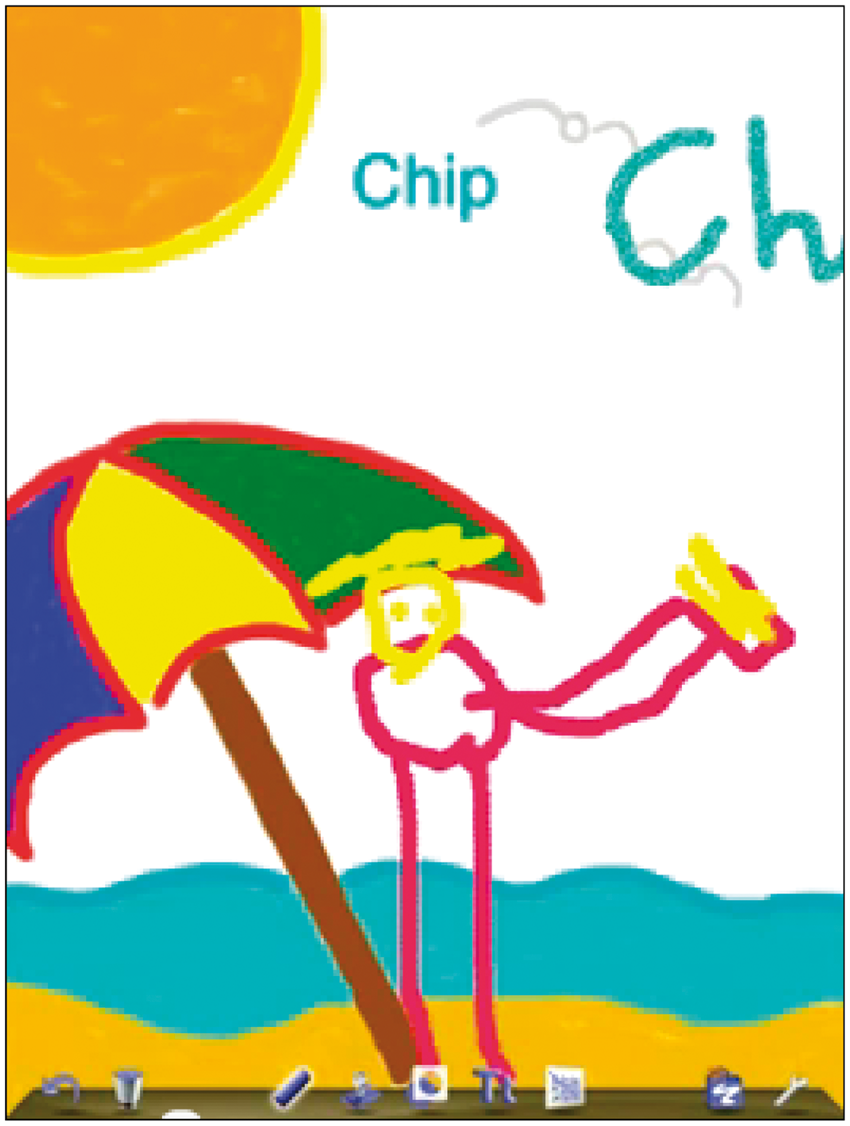
The alphabet books were shared with the school community via the school’s Twitter page and YouTube channel. Jack and one of his classmates later attended a staff professional learning session where they demonstrated their alphabet books and explained to the school’s teaching staff how to make them.
There are many aspects of this activity that realize the teacher’s vision for classroom technology use, including the positioning of students as producers and owners of their learning, and as active participants in a learning community that extends beyond the walls of the classroom. In the teacher interview that followed this activity, the teacher was markedly different in her demeanour. Where previously her enthusiasm had been dampened by expressions of constraint and dissatisfaction, the success of this activity (which was not without technical and organizational difficulties), and its ‘fit’ with her teaching philosophy and goals, manifested in a very upbeat and celebratory exchange, where she stressed the pride that her students showed in their work, their excitement at sharing their products beyond the classroom, and her own satisfaction that the students had used the iPads to create their own products, as opposed to navigating game or interactive book spaces: They’re really proud of it too I think, and it’s always there. I think with – sometimes they think “Oh yeah, I’ve done this work” and it gets stuck in their bag and that’s sort of it. They can only show certain people who are there, but with this – like they can ring up Grandma and say, “Oh Grandma, go onto YouTube and look at this!” And like Jack [Prep student] said, he was really proud of himself after he had done it… They’re learning more about how much you can do on iPads, like they’re amazing – they’re not just games and apps. You can use two different sorts of apps to produce something and then like… that instant transfer onto the Internet… they’re learning that they can do something and then show the world basically or show lots of different people. I think they are learning that you can use other forms – like multi-literacies. … [T]he focus wasn’t about the sounds and the letters for me. It was about using the applications to produce a product, whereas they probably thought – at the start they probably thought it was about the sounds, but I think now that they’ve finished it they’re sort of starting to think more about the applications that they used and the power of it. (Teacher, Term 3, 2011)
There are numerous connections between these reflections and Monique’s earlier statements about her goals and aspirations for classroom technology use. Instead of using closed apps to deliver content, the students have been positioned as producers of their own content. This approach to teaching and learning is paradigmatically different to the teacher-directed skills-focused literacy learning described by current state-endorsed early years literacy guidelines. To use the iPads in this way, the student producers have moved between applications, driven by the needs of the task. This use of the iPad environment is analogous to Monique’s vision of a classroom where students’ use of resources and tools is self-directed and ‘seamless’. Instead of their learning being contained within a content-specific app, which presents them with opportunities to practise staged print-based skills, the students move fluidly between apps and their self-created digital content to create a multimodal text that is then shared with their community using ubiquitous community-centred channels. The difference between these two possible ways of using the iPads encapsulates the difference between educational paradigms that are seen as being contested at this school as the teacher’s student-centred productive pedagogy vies for space, time and resources with state-endorsed requirements that position both teachers and students as receivers and consumers of predetermined, already formed, literacy content and products.
When reflecting on how her use of the iPads had developed over the course of the study, Monique provided an example of how she had begun to move beyond previous practices within the literacy block: I remember when I was first talking to you – like you asked me how I used them – and one activity [I described was] that they would listen to a book and then they’d go back to their table and draw like their favourite part or spots. Now we just use Doodle Buddy or Clicky Sticky or one of those drawing apps to actually do that, but I didn’t have any of those applications on the iPads back then, and I suppose I just sort of followed in previous teachers’ footsteps of what they did, but now they just do that and it’s much better. (Teacher, Term 3, 2011)
Monique’s story as constructed here is one of personal and professional triumph; however, Monique’s reflections on this successful classroom project, one that was consistent with her aspirations as a teacher, were not delivered without qualification. When reflecting on the practical organization of the activity, she explained: I did it in a reading group time, so I pretty much – instead of doing guided reading which was a bit naughty – I used that time to show them the video I made that had the instructions on how to do it, so they were still listening and following sort of visual cues and also – a comprehension activity really
So, where this teacher might have characterized her teaching practice as innovative or exciting or empowering, instead she describes it as ‘a bit naughty’. Although this was uttered with a co-conspiratorial tone to a researcher who shared many of Monique’s views on critical pedagogy and student-centred approaches to using technology, it is not insignificant that she felt a need to admit that her behaviour did not comply with other external expectations. By way of justification, Monique then offered an explanation of how the learning activity, although it did not comply with guidelines for the literacy block, was indeed literacy learning: ‘so they were still listening and following sort of visual cues and also – a comprehension activity really’. The exchange when on: Q: You said you didn’t like not doing their guided reading… A: Just because it feels like that you have to do that all the time. Q: Yeah? A: I don’t think it was a bad thing though. I think they got a lot out of it and just watching them – it’s a comprehension activity because they were watching and they had to really listen and they could ask me to stop and we’d pause it and we’d do a step like we’d follow a step, so it’s sort of a procedural text really and then – I don’t think there was anything wrong with doing it in the guided reading block. (Teacher, Term 3, 2011)
In her justification, the activity is reduced, as it is mapped onto the official curriculum, to ‘a comprehension activity’ and ‘a procedural text’.
Groundwater-Smith and Mockler (2009) make the distinction between ‘doing good’ and ‘being good’ as a teacher, where ‘doing good’ involves challenging the status quo, while ‘being good’ involves complying to external demands of accountability and standardization. Monique does not think using her time and resources to support projects like the alphabet books is ‘a bad thing’, but she knows it is not being good. Together with inquiries and reports at national level, the current approach to curricula seen in Australia suggests that good teachers are predominantly those who promote print-based skills that are easy to test and measure (Louden et al., 2005).
Conclusion
Clearly, as with other computing devices, iPads can be used to support literacy learning in the early years of schooling. As with technology and learning more generally, particularly with ICT that affords flexibility of use, the impact depends largely on how they are used (Lynch, 2006). There are hard-wired affordances of the iPad that make these devices particularly attractive for early years learning – their portability, their ‘touch’ interface, their simple navigation system – and this study suggests that iPads can support independent use by very young learners, as has been demonstrated by researchers such as Verenikina and Kervin (2011) and O’Mara and Laidlaw (2011).
We have discussed different usages of iPads in terms of the openness or closedness of apps, where those apps that offer self-contained already-formed content, such as the gamified literacy apps observed in the early stages of this study, are relatively closed – they direct the learner through the content, positioning the learner as a consumer. The level of interactivity and the level of user-choice varies from app to app, but the geography of the app is closed. The apps observed of this type were commercially developed for early years literacy learning, focusing on print-based skills presented with an underlying behaviourist paradigm where the student practises particular skills and is rewarded with tokens of accomplishment and progress. Apps of this type fit very easily into the literacy teaching practices that currently dominate in Australia and elsewhere, in that they support learners’ independent practice of basic alphabetic skills, and a small number of devices can be used to support a learning-centre approach to classroom management within a literacy block, thus freeing up the teacher to undertake other activities such as guided reading.
In contrast, the production applications that we observed in the later stages of this study are relatively open – they can be used to support any number of learning activities that involve students’ production and communication of knowledge, positioning the learner as a producer, an active community member and, at times, a teacher. Although applications of this type can be used alone, they support the strategic movement between apps, driven by the needs of the production process and the desires of an authoritative self-directed learner. In the example we have described, students moved from handwritten and drawn plans to drawing apps and then, using the screenshot functionality of the iPad, moved their work into an app that allows for the recording of an audio track and the ‘sharing’ of their final product via ubiquitous social networking tools. This type of usage (or combination of apps) is similar to what is seen outside of school, in students’ homes and communities, where users move seamlessly between apps, modes and channels (Davidson, 2009; O’Mara and Laidlaw, 2011), and illustrates a high degree of digital fluency that is not necessarily evident in the use of closed applications.
There is now a long history of ICT being put forward by enthusiasts as an enabler of innovation and change, and this has been a feature of government rhetoric surrounding ICT and school education for several decades. However, desires to transform teaching and learning have always had to interface with the institutionalized roles, structures and processes of schooling, which time and again demonstrate their resilience in the face of potentially innovative forces. Historically, it has been those technologies that are a good fit with existing practices that are most easily implemented in classrooms, while those that afford different types of roles and relations are adapted to institutionalized ways of doing teaching and learning.
We have constructed a meta-narrative that tells a story about one teacher’s efforts to engage her students in a student-centred pedagogy and have provided a glimpse of the potentially transformative impact of what is the latest technological gadget to hit classrooms. However, this story is told with qualification. It is not easy for teachers to do good within the current culture of compliance; it requires confidence and courage (Groundwater-Smith and Mockler, 2009) and this type of work is done within the cracks of the dominant regime, which currently marginalizes multimodal multiliteracy learning and subjects students to the procedures and instruments of assessment rather than positioning them as stakeholders and agents in their own learning. The broader policy context emerges in the current study as an influence on the participating teacher’s practice, both directly, experienced as a pressure to comply with a centrally mandated view of best practice, and indirectly, as a new teacher in her first teaching appointment, attempting to fit in with classroom practices already established in the school. It also features as a shadow on her reflections and evaluation of her teaching practice, where she is mindful of judgements that might be made of her and find her wanting when measured against external expectations.
Stories of technology use are often de-contextualized, with no location in place, time or the broader sociopolitical context (Selwyn, 2010). In this article, we have attempted to locate technology use within both a wider and a local context and through this to demonstrate how technologies such as the iPad can have many different manifestations as they interface with personal and institutional aspirations and constraints, and that within the current policy context of early years literacy teaching, there is a risk that their use will be limited to that of an interactive version of a worksheet or book. We have also framed this story within our own viewpoints and politics surrounding pedagogies of empowerment and how new digital tools and media might be put to work in productive ways to move beyond the traditional processes, structures and relations of schooling and to support students to develop digital literacies and learner identities that will enable them to pursue new forms of cultural participation (Rogers, 2010).
There is a commonly told story found within the broader educational technology research literature: a new gadget presents and supports a vision of transformation; then there is trouble on the road, leading to small pockets of resistance and innovation led by hero teachers. However, in the main, the new gadget is assimilated into the old, inscribed with institutionalized practices and used to perpetuate institutionalized roles, relations and identities. Within early years literacy, the authors believe that ‘smart’ touch-screen devices, such as the iPad, can be used to begin to bridge the gap between emerging home literacies and the techno-literacy practices of the early years classroom, and through this to support new forms of cultural participation and learner identity. The story told here suggests that this sort of transformative work is possible, despite a broader context that requires teachers to be ‘a bit naughty’ in order to realize this vision. But there is a real risk that the iPad and technologies like it will instead emerge as tools to be put to the service of already-established dominant classroom literacy practices, manifesting as mere content-delivery systems with some added interactive multimedia appeal.