




Abstract
This article reports on an ethnographic study involving the literacy practices of two multilingual Chinese children from two similar yet different cultural and linguistic contexts: Montreal and Singapore. Using syncretism as a theoretical tool, this inquiry examines how family environment and support facilitate children’s process of becoming literate in multiple languages. Informed by sociocultural theory, the inquiry looks in particular at the role of grandparents in the syncretic literacy practices of children. Through comparative analysis, the study reveals similarities and differences that, when considered together, contribute to our understanding of multilingual children’s creative forms of learning with regard to their rich literacy resources in multiple languages, the imperceptible influences of mediators, various learning styles and syncretic literacy practices.
Keywords
七七四十九, 死个狗, (qi qi si shi jou, si ge gou,) Seven [times] seven [is] forty-nine, died a dog, 七八五十六, 跑个狗 (qi ba wu shi liu, pao ge gou) Seven [times] eight [is] fifty-six, ran away a dog. Lingling and Meimei’s creation of multiplication table in rhymes (words in parentheses are in Pinyin - Chinese phonetic transcription)
Growing up in Montreal, Lingling (aged eight) and Meimei (aged six), sisters in a Chinese immigrant family, are trilingual in Chinese (Mandarin), English and French. Living together with their parents and grandparents in a cultural and literacy-rich environment, Lingling and Meimei love to play with language and words. They have created numerous rhymes, riddles and texts such as the multiplication rhymes above. Note in the rhymes above how they detect the word九, pronounced as jou (nine), and use the word 狗, pronounced as gou (dog), as the ending syllables. Utilizing the homophonic feature of the Chinese language, they play with the word 四, pronounced as si (four), and the word 死, which is also pronounced as si (death).
In this article, I present literacy portraits of multilingual children in Montreal and Singapore. Employing the concept of mediator of literacy (Gregory, 2005a), I illustrate how multilingual families enact literacy in myriad ways to support and facilitate the sociocultural practices of literacy in multiple languages. Building on the concept of syncretic literacy (Gregory et al., 2004), I explore the implicit role that grandparents can play and the often imperceptible influences they exert on the children’s process of becoming literate. The notion of 潜移默化 – imperceptible influence – is derived from a Chinese four-character idiom. 潜 (be latent) 移 (change, transfer) 默 (silent, tacit) 化 (change, transform) refers to the implicit guidance provided by adults when setting an example by their own conduct. It emphasizes the subtle and invisible influence on thinking, learning and behaviour that children experience by observing the people surrounding them. Learning opportunities are created through both explicit and implicit literacy instructions. When implicit, they are often invisible as part of everyday activities and therefore imperceptible to all involved.
This study has important implications for the many pathways to literacy (Gregory et al., 2004). It contributes to the field of intergenerational literacy practices by focusing on the role of grandparents in the social practice of child rearing. It advances our understanding of the nature of situated literacy practices as multiple, social and ideological, as learning can be imperceptibly shaped through our conduct in our daily interactions with literacy, texts and languages. Showing how children put their own signature on the literacy practices they skilfully engage in at home, I argue that the skills and knowledge that children bring into school not only demonstrate that there are multiple pathways to literacy but also that children’s creative forms of literacy are implicitly shaped by subtle influences from mediators within the ecological environment in which they grow up.
Syncretic literacy
Syncretic literacy refers to the creative forms of literacy practices whereby children draw from the existing pool of languages and literacy practices in their homes, schools and communities and blend familiar practices with new forms, thus transforming their literacy learning experiences (Gregory et al., 2004). Socioculturally situated, syncretic literacy encompasses multiple forms and formats of literacy practices in which children engage with important others when they syncretize literacy resources in various languages (Taylor et al., 2008), formal learning, playful learning styles (Gregory, 2005a, 2008) and different teaching approaches (Li, 2003; Mui and Anderson, 2008). Importantly, syncretic literacy emphasizes the powerful role that mediators play and the imperceptible influence they have on children’s literacy experiences.
Syncretism
The notion of syncretism captures the dynamic, complex and creative process of learning that can take place in myriad social, linguistic and cultural domains and across physical spaces (Gregory, 2008; Purcell-Gates et al., 2011). For example, school learning can transcend the physical location of the school and take place in playgrounds, at home or in a religious community. In a series of studies conducted in the East End of London, Gregory (2005a, 2005b) reported that young children often play school-like activities at home to syncretize school and home discourse, narrative styles and literacy practices. Studying Puerto Rican bilingual children in the USA, Volk and de Acosta (2004) found that literacy learning is a dynamic process with in the complex network between home, school and communities. Kenner (2005) described homes as literacy ecosystems to illuminate how bilingual children explore different writing systems through different language input provided in home domains. More recently, scholars have also recognized heritage language schools as influential environments for children’s cognitive, linguistic and cultural development. Curdt-Christiansen and Maguire (2007) looked at how Chinese trilingual children in Montreal fuse literacy knowledge, acquired in their heritage Chinese language school, with their formal school literacy activities. Examining the role of complementary schools in the UK, Lytra and Martin (2010) presented a comprehensive review of the broad range of functions that complementary schools provide for bilingual children with regard to culture learning and literacy practices.
These multiple spheres of literacy learning in homes and community schools provide dynamic and resourceful contexts where children’s lives are enmeshed, forming an ecology of interconnected environments that support children’s social and intellectual growth. In these cross-cultural learning contexts, children actively participate in exploratory work to discover how the literacy world works (Purcell-Gates et al., 2011). Notably, literacy practices become syncretized as children construct knowledge and negotiate literacy in many pathways (Gregory et al., 2004). Some learning contexts are playful whereas others are school-like literacy activities with highly structured skill and drill worksheet practices. For example, Gregory (2005a) demonstrated that during socio-dramatic play, children’s literacy knowledge is implicitly developed through the link between ‘unofficial’ play and ‘official’ learning. Zipke (2008) showed that children’s love of play extends ‘let’s pretend’ to include metalinguistic knowledge that is often presented in wordplay, riddle and jump-rope chants. In the delight of reworking language, children make discoveries about linguistic structures and metalinguistic knowledge that lead to literacy development. In addition to language play, literacy can be enacted in multiple ways. Challenging the notion that family literacy practice usually portrays mothers reading storybooks to young children, Mui and Anderson (2008) reported on how a six-year-old immigrant child acquired literacy skills through literacy games and worksheets as well as phonics exercises and workbooks. In her work with Chinese immigrant families in Canada, Li (2003) found that rote memorization and drills are regarded as valuable literacy practices by Chinese parents and community schools.
Literacy mediator
Central to the study of syncretic literacy presented here is the concept that learning is social and can be imperceptible as children encounter visible and invisible learning opportunities provided by parents and members of their extended families and communities. Research has shown that children can develop language skills, gain knowledge of the forms and functions of languages, and construct their understanding of cultural practices with grandparents as mediators (Gregory, 2008; Gregory et al., 2007; Kelly, 2004). Gregory et al. (2007), for example, investigated the interlingual and intercultural exchanges between Bengali grandmothers and their grandchildren. They found that traditional heritage patterns of story and rhyme reading are fused with Western pedagogy in a syncretic fashion which offers young children productive and creative ways of constructing meaning.
Researchers have also found that intergenerational learning occurs in different educational settings and on different learning topics. Olmedo (2004) documented an intergenerational literacy project in the USA between grandmothers – abuelitas – in a Latino community centre and children from a dual-language public school. Through storytelling activities, the abuelitas not only engage children with their life experiences and funds of knowledge (Gonzalez et al., 2005), they also provide opportunities for teachers to infuse this fund of knowledge into the school curriculum. Examining the computer as a mediating tool in children’s learning, Gregory and colleagues (2007) demonstrated that knowledge construction can be reciprocal between grandparents and their grandchildren. Using ethnographic research methods, they observed that adults provide knowledge of literacy and numeracy while children offer help with computer skills.
Despite these transformational examples of learning outlined above, intergenerational research remains limited. Although grandparents play an increasingly important role in contributing to the cultural socialization of their grandchildren, their imperceptible influences on children’s language and cognitive development have been less focused on. In this paper I argue that grandparents’ knowledge and life experiences are transformative assets that can be used to facilitate children’s learning and transformed into new forms of children’s knowledge.
Context
This study is located in two similar yet different sociopolitical and cultural-linguistic contexts: Montreal and Singapore. By means of comparative inquiry, I examine the nature of cultural and linguistic diversity in two Chinese families – an immigrant family in Montreal and an ethnic Chinese family in Singapore.
Sociolinguistic contexts
Situated in the French-speaking province of Quebec within the political and geographical nation boundaries of Canada, Montreal is home to three language groups: francophones, anglophones and allophones. Allophones are those immigrants whose mother tongue is neither English nor French. Politically, Canada has two official languages, English and French, based on the Canadian Charter of Rights and Freedom and the Official Languages Act. 1 In Quebec, the official language is French, based on Bill 101, the Charter of the French Language – La charte de la langue française. This law ‘restreint l’accès à l’ècole anglaise aux seuls enfants dont l’un des parents a reçu son enseignement primaire en anglais au Québec’. 2 As a result, immigrants arriving in Quebec are obligated to send their children to French schools. Like any other metropolitan city, Montreal hosts a large number of immigrant groups who speak a wealth of different languages. Arguably, Bill 101 has supported the emergence of trilingualism as immigrant families value both the official languages and their own ethnic tongue(s) (Riches and Curdt-Christiansen, 2010). In most cases, however, the learning of the non-official language is a private matter (Duff and Li, 2009). Nonetheless, immigrant parents, especially those with an Asian background, have been observed to hold high expectations for their children’s language and literacy development, also in the mother tongue, as well as for academic success in general (Curdt-Christiansen, 2009).
Similarly, Singapore displays distinctive multilingual and cultural diversity. With a population of 5.08 million (Statistics Singapore, 2010), Singapore is home to four major ethnic groups: a Chinese majority (76%), and minorities of Malays (13%), Indians (9%) and others (4%). Politically, Singapore’s government has adopted a bilingual policy that recognizes four official languages: English, Mandarin, Malay and Tamil. While English is given the highest status as the language of government and the medium of education in schools, Chinese, Malay and Tamil are granted the status of mother tongues for the three major ethnic groups. In contrast to Montreal, these languages are taught at school and are examinable subjects as required for the Primary School Leaving Exam (PSLE) at national level; they are, however, taught only as second languages. The politics of language recognition in Singapore has given rise to an ‘English Knowing’ bilingualism phenomenon where large parts of the population are bilingual in English and their respective mother tongue (Pakir, 2008). However, there has been a pronounced language shift from mother tongue to English in recent years across all ethnic groups as a result of the legitimization of English in its political and social functions (Zhao and Liu, 2008). Nevertheless, like the Asian parents in North America, Singaporean parents have high expectations for their children’s educational success.
Family context
Lingling was born in Montreal. Her extended family live in a semi-detached house in a suburb. Both her parents have received higher education in China and postgraduate training in North America. Her mother is a university professor and her father is a researcher at a pharmaceutical research centre. Prior to their retirement her grandparents were high school teachers in China. Their presence has been a tremendous help and support for her parents in their busy professional lives. Like many immigrant children in Quebec, as mandated by Bill 101, Lingling attends a French neighbourhood school during the week. On Saturdays, Lingling goes to a Chinese heritage language school. Attending no other afternoon school activities, Lingling spends her leisure time reading, creating stories and drawing. Grandma Ling often proudly remarks: ‘I don't do anything else than collecting all the papers for her around the house.’ Sometimes she complains that she may have to ration the paper supplies in their house as the children use too much of this resource for their creative writing and drawing activities. For Lingling and Meimei, the daily contact with their grandparents has not only provided a way of strengthening family ties, but also given them access to Chinese culture and language education. Lingling speaks French with her teachers and friends in school, Chinese at home, and occasionally English with her Chinese friends at the heritage language school. None of the adults in her family speak French. The grandparents have limited knowledge of English.
Sayang (aged seven) is a Singaporean Chinese. He lives together with his parents and his five-year-old sister Rose in a three-bedroom private apartment. Although Grandma Yang does not live with the family, her HDB (public housing) apartment is only a five-minute walk from Sayang’s home. A graduate from the local university, Sayang’s mother is a Chinese teacher at a high school and his father is an engineer in a private company. In their late thirties, both are working towards their higher career goals. As in Lingling’s family in Montreal, raising children is shared between the parents and a grandparent. Grandma Yang not only picks up the children from school, but also supervises their homework and cooks for Sayang’s family. Educated in a Chinese medium school in the 1960s, Grandma Yang is firmly established in Chinese culture and particularly interested in Chinese medicine. As a homemaker all her life, she makes sure that both her children and grandchildren get nutritious healthy food. At home Sayang speaks mainly Chinese with Grandma Yang and his mother, and mostly English with his father and his little sister. At school, he speaks English with his teachers and friends.
Data collection and analysis
Employing ethnographic tools of inquiry, this study addresses issues of literacy resources, skill-based or play-based practices, and structured or unstructured learning activities. Regular home visits were scheduled once per week or fortnight, depending on the families’ available time, for a period of one school semester in Sayang’s case and two years in Lingling’s case. Field notes, semi-structured interviews and informal conversations with family members, recorded literacy interactions, photographs and samples of literacy artefacts were used to document the literacy practices of the two families. These data capture the complex interplay between the strategies, materials and role relationships of home and school through structured or unstructured learning events. With their qualitative character, these data were triangulated to generate a detailed understanding of multiple and equitable pathways for the intergenerational literacy experience.
Content analysis was conducted to reveal common themes and patterns with the following emphasis: syncretic literacy resources, imperceptible influences, playful learning and structured learning. Syncretic literacy resources refers to the multiple literacy resources in different languages, different genres and types of texts that are associated with various literacy events and activities. The analysis of multiple literacy resources can unpack the ways in which children mesh, blend and syncretize different types of literacy materials and literary genres in their active engagement with literacy. Imperceptible influences refers to children’s invisible learning from observation of their grandparents who implicitly serve as models and transmit cultural and linguistic knowledge. Playful learning and structured learning show the different learning styles and strategies used by children and their grandparents to engage in syncretic literacy practices. For each of these themes, I present the children’s literacy snapshots to highlight their creative exploration of languages in their lives.
Syncretic literacy resources
Literacy in Lingling’s home
Lingling and Meimei love stories. Aware of the importance of fostering a lifelong love of reading, their parents provide them with a full range of children’s books in different languages. There are 西游记 Journey to the West, 动物百科全书 Animal Encyclopedia, 小朋友 Little Friend, 儿童画报 Children’s Magazine, 儿歌三百首 Children’s 300 Poems, 谜语万花筒 Fun Riddles and classical Western fairy tales translated into Chinese. There are other texts such as the works of the Brothers Grimm, fairy tales from Hans Christian Andersen, storybooks by Robert Munch and Tintin’s adventure comics in both English and French; there are books by Raymond Plante and other children’s books in French. Commenting on the abundant supply of books, Lingling’s mother, Mrs Ling, says: 一般来讲, 我们买书都是有目的的○ 你比方说, 中文书一般都是有一定文化和文学价值的, 像西游记之类的○ You know, 我们的书都是有善, 恶之分的 … 法语书呢, 由她们自己选择○ 但是有一条, 八岁不买七岁的书○ 要买的书一定是要高出她们目前的水平○ We generally buy books for certain purposes. For example, the Chinese books normally contain Chinese culture or have certain literary values, like The Monkey King. You know, books that distinguish between good and evil … As for the French books, they [her daughters] usually make their own choices in terms of what to buy. But the rule is, you don’t buy books for children 7 years old when you are 8 yourself. The level of the books must be higher than their present reading level. Des Petites HISTOIRES.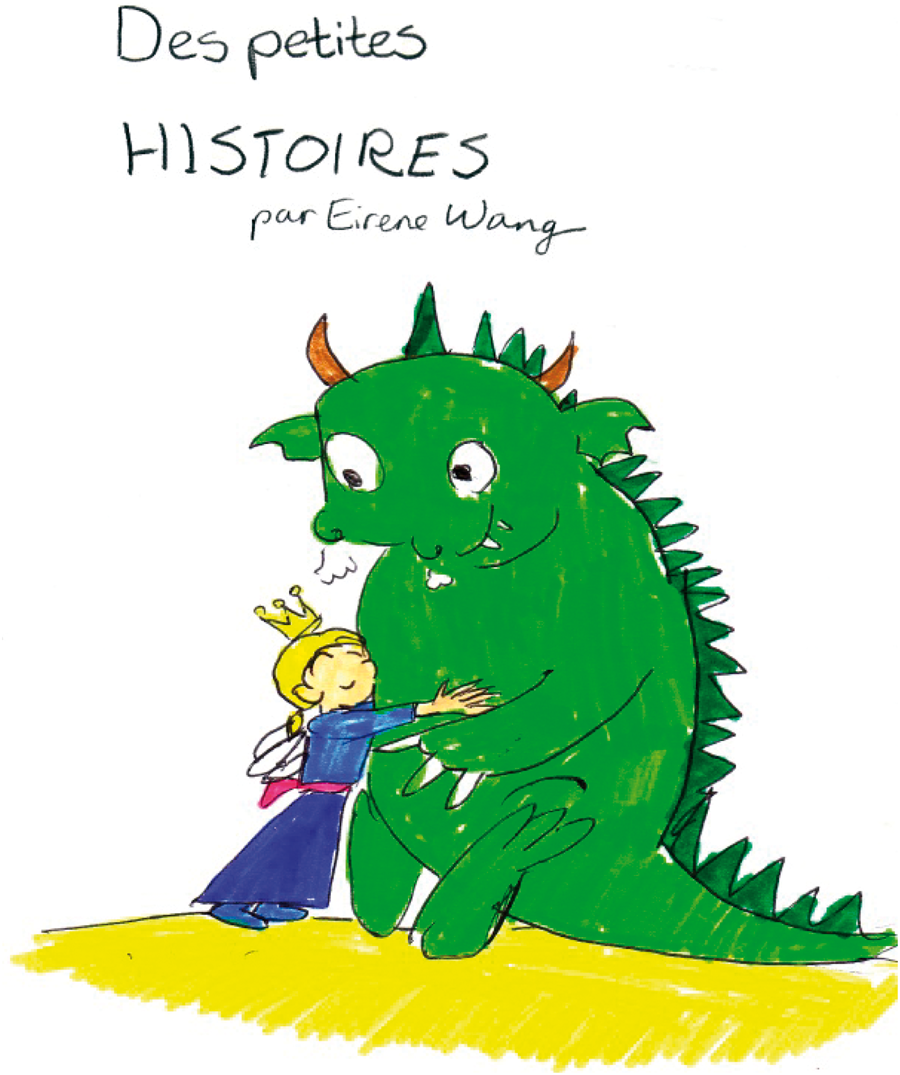
Typically, Lingling’s creative play draws on the diverse literacy resources and literary materials around her. When she was younger, she copied drawings of characters she encountered in her storybooks. Gradually she began to create her own characters and make stories about them. Des petites HISTOIRES is a creative piece illuminating how Lingling re-accents her past experiences with different texts. Encouraged by her parents, Lingling sent her work to The Gazette (the largest English-language newspaper in Montreal) and other newspapers to participate in children’s writing competitions.
In addition to books and self-created artwork and stories, Lingling also owns many children’s films and cartoons on DVD, and she has audio books in all three languages. Her favourite Chinese story is the famous classical novel 西游记 The Monkey King. Although attending a French school and receiving no formal English instruction, Lingling learned English through informal reading with her parents. One of the methods of promoting English literacy is to let her watch English TV programmes with English subtitles.
Literacy resources in Sayang’s home
Although Sayang’s home is warm and cozy, he and Rose like to spend time at Grandma Yang’s apartment where children’s toys and games abound. Sayang has both storybooks and many assessment workbooks in Chinese and English scattered on bookshelves in both his grandma’s and his own home. As a first grader, Sayang is already reading chapter books in English independently. He owns a whole set of Roald Dahl’s stories, a handful of Dr Seuss and a few sets of contemporary children’s literature such as the Butt series by Andy Griffiths and Captain Underpants by Dav Pilkey. He also subscribes to National Geographic Kids and Readers. Although he owns a handful of Chinese storybooks, he does not initiate reading in Chinese. He prefers to listen to grandma reading Chinese stories to him as his Chinese books, according to him, ‘have too many words that I don’t know how to read’.
Sayang’s parents and Grandma Yang all hold the opinion that active learning should be structured. Therefore, Sayang and Rose often engage in worksheet-related literacy activities in addition to their school homework. Assessment books are part of their daily routine resources for practising literacy skills (Figure 2).
Sayang’s Chinese assessment book.
Sayang’s family goes to the community library almost once a week. Although an additive bilingual, Sayang prefers to take out English books. He seldom takes out Chinese books on his own initiative.
At Grandma Yang’s apartment, watching TV or DVDs is strictly supervised, only half an hour per day is permitted. However, Sayang and Rose can choose their own programme or DVD. Despite their strong productive proficiency and rich exposure to Chinese, both children are interested in Disney films and cartoons in English. Grandma Yang believes ‘it’s partly because of English medium education, partly because of peer influence’.
Imperceptible influence
At Lingling’s home, adults are role models constantly demonstrating the different functions and pleasures of literacy. There are classical and modern works of Chinese literature for the grandparents and parents, professional books for the parents, popular literature magazines in Chinese and English, and newsmagazines and newspapers all over the house. Regarding the adults as literacy mediators, Grandma Ling comments: 我们的行为我们平时的所作所为对孩子们都有着影响○ 为什么玲玲爱看书, 勤学好问, 是一和零他们的影响○ 他们两一天到晚都在不停地写呀, 看那○ 我们也是一样○ 这是一种潜移默化的影响, 耳濡目染, 就是我们古人说的无为而治○ Our daily behavior and our conduct have great influence on children. Why does Lingling like reading and why is she always eager to learn? That’s the influence from Yi [father] and Ling [mother], because the two of them read and write all the time. So do we. This is an imperceptible influence, they are imperceptibly influenced by what they see and hear. That is what the ancient said, 无为而治 wu wei er zhi [a non-translatable four character idiom meaning to govern without interference – to govern by keeping explicit intervention to a minimum].
Lingling’s parents do not believe that close supervision is beneficial for children’s overall educational development. On the contrary, they are convinced it may constrain children’s development in creativity, imagination and critical thinking. They encourage the girls to ‘observe, explore and look for patterns’ and leave ‘the structured study to the school’. However, the grandparents believe that both structured and non-structured learning environments are important and can benefit children’s cognitive development. Commenting on memorization – the traditional way of learning – Grandma Ling says: 虽然死记硬背在国内、国外都受到批评, 而且认为是很死板的教育方式○ 我还是觉得对孩子有利○ 我不讲别的, 比方说, 九九表和方程式 … 至于说中文吗, 我自己的体会是, 你背出来了, 就能出口成章○ 语言都是这样发展过来的, 你要不背的话, 你说话都苛苛吧吧○ 有时都想不出来要说什么○ 不可能出口成章○ Although memorization has received much criticism, both in China and the West, and is considered pedantic in education, I still think it’s beneficial for the children. Such as multiplication, and other mathematical formula …. As to the Chinese language, my own experience is that if you can memorise [text], then you can 出口成章 chu kou cheng zhang [let words flow from the mouth as from the pen of a master]. Language is developed in this way, if you don’t memorize the words and phrases, you can’t even express yourselves in adequate language. Sometimes you just don’t have the command of words, not to mention 出口成章.
When Sayang and Rose come back from school every day, the first thing they do is to have a bowl of herb medicine tonic brewed by Grandma Yang during the day. The tonic varies depending on the weather conditions and the children’s state of health. In the rainy season, Grandma Yang prepares a tonic soup with barley, water lily seeds and fructus lychii. If the weather is hot, her soup contains green beans, wolfberries and dried chrysanthemums. Adopting grandma’s view on herb medicine, Sayang tells the researcher that ‘the herbs are good for balancing yin and yang; they are also good for my eyesight’.
Like Lingling’s home, Sayang’s family presents a rich tapestry of language and literacy practices. As Grandma Yang is interested in traditional Chinese medicine, her home is full of books on herbs, Chinese medicine and health magazines. In her view, Chinese medicine is based on 1,000 years of wisdom containing abundant cultural knowledge: ‘Chinese medicine is not about killing all the bacteria in your body, but about keeping a harmonious balance in your body so that virus and bad elements can’t survive in your inner system.’ With these convictions, Grandma Yang provides a nutritious diet for her children and grandchildren and imparts the wisdom of Chinese medicine to them. Sayang can recognize several common herbs and their functions including 桂圆 (dry longan), 南杏 (bitter almond), 陈皮 (tangerine peel) and 罗汉果 (monk fruit). He is also aware that over-consuming lychees can cause nose bleeds as the fruit is a ‘heaty fruit’ (high sugar content), and banana cannot be eaten together with yam as they cause stomach ache. During home visits, he also proudly claims that he knows all the herbs that grandma has planted: 这个叫紫苏叶, 会治感冒○ 这个是薄荷,如果你的喉咙痛, 就可以喝这个茶○ 对不对, 阿婆?这个叫驱蚊草, 有它, 蚊子不会来○ 如果被咬, 那用这个叶子擦擦就好了○ This is called zi su ye (purple leaves), it can be used for coughs. This is menthe, if you have a sore throat, you can drink this tea, right, grandma? This one is called qu wen cao [mosquito-repellent plants]. If you have them, mosquitos won’t come. If you get bitten [by mosquitos], just rub it on your skin, you will be fine. 玩是玩, 学是学, 这两样事情是不可混的啦○ 如果你一边练字一边玩, 怎么可以专心啦?古人不是有讲, 读书有三到: 心到, 眼到, 口到○ 所以读书是不可以玩的嘞○ Play is play, learning is learning, the two things shouldn’t be mixed. If you play while you are practising writing, how can you concentrate? The ancient adage says that reading needs three organs: the heart has to concentrate, the eyes have to see, the mouth has to speak [reading aloud by mouth, seeing clearly by eyes, then comprehending by heart]. Therefore, learning should not be mixed with play.
As shown above, the implicit influences from grandparents are clearly expressed through their convictions about literacy and experiences of different educational systems.
Playing with words: Lingling’s literacy discovery
Lingling’s literacy practices consist of various activities. Despite the traditional Chinese perception of learning that views play as not serious, Grandma Ling makes an effort to provide enjoyable learning opportunities for the girls. For example, to practise Chinese, Grandma Ling engages them in wordplay involving writing and guessing riddles. The following literacy event takes place in the cafeteria of the Chinese heritage language school during a recess. Lingling is reading a Chinese book, 趣味谜语 [fun riddles].
[L = Lingling; M = Meimei; GM = grandma; GP = grandpa; R = researcher] L: 看你们能不能猜这个谜语○ See if you can guess the word. M: 我不要猜谜语, 我要玩牌○ I don’t want to guess. I want to play cards. GM: 来吧. Go ahead. L: 好, 是个字○ 准备好了 Ok, it’s a character [word]. Ready? L: 一个不出头, 两个不出头, 不是不出头, 就是不出头. (yige bu chutou, liangge bu chutou, bushi bu chutou, jiushi bu chutou) One 不 “no” [the character 不 means “no”] sticks out its head, two 不 “no”s stick out their heads, 不 “no” should not stick out its head, but this 不 “no” sticks out its head. GM: (writes down the riddle) … GM: (repeating) 一个不出头, 两个不出头, 不是不出头, 就是不出头. (see full translation above) GP: (reads the riddle written by grandma) 一个不出头, 两个不出头, 不是不出头, 就是不出头. (same translation) R: (repeating) 一个不出头, 两个不出头, 不是不出头, 就是不出头. (same translation) (After two minutes’ discussion, the adults give up. Lingling announces the result.) L: 你们都放弃了○ 看, 这样子○ 一个‘不’字, 这个竖要出头, 再来一个‘不’字, 也是竖出头○ 这就变成‘林’字了○ (Demonstrating how to write) You all give up now. Look, this is what it looks like. You have one “no” where the vertical stroke is stretched out, then another “no” also with its vertical stroke stretching out. What you get now is the character 林 “forest”. (Figure 3 is the answer to the riddle written by Lingling.)
Riddle ‘林’ – forest.
This wordplay not only shows that Lingling has a solid understanding of character composition, it also demonstrates that she understands the functions of literacy. Linguistically, character composition in Chinese requires a learner to be familiar with the configurations of the radicals in different characters and how they relate to each other. As an important stage of Chinese literacy acquisition, wordplay consolidates learners’ metalinguistic knowledge, especially their morphological awareness, as Chinese characters are formed largely by semantic-phonetic compounds (Zhang et al., 2011). In this game, the character 不 (no) can be changed into the character 木 (wood) if the central vertical stroke is stretched to ‘perforate’ the horizontal stroke. As can be understood in its visual form, the character 林 (forest) is composed by two identical semantic morphemes 木 (wood).
Ideologically and culturally, this type of riddle game provides implicit opportunities for children to understand the different functions of literacy. This mental exercise implies that literacy can be both entertaining and problem-solving. Viewing word games as facilitative in children’s cognitive and social development, Grandma Ling states: ‘Riddles are not boring texts, they function as games which engage you in thinking. It’s fruitful as children can draw on their language and literature knowledge to solve problems.’ Such a conviction is also visibly demonstrated from the next riddle that Lingling presents to the researcher.
他有二个大葵扇, He has two big fans, Ta you liang ge da kui shan, 一边走路一边煽 ○ He flaps his fans while walking. Yi bian zou lai yi bian shan. 一顿能吃五十 碗, He can eat fifty bowls [of rice] in one meal, Yi duan neng chi wo shi wan, 什么闲事他都管○ He pokes his nose into everything. Shenme xian shi ta dou guan.
Notice that this riddle is written in four lines, rhyming a-a-a-a and having seven words in each line. This rhyming effect is loved by children and often makes it easy for them to remember the text, leading to phonological awareness. As evidenced in early literacy studies in alphabetic languages, phonological awareness is essential for children to develop literacy skills. Such knowledge of rhymes also plays an important role in Chinese early literacy education.
It is evident that Lingling’s riddles contain elements of general linguistic knowledge and knowledge of classical literature. Providing an engaging environment is vital for literacy development, but more importantly ‘guessing the riddle is not the ultimate goal’ as Grandma Ling comments, ‘it’s the functions of Chinese language children need to learn’. Consistent with sociocultural theory (Vygotsky, 1978), her view of the functions of Chinese language can be extended to any other language, and the game itself is also a powerful tool to develop logical reasoning and analytical ability in addition to literacy learning.
Structured literacy endeavour: Sayang’s literacy event
Grandma Yang’s strong conviction that learning should be a serious endeavour is translated into her direct involvement in Sayang’s literacy education. Although her English knowledge does not permit her to give Sayang structured literacy practice, she diligently supervises Sayang’s work on his weekly spelling list and makes sure that he reads various texts aloud for her. Also convinced that schoolwork does not provide sufficient practice, especially in Chinese, she provides Sayang with extra Chinese exercises, often from commercially produced assessment workbooks.
In the excerpt below, Grandma Yang holds a copy of 小学生作文常用好词语 – Reputable Phrases Commonly Used by Primary School Children in Composition (Pei Lei, n.d); she is helping Sayang practise descriptive words and phrases for hair: [S = Sayang; GY = grandma Yang] GY: 下面的词语是用来形容头发浓和黑的○ The following words are for describing black and thick hair. GY: 写 ‘黑亮亮的头发’ Write “black and shiny hair” S: (repeats while writing in his notebook) 黑亮亮的头发 Black and shiny hair GY: 造个句子, Make a sentence. S: 阿婆, 如果头发不黑的话, 要吃何首乌, 像妈妈一样嘞? Grandma, if a person’s hair is not black, then he should have He Shou Wu (Fallopia Multiflorum)
3
, like mommy, no? GY: 注意力集中哦, 造句子. Now concentrate, make a sentence. S: 他的黑亮亮的头发很美丽○ His black and shiny hair is very beautiful. GY: Okay, 下一个○ ○ ○ Okay, next is …
Despite Grandma Yang’s strong belief in structured practice, Sayang has made a reference to his knowledge of Chinese medicine learned through his socialization with her. When Grandma asks him to make a sentence, Sayang uses a rhetorical question linking ‘头发不黑’ (unblack hair) with his prior knowledge about his mother’s hair issue. Although grandma does not take the opportunity to elaborate on his connection and may not have regarded this as a learning discovery, Sayang’s reference to He Shou Wu is a demonstration of his active contribution to an imperceptible learning process through implicit guidance from Grandma Yang.
Unlike the Lings, Grandma Yang believes that structured learning is not exclusively the business of the school. On the contrary, Grandma Yang adopts the role of teacher to supplement the school curriculum by providing more structured learning. Unlike family literacy in Western culture where more social bonding takes place, Grandma Yang acts as a teacher, steering the learning process by making Sayang concentrate on his work. In this intergenerational exchange, synergy takes place between the role of teacher and the role of grandmother, between the context of home and the context of school.
Discussion
In this paper I have shown, through a comparative lens, the literacy journeys of two additive tri/bilingual children, Lingling and Sayang. Grounded in sociocultural theory, this inquiry contributes to the existing literature on syncretic literacy, emphasizing the implicit and imperceptible influences of grandparents in shaping their grandchildren’s multilingual development. It also sheds light on the many pathways used by children to become literate. Although the two cases present distinctive differences in terms of their sociopolitical context, language status and sociolinguistic environment, their enacted literacy activities indicate a shared belief in multilingualism, literacy education and the various functions of literacy. In the following, I discuss how and why the two families differ, while paying attention to similarities in their literacy practices.
In both families, rich literacy resources distinguish the family environment, both with regard to emergent literacy acquisition for children and as entertainment or professional resources for adults. In Lingling’s family, children’s literature plays a prominent role as a source of literacy acquisition in their day-to-day lived experiences. In Sayang’s home, literacy resources imply significant meanings other than just entertainment and pragmatic functions (medical books). Both children's literature and assessment workbooks are valued in this household.
Contributing to the growing recognition of intergenerational studies (Ferguson and Ready, 2011; Gregory, 2008; Gregory et al., 2004, 2007; Kenner et al., 2007, 2008), this study shows that grandparents share not only child-rearing responsibility with the parents, they also act as key socialization agents playing a transformative role in their grandchildren’s literacy education. In this shared responsibility, grandparents provide not only explicit care for their grandchildren’s overall well-being, but also overt literacy interventions. In Lingling’s case, both parents and grandparents exert their imperceptible influences through their modelling and implicit demonstration of literacy use for a variety of purposes. In Sayang’s case, Grandma Yang is instrumental to his Chinese literacy development, both in terms of explicit coaching and implicit cultural socialization. In both cases, syncretic literacy occurs when the grandparents shift between their roles as caregivers, teachers and co-learners.
Although both families exemplify a syncretism of a variety of literacy practices, the resources for their repertoires of practices vary. Owing to the grandparents’ different beliefs about what counts as learning and how learning should take place, as well as the different public educational demands, the ways in which they engage children in literacy events differ. In Lingling’s case, literacy has multiple functions and learning is viewed as a process of self-discovery and problem-solving. In Lingling’s literacy journey, Grandmother Ling syncretizes both traditional Chinese values and Western educational philosophy to create their own patterns of literacy practice. In Sayang’s situation, literacy also has multiple functions, but learning is viewed as a separate endeavour. While pleasure reading is encouraged, literacy practices are mostly structured and skill based. Although Grandma Yang makes an effort to organize Sayang’s learning in a concentrated manner, he constantly makes reference to the funds of knowledge he has acquired from his medical socialization. This process of learning indicates a syncretism manifested in his association of literacy learning with his broader knowledge implicitly (and invisibly and imperceptibly) imparted to him by his grandmother.
This comparative study presents strong evidence of syncretic literacy practices. Linging’s literacy discovery with wordplay shows the crucial role of play in children’s literacy endeavour, either as a form of ‘play school’ (Gregory, 2005a) or a form of educational ‘game’ (Mui and Anderson, 2008; Zipke, 2008). Vygotsky (1978: 102) also highlights that ‘play contains all the developmental tendencies in a condensed form and is itself a major source of development’. Lingling’s case exemplifies the notion of synergy as play can be effectively melded with active literacy learning where problem-solving, negotiation of meaning and knowledge construction are taking place. While such explicit language play was not observed in Sayang’s home, it may suggest that children syncretize literacy practices differently as they are immersed in different learning environments and receive different imperceptible influences.
Conclusion
Despite the positive evidence that children can engage in syncretic literacy practices in the contexts of their homes and communities, deficit views about home background and home languages still persist in mainstream schools. Furthermore, the existence of mediators beyond teachers and parents is largely unrecognized (Gregory et al., 2004). Most importantly, children’s rich knowledge and creativity gained from their grandparents and other resources are scarcely utilized and rarely included in formal learning.
The findings from this study may have several implications. First, they demonstrate that there are myriad literacy practices outside the school and many different pathways to literacy. Secondly, they foreground the important role of grandparents as key agents in literacy and language socialization. Further studies in this area should include ways in which substantial involvement occurs, given that in Singapore seven out of eight households have grandparents living with their grandchildren (Statistics Singapore, 2010). It is evidenced from this study that grandparents provide a rich language, culture and literacy environment for mother tongue education that will lead to additive bi/multilingualism. Third, educators need to be aware that families provide funds of knowledge on which schools can build literacy skills and expand children’s literacy knowledge. Finally, educators need to acknowledge that children are active agents in their own learning journey, where they constantly create new forms of literacy practice, discover new learning paths and construct new knowledge through their exploration of various resources.