




Abstract
This study examined preschool and kindergarten English language learners (ELLs) attending a migrant summer programme and their vocabulary word learning during both adult-read and technology-enhanced repeated readings. In a within-subject design, 24 ELLs (four to six years old) engaged in repeated readings in a control and a treatment condition. In the control condition, small groups of children listened to an adult-read storybook, reading in English with incidental vocabulary exposure. In the treatment condition, a technology-enhanced English shared reading with Spanish-bridging vocabulary instruction (TESB) was provided with adult mediation in an electronic book (e-book). TESB consisted of multiple vocabulary strategies including a preview of target vocabulary words and audio-recorded Spanish vocabulary definitions embedded throughout the e-book. Research suggests that even brief vocabulary interventions increase word learning (NICHHD, 2000), and accordingly, results have revealed that children make gains in both conditions through incidental exposure (Elley, 1989) and explicit vocabulary instruction (Biemiller and Boote, 2006). Significantly, more word learning gains were made in the TESB treatment condition than in the adult reading condition, as measured by researcher-developed tasks on English receptive knowledge and English naming performance. Significant pre- to post-test differences demonstrated modest growth. Educational implications are discussed, as even short interventions can lead to vocabulary gains using vocabulary strategies to support learning.
Introduction
Vocabulary is one of the core ingredients for reading success for children (NICHHD, 2000). Specifically for English language learners (ELLs), educational researchers recommend daily vocabulary instruction throughout the school day (August and Shanahan, 2006). Over one million children are served in ELL programmes in the 100 largest school districts in the USA (Dalton et al., 2006), and current predictions estimate that nearly a quarter of the US population will be Hispanic with in 40 years (US Census Bureau, 2008). Educational professionals working with children from different linguistic backgrounds (Lucas et al., 2008) need instructional methods designed to increase word learning for young ELLs (Klingner and Edwards, 2006).
One specific ELL population present in schools is children from migrant families. Migrant families are those who travel and migrate across locations based on employment sources, frequently relating to the agricultural industry (NPCC, 2009). Low socio-economic status (SES), emerging English proficiency and low levels of parental education are common factors for families from migrant backgrounds (Levin and Belfield, cited in Waldfogel and Lahaie, 2007). Although parents may acquire access to literacy experiences (e.g. local public library) (Neuman and Celano, 2001), lack of or inaccessibility to resources may decrease print exposure and subsequently reduce exposure to the vocabulary presented in children’s books (Evans, 2004). Poverty and low SES impact on ELLs’ language and learning (Arnold and Doctoroff, 2003; Cummins, 1981).
Children from migrant families represent an emerging bilingual population with biliteracy needs. As professionals, we recognize the dilemmas that surface regarding biliteracy (Hornberger, 2004) but continue to seek evidence of instructional practices to increase vocabulary (Klingner and Edwards, 2006). With a shortage of trained bilingual educators to meet such needs, educators may consider capitalizing on developing technology resources for vocabulary instruction. Even brief vocabulary interventions have proved to increase word learning for English monolingual students (NICHHD, 2000). Children’s storybooks have been identified as providing a context for vocabulary instruction and exposure (Justice et al., 2005). Thus, the purpose of this study was to examine the gains from a vocabulary intervention that combined multiple vocabulary strategies – technology-enhanced English vocabulary instruction with Spanish-bridging (TESB) – as compared to repeated English adult readings.
Bilingual models
From a theoretical perspective, bilingual models focusing on the word level represent the connection between a concept and vocabulary words in each language. All language users have two types of vocabulary storehouses that are interdependent: one for concepts – ideas or meanings; and one for names or lexical labels (Harley, 2008). Therefore, a concept can correspond to more than one lexical label if multiple languages are present. The word association model (Potter et al., 1984) and later the revised hierarchical model (RHM; Kroll and Stewart, 1994) propose that a learner makes links between the concept of a word and the lexical labels of that word (e.g. English and Spanish), and a child’s primary language mediates a second language. For example, the concept of a dog (e.g. mental image and associated characteristics: function, attributes, category) has one connection with the English label (e.g. the word ‘dog’), and another with the Spanish label (e.g. the word ‘perro’). For a Spanish speaker learning English, the connection between the concept and the English label is weaker than the connection between the concept and the Spanish label. Hence, the strength of the connection between a concept and its lexical label may vary, depending on a learner’s proficiency in each language; thus, the first language may mediate word acquisition in the second language.
Bilingual models represent how a shared concept connects to lexical labels in multiple languages, as well as ways to use the stronger language to facilitate learning in the weaker language. If a child already understands or knows a concept with its label in the home language, instruction in the home language can mediate or bridge the gap between the two languages to learn the second label. This bridging demonstrates how home language instruction is potentially advantageous as an instructional tool for young ELLs. Specific attention should be focused on further investigation with home language vocabulary instruction.
Vocabulary facilitation with ELLs
Factors suggested to influence bilingual word learning have been observed based on age (Johnson and Newport, 1989), general language performance (Segalowitz, 1997), the quality and quantity of input from the environment (Cummins, 1991) and the intensity of instruction (Biemiller and Boote, 2006). The literature suggests that monolingual children with a smaller vocabulary tend to make fewer gains than those with a larger vocabulary (Robbins and Ehri, 1994; Senechal et al., 1995; Stanovich, 1986); those with smaller initial vocabularies are less apt to acquire unfamiliar words through incidental or non-explicit exposure (Coyne et al., 2004). To increase word learning for children who are young ELLs, it is essential to investigate the use of combined vocabulary strategies and the effects of home language vocabulary instruction.
Combined vocabulary strategies
Educators and researchers typically combine repeated readings (i.e. an adult reads a story aloud to children) and word elaborations together as vocabulary strategies to achieve word learning gains for young ELLs (Collins, 2010; Leacox & Jackson, submitted; Lugo-Neris et al., 2010). For example, Collins (2010) examined the word learning of advanced vocabulary words of 80 Portuguese-speaking preschool ELLs. Children were assigned to one of three groups: (1) a treatment group listened to stories three times with rich vocabulary explanations (e.g. general definitions, synonyms, decontextualized examples); (2) a control group listened to stories three times; and (3) an additional control group did not listen to the stories. Children who engaged in the repeated readings treatment group with rich instruction made significantly more gains in receptive vocabulary knowledge than those who did not.
Home language instruction: Vocabulary bridging
Several researchers have examined the influence and potential positive effects of first and second language instruction (Barnett et al., 2007; Hancock, 2002; Lugo-Neris et al., 2010; Reese et al., 2000). Several studies support the continual input of the home language to maintain these first language skills and to support learning in a second language (Restrepo et al., 2010; Roberts, 2008).
A few studies have investigated the use of home language support specifically for vocabulary instruction with young ELLs (Leacox & Jackson, submitted; Lugo-Neris et al., 2010). Lugo-Neris et al. (2010) examined the strategy of ‘vocabulary bridging’ where definitions of vocabulary words were provided in Spanish to expand the meaning of a word in the home language and to provide context within a story. Vocabulary bridging used definitions provided in Spanish to bridge to the emerging language, English. Preschool and kindergarten children with limited English proficiency engaged in adult-read repeated readings in English for two conditions: (1) two weeks with embedded supplemental English vocabulary definitions in English; and (2) two weeks with embedded vocabulary definitions in Spanish (i.e. Spanish bridging). Children with basic Spanish proficiency but limited English proficiency demonstrated growth in labelling, receptive vocabulary and expressive definitions. Although embedded instructional definitions in either Spanish or English were beneficial, vocabulary instruction in Spanish during shared reading produced greater gains in the children’s ability to define or explain targeted words. Overall, children with lower skills in both languages made fewer gains in both conditions than children with stronger home language skills. This study warranted further investigation into how to increase word learning for ELLs with low home-language vocabulary scores (Lugo-Neris et al., 2010).
Despite the definite need to support the growing ELL population, a paucity of studies has explicitly examined vocabulary word learning with storybook readings for young Spanish speakers (Lugo-Neris et al., 2010; Roberts and Neal, 2004; Silverman, 2007). The current study addressed the following research question. Is there a difference in young ELLs’ word learning when provided with (1) English storybook adult readings as compared to (2) technology-enhanced English shared readings with Spanish-bridging (TESB) vocabulary instruction?
Method
Participants
The present study recruited preschool and kindergarten ELLs from a summer migrant programme at a rural educational centre in the US southeast. Permission forms were sent home in Spanish and English, according to the Institutional Review Board procedures. Of the 24 children, ages ranged from four to six years (M = 66.9 months), including 8 males and 16 females. All students passed a hearing screening completed at the educational centre. In the summer programme, daily classroom instruction was provided primarily by monolingual English-speaking teachers who were assisted by bilingual high-school students; a biweekly 50-minute class on Mexican culture was taught in Spanish.
Based on a parent survey during a previous investigation at this site (Lugo-Neris et al., 2010) caregivers reported that the majority of parents had obtained a high-school educational level or lower. Reports on the local school district identified that 89% of children in the surrounding areas participated in free and reduced lunch programmes (US Department of Education, 2008–9). Additionally, the majority of children were born in the USA, while the majority of parents and grandparents were born in Mexico. Most of the children reported that their family members were employed as migrant workers. With migrant lifestyles characteristically more transient in nature (Hovey and Magaña, 2002), the attendance rate was negatively affected. Attrition limited the number of weeks that participants could complete the study and assessments. The four-week migrant summer programme operated four days a week. Children participated in research sessions (control or treatment) for three days a week, with one day for missed sessions. Although the original design was for four weeks of control-treatment sessions, attrition did not make this feasible. Vocabulary interventions with short duration are known to produce gains (Marulis and Neuman, 2010; NICHHD, 2000). Thus, children participated for a total of two weeks, assigned to one week of control and one week of treatment sessions in a counterbalanced order (i.e. treatment–control, control–treatment).
Descriptive instruments
Three standardized vocabulary assessments and two language proficiency scales were administered to provide descriptive information on participants’ language and vocabulary performance. The Peabody Picture Vocabulary Test, Fourth Edition (PPVT-4; Dunn and Dunn, 2007) and the Test de Vocabulario en Imágenes Peabody (TVIP; Dunn et al., 1986) assessed children’s receptive picture vocabulary. Both the PPVT and TVIP are standardized tests with normative samples including only monolinguals, English and Spanish respectively. It is noteworthy that the PPVT and TVIP may not be the most linguistically appropriate measures for bilingual children. Each test’s normative data are only for monolingual speakers; however, as limited testing resources are available for bilingual children, these instruments in conjunction with the language proficiency scales were administered to provide a representation of language skills.
Additionally, the Expressive One-Word Picture Vocabulary Test: Spanish Bilingual Edition (EOWPVT-SBE; Brownell, 2000) was administered to examine the children’s expressive naming abilities of objects, categories and actions across both languages. When shown an image and given a verbal prompt (e.g. ‘What is this?’/‘¿Qué es esto?’), the child was permitted to respond in English or Spanish. Accepting answers in either language, also known as conceptual scoring, investigates total expressive vocabulary naming abilities (Bedore et al., 2005). Normative comparisons are based on bilingual speakers. One student was unable to complete either of the descriptive instruments due to terminating the summer programme early.
Verbal proficiency
Children’s language proficiency was screened with two language proficiency scales: PreLAS English 2000 (Duncan and De Avila, 1998) and PreLAS Spanish 2000 (De Avila and Duncan, 1998). These language scales are criterion-referenced tools designed to assess four- to six-year-old children’s language proficiency in each language, i.e. English or Spanish. Sub-tests include auditory comprehension (i.e. following directions), expressive labelling (i.e. naming body parts), sentence repetition and story retelling (i.e. listening to a short story while looking at four pictures, then prompting to produce an oral narrative). For both English and Spanish versions, performance on the sub-tests led to a composite score with scores ranging from 1 to 5. For the English version, a composite score equated the child with one language proficiency category: 1 = non-English speaker; 2 or 3 = limited English speaker; and 4 or 5 = fluent/proficient English speaker. For the Spanish version, there are equivalent tasks, scoring procedures and proficiency identification. As a measure of reliability, the examiner’s manual reports Cronbach’s α level for the different subtests ranging from 0.86 to 0.90. Scoring reliability will be further described next.
Research assistants and reliability
Trained research assistants (RAs) consisted of undergraduate and graduate students in speech-language pathology at a local university (n = 9), as well as trained community volunteers (n = 2) interested in supporting children’s language and literacy. The primary investigators provided RA training on test administration, intervention and control sessions, and scoring procedures. To ensure that descriptive instruments (PPVT-4, TVIP, EOWPVT-SBE) were scored accurately, a trained RA completed scoring of all tests, and a second RA scored these tests a second time; for any noted discrepancies, a third RA triple-scored the test to verify an accurate score. For the PreLAS 2000 (English and Spanish), all but one of the sub-tests were scored immediately as correct or incorrect; the story retell sub-test was audio-recorded for the RAs to transcribe, with scoring completed after administration. These transcriptions were scored independently by two trained bilingual RAs, on a 0–5 scale. A score of 0 indicated that the child did not produce any verbal response, or that the response was in the other language. Several examples were provided during training to determine an accurate score on the PreLAS 2000 language scales. If the two scores did not agree, triple-scoring was conducted independently by another bilingual RA to reach a consensus.
Materials
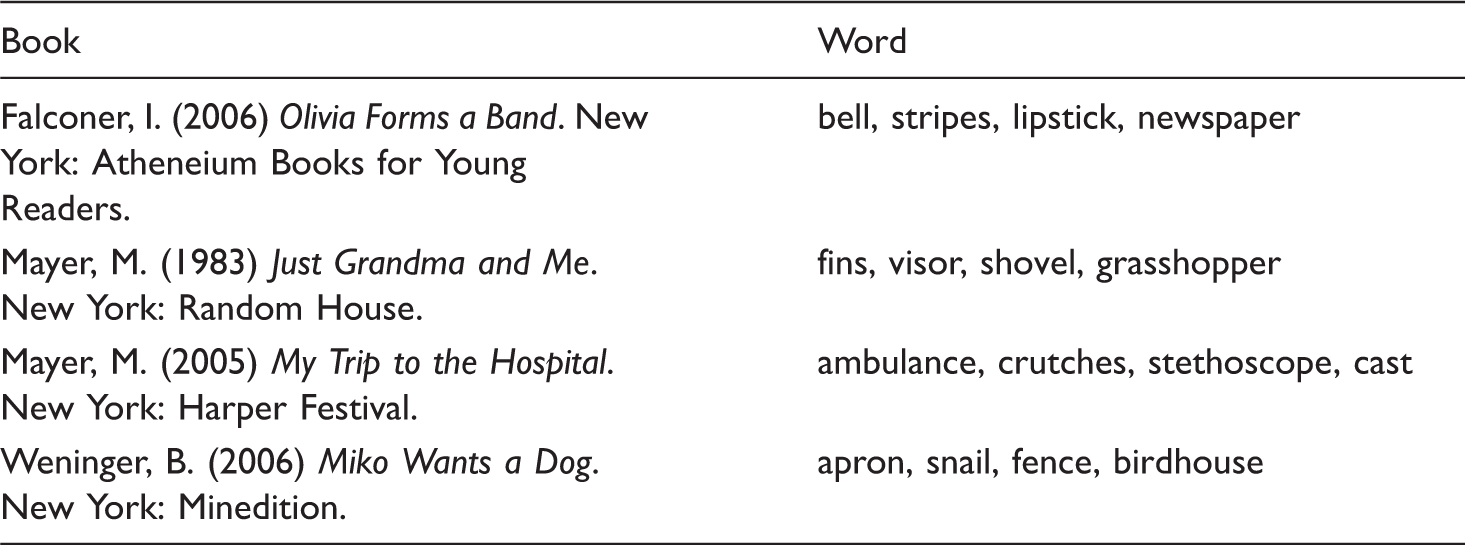
Book and word selection
Intervention books and target vocabulary words
Researcher-developed vocabulary tasks
To assess vocabulary learning, three researcher-developed vocabulary tasks were given as pre-test/post-test dependent measures: (1) English receptive knowledge; (2) English naming; and (3) bilingual definitions. First, the English receptive knowledge task assessed children’s ability to identify a word from an array of four colour pictures, balanced with three foils (i.e. similar appearance, similar function and similar category). Second, the English naming task examined the children’s ability to provide an English label when given a picture (i.e. ‘What is this?’). Individual vocabulary items in English receptive knowledge and English naming tasks were scored with a 1 or 0, with a potential of four points per task for each book. Finally, a bilingual definition task assessed the child’s depth of word knowledge (Beck et al., 2002; Eller et al., 1988) by probing a word’s meaning in English or Spanish with two prompts. The first prompt asked the child for an initial response (e.g. ‘What does __ mean?’; ‘¿Qué significa ___?’). A second prompt queried further description (e.g. ‘What else do you know about ___?’; ‘¿Qué más sabes de ___?’). A detailed definitional rubric of word knowledge guided scores with a possible range of 0 to 3 per vocabulary item: 0 = no knowledge; 1 = emergent knowledge; 2 = partial/incomplete knowledge; and 3 = complete knowledge (Lugo-Neris et al., 2010). Twelve points were possible per book (four words, three points per word). To obtain a definition score, the primary investigator trained bilingual RAs with this multi-level scoring procedure and met to review examples of accurate ratings guided by the rubric (e.g. ‘Here is an example of a definition with a score of zero…’). After training, RAs scored 25% of the expressive definitions independently; then, the scorers discussed scoring differences to ameliorate any discrepancies before scoring the remainder of the definitions. Inter-rater reliability was 82.8%.
Procedures
Pre-test, repeated readings and post-test procedures
Pre-tests were completed prior to repeated readings. To prevent a ceiling effect, children did not participate with a particular book if they scored higher than 2 out of a possible 4 on the English naming task described above. After pre-testing, children participated in repeated readings three days a week, with one week in each condition (control: English adult readings; treatment: TESB). Children participated in a randomly assigned counterbalanced order of treatment and control conditions to examine within-subject word learning gains. One week included three days of repeated readings of the same book. Then, children were post-tested on the four target words from that specific book using the researcher-developed vocabulary tasks. A repeated measures design allows each participant to engage in both conditions, reduces between-participant variation and is unlikely to interfere with learning during a subsequent control condition (Kinnear and Gray, 2010). Figure 1 presents a flow chart to outline English adult readings (control) and technology-enhanced English reading with Spanish-bridging (TESB; intervention).
Flow chart: English adult readings (upper row) and TESB (intervention, bottom row).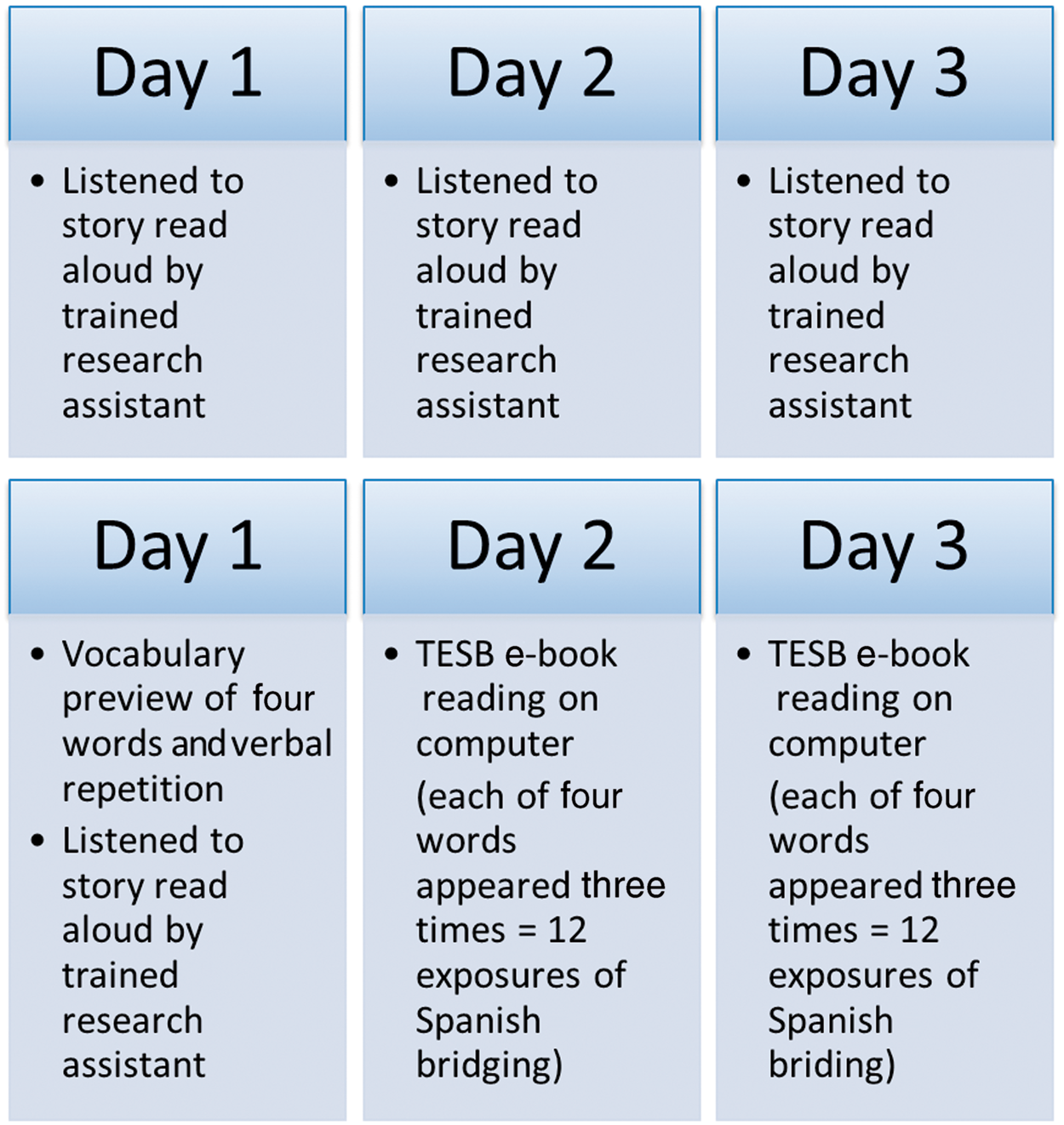
English adult readings
In the English adult readings condition, each RA followed the same protocol: read the title of the book and then read the story. No additional expansions were provided, except for behavioural prompts to facilitate attention. Children, in groups of two to five, listened to three English adult readings with a paper-copy book. Due to occasional unexpected absences, one child listened independently to the adult reading.
Technology-enhanced English reading with Spanish bridging (TESB)
Using Iowa e-book software (Mueller and Hurtig, 2010), the researchers created e-books with scanned images from a selected storybook and with embedded pre-recorded audio files. Figure 2 shows an e-book example. Target vocabulary words were pictured on the right side of the screen. When the picture was clicked, a pre-recorded audio file provided the Spanish bridging (i.e. a short definition in Spanish). Each of the four vocabulary words was pictured three times throughout the e-book, for a total of 12 exposures with Spanish bridging. This Spanish bridging had three purposes: (1) to connect the picture back to the specific e-page; (2) to provide at least one semantic characteristic; and (3) to translate the Spanish word into English (e.g Example of e-book layout and interactive features.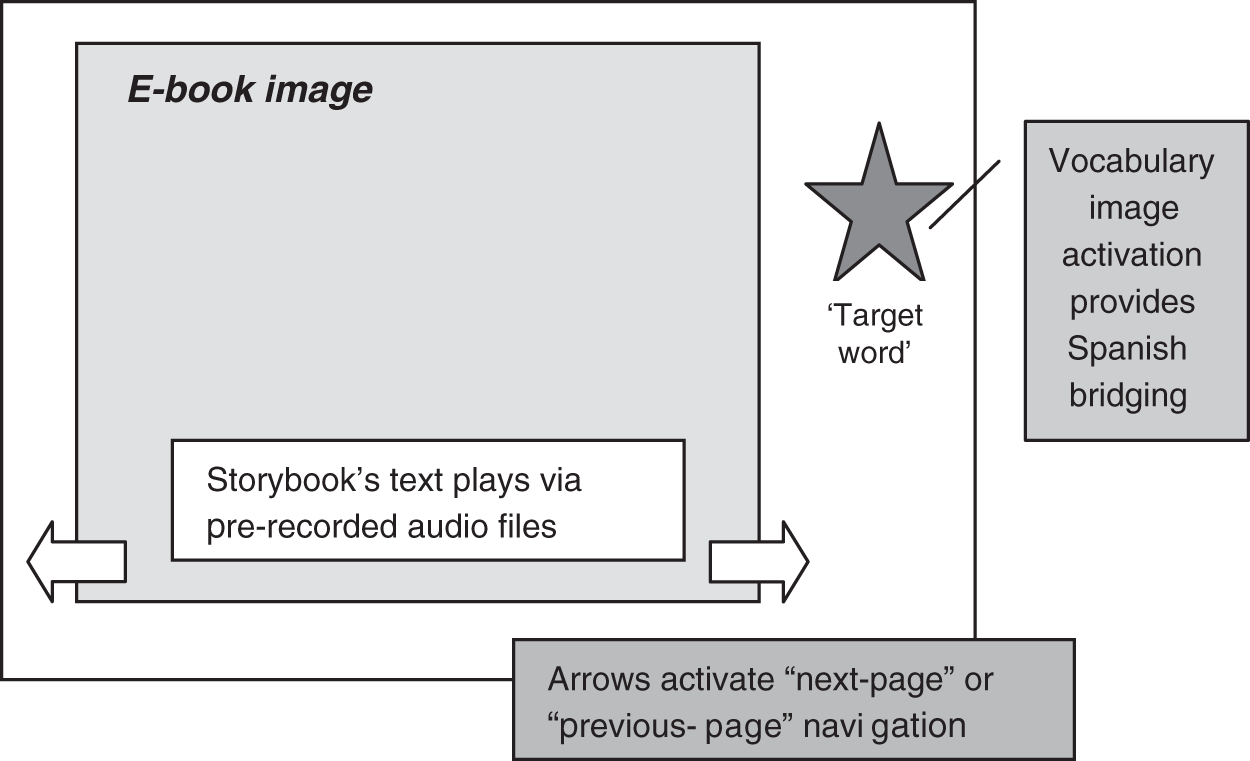
Day 1: Paper-copy reading
Children listened to a paper-copy adult reading in groups of two to five. Different from the control condition, the treatment condition was introduced with a title and vocabulary preview of the four words (e.g. ‘Today we’re going to read a story called “Just Grandma and Me”. I want you to listen for four words: visor, fins, grasshopper and shovel.’). Children were prompted to say each target word once as it occurred in the story (e.g. ‘Say __’ [wait for a response from each child]). Children participated in one day of paper-copy readings and two days of e-book readings. The rationale for this combination of adult and electronic readings ensured that children had one typical adult reading of the story prior to the addition of the technology-enhanced Spanish-bridging component.
Days 2 and 3: TESB e-book reading
Children (individually or in pairs) sat at laptops (Dell 0682, Compal Notebook EL81) with the e-book versions of the storybooks. Each laptop had two headphones allowing two children to listen to one e-book reading together. The RA introduced and demonstrated the e-book to the children and encouraged them to click on the vocabulary picture to the right side of the screen (Figure 2). Headphone volume was checked and headphone placement assistance was provided if needed. With each e-page turn, an audio file was automatically activated that contained a pre-recorded reading of the text on the e-page. After the text was read, children pressed the ‘next page’ button to continue with the story, or children pressed the pictured vocabulary word, which provided the described Spanish bridging. An RA sat next to or behind the child(ren) to mediate e-book interaction (e.g. manage turn taking) as needed and completed a fidelity checklist to ensure that all 12 vocabulary pictures (four words x three exposures of Spanish bridging) were activated in each e-book reading session.
Fidelity
TESB training for RAs involved structured procedures for consistent implementation. Training included demonstrations of the described e-book features and interactive components (e.g. how to initiate the e-book, page navigation). The key intervention component was the activation of target vocabulary pictures, which provided the vocabulary definitions in Spanish (Spanish bridging). Thus, a fidelity checklist was completed to confirm that all the vocabulary pictures with Spanish bridging were clicked during every TESB session. If a child navigated to a subsequent e-page without activating a target picture, the RA was instructed to guide the child back to the preceding e-page to click on the picture and thus activate the audio file, before continuing the story. The e-book did not permit the child to activate any other actions (e.g. ‘next page’) while an audio recording was being played.
The e-book automatically provided a text file output of the type and frequency of button clicks activated during a TESB session. Twenty per cent of the text files were examined and found to have 95% fidelity for activating all target vocabulary images.
Results
Descriptives
Descriptive vocabulary and language instruments
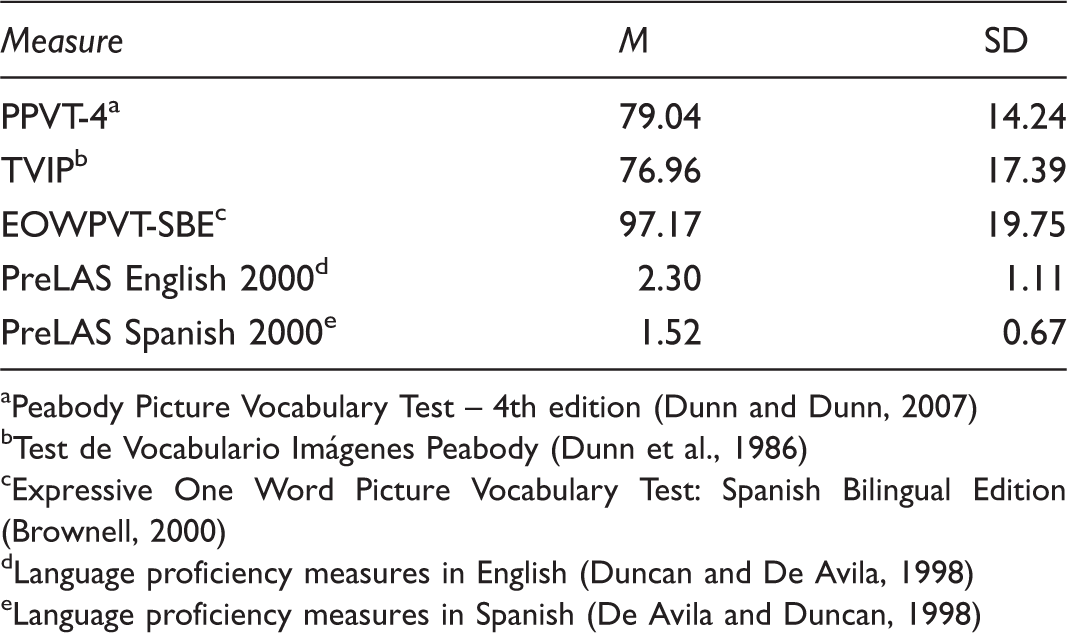
Peabody Picture Vocabulary Test – 4th edition (Dunn and Dunn, 2007)
Test de Vocabulario Imágenes Peabody (Dunn et al., 1986)
Expressive One Word Picture Vocabulary Test: Spanish Bilingual Edition (Brownell, 2000)
Language proficiency measures in English (Duncan and De Avila, 1998)
Language proficiency measures in Spanish (De Avila and Duncan, 1998)
Gains for TESB versus adult reading
The focus of this study was to examine potentially significant gains during a treatment versus a control condition. Mean pre- to post-test gain scores were calculated by subtracting the pre-test score from the post-test score on the three researcher-developed tasks separately. Analyses of variance (ANOVAs) were conducted with condition (English read aloud vs TESB) as the within-subject factor on the three dependent vocabulary tasks (i.e. English receptive knowledge, English naming and bilingual definition). All statistical analyses were conducted with PASW18 statistical software.
Word learning gains in control and treatment conditions
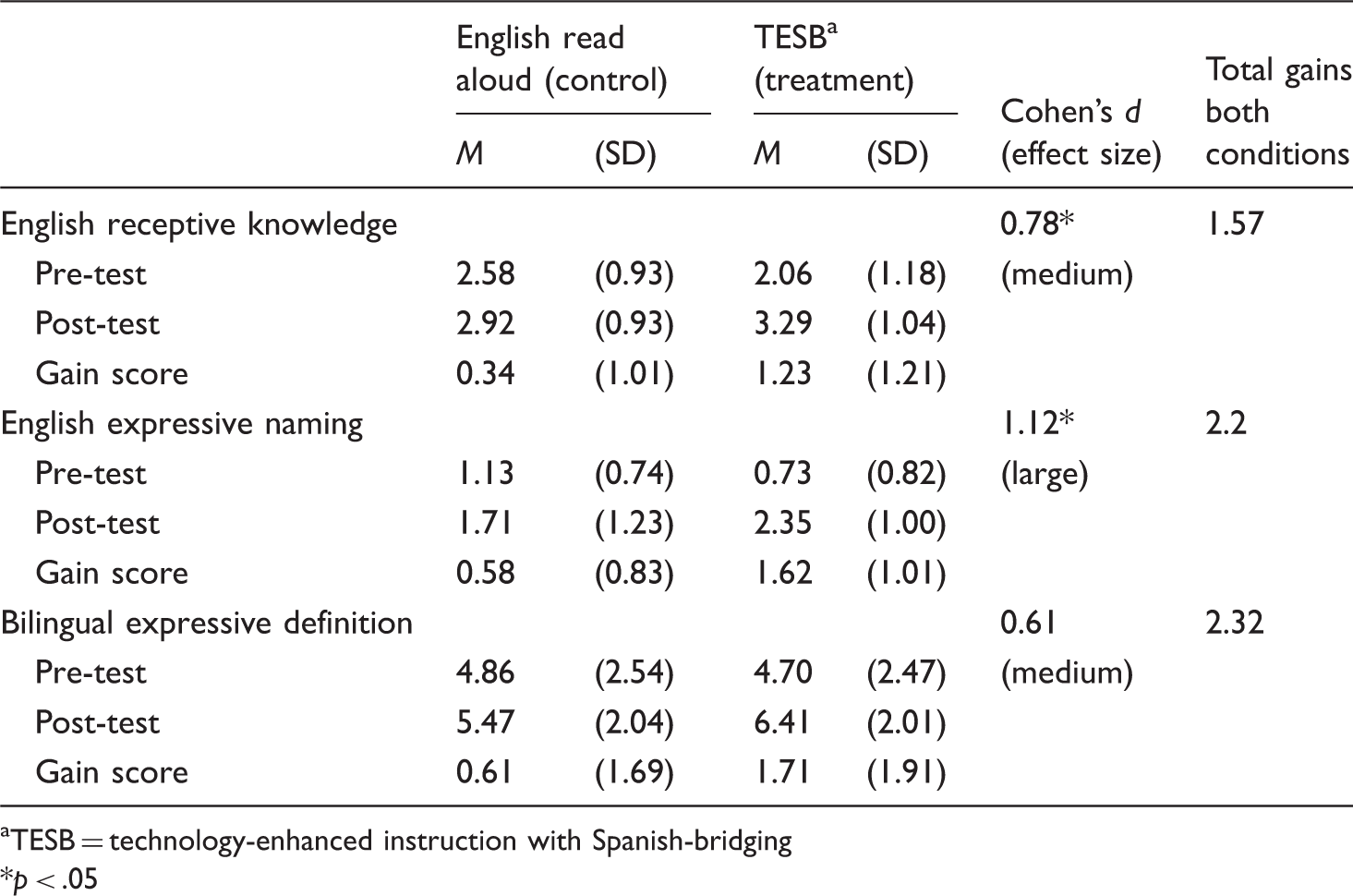
TESB = technology-enhanced instruction with Spanish-bridging
p < .05
Magnitude of learning
For total vocabulary gains across both conditions, children gained 1.57 words in English receptive vocabulary, 2.2 words in English naming and 2.32 points on bilingual definitional abilities (Table 3). Thus, in two weeks children learned approximately two words in both English receptive knowledge and English naming, as well as two semantic attributes or one to two words in definitional abilities.
Gain scores were also examined in the control condition to compare pre- to post-test differences between books related to learning through incidental exposure. Post-hoc analyses found that significantly fewer gains were made in receptive and naming abilities from incidental learning during the control condition with Book 3; definitional gains had no noted differences.
Language measures and word learning gains
Pearson’s moment-correlation coefficients were computed to investigate the associations between word learning gains in each condition and the non-repeated language and vocabulary tests. No significant correlations were found between children’s age in months and word learning gains.
Correlations with receptive knowledge
Gains in receptive knowledge were significantly related to the Spanish TVIP and PreLAS English proficiency assessment in both conditions. Negative correlations were evident in the experimental condition and positive correlations in the control condition. The TVIP contributed 21.2% of the variance in the experimental condition (r = −0.460) and 26.3% of the variance in the control condition (r = 0.513). The PreLAS English contributed 28.2% in the experimental condition (r = −0.531) and 27.5% in the control condition (r = 0.524). These correlations may suggest that in the experimental condition children with lower TVIP and lower PreLAS English scores made higher gains, and those with higher TVIP and PreLAS English scores made lower gains. In the control condition, children with lower TVIP and lower PreLAS English scores made lower gains, and those with higher TVIP and PreLAS English scores made higher gains.
Correlations with expressive naming
There were no statistically significant correlations with performance on the expressive naming task and any of the language or vocabulary descriptive instruments. However, there was a correlation approaching significance between performance on the expressive naming task during the experimental condition and the receptive knowledge task during the experimental condition (r = 0.501, p = .013), contributing 25% of the variance. This positive correlation suggests that during the experimental condition children with higher gains on the receptive knowledge task made higher gains on the expressive naming task. There was no similar receptive–expressive correlation in the control condition (r = 0.154, p = .472), indicating that there was no significant relationship between receptive and expressive abilities.
Correlations with expressive definitions
Interestingly, when children participated in the English-only condition, there was a medium negative correlation between definitional word gains and the PPVT-4 (r = -0.415, p < .05), the EOWPVT-SBE (r = −0.502, p < .05) and the PreLAS English (r = −0.471, p < .05). These associations suggest that children with higher performance on the PPVT-4, EOWPVT-SBE and PreLAS English were correlated with lower definitional gains during the English-only reading. However, when children participated in the treatment condition, expressive definition gains were positively associated with the TVIP (r = 0.442; accounting for 20% of the variance). Children with higher TVIP scores made higher definitional gains, capitalizing on the Spanish-bridging support.
Discussion
Several instructional features were utilized in the intervention condition to examine vocabulary acquisition for young ELLs. The current investigation combined several strategies to create an intervention package with positive effects on word learning with consideration for bilingual learning. Nonetheless, it cannot be determined from these findings which of the intervention’s core ingredients were critical for effective instruction: multiple exposures through expanded definitions, verbal repetitions in a preview and/or definitions provided in the home language (i.e. Spanish bridging) provided through technology-enhanced support.
The present study supports providing vocabulary definitions embedded in repeated readings. By combining expanded definitions with repeated readings, word learning gains are evident, even for those children who are raised in homes of lower SES (Justice et al., 2005) and for preschool ELL children (Collins, 2010). Additionally, the present study’s conclusions support multiple exposures being an important indicator of word learning (Brett et al., 1996; Elley, 1989), with more exposures leading to increased word learning (Biemiller and Boote, 2006). Combining the strategies of repeated readings and expanded definitions facilitates opportunities for increased exposure.
An additional component provided in the intervention was the use of definitions provided in the home language, Spanish. Specific to bilingual models, the current results indicate that home language instruction may link or bridge between the vocabulary conceptual storehouse and the lexical label storehouse (Kroll and Stewart, 1994; Potter et al., 1984). Similarly, Lugo-Neris et al. also found that home language vocabulary support during repeated readings increased word learning with young ELL children.
Furthermore, individual differences and group variability were noted with regard to word learning gains, particularly when children differed in prior standardized vocabulary and criterion-referenced language test performance. Despite individual differences, the findings were consistent with recent research on young children’s word learning; even brief vocabulary interventions can produce large effect sizes (Marulis and Neuman, 2010; NICHHD, 2000).
Overall, the findings support the aforementioned bilingual theoretical models. A child’s first language appears to mediate word learning in a second language. The present study supports vocabulary bridging to enhance word learning during electronic book readings.
Limitations
Limitations were present along with opportunities for further examination. The convenience sample was a limitation due to smaller size and variability. Although variability existed, the sample was representative of attendees to a summer migrant programme. A larger sample size may yield more accurate representation, and thus the results should be interpreted cautiously as regards generalization to other ELLs. Group variability within the sample was a limitation with respect to age, test performance and SES. Participants’ ages ranged from four to six years. Test performance on vocabulary and language proficiency added variation to the sample. Children varied between those with lower vocabulary in one language or the other. Low SES was a confounding variable, which is difficult to separate from other factors (Arnold and Doctoroff, 2003). Although inherent differences existed due to the samples, individual differences are also expected due to the heterogeneity observed in dual-language learners (Fillmore, 1991). The sample included children from migrant backgrounds, which meant that the participants were only available for short time periods at a particular location (Hernandez et al., 2007), which did not allow for follow-up testing on vocabulary word-learning retention. Although a two-week intervention, conditions were counterbalanced to decrease the likelihood of an order effect between treatment and control conditions on such a brief study.
Limitations in the selection of vocabulary words existed. During the analysis it was noted that two of the words were near cognates for phonological similarity (e.g. Book 1: ambulancia / ambulance; Book 2: visera / visor). Although this factor did not appear to facilitate learning, based on an item analysis, it is difficult to be certain with only two instances; future research should investigate young ELLs’ linguistic transfer of vocabulary items. Furthermore, half of the books had semantically related target words associated with a particular theme (e.g. hospital: crutches, stethoscope, cast, ambulance); half were not semantically related (e.g. bell, stripes, lipstick, newspaper). Some of the words were not in the text to provide verbal incidental exposures in the control condition, although children had the opportunity of visual exposure. Only Book 3 differed significantly in English receptive knowledge and English naming during the control condition, suggesting that pictured-only words were incidentally learned less than pictured and verbalized targets; however, additional research is needed as no differences existed among the books for definitional gains. To account for this difference, the researchers controlled for the number of times a target word had Spanish bridging in the treatment condition, as compared to no Spanish bridging in the control. The number of exposures in the control condition was otherwise pictured or occurred in the text of the story.
Conclusion
Future studies should examine specific features of the intervention. As a brief preview component was included in the current intervention, further examination should assess its contribution to word learning (Leacox & Jackson, submitted) and the strategic placement of exposures, such as in a preview and review (Ulanoff and Pucci, 1999). In this study, no measure of technology familiarity or exposure was administered. Thus, it is unknown whether technology familiarity influenced the results; however, an RA moderated each intervention session to aid computer familiarity as needed. The selected books were chosen based on age-appropriate visuals and storylines. Future projects could investigate the effect when books are responsive to a specific cultural background (e.g. Lovelace and Stewart, 2009). One limitation was the multiple formats involved in the intervention; the e-book format may have introduced variability in the reported effects. An additional control condition is recommended for future studies utilizing complex interventions. Researchers could examine the effects of intervention format (i.e. book vs. computer) in technology-enhanced instruction (Segers et al., 2004) and/or the utility of e-books in a classroom setting (Silverman and Hines, 2009), different technology formats and engagement (Mama and Hennessy, 2010) and opportunities to embed language and literacy (Ramirez Verdugo and Alonso Belmonte, 2007). It is probable that a teacher may verbally use bridging to support vocabulary learning, with similar or greater gains. The flexibility of sound and image capabilities makes this possible when a teacher does not speak the child’s home language. Technology allows for adaptations to different linguistic groups, given that one trained home-language speaker is available for an initial audio recording. On a qualitative note, the computer component was a motivating aspect of the intervention, and thus, motivation of technology use should also be considered in future investigations.
Limitations in the sample should be acknowledged. A convenience sample led to significantly more females than males. Future research should investigate word-learning preferences, particularly with regard to technology. For example, do young males learn more or less with instructions using electronic formats?
In summary, this investigation compared repeated English adult readings and repeated technology-enhanced English readings supplemented by Spanish bridging of vocabulary definitions. As educational professionals may work with children from several different linguistic backgrounds (Kohnert et al., 2003), technology provides one means to connect children to their home language in spite of an initial language barrier (Mueller and Hurtig, 2010). Although it remains uncertain which intervention features were most beneficial, educational professionals should consider combining vocabulary strategies as a potential means to enhance vocabulary learning for young ELLs as compared to book reading alone: (1) repeated readings; (2) multiple and varied exposures; and (3) vocabulary definitions in the home language.
Footnotes
Acknowledgements
Thanks to all the collaborative efforts of the participating site and children and those who contributed to this project, especially Amanda Ammons, Rachel Baum, Elizabeth Figarola and Georgia Garcia. A special thanks to Dr Richard Hurtig and collaborators at the University of Iowa for their consultative support and efforts. This research received no specific grant from any funding agency in the public, commercial or not-for-profit sectors.