




Abstract
The present study is the first part of a longitudinal research project investigating whether children become more aware of phonemes or rhyming when they learn letters or letter sounds or even begin to read, and if so how. For the present paper, the phonological awareness of young children aged 2–6 years was analyzed, particularly their auditory knowledge of the phonemic structure of words as well as their knowledge of rhyme. Altogether, 110 children from Finnish day-care centres performed seven phonological tasks and a vocabulary size test. The results showed a clear age-dependent improvement in phonological awareness. Blending words of phonemes, separating rhyming words from each other and correcting words by substituting the wrong phoneme with the right one were found to be easier tasks for 2- to 5-year-old children than producing rhymes, twisting words or detecting an initial letter.
Introduction
The issue of how children acquire phonological awareness has attracted considerable attention in recent years. Understanding the development of the phonological awareness of children is important, because phonological awareness is a critical indicator of later reading ability (see Castles and Coltheart, 2004, for a review). Phonological awareness refers to the degree to which one can distinguish the sound structure of oral language (Anthony and Francis, 2005) and the ability to recognize and manipulate the sound structure of language (McBride-Chang et al., 1997). According to Wagner and Torgesen (1987), it includes making judgements about deleting, counting, blending, reversing and segmenting the syllables and phonemes of a word, and about separating its initial, middle or closing syllables or phonemes, as well as certain judgements concerning rhyme or the oddity of a rhyme, for example.
Phonological awareness develops during childhood when children become more and more sensitive to smaller parts of words, detecting syllables before the onset or rhyme, and detecting or manipulating individual phonemes within words (Anthony and Francis, 2005; Foorman et al., 2002; Lonigan et al., 1998). However, little research is available on kindergarten and preschool children, especially 2- to 3-year-olds, in terms of their phonemic awareness or their ability to focus on and manipulate phonemes in spoken words (Ehri et al., 2001).
Studies involving younger children have mainly addressed phonological awareness—meaning syllable-based blending, phoneme or word elision, rhyme production, rhyme alliteration oddities, etc. (e.g. Carroll et al., 2003; Puolakanaho et al., 2003; Treiman and Baron, 1983)—or have tended to focus on the effects of articulation errors on phonological awareness (e.g. Thomas and Senechal, 1998, 2004) or on letter-name and/or sound knowledge (e.g. Piasta and Wagner, 2010). It is common that in studies exploring phonological awareness, the tasks used are grouped together when presenting the results, which makes it difficult to know exactly which of the tasks (initial phoneme/elision, word/syllable/phoneme blending, etc.) have had a greater or lesser influence on the final results (e.g. Anthony et al., 2007; Piasta and Wagner, 2010; Ponitz and Rimm-Kaufman, 2011; for an evaluation of tests for emergent literacy skills and phonological awareness, see Wilson and Lonigan, 2009; see McDowell et al., 2007 or Anthony et al., 2002 for separated word blending of syllable—onset rhyme—phoneme blending).
Fox and Routh (1975) and Chaney (1992) have explicitly tested the hypothesis that even 3-year-olds can have specific phonological awareness as well as awareness of the phoneme structure of a word. Fox and Routh (1975) found that children are able to show what they implicitly know about the phoneme structure of a word if the task is designed to make this knowledge explicit to them and does not have a high cognitive load, such as tapping out the phonemes of a word by hand. Children were asked to listen to a sentence, repeat part of it, and then isolate the remaining words one at a time. When asked to say a “little bit” of the last remaining two-syllable word, and then a “little bit” (a phoneme) of the last syllable, the children showed an awareness of phonemes: 3-year-olds could separate 28% of the phonemes, 4-year-olds separated 63%, 5-year-olds 78% and 6- to 7-year-olds 90%. Lonigan et al. (1998) found that a small to moderate percentage of 2- to 3-year-old children were able to manipulate sounds at the syllable and phoneme level.
Chaney (1992) invented 21 tasks to measure 33- to 50-month-old children’s metalinguistic awareness, that is, their knowledge of language as distinct from speech. She found that 3-year-olds could make metalinguistic (including phonological) judgements and productions in structured tasks and that this improved with age in months. Among the six easiest tasks were inventing new names for unknown objects (95% met the criterion), phoneme synthesis (93%), phoneme judgement (91%), and phoneme correction (88%). Initial phoneme judgement (14% met the criterion), initial phoneme production (26%), rhyme judgement (26%), rhyme production (35%) and phonological play (37%) were among the six most difficult tasks. Lonigan et al. (1998, see also Hindson et al., 2005) demonstrated that 3-year-olds were twice as proficient at blending phonemes (21.4%) as they were at segmenting them (10.7%). In addition, both Stainthorp and Hughes (1998) and Fletcher-Flinn and Thompson (2000) found that spelling was not easy, even for precocious readers.
Morais (2003) points out that methodological difficulties may occur if it is presumed that all phonological tasks take place in the course of phonologically based reading. “Reading does not involve, of course, making spoonerisms or acronyms, and it presumably does not involve counting or deletion, either” (p.126). Also Stainthorp and Hughes (1998) noted that both the addition and deletion of an initial phoneme was not easy, even for young children able to read at age 5. Nevertheless, of fluently reading children (YER), about 84% managed initial addition and 93.3% managed deletion, whereas of non-reading children (NER), only 15.7% and 8.6% could manage these tasks, respectively. Furthermore, the addition and deletion of an initial phoneme was significantly easier than that of a final phoneme. Of YER children, 74.7% succeeded in the addition and 80% in the deletion of a final phoneme, but only 4.3% and 7.1% of NER children succeeded in these tasks, respectively (see also Hulme et al., 2005).
The tasks one uses to study phonological awareness makes a difference. According to Ehri et al. (2001), phonological awareness tasks can be arranged on a scale from easy to difficult, as follows. (1) First sound comparison: identifying the names of pictures beginning with the same sound. (2) Blending onset-rime units into real words. (3) Blending phonemes into real words. (4) Deleting a phoneme and saying the word that remains. (5) Segmenting words into phonemes. (6) Blending phonemes into non-words (p.275). Ehri’s scale was not used in this study.
In the present paper, the phonological awareness of 2- to 6-year-olds was analyzed, particularly their auditory knowledge of the phonemic structure of words and also their knowledge of rhyme. This was done by
analyzing children’s auditory ability to blend segmented sounds to make a word; analyzing children’s auditory ability to perceive the structure of a word at the level of a single phoneme; and exploring children’s abilities regarding phonological awareness by means of different tasks.
Method
The present study is the first part of a longitudinal research project investigating whether children become more aware of phonemes or rhyming when they learn letters or letter sounds or even begin to read, and if so how. In this first phase of the project, the phonological awareness and letter knowledge of the children were evaluated. The same children will then be examined after six and 18 months.
Participants and context
Altogether, 110 children (57 boys and 53 girls) aged 26–82 months (M = 49.17, SD = 13.25) were recruited from private day-care centres in metropolitan areas in Finland. The children were from two half-day (N = 10) and four full-day (N = 42) private Montessori kindergartens, and from three separate full-day private day-care centres (N = 58). Of the children in the Montessori kindergartens, 58.8% (30) were beginners, i.e. they had been there less than three months at the time of the first task.
In Finland, the socioeconomic level of children in private and public day-care does not greatly differ, because all children have the right to day care. All of the children in the Montessori kindergartens (N = 52) and 39 of those in the day-care centres (N = 58) were between the ages of 2 and 4. For an age comparison, a number of older children from two day-care centres participated as well (5–6, N = 20). The results were computed separately for the 2- to 4-year-olds (N = 90, mean age = 44 months) and the 5- to 6-year-olds (N = 20, mean age = 71 months). There were no requirements regarding a child’s development (e.g. delayed speech, articulation skills or overall developmental level).
Finnish is a language that has 13 consonants and eight vowels. The role of vowels is very important. They are strictly controlled, so almost no allophone exists in Finnish language. Moreover, a characteristic feature of Finnish orthography is that each phoneme is represented by one grapheme, and vice versa. The main stress in all words is on the first syllable, while the second and the last syllable are always unstressed. Geminate (CC) structures are common, both in adult models and children’s forms of early target words (see DePaolis et al., 2008; Saaristo-Helin et al., 2011).
The tasks for phonological awareness
The tasks for the study were devised according to Chaney’s (1992) tasks for phonological awareness. In Chaney’s study, children (N = 43, normally developing) were given four tests for language development: 12 metalinguistic tasks measuring phonological awareness, word awareness and structural awareness; and two measures of literacy knowledge. To make the task more child-friendly, Chaney used ‘talking’ puppets, who had difficulties with the English language. The puppets asked for advice and help from the children to correct the articulation of words and sentences.
In Chaney’s phoneme judgement task, the puppet articulated a series of words, of which some were mispronounced by one phoneme. The children were instructed to evaluate whether the word was pronounced “right” or “wrong”. In the phoneme correction task, the children had to correct any phoneme errors made by the puppet. In the phonological play test, the children were encouraged to play with words. The examiner said a word, like pancake, and the children were instructed to continue the game by replacing the word with a “wrong” (not a real) word. When playing the game, the children would use words like mancake, cancake, and so on. In the phoneme synthesis test, the puppet pronounced three segmented phonemes (/k//a//t/). The children had to choose one of three pictures that represented the word that they had constructed from the phonemes. In the rhyme judgement test, a puppet called Jed said that he liked words that rhymed with (sounded like) his name. The children had to discern whether the words sounded like “Jed” or not. In the rhyme production test, a puppet name Hi liked words that rhymed with his name. The children were asked to say some words that the puppet would like. In the initial phoneme judgement test, a puppet called Max liked words that began with the first sound of his name, /mmm/. The children were asked to discern whether the words pronounced by the puppet began with an /mmm/ sound (Chaney, 1992).
The goal was to devise a tasking situation suitable for small children, because they generally have limited tolerance for extended tasking sessions (Byrne et al., 2006). To make the phonological awareness tasks as concrete as possible for the children, and to direct their attention purely to the task, toys were used as part of the tasks. (Chaney mainly used a “talking” puppet or pictures.) Thus, the children could demonstrate their phonological knowledge by choosing to take or leave a toy, and not by answering orally (see e.g. Wood, 2006). Only rhyme production was conducted without toys.
Following Chaney’s idea, the tasks were chosen to represent as many language patterns as possible that young children normally hear and judge in everyday life, such as attracting their interest if the words they hear are pronounced correctly or not. For instance, the often used elision task was not used because it is not part of everyday language activity. In addition, blending instead of segmenting was used, because segmenting appears to require a more explicit knowledge about letters and the concept of reading (Hulme et al., 2005; Lonigan et al., 1998).
The children performed seven phonological tasks as well as a vocabulary test (Laaksonen, 2004) with the purpose of defining their verbal level. The tasks were carried out in the same order for each child, in one 25–35 minute session. The children were tasked individually by the researcher (first author) in a quiet area or separate room in their day-care centres. The tasking was done with the researcher sitting on the floor in front of a small mat. The idea was to be at the child’s level and hopefully avoid creating an overly formal or intimidating setting for the child. The examiner and the child sat side by side to avoid continual eye contact and to minimize any fear or shyness the child may have had.
Problems with enunciation were taken into account only to ensure that the child was correcting or twisting a word knowingly, and not simply repeating it with inadequate pronunciation. The substitutions of phonemes were then recorded during the vocabulary tasks. Enunciation errors were not an obstacle to participating in the tasks.
All of the tasks were simplified to make them more accessible to the 2- to 4-year-olds by reducing the difficulty of pronunciation when the children had to pronounce a word. Furthermore, when giving the children their instructions, simplified sentences were used. The tasks were preceded by providing the children with oral advice and/or a demonstration, and some tasks were practised before the actual task began. The letter sounds were pronounced with a pure phoneme sound, for example as (/t/) and not (/te:/) or (/m/) and not (/em/). Correct answers were given a mark of 1 or 2 depending on the task. The toys were laid down in front of the child and the examiner pronounced the names clearly, one by one, while laying them down. Then the tasks were explained, and before beginning a task itself the toys were named again.
Phoneme judgements
The purpose of this task was to assess the children’s ability to detect articulated errors involving phonemes in the speech of others. Only small changes in the words presented to the children were made: one phoneme was replaced, vowel for vowel or consonant for consonant. In the task, the children were asked to identify which of the toys’ names were said incorrectly. The examiner told the child that she would say some toys’ names correctly and some incorrectly. The child could place the toys she said correctly in a small tray, but not those said incorrectly. Four words pronounced correctly and six incorrectly were then spoken by the examiner. If the child took the wrong toy, it was noted (see Appendix, item 1).
Phoneme correction
This task was similar to the previous one, but the purpose was to evaluate the children’s ability to detect articulated errors involving phonemes in the speech of others by articulating the mispronounced phoneme correctly. The wrong phonemes were inserted in different positions in the words, with the words becoming more complex to pronounce (1. vcvcv—3. cvcvv—6. cvvcvcvc). The examiner told the children that she would say the name of all five toys incorrectly, and if a child said the word correctly he or she could place the toy in the tray. If the child took the wrong toy or did not correct the wrong phoneme out loud, it was noted. Misarticulated corrections were recorded if the target phonemes were pronounced correctly according to the child’s own articulation pattern (see Appendix, item 2).
Phoneme play
The children were exposed to mispronunciations of a word to determine their ability to manipulate speech sounds. Six toys were in a box, and to practise, the examiner would take one out and present it, for example, saying “polkupyörä” (a bicycle). (In Chaney’s [1992] similar task, the children were asked to manipulate words based on an abstract concept.) The examiner would tell the child that she knew how to pronounce the word correctly, but that she wanted to say it incorrectly in a way that still sounded almost correct. Then she would say “kolkukyörä” (e.g. in English “kicycle”) and ask the child to repeat it. She then said that even though they could identify the toys correctly, the children should say them incorrectly. Then she would take the first toy and say: “This is a pelle (clown). Would you say pelle a little bit incorrectly?” All of the child’s answers were written down. For a correct answer, the mispronounced word had to have a similar structure as the original word, but there had to be phoneme substitution (see Appendix, item 3).
Phoneme synthesis
The children were asked to blend segmented phonemes to create a word. The task was first practised with a box of five toys, after which a box of five new toys was used to perform the task again. After pronouncing the names of the toys clearly, the examiner told the children that she would then identify the toys by saying their “letters” as they were written (e.g. R–A–P–U [crab]). The examiner then asked the children to point to or name the toy that corresponded to the “letters” that were pronounced. All five toys were on the mat during the task. Only phonemes are used, and not the letters’ names. If a child pointed to or named a toy incorrectly, it was noted (see Appendix, item 4).
Rhyme phoneme separating
This task is similar to the phoneme recognition task used by Thomas and Senechal (2004), who wanted to determine if children could distinguish between two phonemes presented together and identify if they were the same or not. They used the names of dogs in drawings, e.g. Ruh and Wuh. Here the children were asked to separate rhyming words differentiated only by an initial phoneme (puu–luu [tree–bone; in English, e.g. bone–cone]). Five pairs of toys were taken to the mat, one pair at a time. The examiner would say: “Here are puu and luu, puu-luu. Listen to which one I say and take it. Luu.” If the child took the wrong toy, it was noted (see Appendix, item 6).
Rhyme production
This task was similar to Chaney’s (1992) rhyme production task but without the puppet. Here the children were asked to generate words that rhymed with two words spoken by the examiner (after katu–latu the child could continue with, for example, satu [road–ski track–story; in English, e.g. cat–bat–hat]). The previous task of rhyme phoneme separation was given as an example of what rhyming means, using two of its pairs and continuing them by adding more rhyming words to each. Five pairs of rhyming words were presented and the children were asked to continue generating new matching words; non-words were also allowed. All answers were written down as they were given (Appendix, item 7).
Initial sound judgements
Even though this task was found to be difficult, and particularly for younger children (e.g. Chaney, 1992; Thomas and Senechal, 1998), its link to reading is of interest to this study in its comparing of older and younger children and also readers and non-readers. To avoid a floor effect, for example, children discontinuing the task, the task was designed so that the child had to make a choice (see e.g. Seymoure and Evans, 1994). The children were asked to choose from two sounds the correct initial sound of a toy. The first (practising) phoneme “P” was chosen because its sound is strongly aspirating, with a strong burst of air at the release of the sound, and therefore easy for a child to perceive, as was also the case with the second phoneme “T”. The sound of the third phoneme “M” is instead that of a nasal consonant, blocked but with the airflow continuing through the nose and therefore distinguishable from “T” when used with it as the pair.
In this task there were three bags, each of which had either the letter P, T or M written in capital letters on one side and in lowercase letters on the other, and a larger bag with no letters written on it. Each of the three bags with letters contained five toys, the names of which began with the letter written on the side of the bag. The first practising task used the bag with the letter P on its side. The examiner told the child that there was a letter drawn on the side of the bag and asked the child if he or she could identify it. If the child said the letter P or made the sound of a P, the examiner repeated the sound, pronouncing it clearly. If not, the examiner pronounced the sound of the letter P so that the child could see the examiner doing so. Then, the child would take each of the toys out of the bag, one by one. As the child took a toy out of the bag, either the child or the examiner would name it, both making sure that each toy began with the letter P. Having done this, the child would put each of the toys back into the bag with the letter P written on it. The exercise concluded with all the toys being put back in the bag.
After practising with the bag “P”, to begin the task the child was asked to pour the contents of bags “M” and “T” into a new, larger bag. The names of the toys in bags “M” and “T” all began with the letter M or T, respectively. The child would then take one toy at a time out of the larger bag that now contained toys beginning with either an M or a T. Each time the child took out a toy, the examiner would say the name of that toy. For example, “That is a man. Does ‘man’ begin with an M (pointing the bag with M) or a T (pointing the bag with T)?” When the child put the toy back in the bag the examiner would repeat the question. In the case of the man-figure, for example, the examiner would say: “M. Does Man begin with an M?” If the child put the man in M bag, or vice versa the question would be: “T. Does Man begin with a T?” Again only phonemes were used and not the names of the letters. If the child put a toy in the wrong bag, that is, a toy beginning with a different letter from that written on the side of the bag, it was noted (see Appendix, item 5).
Scoring the phonological awareness tasks
In the phoneme judgement and initial phoneme judgement, every right answer was scored as 1. In phoneme correction, taking the right item and producing the changed phoneme correctly was scored as 2, as was selecting the right item from two in the rhyme phoneme judging. In phoneme synthesis, answering correctly after the first hearing of phonemes was scored as 2, and after repeated phonemes as 1. In rhyme production and phoneme play tasks which would require an oral answer and have a criteria level, the former were scored as 0 for no answer or an unrelated one, 1 for a small rhyming effect (e.g. in English cone–coach) and 2 for a clear instance of rhyming (e.g. cone–bone). The latter, phoneme play, was scored as 0 when a child did not answer or used an irrelevant word, as 1 if a child stressed one speech sound, e.g. muki–mukki (in Finnish double consonants can change the meaning of a word), and as 2 if a child changed the word by one or more speech sounds.
Vocabulary size and letter knowledge task
The children’s vocabulary size was assessed using a vocabulary test (Laaksonen, 2004). The test is short, taking from 5 to 10 minutes, which allows the child to complete it in one attempt along with the phoneme task. The vocabulary test was used with as many as 400 children at a time and scored as a standard vocabulary measurement tool. The task consists of naming 24 pictures and extra questions concerning pictures about colours, verbs, times of the year, numbers and four higher language concepts. Both raw scores and age-matched scores were used for the data analysis.
Results
The means and standard deviations of tasks for ages 2 (N12), 3 (N35), 4 (N33), 5 (N9) and 6 (N11). The means and standard deviations in bold are for total group of participants.

In tasks where the child had to judge auditorily if the phoneme structure of a word was correct, even the 2- to 4-year-olds did well, and the 5- to 6-year-olds’ performance was excellent. The 2- to 4-year-olds recognized incorrectly pronounced words and could also correct them by changing the wrong phoneme to the right one. The 6-year-olds could perform almost every task, but even 4- to 5-year-olds had difficulties with phoneme play and rhyme production. Almost all of the children could accomplish phoneme correction and rhyme phoneme separation, and children aged 4 or above were successful at phoneme judgement. Moreover, phoneme synthesis showed regular improvement with age, while the initial sound judgement task appeared unconvincing because all of the children regardless of age seemed to have almost the same level.
Nearly all 6-year-olds received full marks in the phoneme play and rhyme production tasks, although rhyme production was more difficult for some. Rhyme production was also more difficult for all other age groups, while in phoneme play 4- to 5-year-olds did better. The 2- to 3-year-olds had almost no success in both tasks, nor did the 4-year-olds do well in rhyme production.
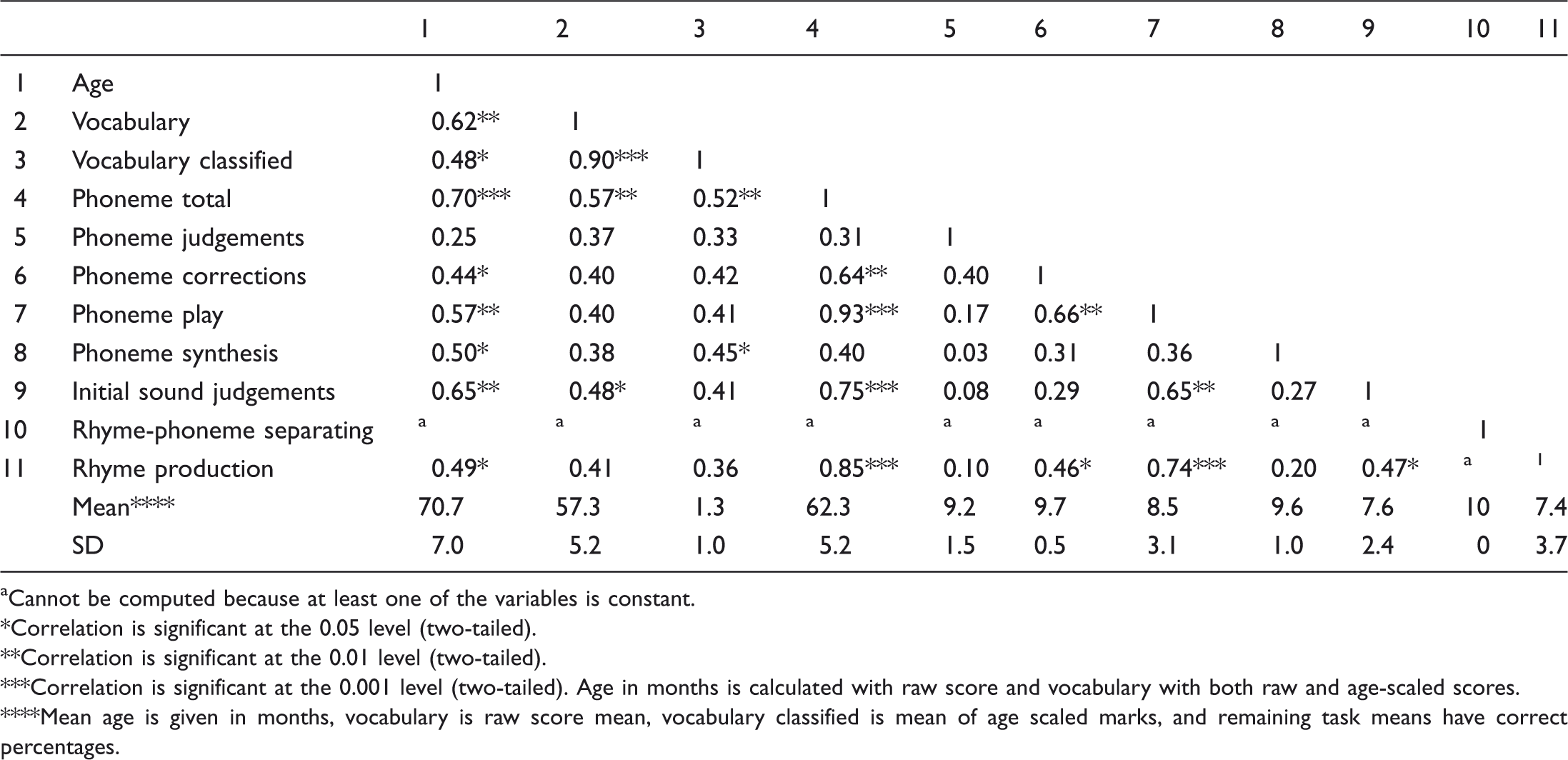
Correlations for age in months, vocabulary, total marks for phonological tasks, awareness of word structure (6–8), phoneme awareness (9–10), phonological awareness (11–12) and letter recognition for children aged 5–6.
Cannot be computed because at least one of the variables is constant.
Correlation is significant at the 0.05 level (two-tailed).
Correlation is significant at the 0.01 level (two-tailed).
Correlation is significant at the 0.001 level (two-tailed). Age in months is calculated with raw score and vocabulary with both raw and age-scaled scores.
Mean age is given in months, vocabulary is raw score mean, vocabulary classified is mean of age scaled marks, and remaining task means have correct percentages.
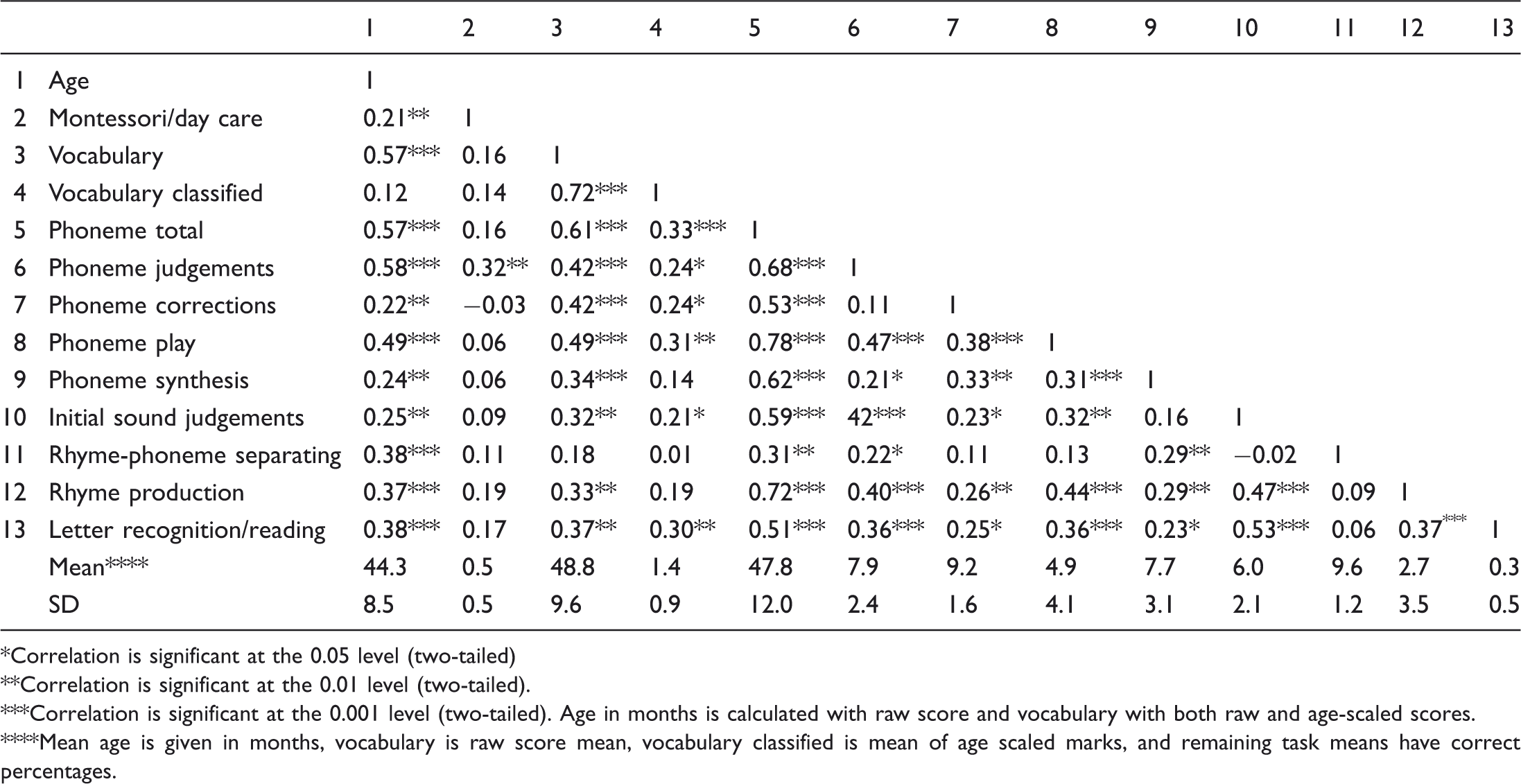
Correlations for age in months, vocabulary, total marks for phonological tasks, awareness of word structure (6–8), phoneme awareness (9–10), phonological awareness (11–12) and letter recognition for children aged 2–4.
Correlation is significant at the 0.05 level (two-tailed)
Correlation is significant at the 0.01 level (two-tailed).
Correlation is significant at the 0.001 level (two-tailed). Age in months is calculated with raw score and vocabulary with both raw and age-scaled scores.
Mean age is given in months, vocabulary is raw score mean, vocabulary classified is mean of age scaled marks, and remaining task means have correct percentages.
Age correlated strongly with both vocabulary and overall success in phoneme tasks. Of the individual tasks, age correlated most strongly with rhyme production, phoneme play and phoneme judgement and least strongly with phoneme corrections, phoneme synthesis and rhyme phoneme separating, and for 2- to 4-year-olds also with initial sound judgement. Vocabulary correlated strongly with overall success in phoneme tasks, and also with all individual tasks, except rhyme phoneme separating. The correlations for the 2- to 4-year-olds were somewhat higher than for the 5- to 6-year-olds. However, when the raw score of the vocabulary task was scaled to show success at age level (vocabulary classified), the 2- to 4-year-olds had slightly higher correlations than the 5- to 6-year-olds. No difference was found in the correlation between Montessori and day-care children concerning vocabulary, total scores or any individual phoneme tasks, with one exception: the 2- to 4-year-olds with respect to the phoneme judgement task (r(88) = 0.32, p < 0.01). Of the tasks, rhyme production for the 2- to 4-year-olds correlated quite strongly with phoneme play and initial sound judgement, with phoneme play correlating more strongly with phoneme judgement than with initial sound judgement. For the 5- to 6-year-olds, phoneme play correlated strongly only with rhyme production (r(18) = 0.74, p < 0.000).
Phoneme judgement had lower means than phoneme correction for the 2- to 3-year-old age group, although the task is basically the same as the phoneme correction task, or even easier. When judging, the child only had to choose the right toy and not say the word in its correct form, as in phoneme correction. This may suggest that the youngest children could not follow the direction to not take the toys the examiner had said incorrectly, because the children still chose the right toy: 85% of 2-year-olds and 98% of 3-year-olds. Furthermore, when success at age 2–4 was calculated separately for the Montessori children (N = 51) and day-care children (N = 39), 30 Montessori children (58.8%) and 10 the day-care children (25.6%) achieved the full ten marks. However, for oral feedback demanding phoneme correction, the numbers were quite similar for the two groups, 72.5% and 74.4%, respectively.
In phoneme synthesis children as young as the age of 2 could create a word when they heard its separate phoneme sounds, and showed or named the right toy; children at age 2 had quite a high mean of 5.3 in phoneme synthesis, and for age 3 the mean was 7.5. No significant difference was noted between the Montessori and day-care children when success at age 2–4 was calculated separately for the Montessori children (M = 7.7) and day-care children (M = 7.3). Altogether, 45% of the Montessori children and 43.6% of the day-care children achieved full marks (10).
Initial sound judgement had a total mean of 6.3. However, the task showed a strong degree of randomness: the 6-year-olds had a mean of 9.1 but for all other age groups the mean was between 5.5 and 6.8. In the experimental situation, it was observed that by guessing or using other than initial-based choices, a child could obtain as high as 8 marks out of 10. Only the children gaining 9 or 10 marks seemed to know the initial letter. Furthermore, when comparing children aged 2–4 from the day-care centres with those from the Montessori kindergartens, there was a difference: children who had been in the Montessori kindergarten for three to 12 months did better (M = 7.0–7.2) than the day-care children (M = 5.7–5.9). In fact, only 1 (2.6%) of the 39 day-care children between the ages of 2 and 4 achieved 10 marks and none achieved 9, but 15.7% (8) of the Montessori children achieved 10 marks and 3.9% (2) achieved 9.
Number and percentage of children having 0 marks and 1–2 marks.
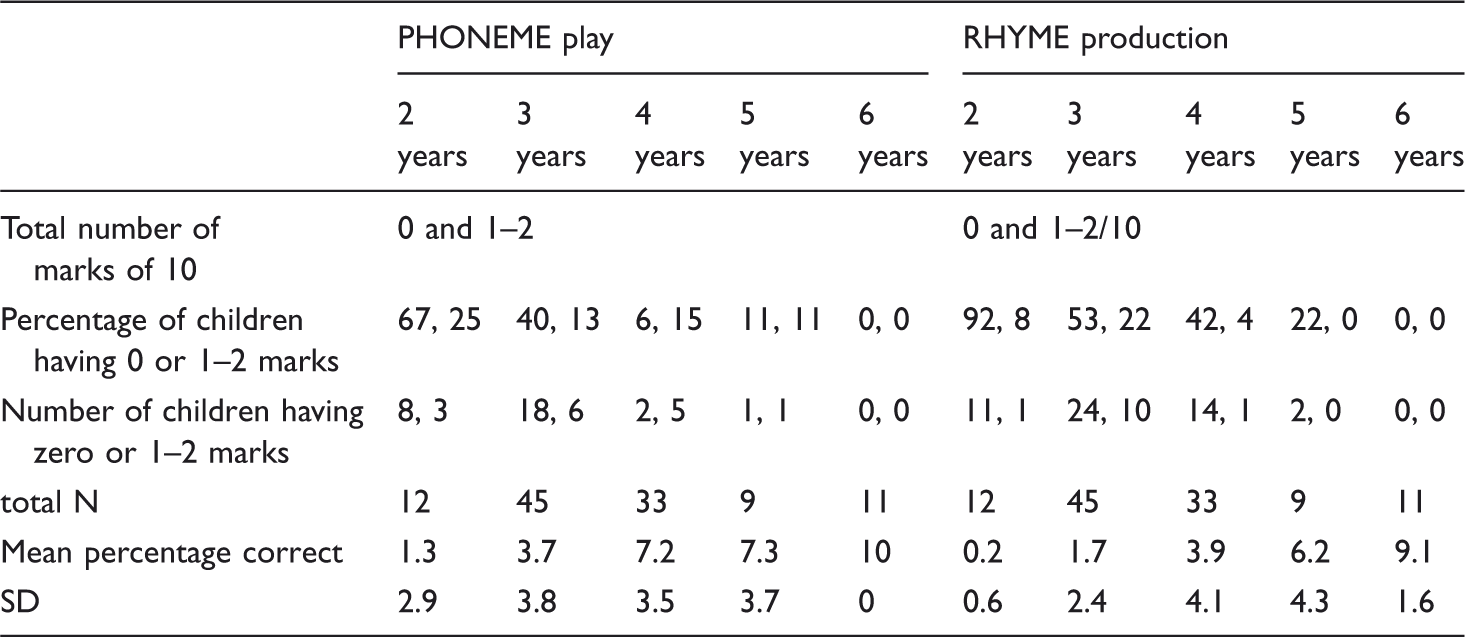
In the phoneme play task, of the 2-year-olds, all but one had 2 or less marks. The one exception, however, had 10 marks. Over half of the 3-year-olds and about one-fifth of the 4-year-olds had only 2 marks or less. Nevertheless, of the 3-year-olds, 3 (6.7%) had 10 marks and 10 (22.3%) had 8–9 marks, and of the 4-year-olds, 14 (42.4%) reached 10 marks and 7 (21.2%) 8–9 marks. Of the 5-year-olds, 7 (77.7%) achieved marks from 8 to 10 and all of the 6-year-olds had full marks. In rhyme production, of the 2-year-olds all but one had 0 marks, and of the 3-year-olds one had 8 marks. A little less than half of the 4-year-olds had a maximum of 2 marks; however, 6 (18%) of these had 10 marks. Of the 5-year-olds, 2 (22%) had a mark of 0; but again, 4 (44%) had 10 marks. No 6-year-olds had a mark of 0, 81% had 8–10 marks, and only one had 5 marks.
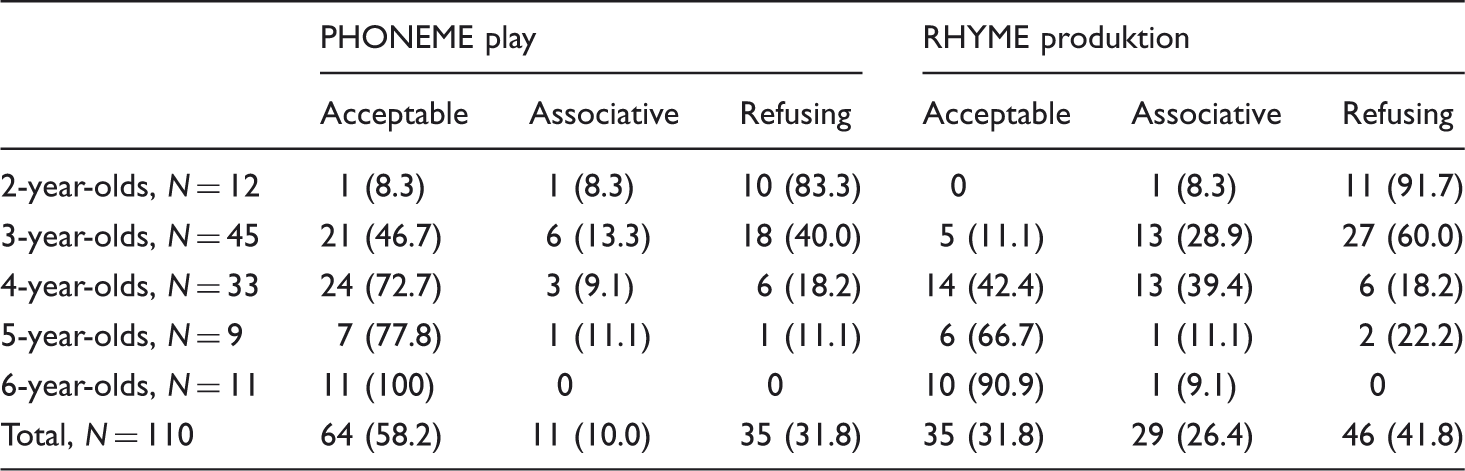
Number and percentage (in parentheses) of children giving acceptable or associative answers or refusing to answer.
Phonological abilities and developmental trends of the children
Reaching criteria in various phonological skills. To determine whether the children in different age groups had developed specific phonological skills related to the phonemic structure of a word, rhyme or initial letter, criteria similar to those used by Chaney (1992) were applied to evaluate the children’s performance. As most tasks required the child to make two choices, except for two oral answers requiring tasks (phoneme play and rhyme production, enabled), a one-tailed binomial task was used in every task to establish a passing criterion that was unlikely to be met by guessing (p < 0.03).
Number and percentage of children aged 2–4 and 5–6 years passing each phonological task (p <0.03).

Table 6 shows that 80% to 100% of the 5- to 6-year-olds met the criterion when it involved awareness of word structure tasks (changed or segmented phonemes). In rhyme production, three-quarters met the criterion, but only slightly over half did so in the initial sound judgement task. Concerning the awareness of word structure tasks, half of the 2- to 4-year-olds met the criterion in phoneme judgements, but in phoneme correction they were close to the 5- to 6-year-olds in meeting the criterion. In phoneme play, less than half met the criterion. Almost two-thirds met the criteria in phoneme synthesis but only a fifth in initial sound judgement. Concerning the rhyme tasks, in rhyme phoneme, separating the 2- to 4-year-olds met the criterion almost completely, with about a tenth meeting the rhyme production criterion.
Discussion
The present study has investigated the phonological awareness of young children aged 2–6 years—particularly their auditory knowledge of the phonemic structure of words. The children performed seven phonological tasks, as well as a vocabulary task for the purpose of evaluating their letter knowledge. In general, the means of the various phonological awareness tasks showed a clear age-dependent improvement in phonological awareness. This is in line with previous research results (Anthony et al., 2002; Lonigan et al., 1998; McDowell et al., 2007; Missall et al., 2007; Thomas and Senechal, 2004).
The study has demonstrated that children could separate rhyming words from each other, correct words by substituting the wrong phoneme with the right one, and judge if one phoneme in a word was pronounced incorrectly. Synthesizing phonemes was also an easy task for the children. In the initial sound task test, the 6-year-olds did well, but not the younger children. In the rhyme and phoneme play tasks, only children above the age of 4 years succeeded. These results are in line with Chaney’s (1992) research, which found that among 3-year-olds completing 21 tasks, the easiest were phoneme synthesis and phoneme judgement, and among the most difficult were phonological play, rhyme production, and initial phoneme judgement.
When the children were asked to make judgements and corrections based on whether the structure of a word was correct, they were able to do so. The children were also frequently able to emphasize the correct portion of the structure by prolonging it or giving it extra emphasis (lau;
The 2- to 3-year-olds were able to blend together sounds spoken in a segmented fashion showing phonological and particularly phoneme awareness (Chaney, 1992; Fox and Routh, 1975; Lonigan et al. 1998). Significantly, many children who could easily blend the phoneme sounds of a word could not make rhymes. Lonigan et al. (2009) also found that in a procedure where children could choose from three pictures when judging a blended word, the results were better than those for rhyming tasks for both 2- to 3-year-olds and 4- to 5-year-olds. In their two-factor model, rhyme oddity and rhyme matching were loaded into the Phonological Awareness and Memory factor, but for younger ones there were the only paths of ten whose indicators were not significant. For 4- to 5-year-olds they were significant.
It was interesting that the children aged four-and-a-half years old or younger quite systematically refused to change the phoneme structure of words. They simply refused to do the task, they answered “I don’t want to—don’t know—I cannot.” Yet they were willing to correct out loud the words the examiner said incorrectly. In Chaney’s (1992) experiment, children aged 2–4 did not succeed in the rhyming or phonological play tasks, but Chaney mentions no refusals during her experiment. However, 40% of the children aged from 3 to almost 4 in her study did excellently in phonological play, about 60% produced 0 to two examples. Seymoure and Evans (1994) found that in a rhyme production task for their Nursery group (age 3.10–4.8), acceptable responses (34%) were almost equally balanced by refusals (36%) and other whole word responses, which were mainly associative (28%). The incidence of refusals also declined in the older groups: 21% for their Primary 1 group (age 4.9–5.8) to 7% for their Primary 2 group (age 5.9–6.10). These unexpected refusals, also present in our study, may need further investigation. For some reasons, younger children were not willing to produce non-words, meaning words whose structure was changed from the original, although they were willing to correct them.
On the basis of our results, it appears that young children have more knowledge about phonemic structure of words than is generally supposed. It was quite easy for children to show their knowledge, even in short experimental situations, as seen here, for example regarding the high number of children who succeeded in the phoneme synthesis task beginning from the age of 2.