




Abstract
One of the tensions in conducting participatory literacy research with young children is finding the balance between protection and voice. In this paper, we describe how we sought to create participant-centred research techniques within the evolving design of a yearlong action research study with kindergarten students. Through weekly classroom read-alouds of social class-themed children’s literature, the larger project explored how children connected and critically responded to issues of poverty, privilege and inequality. How did our research techniques simultaneously balance ‘protecting’ children as ethical guidelines ask us to do, allow us to report our findings in ways that describe the rich data we collected, and create space for children to express and develop their voices and perspectives? We identified three issues that were salient to us in our research project with kindergarten students: using participant-centred research techniques, treating assent as an ongoing process and capturing the complexity of context while protecting children’s identities. We look beyond the minimal requirements of research review boards as we explore some of the ethical issues that arise for us as teachers and researchers when we conduct literacy research with young children. We conclude with a discussion about how literacy researchers are uniquely poised to contribute to the scholarship on ethics with young children.
Keywords
This article explores some of the ethical issues inherent in conducting literacy research with young children as we balance the representation of their authentic voices with protecting their rights and privacy. It is fairly routine in literacy research to include children as participants in the research process, but often, discussions about the complexities of working with children, especially balancing protection and voices, are missing in research reports (Aldridge, 2012; Ebrahim, 2010; Hill et al., 2004; National Research Council, 2004; Spyrou, 2011). If literacy research is going to influence teaching practice, situating it in classrooms, where research is immersed in school culture, then the presence of children as research participants must be taken seriously. Working with children presents some challenges and requires particular kinds of ethical decisions that should inform all research with young people. These ethical decisions occur at all phases of research, from the selection of a topic, in the methodological design, in actually conducting observations, interviews and data-gathering activities, and in making the findings public. This article offers our analysis and critique of the ethical issues we encountered from our study of literacy practices in a kindergarten classroom rather than our substantive findings that can be found in Labadie et al. (2013).
It is fairly routine practice in many countries for professional and academic boards to review research proposals before they commence. The United Nations Convention on the Rights of the Child requires member countries to assure that children as research participants have rights, including the freedom to seek, receive and give information (United Nations, 1989). In the United States, Institutional Review Boards (IRBs) stipulate basic requirements for protecting the rights of participants. These rights focus on: (1) respect for people and their right to choose, put into practice through informed consent/assent to participate; (2) beneficence, brought to life by minimizing discomfort in the research process and ensuring, as a whole, the research brings a benefit to participants and society; and (3) justice, which means that participants are fairly selected and the burden and benefit of the research are fairly distributed amongst members of the population. However, as teachers and researchers, we know that beyond these ethical guidelines, there is quite a bit of bumpy ethical terrain that we must navigate and that the regulatory research protections offered to adults cannot be easily generalized to children. Our focus looks beyond the minimal requirements of the IRB as we explore some of the ethical issues that arose for us as teachers and researchers when we conducted literacy research with young children.
Scholarship on research ethics and young children has been conducted in the health sciences (e.g. Christensen, 2004; Hunleth, 2011; Kirk, 2007), sociology (e.g. James, 2007; James and Prout, 1997), social work (e.g. Mishna et al., 2004), psychology (e.g. Morrow and Richards, 1996), education (e.g. Freeman and Mathison, 2008; Graue and Walsh, 1998) and early childhood education (e.g. Darian-Smith and Henningam, 2014; Dockett and Perry, 2005; Paige-Smith and Rix, 2011; Robson, 2011; Schiller and Einarsdottir, 2009). Researchers in the health sciences, in particular, have taken a lead in suggesting novel ways of educating participants about their rights and responsibilities as participants in research studies (e.g. Kaser-Boyd et al., 1986; Lindeke et al., 2000; Mulvey and Peeples, 1996). However, there has been a lack of scholarship in literacy studies focusing on the ethics of conducting research with young children, especially in classroom settings where the line between instructional and research activity blurs. The majority of literacy scholarship on research ethics has focused on adolescents and adults, not child participants (e.g. Mortensen and Kirsch, 1996; Rhodes and Weiss, 2013; Soap, 2006).
We argue that because literacy researchers study cultures of communication, and often do so using longitudinal, ethnographic and multimodal methods, that we are well suited to extend the well-developed line of scholarship about ethics in practitioner research (e.g. Hammack, 1997; Zeni, 2001) into literacy studies with children. Literacy researchers are often members of the communities they study, either as classroom teachers, reflected in the long tradition of teacher research in literacy studies (e.g. Ballenger, 1998; Calkins, 1983; O’Brien and Comber, 2000; Vasquez, 2004) or literacy teachers-turned-university researchers who stay connected to classrooms as sites of learning and enquiry. Arguably, while the potential risks for children who participate in literacy research in schools are lower than in the health sciences, the ethical boundaries are perhaps less clear-cut in the former. Indeed, studies of early childhood literacy often use ethnographic methods and are relatively long term, giving researchers many encounters with research ethics that are often not reported or are marginalized in published studies. Further, literacy researchers have histories of participation, including assumptions about literate practices and identities – our own, the young children with whom we work, the sociopolitical context of the classroom and so forth. While the insider status affords certain vantage points, it also assures us that there will be silences, fissures and tensions in what can be seen and known, especially when working with young children. These tensions can provide literacy researchers with a productive place for theorizing about what Simons and Usher (2000) call situated ethics – that is, how ethical research processes are constructed in specific situations with young children.
Thus, in this article, we return to our research records from Labadie et al. (2013) to analyse and critique three issues that were salient to us throughout the life of the research project: using participant-centred research techniques, viewing assent as an ongoing process and capturing the complexity of context while protecting children’s identities. Before moving to the issues, we briefly describe the study.
Context of the study
As a practitioner research team, we collaboratively designed and carried out a research project in a kindergarten classroom where we read and discussed a set of themed picture books (Labadie et al., 2013). We wanted students to see diverse characters and economic situations represented in children’s literature and to have the opportunity to discuss and respond to issues of economics, equity and justice. Our intention was that over the course of the seven-month unit that included 15 read-aloud books, the children would develop more complex understandings about social class, poverty and privilege. The original research question that guided the study was: In what ways do kindergarten students connect and respond to literature read aloud focused on the theme of social class?
The action research (Kemmis and McTaggart, 1982) took place in Meredith Labadie's kindergarten classroom in an elementary school located in a nearby suburb of a midwestern city in the United States. The students were invited to participate because they were randomly assigned to the teacher researcher’s own classroom. There were 21 economically and culturally diverse students; 12 spoke English as a second language, and there were 8 different home languages spoken. There was a significant population of immigrant students in the school because the school was one of a few in the area that offered an English Language Learner programme. Independent of language status, 10 students were eligible for free or reduced price meals. The teacher was in her seventh year of teaching, and was enrolled in a doctoral programme in literacy education. The university-based researchers were both faculty members in colleges of education. Although the researchers each had at least a basic knowledge of a language other than English, none of their second languages were the same as any of the home languages spoken by the children.
Multiple sources of data were generated for the study, including 20 observations of read-aloud lessons with field notes, video recordings and transcripts, photographs, teacher notes and reflections, 15 picture books focused on social class, privilege and poverty, student drawing and writing and a class-constructed learning wall with artefacts representing their understanding of each of the books. A complete description of data sources, including a description of the books read aloud, can be found in Labadie et al. (2013).
Our analyses of the data were ongoing and informed subsequent teaching and research decisions. We relied on the tools of critical content analysis (Krippendorff, 2004) and critical discourse analysis (Rogers, 2011; Gee, 2005) to examine how each of the participants responded to the children’s literature through talking, drawing and writing. Our fine-grained analysis of meanings, made across a range of modes, helped us to see patterns of interacting, representing and being around the children’s literature that signalled the development of complex understandings about social class, poverty and privilege. These patterns answered not only our original research question but prompted additional questions about considering voice and protection in literacy research with young children.
The first question had to do with the use of participant-centred research techniques. As we analysed the quantity and quality of children’s responses to literature, we noticed that some children voiced their perspectives in certain modalities more so than in others. Our intention was to understand each child’s developing perspectives on the texts, and so we adjusted our design to incorporate multimodal responses to each piece of literature.
The second question focused on the assent process. As we analysed participation structures during each video-recorded read-aloud, we wondered how interactional patterns (e.g. the amount of talk and by which children) might signal not only learning but also their continued assent to be in the research study. We wondered to what extent the children understood the parameters of their participation in the research and, as a result, investigated more deeply how informed assent was negotiated throughout the research project.
Finally, as our analysis resulted in our interpretations layered alongside the children’s, we worried about how best to stay close to children’s voices, perspectives and original meanings while maintaining their right to confidentiality. All three of these issues became the basis of the theorization and analysis for this article.
Considering voice and protection
In the following sections we explore the three issues that arose regarding the ethics of conducting participatory research with children: using participant-centred techniques; assent as an ongoing process; and balancing the complexity of context with protecting the children’s confidentiality and identities. In each section we draw on examples from the project to illustrate the complexities of the issues. All children’s names have been changed to pseudonyms.
Using research participant-centred techniques
Perhaps inherent in an action research project that involves a teacher studying her own classroom in collaboration with university researchers is the depth of observation, reflection, discussion and analysis that leads to an evolving, research participant-centred, responsive research design. Following Punch (2002), we refer to our techniques as research participant-centred rather than child-centred because we recognize the methodological value of this approach for all research participants, including children. Our process of collaboration led to experimentation with different ways for children to express themselves so that we could find the range of responses, affordances and constraints of each mode (Dalli and One, 2012). As we co-analysed early sessions, looking for wide participation, we fine-tuned the balance of multimodality so that all children could find ways to respond to the texts.
Research with children as participants is based on the assumption that we can learn from them (Clark, 2005; Dalli and One, 2012; Dockett and Perry, 2005; Lansdown, 2005; Theobald, 2012). Without directly providing children with ways to share their thoughts, it would have been easy to stereotype ‘childhood’ based on anecdotes coming from a few vocal students. In this section we want to make explicit the process by which our participant-centred design unfolded and the specific ways in which inviting multimodal responses created a space for a variety of children’s voices and perspectives in the classroom. Including multiple modalities in research designs with young children can help elicit deeper, more meaningful responses. While others (Beresford, 1997; Dockett and Perry, 2005; James and Prout, 1997; Stephenson, 2009) have made this case, here we emphasize how the constraints of one venue for representing ideas for some children (e.g. whole-group discussions) were affordances for others (e.g. writing, drawing and collaborative representation).
We learned that providing opportunities for multimodal responses to the texts helped us get a broader range of responses and better understand how all of the students in the classroom were connecting and responding to the books. The multiple means for responding to the texts offered ways for students who were less comfortable sharing verbally to respond more privately by writing, drawing or collaborating as part of small groups that grappled with issues that arose in the texts.
Fundamental to the design of our study was the recognition that intentionally creating space and time for children to respond to books would support literacy development. This time and space encouraged a diversity of voices and perspectives that helped ensure that the children’s ideas were prioritized. During the read-alouds, the teacher would pause frequently, and children used the pauses to discuss the books. These whole-group discussions continued after the books were finished, typically ending as the conversation waned. The discussions that occurred in the midst and immediately after a reading showed us ‘in the moment’ responses – what children were thinking as they were experiencing the book. These discussions were also ways for children to respond to one another’s thinking, and to reframe and reorganize their own thinking based on evolving conversation with peers. However, not all children felt comfortable participating in these whole-group discussions, and even some of the more verbal children formed ideas that were not shared with the whole class. Therefore, following a read-aloud, students were given time for written and illustrated responses.
For example, in a discussion of the book Tight Times (Hazen, 1983), many of the students felt comfortable sharing examples of difficult economic times from their own lives. However, we noticed that there were several students who had not joined the conversation. Later, as they wrote and drew responses to the text, we saw many more children take up the topic on paper (Figures 1–3). We saw students who enthusiastically participated in the discussion elaborate on those responses in writing and illustration, and some students who participated in the discussions in general ways responded in deeply personal ways on paper. There were other children who were quiet during whole-class discussions, but when given extended time to think about the books, they generated thoughtful responses on paper.
Anne’s response to the text Tight Times. Amina’s response to the text Tight Times. Keisha’s response to the text Tight Times.

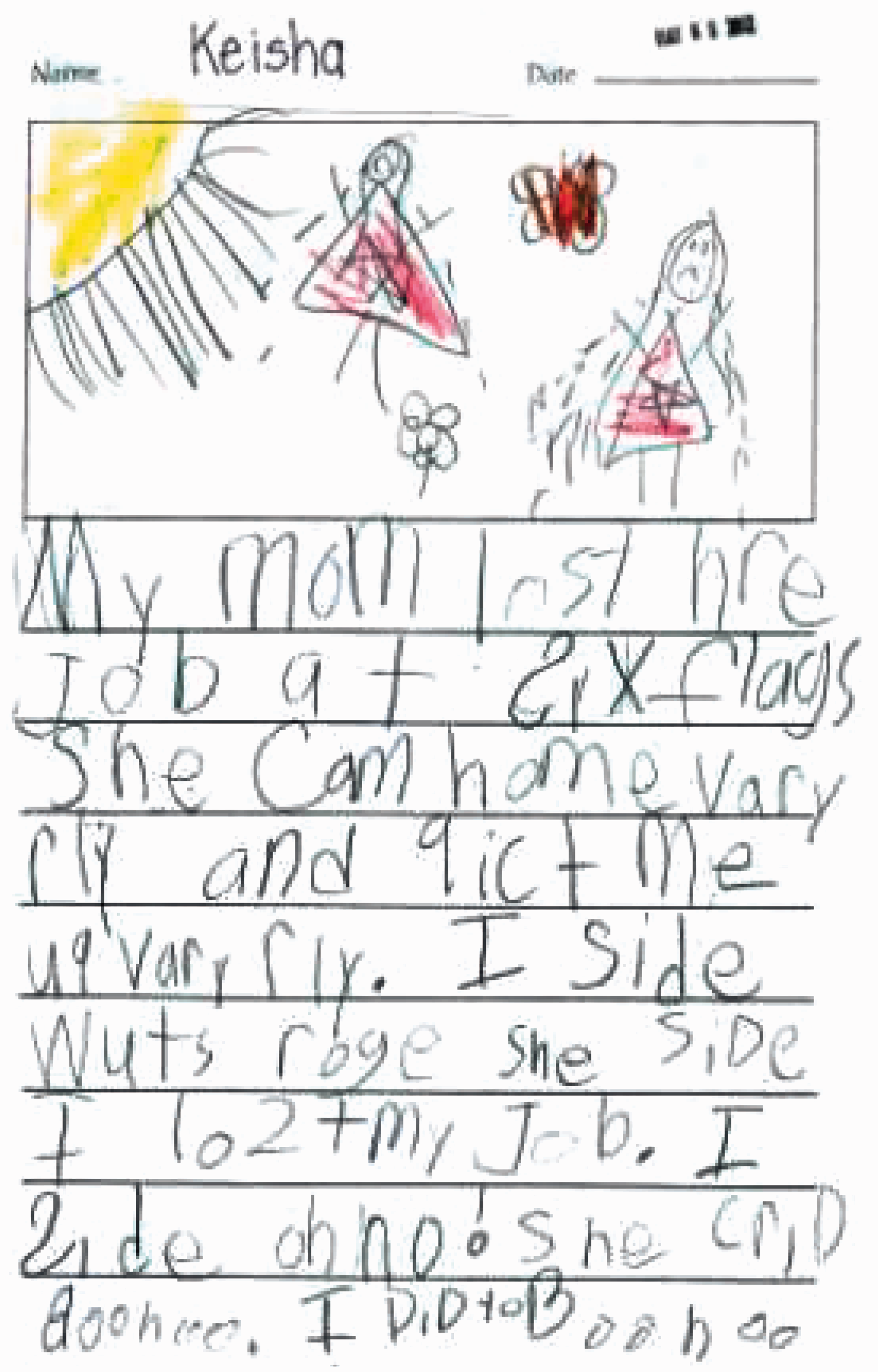
When the children were given the option to write or illustrate a response, some children routinely chose to write, while others chose to draw. Offering multiple modes for individual response to the read-alouds allowed us to hear multiple student perspectives, and helped provide students with different ways of representing their thoughts about the texts. For example, providing opportunities for the students to draw their responses enabled those with limited English proficiency, orthographic skill and vocabulary to express more developed thoughts through illustration. These illustrations extended the opportunities that were afforded in the written responses, while at the same time they often added a deeper layer of response. Illustrations often depicted thinking that went beyond the oral conversations, what was put into writing, and even what may have been dictated for adults to record. Had writing been the only option for paper responses, we would not have heard the perspectives of some children in the class. Also, not every student in the class had a clear-cut preference for talking, writing or drawing as a mode of response to the texts. Although some students participated fully through all three available modes (talking, writing and drawing), the more private spaces of writing and illustration seemed to prompt some students to share more significant and personal responses. Our observations and reflection on children’s modal preferences for generating meanings took into account the individual child, the research context and our research questions.
We also provided opportunities for the students to extend the book discussions beyond whole-class discussion and individual responses by inviting them to participate in small group collaborations that represented thinking on a class learning wall (see Figures 4 and 5). After the first books were read aloud, we noticed the children looking for previously read books to use for support as they made intertextual connections. At that point, we decided that a learning wall would help them discuss relationships between the books (Vasquez, 2004) and provide another mode for participation. Using a large sheet of chart paper that we segmented into columns for each book, and a photocopy of each book’s cover, we asked students to create artefacts based on prompts, such as ‘What problems do the characters in this story face?’ and ‘How did they solve them?’. Artefacts included students’ drawings, writings and everyday objects that helped students access the daily, sensory world and connect more powerfully with the books. For instance, after reading A Chair for My Mother (Williams, 1982), one group affixed a small container-turned-money jar to one of the writing samples to represent the importance of saving money in the story. The learning wall was a visual reminder of the books that were read. It developed gradually over the course of the study into a visual record of student learning across the unit that students could use as support in later discussions and independent responses.
The class-constructed learning wall. Examples of students' written responses to books posted on the learning wall.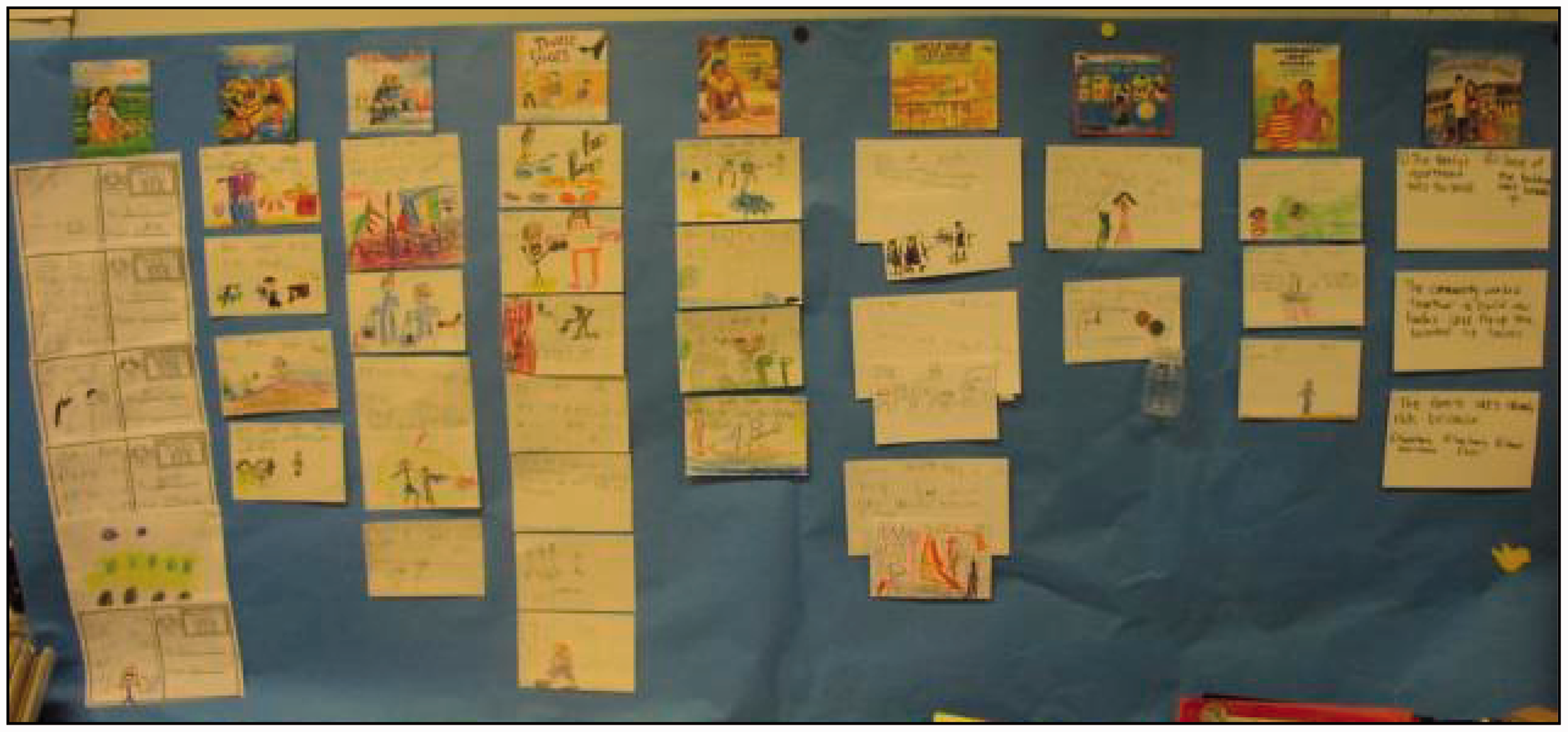

In addition to allowing another kind of format for the children to represent their ideas about the books, the learning wall gave them the chance to revisit books with additional insights garnered from peers, other books and discussions. These collaborative responses enabled different voices to be heard and perspectives to emerge over time.
Assent as an ongoing process
Informed consent hinges on three premises. First, participants will be given information about the research in an accessible manner. Second, their consent to participate in the research is voluntary. Third, the participant has the competence to give their consent (Beresford, 1997; Mahon et al., 1996). For children under the age of 18, parents usually make the first decisions about whether participation is appropriate for their children. After a parent agrees, seeking assent from child participants is an important way to recognize the rights of the child (Cocks, 2007; Ford et al., 2007; Mishna et al., 2004). Although ‘assent’ has been addressed by a number of researchers (Cocks, 2007), there is not yet one accepted definition. Documentation of assent for children aged 7–18 is a requirement of IRBs in the United States, though waivers for assent can be granted based on the child’s maturity level and/or psychological status. Lindeke et al. (2000: 100) describe the assent process as ‘a cooperative process between children and researchers involving disclosure and discussion of the research project’. Cocks (2007: 257) argues that assent is represented by the trust within the ‘relationship between the researched and the researcher, and the acceptance of the researcher’s presence’. Mere failure to object should not, in the absence of affirmative agreement, be construed as assent. Rather, children should be informed about the study and what they will be asked to do, and asked to participate, independent of their parents’ consent. However, the degree to which children can understand research participation and its associated risks can depend significantly on the educative context in which the research process is introduced (e.g. David et al., 2001) and the age of the child (Bruzzese and Fisher, 2003). Bruzzese and Fisher (2003: 14) describe how ‘although 5- to 12-year-olds understood the purpose and procedures of nonclinical research, understanding the risks, benefits, right to withdraw, confidentiality, and the voluntary aspects of research was poor’. In particular, the right to withdraw participation is difficult for young children to understand (Melton, 1983). While children’s perceived authority over adult researchers might be one issue, it is important to note that ‘children also do not have experience with having the right to refuse participation in school-based activities’, which could influence their perception of their true ability to refuse participation in research activities (Bruzzese and Fisher, 2003: 22).
Our view of assent, following the guidelines and research on the topic, is that even children under the age of 7 should be educated about the research process, given a chance to ask questions and discuss what is being asked of them, and personally agree to let their words and work become part of research reporting. This seems particularly relevant and manageable in classroom-based literacy research where practitioners have opportunities to educate children about the research process. In the following sections, we share our analysis of how assent was negotiated over time with young children in the classroom.
Gaining (and keeping) assent. Before beginning the study, Meredith sent home IRB-approved consent forms for the parents. While the read-alouds were part of regular classroom instruction, parents were given the choice of whether or not they wanted their child to be included and written up in the study. If a student’s parents gave consent for the child to participate, Meredith then had an individual conversation with the child to go over the assent form (see Appendix 1). Because most of the children were five-year-olds when this study began, it was not possible to write an assent document that any of them could read independently. We made the choice to write the document using language that was above their ability to read, but within their ability to understand when read orally and discussed. The assent form was read aloud to each child individually; it described the purpose of the study and what would be expected of them if they chose to participate. Students were told that participation was up to them; even though their parents had given consent, they could choose not to participate. We thought that it was important to seek the children’s assent even though their parents had already agreed because we valued their right to make their own decisions (Balen et al., 2006). Meredith made it clear that no one would be upset if the children did not want to participate in the study, and that they could change their minds later. In addition to reading the form to them, Meredith provided additional comments and clarifications until she was sure the students understood what they were being asked to do. Finally, she explained that the students would need to write their name on the assent form if they agreed to be in the study.
Our institutions’ IRBs approved this assent form, and it complied with the federal guidelines, particularly in terms of accessibility of the content. However, our closer analysis of this form reveals several shortcomings. First, the form does not tell the students the length of this study, how many hours the study would entail or that many of the records of their learning would be turned into data sources. For instance, we might have said, ‘Some of the reading lessons will be video recorded. We will also make copies of what you write.’ Second, we did not inform the students that their responses to the books would be shared with other teachers and researchers in presentations and publications. Their parents were, of course, informed that there was a plan to share the findings in writing and presentation agendas, but this was not clearly communicated to the children. In retrospect, it seems important that students have a sense that what is captured in the research record will be shared beyond the walls of their classroom. Third, we did not tell them that we would keep their identities confidential. We might have asked them to help us create pseudonyms for themselves instead of coming up with them ourselves. Fourth, we did not mention any benefits or risks of the study (an enriched language arts curriculum and loss of confidentiality, respectively). These issues pertain to guiding IRB ethics of respect for persons, beneficence and justice and could be included in child-friendly language. Additionally, we might have built a question into the assent form and asked ‘What questions do you have about being in this study?’ Rather than asking the students to give their assent (or dissent) immediately, we could give them time to think about it, discuss the research process in a whole group and offer children a chance to ask questions before they assent to the process.
Despite efforts to inform children about the research and their participation, we recognize the implicit power relationship between a teacher and her students that might make it difficult for a child to say ‘no’, or that might lead a child to agree simply on the basis of already established trust (David et al., 2001). All of the children in this study were asked to give their assent; none of them asked any questions about what they were being asked to do, or how data collected on them would be disseminated. It is interesting to note that all of the children who were asked for assent gave it. We pondered, perhaps students were being agreeable and trusting because this was their teacher who was asking for assent?
Awareness of participation in research. Part of what it means to be a participant in a research study means that you know when the study has started and stopped. When conducting research within the classroom, the boundaries between ‘research’ and ‘nonresearch’ can be blurry, making it difficult for children to know what their assent actually entails and when it applies. Our research process involved video recording read-alouds and related activities. We think this ‘video-active’ context (Shrum et al., 2005: 2) helps children to remember that they are part of a research study. Shrum et al. (2005: 12) refer to ‘camera consciousness’, which is how an awareness of the camera in context can change the naturalness of interactions. That is, the very presence of the camera recording observations symbolizes a different or special status and may interrupt the semblance of ‘normal’ participant behaviour. However, perhaps more problematic than the effects of participants being aware of the camera is what is at stake when and if that awareness disappears. That is, as recording becomes more pervasive and natural, participants may have a diminished awareness of it. We would argue that this might have implications for the continual process of informed consent. That is, ‘camera consciousness’ is evidence that participants continue to be aware that they are in a research study. Shrum et al. (2005: 1) refer to this ‘fluid wall’ which emphasizes that the camera is an actor in the research process and that observation and interaction occur in both directions – in front of and behind the camera. Indeed, when faced with a camera, children may feel compelled to perform, may ask the researcher to capture them on the tape, may be more silent when a camera is on, or may want to see themselves on camera. We want to argue that this fluid wall may productively generate awareness about the research process that serves as an ongoing reminder of people’s participation in a research project.
In our study, the set-up of the video cameras for the read-aloud sessions often signalled commencement of the research. Multiple video cameras were used for each session; Meredith usually set up her camera prior to the read-alouds on a tripod at the back of the rug that the students were sitting on. The other researchers held their cameras or set them on a nearby table to capture a side view of the discussion. Students would take notice of the cameras, and some tried to get near a camera to get a better look, playfully to make faces, or to ensure that they were being recorded throughout the session. The presence of two university researchers also signalled that they were being observed. Students came to expect a read-aloud lesson whenever the university researchers joined the classroom, and at times asked what the new book would be that day, or if they should get out the learning wall since the researchers had arrived. While the class listened to stories together on the rug many times each week, the presence of multiple video cameras and researchers marked particular read-alouds as being a part of the research study.
There were also moments in the research process that raise questions for us about the ethics of what becomes part of the data set, without seeking new assent or consent. We think about the instance during a discussion of parents’ jobs when one student, Amina, started to cry because her father had to be away from home for long stretches of time due to his job as a long-distance truck driver. This interaction was captured on video camera. Might we have asked Amina later if it was okay for the interaction to be part of the data? Did she understand that her thoughts might be shared with people outside of the classroom? Another student in the class, Keisha, also shared that her family were going through hard times as she wondered aloud if they might need to go to a soup kitchen since they did not have much money for food. Sensitive moments like these, where students shared personal stories from their lives with trusted peers and their teacher, were also captured as data by the video cameras, observed by outside researchers and sometimes shared in research publications and presentations.
Even though children assent to be involved in the study, are there ways for researchers to tell if children do not want to participate? If children are unusually quiet in discussions, might they be telling the researcher they do not want their thoughts captured? As Davis (1998: 330) points out, children may signal their lack of consent in other ways; for example, ‘if the adult researcher oversteps the bounds of what a child believes to be appropriate the child will resist through silence, humour, conflict, or by shutting the gates to their world’. We noticed in our study that there were specific children who were quieter on camera, and it is conceivable that their silence signalled such resistance. On the other hand, did jumping in front of the camera, waving directly at the camera or turning to smile into the camera signal continuing assent/consent? As Clark (2011) notes, working with young children requires researchers to be attuned to the variety of ways in which children may communicate. There were some children in the class who were more vocal when the video camera was on, perhaps thinking that the discussion was more worthy because of the presence of the camera. However, overall, the discussions recorded were representative of the kinds of participation structures in the nonrecorded classroom discussions. Being attentive to representative participation structures can help researchers gain insights into ongoing issues of obtaining student assent.
Capturing the complexity of context while protecting children’s identities
The third issue that we grappled with was balancing the thickness of description with protecting the identities of the young participants. We find it helpful to situate this issue within a broader discussion of the salience of context in participatory research. Action research, like all interpretive research, is a meaning-making endeavour. Because all meaning is made in context, we ground our research in the assumption that interactions and the interpretation of these interactions are constructed in context. Gee (2011) reminds us that a key question for researchers is determining which context to include – what he refers to as the frame problem. Context can be construed across domains – social, cultural, political, economic and others. Context can also be construed across scale, radiating narrowly or more widely from an individual speaker or text. Thus, when thinking about the balance between providing richness of context (a wide frame) and simultaneously protecting children’s welfare, we need to think through these different layers of context and at different points in the representation of the study, e.g. as we describe the context of the study, make choices about the breadth and depth of context to share around an interaction and represent the complexity of participants’ social, cultural and linguistic identities. In the following sections, we address each of these points of consideration.
Describing the context of the study. There are multiple layers to consider when describing the context of the study. The interactions between or among teachers and students might be considered the local context, descriptions of curriculum documents, institutional meetings and school policies and procedures can be thought of at an institutional level and legal mandates or educational reform initiatives might be thought of in an institutional plane. Again, the question for the researcher is how wide to cast the net when providing context for the study. In our case, we decided that including the geographical region of the country and a rich description of the school context was important. We were careful to blur some of the details, such as the name of the town and school. However, we run into a challenge – like other teachers who study their own practices – when we consider that one of the authors of the study, whose name appears in the manuscript byline, was the teacher of this class (Shulman, 1990). Someone intent on identifying the school would have an easy enough time figuring that out. We wondered: How much of a leap is it to think that a class list could be available, and pseudonyms decoded?
For us, this raises the question: What does it mean to ‘protect’ children’s identities? What are we protecting them from? Nutbrown (2011) argues that one attempt at protecting children in arts-based educational research has been the use of pixillated pictures which, she argues, is a distortion that obscures others from understanding children’s experiences with art. Nutbrown (2011: 8–9) writes, ‘pixilation takes something drawn from a life truth… and turns it into a lie. Images thus manipulated tell lies about the research and the researched.’ When we obscure images, we lose the richness of children’s meaning making, that is, ‘their faces tell us so much about their responses to the arts’ (Nutbrown, 2011: 9). Of course, there are legitimate issues to consider in school-based research such as custodial issues – if there was a child who was legally protected by a restraining order, and a custodial parent who kept the child’s location concealed. If we were to include an image of a child, even slightly pixillated, combined with a thick description of the context of the school and classroom but with names removed, would our manner of protecting identity go far enough?
Interpretation as context. The ways that children express meaning is key to understanding how they respond to their social situations. We also think about the analysis itself creating a context. For example, in our analysis of a conversation between students around a read-aloud, we may take up discourse analytic procedures to analyse the way in which the teacher and student are interacting, the relationship between them and the way they call on discourses that evoke identity markers. Further, we thread together contexts as we write about local, institutional and societal issues that frame the study. This set of interpretations can also be considered a context created by researchers. As Dockett et al. (2011 : 290) note, ‘Efforts to understand the meaning of children’s comments or other contributions rest with an understanding of context, including the interpretive framework adopted by researchers.’ What is important to remember is that every context has a history of discourse practices, chained together in particular ways. Our interpretations are slippery, and because we are also representing what happened and what is happening and doing so mainly with words, which are incomplete signifiers, we inevitably get further and further from the truth. Nutbrown (2011: 9) writes, ‘adult researchers who focus on children have to acknowledge that they change the meaning of the data when they draw their own meanings from it, thus taking it further from its original truth but still see making honest attempts to offer a faithful portrayal of what they see’. As we pored over videotapes, transcripts of discussions and copies of students’ work that spanned seven months, imposing our analytic frameworks on the data, we were reminded of the challenge of interpreting meanings from children, particularly with all of the biases of our adult lenses.
Considering interpretation as context is particularly challenging, given the longitudinal nature of the research. Looked at from the perspective of time scales (e.g. Lemke, 2000), each read-aloud became part of a larger, yearlong curricular conversation where children learned how to participate in an ongoing, extended discussion around characters, perspectives and social issues. Compton-Lilly (2011: 224) reminds us that ‘failure to recognize the way discourses operate over long periods of time limits the ability of educators and researchers to recognize the temporal nature of meaning construction’. Indeed, many of the conversations lasted for weeks as children came back to take up ideas that they had expressed weeks earlier. Considering time as an interpretive context is important.
Representing complex identities. Shulman (1990) discusses the trickiness of balancing anonymity and visibility, particularly with teacher research. Just as teachers who generate knowledge within research studies might ask for visibility for their efforts, rather than anonymity or confidentiality, the same might be true for child participants. Our consent and assent process promised confidentiality to the child participants, but another tactic might have been to ask the parents if they wanted their child to get credit for their work. On another level, the issue of masking a child’s identity raises questions about blurring the sociocultural richness of interpretive research. This issue became particularly pertinent as we generated pseudonyms for the children. Because the class was culturally diverse, and many students’ names reflected cultural heritage, we wanted pseudonyms for the children that authentically represented ethnic and family backgrounds. It was important for us to bring their realities, experiences and material and sociocultural circumstances to life, because we recognized that to aggregate them into one social category called ‘children’, or to marginalize the forms of diversity, would not honour their individuality. We used baby-naming websites to come up with names that were similar to the students’ given names in terms of popularity and ethnicity, and that we felt conveyed individual and family personalities. However, in doing this, we were aware that these pseudonyms could make students more identifiable and offer them less anonymity in the data. Throughout this process, we balanced the importance of cultural authenticity and respect for diversity (the notion that one cultural group is not interchangeable with another) and the need to protect the privacy of the students.
Discussion
As literacy researchers, we encourage children’s participation in research because of the authenticity it brings to efforts to improve teaching and learning. While it is likely that research with children as participants strengthens findings and adds to the trustworthiness of school-based research, we cannot take for granted that participating in research is always in children’s best interests. It is important for researchers to examine reflexively the assumptions about childhood and how children construct and represent knowledge and reality throughout the course of the research study (e.g. Dorner, in press). We acknowledge that sound methods of protecting human participants in general are crucial to ethical research but may not go far enough in educating child participants in particular. By digging beyond the minimal requirements of academic and professional research boards, literacy researchers can explore a full range of ethical issues that are important to understanding children’s lives and perspectives. We argue that carefully exploring the ethics of working with young children is particularly salient for scholarship in literacy studies. Literacy researchers both study and create the cultures of communication they study. The focus on ways of interacting, representing and being with talk and text that often serves as a focal point for literacy researchers can also provide important insights about how ethics are negotiated with young children. Further, as many literacy researchers are members of the communities they research, either as teacher researchers or former teachers, it is critical that literacy researchers examine their insider status and assumptions about the research setting and participants, which influence the research and how it is carried out. To close, we discuss the significance of each of the three issues we raised, pointing to additional directions for theoretical and empirical work.
The first issue is cultivating participant-centred research through multimodal research designs. Indeed, there has not been sufficient critical reflection on the benefits and drawbacks of multimodal techniques. We echo Connolly’s (1997) sentiment that eliciting perspectives from children involves more than finding an appropriate method. That is, researchers need to be sensitive to the affordances and constraints of different methods and modalities for individual children. Through the use of multimodality, we crafted a research design and process that was responsive to children in the classroom. We continuously reflected on lessons and made adaptations accordingly, and we intentionally looked to include all voices. Thoughts gathered in whole-group discussions were often different than what was revealed in independent or small-group collaborative work. For some of the children, drawing or writing brought out complexities and detail that did not come out in whole-group discussions. The diversity of responses within our approach provoked us to question our own adult and academic perspectives on children’s meaning making. In this sense, letting children respond in multimodal ways also served as triangulation – a way to understand thinking across different types of discourse, group oriented and individual. In our field, literacy research, integrating multimodality is becoming more the norm than the exception. We call for this sensitivity to the kinds of knowledge generated within and across modes to extend to research with older children, youth and adults in an effort to create research participant-centred methods.
The second issue we address is the assent process. When young children are research participants, researchers cannot rely on the conventional concept of informed consent, which applies to decisions about research participation made by people who are legally and intellectually capable of understanding their choices. When working with children as participants, an ethical concern is the extent to which they understand what they are being asked to do. However, we can involve children in meaningful discussions about their participation and obtain their assent to participate. Seeking assent from young children to participate in research might be thought of as a continual educative process rather than as something that occurs only at the beginning of a study. In this article, we have foregrounded the shortcomings of our own assent process, describing additional information we might have told the children in the study. We have pointed out that regardless of how careful we are with informed consent and assent, there are elements that need further thought. For instance, the teacher might have stressed that while everyone would participate in the read-alouds and discussion, some children may not want to have records of their learning (conversation samples, writing, illustrations and discussions) included as part of the data set. Emphasizing the distinctions between routine classroom activities and research activities might help children understand the boundaries of the research and their rights as participants. We encourage other researchers to study how young participants are educated about key aspects of the research process.
This raises questions about how we think about informed consent as a reflexive process rather than as something that happens at one point in time. Because children’s awareness changes based on circumstances and development, it is reasonable for researchers to revisit a child’s decision (whether ‘yes’ or ‘no’) to see if the original decision still stands (Cocks, 2007). While research participation and its potential risks can be discussed with children before research commences, it is important to note that ‘even if cognitively capable of appreciating the nature of the study, children’s relative lack of life experience may make it more difficult for them to project into the future and anticipate the potential pitfalls for them in participating in a qualitative study’ (Mishna et al., 2004: 455). Thus, children who initially give assent because they do not anticipate any problems with participation may later in the study want to change their minds. If children become uncomfortable about aspects of the research at any point, they ‘may also find it more difficult to act on their right to withdraw from a study by not knowing the practicalities of how to withdraw should they wish to, by being more likely to view the researcher as an expert and authority’ (Mishna et al., 2004: 455). Children may find it difficult to express their desire to withdraw from the research. Therefore, researchers might consider deliberately building in times during their study to check in with participating children and learn more about how they perceive the research process and if they would like to continue participating. Although researchers may not intend to cause harm to the children participating in their research, Mishna et al. point out that ‘children and adults may have different frames of reference with respect to what might cause discomfort or harm’ (Mishna et al., 2004: 455). Allowing child participants to take a more active role in the research might be a way to address these concerns. For example, children could be included in reviewing data with researchers and giving feedback on which pieces of data they are comfortable sharing with others. Researchers might also consider rehearsing with children through role-plays how to decline participation, ask questions or withdraw from the study. We call for further research on educating children about their rights and responsibilities as participants in literacy studies.
The third issue we have addressed in this paper is that of balancing the complexity of context with protecting the confidentiality of children’s identities. We have attempted to explore the complexity of representing children’s voices by reflecting on the processes which produce them. We critically interrogated the research contexts that generated student voices – what kinds, how and when. We discussed some of the ethical issues to consider when balancing the kinds of thick and rich descriptions characteristic of qualitative research with our ethical commitments of protecting the identities of the children involved in the research. We emphasize that the production of voices is always situated and reflects power relationships specific to the context in which they were produced. We have only begun to ask and answer questions such as: How does our adult status impact on the research process? How might we inadvertently serve as gatekeepers of children’s voices in our analysis and interpretation of the research?
Finally, in this article, we have tried to model a self-reflexive stance on our research process to emphasize some of the very issues we have highlighted. We think it is this kind of stance that is important in respecting the rights of children who participate in our research studies.