




Abstract
Building on the research on translanguaging practices in classrooms (e.g. García, 2009; Sayer, 2011) and immigrant families’ literacy practices (e.g. Gregory et al., 2004; Li, 2006), this qualitative study explores the nature of translanguaging practices of four Korean bilingual children and their families in home literacy events. Participant observation with video recordings and field notes was used to gather data, and the data analysis focused on the literacy events defined by Heath (1982) and types of language use. The findings demonstrated that bilingual children and their family members used their two languages flexibly and strategically to create and negotiate meaning. Using both languages contributed to clarifying meaning in communication and expanding children’s linguistic repertoires in their heritage language as well as in English. This study takes a particularized look at bilingual children’s language experience in out-of-school contexts by focusing on families’ ways of using their two languages to support their children’s heritage language development in literacy events.
Keywords
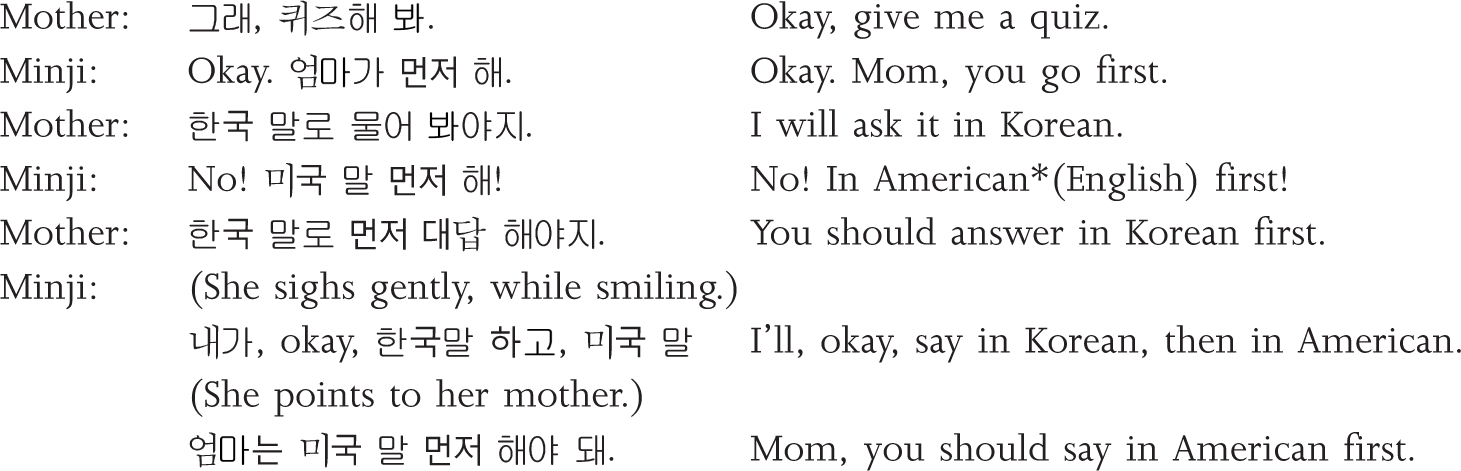
The above exchange between Minji (all names are pseudonyms), a second grade Korean bilingual girl (7.5 years old), and her mother took place after they had discussed Greek and Roman gods in which Minji had recently become interested. Minji’s mother had read books about Greek and Roman myths in Korean and was not familiar with the names as pronounced in English. Minji had read about them in English. In their previous conversation, Minji and her mother had learned from each other how the names of gods and goddesses were pronounced in different languages as they discussed what each god/goddess represented. Throughout the later conversation, English was Minji’s choice of language in the conversation whereas her mother chose to speak in Korean by translating what Minji had said. However, both Minji and her mother also mixed both languages frequently as they continued their talk.
This exchange exemplifies Minji’s everyday experience with two languages with her family members in literacy events. Minji often switched from one language to another as she communicated with her family members. English (or “American” in Minji’s words) was her preferred language choice as revealed in the excerpt. Her mother also encouraged Minji to speak in Korean whenever an opportunity arose. Although Minji was resistant to speaking in Korean at first, she soon acquiesced to her mother’s request by suggesting “I’ll say it in Korean and then in American.” Whereas her mother intended to have Minji speak in Korean, Minji tried to negotiate the language use for this particular literacy event by requesting that her mother “should say it in American”. Like Minji, the other three Korean children in this study (Jihoon, Serin and Youngjoo) often crossed linguistic boundaries between English and Korean. They also negotiated their language choices when communicating with their parents because their language preference was different from their parents’ expectations for their language use at home. Like Minji’s mother, the other parents in this study also requested or reminded their children to speak in Korean whenever their children spoke in English in family conversations.
Reflecting the societal concern about bilingual students’ learning of English, various research has discussed how the use of two languages supports bilingual children’s learning of English and their acquisition of academic language (e.g. García, 2009; Gort, 2006; Manyak, 2001). Although the beneficial role of the first language in academic learning is recognized, children’s learning of their heritage language is yet another concern of international and immigrant families. However, little is known about the ways in which multilingual children experience their two languages in their everyday literacy events and the ways in which multilingual families use two languages to support children’s development in their heritage language.
In a review of research on biliteracy, Reyes (2012) called for further research on the sociocultural contexts in which adults and children utilize multiple languages and literacies for various purposes and contexts in their interactions. Responding to this request, this study explored the nature of language practices of four Korean bilingual children and their family members during literacy events to understand in what ways immigrant and cross-national families support their children in becoming bilingual and biliterate. The research questions guiding this study include: 1) How do Korean-speaking young children and their families choose languages in their interactions with each other during literacy events?; and 2) In what ways do family members use translanguaging in literacy events in service of children’s learning of their heritage language?
Theoretical Framework
Heritage language maintenance and loss
Individuals speaking different languages collaborate with each other as they frequently move from one country to another due to jobs, education and other personal issues (Inglis, 2004; Luke, 2003). Being bilingual and biliterate has become the norm in the everyday conversations of international and cross-national individuals (Bazerman, 2013). In the United States alone, almost 20% of the total population of over 5-year-olds speak more than one language at home (U.S. Census Bureau, 2012). Multilingual families expect their children to develop the literacy skills of the local context in the socially valued language for academic success, but also to learn their heritage language (Worthy and Rodríguez-Galindo, 2006). They believe that maintaining their heritage language will contribute to strengthening familial bond and support their children’s emergent ethnic identity as they develop connections to the values and manners of their heritage culture (Cho, 2000). Through interviews with second generation Korean-American university students, Lee (2002) confirmed that heritage language proficiency was closely related to the degree that they felt connected to cultural values and a sense of ethnic identity.
Despite families’ expectations and efforts, systematic and institutional opportunities for immigrant children to develop bilingual and biliterate skills are limited in the countries in which only one language is recognized as an official language (Valdés, 2005). Fillmore’s (1991) study of immigrant and native American parents’ perspectives of their children’s language use at home documented that children from linguistically and culturally diverse backgrounds gradually lost their skills in their heritage language as their English language and literacy skills developed through schooling. Children quickly start to value speaking English over their home language and to internalize deficit perspectives about speaking languages other than English as they become socialized in a society in which English is the most valued linguistic medium (Martínez-Roldán and Malavé, 2004).
In order to support their children’s learning of their heritage language, multilingual families adopt various strategies. Parents may require children to speak only in their heritage language at home, believing that such a restriction can motivate children’s heritage language learning (Li, 2006; Schecter et al., 1996). Various resources such as children’s songs, books and movies help children become familiar with the heritage language and culture. In addition, parents teach children how to read and write in the writing system of their heritage language at home (Tse, 2001). They also believe that explicit language and literacy instruction through community-based complementary heritage language schools encourages their children to learn their heritage language (Sneddon, 2000; Ro and Cheatham, 2009). Although various research suggests that immigrant families react against their children’s heritage language loss by providing resources for heritage language learning and regulating home language use, there is scant research on immigrant families’ strategies in language practices during literacy events to strengthen their heritage language learning.
Bilingual language practices
Bilingual individuals’ flexible language practices have long been described by the notion of code-switching, which refers to the juxtaposition of two or more languages within the same speech or in discourse without syntactical rule violation (Gumperz, 1982). Studies of young children’s code-switching have examined children’s use of two languages in interactions with peers and adults at home and in the community, focusing on grammatical features, functions and patterns of code-switching in communication. For example, McClure (1977) explored five- and six-year-old Spanish speaking bilingual children’s code-switching in peer interactions during play. Her study highlighted that children changed from one language to the other depending on the individuals with whom they interacted, contexts, discourse styles and topics. Examining a two-year-old German-English speaking child’s language use, Bauer (2000) discusses how the child’s code-switching patterns differed depending on the types of texts and the child’s understanding of tasks, though they were similar across activities. Shin (2010) also demonstrated that Korean bilingual children (aged 6-8) and teachers in a Korean Sunday school code-switched to change and establish their stance and to mitigate uncomfortable situations. Likewise, Vu et al. (2010) found that four- and five-year-old Spanish speaking children code-switched for social purposes to get attention from adults and change their roles.
Reyes’ (2004) study highlighted that Spanish-speaking primary-grade bilingual children code-switched to emphasize, clarify meanings, change topics and accommodate situations, both in social talk and class activities during science classes. Innacci (2008) demonstrated that code-switching was a tool for bilingual children in a monolingual classroom to acquire what they needed in their learning and to express their linguistic and cultural identities. Bilingual children’s code-switching was their act of defiance against the subtractive and deficit views of language use propagated by school and educational policy.
The various studies of code-switching suggest that emergent bilingual children are able to use two languages flexibly and strategically for different purposes, contexts and audiences. Multilingual individuals’ language experiences, however, are characterized by dynamic and fluid language practices, not only in speech but also across oral and written texts and sociocultural contexts through translating, transliterating and enunciating in a particular language (Canagarajah, 2013; García, 2009). Although the studies of young children’s code-switching offer insights into children’s linguistic experiences, they have often focused only on speech in context.
Acknowledging bilingual children’s complex language experiences, educational researchers have recently turned their attention to another notion, translanguaging. The term translanguaging refers to pedagogical practices in bilingual classrooms in which two languages are purposefully and strategically used to support children’s literacy development in both languages as children use their stronger language as scaffolding to understand a text in their weaker language (Creese and Blackledge, 2010). For example, one language is used in a reading task, and code-switching or a child’s more accessible language is used in discussion. Likewise, writing is completed in the language that bilingual children are expected to acquire from school while code-switching can be employed for discussion during the writing task.
Taking Williams’ (as cited in García, 2009) notion of translanguaging as a point of departure, García (45) suggests that translanguaging practices are “multiple discursive practices in which bilinguals engage in order to make sense of their bilingual worlds.” Wei (2011) further emphasizes that translanguaging encompasses flexible alternations from one language to another in interaction, strategic combinations of different linguistic systems and features, and identity enactment through language choices in interactions with others. Therefore, translanguaging is a dynamic and transformative process of structuring and restructuring two languages across different modes in various contexts because two languages are intermingled in the processes and products of language use (Lu and Horner, 2012). Building on previous studies on translanguaging practices, this study explored the ways in which bilingual children and their family members used their two languages in home literacy events.
Traslanguaging as literacy practices
New Literacy Studies provides a useful perspective on multilingual and multicultural literacy practices based on the view that literacy practices are situated in social practices and connected with individuals’ ways of using language (Street, 1984). Multiple ways of utilizing literacies exist as individuals participate in various literacy practices for their own purposes across different communities (Barton et al., 2000). Considering the complex global influences on local literacies and literacy practices, Brandt and Clinton (2002) describe how local literacies are continuously modified, transforming individuals’ ways of interacting with others. Furthermore, immigrant and international families maintain their existing ways of using literacies as they also try to learn new ways in a new country. This global-local nexus resulting from individuals’ immigration and cultural diffusion in a globalized world leads to hybridity in literacy practices, creating new forms of knowledge and new ways of using literacy (Kearney, 1995; Marsh, 2006). Using two languages in everyday literacy events is a new and hybrid way of doing literacy for immigrant and international families, in that they interact in their two languages around written texts composed in both languages.
Bilingual children’s flexible and strategic uses of their two languages in literacy events are often characterized as hybrid practices (e.g. Gutiérrez et al., 1999). Manyak’s (2001) study representatively demonstrated that the hybrid language use in a first-grade English immersion class promoted inclusive participation and extensive collaboration among first-grade students while scaffolding their acquisition of academic English. Using both languages flexibly provided bilingual children with opportunities to develop literacy skills and strategies in English, creating an accessible and collaborative learning environment. Focusing on writing practices in grade 1 Spanish-English bilingual classrooms, Gort (2006) underscored that the children strategically code-switched in their talk and writing as they appropriated various textual resources from Spanish and English texts. Children’s code-switching showed their phonological and alphabetical knowledge of Spanish and English.
Building on the notion of translanguaging as a literacy practice, García (2009) found that translanguaging was used for meaning-negotiation, the inclusion or exclusion of others, and knowledge representation in the classroom. She further indicated that the teacher and children continuously engaged in translanguaging practices during their activities, although the class separated the two languages for instructional purposes according to the school’s language policy. Sayer (2011) further complicated translanguaging practices by discussing how Spanish-speaking students and the teacher in a second-grade classroom of a transitional bilingual school crossed between the standard Spanish language, the local vernacular and English. Worthy et al. (2013) also discuss how a fifth-grade teacher strategically used translanguaging during read-alouds to support bilingual students’ learning of vocabulary words and comprehension of texts. These studies highlight how translanguaging during instruction supports children’s learning by helping them negotiate the meaning of academic content.
With a focus on bilingual children in their home and community contexts, literacy researchers have examined families’ skills and strategies of using languages and literacies (Ro and Cheatham, 2009). Volk and De Acosta (1998) found that Puerto Rican families used English and Spanish to support their children’s literacy in English, interweaving discourse styles from school and church. Gregory and Williams (2000) demonstrated that multilingual immigrant families in London experienced complex literacy practices as they traversed several languages for familial, cultural, educational and religious purposes. Bangladeshi children, for example, learned to speak in the dialect of their heritage language, and they also learned to read and write standard Bangladeshi, English and Arabic. Orellana et al. (2003) examined the nature of interwoven language practices of bilingual homes, describing how Mexican immigrant students and their families engaged in translating and paraphrasing practices across their two languages and different modes (e.g. written, oral) to make sense of texts. Li (2006) further indicates that Chinese-Canadian families encouraged their children to learn to read and write in Chinese and English, and to learn to speak in two different varieties of their heritage language (Mandarin and Cantonese) along with English.
These studies have demonstrated that bilingual children’s language use is inherently characterized by transitions from one language to another across different modes and different types of texts across home, school and other contexts. Children transform, reorganize and renegotiate their two languages and discourses from different social/cultural contexts in their interactions. Through code-switching and translating, bilingual children create new ways of engaging in literacy activities. Bilingual students’ language use can strengthen their language and literacy development in both their heritage language and the major language at school. Although the values of translanguaging in children’s academic learning have been examined, the ways in which immigrant and cross-national families use their two languages to guide their children’s heritage language learning need further substantiation and elaboration.
Method
Participants and context
Information about the participating children and their families’ status.

Although English was their dominant preferred language, the focal children had learned Korean as their first language. The children were fluent enough in Korean to communicate with their family members or with other Korean-speaking adults about their feelings, thoughts and experiences. All four children had also learned to read and write in Korean by attending a local Korean school to such an extent that they were able to comprehend books written for kindergarten children and to write short messages. In general, their English language and literacy skills were stronger than their Korean, as confirmed by the parents.
The parents had high expectations for their children to learn to speak, read and write in Korean. They supported their children’s language and literacy learning in Korean in various ways: They sent children to a local Korean language school; they had established a home language policy requiring children to speak only in Korean; and they reserved time for the children to study Korean and to read children’s books in Korean. However, the parents were also concerned about their children’s development of academic literacy skills in English. Therefore, they made conscientious efforts to support their children’ bilingual and biliteracy development through their interactions at home.
The children were able to access various Korean texts at home: two did so more regularly than the others because their parents scheduled assignments in which students were to build literacy skills in Korean. Thus, each child had a different experience from the others. Jihoon, Minji and Serin used to attend a Korean school, but they no longer did so at the time when this study was conducted. Jihoon voluntarily read comic books written in Korean that his mother had bought in order to encourage Jihoon to learn Korean. Minji’s father used maths workbooks written in Korean to support Minji’s maths skills so that she could become familiar with mathematical concepts in Korean. Serin’s mother scheduled a time for Serin to work on Korean language-arts workbooks once a week and to read a children’s book in Korean every day. Serin also attended a language camp offered by a local Korean language school in summer. Youngjoo attended a Korean language school every Saturday during the academic year. Additionally, Youngjoo’s parents asked her to read aloud a book written in Korean every day. Therefore, the children in this study had multiple opportunities to learn to read and write in Korean.
Data collection
Data were collected over a staggered two-three-month period for each family through interviews and participant observations. The formal interviews were used to examine each family’s immigration experiences, perceptions of using their two languages at home and trajectories of guiding the children’s heritage language learning. Two formal individual interviews were conducted at the beginning and the end of the data-collection period. Each formal interview lasted from 60 to 90 minutes. All but one interview took place in the families’ homes. All of the interviews were conducted and transcribed in Korean.
Participant observations with video recording allowed me to capture the families’ language practices occurring in a natural setting. I visited each family’s home approximately 16 times over a two-three-month span. Each visit took between one and two hours during which I focused on any instances of literacy activities around written texts explicitly and implicitly. Informal interviews with focal children and their family members were conducted as my interaction with family members prompted conversations. The informal interviews helped me to interact with the families in order to understand the origins and nature of their activities. After each observation, I extended my field notes while watching the video recordings by adding theoretical, methodological and personal notes. I also identified focal literacy events based on the definition that a literacy event is an observable unit in which participants make meaning based on various written texts (Heath, 1982). After identifying focal events, I transcribed the conversations in order to examine families’ uses of their two languages.
Because I was a teacher at a local Korean school, the parents introduced me to the children as Sunsaengnim, meaning Teacher, a Korean title to address an adult with respect. Perceiving my role as that of a researcher, the parents initially prompted their children not to interrupt my observation when the children expressed curiosity about my presence. As my observations continued, however, the parents and children often invited me into their conversations and activities by asking questions and requesting assistance. I sometimes initiated conversation to clarify the contexts of activities and by making comments when children shared what they had created or played with. However, I tried to avoid providing help in the children’s academic work even if the children asked for it, not only because the parents wanted their children to be independent, but also because I did not want to influence the parent-child interactions occurring naturally in such situations. When the children requested help, I asked what they usually did or encouraged them to ask their parents. When interacting with the families, I usually spoke in Korean, following the families’ language policy. The parents always spoke in Korean with me, but the children and I sometimes mixed the two languages as the children seemed to be more comfortable and used more elaborated expressions in English than in Korean.
Data sources and analysis
Data sources included interview transcripts, video recordings, field notes, transcripts of family members’ conversations in focal literacy events and children’s drawing and writing artefacts. Data analysis continued iteratively throughout and after data collection (Merriam, 2009). Using a constant comparative approach, I revisited video clips and field notes repeatedly while taking notes about literacy events and the nature of language practices (Denzin and Lincoln, 2006). Using my field notes, I first identified focal literacy events for this study by focusing on those involving conversations around and about written texts. For example, a homework session was one type of literacy event because it involved written texts such as worksheets or a book. A conversation about a book was also another literacy event, although a physical text was absent at that moment. Because literacy events at home were structured fluidly, the boundaries of each literacy event were determined by the changes in the nature of participants’ engagement with the texts.
An example of data analysis chart.
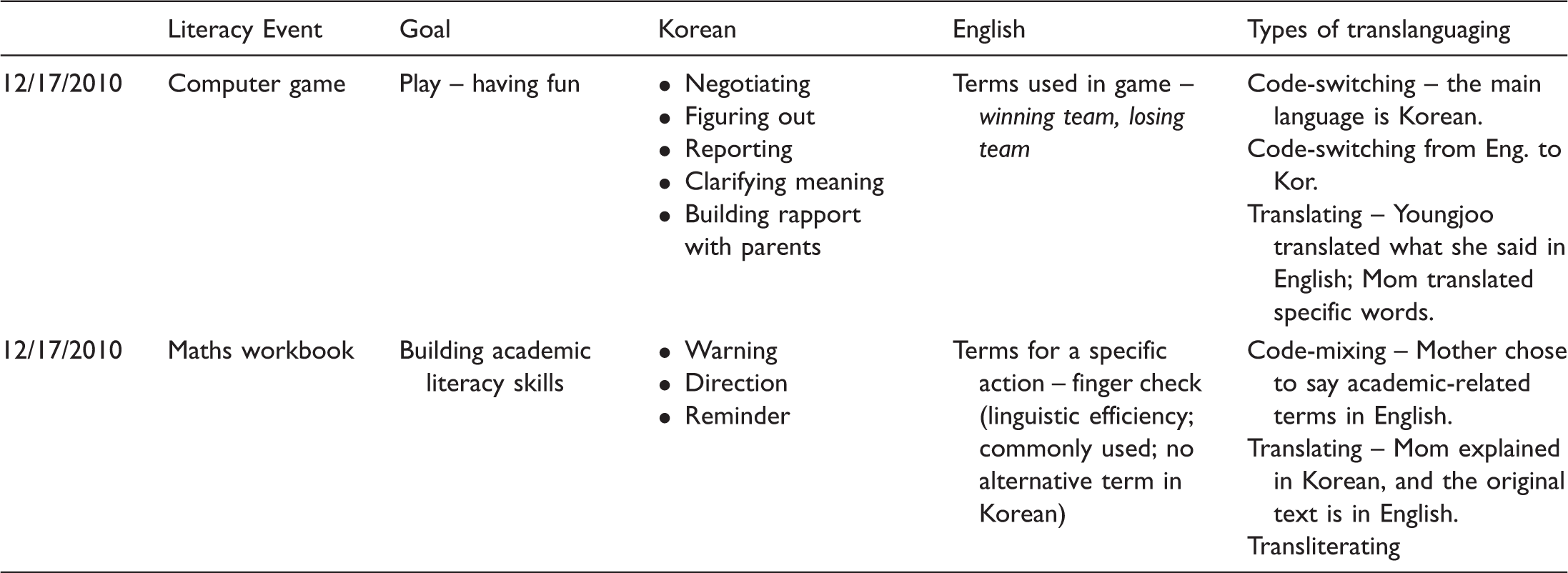
Finally, I compared the patterns in the functions of the two languages and the translanguaging types across the charts. I looked for categories in relation to my research questions. The findings reported here come from the analytic process of summarizing and describing the patterns that emerged from the analysis.
Findings
All four focal children engaged in literacy activities that involved both languages in various ways. Language use across these four families was complex as different modes, texts and contexts were always interwoven in the families’ meaning-making processes. The children and their family members used both English and Korean in their conversations around various types of written, oral and multimodal texts (e.g. TV shows, movies, pictures). They also translated what they read or experienced in one language into the other. The language of a text used in an activity was different from the main language of the conversations among family members during the activity.
For example, as indicated in the earlier excerpt, Minji and her mother often talked about what Minji read in English and what her mother read in Korean (FN 1/14/11; 1/21/11; 2/8/11). Their conversations included both languages: Minji chose to speak English as her main language whereas her mother spoke in Korean. Even so, Minji selected certain words in Korean, and her mother did the opposite. Likewise, when playing a board game written in English, Jinsoo and his mother made sense of the directions written in English using both languages (FN 1/18/11). Jinsoo frequently crossed between English and Korean to explain the directions, whereas his mother continued speaking in Korean to ask questions and to clarify what Jinsoo said in English.
Three themes evolved from the analysis: 1) children and their family members used their two languages as resources to understand meanings in one language; 2) translanguaging was used to construct subtle meanings efficiently; and 3) meanings were co-constructed as children and their family members jointly translated text in their talk. Although each interaction showed characteristics of all three themes to varying degrees, the excerpts presented in this paper were selected because they are particularly good for illustrating a particular point being made about one of the themes.
Using two languages as resources
The families often used their two languages to clarify and refine meanings by indexing a word or an expression in one language with the other one. Martin (2005) refers to this particular way of translating as bilingual label quests in which participants use two languages to index the same objects in order to clarify meanings. Indexing often happened when parents said a Korean word or expression unfamiliar to the children. Parents voluntarily offered the English translation of the target words or expressions, often immediately upon having said those words in Korean. At times, the parents also asked questions such as “What is it in Korean?” and “What is it in English?”

In this exchange, Jihoon’s mother used two languages strategically to help Jihoon infer the meaning of the unfamiliar word, 미지근한 물 [lukewarm water]. Jihoon’s mother initiated the conversation by asking a question in English to monitor his knowledge of the focal word. Because English was more familiar to Jihoon, his mother seemed to intend by her use of English to activate Jihoon’s knowledge about the unfamiliar Korean word. Jihoon’s mother also indexed two Korean words, 뜨거운 물 [hot water] and 찬 물 [cold water], both related to the focal word but more familiar to Jihoon, to help him infer the meaning of the target Korean word about which she was asking. She seemed to assume that Jihoon knew these two words because they were often used in the family’s daily life. As Jihoon could not infer, his mother again indexed with an English word to clarify the meaning of 찬 물 [cold water] that Jihoon selected for his answer to provide explicit support. Thus, she provided an opportunity for Jihoon to predict the meaning of the target word by using words familiar to him.
Conveying subtle meanings through trans-enunciating
The parents claimed that Korean was the main language at home and that they requested their children to speak only in Korean. However, they acknowledged that using English was unavoidable as it was necessary to communicate clearly with their children. In doing so, the parents often pronounced English words with Korean phonemes or trans-enunciated them as the Korean language afforded. Children recognized the differences in pronunciation and called on parents’ trans-enunciation of English words in Korean. Some examples of such English words included daily life words (e.g., check, question, weekend, sleepover etc.) and various academic-related and technical terms, including units of measurement, numbers and grammatical terms. Among these words, some did not have Korean equivalents, and so paraphrasing of the words was necessary if they were expressed in Korean.

In this excerpt, the mother selected the Korean language as the main communicative tool to explain how to transfer units of measurement, the focal concept of the math question on which Youngjoo had made a mistake. However, she maintained units of measurement (inch, foot, hour, minute) and the numbers (one, twelve, ten, fourteen) in English. Units of mieasurement such as inch and foot (or feet) were always used without being translated. Numbers in English were more likely to be used in family conversations except for a few circumstances. Although Youngjoo knew how to count in Korean, she took time to identify numbers in Korean. When parents said numbers in Korean, they also repeated them in English to help the children understand promptly. During an academic literacy activity, therefore, numbers were always spoken in English.
According to the parents, there were several reasons why they maintained some terms in English. First, the parents viewed that their children had become more fluent in English and had not learned all of the expressions that the parents might use in Korean. Because the children had not learned their two languages in the exact same contexts, their linguistic repertoires in Korean were different from those in English. Because Korean counterparts for certain English words or expressions were unfamiliar to the children, using English seemed to contribute to their understanding. Second, as the parents came to acquire the language necessary for life, jobs and academic purposes, they seemed to choose to use certain words in English because these words were frequently repeated in their daily lives. Furthermore, some words or phrases in English had no easy alternatives available in Korean, and so paraphrasing them would be necessary. Native speakers of Korean would use these English words without translating but only through trans-enunciating, or pronouncing them in a way that the Korean oral language affords. Finally, regarding academic vocabulary, the parents felt that it was unnecessary to translate it into Korean because the children were expected to learn it in English. Therefore, the parents admitted that translating or rephrasing words into Korean often resulted in miscommunication or confusion. Both parents and children maintained these words or phrases in English without trying to change them into Korean in order to convey meanings clearly and avoid confusion.
Co-constructing meaning through joint translation

In this excerpt, Minji and her mother collaborated to construct meaning from Minji’s translation. Minji had read a book about Greek and Roman myths in English, and she was now retelling about Charon from the book to her mother by translating what she had learned. Minji seemed to forget how to say the words boat and row in Korean for the moment because they did not often surface in everyday situations. Thus, she chose English for these words to tell her mom what she knew about Charon. Minji’s mother first asked for clarification of the English word row. Her mother seemed not to recognize the word row instantly, not because she did not know the word in English, but rather because she was not familiar with the way Minji pronounced it, as I often observed on several occasions. Thus, Minji's mother repeated the word to ask Minji for further clarification. Minji paraphrased the word in her own words and her gestures to help her mother understand the meaning of the word row. Minji's mother, then, translated the English word into Korean and also added the gesture of rowing, asking for Minji’s confirmation of her translation. Such joint support between mother and Minji allowed them to construct meanings collaboratively and to understand how the same meaning could be represented in both languages.
Conclusion
The findings of this study are congruent with previous studies on immigrant families’ literacy practices (e.g. Gregory and Williams, 2000; Li, 2006; Volk and De Acosta, 2003) and translanguaging practices in classroom contexts (e.g. García, 2009; Sayer, 2011; Worthy et al., 2013). However, this study provides a particularized look at bilingual families’ language experiences in home literacy events to demonstrate how bilingual families support their children’s heritage language learning while utilizing their children’s skills in English. Translanguaging was complexly interwoven into these bilingual families’ literacy practices as they used both languages across written and oral texts and across various contexts. The families used translanguaging in literacy events to construct and negotiate meanings and to convey subtle meanings while using two languages as resources for meaning. Offering meanings in child-familiar language allowed the children to build their understanding of words or expressions in both English and Korean and to become aware of how two different languages can represent similar meanings. Furthermore, as the parents provided Korean translation of English words or phrases, the children were able to expand the range of their linguistic repertoires in Korean that they might otherwise not frequently use in their everyday conversations.
Although the findings from this study cannot be generalized to explain other bilingual children’s experiences with two languages, such flexible uses of languages seem to point to several pedagogical benefits for emergent bilingual children’s literacy development that literacy researchers have previously discussed. First, translanguaging practices enable children to develop skills in using both languages as referential resources to clarify and refine meanings of unfamiliar words or expressions in one language. Both languages are tools for the parents to monitor their children’s understanding and to scaffold their learning in conversations. Such uses of languages allow the children to become aware of potential meaning connections across their two languages and to learn unfamiliar words and expressions in their other language with the help of stronger or more familiar language.
Second, translanguaging practices provide children with opportunities to develop negotiation strategies. Canagarajah (2013) highlights that bilinguals tend to acquire several dispositions and attitudes, such as openness to difference and patience to construct meaning with different languages in social interactions. Translanguaging practices provide children with extensive opportunities to negotiate and construct meaning with their parents and to develop skills to select an appropriate language for a context and to express subtle meaning. When encountering unclear and unfamiliar expressions in either language, children and parents are willing and patient enough to clarify meanings together and to learn new expressions from each other.
Finally, translanguaging seems to contribute to children’s development of metalinguistic knowledge and metacognitive ability. Metalinguistic knowledge refers to “knowledge about language” or knowledge about the “abstract structure of language that organizes sets of linguistic rules” for syntax and phonetics, whereas metalinguistic ability is the ability to use metalinguistic knowledge (Bialystok, 2001: 123). As evidenced in the children’s translanguaging, the children in this study were able to manipulate the syntactic features of their two languages effortlessly, modelled on their parents’ translanguaging. Parents’ trans-enunciating English words also provided children with opportunities to understand how a certain word can be pronounced differently depending on the language. Such awareness could contribute to children’s metalinguistic knowledge about how languages are phonetically different or similar.
Purposeful and careful choices of language in conversation strengthen children’s understanding about the roles of different languages in different contexts and the semantic connections between two languages. Through translanguaging practices, bilingual children engage in learning to use their two languages and “learning the foundations of learning” (Holliday, 1993: 93) through various meaning-making processes. They develop metalinguistic and metacognitive skills and strategies, or what Schallert and Martin (2003: 39) call “self-reflective and self-managing” skills for their language use in different contexts (Gregory et al., 2004). Therefore, translanguaging practices not only foster children’s learning of their two languages, but they are also as a vehicle for bilingual children to expand and enrich their learning in both academic and non-academic settings as they clarify meaning and enhance their understanding (Hornberger, 1989).
Instructional implications
The findings of this study should encourage educators to pay close attention to bilingual children’s complex and rich linguistic experiences and resources at home. Teachers can recognize and appreciate bilingual children’s hybrid and dynamic language practices as their processes of learning, and as pedagogical tools and resources for their learning. Acknowledging the skills and strategies that bilingual children bring to the classroom from their home language practices can be a first step to support their acquisition of state-mandated skills (Martínez, 2010). Inviting bilingual children to use their two languages for meaning-making can enhance their learning in an academic setting as they explore linguistic repertoires in academic tasks (Worthy et al., 2013). Such an invitation could position bilingual children as knowledgeable about how and when to use their two languages (Palmer and Martínez, 2014). Furthermore, encouraging and even advocating bilingual families’ efforts to support their children’s development of their heritage language could empower bilingual families and their children by recognizing their cultural and linguistic capital as a valuable resource (Gregory et al., 2004).