



Abstract
The present study examined how a six-week family literacy programme contributed to supporting the efforts 12 mothers living in a residential shelter were making to foster their preschool children's literacy development. We compared pre- and post-programme interviews to explore whether the mothers applied the literacy strategies discussed in the programme during their daily interactions with their children. Guided by our theoretical perspective, funds of knowledge, data, were analysed through the lens of a Family Strengths Model and thus focused on how learning opportunities were embedded within the families' daily experiences. Findings are presented under two main themes: (1) the mothers' use of the environment as a tool for literacy teaching and (2) use of programme materials and activity ideas in the home environment. Overall, findings indicate that the mothers applied strategies they learned in the programme to their daily interactions with their children, which indicate that the families participating in this study increased their involvement in their children's literacy learning. Our experiences with this transient population illustrate the importance of educators partnering with families, respecting what they are doing to support their children's literacy learning, and building on these efforts by providing them with resources and ideas that support literacy learning. Consideration should be given to the types of resources provided to families living in non-permanent housing in order to maintain their access to literacy activities.
Keywords
Introduction
Children's literacy experiences in the years before they start school are key to their future academic success (Bus et al., 1995; Gest et al., 2004; Green et al., 2006). A home environment plays a crucial role in fostering children's literacy development (Baker and Scher, 2002; Neumann and Neumann, 2010; Purcell-Gates, 1996) and exposure to print prior to starting school has an impact on their language and literacy skills (Carter et al., 2009). However, not all children live in home environments that involve robust language interactions with their parents or include access to print materials. Environmental factors that may contribute to a lack of exposure to literacy include socio-economic disadvantage due to homelessness or lack of access to permanent housing. The purpose of this paper is to describe a six-week family literacy programme offered to mothers and their preschool children who were homeless and living in a shelter. The project objectives were twofold: offering literacy experiences to the families that would encourage continued exposure to reading and writing after the programme was completed and empowering the mothers by affirming their role as their preschool child's first literacy mentor. This article presents the mothers' perspectives about their use of literacy strategies with their children.
Child outcomes and shelter living
Children's home-learning environments are highly predictive of child outcomes (Chazan-Cohen et al., 2009). Home environments that support children's exploration and learning foster children's cognitive, language, social and emotional development as well as their transition to school and school achievement (Baker and Scher, 2002; Barbarin et al., 2008; Chazan-Cohen et al., 2009). However, many Canadian families do not live in permanent housing and have no choice but to rely on shelters. Over the span of a year, from April 2007 to March 2008, more than 100,000 Canadian women and children used shelters (Sauvé and Burns, 2009). Furthermore, over the past two decades, families have become the fastest growing group of people experiencing homelessness (Decter, 2007; Noll and Watkins, 2003; Segaert, 2012), and as reported by the Ontario Women's Health Council (2002), women who are homeless often have children. A homeless family is typically made up of a single mother, usually in her late 20s, with two children under the age of six (Healing Hands, 2012). The greatest increase in shelter use in Canada is seen among families headed by women (Segaert, 2012). From 2006 to 2009, the number of children staying in shelters increased from 6,205 to 9,459. In addition, during this time there was a 50% increase in the average length of shelter stay for families experiencing homelessness (Statistics Canada, 2014). Such statistics are disconcerting as it is highly likely that children who are homeless will be disadvantaged as they face numerous challenges and obstacles, such as having regular access to school (Mawhinney-Rhoads and Stahler, 2006). As a result, these experiences can affect their academic success.
Studies have shown that homeless children are less likely to score at or above grade level in maths and reading (Aviles de Bradley, 2008), and how they live may negatively influence their literacy development (Walker-Dalhouse and Risko, 2008). Researchers have found that the most common causes of mild cognitive challenges in children stem from living in poverty and/or being homeless. These conditions may also be related to hyperactivity and inattentiveness in children (Bigelow, 2006). Findings such as these support the need to provide services and support for families living in shelters with the aim of providing children with experiences that will foster their development and support their academic success. Thus, the goal of this project was to offer mothers with preschool children the opportunity to take part in a family-based literacy programme so that, as a family, they could continue to engage in quality literacy activities after completing the programme. For the purposes of this study, quality literacy activities are those that employ strategies such as shared book-reading, oral storytelling and talking about objects in the environment with children. Sénéchal et al. (1998) suggest that a balanced literacy approach, such as the one reported here, contributes to children's cognitive growth and the acquisition of literacy skills.
When working with marginalized families, we were sensitive to avoiding making assumptions that parents living in shelters do not engage in literacy experiences with their children. In fact, we encouraged mothers to acknowledge what they were currently doing and to build on their previous funds of knowledge by highlighting the need to create a home environment that includes more inclusive emergent literacy concepts. Purcell-Gates’ (1996) findings suggest these concepts are needed for ‘early literacy success in school for [low-socio-economic status] children’ (p. 425). Therefore, a crucial component of the programme was to provide the mothers with information about the types of literacy interactions they could engage in with their children in order to enhance literacy learning while also validating the knowledge that the mothers brought to these literacy interactions, an approach consistent with researchers who think about literacy teaching and learning from a sociocultural perspective (Gee, 2000; Perry, 2012; Tracey and Morrow, 2006). Barton and Hamilton (1998) explain that literacy practices differ from person to person and family to family, but also add that it is essential that these practices involve not merely actions with text, but also connect to and are informed by values, attitudes and social interactions that ‘are beneficial to literacy learning. Freire (2001) similarly defined literacy learning as a process of consciousness that involves not only the use of the printed word but also the connection of literacy to the world and to everyday interactions.
Family literacy interactions
Adults (e.g. parents, early childhood educators) are in pole position to offer young children literacy experiences. ‘Interactions and relationships between children and adults have been recognized as the primary medium through which literacy is acquired’ (Pianta, 2004: 175) and it is imperative that adults recognize that there are many opportunities to engage in literacy episodes with children on a daily basis. Research indicates that when adults, particularly parents, take advantage of opportunities to engage in literacy activities with their preschool children, they are in fact setting the foundation for their children's success in school (e.g. Hannon et al., 2006; Paratore et al., 1999; Purcell-Gates, 2001).
Children who are homeless are more likely to be disadvantaged when starting school. Research shows that children's home environment coupled with family practices such as less responsive parenting that often occurs within families who are homeless may have an impact on children's transition to school and subsequent academic success (Chazan-Cohen et al., 2009; Purcell-Gates, 1996). Despite their early experiences, it is important to note that children are learners no matter what their circumstances; however, their learning of written language functions is based on their experiences with literacy (Purcell-Gates, 1996). Therefore, it is imperative that parents not only understand the important role they play in literacy interactions with their children, but also understand which types of interactions contribute to their children's literacy development. Furthermore, Hannon et al. (2006) posit that the family's social and cultural practices play a role in the types of literacy experiences that are offered to children and that their early understanding of literacy is acquired within the family and community milieus. Given that children's early literacy opportunities are embedded within their social and cultural contexts, adults should consider these contexts, as the experiences will be more meaningful for children (Carter et al., 2009). Literacy programmes should aim to encourage and validate what parents are already doing to promote their children's literacy learning, thereby acknowledging their social and cultural practices. In addition, programmes should extend and build on parents' knowledge by introducing various literacy strategies that families can implement with their children on a daily basis.
Theoretical perspectives
Situated within a sociocultural framework and guided by the concept of funds of knowledge (Moll et al., 1992), this project acknowledges ‘that daily family activities constitute funds of knowledge that serve as important learning experiences for children’ (Riojas-Cortex et al., 2003: 3). Employing a strengths-based approach supports the mothers in their literacy interactions with their children and validates their role as their child's literacy mentor. This approach is critical, especially when working with marginalized populations who may have had limited exposure to quality literacy experiences. To this end, we also drew upon the three main components of the Family Strengths Model (Carter et al., 2009: 520). By offering an on-site family literacy programme that included both the mothers and their preschool children living within the shelter system we sought to ‘recognize the children within the context of their unique system and natural home environment’ (Carter et al., 2009: 520). By acknowledging, validating and building on the mothers’ and children's funds of knowledge, we employed a family-strengths approach (Carter et al., 2009: 520). Furthermore, our programme included opportunities for the mothers to ‘embed learning opportunities within meaningful and contextually relevant everyday experiences’ (Carter et al., 2009: 520) with their children.
Method
Context
This qualitative study was conducted in a transitional shelter for homeless single mothers and their children, located in a major urban area in Ontario, Canada. Families may live at the shelter for up to two years during which time the mothers receive support to help them become self-sufficient, both economically and emotionally. In addition to providing living facilities, the mothers also have access to resources such as workshops, and their children from birth to five years of age may attend an on-site early childhood development programme.
We chose to offer a family literacy programme to the residents following the outcomes of a programme evaluation that had been previously conducted at the shelter in which 20 residents participated. A finding from this evaluation revealed that the mothers' greatest goal was to have their children acquire a good education (Pelletier, 2007). With this information, and knowing that homelessness can negatively impact on children's literacy development (Walker-Dalhouse and Risko, 2008), we decided to return to the shelter to determine whether the mothers who were currently in residence would be interested in participating in a family literacy programme. We first met with shelter staff to discuss the idea and they were instrumental in helping to determine what needed to be put in place for this unique population. Staff suggested that we condense the programme to six weeks because of the transient nature of the families and to offer it on-site to alleviate any transportation costs. Together we planned the day and time to avoid conflicts with other programmes offered at the shelter. Each of the six programme sessions had three components: an introductory time for facilitators, mothers and children together; a breakout time when children continued to play and mothers moved to another room to discuss literacy activities and strategies with a facilitator; and finally the two groups reunited to conclude the session.
Participants
Mothers' demographic characteristics (N = 12).
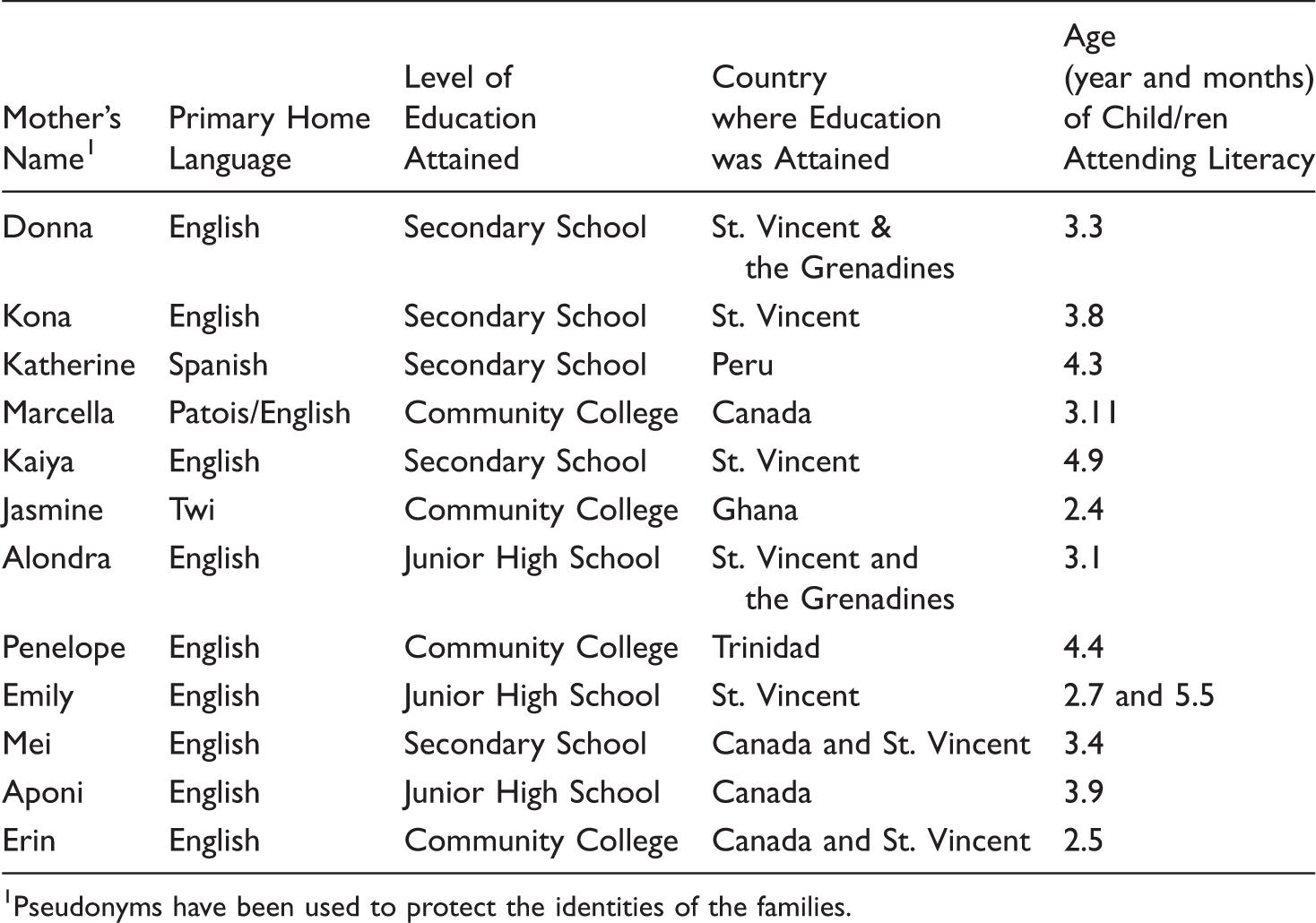
1Pseudonyms have been used to protect the identities of the families.
Procedure
An enquiry-based approach was employed for this study. This approach differs from a programme evaluation that focuses on gathering data to assess whether or not the programme meets its objectives and to use the findings to improve the programme (Scriven, 1991). In contrast, our aim was to explore how the programme could support the mothers in offering their children quality literacy experiences and also to understand their specific learning experiences.
Approximately two weeks after meeting and explaining the programme to the residents, we collected the consent forms. Although mothers provided consent for both themselves and their children to participate, children's assent to participate was also obtained. At the beginning of the first session, the programme was verbally explained to the children in developmentally appropriate language. During any of the break times, children were free to leave to join their mothers if they chose to do so. In the first session, two children followed their mothers into the meeting room, but when later approached by a facilitator about rejoining their peers, they chose to leave their mothers and return to the children's activities. Similarly, during session two, one child did not want to participate and chose to go with his mother to the parents' break time; however, shortly after, he asked to rejoin his peers. The majority of children chose to participate actively in the children's break activities; however, during one session several children chose to be observers rather than participants in a group activity. The facilitators respected children's decisions regarding their role in the programme.
All the research assistants facilitating the sessions had experience of working with children and families. Five were studying early childhood education at a local university and one was a registered early childhood educator and social worker. The research assistants worked with the same group of either children or mothers throughout the duration of the project. One research assistant supported both groups when needed.
Our literacy programme took place in the preschool classroom of the early childhood development centre located at the shelter. The children were familiar with this space and it provided a suitable environment for them (e.g. child size furniture). These were two strategies used to help the children feel comfortable with the programme.
Families gathered in the preschool classroom at the beginning of the session for light refreshments, the introduction to the evening's session and story time. The children then remained in the preschool classroom with three research assistants who were responsible for implementing the activities. The mothers' break time occurred in the shelter's boardroom where two research assistants acted as facilitators. This provided the mothers with opportunities to share their experiences, including both their successes and challenges with their children's literacy development. The facilitators shared examples of activities the mothers could do to support their children's development in the focus area (e.g. taking a walk in the neighbourhood and talking about the signs to support oral development). They also encouraged the mothers to share examples of literacy activities they were already doing with their children. Mothers were asked to brainstorm to build on their current knowledge and to generate new ideas. This activity was in keeping with our theoretical framework whereby facilitators were validating the mothers' funds of knowledge, while at the same time the mothers were learning from each other and from the facilitators. At the end of the break time the mothers returned to the preschool classroom for the concluding session. At this point, they had the chance to try some of the strategies they had discussed in their breakout session.
Interviews
Semi-structured interviews occurred both pre- and post-programme and all the mothers participated in both sets of interviews. All were conducted at the shelter and scheduled with each individual participant. Interviews took place either in the morning, late afternoon or early evening. Ten of the 12 interviews were audio-taped for accuracy. Two mothers requested not to be audio-taped and their interviews were recorded manually.
The pre-programme interview protocol consisted of four main sections: demographic information, the family's home literacy environment (for the purposes of this study, home is defined as the private room that each family has within the shelter), mothers' perceptions about their child's interest in and attitudes towards literacy, and mothers' attitude towards literacy and her role in her child's literacy experiences. The interview ended with the participant sharing her goals in attending the literacy programme. Similar questions were asked in the post-programme interviews with the exception of collecting demographic information and reporting on goals. An additional question in the post-programme interview asked participants to share their views about the programme.
Interviews were transcribed and qualitatively analysed in order to examine which literacy strategies from the programme the mothers reported using in their daily interactions with their children. To protect the participants' identities, pseudonyms are used throughout the paper.
The family literacy programme
Session topics, key messages and feature storybooks.
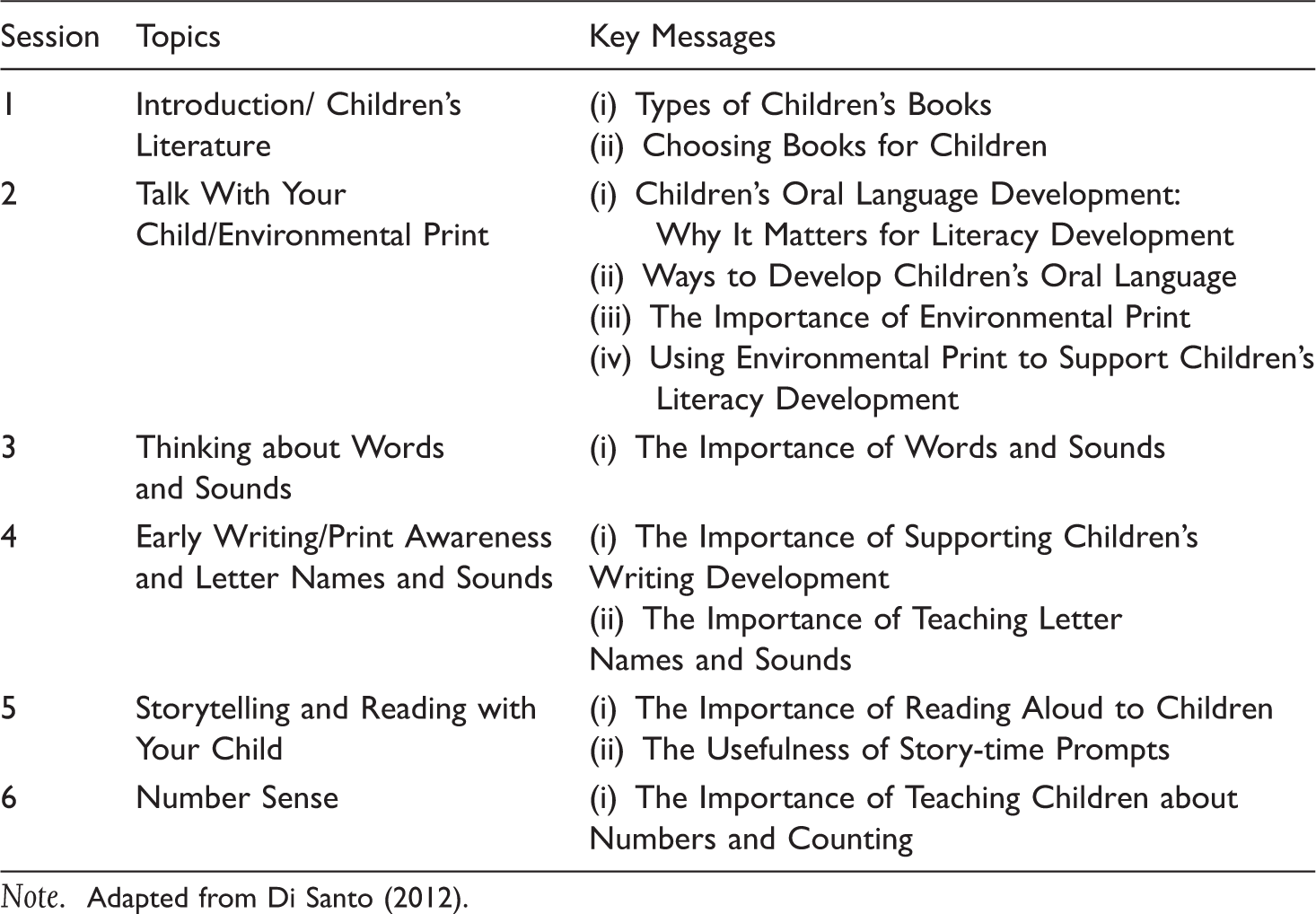
Note. Adapted from Di Santo (2012).
We concluded each session with the mothers and their children gathering to engage in a short activity, listening to a storybook reading and singing a good-bye song. This time was also an opportunity for the mothers to implement the strategies they discussed in their break time. Details of these sessions are beyond the scope of this paper and are described elsewhere (Di Santo, 2012). At the end of each session, each family received various materials and ideas for take-home activities and a copy of the featured storybook. The six books included: ‘The Very Hungry Caterpillar’ (Carle, 1969), ‘Growing Vegetable Soup’ (Elbert, 1987), ‘Chicka Chicka Boom Boom’ (Martin and Archambault, 1989), ‘Brown Bear Brown Bear, What do you see?’ (Martin and Carle, 1967), ‘City Signs’ (Milich, 2002) and ‘Silly Sally’ (Wood, 1992).
A family literacy programme curriculum (Doyle et al., 2008) 1 was chosen for this study. Given the transient nature of the families, the curriculum was revised from a nine- to a six-week programme to offer the mothers and their children a condensed programme. This curriculum was chosen because it recognizes the importance of including families (Barnes and Freude-Lagevardi, 2003) and focuses on the importance of reading and writing for pleasure and parent–child interaction during literacy episodes (Doyle et al., 2008). This curriculum capitalizes on the crucial role parents play in their children's early literacy development. It is in keeping with our theoretical perspective, funds of knowledge, in which the curriculum recognizes parents' knowledge through the inclusion of opportunities for them to share what they are already doing with their children prior to attending the programme.
To build upon the mothers' strengths and to understand their previous knowledge we needed to learn about the types of literacy activities the mothers were engaging in with their children. Our aim was to incorporate the findings into the programme's sessions and to provide the mothers with opportunities to share their expertise. The pre-programme interviews provided such information and brought to light both the unique and similar experiences that each mother brought to the sessions. Each parent break time was structured to provide opportunities for small group discussions and brainstorming. For example, oral storytelling was discussed during session two. Participants informed us that they engaged in oral storytelling with their children – some mothers told stories about their childhood and family members living in their country of origin; others told their children fairy tales such as Cinderella and Little Red Riding Hood. The mothers reflected on their personal experiences and cultural values and they shared traditional stories that were passed down through the generations. Facilitators summarized the key points generated by the mothers and used the experience to show how they were supporting their children's oral language development. To conclude the discussion, the facilitators made additional suggestions that the mothers could implement with their children in their daily interactions. This structure provided an opportunity for the mothers to share their unique experiences, while at the same time learning about experiences they had in common with the others. This teaching strategy was incorporated into each session's break time.
Findings and discussion
Interviews were transcribed and analysed using NVivo software. Overall findings show that the mothers felt that the programme helped them to understand their role in their children's literacy learning. Although studies show that children who are living in the shelter system may experience inconsistent parenting (e.g. changes in parent responsiveness) from their mothers who are dealing with many stressors (Tischler et al., 2007), it is crucial that educators view the families through a strengths-based lens and capitalize on and support the strengths that parents have to offer their children's literacy learning process. Bearing in mind Carter and colleagues' (2009) Family Strengths Model, educators should consider the children's unique home environment and offer the family resources that may be integrated into daily literacy experiences.
Two main themes emerged from the post-programme interviews: (i) the mothers' use of the environment as a tool for literacy teaching; and (ii) the mothers' use of programme materials and activity ideas in the home environment. Within these two main themes the mothers' engagement in literacy activities (e.g. shared-book reading, reading signs in their community) with their children became evident.
Use of the environment as a tool for literacy teaching
In the second session of the programme, we focused on environmental print and its role in children's literacy learning. Environmental print was defined as the different forms of print (e.g. signs, signals, symbols, logos) that are found in both indoor and outdoor environments and which provide us with information. In keeping with our theoretical perspective, our discussions centred on how the mothers were currently using the environment as a stimulus for literacy learning. Using their examples we discussed how they could further stimulate their children's interest in environmental print (e.g. pointing out print around them, explaining why it is used and what it means). The mothers were given examples of questions they could ask their children about environmental print such as, ‘What do you think it says?’, ‘How do you know?’, and ‘How did looking at this sign help us?’.
Findings from our interviews show that prior to the programme only two of the 12 mothers shared examples of how they used the environment as a tool for literacy learning. Kaiya reported that when her child asked her a question, for example about a sign on a bus, she would answer his question directly without extending or engaging in a dialogue. Interestingly, both mothers who reported the use of environmental print with their children prior to participating in the programme later commented that the programme helped to deepen their understanding of how to use the environment for creating learning opportunities, as evidenced in the following discussion with Kaiya: K: But like lately now what I’m doing is like due to the programme teaching us about land prints and stuff like outside prints. Every time we go outside I'll show him little signs like especially on the bus I'll be like ‘Jonathan what does that word say?’ [referring to the stop sign] And he starts looking at it. He now knows that it means stop. He will try spelling but he still misses out like maybe a ‘t’. He's trying in that sense. R: So you're making signs in the environment relevant? K: Exactly. Like an everyday thing for him.
Findings revealed that prior to participating in the programme, Kaiya did not believe that she was using environmental print as a way to support her child's literacy development as she ‘didn't think about environmental signs’ nor did her child demonstrate an interest in signs and symbols. However, unknowingly, she actually described two incidences where she was employing this strategy, albeit in a very limited manner. She would point out the ‘M’ in McDonalds® (the restaurant chain) while asking her child, ‘What does it mean to you?’ Findings also revealed that, at stoplights, her child would make comments such as, ‘Okay mommy it's a white light guy now [referring to the pedestrian light signal], so it's time to cross’. Thus, it is reasonable to suggest that although symbols in the environment were referred to as a means for literacy learning, Kaiya was not cognizant of it.
Kona's (another mother) response to whether her child asked about what signs or symbols ‘say’ or ‘mean’ shared the examples of bus and exit signs. When asked what her child says or does to show his interest in environmental print, she did not provide a related example but rather described how her son brings her books to read. In contrast, findings from the post-programme interview showed that Kona's child's interest in the environment was stimulated by the book ‘City Signs’ (Milich, 2002), which he had received from the programme: ‘They gave us a book about them [signs found in the environment] and he knew a few and then I told him the rest. Wherever we go he points stuff out.’ It appears that as a result of attending the programme both Kona and her child's awareness of discussing objects/symbols in the environment had increased. Although Kaiya and Kona briefly touched on environmental print prior to attending the programme, both mothers contributed their understanding and application of environmental print as a strategy for supporting their children's literacy development to the programme. But like lately now what I'm doing is like due to the programme teaching us about land prints and stuff like that. The outside prints, every time we go outside I'll show him little signs. (Kaiya) Environmental signs, I didn't even think about [it] but you know they gave us a book about them. (Kona)
Additionally, findings reveal that after attending the programme, both mothers were more descriptive in their examples of how the environment is used to support their children's literacy development, suggesting that their understanding of this concept for literacy learning was enhanced: Like the push sign. Like he, like, every time I'm pushing the [door]… I'll be like okay Jonathan, you see the reason why I'm pushing this door? It's because it says push.' And I'll spell it out for him while I'm touching all the letters, and push the door. (Kaiya) We went to the subway. There was the [sign] EXIT and he said ‘Mommy, what is that?’ And then I said, ‘Its exit,’ and then started spelling E X I T. So whenever he sees the word anywhere he says ‘Mommy, that's the exit − E X I T.’ (Kona)
The mothers' responses support the importance of recognizing their funds of knowledge and supporting their efforts to foster their children's literacy development. Given the uniqueness of the population in relation to the participants' transient home life, it should be deemed remarkable that in addition to the many stresses tied to homeless living (Noll and Watkins, 2003; Walker-Dalhouse and Risko, 2008) that the mothers are providing such detailed descriptions of their literacy interactions with their children. It appears that the programme enhanced these mothers' use of environmental print as a teaching strategy with their children.
Furthermore, findings reveal that for other mothers (n=5) capitalizing on environmental print as a means for literacy learning appeared to be a new concept and a strategy that they were embedding in their day-to-day interactions after attending the programme, as can be seen from Emily's experience: ‘They teach me about like when [we] go out and we see signs, we should ask questions. So I’m working on that, to do that with them [her children]’. Mei also shared that prior to attending the programme her child did not show an interest in signs and symbols. In comparison, after attending the programme, Mei described that on their way to the childcare centre she and her daughter would see two signs, enter and exit. The exit sign had letters ‘scratched out so every time we go there we would have to spell it. She tells me the letters and she will say “Mommy what's that say again?” And I will say, “I don't remember.” Then she says “enter”.’ Overall, the findings indicate that the mothers did apply techniques they learned in the programme to their daily interactions with their children.
The increase in mothers’ use of environmental print as a strategy for supporting their child's literacy learning is important, given the literature which supports its use with early learners (e.g. Evans and Saint-Aubin, 2005; Morrow, 2001; Pelletier et al., 2010; Sénéchal and LeFevre, 2001). In our previous work we reported that children's interactions with environmental print are important in supporting their understanding of the purpose of print in daily life (Pelletier, 2011). Because children are curious about environmental print and pay attention to it before they become interested in books (Morrow, 2001), parents can capitalize on this as a means to support their children's literacy development. When parents support children in attending to environmental print, children's attention can shift from pictorial clues (e.g. symbols and shapes) to the letters which are embedded in signs; for this reason, environmental print can be used as an early reading resource (Pelletier, 2011). In addition to a reading resource, the use of environmental print as an emergent literacy strategy can demonstrate to children the functions of print (Sénéchal and LeFevre, 2001) and be used to encourage writing development (Neumann and Neumann, 2010). Although there are mixed reviews about the reading value of environmental print (e.g. Vukelich, 1994), most researchers and professionals believe that it is important in early reading because children are attuned to it naturally, and their attention during literacy episodes shifts from pictures to print (Evans and Saint-Aubin, 2005; Morrow, 2001; Pelletier, 2011). In our project, to further support the notion of referring to the environment as a means of literacy learning, each family received the book ‘City Signs’ (Milich, 2002), a wordless book that has photographs of people, places and common items seen in the environment. Findings show that several of the mothers discussed their children's interest in this book and how they were making connections to their everyday world.
In session five, the families participated in a book-making activity. Each family received a disposable camera and was encouraged to take photographs of their environment. We printed the pictures and each family created their own personal book. Penelope shared that her child modelled their book on ‘City Signs’: When we did the photographs, the picture project … we were supposed to do pictures then make a book with them. So when we did that we were actually focusing on the signs. So now he is trying to have his book looking like the sign book. So the books with all the pictures—he's setting it up just like the book with all the signs and I think there was one sign that we missed. I think the grocery store and I didn't have a photograph of that and he realized that because he tried to pattern the book that we were working on. So I think his favourite was that one, the book with signs.
Penelope demonstrated how she utilized environmental print as a strategy to support her child's literacy development by not only attending to the symbols in their environment but also by making connections to a story they read during a shared reading interaction.
Use of programme materials and activity ideas in the home environment
Shared reading interactions
As mentioned earlier, after each programme session the children were provided with a copy of the storybook introduced in that session. All the mothers reported that their children were looking at the books that they received from the programme. Of the six books that were distributed, findings indicate that four books appeared to be favoured by the children, ‘The Very Hungry Caterpillar’ (Carle, 1969), ‘Brown Bear, Brown Bear, What Do You See?’ (Martin and Carle, 1967), ‘City Signs’ (Milich, 2002) and ‘Silly Sally’ (Wood, 1992). The mothers reported that these four particular books were the ones that their children were repeatedly looking at on their own and were also asking their mothers to read to them. Although adults are sometimes responsible for deciding which books children have access to, they should consider the enjoyment that children get from reading certain books when making their choices (Agnew, 1996) and build on children's choices. For the current project, books were chosen based on their quality and popularity with the children, as children prefer literature that they are familiar with and recognize. For example, when asked, ‘Has your child looked at any of the books from the programme?’ Kaiya shared, Every night, every night. Especially Silly Sally that keeps repeating… he just likes the fact that it's just like funny. It makes him laugh basically because of all the funny things she was doing. He repeats…he'll be like walking backwards upside down so he already memorized it in his head.
Wilkinson (2003) suggests that one of the reasons children decide to revisit or reread their favourite books is simply because they know that the books are worth exploring and that they will have an enjoyable experience reading that particular story.
Researchers and educators alike are concerned with the quality of literacy materials that children access – they value high quality books for their contributions to children's cognitive and emotional growth, as well as to the acquisition of literacy skills (Saracho and Spodek, 2009). However, they may want to also consider which books children enjoy and why. When considering quality, an important factor is children's subjective and particular interactions with a certain book (Wilkinson, 2003) to ensure long-term interest and enjoyment. When parents know that their children enjoy a particular story they can capitalize on children's learning by using the book to foster literacy skills. The mothers in this programme were aware of the books that their children enjoyed most, and even mentioned these stories as being their children's ‘favourites’. For example, Katherine shared, ‘Silly Sally, her favourite. It helped keep her attention focused.’ Donna reported that her child loves the book Brown Bear, Brown Bear. Not only did mothers identify the titles of the storybooks provided by the programme, but they were also able to identify which storybooks their children enjoyed most, demonstrating not only the knowledge of the programme materials, but also the quality of the mother–child shared reading time.
Sénéchal and colleagues’ (1998) research in the area of home literacy practices recognizes that many parents distinguish between two types of literacy experiences in relation to print in the home. Some of these interactions provide informal interactions with print through implicit activities where parents read to their children; alternatively, there are more formal activities where parents explicitly teach about reading and writing letters and words. All of the mothers in the programme reported engaging in more shared book-reading with their children post-programme, demonstrating an increase in informal interactions with their child. Jasmine reported that at bedtime, ‘when he's [her son] going to sleep and don't have Brown Bear, he won't sleep’. Kaiya stated ‘as soon as we go upstairs [from the programme to their room] he will want me to read them [the books] with him again’. Marcella shared how, as a result of attending the programme, her interest in reading to her child changed. ‘I wasn't intent to read to him, but since we started the programme it helped me and encouraged me to read for him.’ During shared reading interactions, mothers have use of a written text, and thus are free from having to construct a narrative; therefore, both child and mother are more likely to have discussions regarding a range of story elements including reasons for actions and reactions in the narrative (McArthur et al., 2005). In the post-programme interviews, the mothers were asked if they read the programme books to their children, and if so, what types of comments they made while reading. In talking about a shared reading interaction of the ‘The Very Hungry Caterpillar’, Donna shared, ‘I would point to the pictures and ask, “Do you know what that is?” and then she [her daughter] would answer “It's a pear, it's a cherry, it's a boy, it's a girl’.” Similarly, Emily responded, When we read The Hungry Caterpillar, I will say, ‘Well I am the hungry caterpillar. So I’m hungry. So you go and get me something to eat.’ And she [her daughter] will say, ‘Okay Mommy you need to eat the apple, so you're not hungry.’ And I will say, ‘Okay then the caterpillar will eat the apple. But she's still hungry so she needs something.’ And she will say, ‘Okay mommy you eat the pear.’
Our findings show that the mothers were applying the strategies that they learned from the various sessions to their interactions with their children, specifically with regard to interacting with their children in shared reading episodes. In keeping with the theoretical perspective of funds of knowledge, we recognized and validated the efforts that the mothers made in relation to reading to their children prior to the programme. In the pre-programme interviews, seven mothers shared that they supported their children's literacy development by reading to their children. It was surprising that after six weeks in the programme these same mothers reported that they were engaging in specific techniques to support their children's reading skills; they provided examples including the use of repetition of storybook text, getting and maintaining the children's attention, helping their children to stay focused, asking questions while reading and making reading fun. Interestingly, Jasmine did not know how she could support her child's reading pre-programme; however, after attending the programme she shared that she reads with her child every evening. These findings indicate that the mothers started incorporating the strategies and techniques discussed in the programme.
Oral storytelling
In addition to shared book-reading, the mothers also discussed oral storytelling. Emily disclosed that she is not a good reader and that ‘Brown Bear, Brown Bear, What Do You See?’ (Martin and Carle, 1967) and ‘Silly Sally’ (Wood, 1992) were ‘not really too hard for me to read. Most of the words I know.’ Interestingly, Emily memorized the story so ‘we don't read it, we just say it’. This is an excellent example of extending the storybook, which would help her child engage with the storyline beyond their shared reading time. This example also demonstrates the family-strengths perspective (Carter et al., 2009) in that this mother felt empowered because the storybook was not too hard for her to read; therefore, she was able to interact with her children in a meaningful and relevant way.
Although the later example in which Emily engaged in oral storytelling with her child was in the form of a retell, our findings indicate that three of the other mothers engaged in oral storytelling with their children in a more traditional way. For example, Donna shared that she tells her daughter stories of her childhood, ‘like from my childhood stories about her [her daughter's] grandparents, great grandparents’. Similarly, Katherine revealed, ‘she [her daughter] and I talk about family stories, and what we do all day’. Mei demonstrated her child's interest in hearing stories about herself, ‘she likes when I make stories about her’. Research indicates that when parents engage in oral storytelling (e.g. sharing past events in their lives), complex parent–child conversations are produced which have implications for social skill development (Cleveland and Reese, 2005; Reese and Cleveland, 2006). Incorporating both literacy modes – shared reading and oral storytelling – is important, since aspects of oral storytelling may be related to social competence in ways that shared reading is not (Curenton and Craig, 2011). Given that different literacy strategies promote various skills, parents should utilize multiple strategies with their children in order to support their overall literacy learning (Curenton and Craig, 2011). For example, storytelling is a dyadic task, which is different from oral storytelling, although these interactions develop related skills they also support distinct areas of literacy (Curenton and Craig, 2011).
Print awareness
In addition to shared book-reading and oral storytelling, our findings also showed that several of the mothers (n=7) described that after attending the programme they used different strategies to support their children's literacy interests. Examples include helping their children with print awareness and letter names and sounds, which was the focus of the fourth programme session. Print awareness is the ability to identify letter names as well as letter-sound correspondences, which serves as the foundation for reading and writing skills (Stage et al., 2001). Mothers reported referring to letters in the child's or family member's name for helping their children learn to recognize and write the letters of the alphabet. This is an example of a formal literacy interaction in which the mothers are explicitly teaching about letters (Sénéchal et al., 1998). Prior to attending the programme, Kaiya reported that her son did not have any interest in letters; afterwards he did. Kaiya's comment shows her son's emerging interest in letter recognition: Well right now we have the ABC characters all over the wall. So like every day and like right now he knows how to spell his name, but it's just trying to recognize the letters that we're trying to work on now. So that's one of my ways of getting him to go across like the wall and be like…this is G, this is E until he finds his whole name.
Role of play
Another strategy that we discussed during the parent-only sessions was the role of play in literacy learning. Play is a meaningful context for hands-on learning; it fosters children's early experience with literacy and can lead to internalized cognitive processes (Roskos and Christie, 2004). Given the important role of play in literacy learning, mothers were provided with take-home activities to encourage them to build on activities that they were already doing with their children. The materials for the take-home activities were easy to implement as we wanted to ensure that the mothers did not feel overwhelmed or threatened by complex activities, nor did we want to put them in a position that required purchasing or making materials. For example, we introduced the ‘What's in the Box Activity’ (Doyle et al., 2008), which involves putting an object or picture of an object in a small box. Children ask three questions and after each answer the child guesses what is in the box. If after the third guess the child does not correctly identify the object, the mother opens the box to reveal the object. The mother and child then switch roles. The child chooses an object to place in the box and her/his mother will try to identify the object. In addition to empowering the child by offering her/him the lead role, it also affords the mother an opportunity to model different questioning techniques.
Additional activities and strategies were discussed throughout the programme to demonstrate how the mothers could model reading and writing techniques. An example was to use their child's name as a means for motivating their children to become involved in literacy activities. The mothers were provided with letter stencils of their children's names and encouraged to use the correct case to help them trace letterforms to print their name. Another example discussed with the mothers was the game ‘I Spy’. The literacy relevance of games such as ‘I Spy’ occurred during one of the parent-only sessions. Findings show that the mothers implemented the activity ideas they learned while in the programme, as can be seen in Penelope's response, who shared that after being in the programme she began to weave play-based literacy activities into her day-to-day interactions with her child: ‘Wherever we are or wherever we go we play a lot of games and a lot of questioning games, like guess who and guess what and a lot of I Spy.’ The take-home activities allowed the mothers to utilize literacy strategies discussed in the sessions beyond their participation in the programme.
A meta-analysis that explored the relationship of literacy and play found that play not only provides a physical context in which skills can be obtained and practised, but also that play supports literacy by allowing a context in which children can make connections between both written and oral language (Roskos and Christie, 2004). By sharing information as to how play fosters literacy learning, we supported the mother's role as her child's literacy mentor and built on her repertoire of ideas. As a result, the mothers can provide their children with meaningful and interesting ways to build their literacy skills.
Concluding thoughts and implications for practice
Findings from this project have implications for diverse educational settings as children who are living in shelters are attending school and various other early learning programmes. The issue is that their lack of permanent housing may have an impact on their educational success; therefore, offering programmes such as the one presented in this article provides families with resources that support literacy learning in the home. Our experiences with this transient population illustrate the importance of providing families with quality literacy resources and ideas that are easily transportable. That is, the resources and ideas that families can use in their daily interactions with their children will remain with them no matter what their living arrangements. It is important that when offering families literacy programmes, facilitators consider how they can incorporate take-home activities to help transient families maintain their access to literacy activities. A common practice in elementary schools is a ‘borrow a book’ programme in which children take books home to read and then return them to school. Although this allows literacy to be extended into the home environment, it does not provide the consistency needed for accessing literacy materials. Children who are homeless tend to change schools often, and not all schools may offer this programme, thus ending the opportunity of extending literacy to the home environment. What may be beneficial is to consider offering children materials that they could keep and to provide take-home sheets describing strategies that a family member can use to help engage the young child in literacy activities. In the family literacy programme presented in this article, participants were given storybooks to keep, which allowed them to start their own quality library collection. Books were selected based on the quality of the text and illustrations and the relevance to the key messages in each session. The books were chosen from a range of genres (e.g. alphabet, informational, storybooks, wordless picture books) to expose the children to a variety of literary works (Lane and Wright, 2007). Alphabet books teach children about letters, informational books foster content knowledge, storybooks enrich vocabulary (Lane and Wright, 2007) and wordless picture books support emergent literacy (Jalongo et al., 2002). In addition to the books, the mothers received take-home activity sheets that they could refer to for ideas on how to engage their children in activities. Educators of young children may want to consider how they could offer literacy take-home activities so that children can continue to have access to a range of books and activities in their home environment.
Respecting mothers' funds of knowledge was essential to ensure that they felt empowered as parents and had the confidence to build on what they were already doing to support their children's literacy development. This approach applies to all families, but in particular to families who are considered vulnerable and at risk because of their socio-economic situation. By respecting families, educators can further empower parents so that they incorporate literacy strategies in their daily interactions with their children. Furthermore, we found that recognizing a parent's role as their child's literacy mentor was essential to ensure that they were confident not only in engaging in literacy interactions with their children, but also in recognizing that what they were doing was important for children's skill development.
This programme highlights the importance of engaging both parents and children in the implementation of literacy programmes. Therefore, when early childhood educators, teachers and researchers develop literacy programmes they should consider how best to include families to capitalize fully on the benefits of the programme. After all, the overarching goal should be to foster children's love of reading. We knew we had effectively engaged the families when we heard a child say in the last session, ‘I wish we could have one more [session] and we could go there every day.’ This should be the aim of all literacy programmes for young children and their families.
Footnotes
Funding
This research was supported by the Lawson Foundation (Funded Award Research # 72026549).