




Abstract
This paper explores dance as literacy. Specifically, it examines qualitative case study research findings and student examples from a dance artist-in-residence that explored curricular content using dance as its primary mode of enquiry and expression. Throughout the residency, students constructed meaning through their dance experiences in dynamic and autonomous ways, exhibiting complex literacy practices of enquiry and communication. Focusing on the kindergarten student participants’ experiences, the authors highlight three themes in their dance literacy practices: (a) artistic autonomy, (b) embodied knowledge and (c) multimodality. As embodied knowledge, dance innately allowed for integrative literacy possibilities in the dance residency. The dance experiences observed and referenced in this research illustrate the complexities of dance as literacy, as both a unique literacy and in meaning making across literacies. Drawing on the findings of this study, the authors seek to inspire teachers to foster similar experiences to develop transformative literacy practices individually in their classrooms and collaboratively in their schools.
Keywords
Dancing literacy: An Introduction
Giving them the silent cue, she nodded her head, and the performance began. The entire school, all K–5 students, began the movement poem as a choir of bodies and voices, moving together and reciting: ‘Baby birds, I’ve watched you grow, taught you what you need to know, sheltered and protected you in our nest, shown you how to do your best … although it hurts to say ‘goodbye,’ I trust that you’ll know how to fly’ (Cherek, no date). Along with speaking the poem, all of the students in each grade performed its accompanying gestures as a movement choir in unison. Some of the movements were quite literal, such as using one’s arms as wings, whilst others seemed quite abstract with simple lines of the body, using different levels from kneeling to standing on their tiptoes. Then, after each grade had performed their class dance, as the finale of the show, the movement poem was performed again. This time, the children moved in silence with only their movements speaking to the audience of family and friends. They were the same movements, but without words; the meaning had changed.
Dance is literacy. It has vocabulary, uses grammar and relies on semantics, much like traditional forms of literacy that continue to be privileged in schools. However, dance as literacy also holds unique power and potential in schools as embodied knowledge, a form of enquiry, a means of developing autonomy and representing knowledge because the dancing body simultaneously serves as object and subject, enactor and action, writer and the written, speaker and the spoken, self and the expression of self. Because our world is one of symbols and complex meaning making within and across media, it requires us to call upon multiple literacies in order to access, interpret and recreate it. In our digital, global world, being literate requires reading, writing and speaking, using combinations of various forms of text: the written word, digital imagery and through the body. As Cancienne and Snowbar (2003) remind us, ‘… it is important to remember that writing begins not only when we put pen to paper, or fingers to the keyboard, but also in the way we are consciously embodied – the way we breathe, think, and feel in our bodies’ (p. 248). The opening vignette highlights this communicative and expressive impact of dance as literacy and as a part of multimodal literacy in schools. Dance education scholar Ann Dils (2007) writes: As an activity in which people participate as doers and observers, dance conceived of as a literacy might spill over into many subject areas with any number of outcomes: individual physical, creative, and intellectual accomplishment; improved problem solving skills in individual and group settings; improved observation and writing skills; critical understanding of the body and dance as social constructs; social integration; historical and cultural understanding; and sensual, critical, intellectual, and imaginative engagement. (p. 107)
In this paper, we explore the impact of dance in developing literacy skills through enquiry and communication in autonomous ways in early childhood. Specifically, we examine research findings and student examples from kindergarteners who participated in a whole-school dance artist-in-residence 1 at a K–5 elementary school in a small U.S. metropolitan public school district. This artist-in-residence explored school curricular content, utilizing dance as its primary means of enquiry and expression. The design and pedagogy of this residency worked to engage students in curricular exploration, empower them by giving them artistic agency, encourage collaboration and community building and enhance their artistic and performance skills. Qualitative case study research was conducted, exploring how the students involved in the residency made meaning of curriculum through dance (Leonard, 2012; Leonard and McShane-Hellenbrand, 2012). Focusing on the findings based on the kindergarten student participants, we highlight three themes in their dance literacy development and practices: (a) artistic autonomy, (b) embodied knowledge and (c) multimodality. Ultimately, we present these research findings to illuminate the power of dance as literacy and encourage teachers to foster similar transformative and embodied literacy experiences within their own classrooms.
Theorizing foundations
There is a growing shift in perspectives on literacy as our world becomes more global and increasingly digital (Albers and Harste, 2007; Burnett, 2010; Hackett, 2014; Winters and Vratulis, 2012). Twenty-first century students learn as much or more about literacy outside of school, living in an aesthetic, technological and designed world, as they do in school through traditional literacies such as reading, writing, speaking and listening (Gee, 2004). Kress (2003) stresses that literacy requires the ability to represent knowledge through a range of mediums: technological and traditional, with each medium having its own affordances and systems of representation. After a decade of theory and curriculum experimentation, literacy scholars recognize these modes of representation as affording increased, varied and fundamentally different ways to construct meaning (Klantzis et al., 2010).
Students engaging in multimodal learning and transmediated strategies make choices about affordances and which mode or across which modes of representation best express their ideas and show their understanding (McCormick, 2011; Siegel, 1995). Multimodality refers to the mixing and integration of modes of representation including print, images, audio, gestural and spatial (Albers and Harste, 2007; Clary et al., 2011; Gee, 2010; Hackett, 2014). Transmediation is the dynamic process of generating new meaning by transferring content between communication systems (Albers et al., 2010; Hoyt, 1992, Siegel, 1995). Often this process is also referred to as transduction (Kress, 2003). We use transmediation here, versus transduction, since transduction is more commonly referred to as the reconfiguration of knowledge through another mode, whilst transmediation refers to the recasting of knowledge and its reshaping of meaning across modes. The new meanings that take shape remain particularly relevant through the gestures and movement afforded by dance. Form and meaning are lived, interpreted, enriched and transferred across modalities, shaping learning and creativity in a uniquely personal manner. The notion of affordances is powerful. First, it acknowledges the process of multimodal, transmediated knowledge construction as exponentially complex (Baker et al., 2010). Second, it provides a frame in which to discuss the potential and limitations of communication and modes of expression, to determine what is gained and lost, and to inform decision making regarding learning resources (Kress, 2005). Although teachers must expand their literacy repertoires to help students sort through possible modes of representation, this shift does not displace traditional literacies. Instead, it allows teachers and students to explore and examine literacy in more complex ways, expanding their multimodal vocabulary and practices to represent ideas and facilitate meaning making on many levels (Cowan and Albers, 2006; Hoyt, 1992; Jenkins et al., 2006).
Expanding definitions of literacy suggests that students should have experiences with a variety of communication systems to nurture multiple perspectives and make connections about their world (Cowan and Albers, 2006). As students create meaning in one communication system, such as writing, and then transfer it to another system, such as dance, they reexamine the concepts and make adjustments to their interpretations, opening up the possibility for critical thinking about media and meaning (McCormick, 2011). By developing their own ‘semiotic toolkits’ this sort of meaning making assists students in engaging more deeply with the curriculum (Siegel, 1995, 2012). For example, the K–5 students in the movement choir began with poetry text and integrated dance movements and gestures to correspond to the words. Then they omitted the spoken word and kept the movements the same during the performance’s finale. During this process of transmediation, the relationship between the words and their meaning, literally and figuratively, was negotiated through speech, movement, memory, lived experiences, sociocultural knowledge and imagination. As a result of taking on this new role as poetry dancers, so speak, the students developed and communicated new perspectives on their knowledge as they communicated through words and movements and then in silence with only the movements.
Furthermore, dance educators and scholars advocate for dance in education because of its ‘cognitive-emotional power’ of transforming knowledge (Hanna, 2008: 495) within the context of teaching and learning, developing and nurturing communication skills, symbolic understanding and social knowledge in education (Gadsen, 2008; Leonard, 2012; Leonard and McShane-Hellenbrand, 2012). Even though dance, as a codified, aesthetic expression of physicality and meaning, has remained an essential feature of human development and knowledge and has recently seen a resurgence in commercial popularity (Hanna, 1979, 2008; Warburton, 2011a), it continues to hold a peripheral, marginal place in schools (Dils, 2007; Risner, 2007), with few schools teaching dance and employing dance specialists (Hanna, 2008; Leonard and McShane-Hellenbrand, 2012; Leonard et al., 2014). Dance has often been marginalized as a mere physical and recreational act, essentialized as purely experiential, subjective and nonacademic (Dils, 2007; Eisner, 2002; Hoyt, 1992; Klein, 2007; Leonard and McShane-Hellenbrand, 2012).
With few and inconsistent dance programmes in schools, understandably, non-dance teachers may feel unprepared to include dance in their curriculum because of a lack of training or pressures to fit so much into their school day (Bonbright, 2003). Yet, if shifting literacy perspectives highlight the arts (Albers, 1997; Albers et al., 2010) and dance as literacy (Dils, 2007; Eisner, 2002; Greene, 1995), teachers may have more models of how effectively to utilize and understand the powerful complexities of dance as literacy. Consequentially, what would be the potential for children who excel at physically expressing themselves but struggle with more traditional forms of literacy, such as reading and writing? On the other hand, how can dance as literacy push those with more sophisticated language arts skills to explore knowledge in new ways? How might dance be used not only to teach disciplines but also to shed light across them. How might the dancing that is created and expressed deepen student understanding because the dancing content is embodied? In this age of multimodal literacies, it is more important than ever to give teachers practical models for integrating the arts across the curriculum. In this way, they can be encouraged to reexamine the power of embodied knowledge through dance as literacy (Albers et al., 2010; Hoyt, 1992).
Based on the bodies of work supporting multimodal literacies, the research examples addressed in this article broaden our understanding of literacy and encourage teachers to include dance as an integral part of children’s daily learning experiences. We do not seek to diminish the work of dance specialists in schools but rather to expand possibilities within and across more than arts classrooms.
Dancing literacy
Dance is embodied knowledge. Theories of embodiment reject the Cartesian duality of mind/body and instead see embodied knowing as ‘the ability to interact with a thought or an experience holistically that involves the integrated power network [neural elements, efforts, memory, language, perception, and attunement] of the total person’ (Block and Kissell, 2001: 8). Calling upon the foundations of perception and cognition in Merleau-Ponty’s (1962) ‘phenomenology of embodiment’, this network merges physical and psychological realms as part of the bodily system (Warburton, 2011b). Merleau-Ponty (1962) refers to the ‘body-subject’ and one’s ‘lived experience’ as shaping perception and knowledge since it is in and through our bodies that we live in the world. Here, epistemology and ontology inform knowledge, an inherently embodied knowledge that is holistic and essentially integrative. Dance scholar Susan Leigh Foster (1995) echoes Merleau-Ponty’s ‘phenomenology of embodiment’, arguing that all bodily practice is a form of ‘bodily writing’ (p. 3). Foster writes, ‘[this] body we can only know through its writing’ (p. 4). Just like written text and verbal language, bodily practice, specifically dance, is an expression of cultural practice and meaning making. Yet, the dancing body is not only writing, it is written and read. One of dance’s unique realities as a literacy is that the body is both object and subject, i.e. the ‘body-subject’ (Merleau-Ponty, 1962) of dance, and as such acts as materiality and abstraction (Foucault, 1995; Leonard, 2014; Manning, 2007). Therefore, dance as literacy and embodied knowledge implicitly and explicitly provides endless possibilities in terms of meaning making, critical thinking, analysis, expression and representation. The body in its movements, in its relationships to others and space, in its aesthetics, and in its cultural, social and political identities speaks and writes, is spoken and is written (Butler, 1993; Greene, 1995; Grosz, 1994; Sheets-Johnstone, 1992).
Dance pioneer and visionary, Isadora Duncan (1877–1927) is commonly credited (Bateson, 1972) with explaining, ‘If I could tell you what it meant, there would be no point in dancing it.’ In this quote, she emphasizes that dance in its embodied nature says something on its own. That can be said of all literacies – that they each speak in a unique voice or can be read in a way that communicates in a way that only that medium can. However, literacies continually speak together, or in dialogue with each other, such as in the opening vignette. Even when the spoken words were silenced in the movement choir, those words were evoked through movement, leaving traces in the audience’s memory. Performing the movements in silence afforded the verbal and conceptual inspirations for the motions to be interpreted and communicated corporeally with the focus on motion and kinesthetic text. Being literate in the 21st century means that students utilize multimodal practices and can read across literacies, speak through various means and can understand and interpret intertextually through written text and digital imagery, dance and sound or all of these combined. In terms of ‘bodily writing’ or the body as text, Foster (1995) explains, ‘[verbal] discourse cannot speak for bodily discourse but must enter into “dialogue” with that bodily discourse’ (p. 9). In the movement choir, the children danced as if flying, expressing what that might feel like, inspired by their experiences and inspiring the audience’s imagination of flying, evoking the qualities of flying, conceptually, aesthetically and technically. Yet, with dance’s unique and embodied voice and canvas, so speak, it is poised well to be in ‘dialogue’ with other forms of literacies in schools due to its immediate availability in every student with any range of abilities and its textual possibilities and roles as both mode and medium.
The study: Context, data and analysis
During a three-week dance artist-in-residence at a K–5 school in a small U.S. metropolitan public school district, a visiting dance artist/educator was invited by the Physical Education (PE) faculty to invigorate the PE curriculum through dance. Seeing dance as a multifaceted arts medium with affordances to educate across the curriculum, the dance artist/educator merged curricular content, chosen by the grade-level teachers, with complimentary National Dance Standards 2 for each grade (Leonard, 2012).
Kick-starting the residency, the dance artist/educator held an all-school assembly in which she introduced the students to the artistic and literacy tool of abstraction, ‘[extracting] the essence or essential meaning of an idea apart from the realistic or literal image’ (Leonard and McShane-Hellenbrand, 2012; Lockhart and Pease, 1982: 217). Along with the grade-specific dance curriculum, each grade level worked on using the concept of abstraction to transform and transmediate curricular content into artistic, dance material to be performed. Each week, the dance artist/educator worked with each class two or three times during 45-minute to 1-hour sessions to explore the content and create a grade-level dance. During these sessions, the dance artist/educator acted as the facilitator, giving the students the opportunity to come up with the dance vocabulary and act as choreographers. Therefore, the students were given a level of agency to be active constructors of their own knowledge. To close the residency, the entire school, roughly 438 students, presented their work in two public performances, attended by over 400 family and community members (Leonard and McShane-Hellenbrand, 2012).
Examining how students make meaning through dance, one of the authors conducted an instrumental case study of the dance artist-in-residence to help provide insights into other similar programmes and experiences of students dancing in schools (Leonard, 2012; Stake, 2008). The dance artist-in-residence stands as an instrumental case since the residency acted as an intervention and innovation in relationship to the school context that did not regularly teach dance or provide dance programming (Lancy, 1993). To examine the efficacy of the programme and how students constructed meaning throughout it, the researcher collected data as a participant–observer (Sánchez-Jankowski, 2002; Tedlock, 2008), assisting the dance artist/educator in demonstrations, leading small group work, and helping to organize the final performances. Data in the form of observations, student work, curricular materials, photographic and video documentation, faculty interviews and student interviews were collected throughout the residency. The data collection was guided by questions asking how students make meaning of curricular concepts through dance and how students perceived themselves and their learning experiences during a dance residency.
Whilst over a third of the school participated in the study, only a cross-section of 13 students (3 kindergarteners and 2 students from each grade, from first to fifth), reflecting the demographics of the school, 3 were interviewed three times throughout the residency about their dance experiences during the residency. Student interviews took place at three intervals during the residency (after their first dance session; after their first grade-level rehearsal; and after the final, whole-school performance) during 20- to 30-minute sessions during the school day. Due to the young age of the students and in an effort to alleviate any discomfort that the interviews might cause, students were interviewed in grade-level pairs, with the exception of the three kindergarteners who were interviewed as one pair and one individual (due to schedule limitations). During these interviews, students were also invited to draw and/or write about their experiences. At the beginning of each interview, the researcher gave the students several drawing prompts. For example, students were prompted during each interview with one of the following: ‘Tell me about our dance class today’; ‘What did you enjoy or remember about today’s dance class?’; ‘Tell me about the final performance’ or ‘What did you notice about the other classes’ dance pieces?’
Following the residency, NVivo 9 qualitative research software was used to organize, code for emerging themes and analyse the data using a grounded theoretical approach (Glaser, 2001; Glaser and Strauss, 1967). Themes that emerged across the data were coded and recoded up to three times, and then finally these codes were condensed into five thematic categories: (1) assumptions (about dance and its role in school), (2) disjuncture (between the dance residency and school context), (3) challenges (discomfort or apprehension about dancing in school), (4) introductions (possibilities that arose from dance in school), and (5) representations (expressions of content in multimodal and transmediated ways). As in grounded theory (Glaser, 2001; Glaser and Strauss, 1967), these categories served as the basis for theorizing the findings. These findings suggest that there lies great power in this dance residency as a curricular and school-wide intervention. It was within the unique context of the dance residency as an intervention (shaped by people’s assumptions) that creative and intellectual spaces (introductions made possible through dance context) were created by the intersection (disjuncture) of the dance residency and the school. Whilst this space caused some disruption (challenges) to normative school practices, the dance residency created opportunities for multimodal expressions of content and knowledge in creative and aesthetic ways (representations) (Leonard, 2012).
This article highlights specific findings and examples from only the last thematic category of representations in which students exhibited a range of abilities and possibilities of expressing and representing their knowledge, exhibiting complex literacy practices. In this category, instances initially coded as ‘representations’ demonstrated a synthesis of knowledge in multimodal, transmediated ways through narrative and abstract representations in dance, and also through verbalizations and pictures that the students used to communicate their ideas about their dancing with the researcher. In this article, we have chosen to focus on three themes from the overall category of representations that pertain directly to dance as literacy and the kindergarten participants. We introduce these themes in the following section.
Dancing literacy findings
During the dance residency, the students entered into a dynamic dialogue with curricular content that they had learned in their classrooms. Since the design and pedagogy of the dance residency focused on student-generated movements, the students were able to make choices and create a unique movement vocabulary, making meaning that centred on curricular themes. Here, we will focus on the kindergarteners and their literacy practices. We present examples of how the kindergarteners were developing and expressing literacy skills of enquiry and communication in autonomous and embodied ways during the dance residency, which we have organized into three thematic categories based on coding themes within the category of ‘representations’: (a) artistic autonomy, (b) embodied knowledge and (c) multimodality.
The kindergarteners were learning about nocturnal animals in science, 4 and the dance artist/educator chose to narrow the concept to the Great Horned Owl, a resident species of the geographic region in which the school is located. During the residency sessions, the students explored owls’ anatomy, eating habits and digestive systems and then embodied and abstracted these concepts through improvised movement and choreography. The dance standards of comparing and contrasting dynamic qualities of movement, i.e. tension and relaxation, tight and loose, and of exploring motion using different body parts were chosen to help the students explore a range of owl-inspired movements and to play with aesthetics through creative movement.
Theme 1: Dancing literacy through artistic autonomy
One of the observed and noted strengths of this residency and the dance literacy experiences within it by the adult participants was that the artistic process of creating dances provided the students with autonomy. The young students were empowered in their learning and expression of that learning through the artistic process. Giving the students creative licence, the dance artist/educator invited students to explore different solutions to movement prompts. For example, exploring the idea of theme and variation, the kindergarteners were asked to explore curricular concepts using different body parts to create diverse and dynamic shapes. The students worked in groups to create ‘prey and talon shapes’, depicting the owl predators and their prey. They created three variations of this idea using different levels and shapes, exploring a range of different ways to use their bodies, experiencing basic elements of the creative process of choreography, such as using artistic tools including abstraction (Figure 1). By creating these shapes based on their exploration and understanding of the concept of predators and prey, the kindergarteners’ dancing was their enquiry and how they communicated knowledge. When interviewing the kindergartners, all three referenced these ‘prey and talon shapes’ as ‘my shapes’ or in reference to those of other students, ‘their shapes’, noting their agency in making and acknowledging their and their student peers’ choices. In this sense, they were reading and communicating each other’s expressions and the particulars and distinctive qualities of each dancer’s choices.
Image of kindergarten students performing their owl-inspired dance sequence. Here students were captured performing their ‘prey and talon shapes’. Photograph taken by Jo Matzner.
In addition, the kindergarteners were given autonomy to make choreographic decisions using different body parts. The students were challenged to ‘peck’ as owls might, but instead of pecking with beaks or noses, the students were invited to peck with their heads, shoulders, elbows, knees, toes or even their fingernails. In this way, they were invited to ‘write’ with different body parts, expanding their bodily vocabularies and artistic expression. They also learned that these owls have tufts on the top of their heads that may look like ears, but that they are actually feathers that communicate to other owls and predators to make the owl more or less visible or appear more threatening. During their dance, the kindergarteners would create their own tufts on their body using their hands. However, instead of only having tufts on their head, they played with the idea of communicating their unique owl-inspired identity through using the aesthetic of their ‘tufts’ (Figure 2). Choosing two new locations on their body to place their tufts (e.g. one hand on a hip, the other on their chin), the students created and wrote their own ‘proud owl shape’. Selecting a new location for their ‘tufts’ allowed them to play creatively with this concept and to own their new shape. With each performance of the dance, the students explored different ways of responding to each dance prompt, relating and transmediating the concepts creatively, corporally and autonomously. In this way, they were becoming more literate through embodying their enquiry and expression, augmenting their motor skills and exploring artistic concepts of theme and variation. Therefore, their dances expressed both science and dance knowledge, demonstrating their enquiries and representations of their knowledge autonomously in their aesthetic and embodied choices.
Image of student in her ‘proud owl shape’. Here the student has chosen to place her owl-inspired tufts her chin and on her hip (not pictured). Photograph taken by Jo Matzner.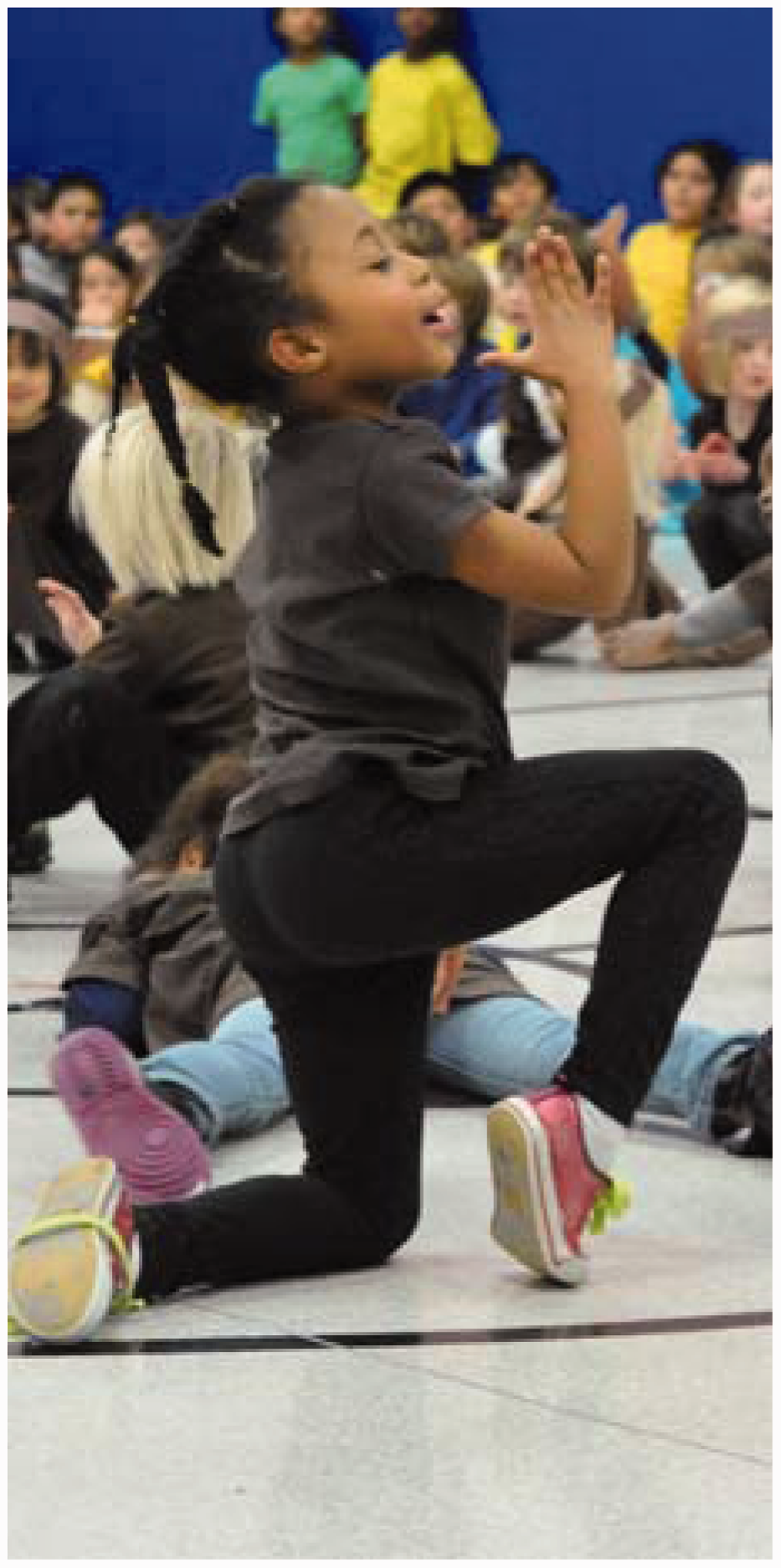
Theme 2: Embodying knowledge through dancing literacy
The kindergarteners also learned about the owl’s unique digestive system and that owls swallow their prey whole. During the digestive process, the owl’s body needs to get rid of the parts of the prey that it cannot use, such as a mouse’s bones and fur. Instead of excreting these items as other animals do, the owls regurgitate this material. In order to help the kindergarteners understand this concept, the dance artist/educator had the students interpret this process with their bodies. The students would mime consuming a mouse whole, swallowing it and then undulating with their bodies physically to abstract the regurgitation process. Whilst it may sound a bit graphic and strange, the result was quite interesting aesthetically, and comically entertaining for the audience. Ultimately, the students were able to explore this complex biological concept in an embodied way, nurturing embodied enquiry skills, accessing their knowledge and imagination, whilst also working on complex gross motor skills of undulation, contraction and releasing of the spine. Each time they performed this sequence, they were asked to vary their approach and explore using different parts of their body (e.g. focus the undulations in their arms, legs or head, along with their spine), showcasing and communicating the diversity of their embodied knowledge.
The children’s development and practising of enquiry skills in autonomous ways were through lived, embodied experience (Cancienne and Snowbar, 2003; Merleau-Ponty, 1962) and in the creation, performance and communication of their curricular and conceptual knowledge (Dils, 2007). They embodied this knowledge, and thus how they understood this knowledge was immediately relatable to them. Thus, the dancing ‘body-subject’ afforded the students the possibility to explore, make meaning, read, write and speak their own stories using their bodies (Merleau-Ponty, 1962).
Theme 3: Multimodality: Intersecting knowledge across literacies
During the residency and research data collection, the students were able to represent and communicate ideas in complex ways, transmediating across movement, speech and vocalization, often singing rhythms and counts. Their thinking became both reflective and generative as they strove to invent connections between semiotic systems that were previously unconnected (Siegel, 1995). The students were also able to represent their ideas on paper in drawings and written text and then explain them verbally and physically during the interviews using different representational forms: literal, narrative and abstract (Leonard, 2012; Leonard and McShane-Hellenbrand, 2012). The process of transmediation changed what was possible for the young learners as they expressed themselves in evocative, transparent and multimodal ways. By incorporating dance, vocalization, drawing and verbal expression, students made connections across modalities and content areas, which served to deepen their understanding and engage with curricula (Siegel, 2012).
For example, during one interview, a kindergartener told the researcher that she was drawing herself and her group in their ‘talon and prey shape’ whereby they represented an owl-like predator about to pounce on its prey (Figure 3). She explained in her own words how she was focusing on expressing tension in their bodies and using dynamic shapes, both concepts that related to the dance standards of movement quality being explored. As she was drawing, she kept saying that she did not know how to draw herself over ‘her prey’. She wanted the drawing to show accurately that she was a predator and bent over her prey. As she continued to talk about this dilemma of going from a three-dimensional concept to a two-dimensional representation, she was making an arc-like motion with her hand to signify ‘over’. After doing this a few times, she then started to talk about adding details to her drawing, such as her hair. As she began to draw her hair, she mentioned again her frustration of not knowing how to draw someone ‘over someone else’. As she explained her drawing, she redirected her hair’s shape into a physical representation of her desire to draw herself ‘over’ her partner. The significance of the arc took on a new meaning that was transformed from an object (hair) to the concept of ‘over’. Note the curved marking above the figure on the right (Figure 3). This example demonstrates the unexpected opportunities that the dance residency and the research data collection provided for the integration of multiple literacies and the representational complexity of her symbol making. Interestingly, this moment was only captured due to the research data collection process that asked students to use one mode – talking – to communicate their experiences in another mode – dance – through the use of another mode – drawing – that resulted in narrative and abstract forms. Here this student was communicating across corporeal, pictorial and verbal media, exhibiting in-action enquiry into curricular content and also incidentally communicating complex, representational and conceptual knowledge of space.
Drawing from an interview with a kindergartner depicting the ‘prey and talon shapes’. Note the brown curve drawn over the figure on the right that symbolizes the three-dimensional, spatial concept of ‘being over’ the other student.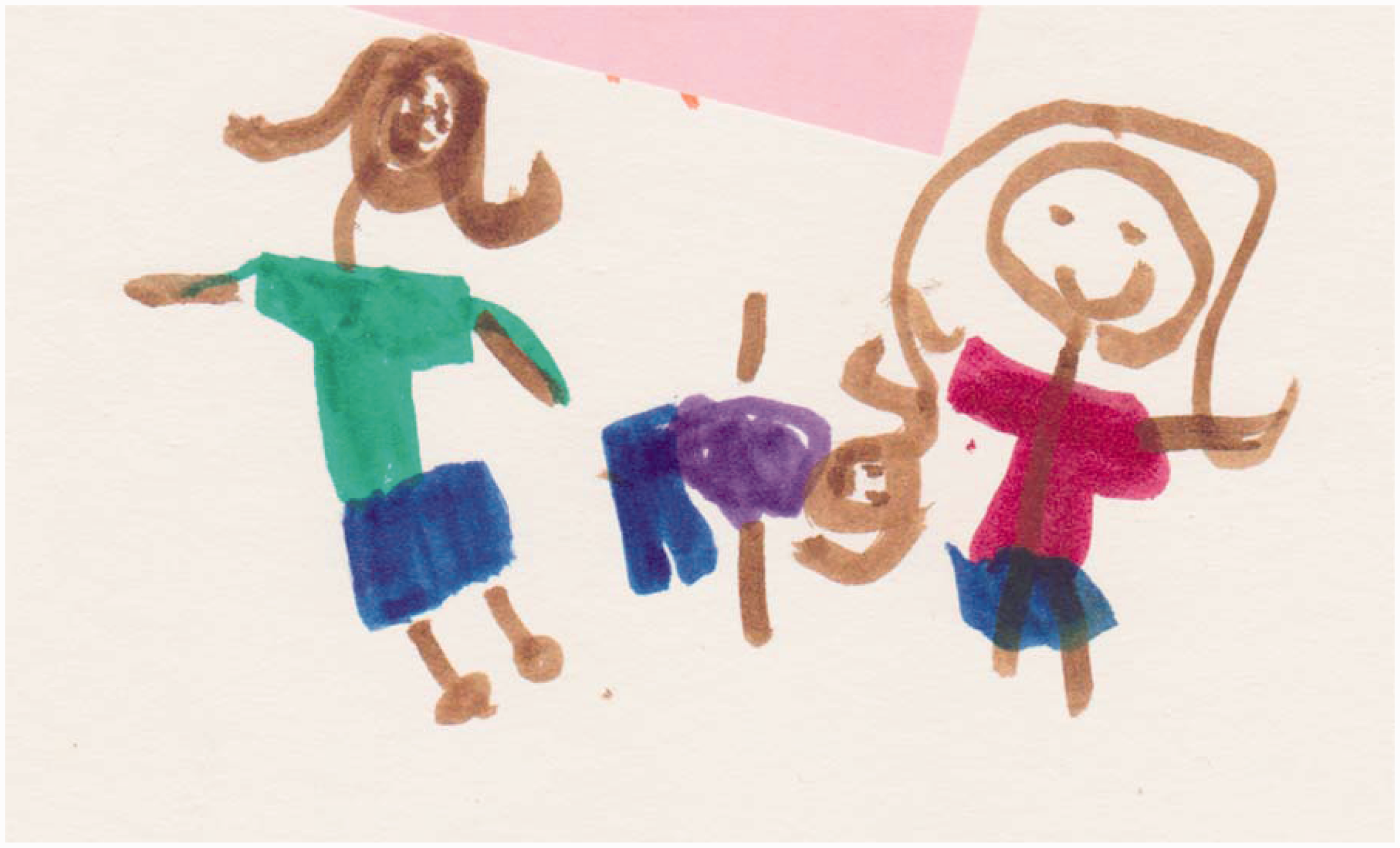
This example answers Kress’s (2005) call for ‘description and analysis’ (p. 21) to propose whether future generations of children may be more attuned to representing knowledge gained through physical, tactile, auditory and spatial construction of learning paths versus relying on the ‘vagueness of words’ (p. 21), that is often general and devoid of meaning. In this case, the de-emphasis of traditional modes of representation and communication (text and static images) shifted to more learner-centred, productive ways. Aligned with Kress’s perspective on the potential (gains) and limitations (losses) of different modes, one consequence of this research is that it bolsters the notion that orderliness of text is no longer paramount to the comprehension and demonstration of knowing. Embracing dance literacy allows us to gain insights into embodied ways of knowing and expressing meaning, but we cannot ignore the tension caused by this juxtaposition of modes. The tradition of instructors determining learning paths is lost as individual learners choose their own ways of constructing meaning and knowledge, creating less certainty in learning outcomes. Embodied literacy provides ways of interpreting and engaging with the world which even for young learners, may guide powerful cultural and intellectual modes of expression and communication. Kress reminds us that an important consequence for the next generation of children might be their attunement to the depiction of accurate representation through this new dominant mode, which may in fact serve them well in a world no longer defined by conventions and stability.
Dancing literacy in our schools
In the current era, teachers and researchers have helped redefine being literate as the ability to understand, interpret and construct meaning across a broad range of expressive and communicative media (Albers and Harste, 2007; Dils, 2007; Eisner, 1998; Giroux, 1992a, 1992b). At the same time, U.S. policy makers and administrators have placed increased emphasis on academic achievement, being globally competitive, and garnering federal support. As teachers transition to using broad and rigorous U.S. Common Core State Standards (CCSS) (National Governors Association Center for Best Practices & Council of Chief State School Officers [NGA and CCSSO], 2010) to guide instruction, many find it difficult to balance transformative literacy experiences in their classrooms with traditional literacy expectations (Geist and Baum, 2005). In addition, the age of accountability has presented new pressures associated with standardized testing and a focus on the uniformity of the educational experience, which makes it more challenging for teachers to illuminate and reclaim the ‘body-subject’ in schools and emphasize the power of dance as literacy within their curriculum. Although dance and embodied knowledge have played a fundamental role in human lives for as long as archaeological human records show (Hanna, 1979), it is evident that dance continues to have peripheral significance in schools or to be positioned as an extracurricular activity outside school (Dils, 2007; Hanna, 2008; Leonard and McShane-Hellenbrand, 2012; Leonard et al., 2014; Risner, 2007).
Since the body ‘communicates social practices and cultural meanings through voice, gesture, and movement’, dance as a codified expression of the body can provide a range of thinking and expressing knowledge in embodied ways (Cancienne and Snowbar, 2003: 244). Regarding dance as embodied knowing and enquiry affords students and teachers with possibilities to expand what it means to be literate in schools. Whilst dance remains an art form that is grounded in artistic creation and physical technique, the dance pedagogy in this artist-in-residence did not focus on rigid technical skills, but embraced a broader understanding of dance participation similar to a community dance model that invites all to dance and value each other’s contributions (Butterworth, 1989; Leonard and McShane-Hellenbrand, 2012; Lomas, 1998). During this residency, dance provided an ‘embodied experience and system of representation that offers many possibilities, among them artistic and scholarly inquiry about personal, historical, social, and cultural experience’ for all students, regardless of their previous dance experience (Dils, 2007: 96).
As the educational climate shifts towards preparing students for a largely unknown and continually changing job market, literacy education and current trends in assessment are beginning to take on new forms (Bonbright, 2007; Halverson and Gibbons, 2009–2010; Partnership for 21st Century Learning, 2011). Seeking out relevant and contextualized ways of assessing students in creative pursuits in education is a high priority (Bonbright, 2007; Crammond, 1994; Halverson and Gibbons, 2009–2010; Halverson et al., 2012; Partnership for 21st Century Learning, 2011). Specifically, more performance-based, authentic assessments are being developed in the arts and in other subjects that use the arts for assessment (Halverson and Gibbons, 2009–2010; Hanna, 2008; Oreck et al., 2003). Here the idea is that the products of the learning process, such as artistic and creative ones, can represent what the learner knows and can do in nuanced and complex ways, versus solely relying on traditional testing. Thus, the focus shifts to the potential and complexity of learner abilities (Halverson and Gibbons, 2009–2010; Warburton, 2002). In this sense, these examples and research findings from the dance artist-in-residence case study can be seen as creating opportunities for performance-based, authentic representations of knowledge and literacy that engage students in creative and artistic enquiry and communication.
The dance experiences observed and referenced in this research illustrate how dance literacy allows for autonomous enquiry and communication, acting both as a means of meaning making and as an entry point for making meaning across literacies. By allowing students to speak, read and write, and be heard, read and be written through various means (e.g. dance, movement, drawing, talking, singing), students were able to demonstrate their knowledge of and through embodied, multimodal experiences. By creating opportunities for student enquiry and communication of content through movement choirs, physical explorations of content, and then in more traditional ways after these embodied experiences, such as in pictures and words, teachers might be able more accurately and richly to assess students’ learning by evaluating authentic products of their learning process. As U.S. teachers address the broad nature of the CCSS and other state-driven standard initiatives and the focus on communication and connections in the 21st century, this work can encourage teachers to use creative dance and the assessment and reflection process of talking about and representing dance experiences (e.g. interviews and drawings) as a resource for integrating content knowledge with arts expression to allow students to construct and communicate knowledge in complex, literate and embodied ways.
Drawing on the findings of the current study, classrooms and schools could consider the power of collaboration with other teachers (e.g. PE teachers) and community members (e.g. professional dance companies) in fostering similar experiences to develop transformative literacy skills. Expressing an interest in using dance and movement in the classroom with others at your school may open up the possibilities of resources or experiences that colleagues have or could lead to in-school collaborations. Local arts and cultural agencies, such as local dance companies, often have some level of educational outreach that is required for most grants; therefore, contacting these agencies may prove fruitful to spearhead partnerships. Even without funding and experience with dance, a teacher can explore movement through the use of gesture. Using a poem, text or song that relates to curricular content, similar to the movement choir discussed in the opening vignette, teachers can work with students to create movement as accompaniment first, and eventually focus on dance in more integrative ways. These activities can delve into richer literacy skills in terms of enquiry and communication so that gestures and movement can abstract meaning from a text, not just replicate it. Particularly when young students are given artistic autonomy to create their own movements, they can exhibit the complexity of their embodied knowing and transmediation practices. Teachers need not have immense resources to incorporate these ideas into their classrooms since dance begins with tools that we all possess, our bodies. As an embodied way of knowing and enquiry, dance innately brings integrative literacy possibilities to the classroom. As Dils (2007) acknowledges, ‘dance underscores the importance of bodily experience as an integrative agent in all learning’ (p. 107). Again … this time, the children moved in silence with only their movements speaking to the audience of family and friends. They were the same movements but without words; the meaning had changed.
Footnotes
Funding
This research received no specific grant from any funding agency in the public, commercial or not-for-profit sectors.