




Abstract
Preschool children begin to represent spoken language in print long before receiving formal instruction in spelling and writing. The current study sought to identify the component skills that contribute to preschool children’s ability to begin to spell words and write their name. Ninety-five preschool children (mean age = 57 months) completed a battery of cognitive, linguistic, as well as print-related measures, including spelling/writing tasks (i.e. letters, words and name). All writing samples were scored using scoring matrices and inter-rater reliability was 90% and above. Hierarchical linear regression was conducted for word spelling, indicating that after controlling for age and IQ, the model of best fit included expressive vocabulary, working memory, blending, letter naming and letter writing ability. Logistic regression was conducted for name writing, indicating that the model that included age, expressive vocabulary, letter naming and letter writing identified preschool children who wrote their name conventionally and those who could not. Letter writing explained unique variance in both word spelling and name writing, and phonological awareness explained unique variance in word spelling only. These findings suggest that different processes underlie word spelling and name writing, supporting the consideration of a dual-route model of children’s early spelling and writing ability.
Preschool children often begin to represent spoken language in print prior to receiving formal instruction in writing and spelling. When a four-year-old girl wrote in her grandmother’s birthday card “HP BrDA NNe” (Happy Birthday Nanny), she was using ‘invented spelling’ (Chomsky, 1971; Ouellette and Sénéchal, 2008b; Read, 1971; Tangel and Blachman, 1992). The examination of children’s early spelling and writing indicates that these abilities typically progress from drawing or scribbling as a means of representing language graphically, to using letters to represent and spell words (Pelletier and Lasenby, 2007; Puranik and Lonigan, 2012; Tangel and Blachman, 1992, 1995; Treiman and Bourassa 2000). The skills and knowledge considered to be developmental precursors to conventional spelling are believed to change as children’s spelling becomes more accurate and refined (Kaderavek et al., 2009; Milburn et al., 2015; Pollo et al., 2008; Shatil et al., 2000). Accordingly, children’s name writing and word spelling may rely on different cognitive and linguistic skills, given that name writing develops earlier than word spelling (Levin et al., 2005).
Early writing is a complex literacy task learned through adult–child interaction (Aram and Levin, 2001, 2004; Milburn et al., 2015) that draws on children’s knowledge about language, print and the relationship between the two. Identifying the component skills that support preschool children’s ability to engage in writing tasks may provide insights into how children begin to map language to print. Studies indicate that there is some overlap in the skills that underlie name writing and word spelling (Ouellette and Sénéchal, 2008a; Puranik et al., 2011). However, few studies have simultaneously compared name writing and word spelling and little is known about the development of these skills in the same group of children (Puranik and Lonigan, 2012). Furthermore, name writing development does not appear to fit within the phase models of spelling development that describe the developmental stages children go through as they advance from early scribbles to conventional name writing. The purpose of the current study was to identify the component cognitive, linguistic and emergent literacy skills that contribute to preschool children’s proficiency in writing their name and spelling written words. The results of this study may have implications for a more dynamic model for spelling than phase models suggest.
A model provides us with “a way of depicting a theory’s variables, mechanisms, constructs, and interrelationships” (Singer and Ruddell, 1985: 620). Further, it allows us to conceptualize our understanding of a theory and make modifications to it if the theory is determined to be incomplete or inaccurate. Classic stage models of spelling development describe children’s systematic progression from the early use of phonology to spell words, to their gradual use of letter-sound and orthographic knowledge to master conventional spelling (Ehri, 1987; Frith, 1980; Gentry, 1982, 2004; Henderson, 1985). Ehri (2000) renamed stage models, ‘phase models’, to better capture the overlap in children’s knowledge that characterizes the transition between phases. A closer look at these phase models is merited in order to highlight distinctions in preschool children’s name writing and word spelling that are not accounted for by these models.
During the first phase, referred to as the precommunicative or pre-alphabetic stage (Ehri, 1987; Gentry, 2004), children demonstrate an understanding that print represents meaning through the production of scribbles, letter-like forms, or random letter strings as symbols to represent words. Although children may possess some alphabetic knowledge, they possess little or no knowledge of letter-sound correspondence. During the second phase, the semi-phonetic or partial-alphabetic stage, children show awareness that letters represent speech sounds and that specific letters are used to represent sounds in words. The third phase, the phonetic or alphabetic stage, children mapping of letter–sound correspondence representing all or most sounds phonetically though the letter sequences do not include spelling conventions. During this phase, children's spelling incorporates more of the conventions of English orthography, such as the use of vowels and consonants rather than the letter name strategy. Finally, the correct spelling phase or consolidated alphabetic stage is characterized by few spelling miscues and a broad knowledge of orthographic conventions.
While effective for describing the developmental progression of spelling (Gentry, 2000; Treiman, 2004), these phase models do not explain some aspects of young children’s early spelling (Reece and Treiman, 2001). Studies of children’s orthographic knowledge have shown that children have knowledge about print earlier than is suggested by phase models. For example, preschool children judge nonword spellings as words when they have double consonants in the coda but not in the onset (Cassar and Treiman, 1997). Further, young children often write their names conventionally prior to spelling words (Levin et al., 2005) despite having little often do not possess knowledge about the letters in their names (Treiman and Broderick, 1998). Name writing does not appear to be accounted for in phase models. Finally, phase models suggest a singular linear path of spelling development, whereas differences between children’s name writing and word spelling seem to suggest that a more dynamic model is needed to explain early development of these skills.
Name writing
Literature related to young children’s name writing consistently reports that name writing progresses to conventional writing faster than word spelling (Ferreiro and Teberosky, 1982), that it promotes writing and spelling ability (Levin et al., 2005), and that it is associated with other literacy competencies (Bloodgood, 1999; Molfese et al., 2006; Puranik and Lonigan, 2012; Welsch et al., 2003). Often, children are able to write their names correctly without having knowledge of individual letter names or sounds (Drouin and Harmon, 2009; Treiman and Broderick, 1998; Villaume and Wilson, 1989). In this way, children’s initial name writing is considered to be logographic, such that they produce their written name as a single orthographic form (Bloodgood, 1999; Puranik and Lonigan, 2011). Cross-linguistic studies in Hebrew and Dutch (Levin et al., 2005) and Cantonese (Chan and Louie, 1992) also indicate that, across different writing systems, preschool children demonstrate early ability to write their name prior to other words. Phase models, as well as Share’s self-teaching model (Share, 1995), postulate that children acquire an orthographic form by first learning to recode the word from speech to print, and after repeated exposure, acquire the word as a single orthographic form. Hence, preschool children’s name writing proficiency is not consistent with the developmental progression suggested by these models and may represent a process that is uniquely different to word spelling. Identifying the component skills that support children’s ability to write their name may provide insights into early writing development.
Recent literature indicates that there are discrepancies across studies regarding the sub-skills that support children’s ability to write their name, particularly phonological awareness. Phonological awareness refers to awareness of and the ability to manipulate sounds in language (Stanovich et al., 1984). Such as, blending sounds to make words. Welsch et al. (2003) examined name writing samples collected from a very large sample of preschoolers (N = 3546) and found that, after controlling for age, only print-related skills (i.e. alphabet and print knowledge) contributed to variance in the children’s name writing ability. Phonological awareness (i.e. rhyme awareness and initial sound awareness) made little contribution to the model. Bloodgood (1999) found that four- and five-year-old children’s name writing was correlated with letter writing, word recognition and understanding of the concept of a word, but not with phonological awareness skills (i.e. syllable tapping, rhyme recognition and initial sound sorts). Puranik et al. (2011) also reported that although preschool children’s print knowledge and letter writing skills predicted their name writing, phonological awareness (i.e. blending and elision) did not. Diamond et al. (2008) found that although name writing sophistication was associated with greater sensitivity to the initial sound of words, it was letter knowledge that had a bidirectional influence on name writing development. Although these studies did not identify a predictive relationship between phonological awareness and name writing, Blair and Savage (2006) reported that letter-sound knowledge and phonological awareness (i.e. matching sounds) were strong predictors of preschool children’s name writing ability. This finding suggests that children may make use of sound analysis to write their name. The current study seeks to identify the component skills that support preschool children’s name writing ability and to determine the role of phonological analysis in this early writing task.
Word spelling
Preschool children often engage in writing behaviours prior to formal instruction, such as ‘writing’ grocery lists or letters during play. These early invented spellings often include the letters of the child’s name (Bloodgood, 1999; Treiman et al., 2001). As children learn the alphabetic principle, they make use of their knowledge of the letters in their name to learn about other letters (Sulzby et al., 1989; Treiman and Broderick, 1998). In this way, children’s name writing provides them with a foothold to learn about print and the need to use phonological recoding of sound to spell words (Both-de Vries and Bus, 2008). Researchers propose that as children repeatedly recode a word using phoneme-to-grapheme conversion, they acquire an orthographic form for that word spelling (Ehri, 2000; Share, 1995, 1999). Understanding the component skills and knowledge that underlie preschool children’s word spelling as they begin to spell words can help us to understand how children learn to spell.
A key skill expected to play a role in children’s early word spelling is phonological awareness. Ouellette and Sénéchal (2008a) reported that after controlling for age, parental education and verbal memory, phonological awareness (i.e. sound matching, elision and blending) accounted for 31% of the variance in five-year-old children’s invented spelling ability. McBride-Chang (1998) reported that phonological awareness accounted for 41% of the variance in spelling outcomes after controlling for age and IQ. Neither of these models included a measure of letter writing. Furnes and Samuelsson (2009) investigated the cross-linguistic differences in the cognitive and linguistic skills predicting US/Australian and Scandinavian kindergarten children’s word spelling ability. They found that, together with language ability, phonological awareness and print awareness were the strongest predictors of kindergarten children’s spelling, accounting for 32% of the variance in invented spelling scores with no statistical difference between language groups. Puranik et al. (2011) reported that phonological awareness (blending), alphabet knowledge, print knowledge and letter writing predicted 39% of the variance in preschool children’s word spelling. Along with phonological awareness, this study provides support for the role of a number of emergent literacy skills, such as letter writing, as predictors of early word spelling. In contrast, Niessen et al. (2011) reported that print-related skills alone (i.e. word and print awareness) predicted preschool children’s word spelling. Using a composite score of phoneme elision, beginning sound sort and rhyme awareness as a measure of phonological awareness, Niessen and her colleagues reported that this composite measure did not contribute to word spelling. The current study will investigate the role of phonological awareness (blending) along with a number of predictor variables used in previous studies listed above, including linguistic factors (vocabulary), print-related skills (letter naming and letter writing) and cognitive skills (memory, non-verbal IQ).
Previous studies indicate that cognitive skills may be associated with individual differences in young children’s early literacy and, specifically, invented spelling sophistication. In a meta-analysis of 30 studies, Ron Nelson et al. (2003) reported that memory and IQ were among the primary learner characteristics that influenced young children’s responsiveness to early literacy intervention with moderately large effect sizes. Previous studies investigating skills that predict young children’s invented spelling performance have controlled for IQ (Caravolas et al., 2001; McBride-Chang, 1998; Ouellette and Sénéchal, 2008a). Caravolas et al. (2001) reported moderate correlations between kindergartener’s invented spelling performance and both verbal memory and non-verbal IQ; however, after controlling for IQ and vocabulary, only letter-sound knowledge and phoneme isolation predicted spelling ability without a significant role for verbal memory. Ouellette and Sénéchal (2008a) found that phonological memory (i.e. a verbal span task) no longer accounted for variance in invented spelling after phonological awareness was added to the predictive model. The role of cognitive skills in predicting word spelling is unclear and little is known about the role of these factors in name writing.
Name writing and word spelling distinctions
Given that young children can recognize and write their name without knowledge of all of the letters in their name, there may be a direct route to writing their name as a single orthographic form. It is conceivable that a child’s name is the first word ‘learned’ using visual cues alone and that young children can ‘acquire’ orthographic representations of words without phonological processing. Thus, if children are learning to write their name and spell words simultaneously, using different processes, a more dynamic developmental process may underlie their acquisition than linear phase models suggest. An alternative model to explain the difference between name and word spelling may be a dual-route model of spelling. This dual-route model has previously focused on acquired spelling disorders, or dysgraphia in adults (Houghton and Zorzi, 2003; Rapp et al., 2002). Houghton and Zorzi (2003) successfully generated a computational dual-route model of spelling that produced comparable spelling results from two patients who had acquired surface dysgraphia. The extent to which this model may apply to spelling development in preschoolers has yet to be explored. Given that the literature related to preschool children’s name writing and word spelling indicates there may be differences in children’s use of phonology versus visual features of writing across these two writing tasks, it would appear that two ‘routes’ may explain the early emergence of these two writing abilities.
The current study asks two primary questions. The first question investigates the component linguistic (i.e. vocabulary), emergent literacy skills (i.e. letter naming, letter writing and phonological awareness) and cognitive skills (i.e. memory and IQ) that predict preschool children’s word spelling. Based on Puranik et al. (2011), our hypothesis is that word spelling will be predicted by phonological awareness (i.e. blending) and letter writing and cognitive skills will be explored. The second question of this study examines the component linguistic, emergent literacy and cognitive skills that predict preschool children’s name writing. Based on the work of Molfese et al. (2006), our hypothesis is that print-related knowledge and skills, such as letter knowledge and letter writing, will predict children’s name writing ability.
Method
Participants
There were 95 children (52 females), ranging in age from 46 to 71 months (M = 57.7, SD = 6.6), who participated in this study. These preschool children were part of a larger study that examined the effects of an emergent literacy professional development programme on preschool educators’ classroom practice and child language and literacy outcomes (Namasivayam et al., 2015). There were 129 preschoolers enrolled in the larger study. Four of the children were excluded from the current study because they were younger than 45 months of age and one child was excluded because she scored below 1.5 SD on the non-verbal reasoning measure. An additional 29 children were excluded because their parents reported that the language the child heard and spoke most often in the home was predominantly a minority language, with little exposure to English. Children whose parents reported that there was a second language spoken in the home but the language the children heard and spoke most often at home was predominantly English were included in this study. The data for the current study were collected at a single time point in the autumn of the year, and reports on the children’s language and literacy outcomes, prior to intervention, at pretest only.
Summary characteristics of the children.

Procedure
Trained research assistants, who were blind to the design and broader goals of the study, met individually with the children in a quiet area in their preschool classroom. Given the age of the children, the measures described below were administered during two 45 minute sessions. The order of presentation of the tests within each session was fixed; however, the order in which the two sessions were conducted was random. All children gave verbal assent to participate prior to testing.
Measures
Expressive vocabulary
The Expressive One Word Picture Vocabulary Test, Third Edition (EOWPVT; Brownell, 2000) was administered to assess the children’s expressive vocabulary skills. Using standardized procedures, the children were shown a series of pictures in a stimulus book and were prompted to say the names of object actions and classifications of objects. The internal consistency of this measure for four and five year olds as reported in the manual is .95 and .96, respectively.
Non-verbal IQ
The non-verbal matrices subtest of the Kaufman Brief Intelligence Test – Second Edition (KBIT-2; Kaufman and Kaufman, 2004) was administered to assess non-verbal reasoning ability. Using a stimulus manual, the children were asked to point to one of five possible responses to identify the one that is associated with a stimulus picture or fits within a matrix. The internal consistency of this measure for four and five year olds reported in the manual is .78.
Phonological awareness
In order to measure children’s blending and elision ability, both the phonological awareness subtest of the Test of Preschool Early Literacy (TOPEL; Lonigan et al., 2007) and the blending and elision subtests of the Comprehensive Test of Phonological Processing (CTOPP; Wagner et al., 1999) were administered. This was done to avoid having children ceiling on TOPEL, which is age-normed for three to five years, while CTOPP is age-normed for five to seven years. The children’s scores on both measures were added together to create a single blending score and a single elision score.
Letter naming task
The letter naming subtest of Phonological Awareness Literacy Screening (PALS; Invernizzi et al., 2004) was administered to assess the children’s knowledge of letter names. Using a fixed random order, the 26 uppercase letters were presented one at a time on 3 × 3 inch laminated white cards. The number of correctly identified letters constituted the child’s score.
Short-term memory
The Memory for Digits subtest of the CTOPP (Wagner et al., 1999) was administered to measure the children’s short-term memory. The children were asked to repeat a series of numbers, beginning with three trials of two digit numbers up to eight digit numbers. The number of correct trials constituted the child’s score.
Writing tasks
For all writing samples, the children were given an 8.5 × 5.5 inch booklet of blank paper and a primer pencil to write their responses. After a child completed all writing tasks, the examiner drew an arrow on each page to indicate how the child chose to orient the booklet during the task.
Letter writing
In order to assess letter writing ability, the children were asked to write each of 10 letters on a separate page in the booklet. The 10 letters (i.e. B, D, S, T, O, A, H, K, M and C) were dictated one at a time with no time limit. These letters were chosen because they were used in previous studies with preschool children (Puranik and Lonigan, 2011) and have been identified as the earliest letters learned by preschoolers (Justice et al., 2006). The letter writing responses were scored using a procedure used by Puranik and Apel (2010). For each letter, the children were given a score of 0 if they did not respond, wrote an incorrect letter or wrote an unrecognizable shape; 1 if the letter was horizontally reversed or poorly formed and would only be recognized by most adult readers in context; and 2 if the letter was written in a conventional form (i.e. upper or lowercase) and would be recognized out of context by most adult readers. A second trained research assistant independently scored 20% of the randomly selected letter writing samples resulting in an inter-rater reliability of 93% agreement.
Word spelling
In order to assess the children’s word spelling ability, they were asked to write each of nine words on a separate page in the writing booklet. The nine words (i.e. cup, bed, man, hot, pig, lady, rabbit, pretty, train) were dictated one at a time with no time limit. The first five words were consonant–vowel–consonant words with transparent grapheme–phoneme correspondence and similar to stimuli used in recent work (Puranik and Lonigan, 2012). The four additional words included more complex spelling conventions and were used in a previous study (Ouellette and Sénéchal, 2008a). The words were scored using a modified Tangel and Blachman (1992, 1995) scale used in previous studies (Puranik and Apel, 2010; Puranik et al., 2011). Each word spelling was scored using a 9-level rubric that included a score of 0 for no attempt or scribble in a scratching fashion, 1 for a single good letter-like form, 2 for a single conventional letter not phonetically related to the phonemes in the word, 3 for more than one random letters, 4 for the presence of at least one letter that is phonetically related to any sound in the word in any position, 5 if the first letter was correct, 6 if the first letter was correct and 50% of the consonants are present, 7 if the first letter was correct, more than half of the other letters are present and an attempt was made at representing a vowel sound, 8 if all sounds in the word are represented but in incorrect order, 9 if the word is spelled in conventional form and all letters are recognizable out of context. The children’s scores for each of the nine words were added together to make a single word spelling score. Inter-rater reliability was determined by having a second trained research assistant independently score 20% of the word spelling data. This resulted in a score of 92% agreement.
Name writing
In order to assess the children’s name writing ability, the children were asked to write their name as they usually would on the front page of the writing booklet. This name writing was scored using the same nine-level rubric used for word spelling (Tangel and Blachman, 1992, 1995). Inter-rater reliability was conducted by a trained research assistant who randomly selected and independently scored 20% of the name writing samples. Inter-rater reliability was 90% agreement.
Results
The results are presented in three sections. The first section examines the descriptive statistics and correlations among all predictor and outcome variables. The second section reports the component cognitive and emergent literacy skills that predict preschool children’s word spelling scores. Finally, the third section presents the component cognitive and emergent literacy skills that predict preschool children’s ability to write their name.
Descriptive statistics for predictor and outcome variables.
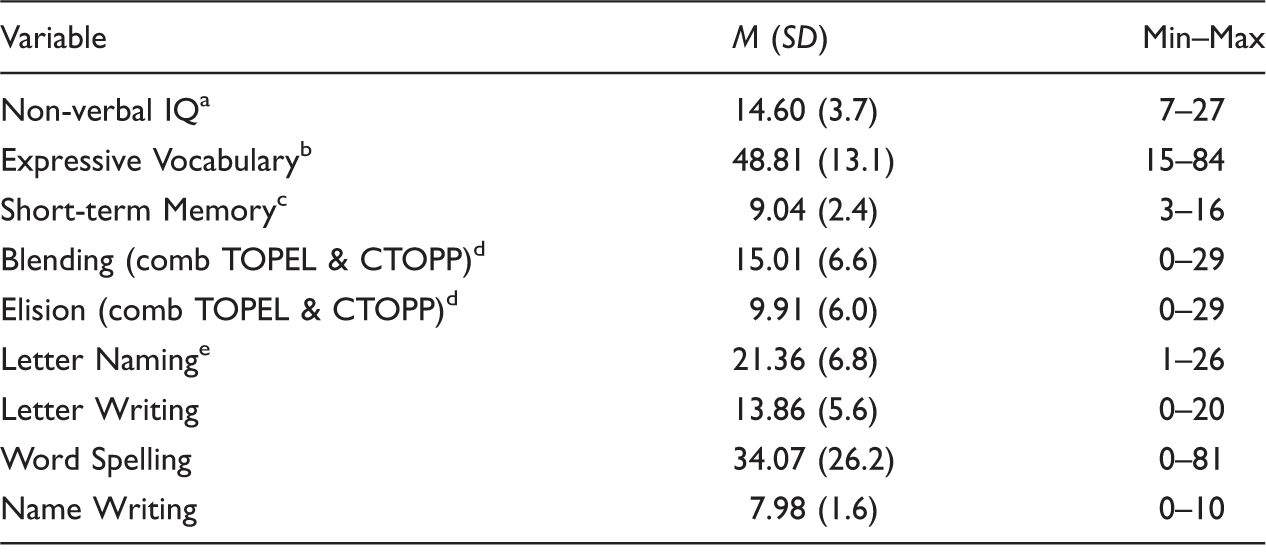
Kaufman Brief Intelligence Test, Second Edition (Kaufman and Kaufman, 2004).
Expressive One Word Picture Vocabulary Test – III (Brownell, 2000).
Memory for Digits subtest of Comprehensive Test of Phonological Processing (CTOPP; Wagner et al., 1999).
Blending and Elision subtests of Test of Preschool Early Literacy (TOPEL; Lonigan et al., 2007) and CTOPP; Wagner et al., 1999).
Alphabet Knowledge subtest of Phonological Awareness Literacy Screen (PALS; Invernizzi et al., 2004).
Note: All scores are raw scores.
Correlations of predictor and outcome variables.
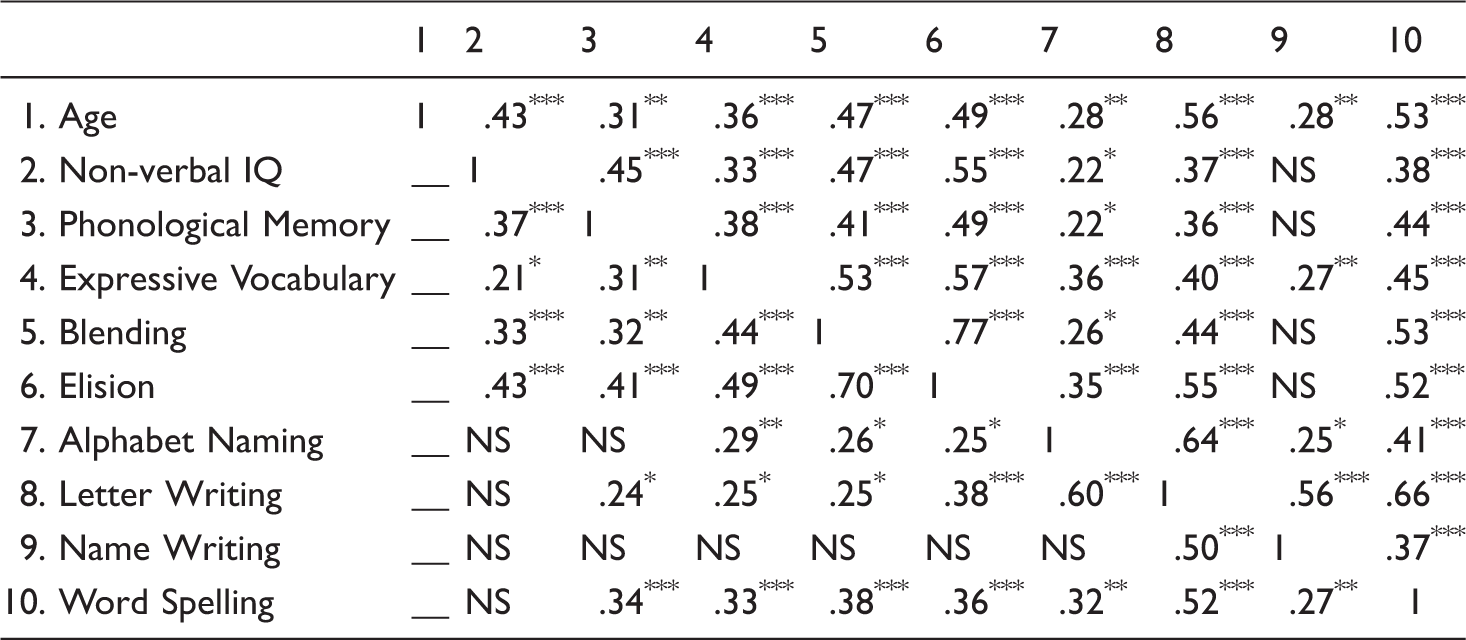
p ≤ .05, **p ≤ .01, ***p ≤ .001.
Note. Bivariate correlations above the diagonal, partial correlations controlling for age below the diagonal.
Hierarchical linear regression table for word spelling.
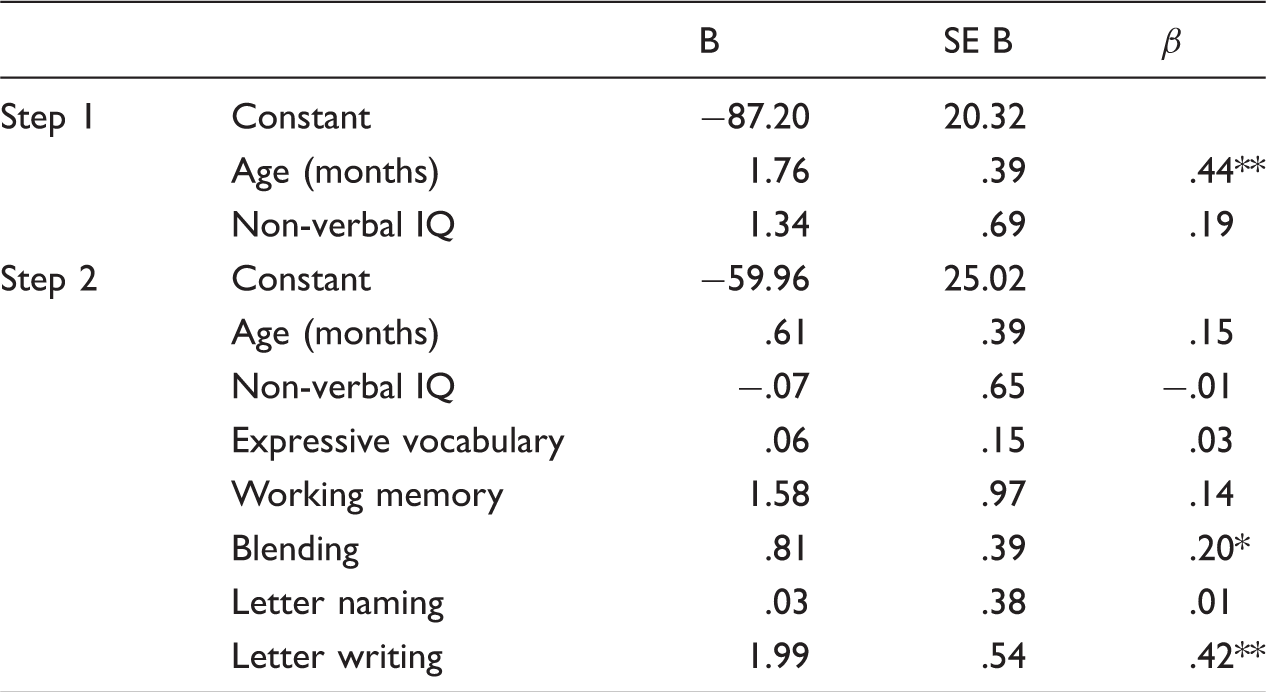
Note. R2 = .30 for Step 1, ΔR2 = .23 for Step 2 (ps < .001), *p < .05, **p < .001.
Logistic regression predicting likelihood of preschoolers being able to write their name.
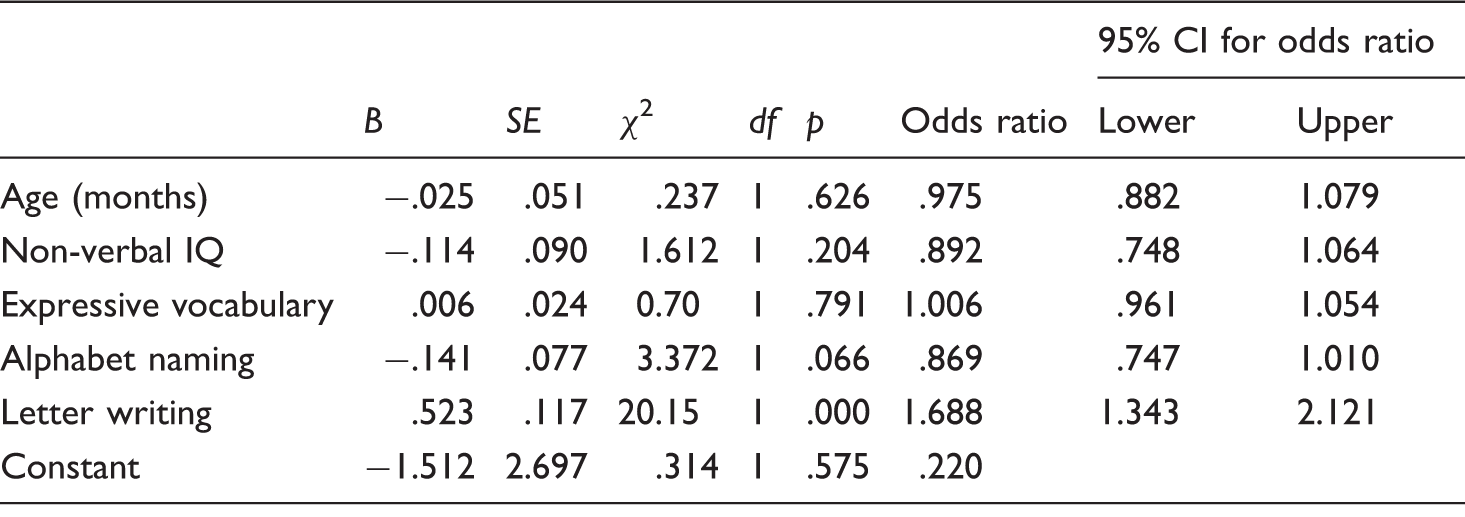
Note. R2 = .431 (Cox & Snell), .575 (Nagelkerke). Model χ2(1) = 52.43, p < .001.
Discussion
The purpose of the current study was to identify the component cognitive, linguistic and emergent literacy skills that contributed to preschool children’s proficiency in spelling written words and writing their name. There were two important findings from this study. First, the skills that predicted preschool children’s word spelling ability included age, IQ, memory, expressive vocabulary, blending, letter naming and letter writing. Blending and letter writing made a unique contribution to children’s word spelling scores. The second important finding was that the skills that predicted the likelihood that preschool children were able to write their name conventionally were age, non-verbal IQ, expressive vocabulary, alphabet naming and letter writing. Only one variable made a unique contribution to the model and that was letter writing. These findings indicate that there are differences in the skills that underlie children’s ability to spell words and write their name during the preschool years.
Word writing
Our first finding indicated that preschool children’s word spelling was related to age, cognitive (IQ, memory), linguistic (expressive vocabulary, blending) and literacy or print-related skills (letter naming and letter writing). These findings confirm those of previous studies, in that both print-related and phonological awareness abilities predicted preschool children’s word spelling (Furnes and Samuelsson, 2009; McBride-Chang, 1998; Ouellette and Sénéchal, 2008a; Puranik et al., 2011). The finding that phonological awareness made a unique contribution to word spelling indicates that young children make use of analysis of language into sound to produce invented word spellings. Only one known study (Niessen et al., 2011) has reported that print-related skills alone (i.e. word and print awareness) predicted preschool children’s word spelling and not phonological awareness. That study used a composite score of phoneme elision, beginning sound sorting and rhyme awareness as a measure of phonological awareness. However, the sample was younger (i.e. four years old) than the children in the current study and used measures primarily tapping into phoneme-level awareness that may be difficult for younger children. The current study used measures of phonological awareness that included items at the word, syllable and phoneme levels.
Our finding that blending makes a unique contribution to preschool children’s word spelling confirms the findings of a previous study (Puranik et al., 2011). Although previous studies have used elision tasks to investigate the skills that predict preschool children’s word spelling (Ouellette and Sénéchal, 2008a), those studies created a composite score for different phonological awareness skills. The current study used specific phonological awareness tasks, blending and elision, at the word, syllable and phoneme levels. For example, blending at the word level involved blending words to make compound words. By using a range of levels of difficulty on a single phonological awareness skill rather than a composite score of different skills, we were able to identify which phonological awareness skill was associated with word spelling. This finding indicates that blending, as measured by a range of phonological grain-sizes, is predictive of preschool children’s word spelling ability.
Letter writing ability also made a unique contribution to children’s word spelling. In order to achieve a score on a word dictation task, a child must write letters or letter-like shapes on the page. In the current study, we found that letter writing explained the same amount of variance in children’s word spelling as letter naming, plus letter writing entered into the model in the same step. Therefore, letter naming did not explain additional variance in word spelling beyond that of letter writing. Previous research indicated that letter naming knowledge is predictive of early word spelling (Muter et al., 1997; Shatil et al., 2000) and greater letter naming knowledge at entry to school is associated with children’s ability to learn to spell faster compared to classmates with less developed letter naming knowledge (Foulin, 2005). However, with the letter dictation task, children were asked to write a specific letter and this required them to recognize a letter's name, associate it with its corresponding shape and write that shape on the page. Letter writing tasks demonstrates more advanced knowledge of letters than a letter naming task and future studies might use a letter writing task as a more sensitive indicator of children’s letter knowledge.
Name writing
The second finding of this study indicated that the cognitive, linguistic and print-related skills that predicted the likelihood that preschool children were able to write their name conventionally were age, expressive vocabulary, alphabet naming and letter writing. Given that many of the children in this sample (i.e. 52%) were able to write their name conventionally while others were in the early stages of learning to write their name, the distribution of this sample was negatively skewed. Our results, based on logistic regression, corroborate the findings of previous studies indicating that only language and print-related skills predict whether or not children are likely to be able to write their name (Puranik et al., 2011; Welsch et al., 2003). Phonological awareness (i.e. blending) did not add any additional predictability in classifying children on the basis of whether they could write their name conventionally or not. In an attempt to identify the most parsimonious model, blending was dropped from the model, making no change in the outcome of the logistic regression. Our findings differ from those of Blair and Savage (2006) who found that letter-sound knowledge and phonological awareness, were predictive of name writing. However, no control variables were entered into the regression, particularly important in this case because, as the authors reported, the age of the children was moderately correlated with phonological awareness and letter-sound knowledge, and strongly correlated with name writing. The current study found that only print-related skills predicted preschool children’s name writing.
Importantly, letter writing explained unique variance in name writing in the current study. The distribution of the data in this study suggests that as children begin to write their name and gain experience with letter writing there is a rapid progression to conventional name writing. Children’s early experience with writing letters is associated with writing their name, an activity often mediated by adults (Aram et al., 2010; Aram and Levin, 2001; Skibbe et al., 2013). Given that children may be motivated to spend time writing their name, this may facilitate greater amounts of time thinking about letters and print and the alphabetic principle. This feed-forward nature of ‘experience and success’ in name writing potentially promotes interest in representing other words in print and becoming aware of other letters and their associated visual shape and sound (Treiman et al., 2001). In so doing, name writing promotes young children’s experience with writing letters and representing words in print.
Theoretical implications
The results of this study indicate that phonological awareness is associated with word spelling but not name writing. Word spelling involves the analysis of the sound structure of language as indicated by the role of phonological awareness (i.e. blending) in preschool children’s invented spelling. This suggests use of the sub-lexical level (or at smaller units than the word level) to spell words. Name writing, on the other hand, was associated with letter writing alone, suggesting that writing one’s name is learned as a single orthographic form by producing a string of letters. This suggests use of the lexical level (word level) to write names. The use of these two different strategies in preschool children’s early writing provides preliminary support for the early emergence of a dual-route model for spelling (Houghton and Zorzi, 2003). Some studies have examined a dual-route parallel processing model of reading development (Coltheart et al., 2001) but only a few studies have examined a serial processing model for spelling, and only with proficient adult spellers who had experienced brain injury (Houghton and Zorzi, 2003; Rapp et al., 2002). There are no known studies that have examined this model for young children’s spelling development; and the findings of the current study add to the circumstantial evidence to consider parallel processing for early spelling.
This model assumes that spellers make use of two processes or “routes” for translating speech to print: a lexical route and a sub-lexical route (see Figure 1). The lexical route involves the speller retrieving the spelling of familiar words from long-term memory storage, referred to as the orthographic output lexicon. A word’s phonological representation is activated in the phonological input lexicon that feeds forward to the semantic system to retrieve a semantic representation or meaning and confirm the word’s orthographic representation in the orthographic output lexicon. The grapheme output buffer facilitates access to the requisite grapheme shapes. A child’s name, in this model, is acquired as an orthographic form through frequent exposure to their name in print and this orthographic form is accessed directly through the lexical route when children write their name. Children do not first learn to recode their name using phonetic cues and later use visual cues as phase models and the self-teaching hypothesis propose for the acquisition of an orthographic form (Ehri, 2013; Share and Shalev, 2004). Given its early acquisition, a child’s name may be the first entry in the orthographic output lexicon. The proposed dual-route model of spelling explains how children learn to write their name with little knowledge of the letters while also explaining the sound to spelling conversion processes used for word spelling.
Dual-route model of spelling.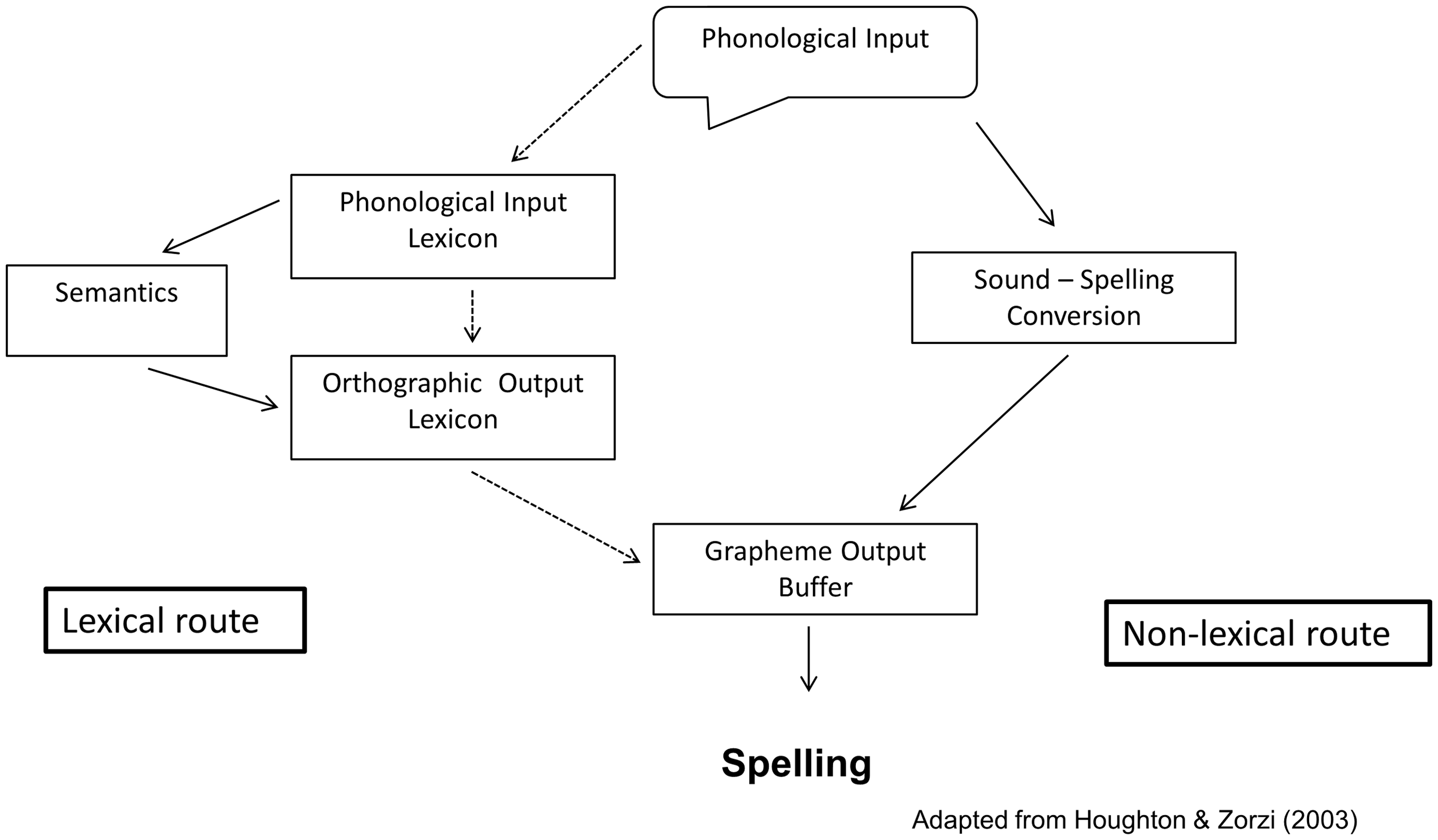
The sub-lexical route involves the speller applying knowledge of sound to spelling conversion to recode sound to print. This sub-lexical route is activated when the speller wants to write a word that he or she determines to be an unfamiliar word spelling (or nonsense word). In this case, the phonological representation activates individual graphemes by exploiting the speller’s knowledge of sound to spelling correspondence. Rapp et al. (2002) proposed that this sub-lexical conversion exploits statistically high frequency combinations of phoneme to grapheme relations, recoding smaller units of sound than the word level (Houghton and Zorzi, 2003). Preschool children receive very little instruction in spelling so their invented spellings draw on what they know about language, sound and print. Most or all word spellings are unfamiliar to them, requiring that they make use of sub-lexical processes to analyse language into print. To do so, these young children draw on cognitive abilities to locate a phonological representation for the word they want to spell, and analyse language into sound. Only after repeated exposure to a word spelling, whether seeing the word in print or writing it, does the word become an orthographic form in the orthographic output lexicon accessed through the lexical route. This aligns with phase models of spelling and Share’s self-teaching hypothesis, in that the words are first recoded using sound to print conversions. The dual-route model of spelling can explain both name writing and word spelling in children’s early experiences with writing and spelling and may inform instructional practice.
Examination of our data indicates that preschool children can acquire an orthographic form for their name and make use of the lexical route to write it without knowledge of the letters in their name. In the current study, a five-year-old named ‘Phoenix’ wrote her name conventionally with relatively well-formed letters recognizable by adult spellers out of context. However, she was unable to name E or N in the letter naming task or write an O in the letter dictation task. (Unfortunately O was the only one of the 10 dictated letters that was in her name.) Together these aspects of her early writing ability indicated that, although this child had some knowledge of the letters in her name, this would be insufficient if she were recoding from sound to print. Furthermore, consistent with the literature, Phoenix wrote P, H, O, E and N excessively in letter strings for all dictated word spellings (Both-de Vries and Bus, 2010). For example, the word ‘cup’ was spelled: “POEPHhn”. Certainly this child’s name is less transparent in letter-sound correspondence than many other names, given that the first phoneme of her name /f/ is written as a digraph ‘ph’ and the last letter of her name ‘x’ represents two phonemes /ks/. Further, her name has two vowel letters ‘oe’ that represent a single vowel phoneme /i/. This child’s proficiency in writing her name without knowledge of all of the letters of her name provides support for a possible dual-route model for spelling. That is, she acquired an orthographic form for her written name without being able to phonetically decode it.
Limitations
There are several limitations that should be considered when reflecting on this study and in looking ahead to future research. First, the current study did not include a measure of letter-sound knowledge. In order to minimize the testing time for our young sample, we administered letter naming and letter writing measures to represent earlier and later letter knowledge and ability. However, a measure of letter-sound correspondence might have explained additional variance in word writing ability providing additional support for the role of the sub-lexical route for word spelling. Future studies might use letter-sound and letter writing measures as these might provide more advanced indicators of children’s alphabet knowledge. Second, the current analysis included a small sample size (N = 95). Replication of the current study with a larger group of children followed longitudinally through the preschool years into the early elementary grades would extend these findings from early writing and spelling to conventional spelling and enable us to investigate it in relation to the dual-route model. Finally, a number of the children in the current sample were able to write their name conventionally. Given that name writing progresses to the conventional form early, inclusion of younger children who are not yet able to write their name (i.e. three year olds) may have provided a normal distribution of name writing scores.
Conclusion
In conclusion, this study extends our understanding of preschool children’s early writing and spelling by differentiating the skills that underlie name writing and word spelling. The role of phonological awareness in word spelling indicates the sub-lexical analysis of language to perform sound-to-spelling conversions to spell unfamiliar words. However, preschool children learn to write their name conventionally as a single orthographic form without the analysis of language to print. Together, these results provide preliminary support for a dual-route model of spelling in young children that explains their earliest writing and spelling production. Consideration of this model to explain spelling development might have implications for future research, both to explore the acquisition of spelling conventions and also possibly to explain atypical spelling development. Moreover, given that name writing develops earlier than word spelling, additional work is needed to understand the role of name writing in supporting children’s early word spelling. Educators and caregivers can support children’s early literacy development by encouraging children to spend time writing, whether they are writing their name or engaged in play-based activities that promote the use of children’s invented spelling.
Footnotes
Acknowledgements
The authors would like to express their gratitude to the staff, parents and children of the participating childcare centres, as well as to the research assistants who took part in data collection and preparation.
Declaration of conflicting interest
The author(s) declared no potential conflicts of interest with respect to the research, authorship, and/or publication of this article.
Funding
The author(s) disclosed receipt of the following financial support for the research, authorship and/or publication of this article: the Social Sciences and Humanities Research Council of Canada and The H. J. Watson Ontario Graduate Scholarship.