



Abstract
Education is in the process of transforming traditional print-based instruction into digital formats. This multi-case study sheds light on the challenge of coping with the old and new in literacy teaching in the context of technology-mediated instruction in the early years of schooling (7–8 years old children). By investigating the relation between literacy and digital technology in diverse pedagogical contexts we capture the complexity in the educational transformation that needs to be acknowledged. Each of the cases demonstrates a distinct knowledge focus and goal for early literacy instruction, organisation and access around technology and what is made visible in instruction. All these factors had consequences for the teaching that occurred. Depending on epistemological beliefs, digital competencies were taught separately from literacy and considered as a goal on its own or integrated with literacy considered as a means and a goal for literacy teaching and learning. Implicit pedagogy with weaker classification and framing enabled conditions for infused approaches making use of digital technology in multimodal, functional and learner centred literacy practices. Furthermore, initial guidance and the weaving of invisible and visible pedagogy highlight a possible way to both exploit the potential of digital technology and support children from various backgrounds. The balance of teacher and student control was further affected in regard to the organisation of technology and choices of pedagogical methods. This research hereby expands the current discussion on the relation between technology and literacy with an understanding that the epistemological focus and context of practices are necessary tools to problematize, rather than measure or value, emerging practices in early literacy instruction. We conclude that in addition to the necessary heavy investments in digital technology in schools there is a need to provide room for action for the teachers and address issues of purpose, pedagogy and organisation around technology.
Keywords
Introduction
Communication and representational patterns in society have changed dramatically due to socio-technological changes that provide opportunities for active, participatory and creative processes of learning. Children and young people participate in multi-literate spaces and engage in a range of interactive and multimodal literacy practices. They consume, create and share screen-based, spoken, visual and digital texts, engaging in multiple modalities of communication. In this interacting and sharing of media content on screen, new meaning-making practices emerge that involve more than reading and writing skills, allowing for participation in emerging, network-based and constantly changing communities (Carpentier, 2011; Jenkins et al., 2006, 2013). In future work and community life, abilities that involve handling both conventional and digital texts and ways of thinking that develop creativity, innovation, problem solving, collaboration and risk taking are vital (Cope et al., 2011; Gee, 2003; Organisation for Economic Co-operation and Development (OECD), 2005, 2013; Wagner, 2008). In the educational context we also observe an increase in screen-based, multimodal composing and interaction. This move from page to screen as a primary means of dissemination (Kress, 2010) challenges teachers to reconceptualise literacy and raises questions about education promoting literacy (e.g. Anstey and Bull 2006; Jewitt et al., 2009; Leu et al., 2004; New London Group, 1996; Thomas, 2011). Research shows that early literacy instruction often privileges print-based practices, with existing teaching traditions being supplemented by technology-mediated practices (Merchant, 2008). This indicates a tension in children’s encounters with literacy in and out of school. Similarly, other studies report that the curriculum is in tension with technological and social change, in that it focuses too narrowly on conventional writing measures (e.g. Jewitt et al., 2009; Merchant, 2008). Consequently, curriculum goals separate literacy from technology, privileging print-based instruction.
Digital technology in literacy instruction obviously entails a challenge for education and teachers that are ‘caught between two paradigms; the old and the new’ (Buchanan et al., 2012: 107). Our interest in this paper is to shed light on these challenges in teachers’ pedagogical approaches to technology-mediated instruction in the early years of schooling (7–8 years old children), thereby providing insights into how literacy education in different pedagogical contexts is dealing with these tensions (e.g. Buchanan et al., 2012). More specifically we are interested in exploring the nature of the pedagogical context influencing this educational transformation: What happens when emergent literacy practices encounter existing pedagogical models of literacy instruction in early primary school and become established? We examine digital approaches to early literacy instruction in the context of class projects evolving around print-based and screen-based practices.
Literacy instruction and digital technology
The impact of technological, global and social change on literacy has, according to Coiro et al. (2008), been conceptualised and theoretically addressed from different angles by various scholars. Some regard these emergent literacy practices as ‘new social practices and conceptions of reading and writing’ (Coiro et al., 2008) due to the emergence of digital technologies (Street, 2003), others regard them as new strategies to master the Internet (Leu et al., 2004), or new discourses (Gee, 2003). There are those who understand them as multiliteracies (Anstey and Bull, 2006; Cope and Kalantzis, 2000; New London Group, 1996; Unsworth, 2001), multimodal contexts (Hull and Schultz, 2002; Kress, 2003) or new literacies (Lankshear and Knobel, 2006, 2007). Irrespective of these different orientations, they all redefine literacy to encompass a convergent concept of a broad and sociocultural view of literacy realised as a shift from print as the primary medium of dissemination towards digital meaning-making and an appreciation of social and cultural change. Re-conceptualising literacy in this way, above all, challenges the traditional print-based instruction that has been dominant in Western education, implying changes in curricula, subject content, classroom practice, assessment and pedagogies (e.g. Cope et al., 2011; Jewitt et al., 2009; Merchant, 2008; New London Group, 1996; Unsworth, 2006).
With regard to curriculum goals, several studies report contradictory goals in relation to technological and social change, with digital meaning-making considered as complementary to print traditions (e.g. Cope et al., 2011; Jewitt et al., 2009; Lynch and Redpath, 2014; Merchant, 2008; Warschauer and Ware, 2008). This pattern is also found in the current Swedish curriculum goals for primary school. The paragraphs relating to central content in the subject Swedish for years 1–3, which is the focus of the present study, contain indications of the ongoing dominance of verbal meaning-making (writing and speaking) aiming at the development of: ‘Strategies for writing different types of texts adapted to their typical structures and language features’, supplemented with a visual mode of expression in formulations such as ‘Creating texts where words and pictures interact’, or the use of ‘Pictures and other aids that can support presentations’ and goals relating to work with fictional and non-fictional texts that ‘… combine words and pictures, such as films, interactive games and web texts’ (The Swedish National Agency for Education called Skolverket, 2011: 212). The continued dominance in early literacy education of ‘teacher-directed mono-modal print and linguistic skills’ is, according to Lynch and Redpath (2014:150), also contradictory to policies that exhort innovative uses of information and communication technology (ICT) in education. This is, by extension, in conflict with teachers’ attempts to meet the curricula goals. Further, students’ engagement in complex literacy practices outside of school is not recognised in the educational context and is particularly restrained by assessment practices (Ivanič et al., 2007).
Digital technology is embedded to different extents in various school subjects and is used in a variety of ways (Erixon, 2010; Jewitt et al., 2009; Selwyn, 1999). In social subjects, like history, religion, geography and civics, films and images are often used during instruction to complement reading and support students visually. Linguistic design (writing and speaking) is predominant in the subject of Swedish, as reported in studies in (lower) secondary schools (Erixon, 2010). Similarly, studies concerning the use of computers in early literacy education (Labbo and Reinking, 2003) report a strong focus on print-based literacy skills of encoding and decoding and the assessment of print-based skills in relation to the acquisition of writing, phonological awareness, reading, collaboration and digital skills (see Merchant, 2008).
There is a prevalent dominance of psychological-cognitive studies on the effects of digital technology on literacy in the sense of interaction with computers as a substitute for teachers, or as a stimulus. Burnett (2010) categorises these studies by positioning technology as ‘deliverer of literacy’ in accordance with the print-based literacy orientation in curricula. Findings from these studies comparing writing with computers to pencil-and-paper writing, they report a positive impact on learning to write and texts of greater length and higher quality, observing tendencies towards collaboration and the sharing of texts and the increased revising of texts when word processing is used (e.g. Bangert-Drowns, 1993; Cochran-Smith, 1991; Goldberg et al., 2003). Studies based on technological development towards web 2.0 report on similar findings for collaborative practice and more opportunities for revising and scaffolding, resulting in longer and more developed texts (e.g. Davis and MacGrail, 2009; Fountain, 2005; Penrod, 2007; Warschauer, 2008). It is especially emphasised that students find assignments motivating and meaningful when text production becomes more ‘real’, with an immediate and virtually unlimited audience, and that they subsequently also develop more confidence in their writing (e.g. Kovacic et al., 2007; Mak and Coniam, 2008).
Studies that assume a sociocultural view of literacy examine interaction and dialogue around digital texts in the classroom and engagement in digital meaning-making as textual production and consumption. Findings from these studies concern evolvement towards exploratory interaction with the text as a shared visual stimulus (Chung and Walsh, 2006; Hyun and Davis, 2005) and the significance of children’s experiences with digital technology outside the school context as a valuable competence for formal learning shaping classroom practice (McPake et al., 2013; Siegel et al., 2008). Further studies address the importance of online reading and participation in networked discussions as sources to mediate and meaningfully engage with texts (Pelletier et al., 2006; Teale and Gambrell, 2007). Making connections between student’s cultural and linguistic capital in their lives highlights the further significance of multilingual literate practices (Taylor et al., 2008) and creative design (Walsh, 2007) at home for the acquisition of literacy practices at school. In addition, children’s involvement and experimentation with digital images and the design of texts as examples of broader communicative practices are highlighted as necessary for children’s development as readers and writers (Marsh, 2006; Schiller and Tillett, 2004).
With the emergence of large-scale investments in laptop computers in schools, so-called one-to-one laptop programmes, reports and studies on the implementation of technology, types of usage, best practice and impact on learning dominate (e.g. Lowther et al., 2003; Penuel, 2006; Russell et al., 2004; Silvernail and Lane, 2004; Valiente, 2010; Warschauer and Grimes, 2005). Regarding literacy in particular, in the laptop programmes in the US, several changes in reading, writing and digital skills are reported in comparison to the typical classroom (Suhr et al., 2010; Warschauer, 2008). Teaching in these classes involved more autonomous learning than in traditional classrooms, where instruction is more teacher-driven. Texts were based on real goals and addressed authentic audiences, which resulted in the students revising their work more, thereby producing texts of higher quality. Computer formatting options enabled students to produce texts of multiple and diverse genres. The students’ digital skills, such as the review of information online or the production of multimodal texts, were also developed. Seemingly, student writing became more iterative, public, collaborative and purposeful. However, various recent studies have pointed more towards a skill focus in laptop classes and less space for dialogue, reflection and deeper learning. Students’ individual work increases and instructions for assignments are often too vague or too comprehensive. Presentation format and fancy PowerPoint slides tend to take over subject content (Fleischer, 2012, 2013; Grönlund et al., 2011).
Instructional design has proven to be a critical area for innovative forms of teaching (e.g. Cartwright and Hammond, 2007; Sofkova Hashemi, 2013; Warschauer, 2010). That is, although research demonstrates that digital composing promotes, for instance, iterative writing and gives opportunities for multimodal expression, scaffolding and feedback, students do not necessarily engage in such advanced, participatory and reflective composing and revising activities. There are examples of studies demonstrating substitutive approaches to digital composing, fitting print-based practices into a new discourse, such as using wikis, promoting participatory and collaborative practices, for individual text production (Sofkova Hashemi, 2013). Ingram (2014) shows in particular that technology-mediated education has the potential to promote learner-centred instruction, moving towards a more implicit teaching approach where the teacher’s role becomes more that of a facilitator than a transmitter. Such a movement from teacher-controlled towards learner-centred tasks makes it easy to hand over more responsibility to the students than they can handle and to expose them to situations where they lack appropriate tools for solving completing the task (Jedeskog and Nissen, 2004). In order to engage students in participatory, creative and reflective processes of learning, screen-based approaches must leave room for autonomy, but at the same time students must be encouraged or driven by an instructor (Gilbert et al., 2008; Lamb, 2004). The choices in balancing teacher and student control and what is made explicit to the students are not just crucial to students’ learning but also complex for the teacher (Exley and Richard-Bossez, 2013; Morais and Neves, 2011; Smith, 2013). For instance, Morais and Neves (2001, 2011) argue that a student-centred and interdisciplinary approach is favourable for students' learning, but needs to be combined with explicitness and teacher control of criteria and selection. Taking a sociological perspective, the authors contend that a weak framing of criteria and selection leaves children from lower social backgrounds and minority ethnic groups ‘…who entered school in disadvantage, more disadvantaged’ (Morais and Neves, 2001: 216).
Our review of previous research shows tensions between literacy practices in and outside school. In the educational context, conventional reading and writing and a skill focuss dominate, separating literacy from technology in curricula goals, subject content, assessment and classroom practice, privileging print-based forms of instruction and regarding digital technology as something that might help to promote the acquisition of literacy. Research on digital technology in early literacy education is relatively scarce, mainly addressing computer use and children’s engagement with digital texts (Burnett, 2010). There is a general prevalence of psychological-cognitive studies on the effects of digital technology on literacy, implementation studies and studies of activities in the classroom. Research suggests a need to problematize and theorise the place of digital technology in early literacy education and studies of literacy practices in the pedagogical context as whole rather than regard examining individual learners. Given that our interest in this paper is to research teachers’ instructional approaches in diverse pedagogical contexts and the factors influencing pedagogical discourses, we adopt an alternative gaze in this research. We reach beyond the surface of which literacy practices (print or screen) are foregrounded in the classroom work in order to analyse what is communicated as meaningful knowledge through classroom organisation and relations between teachers and students.
Research context and methods
Theoretical frame and analytical instruments
The what and how of digital approaches to early literacy education are examined in relation to what Merchant (2008) describes as models of instruction for the development of digital writing in early years and Bernstein’s (2000) sociological theory analysing situated conditions in the classroom and instructional design.
In the discussion of how digital technology can infuse and transform the curriculum and pedagogy, Guy Merchant identifies and describes three models of instruction, drawing attention to the shifts in forms, uses and technologies of writing. The sequential, parallel and infused models, summarised in Figure 1, in essence differ with regard to whether literacy is separated or integrated with digital technologies. In the sequential model, attention is drawn to the fact that literacy instruction and curriculum goals are often in tension with contemporary changes in society, ‘privileging pencil control over keyboard skills, and print over screen-based text’ (Merchant, 2008: 756). In this view, print-technology and conventional writing are considered as desirable and necessary skills before starting on digital composing. In other words, pedagogy essentially retains its existing form. In this sense, the sequential, gradual introduction of digital writing not only ignores the digital competencies and ‘literacy capital’ (Bearne, 2003) of many students, it also implies a separation between school and home literacies. The second model looks for parallel paths of progression in learning and introducing digital writing alongside print-based writing, for example learning to recognise and form letters by hand and also as a basic keyboard skill. Pedagogy is developed here to approach specific aspects of digital writing. However, in both the sequential and the parallel models a separation between literacy and digital technology arises. The third model focuses on the notion that ‘new technology infuses the curriculum’ as students are introduced to digital writing right at the beginning of schooling, implying also ‘a re-conceptualisation of emergent writing’ (Merchant, 2008: 757). Pedagogy develops towards new approaches that include existing literacy practices along with critical choices of writing tools related to the communicative purpose, affordances of media and issues concerning design (Bearne, 2003).
Three models of instruction for the development of digital writing in early years (based on Merchant, 2008: 756–757).
These models exploring the relationship between literacy and digital technology provide an appropriate tool for discussing educational practice in early literacy education concerning print-based and screen-based practices. Our approach and our view of classroom practice, being made up of many different and often competing discourses, draw further attention to the contextual and relational aspects absent in the models above. In investigating the organisation and communication of instructional design, the Bernsteinian (2000) concepts of classification and framing are used as analytical instruments to reveal the structure of pedagogical discourses in terms of visible and invisible pedagogy (Bernstein, 2000, 2003). In this way we extend the theoretical and analytical approach of models of instruction as tools to analyse and discuss early literacy instruction by including contextual and relational aspects, enabling a distinction to be made between specific matters of classroom social context.
Classification and framing are fundamental elements of Bernstein’s code theory. Code is defined as the tacitly acquired principles regulating what is regarded as meaningful and legitimate knowledge and behaviour in the pedagogical context, and how these are expressed and realised (Bernstein, 1990, 2000). Classification is the way in which power relations are transformed into particular discourses. It refers to the relation between and the extent of boundaries and the insulation of observed categories. Where boundaries are explicit and categories are insulated, the classification is strong. On the other hand, weak classification is characterised by integration or blurred boundaries. School subjects being taught in isolation of one another is an example of strong classification of subjects, while thematic instruction where different school subjects are integrated into the theme is an example of weak classification (Bernstein, 2000). The concept of classification can also be used to describe the degree of boundaries between other categories, such as teacher–student relations (agents) or content within subject areas. The degree of insulation or boundaries between such categories has consequences for the identity and internal rules of the category. Bernstein (2000) argues that the specialisation and identity of a category are not created within that category, but in the space between categories in the same set. Therefore, the meaning of a school subject or content within this subject can only be understood in relation to other school subjects or subject contents. A strong identity and specialisation of, for example, a school subject are formed by insulation from other school subjects, and removing this insulation threatens the identity of this subject. Strong and weak classification can be further described as being formed by different rules for the transmission of knowledge. The rule in strong classification is that content must be kept apart while the rule in weak classification is that content in different areas must be connected and integrated.
Framing refers to the rules of communication and the locus of control of selection, sequence, pacing and criteria or the assessment of knowledge in the educational process or, in other words, what the teaching and learning interaction is about. When the teacher (or institution) controls the selection and sequence of content, i.e. the amount of time spent on each assignment and criteria for evaluation, the framing is strong. Weak framing, on the other hand, implies that more control and influence over such decisions is given to the students. In other words, one could think of framing as the way relations between teachers and learners are set up (Hoadley, 2006). However, the degree and locus of control can differ between different aspects of framing (Bernstein, 2000). For example, criteria for the assessment and selection of content can be controlled by the curriculum and the teacher (strong framing) while students can have control over the order in which their assignments are carried out (weak framing).
In our analysis, the concept of classification is used to describe relations or boundaries between subjects, between content within subject, between modes of expression and relations between teachers and students. The teacher–student relation is further discussed using the concept of framing, referring to the locus of control and students’ degree of influence and options. The degree of strength in classification and framing also affects how explicit or visible the rules of communication and organisation plus evaluation criteria are to the students. Strong classification and framing make the rules explicit and known to the students and are the foundation of a visible pedagogy, while invisible pedagogy is the result of weak classification and framing, where the rules are implicit and unknown to the students. Invisible pedagogy is regarded as progressive and visible as conservative (Bernstein, 2000; Sahlström, 2008). However, not all children benefit from an invisible pedagogy that requires them to find out for themselves what they are supposed to produce in a pedagogic activity. While middle-class children are more likely to have acquired the ability to ‘read’ this code from their home lives, children from a working-class background or others who cannot easily read the school code are disadvantaged by an invisible pedagogy (Bernstein, 2003; Morais, 2002; Morais and Neves, 2001, 2011). As digital technology has the potential to weaken classification and framing and lead towards a more invisible pedagogy (Ingram, 2014), that complicates the learning for disadvantaged children (Bernstein, 2003; Morais and Neves, 2011); these concepts provide useful tools for this study. They are used here to examine the organisation of the instructional approach with regard to aspects of relations and boundaries, and to problematize and expand Merchant’s analytical model. Both Merchant’s and Bernstein’s concepts are thus used as instruments to examine and distinguish rather than dichotomise different structures in order to enable the problematisation of pedagogical practice.
Research design
Overview of the studied classes, participants and observed writing projects.
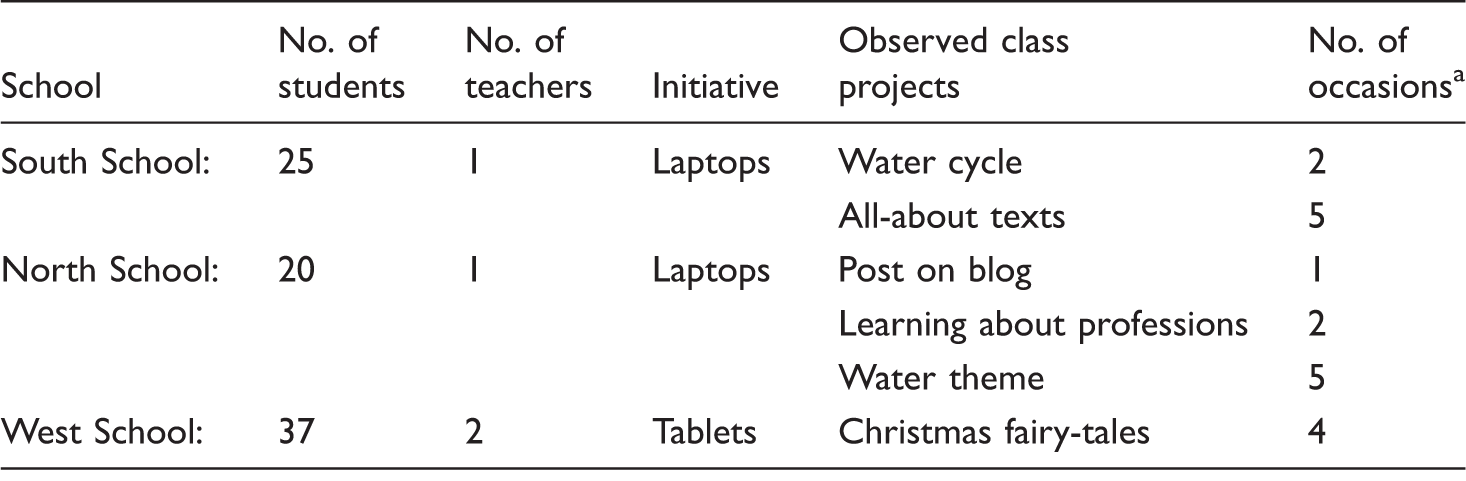
Corresponds to classroom observations of varied lengths of time.
We use ethnographic tools for the production of data, observing and situating literacy in the context of social practices in accordance with Heath and Street’s (2008) ways of relating educational issues to ethnography in education. Classroom observations were carried out in focused periods of observing selected class projects working on the digital composition of fictional and non-fictional texts, blogging and the like – see Table 1. The choice to observe projects involving digital composing relates to our research question of whether print-based or screen-based practices are emphasized when examining the relation between literacy and digital technology, building on Merchant’s (2008) framework. The class projects were part of the syllabus for the classes, planned by the teacher(s), and aimed at learning goals striving for literacy acquisition solely or combined with other learning goals in interdisciplinary projects involving several school subjects.
As the last column in Table 1 indicates, the observed projects varied with regard to the amount of time spent on them, as well as in whether the project was carried out as an integrated part of other school subjects, allowing the class to work with it for most of their school day, or whether it was insulated from other subjects. Also, students at West School started their first year half a year after the start of the research project which explains the lower number of observed occasions. The time devoted to the class projects and the period when they were carried out during the school year was outside the control of the researchers. The aim was instead to capture and follow the practices of their ordinary instruction.
Video-recordings of the observed class projects made it possible to closely examine the specific practices at macro- and micro-levels (Walford, 2008). One stationary camera was placed to capture the whole-class activity at a macro-level and mobile cameras were used to zoom in on activities at a micro-level during the classroom work, which was necessary in order to capture the activities of teachers and students around the laptops or tablet computers as well as the screen. Two researchers were present during each classroom observation, which not only enriched the data with field notes and close video-recordings of the teachers’ and students’ work, but also strengthened the validity (Silverman, 2006) and research trustworthiness (Lincoln and Guba, 1986; Shenton, 2004). This arrangement provided not just opportunities to capture more of the educational settings than what would be possible with just one observer, it also provided opportunities for the researchers to discuss analyses of the observations from the mutual experience of being there. The collected video-material consists of approximately 40 hours of whole-class video-recordings and a corresponding amount of close video-clips from 19 observation occasions (Table 1).
To understand further the premises and meaning of the observed classroom practices as well as of the instructional approaches in general, more information was needed. Therefore, in total, nine interviews with the teachers were conducted, distributed over three interviews per school; the two teachers at West school who worked together were also interviewed together. The initial interview concerned the teachers’ views on literacy instruction and their digital approaches. Subsequent interviews were conducted in connection with the observed class activities. Both semi-structured interviews and video-stimulated reflection interviews, focusing on the teachers’ reflections about the observed lessons, were used. The latter were conducted as a reflective conversation, which took place while the researchers and the teachers viewed short film sequences from the observed lessons as stimuli for reflection (Cutrim Schmid, 2011; Lyle, 2003).
Finally, representations of students’ work in the form of texts produced by 12 focal students, four in each class, were collected from the first day of their schooling. The focal students were selected in joint consultation with the teachers, with an equal number of girls and boys from each class being chosen, as well as a representation of both students who struggle with their encounters with the written language and students who do not. The teachers were instructed to save all the texts produced by these children, both print and screen-based, and the researchers recurrently saved files of digital texts and photographed handwritten texts, exercise books, notebooks and so on. The collected text material consists of about 500 screen-based or handwritten texts produced by the focal students during 2–3 school terms.
By combining observational material (field notes and rich video data) with interviews and text productions from 2–3 terms of classroom work we were able to broaden the empirical material and capture the nature of composing practices over the whole time period, rather than narrowing it down to selected observations. In this way our data material represents the broad, trustworthy and authentic social context needed for the analysis. The analytical process was iterative with a progressive refinement of findings in order to understand the underlying patterns of parts and the whole, both within each category of data material (texts, observations, interviews) and between them. Approaching the analytical process as an interaction between theory, data and researchers, theory and empirical material mutually informed one another (Trondman, 2008).
School context
In this section we describe the pedagogical and material context of the participating classes with regard to the available digital resources and writing pedagogy. The Swedish educational system is regulated by the government on a national level, by means of a national curriculum that stipulates fundamental values, national goals and guidelines for education in preschools, compulsory and upper secondary schools, and regulates the syllabuses of subjects (Skolverket, 2011). The syllabuses for Swedish and Swedish as a Second Language (for second language learners) stipulate the subject’s aim, core content and acceptable knowledge requirements in different grades. In this way, the educational goals and content that should be covered are provided. Schools and teachers are free to choose their working methods and are responsible for organising activities so that pupils can attain the national goals. The individual teacher can make quite flexible decisions with regard to the district’s or municipality’s decisions on local policy and investment in resources such as digital technology and professional development initiatives. Below we describe the contextual conditions of the three participating classes.
South School
South School is located in a socio-economically privileged area and the class under observation is equipped with a set of laptop computers. The teacher had attended courses given by the Teachers College Reading and Writing Project (TCRWP) as part of a municipal initiative. Inspired by Lucy Calkins and the TCRWP method, reading and writing instruction in this class is generally process-oriented and based on workshops with explicit modelling from the teacher (McCormick Calkins, 1994, 2001). Whatever the content or subject, the lessons follow a model with an initial mini-lesson, with the teacher modelling and explicitly instructing on the learning point on that occasion, followed by independent work.
North School
All students in the class at North School are L2 learners and the school is located in a socio-economically underprivileged area. Two classes share a set of laptops and students work in pairs on the computers, inspired by the Writing to Read on Computer method (WTRC; Takala, 2013; Trageton, 2003). This method of ‘playful computer writing’ is widely used in Swedish schools and is, at this school, part of the local policy and professional development initiative. The method hinges on the assumption that writing is easier to learn than reading for young children (5–7 years) (Chomsky, 1982; Clay, 1975) and aims to develop playful and creative ways to master writing, and also to avoid possible motoric problems associated with handwriting, the learning of which is postponed until later years.
The teaching adopts an approach involving the retelling of (shared) experiences, often involving modelling and dialogue that is directed at the students. The lessons we observed generally began with an introduction to the learning point, with the teacher addressing the whole class. The writing task was presented, based on the texts the students had worked with earlier and the experiences they have been through in class. Students worked together in pairs in different configurations and wrote on the computers using a word-processor. They printed their text, pasted it into their writing book and drew a picture by hand to go with the text. Thereafter, they read their texts aloud.
West School
The students at West School have access to individual tablet computers. The school is newly established and has from the start expressed an ambition to work with digital development and digital learning processes. Two teachers, one specialising in maths and science and the other in Swedish and civics, share responsibility for this class. The teachers are not strictly bound to one method of reading and writing instruction, but rather mix methods. They express that they are influenced by for example the WTRC, the Whole Language Approach and sociocultural approaches to literacy. The students work both individually and in pairs using different applications and software on their tablets.
Distribution of practices and organisation of instruction
This section reports on the findings about the types and distribution of screen-based practices and practices in print over a time span of 2–3 terms in the participating classes with regard to the incorporation of digital approaches to early literacy instruction. By means of the concept of classification, we further analyse the organisation of instruction concerning relations and boundaries, not just between screen-based and print-based practices, but between subjects, contents within subjects, modalities (e.g. written text and images) and teacher and student.
All three classes were equipped with either laptop or tablet computers for each student, as mentioned above. At South School and West School the students had their own accounts on their digital devices and had access to the Internet and the school’s Learning Management System (LMS). At North School, students were working offline and had limited options to store their work digitally on the computers. The observed classwork and students’ texts reveal significantly different approaches to digital writing instruction. As illustrated in Figure 2, we found a gradual, sequential approach at South School, privileging print-based activities and handwriting as prerequisites before the students start to use computers. At North School and West School the use of more infused methods occurred, starting with digital composing right from the start.
Distribution of print-based (in bold) and on-screen practices at South, North and West schools.
Taking one step at a time and privileging print
In the clearly sequential model at South School, texts were created by hand first (in bold in Figure 2) and later on computer, utilising word processing, mind-mapping and presentation in that order. The students were, apart from the video-reading (i.e. filming themselves when reading), engaged solely in print practices during the first term. They produced handwritten accounts in diaries of events from class or leisure time, composed fairy tales and factual reports on animals, seasons of the year, the water cycle and similar topics, and they practised creating a story structure with a beginning, middle and end in paper notebooks. They also practised cursive writing, and letter and word recognition in exercise books.
Screen composing was initiated with word processing on computers in the second term. The students first became familiar with the software, experimenting with colour and fonts and creating colourful word lists using different fonts. Then they wrote poems and shorter texts consisting of single sentences about themselves. Inspired by process-oriented methods of writing and explicit teacher-modelling of texts (McCormick Calkins, 1994, 2001), the students word-processed on computers over a period of several weeks, planning, revising and rewriting their texts. On one occasion, they composed text messages and explained the water cycle by sending a personal instant message (PIM) to the teacher on the school’s learning platform using the words: evaporate, vapour and cloud.
During the third term (year two) mind-mapping was introduced to the students, in print first. The students composed their first mind-map ever on the seasons of the year on a sheet of paper. This was followed by a theme of ‘All-about texts’ on non-fictional writing, where the students continued to work with mind-mapping on computers. They gathered facts, in mind-map software on the computer, on subjects familiar to them, such as their pets, games or favourite artists. Then they composed a digital presentation based on these facts. Mind-mapping and presentation software were introduced during separate lessons. In parallel, the students continued to handwrite in diaries and make factual reports about animals, world continents, space and planets and the like.
In this sequential model, introducing screen-based activities one by one and first in print, there was a dominance of strong classification and strict sequencing of school subjects, content within subject and modes of expression (e.g. whether images were used along with writing) in the class projects. Content was introduced by explicit instruction and modelling by the teacher in mini-lessons, with one clear teaching point for each lesson according to the TCRWP model of teaching (McCormick Calkins, 1994, 2001). Writing instruction did not generally include other school subjects, as in the example of All-about texts. The teacher confirmed in interviews that instruction where different school subjects and content within subject were handled separately, focusing on one thing at a time, generally permeated the class projects. A similar separation of content was found concerning both modes of expression and digital skill practices. The teacher instructed students to work with one modality at a time, i.e. solely writing or writing first and then adding images. Consequently, text production was separated from visual practices, in spite of the fact that the presentation software invites the contiguous integration of writing and images rather than inserting pictures after the text has been written. Similarly, print-based activities preceded screen-based activities and software programs were introduced separately before applying them to content. For example, the instant-message assignment had been preceded by testing text messaging to classmates, narrative writing by hand preceded screen-based writing, and handwriting mind-maps on paper preceded composing mind-maps in a mind-mapping software. In the interviews, the teacher explained that the separation and strict sequencing are necessary for two reasons. First, it is assumed to be necessary to develop print-based activities or skills before screen-based composing (see sequential model in Figure 1). The teacher defined handwritten texts as easier, more ‘hands-on’, and on-screen texts as more difficult for her students to handle. This is illustrated by statements like: ‘But I have to have it on paper first so they have the shape for it’ and ‘I didn't know how to do it on the computer in a simple way.' The second motive for strict separation and sequencing, expressed as a need to take ‘one little thing at a time’ and not to ‘lose’ them, seems to be a concern about students’ cognition and ability to maintain paying attention. In the interviews, the teacher referred to how the students’ ‘window’ is open for just a short period of time.
The described sequencing and separation, focusing on one thing at a time, relates to the teaching method this teacher is influenced by, which builds on the modelling and explicit teaching of strategies requiring one clear teaching point in each mini-lesson. On the other hand, even if print-based practices generally preceded the screen-based composing in this class, the teacher has an agenda for progression in digital competencies. The students were gradually introduced to different software, although the TCRWP model of teaching is not actually developed for teaching digital skills. As a consequence of the strict sequencing and separation, the organisation of this instructional approach shows a focus on the development of specific skills and strategies both for writing and digital competencies. However, these aspects are handled in an insulated way, separately from one another.
Blurred boundaries enabling infused practices
Both North School and West School applied the infused model in writing instruction, inspired by the WTRC approach. As described above, this method is characterised by postponing handwriting to later years (usually second grade), early keyboard exercises and use of the computer as a typewriter. North School held on to the WTRC method and continued with word processing on computers during the whole period of our observations. Literacy activities in this class were all screen-based, conducted as collaborative composing with students typing in pairs in a word processor on the computer, printing the final text and pasting it into an individual notebook. Then, also individually, they drew a picture for the text by hand. The composed texts were further used as reading material as the students practised reading and read their texts aloud in front of the class.
At North School in particular, students often composed brief texts on computers. Most of the texts were composed in pairs. The retelling of personal experiences in the form of accounts of excursions and other events in and outside school was the dominant text type. The text activities started with typing model sentences on the computer, such as: We have seen, We like, We do not like. The students composed narrative texts of the form Once upon a time, and they wrote poems and descriptions of the houses they live in, drawing a picture of their family. In the second term the class continued to write accounts of class activities (e.g. Visit from a firewoman) and started a project on magic fairy tales about trolls. The teacher introduced the class to blogging in a class blog, with posts on class activities, and later also on homework. In the second grade, the text types alternated between narratives (tales) and accounts of events. Students were introduced to story structure and practised writing a story with a clear beginning, middle and end, and what time words to use (e.g. first, then and finally). Later during the term, the factual genre was introduced, with reports on experiments and facts about water and animals.
At West School, the students also started with digital composing right from the beginning on their tablet computers (see Figure 2). Both individual and collaborative composing in pairs occurred in this class with texts solely devoted to writing or accompanied by drawings and images, and later also sound in the form of attached sound files of students reading aloud. The students were directly introduced to different digital applications and software, and produced texts using various writing tools, such as word processing, simple text applications, text applications with speech synthesis, presentation, book creating and so on. They also learned early on how to search for images on the Internet and how to take pictures on their own with the tablet computer. The students’ own texts were used as reading material in the class and as homework. During the first term, the students were introduced to sending email and in the second term they learned how to create folders and upload files on the learning platform to document their work. The class also used Twitter, where they wrote about events of the week.
The first digital texts produced at West School were reports about different kind of facts such as animals and trees, and also accounts of whole-class reading using images. At the end of the first term the students composed narrative stories on a Christmas theme, with all kind of elves as the main characters, combining writing, images, drawings and sometimes even sound files when reading their texts. The second term continued with personal reports such as My House, My Family, When I grow up and factual reports on animals. There were also personal accounts of events (e.g. a bicycle excursion) and factual accounts of a book from whole-class reading and the development of caterpillars into butterflies, an experiment conducted in class. One assignment concerned the documentation of the students’ own inventions, such as a ‘get-to-school machine’. Texts were produced individually or in pairs.
In these infused models of instruction on digital writing at North School and West School, a dominance of weak classification and the diffusion of boundaries was found. In contrast to the class projects at South School, multiple subjects were generally integrated within all the class projects at North School and West School. As an example, reading and writing activities in the water theme at North School all evolved from developing or showing knowledge or skills in mathematics, science and civics, as well as reading and writing. Another example is demonstrated in the interviews where the teachers at West School talked about the subject of Swedish and its subject content, not as isolated but as an integrated and natural part of ‘everything’. The content within the subject area, such as grammar, spelling and genre-specific structures of text, was integrated into text activities, rather than separated. This means that content within the subject area of reading and writing instruction was handled inclusively rather than separately. Furthermore, the way both these schools used digital communication arenas like blogs and Twitter is another example of weak classification. Both blogs and Twitter were used as the students’ channel of communication to parents, relatives and other students and teachers in their school. Here, the boundaries between teacher and students became diffused. At North School, the class projects followed a routine of documenting a shared experience of excursions, visits and other activities in and outside the classroom on the blog using photos or a slide show and a short text written by students. This was followed by whole-class activities involving discussing the experience, the pictures and the text. Via comments like: ‘Thanks to the fact that A and B wrote this, we remember a lot today’ and pointing out a student that was absent the week before: ‘But then you heard. Great that C read’, the writing and reading on the blog were given a purpose and a function. The students’ writing on blogs and Twitter in these classes became authentic and functional.
A similar diffusion of boundaries was found concerning both the relation between, on the one hand, literacy and digital technology, and on the other hand, modes of expression. In the introduction to writing, a narrative text at West School, the teacher briefly instructed the group that they could use sound recording to record what they wanted to write about, thus giving the students an opportunity to choose resources. This instruction was repeated and developed in individual instructions to a few students whom the teacher thought might need this. Accordingly, instructions were given, to the whole group and individually, when the need occurred and when related to a task. Furthermore, there was a similar diffusion of boundaries in the relation between text and images. The teacher at West School suggested to a pair of students that content that was not expressed in the text could be developed and told in the picture. Likewise, at North School, the images, texts and oral narrations were frequently used through all stages of the writing process, and the teacher connected different modalities or forms of expression to each other as different ways to ‘tell your story’. These examples indicate components of the infused model of instruction addressing issues of suitability and appropriateness in the choice and use of tools and modalities (see Figure 1).
Reaching below the surface of practices of pedagogical discourses
Expanding our analysis of literacy practices and the organisation of instruction by looking at framing in the classes, this section reveals what knowledge was communicated as meaningful and legitimate. In particular, we outline and problematize pedagogical practice in terms of what was made explicit and visible to the students in terms of visible or invisible pedagogy.
In all three classrooms, the explicit control of writing partners, sequencing of content and method for the task and, to some extent, topic and criteria were primarily the responsibility of the teacher. Especially at South School this strong framing was generally apparent. Here skills, learned through explicit and hierarchically sequenced steps, were in focus. This skills focus was communicated and realised through strong classification and framing. The other two classes instead showed examples of giving, or aiming to give, more control to the students despite visible, strong framing.
At West School framing was in general strong, but moving towards weaker framing by providing tools for the students to make conscious and purposeful choices of writing tools or how to work. Concerning how instructions were given to the students, the observations showed a clear pattern of the teachers coaching the students in what to do, but they rarely took over and did the work themselves. This indicates that in this classroom clarity was provided, not primarily by correction or modelling, but in on-going coaching, dialogue and evaluation of actions and practices with the students. Students deviating from a particular task or engaging in alternative activities were given support by the teacher providing strategies and making explicit what was expected concerning responsibility and collaboration regardless of the subject. Criteria were communicated in a similar way by explicitly showing the students what the goals for the project were. Although the students decided when they were satisfied with their text, criteria were communicated both initially to the group and individually during the writing process. The apparently strong framing was communicated and realised here in a way that aimed at developing students’ consciousness and ability to take responsibility for and control of their learning. The interviews confirmed that these ongoing discussions and coaching were a deliberate choice to facilitate students’ autonomy and responsibility. Actions and learning leading to students’ emancipation by developing skills, consciousness, responsibility and participation were in this instructional approach communicated as valuable and meaningful behaviour and knowledge. The instructional approach thereby focused on the students' development to become competent learners, a focus that is communicated and realised through weak classification and a strong framing that is moving towards a weaker framing.
The explicitly strong framing at North School was weakened by a certain tacit acceptance of students taking the initiative in communication, experimentation and activity. The teacher found it valuable for the students to discuss, collaborate, read and write or discover functions on the computer, even if this was not necessarily done within the frame of a task. On several occasions in the interviews, the teacher made comments like: ‘But they're having a discussion, that's also an ability, that's what we grownups do when we're at a meeting’, referring to several students talking to each other rather than listening to the teachers' instructions during briefings. Furthermore, this teacher emphasised that learning also occurs in the deviations from the assignments when the students engage in conversations of any kind or in activities that are meaningful for them. As a result of this acceptance of deviation and the tacitly communicated rules for what behaviour and knowledge are expected, the students had more options, choices and space for experimenting that could include digital technology. In other words, there was a sort of implicit teaching taking place, even if it was more accidental than planned. Activities and modes of expression that contribute to language development were communicated as meaningful and valuable. Consequently, instruction at North School was characterised by a focus on communication and language development for these L2 learners. The emphasis on using different modalities addressing issues of suitability in the choice and use of tools and modalities (Merchant, 2008) and the ambition to use writing in authentic and functional situations, visible in both North and West schools, shows a focus on communication rather than skills in these classes.
In comparison to the other schools, the observations at North School did not show examples of planned activities or instruction for progression in digital competencies. As a result of technological limitations, such as computers starting up slowly, lack of access to a server or cloud services and problems with the organisation of printers, the teacher’s options as well as the students’ autonomy were reduced. The free space students were given, implicitly or explicitly, allowed a certain amount of autonomy in choosing where to work in the classroom or engaging in alternative activities. However, the students were dependent on the teacher for printing out texts or pictures for example. In addition, computers and software were prepared in advance by the teacher in order not to waste valuable lesson time on starting up and logging on to the computers.
The implicit acceptance of deviations from the task at North School, allowing students to engage in alternative communicative or exploratory activities, resulted in a pedagogic practice with ingredients of invisible pedagogy (Bernstein, 2000, 2003). Compared to South School where a visible pedagogy made the rules of hierarchy, organisation and criteria visible and explicit to the learners through strong classification and framing, these rules were less visible to the students at North school. Observations of classroom interactions at North school showed that in situations where many students needed help from the teacher, keeping the teacher highly occupied, the acceptance of students engaging in other activities than those they were instructed to do was also a way to solve the problem. The computers both complicated the situation by requiring the teacher to assist the children in solving technological problems in addition to helping them with textual matters, and at the same time became resources for learning, providing alternative reading and writing opportunities. While the invisible pedagogy at North school was rather unintended and partly a consequence of a complicated classroom situation, the pedagogic practice in West school was a deliberate way to move towards a more invisible pedagogy. To help the students to be equipped to handle it, criteria and learning strategies were made highly explicit by the teachers with the intention of enabling students to develop the ability to take more responsibility for their learning.
When digital technology becomes established
The three cases communicate distinct ways of what is considered as meaningful knowledge and what role digital technology is given in digital approaches in early literacy instruction.
When print-based activities and handwriting were considered prerequisites for composing texts on computers, applying the sequential model of instruction to digital writing, the digital competencies were taught separately from literacy. The students were in this way gradually introduced to handle different software, with digital skills being considered as a goal in its own right, not necessarily as part of their literacy development. Boundaries between subjects and boundaries between different areas of content within the subject were in general maintained in the explicit teacher-modelling in order to focus the learners’ attention on specific teaching points and to highlight relevant areas of knowledge or rules. This dominance of visible pedagogy did not marginalise the development of digital competencies which occupied a prominent position at South School despite the inherent potential of digital technology to favour invisible pedagogy (Ingram, 2014); however, it was separated from literacy development. The maintenance of boundaries in terms of separating literacy and technology is consistent with pedagogical traditions and curricula goals, where digital competencies are considered as complementary to print traditions (see Research overview). Further, the combination of separation and teacher-modelling demonstrates a skills focus that represents a formalised language view and a way to meet curriculum goals (Langer, 2003; Malmgren, 1996).
When students engaged in digital writing right from the start of their schooling, with the purpose of master code-breaking (Freebody and Luke, 1990), it was a question of using digital technology as a means to develop literacy. This infusion of digital technology with literacy in the form of integrated instruction (Langer, 2003) represents a functionalised perspective on language (Malmgren, 1996) with a focus on content and communicative situations, where students are expected to use their knowledge in an authentic and meaningful context. The infused approaches, however, display differences whether they pay specific attention to the further development of students’ digital competencies in literacy instruction or not.
North School focused on the development of vocabulary and communicative skills for their second language learners. This focus and the influence of writing pedagogy privileging word processing and offline practices in combination with a lack of sound organisation around technology (e.g. lack of student accounts on computers) resulted in the use of computers as an effective means for achieving literacy (e. g. Torgerson and Zhu, 2004). The technological conditions in particular affected the teacher's options and reduced students’ autonomy in digital practices (see below). Students at West School were exposed to a variety of screen-based tools and flexible access to software and shared learning places. They were also guided in the use of media and software, with the teachers explicitly striving to develop digital competencies in the use of software and awareness in the choices of media and resources. Making digital technologies both a means and a goal resulted in literacy teaching with digital competencies being a part of and a context for literacy teaching and learning.
The design of instruction and the degree of teacher control have also proved to be critical for what is communicated as meaningful knowledge in literacy instruction. The cases involved in this study display variation in the balance between literacy practices as encouraged by an instructor, on the one hand, and a space for autonomy, on the other (e.g. Lamb, 2004; Warschauer, 2008). Due to the varying strength in classification and framing, there were differences in what was made explicit to the learners. With the ingredients of invisible pedagogy found at the multicultural North School, digital technology became both a disruptive catalyst and an opportunity-providing catalyst that might be considered beneficial rather than purely disadvantaging these students. That is, the weakened framing and implicit teaching regarded in previous research as problematic for students who were less likely to be familiar with the school code (see Hasan, 2002; Morais and Neves, 2001) was in this context used as a way to enable opportunities for these second language learners to develop vocabulary and communicative skills, but also a way to handle complicated classroom situations. On the other hand, the highly explicit and visible pedagogic practice at South School could be regarded as unjustified for middle-class children who would more likely benefit from a more invisible pedagogy. The question of pedagogy leading towards more inclusive and equal approaches in education, decreasing the differences in social and cultural background, is in this way more complex than creating a dichotomy between visible and invisible pedagogy.
While the streak of invisible pedagogy at North School appeared reactive and partly unintended, West school showed a pedagogic approach that wove together invisible and visible pedagogy with the deliberate aim of moving towards a weaker framing. A ‘mixed pedagogy’ (Morais and Neves, 2001: 215) which is neither purely invisible nor visible pedagogy, but combines weaker framing and classification of pace, spaces, hierarchy and knowledge relations with a stronger framing of selection and evaluation criteria, has in previous studies proven to be beneficial for all students (e.g. Exley and Richard-Bossez, 2013; Morais, 2002; Morais and Neves, 2001, 2011). The case of West School shows that an initially stronger framing and explicitness of not just criteria but also of learning strategies is a way to deliberately move towards a weaker classification and framing to develop students’ strategies, with digital technology as a context for literacy learning.
Furthermore, the differences in organisation around digital technology, concerning how access and functionality at North and West schools enable or constrain teachers’ options and students’ autonomy, imply that not only goals but also access to digital technology are crucial in creating an opportunity to take advantage of the affordances of digital technology.
Implications for early literacy instruction
Examining the relation between literacy and digital technology in diverse pedagogical discourses captured a complexity in the educational transformation in early literacy education that needs to be acknowledged. We expand the discussion with an understanding that an epistemological focus and a context of practices are necessary tools to problematize, rather than measure or value, emerging practices in early literacy instruction. All three classes were infused with digital resources in the form of ‘heavy investments in hardware and software’ (Merchant, 2008: 758), yet the epistemological beliefs, organisation and access around digital resources and what was made visible in instruction differed. Demonstrating in this way that investments in digital technology as a necessary part of this transformation are not determinant for digital technology to redefine education, we draw attention to issues of purpose, pedagogy and organisation around technology that all need to be equally addressed.
The distinct knowledge focus and goal of early literacy instruction displayed in each of the three cases of this study had consequences for what teaching occurred, with digital technology used as a resource for, or being a goal on its own and a context for literacy development. That is, technology can be supportive for literacy when it is used as a means and resource for developing literacy acquisition, i.e. in a traditional sense of literacy. It can also be regarded as a competence area that has an intrinsic value, whether handled separately from or integrated with literacy development. Finally, it can be regarded as something that broadens literacy development, and something that becomes both a means and a goal and entails what we interpret as a reconceptualisation of literacy. Regarding these knowledge focuses and their realisation exclusively as a matter of individual choices of teachers means disregarding the context that enables or constrains these choices. Curricula goals and policy documents, classroom resources (digital or not), the organisation of and access to technology, as well as the needs of students, constitute the framework for teachers’ room for action.
Moreover, the balance of teacher and student control and what is made explicit and visible in instruction have previously been emphasized as crucial for the students’ own encounters with and engagement in literacy practices in digital spaces as well as for learners’ needs, inclusion and equality in education. Our cases demonstrate how weaker classification and framing can provide resources to enable infused approaches with multimodal, functional and learner centred literacy practices. In one of the settings we could also show examples where initial guidance and an approach involving a weaving of invisible and visible pedagogy with criteria and learning strategies made explicit to students was a possible way to both exploit the potential of digital technology and support children from various backgrounds. Whether all students are supported by such an approach would have to be a question for further research concerning student outcomes, one which has not been examined in this study. As previously discussed in this paper, the results of this study indicate that the question of pedagogy decreasing the differences of social and cultural background is more complex than creating a dichotomy between visible and invisible pedagogy. Further insights into the matter are desirable, especially with regard to the fact that invisible pedagogy with weak framing and classification is considered to complicate learning for disadvantaged children (see theoretical frame).
Furthermore, we also show that the balance between invisible and visible pedagogy was affected with regard to the organisation of technology and choices of pedagogical method. Progressive writing pedagogy, developing students as individual writers and focusing on specific areas of knowledge and rules limited opportunities for students’ genuine literacy engagement (see also Mulcahy, 2010; Walsh, 2007). Similarly, the implementation of digital writing from the beginning of schooling, with students working with different computers on every occasion, resulted in a substitutive use of computers as typewriters.
Based on the findings from this study, we conclude that ongoing professional development with pedagogical discussions addressing purpose, pedagogy and organisation around technology is important, but not sufficient, if teachers’ room for action is limited. Consequently, the question of literacy education in a digital classroom concerns not only teachers’ knowledge and choices, but the framework enabling or constraining their work. School leaders, stakeholders and policymakers hold an important position in this matter.
Footnotes
Acknowledgements
We would like to thank all the students and teachers who participated in this study for their effort and commitment to the project and for giving us the opportunity to observe their daily work in their classrooms.
Funding
The author(s) disclose receipt of the following financial support for the research, authorship, and/or publication of this article: the Marcus and Amalia Wallenberg Foundation as part of the project Digital Arenas in Literacy Practices in Early Primary School.