




Abstract
The face of early childhood education continues to change. In Australia, the national early childhood guidelines, Early Years Learning Framework (2009) and the National Quality Framework have articulated and defined the work of early years’ educators in a range of areas, including literacy. Both frameworks state that their aim is to maintain the focus of the Development Strategy provide all Australian children with an educational foundation to support them throughout their lives. In this climate, and some years after the implementation of these guidelines, it seems timely to examine the literacy programmes, practices and perspectives of prior-to-school environments as they prepare children to transition to the early years of primary school. This paper reports on the findings of a study that aimed to explore the nature of literacy programmes, practices and perspectives, and in particular how such programmes support educators and children in one prior-to-school setting, as they prepare to transition to the first year of formal schooling. Analysis of the experiences offered in prior-to-school centres revealed a number of learning experiences that illustrated Bernstein’s notion of visible and invisible literacy learning pedagogies. It was found that viewing these learning experiences along a continuum from invisible to visible pedagogical practices was a useful framework for categorising the range of experiences in which the children engaged. It is suggested that such a continuum would be a useful framework for both prior-to-school and kindergarten teachers to better support children as they transition across settings. However, we must add a caveat, namely, that such a framework should not lead to increase pressure on prior-to-school settings to increase ‘visible pedagogical practices’ in order to ‘teach’ literacy skills.
Keywords
Introduction
In 2005, the Commonwealth Government in Australia released the report of a national inquiry into the teaching of literacy in the compulsory years of schooling, namely, Teaching Reading: Report and Recommendations (DEST, 2005).
The Report made 20 recommendations overall. These ranged across many aspects of the teaching of reading, including evidenced based-instruction, school leadership, the preparation of teachers and assessment. Of particular interest for our study was Recommendation 9: Assessment. The Committee recommends that the teaching of literacy throughout schooling be informed by comprehensive, diagnostic and developmentally appropriate assessments of every child, mapped on common scales. Further, it is recommended that: • nationally consistent assessments on entry to school be undertaken for every child, including regular monitoring of decoding skills and word reading accuracy using objective testing of specific skills, and that these link to future assessments; • education authorities and schools be responsible for the measurement of individual progress in literacy by regularly monitoring the development of each child and reporting progress twice each year for the first three years of schooling; and • the Years 3, 5, 7 and 9 national literacy programme be refocused to make available diagnostic information on individual student performance, to assist teachers to plan the most effective teaching strategies. (DEST, 2005: 18)
In 2009, the Council of Australian Governments (COAG) released a more explicit expectation for prior-to-school educators in Australia’s first national framework for early childhood education related to children from birth to five years and through to transition to school called Belonging, Being and Becoming: The Early Years Learning Framework for Australia (henceforth EYLF). This landmark document created a new and highly significant national context in which to view children’s learning in the early years. Its vision was for ‘all children (to) have the best start in life to create a better future for themselves and for the nation’ (COAG, 2009: 15; DEEWR, 2009: 5). Later, the National Quality Framework (NQF) was released and this enshrined the EYLF in policy and legislation (ACECQUA, 2011). The ACECQUA (2011) now forms the framework for the compulsory accreditation of all Australian early childhood centres.
The EYLF outlines five key outcomes, including Outcome 5: Children are effective communicators. In the introductory section of this outcome, literacy is defined thus: Literacy is the capacity, confidence and disposition to use language in all its forms. Literacy incorporates a range of modes of communication including music, movement, dance, story telling, visual arts, media and drama, as well as talking, listening, reading and writing. (p.3 emphasis added)
This paper aims to describe the pedagogies utilised by educators in one prior-to-school setting as they take up the national guidelines outlined in the EYLF (DEEWR, 2009) and regulated by the ACECQUA (2011). Using Bernstein’s (1975) model of visible and invisible pedagogies, particularly in relation to literacy learning, the programmes, practices and perspectives are examined as the observed educators prepare the children in their care for transition to the early years of primary school. In this context, we define programmes as the planned and incidental learning experiences that are available to children in their prior-to-school setting. Practices refer to the decisions that educators make within the environment as they guide and facilitate learning experiences, as well as the responses they offer to opportunities that children present. Specifically, our focus is on how this ‘looks’ from the perspective of children operating within the environment.
Theoretical framework
Bernstein’s theory of visible and invisible pedagogies provides a sociological lens to analyse the social interactions and their impact on student learning. Application of this theory in an early childhood context allows for the examination of power relations as literacy activities, are classified by examining what meanings are transmitted and how these are framed. Hasan (2002) argues that Bernstein’s theory may be ‘the only sociological theory that takes the power of language seriously enough to give it a definite place in his theory’ (538). The theory recognises that although learning is achieved in the mind, the mind is socially moulded by the way individuals make sense of interactions using language.
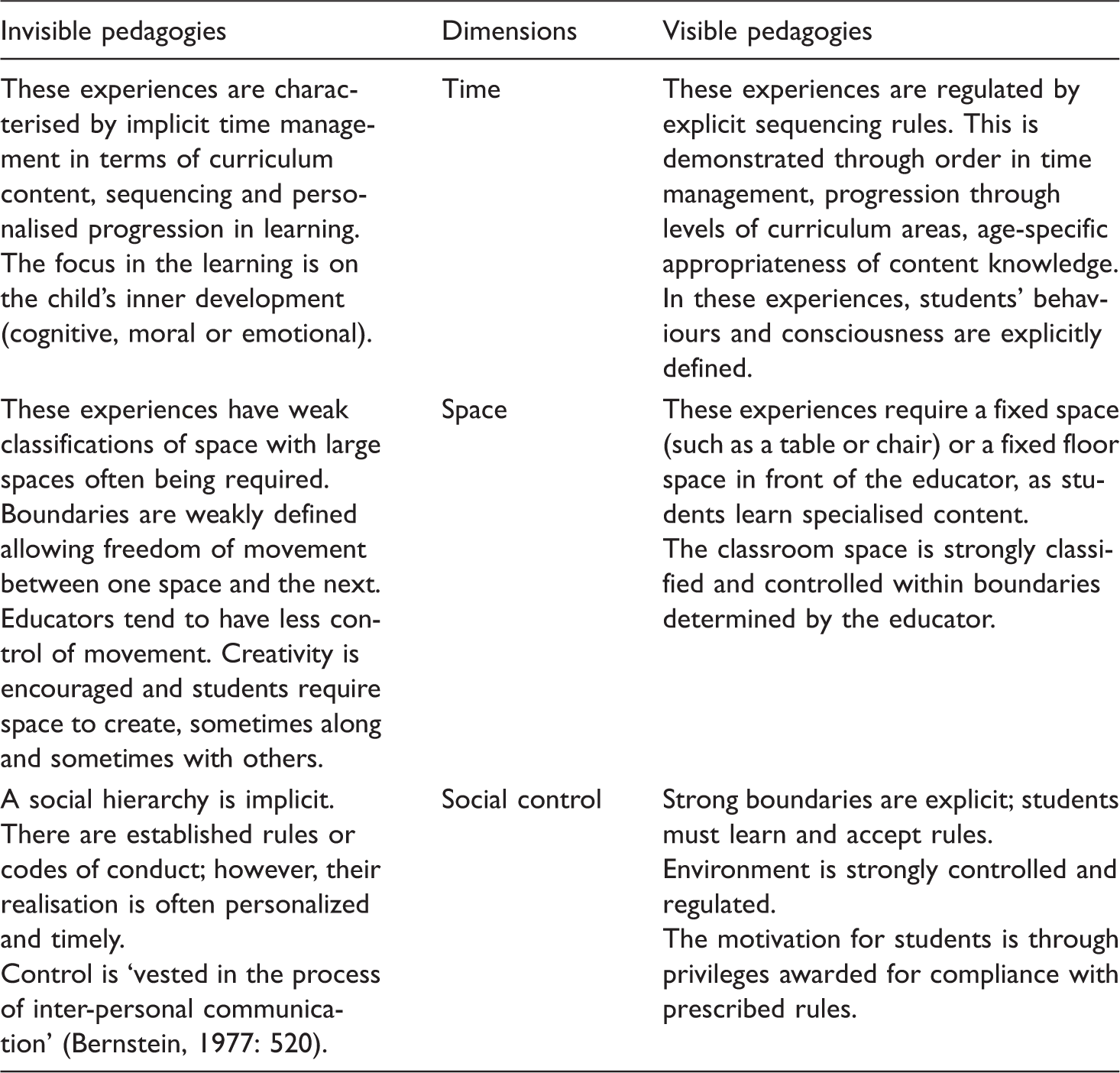
The notion of ‘visible’ and ‘invisible’ pedagogies acknowledges the movements that exist between contrasting forms of pedagogies and pedagogic discourses in a learning environment (Bernstein, 1975). Put simply, ‘visible pedagogies’ are typically conservative, strongly defined pedagogical practices (akin to performance models), whereas ‘invisible pedagogies’ are progressive, weakly defined practices, such as learning through play (akin to competence models).
Visible pedagogies are associated with strong classification and produce strong boundaries within the curriculum. Visible pedagogical practice is strongly framed with a focus on specialised knowledge and disciplines, enabling little choice or movement within curriculum and pedagogical practices. These practices are promoted with in rigid policies and practices.
Invisible pedagogies are associated with weak classification, weak boundaries and weak framing. With invisible pedagogies wider curriculum choice is promoted, resulting in a more flexible and open-ended selection of curriculum content. Classroom practices are flexible as boundaries are widened enabling students have more control in their learning context. Educators are more able to respond to the opportunities that children present to them. Rules within invisible pedagogies are implicit, whereas with visible pedagogies they are explicit.
The current driving concept of early childhood pedagogical practice in Australia and other Western contexts encourages learning through play which aligns most closely with invisible pedagogies. Bernstein (1977) prioritises aspects of play, which he sees as beneficial to pedagogical practices, arguing it is through play, children exteriorise themselves to educators, thus demonstrate their response to an activity that can later be examined. Bernstein claims that through the interpretation of children’s responses, the evaluation and diagnosis of activity is possible. In keeping with the essence of invisible pedagogies, the intention of the activity remains unknown to the child. The weak framing of play contexts provides an open-ended learning environment where the means and ends of learning are flexible and multiple and surveillance is seemingly invisible. Each child contextualises stimuli on an individual level and so learning is facilitated by educators in response to their observations of children. Bernstein (1975) explains that, socially, each act of invisible learning experiences is personalised through weakly framed encounters.
Visible and invisible pedagogies.
Methodology
The larger study employed a qualitative research design using a multicase study approach (Stake, 1995), allowing for a small-scale but in-depth investigation of each of three settings. The particular setting investigated in this paper is a community-based long-day care centre located in a metropolitan setting. Key underpinnings of the centre's philosophy, pertinent to the inquiry, are captured in Figure 1.
Excerpt from the centre’s mission statement.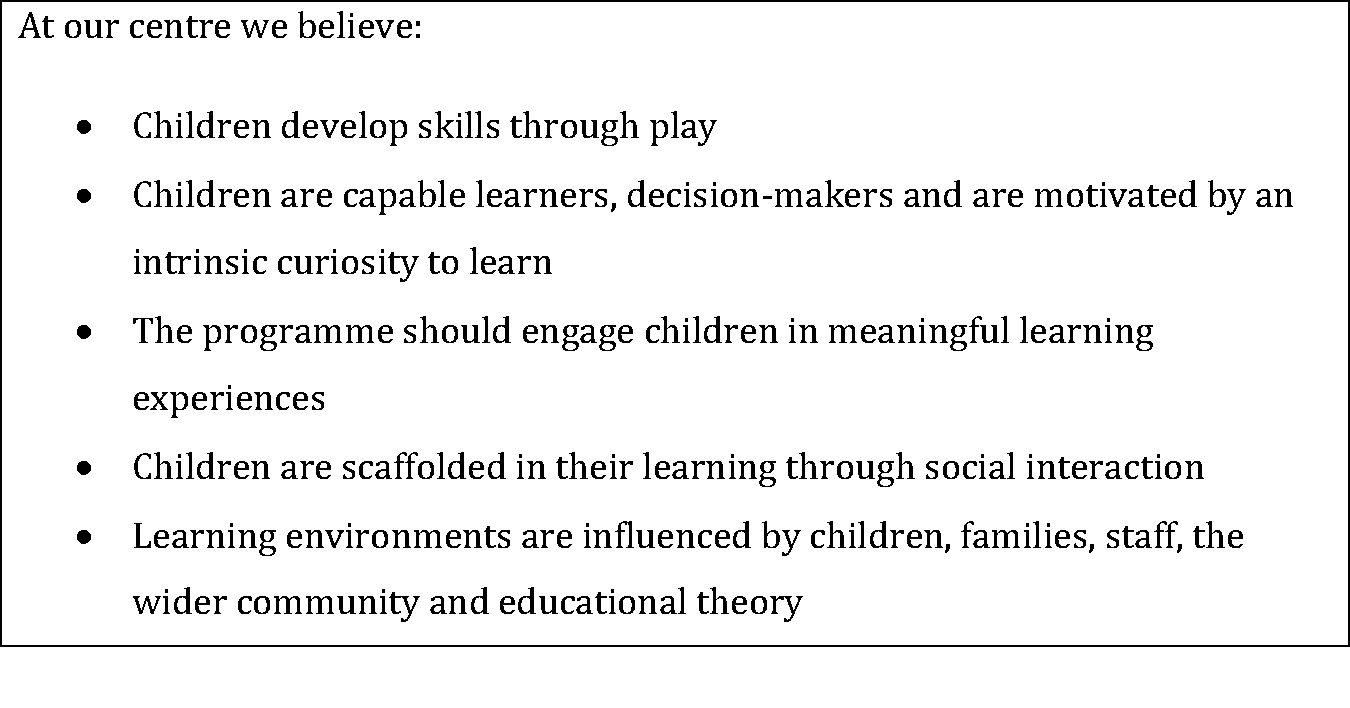
Eighty-two children, all of whom identify English as their first language, were enrolled at the centre during the period of the study. Only ten of these children attended the centre on five days each week, the average rate of attendance for the children was between two and three days each week. Large residential developments in the area, coupled with the reputation of the centre, have resulted in significant numbers of applications for enrolment there (and a substantial waiting list). There are two classrooms in the centre (one for children aged six weeks up to three years, and one for children aged from three years to five years). Seventeen educators are rostered across the five operating days of the centre (four university trained, eight TAFE trained and five untrained). The pre-school room (for the 3–5-year-old children) was the focus of this enquiry and had a maximum of 25 children and 4–5 educators in the space each day.
Documents were collected observations made and interviews conducted to facilitate analysis to develop the case study. The process from data collection to vignette development is presented in Figure 2.
Process from data collection to vignette development.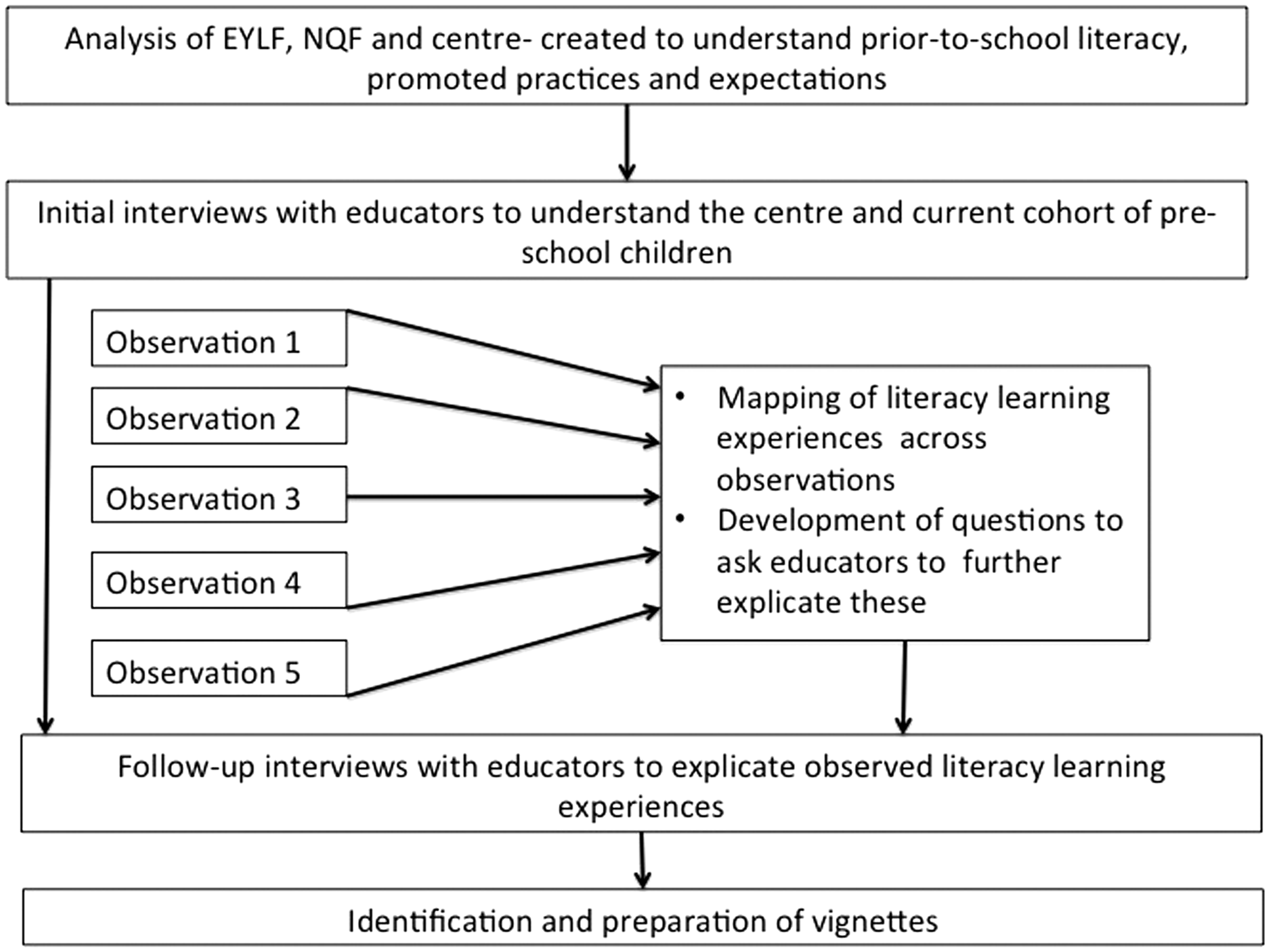
Document analysis
The EYLF and NQF documents and related materials were analysed to understand the expectations of prior-to-school literacy and promoted practices. In addition, programmes developed for implementation in the pre-school classroom were collected and analysed.
Classroom observation
Non-participant observations were made in the pre-school classroom. The observations were open-ended, as ongoing, natural behaviours of the educators and children were recorded.
We engaged in five periods of observation over a five-week period. During this time one observation was made on each weekday (i.e. Monday to Friday) in the pre-school room. Each observation session lasted for 90 minutes occurring between 9 and 10:30 am. Each observation period involved up to 25 children ranging from three to five years with four to five educators in the classroom space. During most periods of observation, the children moved around the classroom space as they wanted, mostly interacting with activities of their own choosing. On two occasions, the children were noticeably divided into two groups – younger children and older children. These groupings occurred during times of planned experiences. The groups were named and the children demonstrated they knew which of the two groups they belonged to as they quickly moved to designated areas and followed instructions when prompted.
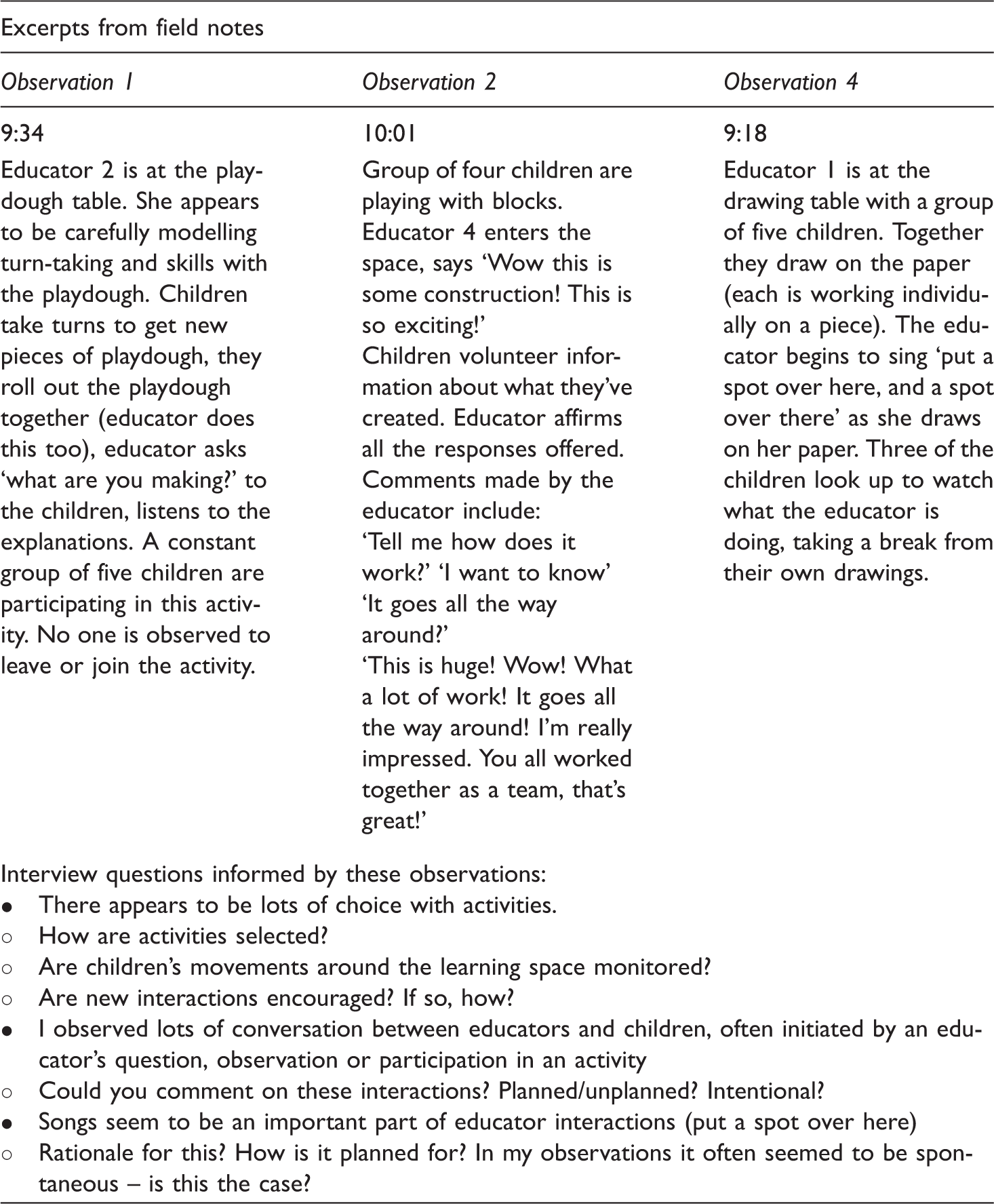
Excerpts from field notes inform interview questions.
Semi-structured interviews
Individual semi-structured interviews were conducted with six EC educators (specifically those staff working with the 4–5-year-old children) before and after the periods of observation. Initial interviews were used to identify and begin to examine the literacy teaching practices identified by each educator. The questions asked aimed to glean information about the centre and the current cohort of pre-school children and focused on the children’s literacy needs, drivers for literacy programming and planning (with prompts to extract information about the use of the EYLF framework in the centre) and an overview of the literacy opportunities available within the setting. Following the observation period the educators were interviewed a second time to seek clarification and elaboration of pertinent points that emerged. From observations in this pre-school classroom, the educators were asked to comment in particular on the roles educators assumed at different times, routines within the classroom, the range and type of print both inside and outside the classroom, the use of technology (including a computer and a digital camera) and the rationale for regularly occurring experiences such as painting, songs, role-plays, games and puzzles. An excerpt from the second interview question schedule is included in Figure 3.
Excerpt from second interview question schedule.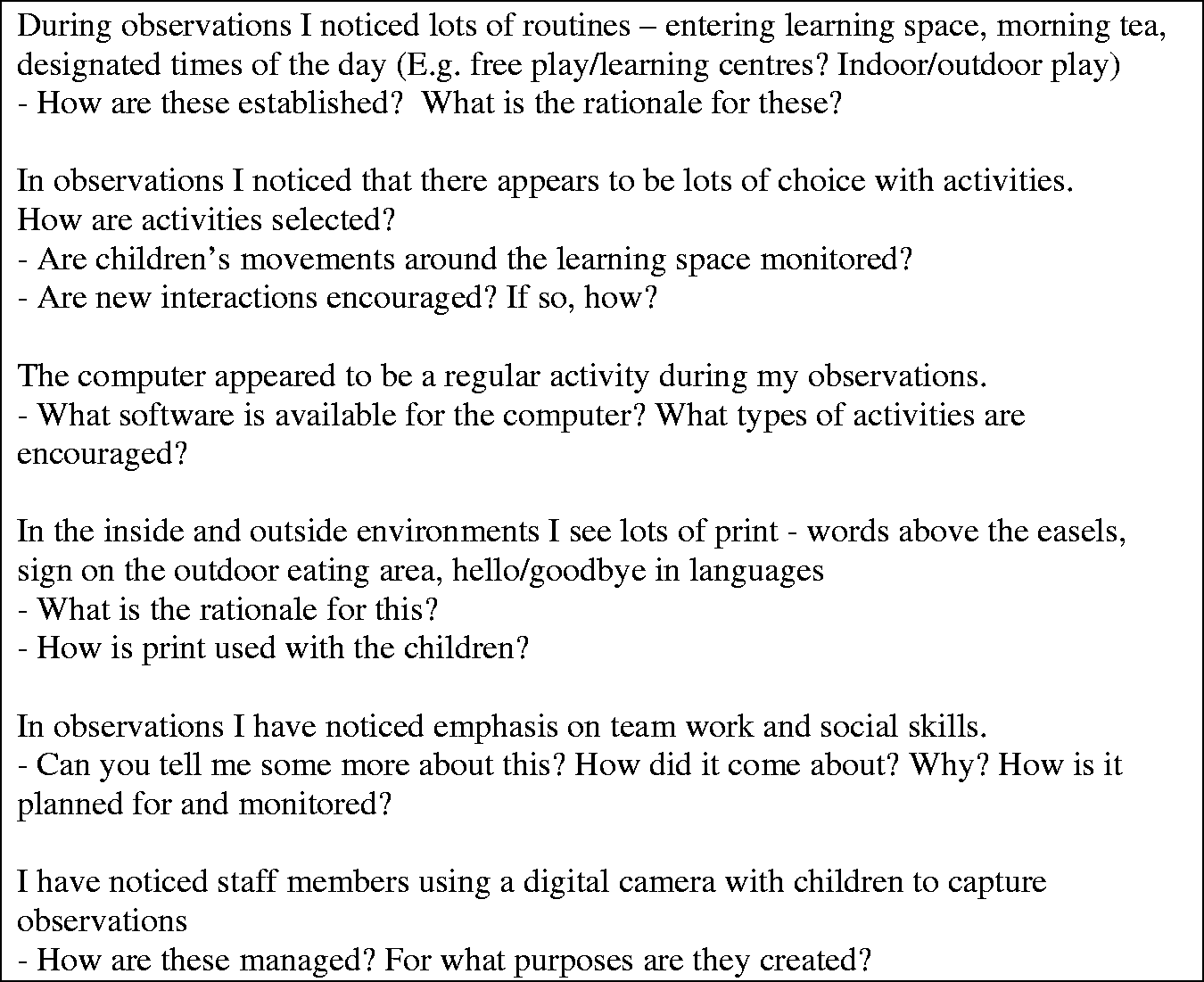
The process of moving from collected data to vignettes
Using Bernstein’s theory of visible and invisible pedagogies as our analytic code, each of the observed pedagogical practices observed was clearly described and categorised accordingly. While we found that there was not always a clear delineation, there was a continuum of these practices. That is, some were clearly invisible practices, yet some were clearly visible as described by Bernstein. However, others seemed to fall somewhere in-between, thus suggesting a continuum.
From our initial mapping, we were able to identify examples of literacy activities that were prominent along the continuum. These were examples that were replicated across observation periods and had been captured through field notes, classroom recordings and in educator interviews. These data were transformed into vignettes as the experiences of the children and the educators in these literacy learning experiences were narrated to enable theoretical analysis.
Findings
To illustrate the incorporation of invisible and visible experiences for literacy learning, we now present four examples of observed classroom practices in order to demonstrate the movement along this continuum from invisible to visible pedagogical practices. Figure 4 presents an overview of a series of classroom-based vignettes, each depicting a literacy learning context and the responses offered by the children and educators. Each vignette emerged from many observations collected in a setting and each was written to provide an opportunity for teachers to reflect on their literacy learning in early years learning environments. Interviews with the educators were used to develop the vignettes in order to describe more explicitly the observed literacy learning experiences. Each vignette aims to showcase a particular event that describes regularly occurring teaching contexts. This process thus allows us to examine these events through the lens of the chosen theoretical framework. For each vignette, we examine three dimensions as outlined in Table 1 to discuss:
The time structures for the experience; The use of classroom space; The social control demonstrated by educators and children. Literacy learning experiences along the invisible to visible continuum.
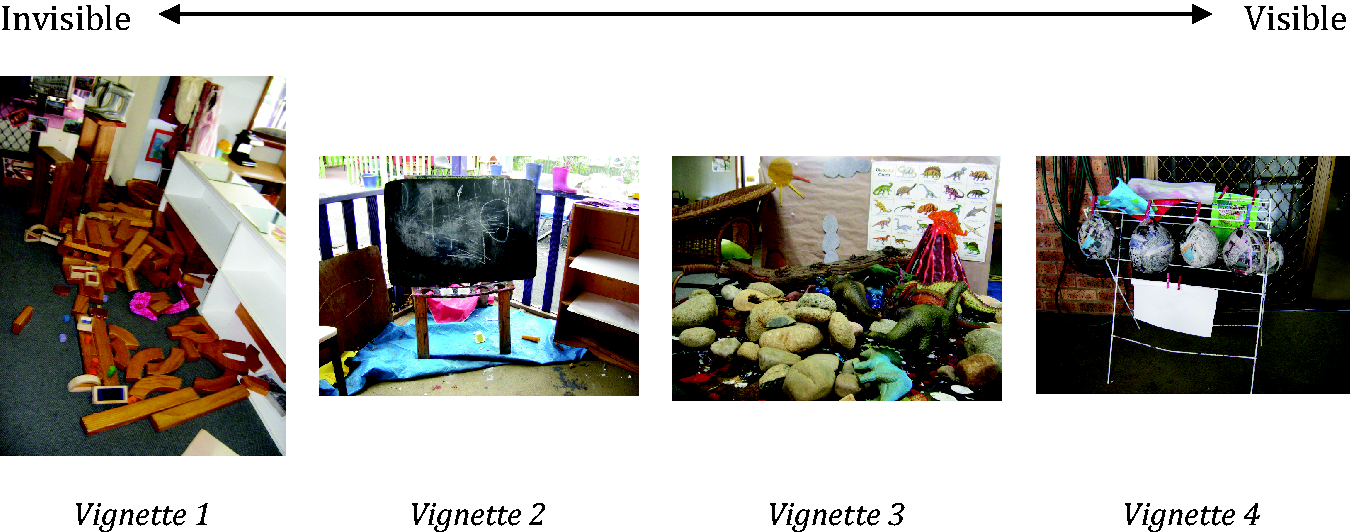
Vignette 1
In the centre of the classroom space an assortment of wooden blocks are stored in shelves. A number of children are observed to regularly use these blocks to create a range of constructions. The children operate either individually or in a small group (of two to three) as they build both complex and expansive structures. They frequently use paper and markers located nearby as they create signs to label and ‘protect’ their constructions. The educators are observed watching, interacting with the children about the constructions. As they do so, they incorporate the language associated with building and technical language associated with their creations (e.g. using the language associated with an aircraft to talk about specific features in the construction of a plane) into their conversation. At no time during the observations did the educators explicitly deconstruct or expect specific literate practices.
Time
The children have complete control over when, how often and how long they engage with this activity. Interestingly, the children used resources located nearby to extend their engagement with the blocks. Throughout the observation periods, it became obvious that there were five children who were consistently observed in this area of the classroom as they alternated between working in small groups and individually. These five children spent an average of 32 minutes, of sustained time in this classroom space. Other children were observed to come and go.
Space
The blocks are located in the centre of the classroom. They have both physical and visual prominence in the classroom, indicating that they are an important and valued activity. As the children engage with the activity the space occupied becomes larger as the constructions spread. Creativity is encouraged and while the educators engage the children in conversation about their creations, they do not direct the experience in any way. Interestingly, once individual children decided it was time to move onto another activity they opted not to pull apart what they had created to pack the blocks away. Instead, the children created signs to tell others what they had made and also to send a strong message that their construction was not to be pulled apart. These messages appeared to be understood by the other children and educators. There were frequent instances observed where other children or educators came to look at the creations after their creator had left. They did not touch it, merely looked and sometimes made a comment back to the creator.
Social control
The children demonstrate that they understand that they have access to this activity. Observations revealed that some children spent more time in this activity than others, and implicitly they became the power holders. Established rules or codes of conduct were observed: those that frequented the activity more frequently appeared to have more control over the resources and the preservation of their creations. The control within the activity was observed to be always with the children. The children used both oral and written forms of communication to protect their work and share their creations with others.
Vignette 2
Directly outside the classroom is an undercover area; this space is clearly visible from the classroom. Positioned in a prominent corner of this space is a blackboard on an easel structure. The chalkboard is at an accessible height for the children and below it is a basket of coloured chalk and a duster. Over the periods of observation a number of children are observed to engage with this tool. The children use the provided chalk to scribble, draw and write on the chalkboard. They use a range of colours and demonstrate a range of abilities. The educators are observed to watch the children create their markings. Over the periods of observation one of the educators is observed to demonstrate multiple times to different children how to write a particular letter or how to write a word. Each demonstration occurs at the request of the child controlling the experience.
Time
The clear visibility of this resource from both inside the preschool room and outside the area makes it continually accessible throughout the daily activities of the children. Individual children are able to direct their experience with this resource. They are able to experiment and seek help if desired. The educators are able to respond to these requests and provide personalised input to the child.
Space
This activity provides an example of the flexibility of movement between indoor and outdoor space and the nature of literate practices encompassing both. The physical location of the blackboard clearly indicates to the children that writing and drawing are appropriate outside activities. The children are encouraged to create markings of their choice on the blackboard using the materials provided. It is not a scheduled activity and the children are able to move from this activity to another at their discretion.
Social control
The children demonstrate understanding of how the resource is to be used. They choose if and when to engage with it, and how long they spend using the blackboard. Each child who engaged with this activity controlled the experience. While there were documented instances of educator engagement, these were always at the invitation of the child. Conversation that emerged during this activity was focused on the act of writing and the meanings that were intended from the chalk marks.
Vignette 3
Many of the children have demonstrated an interest in dinosaurs. This has been recognised by the educators and an assortment of dinosaur figurines have been collected and arranged on a table in a corner of the classroom. Children who are interested in dinosaurs are encouraged to explore this area. As they do this, they are observed talking about the dinosaurs, role-playing scenarios with the figurines and categorising the figurines in connection with books and a poster also located in this space (with each other and educators). Educators are observed modelling technical language associated with dinosaurs, providing plot ideas for role-plays that support knowledge of dinosaur behaviours, and generally supporting the children in making connections between the figurines and other available resources.
Time
The space and activities have emerged from an identified interest area of many of the children. The educators take time in their movements around the classroom to model language and provide other literacy focused activities to explore the topic further. The carefully selected resources identify and define students’ behaviours as they interact with this activity.
Space
A fixed space (the table with the dinosaur collection) is noticeable in the classroom environment. The content on this table is specialised and is conveyed through a range of mediums (figurines, posters, books). While the children are invited to visit this space, once there the educators guide activities.
Social control
The deliberate creation of this classroom space enables the educators to control and regulate student activity. However, the children still retain choice over whether or not they choose to engage with the space. The motivation for the children to engage with the space is through their identified interest and the privileges that have been extended to them, with the educators acknowledging the importance and value of this by responding through a designated classroom space.
Vignette 4
The educators have planned a small unit of study on planets in response to some astrological activity that has recently attracted media attention. Stories about space have been read to the children and books left in the library for children to ‘read’. Educators discussed the planets by naming them and exploring specific characteristics. To demonstrate their knowledge of planets, the children are asked to create their own planet using papier mâché techniques. They are guided through carefully scaffolded experiences to create an object they can paint to illustrate specific features. Educators explicitly model the procedure for creating papier mâché constructions. Embedded within talk about the planets is a high level of technical language, as information obtained about planets from multiple sources (media, books, children’s own knowledge) is discussed.
Time
These educators are explicit in their expectations for the task and the time it will take. Observations reveal that creative constructions of children’s individual ‘planets’ are broken up into distinct lessons:
Knowledge building about planets (through reading stories, discussing charts, looking at pictures); Demonstration of the product to be created (using a previously constructed planet, the educator orientates the children to what they will be creating); Modelling of papier mâché technique; Children independently engage with the papier mâché process, with monitoring and assistance from an educator; Discussion of ways their ‘planet’ may be illustrated (again referring to a previously constructed model to aid discussion); Children independently illustrate their papier mâché constructions to create a planet.
The children are grouped into two smaller groups and are rotated through these lessons to ensure the educator is best able to support the children at each point.
Space
These experiences occur around three tables grouped together. The children each have their own chair and the educator is seated at the head of the table group. Children moved through the activities in this space, carefully directed and guided by the educator.
Social control
Using an example of a final product throughout the experiences provide a clear model of the expected outcome of the experience. Children understand that this is what they are working towards throughout each of the experiences. The children are motivated to create their own interpretation of a planet as they draw upon the input they are provided with in the learning space.
Discussion
The aim of this paper was to explore the nature of literacy programmes, practices and perspectives, and in particular how such programmes support educators and children in one prior-to-school setting, as they prepare to transition to the first year of formal schooling. We defined literacy as a social practice and used Bernstein’s (1975) theory of visible and invisible literacy learning pedagogies as a theoretical lens through which to analyse the collected data. The transition process we acknowledge to be a ‘major challenge children must face during their early childhood’ (Seven, 2010: 347) and ‘successful transition to school is a process that sets the tone for future school success and personal wellbeing’ (Harden-Thew, 2014). Therefore, exploring prior-to-school activity and how this may support the transition to school in early childhood settings is vital.
The findings revealed four key points. First, in exploring children’s use of literate practices, the vignettes highlighted the children’s capacity, confidence and disposition in using language in social learning contexts. For example, as shown in Vignette 1, the building block activity was controlled by the participating children, with educator input given by invitation from the child participants. This clearly invisible pedagogical practice provides gives depth to the literate experiences of the young children involved as they engage in extended social interaction including spoken and written activity. Across the four vignettes, the differing amounts and styles of educator input offered enabled the children to take more control and direct their learning as active participants.
Secondly, the range of literacy opportunities and forms of communication observed in this prior-to-school setting were highlighted across the four vignettes. During observational periods, the children participated in activities as diverse as music, movement, dance, storytelling, visual arts, media and drama, as well as talking, listening, viewing, reading and writing. This varied list emphasises the multimodal nature of literacy resources and experiences available to the children in this setting. Children freely engaged in these diverse opportunities occurring along the continuum of pedagogical practices, further indicating the children’s social control and agency.
Thirdly, the educators assumed a range of roles throughout the experiences along Bernstein’s continuum. In the more visible experiences, educators were clearly more explicit in explaining their expectations for the task and setting specific time limits. They first modelled the task, then monitored and assisted the children where needed. In contrast, in the more invisible experiences educators provided the resources, space and time but allowed the children to assume greater control of the activity. Children could invite educators into this space to participate; however, ownership of the activity highlighted the agency of the child. Overwhelmingly though, the opportunities and facilitation of these activities were in response to feedback from and observed needs and interests of the children.
Finally, there was a richness and depth of experience displayed along the continuum of the vignettes, regardless of where the activity fell on it. The complexity of the literacy learning activity was displayed in the intricate intertwining of the elements of time, space and social control. The children’s agency in these experiences was encouraged as the educators moderated their input in each activity. The motivation for the children participating moved from intrinsic to more extrinsic as the pedagogies utilised became more visible; however, in each space the child’s developing literate practices were exteriorised to the educators through their contextual interactions.
As discussed, Bernstein’s theory of invisible and visible pedagogy has framed the analysis of the findings and this discussion to establish the social dispositions of the learning environment. We found that Bernstein’s categories of visible and invisible pedagogical practices enabled clear descriptions of pedagogic practice which facilitates insights into students’ literacy learning. Further, Bernstein’s theory also provides insights into the interpersonal relationships established in the classroom context between children, and between children and their early years’ educators. The breadth of the literacy learning experiences observed was seen to extend the depth of the differing social contexts of learning.
The pedagogy underlying the Early Years Learning Framework (DEEWR, 2009) which views literacy as a social practice engages educators in practices that stem from the interests and needs of the child in play-based activity. The outcome of this pedagogic stance is that few ‘school-styled’ practices are undertaken, though the children were observed, in this study, to exhibit agency and social control in the many activities with which they engaged, at whichever place these were situated on the pedagogical practices continuum. The pedagogical practices continuum explored in this paper gives a means to consider the types of experiences children have in prior-to-school settings and how these differ from the experiences they are likely to encounter as they enter school for the first time (notably undergoing the initial Best Start Kindergarten Assessment in the first week of school).
The importance of creating a smooth transition for children has been a topic of research interest over the last two decades (Cairney and Munsie, 1992; Dockett and Perry, 2001; Margetts, 2007; Seven, 2010); however, the observable disjunction between activities in different settings suggests that a smooth transition may not be possible without further efforts to embrace wider pedagogic practice in the first year of school, particularly in relation to literacy practices.
Conclusion
The introduction of assessments like Best Start as a mapping tool for student progress in literacy and numeracy highlights the swift transition to visible pedagogic practices in the first year of formal schooling.
As a result one can surmise that there has been added pressure for NSW Kindergarten school children to be moved from a more social understanding of literacy to a more skill-focused view of literacy acquisition. Hence there is likely to be less fewer invisible pedagogical practices (if any), which in turn impacts on the agency of the child with respect to control and responsibility.
In addition, such pressure could lead to an increase in the number of visible practices being undertaken in prior-to-school settings that would see a growing misalignment between the government’s stipulated framework – the EYLF; or to greater dissonance between the two educational settings leading to a less smooth transition between the two for the children.
This presents implications for the ways that educators plan, organise and respond to guiding documents within the prior-to-school setting. For us, the concern over the likelihood of a greater ‘push down’ could change the learning culture of prior-to-school settings.
For ‘all children (to) have the best start in life to create a better future for themselves and for the nation’ (COAG, 2009: 15; DEEWR, 2009: 5) it behoves educators in both prior-to-school and Kindergarten settings to work towards making the transition process as smooth as possible so as not to disadvantage any child regardless of his or her background. Viewing the literacy pedagogical practices in each setting along the continuum of invisible to visible pedagogical practices, as well as understanding what such practices mean with respect to the child’s learning and agency over that learning, provides a useful framework to consider. A timely action would be to use such a framework to monitor a group of children as they move from a prior-to-school setting into the first year of school.