




Abstract
This qualitative study examined three bilingual children’s (aged 2, 3 and 4) meaning making and storytelling in relation to five wordless picture books over a period of 10 weeks. Guided by the Gradual Release of Responsibility Model the children were asked to read each book through four stages in both English and Chinese: I Read You Listen, I Read You help, You Read I help and You Read I Listen. The results suggested that the children applied a variety of techniques in their meaning-making process and that there were commonalities among the strategies they used as well as differences due to age, personal experiences and language ability. The children interacted with these books by making different connections and prompts from adults were also useful in facilitating their storytelling. Finally, the children’s preferences for language use and their unique characteristics in storytelling were also discussed.
Interested in understanding young bilingual children’s meaning making and storytelling of wordless picture books, we worked with three Chinese-English bilingual children (ages 2–4) over a period of 10 weeks and read five wordless picture books together. Each of us (and the mothers of the children) worked with one child and devoted two weeks to each book. The Gradual Release of Responsibility Model (Pearson and Gallagher, 1993) was adapted for each book, given that the children had never been exposed to reading wordless picture books before. This model requires that the adults transition from assuming ‘all the responsibility for performing a task . . . to a situation in which the students assume all of the responsibility’ (Duke and Pearson, 2002: 211). In this model, each book was read by going through these four stages: I Read You Listen, I Read You help, You Read I help and You Read I Listen. We use the word ‘read’ broadly in this study and refer to reading pictures and constructing a story based on them. The books were read in both languages at each stage. Focusing our attention on bilingual children’s interactions with wordless picture books, and with us, we examined the question – How do these bilingual children aged 2, 3 and 4 develop their meaning making and storytelling process for wordless picture books in both languages?
Conceptual framework
Our study is situated within the framework of the sociocultural theory of literacy, the zone of proximal development (ZPD) and scaffolding (Vygotsky, 1978). The sociocultural perspective of literacy is based on the assumption that knowledge is socially constructed and learning takes place interaction with others. The more skilled adult builds on the competencies the child already has and presents activities supporting a level of competence slightly beyond where he/she is now (Miller, 2002). Vygotsky (1978) thus created the term ZPD within the framework of the sociocultural theory of learning and defined it as the distance between a child’s ‘actual development level as determined by independent problem solving’ and the higher level of ‘potential development as determined through problem solving under adult guidance or in collaboration with more capable peers’ (1978: 86). In addition, Vygotsky (1978) also included the notion of scaffolding, a support mechanism that the parent, teacher or more capable peer provides to help the child achieve independent learning. In this study, each researcher (i.e. a more competent other) provided the child with the maximum amount of support when first encountering the book (stage 1) and gradually withdrew her support during the next two readings (stages 2 and 3) of the same book. Eventually, the child read the book independently (stage 4). In this entire process, dialogues (e.g. the child’s comments about the book, questions asked by the researcher to check on understanding and answers provided by the child) occurred, which enhanced the child’s understanding of the book.
Rosenblatt’s (1978, 2001) transactional reading theory also informs this study. This theory suggests that ‘reading is a transaction, a two-way process involving a reader and a text’ and that the reader brings ‘past experience of language and of the world’ (Rosenblatt, 2001: 268) to construct meaning. We believe that when reading a wordless picture book, even though there is no appearance of a ‘text’, the illustrations serve to guide the reader as they create their own personal version of the literary work. We chose the genre of wordless picture books because they offer a broader platform than a single-picture prompt for meaning construction. The pictures in wordless books ‘have an almost infinite capacity for verbal extension’ (Dowhower, 1997: 57) and invite the reader to engage in an open-ended interpretation (Crawford and Hade, 2000).
Literature review
Meaning making from reading picture books
Children’s meaning making develops long before schooling starts (Doake, 1985; Dooley and Matthews, 2009; Goodman and Goodman, 1979, 2009) and their language and literacy growth can be enhanced and sustained through meaningful language experiences, such as reading and storytelling (Fillmore and Snow, 2000; Isbell et al., 2004). While there is vast research evidence focusing on what children read and why they read, there is significantly less on how they read and make meaning from texts (Nikolajeva, 2010). Nikolajeva (2010) explored the necessary meaning-making skills and suggested that the ability to understand what a narrative is, follow a plot and make connections among different plots, plus the ability to decode characters and interpret symbols and context, are imperative to the young reader’s understanding of texts.
Other research also presents some characteristics of meaning making from children reading picture books. For example, young children’s book storytelling develops from oral-language-like form to oral language and then to written-language-like inflections and storybook wording, as they grow older (Sulzby, 1985). In addition, Doake (1985) asserted that children were engaged in a story by not only imitating and remembering but also creating and composing their own version at a younger age. As they gained more experience and accuracy with prints, their fluent reading-like behaviour changed to arhythmic reading-like behaviour, in which children began to attend to cues in print as well as those available from their language and meaning sources (Doake, 1985). Valencia and Sulzby (1991) developed an instrument – the Classification Scheme for Emergent Reading of Favorite Storybooks – to assess young children’s reading attempts. Their study revealed that before children developed print awareness of books, their reading attempts were picture governed.
These early studies have provided research evidence about children’s emergent meaning making from picture books. It can easily be concluded that without fully developed print knowledge, young children treat books with print in the same way as books without print and they are able to make meaning and compose stories based on visual images. As children live in an environment that is filled with visual images these days, this ability to read images is very important (Pantaleo, 2007). The development of meaning making from images can also be enhanced while reading picture books as it can ‘elicit children’s emerging awareness of narrative structure and imagery’ (Van Kraayenoord and Paris, 1996: 41) and may act as a scaffold for independent reading (Sulzby, 1982).
Meaning making from reading wordless picture books
Wordless picture books or ‘almost wordless’ books offer a broad platform for investigating children’s language development, storytelling, and other skills (Arizpe, 2013). For decades, researchers have explored how wordless picture books can be used to enhance children’s literacy development. They have used wordless picture books with children to elicit talk (Larrick, 1976), promote the concept of story structure (Reese, 1996), develop comprehension or the meaning-making process (Arif and Hashim, 2008; Arthur, 1982), support writing (D’Angelo, 1979) and teach visual literacy (Evans, 1992; Read and Smith, 1982; Stewig, 1988).
Doake (1985) suggested that the reading of wordless picture books by mother and child can help children to develop reading-like behaviours and increase their attention span, repertoire of favourite stories and eagerness to read books repeatedly, which facilitates finding pleasure in books. Stadler and Ward (2005) presented a continuum of children’s storytelling skills and suggested five levels (labelling, listing, connecting, sequencing and narrating) to understand children’s language development. Researchers such as Van Kraayenoord and Paris (1996) developed an assessment activity called Story Construction from a Picture Book to measure young children’s ability to make meaning through oral language when presented with modified non-print material. Six aspects of meaning making were measured, including initial examination of the book, remarks about the pictures, elaboration, metalinguistics, revision strategies and identification of themes or morals.
While wordless picture books can be an attractive tool, other research evidence suggests that the reading of wordless picture books is, in fact, a more complex process than reading a picture book (Arizpe, 2013). Nikolajeva and Scott (2000) also recognized the complex relationships between words and pictures in picture books and pointed out that even while reading picture books that are completely devoid of words, readers are still challenged to understand picture narratives. Graham (1998) stated that when reading a wordless picture book, readers are asked to create a story; hence, they have to make their own decisions about what is most important due to the absence of words. Wiesner (1992) indicated that when reading a wordless picture book, the reader must invent a story; however, this creation of a story is different from what most wordless picture book illustrations present, given the fact that the story has already been invented in the pictures. Nodelman (1998) noticed that many children enjoy talking about what they are looking at when presented with wordless picture books; however, this enjoyment of talking about the pictures is different from the task of constructing a story based on pictures. Therefore, looking at pictures and meaning making are complicated processes that involve the reader's selection, connection and projection (Heath, 2009).
Compared with the amount of research done using wordless pictures books to explore English-speaking children’s language development, meaning making and story construction, studies focusing on bilingual children remain scarce. Louie and Sierschynski (2015) suggested using wordless picture books as a great resource in classrooms to enhance English learners’ language development. Several other studies have also explored children’s bilingual and biliteracy development (Buckwalter and Lo, 2002; Hu and Commeyras, 2008; Jalongo et al., 2002; Martinez-Roldan and Newcomer, 2011); however, none have focused on how bilingual children make meaning and storytelling in two languages using wordless picture books. In this study, we borrowed Van Kraayenoord and Paris (1996)’s assessment activity, made modifications to fit our own study and applied it to three Chinese-English bilingual children, aged 2, 3 and 4. The purpose of the research is to explore these children’s meaning making and storytelling development in both languages.
Methodology
This is a qualitative multiple case study (Stake, 2005; Yin, 2003). According to Stake (2005), in multicase study research, each individual case is of interest. And researchers study what is similar and different among all cases in order to understand the whole picture. We adopted this design because we first studied our own child’s meaning-making process in detail and then compared and contrasted to find similarities and characteristics that were unique to each child.
It is worth mentioning, though, that as the mothers of the children, we have unavoidable bias. For instance, we could interpret our children’s meaning not only from what they said but also from their body language. We well understood our bias and worked hard to be objective by writing down everything our children said and reflecting in detail. In addition, in order to ensure the credibility of the research, we exchanged our notes and held bimonthly Skype meetings for member checking.
Participants and setting
We, the researchers (i.e. the mothers of the participating children), obtained our terminate degrees in literacy education in the United States. We started reading to our children from birth, so all the focal children were familiar with book reading. Our homes became the research setting where the children were most comfortable. The participating children, Sally, Evan and Davy (pseudonyms), were 2, 3 and 4, respectively, at the time of the study. Evan and Davy attended daycare and spoke both English and Chinese at home. The youngest child, Sally, stayed at home and mainly spoke Chinese at the beginning of the study, but she switched to both languages as she started attending daycare near the end of the study.
Book selection and order
When choosing the books, we considered several factors: colourful illustrations, age appropriateness, cultural familiarity, personal connection and rich storyline. We started with the book that has the weakest story plot (Elephant Buttons). The book is appropriate for our children’s ages because it has simple and repetitive illustration patterns that are easier for young children to follow and produce their own story. We then moved to books with stronger storylines – the Carl series. These books have realistic illustrations and the stories are closely related to children’s daily life: daycare, birthday, Christmas and going to a park. Figure 1 presents the sequence of these books used and a brief content summary for each book.
Book sequence and content summary.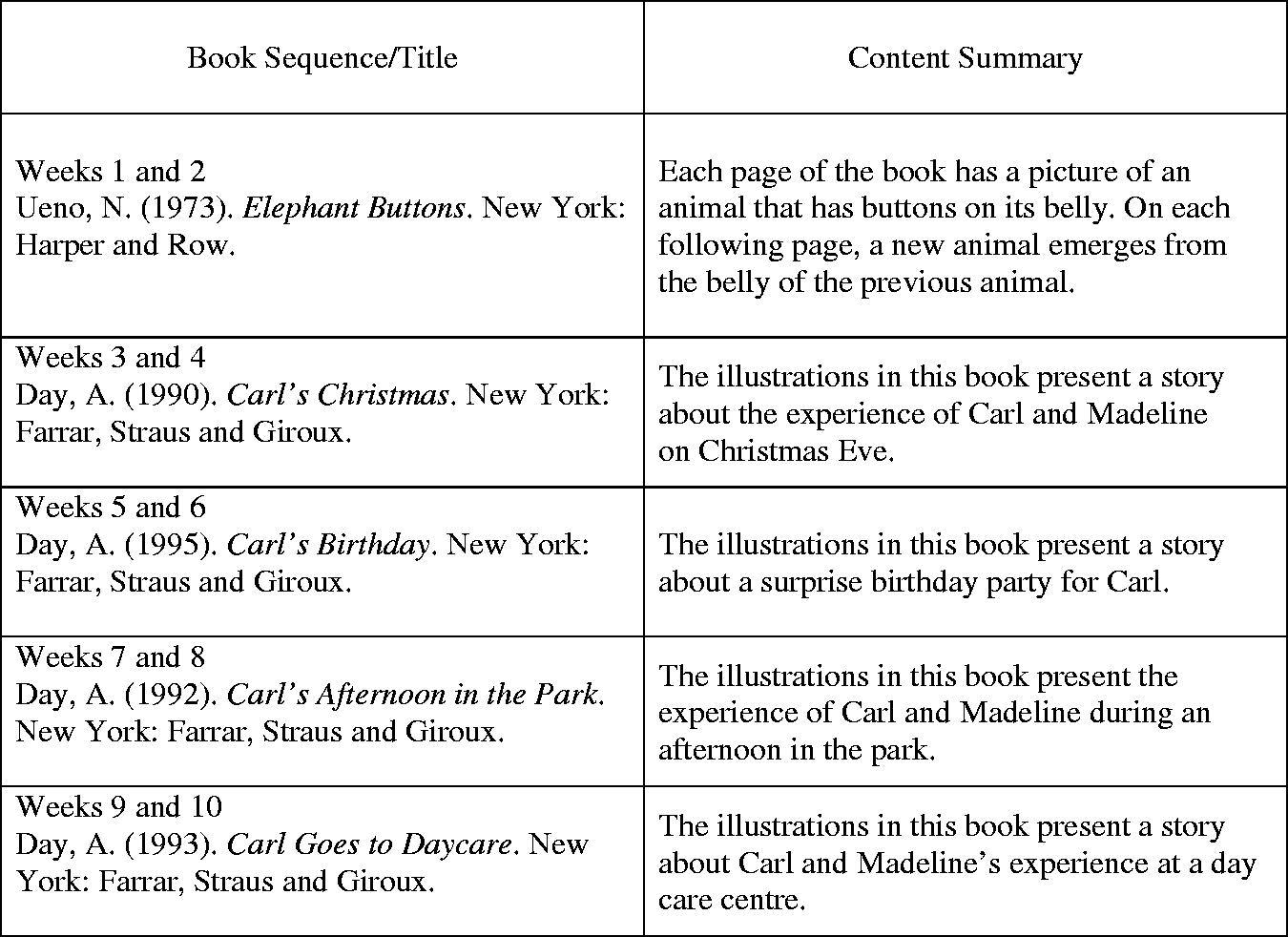
Data collection and analysis
Adapted from the Gradual Release of Responsibility Model (Duke and Pearson, 2002), we read each book with our children through four stages: I Read You Listen, I Read You Help, You Read I help and You Read I Listen. At each stage, the book was read in both languages. Data for this study come from two sources. First, each storytelling session was audio recorded and transcribed. There is a total of 60 recorded reading sessions, approximately 15–30 min each. Second, each of us kept a reflection journal about our own child’s reading. The journals contained a brief description of each reading session, the dialogue that occurred and the child’s reading behaviours and language use.
Data were analysed both deductively and inductively. We went through four phases of data analysis. During the first phase, each researcher started by analysing their own child’s recorded storytelling sessions. We used the Story Construction Checklist (see Appendix 1) adapted from Van Kraayenoord and Paris’ work (1996) for each book. We particularly looked for evidence regarding the children’s story construction techniques in these categories: initial examination of the book, comments about pictures, elaboration and personal involvement, metalinguistics, revision strategies and theme or moral of the story. Each category has a few specific look-fors. For example, under the category of metalinguistics, the look-fors include use of book language, use of storytelling voice/intonation, constructing dialogue for characters and identification of story structure. We also marked whether the child initiated mentioning the above categories on his/her own or with prompting from the researcher. In addition, we noted what language (Chinese or English) the child used to talk about each category as some children tended to use a mix of both languages from time to time. After we each finished the initial coding of all the recorded sessions, during the second phase, we looked for the themes that emerged from each child. What story construction techniques did the child tend to use often? What was lacking? Did the child mostly rely on his/her own or the parent’s prompts? During the third phase of analysis, we consulted our reflection journals to triangulate the data. During the final phase, we exchanged our notes and held bimonthly Skype meetings for member checking and to ensure consistency.
Results and discussion
We found our children made meaning from these wordless picture books using a variety of techniques. There were commonalities among the strategies they used as well as differences due to age, personal experiences and language ability. Prompts from adults were useful in facilitating children’s storytelling. In addition, the children interacted with these wordless picture books in many different ways, making self to text, text to text and text to world connections. We also found that the children’s interests played an important role in the meaning-making process. Their preferences for language use and each individual’s unique characteristics in storytelling were also noted.
Various techniques
During the 10-week study period, the children used a variety of meaning-making techniques while reading these five books, including commenting on title/author, commenting on pictures, naming objects/characters, describing action, identifying motives, displaying effect, identifying with characters/situations, generating relations, prediction, constructing dialogues, using storytelling intonation, using book language and offering opinions. Figure 2 provides examples of how these techniques were used by the children.
Meaning-making techniques and examples.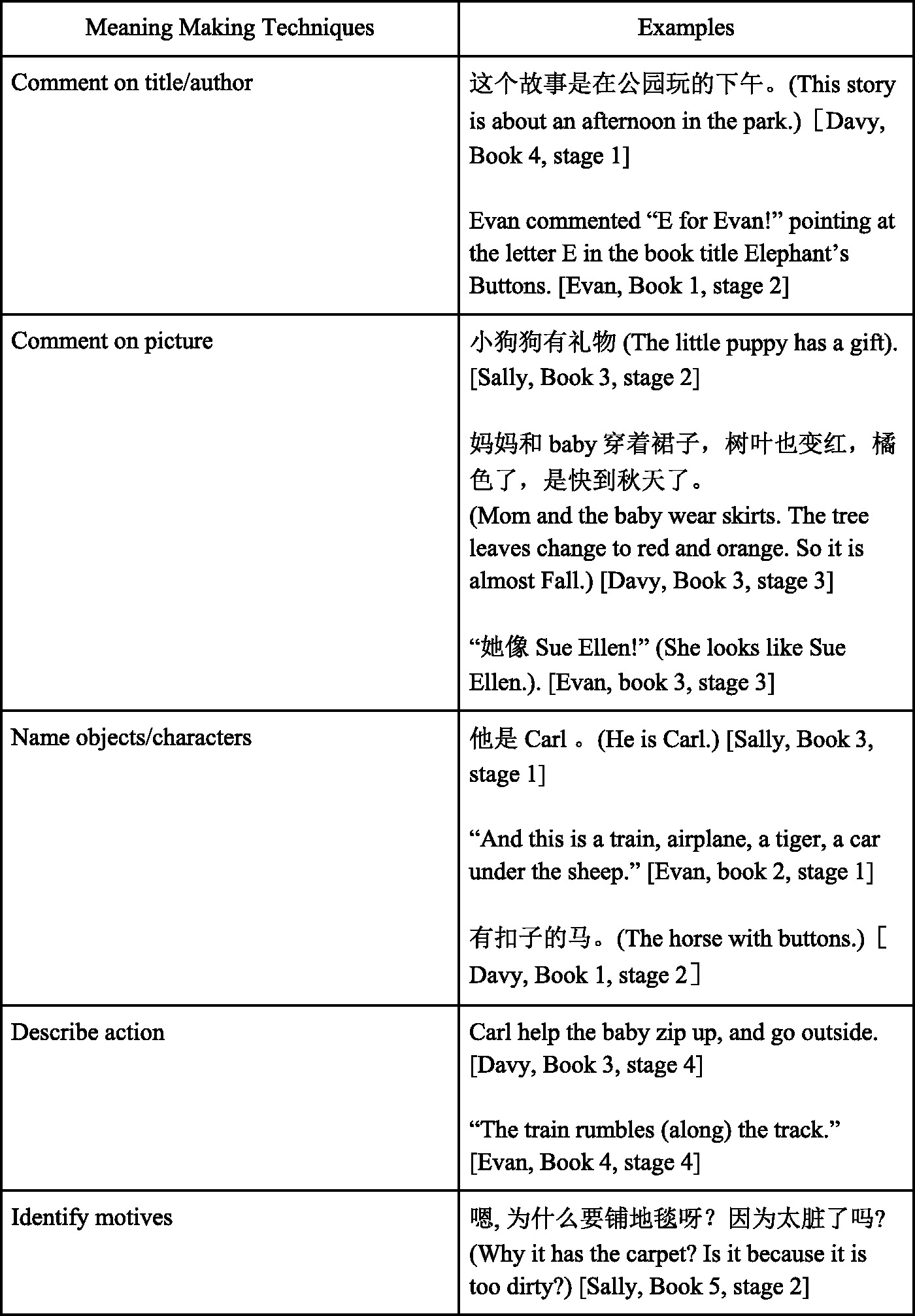
Analysis also suggests that children at different ages favour different techniques in their meaning-making process. For Sally, making comments on pictures was the most often used technique, followed by labelling and naming objects. At each stage and for each book, Sally made comments on the pictures and labelled objects and characters. Making connections was also prevalent in her storytelling. Sally constantly related the events in the book to her own life, such as having a birthday party and celebrating Christmas.
Naming objects/characters was the most frequently used technique by Evan, followed by describing actions, identifying with characters/situations, commenting on title/author, noting effect in the story, offering opinions and using prior experiences/knowledge. Among these most frequently used techniques, four were used for every book: naming objects/characters, describing actions, identifying with characters/situations and offering opinions. There were a few techniques that Evan did not use until later, such as identifying the topic, identifying motives, using storytelling voice/intonation, constructing dialogue for characters and making self-corrections. Some techniques, however, were never used, such as labelling emotions, generating relations, identifying story structure, providing a summary and providing a moral.
Identifying with characters/situations and describing action were the most often used techniques by Davy, and he used them most often in stages 2 and 3. Once Davy started storytelling by himself in the last stage, he used another technique – storytelling voice/intonation, which appeared for all five books. The next most commonly used techniques were generating relations, commenting on pictures and naming objects and characters. Generating relations was used often at stages 3 and 4 for all of Carl's books, while the other two were more prevalent in stages 1 and 2. It is also worth mentioning that as Davy became more familiar with the storytelling routine, the variety of his techniques expanded. Starting with book 3, he applied these techniques in his storytelling: constructing dialogue for characters, offering opinions, noting effect, commenting on the author, identifying with the topic/genre, providing a summary, looking back in the book, and providing a conclusion.
Prompts as scaffolding
In our study, prompts from adults scaffolded the children’s storytelling in two aspects: assisting the children with moving from page to page continuously and smoothly, and helping them to add details to their stories. We believe that the children will gradually depend less on prompts and could eventually produce more detailed stories independently.
In this study, the children depended on prompts more frequently at the beginning of the study and with the story that had a weaker storyline. Elephant Buttons is the book that has the weakest storyline. In this book, each page shows an animal wearing a jacket that is half-buttoned. A different animal is partially revealed through the opening. This new animal appears on the next page wearing a half-buttoned jacket with another animal inside his jacket. Given the fact that this book is different from a traditional story that has a setting, character(s), problem and solution, the children depended on their mothers’ prompts to continue with their storytelling. Sally knew the names of the animals in Chinese. However, when presented with the book and being asked to tell a story, she needed her mother’s prompts to describe what happened on each page. Evan also depended on his mother’s constant prompts when reading this book. She had to ask him ‘what’s next’ in order to keep his storytelling moving forward. Elephant Buttons depicts consecutive moments that have almost no temporal ellipses between them and contains almost no gaps that require the reader to fill them in using their imagination and/or social and cultural knowledge (Nikolajeva and Scott, 2000). In other words, this book, among many other books in children’s literature, resists interpretation (Nikolajeva, 2010). However, when it comes to meaning making and storytelling which demand interpretation, the children in our study understandably needed more scaffolding from the adults.
Prompts also supported these children’s storytelling by making it more detailed. After simply labelling Carl and the baby Madeline (in the book Carl goes to Daycare), Sally’s mother asked, ‘What are they doing?’ Sally immediately replied: ‘在弄 blanket. 他们都摔倒了,他们没小心 (Pulling the blanket. They both fell. They were not careful).' Davy also added more details to his story using his mother’s prompts. For instance, while reading a page in Carl goes to Daycare, he said: ‘老师还在 keep trying’ (The teacher still keeps trying) without his mom’s prompt. But when his mom asked, ‘Try to do what?’ he changed his sentence to ‘老师 (The teacher) keep trying to open the door, but she cannot come in.'
Making connections
We found that during the meaning-making process, these children interacted with the books by making different types of connections: text to self connection, text to text connection and text to world connection.
Text to self
All three children made connections to themselves when reading the Carl books. For example, Sally commented on Carl’s birthday presents and compared them with the presents she received on her birthday. Evan related Carl’s birthday to a friend’s birthday party he had just attended by saying ‘It’s Carl’s birthday time. It’s Georgia’s.' He also thought of his own birthday and added ‘Two minutes is my birthday time’ (He meant to say ‘soon’ but said ‘two minutes’ instead). He made many text-self connections while reading Carl’s Afternoon in the Park. For example, when reading the part where Carl rode a mini train to see all the animals, Evan responded, ‘I rode a cow train. The seat was hot!’ He referred to a recent visit to a farm where he wanted to ride a cow train but the seat was really hot so he had to wait for another one. Later in the book where various animals appear on the page, his mom pointed at the donkey and told him what it was. He immediately said, ‘Donkey bite me!’ Again, he was making a connection to his experience at the farm where a donkey almost bit his finger when he was trying to feed it. Davy was excited to see Carl ride on a train, and he talked about his experience riding the train at the zoo by saying, ‘我上次去坐的火车是红色的 (The train I rode on last time was red).'
Text to text
We found two different types of text-to-text connection that the children initiated: connections made within the Carl-themed stories and connections made to other books. When reading the Carl series, children commented on and compared Carl from book to book. Sally compared the way Carl slept in Book 3 (Carl’s Birthday) to Book 4 (Carl’s Afternoon in the Park) by pointing out Carl’s different sleeping positions. Davy also assumed that the little black dog in Book 4 was the birthday present that Carl received in Book 3. In addition, the children also made connections to other books they had read. For example, Evan commented that the little girl in Carl’s Birthday looked like Sue Ellen, a character in Arthur’s Halloween. Davy related Carl to Martha, the alphabetic dog, and praised both of them as ‘the smartest dogs that can help people’.
Text to world
Davy was the only child who made text to world connections after reading the Carl books. He became very interested in learning what dogs can do to help people. After reading the last book about Carl taking care of the baby in daycare, he asked questions, such as ‘Can dogs really babysit a child?’ ‘Can a dog become a teacher in the daycare classroom?’
Motivation and interest
Observing our children reading these books, we realized that their interest in the topic played an important role in the quality and quantity of their storytelling. The books on birthday and daycare held great interest for Sally, possibly due to her own experiences. Therefore, when reading these two books, she was eager to relate to her life, asked questions and pretended herself to be a character in the stories. Evan and Davy were able to produce longer and more complex stories when reading books they liked. They also applied the following techniques more frequently: predicting, using prior experiences/knowledge and book language. In addition, Davy paid more attention to the details in the pictures and had more opinions to offer when reading books that he was interested in. For instance, when reading Carl’s Christmas, he compared the decoration in the living room with that of his house; he attended to the details by labelling all the toys that Carl and the baby saw in the store; he related the scenario in which the baby and Carl donated the hat to the poor to how he gave his clothes to those who were in need. On the other hand, their stories remained simple and lacked coherence for the books that they did not enjoy. Evan even refused to read a book he did not like by saying to his mother, ‘You read it. I can’t.' ‘I don’t like the book.'
Language use
At the planning stage of this study, we agreed that both the researchers as well as the children should use both languages at each stage during storytelling – first in Chinese and then in English. In reality, however, it was difficult for the children to keep to one language at a time.
Sally used mainly Chinese for the first four books because of the home language environment. However, as she attended a daycare centre towards the end of the study, her storytelling showed a mixture of both languages. English occurred mostly in words and sentences she encountered in daycare, such as ‘T-Rex’, ‘open the door’, ‘time for snack’, as well as the names of the children she played with. Evan chose the language that was most convenient for him and jointly used both languages in one sentence. Some examples are as follows: ‘Carl 干得好 mess’ (Carl made such a mess); ‘有 pig, 羊,还有 horse. 还有马’ (There is a pig, a sheep and a horse. And there is also a horse); ‘把它脱下来,然后 too hot’ (Took it off and then it became too hot). Davy’s storytelling had a mixture of both languages as well, regardless of his mother’s constant reminders to use one language at a time. Some examples include: ‘Baby donate her hat to 需要的人 (the people who are in need)’, ‘Carl 邀请 (invited) some friends, then they 累了 (became tired)’. However, we noticed that English dominated most of Davy’s storytelling and Chinese was used most often to comment on the illustrations or offer his opinion.
Unique characteristics
We also found characteristics unique to each child during their meaning making and storytelling process. First, both Sally and Evan used the strategy of questioning, a strategy not included in the Story Construction Chart (Van Kraayenoord and Paris, 1996) that served as our data analysis tool. For Sally, she constantly asked questions in all four stages. This ranged from asking simple questions, such as ‘What is this? Where did it go?’, to higher order thinking questions, such as ‘What did they say? Why?’ In addition, she occasionally asked multiple questions on a single page without expecting an answer from her mother. We believe that questioning is a way to monitor her understanding and meaning making. Evan also used the strategy of questioning and this was evident when he was reading Carl’s Birthday, a book he did not enjoy very much and therefore had difficulty comprehending. He constantly asked questions such as ‘哪个是 Madeline (Which one is Madeline)?’ ‘Is this his daddy (He was asking whether a guy in the picture was Carl’s father)?’ In Evan’s case, questioning is a strategy he used to support comprehension.
Second, Evan is the only child who did not follow the four stages in order when reading the books. After going through the four stages one by one with the first book, Evan became very excited because the last stage differed from his previous experiences, in that he had an opportunity to read to his parent (versus being read to). When it came to the second book, Evan eagerly took the book and started reading even before his mother entered the room. The same thing happened again with the fourth book.
Third, by looking at Davy’s storytelling throughout the books, he seemed to have followed a sequence from simply describing what he saw in each picture (e.g. ‘This is an elephant’ ‘These are four buttons’ – Elephant Buttons), to using storytelling voice/intonation and constructing conversations between characters (e.g. ‘The baby said to Carl, “let’s go back”. And Carl said, “yes. Let’s go!” ‘– Carl’s Birthday), and finally to offering opinions about the illustrations, the characters and the stories [‘他们的教室可真乱啊! (Their classroom is really messy)’ – Carl goes to Daycare].
Finally, even though we provided scaffolding by starting with reading to them, Davy and Evan did not simply memorize our stories from the first two stages and use those stories as their own during their readings. Instead, they relied on multiple strategies to generate their own versions of the story. When reading Carl’s Christmas, Davy studied the illustration of how Carl took the baby to the store to be the 1,000th customer in great detail. Compared with his mother’s storytelling on that page, Davy’s story was much more detailed. He labelled all the toys Carl and the baby saw in the store and mentioned what toys the baby would like to be included in the gift basket they won. Very interestingly, on the same page, Evan also added more details to his mother’s story. His mother used ‘all kinds of toys’ to describe what Carl and the baby saw in the window of the shop. However, in Evan’s version, he named all the objects in the window – ‘There is a sheep, a bunny. And there is a train, aeroplane, a tiger, a car under the sheep.'
Conclusion and implications
When reading aloud wordless picture books, two processes occur almost simultaneously in the reader's mind: understanding the pictures and creating a story based on the pictures. Therefore, the reader has to rely on both meaning-making strategies in order to comprehend the pictures and storytelling techniques to construct a well-crafted story. These two processes were evident in the children in our study. On one hand, they actively made connections between the text and themselves by making connections to their personal life, other texts and knowledge of the world in order to make sense of the pictures (Rosenblatt, 1978, 2001). This finding confirms earlier research studies, in that readers of wordless picture books use many of the same strategies used when reading print-based books (Crawford and Hade, 2000; Liu et al., 2012). On the other hand, when trying to recreate a story based on pictures, the children in our study demonstrated a wide array of story construction strategies: naming objects/characters, describing actions, identifying with characters and predicting, to name a few. With two processes taking place concurrently, reading a wordless picture book can be more complex than reading a picture book due to the absence of words (Arizpe, 2013; Graham, 1998).
The results of our study on bilingual children suggest some similarities with studies on English-speaking children. Sulzby’s (1985) research findings revealed that young children’s storybook reading attempts at different ages developed from labelling and commenting and oral language-like storytelling to written language-like attempts. Similar to Sulzby (1985)’s findings, we noticed parallel patterns when our children at different ages responded to storybook reading and their meaning-making process. Two-year-old Sally did more talking about the pictures rather than creating a story; three-year-old Evan had more complex oral language in his storytelling; four-year-old Davy used a storytelling voice and had book-language-like attempts in his storytelling.
What is more, our study findings add to the current literature on children’s meaning making and storytelling in two ways. First we found that our children used similar techniques for different purposes. Sally and Evan used questioning as a meaning-making strategy. However, they used this strategy for different purposes. Sally used questioning to monitor her understanding and meaning making, whereas Evan used questioning to support comprehension. Also our children’s storytelling suggested more complex characteristics. Davy’s written language-like inflections and storybook wording were most often in English; however, his opinions and comments about the books were always in Chinese. We think this finding is interesting but not surprising. Davy had read many more books written in English than in Chinese from school and at home; hence, he had accumulated more storybook language in English. However, because the dominant language spoken in Davy’s home was Chinese, he was more used to speaking in Chinese, such as asking a question, commenting on a book and offering an opinion on a book.
Our study shows not only how complex the process is for bilingual children to understand and construct meaning from wordless picture books, but it also reveals multiple benefits of using wordless picture books with young children. First, wordless picture books ‘have an almost infinite capacity for verbal extension’ (Dowhower, 1997: 57). In this study, even though the children read exactly the same books, they had different understandings of the characters and paid attention to different details based on the same illustrations. In Carl’s Birthday, Sally’s story included many details about the cake and Davy expressed his emotion about the gifts Carl received. In Carl’s Christmas, Evan associated this book with his schema for Halloween and trick or treating instead of Christmas.
Second, wordless picture books are able to ‘elicit children’s emerging awareness of narrative structure and imagery’ (Van Kraayenoord and Paris, 1996: 41). The pictures serve as a type of scaffolding that facilitates the concept of story structure. In other words, the pictures prompt the reader to have characters, a setting and actions when creating their own stories. Therefore, it helps prepare preschoolers for kindergarten. Making meaning from wordless books prepared them to present and integrate their knowledge and ideas and motivated reading behaviours. In their reading experience, the children increased their vocabulary by reading with their mothers and asked and answered questions about characters, settings and events based on their understanding of the pictures. This experience prepares them to achieve the goals in common core kindergarten standards, such as ‘identify characters, settings, and major events in a story’ (English Language Arts Common Core Alignment, 2011).
The third benefit of using wordless picture books lies in the fact that it will enhance children’s confidence in reading. It occurred multiple times in our study that Evan would take a book and start reading on his own. With the absence of print, readers, especially English language learners and struggling readers, may feel motivated and more confident when reading them.
Even though wordless picture books may help with developing students’ narrative skills, it is worth mentioning that book choice is critical. If a book does not have a strong storyline that contains the essential literacy elements (e.g. setting, characters, problem and solution), expecting students to create a well-crafted narrative seems unrealistic, especially for young children. As shown in this study, all three children depended on adults’ constant prompts when storytelling Elephant Buttons (Ueno, 1973), a book with a weak storyline. We believe that children, even young children, should be exposed to quality books (with print or without) that have coherent and strong storylines (versus simple, point and name type of books) which allow more space for connection and imagination.
Although our study was completed in a home setting and we as mothers have obvious advantages in terms of understanding our own children, this study could be duplicated in a classroom setting. Therefore, we are certain that our study also has implications for teachers of English language learners (ELLs) in schools. Despite the different levels of sophistication, all the stories produced by the children in this study included a character (or characters), a setting and actions generated by the character(s). A classroom implication associated with this result is that wordless picture books may be a good tool to use with ELLs to elicit oral language production. Once transcribed by the teacher, oral production can then be used as the basis for other reading and writing activities. This classroom practice is similar to the Language Experience Approach (Ashton-Warner, 1963; Stauffer, 1965) often used with ELLs. Reading self-created stories is not only comprehensible to ELLs (Krashen and Terrell, 1983) but also sparks students’ interest in reading.
The second implication for teachers of ELLs is that when situated in an open environment where bilingual students can freely use two languages interchangeably, they are able to construct better and more detailed stories. Evan and Davy’s cases support this point. Because of the constant manoeuvring between two language environments (home/Chinese and daycare/English), their young ages and limited vocabulary in either language, it was very hard for these children to adhere to one language when storytelling. If they had been forced to use only one language at a time, they probably would have shut down or produced a poorly constructed story. For ELLs who are in the early production stage (Otaiba and Pappamihiel, 2005) while acquiring a second language, the use of native language from time to time is inevitable. Respecting ELLs’ or bilingual students’ use of home language supports the notion of culturally responsive teaching. We think all teachers who have ELLs or bilingual students in their classrooms should provide students with the opportunity to use their home language in storytelling. Even though teachers may not understand a student’s story, he/she can record the story and ask others who know that language to help translate it. By doing so, teachers will be able to get the whole picture of a student’s language ability and avoid forming a ‘blind men and the elephant’ type of partial perspective.
Finally, our study also suggests directions for future research. Based on the Graduate Release of Responsibility Model (Pearson and Gallagher, 1993), we asked our children to read these books by following four stages: I Read You Listen, I Read You Help, You Read I help and You Read I listen. In the first stage, we presented to our children how we constructed meaning from each picture and how we told a story. Then we asked them to get involved in our storytelling in the second stage. We assisted our own child’s storytelling in the third stage, and finally we asked them to complete the storytelling independently in the last stage. One of the children, Evan, did not follow these stages for the two books that he had the most interest in. He started with the last stage. Evan’s instant storytelling of the books inspired our thinking and we believe it would be interesting to study children’s meaning making and storytelling development following a different order for these four stages. What is more, it would also be interesting if we could have more participants with more diverse family backgrounds and levels of exposure to books. Finally, it is also worthwhile investigating not only pre-school aged children, but also older bilingual children’s meaning making and storytelling process using wordless picture books.
Funding
The author(s) received no financial support for the research, authorship and/or publication of this article.