



Abstract
A review of 20 experimental, shared book reading (SBR) interventions using questioning strategies with preschool children was conducted. The studies were analyzed in terms of their quality, focus, and the questioning strategies employed. Although there were few methodological concerns about the studies conducted, treatment fidelity and replicability of the reported interventions are raised as issues needing attention in future research. The impact of questioning strategies on language and pre- literacy skills tended to be a focus of the reported studies, with little investigation of the development of children's thinking skills through questioning, and there were few attempts to analyze children's responses to different types of questioning techniques. Across the reported studies, there was also a lack of consistency around the terminology associated with different kinds of questioning. The article concludes with discussion of implications for the use of questioning techniques in early childhood education practice and argues for research into the impact of different questioning techniques on children's cognitive development.
Keywords
In early childhood education, a regular educational activity is shared book-reading (SBR) in which teachers read aloud to children individually or, more commonly, in a group. SBR has been shown to have positive effects on children’s vocabulary development (Sénéchal et al., 1996), their emergent literacy (Rosenhouse et al., 1997) and their later reading achievement (Bus et al., 1995). A focus of the research on SBR has been on the ways teachers read in preschools to encourage young children to extend their vocabulary and comprehension as well as their knowledge of literary conventions (Teale, 2003). Although it has been demonstrated that frequent SBR by adults has positive outcomes for children (Sénéchal et al., 1996, 1995; Teale, 2003), increasingly, researchers are arguing that it is not just the frequency of SBR that is important; the quality of book reading, that is, how teachers read with children, also matters (Morrow et al., 1990; Sénéchal, 1997; Teale, 2003).
Two important aspects of SBR that impact on outcomes for children relate to the amount and type of discussion initiated by the teacher during reading and the way in which a teacher reads, including the use of different types of questions (Teale, 2003). Teale suggests that questions should keep children engaged with the reading and that the best types of questions invite a variety of responses that require children to go beyond literal comprehension.
Danis et al. (2000) found that children are dependent on adults to drive the conversation during SBR towards higher levels of abstract thinking. The researchers suggest that teachers are, in effect, creating a ‘zone of proximal development’ (ZPD; Vygotsky, 1978) for children. Consequently, questions and children’s responses become particularly important in gaining an understanding of a child’s current level of development and moving the child to the next level of cognitive challenge. There are a number of different ways in which teachers can elicit language during SBR. However, the act of questioning is especially important in SBR with young children because questions, by their very nature, require responses, and through verbal responses children learn, practise and engage with language (Blank et al., 1978; Zucker et al., 2010).
Studies that have examined teachers’ questioning techniques during SBR fall into two broad categories: descriptive studies that focus on the ways in which teachers currently read storybooks to children, and experimental studies in which researchers evaluate reading styles in order to determine how teachers can read most effectively with young children. The findings from descriptive studies of SBR (Dickinson and Keebler, 1989; Dickinson and Smith, 1994; Hansen, 2004; Hindman et al., 2012; Martinez and Teale, 1993; Zucker et al., 2010) have demonstrated overwhelmingly that early childhood teachers tend to ask lower-order, literal questions that elicit one-word responses from children (Beck and McKeown, 2001).
With respect to questioning during SBR, Dickinson et al. (2003) found that teachers focus on less cognitively challenging questions and on management of the story-reading experience (children should sit, raise their hands when asking questions etc.). However, the percentage of higher-order questions teachers asked, those requiring more than literal recall (Barden, 1995), increase with child age. Hindman et al. (2008) conclude that although teachers of children in the year prior to school are more likely than parents to use higher-order recalling, predicting and inference-making talk, their levels of higher-order questioning remain low. Similarly, Hindman et al. (2012) found substantial variation in the amount of decontextualised (higher order) questions teachers use with Head Start children during SBR. Zucker et al. (2010) also found a considerable range in the number of questions asked during SBR, with 32% of teachers in their sample asking three or fewer questions. However, the proportions of lower-order and higher-order questions in their study were approximately equal. Together these findings present a pattern of inconsistent use of higher-order questioning during SBR across the early childhood sector.
Although there have been previous reviews of research relating to SBR and emergent literacy (Bus et al., 1995; Gunn et al., 1998; Lennox, 2013; National Early Literacy Panel, 2008; Scarborough and Dobrich, 1994; Schickedanz and McGee, 2010), picture-book reading with children aged 0 to 3 (Fletcher and Reese, 2005), and inferencing strategies (Dunst et al., 2012), to date, no reviews of SBR have focused exclusively on findings relating to questioning interventions with children in the preschool years. The purpose of the current paper is to review the extant research on questioning interventions during SBR, in particular research on the outcomes of those questioning strategies for children’s language and cognitive development. The implications for early childhood teachers of using different kinds of questions when reading to young children are discussed, and directions for future research are suggested.
Method
Search procedure
Searches of the ERIC (Educational Resources Information Center) and PsycInfo (The American Psychological Association) databases were carried out using the following descriptors: ‘shared book reading’, ‘joint book reading’, ‘question*’ and ‘early childhood’, ‘preschool’, and ‘prior-to-school'. The reference lists of articles included in this review was also used to find additional published research in the field.
Selection criteria
Overview of reviewed studies in chronological order.

Note. TE = True experimental; QE = Quasi-experimental; PPVT = Peabody Picture-Vocabulary Test; EOWVT = Expressive One-Word Vocabulary Test; ITPA = Illinois Test of Psycholinguistic Ability; DSC = Developing-Skills Checklist; PLAI = Preschool Language-Assessment Instrument; NWCT = New-Word Comprehension Test; NWPT = New Word Production Test; NWDT = New-Word Definition Test; SWCG = Researcher-devised Seasonal Word Comprehension Game; SALT = Systematic Analysis of Language.
Additional features of the reviewed studies in chronological order.

Analysis of results and discussion
A total of 17 articles that include 20 studies are reviewed here. Rather than report on the results in a separate section, we have integrated the results and discussion in order to offer guidance for early childhood educators based on available research. In the reviewed studies, several important features are identified for analysis and discussion. These include (a) the focus of the research in relation to research participants, aspects of language outcomes targeted and child responses; (b) the use of questioning including type of questioning and the terminology used to refer to question type, frequency of questioning, placement of questions and cognitive demand of questions; (c) group size; and (d) important quality features such as treatment integrity and study details enabling replication of the research. Also included in the discussion are the implications of the research findings for practice and suggestions for future research.
Focus of the studies
There was a range of recurring themes that emerged during the analysis of the studies for this review. These included a focus on vocabulary and language development, a focus on children at risk, and a relative lack of focus on the quality of children’s responses.
Vocabulary and language development
In 18 of the 20 studies reviewed, questioning strategies were investigated as a means of improving language skills (e.g. expressive and/or receptive vocabulary, general language ability). This supports a similar finding by Lennox (2013) that quantitative research on SBR puts an emphasis on a narrow set of quantifiable skills.
The studies in which language skills were investigated can be divided into two distinct groups: studies in which the learning of specific novel words was measured (Ard and Beverley, 2004; Blewitt et al., 2009; Justice, 2002; Opel et al., 2009; Sénéchal, 1997; Sénéchal et al., 1995; Strasser et al., 2013; Walsh and Blewitt, 2006; Walsh and Rose, 2013), and studies where researchers were concerned with overall increases in language skills (Hargrave and Sénéchal, 2000; Reese and Cox, 1999; van Kleeck et al., 2006; Wasik and Bond, 2001; Wasik et al., 2006; Whitehurst et al., 1994b). Studies concerned with specific vocabulary learning tended to rely on lower-order questioning techniques aimed at either providing a situation for the child to say or hear the word in context. Researchers in these studies investigated the following: the most effective types of questions, eliciting and non-eliciting questions, question placement, adult comments and the cognitive-demand level of questions. These studies also tended to be shorter, tightly controlled, one-off experiments. Studies concerned with overall language development were, on the whole, longer interventions and used a greater variety of questioning techniques.
Twelve of the studies analysed in this review had a clear emphasis on children’s vocabulary acquisition for which the outcome measures were mostly receptive and expressive vocabulary. The choice of measures used in particular studies is important, not only from a measurement point of view, but also from the perspective of what they tell us about the researcher’s underlying beliefs about children’s language development (Morrow et al., 1990). In the case of the studies reported in this review, it is clear that SBR is viewed primarily as a way in which children can expand their vocabulary and develop pre-literacy skills. There is a lack of focus on thinking skills and even comprehension of the ideas presented in stories. Of course, this may, to some extent, be an artifice of the selection criteria applied for this review. Selecting only experimental interventions may have excluded studies in which different theoretical perspectives on language acquisition and the role of SBR were explored.
Children at risk
Of the studies included, 13 (65%) focus on children described as at risk of developing learning difficulties or from low SES backgrounds. This focus on children at risk is understandable from the standpoint that research needs to support the development of effective language and literacy interventions for these children, especially given the importance of early literacy and language development for later success in school.
Perhaps one reason for the focus on children at risk is the incidence of Matthew effects reported in the research. The Matthew effect (Stanovich, 1986), which posits that the more children know the more they learn, has been found in many of the studies related to vocabulary acquisition in shared reading (Justice et al., 2005; Penno et al., 2002; Sénéchal et al., 1995). That is, children who commence a study with a high level of vocabulary tend to learn more new vocabulary than children who have a lower level at the commencement of the intervention. In their review of SBR, the National Early Literacy Panel (NELP) suggested that there was a larger benefit found in studies with children who were not at risk (NELP, 2008). Within the studies investigated for this review, there are mixed findings. Some studies (Sénéchal et al., 1995; Strasser et al., 2013) report very evident Matthew effects and others (Blewitt et al., 2009; Walsh and Blewitt, 2006) report none. In many cases, SBR interventions are seen as a way of ‘leveling the playing field’ for children at risk (Callaghan and Madelaine, 2012).
Children’s responses
One of the most surprising aspects of this review is the lack of analysis of children’s responses to adult questions. This seems particularly perplexing, given that the aim in most of the studies was to increase children’s expressive language skills. Only two studies (Lee et al., 2012; Walsh and Rose, 2013) analysed children’s responses to questions during intervention, rather than measuring their language ability with a standardised instrument following intervention. Examples of children’s responses or exchanges between adults and children are not provided in any study. Only Walsh and Rose (2013) examined the validity of the responses that the children gave to questions during intervention (i.e. did the children answer the questions correctly?) rather than administering a test of the new vocabulary at the end of intervention.
Some studies (Lee et al., 2012) reported methodological problems, such as single-camera positioning, that did not allow responses from individual children to be collected and analysed. Other studies, such as Sénéchal et al. (1995) which investigated vocabulary learning, report the number of times a child produced a particular word but do not report the child’s full response to a question. Further analysis of children’s responses would allow researchers to better understand children’s level of comprehension of different types of questioning and of the story.
The use of questioning
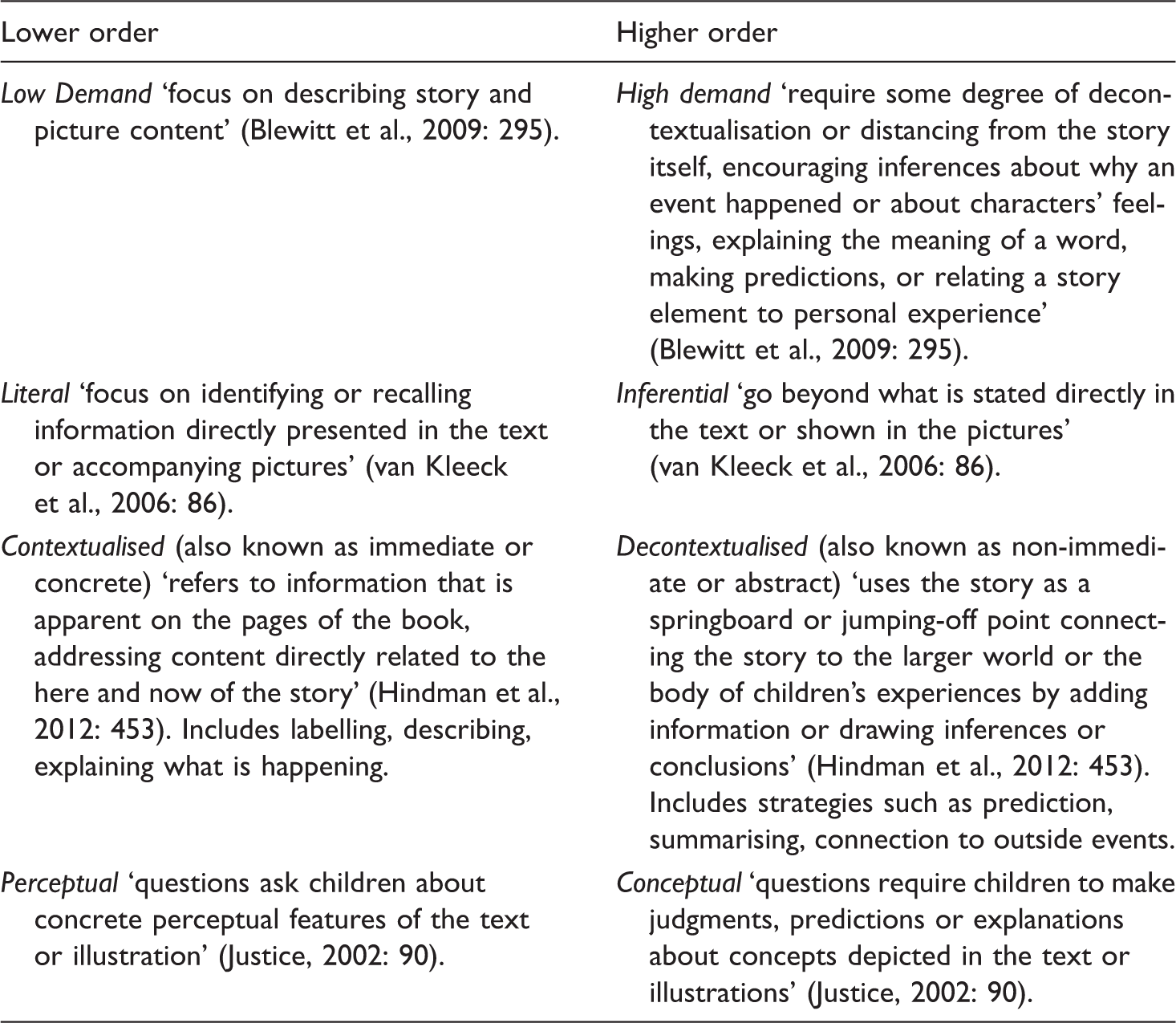
Definitions of questioning terminology used in the reviewed studies.
In nine of the studies (see Table 1 for the different question types used in each study) only lower-order questioning strategies were used, with a combination of higher- and lower-order questions being reported in nine other studies. Two studies focus exclusively on higher-order questioning: Strasser et al. (2013) compared open-ended questions (those with more than one possible response) with coherence questions (cause and effect questions) in one experiment, and Blewitt et al. (2009) included a condition in which only high-demand questions were asked. In five studies, specific reference is made to using dialogic reading. Blewitt et al. define dialogic reading as ‘a reading style in which adults ask low demand questions’ (p. 295). However, Whitehurst et al. (1994b) make specific mention of distancing prompts and open-ended questions as more complex forms of questioning in dialogic reading. Strasser et al. (2013) also refer to using a ‘dialogic style’, but their application of open-ended and coherence questions again appears more complex than some of the other applications of dialogic intervention.
Definitional issues
A problematic element that is revealed in this review is the variety of terms used to describe the questions employed in the studies. Some of these can be divided into a lower-order and higher-order dichotomy (see Table 3 for definitions of cognitive demand), whereas other terminology, such as eliciting and non-eliciting questioning, focuses on the responding child’s language production.
Higher-order and lower-order questioning
A wide variety of terms is used to refer to the cognitive demand of the questions used in the studies. These are defined in Table 3 and, although the definitions differ slightly, there is a uniformity in the way in which dichotomous terms describe the concepts of low cognitive demand versus high cognitive demand: literal versus inferential, perceptual versus conceptual, contextualised versus decontextualised. All of the higher-order questioning techniques rely, to some extent, on children using the top three levels of the revised Bloom’s Taxonomy (Anderson et al., 2001): analysing, evaluating and creating.
One particular area of difficulty is the categorisation of prediction questions, to which there are frequent references (Strasser et al., 2013; van Kleeck et al., 2006; Wasik and Bond, 2001; Wasik et al., 2006). Typically, these questions required children to predict, prior to reading, what the story is going to be about, or what is going to happen next. These questions are cited as examples of higher-order questions. However, if a child is already familiar with a book, then this type of prediction question elicits a simple recall of the story, which imposes a much lower cognitive demand.
Open and closed questioning
Six of the studies refer to open and closed questioning (see Table 1). However, there is little consensus on how each is defined. In some studies, Wasik and Bond (2001) for example, closed questioning refers to those questions that elicit only a yes/no response. In other research, such as Wasik et al. (2006), closed questions are those that elicit only a single-word response. Other researchers refer to closed questions as those that have a limited range of answers and a high level of constraint (Lee et al., 2012). Open questions are defined as any question that is not a closed question (e.g. ‘questions that require more than a yes-no or a one-word response’; Wasik et al., 2006: 67), those that elicit extended language production (allowing more than a ‘yes’ or ‘no’ response, according to Wasik and Bond, 2001: 245); and ‘a question to which a number of different answers would be acceptable’ (Lee et al., 2012: 569).
The differences in these definitions create ambiguity around the categorisation of some questions. For example, How is the girl feeling? could be a closed or an open question, depending on the definition adopted and the response given by the child. If a child responds with Sad, then the question would be closed under the definitions of one-word or a limited range of answers. However, if a child responds that She’s feeling really sad because she lost her book, then the response indicates that this is not a closed question. This is further complicated when the stimulus material is considered. For example, if the text in the book reads: The girl was feeling sad, then the question is clearly a lower-order and closed question. However, if the text reads She closed her eyes and sobbed, then the question How is the girl feeling? becomes an open and higher-order question because the child is required to infer the feelings of the girl from her actions. This ambiguity creates difficulties when comparing the outcomes of studies and attempting to interpret findings across the field.
Strasser et al. (2013) investigated the difference between open-ended questions and coherence questions, with the latter defined as ‘questions about causality, goals, feelings and thoughts’ (p. 630). Open-ended questions in Strasser et al.'s studies are those that allow children to ‘make predictions, interpret pictures and make connections to their own lives and experiences’ (Strasser et al.: 633). However, Strasser et al. do acknowledge that coherence questions are in fact, only one kind of open-ended question.
Other terminology
In studies investigating vocabulary learning (Walsh and Blewitt, 2006; Walsh and Rose, 2013), terms eliciting and non-eliciting questions are used. Eliciting questions are defined as those “that require children to respond using new vocabulary from the story” (Walsh and Blewitt, 2006: 274). For example, What are the penguins gliding on? (correct response/target word: iceberg) would be considered an eliciting question, whereas Who is gliding on the iceberg?, where iceberg is the target word, would be considered a non-eliciting question as it does not require the child to produce the new word iceberg.
Differences in terminology reflect differing aspects of questioning that researchers examine. However, a common understanding of the cognitive levels of questioning and the ways in which questioning affects a child’s language production would make comparison and evaluation of questioning techniques and their relative effectiveness much easier.
Level of cognitive demand
Where level of cognitive demand is employed as a variable, a ratio of approximately 70:30 lower order to higher order questions is used. The justification for this ratio comes from the ratio reported when parents read to children (van Kleeck et al., 1997), but there appears to be no experimental research demonstrating whether this ratio is in fact effective, or the effect other ratios might have on children’s language or cognitive development. It may be that different ratios are appropriate for different levels of ability.
Some researchers have linked the level of cognitive demand in teacher questions to child age or ability (Blewitt et al., 2009; Reese and Cox, 1999; Sénéchal et al., 1995), suggesting that younger and less able children need more lower-demand questions in order to learn new words. A ‘scaffold-like’ condition, in which the cognitive demands of questions move from lower order to higher order, has proved more successful in developing deeper knowledge of words than interventions that use higher- or lower-order questioning (Blewitt et al., 2009). It is possible that the success of dialogic reading might be attributable to a dialogic reading style mimicking a scaffolding style (Blewitt et al., 2009). That is, dialogic reading moves from low-demand questioning about a book through to higher-demand tasks, such as asking a child to retell the story. Again, further research is needed to conclude whether this is the case.
In the study conducted by Reese and Cox (1999), the authors examined the differences between three different styles of reading: a describer style (focusing on describing story pictures), a comprehender style (focusing on story meaning) and a performance-oriented style (focusing on introducing a book and focusing on story meaning at the end of reading). The describer style, which Reese and Cox contend is a lower-demand form of reading is found to have benefits for receptive vocabulary and print skills. The comprehender style, characterised as high demand by Reese and Cox, does not appear to raise children’s comprehension scores. Interestingly, there is significant interaction between reading style and children’s initial skill levels. Children with high-initial vocabulary scores benefit most from a performance-oriented reading style for further vocabulary development. Children who have high initial comprehension skills benefit from a describer style to develop their print skills. Reese and Cox conclude that the style of reading should take into account the child’s initial level of skill.
Placement of questions
Three studies examined the placement of questions from the perspective of interrupting and non-interrupting questions (Blewitt et al., 2009; Reese and Cox, 1999; Strasser et al., 2013), or questions occurring before, during and after the story (Wasik et al., 2006). Reese and Cox (1999) found that the children who benefitted most from non-interrupting questions were older preschoolers or those with more advanced initial skills. Wasik et al. (2006) found a correlation between question placement and vocabulary skills, such that the use of questions before and after reading had more effect on receptive and expressive language skills than questions asked during reading. With regard to comprehension skills, Strasser et al. (2013) found that interrupting the flow of the story to explain new words does not detract from story comprehension. However, Blewitt et al. (2009) found no effects for placement of questions and have even suggested that there is no theoretical reason to expect placement effects. Again, further research is needed to determine whether such a relationship does exist.
Frequency of questioning
No researchers have investigated the number of questions as a variable, despite Karweit and Wasik’s (1996) conclusion that asking too many questions may actually impede children’s attention to the vocabulary and content of a story. As a result of their review of preschool reading studies, Karweit and Wasik called for research to examine the effects of variations in the types and number of questions asked during storybook reading.
Group size
The size of the group during SBR is a contentious issue, with some researchers stating that smaller groups are more effective (Wasik, 2008), or even advocating one-on-one for children from low SES homes (see Whitehurst et al., 1994b). However, the social validity of small groups in early childhood settings has been questioned. Previous research (Dickinson et al., 2003) has suggested that whole-group reading tends to be the norm and that this strategy is sometimes used as a transitional activity to engage children while other activities are being prepared. This approach potentially detracts from the educational value of SBR and relegates reading to a management technique.
In 11 of the studies, children were read to in a one-on-one condition. In four studies, the effects of whole class readings were examined, and small group settings were used in another five studies. One-on-one interventions were more likely to be shorter, one-off experiments, with whole-class interventions and small group sessions typically being conducted over a longer period.
Milburn et al. (2014) question the generalisability of their study because their research employed a ratio of 4:1, whereas all teachers in their sample worked in educational settings with an 8:1 ratio. In line with the mandated teacher–child ratios for their jurisdiction at the time, Hargrave and Sénéchal (2000) deliberately increased the group size in their dialogic reading interventions from 5:1 to 8:1, which is also recommended by Whitehurst et al. (1994a). Hargrave and Sénéchal found that an increased group size did not appear to have a detrimental effect. In fact, children in a dialogic reading condition increased their expressive language by average gains of four months in the space of four weeks.
On the other hand, Whitehurst et al. (1994) found previously that an increase in group size made their dialogic reading intervention less effective. Their conclusion was that in-class reading is only effective in enhancing language skills for children from low-income homes when supplemented by frequent one-on-one reading with an adult.
In terms of optimal group size for reading, the studies reviewed here suggest that it may depend on the purpose of the reading. If the purpose is to elicit language from children, then smaller groups in which all children have a chance to respond individually are likely to be more effective. With regard to questioning at higher levels, there is no research available on the early childhood years, but research in primary classrooms suggests that teachers tend to overestimate the number of children who actually engage in the questioning process, especially when a whole-class approach is used (Wragg and Brown, 2002). This suggests that smaller groups might be more advantageous; again, further research is needed. The degree to which children listen and learn from the responses of their peers in small groups also needs to be investigated.
Quality of the studies
Two areas of concern are identified within the reviewed studies. The first is the standard of treatment fidelity, that is, how do we know that the teachers (or those administering the intervention) were actually doing what was required of them? The second, related concern involves the lack of sufficient detail being reported for the intervention to be replicated.
Treatment fidelity
The importance of treatment fidelity is paramount in intervention research. It is crucial that the independent variable is manipulated exactly in the manner described in the research so that the effects of interventions can be fairly compared (Moncher and Prinz, 1991). Ways in which treatment fidelity can be increased include having a precise and operationalised definition of the independent variable, providing documented training in the implementation of the independent variable, using a treatment manual to ensure accurate implementation, and demonstrating systematic monitoring of the compliance of those implementing the treatment (Moncher and Prinz, 1991). Although explicit mention of treatment fidelity is made in 14 of the 20 studies, it is reported in different ways, and merely reporting attention to treatment fidelity does not ensure that the issue has been adequately addressed.
In the case of dialogic reading, Whitehurst et al. (1994b) examined the application of the teacher behaviours described in the method (correction, completion prompts, labelling, praise, repetition, recall questions, ‘what’ questions, open-ended prompts and distancing prompts) and found that teachers tend to use fewer of the more complex (open-ended and distancing) questioning strategies. This research was conducted through classroom visits by the researchers once every two weeks and a videotaped shared reading session. Although Whitehurst et al. address the issue of compliance extensively in their study, they conclude that more systematic monitoring of teachers would generate more consistent use of strategies and higher teacher compliance.
Hargrave and Sénéchal (2000) also studied dialogic reading in the classroom. In their study, the frequency of teacher ‘yes/no’ questions, ‘wh’ questions, fill-in-the-blanks questions and pointing requests are reported. Despite stating that dialogic reading also includes open-ended questions and expansion, the researchers do not report teacher use of these strategies. Likewise, Opel et al. (2009) report on the application of dialogic reading but only mention training teachers in the use of ‘wh’ questions. No data are reported about the frequency of different types of question use. So, although dialogic reading is stated as the intervention used by the teachers in these three studies, it would appear that the method was applied in three quite different ways.
Moncher and Prinz (1991) state that when treatment fidelity is not ensured then it is difficult to exclude potential contaminants as the cause of intervention effect. For example, Whitehurst et al. (1994) suggest that if a dialogic reading intervention is teamed with a sound foundations programme, it is difficult to determine the extent to which each of the interventions is responsible for the changes observed in children’s language skills. It may be that there are certain aspects of dialogic reading that are more effective than others, but without further monitoring of the implementation of this style of reading, it is difficult to determine which aspects of dialogic reading are the most effective.
Ten studies report using a training manual or some other sort of training for those who will be administering the intervention. In cases where no training is reported, it is usually the case that a single experimenter, usually the first author, administered the intervention. The studies that report the most extensive training (videotape, manual, role play and monitoring) are those that employed dialogic reading.
Scripting the questions and comments made during an intervention is one way in which the likelihood of achieving treatment fidelity can be increased. Ten of the studies report using scripted interventions. There are variations in how the application and measurement of adherence to the script were conducted. Seven of the studies reported no measures of adherence to the script. For example, Strasser et al. (2013) report using a script, videotaping an unspecified number of scripts and concluding that all readers followed the script ‘while at the same time reading in a natural manner’ (p. 622). Similarly, Ard and Beverley (2004) report that sessions were reviewed by the second author and found to be ‘highly congruent’ (p. 21) with the scripts. These vague descriptions do not allow the reader to make informed judgements about the degree to which the independent variable was faithfully implemented.
More sound examples of the measurement of treatment fidelity are found in three of the studies. For example, Reese and Cox (1999) prepared reading protocols that included questions and comments for each of the three reading styles they examined. A sample of 96 readings (5% of readings) were recorded and compared with the scripts. Treatment fidelity was found to be κ = .99. Similarly, Walsh and Rose (2013) analysed a sample of recorded sessions, recording percentage agreement for the placement of questions and adherence to the script, the presentation of novel words and adherence to predetermined comments. Justice (2002) employed an independent trained observer to code 24% of recorded sessions for the presentation of new vocabulary and to ensure that novel words were not employed in commentary.
Treatment fidelity obviously remains a concern in this type of intervention research. Although there would appear to be some use of training as a method for promoting fidelity, adherence to protocols of training needs be measured in order to ensure a high level of fidelity and confidence in the validity of research outcomes.
Replicability of intervention
Interventions should be described in sufficient detail to allow replication (Wiersma, 1995). In the case of dialogic reading interventions, variability in the implementation of dialogic reading makes it difficult for a method to be reliably replicated. Indeed, the researchers in three studies mentioned above (Hargrave and Sénéchal, 2000; Opel et al., 2009; Whitehurst et al., 1994b) appear to be applying differing interventions in terms of their application of dialogic reading. This in itself makes the effect of the questioning techniques applied in dialogic reading difficult to separate from other aspects of the dialogic reading method, such as encouraging the child to speak, repeating the child’s utterances and providing the child with feedback. Hargrave and Sénéchal (2000) discuss this in their study, commenting that although ‘wh-’ questions are the most frequently used dialogic reading tool, there is a need for future research to disentangle the individual components of dialogic reading in order to determine their efficacy.
In the case of other interventions described in the target studies, those involving very discrete vocabulary appear to be the best described for replication. For example, Walsh and Blewitt (2006) examined the differences between conditions of eliciting questions, non-eliciting questions and no questions on the vocabulary acquisition of young children. The experiment was tightly controlled with the exact number of presentations of each word reported.
Implications for practice
In light of the literature reviewed here, then, are we asking children the right questions? It would appear from descriptive studies that early childhood teachers do not often question children during SBR in the most effective ways to support their language learning. Although there is only a small body of research, it would appear that some tentative implications for practice can be inferred. First, the ways in which teachers read to children during SBR need to be carefully planned if they are to be effective. Second, teachers need to consider the outcomes they are aiming for when planning their reading style and questioning strategies. Finally, greater understanding by teachers of the effects of different questioning practices on language learning and emergent literacy will assist them to modify their SBR strategies and develop the language abilities of children in their care.
Both Reese and Cox (1999) and Strasser et al. (2013) remind us that the way in which we question children when reading with them depends on our aim. If learning and acquiring new vocabulary is the aim, then the research reviewed here suggests that teachers should start with low-demand questions and move to higher-order ones (Hargrave and Sénéchal, 2000; Sénéchal et al., 1995; Whitehurst et al., 1994b). Both lower-order and higher-order questioning help children to learn new vocabulary, and the scaffold-like condition described by Reese and Cox appears to promote more in-depth learning and understanding of words. If the aim is to develop comprehension, then Strasser et al. (2013) recommend asking coherence style questions, rather than simply open-ended questions. Strasser et al. contend that questions about cause-and-effect relationships and characters’ goals and problems produced better comprehension outcomes for children than questions that require children to make predictions and connect a story to their own lives. Of course, this is not to dismiss these types of questions and their role during SBR, but simply to highlight the link between an educational intention and the types of questions that are most likely to produce this outcome.
The way in which teachers employ questioning during SBR needs to fall within the child’s ZPD (Blewitt et al., 2009; Reese and Cox, 1999). That is, if the questioning technique is too difficult then the child may feel anxious and frustrated, whereas if the questions are too easy the child may feel bored and disengaged, with less learning taking place. Therefore, children with a low level of ability may initially gain more benefit from easier (lower-order) strategies, whereas children with a high level of ability may need more higher-order and cognitively challenging strategies (Reese and Cox, 1999). Lack of engagement, as reported by Strasser et al. (2013), needs to be addressed for children with both low and high levels of ability.
The best ways to read with—and question—young children may in fact be related to the characteristics and skills of the child (Hindman et al., 2008; Reese and Cox, 1999). Individualising questions can become difficult when reading to a large group (Milburn et al., 2014), so teachers could take advantage of the flexibility of the early childhood classroom to read with small groups of children with similar levels of cognitive development. The reading style and aim could then be tailored to individual needs.
The findings of studies in which teachers’ questioning behaviours were changed suggest that training can assist teachers to develop a wider and more effective range of questioning techniques (Hargrave and Sénéchal, 2000; Lee et al., 2012; Milburn et al., 2014; Wasik et al., 2006). Developing these skills requires time, planning and feedback. Teachers aiming to move their questioning to a higher level should plan some higher-order thinking questions before reading with children. Additional benefits are found for children in classrooms where teachers modify their questioning techniques to include higher-order questions. Children appear to be more engaged in the book reading experience (Milburn et al., 2014), use more vocabulary and more complex syntax (Lee et al., 2012) and perform better on tasks of receptive language (Wasik et al., 2006).
Directions for future research
In the studies reported here, many aspects of questioning are investigated, including level of demand, placement of questions, group size and frequency of questioning. In many cases, too few studies have been conducted to allow reliable conclusions to be drawn about the existence of relationships between specific aspects of questioning and outcomes for children. Often questioning has been included as one part of an intervention and, therefore, the precise effects of the questioning intervention are lost among the effects of other parts of the intervention (Lee et al., 2012). Further research that disentangles the effects of questioning from other aspects of story reading would assist teachers in choosing the most effective questioning procedures.
Two-thirds of the research studies reported in this paper focus on remediating and preventing future difficulties, especially for children with delayed language, or those living in poverty. Although some of the reported research suggests these children should be read to in a specific way that focuses on developing their language abilities, there is still much to be learned from research conducted with typically developing children and those from more enriched backgrounds. There is also a need for research with children whose language abilities are advanced, because it may be that the cognitive needs of these children are not being met by teachers’ tendency to ask lower-level questions. Hindman et al. (2008) hint at this when speculating that a lack of increase in vocabulary scores for children in the top quartile might mean that children with advanced skills do not receive sufficiently advanced instruction to move their skills forward.
References to children’s behaviours during the reading process are made in few of the studies. However, Strasser et al. (2013) measured the attentiveness of children to SBR in two different reading styles by analysing children’s gaze at regular intervals throughout story-reading sessions. They found that children in their coherence (cause-and-effect) question condition paid significantly less attention than children in their open-ended (prediction, interpretation and connection questions) condition, despite the fact that children in the coherence condition demonstrated significantly better story-comprehension skills in a posttest of story content. The authors suggest that open-ended questions, which they think are more typical of the types of questions asked in early childhood contexts, are more intrinsically interesting to children. Further research is needed to see whether or not this is the case.
The only other study to mention issues of child attentiveness during SBR is that conducted by van Kleeck et al. (2006). These researchers reported difficulty in engaging children in the questioning process, although they suggest that this is not uncommon when working with children with learning difficulties. This study reinforces the need for further research into the interaction between children’s abilities, attentiveness and type of questioning technique in SBR.
There appears to be no experimental research investigating how preschoolers respond to higher- and lower-order questions during SBR. Are preschoolers able to comprehend and answer higher-order questions? And if they are, are the responses more complex than their responses to lower-order questions? Common sense would suggest so, but research with older children has produced curiously contradictory findings, indicating that the level of question matches the level of response only about 50% of the time (Dillon, 1982; Mills et al., 1980). The lack of experimental research that investigates children’s actual responses to different questioning styles is a serious gap in the current literature. It is, perhaps, time that we started to listen to and examine the responses that children are giving in response to teacher-questioning during SBR.
Conclusion
In conclusion, there appear to be too few experimental studies to allow any generalisable comments about the optimal level of demand, placement of questions, frequency of questioning or group size. However, the research seems to support the idea that different questioning strategies need to be employed based on children’s age, ability and the outcomes sought by the teacher. In order to determine the right questions, we need to know more about the child and our intention as teachers. As Teale (2003) suggests, ‘one overarching question that should be kept in mind is: “What is the teacher trying to accomplish?”’ (p. 123). One component to help early-childhood teachers move beyond asking lower-level questions and assist them to generate and ask more higher-order questions during SBR is professional development. Having an awareness of the range of questioning types that exist and their relative merits and applications can assist early childhood teachers to choose and ask the right questions.
The current body of experimental research about questioning during SBR has focused on language skills without investigating the rich possibilities for developing children’s thinking skills and comprehension through discussion and questioning of the ideas presented in storybooks.
Footnotes
Acknowledgements
The authors acknowledge the involvement and assistance of Professor Jennifer Bowes and Dr Coral Kemp in the preparation of this paper.
Funding
This research was supported by a Macquarie University Research Award for Areas and Centres of Excellence scholarship.