




Abstract
The purpose of this study was to examine how young children and their teacher constructed literary meaning through engagement with postmodern picturebooks. We framed our enquiry around Langer’s Envisionment Building theory and specifically examined how young children formed meaning as they moved through Langer’s five stances during and after text encounters. We draw special attention to the dialogic nature of transactions around texts, children’s understandings and appropriation of postmodern picturebook metafictive devices, and the ways in which they hybridize personal experiences with intertextual storyworlds. Our enquiry illuminates how young children and their teacher, having engaged with postmodern picturebooks, readily took up the work of envisionment building to construct novel and complex understandings and ‘go beyond’. Our research further exemplifies how the multifaceted nature of postmodern picturebooks provides rich opportunities for young children to negotiate diverse textual features and respond in unique and meaningful ways as they engage in literary meaning making.
Keywords
Introduction
Forming a literate life begins early on for children. One vital part of this learning process involves book reading, particularly when children are positioned as active participants in this meaning-making process. Doing so fosters knowledge acquisition and helps children accrue skills that bring fulfilment and pleasure in growing new understandings about themselves and their world. Although there is still much work to be done on increasing children’s access to high-quality books, many (Dooley et al., 2012; Paris, 2005) have pointed to the development of literature options in the array and sophistication of genres made available to young children, including postmodern picturebooks (PMPBs). PMPBs are defined by their varying uses of metafictive devices, such as self-referentiality and parody. PMPB researchers are particularly interested in how this unique genre entices readers to navigate the complexities of its features. We believe PMPBs provide readers of any age with an ideal context for sparking the imagination, enriching critical thinking skills, developing reader autonomy and boosting reading fortitude. We also know from research (Dooley, 2010; Dooley and Matthews, 2009; Morrow, 2007; Sipe, 2008) and our personal experiences working with emergent readers that children can approach any genre as deep thinkers and text analysts who are ready to explore complicated issues and complex formats. Building on this knowledge of young children’s capabilities and our curiosity in PMPBs we collaborated with an early childhood educator to enquire into how emergent readers construct understandings about and from this literary genre.
Envisionment building with literature
We rely on Langer’s (1995, 2011) theory of envisionment building as a literature response framework to understand how five three- and four-year old readers collaboratively construct literary meaning from PMPBs, over time, with their teacher. Literary meaning making concerns the writing, study or content of literature. Langer’s theory (2011) situates readers as actively forming ideas, images, questions and hunches as they read, write and speak about the world in text. Langer views this work as critical to literary meaning making. As Langer explains, Envisionments are dynamic sets of related ideas, images, questions, disagreements, anticipations, arguments and hunches that fill the mind during every reading, writing, speaking or other experience in which one gains, expresses, and shares thoughts and understandings. Each envisionment includes what the individual does and does not understand, any momentary suppositions about how the whole will unfold, and any reactions to it. An envisionment is always either a state of change or available for and open to change. This act of change is “envisionment building” (p. 10).
The theory proposes that readers explore different stances that allow them to evoke meaning from different vantage points when building envisionments (Langer, 2011). Readers adopt stances that progress from thinking about the knowledge they already possess, and examining how new material contributes to this knowledge, to comprehending and critically assessing the material. These stances draw on and interconnect in a non-linear fashion and readers may experience them at any point during the meaning-making process. In fact, not all stances must be experienced in every envisionment-building effort as some readers connect more closely with particular texts over others. Langer’s four stances that support envisionment building are:
‘Being out and stepping into an envisionment’, in which readers ‘make initial contacts with the genre, content, structure, and language of the text’; ‘Being in and moving through an envisionment’, in which readers are ‘immersed in their understandings, using their previously constructed envisionment, prior knowledge and the text itself to further their creation of meaning’; ‘Stepping back and rethinking what one knows’, in which readers ‘use their envisionments to reflect on their previous knowledge or understanding’; ‘Stepping out and objectifying the experience’, in which readers … distanced themselves from their envisionments, reflecting on and reacting to the content, to the text, or to the reading experience itself. (Beach et al., 2010: 187)
More recently, Langer (2011) named a fifth stance, ‘leaving an envisionment and going beyond’, which is oriented toward higher-level understanding and the integration and building of new concepts. Readers ‘go beyond’ as they read strategically, attentively and critically to create fresh connections that inform future readings and can potentially transform their understandings of the world. Thus, a theory of envisionment building can shed light on how, through literature, readers gain connectedness and seek vision. By flexibly taking up the five stances, Langer asserts, ‘Students learn to explore possibilities and consider options for themselves and humankind. They come to find themselves, imagine others, value difference and search for justice. They become the literate thinkers we need to shape the decisions of tomorrow’ (as cited in Steiner, 2001: 127). Envisionment building, then, is also the work of reflecting on, and potentially reshaping, oneself and the world. Given the newness of this contribution, this fifth stance remains largely unexamined.
The few studies that have applied envisionment-building theory have historically examined the responses of established readers (e.g., Abdullah and Zainal, 2012). To gain a deeper understanding, we ask: In what ways can an early childhood teacher support emergent readers through the work of reading PMPBs? How do young children and their teacher construct meaning from PMPBs? In what ways do they ‘go beyond’ (Langer, 2011) to construct envisionments from this literature?
PMPBs and literary meaning making
Although features of PMPBs, often referred to as metafictive devices, are longstanding in prose and other literary writing, the integration of these features into the contemporary landscape of children’s literature is gaining in popularity and generating a unique trend. Rather than organizing storylines according to a familiar sequence of events or constructing text designs in conventional terms, PMPBs rely on deviating plotlines, parody, a multiplicity of reading pathways, storyworld crossovers, genre mixing and other transgressive characteristics (Sipe and Pantaleo, 2012). In addition, Dresang (1999) points out how postmodern literature alters the forms and formats of texts to expose ‘forbidden subjects, overlooked settings, more complex characters, new communities, and unresolved endings’ (p. 66). Pantaleo (2005, 2014) and others (Do Rozario, 2012; Serafini, 2005) identify extensive lists of metafictive devices that include: dialogue spoken between characters, authors and readers; multiple narrators; stories within stories; materiality of picturebook folded into narrative; unusual artistic or visual elements; multiple meanings; and cynicism. The usages and types of features vary in degree and certainly can overlap, which opens up possibilities for authors and illustrators to fashion novel iterations from these devices.
As children approach and interpret nontraditional print texts such as PMPB, it becomes even more important to understand readers’ experiences with these texts and how teachers might support children’s knowledge in making meaning of these texts. As others (Anstey, 2002; Pantaleo, 2005) have reported, children live in a constantly changing environment with access to a broadening range of texts. This shift in what children read directly impacts on the literacy demands placed upon the reader who encounters conventions that break the range of how one is accustomed to interacting and engaging with a text. Scholars (Goldstone, 2002; Wu, 2014) of PMPBs, for instance, point to a relationship between advancements in technology and the emergence of innovative features found within postmodern literature. PMPBs appear to be reflective of dimensions connected to the reading of a wired world where a reader encounters more visual and interactive components and is provided with more choices in how to digest and navigate texts. In this way, readers of postmodern picture books are invited and perhaps even required to enter these texts differently than other genres of books and to rely on both print and illustration in unexpected ways.
PMPB scholars recognize this genre as making a significant and unique contribution to the growing diversity of children’s literature (Sipe and Pantaleo, 2008). They share a concern, though, that there are still shortcomings in the sharing of these texts in schools and with emergent readers. While content analysis of children’s picturebooks with postmodern features continues to expand (Goldstone and Labbo, 2004; Sipe and Pantaleo, 2008), research on readers’ responses to this literature in classroom settings has focused on readers aged six or older (e.g. McGuire et al., 2008). Pantaleo (2004) notes that ‘although researchers and theorists have written about meta-fiction [postmodern texts], there is a lack of research that has actually explored students’ literary understanding of and responses to books with metafictive characteristics’ (p. 2). In taking a closer look at classroom studies examining PMPBs, however, there are examples of agreement within the scholarship on what it means for readers to respond to PMPB. These scholars maintain that readers must possess a sense of agency to understand metafictive features, particularly given how readers are expected to suspend structured notions of how to read a text (O’Neil, 2010; Serafini, 2005) as they critically examine text structures and metafictive devices. To this end, research studies most often position PMPB readers as flourishing if they prove to be strategic, attentive and critical thinkers.
Of the types of reader responses featured in studies of more established readers, we highlight four responses that illuminate important types of interactions that children engage in with PMPB, and which appear to have the most influence on readers’ understanding of PMPBs.
Persevering through ambiguity: Several studies indicate that children who persevere through the unexpected purviews and complex domains of PMPB are readers who are able to tolerate ambiguity (Knickerbocker and Brueggeman, 2008; Meek, 1988; Pantaleo, 2005). These are readers who exercise patience and insert gaps and questions in the meaning-making process (Pantaleo, 2004) as they construct connections between diverging layerings of a text. Serafini (2005) particularly notes that readers who learn to enjoy the challenges of a text grow comfortable with uncertainty. Perceiving the authorship of a text: PMPBs are often written in ways that force the reader to make continuous inferences about the author’s meaning of a text. For example, self-referentiality by the author or a character often causes readers to ask why things are written in certain ways. And, as metafictive devices make the author’s role more apparent, children can extend this discovery of authorship into all the literature they read (Knickerbocker and Brueggeman, 2008). Pursuing multiple meanings: Seeking multiple meanings helps children to ‘engage in critical dialogue with other readers and with texts and helps them to experience a variety of thoughts and multiple meanings’ (Knickerbocker and Brueggeman, 2008: 75). Rather than operating from an approach whereby readers are asked to identify one interpretation, PMPBs require readers to discover and consider how multiple interpretations exist simultaneously. Taking pleasure: One fundamental, yet not always overt, response involves taking pleasure in the reading of a text. Achieving amusement and personal delight seems to be a result in PMPBs as a reader understands and appreciates metafictive devices (Anstey and Bull, 2006). Reclaiming pleasure (Pantaleo, 2014) in the reading of a PMPB, children embrace their own meaning-making processes and order their own experiences.
In this enquiry, we wondered if three- and four-year old readers of PMPBs would similarly respond and what an envisionment-building lens would allow us to understand about very young readers of PMPBs. We know from research that engaging in fantasy and complex pretence, as PMPBs compel readers to do, nurtures children’s affinities for inferring others’ thoughts, feelings and beliefs (Allen and Kinsey, 2013; Dockett, 1998; Dore and Lillard, 2015). ‘Going beyond’ to enact various situations enhances young children’s reasoning about diverse possibilities (Amsel and Smalley, 2000). PMPBs provide occasions for children to manage multiple perspectives, coordinate representations of characters from different points of view, and consider alternate scenarios as they play out across the pages. Characters often make their inner states explicit and disrupt expected narratives to negotiate their own places in stories. We believe PMPBs uniquely inspire children to take up these complexities in their own fantasy and pretence play. In this paper, we bring together an under-examined population of PMPB readers and an underutilized, yet popular, theory for literature response to advance our understandings of literary meaning making among emergent readers as well as to suggest implications for future research and practices with PMPBs.
Stepping into an envisionment-building classroom
Our study is guided by a socio-constructivist perspective and was designed by bringing together traditional qualitative (Spradley, 1980) and teacher research (Power and Hubbard, 1999) approaches. Informed by a collaborative teacher and researcher enquiry model, we engaged in a multi-week PMPB enquiry project with John, an early childhood classroom teacher. Our work was influenced by a teacher researcher design that sought to draw on the expertise of John and his experiences with the children as we collaboratively planned and implemented a systematic and intentional enquiry (Cochran-Smith and Lytle, 1990, 2009) into PMPB literary meaning making. The three of us were involved in the decision-making details regarding selecting and gathering literature and materials, mapping out daily literacy experiences, securing and designing the physical arrangements of the book-reading environments, determining research goals, participating in the data-collection procedures and exploring problems or surprises that emerged during the project. We planned in person and via email communication and sought to carefully consider one another’s interests and questions related to project design and implementation. With this, however, we also wished to maintain John’s role as the principal adult participant in the classroom environment. Even though preparations and planning were co-designed, John primarily introduced the books, guided the readings, facilitated the discussions and responses and modelled his interpretive engagements within the various book activities. At times, we (the authors of the study) directly interacted with the children to ask questions, celebrate comments, encourage exploration and read with them.
Context and participants
Our study took place in a voluntary preschool classroom (as preschool is not required in the United States) with primarily two-and-a-half to four-and-a-half year old children. The classroom was part of a child development centre located on the campus of a public state university. We chose this site given our growing collaboration with John. Approximately 20 children were enrolled in the classroom; five were selected as focal participants. These children were emergent readers who were very fluent in book-handling skills, in the process of developing concepts of print, and demonstrated abilities to sustain independent book reading in the classroom for a scope of several minutes. In addition, John believed these children would be the most willing and able to readily talk about the books that would be introduced to them.
The focal children consisted of three girls and two boys and included: Rachel who was four years old; Maria who just turned four prior to the start of the project; Hadiya and Logan who were both four-and-a-half; and Andrew who was the youngest participant at three-and-half. John shared how all five children were inquisitive thinkers and, in general, displayed interest in books. They each enjoyed talking about books, and often answered questions adults asked them about them but they also asked their own questions to adults as well. They valued their interactions with teachers and desired to be in conversation with adults, and concurrently enjoyed playing and talking with their friends. Their guardians granted permission for them to participate in the study and for the work to be recorded and published.
Data production and sources
The PMPB study took place over six weeks and was organized around four distinct, yet intersecting, phases of enquiry that consisted of:
A book flood (immersing the children in a flood of related literature) invitation set up for the whole class; A more in-depth small group book browsing experience designed for minimal (yet present) teacher involvement; Lap-reading experiences with more direct teacher guidance on book discussions; and Composing activities and repeated readings for children to further explore text ideas and features explored in class (Sánchez et al., 2017).
As we later describe, three pedagogical structures primarily underlined these phases of enquiry: immersion, read alouds and crafting opportunities.
Children’s direct engagements with PMPBs stretched across eight 45-minute to one-hour time blocks over an intensive 10-day period. Our daily data-collection cycle comprised a series of interrelated activities aimed at capturing children’s interactions with postmodern literature. We produced field notes based upon our observations of John and the children, video recorded each class/group session, photographed meaningful interactions, collected artefacts such as children’s drawings and writings and conducted in-the-moment interviews. We performed these interviews from a relational perspective (Rogers et al., 2005) that entailed face-to-face interactions with the children about their natural encounters with the books. The interviews were conversational in nature as questions and responses built upon the children’s stories and experiences with the intention to provide the children with a structure for expressing their opinions and thoughts. To reiterate, the teacher’s and children’s literature-related practices and perspectives were the centre point of our data gathering.
Inventory of postmodern picturebooks shared.
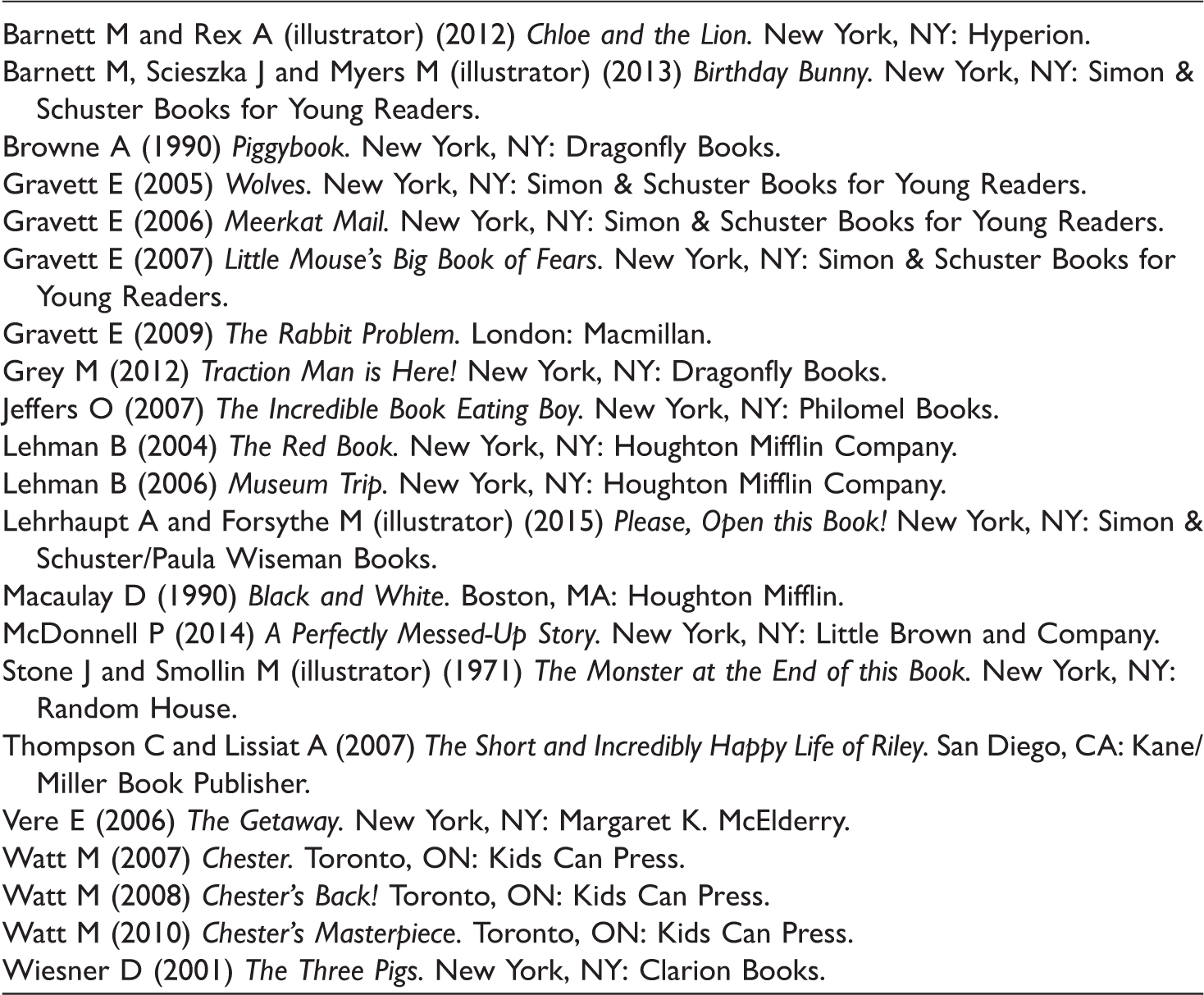
In John’s classroom, children read and inspected illustrations on their own and with interested peers. They also invited John to ‘read the story’ by handing him the book and positioning themselves to follow along and discuss the pictures, a practice they established prior to this study. These immersion experiences served to familiarize the children with the literature, identify favourite titles and give momentum to their inquiry into the PMPB collection. John guided the read-aloud experience with strategic think-aloud demonstrations (Wilhelm, 2001) and open-ended questions to guide the children’s literary meaning making. Langer et al. (1990) found that the kinds of questions teachers pose deeply affect students’ understanding of literature and that open-ended questions tap into children’s growing envisionments more than literal or decontextualized questions. John’s open invitations to share responses achieved the same purpose during his read-alouds. His think-alouds consisted of in-the-moment questions and demonstrations of envisionment building and became models that the children later appropriated and innovated on for their own envisionment building. John additionally utilized think-aloud practices to make public his meaning-making processes.
Understanding the importance of play as pedagogy for young children’s literary meaning making (Martinez et al., 2003; Morrow and Gambrell, 2004), we contributed an array of materials to support the children’s creative storytelling and envisionment building. Masks reflecting the faces of storybook characters, of the young readers themselves, of John, and other actors evoked in conversation were readied and made available to the children. Images of relevant figures were enlarged, laminated and hung on the wall for students to mark on with wipe markers. A smaller mirror was also available for children to use, as were pillows and little stools.
Data analysis
As described by scholars of qualitative and teacher research (Power and Hubbard, 1999; Spradley, 1980), we coded and analysed data continuously and recursively, with Langer’s envisionment building model later serving as a theoretical framework to more closely examine children’s literary meaning-making processes. We began inductively by individually and then collaboratively examining field notes and transcripts. We collected artefacts and then selected data samples to more closely analyse during subsequent research meetings. We also relied on the actual curriculum design (immersion, read-aloud experiences, and composing opportunities) to help us index and manage the data and begin considering patterns. Discussions of ongoing and initial analyses in this phase led us to identify preliminary themes, including the children’s intertextual connections and argumentation as foundational to young children’s reading of PMPBs and the significance of their transparent responses as they animated storybook characters in the classroom. These insights, alongside our regular discussions of conceptual and theoretical work on young children’s meaning making, helped us to narrow the analytical lens we later applied to the study. For this article, we focus on data inventoried around two titles in particular, The Book Eating Boy (2010) and Chester (2013), as they were identified as most salient in John and the children’s PMPB reading over time.
Sample of deductive analysis using Langer’s stances.

Stepping in, living within and moving beyond PMPB storyworlds
Focused on how John and five of his young students constructed literary meanings of PMPBs, we present our findings through analytic representations of the children’s envisionment building of The Incredible Book Eating Boy (2007) and Chester (2009). Langer explains that when engaging in envisionment building, readers do not always begin with the first stance. Rather than list children’s moves through each stance in linear fashion, we detail their most salient movements through Langer’s theory and the broader processes they developed to make meaning from the literature. We believe this format keeps to the fidelity of the children’s actual envisionment-building processes over time. We also contextualize this work by noting the features of postmodern literature that launched the children into envisionment building and specifically note how the materiality of PMPBs and characters’ self-referentiality in the narratives played significant roles in these young readers’ literary meaning-making processes.
Someone ate this book!: An envisionment of The Incredible Book Eating Boy
The Incredible Book Eating Boy (2007) by Oliver Jeffers was the first PMPB many of the children received as a favourite. The children were drawn to the book’s protagonist, Henry, who loves books so much he literally devours them in their entirety. With minimal text, Jeffers’ pencil and paint illustrations stylishly convey Henry’s book cravings, marathon book eating and ultimate book indigestion. Henry eventually substitutes book reading for book eating to curb his appetite for books. An ‘actual bite’ is taken out of the back cover leaving readers to infer that Henry, or someone, cannot help but sink his teeth into books every now and then.
Gathering initial impressions of Henry’s world
John and his young readers were prone to stepping out of their envisionment building from the beginning, a stance according to Langer (2011) that focuses on personal experience and knowledge of the real world and does not occur as frequently as others. Stepping out of the envisionment building process to assess how the text relates to one’s own life was first demonstrated by John through a think-aloud as he read The Incredible Book Eating Boy early on in the study. Before reading the printed text, John closely inspected the cover of the book depicting a boy swallowing a thick stack of books and provided time for the children to do the same. He then interrupted their clue gathering to articulate his own thoughts about Henry’s behaviour. John: I know we don’t eat books. Maria: <We don’t eat books> because it’s bad for us.
As the children continued inspecting the cover and gathering clues, they also discussed the bite mark on the back cover. John: Who do you think ate the book? Maria: Nobody did? Andrew: Maybe it’s the boy ate. He ate this book. John: I know, he’s been eating some of this book! Maria: It’s just made like this, just this book. Andrew: Someone ate this book!!
As the children continued to slowly step into a shared envisionment, they seamlessly shifted between being outside and inside the story world they were constructing. While relying on John’s reading of the written narrative to make sense of Henry, the materiality of the book and illustrations introduced new visual content to simultaneously read. The introduction of new content as they constructed meaning often caused the children to quickly alter their stance and revise their envisionments, once again causing the children to step outside. In particular, these young readers were inclined to count relevant visuals and index images. For example, to represent how Henry, ‘went from eating books whole to eating them three or four at a time’, Jeffers depicted Henry juggling many books (with some landing in his mouth) and having many arms. Upon seeing this illustration, the children could not help but focus on the numerical value of items represented. Andrew: He ate a book. Rachel: And another and another and another and another [pointing to each book]. Andrew: He juggled all of his books into his mouth. Maria: Now he has many hands. John: Mhm. Maria: He has four hands! Andrew: No, sixty-five hands! No, seventy-seven. Rachel: No, look. One, two, three, four, five, six! Six hands? Rachel: He turned into books. Look at that book … he’s scary. Andrew: What a scary book. Rachel: He’s turning it … his feet and his arms and his mouth and his eyes and his nose. Andrew: And his brows and his eyebrows and his mouth Rachel: And his whole body! Maria: And his feet. Rachel: And his tongue and his teeth. Maria: And his hands. Andrew: And his fingers.
Bringing Henry to life
As they collected clues to construct a storyworld together, over time, the children continued to question just who ate the book. Unlike their initial envisionment where many like Maria found it difficult to imagine that a character had actually taken a bite out of the book, during their second read-aloud of The Incredible Book Eating Boy, the children relied exclusively on the illustrations to entertain the possibility that it was indeed Henry who had eaten the book. As he looked at an illustration of Henry eating a number of books at once, Andrew concluded Henry ate books because, ‘It makes him smart.’ Rachel examined the same illustration and further reasoned Henry ate the books because, ‘He does better, better, better when he eats the books.’ Rachel also recognized Henry’s discriminating taste. Pointing to the book on the table she explained, ‘He doesn’t want to eat that book because it’s so big!’ to which Three-year-old Andrew agreed and restated, ‘Yeah, so big.’ By collaborating to reconcile why Henry would eat books, the children began to construct and immerse themselves in the storyworld, and then moved through their envisionment to question and derail their initial interpretations of Henry, and further fill in meaning about his motivations and pursue their book-eating queries.
As they identified reasons for Henry’s book eating, the children remained close to their debate about the bite mark on the back cover and entertained the idea that Henry had indeed bitten the book. That Henry had taken a bite out of the very books they were reading became a narrative the children carried beyond their reading of The Incredible Book Eating Boy. Andrew: He [Henry] ate the book. He ate the book. Rachel: Maybe he did that too [pointing to the back cover]. Andrew: Maybe he did this too. He ate this part of the book too [pointing to Meerkat Manor by Emily Gravett]. Rachel: Maybe so, maybe all of them are chewed. John: Maybe! Rachel: This one’s not chewed! [holding up Battle Bunny] John: That one’s not chewed? Wait, he pointed out one over there too that’s chewed [holding up Rabbit Problem by Emily Gravett]. Sánchez: [pointing to the book on the table] You want to see it? [handing the book to Rachel] Rachel: This one’s chewed. It is chewed. How can we open it? [dropping Battle Bunny] How … how do we open it? Yeah. Where’s this one chewed? Maria: Maybe he did this one too [holding up Chester].
That Chester! An envisionment of Chester
Chester (2009) by Melanie Watt is a PMPB that innocently begins with the story of a mouse in a house, but the narrative is quickly hijacked and rewritten by Chester, a self-centred cat wielding a thick red marker. With a big ego and plenty of humour, Chester revises Watt’s writing and illustrations with large red Xs and new labels that delight and bring laughter to the reading. The saga between dueling authors Chester and Watt continues in Chester’s Masterpiece (2010) and Chester’s Back (2013), both of which were read and enjoyed by the children as well.
Gathering initial impressions of Chester
As they were with Henry, John and the children were immediately captivated by Chester’s curious behaviour and were inclined to go outside their envisionment to gather clues. John gave voice to Chester’s antics as he read aloud and the children gathered clues from the illustrations to form their initial impressions. Upon reading Watts’ illustrations covered in Chester’s large red Xs, which many of the children also counted, Rachel immediately pointed to the red markings on the page and stated: Rachel: That kitty drew on himself. John: He drew? Rachel: He drew on himself! John: He drew on himself? Oh, okay. Maria: He did that [pointing to the red markings]. John: He did that? Who did that? You think Chester did that? Maria: Yes.
Beyond interpreting the surface features of the text, the children were ready to make deeper understandings to round out these initial impressions. As they read, they continued to test out their initial envisionment of Chester as a story-writing cat. John: Who do you think did this drawing? Hadiya: He did it! [pointing to a picture of Chester] John: Why do you think he did it? Hadiya: He always does it … he always draws. John: How do you think Chester looks right here? Unknown: Happy! John: He does look happy … why do you think he’s happy? Hadiya: Because he doesn’t need his marker no more. Maria: I think the mouse is gonna try to get it. Andrew: He wrote it … he wrote the book. Hadiya: He drew on a person. John: So who do you think made this book? Was is Melanie or was it Chester? Maria: Chester.
The children also stepped briefly out of their envisionment to objectify aspects of the text and critique Chester’s craft as an author. On one page in the middle of Chester (2009), Chester had written ‘THE END’ across the illustration to abruptly end Watt’s original plot. Maria critiqued Chester’s decision to end the book, explaining the story was clearly not over yet and that ‘THE END’ did not make sense. Rachel similarly questioned Chester’s decisions at times. ‘Did he draw on himself? Silly cat, silly kitty.’ These young readers stepped out of their envisionment to identify tensions between Chester’s and their own sense of when a story should end and what is clever versus what is inane. They demonstrated that reflecting on the author’s craft is necessary during envisionment building of PMPBs, as this process enables even emergent readers to continually revise their envisionments and progress forward in the narrative.
Bringing Chester to life
Fully immersed in Chester’s world, they moved through their growing envisionment with ease, convinced that Chester was a story-telling cat author who had physically stepped out of the book to do so. Hadiya: Look! Somebody write on it! [pointing to the Chester book]. John: Well let’s look if we can find more spots [reading Chester]. John: Somebody is writing in this book … I wonder who is writing in this book. Maria: It’s Chester! Hadiya: I think Chester got out of the book and then he draws on it. John: And he wrote there too? Is that what you’re noticing? Andrew: And he wrote there too! John: Who do you think is writing about the mouse? … hmm I see red marker. Maria: I think its Chester. Andrew: And there’s another X! Hadiya: Because he’s drawing all over his house.
Henry and Chester did it! Going beyond final envisionments to live within hybrid storyworlds
While John and the children read from a variety of PMPBs, Henry, Chester, the indelible red marker and the enigmatic bite mark surfaced in follow-up book readings, conversations and classroom tales. As previously disclosed, Chester was caught in the act of drawing moustaches on masks and Henry was found liable for chewing on a class copy of Meerkat Manor. It became commonplace to hear exclamations such as ‘Now look what Chester did,’ and overhear children’s concerns for what Henry might eat next. With these expressions of curious unease and eagerness, the children made it possible to invite peers to join them in their quest to halt and occasionally endorse their befriended characters and prevent their ubiquitous troubles from entering into their own real world settings.
We observed these types of interactions most often as the children focused on ‘going beyond’ readings of the books (stance five of envisionment building) to invent hybrid storyworlds that could co-exist between the pages of a book, the walls of the classroom and the newly formed community of PMPB readers. As alluded to in previous sections, the children largely gravitated towards the humour, wit and crises of the stories’ characters as useful mediums for extending meaning beyond these texts. In this section, however, we pause to illustrate additional responses when the children seemed to be most willing to ‘go beyond’ the page as they articulated new purposes for their interactions with a text and envisioned themselves as storyworld authors. The most distinct examples occurred as the children became interested in taking control of Chester’s red marker and when they remixed storyworlds.
Look what Chester did!
During a lap reading of The Incredible Book Eating Boy, John and the children discussed how Henry’s book eating might make him the smartest person on Earth. Taking the book from John’s hands, Rachel brusquely flipped it over, sharing, ‘Let’s check out the back of the book!’ Pointing to a two-inch red line drawn near the spine of the book, Rachel remarked, ‘What! Chester did thatttttttttttttt!’ Shaking her finger off the mark, she grabbed the book and lifted it with both hands above her head to show everyone else in the room, ‘Look what Chester did!’ Sharing in Rachel’s finding, John commented, ‘Chester is writing on our books.’ Andrew contested John and Rachel’s assertion, suggesting, ‘No, No, No. Logan did.’ Upon Rachel’s immediate request to keep reading, John nudged the book closer to him and proceeded with the following page. Subtly and imperceptible to John and her peers, Rachel uncapped a large blue marker she had grabbed seconds prior. Lifting up the edge of the book while John was reading, she snuck the marker in-hand underneath the back of the book to begin drawing on it. But, just as the marker was about to make contact with the book, she was stopped by John and asked to move the marker away. Minutes later, Rachel could be seen with the red marker once more.
In this scene, Rachel animated a character from a previous envisionment, charged this character by altering the book cover, requested that the rest of the group become alarmed by the book’s new appearance, and was then found with a blue marker clutched in her hand. In addition, Logan gets inserted into the newly developed storyline of who to blame for marking on the book. Ultimately, and unexamined by her group, it was Rachel, though, who had earlier in the class session placed the red mark on the book. Perhaps waiting for the best time to share her revelation (or preplanned episode) of the red mark, she co-opted the group reading to put forth a narrative that went beyond and transformed the original. Rachel forged the materiality of the mark into a new story drama involving her peers and teacher.
Jumping out and back in again
This next example occurred a few days into the PMPB enquiry. Amidst the children’s discussion of their noticings, Hadiya, extending her arms out as far as they could stretch, noted how the pigs in The Three Pigs (2001) by David Wiesner were pushing one another off the page in a particular part of the story. She used her language and her body to explicitly indicate a distance created when the characters separated from one another. As this sharing transpired, Andrew and Logan began their own conversation about the bite mark on The Incredible Book Eating Boy. This was Logan’s first day of joining in the PMPB group, and Andrew wanted to alert Logan to the group’s discovery from their prior readings. Similar to the children’s initial reactions to the bite mark enquiry, the following conversation took place: Andrew: Someone ate the book. Logan: Whoa. How? John: How? I don’t know. He [Henry] got hungry maybe. Logan: Is it real? Is it a real book? Andrew: Yes. It’s him [pointing to Henry]. Hadiya: But, but, how can he, how can he do that? Andrew: Well he just got out of the book and ate it. Then he went in the book, went back in the book where he came. … [a few seconds later] … Hadiya: I know who did that! That guy! [pointing to Henry] That’s the guy who did that. Andrew: Yeah. Hadiya: He jumped right out and bite it and then jumped right back in! That’s how he got out and jumped back in. I think that’s a magic book, that guy.
As empirical research on leaving an envisionment and going beyond has not yet been fully developed, like Langer (2011) we found that instances of this stance occurred less often than others. But, when present, we observed how going beyond significantly aided the children as they transcended storyworlds and recreated them into demanding narratives that disrupted or altered actions, experiences and intentions of both the text and readers’ real worlds. Throughout our study, the children were quick to unsettle the author’s plan for a story and position themselves to give voice to an idea by lifting characters or situations from the text into their personal relationships with one another and the materials of the room. We were pleased to see how children viewed themselves as capable of taking Chester’s marker into their own hands, for instance, as they gained confidence about a text’s features and explored personal interpretations of the storyline. Going beyond enabled the children to communicate explicit desires for authoring, or (re)authoring (Sánchez et al., 2017), parallel universes that not only existed, but influenced one another interdependently.
Young children can ‘go beyond’
Young children’s reading of PMPBs made for rich envisionment-building opportunities. Our analysis contributes to, and extends, initial research on Langer’s theory of envisionment building with early childhood readers and examinations of readers ‘going beyond’. Using Langer’s theory, what was most significant in our analysis was how these young readers and their teacher went beyond their final envisionments of PMPB reading to engage in the world of envisionment building to its fullest potential. We observed how metafictive devices such as character and author self-referentiality, in addition to the materiality and illustrations of picturebooks, folded into the narrative and launched children into stances of meaning making, including the more rare stance of ‘going beyond’. Children brought together their final character-focused envisionments to collaboratively craft hybrid worlds where they could mingle with characters, alter storylines and develop themselves as characters. We contend that it is in this disruptive act of remixing storyworlds, just as postmodern authors and illustrators do, that children ‘go beyond’ to create and contribute new texts, to entertain and make meaning within. Our study suggests that how young readers, who are just gaining command of the traditional picturebook form, construct literary meaning from PMPBs deserves greater attention, particularly as it relates to their abilities to engage in fantasy and complex pretence play to entertain multiple perspectives and possibilities.
As the texts children are expected to read become more visually complex and interactive, understanding how young children and their teachers approach and interpret nontraditional texts such as PMPBs becomes necessary and important. Investigations that further examine how young readers of PMPB persevere through ambiguity, work through other metafictive devices, perceive authorship and take pleasure in PMPBs need to continue in order to gain new insights into how emergent readers can similarly construct literary meaning from this demanding genre. For educators interested in sharing PMPBs with young children, we noted John’s genuine responses to literature (at times planned, but primarily organic) were key to an envisionment-building classroom. John’s open-ended questions and think-alouds supported students as they made sense of this new genre. Opportunities to reread the same PMPBs also proved necessary for children to ‘go beyond’ as they built envisionments over time and across different storyworlds. Finally, it is important to note that John did not ‘teach’ students how to use the materials we made available. Instead, he utilized them himself in his own engagements with the children and made room for them to do the same. We believe these classroom implications alone remind educators of the importance of innovative play, pleasurable reading and creative composition in varied forms, and the teacher’s role in opening up possibilities for literary meaning making.
Undoubtedly, responses to PMPB are multifarious in nature and method. Yet, we believe this analysis illustrates how three- and four-year olds can be strategic, attentive and critical thinkers who can engage in the work of literary meaning making with this complex genre. We believe integrating PMPBs into young children’s reading environments will deepen their meaning-making processes and increase their capacity to creatively and critically respond to texts.
Footnotes
Funding
The author(s) received no financial support for the research, authorship, and/or publication of this article.