




Abstract
The aim of this article is to explore how children use and reuse semiotic resources in their writing of hybrid genres in school. In focus are children’s use and reuse of semiotic resources from both earlier literacy events at school and literacy events they have experienced at home or in their leisure time. This double focus is rare in previous studies and thus the study contributes new insights concerning how children’s writing can be understood as a hybridization process in which semiotic resources from different literacy practices in school and out of school interplay. The theoretical framework of the study is based on New Literacy Studies, social semiotics and genre theories. The methodological approach is semiotic ethnography. The material is based on videotaped classroom observations of a particular writing process consisting of both collective and individual writing, as well as on the texts produced. A genre analysis is conducted in three steps, in order to explore the reuse of semiotic resources from literacy events in and out of school in five children’s texts. The results of this analysis show children’s creative ways of reusing semiotic resources, not only from literacy events and practices outside of school but also from previous literacy events in school. These creative ways of children engaging in hybridization processes while writing a narrative in sub-genres within an official literacy event in school can be understood as the children seizing agency in order to influence their own practice.
Keywords
In writing this beginning to the story, Thora is reusing semiotic resources both from the earlier lesson when writing the collective story and from other earlier literacy events that she has taken part of in school and at home – like all the children when writing their stories. The aim of this article is to explore in detail how children use and reuse semiotic resources in their writing of stories in school, and especially the use and reuse of semiotic resources in terms of genres, resulting in different sub-genres. Because we are interested in how children use and reuse semiotic resources from both earlier literacy events at school and literacy events they have experienced at home or in their leisure time, we apply a double focus to the analysis of children’s writing. This double focus is rare in previous studies, as we demonstrate below, but it allows us to contribute new insights to how children’s writing can be understood as a hybridization process in which semiotic resources from different literacy practices in and out of school interplay.
The questions of the Makete method.
Children participating in different literacy practices in and out of school
The fact that children participate in various literacy practices in and out of school has been shown in many studies within the field of New Literacy Studies (NLS) since Shirley Brice Heath’s classic work, Ways with Words, was published in 1983 (Barton and Hamilton, 1998; Fast, 2007). Heath’s study showed how home and school literacies were radically different, especially for children coming from socioeconomically disadvantaged communities and who could not benefit from their literacy experiences at home when engaging in literacy practices at school. Furthermore, children’s home literacies or everyday literacies, especially the home literacies of socioeconomically disadvantaged groups, have been labelled vernacular, informal and private, and not seen as ‘good’ language use (Barton and Hamilton, 1998; Maybin, 2008). Because vernacular literacies do not share the literacies of societal institutions, in this case educational institutions, they can also function as oppositional ones (Barton and Hamilton, 1998; see also Willis, 1997).
The differences between home and school literacies have been addressed in recent literacy research and it has been emphasized that it is necessary, or at least fruitful, to relate school literacy practices to home and leisure-time literacy practices (e.g. Björkvall and Engblom, 2010; Olin Scheller and Tengberg, 2012; Street, 1984). The focus on the differences between home and school literacies has been called the ‘home/school mismatch hypothesis’ in NLS and has been described as ‘the most resilient theme in the two last decades of New Literacy Studies’ (Maybin, 2008: 516).
Even though no researcher argues that this hypothesis has been unproductive in terms of designing research that sheds light on socioeconomically based inequities in education related to different conditions for participating in literacy practices in school, more recent studies have argued that the ‘home/school mismatch hypothesis’ risks leaving us with a simplistic and dichotomized view of the relation between literacy practices in and out of school. These studies have shown that the activities of reading and writing in school can be described as constituted in hybridization processes (Dyson, 1997, 2003; Ranker, 2009; Soltero-Gonzàlez, 2009). In other words, it is emphasized that at the same time that children participate in writing and reading practices at school, they bring with them a range of experiences from other different literacy practices, such as watching television and movies, playing games on computers or interactive tablets, reading or listening to books and participating in various leisure-time activities. This can be understood in terms of children contributing to the redesigning of the literacy practices they encounter at school, which emphasizes their agency (cf. Janks, 2010). Literacy practices have been described as multi-layered and hybridized in relation to literacy practices where children and young people develop techno-literacies, that is a ‘simultaneously functioning blend of technological and literacy skills’ (Edwards-Groves, 2011: 50), literacy practices that Gutiérrez et al. (2009) call ‘third-space learning sites’.
The concepts of official and unofficial literacy activities have been used in several literacy studies exploring how literacy activities in school are constituted in hybridization processes in which different literacy practices are incorporated (Björkvall and Engblom, 2010; Maybin, 2008; Ranker, 2009). Janet Maybin (2008) defines unofficial literacy activities as those ‘which appeared to be clearly ‘off-task’ in terms of institutional norms’, while official literacy activities are those ‘in which students were supposed to be engaged’ (p. 519). Thus, unofficial literacy activities are those that have usually been connected to home or leisure-time literacy practices, such as reading comics or magazines, writing down the lyrics of a song (Maybin, 2008), gaming or playing with applications on interactive tablets (Björkvall and Engblom, 2010). Both the Maybin and the Björkvall and Engblom studies show how unofficial literacy activities occur alongside classroom activities. An interesting result in Maybin’s (2008) study is how official literacy in the classroom can be understood as going through a form of ‘vernacularisation […] within peer interactions over ongoing work’, which helped the pupils to participate in and understand the official literacy tasks to hand (p. 528). A similar result is described in Björkvall and Engblom’s (2010) study in which pupils acquired specific techno-literacy competence through playing with and testing an application in unofficial literacy activities, which was later taken up in the official literacy activity of constructing a multimedia text.
Björkvall and Engblom (2010) are specifically interested in what kinds of semiotic resources children use in unofficial activities in the classroom, which they explored using a social semiotic ethnographic approach. Jason Ranker has a similar research interest, although he focuses on the role of semiotic imports in composing processes in school. Ranker’s (2009) study differs in that way from the studies by Maybin and Björkvall and Engblom, as he explores how children import semiotic resources in terms of multimodal composing from previous events and how these resources are transformed in a new composing situation. Ranker also sheds light on how children move between official and unofficial activities during lessons.
In this article, we explore how children use and reuse semiotic resources in official literacy activities in school. Thus we are not focusing on whether children move between official and unofficial literacy activities during class but rather if the semiotic resources used can be understood as reused or imported, as Ranker puts it (2009), in line with the sociolinguist Theo van Leeuwen (2005). Hence we are interested in exploring whether we can trace the reuse of semiotic resources either from previous literacy events at school or from literacy events out of school, and so we adopt what we earlier referred to as a double focus, which we now have seen is rare in previous studies.
Understanding genre features as semiotic resources
We turn to social semiotics to conceptualize semiotic resources, or more specifically, to Theo van Leeuwen’s (2005) often-cited definition: Semiotic resources are the actions, materials and artefacts we use for communicative purposes, whether produced physiologically – for example, with our vocal apparatus, the muscles we use to make facial expressions and gestures – or technologically – for example, with pen and ink, or computer hardware and software – together with the ways in which these resources can be organized. Semiotic resources have a meaning potential, based on their past uses, and a set of affordances based on their possible uses, and these will be actualized in concrete social contexts where their use is subject to some form of semiotic regime. (p. 3) Three kinds of ‘typical characteristics’ characterize genres, characteristics of content, form and function. (p. 123) … on the function of texts in social interactions, on what people do to or for or with each other by means of texts. […] the social semiotic approach has also stressed that studying the text alone is not enough. The sequences of communicative actions that make up genres are embedded in social practices which contain other elements as well – actors, times, places, and so on. (p. 123)
Research design
This study is part of a longitudinal research project called ‘Digitalization of Early Literacy Practices’ (Hultin and Westman, 2013a, 2013b, 2014), ongoing 2011–2016. The overall aim of that project is to describe, examine and problematize the introduction and implementation of the digitization of early literacy learning in primary schools in a municipality in Sweden. The project has followed different primary school classes during their first five years of school; one of these is the class of the children focused on in this study. Methodologically, the overall study has used semiotic ethnography to investigate resources (digital, didactical, cultural) within literacy practices. This includes classroom observations specifically focusing on literacy events, videotaping literacy events, interviews with teachers and pupils, and collecting and analysing pupils’ texts. In all, the knowledge of the research field is thorough in that the actors, setting, social context and use of multimodal tools are known to us as researchers (Hultin and Westman, 2013a, 2013b, 2014).
The material of the study
In this study, we examine three lessons (3 h of observed and videotaped material in total), comprising the writing processes of collective and individual writing in a third-year classroom in a primary school. During the first two lessons, the children and the teacher wrote and revised a collective text by using the Makete Method (illustrated in Table 1).
The collective text took shape as a result of the children’s vivid discussions and negotiations on the form and content of their story; the teacher functioned as a secretary and wrote down, on her own computer, the children’s suggestions, which were projected onto a white board.
During the third lesson, the children wrote their own story, still using the Makete Method. The first two lessons function, in this study, mostly as background in order to understand how semiotic resources are reused in the third, here focused, literacy event. The main data selected for the analysis of this article are the collective text and five individually written narratives. The individual pupils and their texts are not observed as examples of individuals and their individual use of resources, but rather serve as representatives of children’s narratives constituted in the classroom, and also as examples of the use and reuse of semiotic resources from lesson to lesson, school activities to home activities.
Overview of individual narratives.
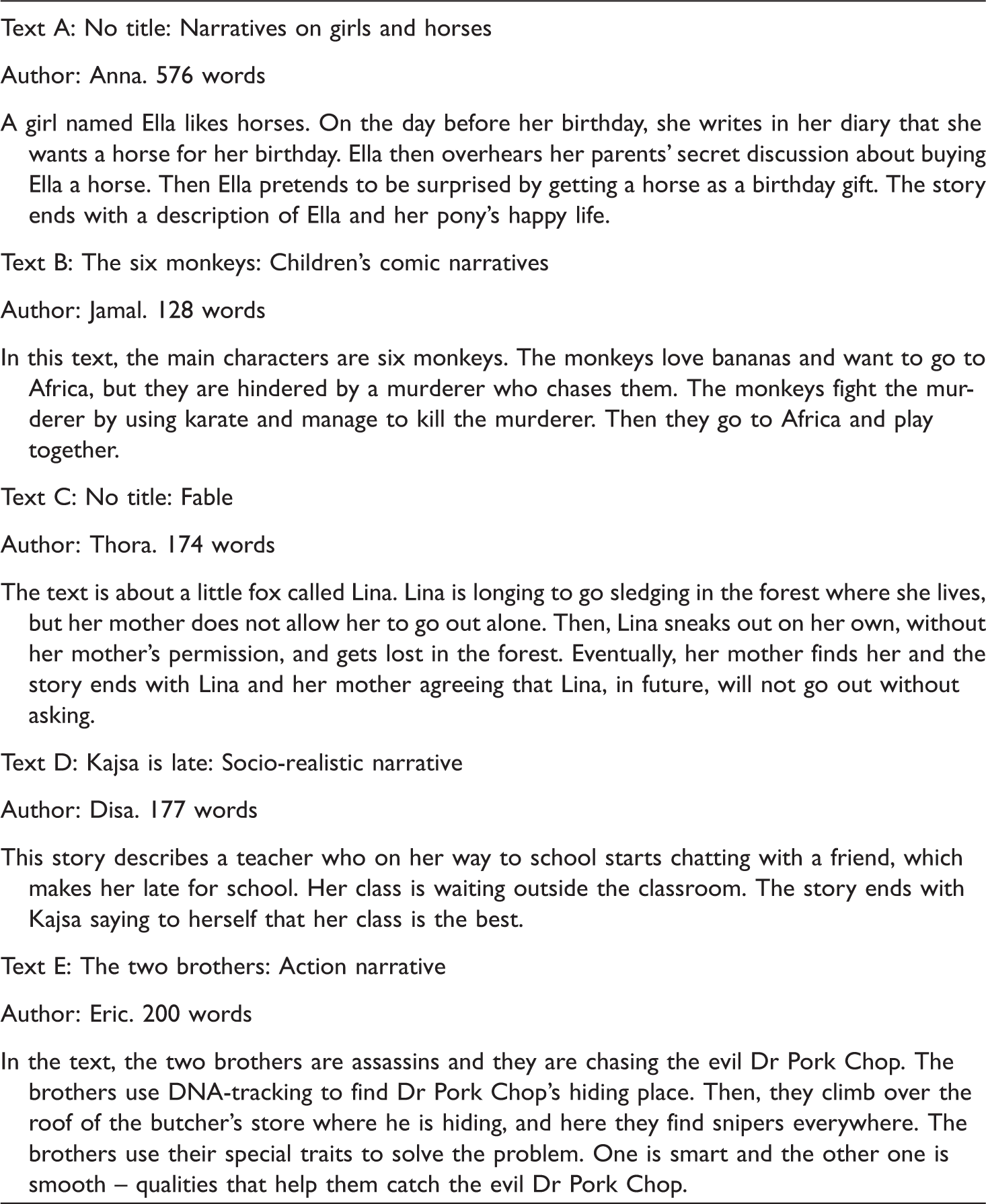
A beginning of a story early in the writing process.

An analysis in three steps
The methodological measures taken to analyse the pupils’ texts are intended to explore the reuse of semiotic resources in terms of genre features in the selected narratives. The analysis has three steps. First, we analyse the genre features of the texts in terms of form aspects. Guiding questions in this step are: How are the instructional questions of the Makete Method (see Table 1) reused to structure a narrative in the individual texts? How can text-structural features as beginnings and endings and linguistic features as words and expressions be understood as subgenre features and as semiotic resources reused from the collective text or from other literacy events?
Second, we analyse the genre features of the text in terms of content aspects. The guiding question in this step is: How can character(s), plot and setting be understood as subgenre features and as semiotic resources reused from the collective text or other literacy events?
Third, we analyse the social functions of the five individual texts. The guiding question in this step is: How do the children socially position themselves through writing in a certain subgenre? In addition to analysing the individual texts, we also draw upon the ethnographical anchored knowledge we have of the children as social actors in this particular social setting.
Finally, we discuss the results of the analysis by focusing on how the reuse of specific semiotic resources in terms of genre features (form, content, function) from different earlier literacy events open up a creative way for pupils to compose new texts in subgenres through hybridization processes.
Semiotic resources as genre features – Form, content and function
Below the results of the analysis are presented, one analytical step at a time.
The reuse of genre features in terms of form aspects
In this part, we present the results of the analysis of how the instructional questions are reused to structure a narrative in individual texts, how text structural features as beginnings and endings and linguistic features as words and expressions can be understood as subgenre features and as semiotic resources reused from the collective text or other literacy events.
Instructional questions as semiotic resources
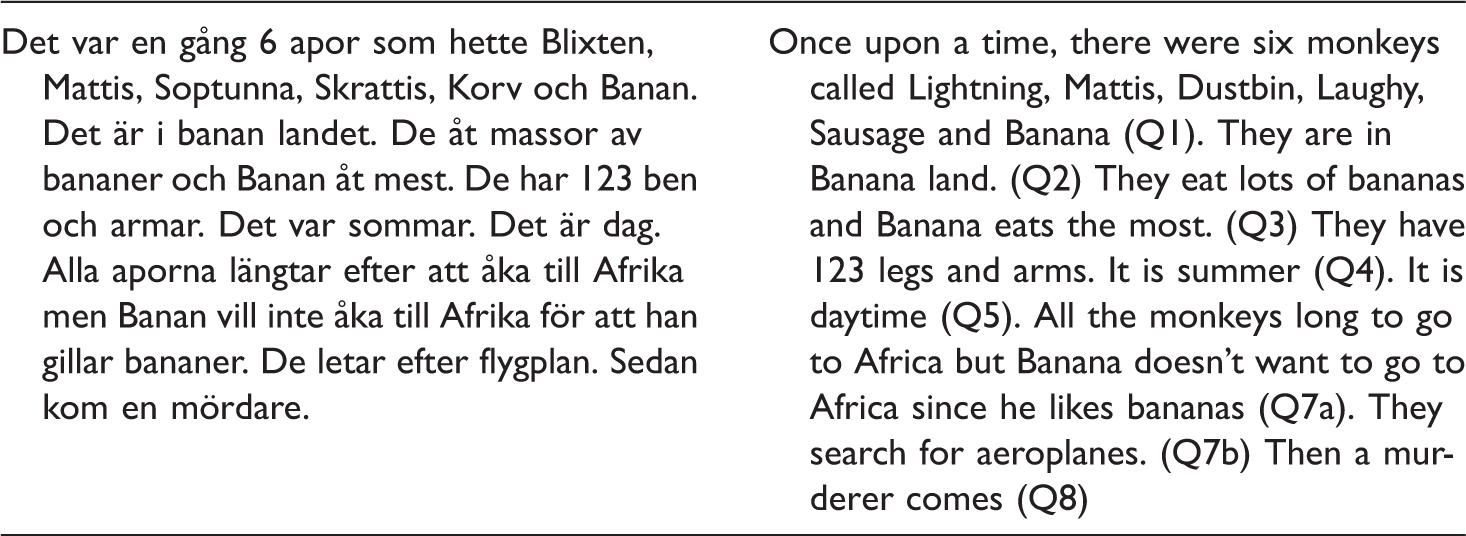
All the children were instructed to use the questions of the Makete Method (see Table 1). However, an analysis of how they answered these questions in their texts shows that they used them quite differently. Some children use the questions closely as they build up their story from their answers to the questions, while others use the questions more freely. The following example, The six monkeys (text B), is one of the more obvious examples of using the questions closely.
The use of instructional questions in text B: The six monkeys.
The use of instructional questions in text E: the two brothers.
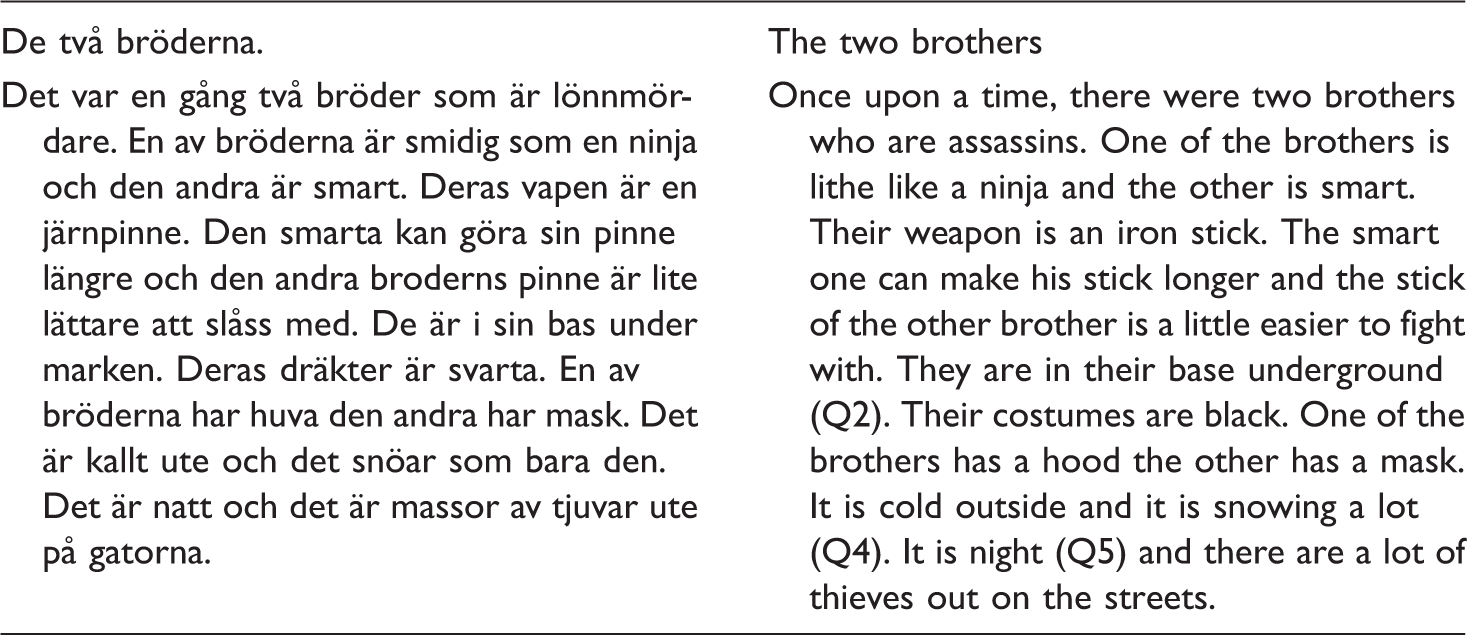
Text Example 3 shows a freer way of using the instructional questions. In text E, the first part of the text does not follow the suggested path but introduces the main characters by describing them through action and personal characteristics rather than by name, place and appearance, as suggested by the instructional questions. This is also visible in text A, where the instructional questions are answered in the dialogue instead of in the text body.
As illustrated above, the function of the instructional questions as semiotic resources structuring the narratives varies. Even if answering these questions functions as semiotic resources structuring the texts into chronological narratives in all the texts, they are given a more crucial function in texts B, C and D that use them more closely. Furthermore, these different ways of using the questions also result in signalling different subgenres. In the narrative The two brothers (Example 3), the main characters are characterized through action, thereby leaving the prescribed order of answering the instructional questions. This directly signals an action narrative, rather than a fable or other subgenre of narrative.
Beginnings and endings as semiotic resources
Signalling genre in the beginning, as well as in the ending, is not unique for the narrative The two brothers, but it is generally done in all kinds of texts and genres. Quite often set genre characteristics are used in certain genres, which is also the case with our material, particularly concerning beginnings.
Beginnings of the collective and individual texts.

Endings of the collective and individual texts.
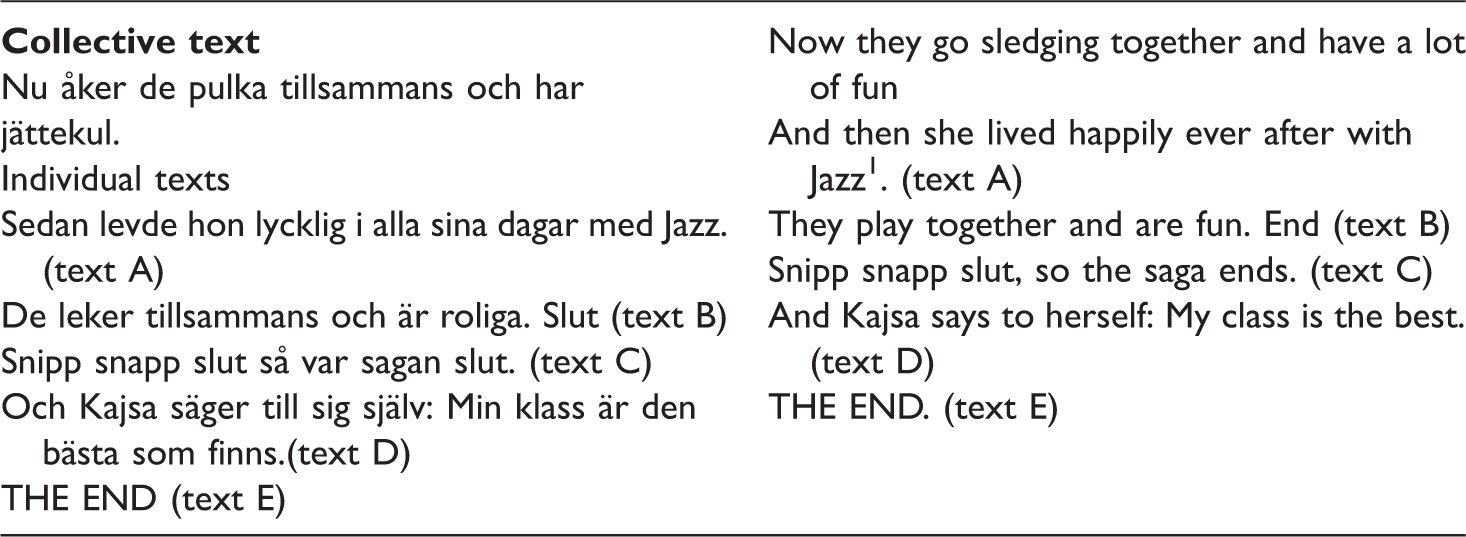
The resource offered in the collective literacy event, instructional questions, suggests introducing the main character by naming him/her/it. Four of the pupils’ texts, A, B, C and D, reuse this semiotic resource from the collective text, since they not only use the phrase once upon a time…, but also reuse the whole first sentence of the collective text, only altering the name and type of the character (animal/human) as Example 4 shows. The exception is text E, where the introduction is followed not by a name but by a ‘profession’. Furthermore, in two of the pupils’ texts, B and D, the same tense construction (here the past tense) is also reused in both clauses of the first sentence. However, texts A, C and E reuse the pattern in another way. Here, the first clause is identical to the one used in the collective text, ‘once upon a time there was’, but then they continue the sentence using the present tense instead of the past. In Example 4, text C exemplifies this.
In our material, the traditional fairy-tale beginning, Once upon a time, seems to be used more as a way of signalling the start of a narrative, rather than signalling a tense or subgenre, i.e. a fairy tale. The introduction of characters in the first sentence in all five texts is by far the most important element of signalling subgenre in these beginnings. We have already pointed out how the assassins in text E signal an action narrative. An analysis of the other characters’ belonging to certain subgenres is conducted in section Characters and plots as semiotic resources (see below).
The endings of the stories signal genres in quite typical ways. The collective text uses an example of an ending, not only stating how the story ends but also making a judgement on the outcome of the described event, which is typical for specific narrative subgenres, e.g. fable and morality tale. This genre feature is reused in two of the individual texts, B and D.
The other three texts reuse other forms of semiotic resources to end their stories. The reuse of the traditional ending lived happily ever after, which is common in fairy tales, is used in text A to signal the ending rather than a genre, as this narrative as a whole is written as a realistic genre (girls and horses). Another interpretation might be that this particular ending stresses an understanding of text A as a modern fairy tale, where the female main character is a common girl, called Ella (instead of a princess), who is longing for a horse (not a prince).
Another ending, Snipp, snapp, snut, so the saga ends, reused but slightly misinterpreted in text C, is a resource often used in Swedish as a traditional ending to fairy tales, sagas and children’s rhymes and stories. The alliterative words in the first clause are nonsensical and carry no real meaning, while the meaning of the second clause is: so the saga ends. This ending of text A signals a genre, as text A, as a whole, can be interpreted as a fable (see below).
Text E reuses another semiotic resource, in that the story ends with THE END in capital letters after the textual body. This is a common way of ending stories, one frequently used by primary-school pupils. This ending seems to be a reuse from popular culture, from movies and films that often end with that phrase.
Conclusively, both the individual and collective texts use endings frequently used both in genres that the children might have experienced at school but also in their leisure time (for example in popular culture) and are reused as semiotic resources in the analysed narratives.
Linguistic form as semiotic resources
Words signalling genre in the collective text and in individual text B.

Metaphorical seasonal and temporal expressions in collective and individual texts.
In text B, stomping describes a form of walking and also illustrates a sound. Descriptions of sound are suggested in the instructional questions used in the collective literacy event. The author of text B reuses this resource and uses the same word when responding to the instructional questions.
Settings in the collective and individual texts.

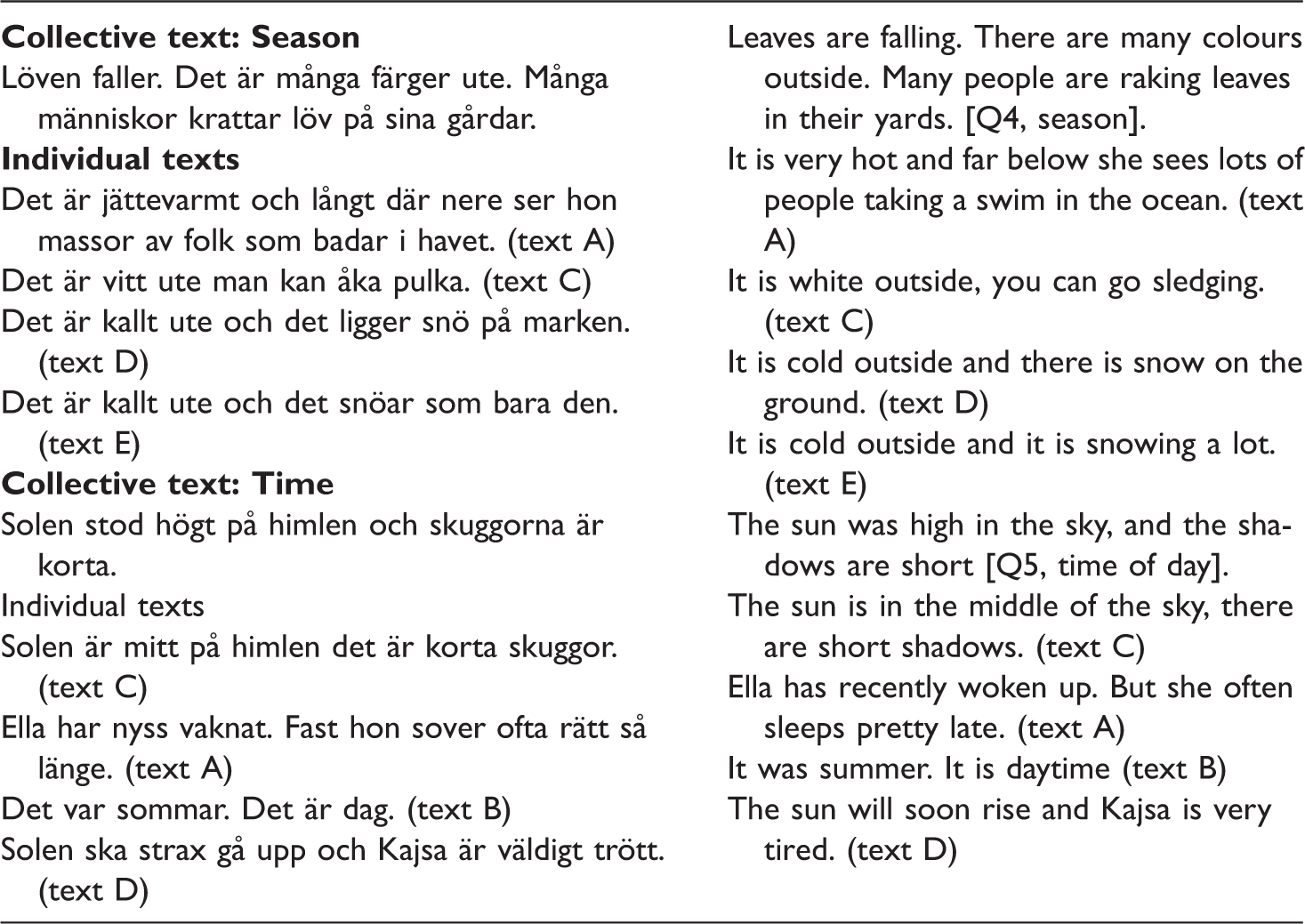
Using descriptive expressions that more metaphorically tell the reader the season and time of day is a construction used in four of the individual texts. Its use varies from text to text; they do not all use precisely the same words, but the resemblance to the original text is easily recognized. In text A, such a construction is used to indicate that the story takes place in the summer; the metaphoric wording is still quite realistic, it corresponds to the realistic genre (girl and horse narrative) that the narrative can be understood as. Texts C and D describe winter in two different metaphorical ways in a style pointing towards a realistic genre. In text C, the realistic wording signals that this fable is set in our world, a world where foxes can go sledging, which the realistic style underlines. In text D, the realistic tone corresponds to the social-realistic genre the text is written in. Text E also reuses this semiotic resource: ‘it is cold outside and it’s snowing a lot’, which contains a factual tone common in action genres.
The time of day (instructional question 5) is also described metaphorically in texts A, C and D; the tone in these examples is realistic, which signals that these narratives are all set in the real world, despite them being written in different subgenres (girl and horse narrative; fable; socio-realistic narrative). Text C reuses an expression from the collective text. Text B use a simplistic and factual style for expressing the season and time of day, which is not rare in children comic genres, especially written for younger children, which this text can be understood as.
Conclusively, texts, A, C and D use two features from the collective text and text E uses one, while text B does not reuse any features from the collective text. The way the linguistic genre features are reused in the text leads to texts being more or less linguistically elaborated; in text A, for instance, the genre resource for indicating the time of the day is also used for characterizing the main character – yet another genre feature of socio-realistic genres, where characterizing the main character’s good and bad qualities is often essential for the story.
Content as semiotic resources
In this section, we analyse semiotic resources as genre features in relation to content. The narrative components analysed as genre features are character, plot and setting. In this analysis, we explore the types of content found in the children’s texts and how they are used as semiotic resources.
Characters as semiotic resources
An indication of genre is the type of characters used in the story; in this case, a clear line separates texts using a human or an animal as characters in the narrative. In the collective text, the main characters are animals with human characteristics. This is a distinguishing feature of specific narrative subgenres, and particularly common in children’s books, as well as in fables and tales. The text samples show two texts with animals (text B – monkeys; text C – a fox) and three with humans as main characters (text A – the girl, Ella; text D – the teacher, Kajsa; text E – the two assassins and their enemies). In all the texts, the characters signal genre; when monkeys and a fox play the leading roles in texts B and C, respectively, we understand these texts in relation to fables and tales. However, identifying a character as an animal is not enough for classifying subgenre. The six monkeys, text B, is written as a children’s comic, which not least the plot shows (see below), while the untitled text C, with the fox, is written as a fable in a realistic setting.
The author of text B reuses the same name for one of his characters as the name of the main character in the collective text, Blixten (Lightning). Interestingly, this name was introduced by that particular pupil in the collective literacy event, and here we see the same realization, a reuse of that particular semiotic resource, in this pupil’s individual writing.
More examples of characters as genre features are: the girl Ella in the narrative on girls and horses (text A), the teacher (human) in the socio-realistic story (text D), and the two brothers working as assassins in the action narrative. These characters might be reused from literacy events and practices from outside of school. This is particularly apparent in relation to the action narrative, which is a genre almost non-existent in primary school, but one often occurring in films on television and in games.
Setting and plot as semiotic resources
Another type of content is setting the time, place and plot. It is obvious that many of the texts reuse ways of expressing time and place from the collective text, like in the analysis of metaphoric expressions of season and time. When doing so, the exact time and specific places are reused in the individual texts. This is exemplified particularly in the description of the time of year when the story takes place. Three texts, C, D and E, are set in wintertime, while the collective text is set in autumn, when the main character is longing for winter.
In text C, the setting in terms of place is reused from the collective text, as both take place in a forest. The choice of content in terms of characters and settings often connects texts to a specific sub-genre, or, at least, a field of genres, where certain types of content are more or less likely. Text E, the action narrative, takes place partly on a roof, where a shooting occurs, a setting which can be expected in an action narrative.
Plots in the collective and individual texts C.
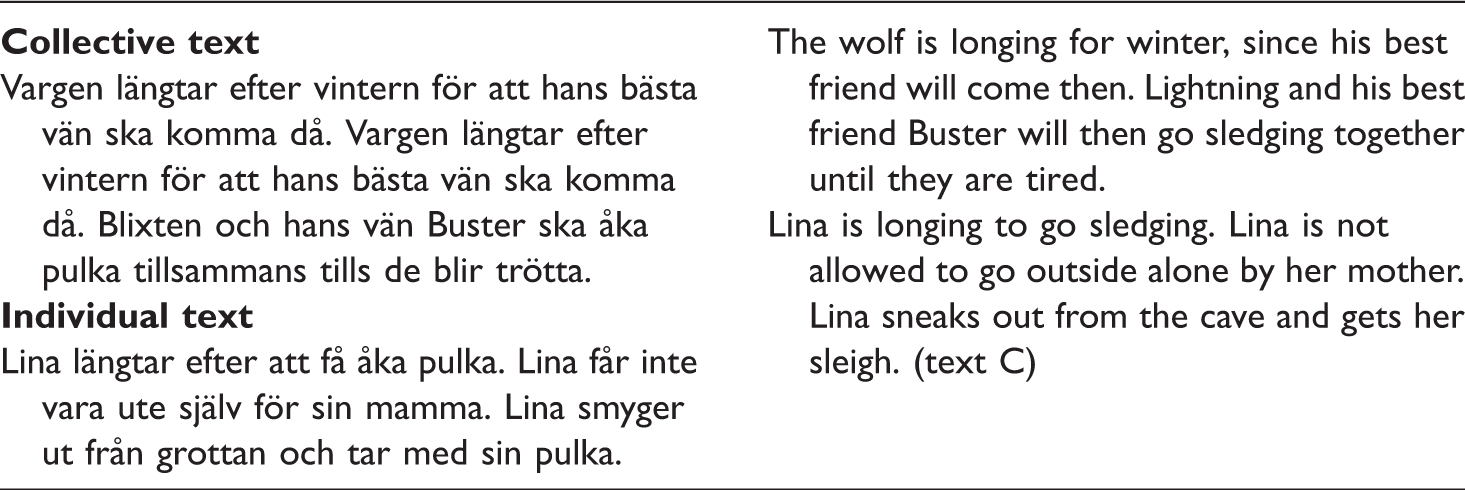
However, the plots of the stories signal genre, and also subgenre. In the girls and horses narrative (text A), the girl is longing for a horse of her own, which is a recurring theme in this genre. In the children’s comic narrative (text B), the plot is built up by a lot of surprising, and sometimes absurd, events, which makes sense in a comic narrative, but not in many other genres. In the fable set in a realistic world (text C), the fox learns a lesson when she has disobeyed the adults, a common development of events in fables and morality tales. In the social realistic narrative (text D), the teacher, Kajsa, is almost late for school. She experiences a mini-drama in her everyday life, which is a recurrent theme in socio-realistic narratives. And finally, in the action narrative, the good guys hunt down the bad guys, also a classical plot in this genre. Conclusively, all the children built up their plots by reusing typical subgenre features for them, which they had encountered in other literacy events, in or out of school, not just in the previous lesson when they wrote the collective story.
Function as semiotic resources
In this part, we present the third step of the analysis, where we focus on the social function of texts. We are especially interested in how the children use their writing of narratives as a way of positioning themselves as social subjects. It is especially in their choice of subgenres that it is possible to relate their texts to specific social positioning of themselves as subjects. As we have seen above, subgenre is the result of the children’s creative reuse of genre features concerning form and content from earlier literacy events they have participated in, both in and out of school. Even if all the children had to use the same semiotic resource, the questions of the Makete Method, they answered those questions in different ways, resulting in five different subgenres of narratives. As we have repeatedly visited the class over three years, we have quite a good knowledge of the individual children’s interests, which is necessary knowledge in order to conduct this part of the analysis in a credible way.
Text A, the narrative on girls and horses, is written by a girl called Anna, who often writes, reads, talks and plays games where horses have a central role. Writing a narrative on girls and horses can thus be seen as her ongoing social positioning of herself as a ‘horse girl’ – a girl who loves horses. There are several other girls in the class, friends of Anna, who also share the same interest and also use reading, writing and playing games to position themselves as horse girls. Hence social positioning as a horse girl is also a way of showing which sub-community in school you belong to.
Text B, the children’s comic narrative about the monkeys, was written by a boy called Jamal. He often uses the monkey as an alter ego when in class. He walks like a monkey and he makes monkey sounds in class. At times, the teacher gets very irritated at his ‘monkey behaviour’, while some schoolmates laugh. Using his monkey alter ego in class seems to be a way of socially positioning himself as a fun and brave friend, brave in the sense that he dares to challenge the teacher with monkey behaviour that is not appreciated by her. Writing about monkeys, which he has done in many other texts as well, seems to reinforce that social position he has strived to gain in class – a fun and brave friend.
Text C, the fable with the fox that does not listen to adults and therefore gets into trouble, is written by Thora. She is a girl who always listens to the teacher and does what she is supposed to do during lessons. In school, she has positioned herself as a good child. Earlier research has pointed out that The good child/pupil in school is equipped with social qualities appreciated by adults (willingness to work, good humour; not being critical of adults; willing to listen to grown-ups) (Bartholdsson, 2007). In an earlier study, we have shown that this subject position, the good child, is recurrent in pupils’ texts in school (Hultin and Westman, 2012). In her narrative, she gives a warning example of what might happen if you are not a good child, and the fox understands the necessity of being good in the end. Writing this narrative could therefore be understood as her positioning herself as a good child, not least in the eyes of the teacher who naturally will read her text.
Text D, the socio-realistic narrative about the teacher, Kajsa, who is late, is written by a girl called Disa who, like Thora, has also positioned herself as a good child in class, always behaving in accordance with the adults’ normative expectations. By choosing a teacher as the main character, a teacher that is good but also human (she is late for class), she positions herself not only as a good child but as a competent child able to see the world from an adult perspective.
Text E, the action narrative about two assassins, was written by Eric, who quite often in third grade complains openly in class about choices made by the teacher. There are only two children in a class of 20 pupils who do so at times. By writing a long and linguistically elaborated narrative, he is positioning himself as a socially competent child independent of the adult world, which is the same social position that he constructs by complaining or arguing with the teacher in class. His choice of subgenre, the action narrative, has content with assassins and snipers, that usually is not allowed in school. However, as the teacher said they could all answer the questions as they wanted, he took the opportunity to write in an inappropriate genre.
Conclusively, we can see how the three girls are normatively in line with the adults in school, while the boys challenge these norms – Jamal in a disarming, jokingly way and Eric in a more open confrontational way. Ultimately, the children’s choices of writing in a certain subgenre of narratives are connected to whom they want to position themselves as in the classroom in front of peers and teachers.
Hybridization into subgenres
All the above-described uses and reuses of semiotic resources as genre features concerning form, content and function are parts of hybridization processes in which texts are produced with different genre features. The texts examined in this study all show features that can be understood as hybridized forms of narrative sub-genres.
Text A reuses the first explicitly given semiotic resource, instructional questions, as a frame and elaborates the answers quite broadly. The author structures her text chronologically, while at the same time she uses a rather advanced narrative structure. The content of the text is not influenced at all by the collective literacy event that occurred before the individual writing, but by narratives (short stories and novels) about horses and girls, written specifically for young girls. The text reuses the semiotic resources of the traditional fairy-tale beginning and ending. The rest of the text, however, does not resemble a fairy tale, since the text sticks to the genre conventions expected in socio-realism; the prose is everyday language, and the thoughts of the girl and the overheard dialogue between the parents also resemble dialogues in everyday life. There are some more literary features, such as the aforementioned metaphorical descriptive expressions of season and time, which in this case are reused from the collective text. Thus, in text A, it is possible to trace the reuse of semiotic resources as genre features from both the school practice of writing narratives and from other literacy practices and events, in particular from the aforementioned genre, narratives on girls and horses.
Text B follows the instructional questions very closely, and this resource helps to structure the text. Content-wise, this text reuses the semiotic resources offered within the collective text in its use of animals as protagonists and even the main character’s name, Blixten (lightning). However, this text does not at all resemble a tale or a fable, rather it reuses semiotic resources from popular culture, such as cartoons or comic strips, which we have called children’s comic narratives. The plot, for instance, is not very consistent or logical, but slightly bizarre, with a lot of surprising events, which is a genre feature in some cartoons. Text B can be seen as a hybrid genre constructed of semiotic resources as genre features that are reused from literacy events and practices both in and out of school.
Text C resembles a fable in many ways. The text reuses the offered semiotic resources in terms of content, featuring a fox as the main character, as well as building the plot around the same activity as in the collective text, going sledging. Another resource from the collective text is the use of the beginning once upon a time. Unlike the collective text, however, text C ends with a moral, which is something very typical of the fable genre. What is more, the setting of the narrative in a realistic world also hints that this is a modern fable. This genre is a type of text that is found both in and out of the school context. It also draws on the more widely understood children’s literature genre, with animals as protagonists. Thus, text C also reuses genre features from different literacy events and practices from different genres, which in the end forms a text that can be understood as a hybrid between a fable and a children’s animal story.
Another type of text is exemplified in text D, which draws on different genres than text C does. The instructional questions are followed quite closely, but the content does not resemble the collective text at all, as it is very realistic in its content and style. An ordinary teacher is the protagonist who experiences a mini-drama in her everyday life, which is a common theme in socio-realistic narratives. This genre is found both in and out of school practice and is also a genre within popular culture. One feature exemplifying social realism is the use of the present tense. Text C uses the semiotic resource of the traditional beginning, which starts in the past tense, but switches to the present tense in the second clause. This text represents a hybrid genre which has much in common with socio-realism stories found in popular culture and marketed to girls and women. In a way it also resembles reality shows, where ordinary people do ordinary things that become mediatized.
Finally, text E uses the scaffolding of the instructional questions more freely, and it is the only text that does not respond to the first instructional question regarding the protagonists’ names, which results in an impersonal text. The plot is a story about two brothers turning into assassins who want to murder the notorious Dr Pork Chop. The text uses some of the resources offered by the collective text, such as the fairy-tale beginning, but then quickly becomes more ‘tough’ in terms of both content and style. Notably, this text uses a metaphoric description when setting the season, which perhaps is not so common within this genre. The instructional question regarding the time of day, however, is answered directly, which is more stylistically suitable for this type of genre. Here, the text has reused semiotic resources from outside of school. This kind of action narrative is common in action movies and films on TV, even some cartoons can be labelled as secret agent stories, but they are not common within school discourse. Text E shows signs of different genres and can be considered as a hybrid of genres used both in and out of school.
Discussion
In this article, we have shown in detail how children’s writing can be understood as a hybridization process in which children use and reuse semiotic resources from different literacy practices in and out of school. Because, analytically, we adopted a double focus, which we in an earlier section of this article have established is rare in previous research, we have been able to display how children in official school literacy activities not only use and reuse semiotic resources from different literacy practices in and out of school, but also how they use their agency in their writing. More precisely, the analysis shows how children are active, competent agents with their own agendas in their writing; the children’s choices in using and reusing semiotic resources in terms of genre features do not only result in different narrative subgenres but also in the construction of different subject positions which signals whom the child wants to be – e.g. a horse girl, a good and competent child, and a funny and brave friend.
Departing from the results of the analysis, we would like to discuss some of the notions on children’s school writing in earlier research that we referred to at the beginning of the article. To begin with, we would like to address the discussion on ‘the home/school mismatch hypothesis’ and earlier researchers’ warnings concerning the risk of understanding the relationship between home and school literacies in dichotomized and simplified ways (cf. Björkvall and Engblom, 2010; Maybin, 2008). Even though our study confirms that school literacy practices are multilayered, simultaneously it also reminds us that the differences between children’s home (or out of school) literacy practices and school literacy practices (cf. Barton and Hamilton, 1998; Fast, 2007; Heath, 1983) still matter when children use and reuse semiotic resources from literacy practices experienced at home or other places out of school. It becomes especially obvious when children use or reuse semiotic resources from out of school literacy practices that comprise different norms and values other than those embedded in school literacy practices. When children bring literacy experiences into school writing that are not in tune with the values and norms of school they might meet resistance and/or their writing might be understood as an act of resistance. In our material we have seen how the girls in their writing are normatively in line with the values and norms of school. They also, like the boys, used and reused semiotic resources from literacy practices out of school but their chosen subgenres and the constructed social positions do not challenge school norms. The boys’ choices in writing, on the other hand, are more oppositional in relation to school norms. While Eric challenged school norms in a rather direct, open way through writing about assassins, snipers and murders, Jamal opposed school norms in a more indirect, as well as joking, way. Jamal’s narrative in itself might not stand out as provocative, even though the subgenre of children’s comic narrative is not that common in school. However, the social position that he constructed through his writing – the brave and funny friend who has a monkey as an alter ego – had not been appreciated earlier by the teacher. Therefore, in the specific literacy practice of the school where Jamal wrote his narrative, insisting on writing about monkeys can be understood as oppositional. Strikingly, these two boys’ ways of challenging the norms of school are quite in line with the results of earlier research emphasising jokes and overt opposition as two ways of resistance (Hollander and Einwohner, 2004; Hultin, 2006; Willis, 1997). Furthermore, Jamal’s narrative particularly reminds us of the necessity of both studying and analysing children’s texts, and the social practices they are produced in, in order to get a reasonable understanding of the texts’ function in a social setting (cp. Van Leeuwen, 2005).
Besides, as mentioned above, earlier research has specifically pointed out that so called vernacular literacies do not share the literacies of societal, educational institutions and thereby might function as oppositional when children use these literacies in school (Barton and Hamilton, 1998; Heath, 1983). However, the out-of-school literacy practices that the children in our study used and reused semiotic resources from cannot be labelled as vernacular nor as home literacies of socioeconomically disadvantaged communities, which are labelled as ‘bad language’ in relation to school literacy practices. The out-of-school literacies that challenged school norms could rather be described as genres in wider popular culture (e.g. cartoons, action movies and docusoaps). Consequently, the children’s choices to reuse semiotic resources from these out-of-school literacy practices should not be understood in terms of language or cultural deficiencies. The children chose to write in certain subgenres because they had an agenda of their own in their writing – to socially position themselves. It takes considerable linguistic and cultural competence to be able to create subgenres in writing, as we have shown in detail, by elaborately signalling a certain subgenre through choices of form and content. Hence, the children’s choices in writing in this study seem to have more to do with the social setting they belonged to and how they wanted to socially position themselves within that setting. Among the girls in the class, it was important to be a good child/a good pupil, who understands the adults’ norms and rules, which is reflected in the values and subject positions that are constructed in their narratives. Some of the girls in the class had constituted a subcommunity of horse girls; writing about girls and horses then becomes a way of establishing one’s position as a horse girl belonging to that subcommunity. Among the boys, as we have seen, it seemed more important to socially position oneself as bold in some way or other by being funny in a way that the teacher did not like or by writing about topics that would never be introduced by the adults in school. The boys’ social positioning through opposition comprised an aspect of risk-taking that was lacking in the girls’ social positioning, which reflects the fact that social positions in the studied setting were gender-coded. Both girls and boys also positioned themselves as competent pupils through their writing, but by different means; Eric created a position as a competent writer and pupil through writing a long and linguistically elaborate narrative, while Disa positioned herself as a competent child through showing that she understood the perspective of adults. Additionally, the children’s social positioning through writing can be seen as individual’s acts of agency, at the same time that those acts of agency are made possible and restricted by norms and values within the social setting.
However, both girls’ and boys’ acts of agency can be understood as them redesigning their literacy practice in school since they brought in these out-of-school literacy experiences, even though they were not encouraged to do so by the teacher. Earlier research has pointed to the necessity for teachers to open up their classrooms to children’s literacy preferences and earlier experiences (Björkvall and Engblom, 2010; Fast, 2007) and also to redesign their teaching to become more inclusive in linguistic and cultural terms (Janks, 2010). Our study shows how the children themselves bring in their experiences and fulfil their own agendas at the same time as they meet the expectations from school as they complete their assignment. Thus, the discourse in earlier research stressing agency as an object of learning or something to be handed to children in school (cp. Janks, 2010) might miss the actual acts of agency that children already take. If we recognise children as agents, we might discuss the conditions for acting in different settings.
Finally, earlier research has shown how children engage in unofficial literacy activities alongside official literacy activities in the classroom (Björkvall and Engblom, 2010; Ranker, 2009). We have shown, on the other hand, how children engage in unofficial literacy activities at the very same time that they engage in official school literacy activities through their choices of semiotic resources from different literacy practices in their school writing.
Conclusion
From our study, we draw the conclusion of the importance of taking on a double focus in literacy research, i.e. focusing on how children use and reuse semiotic resources from both earlier literacy events in school and literacy events they have experienced out of school, in order to see, in full, children’s agency and competence in their school writing. Taking on an analytical double focus makes it possible to explore in detail how children choose to reuse semiotic resources in terms of genre characteristics of a certain subgenre, thereby producing a certain subgenre as well as positioning themselves socially in class as the person they want to be.
Our study also has implications for policy and practice. The study shows how children had the possibility to make choices in their writing, even though the literacy activity was strictly framed by the teacher. This made it possible for them to engage in school writing as competent agents with their own agendas. We would stress that it is crucial to recognize children as competent agents when planning and organising literacy education, not least for addressing questions on how to create stimulating and rich prerequisites for children’s acting and learning in school literacy practices.
Funding
The author(s) received no financial support for the research, authorship, and/or publication of this article.