



Abstract
Although unevenly distributed, many Australian classrooms are increasingly diverse and include young people from a wide variety of cultural and linguistic backgrounds, young people who speak many different languages and dialects of English. These diverse classrooms offer rich and exciting teaching and learning opportunities and require innovative pedagogies that bolster the abilities of educators to draw upon young peoples' transcultural and translingual competencies. This paper details curricula and pedagogies employed in a classroom with six- to eight-year old children newly arrived in Australia. In this classroom, children were positioned as ethnographers of their own language practices; language repertoires were recognized, validated and treated as resources for learning. Analysis centres on the relevant connections made between academic content, children's experiences and the promotion of children's identities as bilingual meaning-makers.
Keywords
Introduction
Recent Australian Census data (Australian Bureau of Statistic, 2016) have revealed that 2.8% of Australians are Aboriginal and Torres Strait Islander peoples and 49% of Australians were either born overseas or have at least one overseas-born parent. Australia's diversity is realized in its classrooms; although unevenly distributed, many Australian classrooms include young people from a wide variety of cultural and linguistic backgrounds, young people who speak many different languages and dialects of English. In 2016, NSW government schools contained 33.1% of students from language backgrounds other than English (NSW Government Education, Centre for Education Statistics and Evaluation, 2017: 1).
Correspondingly, many young children around the world are growing up with two or more languages. Recent international scholarship on the everyday language and literacy practices and experiences of young people (Blommaert, 2010; Cox, 2015; Cruikshank, 2014; D'warte, 2014, 2016; Orellana, 2009; Pennycook, 2010; Rampton, 2011) demonstrates young peoples' linguistic capabilities, and cultural experiences are increasingly diverse and dynamic. Current research undertaken with young bilingual people reveals evidence that many young people possess transcultural and translingual competencies (García, 2014; García and Yip, 2014; Hornberger and Link, 2012; Orellana, 2016; Reynolds and Orellana, 2014; Wei, 2014), that enable them to draw on multiple resources, employ multilingual, multidialectal repertoires and cross registers and codes with flexibility, deploying them strategically for different relationships, contexts and purposes.
It can be argued that, in the current era, realizing the linguistic competencies needed for a rapidly changing world is central to the educational endeavour and enhancing young peoples’ linguistic and cultural strengths in the early years of school is a first step in this process. In the early years of school, children begin to rapidly expand their linguistic repertoires and, as Gort contends, are ‘in the dynamic process of developing bilingual and biliterate competencies’ (2015: 1). Recent research purports that support in a child's immediate environments enhances this ongoing development (Bauer and Gort, 2012; Gort and Sembiante, 2015; Soltero-Gonzalez and Butvilofsky, 2015). Growing evidence contends that bilingualism confers cognitive benefits that go beyond second language acquisition (Bialystok et al., 2009; González et al., 2005).
However, building on the knowledge and skills of young people who are emergent bilinguals (Gort, 2015; García et al., 2008) is increasingly challenging, particularly in mainstream classrooms where common educational policies and practices target universal individual development of Standard English literacy compared and measured by high stakes, traditional tests. Current global standards-based reforms also continue to mediate professional practice in significant ways, while these reforms recognize increasing cultural and linguistic diversity, they do not enhance or harness diversity in practice and work to hinder rather than support teachers' capacities to respond to difference (Darling-Hammond, 2010; French, 2016; Luke, 2011).
Many teachers working in diverse, mainstream, multilingual classrooms recognize that two or more languages bolster each other and that knowledge and abilities acquired in one language are potentially available for the development of another (Cummins, 1979), but they continue to grapple with ways to acknowledge and then build on their students' linguistic strength and complexity (Anderson and Stillman, 2013; Gutiérrez et al., 2011). This has led teacher educators and researchers (Lucas and Villegas, 2013; Santoro and Kennedy, 2015) to highlight the critical need for innovative curricula and pedagogies that bolster the abilities of teachers and other school-based professionals to recognize and build on young people's linguistic resources in the service of learning. Equitable learning environments are created when young people's learning strengths and needs are recognized, making it more important than ever to find ways to support and sustain children's emergent biliteracy.
This manuscript details curricula and pedagogies employed within a classroom comprising six- to eight-year old young people, newly arrived in Australia. In this classroom, instructional practices and learning sequences played dual roles, they assisted teachers to recognize and build on children's strengths and they began to support children's emergent biliteracy development. This ethnographic classroom study analyses the ways in which the multiple languages of emergent bilingual children were explored and treated as resources for learning. Attention is paid to relevant connections made between academic content and students’ experiences and the promotion of ‘children's identities as imaginative and productive bilingual meaning makers’ (Gort and Sembiante, 2015: 9).
Theoretical framework
A key aim of this research was to position young people as active participants, encouraged to express and reflect on their language, literate traditions, orientations and knowledge. Conceptual notions of ‘language as resource’ (Ruiz, 1984), ‘funds of knowledge’ (González et al., 2005) and ‘community cultural wealth’ (Yosso, 2005) inform this thinking. A second research aim was to support teachers to uncover and build on the individual strengths of their students as they worked to address educational needs and English literacy. This study is situated within two bodies of work, the first a sociocultural framework for learning (Vygotsky, 1978) particularly, the work of sociocultural researchers who focus on the everyday skills and competencies of communities and theorize the social and cultural nature of language learning. The second body of work is situated within scholarship on languaging (Becker, 1995; Makoni and Pennycook, 2007; Swain, 1985), explorations of the discourse practices of multilingual speakers and translanguaging (Creese and Blackledge, 2010; García, 2014) pedagogical applications for working in dynamic multilingual classroom contexts.
Sociocultural framework on learning
A sociocultural framework for learning considers the identifiable competences that are cultivated by engagement in particular kinds of cultural practices (Scribner and Cole, 1981). A sociocultural lens offers a way to view personal and interpersonal relationships but also the social, cultural, historical and political circumstances that are inhabited, contested and transformed in daily life. Inspired by Vygotsky, researchers from different disciplines have elucidated and extended understandings of cognition and the intersection of relationships and circumstances within the context of classrooms. Particular focus has been put on how language learning is mediated by history, culture, policy, practice and teacher and student interactions. Close examinations of everyday contexts have documented the dynamic literacy practices and experiences of young people in and out of school settings; this includes the exploration of particular language skills, e.g. moving between languages with regularity (Martínez, 2010), language brokering (Orellana, 2009), enhanced metalinguistic awareness (Manyak, 2006) and linguistic invention (Orellana et al., 2012; Pennycook, 2010).
Educational researchers have not only continued to develop new understandings about the richness of young people's practices but also ideas about how to begin to leverage these practices in school. Unfortunately, evidence suggests that many young people do not see their language competencies as assets and instead internalize deficit views of their skills (Orellana et al., 2012; Martínez, 2010; D’warte, 2014, 2015). Linguistic flexibility and versatility are increasingly important in our globalized world, yet mainstream instructional practices tend to centre on highlighting student errors and emphasizing ‘standardized’ correctness. Vygotsky (1981) suggested that any function in a child's development appeared on two planes, first the social plane and then the psychological plane. Relevant here is an understanding that meaningful learning can only be generated when children's own knowledge and experiences are taken up and their extant repertoires and identities affirmed. It is equally important to consider Vygotsky's (1981) notion that language is a central and important mediating tool of the mind.
In this study, a sociocultural lens offered a view of teacher–student relationships and interactions and the ways they simultaneously focused on the singularity of a child's experience and also the plurality of the experiences and languages of all children (García and Sylvan, 2011). It offered a way to view how learning moved across the social plane to the psychological plane, as home and school language practices were brought together to support teachers and students learning from each other. For many young people, the dynamic and interrelated repertoire of practices required to participate in daily life includes navigating home and school language and literacy practices and this offers new teaching and learning possibilities, as this classroom study reveals.
Dynamic bilingualism and translanguaging
Scholars across disciplines have been prompted to investigate how global flows and globalization have influenced the situated social practices of people. Scholarship situated within sociolinguistics, sociology, cultural studies and anthropology has focused on peoples' linguistic and communicative practices, and educational scholarship has paid particular attention to the linguistic consequences of widespread mobility. In the current era, global shifts have problematized the act of classifying languages and speakers.
In educational contexts, the concept of languaging as defined by Swain (1985), Smagorinsky (1998), Becker (1995) and others, as a product of social activity, comprising the multiple linguistic resources employed for meaning-making across multiple contexts for a variety of purposes with a variety of people, has consolidated an understanding of language as ongoing and evolving. Bilingualism and multilingualism are now viewed as essentially dynamic (García, 2009), challenging previous notions of bilingualism as ‘dual monolingualism’. Recent educational scholarship has turned its attention to the linguistic repertoires of bilingual and multilingual young people in order to learn about the ways in which these young people draw on multiple languages, knowledges and experiences inside and outside of school (García and Wei, 2014; Gutiérrez et al., 2011; Hornberger and Link, 2012). This research has revealed the dynamic, complex and interrelated nature of practices; similarly, work on plurilingualism and plurilingual competence has revealed that myriad communicative ways can result in plurilingual repertoires (Moore and Gajo, 2009).
A holistic view of the linguistic repertoire requires centring on the linkages between languages and across languages, language as complex and interrelated, not transpiring in a linear way or functioning separately but emerging from one linguistic system (García, 2014). The idea that the linguistic repertoire evolves (García, 2009; Pennycook, 2010; Paris, 2009) has important implications for practice in diverse classrooms with students who are learners of English and emergent bilinguals. While young bilingual learners may have uneven competence in one or more languages, rather than viewing them as having limited masteries, a holistic view of the linguistic repertoire calls on educators to consider how associated knowledges can contribute to the overall growth of communication skills and offer the learner an interactive plurality of skills and competencies.
New classroom pedagogies for teaching and learning such as translanguaging (García, 2009) are underpinned by this framing and seek to activate the evident and emerging skills and resources of emerging bilingual and multilingual learners. Translanguaging takes up and extends the practices of bilingual and multilingual people by engaging teachers and students in drawing on and using multiple language and language varieties in the service of learning. Translanguaging promotes interrelationships and includes wide-ranging practices, e.g. moving between languages and across languages and the use of translation and linguistic invention, amongst others. Translanguaging encompasses a broad linguistic repertoire that also includes using the standard academic language(s) required in school. Ongoing evidence suggests that translanguaging pedagogies are supporting educational and sociocultural purposes (Creese and Blackledge, 2010; García, 2014; Hornberger and Link, 2012) and enabling teachers to see student competencies while engaging them in meaningful activities, what García and Sylvan (2011) describe as viewing language practices in motion.
In this study, translanguaging pedagogies were on view as teachers drew on children's multiple and dynamic linguistic resources. Findings reveal the relevant connections made between academic content and children's experiences and how this began to establish children's identities as bilingual meaning-makers, users of complex and interrelated language practices and experiences.
Method
The analysis that follows emerged from an 18-month ethnographic study conducted in seven schools located in Western Sydney, a socioeconomically, linguistically and culturally diverse region in New South Wales, Australia. This study combined ethnography with design research (Edelson, 2002) to engage teachers as co-researchers and students as linguistic ethnographers of their own practices (D'warte, 2014). This manuscript focuses on a subset of the larger study and presents an analysis of data from one school and classroom gathered during two, 10-week periods of dedicated fieldwork guided by the following question: How are young people's linguistic practices and experiences taken up and used for learning in this classroom setting?
Research context
Australian classrooms increasingly comprise young people who speak many different languages. The more than 300 languages spoken by the 21% of Australians who speak a language other than English at home enhance Australia's ongoing presence of Indigenous languages. In South Western Sydney, the site for this study, 50.2% of the population were born overseas and 59% of people speak a language other than English at home (Australian Bureau of Statistics, 2016).
Despite the fact that there has always been a multiplicity of languages spoken in Australia and a number of recent policy and curriculum documents advocating the benefits of multilingualism (French, 2016; Turner and Cross, 2014), the prevailing ideology has been one of English monolingualism. The Australian Curriculum: English (ACARA, 2012) acknowledges Australian students' linguistic diversity; however, the Australian education system frames linguistic homogeneity as the norm and maintains what Coleman (2012) describes as a monolingual and monocultural orientation.
School and classroom setting
Urban School (all names are pseudonyms) is situated in a language-rich community with 54.2% of residents coming from language backgrounds other than English. The school has more than 600 students and 99% of the students are speakers of languages other than English; over 35 languages are spoken by the school community. The largest numbers of families come from Turkey, Afghanistan, Lebanon, Iraq, Somalia, the Pacific Islands and China. A significant number of families have refugee status and a number of these children have not received formal schooling for extended periods. The school has a community language programme with classes in Turkish, Arabic, Mandarin and Farsi. New South Wales K–6 Community Languages Programs involve students participating in 30–40-minute weekly lessons of language study. Class content is closely aligned with age-appropriate mainstream curricula; key concepts and vocabulary covered in the mainstream classes are reinforced in first languages. Bilingual teacher aides are also employed in early-years classrooms, speaking languages that mostly reflect the linguistic diversity of the community.
The classes studied were designated as reception or new-arrivals classes; these classes are created to offer a transitioning of students newly arrived in Australia to mainstream classrooms. In this new-arrivals class, students were classified as English as an additional language/dialect learners (EAL/D). The Australian Curriculum, Assessment and Reporting Authority (ACARA, 2014) employs an EAL/D learning progression from Foundation to Year 10 (5–16 years old). This progression includes broad descriptions of the characteristics of learner groups in each of four phases of English language learning. EAL/D students of any age may be in any of the language learning phases from Beginning English through to Consolidating English (ACARA, 2014: 2).
The young people in this class spoke a wide range of languages and dialects and some children spoke little or no English. They received targeted and systematic English learning support in highly scaffolded age-appropriate curricula. Children entered at any period throughout the school year (January to December) and were transitioned into mainstream classes twice a year, usually at the end of term two (20 weeks) or term three (30 weeks) and at the end of the year following assessment. Most children were transitioned in the Consolidating English learning phase.
Participants
There were 29 participating students aged between six and eight years old, most identified in the Beginning or Emergent phase of English development. Two students were in the Developing phase and 20 students had been in the class for one school term (10 weeks) when the study began. During the period of study, several children transitioned in and out of the classes and numbers fluctuated between 21 and 29 students. In total, the young people spoke eight languages, with 10 students speaking Arabic, six speaking Farsi, four Turkish, three Urdu, two Cantonese, two Dari and two students speaking Burmese and Krio, respectively. The three participating teachers were female, two classroom teachers, Mrs Shas and Mrs Kanna, and an EAL/D support teacher, Mrs Darma (all pseudonyms). Mrs Shas and Mrs Darma, both native Hindi speakers, had immigrated to Australia from India and studied Urdu. Mrs Kanna, also a Hindi speaker, was raised in Fiji. They had all obtained EAL/D qualifications in Australia and had between 15–20 years Australian teaching experience.
Data collection
An ethnographic lens underpins the study design, data-gathering and data analysis. Data emerged from two 10-week observation periods, during twice-weekly classroom visits of between 40 and 90 minutes, within the English Language Arts block. Observations, field notes and audio-recorded lesson segments captured student-to-student and student-to-teacher interactions.
The corpus of data also included 30–45-minute audio-recorded teacher interviews conducted by the researcher at the beginning and end of these observation periods. In initial interviews, teachers were asked to share their experience of working with multilingual learners. They were also asked to share their views on bilingualism and their understandings of students' everyday language and literacy practices, skills and experiences. In both entry and exit interviews, teachers were also asked to consider if opportunities were created for students to reveal their language and literacy skills and experiences in school. They also reflected on the relationship and possible connections between student knowledge, skills and experience and school English learning. Interviews with teachers were conducted during four dedicated audio-recorded professional learning days that involved them in ongoing development and analysis of student maps and multimodal work. In exit interviews, teachers were asked to reflect on the teaching and learning sequence and consider what was revealed about students and their own practices and the ways in which students' home languages and experiences were taken up.
Focus-group interviews were also conducted with three to seven students in 30-minute audio-recorded classroom sessions. Most interviews were conducted in students' first languages, with support from bilingual aides, community language teachers and parent volunteers. Involvement of these participants was brokered by teachers and the school researcher before the research began. Meetings with participants included two dedicated audio-recorded meetings where participants shared their views about bilingualism and the relationship between home languages and school learning. Participants also worked with the researcher to develop age-appropriate focus-group questions that would help to reveal information about the everyday language and literacy practices of the children. Questions centred on the languages used and learned and where, when and with whom they were spoken. Children were also asked questions about translation practices and communication in multimodal environments both inside and outside of school.
Data also included children's language maps (visual mapping), analysed by the researcher and teachers, as well as associated lessons, activities, curriculum artefacts and multimodal student work samples. Weekly observations supported the movement over time from outsider to insider in the field; however, a significant challenge was posed by being a monolingual speaker in a classroom surrounded by children speaking multiple languages. Taking accurate field notes in a multilingual classroom where children spoke Arabic, Farsi, Turkish, Urdu and Cantonese, for example, resulted in the privileging of English in field notes. When students spoke other languages, more proficient English-speaking young people were relied on to share their conversations secondhand, teachers and bilingual teacher aides were also asked to translate and transcribe recorded data sources when possible. Seeking to create a thick description (LeCompte, 2002), close attention was paid to the action, thinking and learning taking place, and the practices and connections made to students' experiences.
Analysis
Codes question 1.

EAL/D: English as an additional language/dialect learners.
Codes question 2.

Codes were then reduced to identify and refine analysis of the form and purpose of teachers' translanguaging practices. These included, for example, translation/recast of student talk, use of students or others as translators, use of multilingual resources (audiovisual etc.), engaging in or encouraging multilingual talk, bilingual reading and writing displays and participation of family or community members.
Using a constant comparative method of analysis (Glaser and Strauss, 1967), data were triangulated. Coding of entry and exit interviews paid particular attention to the search for change over time in teachers' views. Analysis focused on understanding teachers' emic perspectives and reflections on lesson progression, practices and connections to students' experiences. Member checks with teachers and bilingual aides were conducted during and after observation and interview coding procedures in order to improve the accuracy and validity of the codes.
Across data coding: 20 weeks, sequences 1-12. ECL.

Findings
The findings presented here centre on pedagogies that involved teachers and students in drawing on practices and knowledge of multiple languages and language varieties in the service of classroom learning. While translanguaging pedagogies were used, it is important to note that, in this new-arrivals class, teachers were principally focused on supporting students' acquisition of English for transition into mainstream classrooms. Findings draw on instances where multiple linguistic resources were used to participate in classroom activities, where bilingual, bicultural identities were validated and treated as resources for learning, despite the centrality of English hegemony. Relevant connections between academic content, students' experiences and the ways these supported teachers in seeing what their students knew and could do are highlighted.
Recognizing what children knew and could do
Studying the ways we use language/s everyday
Classroom sequences began with talk about the ways children used language/s everyday with family members, friends and in their communities. Collecting information in focus groups of between three and seven in children's first languages and doing so with community language teachers and parent volunteers was an important first step. This process not only offered an opportunity for children to call on their full linguistic repertoire to share their experiences with teachers, it also offered recognition of the linguistic capacity of the school community. Field notes from the first meeting with community language teachers and parent volunteers revealed the importance of recognizing children's full linguistic repertoires, as expressed by the community language teacher's comment, ‘We need help in showing other teachers and parents the importance of the home language and mostly what it can do for children's confidence, learning and thinking.'
These participants were an invaluable source of knowledge and expertise about the wider community's linguistic and cultural practices and facilitated further community involvement in the classroom. Six community language teachers and two parent volunteers audiotaped and then transcribed children's group discussions into English for analysis. Children were asked to name the languages they spoke and those they were learning, either formally or informally, and to talk about their multimodal language and literacy practices (i.e. how, when, with whom and in what languages they were talking, listening, reading, writing and viewing in multiple environments).
Data elucidated authentic, communicative purposes; children were listening to and using their home languages, most often in local shops, at the mosque or temple, with grandparents and family members and in online environments in countries around the world. Children were reading with parents and watching movies and television serials in home languages with regularity, and 11 students were translating and language-brokering regularly for their mothers and grandparents outside of school and for their friends inside school. Teachers were largely unaware of their students' widespread practices and surprised by their ability to share their skills, practices and understandings in these small group settings.
The compiled data were collated and presented to students in the form of simple graphs, tables and wordles on the class electronic board. Children were asked to consider what the data revealed about their class; they counted the number of languages spoken and stood when the name of their language was called or appeared on the board, and children shared greetings and words in each language with each other. Employing mathematical skills, children counted and calculated languages and a variety of practices, e.g. the most spoken and least spoken languages by class members and incidences of translating and skyping, amongst others. The presentation of data evolved to include learning of words and concepts, e.g. less than, more than, most, least. This authentic, maths content was connected to children's experiences and used in both learning new concepts and extending children's language base in more than one language. Children were given time to use English or their respective home languages to talk with a partner about what they noticed, creating opportunities that were not frequently encouraged prior to this lesson. Field notes, observations and discussions with bilingual teachers and volunteers revealed animated multilingual maths talk that included counting and recounting practices and writing numbers in multiple languages.
Excited to see their own data, children volunteered additional information omitted from focus groups, e.g. one child named their African language as Krio and two others talked about learning Arabic and Turkish on Saturday. Two girls shared their experiences of translating for their younger siblings while others detailed regular online conversations with grandparents in home languages. The use of the electronic board enabled teachers to add new data to graphs and tables instantaneously, offering the class an active and ongoing documentation and recognition of their bilingual practices. This is further reflected in two children's comment noted during the discussion: my language helps me think, I told Mum I am clever and we all translate Miss for mum and my friends and brother.
Reinforcing identities as bilingual meaning-makers
Following this discussion, students were encouraged to share the collected information with their parents and assigned a variety of homework tasks. These included, for example, identifying the names and numbers of languages spoken by parents and family members. Year Two asked their parents about their name, how it was chosen and if it had special meaning in the home language. Children learned about their names and their languages and shared meanings with each other, one name came from Sanskrit and meant aims high, five others learned that in Arabic their names meant trustworthy, generous, flower, Princess and much praised. Teachers sought further community support and technologies to access additional resources in children's home languages, this resulted in the inclusion of multilingual classroom materials, such as multilingual signs and word lists and audiovisual and hard-cover bilingual books.
Children's languaging was recognized, and the locus of control for language and literacy learning was their own active use. Language and content understandings were in a dynamic interrelationship as students employed talking and listening, reading and writing skills, and understandings in one or more languages, to engage in these discussions and ongoing tasks. It can be argued this began to facilitate opportunities for learning to be moved from the social plane to the psychological plane.
Visual representations of students' practices
The next sequences also used children's languages in sense-making and learning and further positioned bilingual language repertoires as natural and valuable to completing a class-assigned task. Children were asked to use large pieces of paper, multicoloured crayons, pencils and markers to visually represent how they used language everyday, to think about and draw who they communicated with, in what language or languages, when and in what places. This creative, alternative mode of expression offered children further ways to reflect on their own practices and experiences inside and outside of school and share them with teachers and peers. These visual representations or maps (D'warte, 2013) clearly marked individual language repertoires and situated them in a variety of places, they revealed connections, or lack thereof, that children saw in the ways they used language/s in all the places in their everyday worlds. In this sequence, children were engaged in visually representing the communicative norm of many multilingual communities, showcasing their dynamic bilingualism.
Teachers provided support and scaffolding by modelling the task; using an easel and a large piece of paper they talked through and visually represented their own everyday language practices and experiences. Mrs Darma's map included, for example, speaking Hindi at home, using English in the classroom and with teachers and reading in Urdu. Additional language support was offered by pairing children with first language peers and classroom aides; observations and teacher feedback revealed this to be a task that fully engaged students for several days. Key in these visual representations was the embrace of students' bilingual identities and, correspondingly, the knowledge that it offered teachers and the students themselves about their own active and dynamic language use. Figures 1 to 3 are maps created by a Year One student and Year Two students; these maps represent the range of maps created in this class.
Language map 1: connections. Language map 2: separations. Language map 3: home school division.

While some children represented significant disconnection between their in-school and out-of-school language practices, others seemed to offer evidence of navigating the different spaces and places of their language practices. Maps offered important information for teachers and a common language for communicating with teachers and peers and enlivened translanguaging practices. Figure 1 was produced by a child in the beginning phase of English learning.
The word Arabic centres the picture and connects to places in this child's world, home, the mosque and almost to the school (the box with two long arms). While Arabic-speaking places are marked and radiate out, connecting to the centre, English use is not included in this depiction. For teachers, this map reflected a departure from the child's usual classroom participation. Prior to this task, the child used no English in class and was reluctant to use English to communicate or complete tasks, even when strongly encouraged. However, in this task, the word Arabic was copied, and the teacher was asked to write mum and dad in English, which was copied and included in the picture. This map depicted the dominance of Arabic in the child's world and prompted teachers to use the map to stimulate and encourage talking and writing in English and Arabic.
With the support of a bilingual teacher aide, the child used an iPad to talk about the places and practices on his map and to label individual drawings of people and places in English and Arabic. Teachers reported an increased excitement and enthusiasm for school, as communicated by the child's older sibling and reported by the teacher during a professional learning day: Yes his sister came to me on the playground she said that in the mornings he would be upset and unhappy and not want to come to school but for the last weeks he was excited to come to school, she said yes Miss it's because he can understand and use Arabic.
Teachers were unaware of the extent of the child's involvement in translating and language brokering until seeing this map and talking with the child. Clear divisions between places and practices are evident, as depicted by the boxes that separate individual drawings. Arabic is placed at the bottom of the picture situated above the TV room at home. School is depicted on the right hand side, where evidently lots of talking (talking, talking) takes place. The language of this talk in this place is not identified but it offers a view of how this child sees the practices taking place at school. Following this task, teachers enlisted the child as a peer mentor and translator for others. Teachers reported this improved the child's confidence, as evidenced in his enthusiasm for supporting others and the length and complexity of the child's own English writing.
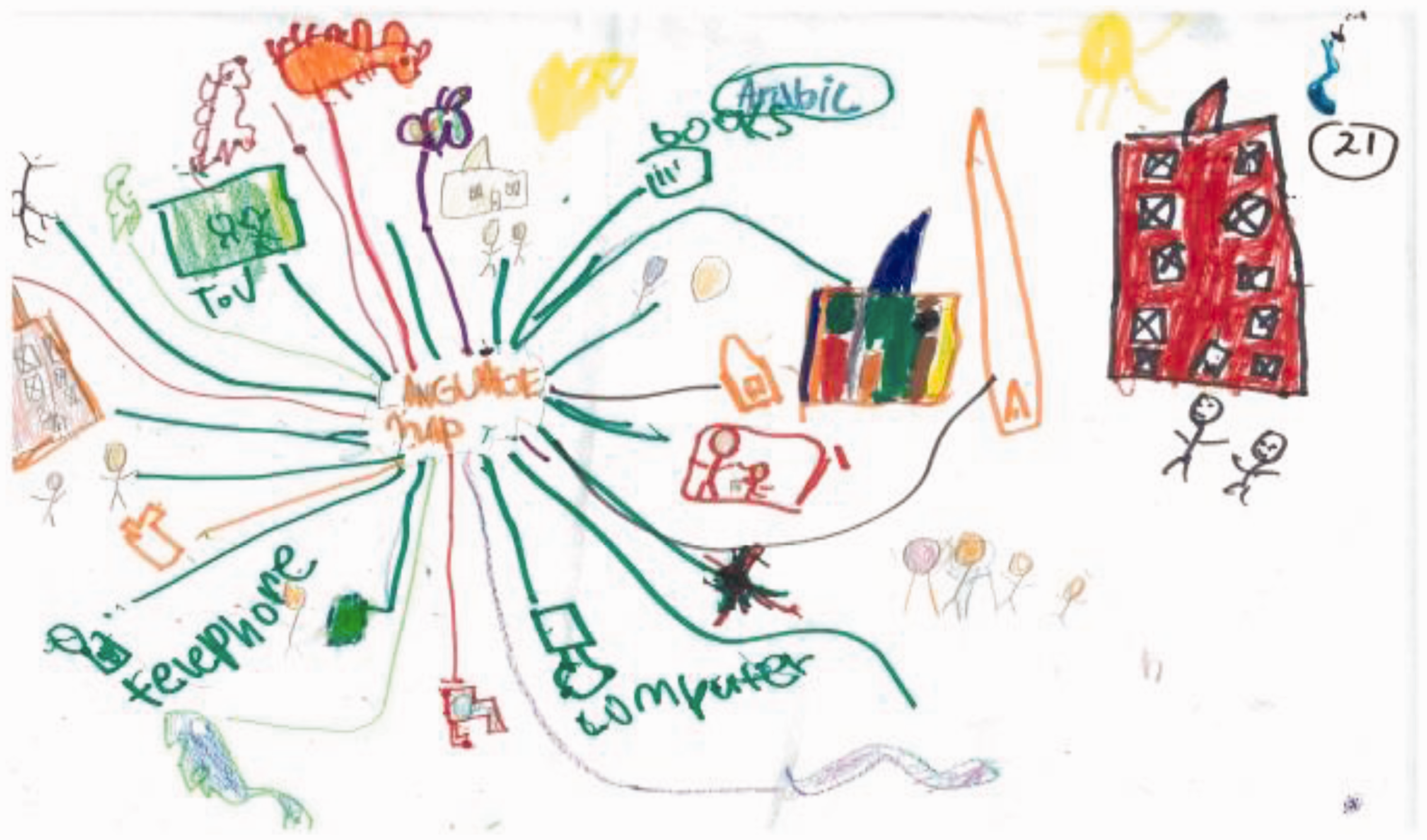
In Figure 3, the child depicts myriad multimodal communicative practices.
Multimodal communicative practices radiate out from the word language map; identified in words and pictures, they take up much of the space on the page and include a wide array of images of people, places and communicative mediums and technologies. The place of Arabic has prominence, sitting above processes and practices in the child's dynamic, everyday communicative world. The block image on the far right of the page is the school, an image clearly marked outside of the vivid communicative practices taking up most of the page. This positioning and the inclusion of barriers in other maps foregrounded a clear division between home and school for some children. These depictions led teachers to reflect on their own practice and to consider the value and importance of making explicit connections between home and school within their instruction. Teachers actively explored ways to make connections by drawing on students' practices and experiences, for writing in particular.
Mapping as a pedagogical tool
Maps became an alternative analytical tool through which teachers felt able to view their students’ sociocultural and sociolinguistic practices and skills in one or more languages or dialects. Looking at and talking about maps with individual children increased teachers’ awareness of the individual and dynamic practices of their emergent bilingual students. Teachers were able to see which languages were prominent and in which environment and the ways children were navigating home and school were elucidated. Teachers reported that, for them, the maps illuminated the close relationship between language and identity, both deepening their understanding of students’ linguistic and cultural resources and enabling them to see the importance of building on young people's bilingual and bicultural identities to complete class tasks. Maps elucidated the singularity and plurality of children's experiences and became a catalyst for generating authentic language and literacy tasks. This is represented in the following teacher comment offered in a final interview.
I am so amazed by what they did, all students, those that are not speaking English
to those that are now beginning to read and write in English or other languages. They were able to represent their languages and the ways they used them, it told me about their literacy and their developing language between home and school. I am so surprised by the detail, colour, drawings of people and places, I wasn't sure my young students would be able to do this at all. The knowledge that they are bringing in we have completely ignored. I haven't tapped into it at all, at this young age at Year One and Year Two I had never imagined that I would, we could get so much out of this.
Linking academic literacy content to students' experiences
Multimodal learning
Further development of children's multimodal language and literacy competencies was facilitated by using a range tools and associated applications, such as iPads. Teachers generated tasks from interviews and maps that employed visual literacy and included art, music and dance, as well as speaking, listening, reading, writing and viewing. Children took pictures of maps and then recorded themselves talking about one or more aspects.
Translanguaging pedagogies were employed in the use of voice-recording tools and they offered children an opportunity to use both their languages to complete classroom-learning activities. Children chose a favourite place and talked about what they did, how they felt and the language they used in that place. Children produced dual-language recordings of varyings length and complexity based on individual linguistic proficiency; these recordings were then shared with parents and bilingual peers. Teachers also used these recordings as an assessment task. One child shared how he made bread with his uncle: I am talking Arabic with my uncle, we are talking about bread, roll it, make it and then we eat it. The sharing of this practice became the basis of a role play, followed up with an invitation to the child's uncle to make bread with the class and the completion of a writing task that used Arabic and English to detail the process. Children were prompted to write: some dictated, copied or individually composed short pieces about one or more aspects of practices in English and in their home languages, depending on proficiency.
In pairs, children completed Venn diagrams, as seen in Image 1. They compared the practices and experiences detailed in maps; they drew, discussed and wrote about their similarities and/or differences. Partners shared what they had found about both themselves and each other in class presentations.
Venn diagrams.
These presentations became a catalyst for writing that included, for example, the introduction of simple and complex sentences and conjunctions. Children generated simple sentences, e.g. At home I speak in x, and moved on to use conjunctions to increase complexity. Sentences included, for example, Farsi helps me to learn English because I help mum understand English words; Arabic helps me in the Mosque because I translate Arabic words into English; I love my language because it makes me feel good when I talk to my friends in Chinese and My mum tells me words in Krio while I tell her words in English. While data revealed that sentences privileged English language use, teachers called on children's dynamic experiences and used an authentic topic for literacy learning, as one teacher noted: I was able to give the kids an authentic task that had real meaning for them. It came from the language work. They were expressing their point of view, identifying themselves and what they do in that sense, but it also helped me to develop their writing, meet my outcomes and validate their language.
Bilingual reading
Teachers further expanded multimodal, multilingual language and literacy work by engaging children and the school community in bilingual story reading. Teachers sourced a bilingual fairy tale series (Bilingual Books for kids Inc., http://www.bilingualbooks.com/) and accompanied these with a range of English versions of fairy tales that included Cinderella, Little Red Riding Hood, The Billy Goats Gruff, Sleeping Beauty and Goldilocks.
Read alouds
Children listened to bilingual fairy tales read in English, Turkish, Arabic, Chinese, Urdu, Hindi and Dari, matching the children's majority languages. Teachers invited bilingual aides, community language teachers, parents and community members to come to class and read stories in home languages or record themselves reading on audiovisual devices, such as iPads, school computers or phones. Books were sent home and volunteers were able to practise and record stories in their own time. All children read fairy tales in English prior to hearing and seeing them written in one of the target languages. Stories were read live or audio-recorded and projected onto interactive class boards for children to hear and view, as shown in Image 2.
Bilingual reading.
Teachers reported that this process began to facilitate community partnerships, beginning with increased communication with parents. While many parents were reluctant to read in the classroom, they were interested in learning more about what their children were doing and this facilitated opportunities for teachers to talk with parents about reading at home. Teachers sent bilingual books home for parents to read with children and several parents added to the class library by sending books to class in home languages. Including bilingual books as home reading encouraged parents and others to audio-record fairy tales in home languages. Teachers and students reported that if parents were unable to read in home languages, they invited older siblings, family members and friends to read on their behalf. In this way, individuals, families and communities were positioned as experts and knowledge producers. Home languages were being heard and valued within the classroom and reinforced at home.
Translanguaging pedagogies were employed in the literacy block as children read, discussed and compared stories presented in seven languages. Children asked questions about words and sound combinations and compared similarities and differences at the sound and word level; field notes revealed several discussions about onomatopoeia. Common nouns and verbs were listed and discussed in multiple languages. Teachers reported that hearing and seeing stories written in multiple languages began to promote competence and confidence and facilitated language learning, as detailed in two teacher comments. I am surprised by how much they enjoyed listening to multilingual stories even in languages they did not speak; I thought they might be bored but they kept asking miss, miss can we hear another story. They were so excited and so still and listening even R who cannot stay still for very long. They listened to stories on their own and were more confident with story mapping; going straight to it –it had more meaning I guess and each time more detail. I did the story maps before and after the bilingual readings and I could see the change, more writing more understanding. They were so engaged, smiling, listening, when we read the stories or when they were projected on the white board, so focused. I remember them really enjoying Goldilocks in Arabic, Dari and Chinese they were all laughing, it was wonderful! They asked so many questions and wanted to share words, like chair, bed, table, in their languages it gave them confidence. When they didn't know a word they asked their parents and told me the next day; sometimes they asked their friends and siblings during lunch and came running in to tell me. It was challenging adding sleepy, happy, sad and scared to our list, google translator first and then I asked parents and other speakers to write it and check it.
Comprehension and independent reading
Whole class reading was followed by a range of comprehension and meaning-making tasks. Observations and teacher assessments revealed high-level engagement and enhanced meaning-making. Data revealed multiple incidents of children independently reading and listening to multilingual audio recordings inside and outside of allocated reading time. Comprehensions tasks included sequencing and retelling activities, as shown in Image 3. Children often used multiple languages in retells and negotiated appropriate word choices with each other. Multilingual word lists and accompanying visuals supported story-mapping and the writing of character profiles. They provided a visual referent that both children and teachers could use, both scaffolding students' writing and helping teachers to interpret children's emergent writing.
Sequencing activities.
Becoming bilingual meaning makers
Identities and skills were foregrounded in the use of digital tools. Digital applications and support from bilingual teachers and parents made it easy for children to listen, write, draw, add photos and begin to expand their vocabulary and use their voices in multiple languages. Including bilingual reading and writing as a component of the literacy block facilitated linguistic flexibility and versatility, as all children were given opportunities to listen to stories and make meaning in multiple languages. Children and teachers built on and extended their own languages skills and competencies as bilingual meaning makers in producing school-valued texts, as illustrated by comments from a teacher and a parent volunteer: The multilingual word lists gave them confidence; they used them in writing and retelling. It gave them independence and they were so excited to add to these lists. It extended their vocabulary; I could not get R and S to write at all without sitting next to me. I saw value there, it really helped them, they used both languages. P kept asking me for more words and more books in Urdu, I was worried because I thought she should be doing English. I could see lots of English speaking and writing so I thought how doing both was helping her and others learn. I was so happy to share my language and P was more excited to learn more Urdu.
Discussion
Analysis centred on translanguaging practices and connections to students' experiences, particularly the dynamic exchanges between teachers and students that drew on students' multiple languages and language varieties and made relevant connections to academic content through the creation of authentic tasks. Findings reveal that facilitating opportunities for bilingual children to use their two or more languages for meaning-making can lead to enhanced learning, and these findings are congruent with previous studies of translanguaging practices in classroom contexts (e.g. Bauer and Gort, 2012; García, 2009; Sayer, 2011; Worthy et al., 2013). However, much of the research on translanguaging is undertaken in bilingual settings where teachers and schools have a predisposition to use and build on young people's home languages. Less research is available on translanguaging in the mainstream, multilingual classroom.
García and Wei (2014) maintain that translanguaging demands openness to co-learning with students in an atmosphere that enables ongoing enquiry. As 21st century classrooms become more linguistically diverse, key challenges include finding time for this enquiry and bolstering the abilities of teachers to build on young people's linguistic resources in the service of learning. Equally important is supporting children to recognize and value their knowledge and to encourage and advocate bilingual families' efforts to support their children's development of home languages. These goals were beginning to emerge in this school setting.
Teachers' knowledge
Sociocultural research has demonstrated that children transform, reorganize and renegotiate their languages and discourses from different social/cultural contexts in their interactions, and this is realized in this study. Educational research also purports that children quickly start to value speaking English over their home language and internalize deficit perspectives about speaking languages other than English (Cox, 2015; Hornberger and Link, 2012; Martínez-Roldán and Malavé, 2004). Correspondingly, understanding the attitudes and views influencing teachers and supporting them to recognize and validate linguistic diversity is crucial. It is also important to recognize that we must go beyond equally valuing all communities' linguistic resources and instead actively build on and extend the skills, knowledges and ways of being needed for success in the present and future.
Several studies report that teachers regard students' linguistic diversity in generally positive terms (Hammond, 2008; Reeves, 2006). However, research also reveals that many teachers find it challenging to move beyond merely honouring students' home languages to actively developing and using them to enhance learning (Anderson and Stillman; 2013; Kibler and Roman, 2013; Lucas and Villegas, 2013; Santoro and Kennedy, 2015). It can be argued that teachers in this study began to find ways to do this; children's languages were not just assigned a place and time in the curriculum but began to inform teaching and learning. More dedicated research is required that reveals how the exploration and cultivation of children's languages can be a first step in supporting their acquisition of state-mandated skills.
Pre-service and in-service teachers' professional learning programmes need to engage teachers in first exploring young people's languages knowledge and skills. In this study, an opportunity was afforded in first engaging teachers, students and community members in actively exploring students' linguistic repertoires together. Indeed, teachers and students were learning from and with each other. These linguistic repertoires became a shared resource that teachers and children could reference as part of classroom literacy activities. Garcia and Sylvan purport that noticing the learner as he or she is engaged in meaningful instructional activities is essential, and they suggest that when this happens educators can adjust their language and instructional practices in ways that support students' linguistic and cognitive growth (2011: 398). In this study, academic tasks were generated from the exploration of young people's linguistic repertoires. This type of classroom work has the potential to support teachers in educating all students equitably and meaningfully. In this classroom, a space was created for students to make sense of their learning by using languages and bicultural identities as resources, despite the centrality of English. Speaking and listening, writing, vocabulary development and comprehension, primarily in English but increasingly in the children's home languages, were encouraged by exploring what children knew and could do. This changed teachers' views and practice, as represented by a teacher's comment: I knew their first language and what they bring in class but I think that has really opened for us, we really need to give it more emphasis because for us as teachers we are looking at our outcomes, we are always into acquisition of their second language, but I saw understanding in their first language. I think we need to work more at recognising that and also letting them use it, making them feel confident and making them realise and understand that their first language is equally important as second language, so that is a really big thing. I realized this more and more as the research went on.
Conclusion
In this study, attention was given to the ways young people's language repertoires were recognized, validated and treated as resources for learning and the ways this began to promote children's identities as bilingual meaning-makers. This research has demonstrated that teachers did not need to master all of their students' languages to implement translanguaging as a curricular practice (Hornberger and Link, 2012). Instead, they could draw on the mobility of students' linguistic and communicative resources. While bilingual language repertoires were positioned as natural and valuable, English was dominant and privileged. Translanguaging tasks, such as using multiple languages, engaging in explicit phonemic and linguistic comparisons and including some writing in languages other than English, were partially taken up but required more dedicated application to fully support learning. However, young people's languaging was recognized and created a dynamic interrelationship between language and academic content.
As a monolingual speaker in a multilingual classroom, the speaking of English was privileged in field notes and this proved to be a limitation of this study. Children, community language teachers and bilingual teacher aides were called on to clarify much of the multilingual classroom talk. Future research will be conducted in partnership with bilingual others and attention will be paid to the further development of bilingual reading and writing processes and the capacities they offer in enhancing learning in mainstream classrooms. Additionally, ongoing research will engage multilingual pre-service teachers in further developing and trialling lessons and activities that explicitly include translanguaging pedagogies as part of mainstream classroom practice.
Footnotes
Acknowledgements
Many thanks to the inspiring teachers, teacher aides and parents for their ongoing work and for the expertise and enthusiasm they showed for this research. My sincere thanks to the bilingual storybook readers for sharing their time and linguistic expertise and to the young people whose enthusiasm and interest was compelling and made this research a joy for everyone involved.
Funding
The author(s) disclosed receipt of the following financial support for the research, authorship and/or publication of this article: This research was generously funded by and conducted in partnership with the NSW Department of Education and the School of Education, Centre for Educational Research.