




Abstract
For children born in the 21st century, the enmeshing of natural and human forces in the survival of the planet requires conceptual and practical innovation. This paper comes from a project funded by the Australian Research Council investigating the integration of literacy and sustainability in early years learning. The methodology employed was ‘deep hanging out’, the purpose of which is to observe without bias or assumption. This paper focuses on a video from a preschool depicting children playing drums and percussion instruments outside, in the playground. We consider the nature of literacy differently, conceptualizing literacy+sustainability within the context of the more-than-human, intra-active world. In our example, the drumming ebbs and flows in intensity, children come and go, rhythms merge then diverge; a chaos of sound and vibration, a refrain of rhythm, movement and bodies, driven by the excess of the earth’s energy and musical force. We see children communicate a sense of the world – with drums, each other, earth – sustained by the vitality of place, the materiality of drums and sound, the energy of earth and the movement of bodies. In this example, we extend the conversation around what literacy and sustainability might look like, offering possibilities for producing new knowledge about literacy and new understandings of sustainability.
Introduction
In the more-than-human world, humans and non-humans, animate and inanimate, visible and invisible exist together in entangled states of ever-changing becoming. Every configuration of separate entities converging produces something different; every iteration is unique and every encounter new. Humans are intricately influenced by any number of entities in the more-than-human world in all its facets of reality, whether animal, plant or element. Matter(s), materialities, bodies and beings are influenced just as intimately by the human. There is significant literature and growing research that advocates thinking-with the more-than-human, entangled, intra-active world (Atkinson, 2015; Barad, 2007; Lenz Taguchi, 2010; Pacini-Ketchabaw and Taylor, 2015; Rautio, 2014; St Pierre, 2013; Taylor, 2013). The common worlds approach, intra-action and intra-active pedagogy, and multispecies or interspecies perspectives are just a few examples of a posthumanist attitude to more-than-human research in the world.
The common worlds approach, as theorized by Latour (2004), has been taken up by many researchers (e.g. Taylor, 2013; Taylor and Giugni, 2012; Pacini-Ketchabaw and Taylor, 2015). Taylor and Giugni (2012) describe Latour’s ‘common world’ as one that asks us to ‘remain radically open’, because ‘it is only when we exercise curiosity to find out more about where we are, and who and what is there with us, that we find hitherto unknown dimensions to our common worlds’ (110). This approach understands the world as an enmeshed set of relations between all things, living and non-living. It is all-inclusive, comprehensively considering the place of animals, humans, technologies, objects, thoughts, discourses, past, present and future, in the existence and being that is life. It asks us to be ‘radically open’ and ‘it is only when we exercise curiosity to find out more about where we are, and who and what is there with us, that we find hitherto unknown dimensions to our common worlds’ (Taylor and Giugni, 2012: 110). In a similar way, the concept of intra-action, as theorized by Barad (2003, 2007), proposes that bodies and objects, affects and thoughts, all assemble, intermingle or join in ways that surpass mere connection or contact, they coalesce and merge to materially redefine each constituent and together they form a new entity. Intra-action is the ‘mutual constitution of entangled agencies’ (Barad, 2007: 33) where animate and inanimate are no longer separate or discrete when in relation with each other. The field of early childhood education has taken up the notion of intra-action as it applies to young children’s learning (e.g. Hultman and Lenz Taguchi, 2010; Lenz Taguchi, 2010, 2011; Rautio, 2014). Lenz Taguchi writes: The concept of intra-activity makes it clear to us why we cannot consider ourselves as a separate entity in the world, but, rather, must consider ourselves as a consequence of the world in a state of mutual inter-dependence with everything else. (40)
Ultimately, these approaches seek to decentre the human and reduce (or remove) the hierarchy between human and animal, things and matter. They recognize the deep and interrelated connections between all things, and the idea of things ‘becoming’ with others in that moment, that things are not static and unchanging. Rather they change (or become) as they merge with other beings or influences. Rethinking existence in this way facilitates an openness to the world, a way of thinking that frees the human from the boundaries of traditional practice(s), including conventional understandings regarding literacy in young children. Whilst acknowledging established literacy learning practices, a posthumanist perspective challenges the expected and focuses instead on ‘departures from the expected’ and on ‘notions of becoming’ (Kuby and Vaughn, 2015: 438), a concept drawn from the work of Deleuze and Guattari (1987). Thinking in this way and embracing such ‘entanglements help[s] highlight the playful improvisational literacy assemblages and intra-actions that unfold’ (Harwood and Collier, 2017: 347). We want to extend the conversation about being in the more-than-human world by suggesting that sound (which includes resonance and vibration) is the ‘lesser known modal resource’ (Wargo, 2017) and a material force, that intra-acts with child(ren) and matter(s) to give rise to something new, where each constituent implicates others and is simultaneously implicated by those others in a simultaneous process of be(com)ing. In doing so, we consider the intra-action of these materialities and forces as they relate to literacy and sustainability learning in young children, arguing that, in the more-than-human world, conventional views or conceptions of both literacy and sustainability must be considered more broadly and in relation to each other.
We present literacy and sustainability from the perspective of an international study, funded by the Australian Research Council, entitled, Naming the world: Enhancing literacy and sustainability in early years learning (Somerville et al., 2016–2019). The study is unique in that it investigates literacy and sustainability together, exploring ideas around what literacy+sustainability may mean in early years education. What we propose is a way of thinking differently about literacy, thinking differently about sustainability, and thinking these two together. In doing so, we consider the nature of literacy – within the context and conceptualization of literacy+sustainability – and we consider how literacy is experienced and enacted by young children. The example we have chosen focuses on a drumming event, a spontaneous performance experience of sound, rhythm, movement and vibration. We present a short video recording of this event that depicts a small group of preschool children (3–5 years of age) playing drums and percussion instruments outside, in the playground. We use the concepts of excess and chaos, as theorized by Elizabeth Grosz (2008), and Deleuze and Guattari’s (1987) notion of the refrain to think through this concept of literacy+sustainability in the early years of learning. We also explore the materiality of vibration and sound, integral to the impact of the drumming, moving and production of sound in this space, thereby extending theoretical imaginings of the more-than-human world. The significance of this intra-active (Barad, 2007) experience of material and cosmic force is considered in terms of its relationship to literacy and sustainability learning, offering an example of thinking differently about when and how learning may occur and what literacy could be.
Literacy+sustainability: Thinking differently
Belonging, Being & Becoming: Early Years Learning Framework (EYLF) (Commonwealth of Australia, 2009) is an Australian national syllabus document, specific to the learning of children aged 0–5 years. It consists of five main learning outcomes, each of which is broken down into a series of statements and examples of how children may demonstrate evidence of these things. Sustainability and environmental awareness form part of Outcome 2: Children are connected with and contribute to their world and are a particular focus of the statement, ‘Children become socially responsible and show respect for the environment’ (Commonwealth of Australia, 2009: 29). According to the EYLF, children show evidence through their knowledge and respect for living and non-living things, contact with natural and built environments, and they ‘develop an awareness of the impact of human activity on environments and the interdependence of living things’ (29). Literacy is comprehensively represented in Outcome 5: Children are effective communicators. This outcome involves numerous aspects of children’s literacy development, including communicating verbally and non-verbally, engaging with texts and their meanings, expressing ideas using various media, understanding symbols and patterns, and using Information & Communication Technology (ICT) to investigate and communicate (39). In this document, literacy and sustainability are quite separate, reflecting a history of thinking both literacy and sustainability in conventional ways. Literacy learning has traditionally privileged print literacy forms, such as reading and writing, and sustainability has largely focused on activities such as reducing waste products, recycling and reusing them. We suggest that bringing literacy and sustainability together, and thinking more intra-actively with them, allows a more open consideration of literacy as it relates to the world children know today and, in the more-than-human world that we consider here, literacy+sustainability can easily be considered ‘literacy+sustainability+’, reflecting the endless potential for the intra-action of materialities.
Children born into the 21st century enter a world very different from that experienced by earlier generations and there is a growing body of literature exploring the age of the Anthropocene, which recognizes the direct correlation between the natural world and the human, that the fate of the planet is entirely entangled with humankind (Zalasiewicz et al., 2010). With such entanglement in mind, it is important that educators and adults learn with and from children to understand the world and to strive to protect our futures. As St Pierre (2013) says, ‘We are not separate from the world. Being in every sense is entangled, connected, indefinite, impersonal, shifting into different multiplicities’ (226).
In thinking and theorizing around the concept of literacy+sustainability this project is set in the context of human-induced changes to the earth’s climate and wellbeing. The project brings literacy and sustainability together with the intention of ‘thinking them together’, which requires us to think differently about learning and meaning-making. This involves considering the rights of the planet and all its living things, as well as children’s right to be part of that world. At this stage we have come to understand sustainability learning as children’s continued, deep engagement in activities that connect them to their bodies, to the matter of the planet (e.g. earth, air, water) and to its living creatures. Signs that indicate this engagement are associated with excitement, intensity and vitality, where a child’s body and senses are fully immersed in what they are doing. Throughout this process children are ‘naming their worlds’, and this is made manifest in many different ways, including more conventional aspects of literacy, such as speaking and writing (mark-making), as well as less conventional aspects, including movement, gesture, sound and musical/rhythmic expression (Somerville and Powell, 2017). These ideas are in keeping with Outcomes 2 and 5 of the EYLF previously mentioned.
Music and movement are recognized forms of literacy and/or language and, according to the Early Years Learning Framework (Commonwealth of Australia, 2009), literacy is: …the capacity, confidence and disposition to use language in all its forms. Literacy incorporates a range of modes of communication including music, movement, dance, story telling, visual arts, media and drama, as well as talking, listening, viewing, reading and writing. (38)
Similarly, a study by Kuby and Vaughn (2015) showed literacy as being expressed in a variety of artistic or creative ways, including story-telling, art-making and writing. It also considered literacy as an enactment of agency where children demonstrated a process of becoming, thereby challenging conventional conceptions of literacy. This ‘privileged’ position of print literacy is questioned by McKee and Heydon (2015), who suggest that integrating a range of approaches will ‘allow for richness within meaning-making opportunities’ (231). They report on the various ways that the development of reading and writing was supported through the use of creative and artistic methods. For example, their study used song to help a young child write words or draw a picture, and they used an iPad to create a storybook. They argue that conventional or print literacy never exists in isolation and that children engage in a range of creative means to communicate. McKee and Heydon (2015) go on to say that multimodal literacy ‘involves the complex interrelationships between different semiotic modes and the materiality of each’ (229), and additionally ‘that thinking about literacy through music might open up new possibilities for conceptualizing print literacy and literacy practices within multimodal ensembles’ (229).
It is worth noting here that it is not only research in education that is connecting music with literacy. Research in the field of neuroscience continues to identify strong and tangible links between music and literacy. For example, Woodruff Carr et al. (2016) have demonstrated in their study that the ability to ‘keep the beat’ was directly connected to language and literacy acquisition, particularly during the critical period in early childhood. Shifting the focus of literacy learning in young children to encompass a range of modes and enactments, and acknowledging that existence is an intra-active web of entangled relationships, means thinking differently.
We want to consider the nature and enactment of literacy in young children so as to include sound, vibration and resonance (music) as part of the material experience of children in their literacy learning. We consider music in its ‘rawest’ form as an integral participant in the more-than-human world and a significant aspect of literacy+sustainability learning.
Chaos, sound and the refrain
Of all the arts, music is the most immediately moving, the most visceral and contagious in its effects (Grosz, 2008: 28).
In Chaos, Territory, Art, Grosz (2008) talks about nature as combinations of ‘cosmological forces’ that provide the creative means for something new to emerge, in particular, art. She describes this ‘material and organic indeterminacy’ (3) as chaos. Such a philosophy of art is not, however, about ordering chaos, nor representing or reducing it to a structure or predictable entity. Rather it is about experimenting and harnessing the forces of the cosmos from any number of conceptual perspectives to make sense of it in that moment, or even to undo it. Art, therefore, does not impose order but it ‘contain[s] some of its fragments in some small space’ so that the ‘living can utilize [it] without being completely overwhelmed’ (28).
Grosz (2008) explores other thinking around music and nature, such as that of Darwin and Uexkull. Such philosophers describe music as a fundamental component of nature and life. Grosz argues that music goes beyond mere survival and demonstrates an excess, an ‘evocative intensification and pleasure’ (36) for its own sake. She goes on to describe the place of music across all peoples and histories, further exemplifying its elemental place in nature and of being: Every people sings the earth and their own bodies into existence only by identifying those earthly elements that tie into or counterpoint their bodies and bodily needs: the earth, however rarefied and abstracted, still marks every body and is the condition for every body's artistic capacities. It is because the earth frames and engulfs the body that the body can sing the earth and the stories of its origin. (51)
It is important to note that not all sound is necessarily considered music and that perspectives differ considerably. Burton (2015) argues that ‘any sound can be either musical or unmusical, depending on the context’ (24) and intention. When considering the way sound is processed by the brain, Miranda (2010) suggests that music is ‘organised sound’ (14) and this notion is consistent with various music syllabus documents (e.g. see Board of Studies NSW, 2003; Board of Studies NSW, 2006; Government of Western Australia, 2013). Similarly, Marsh (2008) discusses the ways in which children manipulate sound(s) to create musical games, songs and compositions in the playground. She describes the complexities of such organization, the array of sounds and sound sources used, and the role of sociocultural context in the performance and construction of children’s musical play. For Grosz (2008), the sounds of the earth contribute to an ‘ontology of music’ (26), where the ‘vibrations, waves, oscillations [and] resonances [that] affect living bodies’ (31) are the sounds of the earth that music has ‘charmed’ (31). Music, therefore, is a way to ‘enjoy the forces of the earth itself’ (31), an organization of sound, vibration and rhythm. It could be argued, then, that sound has its own ontology, unique be(com)ing(s). Such a notion is supported by Miranda (2010) who argues, albeit from a very different perspective, that sounds are processed differently in the brain, ‘depending on their specific characteristics’ (14), thereby demonstrating that the nature of sounds differs in quality and perception, being and becoming differently depending on context and the intra-active scene. According to Henrique (2008) sound is always changing; it is ‘never static … always transitory and ephemeral’ (219).
Sound resonates across life, provoking excess, inscribing itself on all living things. According to Gershon (2013), ‘everything vibrates’ (258) and even that which appears unmoving is simply a result of the inability to perceive movement. Like Grosz (2008), he suggests that because sound impacts on ‘everyday ways of being and knowing’ (258), resonance has both theoretical and material importance and consequently constructs a system of knowledge: Sounds can therefore be understood to form educational systems of knowledge that not only make previously hidden understandings audible but can also be utilized materially to interpret the ordinarily sensible, everyday acts of sensemaking. (Gershon, 2013: 258)
St Pierre (2013) describes the ‘experimental work of thinking the world differently’ (226), going beyond empiricist approaches of attempting to uncover the given meanings assigned to phenomena. This means that the world offers infinite possibilities for meaning and existence, even things that have not yet been thought (226). Thinking differently encourages a freedom of thought, challenging the given and the repetition of what has already been told. Coupled with this is Haraway’s (2015) notion of curious practice. She talks about ‘politeness’ and developing ‘the wild virtue of curiosity’ (5), and she encourages venturing ‘a bit too far off the path’ (6) in order to experience the surprises of the world openly and with a curious mind, always believing that things and people are interesting. Kuby and Rowsell (2017), like St Pierre (2013), issue a challenge to embrace the practice of thinking differently. They draw inspiration from the experimental thought of Deleuze and Guattari, who have ‘thought, experimented, encountered outside worlds (in which we are all already entangled) and engaged with the unthought’ (287). In this way, Kuby and Vaughn (2015) propose that ‘the field of poststructural theory offers an invigorating way to explore literacy practices’ (438).
In our example, we explore the intra-active power and relations of drums and instruments, children’s bodies, movement, sound, vibration, resonance and the earth, an example of the more-than-human world at work together as a moment of literacy+sustainability learning.
The project
Our project involves early learning sites from three Australian locations: Western Sydney, New South Wales; Brisbane, Queensland; and Melbourne, Victoria. It also involves a kindergarten site in Oulu, Finland. The data discussed in this paper come from one of these seven early learning centres: a preschool in New South Wales, situated to the west of Sydney against a backdrop of bush land in the lower Blue Mountains. The participants include about 30 children, aged 3–5 years, and six staff members, both educators and assistants. The children are divided between two rooms based on their pattern of attendance – two days or three days per week – and the numbers of girls and boys across the two rooms are comparable. The data presented here were collected during the first phase of the project, a phase characterized by an observation process of ‘deep hanging out’.
Formal ethical approval was obtained through university processes and an opt-out consent form was distributed to parents to indicate if they did not want their child to be photographed, recorded or involved part of their normal preschool activities. As researchers, however, we were particularly interested in informal consent. We quickly became aware of when and how children gave us their consent to engage with them and when they did not. There were times when children were performing or making music and they were aware of the attraction of their performance, delighting in being recorded by us, but they did not want us to interfere; we did not belong to their performance. They were happy for us to be watching them, in their vicinity, but we did not belong to those moments except as observers or as an audience. We encountered this in various spaces and locations in over two years of this work.
Methodology and methods
Deep hanging out
Deep hanging out is an immersive approach that involves being with children and observing them in their context, and although we know it is impossible for us not to intrude to some degree, we observe at a distance and wait to be invited into that moment by the children. Invitations come in all sorts of ways, including a look from a child, an offer to eat something made of mud, to drink invisible tea, direct conversation from a child or a request to do something for or with them. A term originally associated with anthropology and ethnographic research (Wogan, 2004), deep hanging out involves sitting in the sandpit and in the dirt with children, engaging with them at their level, being splashed by muddy water and being drawn into elaborate, imaginative games. It is about knowing when to be involved and when to keep your distance; when you have been included and when you have been excluded. Deep hanging out is about observing without preconceived notions of what will or should be discovered. Instead it is an open, curious practice (Haraway, 2015) that believes something interesting and surprising will emerge. Our deep hanging out seeks to build on Haraway’s notion of curious practice, which is particularly characterized by being open to anything that happens. Our example here grows out of our experience, as researchers, of being completely implicated in the moment of the encounter and we find ourselves being open to whatever happens, to whatever the moment asks.
During our deep hanging out, we used iPhones as a method of collecting data. The iPhone is, generally speaking, a ubiquitous item in the lives of 21st century children in this location and these children are accustomed to being photographed or videoed by their educators. They would regularly ask us to photograph or record them and then they would enjoy watching the playback and seeing themselves on the screen. Even in something so simple and banal, we are reminded of Barad (2007) and Haraway (2006) who talk about the apparatus as an integral part of a scenario, and again we see how the the more-than-human world assumes yet another facet. Powell (2016) notes a similar phenomenon in her exploration of a child’s video-song created and recorded on an iPad. In her example, the child uses an iPad to record herself singing a song that she made up about the bush. The video shows the child’s bedroom – toys, pink bed covers, clothes – and at times moves side to side with the rhythm of the words. In this way, the iPad has become an integral part of the song, the non-human eyes of the child, and without it the moment would be completely different. The data we collected included short video recordings, photos and notes. Photos were taken to capture a moment of significance where possible. Video recordings are between 10 seconds and 2 minutes in length, often exemplifying the frustration of not quite capturing what was happening. As researchers, we experience the tension inherent in being there to observe and being part of the scene just by being there, just as the iPhone becomes an integral ingredient in the moment. As onlookers we experience the scene, and the sound of the scene, quite differently to the children. When we watch the recording later, we experience it differently again, through the mediation of the iPhone, the sound and vibration being felt in a different way, the image viewed through an alternate lens. The iPhone was also used to jot down words and ideas using the Notes App. These are on-the-spot thought words, articulated in brevity during times of being immersed with children, the intention being to capture something of the moment for later reference. We follow our field visits by writing comprehensive fieldnotes, providing a more detailed and descriptive narrative of what happened, both in an observational sense and in terms of things we, the researchers, experienced, felt, understood, were confounded by, thought and wondered.
Each of us recorded this ‘drumming’ event but from different locations in the playground. Neither of us knew that the other was doing the same. Margaret sat on the large, flat rock near to the drumming site, and Sarah sat on a garden bench, much further away, all the while listening to a young boy chat incessantly about Transformers. The recording we use here was the one captured by Margaret, who was positioned close to the group of children. We were interested in why both of us, despite our disparate locations, were equally drawn to the sound and movement of these children. Something drew us in. Neither of us was involved or close enough to interfere in the activity and neither of us knew what the other was doing, and yet both were drawn inextricably to it. We were yet another part of the intra-action of bodies, earth, instruments, sound, vibration and iPhones, a contributing factor in this more-than-human scene, implicated simply by our presence. The music continued across the morning session, spanning a couple of hours, with children leaving and returning, experimenting and watching throughout that time. Seemingly unrelated games interrupted it and then grew from it, but there was always a return to it somehow and in some form. During this time we see children produce sound through their drumming and we see them responding to sound – children approach the scene, they move their bodies to the rhythms as they walk past, and some of the players change instruments, looking for another sound or colour or vibrational intensity. We, the researchers, also respond to the sound, being drawn to it, recording it, feeling its resonance through the wooden seat or the big rock. At the same, we cannot know what other sounds or influences are impacting on this scene, but despite all the ambient, ordinary preschool noises – teachers’ voices, children’s screams, laughs, cries, cars driving by, birds, a train – something about this drumming draws us all in.
Drumming in excess and chaos
The data example: A video transcript
The scene is both obscured and viewed through the leafless, bare branches of a small tree.
A group of seven children sit on a green rug. A drum or percussion instrument sits on the ground in front or in the hand of each child. A large, slightly elevated rock stands behind the group; a blue, plastic ball lies close by, discarded. The ground is dirt and bark; lomandra grasses randomly dot the perimeter. Beyond the fence, the bike track and fairy garden, a blue-white ‘P’ parking sign and a yellow-black pedestrian sign, intermingled with the green of hedges and trees; a teacher and two children stand at the gate. The open storeroom reveals a clutter of colourful equipment and toys. A green and red tumbling mat to the side with two sets of shoed feet, pink and grey, visible to the ankles. An unhappy, wailing sound permeates the air. A fluffy, brown horsehead on a stick lies waiting in the dirt.
The still frame of the video captures the percussion group in a mostly circular formation. Isaac sits on a blue stool, side on to the camera, playing two floor toms with a clapping stick (claves) in each hand. Anna, facing the camera, is crouching to reach for sticks. Harry, also facing the camera, is kneeling down and reaching for something to play. Billy, side on, sits on his haunches. James is crouching with his back to camera. Samuel, crouching, is about to move in and Tom is also crouching, side on to the camera, largely obscured by Billy (see Figure 1).
Starting and facing positions.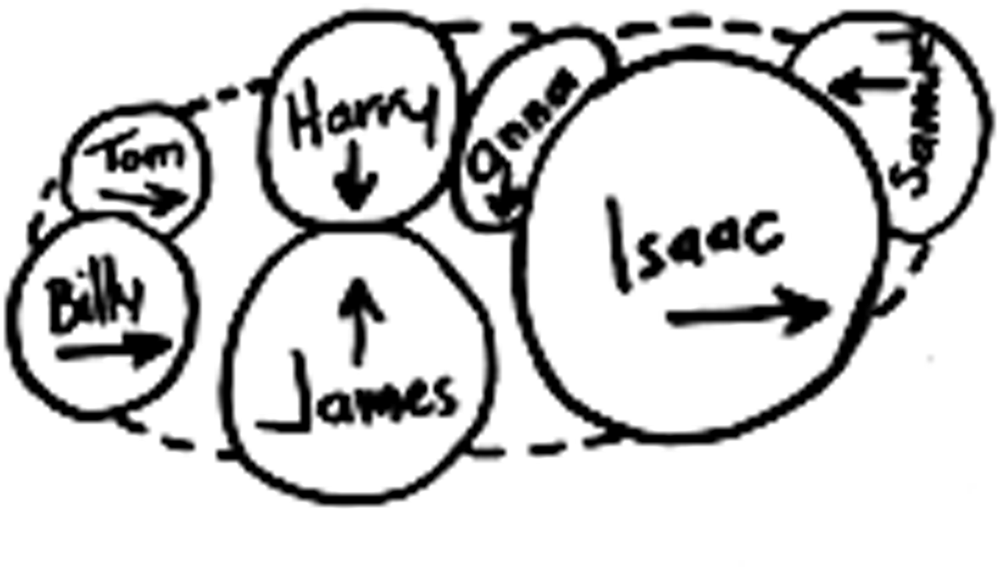
The children play their instruments at the same time. They occupy the same small space of the preschool playground. They are a group, a complexity of simple rhythms and movements. Some of the children look around at others as they play. Some remain consumed by their own production of sound and vibration. There are various patterns that ebb and flow, moving in and out of actuality and comprehension. Concrete, tangible rhythms overlaid with others not so perceptible. Isaac plays a strong beat-like pattern. He uses both hands, left then left and right together (see Figure 2). It is the most stable of all rhythms that occur.
Isaac’s pattern.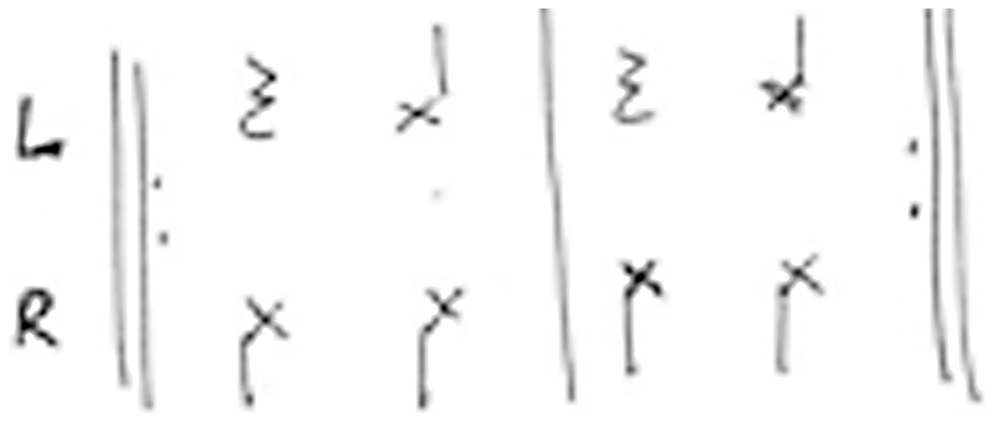
The beat draws in other players who experiment with different patterns and different sound sources. A metallic triangle rings out above the earthiness of the drum, a more random rhythmic experimentation that produces a divergent vibrational feel. Another drum, a smaller, less resonant tambour, taps out a triplet pattern, three notes in the time of two, which seamlessly morphs into semiquavers (see Figure 3) and then quickly dissolves to nothing.
Triplets to semiquavers.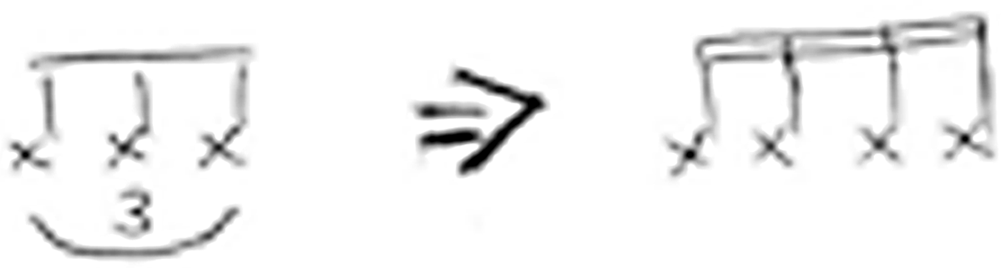
Still more patterns come in and out of existence, briefly changing the vibrations and sensory impact of the sound. Children stand up and move, seeking a new instrument, a new position. Billy stands up and begins to ‘conduct’ the group, the claves leading. Samuel has stood up now. He is playing clapping sticks too. He drops one, picks it up, drops it again then moves away, just a little. As he does so Harry approaches and tries to snatch the claves from him. A slight tussle ensues before Harry retrieves the spare, discarded clapping stick, his body communicating his displeasure, and returns to his spot on the mat. At the same time, three boys approach from the fairy garden. One walks past, his body moving in response to the cacophony. Another boy stands and stares, transfixed. A third boy watches the collection of bodies, instruments and sounds as he walks by, and not looking where he is going he almost trips. The drum continues to beat from Isaac and his sticks, the rhythms continue, the recording ends.
Discussion
In this example, the more-than-human, intra-active world is extended beyond the visible. There are objects and humans; there are musical instruments and earth; there is movement and there are several different bodies intra-acting in this moment. The example, however, encompasses more and we suggest that the music being produced, which consists of sound, vibration and resonance, plays an equally significant role in the production of literacy+sustainability learning in these children.
To begin with, the drumming sequence shows children involved in prolonged, sustained, deep engagement and this is consistent with our theorizing of literacy+sustainability. The scene demonstrates children connected to their bodies, through movement, action, sound production and gesture. It shows them connected to the elements, to the matter of the planet, their feet on earth and dirt, their bodies resonating with the vibrations of sound through air, earth, rock and bodies (their own as well as other humans). The level of engagement is high. There is excitement and yet it is a concentrated calm excitement filled with intensity and aliveness. This also points to what Grosz (2008) refers to as excess. The drumming is not something that children need to do in order to survive, rather they engage with it for the simple act of enjoyment. The encounter has generated an energetic display of pleasure for the sake of it. In this moment, or series of moments, the senses of the children are fully immersed in what they are doing. The conglomeration of objects, bodies, earth, sound and vibration have engaged their physical senses, hearing, feeling and seeing this collective moment. We see the nature of literacy differently here, conceptualizing literacy+sustainability within the context of the more-than-human, intra-active world. In this way, the drumming ebbs and flows in intensity, children come and go, rhythms merge then diverge; a chaos of sound and vibration, a refrain of rhythm, movement and bodies, driven by the excess of the earth’s energy and musical force. We see children communicate a sense of the world – with drums, each other, earth – sustained by the vitality of place, the materiality of drums and sound, the energy of earth and the movement of bodies.
The 34 seconds of the video present a music-making experience of individualities being performed simultaneously as a group. It is an a-grammatical (MacLure, 2016) enactment of music, in the sense that it does not follow conventions and bears only a small resemblance to formalized music. The children do not use spoken language to communicate with each other; they say nothing, in fact. The most stable or secure part is the reasonably steady beat being played on the large drums by Isaac, and yet, he sits with his back to the rest of the children the entire time he plays, communicating only through his drumming. Although playing together, each child experiments as a single entity, seemingly disconnected from the other parts; however, their improvisations are heard to change as other rhythms change, demonstrating the interconnectedness of the different vibrations, rhythms, bodies and parts. Such interdependence is encapsulated by Wargo (2017), who says that ‘humans and the more (than) human are both the singular and plural, the oscillation and unfolding of intensities that work through the material <->discursive’ (395). In this way, they rely on, and are defined and changed by, every alteration and deviation.
Gallagher (2016) argues that everything has the power to affect everything else through its sonic vibration and it is possible that each vibrational variation that occurs – for example, a changing rhythm pattern, choosing a new instrument – has a physical impact on the vibrational output and the physical/sonic experience of another child – they may move to a new place on the mat, select another instrument, change their pattern or communicate with another child. Sound is ‘a force that physically moves bodies of many different kinds’ (Gallagher, 2016: 47). It is a material force that compels a body to respond. The video shows the way children respond differently. Some children stay in one place as they play; others get up and move to new spaces. One boy invades the space of another child and a slight altercation results. They communicate by the shifting of their body to a new position and shape. Even more fascinating, though, is the movement of their body parts as they play. The intensity and colour of the sound is immediately altered when the arm or hand changes what it does, how hard it hits the drum, how quickly it moves the stick, how high an arm is lifted. The instrument responds to the body of the child just as the child’s body responds to the instrument’s sound and feel. It plays louder or softer, faster or slower, the speed of its vibrations reacting to the different modes of play. Movements alter the vibration and the resonance, changing the sound, its intensity and its impact, thereby demonstrating once again the ‘resonant relations between bodies/materials/space’ (Wargo, 2017: 406). The effects can also be seen on the children who walk past or who stop to watch the group. Although not directly involved these onlookers are drawn in, they move closer to the sound source, they move away and they return. Their bodies react – they stop to look/listen/feel; they walk in a jerky, rhythm-inspired fashion – they are compelled to respond, compelled to respond to the pleasurable force of excess generated by the musical vibration and action, for the pure enjoyment of doing so. It could even be argued that the instruments call to the children, asking to be played. A clapping stick discarded does not lie for long before being claimed by a child again, a drum left unattended is quickly repossessed, and the sound endures uninterrupted, generating the vibration and resonance felt by all. Harwood and Collier (2017) argue that moving away from a human-centric reading of the world means ‘viewing relations within a material turn’ (339) in ‘a process that is mutually interdependent and intertwined’ (338), rather than privileging the human in these encounters. Everything, even an instrument lying on the ground, is a ‘performative agent’ (338) with the capacity to impact on other entities.
Complementing this intra-active consideration of the drumming video, we also look briefly at it from the perspective of the refrain and the ordering of cosmological chaos. The refrain is ‘a concept explicitly associated with the child in the work of Deleuze and Guattari’ (MacLure, 2016: 73). A refrain can be made up of nonsense syllables, snippets of things heard, traces of other things, which are organized by a child to create something different. The drumming video exemplifies this as rhythmic patterns are repeated and played with, repeated and changed, repeated and abandoned, repeated and developed, returning again and again in different forms, all the while retaining something of their origin. In this way too the drumming is an a-grammatical (MacLure, 2016) musical performance. It follows no set rules. It develops and functions as a set of individual parts, very rarely coming together to form something that makes conventional musical sense (e.g. staying in time with each other). Instead each of the rhythms is performed and transformed at an individual tempo (speed), changing haphazardly and only, it would seem, unintentionally coinciding in congruence with other parts, a picture of the musically a-grammatical child, engaging in the making and re-making of the refrain.
The resonance experienced by each child, whether conscious of it or not, is understood by Grosz (2008) as a ‘kind of rhythmic regularity that brings a minimum of livable order to a situation in which chaos beckons’ (52). The refrain is a way of making sense of the earth in any given moment, a ‘kind of order of safety that protects the body through the rhythms of the earth itself’ (52). In this way the children connect resonantly with the forces of the earth, responding to its vibrational affect, and elemental being. The rhythms provide an order, if only for a short time, before they transform to embody something new and different. The refrain, the return of a musical idea, a motif, changes with every iteration and yet it retains some of its origin each time – a momentary containment of the forces of the chaotic cosmos. ‘Sounds combine with new sounds’ and these ‘new combinations create new rhythms’ (Adkins, 2015: 175). In this moment it would seem that the children are connecting with the natural world through the vibrational forces of the earth, felt through the tonal, resonant qualities of drums and percussion instruments. It is the bodily response to resonance that enacts meaning-making in children, a grappling-with, an understanding of, and a creating meaning from the forces that connect the child’s body to the earth and cosmos in all of its chaos.
Meaning-making is a theme that runs strongly through the EYLF (Commonwealth of Australia, 2009). It appears particularly in relation to developing identity (Outcome 1) and developing communication skills (Outcome 5). The EYLF seeks to facilitate opportunities for children to ‘make meaning’ of their world in a range of ways and contexts, stating that ‘childhood is a time to be, to seek and make meaning of the world’ (7). The meaning-making in our example points to the heart of literacy, and according to the EYLF (Commonwealth of Australia, 2009), the crux of literacy is communication. This can occur across an array of multimodalities and forms of communicative expression (Hackett et al., 2017; Hackett and Somerville, 2017; Kuby and Vaughn, 2017; McKee and Heydon, 2015). In this way music, rhythm, sound and vibration offer children communicative opportunities to understand the world (make meaning) and to express that understanding (literacy). The drumming example, like many other moments we witnessed in our deep hanging out, ‘generated new forms of embodied knowledge-in-motion’ (Wargo, 2017: 393), a way of considering literacy and sustainability differently. Literacy+sustainability, therefore, is a merging of these chaotic forces of meaning and understandings of the world, an intra-action of earthly and cosmic chaos, vibration and resonance, bodies and thought. The body of the child interprets and experiences understanding and meaning at the most elemental level, intra-actively intermingling and co-creating meaning with and through sound, other humans, objects, earth, air, time and movement. The moment demonstrates an enactment of learning and being in the more-than-human world, utterly entangled in a process of meaning-making. As we consider the intra-active nature of this scene, like Rautio (2014), ‘we can rethink our understanding of how children coexist with their material surroundings’ (462) and continue to challenge the propensity for representation and the privileging of conventional vocabularies of literacy, extending the conversation around what constitutes literacy in the early childhood more-than-human world (McKee and Heydon, 2015).
Conclusion
The project from which this paper emerges aims to think literacy and sustainability together in early years settings, where literacy+sustainability is about children being deeply engaged in activities that immerse their bodies intra-actively with the natural world, its chaos and vibrational affect. We understand literacy+sustainability to incorporate moments where we find children completely immersed in activities that connect them to their bodies, to the world and to its living creatures, and we see them connected with intensity, vitality and sustained engagement. In considering drumming in excess and chaos, we open up possibilities for thinking differently about literacy and sustainability through an ontology of sound. In this ontology, children are immersed in a more-than-human world of music, sound, rhythm, vibration and resonance in the intra-active nature and enactment of early childhood literacies. In this intra-active enactment, children and objects, elements and movement engage in an intense experience of meaning-making through the collective production of sound, vibrations, rhythms and intensities drawing on the chaos of the world. Children’s bodies respond to the vibrational forces of the earth through repeated and changing rhythmic refrains produced on drums and percussion instruments. We see their ‘music’ making sense of the fundamental, natural connective forces between body, vibration, resonance and the earth in a process of intra-active communication, expression and being.
Footnotes
Acknowledgements
We would like to acknowledge the ‘Naming the World Collective’ within which ideas are shared and explored. The collective consists of researchers from Australia, the UK and Finland, and includes Margaret Somerville, Annette Woods, Iris Duhn, Sarah Powell, Sarita Galvez, Michelle Jeffries, Sarah Crinall, Abigail Hackett, Pauliina Rautio and Anna Vladimirova.
Funding
The authors disclosed receipt of the following financial support for the research, authorship, and/or publication of this article: Naming the world: Enhancing literacy and sustainability in early years learning was funded by the Australian Research Council (ARC) Discovery Scheme. ARC Project ID: DP160101008. HREC Approval Number: H11590.