



Abstract
Literacy development involves not only the cultivation of new practices but also of new identities. Drawing on theories of stance and positioning, this study examines the identity negotiations of one first-grade student with his teacher across a semester. Through close analysis of the stance bids and negotiations within a series of writing conferences, it demonstrates how the pair negotiated between four stances (feedback, instruction, management and collaboration) in disrupting the student’s initial institutional positioning as a struggling writer. These findings illustrate how teachers might use stance as a pedagogical tool, highlighting three patterns of negotiation between the pair that supported the development of the student’s literate identities while showing how new discursive patterns and positions emerged as the pair interacted across a semester. This analysis suggests the necessity of negotiation as a pedagogical orientation in (re)positioning students, as well as the need to look across multiple timescales in examinations of identity.
Introduction
While literacy instruction in early childhood classrooms increasingly centres on the acquisition of a set of discrete ‘basic skills’ (Dyson, 2013), a significant body of research argues that effective literacy pedagogy must recognize literacy development as deeply intertwined with the construction of identity. The development of literacy, then, involves not the sequential acquisition of cognitive skills but instead a social and emotional experience (Bomer and Laman, 2004; Jocius, 2017). The positioning of individuals as ‘smart’, ‘struggling’ or otherwise can serve as a means to either encourage or constrain opportunities for learning, which in turn either reifies or disrupts existing identity positions (Chisholm and Olinger, 2017; Kayi-Aydar, 2014). The ways in which instruction is structured, then, can alternatively encourage or discourage the construction of productive literate identities (Aukerman and Chambers Schuldt, 2015; Triplett, 2007). A student’s identity as a reader or writer is not simply a corollary of literacy development but instead is recursively related to it. This relationship between literacy development and identity is particularly evident in early childhood education spaces, where children are socialized into what it means to be a reader and writer in that particular context (Compton-Lilly, 2006; Wohlwend, 2015). Considering literacy practice in early childhood classrooms through a lens of identity can allow researchers and teachers to better understand and ultimately support the varied paths young children follow in becoming literate (Wagner, 2018).
Teachers play a seminal role in the construction of identity (Palmer, 2008; Worthy et al., 2012), yet they alone do not determine it. Although young children’s agency has historically been understated within scholarship (Uprichard, 2010), more recent research has highlighted the active role young children play in shaping their identities (Brownell, 2017; Moses and Kelly, 2017; Tolentino and Lawson, 2017). Additionally, the construction of identity is shaped by forces outside the teacher–student relationship, including students’ experiences with high-stakes testing and grading (Dutro and Selland, 2012; Ryan, 2014). Racism and dominant language ideologies are additional forces at play, shaping how teachers interpret the reading and writing practices of students (Dyson, 2015; Leonardo and Broderick, 2011).
In recognition of the ‘active, strategic, and agential work’ (188) at play, Compton-Lilly et al. (2017) intentionally frame this process as a negotiation. This framing highlights the tensions inherent in identity construction, recognizing that identity is not formed within an individual but instead is always being negotiated amidst multiple forces (interpersonal and institutional) through ongoing activity. In this analysis, I build upon theorizing of identity as negotiation by examining how one first-grade student, Zion, and his teacher, Ms Grey, negotiate identity by positioning themselves and one another in a series of writing conferences spanning one semester. Zion, like far too many students of colour in urban schools, entered Ms Grey’s classroom positioned as a ‘struggling’ writer based on both his standardized testing performance and his previous classroom experiences. Using theories of positioning and stance, I illustrate how Ms Grey and Zion negotiated a shared understanding of what it meant to be a writer in that space, including how Ms Grey’s strategic use of stance supported and made space for Zion to position himself as a writer.
Theorizing interaction and identity
Centring on the relationship between interaction and identity, I take up the notion of identity-as-position in this study (Moje and Luke, 2009). Davies and Harré (1990) initially developed positioning theory as a response to the more static notions of identity as ‘role’.
Rather than view individuals as entering into interactions with already defined identities, positioning theory posits that people are perpetually engaged in the positioning of themselves and their interlocutors. Individuals use particular registers, lexicons and nonverbal cues to signal themselves and their partners as members of particular groups. In turn, these emerging identity positions afford participants particular rights and responsibilities in that interaction (Bucholtz and Hall, 2010; Harré et al., 2009). By positioning oneself as a literacy mentor to other students, for instance, a student can interact with fellow students in ways that differ from how they would typically interact with their peers (Frankel et al., 2018).
The pedagogical value of positioning is due in part to its relational and dialogic nature. Within an interaction, an individual is always positioning both themself and their interlocutor (Harré and Van Langenhove, 1999). While such positioning is not always deliberate, it can be done intentionally (Bucholtz and Hall, 2004). Teachers, then, can use positioning as a pedagogical tool, deliberately performing identities that in turn position students in particular ways (Palmer and Martínez, 2013; Taylor, 2017). For instance, by positioning herself as a facilitator within a text-based discussion, a teacher concurrently positions her students as active meaning-makers of the text (May, 2011). This relational dimension of positioning suggests that teachers can support students in negotiating literate identities through the conscious performance of particular identity positions.
However, a recurrent tension in the positioning literature poses challenges to this pedagogical use of positioning. This tension concerns the relationship between moment-to-moment negotiation of position within discrete interactions and more elongated trajectories of identity over time. Within classroom research, there are calls for both more fine-grained, multimodal analyses of positioning (Kayi-Aydar and Miller, 2018) and for more longitudinal studies of identity (Lee and Anderson, 2009). To make connections in the negotiation of identity across these multiple timescales, I draw on two additional constructs: stance and lamination.
Stance serves to make connections between particular linguistic moves and larger categories of identity (Bucholtz and Hall, 2008), directing attention to the ‘subtler and more fleeting interactional moves’ (Bucholtz, 2009: 7) that over time construct more durable identity positions. Building from Ochs’ (1992) theorizing of the indexical nature of identity, stance recognizes how individuals use talk to index particular identity positions (Clift, 2006; Jaffe, 2009). In other words, an individual enacts a certain stance within an interaction by using features of language associated with that identity position. Bucholtz (2009), for instance, documents how a group of Latino students used the word güey, in concert with other semiotic resources like prosody and posture, to situate themselves within a localized identity position of masculinity. Stance analysis makes visible the subtle use of interactional cues to position oneself as a certain kind of person within an interaction.
Particularly relevant for this analysis is stance’s attention to alignment between interlocutors (Du Bois, 2007). Throughout an interaction, both speaker and listener use verbal and nonverbal resources to manage their alignment of stance with one another. When an individual makes a bid for a certain stance, their interlocutor can in turn either reify or contest that proposed stance (Kiesling, 2011). By nodding while listening to an interlocutor tell a story, for example, the listener indicates their acceptance of the teller’s stance (Stivers, 2008). This recognition of the ongoing arbitration of stance between interlocutors aligns with theorizing of identity as a continuous negotiation.
Whereas stance directs attention to moment-to-moment interaction, the construct of lamination considers the relationship between individual interactions and more durable identity positions. Holland and Leander (2004) use lamination as a metaphor for this process, evoking the practice of layering sheets of metal to create a new material. This metaphor of lamination allows us to consider how positioning within distinct interactions become, layered in a person’s experience, resulting in a more stable identity that travels across interactions. A series of interactions that position an individual as a ‘struggling’ in school, for instance, are layered on one another within an individual’s experience, thus thickening (Holland and Lave, 2001) their identity as a ‘struggling’ student.
In recognizing how previous interactional positioning affects a new interaction, the construction of lamination addresses the role of history and memory in identity construction. Just as lamination places new layers upon existing ones, interactions layer new identity positions upon existing ones. An individual whose identity is layered with experiences that positioned them as a ‘struggling’ student can engage in interactions that position them in a different way, such as the positioning of a capable student; however, such interactions do not erase existing layers of positioning. Instead, these new positions sit in juxtaposition with the existing ones.
In this analysis, I use the concept of stance and stance bids to analyse the negotiations of position occurring turn-by-turn between Zion and Ms Grey, while I use lamination to consider the layering of these negotiations over time. In doing so, I consider the negotiation of identity across multiple timescales, illustrating how small interactions can, over time, lead to substantial changes to one’s literate practices and identities.
Research context and participants
These interactions between Zion and Ms Grey took place at Huerta Elementary, an urban state school situated in a predominately working class Latinx 1 community in a major Texas city. The student body was predominately Latinx (90%), with a smaller population of African American students (8%). Ninety-five percent of students were institutionally identified as ‘economically disadvantaged’, and 53% were identified as ‘English Language Learners’.
At the time of data collection, it was Ms Grey’s third year as a first-grade teacher at Huerta and fifth year teaching in the district. Like approximately half the faculty at Huerta, she identified as White and monolingual. Ms Grey organized writing instruction in her classroom through a workshop model (Bomer, 2011), believing that students would best develop as writers by being given opportunities to write and make decisions about their writing. She supported this development through a variety of instructional structures, including word study and mini-lessons. Guided by district curriculum documents, her writing instruction was organized around genre. These genre-based units included realistic fiction, persuasive letters and personal narratives, and they culminated with students publishing texts in the focal genre. Students also participated in two research units, in which they researched a topic of interest.
The class spent 30 minutes each day writing independently while Ms Grey conferred with individual students about their writing. She particularly valued these conferences, seeing them as ‘this safe space you have with each other … [where] their voice is being heard’ (Interview, 24 September 2015). In addition to serving as a relationship-building space, she noted how conferring ‘really provides me a lot of insight into how [writing] is going with them’ (Interview, 24 September 2015), allowing her to adapt her teaching to each student in the moment. While she strived to confer with each of her students several times each week, she prioritized students who expressed difficulty with a particular unit or phase of the writing process. Conferences typically lasted between 5 and 10 minutes. Ms Grey normally initiated conferences by asking the student about their writing. Using their responses to guide her teaching, she might in turn introduce a writing strategy or provide scaffolded support as the student composed or revised.
Zion joined Ms Grey’s class at Huerta Elementary in December, having transferred from another district school. Although new to the class, he was friendly and outgoing, eager to interact with peers and teachers alike. His institutionally assigned identity, based on standardized test scores, did not capture these qualities. Rather, such scores produced a narrow, fixed identity of ‘below grade level’ in reading and writing. These scores, along with his racial and socioeconomic markers as a Black child in a low-income family, marked him as an ‘at risk’ student, one who in many classrooms would be expected to perform poorly academically (Dyson, 2015; Lee and Anderson, 2009).
When he first entered Ms Grey’s classroom, Zion appeared reluctant to work independently during writing workshop, instead turning his attention to his teachers and his peers while frequently requesting help. In informal conversations with me early in the semester, Ms Grey noted these apparent difficulties, and this observation, along with his standardized test results, led her to select Zion as her case study in a graduate class on literacy development. In that case study, she noted: ‘When I first met Zion, he was quick to refer to the phrases “I don’t know” or “I can’t do it” in regard to reading or writing.’ These responses troubled Ms Grey, who sought to position students as capable independent readers and writers. While Zion’s written products were generally comparable to his classmates, his hesitancy to write independently and his frequent expressions of inability during writing instruction were unique. These practices also represented a challenge to successful participation in the class's writing workshop, in which students were expected to engage in self-directed independent writing.
Researcher positionality
My introduction to Ms Grey’s teaching came as a teacher educator supervising a student teacher in her classroom. In collaboratively mentoring that student teacher, I had the opportunity to observe Ms Grey’s asset-oriented stance towards her students and how this stance came into tension with standardizing and dehumanizing forces of neoliberal accountability (De Lissovoy, 2015). Identifying as a White, monolingual woman who grew up in a middle-class community, I share many identity dimensions with Ms Grey, and yet it is along these same dimensions that I differ from Zion. My positionality influenced both my relationship with participants and my analysis of their interactions. My shared identity positions with Ms Grey, for instance, probably facilitated her willingness to invite me into her classroom and to participate in interviews.
As a researcher I was drawn to Zion’s energy and friendliness in the classroom. In moments of transition, he was eager to engage in conversation with me. Yet, I also observed his apparent frustration in adapting to his new classroom expectations, particularly during periods of independent reading and writing. Because Zion was one of only three Black children in Ms Grey’s class, I was particularly aware of how his racial identity might have positioned him as hypervisible (Carter, 2008), both to Ms Grey as a teacher and myself as a researcher. I decided to focus on Zion’s conferences in order to identify strategies teachers might use to support the (re)positioning of students like Zion, who too often are positioned in formal school contexts as either unable or unwilling to successfully engage in a writing workshop. In doing so, I endeavoured to interpret my observations through an asset-based lens, drawing on critical theorizing on racism and education to guide my analysis while engaging colleagues in explicit discussions throughout the research process to identify how these intersecting positionalities influenced interpretation.
Methodology
The data analysed here originated from a multiple case study of conferring across three classrooms in the same urban elementary school. Drawing on ethnographic tools of data collection (Emerson et al., 2011), I acted as an observer–participant during literacy instruction in each classroom over a six-month period, resulting in 112 visits and 409 conferences observed. In earlier analysis of this data set, I used microethnographic discourse analysis (Erickson, 2004) to examine how both teacher and student shifted between multiple discursive roles within and across their conferences.
I selected Zion and Ms Grey as a focal pair for further analysis due to the proportion of their conferences spent negotiating these discursive roles. The data corpus for this analysis included (a) field notes and video-recordings of 16 writing conferences between Zion and Ms Grey, (b) four semi-structured interviews with Ms Grey, (c) two semi-structured interviews with Zion, and (d) artefacts from writing conferences, including photographs of Zion’s writing. First, I engaged in repeated readings of this corpus to identify the multiple ways in which Zion and Ms Grey positioned themselves and one another. My initial readings of the corpus were used to select six focal conferences in order to more closely examine how these multiple positions were constructed through interaction. I selected conferences that were representative of the larger corpus (with respect to conference length and initial jottings of positioning), as well selecting conferences that spanned the data collection period in order to note changes. Length was also used to make these determinations; while the length of focal conferences (6–12 minutes) mirrored the typical length of their conferences, three especially brief conferences (< 2 minutes) were not included.
Stance bids and outcomes.
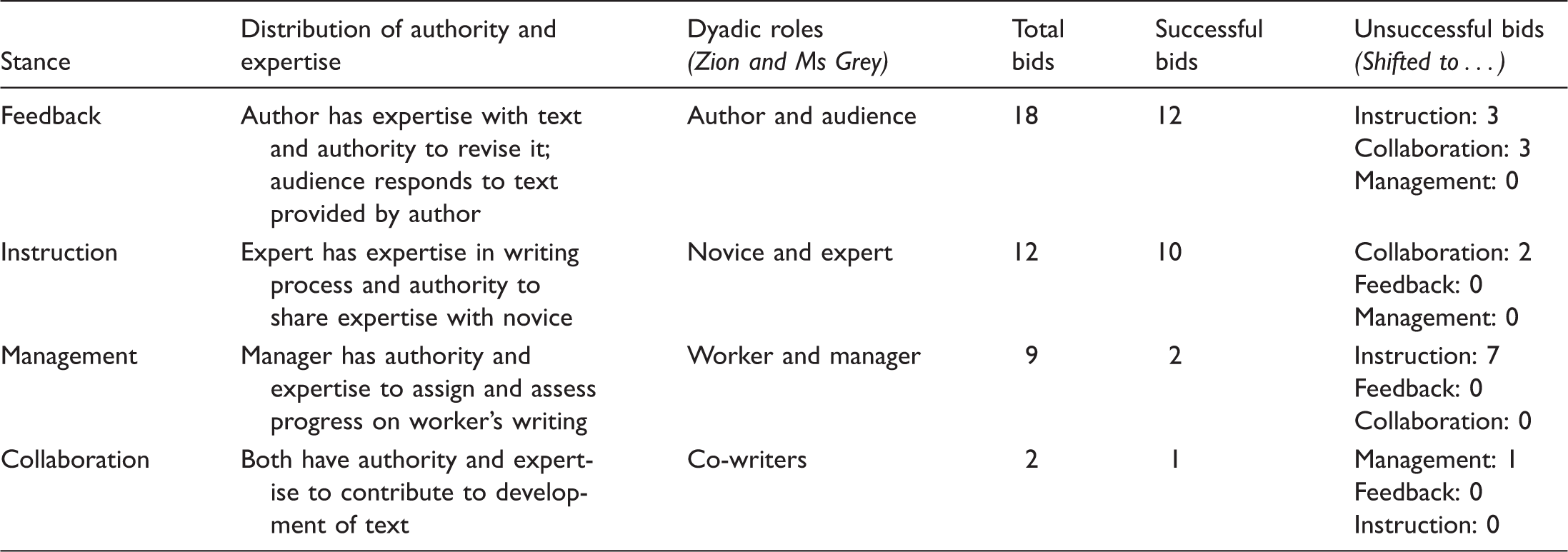
In a feedback stance, Zion was positioned as the author responsible for his ongoing writing, with Ms Grey providing feedback and support as a reader responding to this writing. In an instruction stance, Zion and Ms Grey were positioned as novice and expert writers, respectively, allowing Ms Grey to introduce new strategies to support Zion’s writing development. A management stance positioned Zion as a worker responsible for completing tasks assigned, supervised and evaluated by Ms Grey. Finally, a collaboration stance positioned Zion and Ms Grey as co-writers, collaboratively responsible for composing a text.
Because I was particularly interested in how Zion and Ms Grey negotiated shifts between stances, I then identified instances in which a participant made a bid to shift stances. For each of the 41 stance bids made, I attended to the following: the stance being bid, the participant making the bid, the length of the negotiation (in lines and turns), the discursive moves made during the negotiation, and the outcome of the bid. Bids were classified as successful if both participants shifted to the proposed stance in subsequent talk and unsuccessful if the participant not making the bid maintained their initial stance or made a bid for a third stance. I returned to conferences not included in the sampling in order to determine whether the stances identified in focal conferences were present within those interactions as well; in doing so, I found those stances to be common within the broader data corpus.
Findings
Below I share excerpts from three conferences that span the data corpus, with each conference serving as an example of a pattern of interaction significant to Zion and Ms Grey’s negotiation of stance and positioning. In tracing how each participant initiated and responded to bids to shift stance, I demonstrate how such negotiations changed across the semester.
January: Contesting a management stance
Ms Grey and Zion initially faced difficulty in negotiating a shared stance. One of Ms Grey’s key pedagogical goals was to encourage her students to view themselves as readers and writers capable of engaging in self-directed literacy practices. She viewed writing conferences as an opportunity to build not only writing strategies but also the identity positioning necessary for this work. Such an approach was new to Zion, however, whose previous school writing experiences involved teacher-directed, closed-ended activities focused primarily on spelling and mechanics.
In his first conferences with Ms Grey, Zion made a series of bids to enact a management stance, positioning himself as a worker with writing tasks assigned and managed by Ms Grey.
Of the eight bids made by Zion, seven were management stance bids. In these bids, Zion typically requested that Ms Grey indicate the correct way to complete a portion of his writing, such as stating the topic he should write about or how to spell a word. Each of these bids sought to position Ms Grey as the manager of Zion’s writing, assigning and evaluating tasks for his production. These management stance bids made by Zion were clustered in conferences occurring in the first half of the semester. Echoing the existing layers of identity laminated in Zion’s educational experiences, Zion’s bids for a managing stance appeared to reflect his previous positioning as a student, in which his role was to complete tasks assigned by the teacher. The outcome of each of these bids was the same; all were unsuccessful, resulting in a shift to an instruction stance that provided Zion with support for his writing without removing his agency as a writer.
One such negotiation occurred in a conference in early January, in which the pair discussed details Zion could include in a drawing of his New Year’s Eve celebration. Ms Grey began the conference with a series of questions designed to elicit details about the event. Rather than producing detailed descriptions, however, Zion responded to these questions with short phrases or silence. In this portion of the conference, the length of turns by Ms Grey and Zion differed substantially, with Ms Grey speaking 146 words to Zion’s 25 words.
In her first turn, Ms Grey summarized details the pair had previously named and suggested Zion include similar details in his drawing. In doing so, she took an instruction stance that positioned herself as an experienced writer providing support to Zion as a novice writer. By verbally and nonverbally highlighting the similarities between Williams’ illustrations and his own (Lines 1–3), she positioned both Williams and Zion as authors. She maintained this instruction stance, positioning Zion as a novice writer, by directing attention to the audience (Lines 6–10) while simultaneously introducing the text as a tool he could use to support his writing.
In his subsequent turn, Zion contested this instruction stance, instead making a management stance bid by requesting Ms Grey confirm his understanding of the task to be completed (Line 11). This bid was more aligned with Zion’s experiences in his previous classroom than his current one, suggesting he was drawing on his memory of student–teacher positioning in making this bid. Ms Grey resisted responding directly to Zion’s question by instead listing multiple possibilities for what he might draw. This allowed her to be responsive to Zion’s question, while simultaneously insisting on positioning him as a writer (Line 12). She again made an explicit connection between Zion’s and Williams’ illustrations, as well as suggesting several questions he might ask himself as an author (Lines 16–20). The lack of pausing for responses between Ms Grey’s questions indicates she did not expect answers but instead was modelling a strategy Zion might use. Thus, rather than outright rejecting the call for direction embedded in Zion’s bid, her use of an instruction stance allowed her, as an experienced writer, to introduce tools and strategies that Zion could use as a novice writer. Ms Grey used this strategy of contesting a management stance with an instructional one repeatedly, using the rights that stance afforded her to provide Zion with instructional support while simultaneously positioning him as a writer in their classroom.
March: Using stance to provide scaffolding
A second notable pattern of stance negotiation began with Ms Grey’s bid for a feedback stance. In making this type of bid, Ms Grey sought to position herself as an audience responding to Zion’s composing decisions as an author. In this stance, Ms Grey did not introduce writing strategies (as in an instruction stance) nor did she actively collaborate in composing (as in a collaboration stance). Instead, she provided a new perspective on his writing by articulating her response to the text as a reader. Bids for a feedback stance were the most frequent type of bid across conferences, comprising 44 per cent of bids made. While many of these bids (12/18) were successful, the outcome of the unsuccessful bids illustrates another strategy Ms Grey used to negotiate Zion’s (re)positioning as a capable writer. In these instances, Ms Grey shifted to one of two stances that allowed her to scaffold Zion’s writing development: collaborating and teaching. Both stances allowed Ms Grey to maintain her positioning of Zion as a writer while simultaneously providing him with the necessary scaffolding to successfully engage in the task at hand.
This tactic is illustrated in the excerpt below, where Ms Grey moved from a feedback stance to a collaboration stance. This conference, occurring during a research unit, involved Zion and Ms Grey looking together at a book about Zion’s self-selected enquiry topic, frogs. The conversation centred around learning about that topic through photographs, a strategy introduced in that day’s mini-lesson.
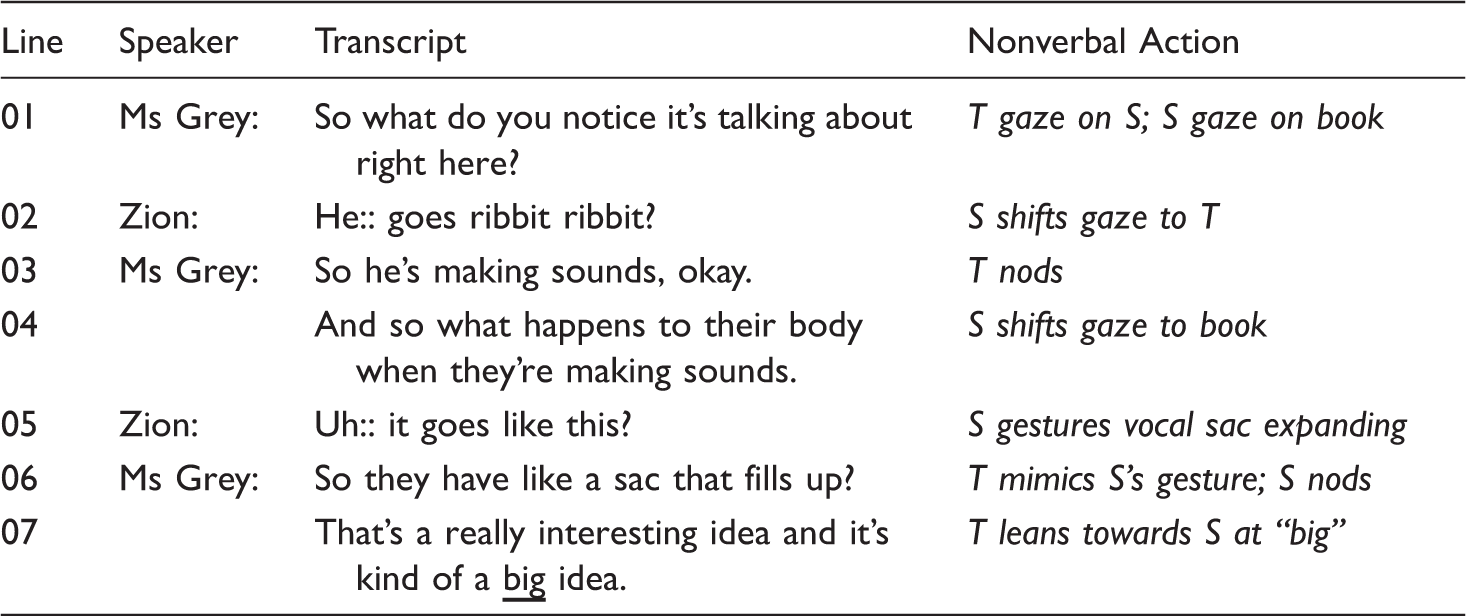
This excerpt also provides evidence of shifts in Zion’s interactions with Ms Grey and of his identity in that classroom. In contrast to the January conference, Zion participated actively here by contributing new knowledge about frogs. Yet, his questioning intonation suggests he was not yet fully comfortable with this authorial position. Again, the concept of lamination provides a possible explanation for this juxtaposition. In response to stances that positioned him in new ways, Zion did not immediately acquiesce. Instead, his shift towards these new positions was more prolonged, suggesting his actions were shaped not only by the current interaction but also by the layers of experience and identity positioning he carried into that interaction.
May: Moving fluidly between stances
A final notable pattern of interaction centres not on negotiation of stance but on its absence. Across the semester, bids to change stance most commonly resulted in extended negotiations between Zion and Ms Grey, with this pattern constituting 71 per cent (29/41) of bids. In these cases, the stance bid was contested, and negotiation over stance lasted across multiple turns. In the remaining instances (11/41), the stance bid was immediately ratified by the other person, resulting in a rapid shift to a new stance.
Like the previous conference excerpt, this excerpt begins with Ms Grey making a bid for a feedback stance, seeking to position herself as an audience to Zion’s position as author. Zion’s response, however, contrasts with the negotiation that followed in the previous excerpt. Rather than engaging in extended negotiation, Zion’s ratified the bid by engaging in extended oral composition. This feedback stance was sustained across a series of turns, with Zion using expression to voice the different characters in his story. Here, Zion positioned himself as an author by orally composing his narrative, ending his turns with a falling intonation indicating certainty in his storytelling (Lines 3–6, 12–13). Ms Grey in turn supported this positioning with her questions (Lines 2, 9, 11). Although this question–answer sequence mimicked the form of the Initiation–Response–Evaluation sequence common in classrooms (cf. Mehan, 1979), its function was different. Rather than posing questions with a correct answer already in mind, Ms Grey’s open-ended questions supported Zion in sequencing the story’s multiple events and in adding additional detail while affirming his identity as the author of ‘Dinosaur King’. This conference suggests the emergence of a new discursive pattern between Zion and Ms Grey, with Zion demonstrating his ability and willingness to engage as a writer in this space.
Discussion
This analysis has illustrated the negotiations of stance between one teacher–student pair in writing conferences across a semester, providing insights into how a student might be socialized into a new speech community and learn a new way of being a student in the process. In these interactions, Zion developed as both a writer and a participant in a new community, one that required him to engage in and talk about writing in unfamiliar ways. His participation in this final conference provides evidence of his increasing adeptness as a member of this new classroom community, one that prioritized students’ self-directed writing. As such, this analysis serves as a study of identity (re)positioning over an extended period, providing an illustration of the interplay of identity between multiple timescales – within discrete interactions and across months.
The path to this new way of being, however, was not always a smooth one. Rather, it was characterized by negotiation between Zion and Ms Grey concerning their positions (and attendant rights and duties) within conferences. While the term negotiation might suggest a combative teacher–student relationship, I argue that such negotiation was critical to Zion’s (re)positioning as a capable participant in the classroom writing community. Another teacher might have read Zion’s uncertainty and misaligned responses in initial conferences through a deficit lens, positioning Zion as defiant or unintelligent. Likewise, a teacher who simply accepted and mirrored the stances proposed by Zion would have ratified his positioning as a passive, incapable student.
Instead, Ms Grey drew on the availability of multiple stances as a resource, remaining responsive to Zion’s request for support while at the same time building his ability and confidence to compose independently. When Zion made bids for a management stance, Ms Grey instead negotiated an alternative one: an instruction stance that allowed her to provide support through the introduction of writing tools and strategies while positioning Zion as responsible for making composing decisions. Holland and Leander’s (2004) theorizing of positioning as lamination is useful to understand the need for such a stance. In their initial conferences, there was little evidence of Zion taking on a position as an agentic writer. Instead, his interaction appeared guided by his existing layers of identity, constructed within another classroom community that positioned him as incapable of working independently and in need of intensive teacher guidance. It was only over time–space (Leander, 2004), through repeated interactions and contradicting stances, that Zion began to enact new identity positions. This suggests the need for teachers to be willing to embrace opportunities for negotiation, particularly when working with students like Zion whose educational history layered identity positions are unsuited for his present community. Rather than assume students will immediately shift identity positions and practices in response to a new instructional strategy, teachers must take a longer view of identity development, providing the necessary scaffolding for such development while recognizing that its impact will not always be immediate. This approach requires a mixture of patience and perseverance, one that holds high expectations for all students while recognizing each student’s unique path.
In framing identity positioning as negotiated, these findings also suggest the need for nuance in considering the role of the teacher in students’ identity (re)positioning. These findings build upon Compton-Lilly et al.’s (2017) theorizing of identity as negotiated rather than constructed by attending to choices available to teachers within such a negotiation. While teachers do of course have a role to play in this identity negotiation (Moses and Kelly, 2018; Yoon, 2008), they cannot impose a desired identity upon a student. This was especially evident when Ms Grey made unsuccessful bids for a feedback stance. Despite her desire to construct an author–audience relationship in that moment, she could not force Zion to adopt such a stance. Recognizing identity as negotiated rather than imposed, then, teachers might instead view their role as one of extending invitations for students to (re)position themselves. In making bids for particular stances, Ms Grey invited Zion to ratify stances that positioned him as a writer. In doing so, she acknowledged his agency in the process of identity positioning (Kuby and Vaughn, 2015; Rogers and Elias, 2012), while encouraging his ratification of identities productive to his writing development. We might consider these stance negotiations, then, as another way for teachers to hold space (Hikida, 2018) for students positioned as ‘struggling’, allowing those students both the support and opportunity necessary to reposition themselves within the classroom.
Recognizing the relational nature of stance and positioning, teacher educators might frame stance as a pedagogical tool teachers can use to support students’ identity development. However, they must be nuanced in elaborating upon the role teachers can play in this area. The language of ‘performing’ particular stances that ‘invite’ preferred identity positions can be useful in clarifying both the capabilities and constraints teachers have when supporting students in negotiating new identities for themselves. Additionally, while teachers should certainly be encouraged to build caring relationships with their students, they must also recognize when disputing a student’s proposed stance might be necessary. Teacher educators can support teachers in developing practices of caring and thoughtful negotiation with students, recognizing the benefits of both collaboration and conflict at different moments in a pedagogical relationship.
While suggesting some important instructional implications for supporting student identity (re)positioning, this analysis represents the interactions of a single teacher–student pair across a single academic semester, and as such, it does not represent the totality of ways in which teachers and students might participate in such (re)positioning. Future research might explore additional ways in which interactions between young children and their teachers can support the negotiation of literate identities. In particular, research might examine how students negotiate such identities across multiple communities, particularly when such communities make available contrasting identity positions for students (cf. Palmer, 2008). How might teachers and schools support students in negotiating durable literate identities that can withstand interactions that position those students as incapable? In the case of Zion, he left Ms Grey’s first-grade classroom with new literate identities and practices, but his educational journal was far from over. In the deficit-laden discourse of urban state schools (Dyson, 2015), he would probably face both support for and threats to his emerging writerly identity, reminding us of both the flexibility and fragility of identity, ever and always in negotiation.
Footnotes
Funding
The author received no financial support for the research, authorship, and/or publication of this article.