




Abstract
In this study, the researchers explored the impact of reading aloud on language acquisition for 12 infants and toddlers (6–22 months old) attending a preschool located in South Florida. The research team included university professors, a preschool director and two preschool teachers. A teacher assistant read a selected picture book to each child individually for 10 weeks using scripts with prompts to assess receptive and expressive language. In addition to the book scripts, data collection included parent surveys, observation, developmental checklists, videotaping and field notes. Researchers measured each child's length of engaged time and level of engagement individually and as a whole group. Results indicate that participants demonstrated book preferences in terms of engagement, with the toddlers showing interest in books on familiar topics. Effective read-aloud strategies and techniques for young children are shared to promote the love of literacy.
Keywords
Reading to babies: Exploring the beginnings of literacy
Danny snuggles into the lap of his preschool teacher, Amy, as she reads Good Luck Baby Owls by Giles Milton (2012). He is eager to listen to this story about two baby owls learning to fly. During the read-aloud, Amy diverts from the text to ask questions or tell Danny to point to images in the illustrations. When Amy asks what baby owls sound like, he says with enthusiasm, ‘Whoo, whoo!’ Danny holds up two little fingers to represent the baby owls when prompted by the teacher. The toddler looks at the book illustrations attentively as he points to the images of the moon and sky. When asked to flap his arms like a baby owl, Danny happily participates. He is actively engaged in the entire reading session (2.37 minutes). According to the parent survey completed at the beginning of the study, Danny's mother and father have read to their son from the time he was born, approximately once or twice a day. At 20 months of age, Danny is successfully on his journey towards literacy.
Reading aloud is a research-based strategy that helps children of all ages develop a love of literacy, grow their vocabularies, read independently and think critically (Casasola, 2016; Cecil et al., 2015; Oczkus, 2012). Lap reading with young children creates a love of literacy as well as a strong bond between parent and child. Reading aloud is an easy and effective way for parents to contribute to their children's literacy development, whether it is in a waiting room at the doctor's office, on a bench at the playground, during story time at the public library or while washing clothes at the local laundromat (Allyn, 2009; Dunst et al., 2012; Fox, 2008; Trelease, 2013). In the landmark study called Becoming a Nation of Readers: The Report of the Commission on Reading, Anderson, Hiebert, Scott, Wilkinson, and the Commission on Reading (1985) found that reading aloud to children is the most important factor for building knowledge leading to their eventual reading success. An emphasis on the importance of reading aloud to children in preschool literacy programmes inspired Janet Towell to collaboratively design a study to observe patterns of behaviour during read-aloud sessions of infants and toddlers (birth to two years of age). In this paper, the researchers (Janet Towell, Lydia Bartram, Susan Morrow and Susannah Brown) describe how individual babies and toddlers react to picture books focusing on levels of engagement and length of engaged time during read-aloud sessions. Effective techniques and practices for reading aloud to young children are recommended to support literacy development, reading engagement and a love of reading based upon the results of this study.
Research on reading aloud and early literacy
Reading aloud stimulates young children's language development and language acquisition. Language development is the process through which a child learns expressive and receptive language. Language acquisition is the process through which children acquire language for communicating feelings or expressing ideas (Halliday, 1978; Vukelich et al., 2011). Learning the meanings of words and ideas through read-aloud experiences helps a child develop listening comprehension, which is an important part of literacy development. Infants and toddlers under three years of age (as in this study) should be immersed in quality children's literature, especially books with rhyme, rhythm and repetition, to give them a solid foundation in the sounds of language. This practice will enhance their phonemic awareness (an awareness of letters and sounds in spoken words), an important early literacy skill and one of the building blocks of the reading process (Clay, 1979).
Picture books are 50% more likely than parent–child interactions to include rare words that aren't among the 5,000 most common words in the English language (Massaro, 2015; Vivas, 1996; Wells, 1983). The rich language, cultural and international diversity in picture books exposes children to unknown worlds and extensive vocabularies (Kümmerling-Meibauer, 2017). Exposing children to a wide variety of genres and topics of interest is a powerful way to encourage a love of reading (Miller, 2009). In her landmark study on early readers, Dolores Durkin (1966) determined that early readers were children who had been read to frequently from an early age by their parents or other caring adults. When babies are read to from birth, that access to books greatly improves a child's chances of becoming a happy, successful human being (Butler, 1980).
Shared book reading stimulates children's oral language skills and builds their comprehension of unknown words (De Jong and Leserman, 2001; Fletcher and Reese, 2005; Isbel et al., 2004). Reading picture books to babies matters because the sooner children acquire language, the more likely they are to master it (Massaro, 2015). ‘One of the most powerful pieces of shared reading is what happens in the pauses between pages and after the book is closed’ (Duursma et al., 2008: 556). This kind of active engagement using decontextualized or non-immediate talk is especially beneficial for children's language development (Zevenberger and Whitehurst, 2003). Dialogic reading, a shared reading technique that involves strategic questioning and conversations during multiple readings, enhances children's oral language development, a foundational skill of emergent literacy (Doyle and Bramwell, 2006).
Brain research highlights the importance of the first three years of life by the National Institute on Deafness and other Communicative Disorders (NIDCD) (2014). Birth to three years is the most sensitive time for the acquisition of speech and language. Critical periods open during the first two years that provide optimal learning for speech and language to be absorbed, and it is during this time that the foundations are laid for future reading proficiency and school readiness. Results of a meta-analysis of six intervention studies on the effects of reading to infants and toddlers by Carl Dunst, Andrew Simkus, and Deborah Hamby (2012) indicated that the interventions stimulated the children's receptive and expressive language; the earlier and longer the intervention, the greater the benefits. However, one limitation of the study was the fact that only a few participants were less than three years of age.
Marianella Casasola (2016), an early literacy expert from Cornell University, studies how babies learn and acquire language during their first two years of life. Her research indicates that infants are learning about their language long before they speak it. Children learn language according to five systems: phonology (sounds), morphology (units of meaning), syntax (word order and sentence structure), semantics (meaning) and pragmatics (language use in different contexts). Infants learn languages in a universal, predictable pattern according to milestones such as cooing at 1–2 months, babbling at 6 months, using gestures and word comprehension at 8–12 months, speaking first words at 13 months, a rapid growth in vocabulary at 18 months, and saying two-word phrases between 18 and 24 months (Casasola, 2016; NIDCD, 2014). Between two and three years of age, toddlers typically begin using three- and four-word sentences on a regular basis – a sign of the preschool to fluency stage of language development when there is a language explosion (Cecil et al., 2015). Children in this stage are able to ask questions, talk about events in the past, take turns during a conversation and speak in whole phrases and sentences.
Research design and implementation
Reading aloud to babies from birth is critical for their literacy development (Casasola, 2016; Dunst et al., 2012). When Janet became a grandmother, she was inspired to design a collaborative research study observing the beginnings of literacy, based on the following research questions:
1. What is the impact of reading aloud on language development? 2. How do infants and toddlers react to the same book? 3. Which picture books do children like best? 4. Why do they prefer some books over others? 5. How are children engaged during reading aloud? What are their patterns of literacy engagement?
A team composed of university professors, a preschool director and preschool teachers designed a qualitative case study to explore possible answers to these questions. A data analysis and writing team included Janet, Lydia, Susan, and Susannah. A case study design was chosen to reflect the in-depth analysis of a small sample of children within a real-life context (Baxter and Jack, 2008). Janet and Lydia, as the lead researchers of the collaborative team of early childhood educators (referred to as teacher researchers), were primarily interested in discovering patterns of literacy behaviour and engagement in the infants and toddlers during individual read-aloud sessions. Direct observation was selected as an effective methodology to gather data. This naturalistic approach is an authentic method of gathering data on early literacy behaviours in infants and toddlers, while providing the least intrusive environment. The methodology of direct observation provides rich, detailed descriptions of real interactions between the teacher/reader and infant/toddler (Neuman and Dickinson, 2001).
The Institutional Review Board (IRB) process was completed including approval of all instruments and observational tools utilized in the study. Parental consent forms were IRB-approved, which protected and served the best interests of the infants and toddlers. Teacher researchers spoke with each parent explaining the study's purpose and procedures, including the right to withdraw their child at any time. All participants were assigned random pseudonyms and codes for data collection. The 10-week study focused on 12 infants and toddlers between the ages of 6 and 22 months. All children enrolled at this preschool in this age range were able to participate in the study with parental consent. Five of the participants were girls and seven were boys. All of the children were from English speaking homes except for Jake (six months of age) whose family's primary language was Spanish.
Selected book titles.

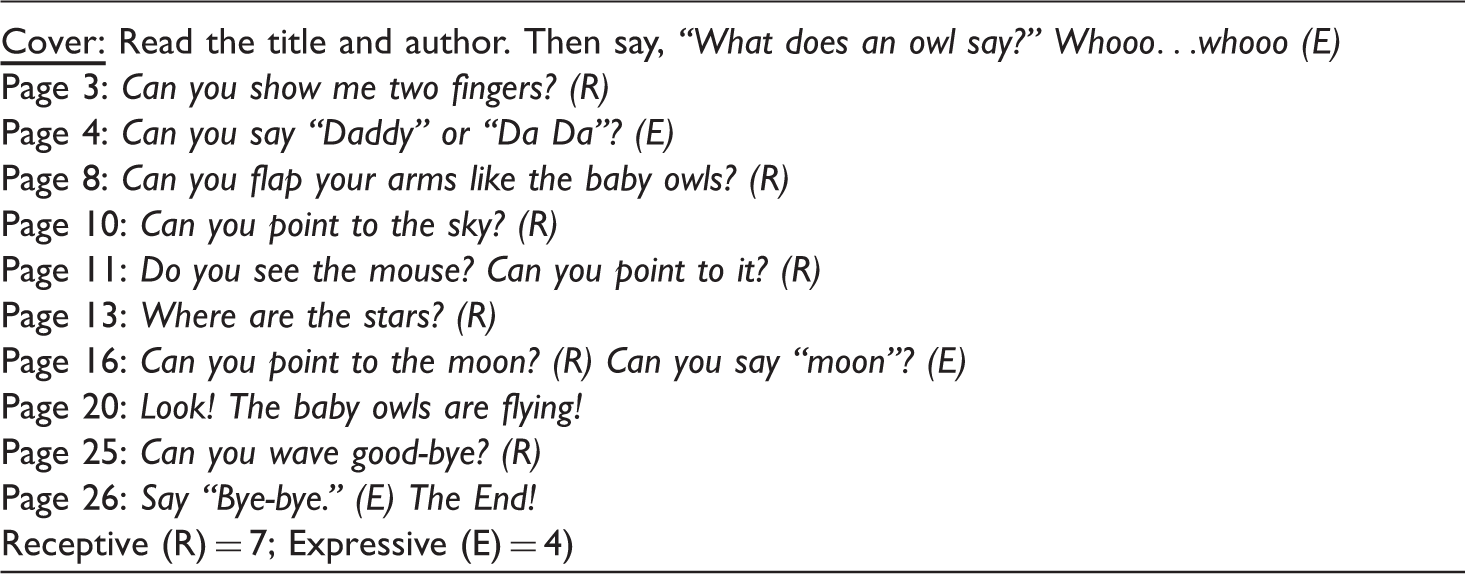
Script for book seven.
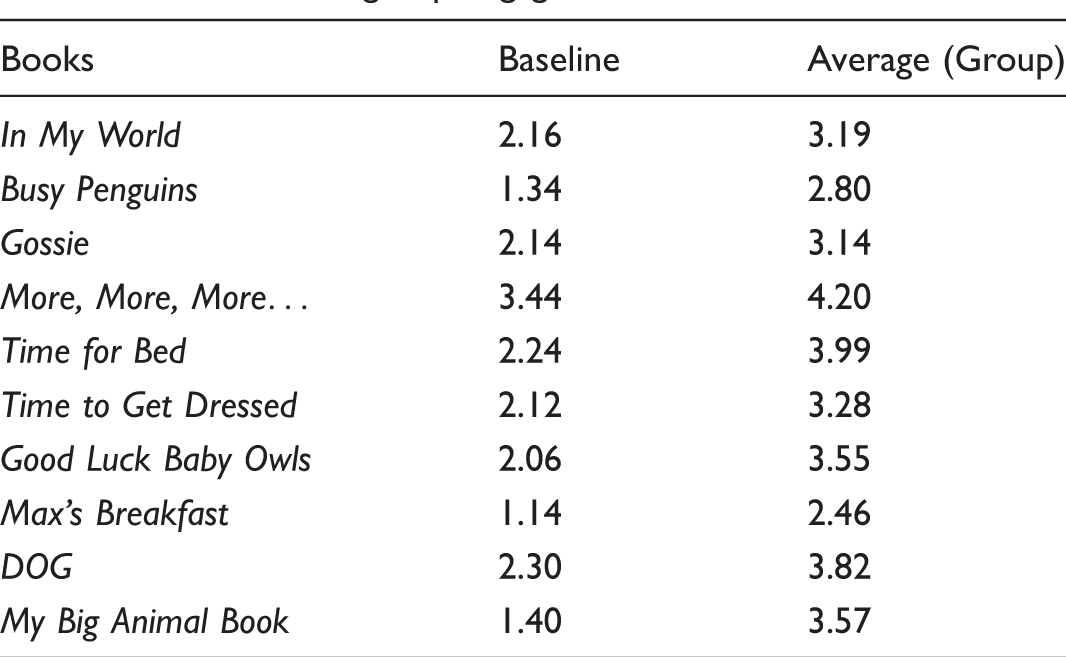
Baseline and group engaged time.
In addition to the scripts, data collection consisted of parent surveys about literacy habits in the home, observation checklists of child behaviours, field notes, videotapes of read-aloud sessions and developmental checklists of literacy milestones (completed at the beginning of the study by teachers). Janet and Susan observed the teacher and child during the individual reading sessions using observation checklists and recording field notes. Each session was videotaped and reviewed by Janet and Susan to validate data collected through observation. These same researchers rated each child's level of engagement and discussed confirmation and consensus. These multiple sources of data for triangulation captured a comprehensive view of each child's literacy experience as well as the teacher's interactions, during the time of the read-aloud session and afterwards through the video recordings. A summary report of the findings written by Janet was shared with teachers and parents involved in the study.
Patterns of literacy engagement
Literacy engagement has multiple meanings, including time on task (paying attention) and affect (interest and enjoyment) during the literacy experience (Guthrie, 2004: 3). The definition of literacy engagement in this study focused on time of engagement (time on task) and level of engagement (affect) relating to the participants' emotional reactions and interest during the read-aloud experience. Observations of the children's patterns of engagement over time were analysed for each book during the 10-week study. The children's time of engagement (number of minutes per book for the whole group and individual children) and level of engagement (high, medium or low) was measured during each read-aloud session. (Criteria for rating the levels of engagement will be described later.) Janet and Susan observed receptive and expressive language during the reading sessions. Verbal and nonverbal behaviours were documented on the observation checklist, described in field notes and reviewed later on videotapes.
Many variables affect a child's interest in story time and these change daily. How the child is feeling, distractions in the classroom, the weather, the teacher's current animation and attitude, the child's interest in the book and background knowledge can all make a difference. Sessions were kept as consistent as possible by reading in the same location at the same time and day each week. Always very loving and patient with the children, the teacher reader read every story with animation and enthusiasm.
The average engaged time for individual children ranged from approximately two minutes to four-and-a-half minutes. Emily and Sophie were engaged for the longest time period. Emily's mother was a first-grade teacher who read to her child daily and emphasized the importance of literacy at home. Sophie was an identical twin whose mother read to them often according to the parent survey. Sierra (Sophie's twin) was also highly engaged during the read-aloud sessions. Taylor was engaged for the least amount of time, with an average attention span of two minutes per book. As noted in observations, Taylor usually preferred to be outside on the playground after a few minutes of listening during the read-aloud sessions.
Analysis of literacy behaviours
Infants' and toddlers' responses varied according to their levels and duration of engagement. Janet, Lydia, Susan, and Susannah analysed data from observation checklists and field notes of individual reading sessions. Using a spreadsheet of collected data, levels and times of engagement individually and as a group (averages) were compared.
Engagement time
The study participants demonstrated book preferences during the read-aloud sessions. According to Figure 1, there is a distinct pattern of literacy behaviours.
Engaged time per book for each child.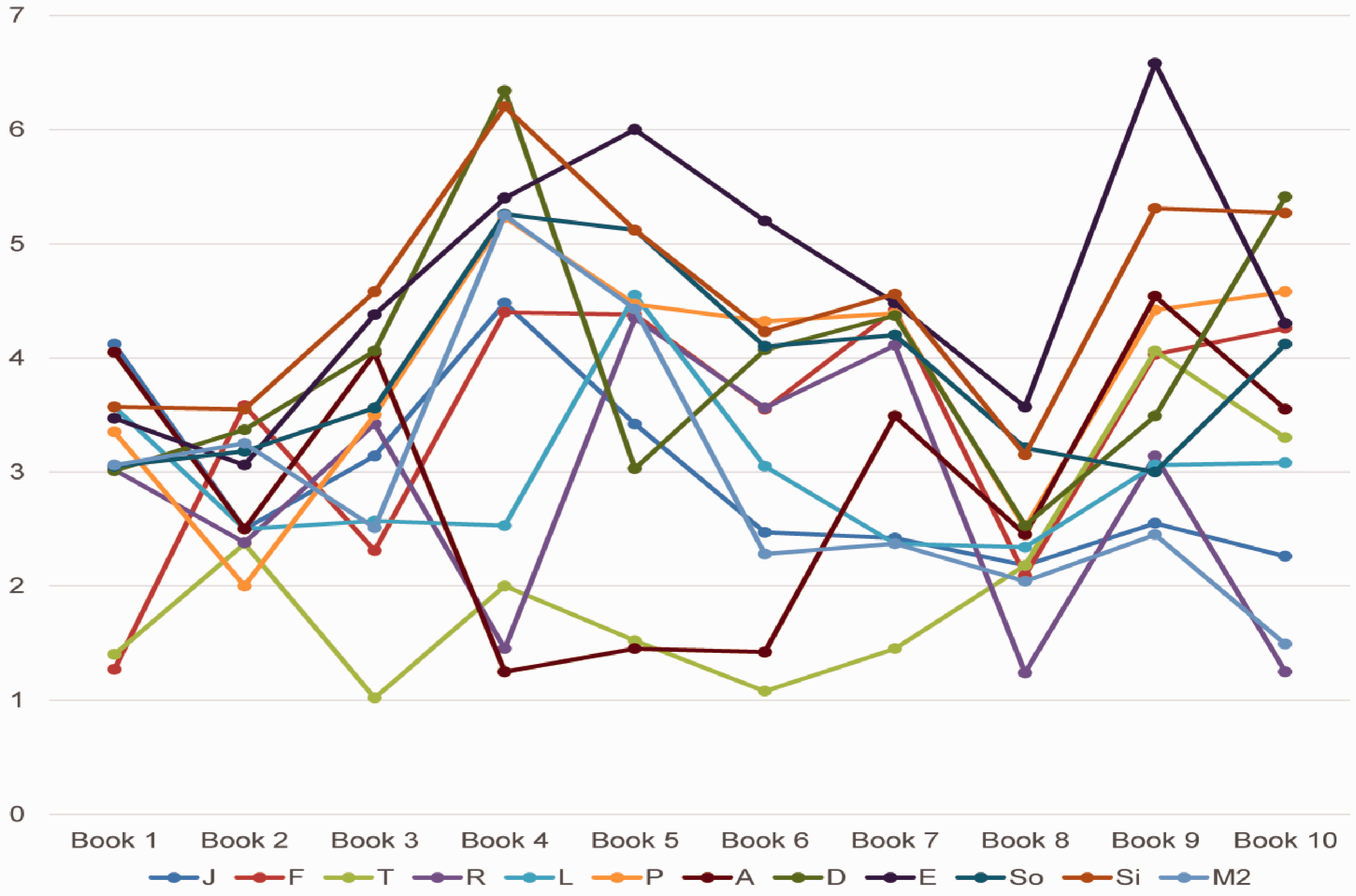
Wide variations exist between read-aloud sessions since some children displayed a higher duration of engagement than others for specific books. Each child is represented by a different colour on the line graph. Coloured coded points are placed on the line to represent engaged time (minutes/seconds) for each of the 10 books. At the beginning of the study, Taylor (T) was engaged for less time than his peers during reading sessions. However, his engaged time increases towards the end of the study. He was engaged in book nine, Dog by Matthew Van Fleet (2007), for approximately four minutes. Taylor's literacy behaviours indicated that he was familiar with and interested in the topic. This book was interactive with pull tabs and textures, which encouraged participation and may have contributed to Taylor's duration of engagement. This book also appealed to other children. Emily was engaged for over six minutes during the reading of Dog (Van Fleet, 2007). She laughed as she tried to pull the tabs and said, ‘I did it!’ Since the baseline time for this book was 2.30 minutes, the amount of time between the baseline and the toddler's engaged time indicates significant interaction between the child and the teacher (reader). Emily was also highly engaged for 5.20 minutes during the reading of book six, Time to Get Dressed by Elivia Savadier (2006). She verbalized many words in the text, including baby, bowl, clock, Da Da, hat and shoes. The baseline for this book (2.12 minutes) was much shorter than Emily's engaged time with the story.
Levels of engagement
If a child paid attention during the entire story, the session was rated as a high level of engagement. The child was able to point to images and repeat words when prompted by the teacher reader. If a child paid attention during part of the story but lost interest at times or the child listened to the story but did not participate when prompted by the teacher (reader), the session was rated as a medium level of engagement. If a child paid little attention, did not look at the text and images or became fussy during the read-aloud, the session was rated as a low level of engagement. Figure 2 represents the children's levels of engagement (high, medium and low).
Levels of engagement.
Book numbers are listed vertically and horizontal numbers represent the number of children who were rated at a low, medium or high level of engagement. Eight children exhibited a low level of engagement for book two, Busy Penguins (Schindel, 2000), which indicated a lower level of interest than the other books used in the study. Janet and Susannah discussed possible reasons for the low level of interest in this text. One reason may be that the children lived in South Florida and knew very little about penguins. While looking at the book cover, one child described a penguin as a flamingo.
In contrast, six children scored at a high level of engagement for book seven, Good Luck Baby Owls (Milton, 2012), book nine Dog (Van Fleet, 2007) and book ten My Big Animal Book (Priddy, 2011). Book nine Dog (Van Fleet, 2007) was interactive with pull tabs and textures. Sophie demonstrated a high level of engagement with book nine by touching the textural dog ears and pulling a tab to wag the dog's tail. She repeated after the teacher, ‘Shake, shake, shake.’ At the end of the book when the illustration of a cat pops out, she exclaimed, ‘Cat, cat!’ Then she clapped her hands and said, ‘Yeah!’
Books nine and ten featured photographs rather than illustrations. One factor that may have contributed to the children's interests in owls (book seven) was that the mascot of this preschool is a burrowing owl. Teachers often read books about owls during story time, which developed children's prior knowledge of this topic. During classroom lessons, photographs are frequently shared and discussed, which may explain why a higher level of engagement was observed for books nine and ten. Sierra demonstrated a high level of engagement with book ten, My Big Animal Book (Priddy, 2011). She pointed to the cover photograph and said, ‘Dog.’ At the beginning of the reading session she listened attentively, focusing on the photographs. Throughout the reading session, she verbalized many animal names when pointing to corresponding images. Her enthusiasm for each animal was shown through facial expressions and excited speech throughout the book.
Observations indicated that time engaged did not always correspond to the children's interest and motivation (level of engagement). Sometimes the children were content to sit and listen to a story for a longer time period without showing much emotion or involvement (low level of engagement). However, the children who listened to the story and looked at the illustrations for a longer time period were often highly engaged with the text. If they weren't interested, the toddlers tended to get distracted, reach for a different book, or simply crawl away. Reading sessions ended based upon children's attention span and interest.
Reflections on the beginning stages of literacy
Reading aloud and talking to children in the early years can have a significant impact on their language development (Suskind, 2015), although it is difficult to determine the extent of the impact with such young subjects. Many variables affect an infant's or toddler's engagement at any given moment and each situation is unpredictable. Reading quality children's literature in a variety of genres and formats has many benefits in a child's literacy and language development (Morrow, 2015). Asking questions and making comments during reading can further enhance a child's receptive and expressive language. Early language exposure significantly affects how language networks are created in the brain (Hart and Risley, 1995). Young children understand so much more, in terms of vocabulary and concepts, than they can possibly verbalize in the early stages of literacy (Massaro, 2015).
Observational data identified familiarity of the topic as an important aspect supporting high levels of engagement. Observing how young children explore the world through their emotions and senses is such a thrilling process as every child is unique. The children in this study did prefer some books over others, and they seemed to be more engaged in books that focused on familiar topics, either fiction or nonfiction. Perhaps the toddlers were able to relate to book characters (animals, birds or people) whose traits and behaviours were similar to their own. For example, in Busy Penguins, the rhyming text and illustrations depict parents and baby penguins (chicks) playing, feeding, cleaning and pooping, which are all part of the children's daily routines. In Max's Breakfast, Max (a rabbit) does not want to eat his eggs for breakfast until his sister, Ruby, convinces him otherwise. Time to Get Dressed and Time for Bed both deal specifically with children's daily routines. Mem Fox in Time for Bed uses animal characters to portray love between a mother and baby at bedtime.
Gossie (a gosling) in Gossie by Olivier Dunrea loses her favourite shoes, a pair of bright red boots. Gertie (another gosling) finds them and Gossie decides to share her boots with her friend. In Good Luck Baby Owls, Daddy Owl teaches his two babies to fly, but only when he determined they were ready. More, More, More, Said the Baby consists of three short stories that portray parents and grandparents loving their children and grandchildren in many different ways throughout the day. These are all familiar stories that young children can relate to and enjoy based on their everyday life experiences.
When the infants and toddlers in this study were engaged in a text, they made nonverbal responses, such as smiling, laughing, patting the pages, pointing to images, clapping their hands, or turning the pages. If they were not engaged, the children became fussy, cried, slept, looked away, kicked, waved, blew kisses or left the area. Verbal responses that represent a high level of engagement include repeating words after the teacher, cooing, babbling, asking questions and saying related or unrelated words.
The participants were on target in their language and speech abilities according to the developmental milestones checklists completed by their classroom teachers (NIDCD, 2014). By their first year, children are usually able to listen when spoken to, understand words for common items, use babble, imitate different speech sounds and say a few words. Sometime between their first and second year, children typically reach additional milestones: answering simple questions, acquiring new words on a regular basis, using one or two-word questions, combining two words and using different consonant sounds at the beginning of words (NIDCD, 2014). The infants and toddlers in this study were progressing along the continuum of speech and language skills as appropriate for their age groups.
Implications for future research
More research is needed to determine the impact of reading aloud on a child's receptive and expressive vocabulary, especially from birth to three years of age (Casasola, 2016). Limitations of the study included book selection, number of books used in the study and the fact that participants were those children enrolled in two infant and toddler classes of a university research preschool. Because of the small sample size and lack of a comparison group, the results may not be generalizable to other infants and toddlers. Janet and Susannah for this study suggest future topics of interest in this section. Since the children in this study were not talking fluently, the impact on language development was difficult to determine in terms of receptive and expressive language. Definitive conclusions about babies' and toddlers' book preferences are inconclusive based on the study's small sample size. Another variable is that lap reading at home with parents differs from lap reading at school with a preschool teacher because of the environment, relationships, time of day and other factors. Replications of this study with different books and populations, especially with bilingual children using bilingual picture books or with children from diverse cultures and ethnicities, would be insightful. A longitudinal case study of language development and acquisition with infants and toddlers is recommended.
The research team reviewed videos of all sessions to analyse the children's responses to receptive (nonverbal) or expressive (verbal) questions in scripts, but only the older children were able to answer with some degree of accuracy. Repeating a similar research agenda with children between the ages of two and three may be more successful in defining engagement through the child's verbal response. At this stage of early literacy, a child's receptive language development is well ahead of his or her expressive language development, but the real dilemma for a researcher is how to accurately measure it (Bloom, 1974; Casasola, 2016).
Recommendations for reading aloud to infants and young children
Research supports that daily reading to children is important, starting at birth (Dunst et al., 2012; Isbel et al., 2004). Reading aloud creates an appreciation of children's literature, develops listening comprehension, improves awareness of text structures, provides exposure to new vocabulary and promotes emergent literacy and language before children can speak (Massaro, 2015). Lap reading strengthens the bond between parent and child while promoting a love of reading through motivation, curiosity and imagination (Allyn, 2009; Casasola, 2016; Frankenstein, 2009). According to Frey (2015), reading aloud is even more important than talking to children in terms of literacy development. In her book called Reading Magic: Why Reading Aloud to Our Children Will Change Their Lives Forever, Mem Fox (2008) describes the emotional and intellectual impact reading aloud has on children's literacy development. Reading, talking and singing to children teaches the sounds of language which are so essential for language development (Allyn, 2009; Suskind, 2015). There are many factors that motivate and inspire a love of reading for young children and this study focuses on impacting on infants' and toddlers' reading engagement through practices of early childhood educators. The strategies in this study can be adapted to serve the needs of both parents and educators of infants and toddlers.
The following recommendations for parents and educators of young children are based on the results of this study:
Establish routines for reading aloud at home and in the early childcare programme – naptime, bedtime, mealtime or bath time; Take books wherever you go, to allow for teachable moments; Read fiction and nonfiction picture books about familiar topics of interest to children; Choose books connected to a child's native language and cultural background or ethnicity; Select different genres with engaging illustrations, including poetry, biographies, fairy tales, and informational books from the local library and bookstores; Encourage young children to repeat words to promote expressive language development and point to images and illustrations to support receptive language development; Ask questions and make comments throughout the book, adding gestures and sound effects for entertainment; Use an animated voice while reading with expression, intonation, joy and excitement; Pay attention to an infant's or child's cues. If he/she is not interested in one book, choose another book or activity; Make personal connections to the story to enhance the shared reading experience; Create books with children based on personal stories and use these for reading aloud; and Read books that were your own childhood favourites to share the joy of reading with children.
Although this study focused on infants and toddlers, these recommendations are equally relevant for the parents and educators of preschool and kindergarten children. Adults who value literacy and are avid readers themselves will inspire their children to develop a love of literacy that will last a lifetime.
Footnotes
Funding
The author(s) received no financial support for the research, authorship, and/or publication of this article.