



Abstract
This study investigated preschoolers’ knowledge of Chinese characters by testing character structures on four levels: radical (character components), whole characters, characters in words and characters in sentences. A total of 107 preschool children between the ages of three and six from four nursery schools in Taiwan participated in the study. Two tasks, namely, Basic Chinese character concepts and a Radical differentiating task, were conducted. The results indicated the following: (a) children younger than four years with no reading ability expressed an awareness of character structure. (b) In general, preschoolers’ character knowledge increased with age; however, there were individual variations among the same age group. (c) Regression analyses revealed that understanding character and radical forms could effectively predict concurrent character reading for children aged between three and six. Our results have some practical implications for literacy instruction to preschool Chinese children and early detection of children at risk of reading difficulties.
Introduction
The development of word recognition skills is important in early literacy. Children have to learn to read words in order to become linguistically literate. In the alphabetic system, phonological awareness and print knowledge are two major precursors to reading words (Justice and Ezell, 2001; Lonigan, 2004). Phonological awareness is defined as children’s capability to consciously isolate word segments and includes the ability to manipulate syllables, onsets and phonemes (Anthony and Lonigan, 2004). Print knowledge reflects children’s knowledge of the forms, functions and organizational properties of print (e.g. left-to-right directionality, combinatorial properties of letters to make words, and alphabet knowledge; Clay, 1989; Levy et al., 2006). Phonological awareness and print knowledge are code-related precursors allowing beginning readers to develop their ability from sounding out letter names to word reading. Studies have shown that well-developed phonological awareness and print knowledge enable children to benefit from beginning reading instruction in kindergarten (McBride-Chang and Kail, 2002; Storch and Whitehurst, 2002). In early elementary school years, reading ability is predominantly determined by the level of print knowledge and phonological awareness a child brings from kindergarten (Storch and Whitehurst, 2002).
Chinese characters have unique representations of sound and font. Unlike alphabetic languages, the manner in which oral language is mapped onto script differs enormously between English and Chinese. In English, 26 letters are combined to make approximately 44 phonemes and thousands of possible syllables. In contrast, the basic symbols of written Chinese are characters, and each character represents both a syllable and a morpheme. The number of commonly used Chinese characters is approximately 4,600, and more than 80% of them are semantic-phonetic compounds (Chen et al., 2011), which have a semantic radical to indicate the word’s meaning and a phonetic radical to provide clues about character pronunciation. Learning to read Chinese does not involve the phoneme-grapheme mapping process; it requires some unique skills different from those used in alphabetic languages (Chung and McBride-Chang, 2011; Tan et al., 2005). In early Chinese character acquisition, phonological awareness is less crucial than understanding radical components (Li et al., 2012).
Chinese characters are comprised of strokes. Strokes are individual complete movements in writing; they can be lines, dots or curves. A set of strokes comprises two types of radicals, semantic and phonetic, which together compose Chinese compound characters. In addition to semantic and phonetic radicals, Chinese print has some sub-radicals such as ㄑ, 卩, 厂 and 亠, which usually appear together with the aforementioned radicals, representing units of print that appear in many Chinese characters. There are 439 basic radicals in written Chinese, each of which can be used to compose an average of 44.10 Chinese characters (Chen et al., 2011). Some radicals are also characters themselves, which can be used alone or composed with other radicals and sub-radicals to form different characters. For example, a simple (few strokes) character 木 (mù) representing wood or tree, is also a semantic radical that can be used to form many wood-related characters such as 森(forest), 椅(chair), 松(pine), 橋(bridge), 板(board), 楓(maple), 棍(stick) and 檸(lemon). Some character structures are quite complex with more than 15 strokes (e.g. 檸); however, all these characters are visually compact and take the same space as 木 in print. Chinese characters always take up the same amount of space and are arranged in a square shape regardless of whether the configuration of strokes is simple or complex.
Semantic and phonetic radicals can offer some indication about the meaning or pronunciation of characters. These radicals may be arranged in a left-right or top-down structure, to ensure that they take relatively less space within a character. For example, a semantic radical ‘
On the other hand, phonetic radicals provide clues about the sounds of novel characters. For example, the phonetic radical 丁 is pronounced as ‘ding’, which is used in 盯(stare), 叮(bite), 町(town), 釘(nail), 酊(intoxicated) etc., making all the characters sound like ‘ding’. If children can read ‘丁’, it helps them learn novel words, such as ‘盯’ and ‘酊’. Anderson et al. (2003) and He et al. (2005) demonstrated that Chinese primary schoolchildren are able to use phonetic radicals to decode the pronunciation of unfamiliar compound characters. However, the association of phonetic radicals with the pronunciation of characters is assumed to be fairly opaque. It has been suggested that for young children, character reading relies primarily on rote memory processes rather than any code-related skills (Chan and Wang, 2003).
Literature review
Several studies (e.g. Chan and Wang, 2003; Ho et al., 2003a, 2003b; Tong and McBride-Chang, 2010) have examined children’s radical knowledge and its relationship with reading Chinese characters and have addressed the importance of radical awareness in orthographic development. Understanding a radical’s role in forming a Chinese character is useful knowledge that can help in the learning of novel characters and the development of reading ability (Chan and Wang, 2003; Feldman and Siok, 1999; Ho et al., 2003a, 2003b; Tong and McBride-Chang, 2010). However, the construction rules underpinning Chinese characters are too difficult for children under the age of six to acquire (Chan and Nunes, 1998; Shu and Anderson, 1997). It has been suggested that radical processing to memorize newly learned Chinese characters develops in children starting from the second grade (Lau and Leung, 2004). Ho et al. (2003b) found that Chinese children needed to learn a good number of characters before they could begin to recognize the rules underlying the components. In their study, most preschoolers were unable to discern legitimate characters from ill-structured, poor components or pseudo-characters because of their limited orthographic knowledge. It was suggested that preschoolers’ radical awareness cannot be measured by examining their knowledge about the rules of radical combination (e.g. Li et al., 2006). In other words, such character-level tests may not be adequate for differentiating individual differences in early literacy development.
Studies about children’s radical knowledge and the relationship with reading Chinese characters in the introduction were ‘cross cultural’, because those Chinese children came from different areas (Beijing, Hong Kong, Taiwan etc.) with different backgrounds. For example, in the study by Chan and Wang (2003), investigating children’s linguistic awareness when learning to read Chinese, participants were selected from Beijing (where simplified Chinese characters are used) and Hong Kong (where traditional Chinese characters are used). Moreover, in the study by Shu and Anderson (1997), investigating whether children can use partial information to learn the pronunciation of Chinese characters, participants were 105 Mandarin-speaking and 168 Cantonese-speaking Chinese children. These studies suggested that the study results can be generalized to Chinese preschoolers in general.
Despite their limited orthographic knowledge, young children possess a body of knowledge pertaining to Chinese characters’ visual structure. Preschool children were found to be able to discriminate Chinese characters among figures (Li et al., 2006). Chinese children prefer using radicals to form words rather than alphabetic characters in orthographic tasks (Miller, 2002); even those three-year-olds who could not read any simple Chinese characters arranged characters in a square-shaped space in writing tasks (Chan and Louie, 1992; Yin and Treiman, 2013). It is generally believed that young children living in a literacy-rich environment will construct basic ideas of the visual structure of Chinese characters effectively before they receive formal reading instruction. They also know that the strokes of Chinese radicals and sub-radicals are usually straight and sharp, and rarely with the circular forms seen in Latin letters C, D, U and O, or in Japanese or Korean characters such as ち,る and ㅎ (Chen, 2012). Although children may not have memorized the whole character, they were able to recognize the subcomponents of a given character (Shu, 2003). In a recent study, Qian et al. (2015) developed an orthographic awareness test to explore the developmental trend of orthographic awareness in Chinese-speaking preschoolers. In their radical test, some radicals were replaced with a number ( ), some were rotated horizontally or vertically (
 ) and some had a deleted subcomponent (
 ). They found that 87% of their tested five-year-olds were able to discern those non-characters as illegitimate indicating that preschoolers possess not only knowledge of Chinese characters’ shape, but also of their radicals’ shape.
A number of studies have revealed that an association exists between young children’s visual skills and Chinese character recognition (Ho and Bryant, 1997; Huang and Hanley, 1997; McBride-Chang and Ho, 2000). Even in some characters with few strokes, such as ‘大’ (Dà, big), ‘太’ (Tài, too) and ‘犬’ (Quǎn, dog), children need to differentiate the subtle differences among the dots to identify each character correctly. This is why Chinese word recognition is more related to visual processing. Accordingly, McBride-Chang (2004) proposed a transitional development model from visual to orthographic knowledge in Chinese, suggesting that preschoolers begin to distinguish print from pictures in their initial literacy development. Although all language writing scripts may be equally representative of print to them at this stage, children could nevertheless make an initial differentiation. The second step is that preschool children begin to acquire the ability to distinguish very different writing systems from their own. In other words, they begin to distinguish Chinese from other writing systems but not from other orthographies using characters (e.g. Korean, Japanese). In the third step, they can then distinguish Chinese scripts from Korean and Japanese ones. Young children then begin to recognize words or characters based on their salient context or features. Words with salient features are also easier to identify; for example, the Chinese character ‘口’ (mouth) resembles an open mouth, and can therefore be easily recognized. Young children can note a particular visual cue in a character to recognize it. Prior to developing real orthographic skills, preschoolers’ word recognition relies mostly on visual skills and rote memory.
Young children follow a similar visual/orthographic developmental trend in the alphabetic language system. In the domain of early reading acquisition, understanding the visual patterns and elements of words is an important development process. As Clay (1993) argues, visual patterns (i.e. word and letter cluster) and printing conventions (e.g. spatial formatting, punctuation) are essential elements in early reading, although they are processed automatically by fluent readers. In studies evaluating preschoolers’ development of early literacy, children’s knowledge of how the shape of English letters, words and sentences should look was tested. In a study, Bialystok (1995) asked three- to six-year-olds whether different displays, including pictures, shapes, cursive writing and printed words, were suitable for reading. She found that younger children are more likely than older children to accept non-alphabetic displays as readable. Levy et al. (2006) used 20 incorrect representations of English words or sentences to tap into 48- to 83-month-olds’ understanding of what constitutes a ‘readable’ print. Each incorrect representation was contrasted with a real word/sentence, and children were asked to decide which one was readable. Children’s performances on the task were regression analysed with prior standardized measures of early reading skills. Results revealed that print knowledge was related to children’s early reading skills.
In English, a word can be long or short, depending on the number of letters it comprises. However, Chinese characters take up the same space size in print regardless of the number of radicals or strokes they may comprise. For example, the three radicals (also characters), 月 (Yuè, moon), 土 (Tǔ, dust) and 皮 (Pí, skin) can clearly be combined from left to right and be read as 月坡 (moon slop) in their printed form. Children who have not developed the spatial formatting concept of the Chinese character 月坡 might misread it as 肚皮 (belly skin) due to the improper spacing of the three characters 月, 土 and 皮. When and how children develop the Chinese character space-size concept and an understanding of the difference of radical spacing in one character and in two neighbouring characters have been rarely studied.
Moreover, as mentioned above, numerous studies have been conducted on young Chinese children’s character knowledge (e.g. Chan and Louie, 1992; Chen, 2001, 2015; Lau and Leung, 2004). Most such tests typically involve asking children to read characters that are frequently seen in first and second graders’ textbooks. Children who cannot read those simple high-frequency characters in these tests are said to be non-readers. However, such children may not be entirely ignorant about reading and writing. Moreover, with regard to the knowledge of character components, children’s radical knowledge might also be underestimated by some character level measurements as mentioned. For both phonological awareness and print knowledge development, understanding the characteristics of Chinese characters (word shape) or radicals (word elements) is an important emergent literacy skill; the concepts of character shape help them to isolate word segments, and the salient features of radicals provide clues for memorizing and identifying characters for Chinese preschoolers. To our knowledge, preschoolers’ knowledge of radicals based on shape characteristics has also been rarely studied.
Although children receive formal education at the age of six in Taiwan, preschoolers usually have a lot of contact with Chinese characters and other language symbols in their daily life. Meanwhile, urban preschoolers in Taiwan are visually stimulated by various kinds of language symbols, including Chinese, Japanese, English, Korean and others in their daily life. These language symbols significantly differ in their forms of writing, shape, spacing and strokes. The extent of Chinese character knowledge that preschoolers possess at different age levels has not been studied, and nor has an appropriate measuring instrument been designed to evaluate such character knowledge in Taiwan.
The present study aimed to examine young children’s knowledge of the characteristics of Chinese characters. We designed a measure to investigate three- to six-year-olds’ knowledge of Chinese characters on four different levels: character components (radicals), whole characters, words and sentences. The study is divided into two parts. In the first part, some basic character concept items were used to examine children’s understanding of the square-shaped and one syllable-one character nature of the Chinese written language, which were believed to be important skills for segmenting a single character out of words and sentences and for mapping the oral sound to each written character. In the second part, we explored preschoolers’ understanding of Chinese radicals from the visual aspect and investigated their ability to differentiate radicals from other symbols or written language components. We hypothesized that even young preschoolers who are classified as non-readers by standardized character reading tests would demonstrate relatively good knowledge about the visual characteristics of Chinese characters, i.e. we explored preschoolers’ emergent reading skills. We also investigated whether knowledge of visual aspects can provide a valid estimate of non-readers’ reading ability.
Methods
Participants
We used a convenience sampling strategy as our sampling method in this study. Participants were recruited from four nursery schools and kindergartens in urban Taipei and Taoyuan cities in Taiwan. In order to ensure none of the children had special needs or had been taught to read or write in school, we interviewed the leaders and teachers of the four nursery schools before recruitment. A total of 107 native Chinese-speaking children (53 girls) were selected for the study. The study was conducted with the permission of the leaders and teachers of the schools and the parents of the participants, and the study plan was reviewed and accepted by the Institutional Review Board in Taiwan.
Participant characteristics.
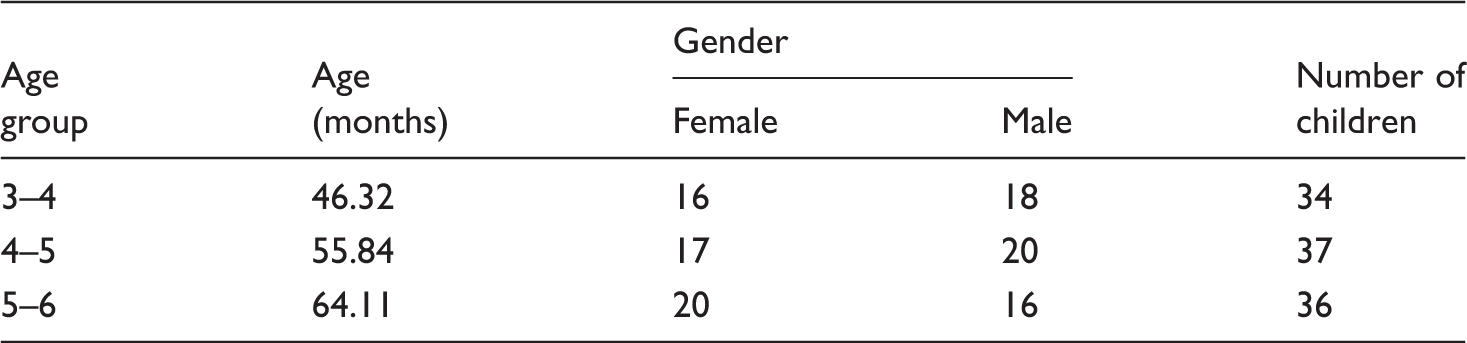
At the time when the present study was conducted, none of the children had ever been formally educated in Chinese reading and writing, and none of them had any sensory, emotional or learning problems as evaluated by the classroom teachers. Of the children selected for the study, 36 were from a bilingual kindergarten and 24 had learned CYFH at nursery school.
Measures
Basic Chinese character concepts
Task of basic Chinese character concepts.
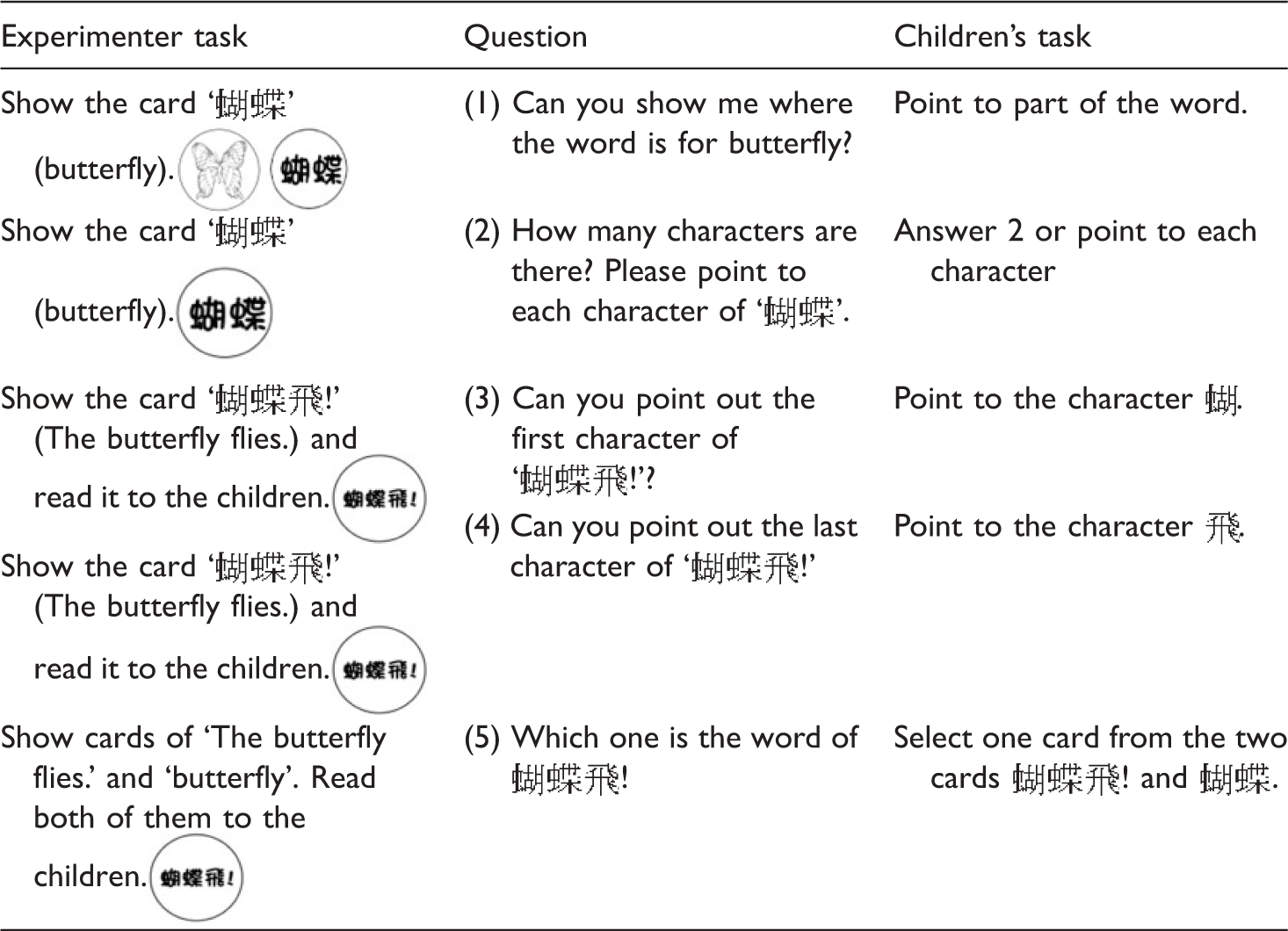
As presented in Table 2, all the characters on each piece of cardboard were arranged in a left-to-right orientation in a circle, and a contrasting picture was also placed in the same size circle. Pretests were conducted to exclude stimuli that could be recognized by any participant. Children were asked to answer questions about the character in the word or sentence by pointing to the character following the experimenter’s reading. The researcher showed the word ‘蝴蝶’ (butterfly) and its picture, read it aloud and narrated ‘This is the word and picture for butterfly.’ The experimenter then asked the first question, ‘Can you show me where the word is for butterfly.’ and followed it with the second question, ‘How many characters are there? Can you point out each character of 蝴蝶?’ The other stimulus was ‘蝴蝶飛!’ (The butterfly flies.) with an exclamation mark following the last character. The experimenter also showed the cardboard, read the sentence to the child and asked the three questions presented in Table 2. One point was given for each correct answer, and the total score for this task was 5 points. The first question in Table 2 was designed to test the children’s ability to distinguish characters from pictures. Questions 2 to 4 were designed to test the children’s ability to recognize character segments. Question 5 was designed to assess the children’s ability to correctly match pronunciation with characters.
Radical differentiating task
Items of radical differentiating task.
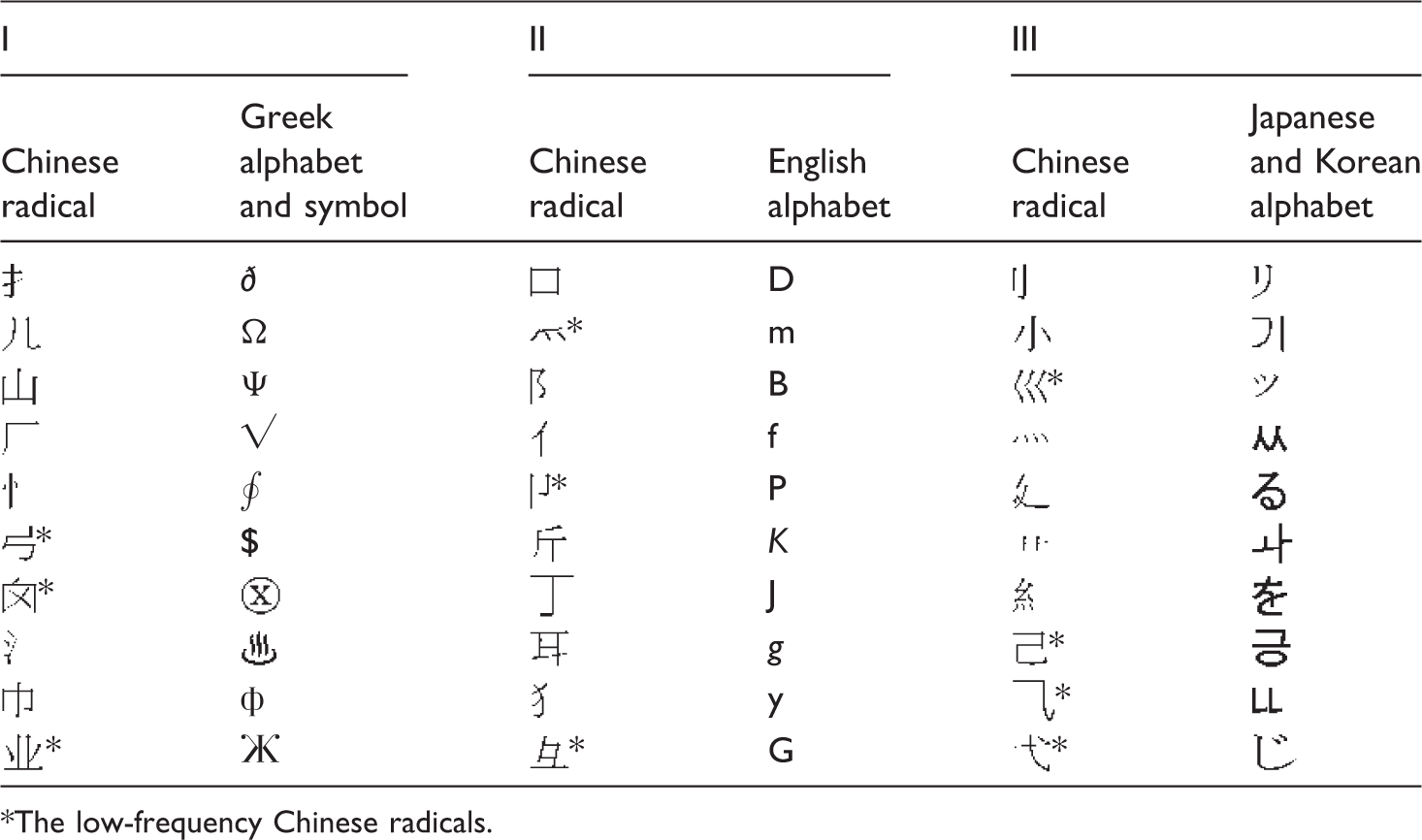
The low-frequency Chinese radicals.
Children were asked to choose one that is ‘more like the Chinese character’ from each pair of stimuli pieces of cardboard, and one point was given for each correct response. The three sections of the radical awareness task were implemented in a counterbalanced order. According to McBride-Chang’s model (2004), it was hypothesized that differentiating the Greek alphabet and symbols from Chinese characters would be easier than differentiating them from English letters or the Korean/Japanese alphabets. Children are expected to obtain the lowest score in differentiating Korean/ Japanese letters from Chinese radicals in the radical awareness task because the orthographies of these two writing systems are more similar to Chinese. This test has been administered to preschoolers in a previous study (Chen, 2015). The internal consistency reliability was 0.82, and Cronbach’s α coefficient was 0.85.
Chinese character reading
This measure was included so that it could examine the relationship between our tests and reading. We used the Simple 200 Chinese Character Test to examine children’s early reading ability. In this task, children were asked to name up to 200 Chinese characters aloud one by one. The characters were the most commonly used Chinese characters selected from Grade 1 and Grade 2 primary school Chinese textbooks. This test has been successfully used for Taiwanese preschoolers in previous studies (e.g. Chen, 2012). The internal consistency reliability for this task was. 92. One point was given per character, and the maximum score was 200 points.
Procedure
All measures were administered individually within a two-week period by trained experimenters in three time slots within a 30-min range in order to avoid any fatigue or boredom among the children. Tests were performed in a quiet room at a children’s preschool. The children took the basic Chinese character concepts test, radical differentiating test and the Chinese character reading test in consecutive order. They were given a sticker as a reward after each test and a short break if necessary.
Prior to each formal test, children were given a short oral instruction about their tasks, and they were asked to sit beside the experimenter to ensure that all of them could see the stimuli with clarity and from the right direction. In all the trials, the children’s responses were recorded by two experimenters simultaneously for inter-rater reliability agreement.
Results
Summary of preschooler’s Chinese character knowledge.
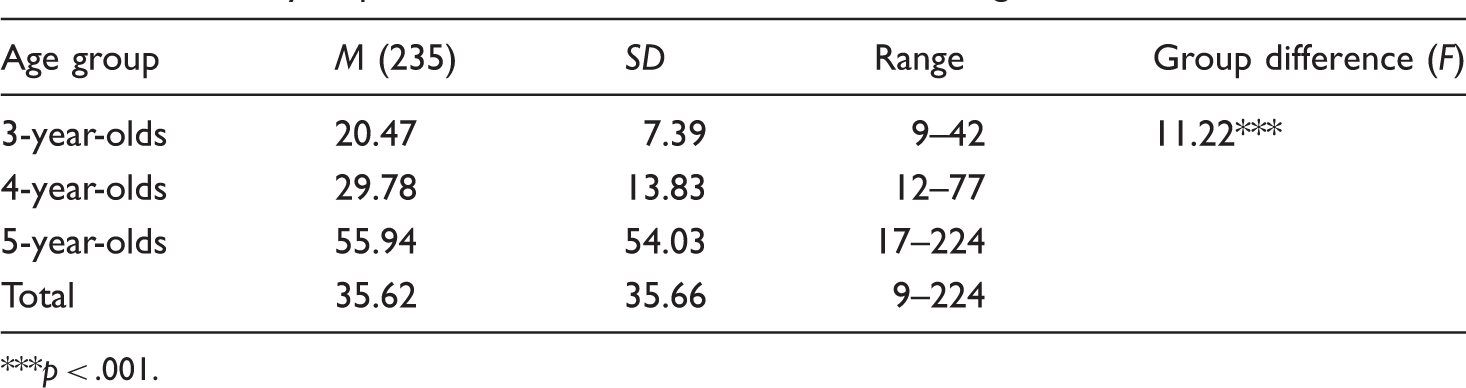
p < .001.
Pearson correlations among variables.
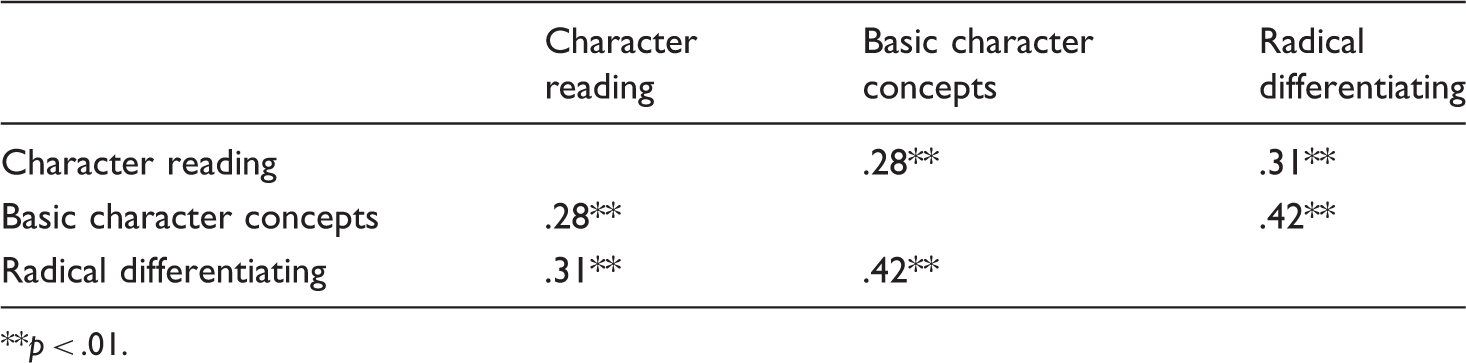
p < .01.
Previous studies by Chen (2001, 2015) showed that 3–6-year-old preschoolers’ performance on Simple 200 Chinese Character Test was significantly correlated with age. Therefore, in our work, we controlled for age and used stepwise analysis to identify the association between our test and character reading. Regression analyses indicated that the basic Chinese character concepts and radical differentiating ability were significantly related to early character reading ability, after accounting for variance due to age. The total scores of the two tasks that predicted performance on character reading ability accounted for 12% (R2 = .12, ß = .35, p = .000) of the variance.
Basic Chinese character concepts
The average score on this task was 3.48 (SD = 1.68). There were significant differences among the three age groups (F (2,104) = 22.52, p < .001, Table 6). The five- to six-year-olds scored higher than younger groups (M = 4.50, SD = 1.00), and children’s performance on each item of this task is presented in Figure 1. Test results on distinguishing picture and word revealed that a total of 94 children (87.85%) gave the correct answer. A total of 60 children (56.07%) could indicate the first character of ‘蝴蝶飛!’, but only 48 (44.85%) children indicated the last character of the same sentence correctly. A total of 79 (73.83%) and 68 (63.55%) children answered ‘Which one is the word for 蝴蝶飛?’ and ‘How many characters are there?’ correctly, respectively. Our results suggest that the ‘one syllable represents one character’ characteristic of Chinese characters was better recognized by preschool children than the square-shape characteristic.
Accuracy of basic Chinese character concepts. Descriptive statistics for basic Chinese character concepts.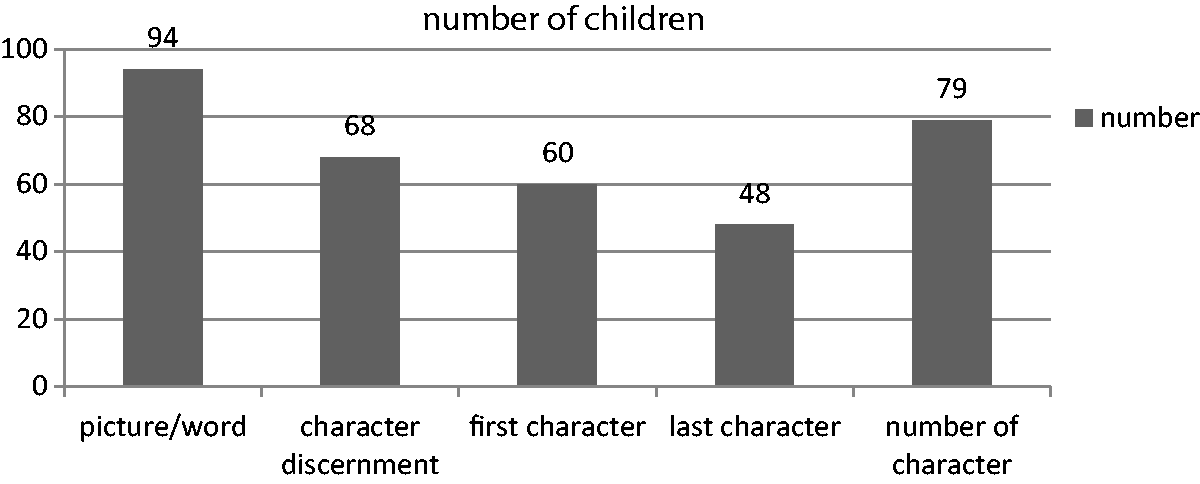
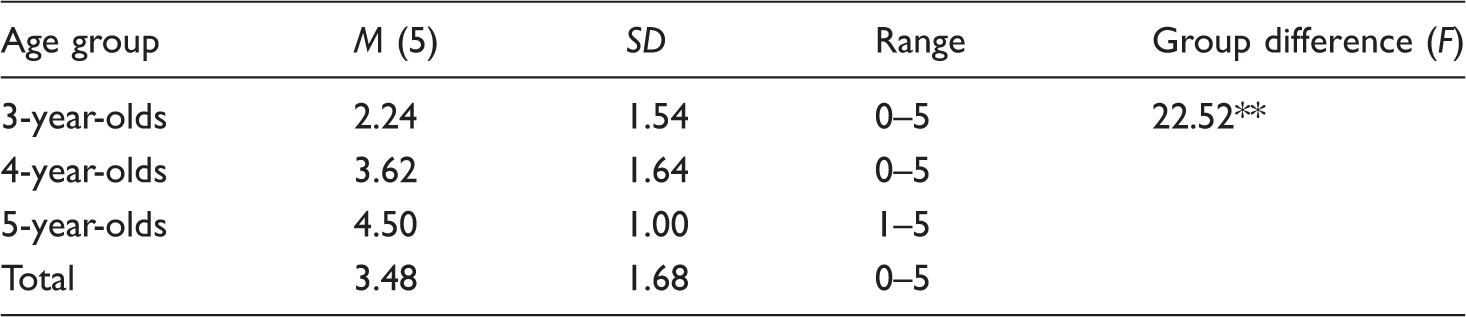
Radical differentiating task
Descriptive statistics for radical differentiating test.
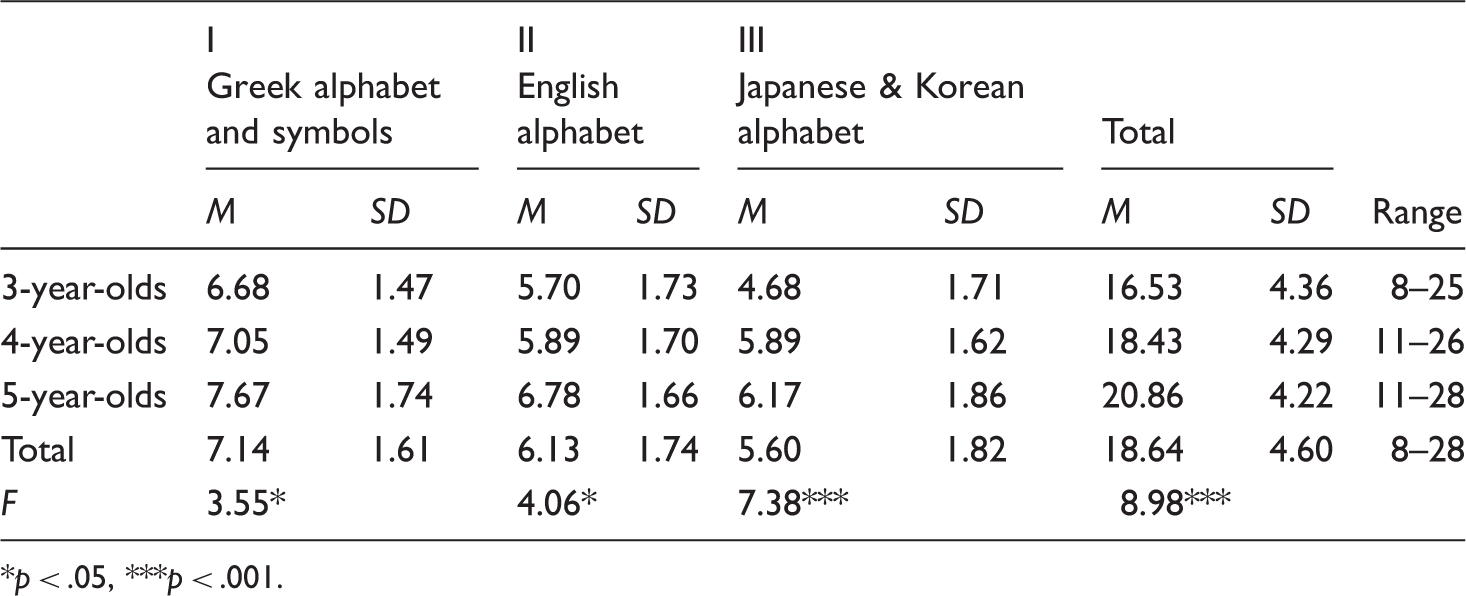
p < .05, ***p < .001.
Children’s performances on this task were shown to improve with age. There were significant differences among the three age groups (F (2,104) = 8.98, p < .001). The five-year-olds gave the right answers for 70% of the items; they were able to distinguish more than 20 radicals from respective resemblances (M = 20.86, SD = 4.22) and performed significantly better than the three-year-olds (p < .05). The maximum score for the three age groups was 25, 26 and 28, while the minimum score was 8, 11 and 11, respectively. Children’s performance on distinguishing radicals from the Greek alphabet and symbols was better than their performance on distinguishing radicals from Japanese and Korean letters. For three- and five-year-olds, scores of the three subtests were shown to descend consequently; however, the four-year-olds achieved similar scores on distinguishing radicals from the English alphabet and Japanese/Korean alphabets.
The results for the recognition of individual radical differentiating test are displayed in Figure 2. Among the 30 radicals, 山, 几, 口 and 扌 were recognized by more than 80% of the children. These four radicals are all high-frequency radicals; the first three are also independent characters that can be recognized by most first-graders. The fourth radical is very similar to an independent character 才, and is therefore also highly recognized. The radicals 刂, ⺥, 丁, 弋 and 氵 were the top five most difficult radicals; less than 50% of the children correctly selected them as Chinese radicals (36.4%, 42.1%, 43.9%, 45.8%, and 47.7%, respectively, from left to right). Among them, ⺥and 弋 are low-frequency radicals, and the rest are all high-frequency radicals.
Accuracy of individual Chinese radicals.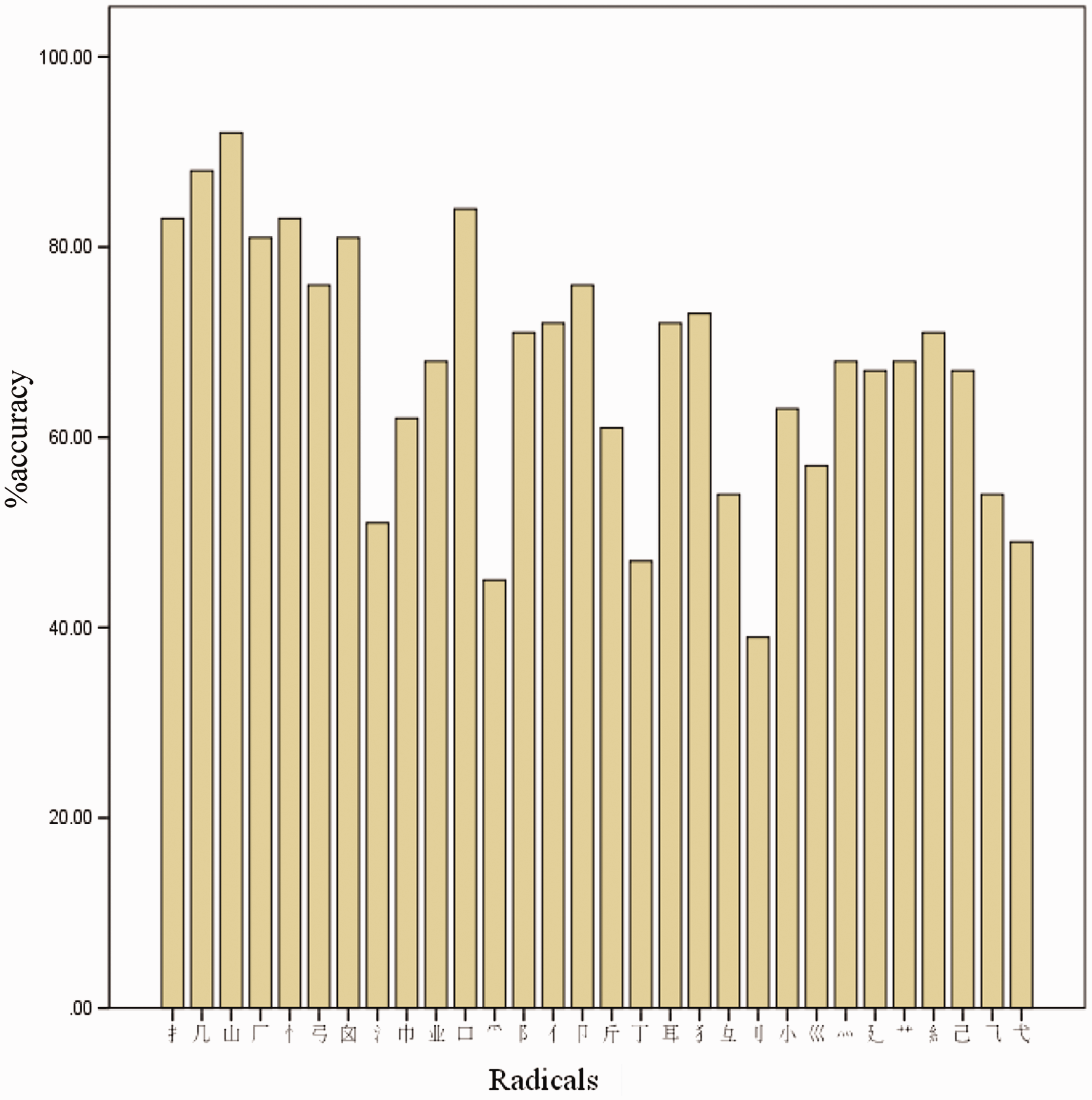
Chinese character reading
Descriptive statistics for Chinese character reading.
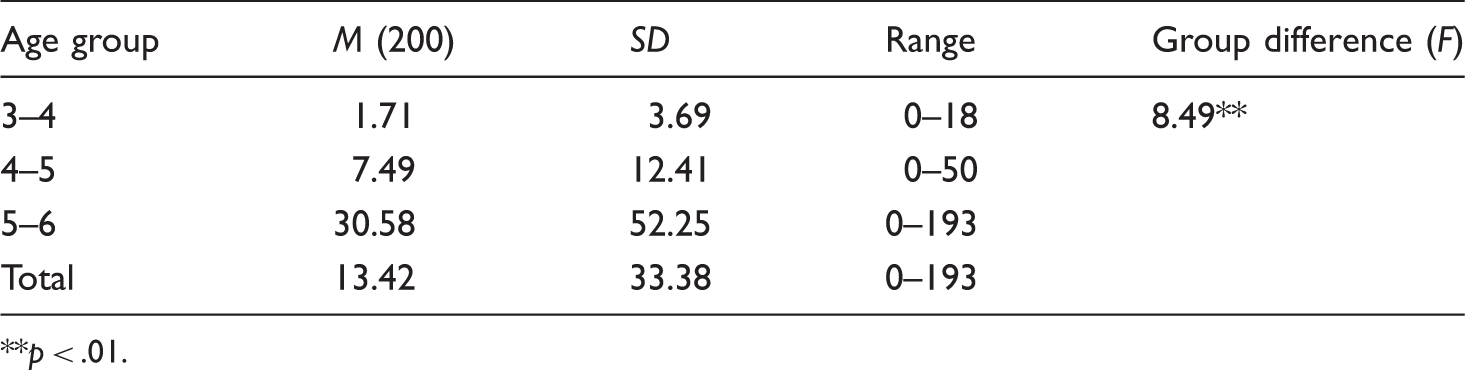
p < .01.
Discussion
Given the importance of early literacy development, we explored preschool children’s knowledge of Chinese characters in the present study. We examined young children’s knowledge of Chinese characters on four different levels: character component (radicals), character, word and sentence. As a morpho-syllabic language system, Chinese word reading may require more visual-related skills than an alphabetic system. The skills, including understanding the forms of character and character components and the ability to differentiate some salient features of characters, could be measured to provide a valid estimate of pre-reading children’s character knowledge. The results revealed that preschoolers’ knowledge of Chinese characters increased with age and could significantly predict their concurrent character reading ability. The basic character concepts and radical differentiating tests used in this study provided a valid estimate of the latent character knowledge of Chinese preschoolers. Our regression analyses suggest that understanding the form of Chinese characters and radicals were both related to children’s character reading, even after accounting for variance due to age. The development of children’s knowledge in Chinese characters is further discussed in detail below.
Basic Chinese character concepts
In the basic Chinese character concepts task, most children showed considerable knowledge of Chinese characters. They knew the square forms of Chinese and could discern one character from an other. Some Chinese characters have a certain degree of iconicity (e.g. 山 mountain, 口 mouth, 川 river) and it can be confusing for children to distinguish them from pictures; however, most children were able to differentiate without much hesitation. Consistent with the findings of Qian et al. (2015), we found that by the age of four, children demonstrate a clear understanding that writing followed different conventions from drawing. When the stimulus word ‘butterfly’ was deliberately printed in a circle in parallel with a same-size picture, all the four- and five-year-olds were able to distinguish it from a picture. Tolchinsky (2003) proposed that children’s literacy development follows a universal trend; they learn about the features of print common to all writing systems first and then master language-specific characteristics (i.e. shapes of letters). The three-year-olds who do not understand the nature of writing systems may face some difficulty in differentiating words from pictures. After they acquire some understanding of the basic nature of writing, they know that writing constitutes sequences of symbols representing sequences of linguistic units and that it differs from drawing, and differentiating Chinese characters from pictures becomes easy.
However, Chinese characters and alphabetic words are two very different languages in writing. To explore whether Tolchinsky’s (2003) literacy development trend also applies in Chinese character recognition, we chose two structurally complex Chinese characters to test children’s ability to distinguish a complex character from a picture first. Furthermore, we also tested children’s knowledge of two Chinese language-specific properties: squared shape and one syllable representing one character (rather than shapes of letters). We found that most five-year-olds were able to discern characters in a word or sentence. Although they could not read the word, they knew that each Chinese character was taking the same space and shape in the text. The character ‘蝴’ is complex in that it consists of three independent characters, ‘虫’, ‘古’ and ‘月’; however, most children (n = 68) knew that those radicals represent only one character based on their concept of how a Chinese character should look. We believed that the children’s concept stemmed from their knowledge that a Chinese character is square shaped and that the component radicals of a character are very close together in a side-by-side or top-down arrangement. With this conceptual knowledge, it was easy for the children to recognize that there are two characters in the word ‘蝴蝶’ (butterfly) and three characters in the sentence ‘蝴蝶飛!’ (The butterfly flies.) and to respond correctly to Question 5. Unlike English words that vary in length and size, each Chinese character is generally arranged in a square-shaped space, with consistent size, length and width, regardless of the number of strokes or radicals. For pre-reading children, it is easier to distinguish every single character from a long Chinese sentence than in English (Jackendoff, 1993). However, it is even more difficult for pre-reading children to distinguish every single character from a sentence with punctuation in it from a word. A character followed by punctuation or an exclamation symbol and vice versa is particularly confusing for them. For instance, in the sentence ‘蝴蝶飛!’, it is easier to distinguish the first character from the third character, for it is followed by a non-syllable exclamation symbol. A total of 60 children (56.07%) could point to the first character of ‘蝴蝶飛!’ in Question 3, but only 48 (44.85%) children pointed to the last character of the same sentence correctly in Question 4. In the sentence ‘蝴蝶飛!’, an exclamation mark was placed right next to the character ‘飛’, making the last character more confusing than the first character; this could be the reason for the difference between the two tasks.
Of the tested children, only 48 could correctly respond to Question 4 and point to the character ‘飛’ as the last character in the sentence ‘蝴蝶飛!’; the correct number was far below Question 2 (n = 68). Among the 39 children who answered incorrectly, about half identified ‘!’ as the last character; the others were confused by ‘飛!’ and answered ‘don’t know’. Our observations suggested that the appearance of the symbol ‘!’ disturbed children’s recognition, probably due to their ignorance of the meaning of the symbol ‘!’. Moreover, discerning each character from a sentence was more complex than discerning it from a two-character-word (i.e. 蝴蝶) for some preschoolers.
Radical differentiating task
Children’s performance on this task significantly explained their knowledge of radicals. Children aged between three and five start to acquire the ability to distinguish other writing systems from their own (Jackendoff, 1993). They can distinguish Chinese radicals from symbols and other language letters before reading any characters. Even among similar shapes, young children may differentiate one that resembles Chinese characters. Children’s performance on distinguishing radicals from the Greek alphabet and symbols was better than their performance on distinguishing radicals from Japanese and Korean letters generally. The visual form differences between Chinese radicals and Greek symbols were significantly greater than that between Chinese and Japanese/Korean, and these could correlate with children’s differentiability.
Radical awareness may develop prior to character recognition and is likely to serve as visual cue for rote memory processes in character learning. In this study, the characters 山, 口 and 小 were included in a character reading test and in a radical differentiating test, in which they were paired side by side with ‘look-alike’ stimuli (Ψ (a symbol), D (English) and기 (Korean), respectively). We found that children who could not read the characters 山, 口 and 小 were able to note the particular shape of radicals and provide correct responses to the radical differentiating test. Consistent with a previous study (Chen, 2015), our regression analysis revealed that children’s radical recognizing ability correlated with their character recognition ability. For Chinese word reading, radical awareness might emerge as a unique correlate during the pre-reading period (Wang et al., 2015). Initially, young children learn to recognize radical shapes and then proceed to gain knowledge of the use of radicals in orthography.
As presented in Table 7, preschoolers’ radical awareness appeared to increase with age; however, the range of scores was quite large among children of the same age. We believe that this was caused by the differences in children’s early literacy experiences. Children’s initial development of radical awareness might have been triggered by literacy experience in Chinese; other types of learning experience may interact to influence their knowledge of Chinese characters. During this task, we found that children who had learned CYFH in nursery school would pronounce the radicals 卩 and 厂 in accordance with the CYFH system and choose them as ‘our characters’. The radicals 卩 and 厂 are also phonetic symbols in the CYFH system and are pronounced as Zī and Hē; however, when they are combined with other radicals to form Chinese characters (e.g. 雁、壓、御、節、卻), they play no role in the pronunciations of the composed characters. Those children who have learnt CYFH in nursery school tended to apply their knowledge in the radical differentiating task.
Similarly, when asked to differentiate 丁 and J, some children from bilingual kindergarten would read J in English and prefer to mistakenly choose it as ‘more like’ the Chinese character, making it the third highest mistakenly answered item. Our observation suggested that young children, particularly four-year-olds in the current study, tended to utilize their knowledge of English letters in the radical tasks. The above assumption is consistent with the fact that of the 37 four-year-old children included in this study, 28 were from bilingual nursery schools. The character 丁 has only two strokes; however, it is not a high-frequency character. On the contrary, J is a letter frequently encountered in poker games and other signs in daily life; therefore, preschool children tend to choose the readable symbol as a Chinese character rather than 丁, a real Chinese character; yet they cannot read. Thus, any type of literacy experience may influence children’s language development.
Since radicals and sub-radicals are stroke patterns that frequently appear in many characters, it was therefore suggested that a radical teaching pedagogy be adopted for teaching Chinese characters (Hwang, 2008). Researchers (e.g. Hwang, 2008; Wang and Koda, 2013) proposed that instead of teaching a single character directly, a set of characters with the same radical should be instructed following the learnt radical. Research found that this radical-character pedagogy enhances Chinese characters’ recognition (Tse, 2011) and reduces stroke errors in writing (Hwang, 2008) for elementary students. A recent study found that semantic radical awareness predicted Chinese kindergarteners’ word reading and writing one year later, and suggested that teachers and parents could draw more children’s attention to semantic radical knowledge in Chinese (Wang et al., 2015). Considering our current study, we suggest that visual discrimination activities for seeing likenesses and differences might help radical awareness. For example, there are only slight differences among the four high-frequency semantic radicals 口, 日, 目 and 田; teachers may ask children to identify their differences, trace or copy the strokes, or find the same radicals from characters to facilitate their radical awareness. However, these activities need further study before they can be implemented in a kindergarten curriculum.
Chinese character reading
Children’s character recognition ability increases rapidly with age. In our study, we found that three- to four-year-olds could only read 1.71 characters in the test, and that the mean of four- to five-year-olds was 7.49 and increased to 30.58 for five- to six-year-olds. Using the same measurement, Yang (2007) revealed that five- to six-year-old children were able to read 65.59 characters. The discrepancy could be due to age difference; the participants in Yang’s study had a mean age of 68 months, while in our study, the mean age was 64 months. For five- to six-year-olds, four months might result in a significant difference in the advancement of language development. In an even earlier report, Chen (2001) revealed that their five- to six-year-old children, selected from urban Taipei city, were able to read 83 characters, which was a significantly better result than Yang and ours. As Morrow (2005) has argued, children who have had exposure to print in a literacy-rich environment learn to read in ways as natural as language acquisition. The type and quality of available preschool experiences as well as the print experiences children possessed in kindergarten were important influencing factors that could significantly affect the study results.
Limitation and directions for future study
The major limitation of this study is that the participants were relatively few and homogeneous. Most of our preschoolers came from the suburban area of Taiwan. It might limit the generalizability of our findings to a larger and more diverse population. In future studies, a larger sample with different social economic status levels and geographical backgrounds maybe needed to further explore children’s knowledge of Chinese characters. Second, we found that the testing tasks employed in the current study appeared to be relatively reliable in assessing pre-reading children’s character knowledge. By expanding the participant size to include children from a more diverse background, the reliability of our testing tasks could be further established.
Finally, understanding the form of characters and radicals might be particularly important for children’s early literacy development. Our results may have some practical implications for literacy instruction to preschool Chinese children. Currently, children in Taiwan’s primary schools are taught to read and write characters according to the stroke order and count the number of strokes of each character. As indicated by the current study, radical structures may also be taught as part of character learning strategies. The importance of basic concepts of Chinese characters and radical recognition potentially suggests ways to improve early literacy instruction and early detection of children at risk of reading difficulties.
Footnotes
Funding
The author(s) disclosed receipt of the following financial support for the research, authorship, and/or publication of this article: This research was supported by the Ministry of Science and Technology, Republic of China (NMRPD1B1581).