



Abstract
This study examined active Swedish preschool teachers’ thoughts and perceptions in terms of read-alouds as a tool to support children's language and literacy development. The research question was ‘How and for what purpose do preschool teachers say that they organize read-alouds in preschool?’ Three focus group interviews were conducted with five preschool teachers from different preschools in each group. The findings reflect traditions that influence preschool education, and the general picture is that teachers’ personal and practical knowledge informs their daily teaching. The informants try to organize read-alouds but do not always succeed as a result of logistical and practical challenges. Teachers describe external factors, such as large groups and the requirement to teach maths and science, as obstacles in the planning and implementing of read-alouds. Teachers that have received in-service training and professional development say that they have daily read-alouds followed by text talk. The need for professional development is discussed.
Keywords
Introduction
This study focuses on teachers’ perceptions of read-alouds in preschool classrooms. Research on preschool teachers’ perceptions of read-alouds seems to be scarce; however, research can be more readily found on the perceptions of teachers in primary schools. In the study for her dissertation, Boyd (2013) received about 200 responses from teachers that provided several reasons for reading aloud: ‘just for fun; filling time; connected to a content we are studying; instruction in decoding, comprehension or vocabulary; literature instruction/study’ (p. 101). When the teachers were asked to log their read-alouds, it appeared that the content of the text was easily the most commonly reported purpose for read-alouds. Likewise, in their survey of 300 teachers from pre-kindergarten to grade eight, Morrow and Brittain (2003) found that teachers focused on the content. Kimmy (2017) in turn found that preschool teachers felt confident in their ability to start discussions with students about the material that they read together, but they felt less confident in their ability to provide the same opportunities for phonemic awareness. These few sources somewhat mirror the research on read-alouds in preschool, which will be discussed below.
From an international perspective, read-alouds do not seem to have a didactic function; rather, this activity is mostly for entertainment purposes and/or disciplinary purposes in the preschool classroom (Damber, 2015; Dickinson, 2001; Eskebaek et al., 2008; Scheiner and Gorsetman, 2009; Shedd and Duke, 2008; Thomas et al., 2011). Dickinson (2001), for example, demonstrates that many preschool teachers do not make optimal use of book reading as a means to develop children's language skills. They may read books in a didactical manner, but without supporting an extended discourse that would solidify understanding and promote the use of more complex language. Scheiner and Gorsetman (2009) found that of 31 preschool teachers, only about half identified the need for analytic talk and inference-making during read-alouds. Damber (2015) found that in Swedish preschools, reading often occurs when there are few children and often in the afternoon while teachers are waiting for parents to collect their children. In Damber's study, 39 Swedish preschools were observed, and it was found that the planned book reading involved large groups of children and mainly took place once a day, either before or after lunch, during the so-called ‘reading rest’ time. Books were chosen randomly. Simonsson (2004) states that care (rest) and an educational moment (read-aloud) are intertwined in the ‘reading rest’ time. Damber (2015) noted that teachers often read to children rather than with them, which means that the children listened more than they discussed content. Similar findings have been presented by other Scandinavian researchers (Eskebaek et al., 2008; Simonsson, 2004; Svensson, 2009). In reading aloud activities in preschool, children have the opportunity to learn and develop from their own experiences in interaction with other children and adults, which contributes to their understanding of the surrounding world (Street, 1984; Neuman, 1996). Through interaction and communication between participants as well as between participant and text, meaning and understanding are created (Barton, 2007).
Reading aloud affects sensitivity to the linguistic and organizational structures of both narrative and informational texts (Duke and Kays, 1998). Exposure to a number of text types gives children different kinds of experiences. With fiction, the reader meets the world through the characters, whereas non-fiction reproduces the world in a way that enhances children's understanding of it (Duke, 2003; Massey, 2014). Besides storybooks and non-fiction books, children need to be exposed to, for example, letters, newspapers, magazines, recipes and instructional texts of varying kinds (cf. Shedd and Duke, 2008).
Children learn words through contextualized and decontextualized talk during read-alouds (Beck and McKeown, 2007; Wasik et al., 2006). Storybook reading also enables referencing print by, for example, highlighting the forms, functions and features of print: this supports children's code-based skills, such as print awareness, alphabet knowledge and phonological awareness (e.g. Justice et al., 2009). Rich language interactions within the context of shared book reading can serve to make children sensitive to the sounds and letters in words (e.g. Wasik et al., 2006).
Oral practice of strategies related to read-alouds as a means to understanding text content is also emphasized as being important in preschool and school (Beck and McKeown, 2001; Dooley and Matthews, 2009). The nature of a text, the quality of the reading style and the number of times a book is read seem to be important contributing factors in the vocabulary development of young children (e.g. McKeown and Beck, 2006; Horst et al., 2011). These benefits are influenced by factors such as the social context created between adult and child, and the quality of conversation embedded within the read-aloud experience (Dickinson and Tabors, 2001; Neuman, 1996).
Research indicates that many preschool teachers lack a comprehensive awareness of early literacy (Hawken et al., 2005; Hindman and Wasik, 2008; Justice et al., 2008; Wasik and Hindman, 2014). Implementation research suggests that external factors such as social, political and economic circumstances within teacher communities may influence teachers' decision-making with regard to what and how to teach, rather than their professional training or years of experience (Butera et al., 2013). In a qualitative study on preschool teachers' implementation of a new curriculum, Butera's research group was concerned that the teachers valued the practical and personal knowledge they had about the children and families in the programme, and that they used this knowledge to inform their teaching instead of valuing knowledge that they might acquire through formal professional development, including coursework, leading to an undergraduate degree. In the cited study, Butera et al.(2013) followed a group of Head Start teachers over the course of six years. In an observation study that included 60 participants, Gerde and Powell (2009) found that when compared with teachers with fewer years of training, well-trained and professionally experienced teachers were more content-focused in their discussions about read-alouds: they defined and discussed new words, asked questions, responded to children's spontaneous comments and expanded the text with additional information related to the book.
The literature states that preschool education needs to be proactive in its orientation towards literacy instruction so as to reduce the number of children who fail to achieve fluent literacy skills in the elementary grades (e.g. Snow et al., 2005). Such orientation requires that preschool teachers use scientifically validated approaches when delivering early literacy instruction in their classrooms (e.g. Dickinson and Caswell, 2007; Hall, 2003).
Purpose and research question
The Swedish government has identified a need for early childhood education so as to more systematically tie together play and learning and thus increase children's learning. As such, the role of the Swedish preschool teacher has been clarified in the Education Act and the national curriculum, and it has become more oriented towards children's development and learning. The curriculum for preschool (National Agency for Education, 2010, revised 2016) states, in particular, that preschool should put great emphasis on stimulating each child's language development and encourage and arouse the child's curiosity and interest in written language.
The present study seeks to contribute to the accumulated knowledge about early literacy instruction and aims to examine active Swedish preschool teachers’ thoughts and perceptions in terms of read-alouds as a tool to support children's language and literacy development. The central focus is on the following research question: ‘How and for what purpose do preschool teachers say that they organize read-alouds in preschool’? Organize here means arrange or implement. There was no intention to focus on instruction of first- or second-language learners but rather to talk broadly about the research question with the teachers.
In this text, the term ‘read-alouds’ refers to reading aloud from different text genres through the use of disparate qualities of reading style for various group sizes, and for a pleasurable and/or specific instructional activity. It could also be aligned with other aspects of classroom life, such as moving into and out of transitions. Since the study investigates teachers’ experiences and perceptions, the term is open for the teachers’ own definitions.
Swedish preschool
In Sweden, preschool is a non-obligatory stage in a child's education, but of all Swedish children aged between 1 and 3, 85% attend preschool. Children are enrolled, and parents pay a fee determined by the local municipality. Almost 97% of children aged 5 are enrolled in some kind of early childhood education programme (Samuelsson and Pramling, 2013). According to the curriculum (National Agency for Education, 2010, Revised 2016), preschool strives to help each child develop social and cognitive skills, the ability to use language and mathematics as well as motor skills. Furthermore, activities should provide science and technology learning opportunities, as well as opportunities to learn about the local environment. Core concepts are exploration and creativity.
The Swedish preschool has traditionally positioned itself against the knowledge tradition in school and been dominated by a holistic view and a vision of the child as a natural being (Vallberg Roth, 2001). Vallberg Roth states that preschool has viewed care as being core to its work, whereas learning and achievement have been considered domains associated with compulsory school.
Qualification as a Swedish preschool teacher requires the completion of a university-level programme that is between two-and-a-half and three years in duration, and which combines practice and theory. Courses focus on child development, family sociology and teaching methods.
Conceptual and theoretical framework
Play and practical-aesthetic activities have, in Western countries over the last decades, been seen as the most important of all activities for children because through these they will develop language and imagination as well as social and communicative skills (Broström, 2006). At the end of the nineties, the term learning was implemented in the preschool curricula of Scandinavian countries. As such, preschool education is moving towards a new paradigm in which both children and childcare workers have an active role (Broström, 2006). According to Broström, the content for teaching and learning in preschool is the shared topic on which the child and childcare worker focus: i.e. in this study, literacy and language-supporting activities.
Uljens' (1997) theory of didactics and Vygotsky's (1986) theories of learning that occurs within a social context has framed the current study and outlined the aims and research question. Three types of questions are consequential to the planning, implementation and evaluation of teaching, i.e. the didactic approach in teaching: what is to be taught and how and why this is to be taught (Uljens, 1997). These questions are of interest in this study when it comes to teaching in preschool. In teaching, the concept of the zone of proximal development by Vygotsky (1986) and scaffolding by Wood et al. (1976) are essential. Theories on socially influenced learning are useful for the analysis and interpretation of teachers' statements about didactic questions related to children's language and literacy learning.
The theoretical tool for the analysis derives from research-based arguments stating the necessity of reading aloud every day in preschool, as formulated by Shedd and Duke (2008). According to them, the teacher needs to plan read-aloud times and carefully select books that children find engaging and interesting so as to help in the development of children's language and literacy skills. Shedd and Duke indicate various factors that are essential in the selection of reading material: powerful illustrations, reflection of diversity in the classroom, variety in book type, books related to a current theme and books with high-quality text. Successful read-alouds rely on active engagement in reading on the part of both adult and child. Open-ended questions related to the text and pictures and contextualized as well as decontextualized text talk are highlighted as being important during read-alouds.
Method
A qualitative approach was used to access data on preschool teachers' perceptions of read-aloud activities as opportunities to stimulate children's language skills and early literacy learning. Focus groups as a concept is a research technique that relies on interaction within the group based on topics that are supplied by the researcher (Krueger, 2002). In the current study, focus groups were suitable since the purpose was to assess perceptions and experiences in terms of activities that are common and culturally entrenched.
The design of the study
The study was designed in two parts as follows: 1. Read-alouds of fiction and non-fiction to different large groups of children in the age group of 3–4 years in preschool were filmed to be used as the basis for discussion in focus group conversations. The filmed teachers were interviewed shortly afterwards about didactic questions related to the read-aloud situation. The aim of the film sequences and interviews with the filmed teachers was that they would serve as material for the focus group discussions. 2. Three groups of five preschool teachers from different preschools in two municipalities participated in focus group conversations with a focus on read-alouds in preschool. The conversations were based on film sequences, interview material from the film sessions and other didactic questions (online Appendix 1). The focus group teachers were not involved in the video-filming but were expected to discuss and critically reflect on their own read-aloud practices as well as those of the filmed teachers. The film sequences provided a look into the filmed teachers' read-alouds and encouraged the informants to focus on and discuss the issue that was the purpose of each film sequence, i.e. the introduction and the ending of the read-aloud sessions. Video content enables research participants to focus on events in the film that might otherwise be overlooked (Pomerantz, 2005). The members of the focus groups were from different institutions and had not met previously, which was considered a strength or even an advantage since there was no predetermined order of discourse (Fairclough, 1992) that might have steered the direction or perspective of the conversation.
The conversations were led by a moderator (one of the authors; cf. Krueger, 2002) and focused on the introduction and the end of two of the films. Although the focus group informants were not involved in the film sequences themselves, the video-recorded read-aloud sequences were expected to trigger their thoughts, feelings and reflections as well as their reactions, which has been found to happen when viewing filmed events (e.g. Tobin and Davidson, 1990). In addition, the focus group teachers received a number of statements from the interviews with the filmed teachers to use as discussion points. During the conversations, the second author took notes (cf. Krueger, 2002). The focus group conversations provided the data for the present study.
Procedures and choices relating to the filming
Two preschool principals in two different municipalities, one rural and one large urban municipality in central Sweden, were asked whether any of their staff would like to volunteer for the filming of read-alouds as the basis for a read-aloud study. Three teachers, whose names were put forward by the principals, were contacted, and they agreed to participate. The authors filmed these teachers’ read-alouds of fiction text a total of four times and of non-fiction text one time during the spring of 2015 (online Appendix 2). Appearing in the films were a number of different large groups of children, all aged 3–4, most of whom had Swedish as their mother tongue. The preschools represented families with an average socio-economic background. The films of fiction text reading involved two small and two large group read-alouds, of which one was a ‘reading rest’ session. The non-fiction read-aloud film involved six children (online Appendix 2). All read-alouds were in Swedish.
Written consent was collected from the teachers and the parents of the children who participated in the films. Information on the consent form stated that the video-recorded read-alouds would be seen by others for discussion purposes (cf. Pomerantz, 2005). The information further stated that the material would be treated confidentially – i.e. that no names of the preschools, teachers or children involved would be given to the focus groups; that the material would be used for research purposes only; and that it was possible to terminate participation at any time during filming. The children were also asked for permission to be filmed during the read-alouds. The filmed teachers were briefly interviewed afterwards regarding the choice of book, the response of the children during the reading, the way children dealt with new words and concepts and the number of times they typically read the same book – i.e. once only or multiple times.
Procedures and choices in terms of the focus groups
To find informants for the focus groups who worked with children who were 3–5 years of age, preschool principals were contacted in one of the municipalities involved in the filming and another municipality in central Sweden – i.e. in one small and one large town. A greater number of preschool teachers reported an interest in participating, and the final selection was based on the strategy that the teachers would be from various preschools in the two municipalities. The 15 informants were contacted in early autumn 2015, and two focus groups of five participants were finally set up in the large town and one in the small town. In the preschools, Swedish was the principal language. Consent forms were collected, and all focus group participants were informed that the material would be kept anonymous and confidential and would only be used for research purposes. They were also told that they could withdraw from participating at any time without giving a reason. The integrity of those involved, both the children and the adults, was important throughout the process. Participants were asked in clear terms not to spread information about the content of the videos or focus group conversations. In order to retain anonymity, no names of informants or institutions have been given.
The focus group discussions were held once with each group in a centrally located room in the town hall of each municipality. Each focus group discussion lasted for about two hours. The focus group discussions were structured and divided into four phases: an initial phase of introductory questions, additional questions in an intermediate phase, a transition phase with key issues and a finishing phase of questions and discussion (cf. Krueger, 2002; online Appendix 1). The conversations were recorded using a dictaphone.
We informed participants in detail about the guidelines for the sessions (Krueger, 2002). In the initial phase of the focus group discussions, four film sequences of three minutes each were shown. One film sequence was from the start of the read-aloud with a small group of children (film 1), the second from the end with a larger group (film 2) and the third and fourth from the start and end of the read-aloud of the non-fiction text (film 5; online Appendix 2). The criteria for the choice of films 1 and 2 of reading fiction were that one was a small group and the other a ‘reading rest’ session. Only during the first sequence did the participants write down their spontaneous thoughts about the current read-aloud situation, which they then shared with each other and briefly discussed. The three other sequences were discussed based on didactic questions about read-alouds with children in preschool (online Appendix 1).
In the intermediate phase, the conversation expanded beyond the films. In the transition phase, participants were asked to read and discuss quotes from the interviews with the filmed teachers. The content in these quotes is very much in line with the focus group teachers' statements. In the closing phase, the participants were asked about their perceptions regarding the basis for read-alouds in preschool. Furthermore, there were questions about whether their knowledge resulted from experience, training or research literature, or whether instinct alone was involved.
Descriptions of the focus groups
Description of the focus groups.
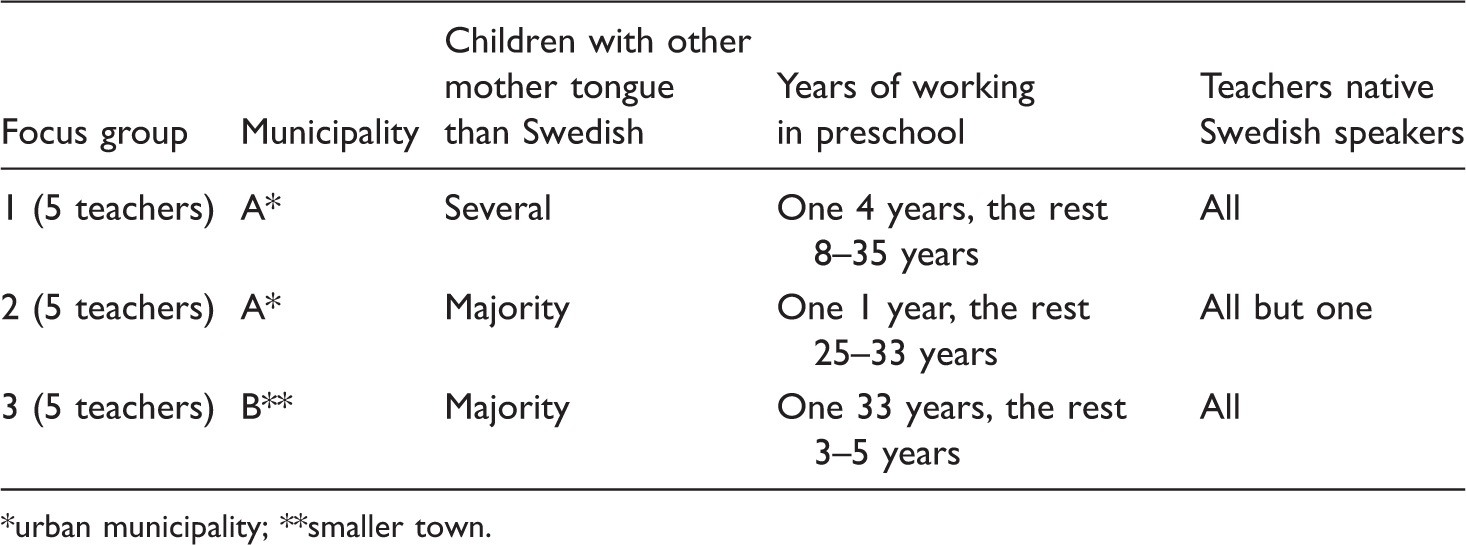
*urban municipality; **smaller town.
Data-processing and analysis
The recorded conversations were transcribed by the researchers immediately following the focus group sessions (Krueger, 2002). This allowed for a return to both recorded and transcribed material to gain a deeper understanding of it and also an understanding of what was said from a holistic perspective (Kvale and Brinkmann, 2009). The notes that the second author took during the focus group conversations were used in the transcribing process to help with, for example, remembering who spoke and how the discussion went. It was important to ensure a true understanding of the statements and to be consistent in how interpretations were made.
Examples of statements, the themes and the headings.
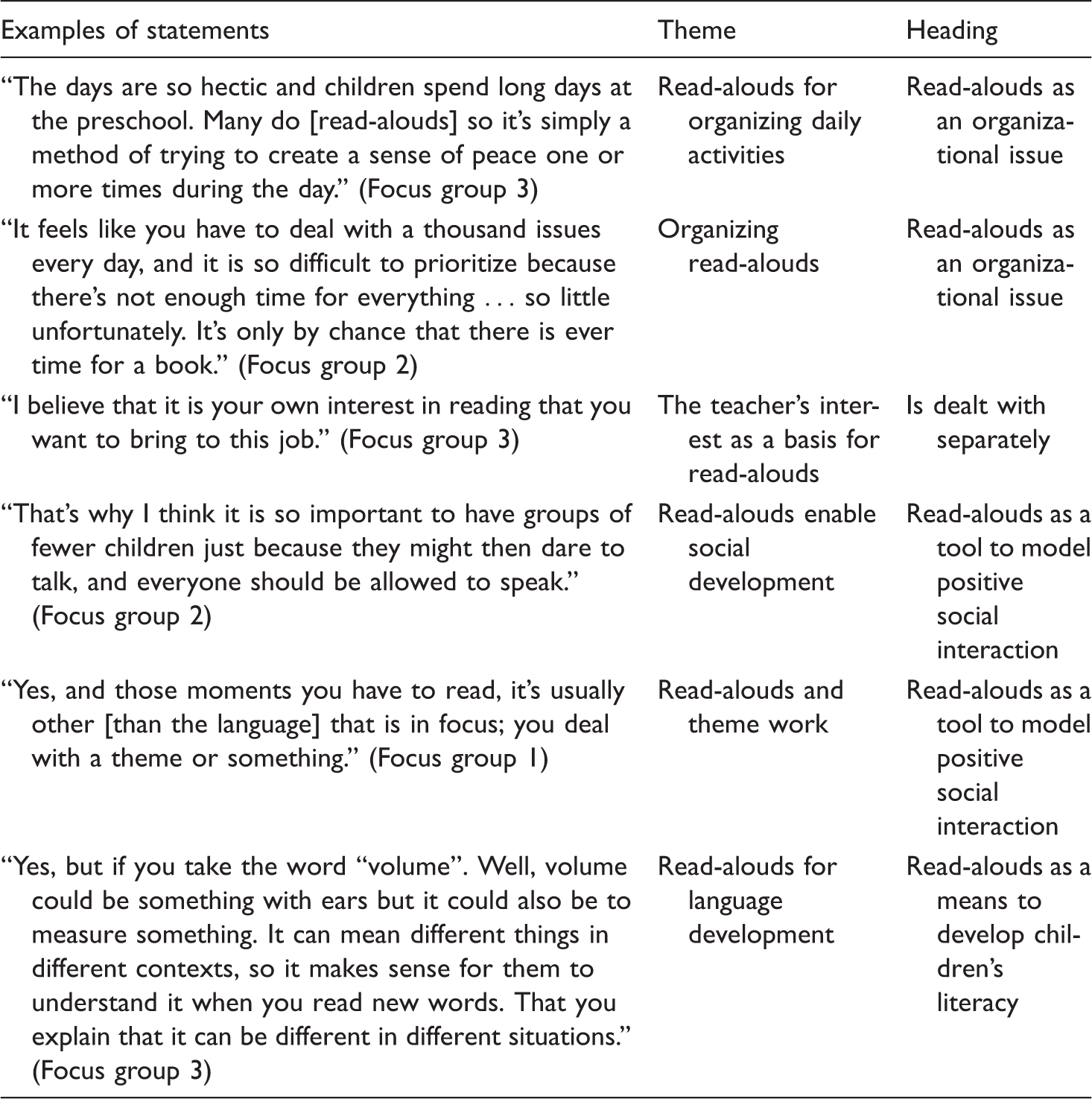
The material was read through repeatedly to ensure that interpretations were properly made and analyses properly conducted. The themes were then sorted into three headings for presentation of the material: ‘Read-alouds as an organizational issue’, ‘Read-alouds as a tool to model positive social interaction’ and ‘Read-alouds as a means to develop children's literacy’, with the last having two sub-headings. The themes that go beneath the headings sometimes overlap. The teachers’ personal interest in reading did not fit beneath any heading and is dealt with separately. Table 2 provides examples of how the themes were sorted into headings. The findings will be presented, analysed and discussed on the basis of the conceptual and theoretical frameworks in the study. The presentation of findings is intended to provide a picture of what became apparent from the teachers’ reasoning and discussions; statements made by the focus groups are presented to exemplify what was said.
Findings
In all focus groups, the teachers' own interest in reading was mentioned as being an important factor when it came to how often the teachers read and what they read to the children. The discussions demonstrated that none of the teachers were interested in reading to children, and as a result, there were a limited number of read-alouds. However, the findings attest to the fact that the teachers do try to organize read-alouds even though they point out the problems with them: this is discussed below.
Read-alouds as an organizational issue
It appeared that the teachers used read-alouds to gather many children at a time, and they said it was used to free up staff. For example, teachers in all the focus groups talked about ‘reading rests’, which were described as being read-alouds in situations that involved the whole group. It appeared that in those situations, the purpose was not so much to convey the content of the book as it was to hold the group of children together so that the other teacher could, for example, plan the next activity. In focus group 2, they discussed the advantages and disadvantages of read-alouds as part of the routine. Two teachers described their insights into how difficult it is for children to sit still and listen to a read-aloud immediately after eating because they need to move. One of them said: We have always thought and believed, ever since I began working in 1985, that of course they listen then. They can lie down, but they absolutely cannot lie still and listen, but they find it of course difficult to concentrate at a time when they are most tired. So it becomes no rest, reading rest, because it's enough for them to keep still and concentrate on listening. (Informant in focus group 2)
In focus group 2, one informant described how they organized the read-alouds: If you think it is a very important moment for the children, then you at least need to try to structure the activity so that there are opportunities for the children to experience a few minutes of the read-alouds. For example, in my preschool, we also jumped back and forth and tried to structure the read-alouds, but finally we came to the conclusion (—) we don't let each other have a break directly after lunch as we have done before, but we divide the group into two, and they therefore get to experience read-alouds. (Informant in focus group 2) Mostly, you don't have time to sit down with one or a few children, you need to have more children … . and we don't have time to read, we need to do this and that… (Informant in focus group 1) In preschool, there is a focus on one thing in particular for a few years and … you lose the reading part and focus on mathematics teaching for a period of time, and then return to focusing on language again. (Informant in focus group 2)
Despite many of the informants' wishes, there may be long periods when the teachers do not read any books. These statements demonstrate that read-alouds with a purpose and as a means to stimulate children's language development were not easy to organize.
Read-alouds as a tool to model positive social interaction
The read-alouds were, as is apparent above, for the most part described as being reading to a large group of children without discussion of the content. On the other hand, teachers described how read-alouds were seen to be a functioning tool for working with different themes along with social interaction. The convention on the rights of the child, everybody's equal worth and democracy are examples of themes that were mentioned. In thematic work, some teachers stated that the children, in interaction with each other and based on the read-aloud text, could talk about the democratic foundations on which society is based: We work very much on and talk about the value base, which can be found in different books. You can discuss the value bases in different families … and talk about the differences between people… . (Informant in focus group 3) Last year I had a boy in my class who was very extroverted and somewhat violent, even explosive. Several times he sat on my lap and we read repeatedly, and I think it was good for him. He would calm down and sit still and during this period I read a great deal. At that time, the main purpose was to just read in order for him to slow down, even stop and not fight with his friends. So I read a lot to him, and he loved to listen to stories. (Informant in focus group 3).
Read-alouds as a means to develop children's literacy
In all the focus groups, discussions were held about children's language development. Read-alouds were pointed out as being important because children learn to listen, create images in their minds, increase both their vocabulary and their language skills and have an outlet for their imagination. However, a picture developed showing that teachers use read-alouds as one educational tool among many, and that read-alouds are used to develop language for the most part when an opportunity arose.
All the focus groups stated how the teachers read the same book many times to the children mostly because ‘the children want to hear the same story despite knowing it off by heart’. In focus group 3, a reason for this repetition was said to be that the children feel safe when they recognize a story. Focus group 2 described the children's joy upon hearing the same story again and the way in which discussion about the book could be developed. The significance of repeated reading (Horst et al., 2011) for language development was not expressed explicitly; however, the groups did state that reading the same book many times increases children's understanding of the book.
Teachers in every focus group said that they explained words and concepts that were new to the children. Different methods for the explanation of words and terms were described. In focus group 1, an informant explained how she asks the children directly what they believe a word means ‘because once you have read the book, it may be too late’. Another explained how she usually reads the whole page and thereafter asks if anything is unclear. In all the focus groups, it appeared that the teachers sometimes change words and use others if they believe they are too difficult for the children: Sometimes, I change words and use another word instead if I think it's too difficult and the kids do not need to learn it. Once we read about the ghost Laban who got sick and then he became the colour carnation (‘skär’ in Swedish, an old-fashioned word for pink). And I said pink instead. You adjust according to the situation… . (Informant in focus group 3)
The feeling among the focus groups was that children whose first language is Swedish do not need to build their vocabulary and language skills as much as second-language learners. This is contrary to prior research that shows a link between storybook reading and preschool children's vocabulary – all children learn more words through contextualized and decontextualized talk during read-alouds (e.g. Beck and McKeown, 2001, 2007). In focus group 3, one teacher stated that children who have another mother tongue have a greater need to develop their language skills: I think that children with another mother tongue need to develop their language, whereas for children whose first language is Swedish, reading is more about listening and being able to concentrate. This is important for my children. (Informant in focus group 3)
Read-alouds and conversations about the read text
Even though conversation about read-alouds was pointed out as being important for the children, there was no consensus as to its function in terms of language and literacy development, i.e. that children learn new words, develop alphabet knowledge and phonological awareness, as well as reading comprehension, through talk during read-alouds.
Read-alouds of books within the children's areas of interest were highlighted in focus group 3 as being a good method to encourage conversation. In the same group, one teacher explained how she reads for 30 minutes a day to a smaller group of children and how it was always followed by a conversation about the text. She was one of those who had received in-service training about language development.
Another teacher from focus group 3 stated that it can be good for children simply to be quiet and listen: Many children want to talk all the time. I think that's one reason why I sometimes say no, now you have to be quiet because now I am reading a story. There's also a difference if you have six or two children. If there are two children, it's more natural that you maybe want to speak more. But if there are six or eight children and they all want to talk the whole time, and especially if I am reading a book that means I have to jump from one page to another … it's hard… . (Informant in focus group 3)
Reading fiction and non-fiction texts
Reading non-fiction to large groups was felt to be difficult because non-fiction requires more discussion that centres on images and because non-fiction cannot be read from start to finish without the teacher having to stop to explain difficult words. The reading of non-fiction books generates more natural conversations, stated the informants.
It was obvious in all the focus groups that non-fiction books were seldom read in preschool and it was fiction books that were used. Focus group 1 stated that children do not request non-fiction books as often as they once used to. One informant in focus group 2 stated how often ‘a teacher will not want to read non-fiction as that would require more from the teacher especially when it is about facts that the teacher him- or herself is not interested in’. In that focus group, it appeared that, more often than not, it is the children themselves who request the reading of a non-fiction book: It's not me who picks up a non-fiction book and says, ‘come, let's sit and look at this’, it is the children that say that I want you to read this or to look at this… . (Informant in focus group 2)
Discussion
The study's contribution to the field of knowledge is its focus on teachers' statements about instruction as supporting children's early language and literacy development, i.e. preschool teachers' opinions about read-alouds and children's learning. Research clearly demonstrates the benefits of read-alouds for children with regard to the following: social development and learning in interaction (Barton, 2007; Neuman, 1996; Street, 1984); the development of early literacy and language and meta-cognitive abilities (e.g. Beck and McKeown, 2001); comprehension skills (Beck and McKeown, 2001; Dooley and Matthews, 2009); vocabulary growth (Beck and McKeown, 2001, 2007; Hindman et al., 2012); print referencing (Justice et al., 2009); and sensitivity to the sounds and letters in words (Dickinson and Caswell, 2007; Wasik et al., 2006). There is thus a need for the careful planning and continuous implementation of read-alouds in preschool (Shedd and Duke, 2008).
The read-aloud is a traditional school and preschool activity (Boyd, 2013), which might be the main reason why teachers try to practise read-alouds in different situations. Teaching in Swedish preschools is influenced not only by tradition but also by aspects of care and social development, which have always been seen to be its two primary functions (Vallberg Roth, 2001). From the interviews, it is obvious that read-alouds are one of a number of educational tools that teachers use to create joyful and socially comfortable moments in preschool, which is also the experience of prior research (Damber, 2015; Dickinson, 2001; Eskebaek et al., 2008; Scheiner and Gorsetman, 2009; Shedd and Duke, 2008; Thomas et al., 2011). Not all teachers prioritize children's literacy development. This is apparent from the fact that teachers say that only second-language learners need to develop their linguistic ability, not those whose mother tongue is Swedish. Furthermore, the teachers indicate a general uncertainty when it comes to the significance of repeated reading, working with vocabulary and reading non-fiction books.
However, it emerges that the informants know the benefits of read-alouds in terms of children's language and literacy learning. They also try to organize read-alouds but do not always succeed as a result of logistical and practical challenges. Just as in prior research (Butera et al., 2013), external factors such as large groups and the requirement to teach maths and science are described as obstacles in the planning and implementing of read-alouds.
Nonetheless, there are teachers who state that they have daily read-alouds that are always followed by discussion about the text, but we cannot state that this is as a result of in-service training and professional development in terms of literacy and instruction in preschool that stimulates language (cf. Dickinson and Caswell, 2007; Gerde and Powell, 2009; Hall, 2003). The question needs further research.
During read-alouds, children learn about the surrounding world in social interaction (Street, 1984). Children create meaning and understanding even when the teacher reads to fill the time, to curb unrest and conflicts or to quieten down and bring the children together. However, our assumption is that the children's language and literacy learning would benefit yet more from the teacher's explicit planning and implementation of read-alouds with associated text talk (Shedd and Duke, 2008).
As in earlier studies (e.g. Butera et al., 2013; Mihai et al., 2017), the general picture here is that teachers' personal and practical knowledge informs their daily teaching. Our findings are in line with prior research that indicates that preschool teachers need to increase their knowledge and understanding of early literacy (Hawken et al., 2005; Hindman and Wasik, 2008; Justice et al., 2008; Wasik and Hindman, 2014).
To meet the needs of professional development, the Swedish National Agency for Education has, in recent years, set up large in-service training programmes on emergent literacy for preschool teachers. The training aims to support preschool teachers with both metalanguage and methods for literacy instruction so as to help children in their literacy development, which will serve the children well in their later school years (Cunningham and Stanovich, 1997; Schatschneider et al., 2004).
Limitations and further research
The study was small-scale and as such makes no claim to being comprehensive or generalizable; however, it does provide insights into the thoughts of this group of informants. The study was also limited in that it did not focus on emergent bilingualism and read-alouds, but dealt with read-alouds from a more general perspective. Had the focus been on multilingualism, further interesting themes might have become apparent. The method of selection procedures, implementation and analyses has been thoroughly described to increase the reliability of the study and to allow for valid arguments and discussions about the findings. The participating teachers were from various preschools, and their statements are highly consistent, which serves to increase the credibility of the study. Further empirical research about preschool teachers' instruction in terms of read-alouds needs to be conducted to secure assumptions and conclusions and to build on current research. In particular, there is a need for knowledge about preschool teachers' professional development and in-service training when it comes to book reading as a tool for language and literacy instruction.
Footnotes
Acknowledgements
Our warmest thanks to Anna Strid, a preschool teacher and a knowledgeable and committed professional language, literacy and writing educator, for participating in the collection of data.
Funding
The author(s) received no financial support for the research, authorship and/or publication of this article.