




Abstract
The legacy of colonization includes stereotypes and misinformation about African and African descendant people as well as a void in an understanding the vast contributions of precolonial Africa to the world’s knowledge impacting knowledge, languages, music, art, and sciences that we take for granted today. This misinformation remains pervasive throughout society perpetuated in schools by ensuring that curriculum is dominated by whiteness and lacks attention to the histories, heritages, communities, and languages of Black people. Pro-Black practices in response to centuries-old curricular voids and misinformation about Africa, the African Diaspora, and African descendant people can lead to an emancipatory education for all students. In our work, we draw on tenets of culturally relevant pedagogy and descriptions of Pro-Black pedagogy to describe the work of 13 early childhood educators who are committed to using their knowledge from ongoing professional development at one school in the southeastern United States. The work represented in this article reflects data collected over four years and analyzed in answer to the question: What are Pro-Black highlights of teaching in one school which sought to develop and normalize culturally relevant teaching including challenges to the work and efforts to negotiate those challenges? Data (e.g. student work, lesson plans, PD session PowerPoints, participants’ responses to a questionnaire, informal commentaries throughout the PD process, and classroom observations) were collected and reviewed to develop this article. Recommendations are made for educators and scholars.
Not only Black students, but all students need to learn through a Pro-Black curriculum. It is not fair for Black students to see their white counterparts’ histories and literature as the primary curriculum and their own ignored or only taught as slavery or a few famous people during Black history month. All students need to know that African genius is the inspiration behind so much of what we use, how we think and operate today. As a matter of fact, almost anything they name can be traced back to Africa. (Christina Stout, African American kindergarten teacher) Teaching all students with an emancipated Pro-Black curriculum will not just give students knowledge in the classroom, but it’s something that can help them in the real world. Our children are the next police officers, judges, doctors, etc.; they need to be able to see and appreciate Blackness and be able to recognize when it is marginalized or otherwise discriminated against. This will hopefully help to alleviate some of the issues with police violence and brutality, or guilty verdicts based on race (which is something we see all the time). (Kyanna Samuel, African American kindergarten teacher) All students benefit from an emancipatory Pro-Black curriculum because this type of curriculum creates a paradigm in which they are prepared with a counternarrative to the systemic anti-Blackness present in the “real world.” This counternarrative makes it possible for children to question the current system, advocate for change, and empathize with their fellow humans. (Caitlyn McDonald, European American first and third grade teacher)
The three teachers quoted above are members of a group of educators from Jackson Creek Elementary School in the southeastern United States. They are deeply involved in professional development (PD) focused on the study, development, and implementation of culturally relevant pedagogy (CRP) in kindergarten through third grade classrooms (five-to nine-year-old students) with a particular focus on Pro-Black pedagogies. Their teaching aligns with the African worldview that values the “inherent worth of all humans” (King and Swartz, 2018, p. 5) as they include a range of cultural, racial, and linguistic groups in their teaching. However, they center Pro-Black practices in response to centuries-old curricular voids and misinformation about Africa, the African Diaspora, and African descendant people (King and Swartz, 2018) recognizing that these voids and misinformation lead to miseducation for all students. In addition, their work recognizes that Black students’ knowledge and abilities can be missed or misinterpreted when they are required to learn within white-dominant ideologies. This kind of teaching is also explored in grades four and five at Jackson Creek; however, in this article we focus on teachers of the youngest children because, as first and third grade teacher, Caitlyn McDonald put it, “emancipatory Pro-Black curriculum in early childhood ensures that students are formally exposed to the brilliance and greatness of Black culture before having to unlearn anti-Black sentiments that are often foundational to eurocentric curriculums.”
In our work, we draw on Ladson-Billings’ (1995) tenets of culturally relevant pedagogy which focus on the development of students’ academic excellence, competence in their own and other cultures, and critical consciousness or ability to identify injustices and know how to stand against them. We also draw on Boutte et al.’s (2021) description of Pro-Black pedagogy as not anti-white “or anti-anything else… [but what we must do] to ensure that Black children across the world are loved and safe and that their souls and spirits are healed from the ongoing damage of living in a world in which white supremacy flourishes” (p. xv).
Co-authors of this article and their Jackson creek elementary school (JCES) collaborative roles.

Professional books read or currently reading during CRP professional development.
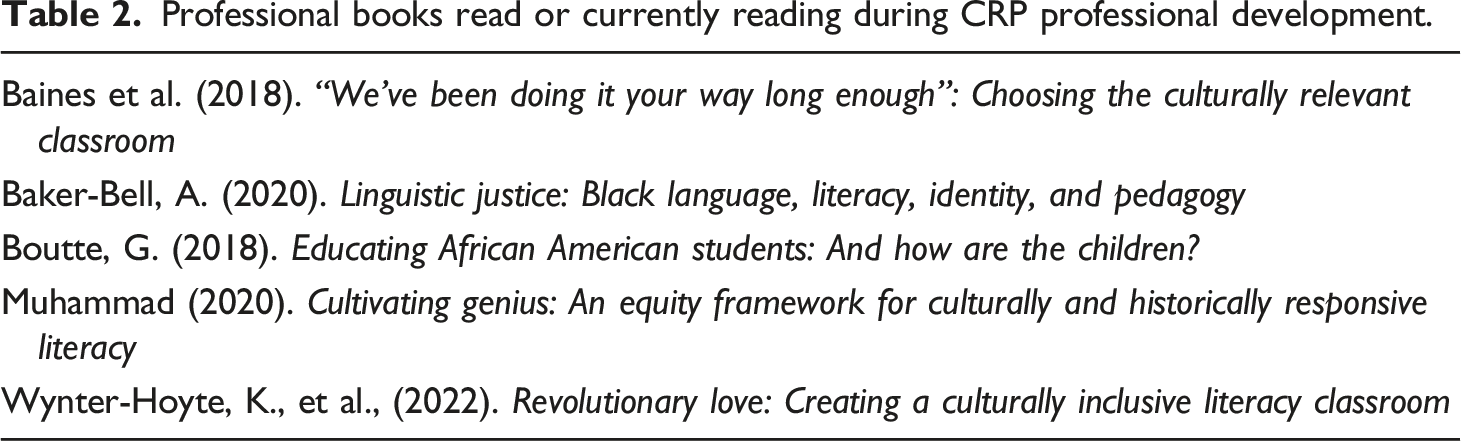
This article is organized to share Jackson Creek’s stories by focusing on (a) why culturally relevant emancipatory pedagogy with a focus on Pro-Black pedagogies is necessary, (b) how we collected data to document the work being done by educators at Jackson Creek School, (c) a sampling of practices from Jackson Creek classrooms organized by grade level and by specialists within the school, (d) challenges experienced and negotiating those challenges, and (e) implications for teachers of young children.
Emancipation from what? Why does curriculum need emancipating?
In 2022, in a diverse United States and global society, curricula continue to be dominated by eurocentric 1 norms instituted during Europe’s colonization of many parts of the world. This occurred when, in the interest of power and control, European countries erroneously and strategically positioned whiteness as the primary source of and standard for excellence in areas such as literature, science, art, technology, and exploration. Simultaneously, to send messages that would give them license to take land and life, enslave, replace languages and belief systems, and steal knowledge and other resources, they positioned Blackness as lacking intelligence, beauty, or ability; as barbarian—subhuman. The legacy of colonization is that stereotypes and misinformation about African and African descendant people continue to be pervasive throughout society perpetuated by curriculum in schools. Thus, curriculum around the world has long been in need of emancipation as the absence of normalized and accurate curricular foci on Black histories, heritages, communities, and languages oppresses Black students’ academic opportunities while “the pedagogical dominance of whiteness privileges white students with affirmations of their humanness” (Baines et al., 2018, p. 10).
We see examples of this when, for example, Black histories are primarily visible during Black History Month and reference is made to a standard few Black heroes such as Martin Luther King and Rosa Parks. We see it when textbooks begin the study of Black people with enslavement and refer to enslaved Africans as “workers’’ and “involuntary immigrants”. We see it when the curriculum ignores African histories that impacted the rest of the world (Jackson et al., 2021; Wayman, 2011); for instance, neglecting the fact that Africans ruled Europeans for over 700 years focusing instead on European's rule over African countries; and omitting global contributions of precolonial African inventors, scientists, mathematicians, architects, explorers, and developers of knowledge in medicine, the arts, agriculture, and astronomy (Ben-Jochannan and Clarke, 1991; Du Bois, 1965).
These kinds of curricular omissions and distortions persist decade after decade impacting how Black students see themselves and how Blackness is seen by all students, perspectives they take with them into adulthood. Responding to these curricular realities is key to our efforts recognizing that, without what King and Swartz (2018) call “reparatory justice curriculum” (p. 155), we will all continue to be miseducated (Woodson, 1933). To reach any kind of societal and educational equity, schools and the teacher education programs that serve them, require emancipation from destructive narratives that diminish Blackness, replacing those narratives with rich and robust curriculum that centers Black people, histories, accomplishments, integrity, intelligence, resistance, resilience, beauty, and joy (Hilliard, 1998; Muhammad, 2020). The practices shared in this article are attempts to do just that, grounded in convictions about Pro-Black teaching as that which: • Overturns eurocentric curricula by examining accounts of histories and contemporary issues for white dominance, correcting inaccurate tellings; and broadening curriculum to not only include but foreground perspectives, histories, and literatures from across the African Diaspora; • Teaches about life and knowledge from the continent of Africa, both precolonial and contemporary, as foundational to much of the knowledge that guides our world today; • Ensures that the curriculum reflects that African people had fully functional and, in fact, exemplary governments, arts, languages, agricultural techniques, medical techniques, knowledge about astronomy, and spiritual belief systems before colonizers appeared and tried to tell the world otherwise; • Refuses to reduce and portray Blackness as only a struggle; instead foregrounds the resistance, resilience, beauty, brilliance, and joy of Black people and their accomplishments; • Centers the lives and experiences of Black students, their communities and histories, contemporary issues, music, language(s), and art; • Identifies and addresses issues of power, privilege, and oppression regarding anti-Black elements within systems of education and society; and • Lifts the voices and identities of Black students to counteract and prevent educational malpractice that is the direct result of systemic racism globally.
Documenting the work
The work represented in this article reflects data collected over 4 years and analyzed in answer to the question: What are Pro-Black highlights of teaching in one school which sought to develop and normalize culturally relevant teaching including challenges to the work and efforts to negotiate those challenges? Data included student work, lesson plans, PD session PowerPoints, participants’ responses to a questionnaire, informal commentaries throughout the PD process, and classroom observations. Our development of this work and our analysis of data were guided by perspectives from Black Critical theory (BlackCrit) (Dumas and ross, 2016; ross, 2019) for its focus on identifying and countering anti-Blackness with Pro-Blackness; and decolonizing methodologies (Chilisa, 2019; Tuhiwai Smith, 2021) for the emphasis on overturning the normativity of colonialism, reconstructing methodologies grounded in issues of justice, valuing stories, and affirming the researcher as change agent (Esposito and Evans-Winters, 2022).
While, in some ways, our methodologies follow European-derived protocols such as ensuring the use of multiple data sources and written questionnaires, our work also addresses the need to decolonize the research process. Emancipation from white-dominated classroom pedagogies also means freeing ourselves from research paradigms grounded in colonized views of what constitutes data, rigor, and analysis. Toward that end, this article reflects valuing oral and written data both collected and remembered through long-established friendships and mentorships, PD sessions, individual support sessions, informal discussions, study trips to Africa, and doctoral advising. Thus, educators’ stories both recorded and remembered underlie data we share about Pro-Black pedagogies brought to life in early childhood classrooms.
Pro-Black emancipatory pedagogies at Jackson Creek: Practices, attitudes, and dedication to the work
The elementary school educators highlighted in this article have worked over the past 4 years to dig deeply into understanding and developing culturally relevant practices and to use that learning in their positions as classroom teachers, literacy coach, behavioral interventionist, principal, and African Studies teacher. A strong element of that work has been a focus on Pro-Blackness. While this emphasis does not neglect other groups, it is a way to acknowledge the foundational importance of Blackness in the world’s knowledge and the importance of developing our own and children’s abilities to notice the absence of Black people, histories, authors, etc., and have the knowledge to alter that reality. As kindergarten teacher, Kyanna Samuel explained, the work is an effort to “freely teach students about the beauty of our Black history not just in the month of February but throughout the year [and to] “talk all the time about what it means to be free and how things have changed, but also how some things are still the same and unfortunately that needs to be changed.”
Much of the data in this section focuses on curricular content and challenging existing norms for what is taught; however, the examples we share also make it clear that teachers’ real love and respect for students, families, and communities are critical to successful Pro-Black teaching. So, we emphasize that Pro-Black curriculum is not just about what we teach and how we teach it, but also about educators’ attitudes toward Black students and the lens we use to interpret Black and white students’ behaviors, linguistic abilities, and family structures and support.
Sweet Honey in the Rock: Music, Africa, and activism in kindergarten
One spring semester, Susi Long (university faculty and PD provider) and several Jackson Creek kindergarten teachers, Ashanda Merritt and Christina Stout, joined a virtual roundtable session sponsored by Gloria Boutte’s Center for the Education and Equity of African American Students (CEEAAS) at the local state university. They were excited to experience guest speakers who were members of the African American women’s a cappella singing group, “Sweet Honey in the Rock”. The teachers and Susi began texting back and forth: “We could develop a unit around Sweet Honey!” “Let’s do it!”
During the next kindergarten PD session, they began to think through possibilities for a 6-week unit. Susi asked the teachers to consider unit themes by presenting Sweet Honey in the Rock’s music around a range of topics. The kindergarten team of five educators—Ashanda Merritt, Kyanna Samuel, Christina Stout, Jennifer Tafel, and Takenya Warren—decided they would focus on three 2-week units: • Introduction to Sweet Honey in the Rock: History, A Capella, and Sign Language • Sweet Honey in the Rock and Africa • Sweet Honey in the Rock and Racial Justice
Together, the teachers and Susi created PowerPoint slides as if they were pages in a children’s book (large print, engaging language, vivid illustrations) to teach about Sweet Honey in the Rock’s purpose and history, and to teach writing and reading skills (critical thinking, high frequency words, vocabulary, phonics skills, expressive language, semantic reading strategies, etc.). Through the lessons, they addressed skills required by the district and school's pacing guides while exploring geography, history, and other content emanating from Sweet Honey in the Rock’s story and music. Trade books were also introduced to extend learning based on content from the PowerPoints. Excerpts from these subunits are described below.
Introduction to Sweet Honey in the Rock
“Meet Sweet Honey in the Rock” was the first 2-week unit. Through it, the teachers and children explored the history of the singing group and its originators Bernice Johnson and Louise Robinson. Geography was introduced and social studies standards were addressed as students pinpointed the group’s origins in Washington DC. They learned about the origin of the group’s name from the biblical verse about a land so rich that honey flowed from the rocks, used to describe African American women who were “as strong as rocks and as sweet as honey.” Christina talked to her kindergartners about how, during the time of the COVID 19 pandemic, they also had the strength of rocks and the sweetness of honey.
In another part of this subunit, kindergartners explored the term a cappella learning that the musical style of singing without instrumental accompaniment, often attributed to Italy, has its roots in the Zulu culture of South Africa where it is called isicathamiya. Isicathamiya was eventually taken back to Europe by Dutch and British colonizers where it was popularized and claimed. The study of isicathamiya provided an important opportunity not only for teaching vocabulary, geography, and history but also for supporting children’s development as critical thinkers able to question whose stories are told and valued and whose are left out or marginalized and need to be told.
Finally, this subunit introduced Shirley Childress who signs in American Sign Language (ASL) for Sweet Honey in the Rock during their performances leading to discussions about ASL and Black American Sign Language (BASL). In addition to talking about how sign language users are bi-or multi-lingual, Christina developed lessons used by all of kindergarten teachers to teach basic phonics skills and high frequency words using the basics of ASL (Figure 1). Sweet Honey in the Rock and learning about American sign language in kindergarten.
Sweet Honey in the Rock and Africa
Sweet Honey in the Rock dedicate much of their music to African histories and musical traditions with songs such as “Juba” and sharing the art and history of drumming. Building from this and drawing on units about Africa created by the teachers during their summer PD sessions with Eliza and Susi, the kindergarten teachers taught lessons about Africans as the first mathematicians, astronomers, and explorers (Figure 2). They supported the development of students’ critical consciousness teaching that African knowledges were often appropriated by other nations along with associated wealth and fame (e.g. Picasso’s appropriation of African art in his exploration of Cubism or Portugal’s claim that they developed particular irrigation techniques that were, in fact, learned from Africans in colonized Angola). The teachers taught geography and problematized maps that diminish the size and positioning of the continent of Africa. They emphasized Africa as a continent with 55 countries introducing the picture book, Africa is not a Country (Knight and O’Brian, 2002). Sweet Honey in the Rock and Africa.
In one aspect of the work, kindergarten teacher Kyanna Samuel focused on language, teaching about Africa as a continent with over 2,000 languages, where most people are multilingual. She emphasized the cognitive and global benefits of being bi- and multilingual. She taught about the impact of West African languages on languages we speak in North America today as revealed in vocabulary, grammatical rules, and the call and response style of communication. Her children explored call-and-response as African in origin but international in impact (Figure 3). They studied examples of how it has been adopted in song, poetry, literature, religious settings, and even military cadences in the U.S. and around the world. Call and response in kindergarten.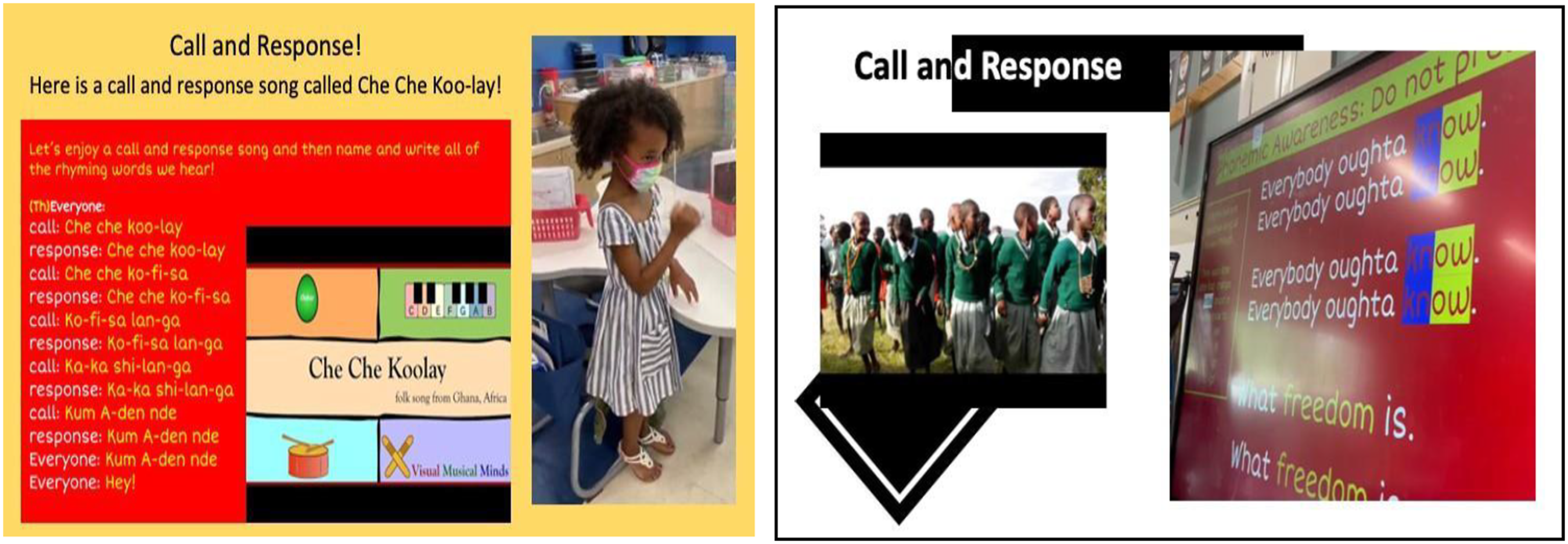
Sweet Honey in the Rock and racial justice
Fannie Lou Hamer
The final subunit focused on racial justice building from Sweet Honey in the Rock’s history of activism and songs that celebrate anti-racist activists. This led to teaching about key figures like voting rights activist Fannie Lou Hamer who used the song This Little Light of Mine to anchor her speeches calling for voting rights for Black people, and Black women in particular. Video recordings from Jennifer Tafel and Christina Stout’s classrooms show children loving the song as they sang while watching Sweet Honey in the Rock on their chromebooks (small laptops computers distributed during the COVID 19 pandemic for use when teaching was completely virtual).
After the children learned This Little Light of Mine for joy in the song and its connections to civil rights history, the teachers taught punctuation, initial consonants, and word patterns using the lyrics to the song the children loved. Then they engaged students in writing about freedom and how they bring light to the world, supporting students’ growth as writers in the classroom and by writing at home with family members (Figure 4). Careful not to turn the song into merely a skills lesson, all of the kindergarten teachers ensured that foundations in history and beauty were established first and returned to throughout the subunit. At the end of the school year in their Promotion ceremony, the kindergartners performed This Little Light of Mine and shared information that they learned about Fannie Lou Hamer. Fannie Lou Hamer, This Little Light of Mine, and activism.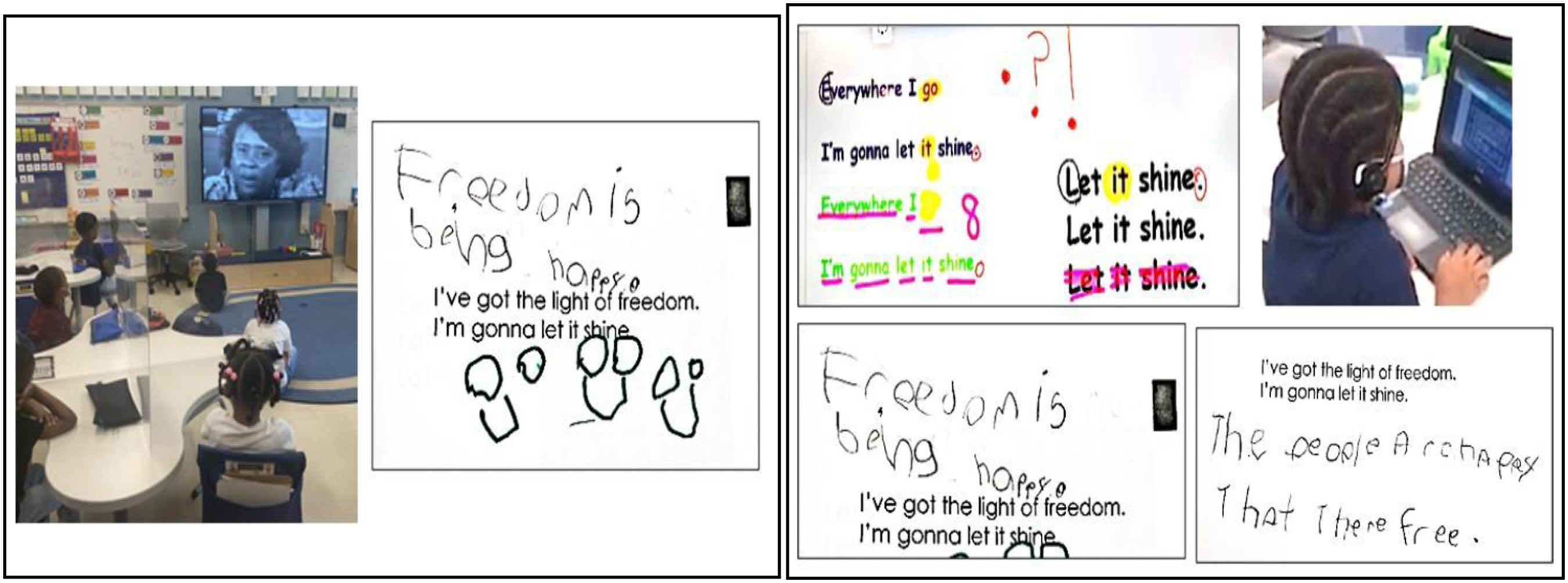
In conjunction with teaching about Fannie Lou Hamer’s fight against injustices, the teachers read picture books celebrating the beauty of Blackness: Black is a Rainbow Color (Joy, 2020) and Black Magic (Johnson, 2010) to address and counter negative stereotypes about Blackness. From discussions about the need to counter negative messaging about Blackness, the students created class books about its beauty. After brainstorming possibilities and practicing spelling strategies, they wrote from the stem, “Black is beautiful like _________” (Figure 5). After completing the books, the students also created a video sharing their thoughts about the beauty of Blackness by reading their pages from the books aloud. Black is beautiful.
Mr George Floyd Jr: “No scholar is too young”
The emphasis on racial justice from Sweet Honey in the Rock also opened doors for the kindergarten teachers to focus on contemporary issues. At the time of this unit, the trial of Derek Chauvin was occurring. He is the police officer who murdered Mr George Floyd Jr, a Black man from Minneapolis, Minnesota. At the time of both the murder and the reading of the verdict, the kindergartners were well aware that something was going on. For example, the day after Chauvin’s verdict was read, James, an African American six-year-old came to his teacher Kyanna saying that his mother cried and kept hugging him while watching the news the night before. He wanted to know what happened. Five-year-old William, also African American, was crying saying that he didn’t want to get in trouble with the police or die. During lunch that day, Kyanna created a short PowerPoint explaining the situation. After lunch she shared it with the class and they talked.
The children had heard family members talking and had seen protests on TV. While many people approved of the guilty verdict, they also felt that justice could only be approached when the serious problem of racial profiling by police in the U.S. was addressed. The children had heard words like protest, verdict, and guilty. So Kyanna explained the words and the reasons for the protest describing “the conversations and emotions that went through the classroom as “just amazing coming from five- and six-year-olds.” Among children engaging in discussion were six-year-old Angela who talked about how her cousin was recently hurt by police and it made her really angry and five-year-old Tyson who was frightened and said he never wanted to leave the house again; and Jayden who said he thought police were supposed to protect not hurt people.
Kyanna reminded the children that not all police are like Derek Chauvin. She brought the school’s resource officer into the classroom and explained how he keeps us safe each day. She showed pictures of other police officers doing good things to protect people. She asked the students about good things they had seen police do and they shared examples. But Kyanna did not avoid the reality that police brutalization of Black people continues. She knew the children would need to feel validated as well as comforted and that comfort could come from feeling empowered to do something. Kyanna used two books she had previously introduced—Paul and Glenn’s (2020) Speak Up and Say Something (Reynolds, 2019)—to remind them about what their role might be in addressing the feelings they were experiencing. She explained that George Floyd had a little girl about their age named Gianna and she was probably feeling bad too. This led to an important outlet for the children. Worried about Gianna, they decided to draw pictures expressing their feelings (Figure 6). Kindergarten letters to Mr George Floyd’s daughter Gianna.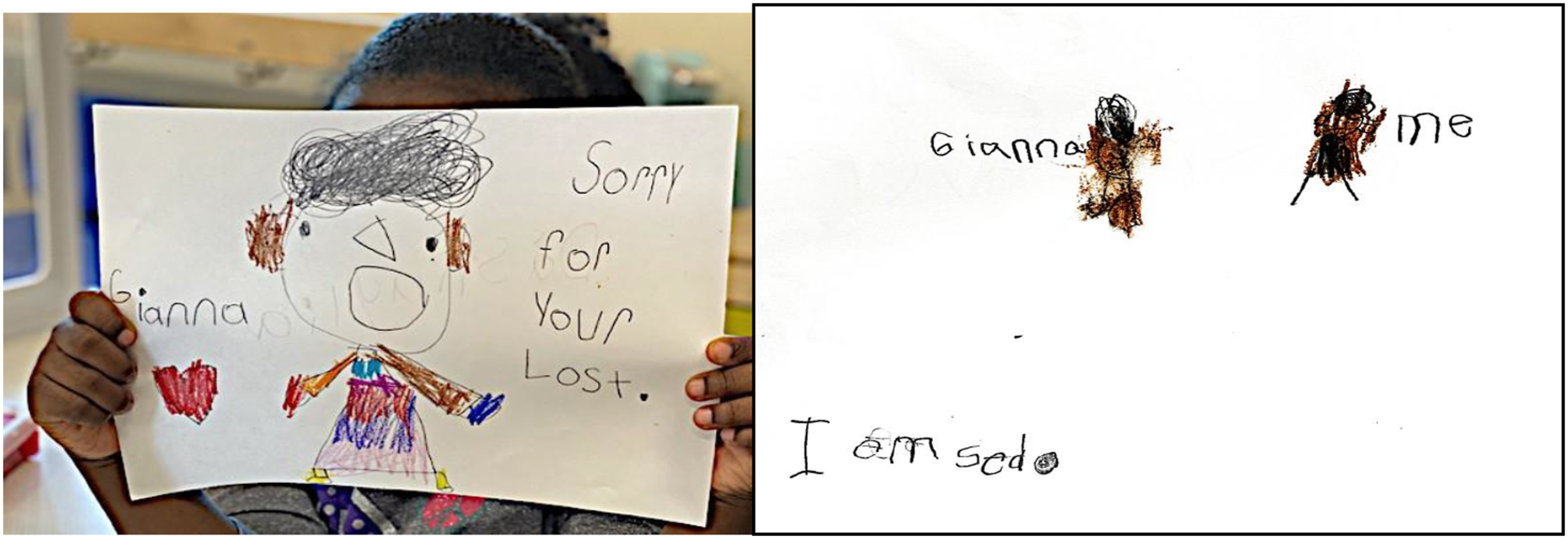
But the children did not stop there. Kyanna explained: After our scholars were able to get their feelings out on paper, we talked about ways they can help to make change in the future. They decided they wanted to write a letter to the police officer. The way the students expressed themselves you could see they were upset and felt it was so unfair for a man to lose his life.
So, the children in Kyanna’s class drew pictures and wrote as if to Derek Chauvin (Figure 7) to get their feelings out. Example of kindergarten letter to police.
Kyanna sent an email to parents so they would know what had been discussed and that their students might come home with more questions or wanting to talk. A few parents emailed and called to tell her how thankful they were to have someone teaching their child about real world situations because they didn’t know how to tell their child or did not think they would understand. Kyanna wrote, “It was just a beautiful moment all around, but it shows that no scholar is too young to learn [how to respond to] the truth of the real world.” And, of course, because she engaged the children in reading and writing that encompassed real world events that mattered to them, they felt empowered and proud rather than defeated by the situation and grew as readers and writers with purpose.
After these experiences, the children learned the Sweet Honey in the Rock song, “Living Out Loud” which embraces the idea that, by working together, they too can help to make change. They created a class book illustrating the song and took further action by writing to friends in upper grade levels asking what they could do to speak up. As in the other lessons, Kyanna and the other kindergarten teachers used this opportunity to address a range of reading skills and to move students forward as writers through feedback and multiple drafts of their work (Figure 8). Kindergartners sing and write about how together, we can make change.
Art for all? First graders ask the question
After the first year of CRP PD, the teachers expressed the need for support in negotiating culturally relevant teaching while addressing district and school mandates. As a result, first grade teachers Edith Gamble, Stephanie Hodge, and Caitlyn McDonald worked with Susi and one of the school’s literacy coaches, Jennipher Frazier, to figure out how they might turn an upcoming unit in the required Open Court (2020) reading series into something culturally relevant. The unit was titled “Art for All.” As they looked at the Open Court lessons and materials, it became clear that they did not actually focus on art for all but on art for a few, meaning that the art depicted in the unit was predominantly by and about white people. They looked at the skills required to be taught through the unit and created a simple chart to support their planning (Figure 9). Then they began recreating the unit. Chart of mandated skills to support planning for culturally relevant teaching.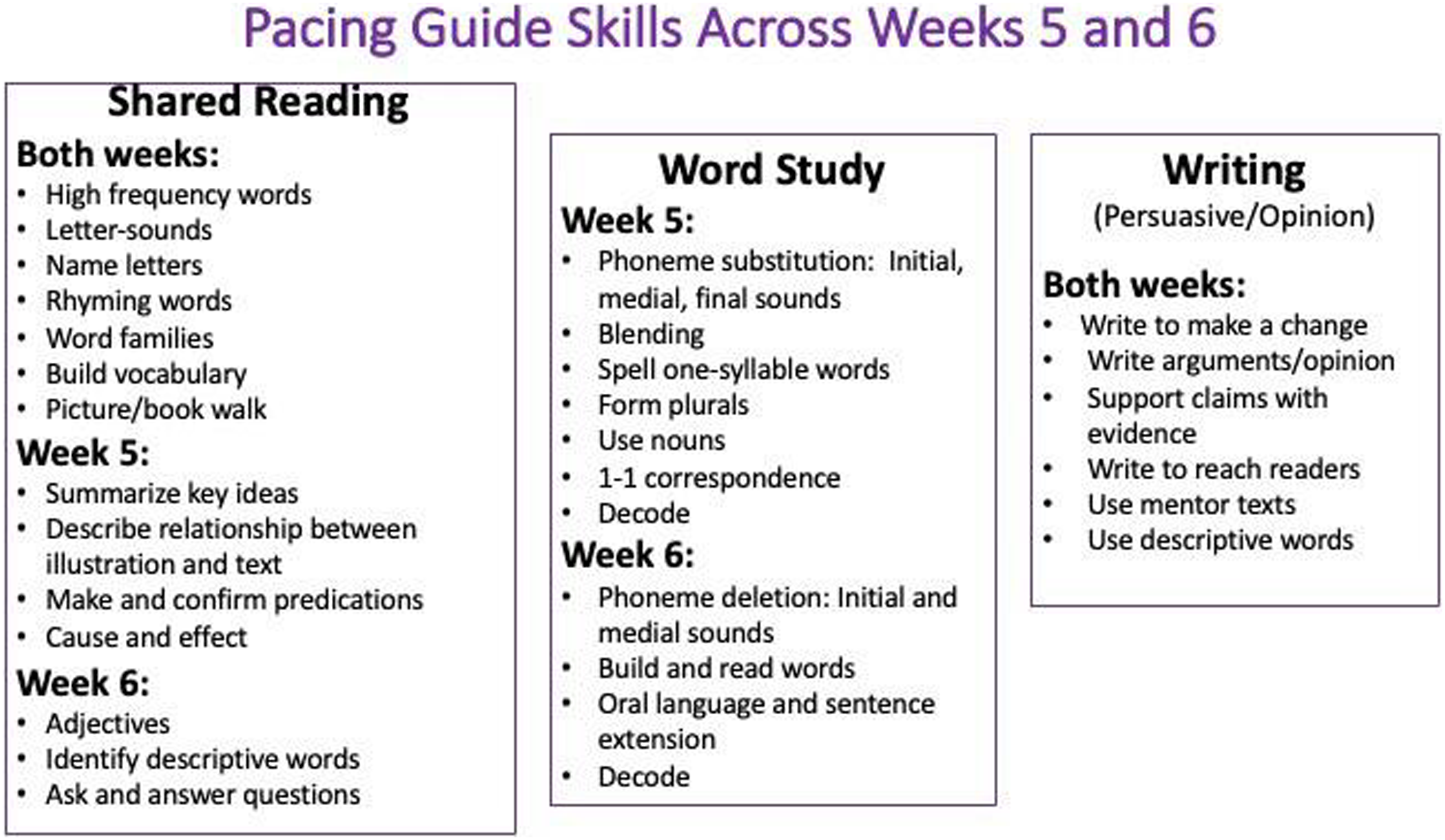
In the process of helping to seek information for recreating the unit, Susi uncovered demographics from major art institutions around the world–The Louvre in Paris, the Metropolitan Museum in New York, the Chicago Art Institute–and shared them in a PD session. Not surprisingly, statistics revealed that 95%–97% of the artists whose work was displayed in those museums were white. Edith, Stephanie, and Caitlyn picked up on this immediately and developed lessons to teach those statistics to the children and engage them in critical conversations, asking: Whose art fills these museums? Whose art is missing? Why and what can we do about it? They did this through shared reading lessons set up to teach reading skills required by district mandates (Figure 10). The students reported their knowledge about white dominance in major art museums to the school’s art teacher telling her: “All these museums have all white artists and it is not fair and we’re gonna change it because we’re gonna write and tell the Columbia museum that Earnest Lee [local Black artist] needs to be in that museum!” Art for all? teaching literacy skills in shared reading while developing a critical consciousness about the absence of Black art.
After establishing that there are missing voices in major art museums, Edith, Stephanie, and Caitlyn used a classroom map (Figure 11) to introduce Black and Brown artists in their efforts to normalize them in the wider canon of “Art for All.” Then they engaged in the study of specific artists. Within each lesson, they addressed required reading and writing skills. For example, when teaching about African American artists Amy Sherald and Augusta Savage, Kenyan artist Ian Njuguna, Jamaican artist Barrington Watson, and local African American artist Earnest Lee, they also taught high frequency words, sentence structure, and word families. The children were excited about the content and therefore motivated to learn literacy skills through content that dispelled notions that only great art comes from white artists. Identifying Black artists geographically in first grade.
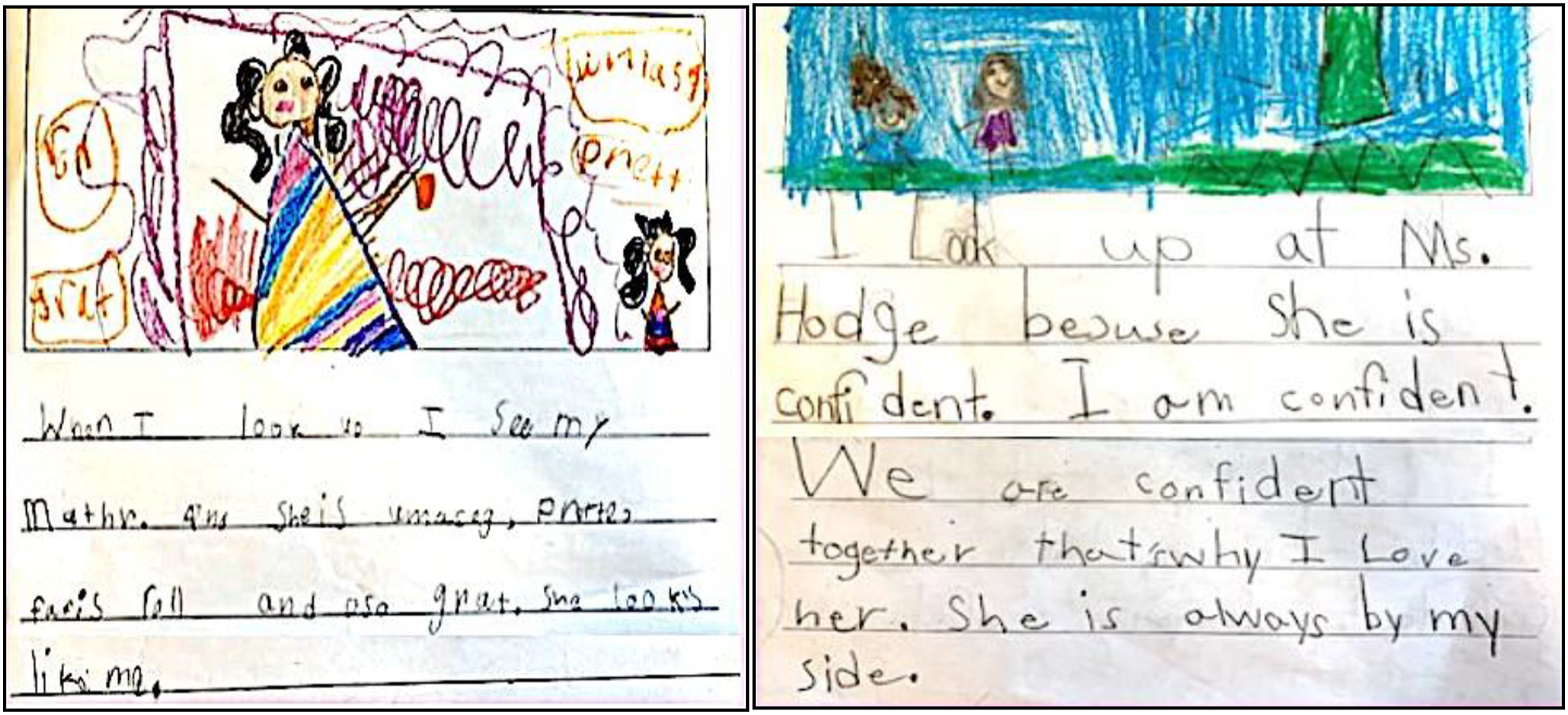
At one point in the unit, the children studied President Obama’s portrait by Kehinde Wiley. Then they read the picture book, Parker Looks Up (Curry, 2019), the story about four-year-old Parker Curry who visited First Lady Michelle Obama’s portrait painted by Amy Sherald. The children created self-portraits (Figure 12). Seeing the students’ excitement about Ms Obama’s portrait, Edith and Stephanie engaged them in studying other works by Amy Sherald. Finally, following the theme of Parker Looks Up, they wrote about people they looked up to (Figure 13). First graders’ self-portraits. After reading about Amy Sherald’s portrait of Michelle Obama in Parker Looks Up, first graders wrote about people they look up to.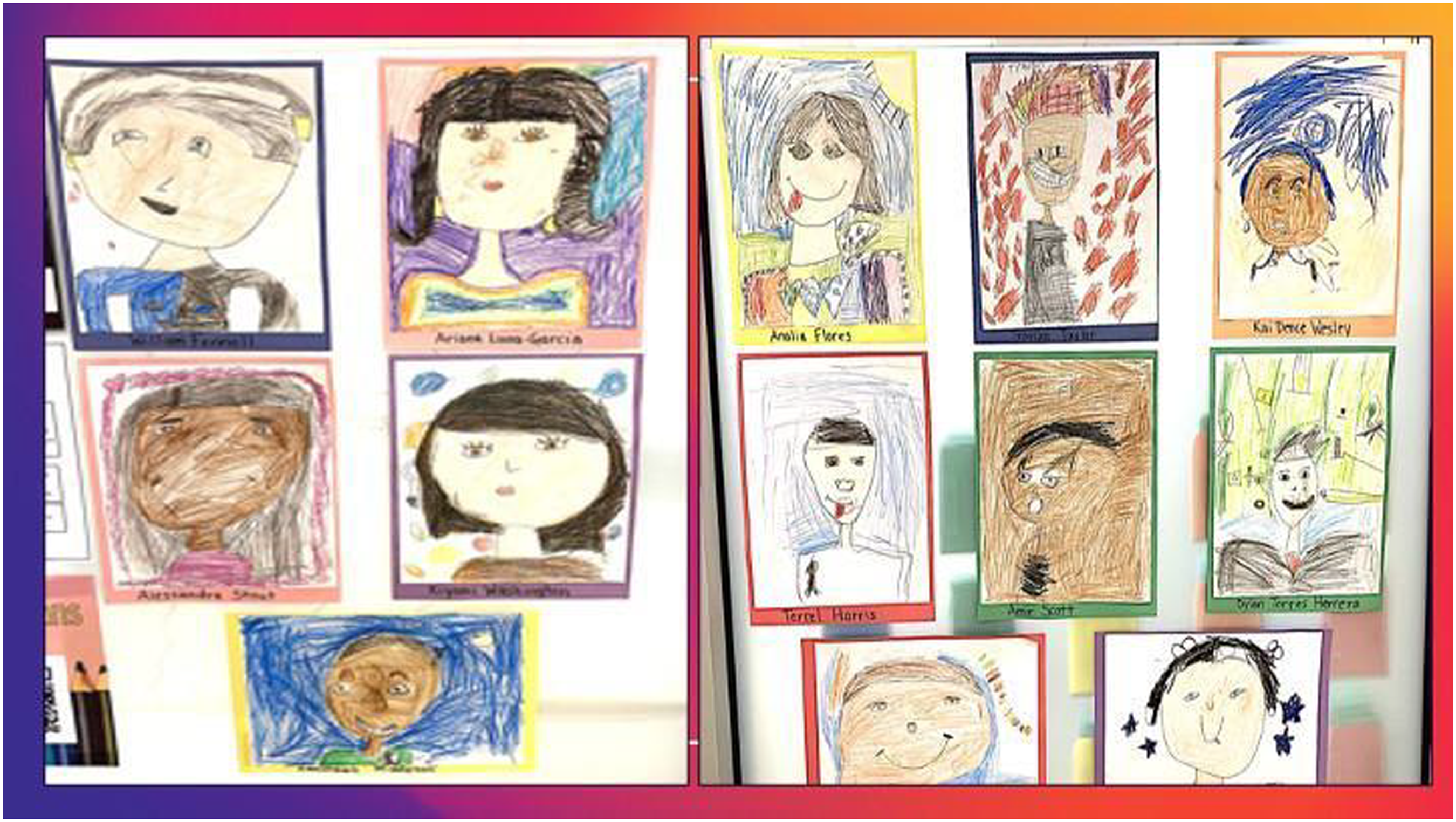
Emancipation in first and second grades
Having participated in two Fulbright-Hays Groups Projects abroad (in Cameroon in 2017 and Ghana in 2018) which examined connections between African and African American culture, language, and history, Saudah Collins brings a deep African-centered background to her pedagogy. Her larger goal is to change the way that people understand the histories, traditions, expertise, and roles of Africa, Africans, and African influence in the U.S. and globally. She routinely integrates dimensions of African Diasporic culture in her teaching in ways that engage students in movement, music, oral tradition, and communalism. She is also a seasoned educator, having taught for three decades across many grade levels and roles. Her demeanor in the classroom can be described as stately, kind, and engaging. Students love being in her class, but also know that there is order and decorum. She listens intently to every child and has created a climate of mutual respect between the students and herself. After just a few minutes in her class, it is clear that she enjoys teaching. She is organized and spends countless hours preparing her classroom environment (e.g. walls, book displays) and lessons. Adinkra symbols, mudcloth, African instruments, are standard parts of the symbolic curriculum in her classroom. Ms Collins and her students use technology often and engage routinely in activities using online read-alouds, flip-grid, Kahoot! videos, and music. Importantly, she holds high expectations of her students and they, in turn, rise to them. For the first 2 years of the study, Saudah taught first grade. She then taught second grade for a year and is currently the Africa Studies Teacher. Because of her excellence in teaching African American students, she is also a model teacher for CEEAAS.
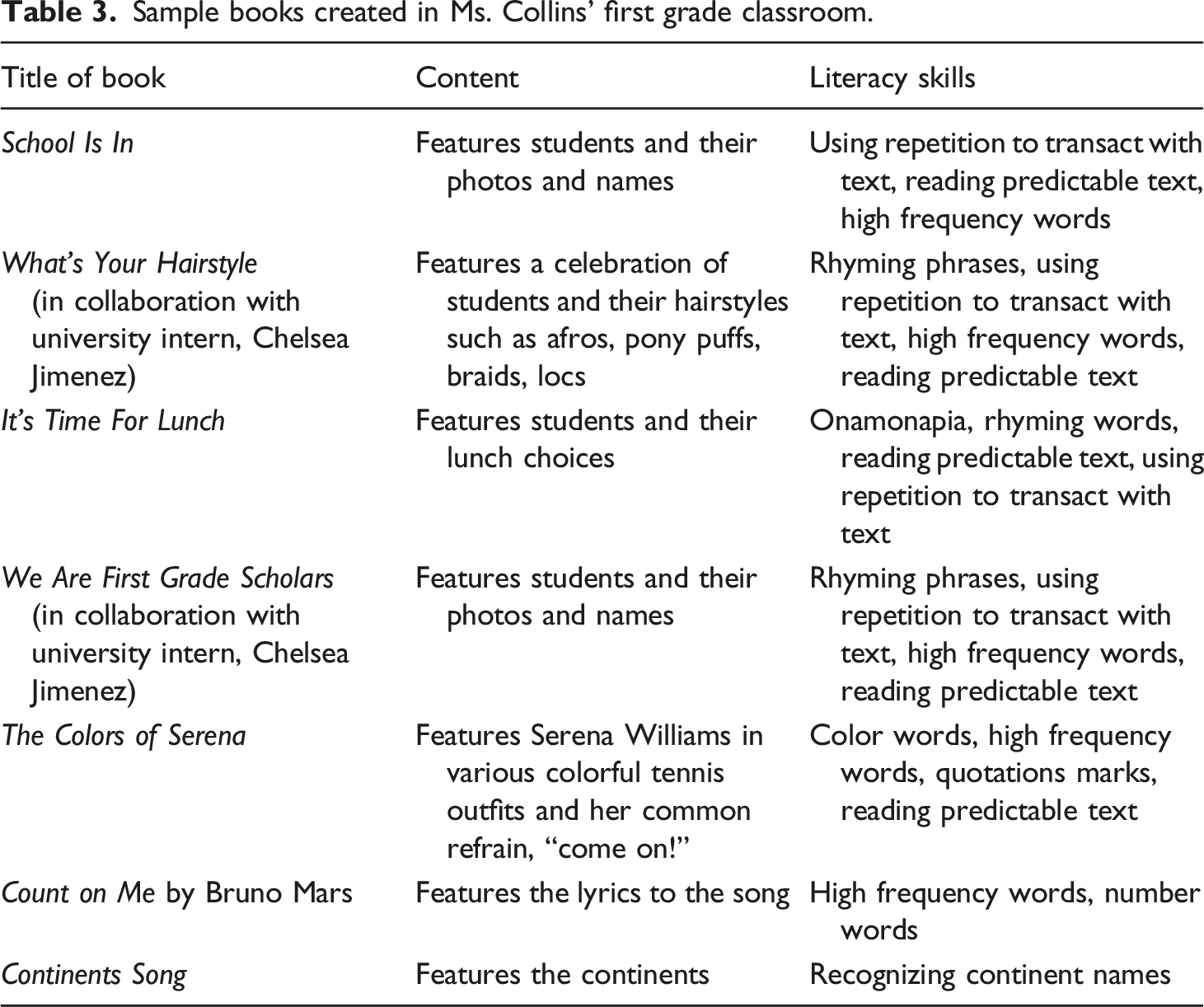
Understanding the need to connect the curriculum to students’ lives, Saudah begins the liberation of the curriculum by centering the children who are present in her classroom. She does this through the creation of class books, which are displayed in the classroom and which children read repeatedly in their free time (Figure 14). Building on children’s interests and background knowledge, she “Africanizes” the standards and lessons. Hence, aspects of Black culture (e.g. movement, communalism, orality) are deeply embedded into every content area while teaching specific literacy skills (Table 3). Display of teacher/student-made books in Ms Collins’ first grade classroom. Sample books created in Ms. Collins’ first grade classroom.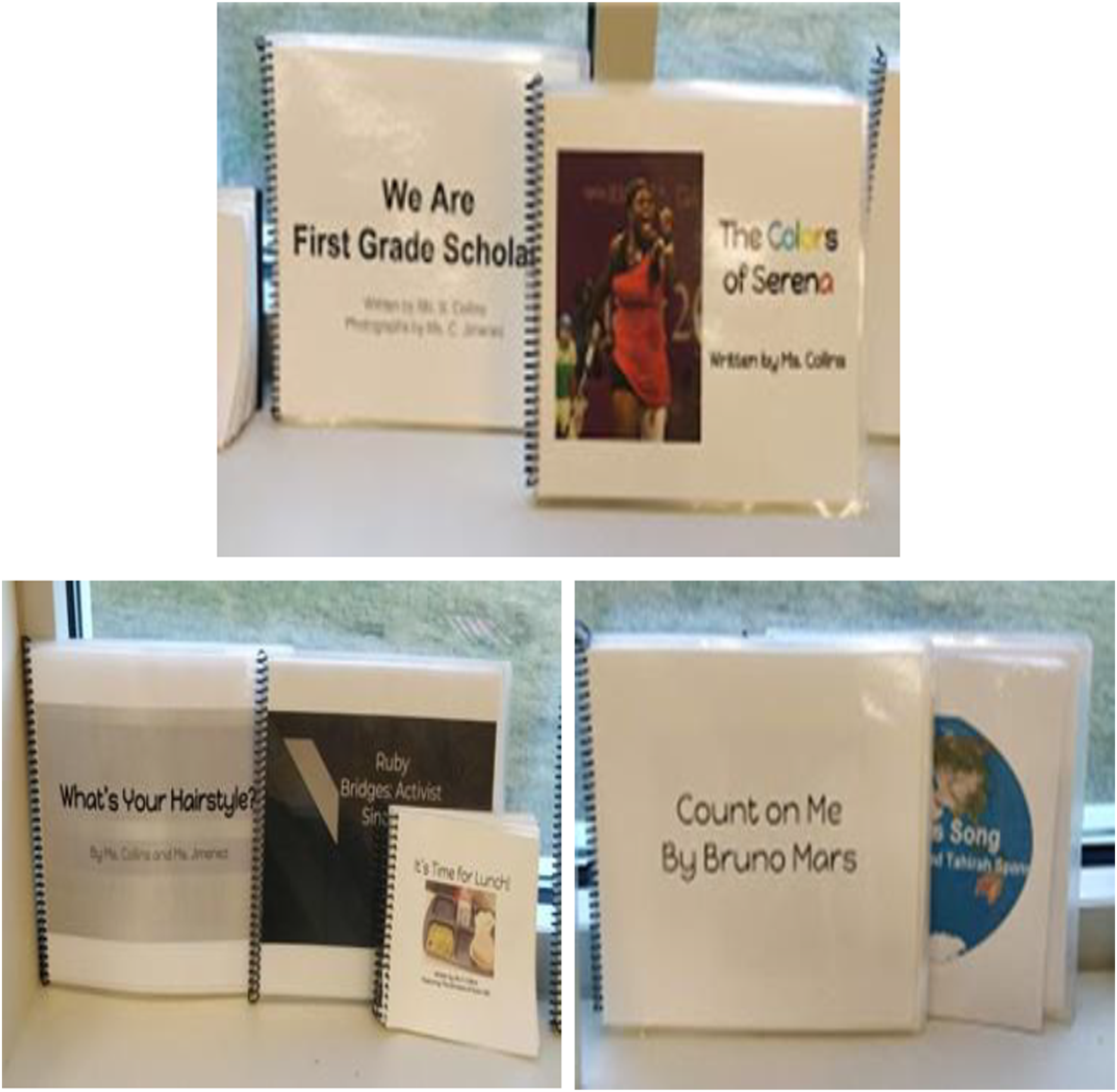
Pro-Black teaching in third grade
Another example of Pro-Black teaching comes from Caitlyn McDonald who taught third grade at that time of this example. Similar to her peers in kindergarten through second grade, Caitlyn noticed ways that curriculum provided an incomplete story of African, African Diasporan, and African American peoples. For example, she noticed that the social studies curriculum required the teaching of Black history with a focus on slavery. However, spending time with Eliza in monthly professional development, Caitlyn quickly noticed how this narrative negated the many contributions, brilliance, and resistance of African people so she worked to normalize stories of Blackness and create an emancipatory Pro-Black unit that allowed her students to gain a more complete view of history.
During the first weeks of school, Caitlyn introduced a daily ritual through which students declare their brilliance through the morning affirmation: “You are appreciated. You are safe. You are welcome. You are valued. You are cared for. You are cared about. You are strong. You are capable. You are kind. You are smart. You are loved beyond measure.” Through this, she created opportunities for children to share their brilliance and their full selves. However, Caitlyn was not always this way. She shared: I remember feeling completely blindsided and defensive the first time I was asked to analyze how my white privilege might impact my students in my undergraduate Program. However, the cycle of engaging in critical dialogue, sitting with my discomfort, and engaging in critical reflection has allowed me to work toward taking anti-racist action in my classroom and in my personal life.
Caitlyn continued to engage in ongoing professional development with Eliza and Susi in which teachers were encouraged to take a reflective walk through their curriculum and assessment practices and analyze them for the ways they humanized and dehumanized Black children. One year, Caitlyn also participated in year-long monthly district-level CRP PD with Gloria Boutte. Through these experiences, Caitlyn began to take a hard look at state standards for third grade and began questioning their accuracy. One social studies standard drew particular concern for Caitlyn because it focused only on African people’s contributions around agriculture and the plantation economy whereas, Caitlyn knew from her research with Eliza, that African people made a number of contributions from their journey from West Africa to the Barbados and finally to the Carolinas. The standard read: Explain the role of Africans in developing the culture and economy of South Carolina, including the growth of the slave trade; slave contributions to the plantation economy; the daily lives of the enslaved people; the development of the Gullah culture; and their resistance to slavery.
Eliza and Caitlyn chart language from the social studies standards juxtaposed with ways to make the lessons less eurocratic and more focused on Pro-Black knowledge.

Sitting together, Caitlyn and Eliza worked to uncover the narratives that were absent from the social studies third grade curriculum. First, they noticed that African people’s history began with enslavement. Second, there was an emphasis on their contributions to agriculture and plantation culture only. Therefore, they began to plan a unit that incorporated both the glanced over and omitted histories juxtaposed with the knowledge and understandings required to become competent on this standard. Caitlyn knew it was important to move students beyond their limited perceptions of Africa, African people, the African Diaspora and the contributions of people to the Carolinas.
First, Caitlyn initiated the classroom inquiry by sharing a video with students about Mansa Musa who was the ninth Mansa of the Mali Empire. In this video, a young boy details the riches of Mansa Musa from Mali who was the richest man to ever live. This debunked the myth that African people only lived in thatched huts and needed the aid of white people to succeed. Children enjoyed viewing the images of individuals dressed as kings and queens. The video equated Mansa to the likes of Bill Gates and Jeff Bezos. Students immediately made connections to the men because of their companies and shared how their parents were consumers of technology and online products. This led to a vibrant discussion around what students had previously believed about Africa and what learning about the rich empires revealed. Mackenzie noted, “Ms McDonald, they were livin their best life!” “Yes, they were!” Caitlyn replied. The ensuing conversation illustrates the student’s creations of counternarratives to stereotypes about Africa: Caitlyn: Mansa Musa went on a journey. He had ornate things to show how wealthy he was. Student: When he was going on the journey. People were doing all good. Caitlyn: During this time, many Europeans were at war. His people were at peace. They were living in prosperity. Student: They were livin their best life. Caitlyn: Yes, they were living their best life. Student: He wasn’t bad. He cared for people.
This discussion became instrumental in moving children beyond stereotypes of Africa. After discussions of Mansa Musa and other leaders, Caitlyn and the children read the book Never Forgotten by Patricia McKissick which details the life of a great Mende Blacksmith Dinga who raised his son Musafa alone after his wife died. Musafa grew to become a Blacksmith who could create small creatures from metal. Dinga learned one day that Musafa had been kidnapped by traders who sold African people into slavery in the Americas. The book tells the story of how Wind traveled across the sea to discover that Musafa continued to make use of his talents with metal in hopes that this talent would one day allow him to return to homeland.
After Caitlyn read the book aloud, she and the children discussed the range of skills and talents that African people held before being torn from their families and how being torn from one’s family made one feel. Caitlyn used a map to show how many people were taken from countries like Sierra Leone, Guinea, Ghana, the Ivory Coast, Nigeria and Cameroon because of their expertise in skills that colonizers needed to promote their own wealth. She taught the students to use primary and secondary sources to investigate how slavery negatively impacted the lives of African people and positively impacted the lives of colonizers. In one example, they learned how Africans’ skills were appropriated on the island of Barbados leading to great wealth for colonizers in the cultivation of sugar cane. Similarly, she shared stories about Africans’ knowledge of rice, indigo, architecture, medicine that were appropriated by colonists in the Carolinas.
Pro-Black convictions of the behavior interventionist
Catharine Aitkin serves as the behavior interventionist at Jackson Creek. She works with children in small groups and individually as referred by committees of teachers and specialists based on their views of students’ behaviors. Attentive to and concerned about research illuminating the over referral of Black students to special education (Codrington and Fairchild, 2013) in what Blanchett (2009) calls “a resegregation of African American children” (p. 370), and disproportionately harsh disciplining of Black students (Gilliam et al., 2016; Morris, 2016; U.S. Department of Education Office for Civil Rights, 2014), Catharine works to identify anti-Blackness in the referral of Black students to her program and in practices within her program, replacing them with Pro-Black practices. For example, concerned about the nebulous guidelines for student referral to her program she is working to respond to the disproportionately large referral of Black students: This year, 100% of the students who have been referred or assigned to me are Black, despite Black students comprising only 77.5% of our school population. This aligns with the data that has shown for years the over-representation of Black students in in-school detention, suspension and expulsion. It also aligns with statistics spotlighting the over-representation of Black students recommended for special education.
Catherine is also concerned that the Black students are disproportionately referred to her program by white teachers and sees this as an opportunity to support her colleagues in seeing Black students through a Pro-Black lens. She encourages teachers to examine their perceptions as she examines her own to identify any deficit views, for example, blaming Black families and students for behaviors, academic performance, and motivation rather than looking at curriculum and approaches to teaching it. Catharine sees emancipatory pedagogy as that which can free Black students from such views through the development of Pro-Black attitudes, expectations, and curriculum leading to reductions in “behaviors being identified as deviant, disruptive, defiant, and/or disrespectful” and “increased classroom engagement; connections between teachers and students; solidarity within the school community; and students’ overall sense of competence, promise, agency, and empowerment.”
To support journeys of self- and institutional-examination, Catharine poses important questions for the field of behavioral intervention. She recommends that educators: a. Look at the district or school’s social-emotional learning and academic standards and analyze them to determine how much they are based on eurocentric ideals and norms for behavior; b. Question whether or not standards promote only social skills that are accepted as stereotypically “white”: for example: sitting quietly, not moving around the classroom, following directions without deviation, waiting to speak until spoken to, expressing joy and anger in subdued ways, and individualism; and c. Question whether or not standards overlook or punish social skills derived from African Diaspora cultural styles: overlapping speech, communal orientations, movement, verve.
Given these foundations, some ways that Catharine brings Pro-Blackness to her work include: a. Modeling a shift from a shaming, punitive approach to an approach that incorporates restorative, trauma-informed, and resiliency-building practices within a Pro-Black curriculum; b. Introducing educators to a collaborative problem-solving approach, centering the family and student in the conversation as experts in their lives and the lives of their children; and c. Meeting with referred students in small groups and engaging students in specific Pro-Black practices: • Naming their group; • Creating a mantra of affirmations that start and end the group to build empowerment; • Creating group-centered norms; • Choosing an African Adinkra symbol to represent themselves and/or the focus of the group; • Learning Ma’at principles from ancient Kemet (Egypt) and using them to self-assess; • Reading and discussing books representing Black people, histories, heritage, resilience, activism; and • Incorporating African-centered movement and music.
Catharine expresses that the very label “behavior intervention” communicates significant deficits and narrow definitions about what counts as “good behavior.” Thus, systemic change is needed to encourage and ensure that schools and school systems move forward by examining their expectations, attitudes, norms, and curricula for eurocentrism and then making bold and specific changes to embrace Pro-Blackness to benefit the futures of all students.
The role of the literacy coach
In this section, we describe elements in the journey of Jackson Creek’s literacy coach Jennipher Frazier to make culturally relevant, Pro-Black teaching foundational to her role. A full description of her work can be found in her dissertation, Supporting Black children within a Eurocratic educational system: Making culturally relevant pedagogy foundational to the role of the literacy coach (Frazier, 2022). We are grateful to Jennipher for providing information from her study to support our telling of the Jackson Creek story.
The position of literacy coach varies from school to school across the U.S. In Jackson Creek’s district, the coach is hired to support teachers in using instructional practices that lead to students’ academic success. However, culturally relevant pedagogy and Pro-Black teaching are not foundational in the training of the district’s literacy coaches. Jennipher’s goal in her research was to challenge the eurocentric model of literacy coaching to make culturally relevant pedagogy (CRP) foundational to her position. This necessitated working to emancipate the literacy coach’s role from its anchor in white-dominated curricula and materials, a process that brought challenges as well as joys and triumphs. A few elements of her experience are described here.
The process
Jennipher initiated the process of making Pro-Black culturally relevant teaching foundational to her position as literacy coach by focusing on the experiences of two teachers – Christina Stout in kindergarten and Edith Gamble in first grade. Jennipher worked with the teachers through classroom observations and debriefing, co-teaching, and bi-monthly coaching sessions often attended by Susi who conducted regular CRP PD in the school. Jennipher supported the teachers in looking at district guidelines and pacing guides, and planning how the lessons could look through a culturally relevant lens.
Critical to this work was learning how to implement Pro-Black practices within the mandated reading program. As Jennipher wrote, it was clear that the Open Court (2020) Reading program was not developed, with the Black child in mind (Frazier, 2022). Not only was the inclusion of Black people in texts and topics used for reading instruction minimal at best, tokenism was clear in the other materials, for example, illustrated letter cards that only had minimal reference to Black people. This brought some concern for the teachers and Jennipher. Although the school’s principal and some district leaders were highly supportive of culturally relevant, Pro-Black teaching, some other administrators felt that the Open Court program should be followed verbatim (reading the script from the teachers’ guide, using only the materials provided by the program). These contradictions cause confusion and some fear as some teachers were never quite sure if they should follow the district mandated curriculum or culturally relevant practices. They believed in their principal who was a strong proponent of the work they were doing, but they also feared district oversight.
To alleviate some of this concern, Jennipher and her colleague, LaQuisha Chester, the school’s other literacy coach, developed a pacing guide mapping the skills required by the district for each grade level each week. This was helpful when the teachers began teaching in culturally relevant ways because they could use the pacing guide ensure they were teaching required skills while teaching topics and using materials that were not in the mandated program.
Practices
A few of the practices supported by Jennipher in her role as literacy coach are described in the following sections beginning with Edith Gamble’s work with Open Court reading program’s Red, White, and Blue unit. Initially, Edith and her student teacher Stacey, began teaching the lessons as they were laid out in the Open Court teachers’ guide. After a discussion in one of their coaching sessions with Jennipher and Susi, they began to look at the unit’s eurocentric perspective on concepts like freedom and justice and its focus on white leaders with no mention of Black freedom fighters.
Who is Sarah Mae Flemming?
Rethinking the Red, White, and Blue unit, Stacey and Edith planned lessons to include the Civil Rights Movement and the courage of Black activists not often mentioned in typical curriculum. One lesson introduced Sarah Mae Flemming, a young Black woman who, in 1954 in Columbia, South Carolina, was assaulted by the white bus driver and forced off of a bus for sitting in or near the white-designated section. Ms Flemming sued the bus company. Although rejected in local courts, the case won appeals out of state and was eventually cited in the more well-known Rosa Parks case which led to bus desegregation. In her teaching, Stacey did not disregard Rosa Parks but taught that there was more to the story explaining that, because of Sarah Mae Flemming’s lawsuit, Rosa Parks and the Montgomery Bus Boycott were able to prevail.
Frazier (2022) writes about how this kind of teaching altered what is known as a visibility narrative (Au et al., 2016)—an event or person that has been selected by white people to represent a moment in history, often narrowing accounts of events significantly. Instead, through Jennipher’s work with Edith and Stacey, the students received a broadened view of one aspect of the history of desegregation in the U.S.
Blackness and U.S. vice presidents
During the time of this unit, President Joe Biden and Vice President Kamala Harris became the new leaders of the U.S. This was also at the time of Stacey’s full-time teaching for her internship. During another small group PD/coaching session, Jennipher and Edith worked alongside Stacey to plan for bringing race and gender into discussions about governmental leaders. In the lesson, Stacey presented the students with an image of all 49 Vice Presidents and asked: “What do you notice in this picture?” Almost immediately, some of the first graders said, “There are a lot of men that were presidents,” “They were all white Vice Presidents,” and “Kamala Harris is the only woman”. To further enhance the students’ knowledge about Kamala Harris, they read books written about her, and after discussing inequities in the history of the Vice Presidency, students drew pictures of Kamala Harris and wrote their views about her job as the Vice President.
Symbols of America
Another unit required in the reading series was titled Stars and Stripes which included an emphasis on “American symbols”such as the U.S. flag, bald eagle, Statue of Liberty, and the Liberty Bell. As Jennipher writes in her dissertation, these symbols were presented in the reading program as representing freedom and strength. However, in a dissertation support session one of Jennipher’s doctoral advisors and a co-author of this paper, Kamania Wynter-Hoyte, asked her to consider, “Freedom for whom? Do those symbols mean that for everyone?” This caused Jennipher to reflect in a new way which allowed her to support Edith in thinking through the limitations of the symbols included in the Open Court lesson. They decided to add the #BlackLivesMatter symbol of the raised closed fist and the rainbow symbol representing LGBTQIA+ rights. Edith explained to her students that symbols are used to represent an idea or people or events and that they mean different things to different people. She asked the students to choose a symbol that spoke to them and write about why (Figure 15). First graders ask: American symbols for whom? one child’s response: “My symbol is Black Lives Matter because Black people need support and love. They get hurt by police and this is why I like Black lives”.
Each of these examples demonstrates how the role of the literacy coach when committed to Pro-Black and culturally relevant pedagogies can provide much needed support for teachers. Although barriers were experienced during this time period (described later in this article and in full in Frazier, 2022), the commitment of a literacy coach to this work made a world of difference.
African studies as a related arts weekly class for every student
Since Africa is the cradle of civilization and African people have long valued freedom intergenerationally (Jackson et al., 2021), much can be learned from African people, history, culture, and perspectives. At Jackson Creek Elementary School, African Studies is viewed as an important facet of emancipation in schools.
The process of emancipation is a continuous journey, fraught with learning curves and other complicated emotions such as anger, guilt, and confusion. But as the revelations begin and are sustained, there is also joy and curiosity–and satisfaction. And this whole process is liberating to teachers, students, and families alike. Here we describe Jackson Creek Elementary School’s journey in adding a required class on African Studies. This class was the brainchild of principal, Sabina Mosso-Taylor.
Saudah Collins was a logical choice as the teacher, having engaged in two Fulbright-Hays Study Abroad experiences in Africa and, subsequently, implementing what was learned in her (then) first grade classroom. When asked to teach the class to all of the preK-fifth grade students, she was overjoyed and renewed. In 2021, Saudah began the inaugural year of the African Studies class serving students in each first through fifth grade class for 50 min weekly and each kindergarten class for 40 min weekly.
The African Studies curriculum centers the histories, knowledges, and past and contemporary cultures and histories of African descendent people throughout the diaspora. During the 6 months prior to the start of the school year, Saudah developed the curriculum utilizing her knowledge and experiences gained through the Fulbright-Hays Group Projects in Cameroon and Ghana, her ongoing work with the Center for the Educational and Equity of African American Students (CEEAAS), and her professional development engagements through the CRP study group. She spent a great deal of time conducting additional research about the continent of Africa and the African diaspora. There were certain key facts and experiences she knew should be integrated into the students' learning experiences in order for them to develop a well-rounded, contextualized, Pro-Black understanding of the continent.
Saudah began the year engaging students in media literacy by studying continents using platforms such as Google Earth and other published maps. She presented Africa as Alkebulan, the Mother of Mankind, the name of the continent given by its people. During the early sessions, Saudah introduced the Adinkra symbols of the Akan people to set a foundation built on the civic dispositions of respect, honesty, compassion, empathy, and cooperation. The symbols were used on the students’ name tents and learning folders as well as a way of identifying values that were important to them, their families, and communities. Since Adinkra symbols represent values and principles such as courage, perseverance, and many others, students also used Adinkra symbols in their work when analyzing characters in different tales and lyrics of a variety of songs from around the world. Sessions included African songs and dances, geographic and natural resource studies, guest speakers from West and East Africa, and the use of carefully curated primary and secondary sources to learn more about Africa and the African diaspora. Saudah intentionally selected resources that were primarily created by African and African diasporic people.
A principal’s support, critical to sustaining the work
Dr Sabina Mosso-Taylor is the principal at Jackson Creek Elementary School. She has been dedicated to culturally relevant teaching and Pro-Black pedagogy from the time she opened the school 5 years ago. Long before that, through her doctoral studies working with some of the university faculty who are co-authors of this article, she built knowledge and conviction. In fact, her dissertation study focused on a year-long study group with teachers in the first school she led, an early childhood center for 3–5 year olds. The group examined their own views and biases about students and families and worked to recognize when deficit views were apparent, building curriculum to counter those views.
This kind of work brought her to the attention of district leaders and led to being hired as the inaugural principal for Jackson Creek School. There, her support for culturally relevant, Pro-Black teaching has been unflinching as she finds the funds for ongoing PD, sending teachers to conferences related to the work, and ordering children’s books and professional books to support teachers’ growth and abilities to do the work. She also envisioned, wrote the proposal for, and received district approval to institute the African Studies program developed by Saudah and described earlier in this article. She has teachers' backs when questions are raised by families; for example, when several classrooms engaged in discussions about racial profiling and killing of Black people by police, she addressed the few family questions supporting the teachers’ opportunity to teach about important issues. Obviously, none of this is without challenges as Sabina works to help others understand the importance and power of the work, but her consistent support and follow through are key to any of it being accomplished.
Challenges to the work and negotiating challenges
The strength, courage, and conviction demonstrated by educators at Jackson Creek Elementary School as they built knowledge through work with university collaborators are critical to their ability to meet challenges faced when initiating and sustaining Pro-Black teaching. This does not mean that all challenges have been overcome, but there is more overall commitment to and follow-through with Pro-Black teaching than we have seen in many other schools in the same region. In this section we briefly share some of the challenges and the work to negotiate them.
Programmatic mandates, the habit of compliance, and fearing for their jobs
Addressing programs and practices required by the district continues to be a major challenge in conjunction with educators’ concern that their jobs or at least their evaluations might be in jeopardy if they teach in ways that deviate from the prescribed programs. Even when recognizing that the rules reflect centuries of white dominance borne of colonial efforts to establish race and racial hierarchies and recognizing the injustices this imposes on all students, it is easy to feel constrained by the very real mandates of the system. Jackson Creek’s literacy coach, Jennipher, encapsulated this feeling when she wrote: One barrier that occurred for me was making changes to the required curriculum when my educational role is to follow and teach district curriculum. I am still working through this but have added extensions to the lesson focus that incorporate Blackness.
Understanding and addressing this need to conform is foundational to the process of emancipating the curriculum from its white dominance. Thus, the challenges of mandated eurocentric curricula are not only about learning to see possibilities for addressing mandates through Pro-Black teaching but also about supporting teachers as they confront habits of compliance and confidence in their own knowledge and convictions in the face of mandates.
In the current political climate in the United States, however, these fears go far beyond merely the lack of confidence that leads to compliance as teachers in many U.S. states face losing their jobs. Legislation is being enacted across the country intended to suffocate any teaching about racism and racial histories or questioning the current curricular norm. Over and over teachers express a very real fear as they work with university collaborators to address this kind of governmental action through letters to legislators and verbal testimony in legislative hearings about bills that would close down this work.
Contradictions between support for CRP and district mandates
Another significant challenge has been the disconnect across school and district leaders and uncertainty felt by teachers about what kind of teaching was and was not supported. This presented itself in the form of contradictions between the call from some administrators for culturally relevant teaching, juxtaposed against the call for “fidelity” in following mandated programs that were eurocentric in nature (Frazier, 2022). Fidelity typically meant following the scripts in the teachers’ guide verbatim and using only the materials and books provided by the program.
When these contradictions occurred, teachers were understandably confused and concerned about who they should be answerable to. Teachers had the support of the school’s principal, but they were concerned about evaluation by other administrators or by district or representatives from the companies of the required programs. Remembering how district inspectors had come in the past to look for fidelity to the Open Court Reading program, some teachers worried that they would receive low scores on their teaching evaluations for not following the prescribed program to the letter. Christina described these realities: Yes, we have some leeway. However, with how tight the district's curriculum is and the frequent changes in expectations, I find myself in a bind at times. This makes it challenging to study new culturally relevant practices- at times.
While this contradiction was never completely resolved, it was helpful when the school’s literacy coach, CRP PD providers, other teachers, and principal helped teachers see how they could address skills from the mandated programs in culturally relevant ways and specifically voiced license for them to engage in culturally relevant teaching.
Concerns about parent reactions
Another barrier—more anticipated than reality—was worrying about the reaction of white parents to Pro-Black teaching. However, the few times a parent called to question a lesson, the school’s principal supported the teachers, assuring parents that the teaching was in the interest of a humane and equitable society and a love for all people. For example, when the kindergarten teachers responded to the children’s concerns about the police murder of George Floyd Jr, the teachers and principal explained that, because young children hear and feel what is going on in the world, it would be irresponsible not to create spaces for them to process what they hear and turn it into constructive action with the support of loving teachers.
Even more important, while it is critical to respond to families’ concerns in ways that help them understand the importance of the work and the love with which it is developed and implemented, the teachers and principal were attuned to the tendency to let the concerns of some parents silence or diminish the appreciation expressed by Black families. In fact, teachers at Jackson Creek received overwhelmingly positive responses from families, both Black and white. Family members shared their appreciation verbally, through text messaging, or through their children, grateful that their children were learning about Africa and contributions made by Black people. Families also expressed that they were learning as well, and that watching their children learn through Pro-Black curriculum nurtured students’ confidence in themselves.
Needing support systems and time
The support provided by the CRP PD in large and small groups provided comfort and confidence which had been missing from most of the teachers’ previous experience. Edith explained what other teachers also felt: Engaging in culturally relevant PD has supported me in developing and enacting a Pro-Black curriculum by making me feel more comfortable and confident. . . In other places that I have taught, I had to follow a certain curriculum that did not exactly bring in a Pro-Black curriculum and I did not have a great support system as I have now. I did not have culturally relevant PD and I did not have a group that I can count on to give and get ideas as to how to teach using specific curriculum materials.
Similarly, Christina wrote about the importance of sustaining long-term PD: There is a lot of information I am still learning. However, the support from book studies and presentations have greatly helped me. I also enjoy working with my team when creating units to study as a grade level. The set-up of my classroom is greatly influenced by the book, "We’ve Been Doing It Your Way Long Enough” (Baines et al., 2018).
In addition, Frazier’s (2022) study of her CRP work with Edith and Christina illustrated the importance of small group and one-to-one work in which teachers had the opportunity to have more focused discussions and planning.
However, to engage with the PD as deeply as they wanted to, teachers also indicated that finding time was a challenge. Frazier’s (2022) study corroborates this as do the reflections of Eliza and Susi as PD providers. For all stakeholders, it was often difficult to create time to do the research and planning necessary for culturally relevant teaching while keeping up with mandates from the district and school. As African Studies teacher Saudah explained, “My biggest barrier was time. There are so many wonderful resources and time was needed to review and plan for the integration of resources or creation of materials.” The issue of time is one we continue to address. A few solutions include: (a) making time for professional reading during PD sessions, (b) working with teachers in their classrooms as a basic part of the PD, (c) replacing existing curriculum rather than adding to it, and (d) planning retreats away from school when the focus can be on the work without distractions that occur in the school building.
Implications and conclusion
The critical mass of educators working together to enact an emancipatory Pro-Black curriculum at Jackson Creek Elementary School see this work as an opportunity to showcase the brilliance and joy that children bring to schools. Young children across preK-third grade classrooms read, write, speak, and advocate through learning about Black people from across the African Diaspora. As Jennipher noted (Frazier, 2022), teachers sometimes feel constrained and anxious for not remaining in compliance with the prescribed curriculum; however, they do not stop there. Their commitment to addressing the need for education as transformation keeps bringing them back to the work of Pro-Black teaching. The alternative is to perpetuate a kind of schooling which “leaves us ignorant of our past, strangers to our people, apes of our oppressors, and creatures of habitual, shallow thought, and trivial values (Hilliard, 1998, p. 8).
Teachers at Jackson Creek Elementary School find that being deeply involved in professional development with others is transformational and freeing. Those devoted to this work see the emancipation of curriculum as a collective journey that requires time and effort beyond the typical one-time workshop. They are dedicated to humanizing practices. Meeting regularly, and co-constructing and teaching lessons beside university faculty supports everyone along this journey. As a result of our learning together, we propose the following implications for the field of early childhood literacy education, research, and policy.
First, we believe adopted state educational standards and selection criteria for instructional programs need to account for African contributions prior to enslavement. Currently, educational standards and policies often relegate African Peoples’ contributions to agriculture alone since much of the U.S. economy was built on the backs of enslaved people. However, as the cradle of civilization and home to much of the knowledge enjoyed and utilized by the rest of the world, Africa has given so much more. The units and lessons described in this article revealed how children can be engaged around language and literacy learning in meaningful ways. Their units also demonstrated ways teachers can make purposeful connections to skill-based teaching when provided with professional development, resources, and support from their administration.
A second critical implication follows our sharing of families’ positive response to the inclusion of Pro-Black lessons. Engaging families in joining historical investigations and reading, singing and writing together about Pro-Black histories, communities, and heritage, was important to the success of this work. Parents were thrilled to finally see the histories, music, art, and literature of Black people taught as intrinsic to the curriculum, grateful for how their children were able to see themselves in the instruction thereby making deeper connections to the content, creating deeper meanings, and being more motivated as readers, writers, artists, scientists, musicians, and mathematicians.
Finally, we propose that additional research is needed around Pro-Black teaching in early childhood classrooms. Much can be learned from university faculty and educators who are working in tandem to support students developing literacy skills as they delve into learning African and African American histories that challenge dominant narratives. It is all about working toward transformation with a love for humanity. At the end of the day, emancipation from anti-Black pedagogy is needed if we are to achieve true Pro-Black practice in the education of future leaders and participants in the systems that guide and control our society.
Footnotes
Declaration of conflicting interests
The author(s) declared no potential conflicts of interest with respect to the research, authorship, and/or publication of this article.
Funding
The author(s) received no financial support for the research, authorship, and/or publication of this article.